
| |
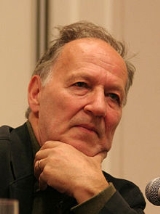
Werner Herzog (born Werner H. Stipetic; 5 September 1942) is an Academy Award-nominated German film director, screenwriter, actor, and opera director.
He is often associated with the German New Wave movement (also called New German Cinema), along with Rainer Werner Fassbinder, Margarethe von Trotta, Volker Schlöndorff, Hans-Jürgen Syberberg, Wim Wenders and others. His films often feature heroes with impossible dreams or people with unique talents in obscure fields.
og was born Werner Stipetic in Munich.

Discussion
Ask a question about 'Werner Herzog'
Start a new discussion about 'Werner Herzog'
Answer questions from other users
|
Recent Posts

Quotations
By dint of declaration the so-called Cinema Verité is devoid of verité. It reaches a merely superficial truth, the truth of accountants.
Film is not analysis, it is the agitation of mind; cinema comes from the country fair and the circus, not from art and academicism.
Filmmakers of Cinema Verité resemble tourists who take pictures amid ancient ruins of facts.
I believe the common denominator of the Universe is not harmony, but chaos, hostility and murder.
"Grizzly Man" (2006)
I like to direct landscapes just as I like to direct actors and animals.
I shouldn't make movies anymore. I should go to a lunatic asylum.

Encyclopedia
Werner Herzog (born Werner H. Stipetic; 5 September 1942) is an Academy Award-nominated German film director, screenwriter, actor, and opera director.
He is often associated with the German New Wave movement (also called New German Cinema), along with Rainer Werner Fassbinder, Margarethe von Trotta, Volker Schlöndorff, Hans-Jürgen Syberberg, Wim Wenders and others. His films often feature heroes with impossible dreams or people with unique talents in obscure fields.
Life
Herzog was born Werner Stipetic in Munich. He adopted his father's name Herzog, which means "duke" in German, when his father returned from a prisoner of war camp after World War II. His family moved to the remote Bavarian village of Sachrang (nested in the Chiemgau Alps), after the house next to theirs was destroyed during the bombing at the close of World War II. When he was 12, he and his family moved back to Munich and shared an apartment with Klaus Kinski in Elisabethstraße in Munich-Schwabing. About this, Herzog recalled, "I knew at that moment that I would be a film director and that I would direct Kinski".
The same year, Herzog was told to sing in front of his class at school and he adamantly refused. He was almost expelled for this and until the age of 18 listened to no music, sang no songs and studied no instruments. He later said that he would easily give 10 years from his life to be able to play an instrument. At 14 he was inspired by an encyclopedia entry about film-making which he says provided him with "everything I needed to get myself started" as a film-maker - that, and the 35 mm camera that the young Herzog stole from the Munich Film School. He studied at the University of Munich despite earning a scholarship to Duquesne University in Pittsburgh, Pennsylvania.
In the early 1960s Herzog worked night shifts as a welder in a steel factory to help fund his first films.
Herzog has been married three times and has three children. In 1967, Herzog married Martje Grohmann, with whom he had a son in 1973, Rudolph Amos Achmed. In 1980 his daughter Hanna Mattes was born to Eva Mattes. In 1987, Herzog married Christine Maria Ebenberger. Their son, Simon Herzog, who currently attends Columbia University, was born in 1989. In 1999 he married Lena Pisetski. They now live in Los Angeles.
Criticism and motifs
Herzog's films have received considerable critical acclaim and achieved popularity on the art house circuit. They have also been the subject of controversy in regard to their themes and messages, especially the circumstances surrounding their creation. A notable example is Fitzcarraldo, in which the obsessiveness of the central character was mirrored by the director during the making of the film. His treatment of subjects has been characterized as Wagnerian in its scope, as Fitzcarraldo and his later film Invincible (2001) are directly inspired by opera, or operatic themes. He is proud of never using storyboards and often improvising large parts of the script, as he explains on the commentary track to Aguirre, The Wrath of God.
One recurring symbol running through Herzog's films is chickens, which Herzog fears. They appear in many of his films. Another recurring symbol in Herzog's films is crabs. They appear in Echoes From a Somber Empire (the migration of the Christmas Island red crab appears in a sequence that describes a dream), Cobra Verde (scavenger crabs infest an abandoned slave fortress), and Invincible (in a dream, crabs are destroyed by an oncoming train).
Career
Besides using movie stars, German, American and otherwise, Herzog is known for using people from the locality in which he is shooting. Especially in his documentaries, he uses locals to benefit his, as he calls it, "ecstatic truth", using footage of them both playing parts and being themselves. Herzog and his films have won and been nominated for many awards over the years. Herzog's first important award was Silver Bear for his first feature film Signs of Life (Nosferatu the Vampyre was also nominated for Golden Bear in 1979). Most notably, Herzog won the best director award for Fitzcarraldo at the 1982 Cannes Film Festival. On the same Festival, but a few years earlier (in 1975) his movie The Enigma of Kaspar Hauser won The Special Price of Jury (also known as 'Silver Palm'). Other films directed by Herzog nominated for Golden Palm are: Woyzeck and Where the green ants dream. His films were also nominated at many other very important festivals all around the world: César Awards (Aguirre, The Wrath of God), Emmy Awards (Little Dieter Needs to Fly), European Film Awards (My Best Fiend) and Venice Film Festival (Scream of Stone and The Wild Blue Yonder).
In 1987 he and his half-brother Lucki Stipetic won the Bavarian Film Awards for Best Producing, for the film Cobra Verde. In 2002 he won the Dragon of Dragons Honorary Award during Cracow Film Festival in Cracow.
Herzog was honored at the 49th San Francisco International Film Festival, receiving the . Four of his films have been shown at the San Francisco International Film Festival throughout the years: in 1990, in 1993, in 1993, and in 2006. Herzog's April 2007 appearance at the Ebertfest in Champaign, IL earned him the Golden Thumb Award, and an engraved glockenspiel given to him by a young film maker inspired by his films. Grizzly Man, directed by Herzog, won the Alfred P. Sloan Prize at the 2005 Sundance Film Festival. Encounters at the End of the World won the award for Best Documentary at the 2008 Edinburgh International Film Festival and was nominated for the Academy Award for Documentary Feature, Herzog's first nomination.
Herzog once promised to eat his shoe if Errol Morris completed the movie project on pet cemeteries that he had been working on, in order to challenge and motivate Morris, whom Herzog perceived as incapable of following up on the projects he conceived. In 1978 when the film Gates of Heaven premiered, Werner Herzog cooked and publicly ate his shoe, an event later incorporated into a short documentary Werner Herzog Eats His Shoe by Les Blank. At the public shoe-eating, Herzog suggested that he hoped the act would serve to encourage anyone having difficulty bringing a project to fruition.
Collaborators
Herzog has a small list of actors who regularly appear in his films, and they are:
- Klaus Kinski: Aguirre, The Wrath of God, Nosferatu, Woyzeck, Fitzcarraldo, and Cobra Verde. In 1999 Herzog directed and narrated the documentary film My Best Fiend, a retrospective on his often rocky relationship with Kinski.
- Bruno S. in The Enigma of Kaspar Hauser and Stroszek
- Brad Dourif in Scream of Stone, The Wild Blue Yonder, Bad Lieutenant: Port of Call New Orleans and also in filming My Son, My Son, What Have Ye Done
- Josef Bierbichler in Heart of Glass and Woyzeck
- Eva Mattes in Woyzeck and Stroszek
- Clemens Scheitz in The Enigma of Kaspar Hauser, Heart of Glass, Stroszek and Nosferatu the Vampyre
- José Lewgoy in Fitzcarraldo and Cobra Verde
- Volker Prechtel in Heart of Glass, Woyzeck and Scream of Stone
- Peter Berling in Aguirre: The Wrath of God and Cobra Verde
Filmography Films
Opera stages
Opera shorts
Further reading
- Paul Cronin. Herzog on Herzog (London: Faber and Faber Ltd., 2002, ISBN 0571207081)
- Werner Herzog. Eroberung des Nutzslosen (Munich: Carl Hanser Verlag, 2004, ISBN 3-446-20457-1)
- ("Conquest of the Useless," Herzog's diaries of the making of Fitzcarraldo -- published in Italian as La Conquista dell'Inutile, English translation in preparation)
- Descheneaux, A. Présence Wagnérienne dans le film Invincible (2001) de Werner Herzog in Canadian University Music Review 24:30–61 n1 2003
- Herzog, Werner. Of Walking in Ice. . 2007.
External links
-
- New Yorker article profiles Herzog on the set of Rescue Dawn
- ArtsEditor.com review of Rescue Dawn
Interviews
- 2008 Interview with Werner Herzog at Screenwize.com
|