
All Topics  
Gulag

 
Gulag

   Email Print
   Bookmark   Link


Gulag


The Gulag was the government agency that administered the penal labor camps of the Soviet Union
Soviet Union

The Union of Soviet Socialist Republics was a Constitution of the Soviet Union socialist state that existed in Eurasia from 1922 to 1991.The name is a translation of the , romanization of Russian Soyuz Sovetskikh Sotsialisticheskikh Respublik, abbreviated ????, SSSR....
. Gulag is the Russian acronym for The Chief Administration of Corrective Labor Camps and Colonies (?????? ?????????? ?????????????-???????? ??????? ? ???????) of the NKVD
NKVD

The NKVD or People's Commissariat for Internal Affairs was the leading secret police organization of the Soviet Union that was responsible for Soviet political repressions during the Stalinism era....
. Eventually, by metonymy
Metonymy

Metonymy is a figure of speech used in rhetoric in which a thing or concept is not called by its own name, but by the name of something intimately associated with that thing or concept....
, the usage of "Gulag" began generally denoting the entire penal labor system in the USSR, then any such penal system.


Discussion
Ask a question about 'Gulag'
Start a new discussion about 'Gulag'
Answer questions from other users
Full Discussion Forum


Encyclopedia


The Gulag was the government agency that administered the penal labor camps of the Soviet Union
Soviet Union

The Union of Soviet Socialist Republics was a Constitution of the Soviet Union socialist state that existed in Eurasia from 1922 to 1991.The name is a translation of the , romanization of Russian Soyuz Sovetskikh Sotsialisticheskikh Respublik, abbreviated ????, SSSR....
. Gulag is the Russian acronym for The Chief Administration of Corrective Labor Camps and Colonies (?????? ?????????? ?????????????-???????? ??????? ? ???????) of the NKVD
NKVD

The NKVD or People's Commissariat for Internal Affairs was the leading secret police organization of the Soviet Union that was responsible for Soviet political repressions during the Stalinism era....
. Eventually, by metonymy
Metonymy

Metonymy is a figure of speech used in rhetoric in which a thing or concept is not called by its own name, but by the name of something intimately associated with that thing or concept....
, the usage of "Gulag" began generally denoting the entire penal labor system in the USSR, then any such penal system. In Russian, Gulag is pronounced: ()

Gulag: A History
Gulag: A History

Gulag: A History, also published as Gulag: A History of the Soviet Camps, is a non-fiction book covering the history of the Soviet Union Gulag system....
, by Anne Applebaum
Anne Applebaum

Anne Elizabeth Applebaum is a journalism and Pulitzer Prize-winning author who has written extensively about Marxism-Leninism and the development of civil society in Central Europe and Eastern Europe....
, explains: "It was the branch of the State Security
NKVD

The NKVD or People's Commissariat for Internal Affairs was the leading secret police organization of the Soviet Union that was responsible for Soviet political repressions during the Stalinism era....
 that operated the penal system of forced labour camps
Labor camp

A labor camp is a simplified detention facility where inmates are forced to engage in penal labor. Labor camps have many common aspects with slavery and with prisons....
 and associated detention and transit camps and prisons. While these camps housed criminals of all types, the Gulag system has become primarily known as a place for political prisoners and as a mechanism for repressing political opposition to the Soviet state
Soviet Union

The Union of Soviet Socialist Republics was a Constitution of the Soviet Union socialist state that existed in Eurasia from 1922 to 1991.The name is a translation of the , romanization of Russian Soyuz Sovetskikh Sotsialisticheskikh Respublik, abbreviated ????, SSSR....
. Though it imprisoned millions, the name became familiar in the West only with the publication of Aleksandr Solzhenitsyn
Aleksandr Solzhenitsyn

Aleksandr Isayevich Solzhenitsyn was a Russians novelist, dramatist and historian. Through his writings, he made the world aware of the Gulag, the Soviet Union's forced labour camp system, and for these efforts Solzhenitsyn was exiled from the Soviet Union in 1974....
's 1973 The Gulag Archipelago
The Gulag Archipelago

The Gulag Archipelago is a book by Aleksandr Solzhenitsyn based on the Soviet forced labor and concentration camp system. The three-volume book is a massive narrative relying on eyewitness testimony and primary research material, as well as the author's own experiences as a prisoner in a GULAG labor camp....
, which likened the scattered camps to a chain of islands."

There were at least 476 separate camps, some of them comprising hundreds, even thousands of camp units. The most infamous complexes were those at arctic or subarctic regions. Today's major industrial cities of the Russian Arctic such as Norilsk
Norilsk

Norilsk is a major types of inhabited localities in Russia in Krasnoyarsk Krai, Russia. It was granted city status in 1953. It is the northernmost city in Siberia and the world's second largest city above the Arctic Circle....
, Vorkuta
Vorkuta

Vorkuta is a coal mining types of inhabited localities in Russia in the Komi Republic, Russia, situated just north of the Arctic circle in the Pechora coal basin at the Usa River river....
, Kolyma
Kolyma

The Kolyma region is located in the far north-eastern area of Russia in what is commonly known as Siberia but is actually part of the Russian Far East....
 and Magadan
Magadan

Magadan is a port types of inhabited localities in Russia on the Sea of Okhotsk and gateway to the Kolyma region. It is the administrative center of Magadan Oblast , in the Russian Far East....
, were camps originally built by prisoners and run by ex-prisoners.

More than 14 million (with some authors like Solzhenitsyn estimating the total at more than 40 million) people passed through the Gulag from 1929 to 1953, with a further 6 to 7 million being deported and exiled
Population transfer in the Soviet Union

Population transfer in the Soviet Union may be classified into the following broad categories: deportations of "anti-Soviet" categories of population, often classified as "enemies of workers", deportations of nationalities, labor force transfer, and organized migrations in opposite directions to fill the ethnic cleansing territories....
 to remote areas of the USSR. According to Soviet data, a total of 1,053,829 people died in the GULAG from 1934 to 1953, not counting those who died in labor colonies. The total population of the camps varied from 510,307 (in 1934) to 1,727,970 (in 1953).. These figures however differ greatly from the most conservative figures presented by historians, who estimate the number of camp victims to be higher than 10 million or even higher than 20 million. The death toll at Kolyma
Kolyma

The Kolyma region is located in the far north-eastern area of Russia in what is commonly known as Siberia but is actually part of the Russian Far East....
 alone is estimated to be between 250 thousand and 1 million . Accordingly also the number of Gulag prisoners is generally considered to be much higher than the number presented by the Soviet secret police, reaching at least 6 million people at its height

Most Gulag inmates were not political prisoners, although the political prisoner population was always significant. People could be imprisoned in a Gulag camp for crimes such as unexcused absences from work, petty theft, or anti-government jokes. About half of the political prisoners were sent to Gulag prison camps without trial
By administrative means

By administrative means was an expression in use in the Soviet Union applied to the cases when some actions that normally required a court decision were left to the decision of executive bodies ....
; per official data, there were more than 2.6 million imprisonment sentences in cases investigated by the secret police, 1921-1953. While the Gulag was radically reduced in size following Stalin
Joseph Stalin

Joseph Stalin was the General Secretary of the Communist Party of the Soviet Union's Central Committee of the Communist Party of the Soviet Union from 1922 until his death in 1953....
’s death in 1953, forced labor camps and political prisoners continued to exist in the Soviet Union right up to the Gorbachev
Mikhail Gorbachev

Mikhail Sergeyevich Gorbachev is a Russian politician. He was the last General Secretary of the Communist Party of the Soviet Union, serving from 1985 until 1991, and also the last head of state of the USSR, serving from 1988 until its collapse in 1991....
 era. However, the camps in Siberia
Siberia

Siberia , is the name given to the vast region constituting almost all of North Asia and for the most part currently serving as the massive central and eastern portion of the Russian Federation, having served in the same capacity previously for the Soviet Union from its beginning, and the Russian Empire beginning in the 16th century....
 still house a labour force of about a million prisoners.

Modern usage and other terminology

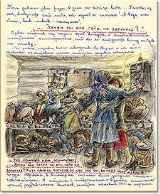
Kersnovskaya Entering Camp5 54
Although Gulag originally was the name of a government agency, the acronym acquired the qualities of a noun, denoting: the Soviet system of prison
Prison

A prison, penitentiary, or correctional facility is a place in which individuals are physically confined or internment and usually deprived of a range of personal Freedom ....
-based, unfree labor
— including specific labor, punishment, criminal, political, and transit camps for men, women, and children.

Even more broadly, "Gulag" has come to mean the Soviet repressive system itself, the set of procedures that prisoners once called the "meat-grinder": the arrests, the interrogations, the transport in unheated cattle cars, the forced labor, the destruction of families, the years spent in exile, the early and unnecessary deaths.
Other authors use gulag as denoting all the prisons and internment camps in Soviet history (1917–1991) with the plural gulags. The term's contemporary usage is notably unrelated to the USSR, such as in the expression "North Korea
North Korea

North Korea, officially the Democratic People's Republic of Korea , is a state in East Asia, occupying the northern half of the Korean Peninsula....
's Gulag".

The word Gulag was not often used in Russian — either officially or colloquially; the predominant terms were the camps and the zone , always singular — for the labor camp system and for the individual camps. The official term, "corrective labor camp", was suggested for official politburo
Politburo

Politburo, short for Political Bureau, Russian language Politicheskoye Buro, is the executive organization for a number of political parties, most notably those of Communist Party....
 of the Communist Party of the Soviet Union
Communist Party of the Soviet Union

The Communist Party of the Soviet Union was the ruling political party in the Soviet Union and one of the largest Communist Party in the world....
 use in the session of July 27, 1929.

History


Early Soviet period

Gpu
From 1918, camp-type detention facilities were set up, as a reformed analogy of the earlier system of penal labor (katorga
Katorga

Katorga was the precursor to the Gulag system. It was a system of penal servitude of the prison farm type in Imperial Russia. Prisoners were sent to remote camps in vast uninhabited areas of Siberia—where voluntary labourers were never available in satisfactory numbers—and forced to perform hard manual labour....
s
), operated in Siberia
Siberia

Siberia , is the name given to the vast region constituting almost all of North Asia and for the most part currently serving as the massive central and eastern portion of the Russian Federation, having served in the same capacity previously for the Soviet Union from its beginning, and the Russian Empire beginning in the 16th century....
 in Imperial Russia. The two main types were "Vechecka Special-purpose Camps" and forced labor camps . They were installed for various categories of people deemed dangerous for the state: for common criminals, for prisoners of the Russian Civil War
Russian Civil War

The Russian Civil War was a multi-party war that occurred within the former Russian Empire after the Russian provisional government collapsed and the Bolshevik party assumed power in Saint Petersburg....
, for officials accused of corruption, sabotage and embezzlement, various political enemies and dissidents, as well as former aristocrats, businessmen and large land owners. These camps, however, were not on the same scale as those in the Stalin era. In 1928 there were 30,000 prisoners in camps, and the authorities were opposed to compelling them to work. In 1927 the official in charge of prison administration wrote that: "The exploitation of prison labour, the system of squeezing ‘golden sweat’ from them, the organisation of production in places of confinement, which while profitable from a commercial point of view is fundamentally lacking in corrective significance – these are entirely inadmissible in Soviet places of confinement.”

The legal base and the guidance for the creation of the system of "corrective labor camps" , the backbone of what is commonly referred to as the "Gulag", was a secret decree of Sovnarkom of July 11 1929 about the use of penal labor that duplicated the corresponding appendix to the minutes of Politburo
Politburo

Politburo, short for Political Bureau, Russian language Politicheskoye Buro, is the executive organization for a number of political parties, most notably those of Communist Party....
 meeting of June 27, 1929.

As an all-Union
Soviet Union

The Union of Soviet Socialist Republics was a Constitution of the Soviet Union socialist state that existed in Eurasia from 1922 to 1991.The name is a translation of the , romanization of Russian Soyuz Sovetskikh Sotsialisticheskikh Respublik, abbreviated ????, SSSR....
 institution and a main administration with the OGPU (the Soviet secret police
Secret police

Secret police are a police agency which operates in secrecy to maintain national security against internal threats to the state.Secret police forces are typically associated with totalitarianism regimes, as they are often used to maintain the political power of the state rather than uphold the rule of law....
), the GULAG was officially established on April 25, 1930 as the "ULAG" by the OGPU order 130/63 in accordance with the Sovnarkom order 22 p. 248 dated April 7, 1930, and was renamed into GULAG in November.

Expansion under Stalin

Belomorkanal
In the early 1930s a drastic tightening of Soviet penal policy caused a significant growth of the prison camp population. During the period of the Great Purge
Great Purge

Great Purge was a series of campaigns of political repression and persecution in the Soviet Union orchestrated by Joseph Stalin in 1936-1938. Also described as a "Soviet holocaust" by several authors, it involved the purge of the Communist Party of the Soviet Union, repression of kulaks, Red Army leadership, and the persecution of unaffiliat...
 (1937–38) mass arrests caused another upsurge in inmate numbers. During these years hundreds of thousands of individuals were arrested and sentenced to long prison terms on the grounds of one of the multiple passages of the notorious Article 58 of the Criminal Codes of the Union republics, which defined punishment for various forms of "counterrevolutionary activities."

Under NKVD Order ? 00447
NKVD Order ? 00447

NKVD Order ? 00447 by July 30, 1937 ? ??????????????? ?????? ???????, ??????????? ? ?????? ????????????? ????????? O repressirovanii byvshikh kulakov, ugolovnikov i drugikh antisovyetskikh elementov undersigned by Nikolai Yezhov and approved by Politburo of the CPSU Central Committee during the Great Purge....
 tens of thousands of GULAG inmates who were accused of "continuing anti-Soviet activity in imprisonment" were executed in 1937-38.

The hypothesis that economic considerations were responsible for mass arrests during the period of Stalinism has been refuted on the grounds of former Soviet archives that have become accessible since the 1990s, although some archival sources also tend to support an economic hypothesis. In any case the development of the camp system followed economic lines. The growth of the camp system coincided with the peak of the Soviet industrialization
Industrialization

Industrialization is the process of social and economic change whereby a human group is transformed from a pre-industrial society into an industry one....
 campaign. Most of the camps established to accommodate the masses of incoming prisoners were assigned distinct economic tasks. These included the exploitation of natural resources and the colonization of remote areas as well as the realization of enormous infrastructural facilities and industrial construction projects.

In 1931–32 the Gulag had approximately 200,000 prisoners in the camps; in 1935 — approximately 800,000 in camps and 300,000 in colonies (annual averages), and in 1939 — about 1.3 millions in camps and 350,000 in colonies. . All data about the numbers of prisoners here and below are however taken from documents produced by the NKVD
NKVD

The NKVD or People's Commissariat for Internal Affairs was the leading secret police organization of the Soviet Union that was responsible for Soviet political repressions during the Stalinism era....
) and are significantly lower than estimates made by historians

GULAG during World War II

After the German invasion of Poland
Invasion of Poland (1939)

The Invasion of Poland in 1939 precipitated World War II. It was carried out by Nazi Germany, the Soviet Union, and a small Slovak invasion of Poland contingent....
 that marked the start of World War II
World War II

World War II, or the Second World War , was a global military conflict which involved a Participants in World War II, including all of the great powers, organised into two opposing military alliances: the Allies of World War II and the Axis powers....
 in 1939, the Soviet Union invaded and annexed eastern parts
Soviet invasion of Poland (1939)

The 1939 Soviet invasion of Poland was a military operation that started without a formal declaration of war on 17 September 1939, during the early stages of World War II, sixteen days after the beginning of the Nazi Germany invasion of Poland ....
 of the Second Polish Republic
Second Polish Republic

The Second Polish Republic, Second Commonwealth of Poland or interwar Poland is the Republic of Poland between World War I and World War II....
. In 1940 the Soviet Union occupied Estonia
Estonia

Estonia , officially the Republic of Estonia is a country in the Baltic region of Northern Europe. It is bordered to the north by Finland across the Gulf of Finland, to the west by Sweden across the Baltic Sea, to the south by Latvia , and to the east by the Russia ....
, Latvia
Latvia

Latvia The Latvians are a Baltic peoples culturally related to the Estonians and Lithuanians, with the Latvian language having many similarities with Lithuanian language, but not with the Estonian language....
, Lithuania
Lithuania

Lithuania , officially the Republic of Lithuania is a country in Northern Europe, the southernmost of the three Baltic states. Situated along the southeastern shore of the Baltic Sea, it shares borders with Latvia to the north, Belarus to the southeast, Poland, and the Russian exclave of Kaliningrad Oblast to the southwest....
, Bessarabia
Bessarabia

Bessarabia is a historical term for the geographic entity in Eastern Europe bounded by the Dniester River on the east and the Prut River on the west....
 and Bukovina
Bukovina

Bukovina is a historical region on the northern slopes of the northeastern Carpathian Mountains and the adjoining plains. It is currently split between Romania and Ukraine....
. Hundreds of thousands of Polish citizens and inhabitants of the other annexed lands, regardless of their ethnic origin, were arrested and sent to the GULAG camps.

Approximately 300,000 Polish prisoners of war
Polish prisoners of war in the Soviet Union (after 1939)

As a result of the Soviet invasion of Poland , hundreds of thousands of Polish soldiers became prisoners of war in the Soviet Union. Thousands of them were executed; over 20,000 Polish military personnel and civilians perished in the Katyn massacre....
 were captured by the USSR during and after the Polish Defensive War
Soviet invasion of Poland (1939)

The 1939 Soviet invasion of Poland was a military operation that started without a formal declaration of war on 17 September 1939, during the early stages of World War II, sixteen days after the beginning of the Nazi Germany invasion of Poland ....
. Almost all of the captured officers and a large number of ordinary soldiers were then murdered (see Katyn massacre
Katyn massacre

The Katyn massacre, also known as the Katyn Forest massacre , was a mass murder of thousands of Poles military officers, policemen, intellectuals and civilian pow by Soviet NKVD, based on a proposal from Lavrentiy Beria to execute all members of the Polish Officer Corps dated March 5 1940....
) or sent to GULAG. Of the 10,000-12,000 Poles sent to Kolyma
Kolyma

The Kolyma region is located in the far north-eastern area of Russia in what is commonly known as Siberia but is actually part of the Russian Far East....
 in 1940-1941, most POWs, only 583 men survived, released in 1942 to join the Polish Armed Forces in the East
Polish Armed Forces in the East

Polish Armed Forces in the East refers to Military of Poland created in the Soviet Union at the time when the territory of Poland was occupied by both Nazi Germany and the Soviet Union in the Second World War....
. Out of Anders
Wladyslaw Anders

Lieutenant-General Wladyslaw Anders CB was a General in the Poland Army and later in life a politician with the Polish government-in-exile in London....
' 80,000 evacuees from Soviet Union gathered in Great Britain only 310 volunteered to return to Soviet-controlled Poland in 1947.

According to the official data, the total number of sentences for political crimes in USSR in 1939-41 was 211,106. During the war, Gulag populations declined sharply, as a consequence of the mass releases of hundreds of thousands of prisoners who were conscripted and sent directly to the front lines and a steep rise in mortality in 1942–43. In the winter of 1941 a quarter of the Gulag's population died of starvation
Starvation

Starvation is a severe reduction in vitamin, nutrient, and energy intake, and is the most extreme form of malnutrition. In humans, prolonged starvation causes permanent organ damage and, eventually, death....
. 516,841 prisoners died in prison camps in 1941-43.

In 1943, the term katorga works (????????? ??????) was reintroduced. They were initially intended for Nazi collaborators
Collaboration during World War II

During World War II Nazi Germany occupied all or parts of the following countries: Poland, Denmark, Norway, Luxembourg, Belgium, the Netherlands, Vichy France, Yugoslavia, Greece, the Soviet Union, Lithuania, Latvia, Estonia, Egypt and Italy....
, but then other categories of political prisoners (for example, members of deported peoples
Population transfer in the Soviet Union

Population transfer in the Soviet Union may be classified into the following broad categories: deportations of "anti-Soviet" categories of population, often classified as "enemies of workers", deportations of nationalities, labor force transfer, and organized migrations in opposite directions to fill the ethnic cleansing territories....
 who fled from exile) were also sentenced to "katorga works". Prisoners sentenced to "katorga works" were sent to Gulag prison camps with the most harsh regime and many of them perished. Other gulag inmates were sentenced to Red Army penal battalions, where they performed extremely hazardous duties such as spearheading Russian offensives, often serving as tramplers, persons who marched or ran over German minefields to clear them for successive Red Army infantry formations.

A total of 427,910 served in penal units from September 1942 to May 1945. These totals should be viewed in comparison to the nearly 34.5 million men and women who served in the Soviet armed forces during the entire period of the war.

GULAG after World War II


After World War II the number of inmates in prison camps and colonies again rose sharply, reaching approximately 2.5 million people by the early 1950s (about 1.7 million of whom were in camps).

When the war ended in May 1945, as many as two million former Russian citizens were forcefully repatriated (against their will) into the USSR.
Operation Keelhaul

Operation Keelhaul was a programme carried out in Northern Italy by United Kingdom and United States forces to repatriate Russian captives to the Soviet Union between August 14, 1946 and May 9, 1947....
 On 11 February 1945, at the conclusion of the Yalta Conference
Yalta Conference

The Yalta Conference, sometimes called the Crimea Conference and Code name the Argonaut Conference, was the wartime meeting from 4 February 1945 to 11 February 1945 among the heads of government of the United States, the United Kingdom, and the Soviet Union?President of the United States Franklin D....
, the United States
United States

The United States of America is a Federal government constitutional republic comprising U.S. state and a federal district. The country is situated mostly in central North America, where its Contiguous United States and Washington, D.C., the Capital districts and territories, lie between the Pacific Ocean and Atlantic Oceans, Borders of the U...
 and United Kingdom
United Kingdom

The United Kingdom of Great Britain and Northern Ireland, commonly known as the United Kingdom , the UK or Britain,is a sovereign state located off the northwestern coast of continental Europe....
 signed a Repatriation Agreement with the Soviet Union. One interpretation of this agreement resulted in the forcible repatriation of all Soviets. British
United Kingdom

The United Kingdom of Great Britain and Northern Ireland, commonly known as the United Kingdom , the UK or Britain,is a sovereign state located off the northwestern coast of continental Europe....
 and U.S. civilian authorities ordered their military forces in Europe to deport to the Soviet Union
Soviet Union

The Union of Soviet Socialist Republics was a Constitution of the Soviet Union socialist state that existed in Eurasia from 1922 to 1991.The name is a translation of the , romanization of Russian Soyuz Sovetskikh Sotsialisticheskikh Respublik, abbreviated ????, SSSR....
 up to two million former residents of the Soviet Union, including persons who had left Russia and established different citizenship years before. The forced repatriation operations took place from 1945-1947.

Often, one finds statements that Soviet POW
Nazi crimes against Soviet POWs

The Nazi crimes against Soviet Prisoners of War relates to the genocide policies taken towards the captured soldiers of the Soviet Union by Nazi Germany....
s on their return to the Soviet Union were often treated as traitors (see Order No. 270). According to some sources, over 1.5 million surviving Red Army
Red Army

The Red Army was the armed force first organized by the Bolsheviks during the Russian Civil War in 1918 and, in 1922, became the army of the Soviet Union....
 soldiers imprisoned by the Germans were sent to the Gulag. However, that is a confusion with two other types of camps. During and after World War II freed PoWs went to special "filtration" camps. Of these, by 1944, more than 90 per cent were cleared, and about 8 per cent were arrested or condemned to penal battalions. In 1944, they were sent directly to reserve military formations to be cleared by the NKVD. Further, in 1945, about 100 filtration camps were set for repatriated Ostarbeiter, PoWs, and other displaced persons, which processed more than 4,000,000 people. By 1946, 80 per cent civilians and 20 per cent of PoWs were freed, 5 per cent of civilians, and 43 per cent of PoWs re-drafted, 10 per cent of civilians and 22 per cent of PoWs were sent to labor battalions, and 2 per cent of civilians and 15 per cent of the PoWs (226,127 out of 1,539,475 total) transferred to the NKVD, i.e. the Gulag.

The Soviets took over former German camps such as the Sachsenhausen concentration camp
Sachsenhausen concentration camp

Sachsenhausen was a concentration camp in Germany, operating between 1936 and 1945. It was named after the Sachsenhausen quarter, part of the town of Oranienburg....
 in which 12,500 Soviet era victims have been uncovered. According to German government estimates "65,000 people died in those Soviet-run camps or in transportation to them." According to German researchers Sachsenhausen should be seen as an integral part of the Gulag system.

For years after World War II, a significant minority of the inmates were Ukrainians
Ukrainians

Ukrainians are an East Slavs ethnic group primarily living in Ukraine, or more broadly?citizens of Ukraine . Some 200 years ago and times prior to that, Ukrainians were usually referred to and known as Rusyny ....
, Belarusians
Belarusians

Belarusians or Belorussians are an East Slavs ethnic group who populate the majority of the Belarus and form minorities in neighboring Poland , Russia, Lithuania and Ukraine....
, Lithuanians
Lithuanians

Lithuanians are the Balts ethnic group native to Lithuania, where they number a little over 3 million people. Another million or more make up the Lithuanian diaspora, largely found in countries such as the United States, Brazil, Canada, Colombia, Russia, United Kingdom and Ireland....
, Latvians
Latvians

Latvians , the indigenous Balts people of Latvia, occasionally refer to themselves by the ancient name of Latvji, which may have originated from the word Latve which is a name of the river that presumably flowed through what is now eastern Latvia....
 and Estonians
Estonians

Estonians are a Finnic people closely related to the Finns and inhabiting, primarily, the country of Estonia. The Estonians speak a Finno-Ugric languages language, known as Estonian....
 from lands newly incorporated into the Soviet Union, as well as Finn
Finnish people

The terms Finns and Finnish people are used in English to mean "a native or inhabitant of Finland". They are also used to refer to the ethnic group historically associated with Finland or Fennoscandia, and they are only used in that sense here....
s, Poles
Poles

The Polish people, or Poles , are a West Slavs ethnic group of Central Europe, living predominantly in Poland. Poles are sometimes defined as people who share a common Polish culture and are of Polish descent....
, Romania
Romania

Romania is a country located in Southeastern Europe Central Europe, North of the Balkan Peninsula, on the Lower Danube, within and outside the Carpathian Mountains, bordering on the Black Sea....
ns and others. POWs, in contrast, were kept in a separate camp system (see POW labor in the Soviet Union
POW labor in the Soviet Union

Systematic POW labor in the Soviet Union is associated primarily with the outcomes of the World War II and covers the period of 1939-1956.This form of forced labor was handled by the Chief Directorate for Prisoners of War and Internees Affairs of the NKVD, established in 1939 according to the NKVD Order no....
), which was managed by GUPVI, a separate main administration with the NKVD
NKVD

The NKVD or People's Commissariat for Internal Affairs was the leading secret police organization of the Soviet Union that was responsible for Soviet political repressions during the Stalinism era....
/MVD.

Yet the major reason for the post-war increase in the number of prisoners was the tightening of legislation on property offences in summer 1947 (at this time there was a famine in some parts of the Soviet Union, claiming about 1 million lives), which resulted in hundreds of thousands of convictions to lengthy prison terms, sometimes on the basis of cases of petty theft or embezzlement. At the beginning of 1953 the total number of prisoners in prison camps was more than 2.4 million of which more than 465 thousand were political prisoners.

The state continued to maintain the extensive camp system for a while after Stalin's death in March 1953, although the period saw the grip of the camp authorities weaken and a number of conflicts and uprisings occur (see Bitch Wars
Bitch Wars

The Bitch Wars or Suka Wars occurred within the Soviet Gulag between 1945 and around the death of Joseph Stalin in 1953.The Russian word suka has a stronger negative connotation than its English equivalent....
; Kengir uprising
Kengir uprising

The Kengir uprising was a prisoner uprising that took place in the Soviet Union prison labor camp Kengir in May and June 1954. Its duration and intensity distinguished it from other Gulag uprisings in the same period ....
; Vorkuta uprising
Vorkuta Uprising

The Vorkuta Uprising was a major uprising of the concentration camp inmates in Vorkuta in July?August 1953, shortly after the arrest of Lavrentiy Beria....
).

The amnesty
Amnesty

Amnesty is a legislative or executive act by which a state restores those who may have been guilty of an offense against it to the positions of innocent persons....
 in March 1953 was limited to non-political prisoners and for political prisoners sentenced to not more than 5 years, therefore mostly those convicted for common crimes were then freed. The release of political prisoners started in 1954 and became widespread, and also coupled with mass rehabilitation
Rehabilitation (Soviet)

Rehabilitation in the context of the former Soviet Union, and the Post-Soviet states, was the restoration of a person who was criminally prosecuted without due basis, to the state of acquittal or being "not guilty"....
s, after Nikita Khrushchev
Nikita Khrushchev

Nikita Sergeyevich Khrushchev served as General Secretary of the Communist Party of the Soviet Union of the Communist Party of the Soviet Union from 1953 to 1964, following the death of Joseph Stalin, and Premier of the Soviet Union from 1958 to 1964....
's denunciation of Stalinism
Stalinism

File:Joseph Stalin.jpgStalinism is a term that purportedly describes the political system of the Soviet Union under the leadership of Joseph Stalin, leader of the Soviet Union from 1929?1953....
 in his Secret Speech at the 20th Congress of the CPSU
Communist Party of the Soviet Union

The Communist Party of the Soviet Union was the ruling political party in the Soviet Union and one of the largest Communist Party in the world....
 in February 1956.

By the end of the 1950s, virtually all "corrective labor camps" were dissolved. Colonies, however, continued to exist. Officially the GULAG was liquidated by the MVD order 20 of January 25, 1960.

Conditions

Living and working conditions in the camps varied significantly across time and place, depending, among other things, on the impact of broader events (World War II
World War II

World War II, or the Second World War , was a global military conflict which involved a Participants in World War II, including all of the great powers, organised into two opposing military alliances: the Allies of World War II and the Axis powers....
, countrywide famines and shortages, waves of terror, sudden influx or release of large numbers of prisoners). However, to one degree or another, the large majority of prisoners at most times faced meagre food rations, inadequate clothing, overcrowding, poorly insulated housing; poor hygiene, and insufficient or inadequate health care. The overwhelming majority of prisoners were compelled to perform harsh physical labor. In most periods and economic branches, the degree of mechanization of work processes was significantly lower than in the civilian industry: tools were often primitive and machinery, if existent, short in supply. Officially established work hours were in most periods longer and days off were fewer than for civilian workers. Often official work time regulations were extended by local camp administrators.

In general, the central administrative bodies showed a discernible interest in maintaining the labor force of prisoners in a condition allowing the fulfillment of construction and production plans handed down from above. Besides a wide array of punishments for prisoners refusing to work (which, in practice, were sometimes applied to prisoners that were too enfeebled to meet production quota), they instituted a number of positive incentives intended to boost productivity. These included monetary bonuses (since the early 1930s) and wage payments (from 1950 onwards), cuts of sentences on an individual basis, general early release schemes for norm fulfillment and overfulfillment (until 1939, again in selected camps from 1946 onwards), preferential treatment and privileges for the most productive workers (shock workers
Udarnik

Udarnik is a Russian term for a superproductive worker in the Soviet Union. The term is derived from the expression "udarnyi trud" for "superproductive, enthusiastic labour", which is often translated as strike labour , and udarnik as strike worker, accordingly....
 or Stakhanovite
Stakhanovite

In Soviet Union history and iconography, a Stakhanovite follows the example of Aleksei Grigorievich Stakhanov, employing hard work or Scientific management efficiencies to over-achieve on the job....
s in Soviet parlance).

A distinctive incentive scheme that included both coercive and motivational elements and was applied universally in all camps consisted in standardized "nourishment scales": the size of the inmates’ ration depended on the percentage of the work quota delivered. Naftaly Frenkel
Naftaly Frenkel

Naftaly Aronovich Frenkel was a Soviet Union citizen and Chekist . Frenkel is best known for his role in the organisation of work in the Gulag, starting from the forced labor camp of the Solovetsky Islands, which is recognised as one of the earliest sites of the Gulag....
 is credited for the introduction of this policy. While it was effective in compelling many prisoners to make serious work efforts, for many a prisoner it had the adverse effect, accelerating the exhaustion and sometimes causing the death of persons unable to fulfill high production quota.

Immediately after the German attack on the Soviet Union
Operation Barbarossa

Operation Barbarossa was the code name for Nazi Germany's invasion of the Soviet Union during World War II that commenced on 22 June 1941. Over 4.5 million troops of the Axis powers invaded the USSR along a 2,900 kilometer front ....
 in June 1941 the conditions in camps worsened drastically: quotas were increased, rations cut, and medical supplies came close to none, all of which led to a sharp increase in mortality. The situation slowly improved in the final period and after the end of the war.

Considering the overall conditions and their influence on inmates, it is important to distinguish three major strata of Gulag inmates:
  • people used to physical labor: "kulak
    Kulak

    Kulaks were a category of relatively affluent and well-endowed peasants in the later Russian Empire, Soviet Russia, and early Soviet Union. The word kulak originally referred to independent farmers in the Russian Empire who emerged as a result of the Stolypin reform which began in 1906....
    s", osadnik
    Osadnik

    Osadniks was the Polish loanword used in Soviet Union for veterans of the Polish Army that were given land in the Kresy territory ceded to Poland by Polish-Soviet Riga Peace Treaty of 1921 ....
    s, "ukazniks" (people sentenced for violation of various ukase
    Ukase

    Ukase in Imperial Russia was a proclamation of the tsar, government, or a religious leader that had the force of law. Adequate translations are "edict" or "decree" of Roman law....
    s, such as Law of Spikelets
    Law of Spikelets

    Law of Spikelets was a common name of the law based on the decree of Supreme Soviet and Sovnarkom of the USSR "About protection of the property of state enterprises, kolkhozes and cooperatives, and strengthening of the public property" dated August 7, 1932....
    , decree about work discipline, etc.), occasional violators of criminal law
    Criminal law

    The term criminal law, sometimes called penal law, refers to any of various bodies of rules in different jurisdictions whose common characteristic is the potential for unique and often severe impositions as punishment for failure to comply....
  • dedicated criminals
  • people unused to physical labour sentenced for various political and religious reasons.


Mortality in GULAG camps in 1934-40 was 4-6 times higher than average in Russia. The estimated total number of those who died in imprisonment in 1930-1953 is 1.76 million, about half of which occurred between 1941-1943 following the German invasion.

Geography

Ru200008020027
In the early days of Gulag, the locations for the camps were chosen primarily for the ease of isolation of prisoners. Remote monasteries in particular were frequently reused as sites for new camps. The site on the Solovetsky Islands
Solovetsky Islands

The Solovetsky Islands are located in the Onega Bay of the White Sea, Russia. The islands are Arkhangelsk Oblast as Solovetsky District and are served by the Solovki Airport....
 in the White Sea
White Sea

The White Sea is an inlet of the Barents Sea on the northwest coast of Russia. It is surrounded by Karelia to the west, the Kola peninsula to the north, and the Kanin Peninsula to the northeast....
 is one of the earliest and also most noteworthy, taking root soon after the Revolution in 1918. The colloquial name for the islands, "Solovki
Solovki

The Solovki prison camp was located on the Solovetsky Islands, in the White Sea). It was the "mother of the GULAG" according to Aleksandr Solzhenitsyn....
", entered the vernacular
Vernacular

Vernacular refers to the native language of a country or a locality. In general linguistics, it is used to describe local languages as opposed to Lingua franca, official standards or global languages....
 as a synonym
Synonym

Synonyms are different words with identical or very similar meanings. Words that are synonyms are said to be synonymous, and the state of being a synonym is called synonymy....
 for the labour camp in general. It was being presented to the world as an example of the new Soviet way of "re-education of class enemies" and reintegrating them through labour into the Soviet society. Initially the inmates, the significant part being Russian intelligentsia
Intelligentsia

The intelligentsia is a social class of people engaged in complex mental and creative labor directed to the development and dissemination of culture, encompassing intellectuals and social groups close to them ....
, enjoyed relative freedom (within the natural confinement of the islands). Local newspapers and magazines were edited and even some scientific research was carried out (e.g., a local botanical garden was maintained, but unfortunately later lost completely). Eventually it turned into an ordinary Gulag camp; in fact some historians maintain that Solovki was a pilot camp of this type. See Solovki
Solovki

The Solovki prison camp was located on the Solovetsky Islands, in the White Sea). It was the "mother of the GULAG" according to Aleksandr Solzhenitsyn....
 for more detail. Maxim Gorky
Maxim Gorky

Aleksey Maksimovich Peshkov , better known as Maxim Gorky , was a Russian/Soviet Union author, a founder of the socialist realism literary method and a political activist....
 visited the camp in 1929 and published an apology of it.

With the new emphasis on Gulag as the means of concentrating cheap labour, new camps were then constructed throughout the Soviet sphere of influence, wherever the economic task at hand dictated their existence (or was designed specifically to avail itself of them, such as Belomorkanal
White Sea-Baltic Canal

The White Sea-Baltic Sea Canal , often abbreviated to White Sea Canal is a ship canal in Russia opened on 2 August 1933. It connects the White Sea with the Baltic Sea, near to Saint Petersburg....
 or Baikal Amur Mainline
Baikal Amur Mainline

|}|}|}|}|}|}|}|}|}|}|}|}|}|}The Russian gauge Baikal-Amur Mainline is a railway line in Russia. Traversing Eastern Siberia and the Russian Far East, the 4,324 km long BAM runs about 610 to 770 km north of and parallel to the Trans-Siberian railway....
), including facilities in big cities — parts of the famous Moscow Metro
Moscow Metro

The Moscow Metro , which spans almost the entire Moscow, is the world's Metro systems by annual passenger rides rapid-transit system. Opened in 1935, it is well known for the ornate design of many of its metro station, which contain outstanding examples of socialist realism art....
 and the Moscow State University
Moscow State University

M. V. Lomonosov Moscow State University , for a time the Lomonosov University , is the largest university in Russia. Founded in 1755, it also claims to be the oldest university in Russia....
 new campus were built by forced labour. Many more projects during the rapid industrialization of the 1930s, war-time
World War II

World War II, or the Second World War , was a global military conflict which involved a Participants in World War II, including all of the great powers, organised into two opposing military alliances: the Allies of World War II and the Axis powers....
 and post-war periods were fulfilled on the backs of convicts, and the activity of Gulag camps spanned a wide cross-section of Soviet industry.

The majority of Gulag camps were positioned in extremely remote areas of north-eastern Siberia (the best known clusters are Sevvostlag
Sevvostlag

Sevvostlag was a system of forced labor camps set up to satisfy the workforce requirements of the Dalstroy construction trust in the Kolyma region in April 1932....
 (The North-East Camps) along Kolyma
Kolyma

The Kolyma region is located in the far north-eastern area of Russia in what is commonly known as Siberia but is actually part of the Russian Far East....
 river and Norillag
Norillag

Norillag, Norilsk Corrective Labor Camp was a gulag labor camp set by Norilsk, Krasnoyarsk Krai, Russia and headquartered there. It existed from June 25, 1935 to August 22, 1956....
 near Norilsk
Norilsk

Norilsk is a major types of inhabited localities in Russia in Krasnoyarsk Krai, Russia. It was granted city status in 1953. It is the northernmost city in Siberia and the world's second largest city above the Arctic Circle....
) and in the south-eastern parts of the Soviet Union, mainly in the steppe
Steppe

In physical geography, a steppe , pronounced , is a grassland plain without trees . The prairie can be considered a steppe. It may be semi-desert, or covered with Poaceae or shrubs or both, depending on the season and latitude....
s of Kazakhstan
Kazakhstan

Kazakhstan, also Kazakstan , officially the Republic of Kazakhstan, is a large Eurasian country in Central Asia and Eastern Europe. Ranked as the List of countries by area as well as the world's largest landlocked country, it has a territory of 2,727,300 km? ....
 (Luglag, Steplag, Peschanlag). These were vast and sparsely inhabited regions with no roads (in fact, the construction of the roads themselves was assigned to the inmates of specialized railroad camps) or sources of food, but rich in minerals and other natural resources (such as timber). However, camps were generally spread throughout the entire Soviet Union
Soviet Union

The Union of Soviet Socialist Republics was a Constitution of the Soviet Union socialist state that existed in Eurasia from 1922 to 1991.The name is a translation of the , romanization of Russian Soyuz Sovetskikh Sotsialisticheskikh Respublik, abbreviated ????, SSSR....
, including the European parts of Russia
Russia

Russia , or the Russian Federation , is a list of countries spanning more than one continent country extending over much of northern Eurasia....
, Byelorussia
Belarus

Belarus is a landlocked country in Eastern Europe, bordered by Russia to the north and east, Ukraine to the south, Poland to the west, and Lithuania and Latvia to the north....
, and Ukraine
Ukraine

Ukraine is a country in Eastern Europe. It is bordered by Russia to the east; Belarus to the north; Poland, Slovakia, and Hungary to the west; Romania and Moldova to the southwest; and the Black Sea and Sea of Azov to the south....
. There were also several camps located outside of the Soviet Union, in Czechoslovakia
Czechoslovakia

Czechoslovakia was a sovereign state in Central Europe that existed from October 1918 until 1992 . On January 1, 1993, Czechoslovakia dissolution of Czechoslovakia into the Czech Republic and Slovakia....
, Hungary
Hungary

Hungary , officially in English the Republic of Hungary , is a landlocked country in the Carpathian Basin of Central Europe, bordered by Austria, Slovakia, Ukraine, Romania, Serbia, Croatia, and Slovenia....
, Poland
Poland

Poland , officially the Republic of Poland , is a country in Central Europe. Poland is bordered by Germany to the west; the Czech Republic and Slovakia to the south; Ukraine, Belarus and Lithuania to the east; and the Baltic Sea and Kaliningrad Oblast, a Russian Enclave and exclave, to the north....
, and Mongolia
Mongolia

Mongolia is a landlocked country in East Asia and Central Asia. It borders Russia to the north and People's Republic of China to the south, east and west....
, which were under the direct control of the Gulag.

Not all camps were fortified; in fact some in Siberia were marked only by posts. Escape was deterred by the harsh elements, as well as tracking dogs that were assigned to each camp. While during the 1920s and 1930s native tribes often aided escapees, many of the tribes were also victimized by escaped thieves. Tantalized by large rewards as well, they began aiding authorities in the capture of Gulag inmates. Camp guards were also given stern incentive to keep their inmates in line at all costs; if a prisoner escaped under a guard's watch, the guard would often be stripped of his uniform and become a Gulag inmate himself. Further, if an escaping prisoner was shot, guards could be fined amounts that were often equivalent to one or two weeks wages.

In some cases, teams of inmates were dropped to a new territory with a limited supply of resources and left to set up a new camp or die. Sometimes it took several attempts before the next wave of colonists could survive the elements.

The area along the Indigirka river
Indigirka River

Indigirka River is a river in the Sakha Republic in Russia. It is 1,726 km in length. The area of its drainage basin is 360,000 km?. The river flows into the Kolyma Bay, East Siberian Sea....
 was known as the Gulag inside the Gulag. In 1926, the Oimiakon (???????) village in this region registered the record low temperature of −71.2 °C (−96 °F).

Under the supervision of Lavrenty Beria who headed both NKVD and the Soviet Atom bomb program until his demise in 1953, thousands of zeks were used to mine uranium
Uranium

Uranium is a silvery-gray metallic chemical element in the actinide series of the periodic table that has the chemical symbol U and atomic number 92....
 ore
Ore

An ore is a type of Rock that contains minerals such as gemstones and metals that can be extracted through mining and refined for use. Samples of ore in the form of exceptionally beautiful crystals, exotic layering visible when sectioned or polished or metallic presentations such as large nuggets or crystalline formations of metals suc...
 and prepare test facilities on Novaya Zemlya
Novaya Zemlya

Novaya Zemlya Novaya Zemlya consists of two major islands, separated by the narrow Matochkin Strait, and a number of smaller ones. The two main islands are Severny Island and Yuzhny Island ....
, Vaygach Island
Vaygach Island

Vaygach Island is an island in the Novaya Zemlya archipelago, in the Arctic Sea between the Pechora Sea and the Kara Sea.Vaygach Island is separated from the Yugorsky Peninsula in the mainland by the Yugorsky Strait and from Novaya Zemlya by the Kara Strait....
, Semipalatinsk
Semipalatinsk Test Site

The Semipalatinsk Test Site was the primary testing venue for the Soviet Union's nuclear weapons. It is located on the steppe in northeast Kazakhstan , south of the valley of the Irtysh River....
, among other sites.

Throughout the period of Stalinism
Stalinism

File:Joseph Stalin.jpgStalinism is a term that purportedly describes the political system of the Soviet Union under the leadership of Joseph Stalin, leader of the Soviet Union from 1929?1953....
, at least 476 separate camp administrations existed. Since many of these existed only for short periods of time, the number of camp administrations at any given point was lower. It peaked in the early 1950s, when there were more than a hundred different camp administrations across the Soviet Union. Most camp administrations oversaw not just one, but several single camp units, some as many as dozens or even hundreds. The infamous complexes were those at Kolyma
Kolyma

The Kolyma region is located in the far north-eastern area of Russia in what is commonly known as Siberia but is actually part of the Russian Far East....
, Norilsk
Norilsk

Norilsk is a major types of inhabited localities in Russia in Krasnoyarsk Krai, Russia. It was granted city status in 1953. It is the northernmost city in Siberia and the world's second largest city above the Arctic Circle....
, and Vorkuta
Vorkuta

Vorkuta is a coal mining types of inhabited localities in Russia in the Komi Republic, Russia, situated just north of the Arctic circle in the Pechora coal basin at the Usa River river....
, all in arctic or subarctic regions. However, prisoner mortality in Norilsk in most periods was actually lower than across the camp system as a whole.

Special institutions

  • Special camps or zones for children (Gulag jargon
    Jargon

    Jargon is terminology which has been especially defined in relationship to a specific activity, profession, or group. In other words, the term covers the language used by people who work in a particular area or who have a common interest....
    : , underaged), for disabled (in Spassk
    Spassk

    Spassk may refer to:*Spassk, Penza Oblast, a town in Penza Oblast, Russia*Spassk, Kemerovo Oblast, an urban-type settlement in Kemerovo Oblast, Russia...
    ), and for mothers with babies.
  • Camps for "wives of traitors of Motherland" — there was a special category of repression: "Traitor of Motherland Family Member" .
  • Sharashka
    Sharashka

    Sharashka was an informal name for secret research and development laboratories in the Soviet Union Gulag labor camp system. Etymologically, the word sharashka is derived from a Russian slang expression sharashkina kontora , an ironic, derogatory term to denote a poorly organized, impromptu, or bluffing organization....
     (the goofing-off place) were in fact secret research laboratories, where the arrested and convicted scientists, some of them prominent, were anonymously developing new technologies, and also conducting basic research.


Influence


Culture


The Gulag spanned nearly four decades of Soviet and East European history and affected millions of individuals. Its cultural impact was enormous.

The Gulag has become a major influence on contemporary Russian thinking, and an important part of modern Russian folklore. Many songs by the authors-performers known as the bards
Bard (Soviet Union)

The term bard came to be used in the Soviet Union in the early 1960s, and continues to be used in Russia today, to refer to singer-songwriters who wrote songs outside the Soviet establishment....
, most notably Vladimir Vysotsky
Vladimir Vysotsky

Vladimir Semyonovich Vysotsky was an iconic Russian singer, songwriter, poet, and actor whose career had an immense and enduring effect on Russian culture....
 and Alexander Galich
Alexander Galich

Alexander Galich , was a Russian poet, screenwriter, playwright, and singer-songwriter. Galich is a pen name, a sort of acronym of his last name, first name, and patronymic: Ginzburg Alexander Arkadievich....
, neither of whom ever served time in the camps, describe life inside the Gulag and glorified the life of "Zeks". Words and phrases which originated in the labor camps became part of the Russian/Soviet vernacular in the 1960s and 1970s.

The memoirs of Alexander Dolgun
Alexander Dolgun

Alexander Dolgun was a survivor of the Soviet Gulag who wrote up his experiences in 1975 after being allowed to leave the Soviet Union and return to his native United States....
, Aleksandr Solzhenitsyn
Aleksandr Solzhenitsyn

Aleksandr Isayevich Solzhenitsyn was a Russians novelist, dramatist and historian. Through his writings, he made the world aware of the Gulag, the Soviet Union's forced labour camp system, and for these efforts Solzhenitsyn was exiled from the Soviet Union in 1974....
, Varlam Shalamov
Varlam Shalamov

Varlam Tikhonovich Shalamov was a Russian writer, journalist, poet and Gulag survivor....
 and Yevgenia Ginzburg
Yevgenia Ginzburg

Yevgenia Ginzburg was a Russian author who served a 18-year sentence in the Gulag. Her given name is often latinized to Eugenia.Her parents were Solomon Natanovich Ginzburg and Revekka Markovna Ginzburg....
, among others, became a symbol of defiance in Soviet society. These writings, particularly those of Solzhenitsyn, harshly chastised the Soviet people for their tolerance and apathy regarding the Gulag, but at the same time provided a testament to the courage and resolve of those who were imprisoned.

Another cultural phenomenon in the Soviet Union linked with the Gulag was the forced migration of many artists and other people of culture to Siberia. This resulted in a Renaissance of sorts in places like Magadan
Magadan

Magadan is a port types of inhabited localities in Russia on the Sea of Okhotsk and gateway to the Kolyma region. It is the administrative center of Magadan Oblast , in the Russian Far East....
, where, for example, the quality of theatre production was comparable to Moscow
Moscow

Moscow is the capital and the largest types of inhabited localities in Russia of the Russian Federation. It is also the largest European cities and metropolitan areas, with the Moscow metropolitan area ranking among the largest urban areas in the world....
's.

Literature
Many eyewitness accounts of Gulag prisoners were published before World War II.

  • Julius Margolin
    Julius Margolin

    Julius Margolin was a Jewish writer and political activist, an author of the book A Travel to the Land Gulag#Terminology."In 1947, when Julius Margolin finished his book about the GULAG, Aleksandr Solzhenitsyn had just begun serving his prison term."...
    's book A Travel to the Land Ze-Ka was finished in 1947, but it was impossible to publish such a book about the Soviet Union at the time, immediately after World War II.
  • Gustaw Herling-Grudzinski
    Gustaw Herling-Grudzinski

    Gustaw Herling-Grudzinski was a Polish essayist and thinker. He is best known for writing a personal account of life in the Soviet gulag - A World Apart ....
     wrote A World Apart, which was translated into English by Andrzej Ciolkosz and published with an introduction by Bertrand Russell
    Bertrand Russell

    Bertrand Arthur William Russell, 3rd Earl Russell, Order of Merit , Fellow of the Royal Society , was a British people philosopher, mathematical logic, mathematician, historian, advocate for social reform, and pacifism....
     in 1951. By describing life in the gulag in a harrowing personal account, it provides an in-depth, original analysis of the nature of the Soviet communist system.
  • Aleksandr Solzhenitsyn
    Aleksandr Solzhenitsyn

    Aleksandr Isayevich Solzhenitsyn was a Russians novelist, dramatist and historian. Through his writings, he made the world aware of the Gulag, the Soviet Union's forced labour camp system, and for these efforts Solzhenitsyn was exiled from the Soviet Union in 1974....
    's book The Gulag Archipelago
    The Gulag Archipelago

    The Gulag Archipelago is a book by Aleksandr Solzhenitsyn based on the Soviet forced labor and concentration camp system. The three-volume book is a massive narrative relying on eyewitness testimony and primary research material, as well as the author's own experiences as a prisoner in a GULAG labor camp....
     was not the first literary work about labour camps. His previous book on the subject, "One Day in the Life of Ivan Denisovich
    One Day in the Life of Ivan Denisovich

    One Day in the Life of Ivan Denisovich is a novel written by Aleksandr Solzhenitsyn, first published in November 1962 in the Soviet Union literary magazine Novy Mir ....
    ", about a typical day of the GULAG inmate, was originally published in the most prestigious Soviet monthly, Novy Mir
    Novy Mir

    Novy Mir is a Russian language literary magazine that has been published in Moscow since January 1925. It was supposed to be modelled on the popular pre-Soviet literary magazines Mir Bozhy , which was published from 1892 to 1906, and its follow-up, Sovremenny Mir , which was published 1906-1917....
    , (New World), in November 1962, but was soon banned and withdrawn from all libraries. It was the first work to demonstrate the Gulag as an instrument of governmental repression against its own citizens on a massive scale. The First Circle
    The First Circle

    The First Circle is a novel by Aleksandr Solzhenitsyn released in 1968.The novel details the life of the occupants of a gulag prison camp located in the Moscow suburbs, the Marfino sharashka....
    , an account of three days in the lives of prisoners in the Marfino sharashka
    Sharashka

    Sharashka was an informal name for secret research and development laboratories in the Soviet Union Gulag labor camp system. Etymologically, the word sharashka is derived from a Russian slang expression sharashkina kontora , an ironic, derogatory term to denote a poorly organized, impromptu, or bluffing organization....
     or special prison was submitted for publication to the Soviet authorities shortly after One Day in the Life but was rejected and later published abroad in 1968.
  • János Rózsás
    János Rózsás

    J?nos R?zs?s a writer, dubbed the "Hungarian Aleksandr Solzhenitsyn". He was held captive in the Soviet Union between 1944 and 1953, and during these years he became friends with Aleksandr Solzhenitsyn, the famous Noble-prize winner Soviet writer....
    , Hungarian writer, often referred to as the Hungarian Solzhenitsyn, wrote a lot of books and articles on the issue of GULAG.
  • Zoltan Szalkai
    Zoltan Szalkai

    Zolt?n Szalkai, a Hungarian film director, was born in 1961. He studied agriculture and geology before turning to a career in directing documentary films....
    , Hungarian documentary filmmaker made several films of gulag camps.
  • Karlo Štajner, an Austrian communist active in the former Kingdom of Yugoslavia
    Kingdom of Yugoslavia

    The Kingdom of Yugoslavia was a monarchy stretching from the Western Balkans to Central Europe which existed during the often-tumultuous interwar era of 1918?1941....
     and manager of Comintern Publishing House in Moscow from 1932–39, was arrested one night and taken from his Moscow home under accusation of anti-revolutionary activities. He spent the following 20 years in camps from Solovki to Norilsk. After USSR–Yugoslavia
    Yugoslavia

    File:LocationYugoslavia2.pngYugoslavia is a term that describes three political entities that existed successively on the Balkan Peninsula in Europe, during most of the 20th century....
    n political normalization he was re-tried and quickly found innocent. He left the Soviet Union with his wife, who had been waiting for him for 20 years, in 1956 and spent the rest of his life in Zagreb
    Zagreb

    Zagreb is the Capital and the largest city of Croatia. Zagreb is the Culture of Croatia, Croatian Academy of Sciences and Arts, Cinema of Croatia, Economy of Croatia and Government of Croatia center of the Croatia....
    , Croatia
    Croatia

    Croatia , officially the Republic of Croatia , is a Central European country at the crossroads of Pannonian Plain, Balkans, and the Mediterranean Sea....
    . He wrote an impressive book entitled 7000 days in Siberia.
  • Dancing Under the Red Star by Karl Tobien (ISBN 1-4000-7078-3) tells the story of Margaret Werner, a young athletic girl who moves to Russia right before the start of Stalin's terror. She faces many hardships, as her father is taken away from her and imprisoned. Werner is the only American woman who survived the Gulag to tell about it.
  • "Alexander Dolgun's Story: An American in the Gulag." (ISBN 0-394-49497-0), of a member of the US Embassy, and "I Was a Slave in Russia" (ISBN 0-815-95800-5), an American factory owner's son, were two more American citizens interned who wrote of their ordeal. Both were interned due to their American citizenship for about 8 years circa 1946–55.


Colonization

Soviet state documents show that among the goals of the GULAG was colonization of sparsely populated remote areas. To this end, the notion of "free settlement" was introduced.

When well-behaved persons had served the majority of their terms, they could be released for "free settlement" (??????? ?????????, volnoye poseleniye) outside the confinement of the camp. They were known as "free settlers" (???????????????, volnoposelentsy, not to be confused with the term ????????????????,ssyl'noposelentsy, "exile settlers
Involuntary settlements in the Soviet Union

Forced settlements in the Soviet Union took several forms. Though the most notorious was the Gulag labor camp system of penal labor, resettling of entire categories of population was another method of political repression in the Soviet Union....
"). In addition, for persons who served full term, but who were denied the free choice of place of residence, it was recommended to assign them for "free settlement" and give them land in the general vicinity of the place of confinement.

This implement was also inherited from the katorga
Katorga

Katorga was the precursor to the Gulag system. It was a system of penal servitude of the prison farm type in Imperial Russia. Prisoners were sent to remote camps in vast uninhabited areas of Siberia—where voluntary labourers were never available in satisfactory numbers—and forced to perform hard manual labour....
 system.

Life after term served

Persons who served a term in a camp or in a prison were restricted from taking a wide range of jobs. Concealment of a previous imprisonment was a triable offence. Persons who served terms as "politicals" were nuisances for "First Department
First Department

The First Department was in charge of secrecy and political security of the workplace of every enterprise or institution of the Soviet Union that dealt with any kind of technical or scientific information or had printing capabilities ....
s" (outlets of the secret police
Secret police

Secret police are a police agency which operates in secrecy to maintain national security against internal threats to the state.Secret police forces are typically associated with totalitarianism regimes, as they are often used to maintain the political power of the state rather than uphold the rule of law....
 at all enterprises and institutions), because former "politicals" had to be monitored.

Many people released from camps were restricted from settling in larger cities.

Lack of prosecution

It has often been asked why there has been nothing along the lines of the Nuremberg Trials
Nuremberg Trials

The Nuremberg Trials were a series of trials, or tribunals, most notable for the prosecution of prominent members of the political, military, and economic leadership of Nazi Germany after its defeat in World War II....
 for those guilty of atrocities at the Gulag camps. Two recent books, reviewed by Peter Rollberg in the Moscow Times, cast some light on this. Tomasz Kizny's Gulag: Life and Death Inside the Soviet Concentration Camps 1917-1990 details the history of the labour camps over the years while Oleg Khlevniuk's The History of the Gulag: From Collectivization to the Great Terror presents records of confidential memos, official resolutions, individual testimonies and tabulated statistics. Rollberg explains how both books contribute to our understanding of why there were no post-Communism trials. "The gulag had already killed tens of thousands of its own most ardent killers. Again and again, yesterday's judges were declared today's criminals, so that Soviet society never had to own up to its millions of state-backed murders."

Gulag memorials

The Memorial pictured below in St Petersburg is made of a boulder from the Solovki camp — the first prison camp in the Gulag system. People gather here every year on the Day of Victims of the Repression
Day of Remembrance of the Victims of Political Repressions

Day of Remembrance of the Victims of Political Repressions, ???? ?????? ????? ???????????? ????????? - October 30, since 1991, in former Soviet republics ....
 (October 30).

See also

  • List of Gulag camps
    List of Gulag camps

    This enormous, but far from complete list enumerates sites of Soviet forced labor camps . Most of them served mining, construction, and timber works. Even this incomplete list can give a fair idea of the scale of forced labor in the Soviet Union....
  • List of uprisings in the Gulag
    List of uprisings in the Gulag

    This is an incomplete list of uprisings in the Gulag.*Parbigskii uprising near Narym, 1931*SS Dalstroi explosion at Bukhta Nakhodka, 1946*Kolyma rebellion, 1946...
  • Kolyma
    Kolyma

    The Kolyma region is located in the far north-eastern area of Russia in what is commonly known as Siberia but is actually part of the Russian Far East....
  • 101st kilometre
    101st kilometre

    101st kilometre is a Colloquialism for the law restricting freedom of movement in the Soviet Union.In the Soviet Union, the rights of an inmate released from the prison would typically still be restricted for a long period of time....
  • Article 58 (RSFSR Penal Code)
    Article 58 (RSFSR Penal Code)

    Article 58 of the Russian SFSR Penal Code was put in force on February 25, 1927 to arrest those suspected of counter-revolutionary activities. It was revised several times....
  • Population transfer in the Soviet Union
    Population transfer in the Soviet Union

    Population transfer in the Soviet Union may be classified into the following broad categories: deportations of "anti-Soviet" categories of population, often classified as "enemies of workers", deportations of nationalities, labor force transfer, and organized migrations in opposite directions to fill the ethnic cleansing territories....
  • Involuntary settlements in the Soviet Union
    Involuntary settlements in the Soviet Union

    Forced settlements in the Soviet Union took several forms. Though the most notorious was the Gulag labor camp system of penal labor, resettling of entire categories of population was another method of political repression in the Soviet Union....
  • Mass graves in the Soviet Union
    Mass graves in the Soviet Union

    Mass graves in the Soviet Union...
  • Soviet political repressions
  • Memorial (society)
    Memorial (society)

    "Memorial" is an international historical and civil rights society that operates in a number of post-USSR states....
  • Kengir uprising
    Kengir uprising

    The Kengir uprising was a prisoner uprising that took place in the Soviet Union prison labor camp Kengir in May and June 1954. Its duration and intensity distinguished it from other Gulag uprisings in the same period ....
  • Norilsk uprising
    Norilsk uprising

    Norilsk uprising was a major uprising of the GULAG labor camp inmates in Norillag, Norilsk, Russia, in the summer of 1953, shortly after Joseph Stalin's death....
    , an uprising in Norilsk
    Norilsk

    Norilsk is a major types of inhabited localities in Russia in Krasnoyarsk Krai, Russia. It was granted city status in 1953. It is the northernmost city in Siberia and the world's second largest city above the Arctic Circle....
     "Gorlag" (mining
    Mining

    Mining is the extraction of value minerals or other geology materials from the earth, usually from an ore body, vein or seam. Materials recovered by mining include base metals, precious metals, iron, uranium, coal, diamonds, limestone, oil shale, Sodium chloride and potash....
     camp), 1953
  • Punitive psychiatry in the Soviet Union
  • Persecution of Christians in the Soviet Union
    Persecution of Christians in the Soviet Union

    The history of Orthodoxy Christianity in the Soviet Union was not limited to this story of repression and secularization. Communist policies toward religious belief and practice tended to vacillate over time between, on the one hand, a Utopian determination to substitute secular rationalism for what they considered to be an unmodern, "superstitiou...


Forced labor camps elsewhere:
    • Devil's Island
      Devil's Island

      Devil's Island is the smallest and northernmost island of the three ?les du Salut located about off the coast of French Guiana. It has an area of 14 hectare ....
       (France)
    • The Vietnamese Gulag
      The Vietnamese Gulag

      The Vietnamese Gulag is a book comparing post-war Vietnam to an archipelago of Reeducation camp, along the lines of the description of the Soviet Union in The Gulag Archipelago....
    • Extermination through labour
      Extermination through labour

      Extermination through labour was a Nazi German World War II principle that regulated the aims and purposes of most of their labour camp and concentration camps....
       (Nazi Germany)
    • Danube-Black Sea Canal
      Danube-Black Sea Canal

      The Danube?Black Sea Canal is a canal in Romania which runs from Cernavoda on the Danube to Agigea and Navodari on the Black Sea. Administrated from Agigea, it is an important part of the European canal system that links the North Sea to the Black Sea....
       (Communist Romania)
    • Katorga
      Katorga

      Katorga was the precursor to the Gulag system. It was a system of penal servitude of the prison farm type in Imperial Russia. Prisoners were sent to remote camps in vast uninhabited areas of Siberia—where voluntary labourers were never available in satisfactory numbers—and forced to perform hard manual labour....
       (Russian Empire)
    • Laogai
      Laogai

      Laogai , the abbreviation for L?od?ng Gaiz?o , which means "reform through labor," is a slogan of the China criminal justice and has been used to refer to the use of Penal labour and prison farms in the People's Republic of China ....
       (China)


Literature

  • Orlando Figes
    Orlando Figes

    Orlando Figes is a multiple-award-winning British historian of Russia, and Professor of History at Birkbeck, University of London....
    , The Whisperers: Private Life in Stalin's Russia, Allen Lane, 2007, hardcover, 740 pp., ISBN 0141013516.
  • Anne Applebaum
    Anne Applebaum

    Anne Elizabeth Applebaum is a journalism and Pulitzer Prize-winning author who has written extensively about Marxism-Leninism and the development of civil society in Central Europe and Eastern Europe....
    , Gulag: A History
    Gulag: A History

    Gulag: A History, also published as Gulag: A History of the Soviet Camps, is a non-fiction book covering the history of the Soviet Union Gulag system....
    , Broadway Books, 2003, hardcover, 720 pp., ISBN 0-7679-0056-1.
  • Walter Ciszek
    Walter Ciszek

    Rev. Walter Ciszek, S.J. was a Polish-American Jesuit priest known for his Clandestine operation missionary work in the Soviet Union between 1941 and 1963....
    , With God in Russia, Ignatius Press, 1997, 433 pp., ISBN 0-8987-0574-6.
  • Nicolas Werth, "A State Against Its People: Violence, Repression, and Terror in the Soviet Union, in Stephane Courtois
    Stéphane Courtois

    St?phane Courtois is a France historian.He is currently employed as research director at the Centre National de la Recherche Scientifique , in the G?ode at University Paris X....
     et al., eds., The Black Book of Communism: Crimes, Terror, Repression, Harvard University Press, 1999, ISBN 0-674-07608-7, pp. 33-260.
  • Alexander Dolgun
    Alexander Dolgun

    Alexander Dolgun was a survivor of the Soviet Gulag who wrote up his experiences in 1975 after being allowed to leave the Soviet Union and return to his native United States....
    , Patrick Watson, "Alexander Dolgun's story: An American in the Gulag", NY, Knopf, 1975, 370 pp., ISBN 978-0394494975.
  • Simon Ertz, Zwangsarbeit im stalinistischen Lagersystem: Eine Untersuchung der Methoden, Strategien und Ziele ihrer Ausnutzung am Beispiel Norilsk, 1935-1953, Duncker & Humblot, 2006, 273 pp., ISBN 9783428118632.
  • J. Arch Getty
    J. Arch Getty

    John Arch Getty is an American historian and professor at the University of California, Los Angeles. He is noted for his research on History of Russia and History of the Soviet Union, especially the period under Joseph Stalin and the history of the Communist Party of the Soviet Union....
    , Oleg V. Naumov, The Road to Terror: Stalin and the Self-Destruction of the Bolsheviks, 1932-1939, Yale University Press, 1999, 635 pp., ISBN 0-300-07772-6.
  • Gustaw Herling-Grudzinski
    Gustaw Herling-Grudzinski

    Gustaw Herling-Grudzinski was a Polish essayist and thinker. He is best known for writing a personal account of life in the Soviet gulag - A World Apart ....
    , A World Apart: Imprisonment in a Soviet Labor Camp During World War II, Penguin, 1996, 284 pp., ISBN 0-14-025184-7.
  • Paul R. Gregory, Valery Lazarev, eds, The Economics of Forced Labour: The Soviet Gulag, Stanford: Hoover Institution Press, 2003, ISBN 0-8179-3942-3, full text available online at
  • Adam Hochschild
    Adam Hochschild

    Adam Hochschild is an United States author and journalist....
    , The Unquiet Ghost: Russians Remember Stalin (Boston: Houghton Mifflin, 2003), 304 pp., paperback: ISBN 0-618-25747-0.
  • Oleg V. Khlevniuk, The History of the Gulag: From Collectivization to the Great Terror, Yale University Press, 2004, hardcover, 464 pp., ISBN 0-300-09284-9.
  • Tomasz Kizny, Gulag: Life and Death Inside the Soviet Concentration Camps 1917-1990, Firefly Books Ltd., 2004, 496 pp., ISBN 1-55297-964-4.
  • Jacques Rossi
    Jacques Rossi

    Jacques Rossi , was a Polish-French writer and polyglot. Rossi was best known for his books on the gulag.He was born as Franz Xaver Heyman and was the son of an architect Martin Heyman and L?ontine Charlotte Goyet who was for a time governess in Kalisz....
    , The Gulag Handbook: An Encyclopedia Dictionary of Soviet Penitentiary Institutions and Terms Related to the Forced Labour Camps, 1989, ISBN 1-55778-024-2.
  • Istorija stalinskogo Gulaga: konec 1920-kh - pervaia polovina 1950-kh godov; sobranie dokumentov v 7 tomach, ed. by V. P. Kozlov et al., Moskva: ROSSPEN 2004-5, 7 vols. ISBN 5-8243-0604-4
  • Aleksandr Solzhenitsyn
    Aleksandr Solzhenitsyn

    Aleksandr Isayevich Solzhenitsyn was a Russians novelist, dramatist and historian. Through his writings, he made the world aware of the Gulag, the Soviet Union's forced labour camp system, and for these efforts Solzhenitsyn was exiled from the Soviet Union in 1974....
    • The Gulag Archipelago, Harper & Row, 660 pp., ISBN 0-06-080332-0.
    • The Gulag Archipelago: Two, Harper & Row, 712 pp., ISBN 0-06-080345-2.


Memoirs


  • Eugenia Ginzburg
    Yevgenia Ginzburg

    Yevgenia Ginzburg was a Russian author who served a 18-year sentence in the Gulag. Her given name is often latinized to Eugenia.Her parents were Solomon Natanovich Ginzburg and Revekka Markovna Ginzburg....
    , Journey into the whirlwind, Harvest/HBJ Book, 2002, 432 pp., ISBN 0156027518.
  • Eugenia Ginzburg
    Yevgenia Ginzburg

    Yevgenia Ginzburg was a Russian author who served a 18-year sentence in the Gulag. Her given name is often latinized to Eugenia.Her parents were Solomon Natanovich Ginzburg and Revekka Markovna Ginzburg....
    , Within the Whirlwind, Harvest/HBJ Book, 1982, 448 pp., ISBN 0156976498.
  • John H. Noble
    John H. Noble

    John H. Noble was an American survivor of the Soviet Gulag system, who wrote two books relating to his experiences after being permitted to leave the Soviet Union and return to his native United States....
    , I Was a Slave in Russia, Broadview, Illinois: Cicero Bible Press, 1961).
  • Varlam Shalamov
    Varlam Shalamov

    Varlam Tikhonovich Shalamov was a Russian writer, journalist, poet and Gulag survivor....
    , Kolyma Tales, Penguin Books, 1995, 528 pp., ISBN 0-14-018695-6.
  • Danylo Shumuk
    Danylo Shumuk

    Danylo Lavrentiyovych Shumuk was a Ukrainian political activist who served a total of 42 years imprisoned by three different states, Second Polish Republic, Nazi Germany and Soviet Union....
    ,
    • Life sentence: Memoirs of a Ukrainian political prisoner, Canadian Institute of Ukrainian Study, 1984, 401 pp., ISBN 978-0920862179.
    • Za Chidnim Obriyam -(Beyond The Eastern Horizon),Paris, Baltimore: Smoloskyp, 1974, 447 pp.
  • , , works at Lib.ru (in original Russian)


Fiction

  • Aleksandr Solzhenitsyn
    Aleksandr Solzhenitsyn

    Aleksandr Isayevich Solzhenitsyn was a Russians novelist, dramatist and historian. Through his writings, he made the world aware of the Gulag, the Soviet Union's forced labour camp system, and for these efforts Solzhenitsyn was exiled from the Soviet Union in 1974....
    • One Day in the Life of Ivan Denisovich
      One Day in the Life of Ivan Denisovich

      One Day in the Life of Ivan Denisovich is a novel written by Aleksandr Solzhenitsyn, first published in November 1962 in the Soviet Union literary magazine Novy Mir ....
      , Signet Classic, 158 pp., ISBN 0-451-52310-5.
    • The First Circle, Northwestern University Press, 580 pp., ISBN 978-0810115903.
  • Chabua Amirejibi
    Chabua Amirejibi

    Mzechabuk "Chabua" Amirejibi is a Georgia novelist and Soviet Union-era dissident notable for his magnum opus, Data Tutashkhia, and a lengthy experience in Soviet prisons....
    , Gora Mborgali. Tbilisi, Georgia: Chabua, 2001, 650 pp., ISBN 99940-734-1-9.


Wikisource

  • Decree about labor camps of 1919
  • A decree about penal labor, 1929


External links

  • Photoalbum at NYPL Digital Gallery
  • , Revelations from the Russian Archives at Library of Congress
    Library of Congress

    The Library of Congress is the de facto national library of the United States and the research arm of the United States Congress. Located in three buildings in Washington, D.C., it is the largest library in the world by shelf space and holds the largest number of books....
  • , Canadian documentary film about Estonians in the GULAG, website includes photos video.