


Pan-Slavism

Encyclopedia
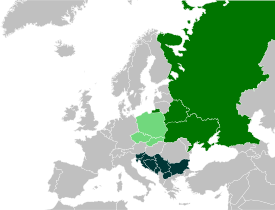
Balkans
The Balkans is a geopolitical and cultural region of southeastern Europe...
where the South Slavs had been ruled for centuries by other empires, Byzantine Empire
Byzantine Empire
The Byzantine Empire was the Eastern Roman Empire during the periods of Late Antiquity and the Middle Ages, centred on the capital of Constantinople. Known simply as the Roman Empire or Romania to its inhabitants and neighbours, the Empire was the direct continuation of the Ancient Roman State...
, Austria-Hungary
Austria-Hungary
Austria-Hungary , more formally known as the Kingdoms and Lands Represented in the Imperial Council and the Lands of the Holy Hungarian Crown of Saint Stephen, was a constitutional monarchic union between the crowns of the Austrian Empire and the Kingdom of Hungary in...
, the Ottoman Empire
Ottoman Empire
The Ottoman EmpireIt was usually referred to as the "Ottoman Empire", the "Turkish Empire", the "Ottoman Caliphate" or more commonly "Turkey" by its contemporaries...
, and Venice
Republic of Venice
The Republic of Venice or Venetian Republic was a state originating from the city of Venice in Northeastern Italy. It existed for over a millennium, from the late 7th century until 1797. It was formally known as the Most Serene Republic of Venice and is often referred to as La Serenissima, in...
. It was also used as a political tool by both the Russian Empire
Russian Empire
The Russian Empire was a state that existed from 1721 until the Russian Revolution of 1917. It was the successor to the Tsardom of Russia and the predecessor of the Soviet Union...
and the Soviet Union
Soviet Union
The Soviet Union , officially the Union of Soviet Socialist Republics , was a constitutionally socialist state that existed in Eurasia between 1922 and 1991....
, which gained political-military influence and control over all Slavic-majority nations between 1945
Aftermath of World War II
After World War II a new era of tensions emerged based on opposing ideologies, mutual distrust between nations, and a nuclear arms race. This emerged into an environment dominated by a international balance of power that had changed significantly from the status quo before the war...
and 1948
Tito-Stalin Split
The Tito–Stalin Split was a conflict between the leaders of Socialist Federal Republic of Yugoslavia and the Union of Soviet Socialist Republics, which resulted in Yugoslavia's expulsion from the Communist Information Bureau in 1948...
.
Origins
Extensive Pan-Slavism began much like Pan-GermanismPan-Germanism
Pan-Germanism is a pan-nationalist political idea. Pan-Germanists originally sought to unify the German-speaking populations of Europe in a single nation-state known as Großdeutschland , where "German-speaking" was taken to include the Low German, Frisian and Dutch-speaking populations of the Low...
, both of which grew from the sense of unity and nationalism
Nationalism
Nationalism is a political ideology that involves a strong identification of a group of individuals with a political entity defined in national terms, i.e. a nation. In the 'modernist' image of the nation, it is nationalism that creates national identity. There are various definitions for what...
experienced within ethnic group
Ethnic group
An ethnic group is a group of people whose members identify with each other, through a common heritage, often consisting of a common language, a common culture and/or an ideology that stresses common ancestry or endogamy...
s under the domination of France
France
The French Republic , The French Republic , The French Republic , (commonly known as France , is a unitary semi-presidential republic in Western Europe with several overseas territories and islands located on other continents and in the Indian, Pacific, and Atlantic oceans. Metropolitan France...
during the Napoleonic Wars
Napoleonic Wars
The Napoleonic Wars were a series of wars declared against Napoleon's French Empire by opposing coalitions that ran from 1803 to 1815. As a continuation of the wars sparked by the French Revolution of 1789, they revolutionised European armies and played out on an unprecedented scale, mainly due to...
. Like other Romantic nationalist
Romantic nationalism
Romantic nationalism is the form of nationalism in which the state derives its political legitimacy as an organic consequence of the unity of those it governs...
movements, Slavic intellectuals and scholars in the developing fields of history
History
History is the discovery, collection, organization, and presentation of information about past events. History can also mean the period of time after writing was invented. Scholars who write about history are called historians...
, philology
Philology
Philology is the study of language in written historical sources; it is a combination of literary studies, history and linguistics.Classical philology is the philology of Greek and Classical Latin...
, and folklore
Folklore
Folklore consists of legends, music, oral history, proverbs, jokes, popular beliefs, fairy tales and customs that are the traditions of a culture, subculture, or group. It is also the set of practices through which those expressive genres are shared. The study of folklore is sometimes called...
actively encouraged the passion of their shared identity and ancestry. Pan-Slavism also co-existed with the Southern Slavic
South Slavs
The South Slavs are the southern branch of the Slavic peoples and speak South Slavic languages. Geographically, the South Slavs are native to the Balkan peninsula, the southern Pannonian Plain and the eastern Alps...
independence.
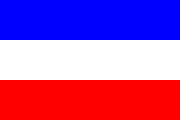
Commonly used symbols of the Pan-Slavic movement were the Pan-Slavic colours
Pan-Slavic colours
The Pan-Slavic colors, red, blue and white, are colors used on the flags of some Slavic peoples and states in which the majority of inhabitants possess a Slavic background. Their use symbolizes the common origin of the Slavic peoples...
(blue, white and red) and the Pan-Slavic anthem, Hey, Slavs
Hey, Slavs
Hey, Slavs is an anthemic song dedicated to Slavic peoples. Its first lyrics were written in 1834 under the title Hey, Slovaks by Samuel Tomášik and it has since served as the anthem of the Pan-Slavic movement, the anthem of the Sokol physical education and political movement, the anthem of the...
.
The first pan-Slavist was Croatian
Croats
Croats are a South Slavic ethnic group mostly living in Croatia, Bosnia and Herzegovina and nearby countries. There are around 4 million Croats living inside Croatia and up to 4.5 million throughout the rest of the world. Responding to political, social and economic pressure, many Croats have...
Catholic missionary Juraj Križanić
Juraj Križanic
Juraj Križanić , also known as Yuriy Krizhanich, was a Croatian Catholic missionary who is often regarded as the earliest recorded pan-Slavist and anti-Normanist.-Early life, education, and early missionary work:...
, who lived in 17th century. Some of the earliest manifestations of Pan-Slavic thought within the Habsburg Monarchy
Habsburg Monarchy
The Habsburg Monarchy covered the territories ruled by the junior Austrian branch of the House of Habsburg , and then by the successor House of Habsburg-Lorraine , between 1526 and 1867/1918. The Imperial capital was Vienna, except from 1583 to 1611, when it was moved to Prague...
have been attributed to Adam Franz Kollár
Adam František Kollár
Adam František Kollár − Adam Franz Kollár in older English sources, a Slovak lower nobleman, was a historian, ethnologist, and as Imperial-Royal Court Councilor and Chief Imperial-Royal Librarian, an influential advocate of Empress Maria Theresa's Enlightened and centralist policies...
and Pavel Jozef Šafárik
Pavel Jozef Šafárik
Pavol Jozef Šafárik Pavol Jozef Šafárik (Safáry / Schaffáry/ Schafary/ Saf(f)arik / Šafarík/ Szafarzik, Czech Pavel Josef Šafařík, German Paul Joseph Schaffarik, Serbian Павле Јосиф Шафарик, Latin Paulus Josephus Schaffarik, Hungarian Pál József Saf(f)arik) Pavol Jozef Šafárik (Safáry /...
. The movement began following the end of the Napoleonic Wars in 1815. In the aftermath, the leaders of Europe sought to restore the pre-war status quo
Status quo
Statu quo, a commonly used form of the original Latin "statu quo" – literally "the state in which" – is a Latin term meaning the current or existing state of affairs. To maintain the status quo is to keep the things the way they presently are...
. At the Congress of Vienna
Congress of Vienna
The Congress of Vienna was a conference of ambassadors of European states chaired by Klemens Wenzel von Metternich, and held in Vienna from September, 1814 to June, 1815. The objective of the Congress was to settle the many issues arising from the French Revolutionary Wars, the Napoleonic Wars,...
, Austria's representative, Prince von Metternich, felt the threat to this status quo in Austria was the nationalists demanding independence from the empire. While their subjects were composed of numerous ethnic groups (such as Italians, Romanians, Hungarians, etc.), most of the subjects were Slavs.
The First Pan-Slav Congress, Prague, 1848
The First Pan-Slav congressPrague Slavic Congress, 1848
The Prague Slavic Congress of 1848 took place in Prague between June 2 and June 12, 1848. It was one of several times that voices from all Slav populations of Central Europe were heard in one place...
was held in Prague
Prague
Prague is the capital and largest city of the Czech Republic. Situated in the north-west of the country on the Vltava river, the city is home to about 1.3 million people, while its metropolitan area is estimated to have a population of over 2.3 million...
, Bohemia
Bohemia
Bohemia is a historical region in central Europe, occupying the western two-thirds of the traditional Czech Lands. It is located in the contemporary Czech Republic with its capital in Prague...
in June, 1848, during the revolutionary movement of 1848
Revolutions of 1848
The European Revolutions of 1848, known in some countries as the Spring of Nations, Springtime of the Peoples or the Year of Revolution, were a series of political upheavals throughout Europe in 1848. It was the first Europe-wide collapse of traditional authority, but within a year reactionary...
. The Czechs had refused to send representatives to the Frankfurt Assembly feeling that Slavs had a distinct interest from the Germans. The Austroslav
Austroslavism
Austroslavism was a political concept and program aimed to solve problems of Slavic peoples in the Austrian Empire.It was most influential among Czech liberals around the middle of the 19th century...
, František Palacký
František Palacký
František Palacký was a Czech historian and politician.-Biography:...
, presided over the event. Most of the delegates were Czech. Palacký called for the co-operation of the Habsburg
Habsburg
The House of Habsburg , also found as Hapsburg, and also known as House of Austria is one of the most important royal houses of Europe and is best known for being an origin of all of the formally elected Holy Roman Emperors between 1438 and 1740, as well as rulers of the Austrian Empire and...
s and had also endorsed the Habsburg monarchy as the political formation most likely to protect the peoples of central Europe
Central Europe
Central Europe or alternatively Middle Europe is a region of the European continent lying between the variously defined areas of Eastern and Western Europe...
. When the Germans asked him to declare himself in favour of their desire for national unity, he replied that he would not as this would weaken the Habsburg state: “Truly, if it were not that Austria
Austrian Empire
The Austrian Empire was a modern era successor empire, which was centered on what is today's Austria and which officially lasted from 1804 to 1867. It was followed by the Empire of Austria-Hungary, whose proclamation was a diplomatic move that elevated Hungary's status within the Austrian Empire...
had long existed, it would be necessary, in the interest of Europe
Europe
Europe is, by convention, one of the world's seven continents. Comprising the westernmost peninsula of Eurasia, Europe is generally 'divided' from Asia to its east by the watershed divides of the Ural and Caucasus Mountains, the Ural River, the Caspian and Black Seas, and the waterways connecting...
, in the interest of humanity itself, to create it.”
The Pan-Slav congress met during the revolutionary turmoil of 1848. Young inhabitants of Prague had taken to the streets and in the confrontation, a stray bullet had killed the wife of Field Marshal
Field Marshal
Field Marshal is a military rank. Traditionally, it is the highest military rank in an army.-Etymology:The origin of the rank of field marshal dates to the early Middle Ages, originally meaning the keeper of the king's horses , from the time of the early Frankish kings.-Usage and hierarchical...
Alfred I, Prince of Windisch-Grätz, the commander of the Austrian forces in Prague. Enraged, Windischgrätz seized the city, disbanded the congress, and established martial law
Martial law
Martial law is the imposition of military rule by military authorities over designated regions on an emergency basis— only temporary—when the civilian government or civilian authorities fail to function effectively , when there are extensive riots and protests, or when the disobedience of the law...
throughout Bohemia.
Pan-Slavism in Central Europe
Slovaks
The Slovaks, Slovak people, or Slovakians are a West Slavic people that primarily inhabit Slovakia and speak the Slovak language, which is closely related to the Czech language.Most Slovaks today live within the borders of the independent Slovakia...
as branches of a single nation.
During World War I
World War I
World War I , which was predominantly called the World War or the Great War from its occurrence until 1939, and the First World War or World War I thereafter, was a major war centred in Europe that began on 28 July 1914 and lasted until 11 November 1918...
captured Slavic soldiers were asked to fight against the "oppression in Austrian Empire": some did (see Czechoslovak Legions
Czechoslovak Legions
The Czechoslovak Legions were volunteer armed forces composed predominantly of Czechs and Slovaks fighting together with the Entente powers during World War I...
).
Creation of an independent Czechoslovakia
Czechoslovakia
Czechoslovakia or Czecho-Slovakia was a sovereign state in Central Europe which existed from October 1918, when it declared its independence from the Austro-Hungarian Empire, until 1992...
made the old ideals of Pan-Slavism anachronistic. Relations with other Slavic states varied, sometimes being tense. Even tensions between Czechs and Slovaks had appeared.
Pan-Slavism in the Balkans
The Southern Slavic movement was active after Serbia regained independence from the Turkish Ottoman EmpireOttoman Empire
The Ottoman EmpireIt was usually referred to as the "Ottoman Empire", the "Turkish Empire", the "Ottoman Caliphate" or more commonly "Turkey" by its contemporaries...
. Austria feared that nationalists would endanger the empire. Pan-Slavism in the south was vastly different, instead it often turned to Russia for support. The Southern Slavic movement advocated the independence of the Slavic peoples in Austro-Hungarian Empire and the Ottoman Empire. Some Serbian intellectuals sought to unite all of the Southern, Balkan Slavs, whether Catholic
Catholicism
Catholicism is a broad term for the body of the Catholic faith, its theologies and doctrines, its liturgical, ethical, spiritual, and behavioral characteristics, as well as a religious people as a whole....
, Muslim
Islam
Islam . The most common are and . : Arabic pronunciation varies regionally. The first vowel ranges from ~~. The second vowel ranges from ~~~...
, or Orthodox, under their rule. Serbia, just having gained independence, was a small nascent state, whereas the Austro-Hungarian Empire, though unstable, was still a strong opponent to Serbia. In this circumstance, the idea of Russia involving the Southern Slavic unity was favored.
The Southern Slavs were some of the first to revolt against the decaying Ottoman Empire. In 1804 and again in 1815, the Serbs secured autonomy from the Ottomans. Almost immediately after Serbia's autonomy, the Serbs began seeking expansion and unity with all the rest of Serbs and other Slavs in neighbouring regions.
In Austria-Hungary Southern Slavs were distributed among several entities: Slovenes in the Austrian part (Carniola
Carniola
Carniola was a historical region that comprised parts of what is now Slovenia. As part of Austria-Hungary, the region was a crown land officially known as the Duchy of Carniola until 1918. In 1849, the region was subdivided into Upper Carniola, Lower Carniola, and Inner Carniola...
, Styria, Carinthia, Gorizia and Gradisca
Gorizia and Gradisca
The County of Gorizia and Gradisca was a Habsburg county in Central Europe, in what is now a multilingual border area of Italy and Slovenia. It was named for its two major urban centers, Gorizia and Gradisca d'Isonzo.-Province of the Habsburg Empire:...
, Trieste
Trieste
Trieste is a city and seaport in northeastern Italy. It is situated towards the end of a narrow strip of land lying between the Adriatic Sea and Italy's border with Slovenia, which lies almost immediately south and east of the city...
, Istria
Istria
Istria , formerly Histria , is the largest peninsula in the Adriatic Sea. The peninsula is located at the head of the Adriatic between the Gulf of Trieste and the Bay of Kvarner...
(also Croats
Croats
Croats are a South Slavic ethnic group mostly living in Croatia, Bosnia and Herzegovina and nearby countries. There are around 4 million Croats living inside Croatia and up to 4.5 million throughout the rest of the world. Responding to political, social and economic pressure, many Croats have...
)), Croats and Serbs
Serbs
The Serbs are a South Slavic ethnic group of the Balkans and southern Central Europe. Serbs are located mainly in Serbia, Montenegro and Bosnia and Herzegovina, and form a sizable minority in Croatia, the Republic of Macedonia and Slovenia. Likewise, Serbs are an officially recognized minority in...
in the Hungarian part within the autonomous Kingdom of Croatia-Slavonia
Kingdom of Croatia-Slavonia
The Kingdom of Croatia-Slavonia or Croatia Slavonia was an autonomous kingdom within the Austro-Hungarian Empire. It was part of the Hungarian Kingdom within the dual Austro-Hungarian state, being within the Lands of the Crown of St. Stephen or Transleithania...
and in the Austrian part within the autonomous Kingdom of Dalmatia
Kingdom of Dalmatia
The Kingdom of Dalmatia was an administrative division of the Habsburg Monarchy from 1815 to 1918. Its capital was Zadar.-History:...
, and in Bosnia and Herzegovina
Bosnia and Herzegovina
Bosnia and Herzegovina , sometimes called Bosnia-Herzegovina or simply Bosnia, is a country in Southern Europe, on the Balkan Peninsula. Bordered by Croatia to the north, west and south, Serbia to the east, and Montenegro to the southeast, Bosnia and Herzegovina is almost landlocked, except for the...
, under direct control from Vienna. Due to a different position within Austria-Hungary several different goals were prominent among the Southern Slavs of Austria-Hungary. A strong alternative to Pan-Slavism was Austroslavism
Austroslavism
Austroslavism was a political concept and program aimed to solve problems of Slavic peoples in the Austrian Empire.It was most influential among Czech liberals around the middle of the 19th century...
, especially among the Slovenes. Because the Serbs were distributed among several provinces, and the fact that they had special ties to the independent nation state
Nation-state
The nation state is a state that self-identifies as deriving its political legitimacy from serving as a sovereign entity for a nation as a sovereign territorial unit. The state is a political and geopolitical entity; the nation is a cultural and/or ethnic entity...
of Serbia
Serbia
Serbia , officially the Republic of Serbia , is a landlocked country located at the crossroads of Central and Southeast Europe, covering the southern part of the Carpathian basin and the central part of the Balkans...
, they were among the strongest supporters of independence of South-Slavs from Austria.
After World War I the creation of the Kingdom of Yugoslavia
Kingdom of Yugoslavia
The Kingdom of Yugoslavia was a state stretching from the Western Balkans to Central Europe which existed during the often-tumultuous interwar era of 1918–1941...
, under Serbian royalty, did unite most Southern Slavs regardless of religion and cultural background (Orthodox/Muslim/Catholic). The only ones they did not unite with were the Bulgarians
Bulgarians
The Bulgarians are a South Slavic nation and ethnic group native to Bulgaria and neighbouring regions. Emigration has resulted in immigrant communities in a number of other countries.-History and ethnogenesis:...
. Still, in the years after the Second World War, there were plans that Bulgaria should join as a 7th republic in communist Yugoslavia
Socialist Federal Republic of Yugoslavia
The Socialist Federal Republic of Yugoslavia was the Yugoslav state that existed from the abolition of the Yugoslav monarchy until it was dissolved in 1992 amid the Yugoslav Wars. It was a socialist state and a federation made up of six socialist republics: Bosnia and Herzegovina, Croatia,...
, thus uniting all south Slavs into one state. The idea was left after the break between Josip Broz Tito
Josip Broz Tito
Marshal Josip Broz Tito – 4 May 1980) was a Yugoslav revolutionary and statesman. While his presidency has been criticized as authoritarian, Tito was a popular public figure both in Yugoslavia and abroad, viewed as a unifying symbol for the nations of the Yugoslav federation...
and Joseph Stalin
Joseph Stalin
Joseph Vissarionovich Stalin was the Premier of the Soviet Union from 6 May 1941 to 5 March 1953. He was among the Bolshevik revolutionaries who brought about the October Revolution and had held the position of first General Secretary of the Communist Party of the Soviet Union's Central Committee...
in 1948.
Pan-Slavism in Poland
Although early Pan-Slavism had found interest among some Poles, it soon lost its appeal as the movement became dominated by RussiaRussia
Russia or , officially known as both Russia and the Russian Federation , is a country in northern Eurasia. It is a federal semi-presidential republic, comprising 83 federal subjects...
, and while Russian Pan-Slavists spoke of liberation of other Slavs through Russian actions, parts of Poland
Poland
Poland , officially the Republic of Poland , is a country in Central Europe bordered by Germany to the west; the Czech Republic and Slovakia to the south; Ukraine, Belarus and Lithuania to the east; and the Baltic Sea and Kaliningrad Oblast, a Russian exclave, to the north...
had been ruled by the Russian Empire
Russian Empire
The Russian Empire was a state that existed from 1721 until the Russian Revolution of 1917. It was the successor to the Tsardom of Russia and the predecessor of the Soviet Union...
since the Partitions of Poland
Partitions of Poland
The Partitions of Poland or Partitions of the Polish–Lithuanian Commonwealth took place in the second half of the 18th century and ended the existence of the Polish–Lithuanian Commonwealth, resulting in the elimination of sovereign Poland for 123 years...
. Historically, Poland often saw itself in partnership with non-Slavic nations most of the time, such as Hungary
Hungary
Hungary , officially the Republic of Hungary , is a landlocked country in Central Europe. It is situated in the Carpathian Basin and is bordered by Slovakia to the north, Ukraine and Romania to the east, Serbia and Croatia to the south, Slovenia to the southwest and Austria to the west. The...
, Saxony
Duchy of Saxony
The medieval Duchy of Saxony was a late Early Middle Ages "Carolingian stem duchy" covering the greater part of Northern Germany. It covered the area of the modern German states of Bremen, Hamburg, Lower Saxony, North Rhine-Westphalia, and Saxony-Anhalt and most of Schleswig-Holstein...
, Sweden or Lithuania
Lithuania
Lithuania , officially the Republic of Lithuania is a country in Northern Europe, the biggest of the three Baltic states. It is situated along the southeastern shore of the Baltic Sea, whereby to the west lie Sweden and Denmark...
under the Polish-Lithuanian Commonwealth
Polish-Lithuanian Commonwealth
The Polish–Lithuanian Commonwealth was a dualistic state of Poland and Lithuania ruled by a common monarch. It was the largest and one of the most populous countries of 16th- and 17th‑century Europe with some and a multi-ethnic population of 11 million at its peak in the early 17th century...
from 1569 to 1795. The influence of 19th century Pan-Slavism had little impact in Poland except for creating sympathy towards the other oppressed Slavic nations to regaining independence. At the same time while Pan-Slavism worked against Austro-Hungary with South Slavs, Poles enjoyed a wide autonomy within the state and assumed a loyalist position as they were able to develop their national culture and preserve Polish language
Polish language
Polish is a language of the Lechitic subgroup of West Slavic languages, used throughout Poland and by Polish minorities in other countries...
, something under threat in both German
Germany
Germany , officially the Federal Republic of Germany , is a federal parliamentary republic in Europe. The country consists of 16 states while the capital and largest city is Berlin. Germany covers an area of 357,021 km2 and has a largely temperate seasonal climate...
and Russia
Russia
Russia or , officially known as both Russia and the Russian Federation , is a country in northern Eurasia. It is a federal semi-presidential republic, comprising 83 federal subjects...
n Empires. A Pan-Slavic federation was proposed, but on the condition that the Russian Empire
Russian Empire
The Russian Empire was a state that existed from 1721 until the Russian Revolution of 1917. It was the successor to the Tsardom of Russia and the predecessor of the Soviet Union...
would be excluded from such an entity. After Poland regained its independence (from Germany, Austria and Russia) in 1918 no major or minor force considered Pan-Slavism as a serious alternative, viewing Pan-Slavism as little more than a code word for Russification
Russification
Russification is an adoption of the Russian language or some other Russian attributes by non-Russian communities...
. During Poland's communist era the USSR used Pan-Slavism as propaganda tool to justify its control over the country. The issue of the Pan-Slavism was not part of the mainstream political agenda
Political agenda
A political agenda is a set of issues and policies laid out by an executive or cabinet in government that tries to influence current and near-future political news and debate....
, and is widely seen as an ideology of Russian imperialism
Imperialism
Imperialism, as defined by Dictionary of Human Geography, is "the creation and/or maintenance of an unequal economic, cultural, and territorial relationships, usually between states and often in the form of an empire, based on domination and subordination." The imperialism of the last 500 years,...
.
Joseph ConradJoseph ConradJoseph Conrad was a Polish-born English novelist.Conrad is regarded as one of the great novelists in English, although he did not speak the language fluently until he was in his twenties...
in Notes on Life and Letters.:
"...between Polonism and Slavonism there is not so much hatred as a complete and ineradicable incompatibility." ...Conrad argues that "nothing is more foreign than what in the literary world is called Slavonism to his individual sensibility and the whole Polish mentality"
Modern day developments
The authentic idea of unity of the Slavic people was all but gone after World War IWorld War I
World War I , which was predominantly called the World War or the Great War from its occurrence until 1939, and the First World War or World War I thereafter, was a major war centred in Europe that began on 28 July 1914 and lasted until 11 November 1918...
when the maxim "Versailles and Trianon have put an end to all Slavisms" and was finally put to rest with the fall of communism
Revolutions of 1989
The Revolutions of 1989 were the revolutions which overthrew the communist regimes in various Central and Eastern European countries.The events began in Poland in 1989, and continued in Hungary, East Germany, Bulgaria, Czechoslovakia and...
in Central and Eastern Europe in late 1980s. With the breakup of Pan-Slavic states such as Czechoslovakia
Czechoslovakia
Czechoslovakia or Czecho-Slovakia was a sovereign state in Central Europe which existed from October 1918, when it declared its independence from the Austro-Hungarian Empire, until 1992...
and Yugoslavia
Yugoslavia
Yugoslavia refers to three political entities that existed successively on the western part of the Balkans during most of the 20th century....
and the problem of Russian and Serbian dominance in any proposed all-Slavic organisation, the idea of Pan-Slavic unity is mostly considered dead. Varying relations between the Slavic countries exist nowadays; they range from mutual respect on equal footing and sympathy towards one another through traditional dislike and enmity, to indifference. None, other than culture and heritage oriented organizations, are currently considered as a form of rapprochement among the countries with Slavic origins. In modern times the appeals to Pan-Slavism are often made in Russia
Russia
Russia or , officially known as both Russia and the Russian Federation , is a country in northern Eurasia. It is a federal semi-presidential republic, comprising 83 federal subjects...
, Serbia
Serbia
Serbia , officially the Republic of Serbia , is a landlocked country located at the crossroads of Central and Southeast Europe, covering the southern part of the Carpathian basin and the central part of the Balkans...
, Bosnia and Herzegovina
Bosnia and Herzegovina
Bosnia and Herzegovina , sometimes called Bosnia-Herzegovina or simply Bosnia, is a country in Southern Europe, on the Balkan Peninsula. Bordered by Croatia to the north, west and south, Serbia to the east, and Montenegro to the southeast, Bosnia and Herzegovina is almost landlocked, except for the...
and Slovakia
Slovakia
The Slovak Republic is a landlocked state in Central Europe. It has a population of over five million and an area of about . Slovakia is bordered by the Czech Republic and Austria to the west, Poland to the north, Ukraine to the east and Hungary to the south...
. Sociologists agree that there are signs that Pan-Slavism is experiencing a growing trend among younger people in some Slavic countries. Multiple factors, such as the entry of Slavic countries such as Poland
Poland
Poland , officially the Republic of Poland , is a country in Central Europe bordered by Germany to the west; the Czech Republic and Slovakia to the south; Ukraine, Belarus and Lithuania to the east; and the Baltic Sea and Kaliningrad Oblast, a Russian exclave, to the north...
, Slovakia
Slovakia
The Slovak Republic is a landlocked state in Central Europe. It has a population of over five million and an area of about . Slovakia is bordered by the Czech Republic and Austria to the west, Poland to the north, Ukraine to the east and Hungary to the south...
and Bulgaria
Bulgaria
Bulgaria , officially the Republic of Bulgaria , is a parliamentary democracy within a unitary constitutional republic in Southeast Europe. The country borders Romania to the north, Serbia and Macedonia to the west, Greece and Turkey to the south, as well as the Black Sea to the east...
into the European Union
European Union
The European Union is an economic and political union of 27 independent member states which are located primarily in Europe. The EU traces its origins from the European Coal and Steel Community and the European Economic Community , formed by six countries in 1958...
has contributed to the fact that many young Slavs feel alienated and are finding a sense of belonging and identity in "being a Slav". Right-wing youth are much more prone to the ideas of Pan-Slavism.
Creation of Pan-Slavic languages
The similarity of Slavic languages inspired many people to create Pan-Slavic languagePan-Slavic language
A pan-Slavic language is a zonal constructed language for communication among Slavic people. Similarity of the Slavic languages has constantly inspired different people to create Pan-Slavic languages.-Old Church Slavonic:...
s, i.e., zonal constructed languages for all Slavic people to communicate with one another. Several of these languages were created in the past, but due to the Internet, many more Pan-Slavic languages were created in the Digital Age. The most popular modern Pan-Slavic languages are Slovio
Slovio
Slovio is a constructed language begun in 1999 by Mark Hučko. Hučko claims that the language should be relatively easy for non-Slavs to learn as well, as an alternative to tongues such as Esperanto which are based more on Latin root words. The vocabulary is based on the shared lexical foundation...
and Slovianski
Slovianski
Slovianski is a Slavic interlanguage, created in 2006 by a group of language creators from different countries. Its purpose is to facilitate communication between representatives of different Slavic nations, as well as to allow people who don't know any Slavic language to communicate with Slavs...
.
External links
- Slavic unity forum (multiple languages)