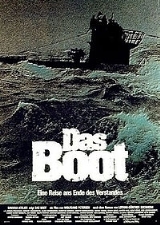
Das Boot ("The Boat"; ) is a 1981 feature film directed by
Wolfgang PetersenWolfgang Petersen is a German film director. He is known for his body of film work, which includes The NeverEnding Story, Outbreak, In the Line of Fire, Air Force One, The Perfect Storm, Troy, and Poseidon...
, adapted from a novel of the same name by
Lothar-Günther BuchheimLothar-Günther Buchheim was a German author, painter, and art collector. He is best known for his novel Das Boot , which became an international bestseller and was adapted in 1981 as an Oscar-nominated film.-Early life:Buchheim was born in Weimar in Thuringia, the second son of artist Charlotte...
. Hans-Joachim Krug, former first officer on U-219, served as a consultant, as did
Heinrich Lehmann-WillenbrockCommander Heinrich Lehmann-Willenbrock was a German naval officer, and a submarine commander during World War II. He was among the top ten Aces of the Deep during the Second Battle of the Atlantic against the Allies, in terms of tonnage of merchant ships sunk...
, the captain of the real U-96.
The film is the story of a single mission of one
World War IIWorld War II, or the Second World War , was a global military conflict which involved a majority of the world's nations, including all great powers, organized into two opposing military alliances: the Allies and the Axis...
U-boatU-boat is the anglicized version of the German word , itself an abbreviation of Unterseeboot , and refers to military submarines operated by Germany, particularly in World War I and World War II...
,
U-96U-96 or Unterseeboot 96 was a German Type VIIC submarine of the Kriegsmarine during World War II. Her keel was laid down September 16, 1939 by Germaniawerft, of Kiel. She was commissioned September 14, 1940 with Kapitänleutnant Heinrich Lehmann-Willenbrock in command. Lehmann-Willenbrock was...
, and its crew. It depicts both the excitement of battle and the tedium of the fruitless hunt, and shows the men serving aboard U-boats as ordinary individuals with a desire to do their best for their comrades and their country. The story is based on an amalgamation of the exploits of the real U-96, a
Type VIIC-class U-boatType VII U-boats were the workhorses of the German World War II U-boot-waffe. Type VII was based on earlier German submarine designs going back to the World War I Type UB III, designed through the Dutch dummy company Ingenieurskantoor voor Scheepsbouw den Haag Type VII U-boats were the workhorses...
commanded by
Heinrich Lehmann-WillenbrockCommander Heinrich Lehmann-Willenbrock was a German naval officer, and a submarine commander during World War II. He was among the top ten Aces of the Deep during the Second Battle of the Atlantic against the Allies, in terms of tonnage of merchant ships sunk...
, one of Germany's top U-boat "tonnage aces" during the war.
One of Petersen's goals was to guide the audience through "a journey to the edge of the mind" (the film's German tagline
Eine Reise ans Ende des Verstandes), showing "what war is all about." Petersen heightened suspense by very rarely showing any external views of the
submarineA submarine is a watercraft capable of independent operation below the surface of the water. It differs from a submersible, which has only limited underwater capability...
unless it is running on the surface and relying on sounds to convey action outside the boat, thus showing the audience only the claustrophobic interior the crew would see.
The original 1981 version cost
DMThe Deutsche Mark or German mark was the official currency of West Germany and, from 1990 until the adoption of the euro, all of unified Germany...
32 million to make. The director's meticulous attention to detail resulted in a historically accurate film that was a critical and financial success, grossing over $80 million worldwide between its two releases in 1981 and 1997. Its high production cost ranks it among the most expensive films in the history of
German cinemaCinema in Germany can be traced back to the very beginnings of the medium at the end of the 19th century. German cinema has made major technical and artistic contributions to film.-Before 1918 - Cinema pioneers:...
. It was the second most expensive up until that time, except for
MetropolisMetropolis is a silent German expressionism science fiction film directed by Fritz Lang and written by Lang and Thea von Harbou. Lang and von Harbou, who were married, wrote the screenplay in , and published a novelization in 1926, before the film was released...
. However,
Metropolis was made in the 1920s, a period of
hyperinflationIn economics, hyperinflation is inflation that is very high or "out of control", a condition in which prices increase rapidly as a currency loses its value....
in Germany, which makes direct cost comparisons between the two eras difficult.
Plot
The story is told from the viewpoint of Lt. Werner (
Herbert GrönemeyerHerbert Arthur Wiglev Clamor Grönemeyer is a German musician and actor, popular in Germany, Austria and Switzerland. He starred as war correspondent Lieutenant Werner in Wolfgang Petersen's movie Das Boot, but later concentrated on his musical career...
), who has been assigned as a
war correspondentA war correspondent is a journalist who covers stories firsthand from a war zone. In the 19th century they were also called Special Correspondents.-Methods:...
on the German Submarine U-96 in October 1941. In the opening scene he joins its Captain (
Jürgen ProchnowJürgen Prochnow is a German actor. His most well-known roles internationally have been as the submarine captain in Das Boot , Duke Leto Atreides in Dune and the villain Maxwell Dent in Beverly Hills Cop II.-Biography:Prochnow was born in Berlin and brought up in Düsseldorf,...
), Chief Engineer (
Klaus WennemannKlaus Wennemann was a German actor. He was best known for his roles as the Chief Engineer in Das Boot and as Faber in the TV show Der Fahnder. He died at the age of 59 from lung cancer....
), and the drunken crew in a French nightclub. Thomsen (
Otto SanderOtto Sander is a German movie, theater, and voice actor.Sander grew up in Kassel, where he graduated in 1961 from the Friedrichgymnasium. After leaving school he spent his military service as a navy reserve officer and then studied theatre science, history of art and philosophy. In 1965 he made...
), another crew's captain, gives a crude drunken speech in which he mocks
Adolf HitlerAdolf Hitler was an Austrian-born German politician and the leader of the National Socialist German Workers Party , popularly known as the Nazi Party...
in celebration of his
Ritterkreuz awardThe Knight's Cross of the Iron Cross was a grade of the Iron Cross. The Knight's Cross of the Iron Cross was the highest award of Germany to recognize extreme battlefield bravery or successful military leadership during World War II...
.
The next morning, they sail out of the
harborA harbor or harbour , or haven, is a place where ships may shelter from the weather or are stored. Harbors can be man-made or natural. A man-made harbor will have sea walls or breakwaters and may require dredging. A natural harbor is surrounded on most sides by land.Harbors and ports are often...
to cheering crowds and a playing band. Werner is given a full tour of the boat and becomes acquainted with the tight quarters and the rest of the crew. As time passes, he observes ideological differences between the fresh crew members and the hardened veterans, particularly the Captain, who is embittered and cynical about the war. The new members, including Werner, are often mocked by the rest of the crew, who share a tight bond. After days of boredom, the crew is excited by another U-boat's spotting of a near-by enemy convoy. They soon locate a British
destroyerIn naval terminology, a destroyer is a fast and maneuverable yet long-endurance warship intended to escort larger vessels in a fleet, convoy or battle group and defend them against smaller, short-range but powerful attackers .Before World War II, destroyers were light vessels without the endurance...
but are bombarded with
depth chargeThe depth charge is an anti-submarine weapon intended to defeat its target by the shock of exploding near it. Most use explosives and a fuze set to go off at a predetermined depth. Some have been designed to use nuclear warheads...
s while preparing to attack. The explosions are deafening but the boat narrowly escapes with only light damage and they resurface safely a few hours later.
The next three weeks are spent enduring a relentless storm. Morale drops after what seems like an endless series of misfortunes, but the crew is cheered temporarily when they randomly meet Thomsen's boat. Shortly after the storm ends, the boat encounters a British
convoyA convoy is a group of vehicles traveling together for mutual support and protection. Often, a convoy is organized with armed defensive support, though it may also be used in a non-military sense, for example when driving through remote areas.-Age of Sail:Naval convoys have been used for hundreds...
and quickly launches four torpedoes, successfully sinking two ships. However, they are spotted by a destroyer and must dive below the submarine's rated limits to escape. The entire crew falls silent to minimize noise and avoid detection, and are constantly depth-charged. The Chief Mechanic has a mental breakdown and must be restrained. The boat sustains heavy damage but is eventually able to safely resurface in darkness. An enemy tanker remains afloat and on fire, so they torpedo the ship and watch as surviving British sailors desperately leap overboard, swimming towards them. Following
orders not to take prisonersThe Laconia Order was issued by German Grand Admiral Karl Dönitz during World War II as a result of the Laconia incident....
, the Captain gives the command to back the ship away. They head back to
La RochelleLa Rochelle is a city in south-western France and a seaport on the Bay of Biscay, a part of the Atlantic Ocean. It is the capital of the Charente-Maritime department....
with a nearly exhausted fuel supply.
The worn-out U-boat crew look forward to returning home to La Rochelle in time for
ChristmasChristmas , also referred to as Christmas Day, is an annual holiday celebrated on December 25 that commemorates the birth of Jesus of Nazareth. The day marks the beginning of the larger season of Christmastide, which lasts twelve days. The nativity of Jesus, which is the basis for the anno Domini...
, but the ship is ordered to
La SpeziaLa Spezia is a city in the Liguria region of northern Italy, at the head of La Spezia Gulf, and capital city of the province of La Spezia. It is one of the major Italian military and commercial harbours, located between Genoa and Pisa on the Ligurian Sea...
,
ItalyItaly , officially the Italian Republic , is a country located on the Italian Peninsula in Southern Europe and on the two largest islands in the Mediterranean Sea, Sicily and Sardinia. Italy shares its northern, Alpine boundary with France, Switzerland, Austria and Slovenia...
, which means passing through the
Strait of GibraltarThe Strait of Gibraltar is a narrow strait that connects the Atlantic Ocean to the Mediterranean Sea and separates Spain from Morocco...
— an area firmly controlled by the Royal Navy. Resistant to let Werner and the "LI" (engineer) perish, the Captain requests for them to be taken ashore. They make a secret night rendezvous in
neutralA neutral power in a particular war is a sovereign state which declares itself to be neutral towards the belligerents. A non-belligerent state does not need to be neutral. The rights and duties of a neutral power are defined in Sections 5 and 13 of the Hague Convention of 1907...
Spain with an interned German liner that clandestinely provides U-boats with fuel, torpedoes, and other supplies. The filthy officers seem out of place on the opulent luxury liner, but are warmly greeted by enthusiastic
NaziNazism, known officially in German as National Socialism , is the totalitarian ideology and practices of the Nazi Party or National Socialist German Workers’ Party under Adolf Hitler, and the policies adopted by the dictatorial government of Nazi Germany from 1933 to 1945.Nazism is often considered...
officers who are eager to hear their exploits. The Captain learns from secret agents on the supply ship that his request that Werner and the "LI" be sent back to Germany has been denied.
The crew finishes resupplying and departs for Italy. As they carefully approach Gibraltar, and will be ready to dive in 10 minutes, they are suddenly attacked by a British fighter plane, wounding the navigator. The Captain orders the boat directly south towards the African coast at full speed. British ships begin closing in and she is forced to dive. When attempting to level off, the boat does not respond and continues to sink until, just before crushing, it lands on a sea shelf. The crew must now make numerous repairs before running out of
oxygenOxygen Oxygen Oxygen (acid, literally "sharp", from the taste of acids) and -γενής (-genēs) (producer, literally begetter) is the element with atomic number 8 and represented by the symbol O...
. After over sixteen hours, they are able to surface by blowing out their ballast of water, and limp home under the cover of darkness to La Rochelle.
The crew is pale and weary upon returning to La Rochelle on
Christmas EveChristmas Eve, December 24, is the night before Christmas Day, which celebrates the birth of Jesus Christ.-Western Churches:Many Roman Catholics and Anglicans traditionally celebrate a midnight Mass which begins sometime before midnight on Christmas Day; this ceremony, which is held in churches...
. Shortly after the wounded navigator is taken ashore to a waiting
ambulanceAn ambulance is a vehicle for transporting sick or injured people, to, from or between places of treatment for an illness or injury. The term ambulance is used to describe a vehicle used to bring medical care to patients outside of the hospital or to transport the patient to hospital for follow-up...
,
AlliedThe Allies of World War II were the countries that opposed the Axis powers during the Second World War . The involvement of the Allies in World War II was either natural and inevitable they were invaded or under the direct threat of invasion by the Axis or compelled by concerns that the Axis powers...
planes strafe the facilities. Werner and some others take refuge in the secure
U-boat bunkerA submarine pen is a bunker to protect moored submarines from air attack.German World War II U-boat pens in France included Saint-Nazaire, Lorient, La Rochelle and Toulon. In Norway, DORA 1 was a large pen in Trondheim, Norway. U-boat pens protecting construction of the German Type XXI submarine...
, though most of the men are wounded. After the raid, Werner exits the bunker and discovers the lifeless bodies of four crew members. He then finds the Captain, with multiple bullet wounds and bleeding from the mouth, watching the U-boat sink at the dock. The Captain collapses after the boat disappears under the water, and a horrified Werner rushes to his side.
Cast

- Jürgen Prochnow
Jürgen Prochnow is a German actor. His most well-known roles internationally have been as the submarine captain in Das Boot , Duke Leto Atreides in Dune and the villain Maxwell Dent in Beverly Hills Cop II.-Biography:Prochnow was born in Berlin and brought up in Düsseldorf,...
as Captain (Kapitänleutnant / Kaleu / Der Alte): A 30-year-old battle-hardened sea veteran, who complains to Werner that most of his crew are boys. Despite being openly anti-Nazi, he is engaged to a "Nazi girl" (a widow of a LuftwaffeLuftwaffe is a generic German term for an air force. It is also the official name for two of the four historic German air forces, the Wehrmacht air arm founded in 1933 and disbanded in 1946; and the current Bundeswehr air arm founded in 1956.Schweizer Luftwaffe is also the name of the Swiss Air...
pilot). Prochnow later became one of the few German actors to establish themselves in Hollywood.
- Herbert Grönemeyer
Herbert Arthur Wiglev Clamor Grönemeyer is a German musician and actor, popular in Germany, Austria and Switzerland. He starred as war correspondent Lieutenant Werner in Wolfgang Petersen's movie Das Boot, but later concentrated on his musical career...
as Lieutenant (Leutnant) Werner, War Correspondent: The naive, but honest narrator. Werner is mocked for his lack of U-boat experience. Grönemeyer was a popular German singer before the film and still is.
- Klaus Wennemann
Klaus Wennemann was a German actor. He was best known for his roles as the Chief Engineer in Das Boot and as Faber in the TV show Der Fahnder. He died at the age of 59 from lung cancer....
as Chief Engineer (Leitender Ingenieur or LI): A quiet and well-respected man. At age 27, the oldest crew member besides the Captain. Tormented by the uncertain fate of his wife, especially after hearing about an Allied air raidStrategic bombing is a military strategy used in a total war with the goal of defeating an enemy nation-state by destroying its economic ability to wage war rather than destroying its land or naval forces...
on CologneCologne is Germany's fourth-largest city , and is the largest city both in the German Federal State of North Rhine-Westphalia and within the Rhine-Ruhr Metropolitan Area, one of the major European metropolitan areas with more than ten million inhabitants...
. The second most important crewman, as he oversees diving operations and makes sure the systems are running correctly. Wennemann later became lead in a successful German detective series, Der Fahnder (the Investigator) before his death in 2000 from lung cancerLung cancer is a disease of uncontrolled cell growth in tissues of the lung. This growth may lead to metastasis, which is the invasion of adjacent tissue and infiltration beyond the lungs. The vast majority of primary lung cancers are carcinomas of the lung, derived from epithelial cells...
.
- Hubertus Bengsch
Hubertus Bengsch is a German actor, best known for his role as the German First Officer in Das Boot.He also is well known for being the German voice of American actor Richard Gere....
as 1st Lieutenant/ 1st Watch Officer (IWO): A young, by-the-book officer, an ardent Nazi and a staunch believer in victory. He has a condescending attitude and is the only crewman who makes the effort to maintain his proper uniform. Raised in some wealth in Mexico by his step-parents who owned a plantation. His German fiancée died in a British carpet bombing raid. He spends his days writing his thoughts on military training and leadership for the High Command. Bengsch later became a successful dubbing artist, providing (amongst others) the German voice of Richard GereRichard Tiffany Gere is an American actor. He began acting in the 1970s, and came to prominence in 1980 for his role in the film American Gigolo, which established him as a leading man and a sex symbol...
.
- Martin Semmelrogge
Martin Semmelrogge is a German actor, best known for his role as the comical 2WO in the film Das Boot...
as 1st Lieutenant / 2nd Watch Officer (IIWO): A vulgar, comedic officer. One of his duties is to decode messages from base, using the Enigma code machineAn Enigma machine is any of a family of related electro-mechanical rotor machines used for the encryption and decryption of secret messages. The first Enigma was invented by German engineer Arthur Scherbius at the end of World War I...
. The film started Semmelrogge's successful German film career.
- Bernd Tauber
Bernd Tauber is a German actor. He is best known for his role as Navigator Kriechbaum in the 1981 film Das Boot....
as Chief Helmsman (Obersteuermann) Kriechbaum: The navigator and IIIWO (3rd Watch Officer). Always slightly sceptical of the Captain, and shows no enthusiasm during the voyage, or any anger when a convoy is too far away to be attacked. Kriechbaum has four sons, with another on the way. He is wounded in the airplane attack at Gibraltar. Following the film, Tauber became a successful actor; one of his roles was the first HIVHuman immunodeficiency virus is a lentivirus that causes acquired immunodeficiency syndrome , a condition in humans in which the immune system begins to fail, leading to life-threatening opportunistic infections. Infection with HIV occurs by the transfer of blood, semen, vaginal fluid,...
-positive character in West Germany television on LindenstraßeLindenstraße is a German television show on ARD's Das Erste, one of Germany's two publicly administered TV channels. The first episode was aired on December 8, 1985, and since then has been broadcast weekly. Its current timeslot on Das Erste is Sundays at 6:50 pm...
.
- Erwin Leder
Erwin Leder is an Austrian actor. He is best known for his role as Chief Mechanic Johann in Das Boot, a 1981 feature film directed by Wolfgang Petersen about a mission of one World War II U-boat and its crew...
as Chief Mechanic (Obermaschinist) Johann: He is obsessed with a near-fetish love for the U96's engines. Suffers a mental breakdown during an attack by two destroyers. He is able to redeem himself by valiantly working to stop water leaks when the boat is trapped underwater near Gibraltar. Speaks with an AustriaAustria , officially the Republic of Austria , is a landlocked country of roughly 8.3 million people in Central Europe. It borders both Germany and the Czech Republic to the north, Slovakia and Hungary to the east, Slovenia and Italy to the south, and Switzerland and Liechtenstein to the west...
n accent. Leder appeared in the Gothic vampire film UnderworldUnderworld is a 2003 action-horror film about the secret history of Vampires and a type of werewolf known as Lycans . It is the first film in the Underworld series. The main plot revolves around Selene , a vampire who is a Death Dealer hunting Lycans...
.

- Martin May as Cadet (Fähnrich) Ullmann: A young officer candidate who has a pregnant French
French people can refer to:* The legal residents and citizens of France, regardless of ancestry. For a legal discussion, see French nationality law.* People whose ancestors lived in France or the area that later became France....
fiancée (which is considered treason by the French partisansThe French Resistance is the collective name used for the French resistance movements which fought against the Nazi German occupation of France and the collaborationist Vichy Regime during World War II...
) and worries about her safety. He is one of the few crew members with whom Werner is able to connect; Werner even offers to deliver Ullmann's stack of love letters when he hears Werner may be leaving the submarine.
- Heinz Hoenig as Petty Officer (Maat) Hinrich: The radioman, sonar controller and ship's combat medic
Combat medics are trained military personnel who are responsible for providing first aid and frontline trauma care on the battlefield. They are also responsible for providing continuing medical care in the absence of a readily available physician, including care for disease and battle injury...
. He is in many ways the third most important crewman, since he gauges speed and direction of targets and enemy destroyers. Hinrich is one of the few officers that the Captain is able to relate to. Hoenig later became one of the most sought-after character faces in German films.
- Uwe Ochsenknecht
Uwe Adam Ochsenknecht is a German actor and singer.- Work :Films Uwe Ochsenknecht has starred in include Schtonk!, Das Boot and the TV miniseries Frank Herbert's Dune.- Personal Life :...
as Chief Bosun (Bootsmann) Lamprecht: The severe chief who shows Werner around the U-96, and supervises the firing and reloading of the torpedo tubes. He only once gets upset after hearing on the radio that the football team the crew supports are losing a match, and they will "Never make the final now". He speaks with a Hessen accent. The film started Ochsenknecht's successful German film career.
- Claude-Oliver Rudolph as Ario: The burly mechanic who tells everyone that Dufte is getting married to an ugly woman, and throws pictures around of Dufte's fiancée in order to laugh at them both.
- Jan Fedder
Jan Fedder is a German actor. He is best known for his role as police officer Dirk Matthies in the German television show "Großstadtrevier"...
as Petty Officer (Maat) Pilgrim: Another sailor (watch officer and diving planes operator), gets almost swept off the submarine, breaks several ribs and is hospitalised for a while. Speaks with a HamburgHamburg is the second-largest city in Germany and the sixth-largest city in the European Union...
accent. Fedder later became lead in a successful light-hearted German police series, Großstadtrevier.
- Ralf Richter
Ralf Richter is a German actor. He debuted as the crude sailor "Frenssen" in the Academy Award nominated 1981 film Das Boot and frequently appeared in German TV series...
as Petty Officer (Maat) Frenssen: Pilgrim's best friend. Pilgrim and Frenssen love to trade dirty jokes and stories. He speaks with a Ruhr AreaThe Ruhr is an urban area in North Rhine-Westphalia, Germany. With 4435 km² and a population of some 5.3 million, it is the largest urban agglomeration in Germany...
accent.
- Joachim Bernhard as Theologian (Bibelforscher): A religious sailor who is constantly reading the Bible. He is punched by Frenssen when the submarine is trapped at the bottom of the Straits of Gibraltar for praying rather than repairing the boat. Bernhard is the brother of Semmelrogge and has not acted since the early 1990s.
- Oliver Stritzel
Oliver Stritzel is a German voice actor from Berlin.-Acting Roles:*Das Boot *Der Untergang -Television animation:*Hellsing -Theater animation:...
as Schwalle: The blond sailor who speaks with a BerlinBerlin is the capital city and one of sixteen states of Germany. With a population of 3.4 million within its city limits, Berlin is Germany's largest city. It is the second most populous city and the eighth most populous urban area in the European Union...
accent.
- Jean-Claude Hoffmann as "Little" Benjamin: A red haired sailor who serves as a diving planes operator and watch officer.
- Lutz Schnell as Dufte: The sailor who gets jeered at because he is getting married, and for a possible false airplane sighting. Schnell's later career was dominated by voice-over work.
- Otto Sander
Otto Sander is a German movie, theater, and voice actor.Sander grew up in Kassel, where he graduated in 1961 from the Friedrichgymnasium. After leaving school he spent his military service as a navy reserve officer and then studied theatre science, history of art and philosophy. In 1965 he made...
as Kapitänleutnant Phillip Thomsen: An alcoholic and shell-shockedCombat stress reaction, in the past commonly known as shell shock or battle fatigue, is a military term used to categorize a range of behaviours resulting from the stress of battle which decrease the combatant's fighting efficiency. The most common symptoms are fatigue, slower reaction times,...
U-boat commander, who is a member of "The Old Guard". When he is introduced, he is extremely drunk and briefly mocks Adolf Hitler on the stage of a French nightclub. Sometime after U-96 departs, Thomsen is deployed once again and the two submarines meet randomly in the middle of the Atlantic OceanThe Atlantic Ocean is the second-largest of the world's oceanic divisions. With a total area of about 106.4 million square kilometres , it covers approximately one-fifth of the Earth's surface and about one-quarter of its water surface area. The first part of its name refers to the Atlas of Greek...
. After failing to make contact later, the Captain is forced to report to HQ that Thomsen is missing. Otto Sander is one of Germany's most prolific character actors, including the angel Cassiel in Wings of DesireWings of Desire is a 1987 film by the German director Wim Wenders. Its original German title is Der Himmel über Berlin, which can be translated as The Sky over Berlin. Rainer Maria Rilke's poetry partially inspired the movie; Wenders claimed angels seemed to dwell in Rilke's poetry...
alongside Bruno GanzBruno Ganz is a Swiss actor, arguably best known for his role as Damiel in Wings of Desire and for his role as Adolf Hitler in Der Untergang.-Biography:...
.
- Günter Lamprecht as Captain of the Weser: An enthusiastic Nazi officer aboard the resupply ship Weser. He mistakes the 1WO for the Captain as they enter the ship's elegant dining room, and complains about the frustration of not being able to fight, but boasts about the food that has been prepared for the crew, and the ship's "specialities". Lamprecht went on to have a successful career in German cinema and television, including a supporting role in Comedian Harmonists
Comedian Harmonists is a 1997 German film by Joseph Vilsmaier. It is a biopic about the popular German vocal group Comedian Harmonists...
alongside Otto Sander.
- Sky du Mont
Sky du Mont is a German actor. He is known for his role in Eyes Wide Shut, as "Santa Maria" in Der Schuh des Manitu and for narrating the German dub of Thomas & Friends. Sky Dumont stands 196 cm .He made an uncredited appearance in Das Boot, as an officer aboard the resupply ship Weser...
(uncredited) as Officer Aboard the Weser: An officer aboard the Weser whom the 2WO amuses with a comical demonstration of depth charging. du Mont narrates the German dub of Thomas and Friends and appeared in the film Night CrossingNight Crossing is a Disney film made in 1981 starring John Hurt and Beau Bridges. The film is based on the true story of the Strelzyk and Wetzel families, who on September 16, 1979 escaped from East Germany to West Germany in a homemade hot air balloon during the days of the Berlin Wall when...
, about an infamous escape from East Germany, as well as Stanley KubrickStanley Kubrick was an American director, writer, producer, and photographer of films, who lived in England during most of the last 40 years of his career...
's Eyes Wide ShutEyes Wide Shut is a psychological drama with many elements of an erotic thriller considered a cult film directed, produced and co-written by Stanley Kubrick, based on the novella Traumnovelle by Arthur Schnitzler. It was Kubrick's last film before his death. The story, set in and around New York...
.
The film features characters who speak German with regional
dialectThe term dialect is used in two distinct ways, even by scholars of language. One usage refers to a variety of a language that is characteristic of a particular group of the language's speakers. The term is applied most often to regional speech patterns, but a dialect may also be defined by other...
s. Director
Wolfgang PetersenWolfgang Petersen is a German film director. He is known for his body of film work, which includes The NeverEnding Story, Outbreak, In the Line of Fire, Air Force One, The Perfect Storm, Troy, and Poseidon...
states in his DVD audio commentary that young men from throughout Germany and Austria were recruited for the film, as he wanted faces and accents that would accurately reflect the diversity of the
Third ReichNazi Germany and the Third Reich are the common English names for Germany between 1933 and 1945, while it was led by Adolf Hitler and the National Socialist German Worker's Party . The name Third Reich refers to the state as the successor to the Holy Roman Empire of the Middle Ages and the German...
, circa 1941. All of the main actors speak English as well as German, and when the film was dubbed into English, each actor recorded his own part (with the exception of Martin Semmelrogge, who only dubbed his own role in the Director's Cut). The German version is dubbed as well, as the film was shot "silent", because the dialogue spoken on-set would have been drowned out by the
gyroscopeA gyroscope is a device for measuring or maintaining orientation, based on the principles of angular momentum. A mechanical gyroscope is essentially a spinning wheel or disk whose axle is free to take any orientation...
s in the special camera developed for filming. While several actors went on to even greater success, Wolfgang Petersen established himself as a long-standing fixture as a Hollywood director and producer.
Production
Production of
Das Boot took two years (1979–1981). Most of the filming was done in one year; to make the appearance of the actors as realistic as possible, scenes were filmed in sequence over the course of the year. This ensured natural growth of beards and hair, increasing skin pallor, and signs of strain on the actors, who had, just like real U-boat men, spent many months in a cramped, unhealthy atmosphere.
Production for this film originally began in 1976. Several American directors were considered, and the
Kaleun (
Kapitänleutnant) was to be played by
Robert RedfordCharles Robert Redford Jr. , better known as Robert Redford, is an American film director, actor, producer, businessman, model, environmentalist, philanthropist, and founder of the Sundance Film Festival...
. Disagreements sprang up among various parties and the project was shelved. Another Hollywood production was attempted with other American directors in mind, this time with the
Kaleun to be portrayed by
Paul NewmanPaul Leonard Newman was an American actor, film director, entrepreneur, humanitarian, and auto racing enthusiast...
. This effort primarily failed due to technical concerns, for example, how to film the close encounter of the two German submarines at sea during a storm.
The final scene of the captain collapsing gives the impression that he dies from injuries, which was the director's intention. However, the real captain actually survived and visited the submarine set and met with
Jürgen ProchnowJürgen Prochnow is a German actor. His most well-known roles internationally have been as the submarine captain in Das Boot , Duke Leto Atreides in Dune and the villain Maxwell Dent in Beverly Hills Cop II.-Biography:Prochnow was born in Berlin and brought up in Düsseldorf,...
during filming.
Sets and models
Several different sets were used. Two full-size mock-ups of a Type VIIC boat were built, one representing the portion above water for use in outdoor scenes, and the other a cylindrical tube on a motion mount for the interior scenes. The mock-ups were built according to U-boat plans from
ChicagoChicago is the largest city in the U.S. state of Illinois, and with more than 2.8 million people, the 3rd largest city in the United States...
's
Museum of Science and IndustryThe Museum of Science and Industry is located in Chicago, Illinois, USA in Jackson Park, in the Hyde Park neighborhood adjacent to Lake Michigan. It is housed in the former Palace of Fine Arts from the 1893 World's Columbian Exposition...
.
The outdoor mock-up was basically a shell propelled with a small engine, and stationed in La Rochelle, France and has a history of its own. One morning the production crew walked out to where they kept it afloat and found it missing. Someone had forgotten to inform the crew that an American filmmaker had rented the mock-up for his own film shooting in the area. This filmmaker was
Steven SpielbergSteven Allan Spielberg KBE is an American film director, screenwriter, and film producer. In a career of over four decades, Spielberg's films have touched on many themes and genres. Spielberg's early sci-fi and adventure films, sometimes centering on children, were seen as an archetype of modern...
and the film he was shooting was
Raiders of the Lost ArkRaiders of the Lost Ark is a action-adventure film directed by Steven Spielberg, produced by George Lucas, and starring Harrison Ford...
. A few weeks later, during production, the mock-up cracked in a storm and sank, was recovered and patched to stand in for the final scenes. Contrary to what some may believe, the full-sized mock-up was used during the Gibraltar surface scenes; the bomber plane (a Douglas
SBD DauntlessThe Douglas SBD Dauntless was a naval dive bomber made by Douglas during World War II. The SBD was the United States Navy's main dive bomber from mid-1940 until late 1943, when it was supplanted, although not entirely replaced, by the SB2C Helldiver....
dive bomber) and rockets were real while the British ships were models.
A mock-up of a conning tower was placed in a water tank at the
Bavaria StudiosThe Bavaria Film Studios in Geiselgasteig, a district of Munich's suburb Grünwald, Bavaria belongs to one of Europe's biggest and most famous movie production studios. - History :...
in
MunichMunich is the capital city of Bavaria, Germany. It is located on the River Isar north of the Bavarian Alps. Munich is the third largest city in Germany, after Berlin and Hamburg...
for outdoor scenes not requiring a full view of the boat's exterior. When filming on the outdoor mockup or the conning tower, jets of cold water were hosed over the actors to simulate the breaking ocean waves. During the filming there is a scene where actor
Jan FedderJan Fedder is a German actor. He is best known for his role as police officer Dirk Matthies in the German television show "Großstadtrevier"...
(Pilgrim) falls off the bridge while the U-boat is surfaced and lands in the front and breaks several ribs. This scene was not scripted and during the take one of the actors exclaims "
Mann über Bord!" in order to draw attention to Fedder. Petersen, who at first did not realise this was an accident said "Good idea, Jan. We'll do that one more time!". However, since Fedder was genuinely injured and had to be hospitalised, this was the only take available and eventually Petersen kept this scene in the film. In this scene, the pained expression on Fedder's face is authentic and not acted. Petersen also had to rewrite Fedder's character for a portion of the film so that the character was portrayed as bedridden. For his scenes later in the film Fedder had to be brought to and from set from the hospital since he suffered a concussion while filming his accident scene. Fedder eventually recovered enough and Pilgrim is seen on his feet from the scene when the U-96 abandons the British sailors. A half-sized full hull operating model was used for underwater shots and some surface running shots, in particular the meeting in stormy seas with another U-boat. The tank was also used for the shots of British sailors jumping from their ship; a small portion of the tanker hull was constructed for these shots.
The interior U-boat mock-up was mounted five metres off the floor and was shaken, rocked, and tilted up to 45 degrees by means of a hydraulic apparatus, and was vigorously shaken to simulate depth charge attacks. Petersen was admittedly obsessive about the structural detail of the U-boat set, remarking that "every screw" in the set was an authentic facsimile of the kind used in a
World War IIWorld War II, or the Second World War , was a global military conflict which involved a majority of the world's nations, including all great powers, organized into two opposing military alliances: the Allies and the Axis...
U-boat. In this he was considerably assisted by the numerous photographs
Lothar-Günther BuchheimLothar-Günther Buchheim was a German author, painter, and art collector. He is best known for his novel Das Boot , which became an international bestseller and was adapted in 1981 as an Oscar-nominated film.-Early life:Buchheim was born in Weimar in Thuringia, the second son of artist Charlotte...
took during his own voyage on the historical
U-96U-96 or Unterseeboot 96 was a German Type VIIC submarine of the Kriegsmarine during World War II. Her keel was laid down September 16, 1939 by Germaniawerft, of Kiel. She was commissioned September 14, 1940 with Kapitänleutnant Heinrich Lehmann-Willenbrock in command. Lehmann-Willenbrock was...
, some of which had been published in his 1976 book,
U-Boot-Krieg ("U-Boat War").
Special camera
Most of the interior shots were filmed using a hand-held Arriflex of cinematographer
Jost VacanoJost Vacano is a German cinematographer. He was the cinematographer of Das Boot and he also worked together with director Paul Verhoeven on seven films, including RoboCop and Total Recall.-Filmography:...
's design to convey the claustrophobic atmosphere of the boat. It had two gyroscopes to provide stability, a reinvention of the
SteadicamA Steadicam is a stabilizing mount for a motion picture camera, which mechanically isolates the operator's movement from the camera, allowing a very smooth shot even when the operator is moving quickly over an uneven surface...
on a smaller scale, so that it could be carried throughout the interior of the mock-up. Vacano wore full-body padding to minimise injury as he ran and the mock-up was rocked and shaken. The gyroscopes used to stabilize his rig were very noisy, and most of the film had to be dubbed as the location sound was unusable.
Throughout the filming, the actors were forbidden to go out into the sunlight, to create the pallor of men who seldom saw the sun during their missions. The actors went through intensive training to learn how to move quickly through the narrow confines of the vessel.
Versions
Several versions of the film and video releases have been made: The first version to be released was the theatrical 150-minute (2½-hour) cut, released to theatres in
GermanyGermany , officially the Federal Republic of Germany , is a country in Central Europe. It is bordered to the north by the North Sea, Denmark, and the Baltic Sea; to the east by Poland and the Czech Republic; to the south by Austria and Switzerland; and to the west by France, Luxembourg, Belgium,...
in 1981, and in the
United StatesThe United States of America is a federal constitutional republic comprising fifty states and a federal district...
in 1982. It was nominated for six Academy Awards (
CinematographyThe Academy Award for Best Cinematography is an Academy Award awarded each year to a cinematographer for work in one particular motion picture....
, Directing,
Film EditingThe Academy Award for Film Editing is one of the annual awards of the Academy of Motion Picture Arts and Sciences; it was first given for films released in 1934. The name of this award is occasionally changed; in 2008, it was listed as the Academy Award for Achievement in Film Editing. The New York...
,
SoundThe Academy Award for Sound Mixing is an Academy Award that recognizes the finest or most euphonic sound mixing or recording, and is generally awarded to the production sound mixers and re-recording mixers of the winning film. Compare this award to the Academy Award for Sound Editing...
,
Sound Effects EditingThe Academy Award of Merit for Best Sound Editing is an Academy Award granted yearly to a film exhibiting the finest or most aesthetic sound editing or sound design...
, and
WritingThe Academy Award for Writing Adapted Screenplay is one of the Academy Awards, the most prominent film awards in the United States. It is awarded each year to the writer of a screenplay adapted from another source...
).
The film was partly financed by the German television broadcasters
WDRWestdeutscher Rundfunk is a German public-broadcasting institution based in the Federal State of North Rhine-Westphalia with its main office in Cologne. WDR is a constituent member of the consortium of German public-broadcasting institutions, ARD...
and the
SDRThe Süddeutscher Rundfunk was a German radio and television station operating in the northern part of the state of Baden-Württemberg. It existed from 1949 to 1998, when it was merged with the then Südwestfunk to form the Südwestrundfunk....
, and much more footage had been shot for the film than was shown in the theatrical version. A version of three 100 minute episodes was transmitted on
BBC Two
in the
United KingdomThe United Kingdom of Great Britain and Northern Ireland is a sovereign state located off the northwestern coast of continental Europe. It is an island country, spanning an archipelago including Great Britain, the northeastern part of Ireland, and many small islands...
in October 1984, and in Germany and Austria the following year. In 1988 a version comprising six 50 minute epsides was screened. These episodes had additional cutback scenes summarising past episodes.
Petersen then oversaw the editing of six hours of film, from which was distilled
Das Boot: The Director's Cut, 209 minutes long (3 hours, 29 minutes), released in 1997, which combines the action sequences seen in the feature-length version with character development scenes contained in the mini-series. This release also provides better sound and video quality. Petersen originally had planned to release this version in 1981, which for commercial reasons was not possible. The Director's Cut was released to cinemas in Germany on December 11 and on April 4 1997 in the U.S.
The uncut miniseries version, running 293 minutes (four hours, 53 minutes), was released to DVD on June 1 2004, as
Das Boot: The Original Uncut Version with enhanced video and audio quality. It omits the cutback scenes of the 1988 television broadcast and is therefore shorter. In addition to the "Director's Cut" DVD, a
SuperbitSuperbit was a brand of premium DVD-Video versions of motion pictures from Columbia TriStar Home Video, a division of Sony. Superbit DVDs aimed to improve picture quality over a standard DVD edition of a feature by increasing the bit rate of the encoded video...
version, with fewer additional DVD features but a higher bit-rate (superior quality), has been released by Columbia Pictures.
Reception
The film drew high critical acclaim and is seen as one of the greatest of all German films, along with
Nosferatu by
Friedrich Wilhelm MurnauFriedrich Wilhelm Murnau, better known as F. W. Murnau , was one of the most influential German film directors of the silent era...
,
MetropolisMetropolis is a silent German expressionism science fiction film directed by Fritz Lang and written by Lang and Thea von Harbou. Lang and von Harbou, who were married, wrote the screenplay in , and published a novelization in 1926, before the film was released...
by
Fritz LangFriedrich "Fritz" Christian Anton Lang was an Austrian-German-American filmmaker, screenwriter, and occasional film producer and actor. One of the best known émigrés from Germany's school of Expressionism, he was dubbed the "Master of Darkness" by the British Film Institute...
,
Der blaue Engel with
Marlene DietrichMarlene Dietrich was a German-born American actress and singer.Dietrich remained popular throughout her long career by continually re-inventing herself. In 1920s Berlin, she acted on the stage and in silent films...
and
Das Leben der AnderenThe Lives of Others is a 2006 German drama film, marking the feature film debut of writer and director Florian Henckel von Donnersmarck. The film involves the monitoring of the cultural scene of East Berlin by agents of the Stasi, the GDR's secret police...
by
Florian Henckel von DonnersmarckFlorian Maria Georg Christian Graf Henckel von Donnersmarck is an Oscar-winning German director and screenwriter.-Personal life:...
. It is regarded as at the forefront among the subgenre of submarine films.
In late 2007, there was an exhibition about the film
Das Boot, as well as about the real U-Boat U96, at the Haus der Geschichte (House of German History) in Bonn. Over 100,000 people visited the exhibition during its four-month run.
Promotion
The film was unusual in its North American promotion, since it was referred to both in German as
Das Boot, and in English as
The Boat. The lack of drama in the translated title eventually led to its being marginalized, with
Das Boot becoming the normal title for the film. For a time, it was called
Das Boot (The Boat).
Historical accuracy
In the film, there is only one ardent Nazi in the crew of 40, namely the First Watch Officer (referred to comically in one scene as
Unser HitlerjugendführerHitlerjugendführer was a paramilitary title of the Hitler Youth which existed within the Nazi Party from approximately 1928 to the fall of Nazi Germany in 1945.- Description :...
or "Our
Hitler YouthThe Hitler Youth was a paramilitary organization of the Nazi Party. It existed from 1922 to 1945. The HJ was the second oldest paramilitary Nazi group, founded one year after its adult counterpart, the Sturmabteilung .-Origins:The first NSDAP-related organization of German youth was the Jugendbund...
Leader"), with the rest of the officers either indifferent or openly anti-Nazi (the Captain). The enlisted sailors and NCO are portrayed as apolitical. In his book
Iron Coffins, former U-boat commander Herbert A. Werner states that the selection of naval personnel based on their loyalty to the party only occurred later in the war (from 1943 onward), when the U-boats were suffering high casualties. At that stage in the war, morale was declining and this degree of skepticism may or may not have occurred. (In support of
Das Boot on this subject, U-Boat historian
Michael GannonMichael Gannon may refer to:*Michael Gannon , U.S. naval historian*Mickey Gannon, fictional character in the Australian TV series Neighbours*Mick Gannon, Irish footballer...
maintains that the U-boat navy was one of the least pro-Nazi branches of the German armed forces.)
Even though the beginning and the end of the film occur in the port of La Rochelle, it does not correspond historically. The
submarine baseA submarine base is a military base that shelters submarines and their personnel.Examples of present-day submarine bases include HMNB Clyde, Île Longue , Naval Submarine Base Kings Bay, Naval Submarine Base New London, and Rybachiy Nuclear Submarine Base .The Israeli navy bases its growing submarine...
in La Rochelle was not functional before November 1941, and at the time of the film the port was dried up. Moreover, none of the British fighter-bombers of late 1941 to early 1942 had the range to bomb La Rochelle from bases in the U.K.; however, it is possible the fighters were carrier-based and not land based. While
Saint-NazaireSaint-Nazaire , is a commune in the Loire-Atlantique department in western France.The town has a major harbour, on the right bank of the Loire River estuary, near the Atlantic Ocean. The town is at the south of the second-largest swamp in France, called "la Brière"...
was the base used in the novel, the film was changed to La Rochelle because its appearance had not changed to such a large degree in the years since World War II.
Buchheim himself was a U-boat correspondent. He has stated that the following film scenes are unrealistic:
- In the film, an unidentified member of the crew throws an oil-stained towel into Lt. Werner's face. As a Lieutenant, Werner would have commanded special respect and in reality, the culprit would have been court-martialed and received a hefty sentence.
- After surviving a bombing, the crew celebrate loudly in their bunks, even with a sailor dressing up as a woman in a red-lit room.
- The crew behaves far too loudly during patrols; the celebrations after getting a torpedo hit were described as unprofessional.
Criticism by novel author Buchheim
Even though overwhelmed by the literally perfect technological accuracy of the film's set-design and port construction buildings, novel author Lothar-Günter Buchheim expressed great disappointment with Petersen's adaptation in a film review published in 1981, especially with Petersen's aesthetic vision for the film and the way the plot and the effects are, according to him, overdone and clichéd by the adaptation, as well as the hysterical over-acting of the cast he called highly unrealistic while acknowledging the cast's acting talent in general. Buchheim, after several attempts for an American adaptation had failed, had provided a script detailing his own narrative, cinematographical and photographical ideas as soon as Petersen was chosen as new director that would have amounted in full to a complete 6-hour epic, however Petersen turned him down because at the time the producers were aiming for a 90-minute feature for international release. Ironically, today's Director's Cut of
Das Boot amounts to over 200 minutes, and the complete TV version of the film to roughly 5 hours long.
Buchheim attacked specifically what he called Petersen's sacrificing of both realism and suspense in dialogue, narration and photography just for the sake of cheap dramatic thrills and action effects (for example, in reality one single exploding bolt of the boat's pressure hull would have been enough for the whole crew to worry about the U-boat very likely being crushed by water pressure, while Petersen has several bolts loosening in various scenes).
Uttering deep concerns about the end result, Buchheim felt that unlike his clearly anti-war novel the adaptation was "another re-glorification and re-mystification" of German WWII U-boat war, German heroism and nationalism, and he called the film a cross between a "cheap, shallow American action flick" and a "contemporary German propaganda newsreel from World War II".
Soundtrack
The characteristic lead melody of the soundtrack, written by composer
Klaus DoldingerKlaus Doldinger is a German saxophonist, especially well-known for jazz and as a composer of film music.- Life and Work :Doldinger was born in Berlin, and entered a Düsseldorf conservatory in 1947, graduating in 1957...
, took on a life of its own after German
raveRave or rave party is a term first used in the 1980s and 90s to describe dance parties with fast-paced electronic music and light shows. At these parties DJs and other performers play Electronic Dance Music...
producer
Alex ChristensenAlex Christensen , or Alex C. as he is known, is a German dance music composer, producer, and DJ.-Biggest hit:...
created a remixed techno version under the title
U96U96 is a dance music project formed by the German DJ and producer Alex Christensen and a team of producers called Matiz , known for a number of 1990s Eurodance hits.-Biography:...
in 1991. The song "Das Boot" later became an international hit.
Three very prominent songs of the film were not included in the official soundtrack:
"
J'attendraiJ'attendrai was the 1939 French version by Rina Ketty of the Italian song Tornerai by Dino Olivieri in 1933.-Dalida:...
" sung by Rina Ketty, the
Erzherzog-Albrecht-MarschThe Erzherzog-Albrecht-Marsch is a German military march. It was used extensively in World War II, especially during the departures and arrivals of U-boats. Also, this song is use by the Chilean Navy during military parades or marches.-In Popular Culture:...
and "
It's a Long Way to Tipperary"It's a Long Way to Tipperary" is a British music hall and marching song written by Jack Judge , a song that, allegedly, was written for a 5 shilling bet in Stalybridge, on the 30 January 1912 and performed the next night at the local music hall...
" performed by the
Red Army ChorusThe A.V. Alexandrov Russian army twice red-bannered academic song and dance ensemble The A.V. Alexandrov Russian army twice red-bannered academic song and dance ensemble The A.V. Alexandrov Russian army twice red-bannered academic song and dance ensemble ' onMouseout='HidePop("21070")' href="http://www.absoluteastronomy.com/topics/Heinrich_Lehmann-Willenbrock">Heinrich Lehmann-Willenbrock
Commander Heinrich Lehmann-Willenbrock was a German naval officer, and a submarine commander during World War II. He was among the top ten Aces of the Deep during the Second Battle of the Atlantic against the Allies, in terms of tonnage of merchant ships sunk...
List of U-boat aces
Submarine films
All Quiet on the Western Front (Anti-War Film)
Battle of the Atlantic (1939–1945)
External links