
All Topics  
Electronic music


   Email Print
   Bookmark   Link


Electronic music


Electronic music is music that employs electronic musical instruments and electronic
Electronic

Electronic may refer to:*Electronics, devices that work by controlling the flow of electrons*Electronic music or electronica*Electronic ,**or their self-titled debut album Electronic ...
 music technology
Music technology

Music Technology is a term that refers to all forms of technology involved with the musical arts, particularly the use of electronic devices and computer software to facilitate playback, recording, musical composition, Computer data storage, and performance....
 in its production. In general a distinction can be made between sound produced using electromechanical means and that produced using electronic technology. Examples of electromechanical sound producing devices include the telharmonium
Telharmonium

The Telharmonium was an early electronic musical instrument, developed by Thaddeus Cahill in 1897. The Telharmonium was intended to be listened to using telephone receivers....
, Hammond organ
Hammond organ

The Hammond organ is an electronic organ which was invented by Laurens Hammond in 1934 and manufactured by the Hammond Organ Company. While the Hammond organ was originally sold to Church as a lower-cost alternative to the wind-driven pipe organ, in the 1960s and 1970s, it became a standard keyboard instrument for jazz, blues, Rock and r...
, and the electric guitar
Electric guitar

An electric guitar is a type of guitar that uses pickup to convert the vibration of its steel-cored strings into an electrical current, which is made louder with an instrument amplifier and a speaker....
. Purely electronic sound production can be achieved using devices such as the Theremin
Theremin

The theremin is an early electronic musical instrument controlled without contact from the player. It is named after its Russian inventor, Professor Leon Theremin, who patented the device in 1928....
, sound synthesizer
Synthesizer

A synthesizer is an electronic instrument capable of producing a variety of sounds by generating and combining signals of different frequency....
, and computer
Computer

A computer is a machine that manipulates Data according to a list of Code .The first devices that resemble modern computers date to the mid-20th century , although the computer concept and various machines similar to computers existed earlier....
.

Electronic music was once associated almost exclusively with Western art music
Art music

Art music , is an umbrella term generally used to refer to musical traditions implying advanced structural and theoretical considerations and a written musical tradition....
 but from the late 1960s on the availability of affordable music technology meant that music produced using electronic means became increasingly common in the popular domain.


Discussion
Ask a question about 'Electronic music'
Start a new discussion about 'Electronic music'
Answer questions from other users
Full Discussion Forum


Encyclopedia


Electronic music is music that employs electronic musical instruments and electronic
Electronic

Electronic may refer to:*Electronics, devices that work by controlling the flow of electrons*Electronic music or electronica*Electronic ,**or their self-titled debut album Electronic ...
 music technology
Music technology

Music Technology is a term that refers to all forms of technology involved with the musical arts, particularly the use of electronic devices and computer software to facilitate playback, recording, musical composition, Computer data storage, and performance....
 in its production. In general a distinction can be made between sound produced using electromechanical means and that produced using electronic technology. Examples of electromechanical sound producing devices include the telharmonium
Telharmonium

The Telharmonium was an early electronic musical instrument, developed by Thaddeus Cahill in 1897. The Telharmonium was intended to be listened to using telephone receivers....
, Hammond organ
Hammond organ

The Hammond organ is an electronic organ which was invented by Laurens Hammond in 1934 and manufactured by the Hammond Organ Company. While the Hammond organ was originally sold to Church as a lower-cost alternative to the wind-driven pipe organ, in the 1960s and 1970s, it became a standard keyboard instrument for jazz, blues, Rock and r...
, and the electric guitar
Electric guitar

An electric guitar is a type of guitar that uses pickup to convert the vibration of its steel-cored strings into an electrical current, which is made louder with an instrument amplifier and a speaker....
. Purely electronic sound production can be achieved using devices such as the Theremin
Theremin

The theremin is an early electronic musical instrument controlled without contact from the player. It is named after its Russian inventor, Professor Leon Theremin, who patented the device in 1928....
, sound synthesizer
Synthesizer

A synthesizer is an electronic instrument capable of producing a variety of sounds by generating and combining signals of different frequency....
, and computer
Computer

A computer is a machine that manipulates Data according to a list of Code .The first devices that resemble modern computers date to the mid-20th century , although the computer concept and various machines similar to computers existed earlier....
.

Electronic music was once associated almost exclusively with Western art music
Art music

Art music , is an umbrella term generally used to refer to musical traditions implying advanced structural and theoretical considerations and a written musical tradition....
 but from the late 1960s on the availability of affordable music technology meant that music produced using electronic means became increasingly common in the popular domain. Today electronic music includes many varieties and ranges from experimental art music to popular forms such as electronic dance music
Electronic dance music

Electronic dance music, also commonly abbreviated as EDM, is electronic music that is produced primarily for the purposes of use within a nightclub setting or in an environment that is centered upon dance-based entertainment....
.

History


Late 19th century to early 20th century

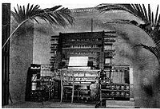
Teleharmonium1897
The ability to record sounds is often connected to the production of electronic music, but not absolutely necessary for it. The earliest known sound recording device was the phonautograph
Phonautograph

The phonautograph was the earliest known invention of a sound transcription device. It was invented by Frenchman Leon Scott and patented on March 25, 1857....
, patented in 1857 by Édouard-Léon Scott de Martinville
Édouard-Léon Scott de Martinville

?douard-L?on Scott de Martinville was a France printer and bookseller who lived in Paris. He invented the earliest known sound recording device, the phonautograph, which was patented on 25 March 1857, as French patent #17,897/31,470....
. It could record sounds visually, but was not meant to play them back.

In 1878, Thomas A. Edison patented the phonograph, which used cylinders similar to Scott
Raymond Scott

Raymond Scott , was an American composer, band leader, pianist, engineer, recording studio maverick, and electronic instrument inventor. He was born in Brooklyn, New York to a family of Russian-Jewish immigrants....
's device. Although cylinders continued in use for some time, Emile Berliner
Emile Berliner

Emile Berliner was a Germany-born United States inventor, best known for developing the gramophone record gramophone . He founded The Berliner Gramophone Company in 1895, The Gramophone Company in London, England, in 1897, Deutsche Grammophon in Hanover, Germany, in 1898 and Berliner Gramophone#Berliner Gram-o-phone Company of Canada in Mon...
 developed the disc phonograph in 1887.

A significant invention, which was later to have a profound effect on electronic music, was Lee DeForest's triode audion
Audion tube

The Audion is an electronic amplifier device invented by Lee De Forest in 1906. It was the forerunner of the triode, in which the current from the Electrical filament to the Plate electrode was controlled by a third element, the grid....
. This was the first thermionic valve, or vacuum tube
Vacuum tube

In electronics, a vacuum tube, electron tube , thermionic valve, or just valve is a device used to amplifier, switch, otherwise modify, or create an Electricity signal by controlling the movement of electrons in a low-pressure space....
, invented in 1906, which led to the generation and amplification of electrical signals, radio broadcasting, and electronic computation, amongst other things.

Before electronic music, there was a growing desire for composers to use emerging technologies for musical purposes. Several instruments were created that employed electromechanical designs and they paved the way for the later emergence of electronic instruments. An electromechanical instrument called the Telharmonium
Telharmonium

The Telharmonium was an early electronic musical instrument, developed by Thaddeus Cahill in 1897. The Telharmonium was intended to be listened to using telephone receivers....
 (sometimes Teleharmonium or Dynamophone) was developed by Thaddeus Cahill
Thaddeus Cahill

Thaddeus Cahill was a prominent inventor of the early 20th century. He is widely credited with the invention of the first electromechanical musical instrument, which he dubbed the telharmonium....
 in the years 1898-1912. However, simple inconvenience hindered the adoption of the Telharmonium, due to its immense size. The first electronic instrument is often viewed to be the Theremin
Theremin

The theremin is an early electronic musical instrument controlled without contact from the player. It is named after its Russian inventor, Professor Leon Theremin, who patented the device in 1928....
, invented by Professor Leon Theremin
Léon Theremin

L?on Theremin was a Russian inventor. He is most famous for his invention of the theremin, one of the first electronic musical instruments. He is also the inventor of interlace, a technique of improving the picture quality of a video signal, widely used in video and television technology....
 circa 1919–1920. Another early electronic instrument was the Ondes Martenot
Ondes Martenot

The ondes Martenot is an early electronic musical instrument, invented in 1928 by Maurice Martenot and originally very similar in sound to the theremin....
, which was most famously used in the Turangalîla-Symphonie
Turangalîla-Symphonie

The Turangal?la-Symphonie is a large-scale piece of orchestral music by Olivier Messiaen. It was written from 1946 to 1948, on a commission by Serge Koussevitzky for the Boston Symphony Orchestra....
 by Olivier Messiaen
Olivier Messiaen

Olivier Messiaen was a French composer, organ , and ornithology. He entered the Conservatoire de Paris at the age of 11 and numbered Paul Dukas, Maurice Emmanuel, Charles-Marie Widor and Marcel Dupr? among his teachers....
 as well as other works by him. It was also used by other, primarily French, composers such as Andre Jolivet
André Jolivet

Andr? Jolivet was a French composer. Known for his devotion to French culture and musical thought, Jolivet's music draws on his interest in acoustics and atonality as well as both ancient and modern influences in music, particularly on instruments used in ancient times....
.

"New Aesthetic of Music"
Just a year later, another significant contribution was made to the advent of experimental music. This was the 1907 publication of Ferruccio Busoni
Ferruccio Busoni

Ferruccio Dante Michelangiolo Benvenuto Busoni was an Italian composer, pianist, editor, writer, piano and composition teacher, and conducting....
's Sketch of a New Esthetic of Music, which discussed the use of electrical and other new sound sources in future music. He wrote of the future of microtonal scales in music, made possible by Cahill's Dynamophone:

Only a long and careful series of experiments, and a continued training of the ear, can render this unfamiliar material approachable and plastic for the coming generation, and for Art.


Also in the Sketch of a New Esthetic of Music, Busoni states:

Quote:

Music as an art, our so-called occidental music, is hardly four hundred years old; its state is one of development, perhaps the very first stage of a development beyond present conception, and we—we talk of "classics" and "hallowed traditions"! And we have talked of them for a long time!

We have formulated rules, stated principles, laid down laws;—we apply laws made for maturity to a child that knows nothing of responsibility!

Young as it is, this child, we already recognize that it possesses one radiant attribute which signalizes it beyond all its elder sisters. And the lawgivers will not see this marvelous attribute, lest their laws should be thrown to the winds. This child—it floats on air! It touches not the earth with its feet. It knows no law of gravitation. It is wellnigh incorporeal. Its material is transparent. It is sonorous air. It is almost Nature herself. It is—free!

But freedom is something that mankind have never wholly comprehended, never realized to the full. They can neither recognize or acknowledge it.

They disavow the mission of this child; they hang weights upon it. This buoyant creature must walk decently, like anybody else. It may scarcely be allowed to leap—when it were its joy to follow the line of the rainbow, and to break sunbeams with the clouds.


Through this writing, as well as personal contact, Busoni had a profound effect on many musicians and composers, perhaps most notably on his pupil, Edgard Varèse
Edgard Varèse

Edgard Victor Achille Charles Var?se, whose name was also spelled Edgar Var?se , was an innovative French-born composer who spent the greater part of his career in the United States....
, who said:

Together we used to discuss what direction the music of the future would, or rather, should take and could not take as long as the straitjacket of the tempered system. He deplored that his own keyboard instrument had conditioned our ears to accept only an infinitesimal part of the infinite gradations of sounds in nature. He was very much interested in the electrical instruments we began to hear about, and I remember particularly one he had read of called the Dynamophone. All through his writings one finds over and over again predictions about the music of the future which have since come true. In fact, there is hardly a development that he did not foresee, as for instance in this extraordinary prophecy: 'I almost think that in the new great music, machines will also be necessary and will be assigned a share in it. Perhaps industry, too, will bring forth her share in the artistic ascent.


Futurists
In Italy
Italy

Italy , officially the Italian Republic , is a country located on the Italian Peninsula in Southern Europe and on the two largest islands in the Mediterranean Sea, Sicily and Sardinia....
, the Futurist
Futurism (art)

Futurism was an art Art movement that originated in Italy in the early 20th century. It was largely an Italian phenomenon, though there were parallel movements in Russia, England and elsewhere....
s were coming at the changing aesthetic from a different angle, but one that also affected the world of classical music. A major thrust of the Futurist philosophy was to value "noise," and to place artistic and expressive value on sounds that had previously not been considered even remotely musical. Balilla Pratella's "Technical Manifesto of Futurist Music" (1911) states that their credo is:

To present the musical soul of the masses, of the great factories, of the railways, of the transatlantic liners, of the battleships, of the automobiles and airplanes. To add to the great central themes of the musical poem the domain of the machine and the victorious kingdom of Electricity.|


On 11 March 1913, futurist Luigi Russolo
Luigi Russolo

Luigi Russolo was an Italian people Futurism painter and composer, and the author of the manifesto The Art of Noises .He is often regarded as one of the first experimental musicians and experimental composers....
 published his manifesto "The Art of Noises
The Art of Noises

The Art of Noises is a futurism manifesto, written by Luigi Russolo in a 1913 letter to friend and Futurist composer Francesco Balilla Pratella....
". In 1914 he held the first "art-of-noises" concert in Milan on April 21. This used his Intonarumori, described by Russolo as "acoustical noise-instruments, whose sounds (howls, roars, shuffles, gurgles, etc.) were hand-activated and projected by horns and megaphones." In June, similar concerts were held in Paris.

The 1920–1930s

This decade brought a wealth of early electronic instruments. Along with the Theremin, there is the presentation of the Ondes Martenot
Ondes Martenot

The ondes Martenot is an early electronic musical instrument, invented in 1928 by Maurice Martenot and originally very similar in sound to the theremin....
, which was designed to reproduce the microtonal sounds found in Hindu music, and the Trautonium
Trautonium

The trautonium is a Monophony electronic musical instrument invented ca. 1929 by Friedrich Trautwein in Berlin. Soon Oskar Sala joined him, continuing development until Sala's death in 2002....
. Maurice Martenot invented the Ondes Martenot in 1928, and soon demonstrated it in Paris.

Another development, which aroused the interest of many composers, occurred in 1919–1920. In Leningrad, Leon Theremin (actually Lev Termen) built and demonstrated his Etherophone, which was later renamed the Theremin. This led to the first compositions for electronic instruments, as opposed to noisemakers and re-purposed machines. In 1929, Joseph Schillinger
Joseph Schillinger

Joseph Schillinger was a composer, music theorist, and composition teacher. He was born in Kharkiv, Ukraine . He graduated from the Classical College in 1914 and the St....
 composed First Airphonic Suite for Theremin and Orchestra, premièred with the Cleveland Orchestra
Cleveland Orchestra

The Cleveland Orchestra is an American orchestra based in Cleveland, Ohio, Ohio. It is one of the five American orchestras commonly referred to as the "Big Five "....
 with Leon Theremin
Léon Theremin

L?on Theremin was a Russian inventor. He is most famous for his invention of the theremin, one of the first electronic musical instruments. He is also the inventor of interlace, a technique of improving the picture quality of a video signal, widely used in video and television technology....
 as soloist.

In 1924, Ottorino Respighi
Ottorino Respighi

Ottorino Respighi was an Italian composer, musicologist and Conducting. He is best known for his orchestral Roman trilogy: Fontane di Roma - "Fountains of Rome"; Pini di Roma - "Pines of Rome"; and Feste Romane - "Roman Festivals"....
 composed The Pines of Rome, which calls for the use of a phonograph
Phonograph

The record player, phonograph or gramophone was the most common device for playing Sound recording and reproduction sound from the 1870s through the 1980s....
 recording of nightingales. However, at the time of composition, phonograph players were acoustical, not electric, and this is actually more along the lines of using a sound effect, and therefore cannot be considered an electroacoustic element in the composition.

The following year, Antheil first composed for mechanical devices, electrical noisemakers, motors and amplifiers in his unfinished opera, Mr. Bloom, as a response to the "art of noises" of Luigi Russolo
Luigi Russolo

Luigi Russolo was an Italian people Futurism painter and composer, and the author of the manifesto The Art of Noises .He is often regarded as one of the first experimental musicians and experimental composers....
, Marinetti and the other Futurists. And just one year later in 1926, was the première of Antheil's Ballet Mécanique
Ballet mécanique

Ballet M?canique was a project by the American composer George Antheil and the filmmaker/artist Fernand L?ger. Although the film was intended to use Antheil's score as a soundtrack, the two parts were not brought together until the 1990s....
, using car horns, airplane propellers, saws, and anvils (but no electronics).

Recording of sounds made a leap in 1927, when American inventor J. A. O'Neill developed a recording device that used magnetically coated ribbon. However, this was a commercial failure. Two years later, Laurens Hammond
Laurens Hammond

Laurens Hammond , was an engineer and inventor. His inventions include, most famously, the Hammond organ and the Hammond clock....
 established his company for the manufacture of electronic instruments. He went on to produce the Hammond organ
Hammond organ

The Hammond organ is an electronic organ which was invented by Laurens Hammond in 1934 and manufactured by the Hammond Organ Company. While the Hammond organ was originally sold to Church as a lower-cost alternative to the wind-driven pipe organ, in the 1960s and 1970s, it became a standard keyboard instrument for jazz, blues, Rock and r...
, which was based on the principles of the Telharmonium
Telharmonium

The Telharmonium was an early electronic musical instrument, developed by Thaddeus Cahill in 1897. The Telharmonium was intended to be listened to using telephone receivers....
, along with other developments including early reverberation units.

The method of photo-optic sound recording used in cinematography made it possible to obtain a visible image of a sound wave, as well as to realize the opposite goal—synthesizing a sound from an artificially drawn sound wave. The research work by the Russian optical engineer Evgeny Murzin taken from 1937 to 1957 made it possible to create a photoelectric synthesizer—a musical instrument that combined three processes: creation, recording, and playback of music. Murzin named his invention in honour of the composer Alexander Nikolayevich Scriabin (“ANS”).

Developments from 1945 to 1960


Musique concrète
Low-fidelity magnetic wire recorders had been in use since 1898 but it was not until the 1930s that the German electronics company AEG
AEG

AEG was a Germany producer of electronics and electrical equipment. AEG was founded in 1883 by Emil Rathenau who had bought some patents from American inventor Thomas Edison....
 developed the first practical tape recorder
Tape recorder

This article deals mainly with analog signal tape recorders for Sound recording and reproduction applications; information on Digital Audio Tape, recording of Videocassette recorder, and data logger can be found in other articles....
, the "Magnetophon
Magnetophon

Magnetophon was the brand or model name of the pioneering reel-to-reel tape recorder developed by engineers of the German electronics company AEG in the 1930s, based on the magnetic tape invention by Fritz Pfleumer....
". During World War II
World War II

World War II, or the Second World War , was a global military conflict which involved a Participants in World War II, including all of the great powers, organised into two opposing military alliances: the Allies of World War II and the Axis powers....
 AEG technicians discovered the AC biasing technique, which dramatically improved the fidlelity of magnetic recording by adding an inaudible high-frequency tone, and by 1943 AEG had developed the first stereo
STEREO

STEREO is a Sun observation mission which was launched on 26 October 2006 at 00:52 GMT. Two nearly identical spacecraft were launched into orbits that cause them to pull respectively further ahead of and fall gradually behind the earth....
 tape recorders. However these devices and techniques remained a secret outside Germany until the end of WWII, when captured Magnetophon recorders and reels of Farben recording tape were brought back to the United States by Jack Mullin
Jack Mullin

John T. "Jack" Mullin was an United States pioneer in the field of magnetic tape sound recording and made significant contributions to many other related fields....
 and others. These captured recorders and tapes were the basis for the development of the first commercial tape recorder, the Model 200, manufactured by the American Ampex
Ampex

Ampex is an United States electronics company founded in 1944 by Alexander M. Poniatoff. The name AMPEX is an acronym, created by its founder, which stands for Alexander M....
 company (Angus 1984) with support from entertainer Bing Crosby
Bing Crosby

Harry Lillis "Bing" Crosby was an United States popular singer and actor whose career lasted from 1926 until his death.One of the first multimedia stars, from 1934 to 1954 Bing Crosby held a nearly unrivaled command of record sales, radio ratings and motion picture grosses....
, who became the first performer to record radio broadcasts and studio master recordings on tape.

It wasn't long before composers began using the tape recorder to develop a new technique for composition called Musique concrète
Musique concrète

Musique concr?te , is a form of electroacoustic music that utilises acousmatic sound as a compositional resource. The compositional material is not restricted to the inclusion of sonorities derived from musical instruments or register s, nor to elements traditionally thought of as 'musical' ....
. This technique involved editing together recorded fragments of natural and industrial sounds. The first pieces of musique concrète were assembled by Pierre Schaeffer
Pierre Schaeffer

Pierre Henri Marie Schaeffer was a France composer, writer, broadcaster, and engineer most widely recognized as the chief pioneer of musique concr?te, a unique genre of experimental music that began in Europe during the mid-1900s....
, who went on to collaborate with Pierre Henry
Pierre Henry

Pierre Henry is a French composer, considered a pioneer of the musique concr?te genre of electronic music.Between 1949 and 1958, Henry worked at the Club d'Essai studio at Office de Radiodiffusion T?l?vision Fran?aise, founded by Pierre Schaeffer....
.

On 5 October 1948, Radiodiffusion Française
Radiodiffusion-Télévision Française

Radiodiffusion-T?l?vision Fran?aise was the France national public broadcasting company established on 9 February 1949 to replace the post-war "Radiodiffusion Fran?aise" , which had been founded in 1945....
 (RDF) broadcast composer Pierre Schaeffer
Pierre Schaeffer

Pierre Henri Marie Schaeffer was a France composer, writer, broadcaster, and engineer most widely recognized as the chief pioneer of musique concr?te, a unique genre of experimental music that began in Europe during the mid-1900s....
's Etude aux chemins de fer. This was the first "movement
Movement (music)

A movement is a self-contained part of a musical composition or musical form. While individual or selected movements from a composition are sometimes performed separately, a performance of the complete work requires all the movements to be performed in succession....
" of Cinq études de bruits, and marked the beginning of studio realizations and musique concrète
Musique concrète

Musique concr?te , is a form of electroacoustic music that utilises acousmatic sound as a compositional resource. The compositional material is not restricted to the inclusion of sonorities derived from musical instruments or register s, nor to elements traditionally thought of as 'musical' ....
 (or acousmatic music). Schaeffer employed a disk-cutting lathe
Lathe

A lathe is a machine tool which spins a block of material to perform various operations such as cutting, sanding, knurling, drilling, or Deformation_ with tools that are applied to the workpiece to create an object which has rotational symmetry about an axis of rotation....
, four turntables, a four-channel mixer, filters, an echo chamber, and a mobile recording unit.

Not long after this, Henry began collaborating with Schaeffer, a partnership that would have profound and lasting affects on the direction of electronic music. Another associate of Schaeffer, Edgard Varèse
Edgard Varèse

Edgard Victor Achille Charles Var?se, whose name was also spelled Edgar Var?se , was an innovative French-born composer who spent the greater part of his career in the United States....
 began work on Déserts, a work for chamber orchestra and tape. The tape parts were created at Pierre Schaeffer's studio, and were later revised at Columbia University.

In 1950, Schaeffer gave the first public (non-broadcast) concert of musique concrète at the Ecole Normale de Musique de Paris
École Normale de Musique de Paris

The ?cole Normale de Musique de Paris is an educational institution providing training for european classical music in Paris, France. The school, established in 1919 by the pianist Alfred Cortot, is officially approved by the Minister of Culture ....
. "Schaeffer used a PA system, several turntables, and mixers. The performance did not go well, as creating live montages with turntables had never been done before." Later that same year, Pierre Henry collaborated with Schaeffer on Symphonie pour un homme seul (1950) the first major work of musique concrete. In Paris in 1951, in what was to become an important worldwide trend, RTF established the first studio for the production of electronic music. Also in 1951, Schaeffer and Henry produced an opera, Orpheus, for concrete sounds and voices.

Elektronische Musik

Karlheinz Stockhausen

Karlheinz Stockhausen was a German composer, widely acknowledged by critics as one of the most important but also controversial composers of the twentieth and early twenty-first centuries....
 worked briefly in Schaeffer's studio in 1952, and afterward for many years at the WDR
Westdeutscher Rundfunk

The Westdeutscher Rundfunk is a Germany public broadcasting institution based in the States of Germany of North Rhine-Westphalia with its main office in K?ln....
 Cologne
Cologne

Cologne is Germany's fourth-largest city , and is the largest city both in the German Federal State of North Rhine-Westphalia and within the Rhine-Ruhr, one of the major European metropolitan areas with more than ten million inhabitants....
's Studio for Electronic Music.

In Cologne, what would become the most famous electronic music studio in the world was officially opened at the radio studios of the NWDR in 1953, though it had been in the planning stages as early as 1950 and early compositions were made and broadcast in 1951. The brain child of Werner Meyer-Eppler
Werner Meyer-Eppler

Werner Meyer-Eppler , was a Germany physicist, experimental acoustician, phonetics, and Information theory.Meyer-Eppler studied mathematics, physics, and chemistry, first at the University of Cologne and then in Bonn, from 1936 until 1939, when he received a doctorate in Physics....
, Robert Beyer, and Herbert Eimert
Herbert Eimert

Herbert Eimert was a Germany Music theory, Musicology, journalist, music critic, Editing, radio producer, and composer....
 (who became its first director), the studio was soon joined by Karlheinz Stockhausen
Karlheinz Stockhausen

Karlheinz Stockhausen was a German composer, widely acknowledged by critics as one of the most important but also controversial composers of the twentieth and early twenty-first centuries....
 and Gottfried Michael Koenig
Gottfried Michael Koenig

Gottfried Michael Koenig is a contemporary German-Dutch composer.He studied church music in Braunschweig, composition, piano, analysis and acoustics in Detmold, music representation techniques in Cologne and computer technique in Bonn....
. In his 1949 thesis Elektronische Klangerzeugung: Elektronische Musik und Synthetische Sprache, Meyer-Eppler conceived the idea to synthesize music entirely from electronically produced signals; in this way, elektronische Musik was sharply differentiated from French musique concrète, which used sounds recorded from acoustical sources.

With Stockhausen and Mauricio Kagel
Mauricio Kagel

Mauricio Kagel was a Germans-Argentina composer who was notable for his interest in developing the theatrical side of musical performance. ...
 in residence, it became a year-round hive of charismatic avante-gardism [sic]" on two occasions combining electronically generated sounds with relatively conventional orchestra
Orchestra

An orchestra is an Musical ensemble, usually fairly large with string, brass, woodwind sections, and possibly a percussion section as well. The term orchestra derives from the name for the area in front of an theatre of ancient Greece reserved for the Greek chorus....
s—in Mixtur (1964) and Hymnen, dritte Region mit Orchester
Hymnen

Hymnen is a work by Karlheinz Stockhausen, composed in 1966?67, and elaborated in 1969....
 (1967). Stockhausen stated that his listeners had told him his electronic music gave them an experience of "outer space," sensations of flying, or being in a "fantastic dream world" More recently, Stockhausen turned to producing electronic music in his own studio in Kürten
Kürten

K?rten is a village and a municipality in the Rheinisch-Bergischer Kreis, in North Rhine-Westphalia, Germany....
, his last work in the genre being Cosmic Pulses (2007).

American electronic music

In the United States, sounds were being created electronically and used in composition, as exemplified in a piece by Morton Feldman
Morton Feldman

Morton Feldman was an American composer, born in New York City.A major figure in 20th century music, Feldman went through several compositional phases....
 called Marginal Intersection. This piece is scored for winds, brass, percussion, strings, 2 oscillators, and sound effects of riveting, and the score uses Feldman's graph notation.

The Music for Magnetic Tape Project was formed by members of the New York School
New York School

The New York School was an informal group of American poets, Paintings, dancers, and musicians active in the 1950s, 1960s in New York City. The poets, painters, composers, dancers, and musicians often drew inspiration from Surrealism and the contemporary avant-garde art movements, in particular action painting, abstract expressionism, Jazz...
 (John Cage
John Cage

John Milton Cage Jr. was an American composer. A pioneer of Aleatoric music, electronic music and Extended technique, Cage was one of the leading figures of the post-war avant-garde and, in the opinion of many, the most influential American composer of the 20th century....
, Earle Brown
Earle Brown

Earle Brown was an American composer. Among his many innovations, he near-singlehandedly re-invigorated classical music with improvisation by establishing his own formal and notational systems....
, Christian Wolff
Christian Wolff (composer)

Christian Wolff is an United States composer of experimental music....
, David Tudor
David Tudor

David Eugene Tudor was an USA pianist and composer of experimental music.Tudor was born in Philadelphia, Pennsylvania. He studied piano with Stefan Wolpe and became known as one of the leading performers of avant garde piano music....
, and Morton Feldman
Morton Feldman

Morton Feldman was an American composer, born in New York City.A major figure in 20th century music, Feldman went through several compositional phases....
), and lasted three years until 1954. Cage wrote of this collaboration,

In this social darkness, therefore, the work of Earle Brown, Morton Feldman, and Christian Wolff continues to present a brilliant light, for the reason that at the several points of notation, performance, and audition, action is provocative.|


Cage completed Williams Mix in 1953 while working with the Music for Magnetic Tape Project. The group had no permanent facility, and had to rely on borrowed time in commercial sound studios, including the studio of Louis and Bebe Barron.

Columbia-Princeton
Also in the U.S., in the same year, significant developments were happening in New York City. Columbia University
Columbia University

Columbia University in the City of New York , is a private university in the United States and a member of the Ivy League. Columbia's main campus lies in the Morningside Heights, Manhattan neighborhood in the borough of Manhattan, in New York City....
 purchased its first tape recorder
Tape recorder

This article deals mainly with analog signal tape recorders for Sound recording and reproduction applications; information on Digital Audio Tape, recording of Videocassette recorder, and data logger can be found in other articles....
—a professional Ampex
Ampex

Ampex is an United States electronics company founded in 1944 by Alexander M. Poniatoff. The name AMPEX is an acronym, created by its founder, which stands for Alexander M....
 machine—for the purpose of recording concerts.

Vladimir Ussachevsky

Vladimir Kirilovitch Ussachevsky was a composer, particularly known for his work in electronic music....
, who was on the music faculty of Columbia University, was placed in charge of the device, and almost immediately began experimenting with it.

Herbert Russcol writes: "Soon he was intrigued with the new sonorities he could achieve by recording musical instruments and then superimposing them on one another."

Ussachevsky said later: "I suddenly realized that the tape recorder could be treated as an instrument of sound transformation."

On Thursday, May 8, 1952, Ussachevsky presented several demonstrations of tape music/effects that he created at his Composers Forum, in the McMillin Theatre at Columbia University. These included Transposition, Reverberation, Experiment, Composition, and Underwater Valse. In an interview, he stated: "I presented a few examples of my discovery in a public concert in New York together with other compositions I had written for conventional instruments." Otto Luening
Otto Luening

Otto Luening was a German-American composer and conductor, and an early pioneer of tape music and electronic music.Leuning was born in Milwaukee, Wisconsin to German parents....
, who had attended this concert, remarked: "The equipment at his disposal consisted of an Ampex tape recorder . . . and a simple box-like device designed by the brilliant young engineer, Peter Mauzey, to create feedback, a form of mechanical reverberation. Other equipment was borrowed or purchased with personal funds."

Just three months later, in August 1952, Ussachevsky traveled to Bennington, Vermont at Luening's invitation to present his experiments. There, the two collaborated on various pieces. Luening described the event: "Equipped with earphones and a flute, I began developing my first tape-recorder composition. Both of us were fluent improvisors and the medium fired our imaginations." They played some early pieces informally at a party, where "a number of composers almost solemnly congratulated us saying, 'This is it' ('it' meaning the music of the future)."

Word quickly reached New York City. Oliver Daniel telephoned and invited the pair to "produce a group of short compositions for the October concert sponsored by the American Composers Alliance and Broadcast Music, Inc., under the direction of Leopold Stokowski at the Museum of Modern Art in New York. After some hesitation, we agreed. . . . Henry Cowell
Henry Cowell

Henry Cowell was an United States composer, music theory, pianist, teacher, publisher, and impresario. His contribution to the world of music was summed up by Virgil Thomson, writing in the early 1950s:...
 placed his home and studio in Woodstock, New York, at our disposal. With the borrowed equipment in the back of Ussachevsky's car, we left Bennington for Woodstock and stayed two weeks. . . . In late September, 1952, the travelling laboratory reached Ussachevsky's living room in New York, where we eventually completed the compositions."

Two months later, on October 28, Vladimir Ussachevsky and Otto Luening presented the first Tape Music concert in the United States. The concert included Luening's Fantasy in Space (1952)—"an impressionistic virtuoso
Virtuoso

A virtuoso is an individual who possesses outstanding technical ability at singing or playing a musical instrument. The plural form is either virtuosi or the Anglicisation, virtuosos, and the feminine form sometimes used is virtuosa....
 piece" using manipulated recordings of flute—and Low Speed (1952), an "exotic composition that took the flute far below its natural range." Both pieces were created at the home of Henry Cowell in Woodstock, NY. After several concerts caused a sensation in New York City, Ussachevsky and Luening were invited onto a live broadcast of NBC's Today Show to do an interview demonstration—the first televised electroacoustic performance. Luening described the event: "I improvised some [flute] sequences for the tape recorder. Ussachevsky then and there put them through electronic transformations."

1954 saw the advent of what would now be considered authentic electric plus acoustic compositions—acoustic instrumentation augmented/accompanied by recordings of manipulated and/or electronically generated sound. Three major works were premiered that year: Varèse's Déserts, for chamber ensemble and tape sounds, and two works by Luening and Ussachevsky: Rhapsodic Variations for the Louisville Symphony and A Poem in Cycles and Bells, both for orchestra and tape. Because he had been working at Schaeffer's studio, the tape part for Varèse's work contains much more concrete sounds than electronic. "A group made up of wind instruments, percussion and piano alternates with mutated sounds of factory noises and ship sirens and motors, coming from two loudspeakers."

Déserts was premiered in Paris in the first stereo
STEREO

STEREO is a Sun observation mission which was launched on 26 October 2006 at 00:52 GMT. Two nearly identical spacecraft were launched into orbits that cause them to pull respectively further ahead of and fall gradually behind the earth....
 broadcast on French Radio. At the German premiere in Hamburg
Hamburg

Hamburg is the second-largest city in Germany , and is the Largest cities of the European Union by population within city limits. The city is home to approximately 1.8 million people, while the Hamburg metropolitan area has more than 4.3 million inhabitants....
, which was conducted by Bruno Maderna
Bruno Maderna

Bruno Maderna was an Italians-German conducting and composer....
, the tape controls were operated by Karlheinz Stockhausen
Karlheinz Stockhausen

Karlheinz Stockhausen was a German composer, widely acknowledged by critics as one of the most important but also controversial composers of the twentieth and early twenty-first centuries....
. The title Déserts, suggested to Varèse not only, "all physical deserts (of sand, sea, snow, of outer space, of empty streets), but also the deserts in the mind of man; not only those stripped aspects of nature that suggest bareness, aloofness, timelessness, but also that remote inner space no telescope can reach, where man is alone, a world of mystery and essential loneliness."

Stochastic music
An important new development was the advent of computers for the purpose of composing music, as opposed to manipulating or creating sounds. Iannis Xenakis
Iannis Xenakis

Iannis Xenakis was a Greeks modernist composer, musical theoretician, and architect. He is regarded as an important and influential composer of the twentieth century....
 began what is called "musique stochastique," or "stochastic music," which is a method of composing that employs mathematical probability systems. Different probability algorithms were used to create a piece under a set of parameters. Xenakis used graph paper and a ruler to aid in calculating the velocity trajectories of glissandi
Glissando

A glissando is a glide from one pitch to another. It is an Italianized Musical terminology derived from the French glisser, to glide....
 for his orchestral composition Metastasis (1953–54), but later turned to the use of computers to compose pieces like ST/4 for string quartet and ST/48 for orchestra (both 1962).

Mid to late 1950s

In 1954, Stockhausen composed his Elektronische Studie II—the first electronic piece to be published as a score.

In 1955, more experimental and electronic studios began to appear. Notable were the creation of the Studio de Fonologia (already mentioned), a studio at the NHK
NHK

, or Japan Broadcasting Corporation, is Japan's public broadcaster. The NHK is financed by a television licence. This Japanese public corporation has always identified itself to its audiences by the English pronunciation of its initials, NHK....
 in Tokyo
Tokyo

, officially , is one of the 47 prefectures of Japan of Japan and located on the eastern side of the main island Honshu. The twenty-three special wards of Tokyo, each governed as a city, cover the area that was once the Tokyo City in the eastern part of the prefecture, and total over 8 million people....
 founded by Toshiro Mayuzumi, and the Phillips studio at Eindhoven
Eindhoven

Eindhoven is a municipality and a city located in the province of North Brabant in the south of the Netherlands, originally at the confluence of the Dommel and Gender streams....
, the Netherlands
Netherlands

The Netherlands is a country that is part of the Kingdom of the Netherlands. It is a parliamentary democratic constitutional monarchy. The Netherlands is located in North-West Europe, and bordered by the North Sea to the north and west, Belgium to the south, and Germany to the east....
, which moved to the University of Utrecht as the Institute of Sonology in 1960.

The score for Forbidden Planet
Forbidden Planet

Forbidden Planet is a 1956 in film science fiction film directed by Fred M. Wilcox and starring Walter Pidgeon, Anne Francis and Leslie Nielsen....
, by Louis and Bebe Barron
Louis and Bebe Barron

Louis and Bebe Barron were two United States pioneers in the field of electronic music. They are credited with writing the first electronic music for magnetic tape, and the first entirely electronic film score for the Metro-Goldwyn-Mayer movie Forbidden Planet ....
, was entirely composed using custom built electronic circuits in 1956.

The world's first computer to play music was CSIRAC
CSIRAC

CSIRAC , originally known as CSIR Mk 1, was Australia's first digital computer, and the fourth stored program computer in the world. It was first to play digital music and is the only surviving first-generation computer....
 which was designed and built by Trevor Pearcey
Trevor Pearcey

Trevor Pearcey was a United Kingdom born Australian scientist, who created CSIRAC, one of the first ever stored program electronic computers in the world....
 and Maston Beard. Mathematician Geoff Hill programmed the CSIRAC to play popular musical melodies from the very early 1950s. In 1951 it publicly played the Colonel Bogey March of which no known recordings exist. However, CSIRAC
CSIRAC

CSIRAC , originally known as CSIR Mk 1, was Australia's first digital computer, and the fourth stored program computer in the world. It was first to play digital music and is the only surviving first-generation computer....
 played standard repertoire and was not used to extend musical thinking or composition practice which is current computer music practice. CSIRAC was never recorded, but the music played was accurately reconstructed (reference 12). The oldest known recordings of computer generated music were played by the Ferranti Mark I
Ferranti Mark I

The Ferranti Mark I, also known as the Manchester Electronic Computer in its sales literature, was the world's first commercially available general-purpose electronic computer....
 computer, a commercial version of the Baby Machine from the University of Manchester
Victoria University of Manchester

The Victoria University of Manchester was a university in Manchester, England. On 1 October 2004 it merged with the University of Manchester Institute of Science and Technology to form a new entity, "University of Manchester"....
 in the autumn of 1951. The music program was written by Christopher Strachey
Christopher Strachey

Christopher Strachey was a United Kingdom computer scientist. He was one of the founders of denotational semantics, and a pioneer in programming language design....
.

The impact of computers continued in 1956. Lejaren Hiller
Lejaren Hiller

Lejaren Arthur Hiller was an United States composer who founded the Experimental Music Studio at the University of Illinois at Urbana-Champaign in 1958 and collaborated on the first significant computer music composition, 1957's Illiac Suite, with Leonard Issacson....
 and Leonard Isaacson composed Iliac Suite for string quartet
String quartet

A string quartet is a musical ensemble of four string instruments — usually two violins, a viola and cello — or a piece written to be performed by such a group....
, the first complete work of computer-assisted composition using algorithm
Algorithm

In mathematics, computing, linguistics and related subjects, an algorithm is a sequence of finite instructions, often used for calculation and data processing....
ic composition. "... Hiller postulated that a computer could be taught the rules of a particular style and then called on to compose accordingly." Later developments included the work of Max Mathews
Max Mathews

Max Vernon Mathews is a pioneer in the world of computer music. He studied electrical engineering at the California Institute of Technology and the Massachusetts Institute of Technology, receiving a Sc.D....
 at Bell Laboratories, who developed the influential MUSIC I
MUSIC-N

MUSIC-N refers to a family of computer music programs and programming languages descended from or influenced by MUSIC, a program written by Max Mathews in 1957 at Bell Labs....
 program. Vocoder
Vocoder

A vocoder, , is an analysis / synthesis system, mostly used for speech in which the input is passed through a multiband filter, each filter is passed through an envelope follower, the control signals from the envelope followers are communicated, and the decoder applies these control signals to corresponding filters in the synthesizer....
 technology was also a major development in this early era.

In 1956 Stockhausen composed Gesang der Jünglinge
Gesang der Jünglinge

Gesang der J?nglinge is a noted electronic music work by Karlheinz Stockhausen. It was realized in 1955?56 at the Westdeutscher Rundfunk studio in Cologne....
, the first major work of the Cologne
Cologne

Cologne is Germany's fourth-largest city , and is the largest city both in the German Federal State of North Rhine-Westphalia and within the Rhine-Ruhr, one of the major European metropolitan areas with more than ten million inhabitants....
 studio, based on a text from the Book of Daniel
Book of Daniel

The Book of Daniel is a book in both the Hebrew Bible and the Christian Old Testament. Originally written in Hebrew language and Aramaic language, it is set during the Babylonian Captivity, a period when Jews were deported and exiled to Babylon following the Siege of Jerusalem of 597 BC....
. An important technological development of that year was the invention of the Clavivox
Clavivox

The Clavivox was a keyboard synthesizer and Music sequencer invented by American composer Raymond Scott in 1952, and patented in 1956. Scott had earlier built a theremin as a toy for his daughter Carrie....
 synthesizer
Synthesizer

A synthesizer is an electronic instrument capable of producing a variety of sounds by generating and combining signals of different frequency....
 by Raymond Scott
Raymond Scott

Raymond Scott , was an American composer, band leader, pianist, engineer, recording studio maverick, and electronic instrument inventor. He was born in Brooklyn, New York to a family of Russian-Jewish immigrants....
 with subassembly by Robert Moog
Robert Moog

Dr. Robert Arthur Moog was an American pioneer of electronic music, best known as the inventor of the Moog synthesizer....
.

The RCA Mark II Sound Synthesizer
RCA Mark II Sound Synthesizer

The RCA Mark II Sound Synthesizer was the first programmable electronic music synthesizer and the flagship piece of equipment at the Columbia-Princeton Electronic Music Center....
 made its debut in 1957. Unlike the earlier Theremin and Ondes Martenot, it was difficult to use, required extensive programming, and could not be played in real time. Sometimes called the first electronic synthesizer, the RCA Mark II Sound Synthesizer
RCA Mark II Sound Synthesizer

The RCA Mark II Sound Synthesizer was the first programmable electronic music synthesizer and the flagship piece of equipment at the Columbia-Princeton Electronic Music Center....
 used vacuum tube
Vacuum tube

In electronics, a vacuum tube, electron tube , thermionic valve, or just valve is a device used to amplifier, switch, otherwise modify, or create an Electricity signal by controlling the movement of electrons in a low-pressure space....
 oscillators and incorporated the first electronic music sequencer
Music sequencer

A music sequencer is software or hardware designed to create and manage computer-generated music.Originally, music sequencers did not include the ability to record audio....
 driven by two punched-paper tapes. It was designed by RCA and installed at the Columbia-Princeton Electronic Music Center where it remains to this day.

In 1957, MUSIC
MUSIC-N

MUSIC-N refers to a family of computer music programs and programming languages descended from or influenced by MUSIC, a program written by Max Mathews in 1957 at Bell Labs....
, one of the first computer programs to play electronic music, was created by Max Mathews
Max Mathews

Max Vernon Mathews is a pioneer in the world of computer music. He studied electrical engineering at the California Institute of Technology and the Massachusetts Institute of Technology, receiving a Sc.D....
 at Bell Laboratories.

Later, Milton Babbitt
Milton Babbitt

Milton Byron Babbitt is an American composer. He is particularly noted for his pioneering Serialism, and electronic music....
, influenced in his student years by Schoenberg's "revolution in musical thought" began applying serial techniques to electronic music.

From 1950 to 1960 the vocabulary of tape music shifted from the fairly pure experimental works which characterized the classic Paris and Cologne schools to more complex and expressive works which explored a wide range of compositional styles. More and more works began to appear by the mid-1950s which addressed the concept of combining taped sounds with live instruments and voices. There was also a tentative interest, and a few attempts, at incorporating taped electronic sounds into theatrical works.|


The public remained interested in the new sounds being created around the world, as can be deduced by the inclusion of Varèse's Poeme Electronique, which was played over four hundred loudspeakers at the Phillips Pavilion of the 1958 Brussels World Fair
Expo '58

Expo 58, also known as the Brussels World?s Fair, Brusselse Wereldtentoonstelling or Exposition Universelle et Internationale de Bruxelles, was held from 17 April to 19 October 1958....
. That same year, Mauricio Kagel
Mauricio Kagel

Mauricio Kagel was a Germans-Argentina composer who was notable for his interest in developing the theatrical side of musical performance. ...
, an Argentine
Argentina

Argentina, officially the Argentine Republic , is a country in South America, constituted as a federation of 23 provinces and an autonomous city....
 composer, composed Transición II. The work was realized at the WDR studio in Cologne. Two musicians perform on a piano, one in the traditional manner, the other playing on the strings, frame, and case. Two other performers use tape to unite the presentation of live sounds with the future of prerecorded materials from later on and its past of recordings made earlier in the performance.

The 1960s


These were fertile years for electronic music—not just for academia, but for independent artists as synthesizer
Synthesizer

A synthesizer is an electronic instrument capable of producing a variety of sounds by generating and combining signals of different frequency....
 technology became more accessible. By this time, a strong community of composers and musicians working with new sounds and instruments was established and growing. 1960 witnessed the composition of Luening's Gargoyle
Gargoyle

In architecture, a gargoyle is a carved stone grotesque with a spout designed to convey water from a roof and away from the side of a building....
s
for violin and tape as well as the premiere of Stockhausen's Kontakte
Kontakte (Stockhausen)

Kontakte is a celebrated electronic music work by Karlheinz Stockhausen, realized in 1958-1960 at the Westdeutscher Rundfunk electronic-music studio in Cologne with the assistance of Gottfried Michael Koenig....
 for electronic sounds, piano, and percussion. This piece existed in two versions—one for 4-channel tape, and the other for tape with human performers. "In Kontakte, Stockhausen abandoned traditional musical form based on linear development and dramatic climax. This new approach, which he termed 'moment form,' resembles the 'cinematic splice' techniques in early twentieth century film."

The first of these synthesizers to appear was the Buchla
Buchla

Buchla & Associates, Inc. is a manufacturer of electronic musical instruments, notably synthesizers and unique MIDI controllers. The 200e Electric Music Box is currently in production....
. Appearing in 1963, it was the product of an effort spearheaded by musique concrète composer Morton Subotnick
Morton Subotnick

Morton Subotnick is an United States of America composer of electronic music, best known for his Silver Apples of the Moon, the first electronic work commissioned by a record company, Nonesuch Records....
. In 1962, working with a grant from the Rockefeller Foundation
Rockefeller Foundation

The Rockefeller Foundation is a prominent philanthropic organization and private foundation based at 420 Fifth Avenue, New York City. The preeminent institution established by the six-generation Rockefeller family, it was founded by John D....
, Subotnick and business partner Ramon Sender
Ramon Sender

Ramon Sender is a composer, writer and the co-founder, with Morton Subotnick, of the San Francisco Tape Music Center in 1961. He studied with George Copeland, Elliott Carter, and Robert Erickson....
 hired electrical engineer Don Buchla
Don Buchla

Don Buchla is a pioneer in the field of sound synthesizers, releasing his first units months after Robert Moog's first synthesizers. However, his instrument was arguably designed before Moog's....
 to build a "black box" for composition.

The theremin
Theremin

The theremin is an early electronic musical instrument controlled without contact from the player. It is named after its Russian inventor, Professor Leon Theremin, who patented the device in 1928....
 had been in use since the 1920s but it attained a degree of popular recognition through its use in science-fiction film soundtrack
Soundtrack

The term soundtrack refers to three related concepts: recorded music accompanying and synchronized to the images of a motion picture, television program or video game; a commercially released soundtrack album of music as featured in the soundtrack of a film or TV show; and the physical area of a film that contains the synchronized recorded so...
 music in the 1950s (e.g., Bernard Herrmann
Bernard Herrmann

Bernard Herrmann was an United States composer noted for his work in motion pictures.An Academy Award-winner , Herrmann is particularly known for collaboration with director Alfred Hitchcock, most famously Psycho , North by Northwest, The Man Who Knew Too Much, and Vertigo ....
's classic score for The Day the Earth Stood Still
The Day the Earth Stood Still

The Day the Earth Stood Still is a 1951 in film black-and-white science fiction film that tells the story of a humanoid alien visitor who comes to Earth with a warning....
). During the 1960s the theremin made occasional appearances in popular music, most notably on The Beach Boys
The Beach Boys

The Beach Boys are an American rock band. Formed in 1961, the group gained popularity for its close harmony and lyrics reflecting a California youth culture of cars and surfing....
 1966 "Good Vibrations
Good Vibrations

"Good Vibrations" is a Pop music single by The Beach Boys. The song was composed by and record producer by Brian Wilson, with lyrics by Wilson and Mike Love....
".

In the UK in this period, the BBC Radiophonic Workshop
BBC Radiophonic Workshop

The BBC Radiophonic Workshop, one of the sound effects units of the BBC, was created in 1958 to produce effects and new music for radio, and was closed in March 1998, although much of its traditional work had already been outsourced by 1995....
 (established in 1958) emerged one of the most productive and widely known electronic music studios in the world, thanks in large measure to their work on the BBC science-fiction series Doctor Who
Doctor Who

Doctor Who is a British Science fiction on television programme produced by the BBC. The programme depicts the adventures of a mysterious alien Time travel known as "Doctor " who travels in his space and time-ship, the TARDIS, which normally appears from the exterior to be a blue 1950s police box....
. One of the most influential British electronic artists in this period was Workshop staffer Delia Derbyshire
Delia Derbyshire

Delia Ann Derbyshire was an English people musician and composer of electronic music. She is best known for her electronic realisation of Ron Grainer's Doctor Who theme music to the British science fiction television series Doctor Who and for her work with the BBC Radiophonic Workshop....
, who added a keen musical ear to her great technical prowess; she is famous for her landmark 1963 electronic realisation of the iconic Doctor Who theme, composed by Ron Grainer
Ron Grainer

Ron Grainer was an Australian-born composer who worked for most of his professional career in the United Kingdom. He is mostly remembered for his film and television music....
, arguably the most widely known piece of electronic music in the world. Derbyshire and her colleagues -- including Dick Mills
Dick Mills

Dick Mills is a United Kingdom sound engineer, specialising in electronic music sound effects which he produced at the BBC Radiophonic Workshop....
, Brian Hodgson
Brian Hodgson

Brian Hodgson is a United Kingdom television composer and sound technician. Born in Liverpool, Hodgson joined the BBC Radiophonic Workshop in 1962 where he became the original sound effects creator for the science fiction programme Doctor Who....
 (creator of the TARDIS
TARDIS

The TARDIS is a Time travel and spacecraft in the United Kingdom Science fiction on television programme Doctor Who.A product of Time Lord technology, a properly maintained and piloted TARDIS can transport its occupants to any point in time and space....
 sound effect), David Cain
David Cain

David Cain may refer to:*David Cain , professor of religion at the University of Mary Washington*David Cain , former State Senator of the 2nd District of Texas...
, John Baker
John Baker

There are several persons known by the name John Baker:...
, Paddy Kingsland
Paddy Kingsland

Paddy Kingsland is a composer of electronic music best known for his incidental music for science fiction series on BBC radio and television whilst working at the BBC Radiophonic Workshop....
 and Peter Howell
Peter Howell

Peter Howell is a musician and composer. He is best-known for his work on Doctor Who as a member of the BBC Radiophonic Workshop.Howell's musical career began in the late 1960s working with John Ferdinando in various psych folk bands including Agincourt and Ithaca....
 -- collectively created a large and very varied body of work that includes station ID stings, program jingles, soundtracks, atmospheres and sound effects for BBC TV and radio stations and programs.

Milton Babbitt composed his first electronic work using the synthesizer—his Composition for Synthesizer—which he created using the RCA synthesizer at CPEMC.

For Babbitt, the RCA synthesizer was a dream come true for three reasons. First, the ability to pinpoint and control every musical element precisely. Second, the time needed to realize his elaborate serial structures were brought within practical reach. Third, the question was no longer "What are the limits of the human performer?" but rather "What are the limits of human hearing?


The collaborations also occurred across oceans and continents. In 1961, Ussachevsky invited Varèse to the Columbia-Princeton Studio (CPEMC). Upon arrival, Varese embarked upon a revision of Déserts. He was assisted by Mario Davidovsky
Mario Davidovsky

Mario Davidovsky is an Argentina-United States composer. Born in Argentina, he emigrated in 1960 to the US, where he lives today. He is best known for his series of compositions called Synchronisms, which in live performance incorporate both acoustic instruments and electroacoustic sounds played from a tape....
 and Bülent Arel
Bülent Arel

B?lent Arel was a Turkey composer of contemporary classical music and electronic music.He studied composition at the Ankara Conservatory and Audio engineering in Paris....
.

The intense activity occurring at CPEMC and elsewhere inspired the establishment of the San Francisco Tape Music Center in 1963 by Morton Subotnick
Morton Subotnick

Morton Subotnick is an United States of America composer of electronic music, best known for his Silver Apples of the Moon, the first electronic work commissioned by a record company, Nonesuch Records....
, with additional members Pauline Oliveros, Ramon Sender, Terry Riley
Terry Riley

Terry Riley is an American composer associated with the minimalism school....
, and Anthony Martin. The center soon incorporated a voltage-controlled synthesizer based around automated sequencing by Don Buchla
Don Buchla

Don Buchla is a pioneer in the field of sound synthesizers, releasing his first units months after Robert Moog's first synthesizers. However, his instrument was arguably designed before Moog's....
, and used in album-length Subotnick pieces such as Silver Apples of the Moon (1967) and The Wild Bull (1968).

Later, the Center moved to Mills College
Mills College

Mills College is an independent Liberal arts colleges in the United States Women's colleges in the United States founded in 1852 that offers bachelor's degrees to women and graduate degrees and certificates to women and men....
, directed by Pauline Oliveros, where it is today known as the Center for Contemporary Music.

Back across the Atlantic, in Czechoslovakia
Czechoslovakia

Czechoslovakia was a sovereign state in Central Europe that existed from October 1918 until 1992 . On January 1, 1993, Czechoslovakia dissolution of Czechoslovakia into the Czech Republic and Slovakia....
, 1964, the First Seminar of Electronic Music was held at the Radio Broadcast Station in Plzen. Four government-sanctioned electroacoustic music studios were later established in the 1960s under the auspices of extant radio and television stations.

New instruments continued to develop. One of the most significant breakthroughs came in 1964, when Robert Moog
Robert Moog

Dr. Robert Arthur Moog was an American pioneer of electronic music, best known as the inventor of the Moog synthesizer....
 introduced the Moog synthesizer
Moog synthesizer

Moog synthesizer may refer to any number of analog synthesizers designed by Dr. Robert Moog or manufactured by Moog Music, and is commonly used as a generic term for analog and digital music synthesisers....
, the first integrated modular voltage controlled analog synthesiser system. Moog Music
Moog Music

Moog Music is an United States of America company based in Asheville, North Carolina which manufactures electronic musical instruments. The current Moog Music is the second company to trade under that name....
 later introduced a smaller synthesizer with a built-in keyboard and hardwired signal path called The Minimoog, which was introduced to many composers and universities and beacme widely used by popular musicians.

A well-known example of the use of Moog's full-sized Moog Modular synthesizer is the Switched-On Bach
Switched-On Bach

Switched-On Bach is a musical album by Wendy Carlos and Benjamin Folkman, produced by Carlos and Rachel Elkind and released in 1968 by CBS Records....
 album by Wendy Carlos
Wendy Carlos

Wendy Carlos is an United States composer and electronic musician. She gained fame in the late 1960s for playing on the Moog synthesizer, which was a relatively new and unknown instrument at the time....
, which triggered a craze for synthesiser music. This decade saw construction of more than 50 electronic music studios in the USA, mostly in universities.

Pietro Grossi
Pietro Grossi

Pietro Grossi was an Italians composer pioneer of computer music, who first in Italy experimented with electronic techniques in the early sixties....
 was an italian pioneer of computer composition and tape music, who first experimented with electronic techniques in the early sixties. Grossi was a cellist and composer, born in Venice in 1917. He founded the S 2F M (Studio de Fonologia Musicale di Firenze) in 1963 in order to experiment with electronic sound and composition.

Computer music

CSIRAC
CSIRAC

CSIRAC , originally known as CSIR Mk 1, was Australia's first digital computer, and the fourth stored program computer in the world. It was first to play digital music and is the only surviving first-generation computer....
, the first computer to play music, did so publicly in August 1951 (reference 12). One of the first large-scale public demonstrations of computer music
Computer music

Computer music is a term that was originally used within academia to describe a field of study relating to the applications of computing technology in music composition; particularly that stemming from the Western art music tradition....
 was a pre-recorded national radio broadcast on the NBC radio network
Radio network

A radio network is a network system which distributes radio programming to multiple radio station simultaneously, or slightly delayed, for the purpose of extending total coverage beyond the limits of a single broadcast signal....
 program Monitor
Monitor (NBC Radio)

NBC Monitor was a weekend radio program broadcast which ran from June 12, 1955 in radio until January 26, 1975 in radio. Airing live and nationwide on NBC Radio, originally beginning Saturday morning at 8am and continuing through the weekend until midnight on Sunday, it offered a magazine-of-the-air mix of news, sports, comedy, variety, musi...
 on February 10, 1962. In 1961, LaFarr Stuart
LaFarr Stuart

LaFarr Stuart , now retired, was an early computer music pioneer, computer engineer and member of the Homebrew Computer Club....
 programmed Iowa State University
Iowa State University

The Iowa State University of Science and Technology, more commonly known as Iowa State University , is a public land-grant university and Space grant colleges university located in Ames, Iowa, United States....
's CYCLONE
Cyclone

In meteorology, a cyclone refers to an area of closed, circular fluid motion rotating in the same direction as the Earth's rotation. This is usually characterized by inward spiraling winds that rotate counter clockwise in the Northern Hemisphere and clockwise in the Southern Hemisphere of the Earth....
 computer (a derivative of the Illiac
ILLIAC

ILLIAC was the name given to a series of supercomputers built at the University of Illinois at Urbana-Champaign. In all, five computers were built in this series between 1951 and 1974....
) to play simple, recognizable tunes through an amplified speaker that had been attached to the system originally for administrative and diagnostic purposes. An interview with Mr. Stuart accompanied his computer music.

The late 1950s, 1960s and 1970s also saw the development of large mainframe computer synthesis. Starting in 1957, Max Mathews of Bell Labs developed the MUSIC programs, culminating in MUSIC V
MUSIC-N

MUSIC-N refers to a family of computer music programs and programming languages descended from or influenced by MUSIC, a program written by Max Mathews in 1957 at Bell Labs....
, a direct digital synthesis language (Mattis 2001).

Live electronics


In America, live electronics were pioneered in the early 1960s by members of Milton Cohen's Space Theater in Ann Arbor, Michigan
Ann Arbor, Michigan

Ann Arbor is a city in the U.S. state of Michigan and the county seat of Washtenaw County, Michigan. It is the state's seventh largest city with a population of 114,024 as of the 2000 United States Census, of which 36,892 are university or college students....
, including Gordon Mumma
Gordon Mumma

Gordon Mumma is a composer. He cofounded Ann Arbor's Cooperative Studio for Electronic Music with Robert Ashley, was a musician with the Merce Cunningham Dance Company and was a member of the Sonic Arts Union with Ashley, Alvin Lucier, and David Behrman....
 and Robert Ashley
Robert Ashley

Robert Ashley is a contemporary American composer born March 28, 1930 in Ann Arbor, Michigan, best known for his operas and other theatrical works, many of which incorporate electronic music and extended techniques....
, by individuals such as David Tudor
David Tudor

David Eugene Tudor was an USA pianist and composer of experimental music.Tudor was born in Philadelphia, Pennsylvania. He studied piano with Stefan Wolpe and became known as one of the leading performers of avant garde piano music....
 around 1965, and The Sonic Arts Union, founded in 1966 by Gordon Mumma, Robert Ashley, Alvin Lucier
Alvin Lucier

Alvin Lucier is an American composer of experimental music and sound installations that explore acoustic phenomena and auditory perception. Lucier was a member of the influential Sonic Arts Union, which included Robert Ashley, David Behrman, and Gordon Mumma....
, and David Behrman
David Behrman

David Behrman is a United States composer and the producer of Columbia Records' Music of Our Time series. He was also a founding member of the Sonic Arts Union....
. ONCE Festivals, featuring multimedia theater music, were organized by Robert Ashley and Gordon Mumma in Ann Arbor between 1958 and 1969. In 1960, John Cage
John Cage

John Milton Cage Jr. was an American composer. A pioneer of Aleatoric music, electronic music and Extended technique, Cage was one of the leading figures of the post-war avant-garde and, in the opinion of many, the most influential American composer of the 20th century....
 composed Cartridge Music, one of the earliest live-electronic works.

In Europe in 1964, Karlheinz Stockhausen composed Mikrophonie I
Mikrophonie (Stockhausen)

Mikrophonie is the title given by Karlheinz Stockhausen to two of his compositions, written in 1964 and 1965, in which ?normally inaudible vibrations ....
 for tam-tam, hand-held microphones, filters, and potentiometers, and Mixtur for orchestra, four sine-wave
Sine wave

The sine wave or sinusoid is a function that occurs often in mathematics, physics, signal processing, hearing , electrical engineering, and many other fields....
 generators, and four ring modulators. In 1965 he composed Mikrophonie II
Mikrophonie (Stockhausen)

Mikrophonie is the title given by Karlheinz Stockhausen to two of his compositions, written in 1964 and 1965, in which ?normally inaudible vibrations ....
 for choir, Hammond organ, and ring modulators.

In 1966-67 Reed Ghazala
Reed Ghazala

Qubais Reed Ghazala, an American author, photographer, composer, musician and experimental instrument builder, is recognized as the "Father of circuit bending," having discovered the technique in 1966, pioneered it, named it, and having taught it ever since....
 discovered and began to teach "circuit bending
Circuit bending

Circuit bending is the creative, short circuit of electronic devices such as low voltage, battery-powered guitar effects, children's toys and small digital synthesizers to create new musical or visual instruments and sound generators....
"—the application of the creative short circuit, a process of chance short-circuiting, creating experimental electronic instruments, exploring sonic elements mainly of timbre and with less regard to pitch or rhythm, and influenced by John Cage
John Cage

John Milton Cage Jr. was an American composer. A pioneer of Aleatoric music, electronic music and Extended technique, Cage was one of the leading figures of the post-war avant-garde and, in the opinion of many, the most influential American composer of the 20th century....
’s aleatoric music
Aleatoric music

Aleatoric music is music in which some Aspect of music is left to Randomness, and/or some primary element of a composed work's realization is left to the determination of its performer....
 concept.

1970s to mid-80s

In 1970, Charles Wuorinen
Charles Wuorinen

Charles Wuorinen is an United States composer. Wuorinen is a prolific composer of primarily serialism instrumental music and high profile proponent of contemporary music....
 composed Time's Encomium, the first Pulitzer Prize winner for an entirely electronic composition
Affordable synthesisers
Released in 1970 by Moog Music
Moog Music

Moog Music is an United States of America company based in Asheville, North Carolina which manufactures electronic musical instruments. The current Moog Music is the second company to trade under that name....
 the Mini-Moog
Minimoog

The Minimoog is a monophonic analog synthesizer, invented by Bill Hemsath and Robert Moog. Released in 1971 by the original Moog Music, it was among the first widely available, portable and relatively affordable synthesizers....
 was among the first widely available, portable and relatively affordable synthesizers. It became the most widely used synthesizer in both popular and electronic art music.

IRCAM
IRCAM
IRCAM

IRCAM is a European institute for science about music and sound and avant garde Electroacoustical art music. It is situated next to, and is organizationally linked with, the Centre Pompidou in Paris....
 in Paris became a major center for computer music research and realization and development of the Sogitec 4X
Sogitec 4X

The Sogitec 4X was a digital sound processing workstation developed by Giuseppe Di Giugno at IRCAM in the 1980's. It was the last large hardware processor before the development of the ISPW....
 computer system, featuring then revolutionary real-time digital signal processing. Pierre Boulez
Pierre Boulez

Pierre Boulez is a French composer of contemporary classical music and Conducting....
's Répons (1981) for 24 musicians and 6 soloists used the 4X to transform and route soloists to a loudspeaker system.

Rise of popular electronic music
Throughout the seventies bands such as The Residents
The Residents

The Residents are an United States avant-garde music and visual arts group who have created over sixty albums, created numerous musical short films, designed three CD-ROM projects and ten DVDs, and undertaken seven major world tours....
 and Can
Can (band)

Can were an experimental rock band formed in West Germany in 1968. One of the most important krautrock groups, Can incorporated strong minimalism and world music influences....
 spearheaded an experimental music movement that incorporated electronic sounds. Can were one of the first bands to use tape loops for rhythm sections and The Residents created their own custom built drum machine. The German band Kraftwerk
Kraftwerk

Kraftwerk is an influential electronic music band from D?sseldorf, Germany. The signature Kraftwerk sound combines driving, Repetitive music rhythms with catchy melody, mainly following a Western classical music style of harmony, with a minimalism and strictly electronic instrumentation....
 took a more purely electronic approach on records such as 1974's Autobahn_(album)
Autobahn (album)

Autobahn is an album by Kraftwerk, released in 1974. The album?s Autobahn was edited to about 3 minutes for single release and reached #25 on the United States Billboard magazine charts, charting even higher around Europe, including #11 in the UK....
. Other artists in the 1970s who composed primarily electronic instrumental music and managed to reach beyond the academic sphere and into the popular realm, were Jean Michel Jarre
Jean Michel Jarre

Jean-Michel Andr? Jarre is a France composer, Performing arts and music producer. Since 1991 he writes his name Jean Michel Jarre, without the hyphen....
, Tangerine Dream
Tangerine Dream

Tangerine Dream is a Germany electronic music group founded in 1967 by Edgar Froese. The band has undergone many personnel changes over the years, with Froese being the only continuous member....
, Klaus Schulze
Klaus Schulze

Klaus Schulze is a Germany electronic music composer and electronic musician. He also used the alias Richard Wahnfried. He was briefly a member of the electronic bands Tangerine Dream and Ash Ra Tempel before launching a solo career consisting of more than 40 albums lasting over 3 decades....
, and Vangelis
Vangelis

Evangelos Odysseas Papathanassiou , is a Greek composer of electronic music, Progressive music, Ambient music and neoclassicism music, under the artist name Vangelis ....
. Also in the 1970s, rock bands from The Beatles
The Beatles

The Beatles were a rock music and pop music band from Liverpool, England that formed in 1960. During their career, the group primarily consisted of John Lennon , Paul McCartney , George Harrison and Ringo Starr ....
 to Genesis_(band)
Genesis (band)

Genesis are an English rock music band formed in 1967. With approximately 150 million albums sold worldwide, Genesis are among the top 30 List of best-selling music artists....
 to The Cars
The Cars

The Cars were an American Rock music band that emerged from the early New Wave music scene in the late 1970s. Members of the band were singer and rhythm guitarist Ric Ocasek, singer and bassist Benjamin Orr, guitarist Elliot Easton, keyboardist Greg Hawkes and drummer David Robinson ....
 began incorporating synthesizers into traditional rock arrangements. Notably, British synthesist Brian Eno
Brian Eno

Brian Peter George St. John le Baptiste de la Salle Eno , commonly known as Brian Eno , is an England musician, composer, record producer, music theory and singer, who, as a solo artist, is best known as the People known as the father or mother of something of ambient music....
 collaborated with rock performers such as David Bowie
David Bowie

David Bowie is an English musician, actor, record producer and Arrangement. Active in five decades of rock music and frequently reinventing his music and image, Bowie is widely regarded as an innovator, particularly for his work in the 1970s....
 and Roxy Music
Roxy Music

Roxy Music are an English art rock group founded in the early 1970s by art school graduate Bryan Ferry . The other members are Phil Manzanera , Andy Mackay and Paul Thompson ....
.

In 1979, UK recording artist Gary Numan
Gary Numan

Gary Numan is an English singer, composer, and musician. He is considered to be one of the pioneers of commercial electronic music and has been described as the "King of synthpop." Numan is widely known for his chart-topping 1979 hits "Are 'Friends' Electric?" and "Cars "....
 helped to bring electronic music into the wider marketplace of pop music with his hit "Cars
Cars (song)

"Cars" is a 1979 song by Gary Numan, released as a single from the album The Pleasure Principle . It reached the top of the charts in several countries and today is considered a New Wave music staple....
" from the album The Pleasure Principle. Other successful hit electronic singles in the early 1980s included "Don't You Want Me" by the Human League, "Whip It!" by Devo
Devo

Devo , often spelled DEVO or DEV-O, is an American Rock music group formed in Akron, Ohio in 1973. They are best known for their 1980 hit "Whip It", which made it to #14 on the Billboard Hot 100 chart....
, and finally 1983's "Blue Monday
Blue Monday (New Order song)

"Blue Monday" is a dance pop song recorded in 1982 and originally released as a single in 1983 by British band New Order, and later remixed for further releases in 1988 and 1995....
" by New Order
New Order

New Order are an English alternative rock/electronic band formed in 1980 by Bernard Sumner , Peter Hook and Stephen Morris . New Order was formed in the wake of the demise of their previous group Joy Division, following the suicide of vocalist Ian Curtis....
, which became the best-selling 12-inch single of all time. The Swiss duo Yello
Yello

Yello is a Switzerland electronica band consisting of Dieter Meier and Boris Blank . They are probably best known for their singles "The Race " and "Oh Yeah ", which feature a mix of electronic music and manipulated vocals....
, Trevor Horn's Art of Noise, Naked Eyes
Naked Eyes

Naked Eyes was a United Kingdom synthpop band popular in the 1980s. The duo is known for their single s: a cover of the Burt Bacharach/Hal David standard " Always Something There to Remind Me" ; and their subsequent hit "Promises, Promises "....
, Prince
Prince (musician)

Prince Rogers Nelson is an United States musician. He performs under the Mononymous person name of Prince, but has also been known by various other names, among them an Love Symbol ...
, Kate Bush
Kate Bush

Kate Bush is an England singer-songwriter, musician and record producer. Her eclectic musical style and Idiosyncrasy lyrics have made her one of England's most successful solo female performers of the past 30 years having sold over 20,000,000 records worldwide....
, Peter Gabriel
Peter Gabriel

Peter Brian Gabriel is a Grammy Award-winning, Academy Award-nominated England musician and songwriter. He first rose to fame as the lead vocals and flautist of the progressive rock group Genesis ....
, and Depeche Mode
Depeche Mode

Depeche Mode is an electronic music band formed in 1980, in Basildon, Essex, England. The group's original line-up was Dave Gahan , Martin Gore , Andrew Fletcher and Vince Clarke ....
 further incorporated early samplers like the Synclavier
Synclavier

The Synclavier System was an early synthesizer and Sampler , manufactured by New England Digital. First released in 1975, it proved to be highly influential among both music producers and electronic musicians, due to its versatility, its cutting-edge technology and distinctive sound....
, Fairlight CMI
Fairlight CMI

The Fairlight CMI was the first polyphonic digital Sampler synthesizer. It was designed in 1979 by the founders of Fairlight, Peter Vogel and Kim Ryrie, and based on a dual microprocessor computer designed by Tony Furse in Sydney, Australia....
, and E-mu Emulator
E-mu Emulator

The Emulator is the name given to a series of floppy disk digital Sampling keyboards manufactured by E-mu Systems from 1982 until 1990. Though not the first commercial sampler, the Emulator was among the first to find wide use among ordinary musicians, due to its relatively low price and its size, which allowed for its use in live performanc...
 into their hit records. By 1984, synthesizers and samplers were prominently featured in much popular music.

Birth of MIDI
In 1980, a group of musicians and music merchants met to standardize an interface by which new instruments could communicate control instructions with other instruments and the prevalent microcomputer. This standard was dubbed MIDI (Musical Instrument Digital Interface
Musical Instrument Digital Interface

MIDI is an industry-standard communications protocol defined in 1982 that enables electronic musical instruments such as keyboard controllers, computers, and other electronic equipment to communicate, control, and synchronize with each other....
). A paper was authored by Dave Smith
Dave Smith

Dave Smith is the name of:*Dave Smith , former Texas A&M quarterback and SMU coach*Dave Smith , former American collegiate and Houston Oilers football player...
 of Sequential Circuits
Sequential Circuits

Sequential Circuits Inc. was a California-based synthesizer company that was founded in the early 1970s by Dave Smith and sold to Yamaha Corporation in 1987....
 and proposed to the Audio Engineering Society
Audio Engineering Society

Established in 1948, the Audio Engineering Society draws its membership from amongst engineers, scientists, manufacturers and other organizations and individuals with an interest or involvement in the professional audio industry....
 in 1981. Then, in August 1983, the MIDI Specification 1.0 was finalized.

The advent of MIDI technology allows a single keystroke, control wheel motion, pedal movement, or command from a microcomputer to activate every device in the studio remotely and in synchrony, with each device responding according to conditions predetermined by the composer.

MIDI instruments and software made powerful control of sophisticated instruments easily affordable by many studios and individuals. Acoustic sounds became reintegrated into studios via sampling
Sampling (music)

In music, sampling is the act of taking a portion, or sample, of one sound recording and reusing it as an musical instrument or a different sound recording of a song....
 and sampled-ROM-based instruments.

Miller Puckette
Miller Puckette

Miller Smith Puckette is the associate director of the Center for Research in Computing and the Arts as well as a faculty member at the University of California, San Diego, where he has been since 1994....
 developed graphic signal-processing software for 4X called Max
Max (software)

Max is a graphical development environment for music and multimedia developed and maintained by San Francisco-based software company Cycling '74....
 (after Max Mathews
Max Mathews

Max Vernon Mathews is a pioneer in the world of computer music. He studied electrical engineering at the California Institute of Technology and the Massachusetts Institute of Technology, receiving a Sc.D....
) and later ported it to Macintosh (with Dave Zicarelli extending it for Opcode
Opcode Systems

Opcode Systems, Inc. was founded in 1985 by Dave Oppenheim and based in and around Palo Alto, California, USA. Opcode produced MIDI sequencing software for the Mac OS and Microsoft Windows, which would later include digital audio capabilities, as well as audio and MIDI hardware interfaces....
 ) for real-time MIDI control, bringing algorithmic composition availability to most composers with modest computer programming background.

Digital synthesis
In 1979 the Australian Fairlight
Fairlight

Fairlight is a digital audio company based in Sydney, Australia. In 1979 they created the Fairlight CMI, the first digital audio sampler, quickly used by artists such as Peter Gabriel , Kate Bush or Jean Michel Jarre....
 company released the Fairlight CMI
Fairlight CMI

The Fairlight CMI was the first polyphonic digital Sampler synthesizer. It was designed in 1979 by the founders of Fairlight, Peter Vogel and Kim Ryrie, and based on a dual microprocessor computer designed by Tony Furse in Sydney, Australia....
 (Computer Musical Instrument) the first practical polyphonic digital synthesiser/sampler system. In 1983, Yamaha introduced the first stand-alone digital synthesizer, the DX-7. It used frequency modulation synthesis (FM synthesis), first experimented with by John Chowning
John Chowning

John M. Chowning is an USA composer, musician, inventor, and professor best known for his work at Stanford University and his invention of FM synthesis while there....
 at Stanford during the late sixties.

Barry Vercoe
Barry Vercoe

Barry Vercoe is a New Zealand-born computer scientist and composer. He completed his undergraduate degree in New Zealand in Music and Mathematics and went on to complete a Ph.D....
 describes one of his experiences with early computer sounds:

At IRCAM in Paris in 1982, flutist Larry Beauregard had connected his flute to DiGiugno's 4X audio processor, enabling real-time pitch-following. On a Guggenheim
Guggenheim

Guggenheim may refer to:* Benjamin Guggenheim* Charles Guggenheim* Davis Guggenheim* Florence Guggenheim-Gr?nberg, Swiss Yiddish linguist* Guggenheim Aviation Partners...
 at the time, I extended this concept to real-time score-following with automatic synchronized accompaniment, and over the next two years Larry and I gave numerous demonstrations of the computer as a chamber musician, playing Handel
HANDEL

HANDEL was the code-name for the United Kingdom's National Attack Warning System in the Cold War. It consisted of a small console consisting of two microphones, lights and gauges....
 flute sonatas, Boulez's Sonatine for flute and piano and by 1984 my own Synapse II for flute and computer—the first piece ever composed expressly for such a setup. A major challenge was finding the right software constructs to support highly sensitive and responsive accompaniment. All of this was pre-MIDI, but the results were impressive even though heavy doses of tempo rubato would continually surprise my Synthetic Performer. In 1985 we solved the tempo rubato problem by incorporating learning from rehearsals (each time you played this way the machine would get better). We were also now tracking violin, since our brilliant, young flautist had contracted a fatal cancer. Moreover, this version used a new standard called MIDI, and here I was ably assisted by former student Miller Puckette, whose initial concepts for this task he later expanded into a program called MAX.


Late 1980s to 90s


Rise of dance music

Advancements
In the 1990s, interactive computer-assisted performance started to become possible, with one example described as follows:

Automated Harmonization of Melody in Real Time: An interactive computer system, developed in collaboration with flutist/composer Pedro Eustache
Pedro Eustache

Pedro Eustache , is a creative solo flautist - "World Music" woodwind instrument-reed -wind synthesizers and composer with extensive academic studies and more than 35 years of professional experience....
, for realtime melodic analysis and harmonic accompaniment. Based on a novel scheme of harmonization devised by Eustache, the software analyzes the tonal melodic function of incoming notes, and instantaneously performs an orchestrated harmonization of the melody. The software was originally designed for performance by Eustache on Yamaha WX7 wind controller, and was used in his composition Tetelestai, premiered in Irvine, California
Irvine, California

Irvine is an incorporated city in Orange County, California, United States. It is a planned city, mainly developed by the Irvine Company since the 1960s....
 in March 1999.|


Other recent developments included the Tod Machover
Tod Machover

Tod Machover , the son of a piano and a computer science, is a composer and an innovator in the application of technology in music.He attended the University of California at Santa Cruz in 1971 and received a BM and MM from the Juilliard School in New York where he studied with Elliott Carter and Roger Sessions ....
 (MIT and IRCAM) composition Begin Again Again for "hypercello," an interactive system of sensors measuring physical movements of the cellist. Max Mathews developed the "Conductor" program for real-time tempo, dynamic and timbre control of a pre-input electronic score. Morton Subotnick released a multimedia CD-ROM All My Hummingbirds Have Alibis.

The 2000s

In recent years, as computer technology has become more accessible and music software has advanced, interacting with music production technology is now possible using means that bear no relationship to traditional musical performance
Performance

A performance, in performing arts, generally comprises an event in which one group of people behave in a particular way for another group of people ....
 practices: for instance, laptop performance (laptronica) and live coding.

In the last decade a number of software-based virtual studio environments have emerged, with products such as Propellerhead's Reason and Ableton Live
Ableton Live

Ableton Live is a professional Music loop-based software music sequencer for Mac OS and Microsoft Windows by Ableton. The latest major release of Live, Version 7, was released in November 2007....
 finding popular appeal. Such tools provide viable and cost-effective alternatives to typical hardware-based production studios, and thanks to advances in microprocessor
Microprocessor

A microprocessor incorporates most or all of the functions of a central processing unit on a single integrated circuit . The first microprocessors emerged in the early 1970s and were used for electronic calculators, using Binary-coded decimal arithmetic on 4-bit Word ....
 technology, it is now possible to create high quality music using little more than a single laptop computer. Such advances have, for better or for worse, democratized music creation, leading to a massive increase in the amount of home-produced electronic music available to the general public via the internet.

Artists can now also individuate their production practice by creating personalized software synthesizers, effects modules, and various composition environments. Devices that once existed exclusively in the hardware domain can easily have virtual counterparts. Some of the more popular software tools for achieving such ends are commercial releases such as Max/Msp and Reaktor
Reaktor

Reaktor is a graphical modular software music studio of proprietary license developed by Native Instruments. It lets musicians and engineers design and build their own instruments, Sampler , effects and sound design tools....
 and freeware
Freeware

Freeware is computer software that is available for use at no cost or for an optional fee. Freeware is different from shareware; the latter obliges the user to pay ....
 packages such as Pure Data
Pure Data

Pure Data is a graphical programming language developed by Miller Puckette in the 1990s for the creation of interaction computer music and multimedia works....
, SuperCollider
Supercollider

A Supercollider is a high energy particle accelerator. The term may refer to:* Superconducting Super Collider, planned 80 km project in Texas, canceled in 1993...
, and ChucK
ChucK

ChucK is a concurrent, strongly-timed audio programming language for real-time synthesis, composition, and performance, which runs on Mac OS X, Linux, and Microsoft Windows....
.

Circuit bending
A practice originally pioneered by Reed Ghazala
Reed Ghazala

Qubais Reed Ghazala, an American author, photographer, composer, musician and experimental instrument builder, is recognized as the "Father of circuit bending," having discovered the technique in 1966, pioneered it, named it, and having taught it ever since....
 in the 1960s; it has recently found significant popular appeal. Circuit bending
Circuit bending

Circuit bending is the creative, short circuit of electronic devices such as low voltage, battery-powered guitar effects, children's toys and small digital synthesizers to create new musical or visual instruments and sound generators....
 is the creative short-circuiting
Short circuit

A short circuit in an electrical circuit that allows a Electric current along a different path from the one intended.The electrical opposite of a short circuit is an "open circuit", which is an infinite resistance between two nodes....
 of low voltage
Voltage

Electrical tension is the potential difference between two points of an electrical or electronic circuit, expressed in volts. It is the measurement of the potential for an electric field to cause an electric current in an electrical conductor....
, battery-powered electronic audio devices
Electronic musical instrument

An electronic musical instrument is a musical instrument that produces its sounds using electronics. In contrast, the term electric instrument is used to mean instruments whose sound is produced mechanically, and only amplified or altered electronically - for example an electric guitar....
 such as guitar effects
Guitar effects

Guitar effects are electronic devices that modify the tone, pitch, or sound of an electric guitar, or condition or reroute the signal in some fashion....
, children's toys
Toys

Toys is a 1992 in film surreal comedy film directed by Barry Levinson and starring Robin Williams, Michael Gambon, Joan Cusack, and Robin Wright-Penn....
 and small synthesizers to create new musical instruments and sound generators. Emphasizing spontaneity and randomness, the techniques of circuit bending have been commonly associated with noise music
Noise music

Noise music is a term used to describe varieties of avant-garde music and sound art that may use elements such as cacophony, Consonance and dissonance#Dissonance, atonality, noise, indeterminacy, and repetition in their realization....
, though many more conventional contemporary musicians and musical groups have been known to experiment with "bent" instruments.

See also

  • Computer Music
    Computer music

    Computer music is a term that was originally used within academia to describe a field of study relating to the applications of computing technology in music composition; particularly that stemming from the Western art music tradition....
  • Acousmatic music
    Acousmatic music

    Acousmatic music is a form of electroacoustic music that deals specifically with acousmatic sound as a compositional resource. The practice has a historical basis in musique concrete....
  • Electroacoustic music
    Electroacoustic music

    Electroacoustic music includes several different sonic and musical genres or musical techniques. Electroacoustic music is a diverse field. Important centers of research and composition can be found around the world, and there are numerous conferences and festivals which present electroacoustic music, notably the International Computer Musi...
  • Experimental music genres
  • NIME
  • Noise music
    Noise music

    Noise music is a term used to describe varieties of avant-garde music and sound art that may use elements such as cacophony, Consonance and dissonance#Dissonance, atonality, noise, indeterminacy, and repetition in their realization....
  • Sound sculpture
    Sound sculpture

    Sound sculpture is an intermedia and time based artform in which sculpture or any kind of art object produces sound, or the reverse . Most often sound sculpture artists were primarily either Visual arts or composers, not having started out directly making sound sculpture....
  • Sound installation
    Sound installation

    Sound installation is an intermedia and time based artform. It is an expansion of an art installation in the sense that it includes the sound element and therefore the time element....
  • Sound art
    Sound art

    Sound art is a diverse group of art practices that considers wide notions of sound, listening and hearing as its predominant focus. There are often distinct relationships forged between the visual and aural domains of art and perception by sound artists....
  • Progressive electronic music
    Progressive electronic music

    Progressive electronic dance music usually refers to differentiate various offshoot styles of electronic dance music from their parent styles, which include trance music, house music, breakbeat and GRP Records....
  • Video game music
  • Winter Music Conference
    Winter Music Conference

    The Winter Music Conference is a weeklong electronic music event, held every March since the mid-1980s in South Florida. It is aimed at professionals such as artists, DJs, record label representatives, producers, promoters, radio and the media....
  • Schaffel music
  • Raymond Scott
    Raymond Scott

    Raymond Scott , was an American composer, band leader, pianist, engineer, recording studio maverick, and electronic instrument inventor. He was born in Brooklyn, New York to a family of Russian-Jewish immigrants....
  • Spectral music
    Spectral music

    Spectral music refers to a musical composition practice where compositional decisions are often informed by the analysis of sound spectra. Computer based sound spectrum analysis using a Fast Fourier transform is one of the more common methods used in generating descriptive data....
  • Live PA
  • Musique concrète
    Musique concrète

    Musique concr?te , is a form of electroacoustic music that utilises acousmatic sound as a compositional resource. The compositional material is not restricted to the inclusion of sonorities derived from musical instruments or register s, nor to elements traditionally thought of as 'musical' ....


Footnotes


Further reading

  • Bogdanov, Vladimir, Chris Woodstra, Stephen Thomas Erlewine, and John Bush (editors). 2001. The All Music Guide to Electronica: The Definitive Guide to Electronic Music. AMG Allmusic Series. San Francisco: Backbeat Books. ISBN 0-87930-628-9
  • Cummins, James. 2008. Ambrosia: About a Culture - An Investigation of Electronica Music and Party Culture. Toronto, ON: Clark-Nova Books. ISBN 978-0-978489-21-2
  • Heifetz, Robin J. (ed.). 1989. "On The Wires of Our Nerves: The Art of Electroacoustic Music". Cranbury, NJ: Associated University Presses. ISBN 0838751555
  • Kahn Douglas. 1999. Noise, Water, Meat: A History of Sound in the Arts. Cambridge, MA: MIT Press. ISBN 0262112434 New edition 2001, ISBN 0262611724
  • Kettlewell, Ben. 2001. Electronic Music Pioneers. [N.p.]: Course Technology, Inc. ISBN 1-931140-17-0
  • Licata, Thomas (ed.). 2002. Electroacoustic Music: Analytical Perspectives. Westport, CT: Greenwood Press. ISBN 0313314209
  • Manning, Peter. 2004. Electronic and Computer Music. Revised and expanded edition. Oxford and New York: Oxford University Press. ISBN 0195144848 (cloth) ISBN 0195170857 (pbk)
  • Prendergast, Mark. 2001. The Ambient Century: From Mahler to Trance: The Evolution of Sound in the Electronic Age. Forward [sic] by Brian Eno. New York: Bloomsbury. ISBN 0-7475-4213-9, ISBN 1-58234-134-6 (hardcover eds.) ISBN 1-58234-323-3 (paper)
  • Reynolds, Simon. 1998. Energy Flash: A Journey Through Rave Music and Dance Culture. London: Pan Macmillan. ISBN 0-330-35056-0 (US title, Generation Ecstasy: Into the World of Techno and Rave Culture. Boston: Little, Brown, 1998 ISBN
0316741116; New York: Routledge, 1999 ISBN 0-415-92373-5)
  • Schaefer, John. 1987. New Sounds: A Listener's Guide to New Music. New York: Harper Collins. ISBN 0-06-097081-2
  • Shapiro, Peter (editor). 2000. Modulations: a History of Electronic Music: Throbbing Words on Sound. New York: Caipirinha Productions ISBN 1-891024-06-X
  • Sicko, Dan. 1999. Techno Rebels: The Renegades of Electronic Funk. New York: Billboard Books. ISBN 0-8230-8428-0


External links


  • - News, Reviews, Interviews and Artist Profiles
  • - A series of articles highlighting pioneers of electronic music
  • - Small collection of electronic works by American composers
  • – From the Computation Laboratory at the University of Melbourne's Dept of Computer Science and Software Engineering
  • official web site