
All Topics  
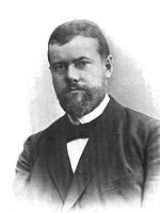
Max Weber

 
Max Weber

   Email Print
   Bookmark   Link


Max Weber


Maximilian Carl Emil Weber (21 April 1864 – 14 June 1920) was one of the most profoundly influential thinkers of the twentieth century. Born in Germany
Germany

Germany , officially the Federal Republic of Germany , is a country in Central Europe. It is bordered to the north by the North Sea, Denmark, and the Baltic Sea; to the east by Poland and the Czech Republic; to the south by Austria and Switzerland; and to the west by France, Luxembourg, Belgium, and the Netherlands....
, Weber became a lawyer, politician, scholar, political economist
Political economy

Political economy originally was the term for studying production, buying and selling, and their relations with law, custom, and government. Political economy originated in moral philosophy....
, and sociologist
Sociology

Sociology is a branch of the social sciences that uses systematic methods of Empiricism and critical theory to develop and refine a body of knowledge about human social structure and activity, sometimes with the goal of applying such knowledge to the pursuit of social welfare....
. He was an indefatigable and eclectic writer who founded or co-founded a number of now separate academic disciplines, including the modern
Modern

Modern generally means something that is "up-to-date", "new", or from the present time. It may refer to:* Late modernity* Modern , an album from the British punk rock band, Buzzcocks...
 study of sociology
Sociology

Sociology is a branch of the social sciences that uses systematic methods of Empiricism and critical theory to develop and refine a body of knowledge about human social structure and activity, sometimes with the goal of applying such knowledge to the pursuit of social welfare....
, public administration
Public administration

Public administration can be broadly described as the development, implementation and study of branches of government public policy. The pursuit of the public good by enhancing civil society and social justice is the ultimate goal of the field....
 and organizational theory. He was also a polyglot
Polyglot

Polyglot may refer to:*Multilingualism, someone who uses two or more languages*Polyglot , a book that contains the same text in more than one language...
 who in his lifetime mastered four foreign languages and became a major scholar of religion as well, writing on the ancient religions of Judaism, India and China.


Discussion
Ask a question about 'Max Weber'
Start a new discussion about 'Max Weber'
Answer questions from other users
Full Discussion Forum


Recent Posts


Quotations


The Truth is the Truth - last words


Encyclopedia


Maximilian Carl Emil Weber (21 April 1864 – 14 June 1920) was one of the most profoundly influential thinkers of the twentieth century. Born in Germany
Germany

Germany , officially the Federal Republic of Germany , is a country in Central Europe. It is bordered to the north by the North Sea, Denmark, and the Baltic Sea; to the east by Poland and the Czech Republic; to the south by Austria and Switzerland; and to the west by France, Luxembourg, Belgium, and the Netherlands....
, Weber became a lawyer, politician, scholar, political economist
Political economy

Political economy originally was the term for studying production, buying and selling, and their relations with law, custom, and government. Political economy originated in moral philosophy....
, and sociologist
Sociology

Sociology is a branch of the social sciences that uses systematic methods of Empiricism and critical theory to develop and refine a body of knowledge about human social structure and activity, sometimes with the goal of applying such knowledge to the pursuit of social welfare....
. He was an indefatigable and eclectic writer who founded or co-founded a number of now separate academic disciplines, including the modern
Modern

Modern generally means something that is "up-to-date", "new", or from the present time. It may refer to:* Late modernity* Modern , an album from the British punk rock band, Buzzcocks...
 study of sociology
Sociology

Sociology is a branch of the social sciences that uses systematic methods of Empiricism and critical theory to develop and refine a body of knowledge about human social structure and activity, sometimes with the goal of applying such knowledge to the pursuit of social welfare....
, public administration
Public administration

Public administration can be broadly described as the development, implementation and study of branches of government public policy. The pursuit of the public good by enhancing civil society and social justice is the ultimate goal of the field....
 and organizational theory. He was also a polyglot
Polyglot

Polyglot may refer to:*Multilingualism, someone who uses two or more languages*Polyglot , a book that contains the same text in more than one language...
 who in his lifetime mastered four foreign languages and became a major scholar of religion as well, writing on the ancient religions of Judaism, India and China. He began his career at the University of Berlin, and later worked at the universities of Freiburg
Freiburg

Freiburg im Breisgau is a city in Baden-W?rttemberg, Germany, in the Breisgau region on the western edge of the Black Forest. It straddles the Dreisam river, on the foothills of the Schlossberg....
, Heidelberg
Heidelberg

Heidelberg is a city in Baden-W?rttemberg, Germany. As of 2006, over 140,000 people live within the city's area. The town of Heidelberg is an administrative district of its own....
, and Munich
Munich

Munich is the capital city of Bavaria, Germany. Munich is located on the River Isar north of the Northern Limestone Alps. Munich is the third largest city in Germany, after Berlin and Hamburg....
.

Weber's major works deal with rationalization in sociology of religion
Sociology of religion

The sociology of religion is primarily the study of the practices, social structures, historys, development of religion, universal theme s, and roles of religion in society....
, government
Political sociology

Political sociology is the study of power and the intersection of personality, social structure and politics. Political sociology is interdisciplinary, where political science and sociology intersect....
, organizational theory, and behavior. His most famous work is his essay The Protestant Ethic and the Spirit of Capitalism
The Protestant Ethic and the Spirit of Capitalism

The Protestant Ethic and the Spirit of Capitalism is a book written by Max Weber, a Germany economist and sociologist, in 1904 and 1905 that began as a series of essays....
, which began his work in the sociology of religion
Religion

A religion is an organized approach to human spirituality which usually encompasses a set of myth, symbols, beliefs and practices, often with a supernatural or transcendence quality, that give meaning to the practitioner's experiences of life through reference to a higher power or truth....
. In this work, Weber argued that religion was one of the non-exclusive reasons for the different ways the cultures of the Occident and the Orient have developed, and stressed that particular characteristics of ascetic Protestantism
Protestantism

Protestantism is a movement within Christianity that originated in the sixteenth-century Protestant Reformation. It is considered to be one of the three principal traditions of Christianity, together with Roman Catholicism and Eastern Orthodoxy....
 influenced the development of capitalism
Capitalism

Capitalism is an economic system in which wealth, and the means of producing wealth, are private property and controlled rather than commonly, publicly, or state-owned and controlled....
, bureaucracy
Bureaucracy

Bureaucracy is the structure and set of regulations in place to control activity, usually in large organizations and government. As opposed to adhocracy, it is represented by standardized procedure that dictates the execution of most or all processes within the body, formal division of powers, hierarchy, and relationships....
 and the rational-legal state in the West
The West

The West is a generic term referring to the Western world, or Western culture or civilization.The term can also mean:* Western culture or Western civilization, referring to cultures derived from European origin....
. Some have used Weber's work on The Protestant Ethic as an argument that human institutions were not shaped by inevitable materialism, as Marx had argued, but by religious ideals and ideas which could not be reduced to material causation. In another major work, Politics as a Vocation
Politics as a Vocation

Politics as a Vocation was a lecture given by Max Weber, a Germany economist and sociology, to the students of the Ludwig Maximilians University of Munich in January 1919 and published in October of the same year....
, Weber defined the state
State

A state is a political Social contract with effective sovereignty over a geographic area and representing a population. These may be nation states, State or multinational states....
 as an entity which claims a monopoly on the legitimate use of physical force
Monopoly on the legitimate use of physical force

The monopoly on the legitimate use of violence is the definition of the state expounded by Max Weber in Politics as a Vocation, and has been predominant in philosophy of law and political philosophy in the twentieth century....
, a definition that became pivotal to the study of modern Western political science
Political science

Political science is a social science concerned with the theory and practice of politics and the description and analysis of political systems and political behavior....
. His analysis of bureaucracy
Bureaucracy

Bureaucracy is the structure and set of regulations in place to control activity, usually in large organizations and government. As opposed to adhocracy, it is represented by standardized procedure that dictates the execution of most or all processes within the body, formal division of powers, hierarchy, and relationships....
 in his Economy and Society
Economy and Society

Economy and Society is a book by political economist and sociologist Max Weber, published posthumously in 1922 in literature by his wife Marianne....
 is still central to the modern study of organizations. His most known contributions are often referred to as the 'Weber Thesis
Weber Thesis

Weber Thesis can refer to several concepts proposed by Max Weber, among them:* Monopoly on the legitimate use of physical force* The Protestant Ethic and the Spirit of Capitalism...
'. He was the first to recognize several diverse aspects of social authority, including charismatic, traditional, and legitimate forms of authority. His work on bureaucracies noted that these institutions were based on legitimate--or legal--authority. Thus he saw bureaucracies as mitigating the effects of "personalism" in organizations. However, this writing was sometimes seen as prescriptive, e.g. by his western mediators, such as Harvard's Talcott Parsons (translator of Economy and Society, 1947).

Biography

Weber was born in Erfurt
Erfurt

Erfurt is a city in central Germany. It is the Capital of the state of Thuringia with a population of 202,929 . Erfurt is located 100 km SW of Leipzig, 150 km N of N?rnberg and 180 km SE of Hannover....
 in Thuringia
Thuringia

The Free State of Thuringia is located in central Germany. It has an area of and 2.29 million inhabitants, making it the sixth smallest by area and the fifth smallest by population of Germany's sixteen States of Germany ....
, Germany
Germany

Germany , officially the Federal Republic of Germany , is a country in Central Europe. It is bordered to the north by the North Sea, Denmark, and the Baltic Sea; to the east by Poland and the Czech Republic; to the south by Austria and Switzerland; and to the west by France, Luxembourg, Belgium, and the Netherlands....
, the eldest of seven children of Max Weber Sr., a wealthy and prominent politician
Politician

A politician is an individual who is involved in influencing public decision making through the influence of politics or a person who influences the way a society is governed....
 in the National Liberal Party (Germany)
National Liberal Party (Germany)

The National Liberal Party was a Germany political party which flourished between 1867 and 1918. It was formed by those Prussian liberals who put aside their differences with Otto von Bismarck over domestic policy due to their support for his highly successful foreign policy, which resulted in the unification of Germany....
 and a civil servant
Civil service

The term civil service has two distinct meanings:* Branch of governmental service in which individuals are hired on the basis of merit which is proven by the use of competitive examinations....
, and Helene Fallenstein, a Protestant and a Calvinist, with strong moral absolutist ideas. Weber Sr.'s engagement with public life immersed the family home in politics
Politics

Politics is the process by which groups of people make decisions. The term is generally applied to behaviour within civil governments, but politics has been observed in all human group interactions, including corporation, academia, and religion institutions....
, as his salon received many prominent scholars
Academia

Academia, Academe, or the Academy are collective terms for the community of students and scholars engaged in higher education and research....
 and public figures. Weber was strongly influenced by his mother's views and approach to life, but he did not claim to be religious himself. The young Weber and his brother Alfred
Alfred Weber

Alfred Weber was a Germany economist, sociologist and theoretician of culture whose work was influential in the development of modern economic geography....
, who also became a sociologist and economist, thrived in this intellectual atmosphere. Weber's 1876 Christmas presents to his parents, when he was thirteen years old, were two historical essays entitled "About the course of German history
History of Germany

Despite the lack of a German nation state before 1871, the countrydates back to the era of the Germanic tribes. Following the migration period, the Franks subsequently subdued the West Germanic tribes, who made up for most of East Francia after the Frankish Empire fell apart....
, with special reference to the positions of the emperor
German Empire

The German Empire is the name commonly used in English to describe Germany from the unification of Germany and proclamation of William I, German Emperor as German Emperor on 18 January 1871, to 1918, when it became Weimar republic after defeat in World War I and the abdication of William II, German Emperor ....
 and the pope
Pope

The Pope is the Bishop of Rome, the leader of the Roman Catholic Church and head of state of Vatican City. The current pope is Pope Benedict XVI, who was elected April 19, 2005 in Papal conclave, 2005....
" and "About the Roman Imperial
Roman Empire

The Roman Empire was the Roman Republic phase of the Ancient Rome, characterised by an autocracy form of government and large territorial holdings in Europe and around the Mediterranean....
 period from Constantine to the migration of nations". At the age of fourteen, he wrote letters studded with references to Homer
Homer

Homer is traditionally held to be the author of the ancient Greek language epic poems the Iliad and the Odyssey, as well as of the Homeric Hymns....
, Virgil
Virgil

Publius Vergilius Maro was a classical Roman poet, best known for three major works?the Bucolics , the Georgics and the Aeneid?although several Appendix Vergiliana are also attributed to him....
, Cicero
Cicero

Marcus Tullius Cicero was a Ancient Rome philosopher, statesman, lawyer, political theorist, and Constitution of the Roman Republic. Cicero is widely considered one of Rome's greatest rhetoric and prose stylists....
, and Livy
Livy

Titus Livius , known as Livy in English language, was a Ancient Rome historian who wrote a monumental history of Rome, Ab Urbe Condita, from its founding through the reign of Augustus in Livy's own time....
, and he had an extended knowledge of Goethe, Spinoza, Kant
KANT

KANT is a computer algebra system for mathematicians interested in algebraic number theory, performing sophisticated computations in algebraic number fields, in Global field function fields, and in local fields....
, and Schopenhauer before he began university studies. It seemed clear that Weber would pursue advanced studies in the social sciences
Social sciences

The social sciences comprise academic disciplines concerned with the study of the social life of human groups and individuals including anthropology, communication studies, economics, human geography, history, political science, psychology and sociology....
.

Max Weber and Brothers 1879
In 1882 Weber enrolled in the University of Heidelberg as a law
LAW

LAW may refer to:* Anti-tank warfare, e.g. the US Army M72 LAW or the British Army LAW 80*Palestinian Society for the Protection of Human Rights ...
 student. Weber joined his father's duelling fraternity, and chose as his major study Weber Sr.'s field of law. Along with his law coursework, young Weber attended lectures in economics
Economics

File:Ballard Farmers' Market - vegetables.jpgEconomics is the Social sciences that studies the Production theory basics, Distribution , and Consumption of Good and Service ....
 and studied medieval history and theology
Theology

Theology is the study of the existence or attributes of a deity or gods, or more generally the study of religion or spirituality. It is sometimes contrasted with religious studies: theology is understood as the study of religion from an internal perspective , and religious studies as the study of religion from an external perspective....
. Intermittently, he served with the German army
Reichswehr

The Reichswehr formed the armed forces of Germany from 1919 until 1935, when it was renamed the Wehrmacht .At the end of World War I, the forces of the German Empire had mostly disintegrated, the men making their way home individually or in small groups....
 in Strasbourg
Strasbourg

Strasbourg is the capital and principal city of the Alsace Regions of France in northeastern France. With 702,412 inhabitants in 2007, its metropolitan area is the Aire urbaine....
.

In the autumn of 1884, Weber returned to his parents' home to study at the University of Berlin. For the next eight years of his life, interrupted only by a term at the University of Göttingen and short periods of further military training, Weber stayed at his parents' house; first as a student, later as a junior barrister, and finally as a Dozent at the University of Berlin. In 1886 Weber passed the examination for "Referendar", comparable to the bar association
Bar association

A bar association is a professional body of lawyers. Some bar associations are responsible for the regulation of the legal profession in their jurisdiction; others are professional organizations dedicated to serving their members; in many cases, they are both....
 examination in the British
United Kingdom

The United Kingdom of Great Britain and Northern Ireland, commonly known as the United Kingdom , the UK or Britain,is a sovereign state located off the northwestern coast of continental Europe....
 and American
United States

The United States of America is a Federal government constitutional republic comprising U.S. state and a federal district. The country is situated mostly in central North America, where its Contiguous United States and Washington, D.C., the Capital districts and territories, lie between the Pacific Ocean and Atlantic Oceans, Borders of the U...
 legal systems. Throughout the late 1880s, Weber continued his study of history. He earned his law doctorate in 1889 by writing a doctoral dissertation on legal history entitled The History of Medieval Business Organisations
Zur Geschichte der Handelsgesellschaften im Mittelalter

Zur Geschichte der Handelgesellschaften im Mittelalter is a doctoral dissertation written by Max Weber, a Germany economist and sociologist in 1889....
. Two years later, Weber completed his Habilitation
Habilitation

Habilitation is the highest academic qualification a person can achieve by their own pursuit in certain European and Asian countries. Earned after obtaining a research doctorate , the habilitation requires the candidate to write a postdoctoral thesis based on independent scholarly accomplishments, reviewed by and defended before an academic c...
sschrift, The Roman Agrarian History and its Significance for Public and Private Law. Having thus become a "Privatdozent
Privatdozent

Private docent is a title conferred in some European university systems, especially in German language-speaking countries, for someone who pursues an academic career and holds all formal qualifications to become a tenured university professor....
", Weber was now qualified to hold a German professorship.

In the years between the completion of his dissertation and habilitation, Weber took an interest in contemporary social policy
Social policy

Social policy primarily refers to guidelines and interventions for the changing, maintenance or creation of living conditions that are conducive to Quality of life....
. In 1888 he joined the "Verein für Socialpolitik
Verein für Socialpolitik

The Verein f?r Socialpolitik is an important society of economists in the German language area. The Society, which covers all branches of economics was founded in 1873....
", the new professional association of German economists affiliated with the historical school
Historical school of economics

The Historical school of economics was an approach to academic economics and to public administration that emerged in 19th century in Germany, and held sway there until well into the 20th century....
, who saw the role of economics primarily as the solving of the wide-ranging social problems of the age, and who pioneered large-scale statistical studies of economic problems. He also involved himself in politics, joining the left leaning Evangelical Social Congress
Evangelical Social Congress

The Evangelical Social Congress was a social-reform movement of German evangelists founded in Whitsuntide in 1890.Various groups were united in the Congress, although, in the end, the Congress failed to set forth a united programme of "Christian socialism" ....
. In 1890 the "Verein" established a research program to examine "the Polish question" or Ostflucht
Ostflucht

The Ostflucht was a movement by residents of the former eastern territories of Germany, such as East Prussia, West Prussia, Province of Silesia and Province of Posen beginning around 1850, to the more industrialized western German Rhine and Ruhr provinces....
, meaning the influx of foreign farm workers into eastern Germany
Eastern Germany

Eastern Germany refers to:* the Former eastern territories of Germany, in Germany known as ehemalige Ostgebiete:**East Prussia**West Prussia...
 as local labourers migrated to Germany's rapidly industrialising
Industrial Revolution

The Industrial Revolution was a period in the late 18th and early 19th centuries when major changes in agriculture, manufacturing, production, and transportation had a profound effect on the socioeconomics and cultural conditions in United Kingdom....
 cities. Weber was put in charge of the study, and wrote a large part of its results. The final report was widely acclaimed as an excellent piece of empirical
Empirical

The word empirical denotes information gained by means of observation, experience, or experiment, as opposed to theory. A central concept in science and the scientific method is that all evidence must be empirical, or empirically based, that is, dependent on evidence or Logical consequence that are observable by the senses....
 research, and cemented Weber's reputation as an expert in agrarian economics
Agricultural economics

Agricultural economics originally applied the principles of economics to the production of crops and livestock ? a discipline known as agronomics....
.

In 1893 he married his distant cousin Marianne Schnitger
Marianne Weber

Marianne Weber, born Marianne Schnitger on August 2, 1870 in Oerlinghausen, died March 12, 1954 in Heidelberg), sociologist, women's rights activist and wife of Max Weber....
, later a feminist
Feminism

Feminism is the belief that women should have equal political, social, sexual, intellectual and economic rights to men. It involves various movements, Theory, and philosophies, all concerned with issues of gender difference, that advocate equality for women and that campaign for women's rights and interests....
 and author in her own right, who was instrumental in collecting and publishing Weber's journal articles as books after his death. The couple moved to Freiburg in 1894, where Weber was appointed professor of economics at Freiburg University, before accepting the same position at the University of Heidelberg in 1896. Next year, Max Weber Sr. died, two months after a severe quarrel with his son that was never resolved. After this, Weber became increasingly prone to nervousness and insomnia, making it difficult for him to fulfill his duties as a professor. His condition forced him to reduce his teaching, and leave his last course in the fall of 1899 unfinished. After spending months in a sanatorium during the summer and fall of 1900, Weber and his wife traveled to Italy at the end of the year, and did not return to Heidelberg until April 1902.

After Weber's immense productivity in the early 1890s, he did not publish a single paper between early 1898 and late 1902, finally resigning his professorship in fall 1903. Freed from those obligations, in that year he accepted a position as associate editor of the Archives for Social Science and Social Welfare
Archiv für Sozialwissenschaft und Sozialpolitik

The Archiv f?r Sozialwissenschaft und Sozialpolitik was a journal for the social sciences in Germany between 1904 and 1933.Its first editors were Edgar Jaff?, Werner Sombart and Max Weber....
 next to his colleagues Edgar Jaffé and Werner Sombart
Werner Sombart

Werner Sombart was a Germany economics and sociology, the head of the ?Youngest Historical School? and one of the leading Continental European social scientists during the first quarter of the 20th century....
. In 1904, Weber began to publish some of his most seminal papers in this journal, notably his essay The Protestant Ethic and the Spirit of Capitalism
The Protestant Ethic and the Spirit of Capitalism

The Protestant Ethic and the Spirit of Capitalism is a book written by Max Weber, a Germany economist and sociologist, in 1904 and 1905 that began as a series of essays....
. It became his most famous work, and laid the foundations for his later research on the impact of culture
Culture

Culture is difficult to define. For example, in 1952, Alfred Kroeber and Clyde Kluckhohn compiled a list of 164 definitions of "culture" in Culture: A Critical Review of Concepts and Definitions....
s and religion
Religion

A religion is an organized approach to human spirituality which usually encompasses a set of myth, symbols, beliefs and practices, often with a supernatural or transcendence quality, that give meaning to the practitioner's experiences of life through reference to a higher power or truth....
s on the development of economic system
Economic system

An economic system or ?conomic system is a system that involves the Economic production, distribution and consumption of Good and Service between the entities in a particular society....
s. This essay was the only one of his works that was published as a book during his lifetime. Also that year, he visited United States
United States

The United States of America is a Federal government constitutional republic comprising U.S. state and a federal district. The country is situated mostly in central North America, where its Contiguous United States and Washington, D.C., the Capital districts and territories, lie between the Pacific Ocean and Atlantic Oceans, Borders of the U...
 and participated in the Congress of Arts and Sciences held in connection with the World's Fair
World's Fair

Universal Exposition or Expo is the name given to various large public exhibitions held since the mid-19th century. They are the third largest event in the world in terms of economic and cultural impact, after the FIFA World Cup and the Olympic Games....
 (Louisiana Purchase Exposition
Louisiana Purchase Exposition

The Louisiana Purchase Exposition, informally known as the Saint Louis World's Fair, was an Expo held in St. Louis, Missouri in 1904....
) at St. Louis
St. Louis, Missouri

St. Louis is an independent city in the U.S. state of Missouri, located near the confluence of the Mississippi River and the Missouri River. St....
. Despite his successes, Weber felt that he was unable to resume regular teaching at that time, and continued on as a private scholar, helped by an inheritance in 1907. In 1912, Weber tried to organise a left-wing political party to combine social-democrats and liberals. This attempt was unsuccessful, presumably because many liberals feared social-democratic revolutionary ideals at the time.

Max Weber 1917
During the First World War
World War I

World War I, or the First World War , was a global military conflict which involved the Great powers, organized into two opposing military alliances: the Allies of World War I and the Central Powers....
, Weber served for a time as director of the army hospitals in Heidelberg. In 1915 and 1916 he sat on commissions that tried to retain German supremacy in Belgium and Poland after the war. Weber's views on war, as well as on expansion of the German empire, changed throughout the war. He became a member of the worker and soldier council
Workers' council

A workers' council is a deliberative assembly, composed of working class members, intended to institute workers' self-management or workers' control....
 of Heidelberg in 1918. In the same year, Weber became a consultant to the German Armistice Commission at the Treaty of Versailles
Treaty of Versailles

The Treaty of Versailles was one of the peace treaty at the end of World War I. It ended the declaration of war between German Empire and Allies of World War I....
 and to the commission charged with drafting the Weimar Constitution
Weimar constitution

The Constitution of the German Reich , usually known as the Weimar Constitution was the constitution that governed the Weimar Republic ....
. He argued in favor of inserting Article 48
Article 48 (Weimar Constitution)

Article 48 of the Weimar constitution of the Weimar Republic of Germany allowed the President of Germany , under certain circumstances, to take "emergency measures" without the prior consent of the Reichstag ....
 into the Weimar Constitution
Weimar constitution

The Constitution of the German Reich , usually known as the Weimar Constitution was the constitution that governed the Weimar Republic ....
. This article was later used by Adolf Hitler
Adolf Hitler

Adolf Hitler was an Austrian-born Germany politician and the leader of the National Socialist German Workers Party , popularly known as the Nazi Party....
 to institute rule by decree, thereby allowing his government to suppress opposition and obtain dictatorial
Dictatorship

A dictatorship is usually defined as an Autocracy form of government in which the government is ruled by an individual, the dictator, without hereditary ascension....
 powers. Weber's contributions to German politics
Weber and German politics

This article is about the political views and activities of the Germany sociologist Max Weber.Max Weber described himself as a left-wing liberal; he can be regarded as a Social Liberalism....
 remain a controversial subject to this day. "God does not exist for men; but men for the sake of god" reflects the controversial nature of his work. Without backing up of the claim of god's true purpose, he hoped to show Calvin's ideals.

Weber resumed teaching during this time, first at the University of Vienna
University of Vienna

The University of Vienna is a public university located in Vienna, Austria. Having opened in 1365, it is one of the oldest universities in Europe....
, then in 1919 at the University of Munich. In Munich, he headed the first German university institute of sociology, but ultimately never held a personal sociology appointment. Weber left politics due to right-wing agitation in 1919 and 1920. Many colleagues and students in Munich argued against him for his speeches and left-wing attitude during the German Revolution
German Revolution

The German Revolution was the politically-driven civil conflict in Germany at the end of World War I. The period lasted from 1918#November until the formal establishment of the Weimar Republic in August 1919....
 of 1918 and 1919, with some right-wing students holding protests in front of his home. Max Weber contracted the Spanish flu
Spanish flu

The 1918 flu pandemic was an influenza pandemic that spread to nearly every part of the world. It was caused by an unusually severe and deadly Influenza A virus Strain of subtype H1N1....
 and died of pneumonia
Pneumonia

Pneumonia is an Inflammation illness of the lung. Frequently, it is described as lung parenchyma/alveolus inflammation and abnormal alveolar filling with fluid ....
 in Munich on June 14, 1920.

Achievements

Along with Karl Marx
Karl Marx

Karl Heinrich Marx was a Germanphilosophy, political economy, historian, sociologist, humanism, political theorist and revolutionary credited as the founder of communism....
 and Émile Durkheim
Émile Durkheim

?mile Durkheim was a France sociologist whose contributions were instrumental in the formation of sociology and anthropology. His work and editorship of the first journal of sociology, L'Ann?e Sociologique, helped establish sociology within academia as an accepted Social sciences....
, Weber is regarded as one of the founders of modern sociology, although in his time he was viewed primarily as a historian and an economist. Whereas Durkheim, following Comte, worked in the positivist
Sociological positivism

In sociology, anthropology, and other social sciences, the term positivism is closely connected to sociological naturalism and can be traced back to the philosophical thinking of Auguste Comte in the 19th century....
 tradition, Weber created and worked – like Werner Sombart
Werner Sombart

Werner Sombart was a Germany economics and sociology, the head of the ?Youngest Historical School? and one of the leading Continental European social scientists during the first quarter of the 20th century....
, his friend and then the most famous representative of German sociology – in the antipositivist
Antipositivism

Antipositivism is the view in sociology that social sciences need to create and use different scientific methods than those used in the field of natural sciences....
, hermeneutic, tradition. Those works started the antipositivistic revolution in social sciences, which stressed the difference between the social sciences and natural sciences, especially due to human social actions
Social actions

In sociology, social actions refer to any Action that takes into account the actions and reactions of other individuals and is modified based on those events....
 (which Weber differentiated into traditional
Traditional action

Traditional action is a social action taken because it was done in the past. They are actions which are carried out due to tradition, because they are always carried out in such a situation....
, affectional
Affectional action

Affectional action is a social action caused by an emotion . Those actions are taken due to one's emotions, to express personal feelings. For example, cheering after a victory, crying at a funeral would be emotional actions....
, value-rational
Value-rational action

Rational action is a social action which is taken because it leads to a valued goal, but with no thought of its consequences and often without consideration of the appropriateness of the means chosen to achieve it ....
 and instrumental
Instrumental action

Instrumental action is a social action pursued after evaluating its consequences and consideration of the various means to achieve it. They are usually planned and taken after considering costs and consequences....
). Weber's early work was related to industrial sociology
Industrial sociology

Industrial sociology is both a study of the interaction of people within industry and, on a macrosociology scale, the study of the impact of industrialization on whole society....
, but he is most famous for his later work on the sociology of religion
Sociology of religion

The sociology of religion is primarily the study of the practices, social structures, historys, development of religion, universal theme s, and roles of religion in society....
 and sociology of government.

Weber began his studies of rationalisation
Rationalization (sociology)

In sociology, rationalization is the process whereby an increasing number of social actions and interactions become based on considerations of efficiency or calculation rather than on motivations derived from custom, tradition, or emotion....
 in The Protestant Ethic and the Spirit of Capitalism
The Protestant Ethic and the Spirit of Capitalism

The Protestant Ethic and the Spirit of Capitalism is a book written by Max Weber, a Germany economist and sociologist, in 1904 and 1905 that began as a series of essays....
, in which he argued that the redefinition of the connection between work and piety in Protestantism, and especially in ascetic Protestant
Protestantism

Protestantism is a movement within Christianity that originated in the sixteenth-century Protestant Reformation. It is considered to be one of the three principal traditions of Christianity, together with Roman Catholicism and Eastern Orthodoxy....
 denominations
Religious denomination

A religious denomination is a subgroup within a religion that operates under a common name, tradition and identity.The term describes various Christian denominations ....
, particularly Calvinism
Calvinism

Calvinism is a theology system and an approach to the Christian life that emphasizes the rule of God over all things. It was developed by several theologians, but it bears the name of the French Protestant Reformation John Calvin because of his prominent influence on it and because of his role in the confessional and ecclesiastical debates t...
, shifted human effort towards rational efforts aimed at achieving economic gain. In Calvinism in particular, but also in Lutheranism, Christian piety towards God was expressed through or in one's secular vocation. Calvin, in particular, viewed the expression of the work ethic as a sign of "election". The rational roots of this doctrine, he argued, soon grew incompatible with and larger than the religious, and so the latter were eventually discarded. Weber continued his investigation into this matter in later works, notably in his studies on bureaucracy
Bureaucracy

Bureaucracy is the structure and set of regulations in place to control activity, usually in large organizations and government. As opposed to adhocracy, it is represented by standardized procedure that dictates the execution of most or all processes within the body, formal division of powers, hierarchy, and relationships....
 and on the classifications of authority
Authority

In government, authority is often used interchangeably with the term "power ". However, their meanings differ: while "power" refers to the ability to achieve certain ends, "authority" refers to a claim of legitimacy , the justification and right to exercise that power....
 into three types--legitimate, traditional, and charismatic. In these works Weber described what he saw as society's movement towards rationalization.

It should be noted that many of Weber's works famous today were collected, revised, and published posthumously. Significant interpretations of Weber's writings were produced by such sociological luminaries as Talcott Parsons
Talcott Parsons

Talcott Parsons was an American sociology, who served on the faculty of Harvard University from 1927–1973. He produced a general theoretical system for the analysis of society, which was called action theory based on the concept on methodological and epistemological principle of "analytical realism" and on the ontological assumption of...
 of Harvard, who imparted to Weber's works a functionalist and teleological perspective (although Weber himself claimed his works were merely descriptive of the phenomena he was studying), and C. Wright Mills
C. Wright Mills

Charles Wright Mills was an United States sociology. Mills is best remembered for his 1959 book The Sociological Imagination in which he lays out a view of the proper relationship between biography and history, theory and method in sociological scholarship....
.

Sociology of religion

Weber's work on the sociology of religion started with the essay The Protestant Ethic and the Spirit of Capitalism
The Protestant Ethic and the Spirit of Capitalism

The Protestant Ethic and the Spirit of Capitalism is a book written by Max Weber, a Germany economist and sociologist, in 1904 and 1905 that began as a series of essays....
, which grew out of heavy "field work" among Protestant sects in America, and continued with the analysis of The Religion of China: Confucianism and Taoism
The Religion of China: Confucianism and Taoism

The Religion of China: Confucianism and Taoism is a book written by Max Weber, a Germany economist and sociologist. It was first published in German language under the title Konfuzianismus und Taoismus in 1915 and an adapted version appeared in 1920....
, The Religion of India: The Sociology of Hinduism and Buddhism
The Religion of India: The Sociology of Hinduism and Buddhism

The Religion of India: The Sociology of Hinduism and Buddhism, also known as just The Religion of India, is a book written by Maximilian Weber, a Germany economist and sociologist in the early twentieth century....
, and Ancient Judaism
Ancient Judaism (book)

Ancient Judaism, also known as Ancient Palestine: Society and Religion, is a book written by Maximilian Weber, a Germany economist and sociologist, in early the 20th century....
. His work on other religions was interrupted by his sudden death in 1920, which prevented him from following Ancient Judaism with studies of Psalms, Book of Jacob
Book of Jacob

The Book of Jacob is the third book of the Book of Mormon. Its full title is The Book of Jacob: The Brother of Nephi. According to the text, it was written by the ancient prophet Jacob , brother of the prophet Nephi, believed to have lived around 600 BC....
, Talmudic Jewry, early Christianity
Christianity

Christianity is a Monotheistic religion #Christian view religion centered on the life and teachings of Jesus as New Testament view on Jesus' life....
 and Islam
Islam

Islam is a Monotheism, Abrahamic religion originating with the teachings of the Prophets of Islam Muhammad, a 7th century Arab religious and political figure....
. His three main themes were the effect of religious ideas on economic activities, the relation between social stratification
Social stratification

In sociology and anthropology, social stratification is the hierarchy arrangement of social classes, castes and strata within a society. While these hierarchies are not universal to all societies, they are the norm among state-level cultures ....
 and religious ideas, and the distinguishable characteristics of Western civilization.

His goal was to find reasons for the different development paths of the cultures of the Occident and the Orient, although without judging or valuing them, like some of the contemporary thinkers who followed the social Darwinist
Social Darwinism

Social Darwinism refers to various ideologies based on a concept that competition among all individuals, groups, nations, or ideas drives social evolution in human societies....
 paradigm; Weber wanted primarily to explain the distinctive elements of the Western civilization
Western culture

File:Clash of Civilizations map.pngWestern culture are terms which are used to refer to cultures of European origin. This terminology originated as a way of describing what was different about the Graeco-Roman culture and its descendants, in contrast to the older neighboring civilizations of the Middle East, which in many ways continued...
. In the analysis of his findings, Weber maintained that Calvinist (and more widely, Protestant
Protestantism

Protestantism is a movement within Christianity that originated in the sixteenth-century Protestant Reformation. It is considered to be one of the three principal traditions of Christianity, together with Roman Catholicism and Eastern Orthodoxy....
) religious ideas had had a major impact on the social innovation
Social innovation

Social innovation refers to new strategies, concepts, ideas and organizations that meet social needs of all kinds - from Working condition and education to community development and health - and that extend and strengthen civil society....
 and development of the economic system
Economic system

An economic system or ?conomic system is a system that involves the Economic production, distribution and consumption of Good and Service between the entities in a particular society....
 of Europe
Europe

Europe is, conventionally, one of the world's seven continents. Comprising the westernmost peninsula of Eurasia, Europe is generally divided from Asia to its east by the water divide of the Ural Mountains, the Ural , the Caspian Sea, and by the Caucasus Mountains to the southeast....
 and the United States
United States

The United States of America is a Federal government constitutional republic comprising U.S. state and a federal district. The country is situated mostly in central North America, where its Contiguous United States and Washington, D.C., the Capital districts and territories, lie between the Pacific Ocean and Atlantic Oceans, Borders of the U...
, but noted that they were not the only factors in this development. Other notable factors mentioned by Weber included the rationalism
Rationalism

In epistemology and in its modern sense, rationalism is "any view appealing to reason as a source of knowledge or justification" . In more technical terms it is a method or a theory "in which the criterion of the truth is not sensory but intellectual and deductive" ....
 of scientific pursuit, merging observation
Observation

Observation is either an activity of a living being , consisting of receiving knowledge of the outside world through the senses, or the recording of data using scientific instruments....
 with mathematics
Mathematics

Mathematics is the study of quantity, structure, space, change, and related topics of pattern and form. Mathematicians seek out patterns whether found in numbers, space, natural science, computers, imaginary abstractions, or elsewhere....
, science of scholarship
Scholarship

A scholarship is an award of access to an institution, or a Student financial aid award for a student to further education. Scholarships are awarded on various criteria usually reflecting the values and purposes of the donor or founder of the award....
 and jurisprudence
Jurisprudence

Jurisprudence is the theory and philosophy of law. Scholars of jurisprudence, or legal philosophers, hope to obtain a deeper understanding of the nature of law, of legal reasoning, legal systems and of legal institutions....
, rational systematisation of government
Government

Government is the body within any organization that has the authority to make and the power to enforce laws, regulations, or rules. Typically, the government refers to a civil government -- local, provincial, or national -- but commercial, academic, religious, or other formal organizations are also administered by governing bodies....
 administration
Public administration

Public administration can be broadly described as the development, implementation and study of branches of government public policy. The pursuit of the public good by enhancing civil society and social justice is the ultimate goal of the field....
, and economic enterprise
Business

A business is a legally recognized organization designed to provide good s and/or Service to consumers. Businesses are predominant in capitalism economies, most being privately owned and formed to earn profit that will increase the wealth of its owners....
. In the end, the study of the sociology of religion, according to Weber, merely explored one phase of the freedom from magic
Magical thinking

Magical thinking in anthropology, psychology, and cognitive science is nonscientific causal reasoning that often includes such ideas as the ability of the mind to affect the physical world , correlation equaling causation, the law of contagion, the power of symbols, and the meaningfulness of synchronicity....
, that "disenchantment of the world" that he regarded as an important distinguishing aspect of Western culture
Western culture

File:Clash of Civilizations map.pngWestern culture are terms which are used to refer to cultures of European origin. This terminology originated as a way of describing what was different about the Graeco-Roman culture and its descendants, in contrast to the older neighboring civilizations of the Middle East, which in many ways continued...
.

The Protestant Ethic and the Spirit of Capitalism
Die Protestantische Ethik Und Der 'geist' Des Kapitalismus Original Cover
Weber's essay The Protestant Ethic and the Spirit of Capitalism (Die protestantische Ethik und der Geist des Kapitalismus) is his most famous work. It is argued that this work should not be viewed as a detailed study of Protestantism
Protestantism

Protestantism is a movement within Christianity that originated in the sixteenth-century Protestant Reformation. It is considered to be one of the three principal traditions of Christianity, together with Roman Catholicism and Eastern Orthodoxy....
, but rather as an introduction into Weber's later works, especially his studies of interaction between various religious ideas and economic behaviour. In The Protestant Ethic and the Spirit of Capitalism, Weber put forward the thesis that Calvinist
Calvinism

Calvinism is a theology system and an approach to the Christian life that emphasizes the rule of God over all things. It was developed by several theologians, but it bears the name of the French Protestant Reformation John Calvin because of his prominent influence on it and because of his role in the confessional and ecclesiastical debates t...
 ethic and ideas influenced the development of capitalism
Capitalism

Capitalism is an economic system in which wealth, and the means of producing wealth, are private property and controlled rather than commonly, publicly, or state-owned and controlled....
. In this work, he relied on a great deal of statistics from the era, which indicated the predominance of Protestants among the wealthy, industrial, and technical classes relative to Catholics. He also noted the shift of Europe's economic center after the Reformation away from Catholic countries such as France, Spain and Italy, and toward Protestant countries such as England, Scotland, Germany and Holland. This theory is often viewed as a reversal of Marx's thesis that the economic "base" of society determines all other aspects of it. Christian religious devotion had historically been accompanied by rejection of mundane affairs, including economic pursuit. Why was that not the case with Protestantism? Weber addressed that paradox
Paradox

A paradox is a Proposition or group of statements that leads to a contradiction or a situation which defies intuition ; or, it can be an apparent contradiction that actually expresses a non-dual truth ....
 in his essay.

According to Weber, one of the universal tendencies that Christians had historically fought against, was the desire to profit. After defining the spirit of capitalism, Weber argued that there were many reasons to look for the origins of modern capitalism in the religious ideas of the Reformation
Protestant Reformation

The Protestant Reformation was a Christian reform movement in Europe. It is thought to have begun in 1517 with Martin Luther's Ninety-Five Theses and may be considered to have ended with the Peace of Westphalia in 1648....
. Many observers, such as William Petty
William Petty

Sir William Petty was an England economist, scientist and philosopher. He first became prominent serving Oliver Cromwell and Commonwealth of England in Ireland....
, Montesquieu
Charles de Secondat, baron de Montesquieu

Charles-Louis de Secondat, baron de La Br?de et de Montesquieu , was a France social commentator and Political philosophy who lived during the Age of Enlightenment....
, Henry Thomas Buckle
Henry Thomas Buckle

Henry Thomas Buckle was an England historian, author of a History of Civilization....
, John Keats
John Keats

John Keats was an England poetry who became one of the principal poets of the English Romanticism movement during the early nineteenth century....
, and others had commented on the affinity between Protestantism and the development of the commercial spirit.

Weber showed that certain types of Protestantism – notably Calvinism – favored rational pursuit of economic gain and worldly activities which had been given positive spiritual and moral meaning. It was not the goal of those religious ideas, but rather a byproduct – the inherent logic of those doctrines and the advice based upon them both directly and indirectly encouraged planning and self-denial in the pursuit of economic gain. A common illustration is in the cobbler, hunched over his work, who devotes his entire effort to the praise of God. In addition, the Reformation view "calling" dignified even the most mundane professions as being those that added to the common good and were blessed by God, as much as any "sacred" calling could. This Reformation view, that all the spheres of life were sacred when dedicated to God and His purposes of nurturing and furthering life, profoundly affected the view of work.

To illustrate and provide an example, Weber quoted the ethical writings of Benjamin Franklin
Benjamin Franklin

Benjamin Franklin was one of the Founding Fathers of the United States of the United States. A noted polymath, Franklin was a leading author and Printer , Satire, list of political philosophers, politician, scientist, inventor, activism, statesman, and diplomacy....
:

Remember, that time is money. He that can earn ten shillings a day by his labor, and goes abroad, or sits idle, one half of that day, though he spends but sixpence during his diversion or idleness, ought not to reckon that the only expense; he has really spent, or rather thrown away, five shillings besides.

...

Remember, that money is the prolific, generating nature. Money can beget money, and its offspring can beget more, and so on. Five shillings turned is six, turned again is seven and threepence, and so on, till it becomes a hundred pounds. The more there is of it, the more it produces every turning, so that the profits rise quicker and quicker. He that kills a breeding sow, destroys all her offspring to the thousandth generation. He that murders a crown, destroys all that it might have produced, even scores of pounds.(Italics in the original)


Weber noted that this is not a philosophy of mere greed, but a statement laden with moral language. Indeed, Franklin claimed that God revealed to him the usefulness of virtue.

To emphasize the work ethic in Protestantism relative to Catholicism, Weber noted a common problem that industrialists faced when employing precapitalist laborers: agricultural entrepreneurs would try to encourage time spent harvesting by offering a higher wage, with the expectation that laborers would see time spent working as more valuable and so engage it longer. However, in precapitalist societies similar attempts often resulted in laborers spending less time harvesting. Laborers judged that they could earn the same amount as previously, while spending less time working and having more leisure. Weber also noted that societies having more Protestants were those that have a more developed capitalist economy.

It was particularly advantageous in technical occupations for workers to be extremely devoted to their craft. To view the craft as an end in itself, or as a "calling" would serve this need well. This attitude was well-noted in certain classes which have endured religious education, especially of a Pietist background.

Weber stated that he abandoned research into Protestantism because his colleague Ernst Troeltsch
Ernst Troeltsch

Ernst Troeltsch was a Germany Protestant theology and writer on philosophy of religion and philosophy of history, and an influential figure in German thought before 1914....
, a professional theologian
Theology

Theology is the study of the existence or attributes of a deity or gods, or more generally the study of religion or spirituality. It is sometimes contrasted with religious studies: theology is understood as the study of religion from an internal perspective , and religious studies as the study of religion from an external perspective....
, had initiated work on the book The Social Teachings of the Christian Churches and Sects. Another reason for Weber's decision was that the essay had already provided the perspective for a broad comparison of religion and society, which he continued in his later works. The phrase "work ethic
Protestant work ethic

The Protestant work ethic, sometimes called the Puritan work ethic, is a sociological, theoretical concept. It is based upon the notion that the Calvinism emphasis on the necessity for hard work is proponent of a person's calling and worldly success is a sign of personal salvation....
" used in modern commentary is a derivative of the "Protestant ethic" discussed by Weber. It was adopted when the idea of the Protestant ethic was generalised to apply to the Japan
Japan

Japan is an island country in East Asia. Located in the Pacific Ocean, it lies to the east of the Sea of Japan, People's Republic of China, North Korea, South Korea and Russia, stretching from the Sea of Okhotsk in the north to the East China Sea and Taiwan in the south....
ese people, Jews
Judaism

Judaism is a set of beliefs and practices originating in the Hebrew Bible , as later further explored and explained in the Talmud and other texts....
 and other non-Christians
Christianity

Christianity is a Monotheistic religion #Christian view religion centered on the life and teachings of Jesus as New Testament view on Jesus' life....
.

The Religion of China: Confucianism and Taoism
The Religion of China: Confucianism
Confucianism

Confucianism is a China Ethics and Philosophy developed from the teachings of the Chinese philosopher Confucius . It focuses on human morality and right action....
 and Taoism
Taoism

Taoism refers to a variety of related philosophical and religious traditions and concepts. These traditions have influenced East Asia for over two thousand years and some have spread to the West....
 was Weber's second major work on the sociology of religion. Weber focused on those aspects of Chinese
China

China is a Culture of China, an ancient civilization, and, depending on perspective, a national or multinational entity extending over a large area in East Asia....
 society that were different from those of Western Europe
Western Europe

Western Europe refers to the countries in the western most half of Europe. This concept has had different meanings, political and cultural as well as geographical issues have influenced the area....
 and especially contrasted with Puritanism, and posed a question why capitalism did not develop in China. In Hundred Schools of Thought
Hundred Schools of Thought

The Hundred Schools of Thought were philosophers and schools that had flourished from 770 to 221 BC, an era of great cultural and intellectual expansion in China....
 Warring States Period
Warring States Period

The Warring States Period , also known as the Era of Warring States, covers the period from 476 BCE to the unification of China by the Qin Dynasty in 221 BCE....
, he concentrated on the early period of Chinese history, during which the major Chinese schools of thoughts (Confucianism and Taoism) came to the fore.

By 200 BC, the Chinese state
State

A state is a political Social contract with effective sovereignty over a geographic area and representing a population. These may be nation states, State or multinational states....
 had developed from a loose federation
Federation

A federation is a Political union comprising a number of partially self-governing states or regions united by a central government. In a federation, the self-governing status of the state is typically constitutionally entrenched and may not be altered by a Unilateralism decision of the central government....
 of feudal
Feudalism

Feudalism, a term first used in the early modern period , in its most classic sense refers to a Middle Ages European political system composed of a set of reciprocal law and military obligations among the warrior nobility, revolving around the three key concepts of lords, vassals, and fiefs....
 states into a unified empire
Empire

Empire derives from the Latin word imperium, denoting ?military command? in Roman. Politically, an empire is a geographically extensive group of states and peoples united and ruled either by a monarch or an oligarchy....
 with patrimonial
Patrimonialism

Patrimonialism is essentially the blending of the public and private sector....
 rule, as described in the Warring States Period
Warring States Period

The Warring States Period , also known as the Era of Warring States, covers the period from 476 BCE to the unification of China by the Qin Dynasty in 221 BCE....
. As in Europe, Chinese cities had been founded as forts or leaders' residences, and were the centres of trade
Trade

Tradeis the willing exchange of goods, Service , or both. Trade is also called commerce. A mechanism that allows trade is called a market. The original form of trade was barter , the direct exchange of goods and services....
 and crafts. However, they never received political autonomy and its citizens had no special political rights or privileges. This is due to the strength of kinship
Kinship

Kinship is a relationship between any entities that share a genealogical origin, through either biological, cultural, or historical descent. In anthropology the kinship system includes people related both by descent and marriage, while usage in biology includes descent and mating....
 ties, which stems from religious beliefs in ancestral spirits. Also, the guild
Guild

File:Windsorguildhall.jpgA guild is an association of artisan in a particular trade. The earliest guilds were formed as confraternities of workers....
s competed against each other for the favor of the Emperor
Emperor

An emperor is a monarch, usually the sovereign ruler of an empire or another type of imperial realm. Empress is the female equivalent. As a title, "empress" may indicate the wife of an emperor or a woman who rules in her own right ....
, never uniting in order to fight for more rights. Therefore, the residents of Chinese cities never constitute a separate status class
Status class

The German sociologist Max Weber formulated a three-component theory of stratification in which he defines status class as a group of people that can be differentiated on the basis of non-economical qualities like honour, prestige and religion....
 like the residents of European cities.

Early unification of the state and the establishment of central officialdom meant that the focus of the power struggle changed from the distribution of land to the distribution of office
Office

An office is generally a room or other area in which people employment, but may also denote a position within an organization with specific duties attached to it ; the latter is in fact an earlier usage, office as place originally referring to the location of one's duty....
s, which with their fees and tax
Tax

To tax is to impose a financial charge or other levy upon an individual or Legal person by a state or the functional equivalent of a state.Taxes are also imposed by many subnational entity....
es were the most prominent source of income for the holder, who often pocketed up to 50% of the revenue. The imperial government depended on the services of those officials, not on the service of the military (knight
Knight

File:Gothic armor 2.jpgKnight is the term for a social position originating in the Middle Ages. In the Commonwealth of Nations, knighthood is a non-heritable form of gentry....
s) as in Europe.

Weber emphasised that Confucianism tolerated a great number of popular cults without any effort to systematise them into a religious doctrine. Instead of metaphysical conjectures, it taught adjustment to the world. The "superior" man (literati
Literati

Literati may refer to:*Intellectuals*The scholar-bureaucrats or literati of imperial China**Literati painting, also known as the Southern School of painting, developed by Chinese literati...
) should stay away from the pursuit of wealth (though not from wealth itself). Therefore, becoming a civil servant
Civil service

The term civil service has two distinct meanings:* Branch of governmental service in which individuals are hired on the basis of merit which is proven by the use of competitive examinations....
 was preferred to becoming a business
Business

A business is a legally recognized organization designed to provide good s and/or Service to consumers. Businesses are predominant in capitalism economies, most being privately owned and formed to earn profit that will increase the wealth of its owners....
man and granted a much higher status.

Chinese civilisation had no religious prophecy
Prophecy

Prophecy, generally, describes the disclosing of information that is not known to the prophet by any ordinary means. In religion, this is thought to be a divinely inspired revelation or interpretation....
 nor a powerful priest
Priest

A priest or priestess is a person having the authority or power to administer religious rites; in particular, rites of sacrifice to, and propitiation of, a deity or deities....
ly class. The emperor was the high priest of the state religion
State religion

A state religion is a religion body or creed officially endorsed by the state. Practically, a state without a state religion is called a secular state....
 and the supreme ruler, but popular cults were also tolerated (however the political ambitions of their priests were curtailed). This forms a sharp contrast with medieval Europe, where the Church
Roman Catholic Church

The Roman Catholic Church, officially known as the Catholic Church is the world's largest Christianity Ecclesia , representing over half of all Christians and one-sixth of the world population....
 curbed the power of secular
Secularism

Secularism is the assertion that governmental practices or institutions should exist separately from religion and/or religious beliefs.In one sense, secularism may assert the right to be free from religious rule and teachings, and freedom from the government imposition of religion upon the people, within a state that is neutral on matters...
 rulers and the same faith was professed by rulers and common folk alike.

According to Confucianism, the worship of great deities is the affair of the state, while ancestral worship is required of all, and the multitude of popular cults is tolerated. Confucianism tolerated magic
Magic and religion

A belief in Magic as a means of influencing the world seems to have been common in all cultures. Some of these beliefs crossed over into nascent religions, influencing rites and religious celebrations....
 and mysticism
Mysticism

Mysticism is the pursuit of communion with, Unio Mystica with, or conscious awareness of an ultimate reality, divinity, Spirituality, or God through direct experience, intuition, or insight....
 as long as they were useful tools for controlling the masses; it denounced them as heresy
Heresy

Heresy is an introduced change to some system of belief, especially a religion, that conflicts with the previously established canon of that belief....
 and suppressed them when they threatened the established order (hence the opposition to Buddhism
Buddhism

Buddhism is a family of beliefs and practices considered by most to be a religionand is based on the teachings attributed to Siddhartha Gautama, commonly known as "The Buddha" , who was born in what is today Nepal....
). Note that in this context, Confucianism can be referred to as the state cult, and Taoism as the popular religion.

Weber argued that while several factors favored the development of a capitalist economy (long periods of peace, improved control of rivers, population growth, freedom to acquire land and move outside of native community, free choice of occupation) they were outweighed by others (mostly stemming from religion):
  • technical inventions were opposed on the basis of religion, in the sense that the disturbance of ancestral spirits was argued to lead to bad luck, and adjusting oneself to the world was preferred to changing it.
  • sale of land was often prohibited or made very difficult.
  • extended kinship
    Kinship

    Kinship is a relationship between any entities that share a genealogical origin, through either biological, cultural, or historical descent. In anthropology the kinship system includes people related both by descent and marriage, while usage in biology includes descent and mating....
     groups (based on the religious importance of family ties and ancestry) protected its members against economic adversities, therefore discouraging payment of debts, work discipline, and rationalisation of work processes.
  • those kinship groups prevented the development of an urban status class and hindered developments towards legal institutions, codification of laws, and the rise of a lawyer class.


According to Weber, Confucianism and Puritanism represent two comprehensive but mutually exclusive types of rationalisation, each attempting to order human life according to certain ultimate religious beliefs. Both encouraged sobriety and self-control and were compatible with the accumulation of wealth. However, Confucianism aimed at attaining and preserving "a cultured status position" and used as means adjustment to the world, education, self-perfection, politeness and familial piety. Puritanism used those means in order to create a "tool of God", creating a person that would serve the God and master the world. Such intensity of belief and enthusiasm for action were alien to the aesthetic values of Confucianism. Therefore, Weber states that it was the difference in prevailing mentality that contributed to the development of capitalism in the West and the absence of it in China.

The Religion of India: The Sociology of Hinduism and Buddhism
The Religion of India: The Sociology of Hinduism
Hinduism

'Hinduism' is the predominant religion of the Indian subcontinent. Hinduism is often referred to as , a Sanskrit phrase meaning "the eternal dharma", by its practitioners....
 and Buddhism
Buddhism

Buddhism is a family of beliefs and practices considered by most to be a religionand is based on the teachings attributed to Siddhartha Gautama, commonly known as "The Buddha" , who was born in what is today Nepal....
 was Weber's third major work on the sociology of religion. In this work he deals with the structure of India
India

India, officially the Republic of India , is a country in South Asia. It is the List of countries and outlying territories by total area country by geographical area, the List of countries by population country, and the most populous liberal democracy in the world....
n society, with the orthodox
Orthodoxy

The word orthodox, from Greek language orthodoxos "having the right opinion," from orthos + Doxa , is typically used to mean adhering to the accepted or traditional and established faith, especially in religion....
 doctrine
Doctrine

Doctrine is a codification of beliefs or "a body of teachers" or "instructions", taught principles or positions, as the body of teachings in a branch of knowledge or belief system....
s of Hinduism and the heterodox doctrines of Buddhism, with modifications brought by the influence of popular religiosity
Religiosity

File:Religion in the world.PNGReligiosity, in its broadest sense, is a comprehensive sociological term used to refer to the numerous aspects of religious activity, dedication, and belief ....
, and finally with the impact of religious beliefs on the secular ethic of Indian society.

The ancient Indian social system was shaped by the concept of caste
Caste

Castes are hereditary systems of wikt:occupation, endogamy, culture, social class, and political power, the assignment of individuals to places in the social hierarchy is determined by social group and culture....
. It directly linked religious belief and the segregation of society into status groups. Weber describes the caste system, consisting of the Brahmin
Brahmin

Brahmin is the class of educators, law makers, scholars and preachers of Dharma in Hinduism. It is said to occupy the highest position among the varna in Hinduism of Hinduism....
s (priests), the Kshatriya
Kshatriya

Kshatriya is one of the four varna in Hinduism in Hinduism. It constitutes the military and ruling order of the traditional Vedic-Hindu social system as outlined by the Vedas and the Laws of Manu....
s (warriors), the Vaisyas (merchants) and the Shudra
Shudra

Shudra is the lowest Varna in the traditional four-section division in the Hindu caste system. Their assigned and expected role in post-Vedic civilization India was that of farmers, craftsmen and labourers....
s (labourers). Then he describes the spread of the caste system in India due to conquests, the marginalisation of certain tribe
Tribe

A tribe, viewed historically or developmentally, consists of a social group existing before the development of, or outside of, states.Many anthropologists use the term to refer to societies organized largely on the basis of kinship, especially corporate descent groups ....
s and the subdivision of castes.

Weber pays special attention to Brahmin
Brahmin

Brahmin is the class of educators, law makers, scholars and preachers of Dharma in Hinduism. It is said to occupy the highest position among the varna in Hinduism of Hinduism....
s and analyzes why they occupied the highest place in Indian society for so many centuries. With regard to the concept of dharma
Dharma

The term , is an Indian Indian philosophy and Indian religions term, that means one's righteous duty or any virtuous path in the common sense of the term....
 he concludes that the Indian ethical pluralism is very different both from the universal ethic of Confucianism
Confucianism

Confucianism is a China Ethics and Philosophy developed from the teachings of the Chinese philosopher Confucius . It focuses on human morality and right action....
 and Christianity
Christianity

Christianity is a Monotheistic religion #Christian view religion centered on the life and teachings of Jesus as New Testament view on Jesus' life....
. He notes that the caste system prevented the development of urban status groups.

Next, Weber analyses the Hindu religious beliefs, including asceticism
Asceticism

Asceticism describes a life-style characterized by abstinence from various sorts of worldly pleasures often with the aim of pursuing religious and spirituality goals....
 and the Hindu world view, the Brahman orthodox doctrines, the rise and fall of Buddhism in India, the Hindu restoration, and the evolution of the guru
Guru

A guru is a person who is regarded as having great knowledge, wisdom and authority in a certain area, and who uses these abilities to guide others....
. Weber asks the question whether religion had any influence upon the daily round of mundane activities, and if so, how it impacted economic conduct. He notes the idea of an immutable world order consisting of the eternal cycles of rebirth
Rebirth

Rebirth may refer to:* Reincarnation, belief that some essential part of a living being survives death to be reborn in a new body* Rebirth , belief that consciousness arising in the new person is neither identical to, nor different from, the old consciousness, but forms part of a causal continuum...
 and the deprecation of the mundane world, and finds that the traditional caste system, supported by the religion, slowed economic development; in other words, the "spirit" of the caste system militated against an indigenous development of capitalism
Capitalism

Capitalism is an economic system in which wealth, and the means of producing wealth, are private property and controlled rather than commonly, publicly, or state-owned and controlled....
.

Weber concludes his study of society and religion in India by combining his findings with his previous work on China. He notes that the beliefs tended to interpret the meaning of life as otherworldly or mystical
Mysticism

Mysticism is the pursuit of communion with, Unio Mystica with, or conscious awareness of an ultimate reality, divinity, Spirituality, or God through direct experience, intuition, or insight....
 experience, that the intellectual
Intellectual

An intellectual is a person who uses his or her intelligence and Critical thinking, either in their profession or for the benefit of personal pursuits....
s tended to be apolitical in their orientation, and that the social world was fundamentally divided between the educated, whose lives were oriented toward the exemplary conduct of a prophet
Prophet

In religion, a prophet is a person who has claimed to have encountered the supernatural or the Divinity, often one who serves as an intermediary with humanity....
 or wise man, and the uneducated masses who remained caught in their daily rounds and believed in magic. In Asia, no Messianic prophecy appeared that could have given "plan and meaning to the everyday life of educated and uneducated alike." He argues that it was the Messianic prophecies in the countries of the Near East
Near East

Near East today is an ambiguous term that covers different countries for archeologists and historians, on one hand, and for political scientists, economists, and journalists, on the other....
, as distinguished from the prophecy of the Asia
Asia

Asia is the world's largest and most populous continent. It covers 8.6% of the Earth's total surface area and, with over 4 billion people, it contains more than 60% of the world's current human population....
tic mainland, that prevented Western countries from following the paths of China and India, and his next work, Ancient Judaism
Ancient Judaism (book)

Ancient Judaism, also known as Ancient Palestine: Society and Religion, is a book written by Maximilian Weber, a Germany economist and sociologist, in early the 20th century....
 was an attempt to prove this theory.

Ancient Judaism
In Ancient Judaism
Ancient Judaism (book)

Ancient Judaism, also known as Ancient Palestine: Society and Religion, is a book written by Maximilian Weber, a Germany economist and sociologist, in early the 20th century....
, his fourth major work on the sociology of religion, Weber attempted to explain the "combination of circumstances" which resulted in the early differences between Oriental
Oriental

Oriental means generally "eastern". It is a traditional designation for anything belonging to the Eastern world or "East" , and especially of its Eastern culture to include the peoples....
 and Occidental
Occidental

Occidental means generally "western". It is a traditional designation for anything belonging to the Western world or "West" , and especially of its Western culture....
 religiosity
Religiosity

File:Religion in the world.PNGReligiosity, in its broadest sense, is a comprehensive sociological term used to refer to the numerous aspects of religious activity, dedication, and belief ....
. It is especially visible when the innerworldly asceticism
Asceticism

Asceticism describes a life-style characterized by abstinence from various sorts of worldly pleasures often with the aim of pursuing religious and spirituality goals....
 developed by Western Christianity
Christianity

Christianity is a Monotheistic religion #Christian view religion centered on the life and teachings of Jesus as New Testament view on Jesus' life....
 is contrasted with mystical contemplation of the kind developed in India
India

India, officially the Republic of India , is a country in South Asia. It is the List of countries and outlying territories by total area country by geographical area, the List of countries by population country, and the most populous liberal democracy in the world....
. Weber noted that some aspects of Christianity sought to conquer and change the world, rather than withdraw from its imperfections. This fundamental characteristic of Christianity (when compared to Far East
Far East

The Far East is a term current in English language to refer to the countries of East Asia. The term is often expanded to also include Southeast Asia and South Asia, for economic and cultural reasons, for example because Buddhism is common to East Asia, Southeast Asia and South Asia....
ern religions) stems originally from ancient Jewish prophecy
Prophecy

Prophecy, generally, describes the disclosing of information that is not known to the prophet by any ordinary means. In religion, this is thought to be a divinely inspired revelation or interpretation....
. Stating his reasons for investigating ancient Judaism, Weber wrote that
Anyone who is heir to the traditions of modern European civilization will approach the problems of universal history
Universal history

Universal history is basic to the Western tradition of historiography, especially the Abrahamic religion wellspring of that tradition. Simply stated, universal history is the presentation of the history of mankind as a whole, as a coherent unit....
 with a set of questions, which to him appear both inevitable and legitimate. These questions will turn on the combination of circumstances which has brought about the cultural phenomena that are uniquely Western and that have at the same time (…) a universal cultural significance.


Further on he adds:
"For the Jew (…) the social order of the world was conceived to have been turned into the opposite of that promised for the future, but in the future it was to be overturned so that Jewry could be once again dominant. The world was conceived as neither eternal nor unchangeable, but rather as being created. Its present structure was a product of man's actions, above all those of the Jews, and God's reaction to them. Hence the world was a historical product designed to give way to the truly God-ordained order (…). There existed in addition a highly rational religious ethic of social conduct; it was free of magic and all forms of irrational quest for salvation; it was inwardly worlds apart from the path of salvation offered by Asiatic religions. To a large extent this ethic still underlies contemporary Middle Eastern and European ethic. World-historical interest in Jewry rests upon this fact. (…) Thus, in considering the conditions of Jewry's evolution, we stand at a turning point of the whole cultural development of the West and the Middle East".


Weber analyzes the interaction between the Bedouin
Bedouin

The Bedouin, , are predominantly Muslim, desert-dwelling Arab nomadic pastoralist, or previously nomadic group, found throughout most of the desert belt extending from the Atlantic coast of the Sahara via the Western Desert , Sinai Peninsula, and Negev to the Arabian Desert....
s, the cities, the herdsmen and the peasants, including the conflicts between them and the rise and fall of the United Monarchy
United Monarchy

The united Kingdom of Israel was a kingdom in the Land of Israel which according to the Bible existed from c. 1050 BCE until c. 930 BCE, a period referred to by scholars as the United Monarchy....
. The time of the United Monarchy appears as a mere episode, dividing the period of confederacy
Confederation

Usually created by treaty but often later adopting a common constitution, confederations tend to be established for dealing with critical issues such as defense , foreign affairs, or a common currency, with the central government being required to provide support for all members....
 since the Exodus
Exodus

Exodus is the second book of the Jewish Torah and of the Christian Old Testament. It tells how Moses leads the Israelites out of Egypt and through the wilderness to the Mountain of God Sinai....
 and the settlement of the Israelite
Israelite

According to the Tanakh, the Israelites were the descendants of the Biblical patriarch Jacob. They were divided into twelve tribes, each descended from one of twelve sons or grandsons of Jacob....
s in Canaan from the period of political decline following the Division of the Monarchy. This division into periods has major implications for religious history. Since the basic tenets of Judaism were formulated during the time of Israelite confederacy and after the fall of the United Monarchy, they became the basis of the prophetic movement that left a lasting impression on the Western civilization.

Weber discusses the organization of the early confederacy, the unique qualities of the Israelites' relations to Yahweh
Yahweh

Image:Tetragrammaton scripts.svg[Aramaic alphabet|Aramaic]] and Hebrew alphabet Yahweh is the English rendering of , a vocalization of the Tetragrammaton that was proposed by the Hebrew scholar Gesenius in the 19th century....
, the influence of foreign cults, types of religious ecstasy, and the struggle of the priests against ecstasy and idol worship. He goes on to describe the times of the Division of the Monarchy, social aspects of Biblical prophecy, the social orientation of the prophets, demagogues and pamphleteers, ecstasy and politics, and the ethic and theodicity of the prophets. Weber notes that Judaism not only fathered Christianity and Islam, but was crucial to the rise of modern Occident state, as its influence were as important to those of Hellenistic and Roman
Ancient Rome

Ancient Rome was a civilization that grew out of a small agricultural community founded on the Italian Peninsula as early as the 10th century BC....
 cultures. Reinhard Bendix
Reinhard Bendix

Reinhard Bendix was an accomplished Sociology born in Berlin, Germany.As a teenager, he briefly belonged to Neu beginnen and Hashomer Hatzair, groups that resisted the Nazis....
, summarizing Ancient Judaism, writes that
free of magic and esoteric speculations, devoted to the study of law, vigilant in the effort to do what was right in the eyes of the Lord in the hope of a better future, the prophets established a religion of faith that subjected man's daily life to the imperatives of a divinely ordained moral law. In this way, ancient Judaism helped create the moral rationalism of Western civilisation.


Sociology of politics and government

In the sociology of politics and government, one of Weber's most significant contributions is his Politics as a Vocation
Politics as a Vocation

Politics as a Vocation was a lecture given by Max Weber, a Germany economist and sociology, to the students of the Ludwig Maximilians University of Munich in January 1919 and published in October of the same year....
 essay. Therein, Weber unveils the definition of the state
State

A state is a political Social contract with effective sovereignty over a geographic area and representing a population. These may be nation states, State or multinational states....
 that has become so pivotal to Western social thought: that the state
State

A state is a political Social contract with effective sovereignty over a geographic area and representing a population. These may be nation states, State or multinational states....
 is that entity which possesses a monopoly on the legitimate use of physical force
Monopoly on the legitimate use of physical force

The monopoly on the legitimate use of violence is the definition of the state expounded by Max Weber in Politics as a Vocation, and has been predominant in philosophy of law and political philosophy in the twentieth century....
, which it may nonetheless elect to delegate as it sees fit. In this essay, Weber wrote that politics is to be understood as any activity in which the state might engage itself in order to influence the relative distribution of force. Politics thus comes to be understood as deriving from power. A politician must not be a man of the "true Christian ethic", understood by Weber as being the ethic of the Sermon on the Mount
Sermon on the Mount

In the Gospel of St. Matthew, the Sermon on the Mount is a compilation of Jesus' sayings, epitomizing his Ethics in religion#Christian ethics....
, that is to say, the injunction to turn the other cheek. An adherent of such an ethic ought rather to be understood to be a saint
Saint

A saint in Christianity is a human being who has been called to holiness. The term is used differently by various denominations, with some, such as the Anglicans, Methodists, and Lutherans distinguishing between Saints and saints....
, for it is only saints, according to Weber, that can appropriately follow it. The political realm is no realm for saints. A politician ought to marry the ethic of ultimate ends and the ethic of responsibility, and must possess both a passion for his avocation and the capacity to distance himself from the subject of his exertions (the governed).

Weber distinguished three pure types of political leadership, domination and authority:
  1. charismatic domination (familial
    Family

    Family denotes a group of people affiliated by a common ancestry, affinity or co-residence. Although the concept of consanguinity originally referred to relations by "blood," some cultural anthropology have argued that one must understand the idea of "blood" metaphorically, and that many societies understand 'family' through other concepts r...
     and religious
    Religion and politics

    Religion is a set of beliefs and practices that are determined by one's view of reality and the supernatural. Politics is the process by which group decision making....
    ),
  2. traditional domination (patriarch
    Patriarch

    Originally a patriarch was a man who exercised Autocracy authority as a pater familias over an extended family. The system of such rule of families by senior males is called patriarchy....
    s, patrimonalism
    Patriarchy

    Patriarchy can be defined as the structuring of society on the basis of family units, where fathers have primary Social responsibility for the welfare of, and authority over, their families....
    , feudalism
    Feudalism

    Feudalism, a term first used in the early modern period , in its most classic sense refers to a Middle Ages European political system composed of a set of reciprocal law and military obligations among the warrior nobility, revolving around the three key concepts of lords, vassals, and fiefs....
    ), and
  3. legal domination (modern law and state, bureaucracy
    Bureaucracy

    Bureaucracy is the structure and set of regulations in place to control activity, usually in large organizations and government. As opposed to adhocracy, it is represented by standardized procedure that dictates the execution of most or all processes within the body, formal division of powers, hierarchy, and relationships....
    ).
In his view, every historical relation between rulers and ruled contained such elements and they can be analysed on the basis of this tripartite distinction
Tripartite classification of authority

Max Weber distinguished three ideal types of political leadership, domination and authority:# charismatic authority ,# traditional authority and...
. He also notes that the instability of charismatic authority inevitably forces it to "routinize" into a more structured form of authority. Likewise he notes that in a pure type of traditional rule, sufficient resistance to a master can lead to a "traditional revolution". Thus he alludes to an inevitable move towards a rational-legal structure of authority, utilising a bureaucratic structure. Thus this theory can be sometimes viewed as part of the social evolutionism theory. This ties to his broader concept of rationalisation
Rationalization

Rationalization can refer to any of the following:*Rationalization , the process of constructing a logical justification for a decision that was originally arrived at through a different mental process...
 by suggesting the inevitability of a move in this direction.

Weber is also well-known for his critical study of the bureaucratisation of society, the rational ways in which formal social organizations apply the ideal type characteristics of a bureaucracy. It was Weber who began the studies of bureaucracy and whose works led to the popularization of this term. Many aspects of modern public administration
Public administration

Public administration can be broadly described as the development, implementation and study of branches of government public policy. The pursuit of the public good by enhancing civil society and social justice is the ultimate goal of the field....
 go back to him, and a classic, hierarchically organised civil service
Civil service

The term civil service has two distinct meanings:* Branch of governmental service in which individuals are hired on the basis of merit which is proven by the use of competitive examinations....
 of the Continental type is called "Weberian civil service", although this is only one ideal type of public administration and government described in his magnum opus
Magnum opus

Magnum opus , from the Latin meaning great work, refers to the largest, and perhaps the best, greatest, most popular, or most renowned achievement of an author, artist, or composer....
 Economy and Society
Economy and Society

Economy and Society is a book by political economist and sociologist Max Weber, published posthumously in 1922 in literature by his wife Marianne....
 (1922), and one that he did not particularly like himself – he only thought it particularly efficient and successful. In this work, Weber outlines a description, which has become famous, of rationalization (of which bureaucratization is a part) as a shift from a value-oriented organisation and action (traditional authority and charismatic authority) to a goal-oriented organization and action (legal-rational authority). The result, according to Weber, is a "polar night of icy darkness", in which increasing rationalization of human life traps individuals in an "iron cage
Iron cage

Iron cage is a sociology concept introduced by Max Weber. Iron cage refers to the increasing Rationalization of human life, which traps individuals in an "iron cage" of rule-based, rational control....
" of rule-based, rational control. Weber's bureaucracy studies also led him to his analysis – correct, as it would turn out, after Stalin's takeover – that socialism
Socialism

Socialism refers to a broad set of economic theories of social organization advocating public or state ownership and administration of the means of production and distribution of goods, and a society characterized by equality for all individuals, with a fair or Egalitarianism method of compensation....
 in Russia
Russia

Russia , or the Russian Federation , is a list of countries spanning more than one continent country extending over much of northern Eurasia....
 would lead to over-bureaucratization rather than to the "withering away of the state" (as Karl Marx
Karl Marx

Karl Heinrich Marx was a Germanphilosophy, political economy, historian, sociologist, humanism, political theorist and revolutionary credited as the founder of communism....
 had predicted would happen in communist
Communism

Communism is a socioeconomic structure and political ideology that promotes the establishment of an egalitarianism, classlessness, stateless society based on common ownership and control of the means of production and property in general....
 society).

Economics

While Weber is best known and recognised today as one of the leading scholars and founders of modern sociology, he also accomplished much in other fields, notably economics
Economics

File:Ballard Farmers' Market - vegetables.jpgEconomics is the Social sciences that studies the Production theory basics, Distribution , and Consumption of Good and Service ....
, although this is largely forgotten today among orthodox economists, who pay very little attention to his works. The view that Weber is at all influential to modern economists comes largely from non-economists and economic critics with sociology backgrounds. During his life distinctions between the social sciences were less clear than they are now, and Weber considered himself a historian and an economist first, sociologist distant second.

From the point of view of the economists, he is a representative of the "Youngest" German historical school of economics
Historical school of economics

The Historical school of economics was an approach to academic economics and to public administration that emerged in 19th century in Germany, and held sway there until well into the 20th century....
. His most valued contributions to the field of economics is his famous work, The Protestant Ethic and the Spirit of Capitalism
The Protestant Ethic and the Spirit of Capitalism

The Protestant Ethic and the Spirit of Capitalism is a book written by Max Weber, a Germany economist and sociologist, in 1904 and 1905 that began as a series of essays....
. This is a seminal essay on the differences between religions and the relative wealth of their followers. Weber's work is parallel to Sombart's
Werner Sombart

Werner Sombart was a Germany economics and sociology, the head of the ?Youngest Historical School? and one of the leading Continental European social scientists during the first quarter of the 20th century....
 treatise of the same phenomenon, which however located the rise of Capitalism in Judaism
Judaism

Judaism is a set of beliefs and practices originating in the Hebrew Bible , as later further explored and explained in the Talmud and other texts....
. Weber's other main contribution to economics (as well as to social sciences in general) is his work on methodology
Methodology

Methodology can be defined as:# "the analysis of the principles of methods, rules, and postulates employed by a discipline";# "the systematic study of methods that are, can be, or have been applied within a discipline"; or...
: his theories of "Verstehen
Verstehen

Verstehen is a German language word signifying the "understanding" and "interpretation" of meaning and human activities. It is "fehr-SHTEH-ehn", and is used as an adjective in phrases such as Interpretative Sociology ....
" (known as understanding or Interpretative Sociology) and of antipositivism
Antipositivism

Antipositivism is the view in sociology that social sciences need to create and use different scientific methods than those used in the field of natural sciences....
 (known as humanistic sociology).

The doctrine of Interpretative Sociology is one of the main sociological paradigms, with many supporters as well as critics. This thesis states that social, economic and historical research can never be fully inductive or descriptive as one must always approach it with a conceptual apparatus, which Weber termed "Ideal Type
Ideal type

Ideal type, also known as pure type or Idealtyp in the original German language, is a typological term most closely associated with sociologist Max Weber ....
". The idea can be summarised as follows: an ideal type is formed from characteristics and elements of the given phenomena but it is not meant to correspond to all of the characteristics of any one particular case. Weber's Ideal Type became one of the most important concepts in social sciences, and led to the creation of such concepts as Ferdinand Tönnies
Ferdinand Tönnies

Ferdinand T?nnies was a Germany Sociology. He was a major contributor to sociological theory and field studies, as well as bringing Thomas Hobbes back on the agenda, by publishing his manuscripts....
' "Normal Type
Normal type

The type term normal type was coined by Ferdinand T?nnies . It should not be confused with Max Weber?s term ideal type .T?nnies drew a sharp line between the realm of conceptuality and the realm of reality ....
".

Weber conceded that employing "Ideal Types" was an abstraction
Abstraction

Abstraction is the process or result of generalization by reducing the information content of a concept or an observable phenomenon, typically in order to retain only information which is relevant for a particular purpose....
 but claimed that it was nonetheless essential if one were to understand any particular social phenomena because, unlike physical phenomena, they involve human behaviour which must be interpreted by ideal types. This, together with his antipositivistic argumentation can be viewed as the methodological justification for the assumption of the "rational economic man" (homo economicus
Homo economicus

Homo economicus, or Economic human, is the concept in some economic theories of humans as Rationality and broadly self-interested actors who have the ability to make judgments towards their subjectively defined ends....
).

Weber formulated a three-component theory of stratification
Three-component theory of stratification

The three-component theory of stratification, more widely known as Weberian Stratification or Three Class System, was developed by Germany sociologist Max Weber with social class, Social status and Political party as distinct ideal types....
, with Social class
Social class

Social class refers to the hierarchy distinctions between individuals or groups in societies or cultures. Usually most societies have some notion of social class , but concretely defined social classes are not found in every known type of human societies....
, Social status
Social status

In sociology or anthropology, social status is the honor or prestige attached to one's position in society . The stratification system, which is the system of distributing rewards to the members of society, determines social status....
 and party
Political party

A political party is a political organization that seeks to attain and maintain politics power within government, usually by participating in electoral campaigns....
 (or politicals) as conceptually distinct elements.
  • Social class
    Social class

    Social class refers to the hierarchy distinctions between individuals or groups in societies or cultures. Usually most societies have some notion of social class , but concretely defined social classes are not found in every known type of human societies....
     is based on economically determined relationship to the market
    Market

    A market is any one of a variety of different systems, institutions, procedures, social relations and infrastructures whereby persons trade, and goods and services are exchanged, forming part of the economy....
     (owner, renter
    Renting

    Renting is an agreement where a payment is made for the temporary use of a good or property owned by another person or company. The owner of the property may be referred to as the lessor and the party paying to use the property as the lessee or renter....
    , employee etc.).
  • Status is based on non-economical qualities like honour
    Honour

    File:Hamilton-burr-duel.jpgHonour or Honor , is the evaluation of a person's trustworthiness and social social status based on that individual's espousals and actions....
    , prestige and religion.
  • Party refers to affiliations in the political domain.


All three dimensions have consequences for what Weber called "life chances
Life chances

Life chances are the opportunity each individual has to improve his or her quality of life. The concept was introduced by German sociologist Max Weber....
".

Weber's other contributions to economics were several: these include a (seriously researched) economic history of Roman agrarian society, his work on the dual roles of idealism
Idealism

Idealism is the philosophical theory which maintains that the ultimate nature of reality is based on mind or ideas. It holds that the so-called external or "real world" is inseparable from mind, consciousness, or perception....
 and materialism
Materialism

The philosophy of materialism holds that the only thing that can be truly proven to existence is matter, and is considered a form of physicalism....
 in the history of capitalism
Capitalism

Capitalism is an economic system in which wealth, and the means of producing wealth, are private property and controlled rather than commonly, publicly, or state-owned and controlled....
 in his Economy and Society (1914) which present Weber's criticisms (or according to some, revisions) of some aspects of Marxism
Marxism

Marxism is the political philosophy and practice derived from the work of Karl Marx and Friedrich Engels. Marxism holds at its core a Marxist analysis of Critique of capitalism and a theory of social change....
. Finally, his thoroughly researched General Economic History
Wirtschaftsgeschichte

Max Weber's Wirtschaftsgeschichte was composed by his students from lecture notes shortly after his death. In his General Economic History, Weber creates an institutional theory of the rise of capitalism in the west....
 (1923) can be considered the Historical School at its empirical best.

Critical responses to Weber


Influence from and on the Austrian school


During his own lifetime, Weber was critical of the neoclassical economic approaches of authors such as Carl Menger
Carl Menger

Carl Menger was the founder of the Austrian School of economics, famous for contributing to the development of the theory of marginal utility that refuted the cost-of-production theories of value developed by the classical economics such as Adam Smith and David Ricardo....
 and Friedrich von Weiser, whose formal approach was quite different from his own historical sociology. The work of these authors eventually led to the creation of the Austrian School
Austrian School

The Austrian School is a Heterodox economics school of economics. It emphasizes the spontaneous organizing power of the price mechanism, holds that the complexity of subjective human choices makes mathematical modelling of the evolving market extremely difficult and therefore advocates a laissez faire approach to the economy....
 of economics. This includes followers of Friedrich von Hayek and, more recently, authors Daniel Yergin
Daniel Yergin

Daniel H. Yergin is an American author, speaker, and economic researcher. Yergin is the co-founder and chairman of Cambridge Energy Research Associates, an energy research consultancy....
 and Joseph Stanislaw
Joseph Stanislaw

Joseph Stanislaw is a financial adviser on international markets and politics. He is also the co-founder and former president of Cambridge Energy Research Associates, an energy research consultancy that was acquired in 2004 by IHS Energy....
. In their pro-globalization book Commanding Heights: The Battle for the World Economy
Commanding Heights: The Battle for the World Economy

Commanding Heights: The Battle for the World Economy is a book by Daniel Yergin and Joseph Stanislaw, first published as The Commanding Heights: The Battle Between Government and the Marketplace That Is Remaking the Modern World in 1998....
, they attack Weber for claiming that only Protestantism could lead to a work ethic, pointing to the "Tiger Economies" of Southeastern Asia. (Likewise, Weber's blending of economics with Calvinism has been satirized by such works as "America's Keenest City" by Mongo.)

However, in these debates, it is easy to overlook that the methods advocated by these later generations of the Austrian School are heavily indebted to the work of Weber. His "action sociology", as they called it, was a frequent topic in the "Mises Circle", an influential group headed by Ludwig von Mises
Ludwig von Mises

Ludwig Heinrich Edler von Mises was an Austrian economics, philosopher, and liberalism who had a major influence on the modern libertarianism movement....
, a key figure in the Austrian School. Among the attendees was a student of Mises, the philosopher of sociology Alfred Schutz, who sought to clarify Weber's interpretive approach in terms of the analytic phenomenology of Edmund Husserl
Edmund Husserl

Edmund Gustav Albrecht Husserl was a philosophy who is deemed the founder of phenomenology . He broke with the positivist orientation of the science and philosophy of his day, believing that experience is the source of all knowledge, while at the same time he elaborated critiques of psychologism and historicism....
. Hence, although Schutz's work, especially The Phenomenology of the Social World (1932), is in effect a profound critique of Weber's method, it is nevertheless an attempt to further it. Hayek also frequently attended these discussions, and the subjective method advanced in his The Counter-Revolution of Science: Studies in the Abuse of Reason (1952) reflects these influences. Ludwig Lachmann
Ludwig Lachmann

Ludwig Lachmann was a Germany economist who became a member of and important contributor to the Austrian School....
, a later member of the Austrian School, made explicit the Austrian School's indebtedness to the Weberian method.

Interestingly, given their methodological and sociological differences, Weber and Mises were not only acquainted, they shared an admiration for each other’s work. Mises considered Weber a "great genius" and his death a blow to Germany. Likewise, Weber comments that Mises’s Theory of Money and Credit is the monetary theory most acceptable to him. Weber accepted Ludwig von Mises's criticism of socialist economic planning and added his own argument. He believed that under socialism workers would still work in a hierarchy, but that now the hierarchy would be fused with government. Instead of dictatorship of the worker, he foresaw dictatorship of the official.

Historical critiques

The economist Joseph Schumpeter
Joseph Schumpeter

Joseph Alois Schumpeter was an economist and political scientist born in Moravia, then Austria-Hungary, now Czech Republic. He popularized the term "creative destruction" in economics....
 argued that capitalism did not begin with the Industrial Revolution
Industrial Revolution

The Industrial Revolution was a period in the late 18th and early 19th centuries when major changes in agriculture, manufacturing, production, and transportation had a profound effect on the socioeconomics and cultural conditions in United Kingdom....
 but in 14th century Italy. In Milan
Milan

Milan is the second largest city of Italy, located in the plains of Lombardy. It is the capital in the Province of Milan, as well as the Regions of Italy capital of Lombardy....
, Venice
Venice

Venice is a city in northern Italy, the capital city of the Italian regions Veneto, a population of 271,251 . Together with Padua, Italy, the city is included in the Padua-Venice Metropolitan Area ....
, and Florence
Florence

Florence is the Capital city of the Italy Regions of Italy of Tuscany and of the provinces of Italy Province of Florence. It is the most populous city in Tuscany and has a population of 364,779 ....
 the small City-state
Italian city-states

The Italian City-States were a remarkable political phenomenon of small independent states in the northern Italian peninsula between the tenth and fifteenth centuries....
 governments lead to the development of the earliest forms of capitalism
Capitalism

Capitalism is an economic system in which wealth, and the means of producing wealth, are private property and controlled rather than commonly, publicly, or state-owned and controlled....
. In the 16th century Antwerp
Antwerp

||-||-||-||}Antwerp is a city and municipality in Belgium and the capital of the Antwerp in Flanders, one of Belgium's three regions....
 was a commercial center of Europe. It was also noted that the predominantly Calvinist country of Scotland
Scotland

conventional_long_name = ScotlandAlba|common_name= Scotland|image_flag = Flag of Scotland.svg|flag_width = 130px...
 did not enjoy the same economic growth as Holland, England, and New England. In addition, it has been pointed out that Holland, which was heavily Calvinist, industrialized much later in the 19th century than predominantly Catholic Belgium, which was one of the centres of the Industrial Revolution on the European mainland.

Emil Kauder expanded Schumpeter's argument by arguing the hypothesis that Calvinism
Calvinism

Calvinism is a theology system and an approach to the Christian life that emphasizes the rule of God over all things. It was developed by several theologians, but it bears the name of the French Protestant Reformation John Calvin because of his prominent influence on it and because of his role in the confessional and ecclesiastical debates t...
 hurt the development of capitalism by leading to the development of the labor theory of value
Labor theory of value

The labor theories of value are theory of value according to which the Value of commodities are related to the Labour needed to produce them....
. Kauder writes "Any social philosopher or economist exposed to Calvinism will be tempted to give labor an exalted position in his social or economic treatise, and no better way of extolling labor can be found than by combining work with value theory, traditionally the very basis of an economic system." In contrast, Catholic
Catholic

Catholic is an adjective derived from the Greek language adjective , meaning "whole" or "complete". In the context of Christianity ecclesiology, it has a rich history and several usages....
 areas that were influenced by the late scholastics
School of Salamanca

The School of Salamanca is the renaissance of thought in diverse intellectual areas by Spain theology, rooted in the intellectual and pedagogical work of Francisco de Vitoria....
 were more likely to adhere to the subjective theory of value
Subjective theory of value

The subjective theory of value is an economic theory of value that holds that "to possess value an object must be both useful and scarce, with the extent of that value dependent upon the ability of an object to satisfy the wants of any given individual....
.

Weberians' rebuttal of such criticisms follow along the lines of looking not at small areas such as Holland and Belgium or between the Mercantilist capitalism of Venice and industrial capitalism proper, but at the larger "blooms" of capitalism, where its beginnings had also taken permanent and decisive hold.

See also

  • Interpretations of Weber's liberalism
    Interpretations of Weber's liberalism

    There are varying interpretations of Max Weber's liberalism due to his well known sociology achievements. Max Weber is considered an eminent founder of modern social sciences, rivaled by the figures of Emile Durkheim and Karl Marx....
  • List of charismatic leaders as defined by Max Weber's classification of authority
    List of charismatic leaders as defined by Max Weber's classification of authority

    This is a list of people whose leadership has been characterized as based on charismatic authority by listed sources. Charismatic authority is a sociological concept and one of three forms of authority as defined by Max Weber's tripartite classification of authority....
  • List of Max Weber works
    List of Max Weber works

    This is a chronological list of works by Max Weber. Original titles with dates of publication and translated titles are given when possible, then a list of works translation into English language, with earliest-found date of translation....
  • The Rejection and the Meaning of the World (book)
    The Rejection and the Meaning of the World (book)

    The Rejection and the Meaning of the World, know also as World Rejection and Theodicy is a book written by Maximilian Weber, a Germany economist and sociologist....
  • Speeches of Weber
    Speeches of Weber

    Max Weber influenced on German society and politics in the late 1910s. Some of his speeches and articles made a big impression on his listeners....
  • Weber and German politics
    Weber and German politics

    This article is about the political views and activities of the Germany sociologist Max Weber.Max Weber described himself as a left-wing liberal; he can be regarded as a Social Liberalism....
  • Sociology of law
    Sociology of law

    Sociology of law. refers to both a sub-discipline of sociology and an approach within the field of legal studies. Sociology of law is a diverse field of study which examines the interaction of law with other aspects of society, such as the effect of legal institutions, doctrines, and practices on other social phenomena and vice versa....


Further reading

  • Korotayev A., Malkov A., Khaltourina D. Introduction to Social Macrodynamics. Moscow: URSS, 2006. ISBN 5-484-00414-4 (Chapter 6: Reconsidering Weber: Literacy and "the Spirit of Capitalism").
  • Bernhard K. Quensel (2007), Max Webers Konstruktionslogik. Sozialökonomik zwischen Geschichte und Theorie. Nomos. ISBN 9783832925178 [Revisiting Weber's concept of sociology against the background of his juristic and economic provenance within the framework of "social economics"]
  • Roth, Guenther (2001). Max Webers deutsch-englische Familiengeschichte. J.C.B. Mohr (Paul Siebeck). ISBN 3-16-147557-7
  • Radkau, Joachim
    Joachim Radkau

    Joachim Radkau is a German historian....
     (2005). Max Weber The most important Weber-biography on Max Weber's life and torments since Marianne Weber.
  • Richard Swedberg
    Richard Swedberg

    Richard Swedberg is a Sweden sociologist at Cornell University. Swedberg has been a contributor to developing a sociological approach to the analysis of the economy....
     , American Journal of Economics and Sociology
  • William H. Swatos, ed. (1990), Time, Place, and Circumstance: Neo-Weberian Studies in Comparative Religious History. New York: Greenwood Press. ISBN 0-313-26892-4
  • Richard Swedberg, Max Weber and the Idea of Economic Sociology. Princeton: Princeton University Press. ISBN 0-691-07013-X
  • Weber, Marianne
    Marianne Weber

    Marianne Weber, born Marianne Schnitger on August 2, 1870 in Oerlinghausen, died March 12, 1954 in Heidelberg), sociologist, women's rights activist and wife of Max Weber....
     (1926/1988). Max Weber: A Biography. New Brunswick: Transaction Books. ISBN 0-471-92333-8
  • Problems in European Civilization, Protestantism and Capitalism: The Weber Thesis and Its Critics, ed: Robert Green, D.C. Heath and Company, 1959.


External links

Texts of his works:


About Weber:
  • by William P. Anderson
  • by Gene Callahan