
Encyclopedia
- See also Gothic art.
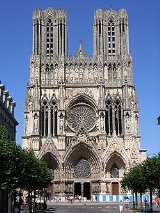
Gothic architecture is a style of
architecture, particularly associated with
cathedrals and other churches, which flourished in
Europe during the high and late
medieval period. Beginning in
12th century France, it was known as "the French Style" during the period, with the term
Gothic first appearing in the Reformation era as a stylistic insult.
It was succeeded by
Renaissance architecture beginning in
Florence in the
15th century.
A series of
Gothic revivals began in mid-
18th century England, spread through
19th century Europe and continued, largely for ecclesiastical and university structures, into the
20th century.
Origin
The style originated at the
abbey church of Saint-Denis in
Saint-Denis, near
Paris, where it exemplified the vision of
Abbot Suger. Suger wanted to create a physical representation of the Heavenly
Bethlehem, a building of a high degree of linearity that was suffused with light and color. The
façade was actually designed by Suger, whereas the Gothic nave was added some hundred years later. He designed the façade of Saint-Denis to be an echo of the Roman
Arch of Constantine with its three-part division. This division is also frequently found in the
Romanesque style. The eastern
"rose" window, which is credited to him as well, is a re-imagining of the Christian "circle-square"
iconography.
The first truly Gothic construction was the
choir of the church, consecrated in 1144. With its thin columns,
stained-glass windows, and a sense of verticality with an ethereal look, the choir of Saint-Denis established the elements that would later be elaborated upon during the Gothic period.
This style was adopted first in northern
France and by the
English, and spread throughout France, the
Low Countries and parts of
Germany and also to
Spain and northern
Italy.
The Term "Gothic"
Gothic architecture has nothing to do with the historical
Goths. It was a pejorative term that came to be used as early as the 1530s to describe culture that was considered rude and barbaric.
François Rabelais imagines an inscription over the door of his
Utopian Abbey of Thélème, "Here enter no hypocrites, bigots..." slipping in a slighting reference to "Gotz" and "Ostrogotz." In English
17th century usage, "Goth" was an equivalent of "
vandal," a savage despoiler with a Germanic heritage and so came to be applied to the architectural styles of northern Europe before the revival of classical types of architecture. "There can be no doubt that the term 'Gothic' as applied to pointed styles of ecclesiastical architecture was used at first contemptuously, and in derision, by those who were ambitious to imitate and revive the Grecian orders of architecture, after the revival of classical literature. Authorities such as
Christopher Wren lent their aid in deprecating the old mediæval style, which they termed Gothic, as synonymous with every thing that was barbarous and rude.", according to a correspondent in Notes and Queries
No. 9. December 29, 1849.
Characteristics
Style emphasizes verticality and features almost skeletal stone structures with great expanses of glass, pointed
arches using the
ogive shape, ribbed vaults, clustered columns, sharply pointed spires,
flying buttresses and inventive
sculptural detail such as gargoyles and even
butterflies attacking men. These features are all the consequence of the use of the pointed arch and a focus on large stained-glass windows that allowed more light to enter than was possible with older styles. To achieve this "light" style, flying buttresses were used as a means of support to enable higher ceilings and slender columns. Many of these features had already appeared, for example in
Durham Cathedral, whose construction started in 1093.
As a defining characteristic of Gothic Architecture, the pointed arch was introduced for both visual and structural reasons. Visually, the verticality suggests an aspiration to Heaven. Structurally, its use gives a greater flexibility to Architectural form. The Gothic vault, unlike the semi-circular vault of Roman and Romanesque buildings, can be used to roof rectangular and irregularly shaped plans such as trapezoids. The other advantage is that the pointed arch channels the weight onto the bearing piers or columns at a steep angle.
In Gothic Architecture the pointed arch is utilized in every location where a vaulted shape is called for, both structural and decorative. Gothic openings such as doorways, windows, arcades and galleries have pointed arches. Gothic vaulting above spaces both large and small is usually supported by richly molded ribs. Rows of arches upon delicate shafts form a typical wall decoration known as blind arcading. Niches with pointed arches and containing statuary are a major external feature. The pointed arch leant itself to elaborate intersecting shapes which developed within window spaces into complex Gothic tracery forming the structural support of the large windows that are characteristic of the style.
Gothic cathedrals could be highly decorated with statues on the outside and painting on the inside. Both usually told
Biblical stories, emphasizing visual
typological allegories between Old Testament prophecy and the
New Testament.
Important Gothic churches could also be severely simple. At the
Basilica of
Mary Magdalene in Saint-Maximin,
Provence , the local traditions of the sober, massive, Romanesque architecture were still strong. The basilica, begun in the
13th century under the patronage of
Charles of Anjou, was laid out on an ambitious scale to accommodate pilgrims that came to venerate
relics. Building in the Gothic style continued at the basilica until 1532.
In Gothic architecture new technology stands behind the new building style. The Gothic cathedral was supposed to be a microcosm representing the world, and each architectural concept, mainly the loftiness and huge dimensions of the structure, were intended to pass a theological message: the great glory of
God versus the smallness and insignificance of the mortal being.
Brick Gothic
Main article: Brick Gothic.
In Northern Germany,
Scandinavia and northern
Poland, in areas where native stone was unavailable, simplified provincial gothic churches were built of brick. The resultant style is called
Backsteingotik in Germany and Scandinavia. The biggest brick gothic building is the Teutonic Knights Castle of
Malbork in Poland and the biggest brick gothic church is the
St. Mary's Church, Gdansk in
Gdansk. The most famous example in
Denmark is
Roskilde Cathedral. Brick gothic buildings were associated with the
Hanseatic League and the
Teutonic Knights. There are over one hundred brick gothic castles in northern Poland, Baltic States, and western Russia.
Sequence of Gothic Styles: France
The designations of styles in French Gothic architecture are as follows:
- Early Gothic
- High Gothic
- Rayonnant
- Late Gothic or Flamboyant style
These divisions are effective, but debatable. Because Gothic cathedrals were built over several successive periods, each period not necessarily following the wishes of previous periods, the dominant architectural style changes throughout a particular building. Consequently, it is often difficult to declare one building as a member of a certain era of Gothic architecture. It is more useful to use the terms as descriptors for specific elements within a structure, rather than applying it to the building as a whole.
Early Gothic:
High Gothic:
Rayonnant:
Late Gothic:
Sequence of Gothic styles: England
The designations of styles in English architecture still follows conventions of labels given them by the antiquary Thomas Rickman, who coined the terms in his
Attempt to Discriminate the Style of Architecture in EnglandEarly English:
Decorated or "Flamboyant":
Perpendicular:
Sequence of Gothic Styles: Spain
The designations of styles in Spanish Gothic architecture are as follows. Dates are approximative.
Gothic style started in Spain as a result of European influence in 12th century when late Romanesque alternated with few expressions of pure Gothic architecture. The High Gothic arrives with all its strength through the
Way of Saint James in the 13th century, with some of the most pure classical Gothic cathedrals, with German and French influence. The most important post-13th century gothic styles in Spain are the Levantino, characterised by its structural achievements and their unification of space, and Isabelline Gothic, made under the
Catholic Kings, that supposed a transition to Renaissance. Gothic style was sometimes adopted by the
Mudejar architects, who built with spanish-arab techniques and materials, and created an hybrid style.
Early Gothic
High Gothic
Mudejar Gothic
Levantino Gothic
Isabelline Gothic
- Saint John of The Kings in Toledo
- Royal Chapel of Granada
Secular Gothic Architecture in England
Few examples of secular structures in Gothic style survive. The "Old Palace" at
Hatfield, built in 1497, is famous for its entrance wing with an imposing gatehouse, which gave access to the protected inner court. This is an example of the last phase of Gothic design in England which, due to its far northern situation, was still untouched by the Renaissance underway in central Italy. Local building traditions produced a vernacular style that was as important as Gothic in the final appearance. The roofs are tiled in the local
East Anglian tradition. Substantial eaves enclose essential storage areas in spacious attics. The Gothic elements in these buildings are the paired lancet windows joined under a molding that threw rainwater away from their sills, and the buttresses between each pier and on the angles of the gatehouse tower.
Gothic revival
Main article: Gothic revival architectureIn England, some discrete Gothic details appeared on new construction at
Oxford and
Cambridge in the late 17th century, and at the
Archbishop of Canterbury's residence
Lambeth Palace, a Gothic
hammerbeam roof was built in 1663 to replace a building that had been sacked during the
English Civil War. It is not easy to decide whether these instances were
Gothic survival or early appearances of
Gothic revival,.
In England in the mid-18th century, the Gothic style was more widely revived, first as a decorative, whimsical alternative to
Rococo that is still conventionally termed 'Gothick', of which
Horace Walpole's Twickenham villa "Strawberry Hill" is the familiar example. Then, especially after the 1830s, Gothic was treated more seriously in a series of
Gothic revivals . The
Houses of Parliament in
London are an example of this Gothic revival style, designed by
Sir Charles Barry and a major exponent of the early Gothic Revival, Augustus Pugin. Another example is the main building of the
University of Glasgow designed by Sir
George Gilbert Scott.
In France, the towering figure of the Gothic Revival was
Eugène Viollet-le-Duc, who outdid historical Gothic constructions to create a Gothic as it ought to have been, notably at the fortified city of
Carcassonne in the south of France and in some richly fortified keeps for industrial magnates . Viollet-le-Duc compiled and coordinated an
Encyclopédie médiévale that was a rich repertory his contemporaries mined for architectural details but also include armor, costume, tools, furniture, weapons and the like. He effected vigorous restoration of crumbling detail of French cathedrals, famously at
Notre Dame, many of whose most "Gothic" gargoyles are Viollet-le-Duc's. But he also taught a generation of reform-Gothic designers and showed how to apply Gothic style to thoroughly modern structural materials, especially
cast iron.
Neo-Gothic in the 20th Century
Neo-Gothic continued to be considered appropriate for churches and college buildings well into the 20th century. Charles Donagh Maginnis's early buildings at
Boston College helped establish the prevalence of
Collegiate Gothic architecture on American university campuses, such as at
Chicago,
Princeton,
Yale and
Duke. It was also used, perhaps less appropriately, for early steel skyscrapers.
Cass Gilbert produced his 1907 90 West Street building and the 1914
Woolworth Building, both in
Manhattan, in a neo-Gothic idiom. It was
Raymond Hood's neo-Gothic tower that won the 1922 competition for the Chicago
Tribune Tower, a late example of the vertical style that has been called "American Perpendicular Gothic."
Another Gothic structure of interest is the jailhouse built in
DeRidder,
Louisiana in 1914. The iron bars in most of the windows give the structure an eerie appearance. The structure includes shallow arches, dormer windows and has a central tower. It is now on the
National Register of Historic Places.
The National Cathedral is also a neo-Gothic structure.
The last prominent Gothic architect in America was probably
Ralph Adams Cram, working in the 1910s and 1920s. With partner
Bertram Goodhue they produced many good examples, like the sensitive and clever French High Gothic
St. Thomas Episcopal Church, New York with its asymmetrical, urban facade in the heart of Manhattan. Working alone, Cram took up the
Cathedral of Saint John the Divine, what he meant to be the largest cathedral and largest Gothic struture in the world, again in French High Gothic. It remains unfinished. Both St. Thomas and St. John the Divine are built without steel.
List of notable Gothic structures
- Ordered by countries roughly from west to the east: