

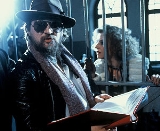
Rainer Werner Fassbinder

Encyclopedia
Rainer Werner Maria Fassbinder (May 31, 1945 – June 10, 1982) was a German movie director, screenwriter and actor. He is considered one of the most important representatives of the New German Cinema
.
He maintained a frenetic pace in film-making. In a professional career that lasted less than fifteen years, Fassbinder completed 40 feature length
films; two television film series; three short films
; four video productions; twenty-four stage plays
and four radio plays
; and 36 acting roles in his own and others’ films. He also worked as an actor (film and theater), author, cameraman, composer
, designer
, editor, producer
and theater manager.
Underlying Fassbinder's work was a desire to provoke and disturb. His phenomenal creative energy when working, co-existed with a wild, self-destructive libertinism that earned him a reputation as the enfant terrible of the New German Cinema, as well as being its central figure. He had tortured personal relationships with the actors and technicians around him who formed a surrogate family. However, his pictures demonstrate his deep sensitivity to social outsiders and his hatred of institutionalized violence. He ruthlessly attacked both German bourgeois society and the larger limitations of humanity.
Fassbinder died at the age of 37 from heart failure resulting from a lethal interaction between sleeping pills and cocaine
. His death is often considered to mark the end of the New German Cinema.
in the small town of Bad Wörishofen
, on May 31, 1945, three weeks after the Americans entered the town and the unconditional surrender of Germany. The aftermath of World War II
deeply marked his childhood and the life of his family. Fassbinder himself, in compliance with his mother's wishes, later altered the date of his birthday to 1946 in order to enhance his status as a cinematic prodigy. It was towards his death that his real age was revealed confronting his passport.
Born into a cultured bourgeois family, Fassbinder had an unconventional childhood about which he would later express grievances in interviews. At three months, he was left with a paternal uncle and aunt in the country, since his parents feared he would not survive the winter with them. The child was a year old when he was returned to his parents.
Fassbinder’s mother, Liselotte Pempeit (1922–93), came from Danzig
(now Gdańsk), from which many ethnic Germans had fled following the occupation of Poland by the Soviet Union
. As a result, a number of her relatives came to live with them in Munich.
From 1946–1951, Fassbinder lived with both of his parents; he was their only child. His father, Helmut Fassbinder, a doctor with a surgery at his apartment in Sendlinger Strasse, near Munich’s red light district
, saw his career as the means to indulge his passion for writing poetry. The doctor, who had two sons from a previous marriage, did not take much interest in the child, and neither did his mother, who helped her husband in his medical practice. Prostitutes came to Helmut Fassbinder for the medical check-up they were required to have so his son became used to seeing these women and, "he would go on feeling that there was nothing wrong or abnormal in prostitution." The extended family disbanded in 1951 and the child, age six, was left alone with his mother after his parent's divorce that same year.
Helmut moved to Cologne
and Liselotte raised her son as a single parent. To provide for them, she rented out rooms and found employment as a translator, but tuberculosis
kept her away for long periods while she recuperated. Rainer was looked after by his mother's tenants and friends, but he became more independent and uncontrollable. Fassbinder spent time in the streets, sometimes playing with other boys, sometimes just watching events around him. He clashed with his mother's younger lover Siggi, who lived with them when Rainer was eight or nine years old. He had a similar difficult relationship with the much older journalist Wolff Eder (c1905-71), who became his stepfather in 1959. Liselotte, who worked as an English- German translator, could not concentrate with her son around her and Fassbinder was often given money to go to the cinema. Later in life, he would claim that he saw a film nearly every day and sometimes as many as three or four. "The cinema was the family life I never had at home."
His time at a boarding school was marred by his repeated escape and he left school before any final examinations. At the age of 15, he moved to Cologne
to stay with his father, but they argued frequently. He stayed though for a couple of years while attending night school, and earned a living on small jobs and helping his father, who rented shabby apartments to immigrant workers. At this time, Fassbinder wrote short plays, poems and short stories. Early in his adolescence, Fassbinder identified himself as homosexual.
, who would become one of his most important actors. During this time, he made his first 8mm films
and took on small jobs as actor, assistant director, and sound man
. At this time he also wrote the tragic comic play: Drops on Hot Stones. To gain entry to the Berlin Film School
, Fassbinder submitted a film version of his play Parallels. He also entered several 8 mm films including This Night (now lost), but he was turned down for admission along side two other who would become famous directors Werner Schroeter
and Rosa von Praunheim
.
He returned to Munich, continued with his writing and made two short films,The City Tramp (Der Stadtstreicher, 1965) and The Little Chaos (Das Kleine Chaos, 1966). Shot in black and white, they were financed by Fassbinder's lover, Christoph Roser, an aspiring actor, in exchange for leading roles. Fassbinder acted in both of these films which also featured Irm Hermann
. In the latter, his mother – under the name of Lilo Pempeit – played the first of many parts in her son's films.
, Harry Baer
and Kurt Raab
, who along with Hanna Schygulla and Irm Hermann, became the most important members of his cinematic stock company. Working with the Anti-Theater, Fassbinder would learn writing, directing, acting, and from which he would cull his own repertory group. Even in this period, Fassbinder productivity was remarkable. In the space of eighteen months he directed twelve plays, of these he wrote four himself and rewrote five others.
The style of his stage directing closely resembled that of his early films, a mixture of choreographed movement and static poses, taking its cues not from the traditions of stage theater, but from musicals, cabaret, films and the student protest movement.
After he made his first feature films in 1969 Fassbinder centered his efforts in his career as film director, but he maintained an intermittent foothold in the theater until his death. He worked in various productions throughout Germany and made a number of radio plays in the early 1970s. In 1974 Fassbinder took directorial control over the Theater am Turm (TAT) of Frankfurt, when this project ended in failure and controversy, Fassbinder became less interested in the theater.
cinema, particularly Godard's
Pierrot le fou
(1965) and Week End (1967). Fassbinder developed his rapid working methods early. Because he knew his actors and technicians so well, Fassbinder was able to complete as many as four or five films per year on extremely low budgets. This allowed him to compete successfully for the government grants needed to continue making films.
Unlike the other major auteurs of the New German Cinema, Volker Schlöndorff
, Werner Herzog
and Wim Wenders
, who started out making movies, Fassbinder's stage background was evident throughout his work. Additionally, he learned how to handle all phases of production, from writing and acting to direction and theater management. This versatility surfaced in his films too where, in addition to some of the aforementioned responsibilities, Fassbinder served as composer, production designer, cinematographer, producer and editor. He also appeared in 30 projects of other directors.
By 1976, Fassbinder had gained international prominence, prizes at major film festival
s, premieres and retrospectives in Paris, New York, Los Angeles and a study of his work by Tony Rayns
was published, all helped make him a familiar name among cinephiles and campus audiences throughout the world. He lived in Munich when not traveling, rented a house in Paris (with ex-wife Ingrid Caven) and could be seen in gay bars in New York, earning him cult hero status, but also a controversial reputation in and out of his films. His films were a fixture in art houses of the time after he became internationally known with Ali: Fear Eats the Soul
. In 1977, he was a member of the jury at the 27th Berlin International Film Festival
.
, a former secretary whom he forced to become an actress. The director usually cast her in unglamorous roles most notably as the unfaithful wife in The Merchant of Four Seasons
and the silent abused assistant in The Bitter Tears of Petra von Kant
. Irm Hermann idolized him, but Fassbinder tormented and tortured her for over a decade. This included domestic violence
: "He couldn't conceive of my refusing him, and he tried everything. He almost beat me to death on the streets of Bochum
...." In 1977, Hermann became romantically involved with another man and became pregnant by him. Fassbinder proposed to her and offered to adopt the child; she turned him down.
Fassbinder's main romantic interest during his early period as a film director was Günther Kaufmann
, a black Bavarian. Kaufmann was not a trained actor and entered cinema when, in 1969, Fassbinder fell madly in love with him. The director tried to buy his love with movie roles and expensive gifts, but Kaufmann managed to destroy four Lamborghini
s in a year. Like Salem, Fassbinder's next male partner, he was married and the father of two children. He appeared in fourteen of Fassbinder's films, having the leading role in Whity
(1971).
Although he claimed to be opposed to matrimony as an institution, in 1970 Fassbinder married Ingrid Caven
, a regular actress in his films. Their wedding reception was recycled in the film he was making at that time, The American Soldier. Their relationship of mutual admiration survived the complete failure of their two-year marriage. "Ours was a love story in spite of the marriage," Ingrid explained in an interview, adding about her former husband's sexuality
: "Rainer was a homosexual who also needed a woman. It’s that simple and that complex." The three most important women of Fassbinder’s life, Irm Hermann, Ingrid Caven and Juliane Lorenz
, his last partner, were not disturbed by his homosexuality.
In 1971, Fassbinder fell in love with El Hedi ben Salem
(c1935-82), a Berber
from Morocco
. Their turbulent relationship ended violently in 1974. Salem, cast as Ali in Fear Eats the Soul, hanged himself in jail in 1982. Fassbinder, who barely outlived his former lover, dedicated his last film, Querelle
, to Salem.
Armin Meier (1943–78), a former butcher who was almost illiterate and who had spent his early years in an orphanage, was Fassbinder's lover from 1974 to 1978. He also appeared in several Fassbinder films in this period. A glimpse into their troubled relationship can be seen in Fassbinder's episode for Germany in Autumn (1978). After Fassbinder broke up with him, Meier committed suicide
on Fassbinder’s birthday. He was found dead in their apartment only days later. Devastated by Armin’s suicide, Fassbinder made In a Year with Thirteen Moons to exorcise his pain.
In the last four years of his life, Fassbinder's companion was Juliane Lorenz (born 1957), the editor of his films during this period. She can be seen in a small role as the film producer's secretary in Veronika Voss. According to Lorenz, they considered getting married, but never did so. Although they were drifting apart in his last year, they were still living together at the time of his death.
There were frequent exposés of his lifestyle in the press, and attacks from all sides from the groups his films offended. His television series Eight Hours Do Not Make a Day was cut from eight to five episodes after pressure from conservatives. The playwright Franz Xaver Kroetz
sued over Fassbinder's adaptation of his play Jail Bait, alleging that it was obscene
. Lesbian
s and feminists accused Fassbinder of misogyny
(in presenting women as complicit in their own oppression) in his 'Women‘s Picture'. The Bitter Tears of Petra von Kant has been cited by some feminist and gay critics as both homophobic
and sexist
.
Gays complained of misrepresentation in Fox and his Friends. Conservatives attacked him for his association with the radical left
. Marxists
said he had sold out his political principles in his depictions of left-intellectual manipulations in Mother Küsters' Trip to Heaven
and of a late-blooming terrorist
in The Third Generation. Berlin Alexanderplatz was moved to a late night television slot amid widespread complaints that it was unsuitable for children. The most heated criticism came for his play Garbage, the City, and Death, whose scheduled performance at the Theater am Turm in Frankfurt was cancelled early in 1975 amid charges of anti-semitism
. Though published at the time, and quickly withdrawn, the play was not performed until 1985, after Fassbinder's death. In the turmoil, Fassbinder resigned from his directorship of that prestigious theater complex, complaining that the play had been misinterpreted.
Fassbinder did little to discourage the personalized nature of the attacks on himself and his work. He seemed to provoke them by his aggressively non-conformist lifestyle, symbolized in his black leather jacket, battered hat, dark glasses and perennial scowl.
(1982), Fassbinder was using heavy doses of drugs and alcohol to sustain his unrelenting work schedule. On the night of June 9–10, 1982, Wolf Gremm
, director of the film Kamikaze 1989 (1982), which starred Fassbinder, was staying in his apartment. Early that evening, Fassbinder retired to his bedroom. He was working on notes for a future film: Rosa L, based on the life of Rosa Luxemburg
, the Polish-German revolutionary socialist. Fassbinder was watching television, video and reading in between when shortly after one o'clock in the morning he received a phone call from his friend and assistant Harry Baer. At 3:30 a.m, when Juliane Lorenz arrived home, she heard the noise of television in Fassbinder’s room, but she could not hear him snoring. Though not allowed to enter the room uninvited, she went in, and she found him lying on the bed, dead, a cigarette still between his lips. A thin ribbon of blood trickled from one nostril.
The cause of death was reported as heart attack
resulting from a lethal combination of sleeping pills and cocaine
. The notes for Rosa Luxemburg were found next to his body.
Fassbinder's remains were interred at Bogenhausener Friedhof in Munich
.
on most of the early films, editor or co-editor on many of them (often credited as Franz Walsh, though the spelling varies), and he acted in nineteen of his own films as well as for other directors. He wrote fourteen plays, created new versions of six classical plays, and directed or co-directed twenty-five stage plays. He wrote and directed four radio plays and wrote song lyrics. In addition, he wrote thirty-three screenplays and collaborated with other screenwriters on thirteen more. On top of this, he occasionally performed many other roles such as cinematographer and producer on a small number of them. Working with a regular group of actors and technicians, he was able to complete films ahead of schedule and often under budget and thus compete successfully for government subsidies. He worked fast, typically omitting rehearsals and going with the first take.
There are three distinct phases to Fassbinder’s career. His first ten movies (1969–1971) were an extension of his work in the theater, shot usually with static camera and with deliberately unnaturalistic dialogue.
The second phase is the one that brought him international attention, with films modeled, to ironic effect, on the melodramas Douglas Sirk
made in Hollywood in the 1950s. In these films, Fassbinder explored how deep-rooted prejudices about race, sex, sexual orientation
, politics and class are inherent in society, while also tackling his trademark subject of the everyday fascism
of family life and friendship.
The final films, from around 1977 until his death, were more varied, with international actors sometimes used and the stock company disbanded (although the casts of some films were still filled with Fassbinder regulars). He became increasingly more idiosyncratic in terms of plot, form and subject matter in movies like The Marriage of Maria Braun (1978), The Third Generation (1979) and Querelle (1982). He also articulated his themes in the bourgeois milieu with his trilogy about women in post-fascist Germany: The Marriage of Maria Braun (1978), The Angst of Veronica Voss and Lola.
"I would like to build a house with my films," Fassbinder once remarked. "Some are the cellars, others the walls, still others the windows. But I hope in the end it will be a house."
, Jean-Marie Straub
and the theories of Brecht
, these films are austere and minimalist in style. Although praised by many critics, they proved too demanding and inaccessible for a mass audience. It was during this time, however, that Fassbinder developed his rapid working methods.
(1969) (Liebe ist kälter als der Tod), was a deconstruction
of the gangster film genre. Fassbinder dedicated the film to his cinematic mentors: Claude Chabrol
, Eric Rohmer
and Jean-Marie Straub
. Success was not immediate: Love is Colder than Death was ill received at the Berlin Film Festival
, but marked the beginning of the successful careers of the film's three leading actors: Hanna Schygulla
, Ulli Lommel
and Fassbinder himself.
(1969), (Bavarian slang for 'foreign worker'), was received more positively, garnering five prizes after its debut at Mannheim
. It featured an immigrant from Greece who encounters violent xenophobic slackers
when moving into an all-German neighborhood. This kind of social criticism, featuring alienated characters unable to escape the forces of oppression, is a constant throughout Fassbinder's oeuvre. Katzelmacher was adapted from Fassbinder's first produced play – a companion feature to Jean-Marie Straub's 10-minute stage adaptation of Ferdinand Bruckner
's three-act play, Sickness of Youth (1926) for the underground Action Theater.
race narratives like Band of Angels
(1957), directed by Raoul Walsh
, another Fassbinder influence.
was based, like many of Fassbinder’s films, on a personal experience – the shooting of his earlier film, the revisionist Western Whity (1970). The film shows an egomaniacal director, beset by a stalled production, temperamental actors, and a frustrated crew. When asked what the movie he is making is about, he replies: brutality. The film ends with a typical Fassbinder-esque irony, as the crew gang up on the director. Beware of a Holy Whore marked the end of Fassbinder’s avant-garde period. It presented such an embittered and radical self-critique that his future films would have to be quite different from the ones made before. After spinning out ten films within two years in a frenzied burst of creativity, his anti-film anti-theater drive seemed pretty much exhausted.
made in Hollywood for Universal-International
in the 1950s: All That Heaven Allows
, Magnificent Obsession
and Imitation of Life
. Fassbinder was attracted to these films not only because of their entertainment value, but also for their depiction of various kinds of repression and exploitation.
(1971) (Händler der vier Jahreszeiten). The film portrays a married couple who are fruit sellers. Hans faces rejection from his family after he violently assaults his wife for not bending to his will. She leaves him, but after he suffers a heart attack they reunite, though he now has to employ other men. His restricted ability to function leads him to ponder his own futility. He literally drinks himself to death.
The Merchant of Four Seasons introduced a new phase of Fassbinder’s filmmaking, using melodrama as a style to create critical studies of contemporary German life for a general audience. It was Fassbinder's first effort to create what he declared he aspired to: a cinematic statement of the human condition that would transcend national boundaries as the films of Michelangelo Antonioni
, Ingmar Bergman
and Federico Fellini
had done. It is also his first realization of what he learned from Sirk: that people, however small they may be, and their emotions, however insignificant they may seem, could be big on the movie screen.
(1972), (Die bitteren Tränen der Petra von Kant), adapted from one of Fassbinder's plays. The title character is a fashion designer who lives in a self-created dreamland and the action is restricted mostly to her lavish bedroom. After the failure of her second marriage, Petra falls hopelessly and obsessively in love with a working-class, cunning young woman who wants a career in modeling. The model's exploitation of Petra mirrors Petra's extraordinary psychological abuse of her silent assistant. Fassbinder portrays the slow meltdown of these relationships as inevitable, and his actresses (there are no men in the film) move in a slow, trance-like way that hints at a vast world of longing beneath the beautiful, brittle surface.
Originally made for German television, Jailbait was based on a play by Franz Xaver Kroetz
who violently disagreed with Fassbinder’s adaptation, calling it pornographic. The luridness of its theme further the controversy.
, World on a Wire
(Welt am Draht
, 1973) was a departure for Fassbinder. An adaptation of the pulp sci-fi novel Simulacron-3
by Daniel F. Galouye
, it was made as a two part, 205 minute production for television using 16 mm film stock during a hiatus from the lengthy production of Effi Briest and in the same year as Martha and Ali: Fear Eats the Soul.
A story of realities within realities, World on a Wire follows a researcher, working at the institute of cybernetics and future science, who begins to investigate the mysterious death of his mentor. He falls deep into the cover up behind a computer capable of creating an artificial world with units living as human beings unaware that their world is just a computer projection. Set in 1970s Paris, the film was stylistically inspired by Jean Luc Godard's Alphaville (1965) and in its theme of artificial humans wanting to reach real life anticipated Ridley Scott
's Blade Runner
.
(1974) (Angst essen Seele auf). This film was shot in 15 days in September 1973 with a very low budget ranking among Fassbinder's quickest and cheapest. Nevertheless, the impact on Fassbinder’s career and foreign cinema remains cemented as a great and influential work. It won the International Critics Prize at Cannes
and was acclaimed by critics everywhere as one of 1974's best films.
Fear Eats the Soul was loosely inspired on Sirk's All That Heaven Allows
. It details the vicious response of family and community to a lonely aging white cleaning lady who marries a muscular, much younger black Moroccan immigrant worker. The two are drawn to each other out of mutual loneliness. When their relationship becomes known, they experience various forms of hostility and public rejection. Gradually, their relationship is tolerated, not out of real acceptance, but because those around the good-hearted old lady realize their ability to exploit her is threatened. As the external pressures over the couple begin to subside, internal conflicts surface.
(1974) is a melodrama about the cruelty of a traditional marriage.
The plot focuses on the title character, a spinster librarian. Soon after the death of her father while on vacation in Rome
, Martha meets a wealthy civil engineer who sweeps her off her feet. They encounter again at a wedding in her hometown of Constance
and marry. However their married life becomes an exercise for her husband to express his sadism and for Martha to endure her masochism. Her husband shows his desire for her violently leaving marks on her body. He obsessively controls her life, her diet, her taste in music and her interest until she is confined to their house. Martha’s initially positive wish to be liked by her oppressive and abusive husband push her to such an extreme that she becomes deranged leading to her own permanent physical paralysis.
was Fassbinder’s dream film and the one in which he invested the most work. While he normally took between nine and 20 days to make a film, this time it required 58 shooting days, dragged out over two years. The film is a period piece adapted from Theodor Fontane
's classic novel
of 1894, concerning the consequences of betrayed love. Set in the closed, repressive Prussian society of the Bismarck
era, the film paints a portrait of a woman's fate completely linked to an unbending and utterly unforgiving code of social behavior. The plot follows the story of Effi Briest, a young woman who seeks to escape her stifling marriage to a much older man by entering into a brief affair with a charming soldier. Six years later, Effi’s husband discovers her affair with tragic consequences.
The film served as a showpiece for Fassbinder's muse and favorite actress Hanna Schygulla
, whose detached acting style fitted the roles the director created for her. Fassbinder made her a star, but artistic differences while making Effie Briest created a split that lasted four years, until Fassbinder called her back to take the role of Maria Braun.
, the main actress in Fear eats the Soul, singing cabaret songs and love ballads from the 1940s and 1950s. Between songs she drinks and talks about her husbands. The title is borrowed from Leonard Cohen
's song Like a bird on the Wire
, with which the program ends.
Fassbinder considered this project " an attempt to do a show about the Adenauer era
. For us it certainly wasn’t entirely successful. But the film does reveal the utter repulsiveness and sentimentality of the time" he explained.
Fox and His Friends (1975) Many of Fassbinder’s films deal with homosexuality, in keeping with his interest in characters who are outsiders to society; however, he drew away from most representations of homosexuals in films. In an interview at the 1975 Cannes Film Festival
, Fassbinder said about Fox and His Friends
: “It is certainly the first film in which the characters are homosexuals, without homosexuality being made into a problem. In films, plays or novels, if homosexuals appear, the homosexuality was the problem, or it was a comic turn. But here homosexuality is shown as completely normal, and the problem is something quite different, it’s a love story, where one person exploits the love of the other person, and that’s the story I always tell”.
In Fox and His Friends (1974) (Faustrecht der Freiheit) a sweet but unsophisticated working-class homosexual wins the lottery and falls in love with the elegant son of an industrialist. His lover tries to mold him into a gilt-edged mirror of upper-class values and ultimately destroys his illusions, leaving him heartbroken and destitute.
Fassbinder worked within the limits of Hollywood melodrama, though the film is partially based on the plight of his then lover Armin Meier (to whom the film is dedicated). The film is notable for Fassbinder's performance as the unlucky Fox, in a self-directed starring role.
Fox and His Friends has been deemed homophobic by some and overly pessimistic by others. The film's homosexuals are not, surprisingly, any different from the film's equally lecherous heterosexuals. Moreover, the film's pessimism is far outweighed by Fassbinder's indictment of Fox as an active participant in his own victimization, a familiar critique found in many of the director's films.
Mother Küsters Goes to Heaven (1975) Interested in and deeply critical of West Germany political situation, Fassbinder made three films dealing with contemporary issues of his country: Mother Küsters Goes to Heaven (1975), Germany in Autumn (1978) and The Third Generation (1979).
In Mother Küsters Goes to Heaven (Mutter Küsters Fahrt zum Himmel), Emma Küsters, a kind old widow, becomes the center of media and political attention after her husband, a factory worker, killed his supervisor and then himself when lay offs were announced. Wherever Mother Küsters turns for comfort and assistance she meets either rejection or exploitation. Journalist, left wing political extremist and even her family take advantage of Mother Küsters’s personal tragedy to advance their own agendas.
At age thirty and already in the mid point of his career as a filmmaker, Fassbinder was inspired by the German classic film Mother Krauser’s trip to Happiness (1929) directed by Phil Jutzis.
Fear of Fear (1975) Made for German television, Fear of Fear is a physiological drama about a middle class house wife, locked into a dull life with a distracted husband, two small children and openly hostile in laws. She becomes addicted to valium and alcohol overwhelmed by an irrational anxiety and fear of her inexorable descent into madness.
Fear of Fear is similar in themes to Martha, which also portrays the effect of a dysfunctional marriage in an oppressed housewife, the central role in both films is played by one Fassbinder’s favorite leading ladies, Margit Carstensen
.
I Only Want You to Love Me (1976) I Only Want You to Love Me (1976) (Ich will doch nur, daß ihr mich liebt) tells the story of Peter, a construction worker in jail for manslaughter. His life is recounted in a series of flashbacks. A hard working man, Peter spends his spare time building a house for his cold unloving parents. He marries and finds a job in another city, but in his desperate yearning for affection he tries to buy the love of those around him with expensive gifts which soon makes him fall in a spiral of debt. When he sees his own unrequited love for his parents reflected during an argument in a bar, he kills a man who serves as a proxy for his father.
The film, made for television and shot during a pause while making Satan's Brew, it is based on a true account taken from from For Life, a book of interviews edited by Klaus Antes and Christiane Erhardt. It was also Fassbinder's personal reflection in his longing for love during his childhood and adolescence.
Satan's Brew (1976) In a time of professional crisis, Fassbinder made Satan's Brew (1976) (Satansbraten) a bleak amoral comedy that pays homage to Antonin Artaud
’s theatre of cruelty
. Stylistically far from the melodramas that made him known internationally, Satan's Brew gave way to a new phase in Fassbinder’s career.
In Satan's Brew, a neurotic poet suffering from writer's block; struggles to make ends meet while dealing with a frustrated long suffering wife, a half witted brother and various prostitutes and masochist women who drift in and out of his life. He convinces himself to be the reincarnation of the gay romantic poet Stefan George
(1868-1933) after he plagiarizes his poem The Albatros.
paid tribute to Fassbinder as "the most original talent since Godard". In 1977, the New Yorker Theater in Manhattan held a Fassbinder Festival.
However, as enthusiasm for Fassbinder grew outside of Germany, his films still failed to impress the native audience. At home, he was better known for his television work and for his open homosexuality. Coupled with the controversial issues of his films — terrorism, state violence, racism
, sexual politics — it seemed that everything Fassbinder did provoked or offended someone.
After completing in 1978 his last low-budget and very personal ventures (In a Year of 13 Moons
and The Third Generation
) he would concentrate on making films that were becoming increasingly garish and stylized. But Fassbinder's acclaimed TV series Berlin Alexanderplatz were a naturalistic adaptation of the two-volume novel by Alfred Döblin
, which Fassbinder had read many times.
Chinese Roulette (1976) Chinese Roulette
(Chinesisches Roulette) is Fassbinder's only film dealing with childhood. A gothic thriller with an ensemble cast, the story follows a twelve year old crippled girl who, out of hate for her parents lack of affection, arranges an encounter between them with their respective lovers at the family country estate. The film centers on a truth guessing game Fassbinder often played with his friends. The players divide into two teams, which take it in turn to pick out one member of the other side and ask them question about people and objects. The game is played at the suggestion of Angela, the disabled daughter, who plays on the opposite side from her mother. When the mother asks: "In the Third Reich, what would that person have been?" Angela’s answer is "Commandant of the concentration camp at Bergen Belsen"; it is her mother she is describing.
. The plot follows the downfall of Xaver Bolwieser, a rail way stationmaster submitted to the will of his domineering unfaithful wife, whose repeated infidelities completely ruin Bolwiser’s life. Broadcast as a two part television series, The Stationmaster's Wife was shorten to a 112 minute feature film and released in the first anniversary of Fassbinder's death. The film star Kurt Raab
, Fassbinder's close friend who the director usually cast as a pathetic man. Raab was also set designer of Fassbinder's films until they broke their friendship and professional relationship after making this film.
(1978), Lili Marleen (1980) and Querelle (1982). All three films have international stars and are very ambitious, yet each faced artistic and commercial problems.
Despair
is based upon the novel
by Vladimir Nabokov
, adapted by Tom Stoppard
and featuring Dirk Bogarde
. It was made on a budget of 6,000,000 DEM
, exceeding the total cost of Fassbinder’s first 15 films.
Despair – A journey into the Light
(Despair – Eine Reise ins Licht) tells the story of Hermann Hermann, an unbalanced Russian émigré and chocolate magnate, whose business and marriage have both grown bitter. The factory is close to bankruptcy, and his vulgar wife is chronically unfaithful. He hatches an elaborate plot to take a new identity in the belief it will free him of all his worries. The story of Hermann’s descent into madness is juxtaposed against the rise of National Socialism in Germany of the 1930s
s and hears the brutal story of her childhood. Fassbinder's camera tracks the nun (played by his mother) telling Elvira's story; she moves with a kind of military precision through the grounds, recounting the story in blazing detail, unaware that Elvira had collapsed and can no longer hear it.
In a Year of Thirteen Moons was explicitly personal, a reaction to Meier's suicide. In addition to writing, directing, and editing, Fassbinder also designed the production and served as cameraman.
(Die Ehe der Maria Braun). He finally attained the popular acceptance he sought, even with German audiences. The title character is an ambitious and strong willed woman separated from her husband towards the end of World War II. The plot follows Maria Braun steady rise as a successful business woman during the Adenauer
era, but her professional achievements are not accompanied with personal happiness. Maria’s dream of a happy life with her husband remains unfulfilled. The film, constructed in the Hollywood tradition of the women pictures presenting a woman overcoming hardships, serves also as a parable of West Germany economic miracle embodied in the character of Maria Braun. Her story of manipulation and betrayal exposes Germany's spectacular postwar economic recovery in terms of its cost in human values.
The film was the first part of a trilogy that was completed with Lola (1981) and Veronika Voss (1982). All three film center on women during the "economic miracle
" of the 1950s.
(1979) (Die Dritte Generation), a black comedy about terrorism. However Fassbinder had difficulties finding financing backing for this project which was ultimately made with a small budget and borrowed money. As he did with In a Year of Thirteen Moons, Fassbinder worked as his own cameraman.
The film follows a group of leftist bourgeois aspiring terrorist who kidnap an industrialist during carnival season unaware of the fact that they have been manipulated by capitalist and the authorities whose hidden agenda is that terrorism would create demand for security hardware and allow harsher security measures by the government. The actions of the ineffectual cell of underground terrorist are overlaid with a soundtrack filled with newscast, voiceovers, music and gibberish. The political theme of the film aroused controversy.
's 1929 novel Berlin Alexanderplatz
in 1980. A monumental TV series
running more than 13 hours, with a two-hour coda released in the U.S. as a 15-hour feature, it became his crowning achievement. It was the culmination of the director's inter-related themes of love, life, and power.
Berlin Alexanderplatz centers on Franz Biberkopff, a former convict and minor pimp, who tries to stay out of trouble but is dragged down by crime, poverty and the duplicity of those around him. His best friend, Reinhold, makes him lose an arm and murders Franz’ prostitute girlfriend, Mieze. The love triangle of Franz, Reinhold and Mieze is staged against the rising tide of Nazism in Germany. The film emphasized the sadomasochist relationship between Biberkopff and Reinhold stressing its homoerotic nature.
Fassbinder had read the book at age fourteen; later claiming that it helped him survive a “murderous puberty”. The influence of Döblin's novel can be seen in many of Fassbinder’s films most of whose protagonist are named Franz, some with the surname Biberkopff like the naïve working class lottery winner in Fox and his friends who is played by Fassbinder himself. He also took the pseudonym of Franz Walsh for his work as editor on his own films: Walsh was a skew homage to director Raoul Walsh
while Franz came from Biberkopff.
, an international co production, shot in English and with a big budget. The script was vaguely based on the autobiography of World War II
singer Lale Andersen
, The Sky Has Many Colors. The film is constructed as a big, tear-jerking Hollywood melodrama
in its depiction of the unfulfilled love story between a German variety singer separated by the war from a Swiss Jewish composer. Central to the story is the song
that gives the film its title.
Fassbinder presents the period of the Third Reich as a predictable development of German history that was staged as spectacle supported by hate. Filmed with a morbid nostalgia for swastika
s, showbiz glitz and as a cloak-and-dagger romance, the main theme of Lili Marleen is the question: is it morally justifiable to survive under National Socialism, as does the naïve singer by having a successful career?
and the Tanztheater Wuppertal Pina Bausch
Fassbinder spoke passages from Antonin Artaud
as well as his own commentary.
Lola was loosely based on Josef von Sternberg
’s The Blue Angel
(1930) and its source novel, Professor Unrat
(1905), by Heinrich Mann
. In The Blue Angel, a cabaret singer leads a sanctimonious teacher to his ruin, and "Lola" is the name of the character portrayed by Marlene Dietrich
. Unlike the earlier film – of little stylistic resemblance to Lola – Fassbinder equally emphasizes his leading man and leading woman, rendering them compellingly, and giving added thematic resonance to how both are corrupted: the weak-willed commissioner by submitting to Lola, and Lola by submitting to the sham values of materialism.
at the 32nd Berlin International Film Festival
with Veronika Voss. The original German title, Die Sehnsucht der Veronika Voss, translates as "The longing of Veronika Voss". Set in the 1950s, the film depicts the twilight years of the title character, a faded Nazi starlet. A sports reporter becomes enthralled by the unbalanced actress and discovers that she is under the power of a villainous doctor who supplies her with the drugs she craves so long as she can pay the exorbitant fee. Despite the reporter’s best attempts, he is unable to save her from a terrible end.
Veronika Voss was inspired as much by Billy Wilder
's Sunset Boulevard
(1950), as by the life of performer Sybille Schmitz
. While the stories of the two films are distinct, there is a similarity between the pathologically self-deluding characters of Norma Desmond (Gloria Swanson
) and Veronika Voss. The film was shot in high-contrast black and white.
, based on Jean Genet
's novel Querelle de Brest
. The plot follows the title character, a handsome sailor who is a thief and hustler. Frustrated in a homoerotic relationship with his own brother, Querelle betrays those who love him and pays them even with murder. His story unfolds in a surreal, phallic setting lighted with an orange glow. The film was the subject of much controversy, not least because of its free and provocative depiction of homosexuality and criminality. It was shot in English with unnaturalistic dialogue and flat acting style.
, Bela Tarr
, Todd Haynes
, Kathryn Bigelow
, John Waters
, François Ozon
, Richard Linklater
, Harmony Korine
and Gus Van Sant
. Additionally, filmmakers Michael Haneke
, Aki Kaurismäki
, and Fatih Akin
have been compared to Fassbinder in terms of style and content, although all three filmmakers have stated in interviews that Fassbinder was not a direct influence on their work.
New German Cinema
New German cinema is a period in German cinema which lasted from the late 1960s into the 1980s. It saw the emergence of a new generation of directors...
.
He maintained a frenetic pace in film-making. In a professional career that lasted less than fifteen years, Fassbinder completed 40 feature length
Feature film
In the film industry, a feature film is a film production made for initial distribution in theaters and being the main attraction of the screening, rather than a short film screened before it; a full length movie...
films; two television film series; three short films
Short subject
A short film is any film not long enough to be considered a feature film. No consensus exists as to where that boundary is drawn: the Academy of Motion Picture Arts and Sciences defines a short film as "an original motion picture that has a running time of 40 minutes or less, including all...
; four video productions; twenty-four stage plays
Play (theatre)
A play is a form of literature written by a playwright, usually consisting of scripted dialogue between characters, intended for theatrical performance rather than just reading. There are rare dramatists, notably George Bernard Shaw, who have had little preference whether their plays were performed...
and four radio plays
Radio drama
Radio drama is a dramatized, purely acoustic performance, broadcast on radio or published on audio media, such as tape or CD. With no visual component, radio drama depends on dialogue, music and sound effects to help the listener imagine the characters and story...
; and 36 acting roles in his own and others’ films. He also worked as an actor (film and theater), author, cameraman, composer
Composer
A composer is a person who creates music, either by musical notation or oral tradition, for interpretation and performance, or through direct manipulation of sonic material through electronic media...
, designer
Production designer
In film and television, a production designer is the person responsible for the overall look of a filmed event such as films, TV programs, music videos or adverts. Production designers have one of the key creative roles in the creation of motion pictures and television. Working directly with the...
, editor, producer
Film producer
A film producer oversees and delivers a film project to all relevant parties while preserving the integrity, voice and vision of the film. They will also often take on some financial risk by using their own money, especially during the pre-production period, before a film is fully financed.The...
and theater manager.
Underlying Fassbinder's work was a desire to provoke and disturb. His phenomenal creative energy when working, co-existed with a wild, self-destructive libertinism that earned him a reputation as the enfant terrible of the New German Cinema, as well as being its central figure. He had tortured personal relationships with the actors and technicians around him who formed a surrogate family. However, his pictures demonstrate his deep sensitivity to social outsiders and his hatred of institutionalized violence. He ruthlessly attacked both German bourgeois society and the larger limitations of humanity.
Fassbinder died at the age of 37 from heart failure resulting from a lethal interaction between sleeping pills and cocaine
Cocaine
Cocaine is a crystalline tropane alkaloid that is obtained from the leaves of the coca plant. The name comes from "coca" in addition to the alkaloid suffix -ine, forming cocaine. It is a stimulant of the central nervous system, an appetite suppressant, and a topical anesthetic...
. His death is often considered to mark the end of the New German Cinema.
Early life
Fassbinder was born in BavariaBavaria
Bavaria, formally the Free State of Bavaria is a state of Germany, located in the southeast of Germany. With an area of , it is the largest state by area, forming almost 20% of the total land area of Germany...
in the small town of Bad Wörishofen
Bad Wörishofen
Bad Wörishofen is a spa town in the district Unterallgäu, Bavaria Germany known for the water-cure developed by Sebastian Kneipp , a Catholic priest, who lived there for 42 years...
, on May 31, 1945, three weeks after the Americans entered the town and the unconditional surrender of Germany. The aftermath of World War II
World War II
World War II, or the Second World War , was a global conflict lasting from 1939 to 1945, involving most of the world's nations—including all of the great powers—eventually forming two opposing military alliances: the Allies and the Axis...
deeply marked his childhood and the life of his family. Fassbinder himself, in compliance with his mother's wishes, later altered the date of his birthday to 1946 in order to enhance his status as a cinematic prodigy. It was towards his death that his real age was revealed confronting his passport.
Born into a cultured bourgeois family, Fassbinder had an unconventional childhood about which he would later express grievances in interviews. At three months, he was left with a paternal uncle and aunt in the country, since his parents feared he would not survive the winter with them. The child was a year old when he was returned to his parents.
Fassbinder’s mother, Liselotte Pempeit (1922–93), came from Danzig
Gdansk
Gdańsk is a Polish city on the Baltic coast, at the centre of the country's fourth-largest metropolitan area.The city lies on the southern edge of Gdańsk Bay , in a conurbation with the city of Gdynia, spa town of Sopot, and suburban communities, which together form a metropolitan area called the...
(now Gdańsk), from which many ethnic Germans had fled following the occupation of Poland by the Soviet Union
Soviet Union
The Soviet Union , officially the Union of Soviet Socialist Republics , was a constitutionally socialist state that existed in Eurasia between 1922 and 1991....
. As a result, a number of her relatives came to live with them in Munich.
From 1946–1951, Fassbinder lived with both of his parents; he was their only child. His father, Helmut Fassbinder, a doctor with a surgery at his apartment in Sendlinger Strasse, near Munich’s red light district
Red Light District
Red Light District may refer to:* Red-light district - a neighborhood where prostitution is common* The Red Light District - the title of the 2004 album by rapper Ludacris* Red Light District Video - a pornography studio based in Los Angeles, California...
, saw his career as the means to indulge his passion for writing poetry. The doctor, who had two sons from a previous marriage, did not take much interest in the child, and neither did his mother, who helped her husband in his medical practice. Prostitutes came to Helmut Fassbinder for the medical check-up they were required to have so his son became used to seeing these women and, "he would go on feeling that there was nothing wrong or abnormal in prostitution." The extended family disbanded in 1951 and the child, age six, was left alone with his mother after his parent's divorce that same year.
Helmut moved to Cologne
Cologne
Cologne is Germany's fourth-largest city , and is the largest city both in the Germany Federal State of North Rhine-Westphalia and within the Rhine-Ruhr Metropolitan Area, one of the major European metropolitan areas with more than ten million inhabitants.Cologne is located on both sides of the...
and Liselotte raised her son as a single parent. To provide for them, she rented out rooms and found employment as a translator, but tuberculosis
Tuberculosis
Tuberculosis, MTB, or TB is a common, and in many cases lethal, infectious disease caused by various strains of mycobacteria, usually Mycobacterium tuberculosis. Tuberculosis usually attacks the lungs but can also affect other parts of the body...
kept her away for long periods while she recuperated. Rainer was looked after by his mother's tenants and friends, but he became more independent and uncontrollable. Fassbinder spent time in the streets, sometimes playing with other boys, sometimes just watching events around him. He clashed with his mother's younger lover Siggi, who lived with them when Rainer was eight or nine years old. He had a similar difficult relationship with the much older journalist Wolff Eder (c1905-71), who became his stepfather in 1959. Liselotte, who worked as an English- German translator, could not concentrate with her son around her and Fassbinder was often given money to go to the cinema. Later in life, he would claim that he saw a film nearly every day and sometimes as many as three or four. "The cinema was the family life I never had at home."
His time at a boarding school was marred by his repeated escape and he left school before any final examinations. At the age of 15, he moved to Cologne
Cologne
Cologne is Germany's fourth-largest city , and is the largest city both in the Germany Federal State of North Rhine-Westphalia and within the Rhine-Ruhr Metropolitan Area, one of the major European metropolitan areas with more than ten million inhabitants.Cologne is located on both sides of the...
to stay with his father, but they argued frequently. He stayed though for a couple of years while attending night school, and earned a living on small jobs and helping his father, who rented shabby apartments to immigrant workers. At this time, Fassbinder wrote short plays, poems and short stories. Early in his adolescence, Fassbinder identified himself as homosexual.
Beginnings
At age eighteen in 1963, Fassbinder returned to Munich. He wanted to go to night school with the idea to eventually study theatrical science. Following his mother's advice, he took acting lessons and, from 1964–1966, attended the Fridl-Leonhard Studio for actors in Munich. There, he met Hanna SchygullaHanna Schygulla
Hanna Schygulla is a German actress and chanson singer. She is generally considered the most prominent German actress of the New German Cinema.-Life and career:Schygulla was born in Königshütte, Upper Silesia,...
, who would become one of his most important actors. During this time, he made his first 8mm films
8 mm film
8 mm film is a motion picture film format in which the filmstrip is eight millimeters wide. It exists in two main versions: the original standard 8mm film, also known as regular 8 mm or Double 8 mm, and Super 8...
and took on small jobs as actor, assistant director, and sound man
Audio engineering
An audio engineer, also called audio technician, audio technologist or sound technician, is a specialist in a skilled trade that deals with the use of machinery and equipment for the recording, mixing and reproduction of sounds. The field draws on many artistic and vocational areas, including...
. At this time he also wrote the tragic comic play: Drops on Hot Stones. To gain entry to the Berlin Film School
Deutsche Film- und Fernsehakademie Berlin
The Deutsche Film- und Fernsehakademie Berlin is a film school in Berlin, Germany.In the German film school ranking of FOCUS , the dffb - together with the Academy of Media Arts Cologne and the international filmschool cologne - were ranked as 2nd after the Film Academy Baden-Wuerttemberg...
, Fassbinder submitted a film version of his play Parallels. He also entered several 8 mm films including This Night (now lost), but he was turned down for admission along side two other who would become famous directors Werner Schroeter
Werner Schroeter
Werner Schroeter was a German film director and screenwriter, who some consider among the most important German writer-directors of the post-war period.-Biography:...
and Rosa von Praunheim
Rosa von Praunheim
Rosa von Praunheim , in Riga, Latvia. His given name is Holger Mischwitzky. He is a German film director, author, painter and gay rights activist. Openly gay, he is one of the initiators of the gay rights movement in Germany....
.
He returned to Munich, continued with his writing and made two short films,The City Tramp (Der Stadtstreicher, 1965) and The Little Chaos (Das Kleine Chaos, 1966). Shot in black and white, they were financed by Fassbinder's lover, Christoph Roser, an aspiring actor, in exchange for leading roles. Fassbinder acted in both of these films which also featured Irm Hermann
Irm Hermann
-Biography:Hermann became a publishing clerk after finishing school and worked as a secretary for ADAC when she met Rainer Werner Fassbinder in 1966, who convinced her to quit her job to work with him, despite her lack of formal training as an actor...
. In the latter, his mother – under the name of Lilo Pempeit – played the first of many parts in her son's films.
Theater career
In 1967, Fassbinder joined the Munich action-theater where he was active as an actor, director and script writer. After two months, he became the company's leader. In April 1968 Fassbinder directed the premiere production of his play: Katzelmacher, the story a foreign worker from Greece who becomes the object of intense racial, sexual, and political hatred among a group of Bavarian slackers. A few weeks later, in May 1968, the Action Theater was disbanded after its theater was wrecked by one of its founders, jealous of Fassbinder's growing power within the group. It promptly reformed as the Anti-Theater (antiteater) under Fassbinder's direction. The troupe lived and performed together. The knit group of young actors, included among them Fassbinder, Peer RabenPeer Raben
Peer Raben was a composer best known for his work with German film-maker Rainer Werner Fassbinder.-Life:Raben was born Wilhelm Rabenbauer in Viechtach, Bavaria...
, Harry Baer
Harry Baer
Harry Baer is a German actor, producer and author. Notable for his work with Rainer Werner Fassbinder.-Life:...
and Kurt Raab
Kurt Raab
Kurt Raab was a West German stage and film actor, as well as a screenwriter and playwright. Raab is best remembered for his work with cult German film director, Rainer Werner Fassbinder with whom he collaborated on 31 film projects.-Biography:Raab was born in Bergreichenstein, Sudetenland, what is...
, who along with Hanna Schygulla and Irm Hermann, became the most important members of his cinematic stock company. Working with the Anti-Theater, Fassbinder would learn writing, directing, acting, and from which he would cull his own repertory group. Even in this period, Fassbinder productivity was remarkable. In the space of eighteen months he directed twelve plays, of these he wrote four himself and rewrote five others.
The style of his stage directing closely resembled that of his early films, a mixture of choreographed movement and static poses, taking its cues not from the traditions of stage theater, but from musicals, cabaret, films and the student protest movement.
After he made his first feature films in 1969 Fassbinder centered his efforts in his career as film director, but he maintained an intermittent foothold in the theater until his death. He worked in various productions throughout Germany and made a number of radio plays in the early 1970s. In 1974 Fassbinder took directorial control over the Theater am Turm (TAT) of Frankfurt, when this project ended in failure and controversy, Fassbinder became less interested in the theater.
Early films and acclaim
Fassbinder used his theatrical work as a springboard for making films; and many of the Anti-Theater actors and crew worked with him throughout his entire career (for instance, he made 20 films each with actresses Hanna Schygulla and Irm Herrmann). He was strongly influenced by Brecht's Verfremdungseffekt (alienation effect) and the French New WaveFrench New Wave
The New Wave was a blanket term coined by critics for a group of French filmmakers of the late 1950s and 1960s, influenced by Italian Neorealism and classical Hollywood cinema. Although never a formally organized movement, the New Wave filmmakers were linked by their self-conscious rejection of...
cinema, particularly Godard's
Jean-Luc Godard
Jean-Luc Godard is a French-Swiss film director, screenwriter and film critic. He is often identified with the 1960s French film movement, French Nouvelle Vague, or "New Wave"....
Pierrot le fou
Pierrot le fou
Pierrot le fou is a 1965 French film directed by Jean-Luc Godard, starring Anna Karina and Jean-Paul Belmondo. The film is based on Obsession, a novel by Lionel White. It was Jean-Luc Godard's tenth feature film, released between Alphaville and Masculin, féminin...
(1965) and Week End (1967). Fassbinder developed his rapid working methods early. Because he knew his actors and technicians so well, Fassbinder was able to complete as many as four or five films per year on extremely low budgets. This allowed him to compete successfully for the government grants needed to continue making films.
Unlike the other major auteurs of the New German Cinema, Volker Schlöndorff
Volker Schlöndorff
Volker Schlöndorff is a Berlin-based German filmmaker who has worked in Germany, France and the United States...
, Werner Herzog
Werner Herzog
Werner Herzog Stipetić , known as Werner Herzog, is a German film director, producer, screenwriter, actor, and opera director.He is often considered as one of the greatest figures of the New German Cinema, along with Rainer Werner Fassbinder, Margarethe von Trotta, Volker Schlöndorff, Werner...
and Wim Wenders
Wim Wenders
Ernst Wilhelm "Wim" Wenders is a German film director, playwright, author, photographer and producer.-Early life:Wenders was born in Düsseldorf. He graduated from high school in Oberhausen in the Ruhr area. He then studied medicine and philosophy in Freiburg and Düsseldorf...
, who started out making movies, Fassbinder's stage background was evident throughout his work. Additionally, he learned how to handle all phases of production, from writing and acting to direction and theater management. This versatility surfaced in his films too where, in addition to some of the aforementioned responsibilities, Fassbinder served as composer, production designer, cinematographer, producer and editor. He also appeared in 30 projects of other directors.
By 1976, Fassbinder had gained international prominence, prizes at major film festival
Film festival
A film festival is an organised, extended presentation of films in one or more movie theaters or screening venues, usually in a single locality. More and more often film festivals show part of their films to the public by adding outdoor movie screenings...
s, premieres and retrospectives in Paris, New York, Los Angeles and a study of his work by Tony Rayns
Tony Rayns
Antony Rayns is a British writer, commentator, film festival programmer and screenwriter. Much inspired in his youth by the films of Kenneth Anger, he wrote for the underground publication Cinema Rising before contributing to the Monthly Film Bulletin from the December 1970 issue until its demise...
was published, all helped make him a familiar name among cinephiles and campus audiences throughout the world. He lived in Munich when not traveling, rented a house in Paris (with ex-wife Ingrid Caven) and could be seen in gay bars in New York, earning him cult hero status, but also a controversial reputation in and out of his films. His films were a fixture in art houses of the time after he became internationally known with Ali: Fear Eats the Soul
Ali: Fear Eats the Soul
Ali: Fear Eats the Soul is a 1974 West German film written and directed by Rainer Werner Fassbinder and starring Brigitte Mira and El Hedi ben Salem. The film won two awards at the 1974 Cannes Film Festival and is considered to be one of Fassbinder's most powerful works...
. In 1977, he was a member of the jury at the 27th Berlin International Film Festival
27th Berlin International Film Festival
The 27th annual Berlin International Film Festival was held from June 24 to July 5, 1977.-Jury:* Senta Berger * Ellen Burstyn* Helène Vager* Rainer Werner Fassbinder* Derek Malcolm* Andrej Michaolkow-Kontschalowski* Ousmane Sembène...
.
Personal life
Fassbinder was entangled in multiple relationships with women, but more often with men. His life, always well publicized, met with gossip and media scandal. Mixing his personal and professional lives, family, friends and lovers appeared in his films. Early in his career, he had a lasting, but fractured relationship with Irm HermannIrm Hermann
-Biography:Hermann became a publishing clerk after finishing school and worked as a secretary for ADAC when she met Rainer Werner Fassbinder in 1966, who convinced her to quit her job to work with him, despite her lack of formal training as an actor...
, a former secretary whom he forced to become an actress. The director usually cast her in unglamorous roles most notably as the unfaithful wife in The Merchant of Four Seasons
The Merchant of Four Seasons
The Merchant of Four Seasons is a 1971 West German film written and directed by Rainer Werner Fassbinder, starring Hans Hirschmueller and Irm Hermann. The plot follows the life of a fruit-peddler, living in 1950s West Germany, who is driven over the edge by an uncaring society.The title apparently...
and the silent abused assistant in The Bitter Tears of Petra von Kant
The Bitter Tears of Petra von Kant
The Bitter Tears of Petra von Kant is a 1972 German film directed by Rainer Werner Fassbinder, based on his own play. This film has an all female cast and is set in the home of the protagonist, Petra von Kant. It follows the changing dynamics in her relationships with the other women...
. Irm Hermann idolized him, but Fassbinder tormented and tortured her for over a decade. This included domestic violence
Domestic violence
Domestic violence, also known as domestic abuse, spousal abuse, battering, family violence, and intimate partner violence , is broadly defined as a pattern of abusive behaviors by one or both partners in an intimate relationship such as marriage, dating, family, or cohabitation...
: "He couldn't conceive of my refusing him, and he tried everything. He almost beat me to death on the streets of Bochum
Bochum
Bochum is a city in North Rhine-Westphalia, western Germany. It is located in the Ruhr area and is surrounded by the cities of Essen, Gelsenkirchen, Herne, Castrop-Rauxel, Dortmund, Witten and Hattingen.-History:...
...." In 1977, Hermann became romantically involved with another man and became pregnant by him. Fassbinder proposed to her and offered to adopt the child; she turned him down.
Fassbinder's main romantic interest during his early period as a film director was Günther Kaufmann
Günther Kaufmann
Günther Kaufmann is a German film actor best known for his association with director Rainer Werner Fassbinder. Fassbinder directed Kaufmann in a total of 14 films, casting him in a variety of leading and minor roles...
, a black Bavarian. Kaufmann was not a trained actor and entered cinema when, in 1969, Fassbinder fell madly in love with him. The director tried to buy his love with movie roles and expensive gifts, but Kaufmann managed to destroy four Lamborghini
Lamborghini
Automobili Lamborghini S.p.A., commonly referred to as Lamborghini , is an Italian car manufacturer. The company was founded by manufacturing magnate Ferruccio Lamborghini in 1963, with the objective of producing a refined grand touring car to compete with established offerings from marques like...
s in a year. Like Salem, Fassbinder's next male partner, he was married and the father of two children. He appeared in fourteen of Fassbinder's films, having the leading role in Whity
Whity (film)
Whity is a 1971 German Western film directed by Rainer Werner Fassbinder. It was entered into the 21st Berlin International Film Festival.-Cast:* Ron Randell - Benjamin Nicholson* Hanna Schygulla - Hanna* Katrin Schaake - Katherine Nicholson...
(1971).
Although he claimed to be opposed to matrimony as an institution, in 1970 Fassbinder married Ingrid Caven
Ingrid Caven
Ingrid Caven is a German film actress and singer. Her younger sister Trudeliese Schmidt was an opera singer and also an actress.Caven has appeared in over 50 films since her film debut in 1969 in the short film...
, a regular actress in his films. Their wedding reception was recycled in the film he was making at that time, The American Soldier. Their relationship of mutual admiration survived the complete failure of their two-year marriage. "Ours was a love story in spite of the marriage," Ingrid explained in an interview, adding about her former husband's sexuality
Sexual orientation
Sexual orientation describes a pattern of emotional, romantic, or sexual attractions to the opposite sex, the same sex, both, or neither, and the genders that accompany them. By the convention of organized researchers, these attractions are subsumed under heterosexuality, homosexuality,...
: "Rainer was a homosexual who also needed a woman. It’s that simple and that complex." The three most important women of Fassbinder’s life, Irm Hermann, Ingrid Caven and Juliane Lorenz
Juliane Lorenz
Juliane Lorenz is a German film editor best known for her work with and relationship to director Rainer Werner Fassbinder. Lorenz is the head of the Fassbinder Foundation, an organization that seeks to preserve and promote the filmmaker's legacy...
, his last partner, were not disturbed by his homosexuality.
In 1971, Fassbinder fell in love with El Hedi ben Salem
El Hedi ben Salem
El Hedi ben Salem , was a Moroccan actor best known for his work with German film director Rainer Werner Fassbinder.-Biography:...
(c1935-82), a Berber
Berber people
Berbers are the indigenous peoples of North Africa west of the Nile Valley. They are continuously distributed from the Atlantic to the Siwa oasis, in Egypt, and from the Mediterranean to the Niger River. Historically they spoke the Berber language or varieties of it, which together form a branch...
from Morocco
Morocco
Morocco , officially the Kingdom of Morocco , is a country located in North Africa. It has a population of more than 32 million and an area of 710,850 km², and also primarily administers the disputed region of the Western Sahara...
. Their turbulent relationship ended violently in 1974. Salem, cast as Ali in Fear Eats the Soul, hanged himself in jail in 1982. Fassbinder, who barely outlived his former lover, dedicated his last film, Querelle
Querelle
Querelle, a 1982 film directed by Rainer Werner Fassbinder, adapted from French author Jean Genet's 1947 novel Querelle de Brest. It marked Fassbinder's final film as a writer/director; it was posthumously released just months after the director died of a drug overdose in June 1982.-Plot:The plot...
, to Salem.
Armin Meier (1943–78), a former butcher who was almost illiterate and who had spent his early years in an orphanage, was Fassbinder's lover from 1974 to 1978. He also appeared in several Fassbinder films in this period. A glimpse into their troubled relationship can be seen in Fassbinder's episode for Germany in Autumn (1978). After Fassbinder broke up with him, Meier committed suicide
Suicide
Suicide is the act of intentionally causing one's own death. Suicide is often committed out of despair or attributed to some underlying mental disorder, such as depression, bipolar disorder, schizophrenia, alcoholism, or drug abuse...
on Fassbinder’s birthday. He was found dead in their apartment only days later. Devastated by Armin’s suicide, Fassbinder made In a Year with Thirteen Moons to exorcise his pain.
In the last four years of his life, Fassbinder's companion was Juliane Lorenz (born 1957), the editor of his films during this period. She can be seen in a small role as the film producer's secretary in Veronika Voss. According to Lorenz, they considered getting married, but never did so. Although they were drifting apart in his last year, they were still living together at the time of his death.
Controversy
Media scandals and controversies ensured that in Germany itself Fassbinder was permanently in the news, making calculatedly provocative remarks in interviews. His work often received mixed reviews from the national critics, many of whom only began to take him seriously after the foreign press had hailed him as a major director.There were frequent exposés of his lifestyle in the press, and attacks from all sides from the groups his films offended. His television series Eight Hours Do Not Make a Day was cut from eight to five episodes after pressure from conservatives. The playwright Franz Xaver Kroetz
Franz Xaver Kroetz
Franz Xaver Kroetz is a German author, playwright, actor and film director. His plays have been translated and performed internationally.-Life:Kroetz attended an acting school in Munich and the Max-Reinhardt-Seminar in Vienna...
sued over Fassbinder's adaptation of his play Jail Bait, alleging that it was obscene
Obscenity
An obscenity is any statement or act which strongly offends the prevalent morality of the time, is a profanity, or is otherwise taboo, indecent, abhorrent, or disgusting, or is especially inauspicious...
. Lesbian
Lesbian
Lesbian is a term most widely used in the English language to describe sexual and romantic desire between females. The word may be used as a noun, to refer to women who identify themselves or who are characterized by others as having the primary attribute of female homosexuality, or as an...
s and feminists accused Fassbinder of misogyny
Misogyny
Misogyny is the hatred or dislike of women or girls. Philogyny, meaning fondness, love or admiration towards women, is the antonym of misogyny. The term misandry is the term for men that is parallel to misogyny...
(in presenting women as complicit in their own oppression) in his 'Women‘s Picture'. The Bitter Tears of Petra von Kant has been cited by some feminist and gay critics as both homophobic
Homophobia
Homophobia is a term used to refer to a range of negative attitudes and feelings towards lesbian, gay and in some cases bisexual, transgender people and behavior, although these are usually covered under other terms such as biphobia and transphobia. Definitions refer to irrational fear, with the...
and sexist
Sexism
Sexism, also known as gender discrimination or sex discrimination, is the application of the belief or attitude that there are characteristics implicit to one's gender that indirectly affect one's abilities in unrelated areas...
.
Gays complained of misrepresentation in Fox and his Friends. Conservatives attacked him for his association with the radical left
Far left
Far left, also known as the revolutionary left, radical left and extreme left are terms which refer to the highest degree of leftist positions among left-wing politics...
. Marxists
Marxism
Marxism is an economic and sociopolitical worldview and method of socioeconomic inquiry that centers upon a materialist interpretation of history, a dialectical view of social change, and an analysis and critique of the development of capitalism. Marxism was pioneered in the early to mid 19th...
said he had sold out his political principles in his depictions of left-intellectual manipulations in Mother Küsters' Trip to Heaven
Mother Küsters' Trip to Heaven
Mother Küsters' Trip to Heaven is a 1975 German film written and directed by Rainer Werner Fassbinder. It stars Brigitte Mira, Ingrid Caven, Karlheinz Böhm and Margit Carstensen. The film was shot over 20 days in February - March 1975 in Frankfurt am Main....
and of a late-blooming terrorist
Terrorism
Terrorism is the systematic use of terror, especially as a means of coercion. In the international community, however, terrorism has no universally agreed, legally binding, criminal law definition...
in The Third Generation. Berlin Alexanderplatz was moved to a late night television slot amid widespread complaints that it was unsuitable for children. The most heated criticism came for his play Garbage, the City, and Death, whose scheduled performance at the Theater am Turm in Frankfurt was cancelled early in 1975 amid charges of anti-semitism
Anti-Semitism
Antisemitism is suspicion of, hatred toward, or discrimination against Jews for reasons connected to their Jewish heritage. According to a 2005 U.S...
. Though published at the time, and quickly withdrawn, the play was not performed until 1985, after Fassbinder's death. In the turmoil, Fassbinder resigned from his directorship of that prestigious theater complex, complaining that the play had been misinterpreted.
Fassbinder did little to discourage the personalized nature of the attacks on himself and his work. He seemed to provoke them by his aggressively non-conformist lifestyle, symbolized in his black leather jacket, battered hat, dark glasses and perennial scowl.
Death
By the time he made his last film, QuerelleQuerelle
Querelle, a 1982 film directed by Rainer Werner Fassbinder, adapted from French author Jean Genet's 1947 novel Querelle de Brest. It marked Fassbinder's final film as a writer/director; it was posthumously released just months after the director died of a drug overdose in June 1982.-Plot:The plot...
(1982), Fassbinder was using heavy doses of drugs and alcohol to sustain his unrelenting work schedule. On the night of June 9–10, 1982, Wolf Gremm
Wolf Gremm
Wolf Gremm is a German film director and screenwriter.In the 1960s he studied German literature, psychology, sociology and theater. After graduation he studied film direction at the Deutsche Film- und Fernsehakademie Berlin and directed his first feature film Ich dachte, ich wär tot in 1973...
, director of the film Kamikaze 1989 (1982), which starred Fassbinder, was staying in his apartment. Early that evening, Fassbinder retired to his bedroom. He was working on notes for a future film: Rosa L, based on the life of Rosa Luxemburg
Rosa Luxemburg
Rosa Luxemburg was a Marxist theorist, philosopher, economist and activist of Polish Jewish descent who became a naturalized German citizen...
, the Polish-German revolutionary socialist. Fassbinder was watching television, video and reading in between when shortly after one o'clock in the morning he received a phone call from his friend and assistant Harry Baer. At 3:30 a.m, when Juliane Lorenz arrived home, she heard the noise of television in Fassbinder’s room, but she could not hear him snoring. Though not allowed to enter the room uninvited, she went in, and she found him lying on the bed, dead, a cigarette still between his lips. A thin ribbon of blood trickled from one nostril.
The cause of death was reported as heart attack
Myocardial infarction
Myocardial infarction or acute myocardial infarction , commonly known as a heart attack, results from the interruption of blood supply to a part of the heart, causing heart cells to die...
resulting from a lethal combination of sleeping pills and cocaine
Cocaine
Cocaine is a crystalline tropane alkaloid that is obtained from the leaves of the coca plant. The name comes from "coca" in addition to the alkaloid suffix -ine, forming cocaine. It is a stimulant of the central nervous system, an appetite suppressant, and a topical anesthetic...
. The notes for Rosa Luxemburg were found next to his body.
Fassbinder's remains were interred at Bogenhausener Friedhof in Munich
Munich
Munich The city's motto is "" . Before 2006, it was "Weltstadt mit Herz" . Its native name, , is derived from the Old High German Munichen, meaning "by the monks' place". The city's name derives from the monks of the Benedictine order who founded the city; hence the monk depicted on the city's coat...
.
Film career
Starting at age 21, Fassbinder made over 40 films in 15 years, along with numerous plays and TV dramas. These films were largely written or adapted for the screen by Fassbinder himself. He was also art directorArt director
The art director is a person who supervise the creative process of a design.The term 'art director' is a blanket title for a variety of similar job functions in advertising, publishing, film and television, the Internet, and video games....
on most of the early films, editor or co-editor on many of them (often credited as Franz Walsh, though the spelling varies), and he acted in nineteen of his own films as well as for other directors. He wrote fourteen plays, created new versions of six classical plays, and directed or co-directed twenty-five stage plays. He wrote and directed four radio plays and wrote song lyrics. In addition, he wrote thirty-three screenplays and collaborated with other screenwriters on thirteen more. On top of this, he occasionally performed many other roles such as cinematographer and producer on a small number of them. Working with a regular group of actors and technicians, he was able to complete films ahead of schedule and often under budget and thus compete successfully for government subsidies. He worked fast, typically omitting rehearsals and going with the first take.
There are three distinct phases to Fassbinder’s career. His first ten movies (1969–1971) were an extension of his work in the theater, shot usually with static camera and with deliberately unnaturalistic dialogue.
The second phase is the one that brought him international attention, with films modeled, to ironic effect, on the melodramas Douglas Sirk
Douglas Sirk
Douglas Sirk was a Danish-German film director best known for his work in Hollywood melodramas in the 1950s.-Life and work:...
made in Hollywood in the 1950s. In these films, Fassbinder explored how deep-rooted prejudices about race, sex, sexual orientation
Sexual orientation
Sexual orientation describes a pattern of emotional, romantic, or sexual attractions to the opposite sex, the same sex, both, or neither, and the genders that accompany them. By the convention of organized researchers, these attractions are subsumed under heterosexuality, homosexuality,...
, politics and class are inherent in society, while also tackling his trademark subject of the everyday fascism
Fascism
Fascism is a radical authoritarian nationalist political ideology. Fascists seek to rejuvenate their nation based on commitment to the national community as an organic entity, in which individuals are bound together in national identity by suprapersonal connections of ancestry, culture, and blood...
of family life and friendship.
The final films, from around 1977 until his death, were more varied, with international actors sometimes used and the stock company disbanded (although the casts of some films were still filled with Fassbinder regulars). He became increasingly more idiosyncratic in terms of plot, form and subject matter in movies like The Marriage of Maria Braun (1978), The Third Generation (1979) and Querelle (1982). He also articulated his themes in the bourgeois milieu with his trilogy about women in post-fascist Germany: The Marriage of Maria Braun (1978), The Angst of Veronica Voss and Lola.
"I would like to build a house with my films," Fassbinder once remarked. "Some are the cellars, others the walls, still others the windows. But I hope in the end it will be a house."
Avant-garde films (1969–1971)
Working simultaneously in theater and film, Fassbinder created his own style out of fusion of the two artforms. His ten early films are characterized by a self-conscious and assertive formalism. Influenced by GodardJean-Luc Godard
Jean-Luc Godard is a French-Swiss film director, screenwriter and film critic. He is often identified with the 1960s French film movement, French Nouvelle Vague, or "New Wave"....
, Jean-Marie Straub
Jean-Marie Straub
Jean-Marie Straub and Danièle Huillet were a duo of filmmakers who made two dozen films between 1963 and 2006...
and the theories of Brecht
Bertolt Brecht
Bertolt Brecht was a German poet, playwright, and theatre director.An influential theatre practitioner of the 20th century, Brecht made equally significant contributions to dramaturgy and theatrical production, the latter particularly through the seismic impact of the tours undertaken by the...
, these films are austere and minimalist in style. Although praised by many critics, they proved too demanding and inaccessible for a mass audience. It was during this time, however, that Fassbinder developed his rapid working methods.
Love is Colder than Death (1969)
Released in 1969, Fassbinder's first feature-length film Love is Colder than DeathLove Is Colder than Death (film)
Love is Colder than Death is a 1969 German film directed by Rainer Werner Fassbinder. This is Fassbinder's first feature film, and he stars as a petty hood, Franz Biberkopf. Biberkopf's friend, portrayed by actor Ulli Lommel, has been ordered to kill Franz by a crime syndicate...
(1969) (Liebe ist kälter als der Tod), was a deconstruction
Deconstruction
Deconstruction is a term introduced by French philosopher Jacques Derrida in his 1967 book Of Grammatology. Although he carefully avoided defining the term directly, he sought to apply Martin Heidegger's concept of Destruktion or Abbau, to textual reading...
of the gangster film genre. Fassbinder dedicated the film to his cinematic mentors: Claude Chabrol
Claude Chabrol
Claude Chabrol was a French film director, a member of the French New Wave group of filmmakers who first came to prominence at the end of the 1950s...
, Eric Rohmer
Éric Rohmer
Éric Rohmer was a French film director, film critic, journalist, novelist, screenwriter and teacher. A figure in the post-war New Wave cinema, he was a former editor of Cahiers du cinéma....
and Jean-Marie Straub
Jean-Marie Straub
Jean-Marie Straub and Danièle Huillet were a duo of filmmakers who made two dozen films between 1963 and 2006...
. Success was not immediate: Love is Colder than Death was ill received at the Berlin Film Festival
19th Berlin International Film Festival
The 19th annual Berlin International Film Festival was held from June 25 to July 6, 1969.-Jury:* Johannes Schaaf * Agnesa Kalinova* José P...
, but marked the beginning of the successful careers of the film's three leading actors: Hanna Schygulla
Hanna Schygulla
Hanna Schygulla is a German actress and chanson singer. She is generally considered the most prominent German actress of the New German Cinema.-Life and career:Schygulla was born in Königshütte, Upper Silesia,...
, Ulli Lommel
Ulli Lommel
Ulli Lommel , is a German actor and director, noted for his many horror films, and for his career as an actor on Rainer Werner Fassbinder's films.-Career:...
and Fassbinder himself.
Katzelmacher (1969)
His second film, KatzelmacherKatzelmacher
Katzelmacher is a 1969 West German film directed by Rainer Werner Fassbinder. The film centers on an aimless group of friends whose lives are shaken up by the arrival of an immigrant Greek worker, Jorgos .-External links:*...
(1969), (Bavarian slang for 'foreign worker'), was received more positively, garnering five prizes after its debut at Mannheim
Mannheim
Mannheim is a city in southwestern Germany. With about 315,000 inhabitants, Mannheim is the second-largest city in the Bundesland of Baden-Württemberg, following the capital city of Stuttgart....
. It featured an immigrant from Greece who encounters violent xenophobic slackers
Slackers
Slackers is a 2002 romantic comedy film directed by Dewey Nicks and stars Jason Schwartzman, Devon Sawa, Jason Segel, and Michael Maronna.-Plot:...
when moving into an all-German neighborhood. This kind of social criticism, featuring alienated characters unable to escape the forces of oppression, is a constant throughout Fassbinder's oeuvre. Katzelmacher was adapted from Fassbinder's first produced play – a companion feature to Jean-Marie Straub's 10-minute stage adaptation of Ferdinand Bruckner
Ferdinand Bruckner
Ferdinand Bruckner was an Austrian-German writer and theater manager.-Life:...
's three-act play, Sickness of Youth (1926) for the underground Action Theater.
The American Soldier (1971)
The main theme of the gangster film The American Soldier is that violence is an expression of frustrated love. The eponymous hit man of the title (actually a German, played by Karl Scheydt) wipes out half the Munich underworld for the corrupt police. American Soldier pays homage to the Hollywood gangster genre, it also alludes to Southern GothicSouthern Gothic
Southern Gothic is a subgenre of Gothic fiction unique to American literature that takes place exclusively in the American South. It resembles its parent genre in that it relies on supernatural, ironic, or unusual events to guide the plot...
race narratives like Band of Angels
Band of Angels
Band of Angels is a 1957 romantic drama film set in the American South before and during the American Civil War, based on the novel of the same name by Robert Penn Warren. It starred Clark Gable, Yvonne De Carlo, and Sidney Poitier. The movie was directed by Raoul Walsh.-Plot:Amantha Starr is the...
(1957), directed by Raoul Walsh
Raoul Walsh
Raoul Walsh was an American film director, actor, founding member of the Academy of Motion Picture Arts and Sciences and the brother of silent screen actor George Walsh...
, another Fassbinder influence.
Beware of a Holy Whore (1971)
Beware of a Holy WhoreBeware of a Holy Whore
Beware of a Holy Whore is a 1971 West German drama film written and directed by Rainer Werner Fassbinder which features Lou Castel, Eddie Constantine, Hanna Schygulla and Fassbinder himself. Semi-autobiographical, the film was influenced by the shooting of the director's earlier Whity in Spain....
was based, like many of Fassbinder’s films, on a personal experience – the shooting of his earlier film, the revisionist Western Whity (1970). The film shows an egomaniacal director, beset by a stalled production, temperamental actors, and a frustrated crew. When asked what the movie he is making is about, he replies: brutality. The film ends with a typical Fassbinder-esque irony, as the crew gang up on the director. Beware of a Holy Whore marked the end of Fassbinder’s avant-garde period. It presented such an embittered and radical self-critique that his future films would have to be quite different from the ones made before. After spinning out ten films within two years in a frenzied burst of creativity, his anti-film anti-theater drive seemed pretty much exhausted.
German melodramas (1971–1975)
After Beware of a Holy Whore, Fassbinder took an eight-month respite from filmmaking. During this time, Fassbinder turned for a model to Hollywood melodrama, particularly the films German émigré Douglas SirkDouglas Sirk
Douglas Sirk was a Danish-German film director best known for his work in Hollywood melodramas in the 1950s.-Life and work:...
made in Hollywood for Universal-International
Universal Studios
Universal Pictures , a subsidiary of NBCUniversal, is one of the six major movie studios....
in the 1950s: All That Heaven Allows
All That Heaven Allows
All That Heaven Allows is a romance feature film starring Jane Wyman and Rock Hudson in a tale about a well-to-do widow and a younger landscape designer falling in love. The screenplay was written by Peg Fenwick based upon a story by Edna L. Lee and Harry Lee...
, Magnificent Obsession
Magnificent Obsession
Magnificent Obsession is a 1929 novel by Lloyd C. Douglas. It was one of four of his books that were eventually made into blockbuster motion pictures, the other three being The Robe, White Banners and The Big Fisherman.-Plot summary:...
and Imitation of Life
Imitation of Life (1959 film)
Imitation of Life is a 1959 American film directed by Douglas Sirk, produced by Ross Hunter and released by Universal Pictures, starring Lana Turner and John Gavin and features Sandra Dee, Dan O'Herlihy, Susan Kohner, Robert Alda and Juanita Moore as Annie Johnson. Gospel music star Mahalia Jackson...
. Fassbinder was attracted to these films not only because of their entertainment value, but also for their depiction of various kinds of repression and exploitation.
The Merchant of Four Seasons (1971)
Fassbinder scored his first domestic commercial success with The Merchant of Four SeasonsThe Merchant of Four Seasons
The Merchant of Four Seasons is a 1971 West German film written and directed by Rainer Werner Fassbinder, starring Hans Hirschmueller and Irm Hermann. The plot follows the life of a fruit-peddler, living in 1950s West Germany, who is driven over the edge by an uncaring society.The title apparently...
(1971) (Händler der vier Jahreszeiten). The film portrays a married couple who are fruit sellers. Hans faces rejection from his family after he violently assaults his wife for not bending to his will. She leaves him, but after he suffers a heart attack they reunite, though he now has to employ other men. His restricted ability to function leads him to ponder his own futility. He literally drinks himself to death.
The Merchant of Four Seasons introduced a new phase of Fassbinder’s filmmaking, using melodrama as a style to create critical studies of contemporary German life for a general audience. It was Fassbinder's first effort to create what he declared he aspired to: a cinematic statement of the human condition that would transcend national boundaries as the films of Michelangelo Antonioni
Michelangelo Antonioni
Michelangelo Antonioni, Cavaliere di Gran Croce OMRI was an Italian modernist film director, screenwriter, editor and short story writer.- Personal life :...
, Ingmar Bergman
Ingmar Bergman
Ernst Ingmar Bergman was a Swedish director, writer and producer for film, stage and television. Described by Woody Allen as "probably the greatest film artist, all things considered, since the invention of the motion picture camera", he is recognized as one of the most accomplished and...
and Federico Fellini
Federico Fellini
Federico Fellini, Cavaliere di Gran Croce OMRI , was an Italian film director and scriptwriter. Known for a distinct style that blends fantasy and baroque images, he is considered one of the most influential and widely revered filmmakers of the 20th century...
had done. It is also his first realization of what he learned from Sirk: that people, however small they may be, and their emotions, however insignificant they may seem, could be big on the movie screen.
The Bitter Tears of Petra von Kant (1972)
Loneliness is a common theme in Fassbinder's work, together with the idea that power becomes a determining factor in all human relationships. His characters yearn for love, but seem condemned to exert an often violent control over those around them. A good example is The Bitter Tears of Petra von KantThe Bitter Tears of Petra von Kant
The Bitter Tears of Petra von Kant is a 1972 German film directed by Rainer Werner Fassbinder, based on his own play. This film has an all female cast and is set in the home of the protagonist, Petra von Kant. It follows the changing dynamics in her relationships with the other women...
(1972), (Die bitteren Tränen der Petra von Kant), adapted from one of Fassbinder's plays. The title character is a fashion designer who lives in a self-created dreamland and the action is restricted mostly to her lavish bedroom. After the failure of her second marriage, Petra falls hopelessly and obsessively in love with a working-class, cunning young woman who wants a career in modeling. The model's exploitation of Petra mirrors Petra's extraordinary psychological abuse of her silent assistant. Fassbinder portrays the slow meltdown of these relationships as inevitable, and his actresses (there are no men in the film) move in a slow, trance-like way that hints at a vast world of longing beneath the beautiful, brittle surface.
Jailbait (1973)
Jailbait (Wildwechsel) (1973), also known as Wild Game Crossing, is a bleak story of teenage angst, set in industrial northern Germany in the 1950s. Like in many other of his films, Fassbinder analyses lower middle class life with characters who, unable to articulate their feelings, bury them in inane phrases and violent acts. Love turns into a power struggle of deception and betrayal. The story centers on Hanni, a precocious fourteen-year-old schoolgirl who starts a relationship with Franz, a nineteen-year-old worker in a chicken processing plant. Their romance faces the opposition of the girl’s conservative parents. Franz is sentenced to nine months in prison for having sex with a minor. When he is released on probation, they continue their relationship and Hanni becomes pregnant. Afraid of her father’s anger, she persuades Franz to kill him. Back in prison, Franz is told by Hanni that their child died at birth and that their love was "only physical".Originally made for German television, Jailbait was based on a play by Franz Xaver Kroetz
Franz Xaver Kroetz
Franz Xaver Kroetz is a German author, playwright, actor and film director. His plays have been translated and performed internationally.-Life:Kroetz attended an acting school in Munich and the Max-Reinhardt-Seminar in Vienna...
who violently disagreed with Fassbinder’s adaptation, calling it pornographic. The luridness of its theme further the controversy.
World on a Wire (1973)
A science fiction filmScience fiction film
Science fiction film is a film genre that uses science fiction: speculative, science-based depictions of phenomena that are not necessarily accepted by mainstream science, such as extraterrestrial life forms, alien worlds, extrasensory perception, and time travel, often along with futuristic...
, World on a Wire
Welt am Draht
Welt am Draht , is a 1973 science fiction film directed by Rainer Werner Fassbinder. Shot in 16 mm, it was made for German television and originally aired in 1973, as a two-part miniseries. Starring Klaus Löwitsch, it was based on the novel Simulacron-3 by Daniel F...
(Welt am Draht
Welt am Draht
Welt am Draht , is a 1973 science fiction film directed by Rainer Werner Fassbinder. Shot in 16 mm, it was made for German television and originally aired in 1973, as a two-part miniseries. Starring Klaus Löwitsch, it was based on the novel Simulacron-3 by Daniel F...
, 1973) was a departure for Fassbinder. An adaptation of the pulp sci-fi novel Simulacron-3
Simulacron-3
Simulacron-3 , by Daniel F. Galouye, is an American science fiction novel featuring an early literary description of virtual reality.-Plot summary:...
by Daniel F. Galouye
Daniel F. Galouye
Daniel Francis Galouye was an American science fiction writer. During the 1950s and 1960s, he contributed novelettes and short stories to various digest size science fiction magazines, sometimes writing under the pseudonym Louis G...
, it was made as a two part, 205 minute production for television using 16 mm film stock during a hiatus from the lengthy production of Effi Briest and in the same year as Martha and Ali: Fear Eats the Soul.
A story of realities within realities, World on a Wire follows a researcher, working at the institute of cybernetics and future science, who begins to investigate the mysterious death of his mentor. He falls deep into the cover up behind a computer capable of creating an artificial world with units living as human beings unaware that their world is just a computer projection. Set in 1970s Paris, the film was stylistically inspired by Jean Luc Godard's Alphaville (1965) and in its theme of artificial humans wanting to reach real life anticipated Ridley Scott
Ridley Scott
Sir Ridley Scott is an English film director and producer. His most famous films include The Duellists , Alien , Blade Runner , Legend , Thelma & Louise , G. I...
's Blade Runner
Blade Runner
Blade Runner is a 1982 American science fiction film directed by Ridley Scott and starring Harrison Ford, Rutger Hauer, and Sean Young. The screenplay, written by Hampton Fancher and David Peoples, is loosely based on the novel Do Androids Dream of Electric Sheep? by Philip K...
.
Ali: Fear Eats the Soul (1974)
Fassbinder first gained international success with Fear Eats the SoulAli: Fear Eats the Soul
Ali: Fear Eats the Soul is a 1974 West German film written and directed by Rainer Werner Fassbinder and starring Brigitte Mira and El Hedi ben Salem. The film won two awards at the 1974 Cannes Film Festival and is considered to be one of Fassbinder's most powerful works...
(1974) (Angst essen Seele auf). This film was shot in 15 days in September 1973 with a very low budget ranking among Fassbinder's quickest and cheapest. Nevertheless, the impact on Fassbinder’s career and foreign cinema remains cemented as a great and influential work. It won the International Critics Prize at Cannes
Cannes Film Festival
The Cannes International Film Festival , is an annual film festival held in Cannes, France, which previews new films of all genres including documentaries from around the world. Founded in 1946, it is among the world's most prestigious and publicized film festivals...
and was acclaimed by critics everywhere as one of 1974's best films.
Fear Eats the Soul was loosely inspired on Sirk's All That Heaven Allows
All That Heaven Allows
All That Heaven Allows is a romance feature film starring Jane Wyman and Rock Hudson in a tale about a well-to-do widow and a younger landscape designer falling in love. The screenplay was written by Peg Fenwick based upon a story by Edna L. Lee and Harry Lee...
. It details the vicious response of family and community to a lonely aging white cleaning lady who marries a muscular, much younger black Moroccan immigrant worker. The two are drawn to each other out of mutual loneliness. When their relationship becomes known, they experience various forms of hostility and public rejection. Gradually, their relationship is tolerated, not out of real acceptance, but because those around the good-hearted old lady realize their ability to exploit her is threatened. As the external pressures over the couple begin to subside, internal conflicts surface.
Martha (1974)
Fassbinder’s main characters tend to be naifs, either men or women, who are rudely, sometimes murderously disabused of their romantic illusions. Shot in 16 mm and made for television, MarthaMartha (1974 film)
Martha is a 1974 drama film made for German television which was directed by Rainer Werner Fassbinder. It features Margit Carstensen in the title role with Karlheinz Böhm as her abusive husband. It is one of the earliest of Fassbinder's films to be influenced by the American work of Douglas Sirk...
(1974) is a melodrama about the cruelty of a traditional marriage.
The plot focuses on the title character, a spinster librarian. Soon after the death of her father while on vacation in Rome
Rome
Rome is the capital of Italy and the country's largest and most populated city and comune, with over 2.7 million residents in . The city is located in the central-western portion of the Italian Peninsula, on the Tiber River within the Lazio region of Italy.Rome's history spans two and a half...
, Martha meets a wealthy civil engineer who sweeps her off her feet. They encounter again at a wedding in her hometown of Constance
Konstanz (district)
Konstanz is a district in the south of Baden-Württemberg, Germany. Neighboring districts are Schwarzwald-Baar, Tuttlingen, Sigmaringen and Bodenseekreis. To the south it borders the Swiss canton Thurgau and Schaffhausen...
and marry. However their married life becomes an exercise for her husband to express his sadism and for Martha to endure her masochism. Her husband shows his desire for her violently leaving marks on her body. He obsessively controls her life, her diet, her taste in music and her interest until she is confined to their house. Martha’s initially positive wish to be liked by her oppressive and abusive husband push her to such an extreme that she becomes deranged leading to her own permanent physical paralysis.
Effi Briest (1974)
Effi BriestEffi Briest (1974 film)
Effi Briest is a 1974 film directed by Rainer Werner Fassbinder, adapted from German author Theodor Fontane's 1894 novel of the same name. The film won the 1974 Interfilm Award at the 24th Berlin International Film Festival and was nominated for the Golden Bear...
was Fassbinder’s dream film and the one in which he invested the most work. While he normally took between nine and 20 days to make a film, this time it required 58 shooting days, dragged out over two years. The film is a period piece adapted from Theodor Fontane
Theodor Fontane
Theodor Fontane was a German novelist and poet, regarded by many as the most important 19th-century German-language realist writer.-Youth:Fontane was born in Neuruppin into a Huguenot family. At the age of sixteen he was apprenticed to an apothecary, his father's profession. He became an...
's classic novel
Effi Briest
Effi Briest is widely considered to be Theodor Fontane’s masterpiece and one of the most famous German realist novels of all time. Thomas Mann once said that if one had to reduce one’s library to six novels, Effi Briest would have to be one of them...
of 1894, concerning the consequences of betrayed love. Set in the closed, repressive Prussian society of the Bismarck
Otto von Bismarck
Otto Eduard Leopold, Prince of Bismarck, Duke of Lauenburg , simply known as Otto von Bismarck, was a Prussian-German statesman whose actions unified Germany, made it a major player in world affairs, and created a balance of power that kept Europe at peace after 1871.As Minister President of...
era, the film paints a portrait of a woman's fate completely linked to an unbending and utterly unforgiving code of social behavior. The plot follows the story of Effi Briest, a young woman who seeks to escape her stifling marriage to a much older man by entering into a brief affair with a charming soldier. Six years later, Effi’s husband discovers her affair with tragic consequences.
The film served as a showpiece for Fassbinder's muse and favorite actress Hanna Schygulla
Hanna Schygulla
Hanna Schygulla is a German actress and chanson singer. She is generally considered the most prominent German actress of the New German Cinema.-Life and career:Schygulla was born in Königshütte, Upper Silesia,...
, whose detached acting style fitted the roles the director created for her. Fassbinder made her a star, but artistic differences while making Effie Briest created a split that lasted four years, until Fassbinder called her back to take the role of Maria Braun.
Like a Bird on a Wire (1975)
Like a Bird on a Wire is a forty minutes television production featuring Brigitte MiraBrigitte Mira
Brigitte Mira was a German actress. She worked in both theater and film, often with Rainer Werner Fassbinder....
, the main actress in Fear eats the Soul, singing cabaret songs and love ballads from the 1940s and 1950s. Between songs she drinks and talks about her husbands. The title is borrowed from Leonard Cohen
Leonard Cohen
Leonard Norman Cohen, is a Canadian singer-songwriter, musician, poet and novelist. Cohen published his first book of poetry in Montreal in 1956 and his first novel in 1963. His work often explores religion, isolation, sexuality and interpersonal relationships...
's song Like a bird on the Wire
Bird on the Wire
"Bird on the Wire" is one of Leonard Cohen's signature songs. It was recorded 26 September 1968 in Nashville and included on his 1969 album Songs from a Room. A May 1968 recording produced by David Crosby, entitled "Like a Bird", was added to the 2007 remastered CD...
, with which the program ends.
Fassbinder considered this project " an attempt to do a show about the Adenauer era
Konrad Adenauer
Konrad Hermann Joseph Adenauer was a German statesman. He was the chancellor of the West Germany from 1949 to 1963. He is widely recognised as a person who led his country from the ruins of World War II to a powerful and prosperous nation that had forged close relations with old enemies France,...
. For us it certainly wasn’t entirely successful. But the film does reveal the utter repulsiveness and sentimentality of the time" he explained.
Fox and His Friends (1975) Many of Fassbinder’s films deal with homosexuality, in keeping with his interest in characters who are outsiders to society; however, he drew away from most representations of homosexuals in films. In an interview at the 1975 Cannes Film Festival
Cannes Film Festival
The Cannes International Film Festival , is an annual film festival held in Cannes, France, which previews new films of all genres including documentaries from around the world. Founded in 1946, it is among the world's most prestigious and publicized film festivals...
, Fassbinder said about Fox and His Friends
Fox and His Friends
Fox and His Friends, is a 1975 West German film written and directed by Rainer Werner Fassbinder, starring Fassbinder himself, Peter Chatel and Karlheinz Böhm. The plot follows the misadventures of a working-class homosexual who falls in love with the elegant son of an industrialist...
: “It is certainly the first film in which the characters are homosexuals, without homosexuality being made into a problem. In films, plays or novels, if homosexuals appear, the homosexuality was the problem, or it was a comic turn. But here homosexuality is shown as completely normal, and the problem is something quite different, it’s a love story, where one person exploits the love of the other person, and that’s the story I always tell”.
In Fox and His Friends (1974) (Faustrecht der Freiheit) a sweet but unsophisticated working-class homosexual wins the lottery and falls in love with the elegant son of an industrialist. His lover tries to mold him into a gilt-edged mirror of upper-class values and ultimately destroys his illusions, leaving him heartbroken and destitute.
Fassbinder worked within the limits of Hollywood melodrama, though the film is partially based on the plight of his then lover Armin Meier (to whom the film is dedicated). The film is notable for Fassbinder's performance as the unlucky Fox, in a self-directed starring role.
Fox and His Friends has been deemed homophobic by some and overly pessimistic by others. The film's homosexuals are not, surprisingly, any different from the film's equally lecherous heterosexuals. Moreover, the film's pessimism is far outweighed by Fassbinder's indictment of Fox as an active participant in his own victimization, a familiar critique found in many of the director's films.
Mother Küsters Goes to Heaven (1975) Interested in and deeply critical of West Germany political situation, Fassbinder made three films dealing with contemporary issues of his country: Mother Küsters Goes to Heaven (1975), Germany in Autumn (1978) and The Third Generation (1979).
In Mother Küsters Goes to Heaven (Mutter Küsters Fahrt zum Himmel), Emma Küsters, a kind old widow, becomes the center of media and political attention after her husband, a factory worker, killed his supervisor and then himself when lay offs were announced. Wherever Mother Küsters turns for comfort and assistance she meets either rejection or exploitation. Journalist, left wing political extremist and even her family take advantage of Mother Küsters’s personal tragedy to advance their own agendas.
At age thirty and already in the mid point of his career as a filmmaker, Fassbinder was inspired by the German classic film Mother Krauser’s trip to Happiness (1929) directed by Phil Jutzis.
Fear of Fear (1975) Made for German television, Fear of Fear is a physiological drama about a middle class house wife, locked into a dull life with a distracted husband, two small children and openly hostile in laws. She becomes addicted to valium and alcohol overwhelmed by an irrational anxiety and fear of her inexorable descent into madness.
Fear of Fear is similar in themes to Martha, which also portrays the effect of a dysfunctional marriage in an oppressed housewife, the central role in both films is played by one Fassbinder’s favorite leading ladies, Margit Carstensen
Margit Carstensen
Margit Carstensen is a German theatre and film actress, best known outside Germany for roles in the works of film director Rainer Werner Fassbinder.-Theater career:...
.
I Only Want You to Love Me (1976) I Only Want You to Love Me (1976) (Ich will doch nur, daß ihr mich liebt) tells the story of Peter, a construction worker in jail for manslaughter. His life is recounted in a series of flashbacks. A hard working man, Peter spends his spare time building a house for his cold unloving parents. He marries and finds a job in another city, but in his desperate yearning for affection he tries to buy the love of those around him with expensive gifts which soon makes him fall in a spiral of debt. When he sees his own unrequited love for his parents reflected during an argument in a bar, he kills a man who serves as a proxy for his father.
The film, made for television and shot during a pause while making Satan's Brew, it is based on a true account taken from from For Life, a book of interviews edited by Klaus Antes and Christiane Erhardt. It was also Fassbinder's personal reflection in his longing for love during his childhood and adolescence.
Satan's Brew (1976) In a time of professional crisis, Fassbinder made Satan's Brew (1976) (Satansbraten) a bleak amoral comedy that pays homage to Antonin Artaud
Antonin Artaud
Antoine Marie Joseph Artaud, more well-known as Antonin Artaud was a French playwright, poet, actor and theatre director...
’s theatre of cruelty
Theatre of Cruelty
The Theatre of Cruelty is a surrealist form of theatre theorised by Antonin Artaud in his book The Theatre and its Double. "Without an element of cruelty at the root of every spectacle," he writes, "the theatre is not possible...
. Stylistically far from the melodramas that made him known internationally, Satan's Brew gave way to a new phase in Fassbinder’s career.
In Satan's Brew, a neurotic poet suffering from writer's block; struggles to make ends meet while dealing with a frustrated long suffering wife, a half witted brother and various prostitutes and masochist women who drift in and out of his life. He convinces himself to be the reincarnation of the gay romantic poet Stefan George
Stefan George
Stefan Anton George was a German poet, editor, and translator.-Biography:George was born in Bingen in Germany in 1868. He spent time in Paris, where he was among the writers and artists who attended the Tuesday soireés held by the poet Stéphane Mallarmé. He began to publish poetry in the 1890s,...
(1868-1933) after he plagiarizes his poem The Albatros.
International films (1976–1982)
Enthusiasm for Fassbinder's films grew quickly after Fear Eats the Soul. Vincent CanbyVincent Canby
Vincent Canby was an American film critic who became the chief film critic for The New York Times in 1969 and reviewed more than 1000 films during his tenure there.-Life and career:...
paid tribute to Fassbinder as "the most original talent since Godard". In 1977, the New Yorker Theater in Manhattan held a Fassbinder Festival.
However, as enthusiasm for Fassbinder grew outside of Germany, his films still failed to impress the native audience. At home, he was better known for his television work and for his open homosexuality. Coupled with the controversial issues of his films — terrorism, state violence, racism
Racism
Racism is the belief that inherent different traits in human racial groups justify discrimination. In the modern English language, the term "racism" is used predominantly as a pejorative epithet. It is applied especially to the practice or advocacy of racial discrimination of a pernicious nature...
, sexual politics — it seemed that everything Fassbinder did provoked or offended someone.
After completing in 1978 his last low-budget and very personal ventures (In a Year of 13 Moons
In a Year of 13 Moons
In a Year of 13 Moons is a 1978 drama film directed by Rainer Werner Fassbinder and starring Volker Spengler. The film was made in response to the suicide of Fassbinder's lover at the time, Armin Meier.- Plot :...
and The Third Generation
The Third Generation
The Third Generation is a 1979 West German film, a black comedy about terrorism, written, directed and cinematographed by Rainer Werner Fassbinder. The plot follows an ineffectual cell of underground terrorist who plan to kidnap an industrialist.-Plot:...
) he would concentrate on making films that were becoming increasingly garish and stylized. But Fassbinder's acclaimed TV series Berlin Alexanderplatz were a naturalistic adaptation of the two-volume novel by Alfred Döblin
Alfred Döblin
Alfred Döblin was a German expressionist novelist, best known for the novel Berlin Alexanderplatz .- 1878–1918:...
, which Fassbinder had read many times.
Chinese Roulette (1976) Chinese Roulette
Chinese Roulette
Chinese Roulette is a 1976 German film written and directed by Rainer Werner Fassbinder. It stars Margit Carstensen, Ulli Lommel and Anna Karina. The film, a bleak psychological drama, centers on a truth guessing game, which gives the film its title...
(Chinesisches Roulette) is Fassbinder's only film dealing with childhood. A gothic thriller with an ensemble cast, the story follows a twelve year old crippled girl who, out of hate for her parents lack of affection, arranges an encounter between them with their respective lovers at the family country estate. The film centers on a truth guessing game Fassbinder often played with his friends. The players divide into two teams, which take it in turn to pick out one member of the other side and ask them question about people and objects. The game is played at the suggestion of Angela, the disabled daughter, who plays on the opposite side from her mother. When the mother asks: "In the Third Reich, what would that person have been?" Angela’s answer is "Commandant of the concentration camp at Bergen Belsen"; it is her mother she is describing.
The Stationmaster's Wife (1977)
There are no happy endings in Fassbinder’s films. His protagonists, usually weak men or women with masochistic tendencies, pay a heavy prize for their victimization. A case in point is The Stationmaster's Wife (Bolwieser). The film is based on a 1931 novel, Bolwiser: the novel of a husband by the Bavarian writer Oskar Maria GrafOskar Maria Graf
Oskar Maria Graf was a German author.He wrote several socialist-anarchist novels and narratives about life in Bavaria, mostly autobiographical.In the beginning Graf wrote under his real name Oskar Graf...
. The plot follows the downfall of Xaver Bolwieser, a rail way stationmaster submitted to the will of his domineering unfaithful wife, whose repeated infidelities completely ruin Bolwiser’s life. Broadcast as a two part television series, The Stationmaster's Wife was shorten to a 112 minute feature film and released in the first anniversary of Fassbinder's death. The film star Kurt Raab
Kurt Raab
Kurt Raab was a West German stage and film actor, as well as a screenwriter and playwright. Raab is best remembered for his work with cult German film director, Rainer Werner Fassbinder with whom he collaborated on 31 film projects.-Biography:Raab was born in Bergreichenstein, Sudetenland, what is...
, Fassbinder's close friend who the director usually cast as a pathetic man. Raab was also set designer of Fassbinder's films until they broke their friendship and professional relationship after making this film.
Despair (1978)
Fassbinder made three films in English, a language he was not proficient in: DespairDespair (film)
Despair is a 1978 film directed by Rainer Werner Fassbinder and starring Dirk Bogarde, based on the novel of the same name by Vladimir Nabokov...
(1978), Lili Marleen (1980) and Querelle (1982). All three films have international stars and are very ambitious, yet each faced artistic and commercial problems.
Despair
Despair (film)
Despair is a 1978 film directed by Rainer Werner Fassbinder and starring Dirk Bogarde, based on the novel of the same name by Vladimir Nabokov...
is based upon the novel
Despair (novel)
Despair was written by Vladimir Nabokov and originally published as a serial in Sovremennye Zapiski during 1934. It was then published as a book in 1936 and later translated to English by the author in 1937. Most copies of the 1937 English translation of the book were destroyed by German bombs,...
by Vladimir Nabokov
Vladimir Nabokov
Vladimir Vladimirovich Nabokov was a multilingual Russian novelist and short story writer. Nabokov wrote his first nine novels in Russian, then rose to international prominence as a master English prose stylist...
, adapted by Tom Stoppard
Tom Stoppard
Sir Tom Stoppard OM, CBE, FRSL is a British playwright, knighted in 1997. He has written prolifically for TV, radio, film and stage, finding prominence with plays such as Arcadia, The Coast of Utopia, Every Good Boy Deserves Favour, Professional Foul, The Real Thing, and Rosencrantz and...
and featuring Dirk Bogarde
Dirk Bogarde
Sir Dirk Bogarde was an English actor and novelist. Initially a matinee idol in such films as Doctor in the House and other Rank Organisation pictures, Bogarde later acted in art-house films such as Death in Venice...
. It was made on a budget of 6,000,000 DEM
DEM
- Codes :* DEM, the ISO 4217 code for Deutsche Mark, the former currency of Germany- Computing :* Digital elevation model, a digital representation of ground surface topography or terrain** .dem, a common extension for USGS DEM files...
, exceeding the total cost of Fassbinder’s first 15 films.
Despair – A journey into the Light
Despair (film)
Despair is a 1978 film directed by Rainer Werner Fassbinder and starring Dirk Bogarde, based on the novel of the same name by Vladimir Nabokov...
(Despair – Eine Reise ins Licht) tells the story of Hermann Hermann, an unbalanced Russian émigré and chocolate magnate, whose business and marriage have both grown bitter. The factory is close to bankruptcy, and his vulgar wife is chronically unfaithful. He hatches an elaborate plot to take a new identity in the belief it will free him of all his worries. The story of Hermann’s descent into madness is juxtaposed against the rise of National Socialism in Germany of the 1930s
In a Year of Thirteen Moons (1978)
In a Year of Thirteen Moons (1978) (In einem Jahr mit 13 Monden) is Fassbinder most personal and bleakest work. The film follows the tragic life of Elvira, a transsexual formerly known as Erwin. In the last few days before her suicide, she decides to visit some of the important people and places in her life. In one sequence, Elvira wanders through the slaughterhouse where she worked as Erwin, recounting her history amid the meat-hooked corpses of cattle whose slit throats rain blood onto the floor. In another scene, Elvira returns to the orphanage where she was raised by nunNun
A nun is a woman who has taken vows committing her to live a spiritual life. She may be an ascetic who voluntarily chooses to leave mainstream society and live her life in prayer and contemplation in a monastery or convent...
s and hears the brutal story of her childhood. Fassbinder's camera tracks the nun (played by his mother) telling Elvira's story; she moves with a kind of military precision through the grounds, recounting the story in blazing detail, unaware that Elvira had collapsed and can no longer hear it.
In a Year of Thirteen Moons was explicitly personal, a reaction to Meier's suicide. In addition to writing, directing, and editing, Fassbinder also designed the production and served as cameraman.
The Marriage of Maria Braun (1978)
Fassbinder’s greatest success was The Marriage of Maria BraunThe Marriage of Maria Braun
The Marriage of Maria Braun is a 1979 West German film directed by Rainer Werner Fassbinder. The film stars Hanna Schygulla as Maria, whose marriage with the soldier Hermann remained unfulfilled due to World War II and his post-war imprisonment...
(Die Ehe der Maria Braun). He finally attained the popular acceptance he sought, even with German audiences. The title character is an ambitious and strong willed woman separated from her husband towards the end of World War II. The plot follows Maria Braun steady rise as a successful business woman during the Adenauer
Konrad Adenauer
Konrad Hermann Joseph Adenauer was a German statesman. He was the chancellor of the West Germany from 1949 to 1963. He is widely recognised as a person who led his country from the ruins of World War II to a powerful and prosperous nation that had forged close relations with old enemies France,...
era, but her professional achievements are not accompanied with personal happiness. Maria’s dream of a happy life with her husband remains unfulfilled. The film, constructed in the Hollywood tradition of the women pictures presenting a woman overcoming hardships, serves also as a parable of West Germany economic miracle embodied in the character of Maria Braun. Her story of manipulation and betrayal exposes Germany's spectacular postwar economic recovery in terms of its cost in human values.
The film was the first part of a trilogy that was completed with Lola (1981) and Veronika Voss (1982). All three film center on women during the "economic miracle
Wirtschaftswunder
The term describes the rapid reconstruction and development of the economies of West Germany and Austria after World War II . The expression was used by The Times in 1950...
" of the 1950s.
The Third Generation (1979)
The economical success of The Marriage of Maria Braun allowed Fassbinder to pay his debts and he embarked on a personal project, The Third GenerationThe Third Generation
The Third Generation is a 1979 West German film, a black comedy about terrorism, written, directed and cinematographed by Rainer Werner Fassbinder. The plot follows an ineffectual cell of underground terrorist who plan to kidnap an industrialist.-Plot:...
(1979) (Die Dritte Generation), a black comedy about terrorism. However Fassbinder had difficulties finding financing backing for this project which was ultimately made with a small budget and borrowed money. As he did with In a Year of Thirteen Moons, Fassbinder worked as his own cameraman.
The film follows a group of leftist bourgeois aspiring terrorist who kidnap an industrialist during carnival season unaware of the fact that they have been manipulated by capitalist and the authorities whose hidden agenda is that terrorism would create demand for security hardware and allow harsher security measures by the government. The actions of the ineffectual cell of underground terrorist are overlaid with a soundtrack filled with newscast, voiceovers, music and gibberish. The political theme of the film aroused controversy.
Berlin Alexanderplatz (1980)
Returning to his explorations of German history, Fassbinder finally realized his dream of adapting Alfred DöblinAlfred Döblin
Alfred Döblin was a German expressionist novelist, best known for the novel Berlin Alexanderplatz .- 1878–1918:...
's 1929 novel Berlin Alexanderplatz
Berlin Alexanderplatz
Berlin Alexanderplatz is a novel by Alfred Döblin, published in 1929. The story concerns a small-time criminal, Franz Biberkopf, fresh from prison, who is drawn into the underworld. When his criminal mentor murders the prostitute whom Biberkopf has been relying on as an anchor, he realizes that...
in 1980. A monumental TV series
Berlin Alexanderplatz (television)
Berlin Alexanderplatz, originally broadcast in 1980, is a 14-part television film adapted and directed by Rainer Werner Fassbinder from the Alfred Döblin novel of the same name, and stars Günter Lamprecht, Hanna Schygulla, Barbara Sukowa, Elisabeth Trissenaar and Gottfried John...
running more than 13 hours, with a two-hour coda released in the U.S. as a 15-hour feature, it became his crowning achievement. It was the culmination of the director's inter-related themes of love, life, and power.
Berlin Alexanderplatz centers on Franz Biberkopff, a former convict and minor pimp, who tries to stay out of trouble but is dragged down by crime, poverty and the duplicity of those around him. His best friend, Reinhold, makes him lose an arm and murders Franz’ prostitute girlfriend, Mieze. The love triangle of Franz, Reinhold and Mieze is staged against the rising tide of Nazism in Germany. The film emphasized the sadomasochist relationship between Biberkopff and Reinhold stressing its homoerotic nature.
Fassbinder had read the book at age fourteen; later claiming that it helped him survive a “murderous puberty”. The influence of Döblin's novel can be seen in many of Fassbinder’s films most of whose protagonist are named Franz, some with the surname Biberkopff like the naïve working class lottery winner in Fox and his friends who is played by Fassbinder himself. He also took the pseudonym of Franz Walsh for his work as editor on his own films: Walsh was a skew homage to director Raoul Walsh
Raoul Walsh
Raoul Walsh was an American film director, actor, founding member of the Academy of Motion Picture Arts and Sciences and the brother of silent screen actor George Walsh...
while Franz came from Biberkopff.
Lili Marleen (1981)
Fassbinder took on the Nazi period with Lili MarleenLili Marleen (film)
Lili Marleen is a 1981 German drama film directed by Rainer Werner Fassbinder and starring Hanna Schygulla.The screenplay was produced using the novel Der Himmel hat viele Farben by Lale Andersen...
, an international co production, shot in English and with a big budget. The script was vaguely based on the autobiography of World War II
World War II
World War II, or the Second World War , was a global conflict lasting from 1939 to 1945, involving most of the world's nations—including all of the great powers—eventually forming two opposing military alliances: the Allies and the Axis...
singer Lale Andersen
Lale Andersen
Lale Andersen was a German chanson singer-songwriter born in Bremerhaven, Germany. She is best known for her interpretation of the song "Lili Marleen" in 1939, which became tremendously popular on both sides during the Second World War.- Early life :She was born in Lehe and baptized Liese-Lotte...
, The Sky Has Many Colors. The film is constructed as a big, tear-jerking Hollywood melodrama
Melodrama
The term melodrama refers to a dramatic work that exaggerates plot and characters in order to appeal to the emotions. It may also refer to the genre which includes such works, or to language, behavior, or events which resemble them...
in its depiction of the unfulfilled love story between a German variety singer separated by the war from a Swiss Jewish composer. Central to the story is the song
Lili Marleen
"Lili Marleen" is a German love song which became popular during World War II.Written in 1915 during World War I, the poem was published under the title "Das Lied eines jungen Soldaten auf der Wacht" in 1937, and was first recorded by Lale Andersen in 1939 under the...
that gives the film its title.
Fassbinder presents the period of the Third Reich as a predictable development of German history that was staged as spectacle supported by hate. Filmed with a morbid nostalgia for swastika
Swastika
The swastika is an equilateral cross with its arms bent at right angles, in either right-facing form in counter clock motion or its mirrored left-facing form in clock motion. Earliest archaeological evidence of swastika-shaped ornaments dates back to the Indus Valley Civilization of Ancient...
s, showbiz glitz and as a cloak-and-dagger romance, the main theme of Lili Marleen is the question: is it morally justifiable to survive under National Socialism, as does the naïve singer by having a successful career?
Theater In Trance (1981)
A documentary which Fassbinder shot in Cologne in June 1981 at the "Theaters of the World" Festival. Over scenes from groups such as the Squat TheatreSquat Theatre
Squat Theatre is a theatre group who moved to New York City in 1978.Squat Theatre was founded by artists, writers, designers, musicians in Budapest, Hungary in the late 1960s. They were known as Kassak Studio, and later, during their underground years in Budapest as "apartment theatre". Members of...
and the Tanztheater Wuppertal Pina Bausch
Pina Bausch
Philippina "Pina" Bausch was a German performer of modern dance, choreographer, dance teacher and ballet director...
Fassbinder spoke passages from Antonin Artaud
Antonin Artaud
Antoine Marie Joseph Artaud, more well-known as Antonin Artaud was a French playwright, poet, actor and theatre director...
as well as his own commentary.
Lola (1981)
Sex as a means for the strong to manipulate the weak is a frequent motif in Fassbinder's work. This is one of the themes in Lola, which tells the story of an upright, new building commissioner who arrives to a small town. He falls in love with Lola, innocently unaware of the fact that she is a famed prostitute and the mistress of an unscrupulous developer. Unable to reconcile his idealistic image of Lola with reality, the commissioner spirals into the very corruption he had sought to fight out.Lola was loosely based on Josef von Sternberg
Josef von Sternberg
Josef von Sternberg — born Jonas Sternberg — was an Austrian-American film director. He is particularly noted for his distinctive mise en scène, use of lighting and soft lens, and seven-film collaboration with actress Marlene Dietrich.-Youth:Von Sternberg was born Jonas Sternberg to a Jewish...
’s The Blue Angel
Der blaue Engel
The Blue Angel is a film directed by Josef von Sternberg in 1930, based on Heinrich Mann's novel Professor Unrat. The film is considered to be the first major German sound film and it brought world fame to actress Marlene Dietrich...
(1930) and its source novel, Professor Unrat
Professor Unrat
Professor Unrat , literally meaning “Professor Garbage”, is one of the most important works of Heinrich Mann and has achieved notoriety through film adaptations, most notably Der blaue Engel with Marlene Dietrich...
(1905), by Heinrich Mann
Heinrich Mann
Luiz Heinrich Mann was a German novelist who wrote works with strong social themes. His attacks on the authoritarian and increasingly militaristic nature of pre-World War II German society led to his exile in 1933.-Life and work:Born in Lübeck as the oldest child of Thomas Johann Heinrich Mann...
. In The Blue Angel, a cabaret singer leads a sanctimonious teacher to his ruin, and "Lola" is the name of the character portrayed by Marlene Dietrich
Marlene Dietrich
Marlene Dietrich was a German-American actress and singer.Dietrich remained popular throughout her long career by continually re-inventing herself, professionally and characteristically. In the Berlin of the 1920s, she acted on the stage and in silent films...
. Unlike the earlier film – of little stylistic resemblance to Lola – Fassbinder equally emphasizes his leading man and leading woman, rendering them compellingly, and giving added thematic resonance to how both are corrupted: the weak-willed commissioner by submitting to Lola, and Lola by submitting to the sham values of materialism.
Veronika Voss (1982)
Fassbinder finally achieved recognition in his own country when he won the Golden BearGolden Bear
According to legend, the Golden Bear was a large golden Ursus arctos. Members of the Ursus arctos species can reach masses of . The Grizzly Bear and the Kodiak Bear are North American subspecies of the Brown Bear....
at the 32nd Berlin International Film Festival
32nd Berlin International Film Festival
The 32nd annual Berlin International Film Festival was held from February 12 to February 23, 1982.-Jury:* Joan Fontaine * Vladimir Baskakov* Brigitte Fossey* Joe Hembus* László Lugossy* Gian Luigi Rondi* Helma Sanders-Brahms...
with Veronika Voss. The original German title, Die Sehnsucht der Veronika Voss, translates as "The longing of Veronika Voss". Set in the 1950s, the film depicts the twilight years of the title character, a faded Nazi starlet. A sports reporter becomes enthralled by the unbalanced actress and discovers that she is under the power of a villainous doctor who supplies her with the drugs she craves so long as she can pay the exorbitant fee. Despite the reporter’s best attempts, he is unable to save her from a terrible end.
Veronika Voss was inspired as much by Billy Wilder
Billy Wilder
Billy Wilder was an Austro-Hungarian born American filmmaker, screenwriter, producer, artist, and journalist, whose career spanned more than 50 years and 60 films. He is regarded as one of the most brilliant and versatile filmmakers of Hollywood's golden age...
's Sunset Boulevard
Sunset Boulevard (film)
Sunset Boulevard is a 1950 American film noir directed and co-written by Billy Wilder, and produced and co-written by Charles Brackett...
(1950), as by the life of performer Sybille Schmitz
Sybille Schmitz
Sybille Schmitz was a German actress.-Biography:Schmitz attended an acting school in Cologne and got her first engagement at Max Reinhardt's Deutsches Theater in Berlin in 1927. Only one year later, she made her film debut with Freie Fahrt , which attracted her first attention from the critics...
. While the stories of the two films are distinct, there is a similarity between the pathologically self-deluding characters of Norma Desmond (Gloria Swanson
Gloria Swanson
Gloria Swanson was an American actress, singer and producer. She was one of the most prominent stars during the silent film era as both an actress and a fashion icon, especially under the direction of Cecil B. DeMille, made dozens of silents and was nominated for the first Academy Award in the...
) and Veronika Voss. The film was shot in high-contrast black and white.
Querelle (1982)
Fassbinder did not live to see the premiere of his last film, QuerelleQuerelle
Querelle, a 1982 film directed by Rainer Werner Fassbinder, adapted from French author Jean Genet's 1947 novel Querelle de Brest. It marked Fassbinder's final film as a writer/director; it was posthumously released just months after the director died of a drug overdose in June 1982.-Plot:The plot...
, based on Jean Genet
Jean Genet
Jean Genet was a prominent and controversial French novelist, playwright, poet, essayist, and political activist. Early in his life he was a vagabond and petty criminal, but later took to writing...
's novel Querelle de Brest
Querelle of Brest
Querelle of Brest is a novel by the French writer Jean Genet. It was written in 1947 and first published in 1953. It is set in the midst of the port town of Brest, where sailors and the sea are associated with murder, and its protagonist is Georges Querelle. The novel formed the basis for Rainer...
. The plot follows the title character, a handsome sailor who is a thief and hustler. Frustrated in a homoerotic relationship with his own brother, Querelle betrays those who love him and pays them even with murder. His story unfolds in a surreal, phallic setting lighted with an orange glow. The film was the subject of much controversy, not least because of its free and provocative depiction of homosexuality and criminality. It was shot in English with unnaturalistic dialogue and flat acting style.
Legacy
Some of the filmmakers who have been influenced by Fassbinder include: Pedro AlmodovarPedro Almodóvar
Pedro Almodóvar Caballero is a Spanish film director, screenwriter and producer.Almodóvar is arguably the most successful and internationally known Spanish filmmaker of his generation. His films, marked by complex narratives, employ the codes of melodrama and use elements of pop culture, popular...
, Bela Tarr
Béla Tarr
-Life:Tarr was born in Pécs, but grew up in Budapest. Both of his parents were close to theatre and film: his father was a scenery designer, while his mother has been working as a prompter at a theater for more than 50 years now...
, Todd Haynes
Todd Haynes
Todd Haynes is an American independent film director and screenwriter. He is best known for his feature films Superstar: The Karen Carpenter Story, Poison, Velvet Goldmine, Safe, and the Academy Award-nominated Far from Heaven and I'm Not There.- Style and themes :The writes that "Haynes is...
, Kathryn Bigelow
Kathryn Bigelow
Kathryn Ann Bigelow is an American film director. Her best-known films are the cult horror film Near Dark , the surfer/bank robbery action picture Point Break , the science fiction/film noir Strange Days , the historical/mystery film The Weight of Water and the war drama The Hurt Locker...
, John Waters
John Waters (filmmaker)
John Samuel Waters, Jr. is an American filmmaker, actor, stand-up comedian, writer, journalist, visual artist, and art collector, who rose to fame in the early 1970s for his transgressive cult films...
, François Ozon
François Ozon
François Ozon is a French film director and screenwriter and whose films are usually characterized by sharp satirical wit and a freewheeling view on human sexuality....
, Richard Linklater
Richard Linklater
-Early life:Linklater was born in Houston, Texas. He studied at Sam Houston State University and left midway through his stint in college to work on an off-shore oil rig in the Gulf of Mexico. While working on the rig he read a lot of literature, but on land he developed a love of film through...
, Harmony Korine
Harmony Korine
The story is told from the perspective of a young man suffering from untreated schizophrenia, played by Ewen Bremner, as he tries to understand his deteriorating world. Julien's abusive father is played by Werner Herzog...
and Gus Van Sant
Gus Van Sant
Gus Green Van Sant, Jr. is an American director, screenwriter, painter, photographer, musician, and author. He is a two time nominee of the Academy Award for Best Director for his 1997 film Good Will Hunting and his 2008 film Milk, both of which were also nominated for Best Picture, and won the...
. Additionally, filmmakers Michael Haneke
Michael Haneke
Michael Haneke is a German born Austrian filmmaker and writer best known for his bleak and disturbing style. His films often document problems and failures in modern society. Haneke has worked in television‚ theatre and cinema. He is also known for raising social issues in his work...
, Aki Kaurismäki
Aki Kaurismäki
-Career:After studying Media Studies at the University of Tampere, Aki Kaurismäki started his career as a co-director in the films of his elder brother Mika Kaurismäki. His debut as an independent director was Crime and Punishment , Dostoyevsky's famous crime story set in modern-day Helsinki...
, and Fatih Akin
Fatih Akin
Fatih Akın is a German film director, screenwriter and producer of Turkish descent.- Personal life :Akın was born in 1973 in Hamburg to parents of Turkish ethnicity...
have been compared to Fassbinder in terms of style and content, although all three filmmakers have stated in interviews that Fassbinder was not a direct influence on their work.
Filmography
All titles written and directed by Rainer Werner Fassbinder unless stated otherwise. According to Hanna Schygulla, Fassbinder had no part in making of Why Does Herr R. Run Amok?, that was realized off his idea by Michael Fengler, his assistant.| Year | English title | Original title | Notes |
|---|---|---|---|
| 1965 | This Night | This Night | Short. Lost. |
| 1966 | The City Tramp | Der Stadtstreicher | Short. |
| 1966/67 | The Little Chaos | Das kleine Chaos | Short. |
| 1969 | Love Is Colder Than Death Love Is Colder than Death (film) Love is Colder than Death is a 1969 German film directed by Rainer Werner Fassbinder. This is Fassbinder's first feature film, and he stars as a petty hood, Franz Biberkopf. Biberkopf's friend, portrayed by actor Ulli Lommel, has been ordered to kill Franz by a crime syndicate... |
Liebe ist kälter als der Tod | |
| 1969 | Katzelmacher Katzelmacher Katzelmacher is a 1969 West German film directed by Rainer Werner Fassbinder. The film centers on an aimless group of friends whose lives are shaken up by the arrival of an immigrant Greek worker, Jorgos .-External links:*... (aka Cock Artist) |
Katzelmacher | Based on his play. |
| 1970 | Gods of the Plague | Götter der Pest | |
| 1970 | The Coffee House | Das Kaffeehaus | Video recording for German TV. Based on a play by Carlo Goldoni Carlo Goldoni Carlo Osvaldo Goldoni was an Italian playwright and librettist from the Republic of Venice. His works include some of Italy's most famous and best-loved plays. Audiences have admired the plays of Goldoni for their ingenious mix of wit and honesty... . |
| 1970 | Why Does Herr R. Run Amok? Why Does Herr R. Run Amok? Why Does Herr R. Run Amok? is a 1970 German drama film directed by Rainer Werner Fassbinder and Michael Fengler. It was entered into the 20th Berlin International Film Festival.-Cast:* Lilith Ungerer - Frau R.* Kurt Raab - Herr R.... |
Warum läuft Herr R. Amok? | Co-directed and written (improvisation instructions) with Michael Fengler Michael Fengler Michael Fengler is a German film producer, director and screenwriter. In 1970, along with Rainer Werner Fassbinder, he co-directed the film Why Does Herr R. Run Amok?. It was entered into the 20th Berlin International Film Festival.... . |
| 1970 | The American Soldier | Der amerikanische Soldat | |
| 1970 | The Niklashausen Journey | Die Niklashauser Fahrt | TV film. Co-directed with Michael Fengler. |
| 1971 | Rio das Mortes Rio das Mortes (film) Rio das Mortes is a 1971 color film written and directed by Rainer Werner Fassbinder. One of the early Fassbinder films it stars Hanna Schygulla as Hanna, Michael König as Michael/Mike and Günther Kaufmann as Gunther. The film was filmed for TV on 16 mm and later released on DVD.-Plot... |
Rio das Mortes | TV film. |
| 1971 | Pioneers in Ingolstadt Pioneers in Ingolstadt Pioneers in Ingolstadt is a play by German playwright Marieluise Fleißer, which premiered on 25 March 1928 in Dresden. The play is set in 1926 and is described as a comedy in 14 Scenes. Fleißer based the play on real incidents, and worked on it in collaboration with Bertolt Brecht... |
Pioniere in Ingolstadt | TV film. Based on a play by Marieluise Fleißer Marieluise Fleißer Marieluise Fleißer was a German author and playwright.Her best known works are two plays, Purgatory in Ingolstadt and Pioneers in Ingolstadt . Bertolt Brecht persuaded the director Moriz Seeler to stage the first play, which Seeler retitled; Fleißer's original title was The Washing of Feet.... . |
| 1971 | Whity Whity (film) Whity is a 1971 German Western film directed by Rainer Werner Fassbinder. It was entered into the 21st Berlin International Film Festival.-Cast:* Ron Randell - Benjamin Nicholson* Hanna Schygulla - Hanna* Katrin Schaake - Katherine Nicholson... |
Whity | |
| 1971 | Beware of a Holy Whore Beware of a Holy Whore Beware of a Holy Whore is a 1971 West German drama film written and directed by Rainer Werner Fassbinder which features Lou Castel, Eddie Constantine, Hanna Schygulla and Fassbinder himself. Semi-autobiographical, the film was influenced by the shooting of the director's earlier Whity in Spain.... |
Warnung vor einer heiligen Nutte | |
| 1972 | The Merchant of Four Seasons The Merchant of Four Seasons The Merchant of Four Seasons is a 1971 West German film written and directed by Rainer Werner Fassbinder, starring Hans Hirschmueller and Irm Hermann. The plot follows the life of a fruit-peddler, living in 1950s West Germany, who is driven over the edge by an uncaring society.The title apparently... |
Händler der vier Jahreszeiten | |
| 1972 | The Bitter Tears of Petra von Kant The Bitter Tears of Petra von Kant The Bitter Tears of Petra von Kant is a 1972 German film directed by Rainer Werner Fassbinder, based on his own play. This film has an all female cast and is set in the home of the protagonist, Petra von Kant. It follows the changing dynamics in her relationships with the other women... |
Die bitteren Tränen der Petra von Kant | Based on his play. |
| 1972–1973 | Eight Hours Are Not a Day | Acht Stunden sind kein Tag | TV series, 5 episodes. |
| 1972 | Bremen Freedom | Bremer Freiheit | TV film. Based on his play. |
| 1973 | Jail Bait | Wildwechsel | TV film. Based on a play by Franz Xaver Kroetz Franz Xaver Kroetz Franz Xaver Kroetz is a German author, playwright, actor and film director. His plays have been translated and performed internationally.-Life:Kroetz attended an acting school in Munich and the Max-Reinhardt-Seminar in Vienna... . |
| 1973 | World on a Wire Welt am Draht Welt am Draht , is a 1973 science fiction film directed by Rainer Werner Fassbinder. Shot in 16 mm, it was made for German television and originally aired in 1973, as a two-part miniseries. Starring Klaus Löwitsch, it was based on the novel Simulacron-3 by Daniel F... |
Welt am Draht | TV film in two parts. Based on the novel Simulacron-3 Simulacron-3 Simulacron-3 , by Daniel F. Galouye, is an American science fiction novel featuring an early literary description of virtual reality.-Plot summary:... by Daniel F. Galouye Daniel F. Galouye Daniel Francis Galouye was an American science fiction writer. During the 1950s and 1960s, he contributed novelettes and short stories to various digest size science fiction magazines, sometimes writing under the pseudonym Louis G... . Co-written with Fritz Müller-Scherz. |
| 1974 | Nora Helmer | Nora Helmer | Video recording for German TV. Based on A Doll's House A Doll's House A Doll's House is a three-act play in prose by the Norwegian playwright Henrik Ibsen. It premièred at the Royal Theatre in Copenhagen, Denmark, on 21 December 1879, having been published earlier that month.... by Ibsen Henrik Ibsen Henrik Ibsen was a major 19th-century Norwegian playwright, theatre director, and poet. He is often referred to as "the father of prose drama" and is one of the founders of Modernism in the theatre... (German translation by Bernhard Schulze). |
| 1974 | Ali: Fear Eats the Soul Ali: Fear Eats the Soul Ali: Fear Eats the Soul is a 1974 West German film written and directed by Rainer Werner Fassbinder and starring Brigitte Mira and El Hedi ben Salem. The film won two awards at the 1974 Cannes Film Festival and is considered to be one of Fassbinder's most powerful works... |
Angst essen Seele auf | Inspired by Douglas Sirk's All That Heaven Allows All That Heaven Allows All That Heaven Allows is a romance feature film starring Jane Wyman and Rock Hudson in a tale about a well-to-do widow and a younger landscape designer falling in love. The screenplay was written by Peg Fenwick based upon a story by Edna L. Lee and Harry Lee... . |
| 1974 | Martha Martha (1974 film) Martha is a 1974 drama film made for German television which was directed by Rainer Werner Fassbinder. It features Margit Carstensen in the title role with Karlheinz Böhm as her abusive husband. It is one of the earliest of Fassbinder's films to be influenced by the American work of Douglas Sirk... |
Martha | 16mm TV film. Based on the story "For the Rest of Her Life" by Cornell Woolrich Cornell Woolrich Cornell George Hopley-Woolrich was an American novelist and short story writer who sometimes wrote under the pseudonyms William Irish and George Hopley.... . |
| 1974 | Effi Briest Effi Briest (1974 film) Effi Briest is a 1974 film directed by Rainer Werner Fassbinder, adapted from German author Theodor Fontane's 1894 novel of the same name. The film won the 1974 Interfilm Award at the 24th Berlin International Film Festival and was nominated for the Golden Bear... |
Fontane – Effi Briest oder: Viele, die eine Ahnung haben von ihren Möglichkeiten und Bedürfnissen und dennoch das herrschende System in ihrem Kopf akzeptieren durch ihre Taten und es somit festigen und durchaus bestätigen |
Based on the novel by Theodor Fontane Theodor Fontane Theodor Fontane was a German novelist and poet, regarded by many as the most important 19th-century German-language realist writer.-Youth:Fontane was born in Neuruppin into a Huguenot family. At the age of sixteen he was apprenticed to an apothecary, his father's profession. He became an... . |
| 1975 | Like a Bird on a Wire | Wie ein Vogel auf dem Draht | TV film. Co-written with Christian Hohoff and Anja Hauptmann. |
| 1975 | Fox and His Friends Fox and His Friends Fox and His Friends, is a 1975 West German film written and directed by Rainer Werner Fassbinder, starring Fassbinder himself, Peter Chatel and Karlheinz Böhm. The plot follows the misadventures of a working-class homosexual who falls in love with the elegant son of an industrialist... |
Faustrecht der Freiheit | Co-written with Christian Hohoff. |
| 1975 | Mother Küsters' Trip to Heaven Mother Küsters' Trip to Heaven Mother Küsters' Trip to Heaven is a 1975 German film written and directed by Rainer Werner Fassbinder. It stars Brigitte Mira, Ingrid Caven, Karlheinz Böhm and Margit Carstensen. The film was shot over 20 days in February - March 1975 in Frankfurt am Main.... |
Mutter Küsters Fahrt zum Himmel | Co-written with Kurt Raab. Based on the short story "Mutter Krausens Fahrt Ins Glück" by Heinrich Zille Heinrich Zille Rudolf Heinrich Zille , German illustrator and photographer, was born in Radeburg near Dresden, as the son of watchmaker Johann Traugott Zill and Ernestine Louise... . |
| 1975 | Fear of Fear | Angst vor der Angst | TV film. Based on the novel by Asta Scheib. |
| 1976 | I Only Want You to Love Me | Ich will doch nur, daß ihr mich liebt | TV film. Based on the book Lebenslänglich by Klaus Antes and Christiane Erhardt. |
| 1976 | Satan's Brew | Satansbraten | |
| 1976 | Chinese Roulette Chinese Roulette Chinese Roulette is a 1976 German film written and directed by Rainer Werner Fassbinder. It stars Margit Carstensen, Ulli Lommel and Anna Karina. The film, a bleak psychological drama, centers on a truth guessing game, which gives the film its title... |
Chinesisches Roulette | |
| 1977 | Women in New York | Frauen in New York | TV film. Based on the play by Clare Boothe Luce Clare Boothe Luce Clare Boothe Luce was an American playwright, editor, journalist, ambassador, socialite and U.S. Congresswoman, representing the state of Connecticut.-Early life:... . |
| 1977 | The Stationmaster's Wife | Bolwieser | TV film in two parts. Based on the play by Oskar Maria Graf Oskar Maria Graf Oskar Maria Graf was a German author.He wrote several socialist-anarchist novels and narratives about life in Bavaria, mostly autobiographical.In the beginning Graf wrote under his real name Oskar Graf... . |
| 1978 | Germany in Autumn Germany in Autumn Germany in Autumn is a 1978 West German omnibus film about the German Autumn. The film is composed of contributions from different filmmakers, including Rainer Werner Fassbinder, Edgar Reitz and Volker Schlöndorff. It was entered into the 28th Berlin International Film Festival, where it won a... |
Deutschland im Herbst | Fassbinder directed 26-minute episode for this omnibus film. |
| 1978 | Despair Despair (film) Despair is a 1978 film directed by Rainer Werner Fassbinder and starring Dirk Bogarde, based on the novel of the same name by Vladimir Nabokov... |
Despair – Eine Reise ins Licht | Screenplay by Tom Stoppard Tom Stoppard Sir Tom Stoppard OM, CBE, FRSL is a British playwright, knighted in 1997. He has written prolifically for TV, radio, film and stage, finding prominence with plays such as Arcadia, The Coast of Utopia, Every Good Boy Deserves Favour, Professional Foul, The Real Thing, and Rosencrantz and... . Based on the novel by Vladimir Nabokov Vladimir Nabokov Vladimir Vladimirovich Nabokov was a multilingual Russian novelist and short story writer. Nabokov wrote his first nine novels in Russian, then rose to international prominence as a master English prose stylist... . |
| 1978 | In a Year of 13 Moons In a Year of 13 Moons In a Year of 13 Moons is a 1978 drama film directed by Rainer Werner Fassbinder and starring Volker Spengler. The film was made in response to the suicide of Fassbinder's lover at the time, Armin Meier.- Plot :... |
In einem Jahr mit 13 Monden | |
| 1979 | The Marriage of Maria Braun The Marriage of Maria Braun The Marriage of Maria Braun is a 1979 West German film directed by Rainer Werner Fassbinder. The film stars Hanna Schygulla as Maria, whose marriage with the soldier Hermann remained unfulfilled due to World War II and his post-war imprisonment... |
Die Ehe der Maria Braun | Co-written with Pea Fröhlich and Peter Märthesheimer Peter Märthesheimer Peter Märthesheimer was a German screenwriter, producer and author.-External links:... . |
| 1979 | The Third Generation The Third Generation The Third Generation is a 1979 West German film, a black comedy about terrorism, written, directed and cinematographed by Rainer Werner Fassbinder. The plot follows an ineffectual cell of underground terrorist who plan to kidnap an industrialist.-Plot:... |
Die dritte Generation | |
| 1980 | Berlin Alexanderplatz Berlin Alexanderplatz (television) Berlin Alexanderplatz, originally broadcast in 1980, is a 14-part television film adapted and directed by Rainer Werner Fassbinder from the Alfred Döblin novel of the same name, and stars Günter Lamprecht, Hanna Schygulla, Barbara Sukowa, Elisabeth Trissenaar and Gottfried John... |
Berlin Alexanderplatz | 16mm TV film series, 14 episodes. Based on the novel by Alfred Döblin Alfred Döblin Alfred Döblin was a German expressionist novelist, best known for the novel Berlin Alexanderplatz .- 1878–1918:... . |
| 1981 | Lili Marleen Lili Marleen (film) Lili Marleen is a 1981 German drama film directed by Rainer Werner Fassbinder and starring Hanna Schygulla.The screenplay was produced using the novel Der Himmel hat viele Farben by Lale Andersen... |
Lili Marleen | Based on Der Himmel hat viele Farben, the autobiography of Lale Andersen Lale Andersen Lale Andersen was a German chanson singer-songwriter born in Bremerhaven, Germany. She is best known for her interpretation of the song "Lili Marleen" in 1939, which became tremendously popular on both sides during the Second World War.- Early life :She was born in Lehe and baptized Liese-Lotte... . Co-written with Manfred Purzer and Joshua Sinclair. |
| 1981 | Theater in Trance | Theater im Trance | Documentary. |
| 1981 | Lola | Lola | Co-written with Pea Fröhlich and Peter Märthesheimer. |
| 1982 | Veronika Voss Die Sehnsucht der Veronika Voss Veronika Voss is a black and white 1982 film directed by Rainer Werner Fassbinder. Its original German title is Die Sehnsucht der Veronika Voss, which means The Longing of Veronika Voss.... |
Die Sehnsucht der Veronika Voss | Co-written with Pea Fröhlich and Peter Märthesheimer. |
| 1982 | Querelle Querelle Querelle, a 1982 film directed by Rainer Werner Fassbinder, adapted from French author Jean Genet's 1947 novel Querelle de Brest. It marked Fassbinder's final film as a writer/director; it was posthumously released just months after the director died of a drug overdose in June 1982.-Plot:The plot... |
Querelle | Co-written with Burkhard Driest. Based on the novel Querelle de Brest by Jean Genet Jean Genet Jean Genet was a prominent and controversial French novelist, playwright, poet, essayist, and political activist. Early in his life he was a vagabond and petty criminal, but later took to writing... . |
Documentaries about Fassbinder
- Rainer Werner Fassbinder (1977) – German documentary made by Florian Hopf and Maximiliane Mainka. (29 minutes)
- Life Stories: A Conversation with RWF (original title: Lebensläufe: RWF, 1982) – German TV documentary made by Peter W. Jansen as part of a regular series. Contains an in-depth interview given by RWF in his Paris home on 18 March 1978. (48 minutes)
- RWF Last Works (original title: RWF Letzte Arbeiten, 1982) – German TV documentary made by Wolf GremmWolf GremmWolf Gremm is a German film director and screenwriter.In the 1960s he studied German literature, psychology, sociology and theater. After graduation he studied film direction at the Deutsche Film- und Fernsehakademie Berlin and directed his first feature film Ich dachte, ich wär tot in 1973...
during the shooting of Kamikaze 1989 and QuerelleQuerelleQuerelle, a 1982 film directed by Rainer Werner Fassbinder, adapted from French author Jean Genet's 1947 novel Querelle de Brest. It marked Fassbinder's final film as a writer/director; it was posthumously released just months after the director died of a drug overdose in June 1982.-Plot:The plot...
. - Room 666Room 666Room 666 is a 1982 documentary film directed by German film director Wim Wenders.During the 1982 Cannes Film Festival, Wenders set up a static camera in room 666 of the Hotel Martinez and provided selected film directors a list of questions to answer concerning the future of cinema. Each director...
(original title: Chambre 666, 1982) – Along with a number of his peers, Fassbinder participated in this Wim WendersWim WendersErnst Wilhelm "Wim" Wenders is a German film director, playwright, author, photographer and producer.-Early life:Wenders was born in Düsseldorf. He graduated from high school in Oberhausen in the Ruhr area. He then studied medicine and philosophy in Freiburg and Düsseldorf...
documentary project. (50 minutes) - I Don't Just Want You to Love Me (1992) – German feature-length documentary on Fassbinder's career. (90 minutes)
- The Women of Fassbinder (original title: Frauen über R. W. Fassbinder 1992) – German television documentary made by Thomas Honickel. Margit CarstensenMargit CarstensenMargit Carstensen is a German theatre and film actress, best known outside Germany for roles in the works of film director Rainer Werner Fassbinder.-Theater career:...
, Irm Hermann, Hanna Schygulla and (briefly) Rosel Zech are interviewed. (60 minutes) - The Many Women of Fassbinder (1997)
- Life, Love and Celluloid (1998) – documentary film by Juliane Lorenz (in English) centring around the 1997 Museum of Modern ArtMuseum of Modern ArtThe Museum of Modern Art is an art museum in Midtown Manhattan in New York City, on 53rd Street, between Fifth and Sixth Avenues. It has been important in developing and collecting modernist art, and is often identified as the most influential museum of modern art in the world...
retrospective in New York. Gottfried JohnGottfried John-Life and work:During the 1970s and early 1980s, Gottfried John played various roles in films by Rainer Werner Fassbinder, notably that of Reinhold in the epic Berlin Alexanderplatz . He is internationally known for his portrayals of General Ourumov in the James Bond film GoldenEye and Julius...
and Günter Lamprecht are featured. (90 minutes) - Fassbinder in Hollywood (2002) – documentary made by Robert Fischer (mainly in English) and co-written by Ulli LommelUlli LommelUlli Lommel , is a German actor and director, noted for his many horror films, and for his career as an actor on Rainer Werner Fassbinder's films.-Career:...
, who also appears. Michael BallhausMichael BallhausMichael Ballhaus, A.S.C. is a German cinematographer. In 1990, he was the Head of the Jury at the 40th Berlin International Film Festival.- Life and career :...
, Hanna SchygullaHanna SchygullaHanna Schygulla is a German actress and chanson singer. She is generally considered the most prominent German actress of the New German Cinema.-Life and career:Schygulla was born in Königshütte, Upper Silesia,...
and Wim WendersWim WendersErnst Wilhelm "Wim" Wenders is a German film director, playwright, author, photographer and producer.-Early life:Wenders was born in Düsseldorf. He graduated from high school in Oberhausen in the Ruhr area. He then studied medicine and philosophy in Freiburg and Düsseldorf...
are interviewed. (57 minutes) - Fassbinder's Women (2005) – French thematic anthology of film clips. (25 minutes)
External links
- Fassbinder's Satan's Brew
- http://www.fassbinderfoundation.de
- http://www.rafamorata.com/fassbinder.html
- Senses of Cinema: Great Directors Critical Database
- filmportal.de including biography, filmography, photos, texts
- Overview of Fassbinder's cinematic and theatre careers
- Holy Whore: Remembering Rainer Werner Fassbinder
- Fassbinder Bibliography (via UC Berkeley)
- Interview with Hanna Schygulla about Fassbinder
- Short film clip with Fassbinder's editor Julianne Lorenz
- Essay on Fassbinder's Films in German
- Rainer Fassbinder's Gravesite
- DVD review of Whity
- "We still miss him", Goethe Institut article, May 2010
- "Fugitive Physicality and Female Performance in Rainer Werner Fassbinder’s The Marriage of Maria Braun, Veronika Voss and Lola" Movie: A Journal of Film Criticism, No.1, 2010