
All Topics  
Meister Eckhart


   Email Print
   Bookmark   Link


Meister Eckhart


Meister Eckhart O.P.
Dominican Order

The Order of Preachers , after the 15th century more commonly known as the Dominican Order or Dominicans, is a Roman Catholic religious order founded by Saint Dominic in the early 13th century in France....
 (c. 1260–c. 1328), is the most common formula used to refer to Eckhart von Hochheim, a German
Germany

Germany , officially the Federal Republic of Germany , is a country in Central Europe. It is bordered to the north by the North Sea, Denmark, and the Baltic Sea; to the east by Poland and the Czech Republic; to the south by Austria and Switzerland; and to the west by France, Luxembourg, Belgium, and the Netherlands....
 theologian
Theology

Theology is the study of the existence or attributes of a deity or gods, or more generally the study of religion or spirituality. It is sometimes contrasted with religious studies: theology is understood as the study of religion from an internal perspective , and religious studies as the study of religion from an external perspective....
, philosopher and mystic
German mysticism

German mysticism, sometimes called Dominican mysticism or Rhineland mysticism, was a Late Middle Ages Christian mysticism movement, that was especially prominent within the Dominican order and in Germany....
, born near Erfurt
Erfurt

Erfurt is a city in central Germany. It is the Capital of the state of Thuringia with a population of 202,929 . Erfurt is located 100 km SW of Leipzig, 150 km N of N?rnberg and 180 km SE of Hannover....
, in Thuringia
Thuringia

The Free State of Thuringia is located in central Germany. It has an area of and 2.29 million inhabitants, making it the sixth smallest by area and the fifth smallest by population of Germany's sixteen States of Germany ....
. Meister is German for "Master", referring to the academic title Magister in theologia he obtained in Paris
Paris

Paris is the Capital of France and the country's largest city. It is situated on the river Seine, in northern France, at the heart of the ?le-de-France Regions of France ....
. Coming into prominence during the decadent Avignon Papacy
Avignon Papacy

In the history of the Roman Catholic Church, the Avignon Papacy was the period from 1309 to 1377 during which seven popes, all List of French popes-speaking, resided in Avignon, :...
 and a time of increased tensions between the Franciscans and Eckhart's Dominican Order
Dominican Order

The Order of Preachers , after the 15th century more commonly known as the Dominican Order or Dominicans, is a Roman Catholic religious order founded by Saint Dominic in the early 13th century in France....
 of Preacher Friars, he was brought up on charges later in life before the local Franciscan-led Inquisition
Inquisition

The term Inquisition can refer to any one of several institutions charged with trying and convicting Christian heresy within the Roman Catholic Church....
.


Discussion
Ask a question about 'Meister Eckhart'
Start a new discussion about 'Meister Eckhart'
Answer questions from other users
Full Discussion Forum


Quotations


God wants nothing of you but the gift of a peaceful heart.

If the only prayer you said in your whole life was, Thank You, that would suffice.

Love God, and do as you like, say the Free Spirits. Yes; but as long as you like anything contrary to God's will, you do not love Him

Only those who have dared to let go can dare to reenter.

The quieter the mind the more powerful, the worthier, the deeper, the more telling and more perfect the prayer is.

Truth is something so noble that if God could turn aside from it, I could keep the truth and let God go.


Encyclopedia


Meister Eckhart O.P.
Dominican Order

The Order of Preachers , after the 15th century more commonly known as the Dominican Order or Dominicans, is a Roman Catholic religious order founded by Saint Dominic in the early 13th century in France....
 (c. 1260–c. 1328), is the most common formula used to refer to Eckhart von Hochheim, a German
Germany

Germany , officially the Federal Republic of Germany , is a country in Central Europe. It is bordered to the north by the North Sea, Denmark, and the Baltic Sea; to the east by Poland and the Czech Republic; to the south by Austria and Switzerland; and to the west by France, Luxembourg, Belgium, and the Netherlands....
 theologian
Theology

Theology is the study of the existence or attributes of a deity or gods, or more generally the study of religion or spirituality. It is sometimes contrasted with religious studies: theology is understood as the study of religion from an internal perspective , and religious studies as the study of religion from an external perspective....
, philosopher and mystic
German mysticism

German mysticism, sometimes called Dominican mysticism or Rhineland mysticism, was a Late Middle Ages Christian mysticism movement, that was especially prominent within the Dominican order and in Germany....
, born near Erfurt
Erfurt

Erfurt is a city in central Germany. It is the Capital of the state of Thuringia with a population of 202,929 . Erfurt is located 100 km SW of Leipzig, 150 km N of N?rnberg and 180 km SE of Hannover....
, in Thuringia
Thuringia

The Free State of Thuringia is located in central Germany. It has an area of and 2.29 million inhabitants, making it the sixth smallest by area and the fifth smallest by population of Germany's sixteen States of Germany ....
. Meister is German for "Master", referring to the academic title Magister in theologia he obtained in Paris
Paris

Paris is the Capital of France and the country's largest city. It is situated on the river Seine, in northern France, at the heart of the ?le-de-France Regions of France ....
. Coming into prominence during the decadent Avignon Papacy
Avignon Papacy

In the history of the Roman Catholic Church, the Avignon Papacy was the period from 1309 to 1377 during which seven popes, all List of French popes-speaking, resided in Avignon, :...
 and a time of increased tensions between the Franciscans and Eckhart's Dominican Order
Dominican Order

The Order of Preachers , after the 15th century more commonly known as the Dominican Order or Dominicans, is a Roman Catholic religious order founded by Saint Dominic in the early 13th century in France....
 of Preacher Friars, he was brought up on charges later in life before the local Franciscan-led Inquisition
Inquisition

The term Inquisition can refer to any one of several institutions charged with trying and convicting Christian heresy within the Roman Catholic Church....
. Tried as a heretic
Heresy

Heresy is an introduced change to some system of belief, especially a religion, that conflicts with the previously established canon of that belief....
 by Pope John XXII
Pope John XXII

Pope John XXII , born Jacques Du?ze , was pope from 1316 to 1334. He was the second Pope of the Avignon Papacy , elected by a Papal conclave in Lyon assembled by Philip V of France....
, his "Defence" is famous for his reasoned arguments to all challenged articles of his writing and his refutation of heretical intent. He purportedly died before his verdict was received, although no record of his death or burial site has ever been discovered. Well known for his work with pious lay groups such as the Friends of God
Friends of God

The Friends of God was a Middle Age lay mystical group and a center of German mysticism. It was founded between 1339 and 1343 in Basel, Switzerland, and was also fairly important in Strasbourg and Cologne, because around those times, some of the area was placed under a Interdict ....
 and succeeded by his more circumspect disciples of John Tauler and Henry Suso
Henry Suso

Henry Suso was a German mystic, born at ?berlingen on Lake Constance on March 21, c. 1300; he died at Ulm, January 25, 1366; declared Beatification in 1831 by Gregory XVI, who assigned his feast in the Dominican Order to March 2....
, he has gained a large following in recent years. In his study of medieval humanism
Renaissance of the 12th century

File:Koelner_Dom_Innenraum.jpgThe Renaissance of the 12th century was a period of many changes during the High Middle Ages. It included social, political and economic transformations, and an intellectual revitalization of Europe with strong philosophical and scientific roots....
, Richard Southern
Richard Southern

Sir Richard William Southern was a notable English medieval historian, based at the University of Oxford.Southern was born in Newcastle-upon-Tyne and educated at the Royal Grammar School, Newcastle and at Balliol College, Oxford where he graduated with a first-class honours degree in History....
 includes him along with Saint Bede the Venerable and Saint Anselm as emblematic of the intellectual spirit of the Middle Ages
Middle Ages

File:Karl 1 mit papst gelasius gregor1 sacramentar v karl d kahlen.jpgThe Middle Ages of European history are a period in history which lasted for roughly a millennium, commonly dated from the fall of the Roman Empire in the 5th century to the beginning of the Early Modern Period in the 16th century, marked by the division of Western Christi...
.

Overview


Eckhart was one of the most influential 14th c. Christian Neoplatonist
Neoplatonism

Neoplatonism is the modern term for a school of religious and mystical philosophy that took shape in the 3rd century AD, founded by Plotinus and based on the teachings of Plato and earlier Platonism....
s, and although technically a faithful Thomist (as a prominent member of the Dominican Order
Dominican Order

The Order of Preachers , after the 15th century more commonly known as the Dominican Order or Dominicans, is a Roman Catholic religious order founded by Saint Dominic in the early 13th century in France....
), Eckhart wrote on metaphysics
Metaphysics

Metaphysics investigates principles of reality transcending those of any particular science. cosmology and ontology are traditional branches of metaphysics....
 and spiritual psychology
Psychology

Psychology is an academic and applied science discipline involving the science study of human mental functions and behavior. Occasionally it also relies on symbolic hermeneutics and critical theory, although these traditions are less pronounced than in other social sciences such as sociology....
, drawing extensively on mythic imagery and was notable for his sermons communicating the metaphorical content of the gospels to laymen and clergy alike. Major German philosophers have been influenced by his work.

Novel concepts Eckhart introduced into Christian metaphysics clearly deviate from the common scholastic
Scholasticism

Scholasticism was the dominant form of theology and philosophy in the Western Europe in the Middle Ages, particularly in the 12th, 13th, and 14th centuries....
 canon: in Eckhart's vision, God
God

God is a deity in theism and deism religions and other belief systems, representing either the sole deity in monotheism, or a principal deity in polytheism....
 is primarily fertile. Out of overabundance of love the fertile God gives birth to the Son
Son

A son is a male reproduction; a boy, man, or male animal in relation to either or both of his parents. The female equivalent is a daughter....
, the Word
Logos

is an important term in philosophy, analytical psychology, rhetoric and religion.Heraclitus established the term in Western philosophy as meaning both the source and fundamental order of the cosmos....
 in all of us. Clearly (aside from a rather striking metaphor of "fertility"), this is rooted in the Neoplatonic notion of "overflow" of the One that cannot hold back its abundance of Being. Eckhart had imagined the creation not as a "compulsory" overflowing (a metaphor based on a common hydrodynamic picture), but as the free act of will of the triune
Triune

triune denotes the essence or quality of 'being three in one' or 'being both three and one at the same time'. In simplest terms, a triune is a trichotomy....
 nature of Deity (refer Trinitarianism). Another bold assertion is Eckhart's distinction between God and Godhead
Godhead

Godhead may refer to:*God*any deity*divinity, the quality of being God*Conceptions of God**Godhead ? In Judaism, the term "Godhead" is sometimes used to refer to the unknowable aspect of God which lies beyond His actions or emanations ....
 (Gottheit in German). These notions had been present in Pseudo-Dionysius's writings and John the Scot
Johannes Scotus Eriugena

Johannes Scotus Eriugena , was an Ireland theologian, Neoplatonism philosopher, and poet. He is known for having translated and made commentaries upon the work of Pseudo-Dionysius....
's De divisione naturae, but it was Eckhart who, with characteristic vigor and audacity, reshaped the germinal metaphors into profound images of polarity between the Unmanifest and Manifest Absolute. (This may interestingly be paralleled with Hinduism's Brahma Nirguna
Nirguna Brahman

Nirguna Brahman, refers to Supreme Reality which pervades through the Universe. Brahman is considered without any form in Advaita and without material form in Dvaita schools of philosophy....
 and Brahma Saguna
Saguna brahman

Saguna Brahman came from the Sanskrit "with qualities" and Brahman "The Absolute_%28philosophy%29#The_Ultimate"....
, or, God without form and God with form) One of his most intriguing sermons on the "highest virtue of disinterest," unique in Christian theology both then and now, conforms to the Buddhist concept of detachment and more contemporarily, Kant
KANT

KANT is a computer algebra system for mathematicians interested in algebraic number theory, performing sophisticated computations in algebraic number fields, in Global field function fields, and in local fields....
's "disinterestedness." Meister Eckhart's Abgeschiedenheit was also admired by Alexei Losev in that contemplative ascent (reunion with meaning) is bound with resignation/detachment from the world. The difference is that truth/meaning in the phenomenological sense was not the only result, as expressed in Eckhart's practical guide "for those who have ears to hear", but creation itself. He both understood and sought to communicate the practicalities of spiritual (psychological) perfection and the consequences in real terms.

Eckhart expressed himself both in learned Latin for the clergy in his tractates, and more famously in the German vernacular (at that time Middle High German) in his sermons. Because, as he said in the defence he gave at his trial, his sermons were meant to inspire in listeners the desire above all to do some good, he frequently used unusual language or seemed to stray from the path of orthodoxy. His unorthodox teachings made him suspicious to the Catholic Church during the tension filled years of the Avignon Papacy, and he was tried for heresy in the final years of his life. We do know that he disappeared from the public arena before the papal verdict, and is suspected by some of continuing his ministry in anonymity. However there is no single medieval source giving evidence of this suspicion.

He is also considered by some to have been the inspirational "layman" referred to in Johannes Tauler's and Rulman Mershwin's later writings in Strasbourg where he is known to have spent time (although it is doubtful that he authored the simplistic "Book of the Nine Rocks" published by Mershwin and attributed to the layman knight from the north). On the other hand most scholars consider the "layman" to be a pure fiction invented by Rulman Mershwin to hide his authorship because of the intimidating tactics of the Inquisition at the time.

It has also been suspected that his practical communication of the mystical path is behind the influential 14th c. "anonymous" Theologia Germanica
Theologia Germanica

Theologia Germanica, also known as Theologia Deutsch, is a mystical treatise believed to have been written in the mid 14th century by an anonymous author, usually associated with the Friends of God....
 which was disseminated after his disappearance. According to the medieval introduction of the document, its author was an unnamed member of the Teutonian Order of Knights living in Frankfurt.

Life

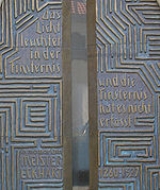
Meister Ekkehard Portal Der Erfurter Predigerkirche
Eckhart was probably born in the village of Tambach (Thuringia
Thuringia

The Free State of Thuringia is located in central Germany. It has an area of and 2.29 million inhabitants, making it the sixth smallest by area and the fifth smallest by population of Germany's sixteen States of Germany ....
) in approximately 1260. He was born to a noble family of landowners, but little is known about his family and early life except that he attended the University of Paris. James M. Clark (Christianity through the Centuries, Cairns) states that there is no authority for giving him the Christian name of Johannes which sometimes appears in biographical sketches: his Christian name was Eckhart; his surname was von Hochheim.

Eckhart joined the Dominicans at Erfurt. The lighter studies he no doubt followed at Cologne
Cologne

Cologne is Germany's fourth-largest city , and is the largest city both in the German Federal State of North Rhine-Westphalia and within the Rhine-Ruhr, one of the major European metropolitan areas with more than ten million inhabitants....
. Later he was Prior
Prior

Prior is a title, derived from the Latin adjective for 'earlier, first', with several notable uses....
 at Erfurt and Provincial
Provincial superior

A provincial superior is a major superior of a religious order acting under the order's superior general and exercising a general supervision over all the local superiors in a territorial division of the order called a province ....
 of Thuringia. In 1300, he was sent to Paris to lecture and take the academical degrees, and remained there till 1303. At this point he returned to Erfurt, and was made Provincial for Saxony
Saxony

The Free State of Saxony is a States of Germany of Germany. Located in the southeastern part of present-day Germany. It is the tenth-largest German state in area and the sixth largest in population , of Germany's sixteen states....
, a province which reached at that time from the Netherlands
Netherlands

The Netherlands is a country that is part of the Kingdom of the Netherlands. It is a parliamentary democratic constitutional monarchy. The Netherlands is located in North-West Europe, and bordered by the North Sea to the north and west, Belgium to the south, and Germany to the east....
 to Livonia
Livonia

Livonia was once the land of the Finnic Livonians inhabiting the principal ancient Livonian County Metsepole with its center at Turaida Castle....
. Complaints made against him and the provincial of Teutonia
Teutônia

Teut?nia is a municipality in the state Rio Grande do Sul, Brazil.See also*List of municipalities in Rio Grande do Sul...
 at the general chapter held in Paris in 1306, concerning irregularities among the ternaries, must have been trivial, because the general, Aymeric of Piacenza
Aymeric of Piacenza

Aymeric of Piacenza was an Italy Dominican Order scholar, who became Master of the Order of Preachers. He involved in both the suppression of the Fraticelli, and the downfall of the Knights Templar....
, appointed him in the following year his vicar-general for Bohemia
Bohemia

History...
 with full power to set the demoralized monasteries there in order.

In 1311, Eckhart was appointed by the general chapter of Naples
Naples

Naples is a city in southern Italy, the capital of the region of Campania and of the province of Naples. The city is known for its rich history, art, culture and gastronomy, playing an important role throughout much of its existence; it is over 2,800 years old....
 as teacher at Paris. Then follows a long period of which it is known only that he spent part of the time at Strasbourg
Strasbourg

Strasbourg is the capital and principal city of the Alsace Regions of France in northeastern France. With 702,412 inhabitants in 2007, its metropolitan area is the Aire urbaine....
. A passage in a chronicle of the year 1320, extant in manuscript (cf. Wilhelm Preger, i. 352–399), speaks of a prior Eckhart at Frankfurt
Frankfurt

is the largest city in the German States of Germany of Hesse and the List of cities in Germany with more than 100,000 inhabitants in Germany, with a 2008 population of 670,000....
 who was suspected of heresy, and some have referred this to Meister Eckhart. It is unusual that a man under suspicion of heresy would have been appointed teacher in one of the most famous schools of the order, but Eckhart's distinctive expository style could well have already been under scrutiny by his Franciscan detractors.

Eckhart next appears as teacher at Cologne, where the archbishop, Hermann von Virneburg, eventually accuses him of heresy before the Pope. But Nicholas of Strasburg
Nicholas of Strasburg

Nicholas of Strasburg was a 14th century Alsace mysticism from Strasbourg. He was the inquisitor who acquitted Master Eckhart....
, to whom the pope had given the temporary charge of the Dominican monasteries in Germany, promptly exonerated him. The archbishop, however, further pressed his charges against Eckhart and against Nicholas before his own court, forcing them to deny the competency of the archepiscopal inquisition
Inquisition

The term Inquisition can refer to any one of several institutions charged with trying and convicting Christian heresy within the Roman Catholic Church....
 and demanded litterce dimissorix (apostoli) for an appeal to the Pope.

On February 13, 1327, he stated in his protest, which was read publicly, that he had always detested everything wrong, and should anything of the kind be found in his writings, he now retracts. Of the further progress of the case there is no information, except that Pope John XXII
Pope John XXII

Pope John XXII , born Jacques Du?ze , was pope from 1316 to 1334. He was the second Pope of the Avignon Papacy , elected by a Papal conclave in Lyon assembled by Philip V of France....
 issued a bull (In agro dominico), March 27, 1329, in which a series of statements from Eckhart is characterized as heretical; another as suspected of heresy (the bull is given complete in ALKG, ii. 636–640). At the close, it is stated that Eckhart recanted before his death everything which he had falsely taught, by subjecting himself and his writing to the decision of the Apostolic See
Apostolic See

An Apostolic See is any episcopal see whose foundation is attributed to one or more of the Twelve Apostles. Examples are the Churches in Thessalonica and Corinth and the many others founded by Paul the Apostle, such as the Maltese Church....
. By this is no doubt meant the statement of February 13, 1327, and it may be inferred that Eckhart's death, concerning which no information or burial site exists, took place shortly after that event.

In 1328, the general chapter of the order at Toulouse
Toulouse

Toulouse is a commune of France in southwest France on the banks of the Garonne, half-way between the Atlantic Ocean and the Mediterranean Sea....
 decided to proceed against preachers who "endeavor to preach subtle things which not only do (not) advance morals, but easily lead the people into error". Eckhart's disciples were admonished to be more cautious, but nevertheless they cherished the memory of their master. The lay group, Friends of God
Friends of God

The Friends of God was a Middle Age lay mystical group and a center of German mysticism. It was founded between 1339 and 1343 in Basel, Switzerland, and was also fairly important in Strasbourg and Cologne, because around those times, some of the area was placed under a Interdict ....
, followers of Eckhart, existed in communities across the region and carried on his ideas under the leadership of such priests as John Tauler and Henry Suso. (Christianity through the Centuries, Cairns)

Works and doctrines


Although he was an accomplished academic theologian, Eckhart's best-remembered works are his highly unusual sermons in the vernacular during a time of disarray among the clergy and monastic orders, rapid growth of numerous pious lay groups, and the Inquisition
Inquisition

The term Inquisition can refer to any one of several institutions charged with trying and convicting Christian heresy within the Roman Catholic Church....
's continuing concerns over heretical movements throughout Europe. With the move of the Papacy from Rome to Avignon and the tension between the second Avignon Pope John XXII and Holy Roman Emperor
Holy Roman Emperor

Image:HRR 14Jh.jpgThe Roman of the Emperor's title was a reflection of the translatio imperii principle that regarded the Holy Roman Emperors as the inheritors of the title of Emperor of the Western Roman Empire, a title left unclaimed in the West after the death of Julius Nepos in 480....
 Louis IV who battled for power, Eckhart as a preaching friar attempted to guide his flock, as well as monks and nuns under his jurisdiction with practical sermons on spiritual/psychological transformation and New Testament metaphorical content related to the creative power inherent in disinterest (or detachment).

The central theme of Eckhart's German sermons is the presence of God in the individual soul, and the dignity of the soul of the just man. Although he elaborated on this theme, he rarely departed from it. In one sermon, Eckhart gives the following summary of his message:

"When I preach, I usually speak of detachment and say that a man should be empty of self and all things; and secondly, that he should be reconstructed in the simple good that God is; and thirdly, that he should consider the great aristocracy which God has set up in the soul, such that by means of it man may wonderfully attain to God; and fourthly, of the purity of the divine nature."


Posterity


The lack of imprimatur
Imprimatur

An Imprimatur is an official declaration from the hierarchy of the Roman Catholic Church that a literary or similar work is free from error in matters of Roman Catholic doctrine and morals, and hence acceptable reading for faithful Roman Catholics....
 from the Church and anonymity of the author of the "Theologia germanica" did not lessen its influence for the next two centuries — including Martin Luther
Martin Luther

Martin Luther was a Germans monk, theology, university professor, priest, father of Protestantism, and Protestant Reformers whose ideas started the Protestant Reformation and changed the course of Western culture....
 at the peak of public and clerical resistance to Catholic indulgences — and was viewed by some historians of the early twentieth century as pivotal in provoking Luther's actions and the subsequent Protestant Reformation
Protestant Reformation

The Protestant Reformation was a Christian reform movement in Europe. It is thought to have begun in 1517 with Martin Luther's Ninety-Five Theses and may be considered to have ended with the Peace of Westphalia in 1648....
.

“The two eyes of the soul of man,” says the Theologia Germanica,”cannot both perform their work at once: but if the soul shall see with the right eye into eternity, then the left eye must close itself and refrain from working, and be as though it were dead. For if the left eye be fulfilling its office toward outward things, that is holding converse with time and the creatures; then must the right eye be hindered in its working; that is, in its contemplation. Therefore, whosoever will have the one must let the other go; for ‘no man can serve two masters.’“

Eckhart today


Eckhart's status in the contemporary Church is uncertain. The Dominican Order pressed in the last decade of the 20th century for his full rehabilitation and confirmation of his theological orthodoxy; the late Pope
Pope

The Pope is the Bishop of Rome, the leader of the Roman Catholic Church and head of state of Vatican City. The current pope is Pope Benedict XVI, who was elected April 19, 2005 in Papal conclave, 2005....
 John Paul II
Pope John Paul II

Pope John Paul II John Paul II is widely acclaimed as one of the most influential leaders of the twentieth century. He has been Pope_John_Paul_II#Role_in_the_fall_of_Communism in bringing down communism in Eastern Europe, as well as significantly improving the Roman Catholic Church's relations with Judaism, the Eastern Orthodox Church, and A...
 voiced favorable opinion on this initiative, but the affair is still confined to the corridors of the Vatican
Vatican City

Vatican City , officially the State of the Vatican City , is a Landlocked country sovereignty city-state whose territory consists of a walled enclave within the city of Rome, the Capital of Italy....
.

The 19th century philosopher Schopenhauer compared Eckhart's views to the teachings of India
India

India, officially the Republic of India , is a country in South Asia. It is the List of countries and outlying territories by total area country by geographical area, the List of countries by population country, and the most populous liberal democracy in the world....
n, Christian
Christian

A Christian is a person who adheres to Christianity, a Monotheism#Christian view religion centered on the life and teachings of Jesus and interpreted by Christians to have been prophesied in the Hebrew Bible/Old Testament....
, and Islamic mystic
Mysticism

Mysticism is the pursuit of communion with, Unio Mystica with, or conscious awareness of an ultimate reality, divinity, Spirituality, or God through direct experience, intuition, or insight....
s and ascetics:

In 1891, Karl Eugen Neumann
Karl Eugen Neumann

Karl Eugen Neumann was the first translator of large parts of the Pali Canon of Buddhist scriptures from the original Pali into a European language and one of the pioneers of European Buddhism....
, who translated large parts of the Tripitaka
Tripitaka

The is the Sanskrit term used by Westerners for a Buddhist canon of scriptures. Asian Buddhists of the Theravada Buddhist school use the term Tipitaka to refer to the Pali Canon....
, found parallels between Eckhart and Buddhism
Buddhism

Buddhism is a family of beliefs and practices considered by most to be a religionand is based on the teachings attributed to Siddhartha Gautama, commonly known as "The Buddha" , who was born in what is today Nepal....
. Shizuteru Ueda
Shizuteru Ueda

is a Japanese philosopher specializing in philosophy of religion.The son of a Buddhist priest, he studied philosophy at Kyoto University where his mentor Keiji Nishitani oriented his studies toward medieval mystics....
, a third generation Kyoto School
Kyoto School

The Kyoto School is the name given to the Japanese "philosophical movement centered at Kyoto University that assimilated Western philosophy and religious ideas and used them to reformulate religious and moral insights unique to the East Asian cultural tradition." ....
 philosopher and scholar in medieval philosophy showed similarities between Eckhart's soteriology
Soteriology

Christian Soteriology is the branch of Christian theology that deals with salvation. It is derived from the Greek language soterion + English -logy....
 and zen buddhism in an article ("Eckhardt um zen am problem", 1989). In the 20th century, Eckhart's thoughts were compared to Eastern mystics by both Rudolf Otto
Rudolf Otto

Rudolf Otto was an eminent Germany Lutheranism theology and scholar of comparative religion....
 and D.T. Suzuki, among other scholars. Interestingly, one of the pioneer translators of Eckhart's writings to English, Maurice O'Connell Walshe, was also an accomplished translator of Buddhist scriptures such as the Digha Nikaya
Digha Nikaya

The Digha Nikaya is a Buddhism scripture, the first of the five nikayas, or collections, in the Sutta Pitaka, which is one of the "three baskets" that compose the Pali Tipitaka of Theravada Buddhism....
. However, Reiner Schurmann, Ph.D., a Professor of Philosophy, while agreeing with Daisetz T. Suzuki that there exist certain similarities between Zen Buddhism and Meister Eckhart’s teaching, also disputed Suzuki’s contention that the ideas expounded in Eckhart’s sermons closely approach Buddhist thought, “so closely indeed, that one could stamp them almost definitely as coming out of Buddhist speculations.” [Wandering Joy: Meister Eckhart’s Mystical Philosophy,” at p. 217 - C The Estate of Reiner Schurmann 2001, Lindisfarne Books, Great Barrington, MA.]

Schurmann’s several clarifications included, to name of few: 1) on the question of “Time” and Eckhart’s view (claimed as parallel to Buddhism in reducing awakening to instantaneity) that the birth of the Word in the ground of the mind must accomplish itself in an instant, in “the eternal now”, that in fact Eckhart in this respect is rooted directly in the catechisis of the Fathers of the Church rather than merely derived from Buddhism [Id.]; 2) on the question of "Isness” and Suzuki’s contention that the “Christian experiences are not after all different from those of the Buddhist…[;][t]erminology is all that divides us,” that in Eckhart “[t]he Godhead’s isticheit [translated as `isness’ by Suzuki] is a negation of all quiddities; it says that God, rather than non-being, is at the heart of all things” thereby demonstrating with Eckhart's theocentrism that “[t]he isticheit of the Godhead and the isness of a thing then refer to two opposite experiences in Meister Eckhart and Suzuki: in the former, to God, and in the latter, to `our ordinary state of the mind'” and Buddhism's attempts to think "pure nothingness" (Id. At p. 218); and 3) on the question of “Emptiness” and Eckhart’s view (claimed as parallel to Buddhist emphasis “on the emptiness of all `composite things’”) that only a perfectly released person, devoid of all, comprehends, “seizes,” God, that the Buddhist “emptiness” seems to concern man’s relation to things while Eckhart’s concern is with what is “at the end of the road opened by detachment [which is] the mind espouses the very movement of the divine `dehiscence’…[;] [i]t does what the Godhead does: it lets all things be…[;][n]ot only must God also abandon all of his own—names and attributes—if he is to reach into the ground of the mind (this is already a step beyond the recognition of the emptiness of all composite things), but God’s essential being, releasement, becomes the being of a released man.” ([Id. At 219.)

More recently, although most scholars accept that Eckhart's work is divided into philosophical and theological, Kurt Flasch and other interpreters see Eckhart strictly as a philosopher. Flasch argues that the opposition between "mystic" and "scholastic" is not relevant because this mysticism (in Eckhart's context) is penetrated by the spirit of the University
Scholasticism

Scholasticism was the dominant form of theology and philosophy in the Western Europe in the Middle Ages, particularly in the 12th, 13th, and 14th centuries....
, in which it occurred. Eckhart has also influenced contemporary theologians, such as Matthew Fox
Matthew Fox (priest)

Matthew Fox is an United States Episcopal Church priest and theology. He is an exponent of Creation Spirituality, a movement grounded in the mystical philosophies of medieval visionaries Hildegard of Bingen, Thomas Aquinas, Meister Eckhart and Nicholas of Cusa....
, who draws heavily on Eckhart for his own theology and whose "Breakthrough" presents an alternative and substantially different view of the nature and significance of Eckhart's thinking from that taken in earlier sections of this article. The notable humanistic psychoanalyst and philosopher Erich Fromm was another scholar who brought renewed attention in the west to Eckhart's writings, drawing upon many of the latters themes in his large corpus of work.

Renewed academic attention to Eckhart has attracted favorable attention to his work from contemporary non-Christian mystics. Eckhart's most famous single quote, "The Eye with which I see God is the same Eye with which God sees me", is commonly cited by thinkers within neopaganism
Neopaganism

Neopaganism or Neo-Paganism is an umbrella term used to identify a wide variety of new religious movement, particularly those influenced by pre-Christian "Paganism" beliefs of Europe....
 and ultimatist Buddhism
Buddhism

Buddhism is a family of beliefs and practices considered by most to be a religionand is based on the teachings attributed to Siddhartha Gautama, commonly known as "The Buddha" , who was born in what is today Nepal....
 as a point of contact between these traditions and Christian mysticism.

In popular culture

  • In Jacob's Ladder (film)
    Jacob's Ladder (film)

    Jacob's Ladder is a 1990 in film Thriller film directed by Adrian Lyne, based on a screenplay by Bruce Joel Rubin. It stars Tim Robbins, Elizabeth Pe?a, Danny Aiello, and Jason Alexander....
    , Louis — the main character's friend and an island of calm within a hellish nightmare — quotes Eckart: "You know what he [Eckart] said? The only thing that burns in Hell is the part of you that won't let go of your life; your memories, your attachments. They burn 'em all away. But they're not punishing you, he said. They're freeing your soul. ... If you're frightened of dying and holding on, you'll see devils tearing your life away. But if you've made your peace then the devils are really angels, freeing you from the Earth" (Rubin 1990, p. 82).
  • The same phrase (..If you're frightened..) is also said at the end of "Forsaken" (song) by VNV Nation
    VNV Nation

    VNV Nation are an electronic music band originally from Wexford and London, now based in Hamburg, that combines elements of trance , synthpop and electronic body music , into what they call futurepop....
    .
  • In the comic strip Mutts
    Mutts

    Mutts is a daily comic strip created by Patrick McDonnell in 1994 based on the day-to-day adventures of two pet: a dog named Earl and a cat named Mooch....
    , Patrick McDonnell quoted Meister Eckhart in a series of panels from 20-25th Nov. 2006 as follows: "If the only prayer you say in your life is thank you, that would suffice."


See also

  • Brethren of the Free Spirit
    Brethren of the Free Spirit

    The Brothers, or Brethren of the Free Spirit , was a laity Christian movement which flourished in northern Europe in the 13th and 14th Centuries....
  • Heresy of the Free Spirit
    Heresy of the Free Spirit

    The Free Spirit heresy consisted of small groups of Christianity heretics living mostly in Bohemia, now the Czech Republic, during the fourteenth and fifteenth centuries....
  • Sister Catherine Treatise
    Sister Catherine Treatise

    The Sister Catherine Treatise is a work of Medieval Christian mysticism seen as representative of the Heresy of the Free Spirit of the thirteenth and fourteenth Centuries in Europe....


Bibliography


Sources

  • Meister Eckhart: Die deutschen und lateinischen Werke. Herausgegeben im Auftrage der Deutschen Forschungsgemeinschaft. Stuttgart and Berlin: Verlag W. Kohlhammer, 11 Vols., 1936.
  • Augustine Daniels, O.S.B., ed., "Eine lateinische Rechtfertigungsschrift des Meister Eckharts," Beiträge zur Geschichte der Philosophie des Mittelalters, 23, 5 (Münster, 1923): 1 - 4, 12 - 13, 34 - 35, 65 - 66.
  • Franz Jostes, ed., Meister Eckhart und seine Jünger: Ungedruckte Texte zur Geschichte der deutschen Mystik, De Gruyter, 1972 (Series: Deutsche Neudrucke Texte des Mittelalters).
  • Thomas Kaepelli, O.P., "Kurze Mitteilungen über mittelalterliche Dominikanerschriftsteller," Archivum Fratrum Praedicatorum 10, (1940), pp. 293 - 94.
  • Thomas Kaepelli, O.P., Scriptores ordinis Praedicatorum medii aevi. Vol. I (A-F). Rome, 1970.
  • M.H. Laurent, "Autour du procés de Maître Eckhart. Les documents des Archives Vaticanes," Divus Thomas (Piacenza) 39 (1936), pp. 331 - 48, 430 - 47.
  • Franz Pelster, S.J., ed., Articuli contra Fratrem Aychardum Alamannum, Vat. lat. 3899, f. 123r - 130v, in "Ein Gutachten aus dem Eckehart-Prozess in Avignon," Aus der Geistewelt des Mittelalters, Festgabe Martin Grabmann, Beiträge Supplement 3, Munster, 1935, pp. 1099 - 1124.
  • Josef Quint, ed. and trans. Meister Eckehart: Deutsche Predigten und Traktate, Munich: Carl Hanser, 1955.
  • Josef Quint, ed., Textbuch zur Mystik des deutschen Mittelalters: Meister Eckhart, Johannes Tauler, Heinrich Seuse, Halle/Saale: M. Niemeyer, 1952.
  • Rubin, Bruce Joel, Jacob's Ladder. Mark Mixson, general editor, The Applause Screenplay Series, Applause Theatre Book Publishers, 1990. ISBN 1-55783-086-X.
  • Gabriel Théry, O.P., "Édition critique des piéces relatives au procés d'Eckhart continues dans le manuscrit 33b de la Bibliothèque de Soest," Archives d'histoire littéraire et doctrinal du moyen âge, 1 (1926), pp. 129 - 268.


Translations and commentaries

  • Meister Eckhart: A Modern Translation, trans. Raymond B. Blakney, New York: Harper and Row, 1941, ISBN 0-06-130008-X, about one-half the works including treatises, 28 sermons, Defense against heresy
  • Meister Eckhart, The Essential Sermons, Commentaries, Treatises and Defense, trans. and ed. by Bernard McGinn and Edmund Colledge, New York: Paulist Press, 1981.
  • Meister Eckhart: Teacher and Preacher, trans. and ed. by Bernard McGinn and Frank Tobin, New York and London: Paulist Press / SPCK, 1987.
  • Meister Eckhart, Sermons and Treatises, trans. by M. O'C. Walshe, 3 vols., Longmead, Shaftesbury, Dorset: Element Books, 1987.
  • J ames Midgely Clark, Meister Eckhart: An Introduction to the Study of His Works with an Anthology of His Sermons, Edinburgh: Thomas Nelson, 1957.
  • James M. Clark and John V. Skinner, eds. and trans., Treatises and Sermons of Meister Eckhart, New York: Octagon Books, 1983. (Reprint of Harper and Row ed., 1958.)
  • Meister Eckhart: Selected Writings, ed. and trans. by Oliver Davies, London: Penguin, 1994.
  • C. de B. Evans, Meister Eckhart by Franz Pfeiffer, 2 vols., London: Watkins, 1924 and 1931.
  • Ursula Fleming, Meister Eckhart: The Man from whom God Hid Nothing, Leominster, Herefordshire: Gracewing, 1995.
  • Matthew Fox, O.P., ed., Breakthrough: Meister Eckhart's Creation Spirituality in New Translation, Garden City, NY: Doubleday, 1980.
  • Armand Maurer, ed., Master Eckhart: Parisian Questions and Prologues, Toronto, Canada: Pontifical Institute of Medieval Studies, 1974.
  • Reiner Schürmann, Meister Eckhart: Mystic and Philosopher, Bloomington: Indiana University Press, 1978.
  • Otto Karrer Meister Eckehart Speaks The Philosophical Library, Inc. New York, New York, 1957.
  • Shizuteru Ueda, Die Gottesgeburt in der Seele und der Durchbruch zur Gottheit. Die mystische Anthropologie Meister Eckharts und ihre Konfrontation mit der Mystik des Zen-Buddhismus, Gütersloh: Mohn, 1965.


Supplementary

  • Jeanne Ancelet-Hustache, Master Eckhart and the Rhineland Mystics, New York and London: Harper and Row/ Longmans, 1957.
  • James M. Clark, The Great German Mystics, New York: Russell and Russell, 1970 (reprint of Basil Blackwell edition, Oxford: 1949.)
  • James M. Clark, trans., Henry Suso: Little Book of Eternal Wisdom and Little Book of Truth, London: Faber, 1953.
  • Oliver Davies, God Within: The Mystical Tradition of Northern Europe, London: Darton, Longman and Todd, 1988.
  • Oliver Davies, Meister Eckhart: Mystical Theologian, London: SPCK, 1991.
  • Eckardus Theutonicus, homo doctus et sanctus, Fribourg: University of Fribourg
    University of Fribourg

    The University of Fribourg is a university in the city of Fribourg, Switzerland.It was founded in 1889 by local businessman Georges Python, although the origins of the university can be traced to 1580 with the foundation of the Jesuit Seminary of St....
    , 1993.
  • Robert K. Forman, Meister Eckhart: Mystic as Theologian, Rockport, Mass. / Shaftesbury, Dorset: Element Books, 1991.
  • Gundolf Gieraths, O.P., '"Life in Abundance: Meister Eckhart and the German Dominican Mystics of the 14th Century", Spirituality Today Supplement, Autumn, 1986.
  • Amy Hollywood, The Soul as Virgin Wife: Mechthild of Magdeburg, Marguerite Porete, and Meister Eckhart, Notre Dame and London: University of Notre Dame Press, 1996.
  • Rufus Jones, The Flowering of Mysticism in the Fourteenth Century, New York: Hafner Publishing Co., 1971 (facsimile of 1939 ed.).
  • Bernard McGinn, "Eckhart's Condemnation Reconsidered" in The Thomist, vol. 44, 1980.
  • Bernard McGinn, ed., Meister Eckhart and the Beguine Mystics Hadewijch of Brabant, Mechthild of Magdeburg, and Marguerite Porete, New York: Continuum, 1994.
  • Arthur Schopenhauer
    Arthur Schopenhauer

    Arthur Schopenhauer was a Germany philosopher known for his atheistic pessimism and philosophical clarity. At age 25, he published his doctoral dissertation, On the Fourfold Root of the Principle of Sufficient Reason, which examined the fundamental question of whether reason alone can unlock answers about the world....
    ,
    The World as Will and Representation
    The World as Will and Representation

    The World as Will and Representation is the central work of German philosopher Arthur Schopenhauer. It was published in December 1818....
    , Vol. II, ISBN 0-486-21762-0
  • Cyprian Smith, The Way of Paradox: Spiritual Life as Taught by Meister Eckhart, New York: Paulist Press, 1988.
  • Frank Tobin, Meister Eckhart: Thought and Language, Philadelphia: University of Pennsylvania Press, 1986.
  • Denys Turner, The Darkness of God: Negativity in Christian Mysticism, Cambridge: Cambridge University Press, 1995.
  • Winfried Trusen, Der Prozess gegen Meister Eckhart, Fribourg: University of Fribourg, 1988.
  • Andrew Weeks, German Mysticism from Hildegard of Bingen to Ludwig Wittgenstein: A Literary and Intellectual History, Albany: State University of New York Press, 1993.
  • Richard Woods, O.P., Eckhart's Way, Wilmington, DE: Glazier, 1986 (Collegeville, MN: Liturgical Press, 1991).
  • Richard Woods, O.P., Meister Eckhart: The Gospel of Peace and Justice, Tape Cassette Program, Chicago: Center for Religion & Society, 1993.


External links

  • Published 1909. New York: Robert Appleton Company. Nihil Obstat, May 1, 1909. Remy Lafort, Censor. Imprimatur. +John M. Farley, Archbishop of New York
  • translated into English by Claud Field. At .
  • German Website, most texts in German translation, some in Latin
  • French Website of the University of Metz. Studies, bibliographies, links.
  • Stanford Encyclopedia of Philosophy
    Stanford Encyclopedia of Philosophy

    The Stanford Encyclopedia of Philosophy is a Open access online encyclopedia of philosophy maintained by Stanford University. The SEP was initially developed with U.S....
    : "" by B. Mojsisch & O.F. Summerell.
  • Brown, Arthur, ""
  • Some humanist and sometimes esoterical views about Master Eckhart
  • . Research by catholic scholars
  • , including full text of
  • on www.mysticism.nl.