

Ostsiedlung

Encyclopedia
Ostsiedlung (ˈɔstˌziːdlʊŋ, settlement in the east), also called German eastward expansion, was the medieval eastward migration and settlement of Germans
from modern day western and central Germany into less-populated regions and countries of eastern Central Europe
and Eastern Europe
. The affected area roughly stretched from Slovenia
to Estonia
, and eastwards into Transylvania
. In part, Ostsiedlung followed the territorial expansion of the Holy Roman Empire
and the Teutonic Order.
According to Jedlicki (1950), in many cases the term "German colonization" does not refer to an actual migration of Germans, but rather to the internal migration of native populations (Poles, Hungarians, etc.) from the countryside to the cities, which then adopted laws modeled on those of the German towns of Lubeck
and Magdeburg
. 19th and 20th century German historians have often exaggerated the importance of the adoption of German law and settlement in Eastern Europe for political reasons; while the phenomenon did increase the economic well being of destination countries, at least some of them, like medieval Poland, were already quite developed economically and politicallyand the local Slavic population was already established in its towns far stronger than previously believed; the whole process took part in territories where Slavic solid organisational structures existed.
Before and during the time of German settlement, late medieval Central and Eastern European societies underwent deep cultural changes in demography, religion, law and administration, agriculture, settlement numbers and structures. Thus Ostsiedlung is part of a process termed Ostkolonisation ("east colonization") or Hochmittelalterlicher Landesausbau ("late medieval land consolidation"), although these terms are sometimes used synonymously.
Ethnic conflicts erupted between the newly arrived settlers and local populations, sometimes bloody, and expulsions of native populations are also known In several areas under the Ostsiedlung the original population was later discriminated and pushed away from administration
Ostsiedlung was heavily exploited by German nationalists as well as the Nazis to press territorial claims of Germany, and to demonstrate supposed German superiority over non-German peoples, whose cultural, urban and scientific achievements in that era were rejected and presented as German.
of 300 to 700 CE. The Roman Empire
had lost its dominant position. The Franks
had created an empire that, besides former Roman Gallia
, had united the former West Germanic tribes and adopted Christianity
. East Francia, an early predecessor of Germany
, aimed to be the successor to the Catholic
Western Roman Empire
, and developed into the Holy Roman Empire
. In Scandinavia
, the former North Germanic tribes entered the Viking Age
, affecting the whole of Europe through trade and raids. Some former East Germanic tribes had entered and merged into Rome, their own culture ceasing to exist. At the same time Slav states arose and became dominant in Eastern Europe and large parts of Central Europe;in 833 Great Moravia
was formed, in 882 Kievan Rus, and in 966 Poland
, all of which adopted Christianity.
(later the Holy Roman Empire
) were collectively called Wends
, also Elbe Slavs. They seldom formed larger political entities, but rather constituted various small tribes, dwelling as far west as to a line from the Eastern Alps
and Bohemia
to the Saale
and Elbe
rivers. As the Frankish Empire expanded, various Wendish tribes were conquered or allied with the Franks, such as the Obodrites, who aided the Franks in defeating the West Germanic Saxons
. The conquered Wendish areas were organized by the Franks into marches
, which were administered by an entrusted noble who collected the tribute, reinforced by military units. The establishing of marches was also accompanied by missionary
efforts.
Marches set up by Charlemagne
in the territory where the Ostsiedlung would take place included, from north to south:
In most cases, the tribes of the marches were not stable allies of the empire. Frankish kings initiated numerous, yet not always successful, military campaigns to maintain their authority.
Later kings and emperors such as Otto the Great restructured and expanded the marches, creating (from north to south):
Under the rule of King Louis the German
of East Francia and of Arnulf of Carinthia
, the first waves of settlement were led by Franks
and Bavarii
, and reached the area of what is today Slovakia
and what was then Pannonia
(present-day Burgenland
, Hungary
, and Slovenia
). The pioneers were Roman Catholics.
Although the first settlements led by the Franks and Bavarii followed the conquest of the Sorbians and other Wends
in the early 10th century, and other campaigns by Holy Roman Emperor
s made migration possible, the beginning of a continuous Ostsiedlung is usually dated to around the 12th century.
in the March of the Billungs and the Northern March
stretching from the Elbe
River to the Baltic shore succeeded in a rebellion against the political rule and Christian mission of the Empire. In spite of their new-won independence, the Obodrite, Rani
, Liutizian
and Hevelli tribes were soon faced with internal struggles and warfare as well as raids from the newly-constituted and expanding Piast (early Polish
) state from the East, Denmark
from the North and the Empire from the West, eager to re-establish her marches.
invaded and subdued the northeastern parts of the Liutizian lands. In 1124 and 1128, the Pomeranian duke Wartislaw I
, at that time a vassal of Poland, invited bishop Otto von Bamberg to Christianize the Pomeranians and Liutizians of his duchy. In 1147, as a campaign of the Northern Crusade, the Wendish Crusade
was mounted in the Duchy of Saxony
to retake the marches lost in 983. The crusaders also headed for Pomeranian Demmin
and Stettin, despite these areas having already been Christianized successfully.
After the Wendish crusade, Albert the Bear
was able to establish the Brandenburg
march on approximately the territory of former Northern March, which since 983 had been controlled by the Hevelli and Liutizian tribes, and to expand it. The Havelberg
bishopric was set up again to Christianize the Wends.
In 1164, after Saxon duke Henry the Lion
finally defeated rebellious Obodrite and Pomeranian dukes in the Battle of Verchen
, the Pomeranian duchies of Demmin and Stettin
became Saxon fiefs, as did the Obodrite territory, which became known as Mecklenburg
after its main burgh
. After Henry the Lion lost an internal struggle with Emperor Frederick I
, Mecklenburg and Pomerania became part of the Holy Roman Empire
in 1181.
or Old Livonia which was formed in the aftermath of the Livonian Crusade
in the territories comprising present day Estonia
and Latvia
. It was established on February 2, 1207 as a principality of the Holy Roman Empire
and proclaimed by Pope Innocent III in 1215 as a subject to the Holy See
.
Medieval Livonia was intermittently ruled first by the Livonian Brothers of the Sword
, since 1237 by the semi-autonomous branch of Teutonic knights
called Livonian Order
and the Roman Catholic Church
. The nominal head of Terra Mariana as well as the city of Riga was the Archbishop of Riga
as the apex of the ecclesiastical hierarchy.
In 1561, during the Livonian war
, Terra Mariana ceased to exist. Its northern parts were ceded to Sweden
and formed into the Duchy of Estonia
, its southern territories became part of the Grand Duchy of Lithuania
— and thus eventually of the Polish–Lithuanian Commonwealth as the Duchy of Livonia
and Duchy of Courland and Semigallia
. The island of Saaremaa
became part of Denmark.
and Yotvingians
. In the early 13th century Konrad of Masovia and Daniel of Halych
allied with the Teutonic Order, who during the Northern Crusades conquered and Christianized the Balts, with heavy losses on both sides. In return the region of Prussia
(Altpreussenland) was granted to the knights, who set up a monastic state
there in 1224. With the merger of Livonian Brothers of the Sword
in 1237 the Livonian territories were incorporated with the Teutonic Order. In 1308, with the takeover of Danzig (Gdańsk), this state expanded into Pomerelia
. In 1346, the Duchy of Estonia was sold by king of Denmark to the Teutonic Order.
, West Mecklenburg
, Central and Southeastern marches), and in the early 13th century (e.g. in Pomerania
, Rügen
), following the reassertion of Saxon
authority over Wendish
areas (the Holstein
area by Holstein Count
Adolf II
, Brandenburg
by Albert the Bear
, Mecklenburg
and Pomerania
by Henry the Lion
) in the 1150s). The activities of the Teutonic Order accelerated settlement along the Baltic coast.
During the Ostsiedlung, Germans settled east of the Elbe
and Saale
rivers, regions largely inhabited by Polabian Slavs
. Likewise, in Styria and Carinthia
, German communities took form in areas inhabited by Slovenes.
The emigration of inhabitants of the Valais
valley in Switzerland
to areas that had been settled before by the Romans
had to some extent the same preconditions as the colonisation of the East.
With the introduction of these techniques, cereals became the primary nutrition, making up for an averaged 70% of the peoples' calorie intake. As a consequence, an abundance of barns and mills were built. Channels dug for the numerous new watermills marked the first large-scale human interference with the previously untouched water bodies in this area.
To the increase in crops per unit of area added an absolute increase of the total of cultivated land, especially through the clearance of forests. The extend of this increase differed by region: while for example in Poland, the area of arable land had doubled (16% of the total area by the beginning of the 11th century and 30% in the 16th century, with the highest increase rates in the 14th century), the area of arable land increased 7- to 20-fold in many Silesian regions during the Ostsiedlung.
The changes in agriculture went along with changes in farm layout and settlement structure based on the Hufenverfassung, a system to divide and classify land. Farmland was divided into Hufen (also Huben, mansi), much like English hides
, with one Hufe (25 to 40 hectare
s depending on the region) plentifully supplying one farm. This led to new types of larger villages, replacing the previously dominant type of small villages consisting of four to eight farms. According to Piskorski (1999), this led to "a complete transformation of the previous settlement structure. The cultural landscape of East Central Europe formed by the medieval settlement processes essentially prevails until today."
Ostsiedlung also led to a rapid population growth
throughout East Central Europe. During the 12th and 13th century, the population density
in persons per square kilometer increased e.g. from two to 20–25 in the area of present-day Saxony, from six to fourteen in Bohemia, and from five to 8.5 in Poland (30 in the Cracow region). In his 1999 essay summarizing the state of research, Piskorski said that the increase was due to the influx of settlers on the one hand and an increase in indigenous populations after the colonization on the other hand: settlement was the primary reason for the increase e.g. in the areas east of the Oder
, the Duchy of Pomerania
, western Greater Poland
, Silesia
, Austria
, Moravia
, Prussia
and Transylvania (Siebenbürgen)
, while in the larger part of Eastern Europe indigenous populations were responsible for the growth. In an essay of 2007, the same Piskorski said that "insofar as it is possible to draw conclusions from the less than rich medieval source material, it appears that at least in some East Central European territories the population increased significantly. It is however possible to contest to what extent this was a direct result of migration and how far it was due to increased agricultural productivity and the gathering pace of urbanization." In contrast to Western Europe
, this increased population was largely spared by the 14th-century Black Death
pandemic
.
With the Germans came also new systems of taxation. While the Wendish tithe
was a fixed tax depending on village size, the German tithe
depended on the actual crop, leading to higher taxes being collected from settlers than from the Wends, even though settlers were at least in part exempted from taxes in the first years after the settlement was established. This was a major reason for local rulers' keenness to invite settlers.
s of fortified strongholds (grads) or the Wendish-Scandinavian merchants' settlements (emporia) of the Baltic coast. Large cities included Szczecin which reached 9.000 inhabitants and had several temples, Kraków which was the capital of the state of Piast Poland), or Wrocław which already existed with an extensive state administration and church presence. In Poland the largest cities like Kraków
, Gniezno
, Wrocław, Wolin
counted on average 4,000-5,000 inhabitants each in the beginning of 12th century Previous theories that urban development was brought to areas such as Pomerania, Mecklenburg or Poland by Germans during the Ostsiedlung are now discarded, and studies show that towns existed long before arrival of any German colonists, housing Poles and other numerous nationalities
While some historians address these centers as towns, this is rejected by others due to the differences to later towns. To distinguish the pre-Ostsiedlung urban centers from the communal or free towns introduced in the course of the Ostsiedlung, they are usually referred to as early towns, proto-towns, castle town
s or emporia, their Slavic designations were local variants of the root *grod. Ostsiedlung narrowed the meaning of *grod to denote castles only, while towns were thence termed *město (orig. "site", [cf. Polish miast]; in areas not affected by Ostsiedlung, the term for town remained a variant of *grod, cf. Russian город).
The type of town introduced during the Ostsiedlung was called "free town" (civitates liberae) or "new town" by its contemporaries. The rapid increase in the number of towns led, per Piskorski, to an "urbanization of East Central Europe." The new towns differed from their predecessors in:
The corresponding acts of locatio were defined for Poland by Benedykt Zientara as either the actual foundation of a new town, the regularization of a town's layout, and/or the chartering with German town law
. Like its rural equivalent, the urban locatio was usually realized by immigrant contractors. These locatores marked out and divided the settlement area, recruited the settlers and assigned them their plots.
Soon after town law was granted and the town area settled, many towns came to care for their own interests much more than for those of the local ruler, and gained partial or full economic and military independence. Many of them joined the Hanseatic League
.
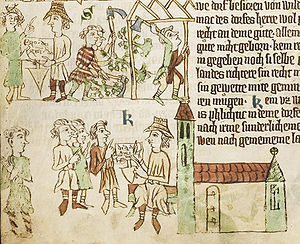 Although the vast majority of the settlers are considered to be German, this term must be taken in its medieval meaning, as today great numbers of the settlers would not be considered to be German anymore; most notably Dutch
and Flemish
. To a lesser extent, the settlers were of even another origin, e.g. Danes, Scots
or local Wends
.
The settlers migrated in lines following nearly straight West to East directions, therefore the Southeast had been settled by South Germans (Bavarians, Swabians), the Northeast had been settled by Flemish people
, Dutch people
and Saxons
, while in central regions Franks
moved in also. As a result, the different German dialect groups
expanded eastward along with their bearers, the "new" Eastern forms only slightly differing from their Western counterparts.
Settlers were invited by local secular rulers, such as dukes, counts, margraves, princes and, only in a few cases due to the weakening central power, the king. Also, settlers were invited by religious institutions such as monasteries and bishops, who had become mighty land-owners in the course of Christian mission. Often, a local secular ruler would grant vast woodlands and wilderness and a few villages to an order like the Cistercian monks, who would erect an abbey, call in settlers and cultivate the land.
The settlers were granted estates and privileges. Settlement was usually organised by a so-called Lokator (lessor), who was granted an outstanding position such as the inheritable position of the village elder (Schulte or Schulze). Towns were founded and granted German town law
. The agricultural, legal, administrative, and technical methods of the immigrants, as well as their successful proselytising of the native inhabitants, led to a gradual transformation of the settlement areas, as former linguistically and culturally Slavic areas became Germanised.
Besides the marches, which were adjacent to the Empire, German settlement occurred in areas farther away, such as the Carpathians
, Transylvania
, and along the Gulf of Riga
. German cultural and linguistic influence lasted in some of these areas right up to the present day. The rulers of Hungary
, Bohemia, Silesia
, Pomerania
, Mecklenburg
, and Poland
encouraged German settlement to promote the development of the less populated portions of the land, and promote the motivated populations who wished to till it. The Transylvanian Saxons
and Baltic German
s were corporately combined and privileged.
In the middle of the 14th century, the settling progress slowed as a result of the Black Death
; in addition, the most arable and promising regions were largely occupied. Local Slavic leaders in late Medieval Pomerania
and Silesia
continued inviting German settlers to their territories. As late as the 18th century, well after the Thirty Years War had reduced Germany's population by a third, some Germans
followed invitations to settle as far away as the Volga River
.
process of Germans who since the 13th century settled Polish
towns like Kraków
(Krakau, Cracow) and Posen
(Poznań) lasted about two centuries. The Sorbs
over time assimilated German settlers, yet other Sorbs were themselves assimilated by the surrounding German population. Many Eastern Europe
an towns were multi-ethnic melting pot
s.
and had even further declined by the extensive warfare during the 10th to 12th centuries, some of the settled areas were still to a varying degree populated with Wends.
There are also documented cases, where the Wends were driven out in order to rebuild the village with settlers. In this case, the new village would nevertheless keep its former Slavic name. As an example, in the case of the village Böbelin in Mecklenburg it is documented, that driven-out Wendish inhabitants repeatedly invaded their former village hindering a resettlement.
Yet, discrimination of the Wends should not be mistaken for being part of a general concept of the Ostsiedlung. Rather, local Wends were subject to a different taxation level and thus not as profitable as new settlers. Wends also participated in the development of the area aside with German settlers, for new settlers were not attracted due to their ethnicity, a concept unknown in the Middle Ages, but due to their manpower and agricultural and technical know-how. Even though the majority of the settlers were Germans (Franks
and Bavarians in the South, Saxons
and Flemings in the North), Wends and others also participated in the settlement.
Over time, most of the Wends were gradually Germanized. However, in isolated rural areas where Wends formed a substantial part of the population, they continued to use Slavic tongues and kept elements of local Wendish culture despite a strong German influx. Those were the Drawehnopolaben of the Lüneburger Heide, the Slovincians and Kashubs of Eastern Pomerania
and the Sorbs
of Lusatia
, the Kashubs and Sorbs even until today.
villages, a German and a Slavic placename describing the same settlement co-existed for several centuries.
Where German names were introduced, they usually ended with -dorf, -hagen in the North or -rode and -hain in the South. Often, the Lokator 's name or the region where the settlers originated was made part of the name, too.
Because former Slavic site names were used to name newly established or expanded settlements, a lot (in many areas even the majority) of towns and villages in modern East Germany and the "Former eastern territories of Germany" carry names with Slavic roots. Most obvious are names ending with -ow, -vitz or -witz and in many cases -in, including Berlin
itself. In case of the former eastern territories of Germany, these names were Polonized or replaced by new Polish or Russian names after 1945.
Because in Germany surnames came up only after Ostsiedlung was launched, and many surnames derive from the home village or home town of an ancestor, many German surnames
are in fact Germanized Wendish placenames.
and the Danish fortress of Dannevirke
in the north and the Eider River
in the south, was part of the Empire during the reign of Charlemagne
. The border was later fixed at the Eider River.
east of the Saale
river in the 9th century, king Otto I designated a much vaster area the Saxon Eastern March in 937, comprising roughly the territory between the Elbe
, Oder
and Peene
rivers. Ruled by margrave Gero I, it is also referred to as Marca Geronis
. Ater Gero's death in 965, the march was divided in smaller districts: Northern March
, Lusatian March, Meissen March, and Zeitz March.
The march was settled by various West Slavic
tribes, the most important being Polabian Slavs
tribes in the north and Sorbian
tribes in the south.
s was constituted simultaneously with the Saxon Eastern March by king Otto I in 936. It covered the areas south of the Baltic Sea not included in the Eastern March and was put under the rule of Hermann Billung.
The area was inhabited by Obodrites in the West, Rani
in the Northeast and Polabian Slavs
tribes in the South east.
Due to the great Slavic uprising in 983, both the Billung March and the Northern March were lost for the Empire except for a small area in the West. No substantial Saxon settlement had taken place in the short existence of these marches.
Various efforts were made to re-establish Saxon rule in these territories, the most prominent being the Rethra raiding in 1068 and the Wendish crusade
in 1147. Also, there were campaigns of Piast Poland
and Denmark into the eastern and northern parts of the area, respectively. Also, local rulers campaigned against each other. Until the final defeat of the Slavs in the 12th century, no Ostsiedlung could take place.
The Northern March was in part re-established as Brandenburg march during the next centuries.
In the 1164 Battle of Verchen
the last Obotrite army was defeated by Saxon Henry the Lion
. In 1168, the Rani were defeated by the Danes. Mecklenburg
, Pomerania
and Rügen
from now on were under German and Danish overlordship, governed as fiefs by local dynasties of Slavic origin. These dukes called in lots of German gentry and settlers, adopted German law and Low German
language. This is also called Second Ostsiedlung due to the break of some two centuries.
by Kaiser Friedrich I Barbarossa
, while the duchy of Rügen still was Danish. During the next half century, the Empire and Denmark struggled for overlordship in Mecklenburg, Rügen and Pomerania. Most fell to Denmark. Also, the local gentry raised troops to expand their territories. When Denmark lost in the battle of Bornhöved
in 1227, all Pomeranian and Mecklenburg areas were again controlled by the Holy Roman Empire.
Despite ongoing border conflicts between the dukes of Pomerania, Mecklenburg, Rügen and Brandenburg, the numbers of German settlers increased rapidly. Existing and deserted villages and farms were settled up, and new villages were founded, especially by turning the vast woodlands into farmland. Large new German towns replaced the former Slavic castles' suburbia, or were founded in former wilderness.
Germans, especially Saxons and Flames, were attracted by low taxes, cheap or free land and privileges. The settlements were organised by locators, who were assigned by the dukes to plan and settle sites, and in turn, were privileged even more as the settlers they attracted.
The adoption of German law and culture and the large numbers of settlers as well as replacement or intermarriage of the former Slavic gentry resulted in a completely new organisation and administration of settlements and agriculture.
The local Slavic population only in part participated, other parts did not enjoy any benefits and were to settle in separate "Wendish villages", "Wendish streets" or "Wendish quarters".
Most of Mecklenburg and Vorpommern, the northern parts of Hinterpommern and the mainland section of the duchy of Rügen were settled by Germans in the 12th and 13th century, the other regions of Rügen and Hinterpommern were settled about a century later. In some enclaves, especially in the East of Pomerania, there was only a minor influx of German settlers, so Slavic minorities like the Kashubs persisted.
In Eastern Mecklenburg, Pomerania, and Rügen, Ostsiedlung started after the 1164 Saxon
conquest. Yet, there are only few records of Germans from the 1170s, a large influx of settlers occurred in Eastern Mecklenburg since 1210 on behalf of Duke Heinrich Borwin, in Pomerania since 1220-40 on behalf of the dukes Wartislaw III (Pomerania-Demmin) and Barnim I (Pomerania-Stettin) as well as the Cammin bishop Herrmann von der Gleichen. In the same period, massive settlement began in the mainland section of the Principality of Rügen. The island of Rügen was settled only in the 14th century.
Hohenkrug near Stettin
is the first village clearly recorded as German (villa teutonicorum) in 1173. At the same time, there are records about Germans in the duke's court. Settlement in urban centers is likely to have occurred even earlier (since the 1150s), Stettin's German community had its own church (St. James') erected in 1187.
In Eastern Mecklenburg, the first settlers from Holstein
and Dithmarschen
arrived on the isle of Poel
. Since 1220, Ostsiedlung was coordinated by the German knights rather than the Slavic duke. German settlement in its early period focussed on the coastal region with its large woods and only few Slavic settlements. Especially towards the Southeast of Mecklenburg, settlements were established not only by Low German, but also Slavic locators. Here, local Slavs were heavily involved in the settlement process, Germans started to move in since the second half of the 13th century. The settlers originated in the areas west of Mecklenburg (Holstein, Friesland
, Lower Saxony
, Westphalia
), except for the terra Land Stargard
, that since 1236 was a part of the Margraviate of Brandenburg
and settled by Germans from the Brandenburgian Altmark
region.
Pomerania was settled from two directions. The West and the North, including the Principality of Rügen, were settled by people primarily from Mecklenburg, Holstein and Friesland, whereas the South (Stettin area) and the East (parts of Farther Pomerania
) were settled primarily by people from the Magdeburg
area and Brandenburg. The origins of the Usedom
settlers resemble this pattern: Most came from Mecklenburg, the Hanover
region and Brandenburg, the others came from Westphalia, Holstein, Friesland, Rhineland, and even Prussia (region)
and Poland
.
Ostsiedlung in Pomerania and Rügen differed from other settlements by the high proportion of Scandinavians
, especially Danes and people from the than Danish Scania
region. The highest Danish influence was on the Ostsiedlung of the than Danish Rugian principality. In the possessions of the Rugian Eldena Abbey
, settlers who opened a tavern
would respectively be treated according to Danish, German and Wendish law.
Wampen and Ladebow and other villages near Greifswald
are of Danish origin. Yet, many Scandinavian settlers in the Pomeranian towns were of German origin, moving from the German merchants' settlements in Sweden to the newly founded towns at the Southern Baltic shore.
The evolving large towns of the area (Lübeck
, Wismar
, Stralsund
, Greifswald
, Stettin) attracted settlers primarily from Westphalia, Eastphalia
, the Low Countries
and the Lower Rhine area.
Assimilation and treatment of the Wends
varied according to the region and differed between urban and rural areas. In the towns, Wends took part in the settlement, yet were administered separately. In Rostock
, Stralsund
and Friedland, the Wends were governed by their own voigt
. On the other hand, there are a few records of Wendish patricians, e.g. mentions of a Wendish ratsherr in Ueckermünde
(1284) and Gollnow (1328). The Wends were concentrated in the suburbs, that in some cases were pre-Ostsiedlung Slavic settlements (e.g. in Stettin, where the pre-German town evolved in a Wendish suburb, in which a Wendish public bath is recorded as late as 1350), in other cases new-built settlements (e.g. Greifenhagen
-Wiek). In the towns, Wends were subsequently pushed into low-skill professions like dock workers, but there are also records about better situated Wends, who for example dominated pork beef trade in Rostock or ran a bakery in Stettin.
In most of Mecklenburg, Rügen and Pomerania, the Wends were assimilated by the beginning of the 15th century. In the Principality of Rügen, the last Wendish-speaking woman died in 1404 on the Jasmund
peninsula. In rural parts of Mecklenburg and Farther Pomerania (east of Köslin) however, Wends are still recorded in the 16th century. Most of the Wends were fishermen, peasants or shepherds, also there were a few Wendish craftsmen.
, Ostsiedlung was started by the Pomerelian dukes and focussed on the towns, whereas much of the countryside remained Slavic (Kashubians
). An exception was the German settled Vistula
delta (Vistula Germans
), the coastal regions, and the Vistula valley.
Mestwin II in 1271 referred to the inhabitants of the "civitas" (town) of Danzig (Gdansk) as "burgensibus theutonicis fidelibus" (to the faithful German burghers).
The settlers came from Low German areas like Holstein, the Low Countries, Flandres, Lower Saxony, Westphalia and Mecklenburg, but a few also from the Middle German Thuringia
region.
) to the Markgrafschaft Brandenburg and therefore became part of the Empire. In 1147, Heinrich the Lion conquered the March of the Billungs, the later Mecklenburg
as a seignory
and in 1164 Pomerania
, that lay further to the east of the Baltic Sea. In 1181, Mecklenburg and Pomerania officially became parts of the Roman-German Empire.
, a duchy which became independent in the 12th century during the fragmentation of Poland, was ruled by the local Piast dynasty
. The country at this time was
sparsely populated with small hamlets and altogether not more than 150.000 people. Castles with adjacent suburbias were the centre of commerce, administration, crafts and the church. The most important of these citied suburbias, most often the seat of a duke, were Wrocław, Legnica
, Opole
and Racibórz
. The country was fortified by the so called Preseka, a system of dense forests.
The Ostsiedlung in Silesia was initiated by Bolesław I, who spent a part of his life in Germany, and especially by his son Henry I
and whose wife Hedwig
in the late 12th century. They became the first Slavic sovereigns outside of the Holy Roman Empire to promote German settlements on a wide base. Both began to invite German settlers in order to develop their realm economically and to extend their rule. Already in 1175 Bolesław I founded Lubensis abbey
and staffed the monastery with German monks from Pforta Abbey
in Saxony
. Before 1163, the abbey had been inhabited by German Benedictines. The Cistercian abbey, its domain and the German settlers were excluded from local legislation and subsequently the monks founded several German villages on their soil. During Henry I reign the systematic settlement began. In a complex system a network of towns was founded in the western and southwestern parts of Silesia. These towns, economic and judicial centers, were surrounded by standardized built villages which were often constructed on a cleared spot in the forests. The earliest German land clearing area in Silesia appeared from 1147 until 1200 in the area of Goldberg and Löwenberg
, two settlements founded by German
miners. Goldberg and Löwenberg were also the first Silesian cities to receive German town law in 1211 and 1217. This pattern of colonization was soon adopted in all other, already populated, parts of Silesia, were cities with German town law were often founded beside Slavic settlements.
In the early 14th century Silesia possessed ca. 150 towns and the population more than quintupled. The townspeople were Germans, which now formed the majority of the overall population, while the Slavs usually lived outside of the cities. In a process of peaceful assimilation
Lower and Middle Silesia became organically Germanized while Upper Silesia retained a Slavic majority, although also there German villages, German towns and increasing German agricultural cultivation of barren lands came into existence.
Since the beginning of the 14/15th centuries, the Polish-Silesian Piast dynasty
– (Władysław Opolczyk), reinforced German settlers on the land, who in decades founded more than 150 towns and villages under German town law, particularly under the law of the town Magdeburg
(Magdeburg law). Ethnic Germans, along with German-speaking Ashkenazi Jews from the Rhineland
, also formed a large part of the town population of Kraków
.
Concurrent with the change in the structure of the Polish State and sovereignty was an economic and social impoverishment of the country. Harassed by civil strife and foreign invasions, like the Mongol invasion in 1241, the small principalities became enfeebled and depopulated. The incomes of the Princes began to decrease materially. This led them to take steps toward encouraging immigration from foreign countries. A great number of German peasants, who, during the interregnum
following the death of Frederick II
, suffered great oppression at the hands of their lords, were induced to settle in Poland under very favorable conditions. German
immigration into Poland had started spontaneously earlier, about the end of the 11th century, and was the result of overpopulation in the central provinces of the Empire. Advantage of the existing tendency had already been taken by the Polish Princes in the 12th century for the development of cities and crafts. Now the movement became intensified.
Some of studies of the development of the German settlements in Poland indicate that they sprang up along the wide belt which the Mongols
laid waste in 1241. It was a stretch of land comprising present Galicia and southern Silesia. Before the Mongol invasion these two provinces were thickly settled and highly developed. Through them ran the commercial highways from the East and the Levant
to the Baltic
and the west of Europe
. Kraków and Wrocław (Breslau) were large and prosperous towns. Some historians, mostly those stressing the scale of German settlements, claim that after the Mongol barbarians retired the country was in ruins and the population scattered or exterminated. German historian Walter de Gruyter claims that the majority of the citizens in Polish and Bohamian towns were of German
origin. The theory that newly arrived settlers can be named German has been disputed;for example Norman Davies in his study on Wrocław, states that such term for people in that era is misleading, as German identity wasn't formed yet Others, minimizing the effect of German colonisation, minimize the effect of the Mongol invasion, stressing that the destruction was limited mainly to Lesser Poland and mainly the third Mongol invasion. The refugees from this invasion went north and helped to colonize the sparsely inhabited areas and to clear the forests to the east of the Vistula in Mazovia.
The 1257 foundation decree issued by Bolesław V the Chaste for Kraków was unusual insofar that it explicitly separated the local Polish population that already lived in the city, in order to avoid depopulation of already existing settlements that would lead to loss of taxes. Often, the Ostsiedlung settlement was founded near a pre-existing fortress that was within the already existing town, as for example with Poznan
(Posen) and Kraków. in order to avoid depopulation of already existing settlements that would lead to loss of taxes Often, the Ostsiedlung town was founded near a pre-existing fortress, as for example with Poznan
(Posen) and Cracow.
in 900, whose founder Rastislav
wanted to submit the land to the Eastern Church with the help of the missionaries Kyrill
and Methodius, who were summoned from Constantinople
, Bohemian princes appeared in the Diet, including the Přemyslidian Spytihnev I of Bohemia
who came to Regensburg
. They built a new following of the East Carolingian Empire that was however still highly controversial between the members of the Bohemian (Czech) aristocracy: in 929, the Premyslidian Boleslav I of Bohemia murdered his brother, the duke Wenceslaus
who was still in charge, because of his following and his Christianity supported by missionaries. The German king Henry I, the Fowler, led his army to Prague
the same year to vassalise Bohemia to the Empire. In 950, Duke Boleslaw realized the cruelty of the German fiefdom and organized a secession in the army, in the 955 battle of Lechfeld
. In 973, the diocese of Prague was founded under the aegis of Wolfgang
, bishop of Regensburg. The first bishop of this diocese became the Saxon benedictine monk Thietmar
, who was Czech speaking. After that church in Bohemia was supervised by the archbishopric of Mainz
. In 983, Vojtech
, a Slav who founded the benedictine monastery St. Margaret
in Břevnov Monastery
, became successor of Thietmar. In 997, Vojtech was killed by Old Prussian pagans. Henry II
, who was emperor from 1014 until 1024, dislodged the Polish duke (and later king) Bolesław Chrobry who had conquered large parts of Bohemia as well as Moravia and Silesia. Bohemia fell under influence of Holy Roman Empire.
New trading paths connecting Bohemia and Bavaria through the Virgin Forest - were built, with the so-called Golden Path as the most important trade path between Bohemia and Moravia. Along those paths, a number of new - mostly ethnic German
- towns emerged on both sides of the Bohemian forest. The city Prachatice
owes its foundation and its time of prosperity in the 14th century to the Golden Path.
In 1030, Bretislaus
re-united Bohemia and Moravia after Hungarian attacks. In 1038, duke Bretislaus conquered further parts of Poland and attempted to secede from the Empire that brought about preconditions with the Emperor Henry II.
In 1063, duke Vratislaus
founded the Diocese of Olomouc
; in 1085 he was crowned by Henry IV in Mainz to be King of Bohemia, for his help with suppressing of revolt in Saxony.
By the beginning of the 11th century AD, Aš
was founded and settled by Germans. In 1061, the Eger Region
and the city of Eger
were mentioned as parts of the March of the Nordgau
. Teplá Abbey
was founded by the Bohemian baron Hroznata and staffed monks from Prague
and Steinfeld Abbey
in 1193; from this abbey and its surrounding houses, the town of Mariánské Lázně
developed.
. In Germany and some Slavic countries, most notably Poland, Ostsiedlung was perceived in nationalist circles as a prelude to contemporary expansionism and Germanisation
efforts, the slogan used for this perception was Drang nach Osten
.
in the late 19th and early 20th century (Ostflucht
).
The 20th century wars and nationalist policies severely altered the ethnic and cultural composition of Eastern Europe. After World War I
, Germans in reconstituted Poland
were set under pressure to leave the Polish Corridor
and other areas. Before World War II
, the Nazis initiated the Nazi-Soviet population transfers
, wiping out the old settlement areas of the Baltic Germans, the Germans in Bessarabia and others. During World War II
, in line with Nazi Germany
's expansion, Generalplan Ost
was drawn to expel and enslave the Slavs according to the Nazi's Lebensraum
concept. While that was prevented by the war's turn, some measures such as the expulsion of 2 million Poles
and settlement of Volksdeutsche
in the annexed territories were implied.
With the Red Army
's advance and Nazi Germany
's defeat in 1945, the ethnic make-up of Eastern
and East Central Europe was radically changed, as nearly all Germans were expelled
not only from all Soviet conquered German settlement areas across Eastern Europe, but also from former territories of the Reich east of the Oder-Neisse line
, mainly, the provinces of Silesia
, East Prussia
, East Brandenburg, and Pomerania
. The Soviet
-established People's Republic of Poland
annexed the majority of the lands while the northern half of East Prussia
was taken by the Soviets and made a new enclave in the Russian Soviet Socialist Republic. The former German settlement areas were resettled by ethnic citizens of the respective succeeding state, (Czechs, Slovaks and Roma in the former Sudetenland
and Poles, Lemkos
, ethnic Ukrainians
in Silesia and Pomerania). However, some areas settled and Germanised in the course of the Ostsiedlung still form the northeastern part of modern eastern Germany, like the Bundesländer
Mecklenburg-Vorpommern, Brandenburg, Saxony
and east of the limes Saxoniae
in the Holstein
part of Schleswig-Holstein
.
Germans
The Germans are a Germanic ethnic group native to Central Europe. The English term Germans has referred to the German-speaking population of the Holy Roman Empire since the Late Middle Ages....
from modern day western and central Germany into less-populated regions and countries of eastern Central Europe
Central Europe
Central Europe or alternatively Middle Europe is a region of the European continent lying between the variously defined areas of Eastern and Western Europe...
and Eastern Europe
Eastern Europe
Eastern Europe is the eastern part of Europe. The term has widely disparate geopolitical, geographical, cultural and socioeconomic readings, which makes it highly context-dependent and even volatile, and there are "almost as many definitions of Eastern Europe as there are scholars of the region"...
. The affected area roughly stretched from Slovenia
Slovenia
Slovenia , officially the Republic of Slovenia , is a country in Central and Southeastern Europe touching the Alps and bordering the Mediterranean. Slovenia borders Italy to the west, Croatia to the south and east, Hungary to the northeast, and Austria to the north, and also has a small portion of...
to Estonia
Estonia
Estonia , officially the Republic of Estonia , is a state in the Baltic region of Northern Europe. It is bordered to the north by the Gulf of Finland, to the west by the Baltic Sea, to the south by Latvia , and to the east by Lake Peipsi and the Russian Federation . Across the Baltic Sea lies...
, and eastwards into Transylvania
Transylvania
Transylvania is a historical region in the central part of Romania. Bounded on the east and south by the Carpathian mountain range, historical Transylvania extended in the west to the Apuseni Mountains; however, the term sometimes encompasses not only Transylvania proper, but also the historical...
. In part, Ostsiedlung followed the territorial expansion of the Holy Roman Empire
Holy Roman Empire
The Holy Roman Empire was a realm that existed from 962 to 1806 in Central Europe.It was ruled by the Holy Roman Emperor. Its character changed during the Middle Ages and the Early Modern period, when the power of the emperor gradually weakened in favour of the princes...
and the Teutonic Order.
According to Jedlicki (1950), in many cases the term "German colonization" does not refer to an actual migration of Germans, but rather to the internal migration of native populations (Poles, Hungarians, etc.) from the countryside to the cities, which then adopted laws modeled on those of the German towns of Lubeck
Lübeck
The Hanseatic City of Lübeck is the second-largest city in Schleswig-Holstein, in northern Germany, and one of the major ports of Germany. It was for several centuries the "capital" of the Hanseatic League and, because of its Brick Gothic architectural heritage, is listed by UNESCO as a World...
and Magdeburg
Magdeburg
Magdeburg , is the largest city and the capital city of the Bundesland of Saxony-Anhalt, Germany. Magdeburg is situated on the Elbe River and was one of the most important medieval cities of Europe....
. 19th and 20th century German historians have often exaggerated the importance of the adoption of German law and settlement in Eastern Europe for political reasons; while the phenomenon did increase the economic well being of destination countries, at least some of them, like medieval Poland, were already quite developed economically and politicallyand the local Slavic population was already established in its towns far stronger than previously believed; the whole process took part in territories where Slavic solid organisational structures existed.
Before and during the time of German settlement, late medieval Central and Eastern European societies underwent deep cultural changes in demography, religion, law and administration, agriculture, settlement numbers and structures. Thus Ostsiedlung is part of a process termed Ostkolonisation ("east colonization") or Hochmittelalterlicher Landesausbau ("late medieval land consolidation"), although these terms are sometimes used synonymously.
Ethnic conflicts erupted between the newly arrived settlers and local populations, sometimes bloody, and expulsions of native populations are also known In several areas under the Ostsiedlung the original population was later discriminated and pushed away from administration
Ostsiedlung was heavily exploited by German nationalists as well as the Nazis to press territorial claims of Germany, and to demonstrate supposed German superiority over non-German peoples, whose cultural, urban and scientific achievements in that era were rejected and presented as German.
Central Europe before the onset of Ostsiedlung
Central Europe underwent dramatic changes after the Migration periodMigration Period
The Migration Period, also called the Barbarian Invasions , was a period of intensified human migration in Europe that occurred from c. 400 to 800 CE. This period marked the transition from Late Antiquity to the Early Middle Ages...
of 300 to 700 CE. The Roman Empire
Roman Empire
The Roman Empire was the post-Republican period of the ancient Roman civilization, characterised by an autocratic form of government and large territorial holdings in Europe and around the Mediterranean....
had lost its dominant position. The Franks
Franks
The Franks were a confederation of Germanic tribes first attested in the third century AD as living north and east of the Lower Rhine River. From the third to fifth centuries some Franks raided Roman territory while other Franks joined the Roman troops in Gaul. Only the Salian Franks formed a...
had created an empire that, besides former Roman Gallia
Gallia
Gallia may refer to:*Gaul , the region of Western Europe occupied by present-day France, Belgium and other neighbouring countries...
, had united the former West Germanic tribes and adopted Christianity
Christianity
Christianity is a monotheistic religion based on the life and teachings of Jesus as presented in canonical gospels and other New Testament writings...
. East Francia, an early predecessor of Germany
Germany
Germany , officially the Federal Republic of Germany , is a federal parliamentary republic in Europe. The country consists of 16 states while the capital and largest city is Berlin. Germany covers an area of 357,021 km2 and has a largely temperate seasonal climate...
, aimed to be the successor to the Catholic
Catholic
The word catholic comes from the Greek phrase , meaning "on the whole," "according to the whole" or "in general", and is a combination of the Greek words meaning "about" and meaning "whole"...
Western Roman Empire
Western Roman Empire
The Western Roman Empire was the western half of the Roman Empire after its division by Diocletian in 285; the other half of the Roman Empire was the Eastern Roman Empire, commonly referred to today as the Byzantine Empire....
, and developed into the Holy Roman Empire
Holy Roman Empire
The Holy Roman Empire was a realm that existed from 962 to 1806 in Central Europe.It was ruled by the Holy Roman Emperor. Its character changed during the Middle Ages and the Early Modern period, when the power of the emperor gradually weakened in favour of the princes...
. In Scandinavia
Scandinavia
Scandinavia is a cultural, historical and ethno-linguistic region in northern Europe that includes the three kingdoms of Denmark, Norway and Sweden, characterized by their common ethno-cultural heritage and language. Modern Norway and Sweden proper are situated on the Scandinavian Peninsula,...
, the former North Germanic tribes entered the Viking Age
Viking Age
Viking Age is the term for the period in European history, especially Northern European and Scandinavian history, spanning the late 8th to 11th centuries. Scandinavian Vikings explored Europe by its oceans and rivers through trade and warfare. The Vikings also reached Iceland, Greenland,...
, affecting the whole of Europe through trade and raids. Some former East Germanic tribes had entered and merged into Rome, their own culture ceasing to exist. At the same time Slav states arose and became dominant in Eastern Europe and large parts of Central Europe;in 833 Great Moravia
Great Moravia
Great Moravia was a Slavic state that existed in Central Europe and lasted for nearly seventy years in the 9th century whose creators were the ancestors of the Czechs and Slovaks. It was a vassal state of the Germanic Frankish kingdom and paid an annual tribute to it. There is some controversy as...
was formed, in 882 Kievan Rus, and in 966 Poland
Poland
Poland , officially the Republic of Poland , is a country in Central Europe bordered by Germany to the west; the Czech Republic and Slovakia to the south; Ukraine, Belarus and Lithuania to the east; and the Baltic Sea and Kaliningrad Oblast, a Russian exclave, to the north...
, all of which adopted Christianity.
Eastern Marches of the Frankish and Holy Roman Empires
The Slavs living within the reach of the Frankish EmpireFrankish Empire
Francia or Frankia, later also called the Frankish Empire , Frankish Kingdom , Frankish Realm or occasionally Frankland, was the territory inhabited and ruled by the Franks from the 3rd to the 10th century...
(later the Holy Roman Empire
Holy Roman Empire
The Holy Roman Empire was a realm that existed from 962 to 1806 in Central Europe.It was ruled by the Holy Roman Emperor. Its character changed during the Middle Ages and the Early Modern period, when the power of the emperor gradually weakened in favour of the princes...
) were collectively called Wends
Wends
Wends is a historic name for West Slavs living near Germanic settlement areas. It does not refer to a homogeneous people, but to various peoples, tribes or groups depending on where and when it is used...
, also Elbe Slavs. They seldom formed larger political entities, but rather constituted various small tribes, dwelling as far west as to a line from the Eastern Alps
Alps
The Alps is one of the great mountain range systems of Europe, stretching from Austria and Slovenia in the east through Italy, Switzerland, Liechtenstein and Germany to France in the west....
and Bohemia
Bohemia
Bohemia is a historical region in central Europe, occupying the western two-thirds of the traditional Czech Lands. It is located in the contemporary Czech Republic with its capital in Prague...
to the Saale
Saale
The Saale, also known as the Saxon Saale and Thuringian Saale , is a river in Germany and a left-bank tributary of the Elbe. It is not to be confused with the smaller Franconian Saale, a right-bank tributary of the Main, or the Saale in Lower Saxony, a tributary of the Leine.-Course:The Saale...
and Elbe
Elbe
The Elbe is one of the major rivers of Central Europe. It rises in the Krkonoše Mountains of the northwestern Czech Republic before traversing much of Bohemia , then Germany and flowing into the North Sea at Cuxhaven, 110 km northwest of Hamburg...
rivers. As the Frankish Empire expanded, various Wendish tribes were conquered or allied with the Franks, such as the Obodrites, who aided the Franks in defeating the West Germanic Saxons
Saxons
The Saxons were a confederation of Germanic tribes originating on the North German plain. The Saxons earliest known area of settlement is Northern Albingia, an area approximately that of modern Holstein...
. The conquered Wendish areas were organized by the Franks into marches
Marches
A march or mark refers to a border region similar to a frontier, such as the Welsh Marches, the borderland between England and Wales. During the Frankish Carolingian Dynasty, the word spread throughout Europe....
, which were administered by an entrusted noble who collected the tribute, reinforced by military units. The establishing of marches was also accompanied by missionary
Missionary
A missionary is a member of a religious group sent into an area to do evangelism or ministries of service, such as education, literacy, social justice, health care and economic development. The word "mission" originates from 1598 when the Jesuits sent members abroad, derived from the Latin...
efforts.
Marches set up by Charlemagne
Charlemagne
Charlemagne was King of the Franks from 768 and Emperor of the Romans from 800 to his death in 814. He expanded the Frankish kingdom into an empire that incorporated much of Western and Central Europe. During his reign, he conquered Italy and was crowned by Pope Leo III on 25 December 800...
in the territory where the Ostsiedlung would take place included, from north to south:
- The Danish march (sometimes regarded as just a series of forts rather than a march) between the EiderEider RiverThe Eider is the longest river of the German state of Schleswig-Holstein. The river starts near Bordesholm and reaches the southwestern outskirts of Kiel on the shores of the Baltic Sea, but flows to the west, ending in the North Sea...
and SchleiSchleiThe Schlei is a narrow inlet of the Baltic Sea in Schleswig-Holstein in northern Germany. It stretches for approximately 20 miles from the Baltic near Kappeln and Arnis to the city of Schleswig. Along the Schlei are many small bays and swamps...
rivers, against the Danes; - the Saxon or Nordalbingen march between the EiderEider RiverThe Eider is the longest river of the German state of Schleswig-Holstein. The river starts near Bordesholm and reaches the southwestern outskirts of Kiel on the shores of the Baltic Sea, but flows to the west, ending in the North Sea...
and ElbeElbeThe Elbe is one of the major rivers of Central Europe. It rises in the Krkonoše Mountains of the northwestern Czech Republic before traversing much of Bohemia , then Germany and flowing into the North Sea at Cuxhaven, 110 km northwest of Hamburg...
rivers in modern HolsteinHolsteinHolstein is the region between the rivers Elbe and Eider. It is part of Schleswig-Holstein, the northernmost state of Germany....
, against the ObotritesObotritesThe Obotrites , also commonly known as the Obodrites, Abotrites, or Abodrites, were a confederation of medieval West Slavic tribes within the territory of modern Mecklenburg and Holstein in northern Germany . For decades they were allies of Charlemagne in his wars against Germanic Saxons and Slavic...
; - the Thuringian or Sorbian marchSorbian MarchThe Sorb March was a frontier district on the eastern border of East Francia in the 9th through 11th centuries. It was composed of several counties bordering the Sorbs. The Sorbian march seems to have comprised the eastern part of Thuringia....
on the SaaleSaaleThe Saale, also known as the Saxon Saale and Thuringian Saale , is a river in Germany and a left-bank tributary of the Elbe. It is not to be confused with the smaller Franconian Saale, a right-bank tributary of the Main, or the Saale in Lower Saxony, a tributary of the Leine.-Course:The Saale...
river, against the SorbsSorbsSorbs are a Western Slavic people of Central Europe living predominantly in Lusatia, a region on the territory of Germany and Poland. In Germany they live in the states of Brandenburg and Saxony. They speak the Sorbian languages - closely related to Polish and Czech - officially recognized and...
dwelling behind the limesLimesA limes was a border defense or delimiting system of Ancient Rome. It marked the boundaries of the Roman Empire.The Latin noun limes had a number of different meanings: a path or balk delimiting fields, a boundary line or marker, any road or path, any channel, such as a stream channel, or any...
sorabicus; - the Franconian march in modern Upper FranconiaUpper FranconiaUpper Franconia is a Regierungsbezirk of the state of Bavaria, southern Germany. It forms part of the historically significant region of Franconia , all now part of the German Federal State of Bayern .With more than 200 independent breweries which brew...
, against the Czechs; - the Avar marchAvar MarchThe Avar March was a frontier district established by Charlemagne against Avaria in the southeast of the Carolingian Empire.In the late 8th century, Charlemagne destroyed the Avar fortress called the Ring of the Avars and made the people tributary to him...
between Enns river and WienerwaldWienerwaldThe Vienna Woods are forested highlands that form the northeastern foothills of the Northern Limestone Alps in the states of Lower Austria and Vienna. The long and wide hill range is heavily wooded and a popular recreation area with the Viennese....
(the later marcha Orientalis), against the AvarsEurasian AvarsThe Eurasian Avars or Ancient Avars were a highly organized nomadic confederacy of mixed origins. They were ruled by a khagan, who was surrounded by a tight-knit entourage of nomad warriors, an organization characteristic of Turko-Mongol groups...
; - the Pannonian marchMarch of PannoniaThe March of Pannonia was a frontier march of the Carolingian Empire erected in the mid-ninth century against the threat of Great Moravia and lasting only as long as the strength of that state....
east of ViennaViennaVienna is the capital and largest city of the Republic of Austria and one of the nine states of Austria. Vienna is Austria's primary city, with a population of about 1.723 million , and is by far the largest city in Austria, as well as its cultural, economic, and political centre...
(divided into Upper and Lower); - the Carantanian march;
- the Friaul marchFriuliFriuli is an area of northeastern Italy with its own particular cultural and historical identity. It comprises the major part of the autonomous region Friuli-Venezia Giulia, i.e. the province of Udine, Pordenone, Gorizia, excluding Trieste...
.
In most cases, the tribes of the marches were not stable allies of the empire. Frankish kings initiated numerous, yet not always successful, military campaigns to maintain their authority.
Later kings and emperors such as Otto the Great restructured and expanded the marches, creating (from north to south):
- the March of the Billungs on the Baltic coastBaltic SeaThe Baltic Sea is a brackish mediterranean sea located in Northern Europe, from 53°N to 66°N latitude and from 20°E to 26°E longitude. It is bounded by the Scandinavian Peninsula, the mainland of Europe, and the Danish islands. It drains into the Kattegat by way of the Øresund, the Great Belt and...
, stretching approximately from GroswinGroswinGroswin was the name-giving seat of one of the castellanies of the Duchy of Pomerania in the High Middle Ages. It was located in Western Pomerania near modern Anklam....
to SchleswigSchleswigSchleswig or South Jutland is a region covering the area about 60 km north and 70 km south of the border between Germany and Denmark; the territory has been divided between the two countries since 1920, with Northern Schleswig in Denmark and Southern Schleswig in Germany...
; - Marca GeronisMarca GeronisThe Marca Geronis was a vast super-march in the middle of the tenth century. It was created probably for Thietmar and passed to his two sons consecutively: Siegfried and Gero...
(march of Gero), a precursor of the Saxon Eastern MarchSaxon Eastern MarchThe Saxon Eastern March or Ostmark was a march of the Holy Roman Empire from the 10th until the 12th century. The term "eastern march" or "ostmark" comes from the Latin term marchia Orientalis and originally could refer to either a march created on the eastern frontier of the Duchy of Saxony or...
, later divided into smaller marches (the Northern MarchNorthern MarchThe Northern March or North March was created out of the division of the vast Marca Geronis in 965. It initially comprised the northern third of the Marca and was part of the territorial organisation of areas conquered from the Wends...
, which later was re-established as Margraviate of BrandenburgMargraviate of BrandenburgThe Margraviate of Brandenburg was a major principality of the Holy Roman Empire from 1157 to 1806. Also known as the March of Brandenburg , it played a pivotal role in the history of Germany and Central Europe....
; the Lusatian March and the Meissen March in modern Free state of SaxonySaxonyThe Free State of Saxony is a landlocked state of Germany, contingent with Brandenburg, Saxony Anhalt, Thuringia, Bavaria, the Czech Republic and Poland. It is the tenth-largest German state in area, with of Germany's sixteen states....
; the Zeitz March; the Merseburg March; the Milzener MarchMilceniThe Milceni or Milzeni were a West Slavic tribe, who settled in the present-day Upper Lusatia region. They were first mentioned in the middle of the 9th century AD by the Bavarian Geographer, who wrote of 30 civitates which possibly had fortifications. They were gradually conquered by Germans...
around BautzenBautzenBautzen is a hill-top town in eastern Saxony, Germany, and administrative centre of the eponymous district. It is located on the Spree River. As of 2008, its population is 41,161...
); - March of AustriaMarch of AustriaThe March of Austria was created in 976 out of the territory that probably formed the earlier March of Pannonia. It is also called the Margraviate of Austria or the Bavarian Eastern March. In contemporary Latin, it was the marchia Austriae, Austrie marchionibus, or the marcha Orientalis...
(marcha Orientalis, the "Eastern March" or "Bavarian Eastern March" in modern lower AustriaLower AustriaLower Austria is the northeasternmost state of the nine states in Austria. The capital of Lower Austria since 1986 is Sankt Pölten, the most recently designated capital town in Austria. The capital of Lower Austria had formerly been Vienna, even though Vienna is not officially part of Lower Austria...
); - the Carantania march or March of StyriaMarch of StyriaThe March of Styria was originally broken off the Duchy of Carinthia before 970 as a buffer zone against the Magyars. Originally it was known as the Carantanian march , after the former Slavic principality of Carantania, a predecessor of the Carinthian duchy...
; - the Drau March (MarburgMarburgMarburg is a city in the state of Hesse, Germany, on the River Lahn. It is the main town of the Marburg-Biedenkopf district and its population, as of March 2010, was 79,911.- Founding and early history :...
and Pettau); - the Sann March (Cilli);
- the Krain or CarniolaCarniolaCarniola was a historical region that comprised parts of what is now Slovenia. As part of Austria-Hungary, the region was a crown land officially known as the Duchy of Carniola until 1918. In 1849, the region was subdivided into Upper Carniola, Lower Carniola, and Inner Carniola...
march, also Windic marchWindic marchThe Windic march or marca Vindica was a province of the Holy Roman Empire in the Middle Ages, corresponding more or less to modern Lower Carniola in Slovenia. In Medieval German language, the term "Windisch" was a common name for some Slavic peoples The Windic march or marca Vindica was a...
and White CarniolaWhite CarniolaWhite Carniola is a traditional region in southeastern Slovenia on the border with Croatia and is the most southern part of the historical and traditional region of Lower Carniola. Its major towns are Metlika, Črnomelj, and Semič, and the principal river is the Kolpa, which also forms part of the...
(White March), in modern SloveniaSloveniaSlovenia , officially the Republic of Slovenia , is a country in Central and Southeastern Europe touching the Alps and bordering the Mediterranean. Slovenia borders Italy to the west, Croatia to the south and east, Hungary to the northeast, and Austria to the north, and also has a small portion of...
.
Under the rule of King Louis the German
Louis the German
Louis the German , also known as Louis II or Louis the Bavarian, was a grandson of Charlemagne and the third son of the succeeding Frankish Emperor Louis the Pious and his first wife, Ermengarde of Hesbaye.He received the appellation 'Germanicus' shortly after his death in recognition of the fact...
of East Francia and of Arnulf of Carinthia
Arnulf of Carinthia
Arnulf of Carinthia was the Carolingian King of East Francia from 887, the disputed King of Italy from 894 and the disputed Holy Roman Emperor from February 22, 896 until his death.-Birth and Illegitimacy:...
, the first waves of settlement were led by Franks
Franks
The Franks were a confederation of Germanic tribes first attested in the third century AD as living north and east of the Lower Rhine River. From the third to fifth centuries some Franks raided Roman territory while other Franks joined the Roman troops in Gaul. Only the Salian Franks formed a...
and Bavarii
Bavarii
The Bavarii were a Germanic tribe whose name emerged late in Teutonic tribal times. The full name originally was the Germanic *baio-warioz. This name has been handed down as Baiwaren, Baioaren, Bioras, latinised Bavarii, Baioarii. or Bavarii, Bavarians, Bajuwaren, Bajuvarii, Bajuwaren and Baiern....
, and reached the area of what is today Slovakia
Slovakia
The Slovak Republic is a landlocked state in Central Europe. It has a population of over five million and an area of about . Slovakia is bordered by the Czech Republic and Austria to the west, Poland to the north, Ukraine to the east and Hungary to the south...
and what was then Pannonia
Pannonia
Pannonia was an ancient province of the Roman Empire bounded north and east by the Danube, coterminous westward with Noricum and upper Italy, and southward with Dalmatia and upper Moesia....
(present-day Burgenland
Burgenland
Burgenland is the easternmost and least populous state or Land of Austria. It consists of two Statutarstädte and seven districts with in total 171 municipalities. It is 166 km long from north to south but much narrower from west to east...
, Hungary
Hungary
Hungary , officially the Republic of Hungary , is a landlocked country in Central Europe. It is situated in the Carpathian Basin and is bordered by Slovakia to the north, Ukraine and Romania to the east, Serbia and Croatia to the south, Slovenia to the southwest and Austria to the west. The...
, and Slovenia
Slovenia
Slovenia , officially the Republic of Slovenia , is a country in Central and Southeastern Europe touching the Alps and bordering the Mediterranean. Slovenia borders Italy to the west, Croatia to the south and east, Hungary to the northeast, and Austria to the north, and also has a small portion of...
). The pioneers were Roman Catholics.
Although the first settlements led by the Franks and Bavarii followed the conquest of the Sorbians and other Wends
Wends
Wends is a historic name for West Slavs living near Germanic settlement areas. It does not refer to a homogeneous people, but to various peoples, tribes or groups depending on where and when it is used...
in the early 10th century, and other campaigns by Holy Roman Emperor
Holy Roman Emperor
The Holy Roman Emperor is a term used by historians to denote a medieval ruler who, as German King, had also received the title of "Emperor of the Romans" from the Pope...
s made migration possible, the beginning of a continuous Ostsiedlung is usually dated to around the 12th century.
Slavic uprising of 983
In 983, the Polabian SlavsPolabian Slavs
Polabian Slavs - is a collective term applied to a number of Lechites tribes who lived along the Elbe river, between the Baltic Sea to the north, the Saale and the Limes Saxoniae to the west, the Ore Mountains and the Western Sudetes to the south, and Poland to the east. They have also been known...
in the March of the Billungs and the Northern March
Northern March
The Northern March or North March was created out of the division of the vast Marca Geronis in 965. It initially comprised the northern third of the Marca and was part of the territorial organisation of areas conquered from the Wends...
stretching from the Elbe
Elbe
The Elbe is one of the major rivers of Central Europe. It rises in the Krkonoše Mountains of the northwestern Czech Republic before traversing much of Bohemia , then Germany and flowing into the North Sea at Cuxhaven, 110 km northwest of Hamburg...
River to the Baltic shore succeeded in a rebellion against the political rule and Christian mission of the Empire. In spite of their new-won independence, the Obodrite, Rani
Rani (Slavic tribe)
The Rani or Rujani were a West Slavic tribe based on the island of Rugia and the southwestern mainland across the Strelasund in what is today northeastern Germany....
, Liutizian
Veleti
The Veleti or Wilzi were a group of medieval Lechites tribes within the territory of modern northeastern Germany; see Polabian Slavs. In common with other Slavic groups between the Elbe and Oder Rivers, they were often described by Germanic sources as Wends. In the late 10th century, they were...
and Hevelli tribes were soon faced with internal struggles and warfare as well as raids from the newly-constituted and expanding Piast (early Polish
Poland
Poland , officially the Republic of Poland , is a country in Central Europe bordered by Germany to the west; the Czech Republic and Slovakia to the south; Ukraine, Belarus and Lithuania to the east; and the Baltic Sea and Kaliningrad Oblast, a Russian exclave, to the north...
) state from the East, Denmark
Denmark
Denmark is a Scandinavian country in Northern Europe. The countries of Denmark and Greenland, as well as the Faroe Islands, constitute the Kingdom of Denmark . It is the southernmost of the Nordic countries, southwest of Sweden and south of Norway, and bordered to the south by Germany. Denmark...
from the North and the Empire from the West, eager to re-establish her marches.
Mecklenburg, Pomerania and Brandenburg
Weakened by ongoing internal conflicts and constant warfare, the independent Wendish territories finally lost the capacity to provide effective military resistance. From 1119 to 1123, PomeraniaPomerania
Pomerania is a historical region on the south shore of the Baltic Sea. Divided between Germany and Poland, it stretches roughly from the Recknitz River near Stralsund in the West, via the Oder River delta near Szczecin, to the mouth of the Vistula River near Gdańsk in the East...
invaded and subdued the northeastern parts of the Liutizian lands. In 1124 and 1128, the Pomeranian duke Wartislaw I
Wartislaw I, Duke of Pomerania
Wartislaw I was the first historical ruler of the Duchy of Pomerania and the founder of the Griffin dynasty....
, at that time a vassal of Poland, invited bishop Otto von Bamberg to Christianize the Pomeranians and Liutizians of his duchy. In 1147, as a campaign of the Northern Crusade, the Wendish Crusade
Wendish Crusade
The Wendish Crusade was an 1147 campaign, one of the Northern Crusades and also a part of the Second Crusade, led primarily by the Kingdom of Germany inside the Holy Roman Empire and directed against the Polabian Slavs ....
was mounted in the Duchy of Saxony
Duchy of Saxony
The medieval Duchy of Saxony was a late Early Middle Ages "Carolingian stem duchy" covering the greater part of Northern Germany. It covered the area of the modern German states of Bremen, Hamburg, Lower Saxony, North Rhine-Westphalia, and Saxony-Anhalt and most of Schleswig-Holstein...
to retake the marches lost in 983. The crusaders also headed for Pomeranian Demmin
Demmin
Demmin is a town in the Mecklenburgische Seenplatte district, Mecklenburg-Western Pomerania, Germany. It was the capital of the former district Demmin.- Name :...
and Stettin, despite these areas having already been Christianized successfully.
After the Wendish crusade, Albert the Bear
Albert I of Brandenburg
Albert the Bear was the first Margrave of Brandenburg from 1157 to his death and was briefly Duke of Saxony between 1138 and 1142.-Life:...
was able to establish the Brandenburg
Brandenburg
Brandenburg is one of the sixteen federal-states of Germany. It lies in the east of the country and is one of the new federal states that were re-created in 1990 upon the reunification of the former West Germany and East Germany. The capital is Potsdam...
march on approximately the territory of former Northern March, which since 983 had been controlled by the Hevelli and Liutizian tribes, and to expand it. The Havelberg
Havelberg
Havelberg is a town in the district of Stendal, in Saxony-Anhalt, Germany. It is situated on the Havel, and part of the town is built on an island in the centre of the river. The two parts were incorporated as a town in 1875...
bishopric was set up again to Christianize the Wends.
In 1164, after Saxon duke Henry the Lion
Henry the Lion
Henry the Lion was a member of the Welf dynasty and Duke of Saxony, as Henry III, from 1142, and Duke of Bavaria, as Henry XII, from 1156, which duchies he held until 1180....
finally defeated rebellious Obodrite and Pomeranian dukes in the Battle of Verchen
Battle of Verchen
The Battle of Verchen was a battle between Saxons and West Slavic Obotrites on 6 July 1164.The Obotrites were attacked by Saxons and Danes in 1160, resulting in the death of the Obotrite prince, Niklot, and the partition of the Obotrite lands...
, the Pomeranian duchies of Demmin and Stettin
Dukes of Pomerania
- 10th and 11th century – Dukes of the Slavic Pomeranian tribes :* 1046 mention of Zemuzil * 1113 Gallus Anonymus mentions several dukes of Pomerania: Swantibor, Gniewomir, and an unnamed duke besieged in Kołobrzeg.-Duchy of Pomerania:*1121–1135 Wartislaw I*1135–1155 Ratibor I, ancestor of the...
became Saxon fiefs, as did the Obodrite territory, which became known as Mecklenburg
Mecklenburg
Mecklenburg is a historical region in northern Germany comprising the western and larger part of the federal-state Mecklenburg-Vorpommern...
after its main burgh
Burgh
A burgh was an autonomous corporate entity in Scotland and Northern England, usually a town. This type of administrative division existed from the 12th century, when King David I created the first royal burghs. Burgh status was broadly analogous to borough status, found in the rest of the United...
. After Henry the Lion lost an internal struggle with Emperor Frederick I
Frederick I, Holy Roman Emperor
Frederick I Barbarossa was a German Holy Roman Emperor. He was elected King of Germany at Frankfurt on 4 March 1152 and crowned in Aachen on 9 March, crowned King of Italy in Pavia in 1155, and finally crowned Roman Emperor by Pope Adrian IV, on 18 June 1155, and two years later in 1157 the term...
, Mecklenburg and Pomerania became part of the Holy Roman Empire
Holy Roman Empire
The Holy Roman Empire was a realm that existed from 962 to 1806 in Central Europe.It was ruled by the Holy Roman Emperor. Its character changed during the Middle Ages and the Early Modern period, when the power of the emperor gradually weakened in favour of the princes...
in 1181.
Terra Mariana (Livonian Confederation)
Terra Mariana (Land of St. Mary) was the official name for Medieval LivoniaLivonia
Livonia is a historic region along the eastern shores of the Baltic Sea. It was once the land of the Finnic Livonians inhabiting the principal ancient Livonian County Metsepole with its center at Turaida...
or Old Livonia which was formed in the aftermath of the Livonian Crusade
Livonian Crusade
The Livonian Crusade refers to the German and Danish conquest and colonization of medieval Livonia, the territory constituting modern Latvia and Estonia, during the Northern Crusades...
in the territories comprising present day Estonia
Estonia
Estonia , officially the Republic of Estonia , is a state in the Baltic region of Northern Europe. It is bordered to the north by the Gulf of Finland, to the west by the Baltic Sea, to the south by Latvia , and to the east by Lake Peipsi and the Russian Federation . Across the Baltic Sea lies...
and Latvia
Latvia
Latvia , officially the Republic of Latvia , is a country in the Baltic region of Northern Europe. It is bordered to the north by Estonia , to the south by Lithuania , to the east by the Russian Federation , to the southeast by Belarus and shares maritime borders to the west with Sweden...
. It was established on February 2, 1207 as a principality of the Holy Roman Empire
Holy Roman Empire
The Holy Roman Empire was a realm that existed from 962 to 1806 in Central Europe.It was ruled by the Holy Roman Emperor. Its character changed during the Middle Ages and the Early Modern period, when the power of the emperor gradually weakened in favour of the princes...
and proclaimed by Pope Innocent III in 1215 as a subject to the Holy See
Holy See
The Holy See is the episcopal jurisdiction of the Catholic Church in Rome, in which its Bishop is commonly known as the Pope. It is the preeminent episcopal see of the Catholic Church, forming the central government of the Church. As such, diplomatically, and in other spheres the Holy See acts and...
.
Medieval Livonia was intermittently ruled first by the Livonian Brothers of the Sword
Livonian Brothers of the Sword
The Livonian Brothers of the Sword were a military order founded by Bishop Albert of Riga in 1202. Pope Innocent III sanctioned the establishment in 1204. The membership of the order comprised German "warrior monks"...
, since 1237 by the semi-autonomous branch of Teutonic knights
Teutonic Knights
The Order of Brothers of the German House of Saint Mary in Jerusalem , commonly the Teutonic Order , is a German medieval military order, in modern times a purely religious Catholic order...
called Livonian Order
Livonian Order
The Livonian Order was an autonomous Livonian branch of the Teutonic Order and a member of the Livonian Confederation from 1435–1561. After being defeated by Samogitians in the 1236 Battle of Schaulen , the remnants of the Livonian Brothers of the Sword were incorporated into the Teutonic Knights...
and the Roman Catholic Church
Roman Catholic Church
The Catholic Church, also known as the Roman Catholic Church, is the world's largest Christian church, with over a billion members. Led by the Pope, it defines its mission as spreading the gospel of Jesus Christ, administering the sacraments and exercising charity...
. The nominal head of Terra Mariana as well as the city of Riga was the Archbishop of Riga
Archbishop of Riga
The Archbishopric of Riga was an archbishopric in Medieval Livonia, a subject to the Holy See. It was established in 1186 as the bishopric of Livonia at Üxküll, then after moving to Riga it became the bishopric of Riga in 1202 and was elevated to an archbishopric in 1255.- Archbishops of Riga :The...
as the apex of the ecclesiastical hierarchy.
In 1561, during the Livonian war
Livonian War
The Livonian War was fought for control of Old Livonia in the territory of present-day Estonia and Latvia when the Tsardom of Russia faced a varying coalition of Denmark–Norway, the Kingdom of Sweden, the Union of the Grand Duchy of Lithuania and the Kingdom of Poland.During the period 1558–1578,...
, Terra Mariana ceased to exist. Its northern parts were ceded to Sweden
Swedish Empire
The Swedish Empire refers to the Kingdom of Sweden between 1561 and 1721 . During this time, Sweden was one of the great European powers. In Swedish, the period is called Stormaktstiden, literally meaning "the Great Power Era"...
and formed into the Duchy of Estonia
Swedish Estonia
The Duchy of Estonia , also known as Swedish Estonia, was a dominion of the Swedish Empire from 1561 until 1721, when it was ceded to Russia in the Treaty of Nystad, following its capitulation in the Great Northern War. The dominion arose when the northern parts of present-day Estonia were united...
, its southern territories became part of the Grand Duchy of Lithuania
Grand Duchy of Lithuania
The Grand Duchy of Lithuania was a European state from the 12th /13th century until 1569 and then as a constituent part of Polish-Lithuanian Commonwealth until 1791 when Constitution of May 3, 1791 abolished it in favor of unitary state. It was founded by the Lithuanians, one of the polytheistic...
— and thus eventually of the Polish–Lithuanian Commonwealth as the Duchy of Livonia
Duchy of Livonia
The Duchy of Livonia was a territory of the Grand Duchy of Lithuania — and later the Polish–Lithuanian Commonwealth — that existed from 1561 to 1621...
and Duchy of Courland and Semigallia
Duchy of Courland and Semigallia
The Duchy of Courland and Semigallia is the name of a duchy in the Baltic region that existed from 1562 to 1569 as a vassal state of the Grand Duchy of Lithuania and from 1569...
. The island of Saaremaa
Saaremaa
Saaremaa is the largest island in Estonia, measuring 2,673 km². The main island of Saare County, it is located in the Baltic Sea, south of Hiiumaa island, and belongs to the West Estonian Archipelago...
became part of Denmark.
State of the Teutonic Order
From 997, the newly established Piast state in Poland had made attempts to conquer the lands of her northeastern neighbours, the Baltic Old PrussiansOld Prussians
The Old Prussians or Baltic Prussians were an ethnic group, autochthonous Baltic tribes that inhabited Prussia, the lands of the southeastern Baltic Sea in the area around the Vistula and Curonian Lagoons...
and Yotvingians
Yotvingians
Yotvingians or Sudovians were a Baltic people with close cultural ties to the Lithuanians and Prussians...
. In the early 13th century Konrad of Masovia and Daniel of Halych
Daniel of Halych
Daniel I of Galicia or Daniel Romanovych or Danylo Halytskyi was a King of Galicia , Peremyshl , and Volodymyr...
allied with the Teutonic Order, who during the Northern Crusades conquered and Christianized the Balts, with heavy losses on both sides. In return the region of Prussia
Prussia (region)
Prussia is a historical region in Central Europe extending from the south-eastern coast of the Baltic Sea to the Masurian Lake District. It is now divided between Poland, Russia, and Lithuania...
(Altpreussenland) was granted to the knights, who set up a monastic state
Monastic State of the Teutonic Knights
The State of the Teutonic Order, , also Monastic State of the Teutonic Knights or Ordensstaat , was formed in 1224 during the Northern Crusades, the Teutonic Knights' conquest of the pagan West-Baltic Old Prussians in the 13th century....
there in 1224. With the merger of Livonian Brothers of the Sword
Livonian Brothers of the Sword
The Livonian Brothers of the Sword were a military order founded by Bishop Albert of Riga in 1202. Pope Innocent III sanctioned the establishment in 1204. The membership of the order comprised German "warrior monks"...
in 1237 the Livonian territories were incorporated with the Teutonic Order. In 1308, with the takeover of Danzig (Gdańsk), this state expanded into Pomerelia
Pomerelia
Pomerelia is a historical region in northern Poland. Pomerelia lay in eastern Pomerania: on the southern shore of the Baltic Sea and west of the Vistula and its delta. The area centered on the city of Gdańsk at the mouth of the Vistula...
. In 1346, the Duchy of Estonia was sold by king of Denmark to the Teutonic Order.
Ostsiedlung
Though settlement had to a lower degree occurred in the Frankish marches already, massive settlement did not start until the 12th century (e.g. in East HolsteinHolstein
Holstein is the region between the rivers Elbe and Eider. It is part of Schleswig-Holstein, the northernmost state of Germany....
, West Mecklenburg
Mecklenburg
Mecklenburg is a historical region in northern Germany comprising the western and larger part of the federal-state Mecklenburg-Vorpommern...
, Central and Southeastern marches), and in the early 13th century (e.g. in Pomerania
Pomerania
Pomerania is a historical region on the south shore of the Baltic Sea. Divided between Germany and Poland, it stretches roughly from the Recknitz River near Stralsund in the West, via the Oder River delta near Szczecin, to the mouth of the Vistula River near Gdańsk in the East...
, Rügen
Rani (Slavic tribe)
The Rani or Rujani were a West Slavic tribe based on the island of Rugia and the southwestern mainland across the Strelasund in what is today northeastern Germany....
), following the reassertion of Saxon
Saxons
The Saxons were a confederation of Germanic tribes originating on the North German plain. The Saxons earliest known area of settlement is Northern Albingia, an area approximately that of modern Holstein...
authority over Wendish
Wends
Wends is a historic name for West Slavs living near Germanic settlement areas. It does not refer to a homogeneous people, but to various peoples, tribes or groups depending on where and when it is used...
areas (the Holstein
Holstein
Holstein is the region between the rivers Elbe and Eider. It is part of Schleswig-Holstein, the northernmost state of Germany....
area by Holstein Count
Counts of Schauenburg and Holstein
The Counts of Schauenburg and Holstein were titles of the Holy Roman Empire. The dynastic family came from Schauenburg near Rinteln on the Weser in Germany...
Adolf II
Adolf II of Holstein
Adolf II was the Count of Schauenburg and Holstein from 1130 until his death, though he was briefly out of Holstein from 1137 until 1142. He succeeded his father Adolf I under the regency of his mother, Hildewa....
, Brandenburg
Margraviate of Brandenburg
The Margraviate of Brandenburg was a major principality of the Holy Roman Empire from 1157 to 1806. Also known as the March of Brandenburg , it played a pivotal role in the history of Germany and Central Europe....
by Albert the Bear
Albert I of Brandenburg
Albert the Bear was the first Margrave of Brandenburg from 1157 to his death and was briefly Duke of Saxony between 1138 and 1142.-Life:...
, Mecklenburg
Mecklenburg
Mecklenburg is a historical region in northern Germany comprising the western and larger part of the federal-state Mecklenburg-Vorpommern...
and Pomerania
Pomerania
Pomerania is a historical region on the south shore of the Baltic Sea. Divided between Germany and Poland, it stretches roughly from the Recknitz River near Stralsund in the West, via the Oder River delta near Szczecin, to the mouth of the Vistula River near Gdańsk in the East...
by Henry the Lion
Henry the Lion
Henry the Lion was a member of the Welf dynasty and Duke of Saxony, as Henry III, from 1142, and Duke of Bavaria, as Henry XII, from 1156, which duchies he held until 1180....
) in the 1150s). The activities of the Teutonic Order accelerated settlement along the Baltic coast.
During the Ostsiedlung, Germans settled east of the Elbe
Elbe
The Elbe is one of the major rivers of Central Europe. It rises in the Krkonoše Mountains of the northwestern Czech Republic before traversing much of Bohemia , then Germany and flowing into the North Sea at Cuxhaven, 110 km northwest of Hamburg...
and Saale
Saale
The Saale, also known as the Saxon Saale and Thuringian Saale , is a river in Germany and a left-bank tributary of the Elbe. It is not to be confused with the smaller Franconian Saale, a right-bank tributary of the Main, or the Saale in Lower Saxony, a tributary of the Leine.-Course:The Saale...
rivers, regions largely inhabited by Polabian Slavs
Polabian Slavs
Polabian Slavs - is a collective term applied to a number of Lechites tribes who lived along the Elbe river, between the Baltic Sea to the north, the Saale and the Limes Saxoniae to the west, the Ore Mountains and the Western Sudetes to the south, and Poland to the east. They have also been known...
. Likewise, in Styria and Carinthia
Duchy of Carinthia
The Duchy of Carinthia was a duchy located in southern Austria and parts of northern Slovenia. It was separated from the Duchy of Bavaria in 976, then the first newly created Imperial State beside the original German stem duchies....
, German communities took form in areas inhabited by Slovenes.
The emigration of inhabitants of the Valais
Valais
The Valais is one of the 26 cantons of Switzerland in the southwestern part of the country, around the valley of the Rhône from its headwaters to Lake Geneva, separating the Pennine Alps from the Bernese Alps. The canton is one of the drier parts of Switzerland in its central Rhône valley...
valley in Switzerland
Switzerland
Switzerland name of one of the Swiss cantons. ; ; ; or ), in its full name the Swiss Confederation , is a federal republic consisting of 26 cantons, with Bern as the seat of the federal authorities. The country is situated in Western Europe,Or Central Europe depending on the definition....
to areas that had been settled before by the Romans
Ancient Rome
Ancient Rome was a thriving civilization that grew on the Italian Peninsula as early as the 8th century BC. Located along the Mediterranean Sea and centered on the city of Rome, it expanded to one of the largest empires in the ancient world....
had to some extent the same preconditions as the colonisation of the East.
Rural development
Medieval West European agriculture saw some advances that were carried eastward in the course of the Ostsiedlung. These included:- the three-field crop rotationCrop rotationCrop rotation is the practice of growing a series of dissimilar types of crops in the same area in sequential seasons.Crop rotation confers various benefits to the soil. A traditional element of crop rotation is the replenishment of nitrogen through the use of green manure in sequence with cereals...
, which replaced the lay farming previously common east in East Central Europe. According to estimates by Henryk Łowmiański, as cited by Jan Maria Piskorski, this reduced the area of cultivated land needed to feed a family from 35 to 100 ha (86.5 to 247.1 acre) (lay farming) to 4 to 8 ha (9.9 to 19.8 acre) (three-field system); furthermore the growth of both warm- and cool-season grain increased the likelihood of a good harvest. - the mouldboard plough with an iron blade, which replaced the scratch plough. While this is stated by Jan Maria Piskorski in an 1997 essay summarizing the state of research, Paweł Zaremba in 1961 said that the moulboard plough existed already on these territories before the German arrival. However, scratch ploughs remained in use in LivoniaLivoniaLivonia is a historic region along the eastern shores of the Baltic Sea. It was once the land of the Finnic Livonians inhabiting the principal ancient Livonian County Metsepole with its center at Turaida...
until the 19th century and were used in France till that century as well. - the harrowHarrow (tool)In agriculture, a harrow is an implement for breaking up and smoothing out the surface of the soil. In this way it is distinct in its effect from the plough, which is used for deeper tillage. Harrowing is often carried out on fields to follow the rough finish left by ploughing operations...
with iron spikes - iron shovels, scythes and axes
- increased use of horses
- land amelioration techniques such as drainageDrainageDrainage is the natural or artificial removal of surface and sub-surface water from an area. Many agricultural soils need drainage to improve production or to manage water supplies.-Early history:...
and dike or leveeLeveeA levee, levée, dike , embankment, floodbank or stopbank is an elongated naturally occurring ridge or artificially constructed fill or wall, which regulates water levels...
construction. Sporadic use of fertilizerFertilizerFertilizer is any organic or inorganic material of natural or synthetic origin that is added to a soil to supply one or more plant nutrients essential to the growth of plants. A recent assessment found that about 40 to 60% of crop yields are attributable to commercial fertilizer use...
s was likewise introduced.
With the introduction of these techniques, cereals became the primary nutrition, making up for an averaged 70% of the peoples' calorie intake. As a consequence, an abundance of barns and mills were built. Channels dug for the numerous new watermills marked the first large-scale human interference with the previously untouched water bodies in this area.
To the increase in crops per unit of area added an absolute increase of the total of cultivated land, especially through the clearance of forests. The extend of this increase differed by region: while for example in Poland, the area of arable land had doubled (16% of the total area by the beginning of the 11th century and 30% in the 16th century, with the highest increase rates in the 14th century), the area of arable land increased 7- to 20-fold in many Silesian regions during the Ostsiedlung.
The changes in agriculture went along with changes in farm layout and settlement structure based on the Hufenverfassung, a system to divide and classify land. Farmland was divided into Hufen (also Huben, mansi), much like English hides
Hide (unit)
The hide was originally an amount of land sufficient to support a household, but later in Anglo-Saxon England became a unit used in assessing land for liability to "geld", or land tax. The geld would be collected at a stated rate per hide...
, with one Hufe (25 to 40 hectare
Hectare
The hectare is a metric unit of area defined as 10,000 square metres , and primarily used in the measurement of land. In 1795, when the metric system was introduced, the are was defined as being 100 square metres and the hectare was thus 100 ares or 1/100 km2...
s depending on the region) plentifully supplying one farm. This led to new types of larger villages, replacing the previously dominant type of small villages consisting of four to eight farms. According to Piskorski (1999), this led to "a complete transformation of the previous settlement structure. The cultural landscape of East Central Europe formed by the medieval settlement processes essentially prevails until today."
Ostsiedlung also led to a rapid population growth
Population growth
Population growth is the change in a population over time, and can be quantified as the change in the number of individuals of any species in a population using "per unit time" for measurement....
throughout East Central Europe. During the 12th and 13th century, the population density
Population density
Population density is a measurement of population per unit area or unit volume. It is frequently applied to living organisms, and particularly to humans...
in persons per square kilometer increased e.g. from two to 20–25 in the area of present-day Saxony, from six to fourteen in Bohemia, and from five to 8.5 in Poland (30 in the Cracow region). In his 1999 essay summarizing the state of research, Piskorski said that the increase was due to the influx of settlers on the one hand and an increase in indigenous populations after the colonization on the other hand: settlement was the primary reason for the increase e.g. in the areas east of the Oder
Oder
The Oder is a river in Central Europe. It rises in the Czech Republic and flows through western Poland, later forming of the border between Poland and Germany, part of the Oder-Neisse line...
, the Duchy of Pomerania
Duchy of Pomerania
The Duchy of Pomerania was a duchy in Pomerania on the southern coast of the Baltic Sea, ruled by dukes of the House of Pomerania ....
, western Greater Poland
Greater Poland
Greater Poland or Great Poland, often known by its Polish name Wielkopolska is a historical region of west-central Poland. Its chief city is Poznań.The boundaries of Greater Poland have varied somewhat throughout history...
, Silesia
Silesia
Silesia is a historical region of Central Europe located mostly in Poland, with smaller parts also in the Czech Republic, and Germany.Silesia is rich in mineral and natural resources, and includes several important industrial areas. Silesia's largest city and historical capital is Wrocław...
, Austria
Austria
Austria , officially the Republic of Austria , is a landlocked country of roughly 8.4 million people in Central Europe. It is bordered by the Czech Republic and Germany to the north, Slovakia and Hungary to the east, Slovenia and Italy to the south, and Switzerland and Liechtenstein to the...
, Moravia
Moravia
Moravia is a historical region in Central Europe in the east of the Czech Republic, and one of the former Czech lands, together with Bohemia and Silesia. It takes its name from the Morava River which rises in the northwest of the region...
, Prussia
Prussia (region)
Prussia is a historical region in Central Europe extending from the south-eastern coast of the Baltic Sea to the Masurian Lake District. It is now divided between Poland, Russia, and Lithuania...
and Transylvania (Siebenbürgen)
Transylvania
Transylvania is a historical region in the central part of Romania. Bounded on the east and south by the Carpathian mountain range, historical Transylvania extended in the west to the Apuseni Mountains; however, the term sometimes encompasses not only Transylvania proper, but also the historical...
, while in the larger part of Eastern Europe indigenous populations were responsible for the growth. In an essay of 2007, the same Piskorski said that "insofar as it is possible to draw conclusions from the less than rich medieval source material, it appears that at least in some East Central European territories the population increased significantly. It is however possible to contest to what extent this was a direct result of migration and how far it was due to increased agricultural productivity and the gathering pace of urbanization." In contrast to Western Europe
Western Europe
Western Europe is a loose term for the collection of countries in the western most region of the European continents, though this definition is context-dependent and carries cultural and political connotations. One definition describes Western Europe as a geographic entity—the region lying in the...
, this increased population was largely spared by the 14th-century Black Death
Black Death
The Black Death was one of the most devastating pandemics in human history, peaking in Europe between 1348 and 1350. Of several competing theories, the dominant explanation for the Black Death is the plague theory, which attributes the outbreak to the bacterium Yersinia pestis. Thought to have...
pandemic
Pandemic
A pandemic is an epidemic of infectious disease that is spreading through human populations across a large region; for instance multiple continents, or even worldwide. A widespread endemic disease that is stable in terms of how many people are getting sick from it is not a pandemic...
.
With the Germans came also new systems of taxation. While the Wendish tithe
Tithe
A tithe is a one-tenth part of something, paid as a contribution to a religious organization or compulsory tax to government. Today, tithes are normally voluntary and paid in cash, cheques, or stocks, whereas historically tithes were required and paid in kind, such as agricultural products...
was a fixed tax depending on village size, the German tithe
Tithe
A tithe is a one-tenth part of something, paid as a contribution to a religious organization or compulsory tax to government. Today, tithes are normally voluntary and paid in cash, cheques, or stocks, whereas historically tithes were required and paid in kind, such as agricultural products...
depended on the actual crop, leading to higher taxes being collected from settlers than from the Wends, even though settlers were at least in part exempted from taxes in the first years after the settlement was established. This was a major reason for local rulers' keenness to invite settlers.
Urban development
In the Slavic areas, urban centers already existed before the Ostsiedlung. Initially craftsmen and merchants formed suburbSuburb
The word suburb mostly refers to a residential area, either existing as part of a city or as a separate residential community within commuting distance of a city . Some suburbs have a degree of administrative autonomy, and most have lower population density than inner city neighborhoods...
s of fortified strongholds (grads) or the Wendish-Scandinavian merchants' settlements (emporia) of the Baltic coast. Large cities included Szczecin which reached 9.000 inhabitants and had several temples, Kraków which was the capital of the state of Piast Poland), or Wrocław which already existed with an extensive state administration and church presence. In Poland the largest cities like Kraków
Kraków
Kraków also Krakow, or Cracow , is the second largest and one of the oldest cities in Poland. Situated on the Vistula River in the Lesser Poland region, the city dates back to the 7th century. Kraków has traditionally been one of the leading centres of Polish academic, cultural, and artistic life...
, Gniezno
Gniezno
Gniezno is a city in central-western Poland, some 50 km east of Poznań, inhabited by about 70,000 people. One of the Piasts' chief cities, it was mentioned by 10th century A.D. sources as the capital of Piast Poland however the first capital of Piast realm was most likely Giecz built around...
, Wrocław, Wolin
Wolin
Wolin is the name both of an island in the Baltic Sea, just off the Polish coast, and a town on that island. It is separated from the island of Usedom by the Świna river, and from mainland Pomerania by the Dziwna river...
counted on average 4,000-5,000 inhabitants each in the beginning of 12th century Previous theories that urban development was brought to areas such as Pomerania, Mecklenburg or Poland by Germans during the Ostsiedlung are now discarded, and studies show that towns existed long before arrival of any German colonists, housing Poles and other numerous nationalities
While some historians address these centers as towns, this is rejected by others due to the differences to later towns. To distinguish the pre-Ostsiedlung urban centers from the communal or free towns introduced in the course of the Ostsiedlung, they are usually referred to as early towns, proto-towns, castle town
Castle town
A castle town is a settlement built adjacent to or surrounding a castle. Castle towns are common in Medieval Europe. Good example include small towns like Alnwick and Arundel, which are still dominated by their castles...
s or emporia, their Slavic designations were local variants of the root *grod. Ostsiedlung narrowed the meaning of *grod to denote castles only, while towns were thence termed *město (orig. "site", [cf. Polish miast]; in areas not affected by Ostsiedlung, the term for town remained a variant of *grod, cf. Russian город).
The type of town introduced during the Ostsiedlung was called "free town" (civitates liberae) or "new town" by its contemporaries. The rapid increase in the number of towns led, per Piskorski, to an "urbanization of East Central Europe." The new towns differed from their predecessors in:
- the introduction of German town lawGerman town lawGerman town law or German municipal concerns concerns town privileges used by many cities, towns, and villages throughout Central and Eastern Europe during the Middle Ages.- Town law in Germany :...
, resulting in far-reaching administrative and judicial rights for the towns. The townspeople were personally free, enjoyed far-reaching property rights and were subject to the town's own jurisdiction. The privileges granted to the towns were copied, sometimes with minor changes, from the legal charters of LübeckLübeckThe Hanseatic City of Lübeck is the second-largest city in Schleswig-Holstein, in northern Germany, and one of the major ports of Germany. It was for several centuries the "capital" of the Hanseatic League and, because of its Brick Gothic architectural heritage, is listed by UNESCO as a World...
(Lübeck LawLübeck lawThe Lübeck law was the constitution of a municipal form of government developed at Lübeck in Schleswig-Holstein after it was made a free city in 1226. The law provides for self-government. It replaced the personal rule of tribal monarchs descending from ancient times or the rule of the regional...
in 33 towns at the southern coast of the Baltic Sea): MagdeburgMagdeburgMagdeburg , is the largest city and the capital city of the Bundesland of Saxony-Anhalt, Germany. Magdeburg is situated on the Elbe River and was one of the most important medieval cities of Europe....
(Magdeburg Law in BrandenburgMargraviate of BrandenburgThe Margraviate of Brandenburg was a major principality of the Holy Roman Empire from 1157 to 1806. Also known as the March of Brandenburg , it played a pivotal role in the history of Germany and Central Europe....
, areas of modern SaxonySaxonyThe Free State of Saxony is a landlocked state of Germany, contingent with Brandenburg, Saxony Anhalt, Thuringia, Bavaria, the Czech Republic and Poland. It is the tenth-largest German state in area, with of Germany's sixteen states....
, LusatiaLusatiaLusatia is a historical region in Central Europe. It stretches from the Bóbr and Kwisa rivers in the east to the Elbe valley in the west, today located within the German states of Saxony and Brandenburg as well as in the Lower Silesian and Lubusz voivodeships of western Poland...
, SilesiaSilesiaSilesia is a historical region of Central Europe located mostly in Poland, with smaller parts also in the Czech Republic, and Germany.Silesia is rich in mineral and natural resources, and includes several important industrial areas. Silesia's largest city and historical capital is Wrocław...
, northern BohemiaBohemiaBohemia is a historical region in central Europe, occupying the western two-thirds of the traditional Czech Lands. It is located in the contemporary Czech Republic with its capital in Prague...
, northern MoraviaMoraviaMoravia is a historical region in Central Europe in the east of the Czech Republic, and one of the former Czech lands, together with Bohemia and Silesia. It takes its name from the Morava River which rises in the northwest of the region...
, Teutonic Order state); NurembergNurembergNuremberg[p] is a city in the German state of Bavaria, in the administrative region of Middle Franconia. Situated on the Pegnitz river and the Rhine–Main–Danube Canal, it is located about north of Munich and is Franconia's largest city. The population is 505,664...
(Nuremberg Law in southwestern Bohemia); BrünnBrunnBrunn or Brünn may refer to:Places* Brünn, the German form of the Czech city Brno* Brunn, Upper Palatinate, a town in Bavaria, Germany* Brunn, Mecklenburg-Vorpommern, a municipality in Mecklenburg-Vorpommern, Germany...
(Brünn Law in Moravia, based on the charter of ViennaViennaVienna is the capital and largest city of the Republic of Austria and one of the nine states of Austria. Vienna is Austria's primary city, with a population of about 1.723 million , and is by far the largest city in Austria, as well as its cultural, economic, and political centre...
); and Iglau (Iglau Law in Bohemian and Moravian mining areas). Besides these basic town laws, several adapted charters existed. - the introduction of permanent markets. While previously, markets were held only periodically, townspeople were permanently free to trade and marketplaces were a central feature of the new towns.
- layout. The new towns were planned townsPlanned communityA planned community, or planned city, is any community that was carefully planned from its inception and is typically constructed in a previously undeveloped area. This contrasts with settlements that evolve in a more ad hoc fashion. Land use conflicts are less frequent in planned communities since...
, with their layout often resembling a checkerboard. - location. Where towns were not founded on previously empty soil (ex cruda radice, ex nihilo, e.g. NeubrandenburgNeubrandenburgNeubrandenburg is a city in Mecklenburg-Vorpommern, Germany. It is located in the southeastern part of the state, on the shore of a lake called the Tollensesee ....
,), they were - with few exceptions - built in a certain distance from a pre-existing castle or early town. Sometimes, as in the case of Brandenburg, the nuclei of the new towns were merchant settlements (usually with a St. NicholasSaint NicholasSaint Nicholas , also called Nikolaos of Myra, was a historic 4th-century saint and Greek Bishop of Myra . Because of the many miracles attributed to his intercession, he is also known as Nikolaos the Wonderworker...
church) adjacent to Slavic settlements; in other cases, such as Kolberg (Kołobrzeg), the new town was founded several kilometers away from its predecessor. Where new towns were built in the vicinity of Slavic settlements, the latter continued to exist — its inhabitants usually remained there, or sometimes lived in the new town where they were however kept under the force and law of the prince or bishop (both was true for e.g. Poznań (Posen)PoznanPoznań is a city on the Warta river in west-central Poland, with a population of 556,022 in June 2009. It is among the oldest cities in Poland, and was one of the most important centres in the early Polish state, whose first rulers were buried at Poznań's cathedral. It is sometimes claimed to be...
). That way, the princes and bishops kept the services and taxes from the older settlements' inhabitants and did not have to put up with the intricate property rights there. In the few cases where an older settlement was included in the new town, it was, per Piskorski, "surveyed again and built anew" (e.g. Stettin (Szczecin)SzczecinSzczecin , is the capital city of the West Pomeranian Voivodeship in Poland. It is the country's seventh-largest city and the largest seaport in Poland on the Baltic Sea. As of June 2009 the population was 406,427....
).
The corresponding acts of locatio were defined for Poland by Benedykt Zientara as either the actual foundation of a new town, the regularization of a town's layout, and/or the chartering with German town law
German town law
German town law or German municipal concerns concerns town privileges used by many cities, towns, and villages throughout Central and Eastern Europe during the Middle Ages.- Town law in Germany :...
. Like its rural equivalent, the urban locatio was usually realized by immigrant contractors. These locatores marked out and divided the settlement area, recruited the settlers and assigned them their plots.
Soon after town law was granted and the town area settled, many towns came to care for their own interests much more than for those of the local ruler, and gained partial or full economic and military independence. Many of them joined the Hanseatic League
Hanseatic League
The Hanseatic League was an economic alliance of trading cities and their merchant guilds that dominated trade along the coast of Northern Europe...
.
The settlers
Dutch people
The Dutch people are an ethnic group native to the Netherlands. They share a common culture and speak the Dutch language. Dutch people and their descendants are found in migrant communities worldwide, notably in Suriname, Chile, Brazil, Canada, Australia, South Africa, New Zealand, and the United...
and Flemish
Flanders
Flanders is the community of the Flemings but also one of the institutions in Belgium, and a geographical region located in parts of present-day Belgium, France and the Netherlands. "Flanders" can also refer to the northern part of Belgium that contains Brussels, Bruges, Ghent and Antwerp...
. To a lesser extent, the settlers were of even another origin, e.g. Danes, Scots
Scottish people
The Scottish people , or Scots, are a nation and ethnic group native to Scotland. Historically they emerged from an amalgamation of the Picts and Gaels, incorporating neighbouring Britons to the south as well as invading Germanic peoples such as the Anglo-Saxons and the Norse.In modern use,...
or local Wends
Wends
Wends is a historic name for West Slavs living near Germanic settlement areas. It does not refer to a homogeneous people, but to various peoples, tribes or groups depending on where and when it is used...
.
The settlers migrated in lines following nearly straight West to East directions, therefore the Southeast had been settled by South Germans (Bavarians, Swabians), the Northeast had been settled by Flemish people
Flemish people
The Flemings or Flemish are the Dutch-speaking inhabitants of Belgium, where they are mostly found in the northern region of Flanders. They are one of two principal cultural-linguistic groups in Belgium, the other being the French-speaking Walloons...
, Dutch people
Dutch people
The Dutch people are an ethnic group native to the Netherlands. They share a common culture and speak the Dutch language. Dutch people and their descendants are found in migrant communities worldwide, notably in Suriname, Chile, Brazil, Canada, Australia, South Africa, New Zealand, and the United...
and Saxons
Saxons
The Saxons were a confederation of Germanic tribes originating on the North German plain. The Saxons earliest known area of settlement is Northern Albingia, an area approximately that of modern Holstein...
, while in central regions Franks
Franks
The Franks were a confederation of Germanic tribes first attested in the third century AD as living north and east of the Lower Rhine River. From the third to fifth centuries some Franks raided Roman territory while other Franks joined the Roman troops in Gaul. Only the Salian Franks formed a...
moved in also. As a result, the different German dialect groups
German dialects
German dialect is dominated by the geographical spread of the High German consonant shift, and the dialect continuum that connects the German with the Dutch language.-German dialects in relation to varieties of standard German:...
expanded eastward along with their bearers, the "new" Eastern forms only slightly differing from their Western counterparts.
Settlers were invited by local secular rulers, such as dukes, counts, margraves, princes and, only in a few cases due to the weakening central power, the king. Also, settlers were invited by religious institutions such as monasteries and bishops, who had become mighty land-owners in the course of Christian mission. Often, a local secular ruler would grant vast woodlands and wilderness and a few villages to an order like the Cistercian monks, who would erect an abbey, call in settlers and cultivate the land.
The settlers were granted estates and privileges. Settlement was usually organised by a so-called Lokator (lessor), who was granted an outstanding position such as the inheritable position of the village elder (Schulte or Schulze). Towns were founded and granted German town law
German town law
German town law or German municipal concerns concerns town privileges used by many cities, towns, and villages throughout Central and Eastern Europe during the Middle Ages.- Town law in Germany :...
. The agricultural, legal, administrative, and technical methods of the immigrants, as well as their successful proselytising of the native inhabitants, led to a gradual transformation of the settlement areas, as former linguistically and culturally Slavic areas became Germanised.
Besides the marches, which were adjacent to the Empire, German settlement occurred in areas farther away, such as the Carpathians
Carpathian Mountains
The Carpathian Mountains or Carpathians are a range of mountains forming an arc roughly long across Central and Eastern Europe, making them the second-longest mountain range in Europe...
, Transylvania
Transylvania
Transylvania is a historical region in the central part of Romania. Bounded on the east and south by the Carpathian mountain range, historical Transylvania extended in the west to the Apuseni Mountains; however, the term sometimes encompasses not only Transylvania proper, but also the historical...
, and along the Gulf of Riga
Gulf of Riga
The Gulf of Riga, or Bay of Riga, is a bay of the Baltic Sea between Latvia and Estonia. According to C.Michael Hogan, a saline stratification layer is found at a depth of approximately seventy metres....
. German cultural and linguistic influence lasted in some of these areas right up to the present day. The rulers of Hungary
Hungary
Hungary , officially the Republic of Hungary , is a landlocked country in Central Europe. It is situated in the Carpathian Basin and is bordered by Slovakia to the north, Ukraine and Romania to the east, Serbia and Croatia to the south, Slovenia to the southwest and Austria to the west. The...
, Bohemia, Silesia
Silesia
Silesia is a historical region of Central Europe located mostly in Poland, with smaller parts also in the Czech Republic, and Germany.Silesia is rich in mineral and natural resources, and includes several important industrial areas. Silesia's largest city and historical capital is Wrocław...
, Pomerania
Pomerania
Pomerania is a historical region on the south shore of the Baltic Sea. Divided between Germany and Poland, it stretches roughly from the Recknitz River near Stralsund in the West, via the Oder River delta near Szczecin, to the mouth of the Vistula River near Gdańsk in the East...
, Mecklenburg
Mecklenburg
Mecklenburg is a historical region in northern Germany comprising the western and larger part of the federal-state Mecklenburg-Vorpommern...
, and Poland
Poland
Poland , officially the Republic of Poland , is a country in Central Europe bordered by Germany to the west; the Czech Republic and Slovakia to the south; Ukraine, Belarus and Lithuania to the east; and the Baltic Sea and Kaliningrad Oblast, a Russian exclave, to the north...
encouraged German settlement to promote the development of the less populated portions of the land, and promote the motivated populations who wished to till it. The Transylvanian Saxons
Transylvanian Saxons
The Transylvanian Saxons are a people of German ethnicity who settled in Transylvania from the 12th century onwards.The colonization of Transylvania by Germans was begun by King Géza II of Hungary . For decades, the main task of the German settlers was to defend the southeastern border of the...
and Baltic German
Baltic German
The Baltic Germans were mostly ethnically German inhabitants of the eastern shore of the Baltic Sea, which today form the countries of Estonia and Latvia. The Baltic German population never made up more than 10% of the total. They formed the social, commercial, political and cultural élite in...
s were corporately combined and privileged.
In the middle of the 14th century, the settling progress slowed as a result of the Black Death
Black Death
The Black Death was one of the most devastating pandemics in human history, peaking in Europe between 1348 and 1350. Of several competing theories, the dominant explanation for the Black Death is the plague theory, which attributes the outbreak to the bacterium Yersinia pestis. Thought to have...
; in addition, the most arable and promising regions were largely occupied. Local Slavic leaders in late Medieval Pomerania
Pomerania
Pomerania is a historical region on the south shore of the Baltic Sea. Divided between Germany and Poland, it stretches roughly from the Recknitz River near Stralsund in the West, via the Oder River delta near Szczecin, to the mouth of the Vistula River near Gdańsk in the East...
and Silesia
Silesia
Silesia is a historical region of Central Europe located mostly in Poland, with smaller parts also in the Czech Republic, and Germany.Silesia is rich in mineral and natural resources, and includes several important industrial areas. Silesia's largest city and historical capital is Wrocław...
continued inviting German settlers to their territories. As late as the 18th century, well after the Thirty Years War had reduced Germany's population by a third, some Germans
Volga German
The Volga Germans were ethnic Germans living along the River Volga in the region of southern European Russia around Saratov and to the south. Recruited as immigrants to Russia in the 18th century, they were allowed to maintain German culture, language, traditions and churches: Lutherans, Reformed,...
followed invitations to settle as far away as the Volga River
Volga River
The Volga is the largest river in Europe in terms of length, discharge, and watershed. It flows through central Russia, and is widely viewed as the national river of Russia. Out of the twenty largest cities of Russia, eleven, including the capital Moscow, are situated in the Volga's drainage...
.
Assimilation
Colonization was the pretext to assimilation processes, that went on for centuries. Assimilation occurred both ways - depending on the region, either the Germans, or the local pre-German population was assimilated.Assimilation of Germans
The PolonizationPolonization
Polonization was the acquisition or imposition of elements of Polish culture, in particular, Polish language, as experienced in some historic periods by non-Polish populations of territories controlled or substantially influenced by Poland...
process of Germans who since the 13th century settled Polish
Poland
Poland , officially the Republic of Poland , is a country in Central Europe bordered by Germany to the west; the Czech Republic and Slovakia to the south; Ukraine, Belarus and Lithuania to the east; and the Baltic Sea and Kaliningrad Oblast, a Russian exclave, to the north...
towns like Kraków
Kraków
Kraków also Krakow, or Cracow , is the second largest and one of the oldest cities in Poland. Situated on the Vistula River in the Lesser Poland region, the city dates back to the 7th century. Kraków has traditionally been one of the leading centres of Polish academic, cultural, and artistic life...
(Krakau, Cracow) and Posen
Poznan
Poznań is a city on the Warta river in west-central Poland, with a population of 556,022 in June 2009. It is among the oldest cities in Poland, and was one of the most important centres in the early Polish state, whose first rulers were buried at Poznań's cathedral. It is sometimes claimed to be...
(Poznań) lasted about two centuries. The Sorbs
Sorbs
Sorbs are a Western Slavic people of Central Europe living predominantly in Lusatia, a region on the territory of Germany and Poland. In Germany they live in the states of Brandenburg and Saxony. They speak the Sorbian languages - closely related to Polish and Czech - officially recognized and...
over time assimilated German settlers, yet other Sorbs were themselves assimilated by the surrounding German population. Many Eastern Europe
Eastern Europe
Eastern Europe is the eastern part of Europe. The term has widely disparate geopolitical, geographical, cultural and socioeconomic readings, which makes it highly context-dependent and even volatile, and there are "almost as many definitions of Eastern Europe as there are scholars of the region"...
an towns were multi-ethnic melting pot
Melting pot
The melting pot is a metaphor for a heterogeneous society becoming more homogeneous, the different elements "melting together" into a harmonious whole with a common culture...
s.
Assimilation, treatment, involvement and traces of the Wends
Although in many areas Slavic population density was not very high compared to the EmpireHoly Roman Empire
The Holy Roman Empire was a realm that existed from 962 to 1806 in Central Europe.It was ruled by the Holy Roman Emperor. Its character changed during the Middle Ages and the Early Modern period, when the power of the emperor gradually weakened in favour of the princes...
and had even further declined by the extensive warfare during the 10th to 12th centuries, some of the settled areas were still to a varying degree populated with Wends.
There are also documented cases, where the Wends were driven out in order to rebuild the village with settlers. In this case, the new village would nevertheless keep its former Slavic name. As an example, in the case of the village Böbelin in Mecklenburg it is documented, that driven-out Wendish inhabitants repeatedly invaded their former village hindering a resettlement.
Yet, discrimination of the Wends should not be mistaken for being part of a general concept of the Ostsiedlung. Rather, local Wends were subject to a different taxation level and thus not as profitable as new settlers. Wends also participated in the development of the area aside with German settlers, for new settlers were not attracted due to their ethnicity, a concept unknown in the Middle Ages, but due to their manpower and agricultural and technical know-how. Even though the majority of the settlers were Germans (Franks
Franks
The Franks were a confederation of Germanic tribes first attested in the third century AD as living north and east of the Lower Rhine River. From the third to fifth centuries some Franks raided Roman territory while other Franks joined the Roman troops in Gaul. Only the Salian Franks formed a...
and Bavarians in the South, Saxons
Saxons
The Saxons were a confederation of Germanic tribes originating on the North German plain. The Saxons earliest known area of settlement is Northern Albingia, an area approximately that of modern Holstein...
and Flemings in the North), Wends and others also participated in the settlement.
Over time, most of the Wends were gradually Germanized. However, in isolated rural areas where Wends formed a substantial part of the population, they continued to use Slavic tongues and kept elements of local Wendish culture despite a strong German influx. Those were the Drawehnopolaben of the Lüneburger Heide, the Slovincians and Kashubs of Eastern Pomerania
Pomerania
Pomerania is a historical region on the south shore of the Baltic Sea. Divided between Germany and Poland, it stretches roughly from the Recknitz River near Stralsund in the West, via the Oder River delta near Szczecin, to the mouth of the Vistula River near Gdańsk in the East...
and the Sorbs
Sorbs
Sorbs are a Western Slavic people of Central Europe living predominantly in Lusatia, a region on the territory of Germany and Poland. In Germany they live in the states of Brandenburg and Saxony. They speak the Sorbian languages - closely related to Polish and Czech - officially recognized and...
of Lusatia
Lusatia
Lusatia is a historical region in Central Europe. It stretches from the Bóbr and Kwisa rivers in the east to the Elbe valley in the west, today located within the German states of Saxony and Brandenburg as well as in the Lower Silesian and Lubusz voivodeships of western Poland...
, the Kashubs and Sorbs even until today.
Placenames
Where Germans settled and expanded an already existing Slavic settlement, they either kept the Slavic name, translated it, renamed it or assigned a mixed German-Slavic name. In most cases, the Slavic name was kept. Sometimes, the Wends continued to live in a distinct small portion of the village, the Kiez. Where Germans founded a village in the vicinity of an existing Slavic settlement, which decayed afterwards, the new settlement was named after the nearby Slavic one, seldom a new name was assigned. If the Slavic settlement in the vicinity of the new German one did not decay, the German and Slavic settlement were distinguished by the attributes "Deutsch-" for the German and "Wendisch-" for the Slavic one, or Klein- ("little") for the old and Groß- ("large") for the new one. If the German settlement was founded with no Slavic settlement in the vicinity ("aus wilder Wurzel", literally "wild rooted"), the name could either be German, the Slavic toponym for the area, or mixed. Slavic-languague-rooted German placenames are not per se an indicator of preceding Slavic settlements. In some cases, as was shown for some SudetenlandSudetenland
Sudetenland is the German name used in English in the first half of the 20th century for the northern, southwest and western regions of Czechoslovakia inhabited mostly by ethnic Germans, specifically the border areas of Bohemia, Moravia, and those parts of Silesia being within Czechoslovakia.The...
villages, a German and a Slavic placename describing the same settlement co-existed for several centuries.
Where German names were introduced, they usually ended with -dorf, -hagen in the North or -rode and -hain in the South. Often, the Lokator 's name or the region where the settlers originated was made part of the name, too.
Because former Slavic site names were used to name newly established or expanded settlements, a lot (in many areas even the majority) of towns and villages in modern East Germany and the "Former eastern territories of Germany" carry names with Slavic roots. Most obvious are names ending with -ow, -vitz or -witz and in many cases -in, including Berlin
Berlin
Berlin is the capital city of Germany and is one of the 16 states of Germany. With a population of 3.45 million people, Berlin is Germany's largest city. It is the second most populous city proper and the seventh most populous urban area in the European Union...
itself. In case of the former eastern territories of Germany, these names were Polonized or replaced by new Polish or Russian names after 1945.
Because in Germany surnames came up only after Ostsiedlung was launched, and many surnames derive from the home village or home town of an ancestor, many German surnames
German family name etymology
German family names were introduced during the late Middle Ages in the German language area. Usually, such family names are derived from nicknames. In etymology, they are generally classified into four groups, based on the origin of a nickname: given names, job designations, bodily attributes, and...
are in fact Germanized Wendish placenames.
Nordalbingen
The Nordalbingen March, occupying the territory between HedebyHedeby
Hedeby |heath]]land, and býr = yard, thus "heath yard"), mentioned by Alfred the Great as aet Haethe , in German Haddeby and Haithabu, a modern spelling of the runic Heiðabý was an important trading settlement in the Danish-northern German borderland during the Viking Age...
and the Danish fortress of Dannevirke
Danevirke
The Danevirke The Danevirke The Danevirke (modern Danish spelling: Dannevirke; in Old Norse Danavirki ; in German Danewerk ; is a system of Danish fortifications in Schleswig-Holstein (Northern Germany). This important linear defensive earthwork was constructed across the neck of the Cimbrian...
in the north and the Eider River
Eider River
The Eider is the longest river of the German state of Schleswig-Holstein. The river starts near Bordesholm and reaches the southwestern outskirts of Kiel on the shores of the Baltic Sea, but flows to the west, ending in the North Sea...
in the south, was part of the Empire during the reign of Charlemagne
Charlemagne
Charlemagne was King of the Franks from 768 and Emperor of the Romans from 800 to his death in 814. He expanded the Frankish kingdom into an empire that incorporated much of Western and Central Europe. During his reign, he conquered Italy and was crowned by Pope Leo III on 25 December 800...
. The border was later fixed at the Eider River.
Saxon Eastern March
While the Franks had already established a Sorbian MarchSorbian March
The Sorb March was a frontier district on the eastern border of East Francia in the 9th through 11th centuries. It was composed of several counties bordering the Sorbs. The Sorbian march seems to have comprised the eastern part of Thuringia....
east of the Saale
Saale
The Saale, also known as the Saxon Saale and Thuringian Saale , is a river in Germany and a left-bank tributary of the Elbe. It is not to be confused with the smaller Franconian Saale, a right-bank tributary of the Main, or the Saale in Lower Saxony, a tributary of the Leine.-Course:The Saale...
river in the 9th century, king Otto I designated a much vaster area the Saxon Eastern March in 937, comprising roughly the territory between the Elbe
Elbe
The Elbe is one of the major rivers of Central Europe. It rises in the Krkonoše Mountains of the northwestern Czech Republic before traversing much of Bohemia , then Germany and flowing into the North Sea at Cuxhaven, 110 km northwest of Hamburg...
, Oder
Oder
The Oder is a river in Central Europe. It rises in the Czech Republic and flows through western Poland, later forming of the border between Poland and Germany, part of the Oder-Neisse line...
and Peene
Peene
The Peene is a river in Germany. The Westpeene, Kleine Peene and Ostpeene flow into the Kummerower See, and from there as Peene proper to Anklam and into the Oder Lagoon....
rivers. Ruled by margrave Gero I, it is also referred to as Marca Geronis
Marca Geronis
The Marca Geronis was a vast super-march in the middle of the tenth century. It was created probably for Thietmar and passed to his two sons consecutively: Siegfried and Gero...
. Ater Gero's death in 965, the march was divided in smaller districts: Northern March
Northern March
The Northern March or North March was created out of the division of the vast Marca Geronis in 965. It initially comprised the northern third of the Marca and was part of the territorial organisation of areas conquered from the Wends...
, Lusatian March, Meissen March, and Zeitz March.
The march was settled by various West Slavic
West Slavs
The West Slavs are Slavic peoples speaking West Slavic languages. They include Poles , Czechs, Slovaks, Lusatian Sorbs and the historical Polabians. The northern or Lechitic group includes, along with Polish, the extinct Polabian and Pomeranian languages...
tribes, the most important being Polabian Slavs
Polabian Slavs
Polabian Slavs - is a collective term applied to a number of Lechites tribes who lived along the Elbe river, between the Baltic Sea to the north, the Saale and the Limes Saxoniae to the west, the Ore Mountains and the Western Sudetes to the south, and Poland to the east. They have also been known...
tribes in the north and Sorbian
Sorbs
Sorbs are a Western Slavic people of Central Europe living predominantly in Lusatia, a region on the territory of Germany and Poland. In Germany they live in the states of Brandenburg and Saxony. They speak the Sorbian languages - closely related to Polish and Czech - officially recognized and...
tribes in the south.
March of the Billungs and the Northern March
The March of the BillungBillung
The House of Billung was a dynasty of Saxon noblemen in the 9th through 12th centuries.The first known member of the house was Count Wichmann, mentioned as a Billung in 811...
s was constituted simultaneously with the Saxon Eastern March by king Otto I in 936. It covered the areas south of the Baltic Sea not included in the Eastern March and was put under the rule of Hermann Billung.
The area was inhabited by Obodrites in the West, Rani
Rani (Slavic tribe)
The Rani or Rujani were a West Slavic tribe based on the island of Rugia and the southwestern mainland across the Strelasund in what is today northeastern Germany....
in the Northeast and Polabian Slavs
Polabian Slavs
Polabian Slavs - is a collective term applied to a number of Lechites tribes who lived along the Elbe river, between the Baltic Sea to the north, the Saale and the Limes Saxoniae to the west, the Ore Mountains and the Western Sudetes to the south, and Poland to the east. They have also been known...
tribes in the South east.
Due to the great Slavic uprising in 983, both the Billung March and the Northern March were lost for the Empire except for a small area in the West. No substantial Saxon settlement had taken place in the short existence of these marches.
Various efforts were made to re-establish Saxon rule in these territories, the most prominent being the Rethra raiding in 1068 and the Wendish crusade
Wendish Crusade
The Wendish Crusade was an 1147 campaign, one of the Northern Crusades and also a part of the Second Crusade, led primarily by the Kingdom of Germany inside the Holy Roman Empire and directed against the Polabian Slavs ....
in 1147. Also, there were campaigns of Piast Poland
Poland
Poland , officially the Republic of Poland , is a country in Central Europe bordered by Germany to the west; the Czech Republic and Slovakia to the south; Ukraine, Belarus and Lithuania to the east; and the Baltic Sea and Kaliningrad Oblast, a Russian exclave, to the north...
and Denmark into the eastern and northern parts of the area, respectively. Also, local rulers campaigned against each other. Until the final defeat of the Slavs in the 12th century, no Ostsiedlung could take place.
The Northern March was in part re-established as Brandenburg march during the next centuries.
In the 1164 Battle of Verchen
Battle of Verchen
The Battle of Verchen was a battle between Saxons and West Slavic Obotrites on 6 July 1164.The Obotrites were attacked by Saxons and Danes in 1160, resulting in the death of the Obotrite prince, Niklot, and the partition of the Obotrite lands...
the last Obotrite army was defeated by Saxon Henry the Lion
Henry the Lion
Henry the Lion was a member of the Welf dynasty and Duke of Saxony, as Henry III, from 1142, and Duke of Bavaria, as Henry XII, from 1156, which duchies he held until 1180....
. In 1168, the Rani were defeated by the Danes. Mecklenburg
Mecklenburg
Mecklenburg is a historical region in northern Germany comprising the western and larger part of the federal-state Mecklenburg-Vorpommern...
, Pomerania
Pomerania
Pomerania is a historical region on the south shore of the Baltic Sea. Divided between Germany and Poland, it stretches roughly from the Recknitz River near Stralsund in the West, via the Oder River delta near Szczecin, to the mouth of the Vistula River near Gdańsk in the East...
and Rügen
Rügen
Rügen is Germany's largest island. Located in the Baltic Sea, it is part of the Vorpommern-Rügen district of Mecklenburg-Vorpommern.- Geography :Rügen is located off the north-eastern coast of Germany in the Baltic Sea...
from now on were under German and Danish overlordship, governed as fiefs by local dynasties of Slavic origin. These dukes called in lots of German gentry and settlers, adopted German law and Low German
Low German
Low German or Low Saxon is an Ingvaeonic West Germanic language spoken mainly in northern Germany and the eastern part of the Netherlands...
language. This is also called Second Ostsiedlung due to the break of some two centuries.
Mecklenburg, Principality of Rügen and Pomerania
After Henry the Lion's defeat, Mecklenburg and Pomerania were turned from Saxon fiefs into direct parts of the Holy Roman EmpireHoly Roman Empire
The Holy Roman Empire was a realm that existed from 962 to 1806 in Central Europe.It was ruled by the Holy Roman Emperor. Its character changed during the Middle Ages and the Early Modern period, when the power of the emperor gradually weakened in favour of the princes...
by Kaiser Friedrich I Barbarossa
Frederick I, Holy Roman Emperor
Frederick I Barbarossa was a German Holy Roman Emperor. He was elected King of Germany at Frankfurt on 4 March 1152 and crowned in Aachen on 9 March, crowned King of Italy in Pavia in 1155, and finally crowned Roman Emperor by Pope Adrian IV, on 18 June 1155, and two years later in 1157 the term...
, while the duchy of Rügen still was Danish. During the next half century, the Empire and Denmark struggled for overlordship in Mecklenburg, Rügen and Pomerania. Most fell to Denmark. Also, the local gentry raised troops to expand their territories. When Denmark lost in the battle of Bornhöved
Battle of Bornhöved (1227)
The Battle of Bornhöved took place on 22 July 1227 near Bornhöved in Holstein. Count Adolf IV of Schauenburg and Holstein — leading an army consisting of troops from the cities of Lübeck and Hamburg, about 1000 Dithmarsians and combined troops of Holstein next to various north German nobles —...
in 1227, all Pomeranian and Mecklenburg areas were again controlled by the Holy Roman Empire.
Despite ongoing border conflicts between the dukes of Pomerania, Mecklenburg, Rügen and Brandenburg, the numbers of German settlers increased rapidly. Existing and deserted villages and farms were settled up, and new villages were founded, especially by turning the vast woodlands into farmland. Large new German towns replaced the former Slavic castles' suburbia, or were founded in former wilderness.
Germans, especially Saxons and Flames, were attracted by low taxes, cheap or free land and privileges. The settlements were organised by locators, who were assigned by the dukes to plan and settle sites, and in turn, were privileged even more as the settlers they attracted.
The adoption of German law and culture and the large numbers of settlers as well as replacement or intermarriage of the former Slavic gentry resulted in a completely new organisation and administration of settlements and agriculture.
The local Slavic population only in part participated, other parts did not enjoy any benefits and were to settle in separate "Wendish villages", "Wendish streets" or "Wendish quarters".
Most of Mecklenburg and Vorpommern, the northern parts of Hinterpommern and the mainland section of the duchy of Rügen were settled by Germans in the 12th and 13th century, the other regions of Rügen and Hinterpommern were settled about a century later. In some enclaves, especially in the East of Pomerania, there was only a minor influx of German settlers, so Slavic minorities like the Kashubs persisted.
In Eastern Mecklenburg, Pomerania, and Rügen, Ostsiedlung started after the 1164 Saxon
Duchy of Saxony
The medieval Duchy of Saxony was a late Early Middle Ages "Carolingian stem duchy" covering the greater part of Northern Germany. It covered the area of the modern German states of Bremen, Hamburg, Lower Saxony, North Rhine-Westphalia, and Saxony-Anhalt and most of Schleswig-Holstein...
conquest. Yet, there are only few records of Germans from the 1170s, a large influx of settlers occurred in Eastern Mecklenburg since 1210 on behalf of Duke Heinrich Borwin, in Pomerania since 1220-40 on behalf of the dukes Wartislaw III (Pomerania-Demmin) and Barnim I (Pomerania-Stettin) as well as the Cammin bishop Herrmann von der Gleichen. In the same period, massive settlement began in the mainland section of the Principality of Rügen. The island of Rügen was settled only in the 14th century.
Hohenkrug near Stettin
Szczecin-Struga
Struga is a part of the Szczecin City, Poland situated on the right bank of Oder river, east of the Szczecin Old Town, and south-east of Szczecin-Dąbie.-History:...
is the first village clearly recorded as German (villa teutonicorum) in 1173. At the same time, there are records about Germans in the duke's court. Settlement in urban centers is likely to have occurred even earlier (since the 1150s), Stettin's German community had its own church (St. James') erected in 1187.
In Eastern Mecklenburg, the first settlers from Holstein
Holstein
Holstein is the region between the rivers Elbe and Eider. It is part of Schleswig-Holstein, the northernmost state of Germany....
and Dithmarschen
Dithmarschen
Dithmarschen is a district in Schleswig-Holstein, Germany. It is bounded by the districts of Nordfriesland, Schleswig-Flensburg, Rendsburg-Eckernförde, and Steinburg, by the state of Lower Saxony , and by the North Sea.-Geography:The district is located on the North Sea...
arrived on the isle of Poel
Poel
Poel or Poel Island ), is an island in the Baltic Sea. It builds the natural northern and eastern boundaries of the Bay of Wismar on the German coast. The northern coast of the island is also on the south side of the large gulf known as the Bay of Mecklenburg, which Wismar Bay enters in to...
. Since 1220, Ostsiedlung was coordinated by the German knights rather than the Slavic duke. German settlement in its early period focussed on the coastal region with its large woods and only few Slavic settlements. Especially towards the Southeast of Mecklenburg, settlements were established not only by Low German, but also Slavic locators. Here, local Slavs were heavily involved in the settlement process, Germans started to move in since the second half of the 13th century. The settlers originated in the areas west of Mecklenburg (Holstein, Friesland
Friesland
Friesland is a province in the north of the Netherlands and part of the ancient region of Frisia.Until the end of 1996, the province bore Friesland as its official name. In 1997 this Dutch name lost its official status to the Frisian Fryslân...
, Lower Saxony
Lower Saxony
Lower Saxony is a German state situated in north-western Germany and is second in area and fourth in population among the sixteen states of Germany...
, Westphalia
Westphalia
Westphalia is a region in Germany, centred on the cities of Arnsberg, Bielefeld, Dortmund, Minden and Münster.Westphalia is roughly the region between the rivers Rhine and Weser, located north and south of the Ruhr River. No exact definition of borders can be given, because the name "Westphalia"...
), except for the terra Land Stargard
Burg Stargard
Burg Stargard is a municipality in the Mecklenburgische Seenplatte district, in Mecklenburg-Vorpommern, Germany. It is situated southeast of Neubrandenburg.Burg Stargard is a small town in Mecklenburg Strelitz...
, that since 1236 was a part of the Margraviate of Brandenburg
Margraviate of Brandenburg
The Margraviate of Brandenburg was a major principality of the Holy Roman Empire from 1157 to 1806. Also known as the March of Brandenburg , it played a pivotal role in the history of Germany and Central Europe....
and settled by Germans from the Brandenburgian Altmark
Altmark
The Altmark is a historic region in Germany, comprising the northern third of Saxony-Anhalt. As the initial territory of the Brandenburg margraves, it is sometimes referred to as the "Cradle of Prussia", as by Otto von Bismarck, a native from Schönhausen near Stendal.- Geography :The Altmark is...
region.
Pomerania was settled from two directions. The West and the North, including the Principality of Rügen, were settled by people primarily from Mecklenburg, Holstein and Friesland, whereas the South (Stettin area) and the East (parts of Farther Pomerania
Farther Pomerania
Farther Pomerania, Further Pomerania, Transpomerania or Eastern Pomerania , which before the German-Polish border shift of 1945 comprised the eastern part of the Duchy, later Province of Pomerania, roughly stretching from the Oder River in the West to Pomerelia in the East...
) were settled primarily by people from the Magdeburg
Magdeburg
Magdeburg , is the largest city and the capital city of the Bundesland of Saxony-Anhalt, Germany. Magdeburg is situated on the Elbe River and was one of the most important medieval cities of Europe....
area and Brandenburg. The origins of the Usedom
Usedom
Usedom is a Baltic Sea island on the border between Germany and Poland. It is situated north of the Szczecin Lagoon estuary of the River Oder in Pomerania...
settlers resemble this pattern: Most came from Mecklenburg, the Hanover
Hanover
Hanover or Hannover, on the river Leine, is the capital of the federal state of Lower Saxony , Germany and was once by personal union the family seat of the Hanoverian Kings of Great Britain, under their title as the dukes of Brunswick-Lüneburg...
region and Brandenburg, the others came from Westphalia, Holstein, Friesland, Rhineland, and even Prussia (region)
Prussia (region)
Prussia is a historical region in Central Europe extending from the south-eastern coast of the Baltic Sea to the Masurian Lake District. It is now divided between Poland, Russia, and Lithuania...
and Poland
Poland
Poland , officially the Republic of Poland , is a country in Central Europe bordered by Germany to the west; the Czech Republic and Slovakia to the south; Ukraine, Belarus and Lithuania to the east; and the Baltic Sea and Kaliningrad Oblast, a Russian exclave, to the north...
.
Ostsiedlung in Pomerania and Rügen differed from other settlements by the high proportion of Scandinavians
Scandinavians
Scandinavians are a group of Germanic peoples, inhabiting Scandinavia and to a lesser extent countries associated with Scandinavia, and speaking Scandinavian languages. The group includes Danes, Norwegians and Swedes, and additionally the descendants of Scandinavian settlers such as the Icelandic...
, especially Danes and people from the than Danish Scania
Scania
Scania is the southernmost of the 25 traditional non-administrative provinces of Sweden, constituting a peninsula on the southern tip of the Scandinavian peninsula, and some adjacent islands. The modern administrative subdivision Skåne County is almost, but not totally, congruent with the...
region. The highest Danish influence was on the Ostsiedlung of the than Danish Rugian principality. In the possessions of the Rugian Eldena Abbey
Eldena Abbey
Eldena Abbey , originally Hilda Abbey is a former Cistercian monastery near the present town of Greifswald in Mecklenburg-Vorpommern, Germany...
, settlers who opened a tavern
Tavern
A tavern is a place of business where people gather to drink alcoholic beverages and be served food, and in some cases, where travelers receive lodging....
would respectively be treated according to Danish, German and Wendish law.
Wampen and Ladebow and other villages near Greifswald
Greifswald
Greifswald , officially, the University and Hanseatic City of Greifswald is a town in northeastern Germany. It is situated in the state of Mecklenburg-Vorpommern, at an equal distance of about from Germany's two largest cities, Berlin and Hamburg. The town borders the Baltic Sea, and is crossed...
are of Danish origin. Yet, many Scandinavian settlers in the Pomeranian towns were of German origin, moving from the German merchants' settlements in Sweden to the newly founded towns at the Southern Baltic shore.
The evolving large towns of the area (Lübeck
Lübeck
The Hanseatic City of Lübeck is the second-largest city in Schleswig-Holstein, in northern Germany, and one of the major ports of Germany. It was for several centuries the "capital" of the Hanseatic League and, because of its Brick Gothic architectural heritage, is listed by UNESCO as a World...
, Wismar
Wismar
Wismar , is a small port and Hanseatic League town in northern Germany on the Baltic Sea, in the state of Mecklenburg-Vorpommern,about 45 km due east of Lübeck, and 30 km due north of Schwerin. Its natural harbour, located in the Bay of Wismar is well-protected by a promontory. The...
, Stralsund
Stralsund
- Main sights :* The Brick Gothic historic centre is a UNESCO World Heritage Site.* The heart of the old town is the Old Market Square , with the Gothic Town Hall . Behind the town hall stands the imposing Nikolaikirche , built in 1270-1360...
, Greifswald
Greifswald
Greifswald , officially, the University and Hanseatic City of Greifswald is a town in northeastern Germany. It is situated in the state of Mecklenburg-Vorpommern, at an equal distance of about from Germany's two largest cities, Berlin and Hamburg. The town borders the Baltic Sea, and is crossed...
, Stettin) attracted settlers primarily from Westphalia, Eastphalia
Eastphalia
Eastphalia is a historical region in northern Germany, encompassing the eastern part of the historic Duchy of Saxony, between the Elbe, Leine, Saale and Unstrut rivers. Today, it covers the southeastern part of the state of Lower Saxony and the western part of Saxony-Anhalt.-Etymology:The name...
, the Low Countries
Low Countries
The Low Countries are the historical lands around the low-lying delta of the Rhine, Scheldt, and Meuse rivers, including the modern countries of Belgium, the Netherlands, Luxembourg and parts of northern France and western Germany....
and the Lower Rhine area.
Assimilation and treatment of the Wends
Wends
Wends is a historic name for West Slavs living near Germanic settlement areas. It does not refer to a homogeneous people, but to various peoples, tribes or groups depending on where and when it is used...
varied according to the region and differed between urban and rural areas. In the towns, Wends took part in the settlement, yet were administered separately. In Rostock
Rostock
Rostock -Early history:In the 11th century Polabian Slavs founded a settlement at the Warnow river called Roztoc ; the name Rostock is derived from that designation. The Danish king Valdemar I set the town aflame in 1161.Afterwards the place was settled by German traders...
, Stralsund
Stralsund
- Main sights :* The Brick Gothic historic centre is a UNESCO World Heritage Site.* The heart of the old town is the Old Market Square , with the Gothic Town Hall . Behind the town hall stands the imposing Nikolaikirche , built in 1270-1360...
and Friedland, the Wends were governed by their own voigt
Voigt
Voigt is a German surname, and may refer to:* Angela Voigt, East German long jumper* Alexander Voigt, German football player* Andreas J...
. On the other hand, there are a few records of Wendish patricians, e.g. mentions of a Wendish ratsherr in Ueckermünde
Ueckermünde
Ueckermünde is a seaport town in northeast Germany, located in the district of Vorpommern-Greifswald, Western Pomerania, near Germany's border with Poland . Ueckermünde has a long and varied history, going back to its founding by Slavs, known as the Uchri and mentioned in 934 by Widukind of Corvey...
(1284) and Gollnow (1328). The Wends were concentrated in the suburbs, that in some cases were pre-Ostsiedlung Slavic settlements (e.g. in Stettin, where the pre-German town evolved in a Wendish suburb, in which a Wendish public bath is recorded as late as 1350), in other cases new-built settlements (e.g. Greifenhagen
Greifenhagen
Greifenhagen is a village and a former municipality in the Mansfeld-Südharz district, Saxony-Anhalt, Germany. Since 1 January 2010, it has been part of the town of Arnstein....
-Wiek). In the towns, Wends were subsequently pushed into low-skill professions like dock workers, but there are also records about better situated Wends, who for example dominated pork beef trade in Rostock or ran a bakery in Stettin.
In most of Mecklenburg, Rügen and Pomerania, the Wends were assimilated by the beginning of the 15th century. In the Principality of Rügen, the last Wendish-speaking woman died in 1404 on the Jasmund
Jasmund
Jasmund is a peninsula of the island of Rügen in Mecklenburg-Vorpommern, Germany. It is connected to the Wittow peninsula and to the Muttland main section of Rügen by the narrow land bridges Schaabe and Schmale Heide, respectively. Sassnitz, Sagard and the Mukran international ferry terminal are on...
peninsula. In rural parts of Mecklenburg and Farther Pomerania (east of Köslin) however, Wends are still recorded in the 16th century. Most of the Wends were fishermen, peasants or shepherds, also there were a few Wendish craftsmen.
Pomerelia
In PomereliaPomerelia
Pomerelia is a historical region in northern Poland. Pomerelia lay in eastern Pomerania: on the southern shore of the Baltic Sea and west of the Vistula and its delta. The area centered on the city of Gdańsk at the mouth of the Vistula...
, Ostsiedlung was started by the Pomerelian dukes and focussed on the towns, whereas much of the countryside remained Slavic (Kashubians
Kashubians
Kashubians/Kaszubians , also called Kashubs, Kashubes, Kaszubians, Kassubians or Cassubians, are a West Slavic ethnic group in Pomerelia, north-central Poland. Their settlement area is referred to as Kashubia ....
). An exception was the German settled Vistula
Vistula
The Vistula is the longest and the most important river in Poland, at 1,047 km in length. The watershed area of the Vistula is , of which lies within Poland ....
delta (Vistula Germans
Vistula Germans
Vistula Germans are ethnic Germans who had settled in what became known after the 1863 Polish rebellion as the Vistula Territory...
), the coastal regions, and the Vistula valley.
Mestwin II in 1271 referred to the inhabitants of the "civitas" (town) of Danzig (Gdansk) as "burgensibus theutonicis fidelibus" (to the faithful German burghers).
The settlers came from Low German areas like Holstein, the Low Countries, Flandres, Lower Saxony, Westphalia and Mecklenburg, but a few also from the Middle German Thuringia
Thuringia
The Free State of Thuringia is a state of Germany, located in the central part of the country.It has an area of and 2.29 million inhabitants, making it the sixth smallest by area and the fifth smallest by population of Germany's sixteen states....
region.
Brandenburg March
At the time of Albert I, Margrave of Brandenburg (Albrecht "the Bear" von Ballenstedt), the North March stretched from the territory of the Askanier (Ascanians, see also AnhaltAnhalt
Anhalt was a sovereign county in Germany, located between the Harz Mountains and the river Elbe in Middle Germany. It now forms part of the state of Saxony-Anhalt.- Dukes of Anhalt :...
) to the Markgrafschaft Brandenburg and therefore became part of the Empire. In 1147, Heinrich the Lion conquered the March of the Billungs, the later Mecklenburg
Mecklenburg
Mecklenburg is a historical region in northern Germany comprising the western and larger part of the federal-state Mecklenburg-Vorpommern...
as a seignory
Seignory
In English law, Seignory or seigniory , the lordship remaining to a grantor after the grant of an estate in fee simple....
and in 1164 Pomerania
Pomerania
Pomerania is a historical region on the south shore of the Baltic Sea. Divided between Germany and Poland, it stretches roughly from the Recknitz River near Stralsund in the West, via the Oder River delta near Szczecin, to the mouth of the Vistula River near Gdańsk in the East...
, that lay further to the east of the Baltic Sea. In 1181, Mecklenburg and Pomerania officially became parts of the Roman-German Empire.
Silesia
SilesiaSilesia
Silesia is a historical region of Central Europe located mostly in Poland, with smaller parts also in the Czech Republic, and Germany.Silesia is rich in mineral and natural resources, and includes several important industrial areas. Silesia's largest city and historical capital is Wrocław...
, a duchy which became independent in the 12th century during the fragmentation of Poland, was ruled by the local Piast dynasty
Silesian Piasts
The Silesian Piasts were the oldest line of the Piast dynasty beginning with Władysław II the Exile, son of Bolesław III Wrymouth, Duke of Poland...
. The country at this time was
sparsely populated with small hamlets and altogether not more than 150.000 people. Castles with adjacent suburbias were the centre of commerce, administration, crafts and the church. The most important of these citied suburbias, most often the seat of a duke, were Wrocław, Legnica
Legnica
Legnica is a town in south-western Poland, in Silesia, in the central part of Lower Silesia, on the plain of Legnica, riverside: Kaczawa and Czarna Woda. Between 1 June 1975 and 31 December 1998 Legnica was the capital of the Legnica Voivodeship. It is currently the seat of the county...
, Opole
Opole
Opole is a city in southern Poland on the Oder River . It has a population of 125,992 and is the capital of the Upper Silesia, Opole Voivodeship and, also the seat of Opole County...
and Racibórz
Racibórz
Racibórz is a town in southern Poland with 60,218 inhabitants situated in the Silesian Voivodeship , previously in Katowice Voivodeship...
. The country was fortified by the so called Preseka, a system of dense forests.
The Ostsiedlung in Silesia was initiated by Bolesław I, who spent a part of his life in Germany, and especially by his son Henry I
Henry I the Bearded
Henry I the Bearded , of the Silesian line of the Piast dynasty, was Duke of Silesia at Wrocław from 1201 and Duke of Kraków and thus High Duke of all Poland - internally divided - from 1232 until his death.-Heir of Wroclaw:...
and whose wife Hedwig
Hedwig of Andechs
Saint Hedwig of Silesia , also Saint Hedwig of Andechs from the comital House of Andechs was Duchess of Silesia from 1201 and of Greater Poland from 1231 as well as High Duchess consort of Poland from 1232 until 1238.-Life:...
in the late 12th century. They became the first Slavic sovereigns outside of the Holy Roman Empire to promote German settlements on a wide base. Both began to invite German settlers in order to develop their realm economically and to extend their rule. Already in 1175 Bolesław I founded Lubensis abbey
Abbatia Lubensis abbey
Lubiąż Abbey , also commonly known in English as Leubus Abbey, is a former Cistercian monastery in Lubiąż,, in the Lower Silesian Voivodeship of southwestern Poland, located about northwest of Wrocław...
and staffed the monastery with German monks from Pforta Abbey
Pforta
Pforta, or Schulpforta, is a former Cistercian monastery, Pforta Abbey , near Naumburg on the Saale River in the German state of Saxony-Anhalt. It is now a celebrated German public boarding school, called Landesschule Pforta...
in Saxony
Saxony
The Free State of Saxony is a landlocked state of Germany, contingent with Brandenburg, Saxony Anhalt, Thuringia, Bavaria, the Czech Republic and Poland. It is the tenth-largest German state in area, with of Germany's sixteen states....
. Before 1163, the abbey had been inhabited by German Benedictines. The Cistercian abbey, its domain and the German settlers were excluded from local legislation and subsequently the monks founded several German villages on their soil. During Henry I reign the systematic settlement began. In a complex system a network of towns was founded in the western and southwestern parts of Silesia. These towns, economic and judicial centers, were surrounded by standardized built villages which were often constructed on a cleared spot in the forests. The earliest German land clearing area in Silesia appeared from 1147 until 1200 in the area of Goldberg and Löwenberg
Lwówek Slaski
Lwówek Śląski is a town in the Lower Silesian Voivodeship in Poland. Situated on the Bóbr River, Lwówek Śląski is about 30 km NNW of Jelenia Góra and has a population of about 10,300 inhabitants...
, two settlements founded by German
Germans
The Germans are a Germanic ethnic group native to Central Europe. The English term Germans has referred to the German-speaking population of the Holy Roman Empire since the Late Middle Ages....
miners. Goldberg and Löwenberg were also the first Silesian cities to receive German town law in 1211 and 1217. This pattern of colonization was soon adopted in all other, already populated, parts of Silesia, were cities with German town law were often founded beside Slavic settlements.
In the early 14th century Silesia possessed ca. 150 towns and the population more than quintupled. The townspeople were Germans, which now formed the majority of the overall population, while the Slavs usually lived outside of the cities. In a process of peaceful assimilation
Cultural assimilation
Cultural assimilation is a socio-political response to demographic multi-ethnicity that supports or promotes the assimilation of ethnic minorities into the dominant culture. The term assimilation is often used with regard to immigrants and various ethnic groups who have settled in a new land. New...
Lower and Middle Silesia became organically Germanized while Upper Silesia retained a Slavic majority, although also there German villages, German towns and increasing German agricultural cultivation of barren lands came into existence.
Poland
Rather, the phenomenon involved internal colonization, associated with rural-urban migration by natives, in which many of the Polish cities adopted laws based on those of the German towns of Lubeck and Magdeburg. Some economic methods were likewise imported from Germany.Since the beginning of the 14/15th centuries, the Polish-Silesian Piast dynasty
Piast dynasty
The Piast dynasty was the first historical ruling dynasty of Poland. It began with the semi-legendary Piast Kołodziej . The first historical ruler was Duke Mieszko I . The Piasts' royal rule in Poland ended in 1370 with the death of king Casimir the Great...
– (Władysław Opolczyk), reinforced German settlers on the land, who in decades founded more than 150 towns and villages under German town law, particularly under the law of the town Magdeburg
Magdeburg
Magdeburg , is the largest city and the capital city of the Bundesland of Saxony-Anhalt, Germany. Magdeburg is situated on the Elbe River and was one of the most important medieval cities of Europe....
(Magdeburg law). Ethnic Germans, along with German-speaking Ashkenazi Jews from the Rhineland
Rhineland
Historically, the Rhinelands refers to a loosely-defined region embracing the land on either bank of the River Rhine in central Europe....
, also formed a large part of the town population of Kraków
Kraków
Kraków also Krakow, or Cracow , is the second largest and one of the oldest cities in Poland. Situated on the Vistula River in the Lesser Poland region, the city dates back to the 7th century. Kraków has traditionally been one of the leading centres of Polish academic, cultural, and artistic life...
.
Concurrent with the change in the structure of the Polish State and sovereignty was an economic and social impoverishment of the country. Harassed by civil strife and foreign invasions, like the Mongol invasion in 1241, the small principalities became enfeebled and depopulated. The incomes of the Princes began to decrease materially. This led them to take steps toward encouraging immigration from foreign countries. A great number of German peasants, who, during the interregnum
Interregnum
An interregnum is a period of discontinuity or "gap" in a government, organization, or social order...
following the death of Frederick II
Frederick II, Holy Roman Emperor
Frederick II , was one of the most powerful Holy Roman Emperors of the Middle Ages and head of the House of Hohenstaufen. His political and cultural ambitions, based in Sicily and stretching through Italy to Germany, and even to Jerusalem, were enormous...
, suffered great oppression at the hands of their lords, were induced to settle in Poland under very favorable conditions. German
Germans
The Germans are a Germanic ethnic group native to Central Europe. The English term Germans has referred to the German-speaking population of the Holy Roman Empire since the Late Middle Ages....
immigration into Poland had started spontaneously earlier, about the end of the 11th century, and was the result of overpopulation in the central provinces of the Empire. Advantage of the existing tendency had already been taken by the Polish Princes in the 12th century for the development of cities and crafts. Now the movement became intensified.
Some of studies of the development of the German settlements in Poland indicate that they sprang up along the wide belt which the Mongols
Mongols
Mongols ) are a Central-East Asian ethnic group that lives mainly in the countries of Mongolia, China, and Russia. In China, ethnic Mongols can be found mainly in the central north region of China such as Inner Mongolia...
laid waste in 1241. It was a stretch of land comprising present Galicia and southern Silesia. Before the Mongol invasion these two provinces were thickly settled and highly developed. Through them ran the commercial highways from the East and the Levant
Levant
The Levant or ) is the geographic region and culture zone of the "eastern Mediterranean littoral between Anatolia and Egypt" . The Levant includes most of modern Lebanon, Syria, Jordan, Israel, the Palestinian territories, and sometimes parts of Turkey and Iraq, and corresponds roughly to the...
to the Baltic
Baltic region
The terms Baltic region, Baltic Rim countries, and Baltic Rim refer to slightly different combinations of countries in the general area surrounding the Baltic Sea.- Etymology :...
and the west of Europe
Europe
Europe is, by convention, one of the world's seven continents. Comprising the westernmost peninsula of Eurasia, Europe is generally 'divided' from Asia to its east by the watershed divides of the Ural and Caucasus Mountains, the Ural River, the Caspian and Black Seas, and the waterways connecting...
. Kraków and Wrocław (Breslau) were large and prosperous towns. Some historians, mostly those stressing the scale of German settlements, claim that after the Mongol barbarians retired the country was in ruins and the population scattered or exterminated. German historian Walter de Gruyter claims that the majority of the citizens in Polish and Bohamian towns were of German
Germans
The Germans are a Germanic ethnic group native to Central Europe. The English term Germans has referred to the German-speaking population of the Holy Roman Empire since the Late Middle Ages....
origin. The theory that newly arrived settlers can be named German has been disputed;for example Norman Davies in his study on Wrocław, states that such term for people in that era is misleading, as German identity wasn't formed yet Others, minimizing the effect of German colonisation, minimize the effect of the Mongol invasion, stressing that the destruction was limited mainly to Lesser Poland and mainly the third Mongol invasion. The refugees from this invasion went north and helped to colonize the sparsely inhabited areas and to clear the forests to the east of the Vistula in Mazovia.
The 1257 foundation decree issued by Bolesław V the Chaste for Kraków was unusual insofar that it explicitly separated the local Polish population that already lived in the city, in order to avoid depopulation of already existing settlements that would lead to loss of taxes. Often, the Ostsiedlung settlement was founded near a pre-existing fortress that was within the already existing town, as for example with Poznan
Poznan
Poznań is a city on the Warta river in west-central Poland, with a population of 556,022 in June 2009. It is among the oldest cities in Poland, and was one of the most important centres in the early Polish state, whose first rulers were buried at Poznań's cathedral. It is sometimes claimed to be...
(Posen) and Kraków. in order to avoid depopulation of already existing settlements that would lead to loss of taxes Often, the Ostsiedlung town was founded near a pre-existing fortress, as for example with Poznan
Poznan
Poznań is a city on the Warta river in west-central Poland, with a population of 556,022 in June 2009. It is among the oldest cities in Poland, and was one of the most important centres in the early Polish state, whose first rulers were buried at Poznań's cathedral. It is sometimes claimed to be...
(Posen) and Cracow.
Literature
- Manfred Raether: Polens deutsche Vergangenheit (Poland's German Past), 2004 – ISBN 3-00-012451-9. – Followed by a revised e-book edition (2009).
- Prof. Kazimierz Tymieniecki - "Niemcy w Polsce", Poznań 1934
- Prof. Barbara Czopek-Kopciuch - "Adaptacje niemieckich nazw miejscowych w języku polskim", Kraków 1995, ISBN 83-85579-33-8
- Prof. Aleksandra Cieślikowa (Cieślik) - "Nazwy osobowe pochodzenia niemieckiego", Kraków 1997, ISBN 83-85579-63-X
Link
Bohemia and Moravia
After the decline of the Great MoraviaGreat Moravia
Great Moravia was a Slavic state that existed in Central Europe and lasted for nearly seventy years in the 9th century whose creators were the ancestors of the Czechs and Slovaks. It was a vassal state of the Germanic Frankish kingdom and paid an annual tribute to it. There is some controversy as...
in 900, whose founder Rastislav
Rastislav
Rastislav or Rostislav was the second known ruler of Moravia . Although he started his reign as vassal to Louis the German, king of East Francia, he consolidated his rule to the extent that after 855 he was able to repel a series of Frankish attacks...
wanted to submit the land to the Eastern Church with the help of the missionaries Kyrill
Saints Cyril and Methodius
Saints Cyril and Methodius were two Byzantine Greek brothers born in Thessaloniki in the 9th century. They became missionaries of Christianity among the Slavic peoples of Bulgaria, Great Moravia and Pannonia. Through their work they influenced the cultural development of all Slavs, for which they...
and Methodius, who were summoned from Constantinople
Constantinople
Constantinople was the capital of the Roman, Eastern Roman, Byzantine, Latin, and Ottoman Empires. Throughout most of the Middle Ages, Constantinople was Europe's largest and wealthiest city.-Names:...
, Bohemian princes appeared in the Diet, including the Přemyslidian Spytihnev I of Bohemia
Spytihnev I of Bohemia
Spytihněv I was Duke of Bohemia from 894/895 until his death.He was the eldest son of Duke Bořivoj I, the first historically confirmed Bohemian ruler of the Přemyslid dynasty, and his wife Ludmila. As he was still a minor upon his father's death in 899, the Bohemian lands were under the regency of...
who came to Regensburg
Regensburg
Regensburg is a city in Bavaria, Germany, located at the confluence of the Danube and Regen rivers, at the northernmost bend in the Danube. To the east lies the Bavarian Forest. Regensburg is the capital of the Bavarian administrative region Upper Palatinate...
. They built a new following of the East Carolingian Empire that was however still highly controversial between the members of the Bohemian (Czech) aristocracy: in 929, the Premyslidian Boleslav I of Bohemia murdered his brother, the duke Wenceslaus
Wenceslaus I, Duke of Bohemia
Wenceslaus I , or Wenceslas I, was the duke of Bohemia from 921 until his assassination in 935, purportedly in a plot by his own brother, Boleslav the Cruel....
who was still in charge, because of his following and his Christianity supported by missionaries. The German king Henry I, the Fowler, led his army to Prague
Prague
Prague is the capital and largest city of the Czech Republic. Situated in the north-west of the country on the Vltava river, the city is home to about 1.3 million people, while its metropolitan area is estimated to have a population of over 2.3 million...
the same year to vassalise Bohemia to the Empire. In 950, Duke Boleslaw realized the cruelty of the German fiefdom and organized a secession in the army, in the 955 battle of Lechfeld
Battle of Lechfeld
The Battle of Lechfeld , often seen as the defining event for holding off the incursions of the Hungarians into Western Europe, was a decisive victory by Otto I the Great, King of the Germans, over the Hungarian leaders, the harka Bulcsú and the chieftains Lél and Súr...
. In 973, the diocese of Prague was founded under the aegis of Wolfgang
Wolfgang of Regensburg
Saint Wolfgang was bishop of Regensburg in Bavaria from Christmas 972 until his death. He is a saint of the Roman Catholic and Eastern Orthodox churches...
, bishop of Regensburg. The first bishop of this diocese became the Saxon benedictine monk Thietmar
Thietmar of Merseburg
Thietmar of Merseburg was a German chronicler who was also bishop of Merseburg.-Life:...
, who was Czech speaking. After that church in Bohemia was supervised by the archbishopric of Mainz
Archbishopric of Mainz
The Archbishopric of Mainz or Electorate of Mainz was an influential ecclesiastic and secular prince-bishopric in the Holy Roman Empire between 780–82 and 1802. In the Roman Catholic Church hierarchy, the Archbishop of Mainz was the primas Germaniae, the substitute of the Pope north of the Alps...
. In 983, Vojtech
Adalbert of Prague
This article is about St Adalbert of Prague. For other uses, see Adalbert .Saint Adalbert, Czech: ; , , Czech Roman Catholic saint, a Bishop of Prague and a missionary, was martyred in his efforts to convert the Baltic Prussians. He evangelized Poles and Hungarians. St...
, a Slav who founded the benedictine monastery St. Margaret
Margaret the Virgin
Margaret the Virgin, also known as Margaret of Antioch , virgin and martyr, is celebrated as a saint by the Roman Catholic and Anglican Churches on July 20; and on July 17 in the Orthodox Church. Her historical existence has been questioned; she was declared apocryphal by Pope Gelasius I in 494,...
in Břevnov Monastery
Brevnov Monastery
Břevnov Monastery is a Benedictine monastery in Břevnov, Prague. It was founded by Prince Boleslav II and Saint Adalbert, bishop of Prague in 993 AD....
, became successor of Thietmar. In 997, Vojtech was killed by Old Prussian pagans. Henry II
Henry II, Holy Roman Emperor
Henry II , also referred to as Saint Henry, Obl.S.B., was the fifth and last Holy Roman Emperor of the Ottonian dynasty, from his coronation in Rome in 1014 until his death a decade later. He was crowned King of the Germans in 1002 and King of Italy in 1004...
, who was emperor from 1014 until 1024, dislodged the Polish duke (and later king) Bolesław Chrobry who had conquered large parts of Bohemia as well as Moravia and Silesia. Bohemia fell under influence of Holy Roman Empire.
New trading paths connecting Bohemia and Bavaria through the Virgin Forest - were built, with the so-called Golden Path as the most important trade path between Bohemia and Moravia. Along those paths, a number of new - mostly ethnic German
Ethnic German
Ethnic Germans historically also ), also collectively referred to as the German diaspora, refers to people who are of German ethnicity. Many are not born in Europe or in the modern-day state of Germany or hold German citizenship...
- towns emerged on both sides of the Bohemian forest. The city Prachatice
Prachatice
Prachatice is a town in the South Bohemian Region, Czech Republic.-History:The town of Prachatice has its origins in the 11th century, following the beginning of trade on the "Golden Path"...
owes its foundation and its time of prosperity in the 14th century to the Golden Path.
In 1030, Bretislaus
Bretislaus I of Bohemia
Bretislaus I , known as Bohemian Achilles, of the house of the Přemyslids, was the duke of Bohemia from 1035 till death.-Youth:...
re-united Bohemia and Moravia after Hungarian attacks. In 1038, duke Bretislaus conquered further parts of Poland and attempted to secede from the Empire that brought about preconditions with the Emperor Henry II.
In 1063, duke Vratislaus
Vratislaus II of Bohemia
-Literature:*Vratislav Vaníček: Vratislav II. . První český král. Vyšehrad 2004, ISBN 80-7021-655-7*Hans Patze: Die Pegauer Annalen, die Königserhebung Wratislaws v. Böhmen und die Anfänge der Stadt Pegau. JGMODtl 12, 1963, 1-62...
founded the Diocese of Olomouc
Roman Catholic Archdiocese of Olomouc
The Roman Catholic Archdiocese of Olomouc is an archdiocese of the Latin Rite of the Roman Catholic Church in the Czech Republic. Not much is known about the beginnings of the Diocese of Olomouc...
; in 1085 he was crowned by Henry IV in Mainz to be King of Bohemia, for his help with suppressing of revolt in Saxony.
By the beginning of the 11th century AD, Aš
Aš
Aš is a town in the Karlovy Vary Region of the Czech Republic.-History:Previously uninhabited hills and swamps, the town of Asch was founded in the early 11th century by German colonists. Slavic settlements in the area are not known. The dialect spoken in the town was that of the Upper Palatinate,...
was founded and settled by Germans. In 1061, the Eger Region
Egerland
The Egerland is a historical region in the far north west of Bohemia in the Czech Republic at the border with Germany. It is named after the German name Eger for the city of Cheb and the main river Ohře...
and the city of Eger
Cheb
Cheb is a city in the Karlovy Vary Region of the Czech Republic, with about 33,000 inhabitants. It is situated on the river Ohře , at the foot of one of the spurs of the Smrčiny and near the border with Germany...
were mentioned as parts of the March of the Nordgau
March of the Nordgau
The March of the Nordgau or the Bavarian Nordgau was a margraviate in the north of the duchy of Bavaria in the High Middle Ages. It covered the region roughly covered by the modern Upper Palatinate along the river Main. The chief cities of the Nordgau were the Frankish cities Nuremberg and...
. Teplá Abbey
Teplá Abbey
Teplá Abbey is a Premonstratensian abbey in the western part of Bohemia, included in the Archdiocese of Prague; it was founded in 1193 by the blessed Hroznata, a Bohemian nobleman...
was founded by the Bohemian baron Hroznata and staffed monks from Prague
Prague
Prague is the capital and largest city of the Czech Republic. Situated in the north-west of the country on the Vltava river, the city is home to about 1.3 million people, while its metropolitan area is estimated to have a population of over 2.3 million...
and Steinfeld Abbey
Steinfeld Abbey
Steinfeld Abbey is a former Premonstratensian monastery, now a Salvatorian convent, with an important basilica, in Steinfeld in Kall, North Rhine-Westphalia, Germany.- History :...
in 1193; from this abbey and its surrounding houses, the town of Mariánské Lázně
Mariánské Lázne
Mariánské Lázně is a spa town in the Karlovy Vary Region of the Czech Republic. The town, surrounded by green mountains, is a mosaic of parks and noble houses...
developed.
Drang nach Osten
In the 19th century, recognition of this complex phenomenon coupled with the rise of nationalismNationalism
Nationalism is a political ideology that involves a strong identification of a group of individuals with a political entity defined in national terms, i.e. a nation. In the 'modernist' image of the nation, it is nationalism that creates national identity. There are various definitions for what...
. In Germany and some Slavic countries, most notably Poland, Ostsiedlung was perceived in nationalist circles as a prelude to contemporary expansionism and Germanisation
Germanisation
Germanisation is both the spread of the German language, people and culture either by force or assimilation, and the adaptation of a foreign word to the German language in linguistics, much like the Romanisation of many languages which do not use the Latin alphabet...
efforts, the slogan used for this perception was Drang nach Osten
Drang nach Osten
Drang nach Osten was a term coined in the 19th century to designate German expansion into Slavic lands. The term became a motto of the German nationalist movement in the late nineteenth century...
.
"The German settlement in Pomerania did, as the other migrations, not follow a certain ideology. In contrast, the settlement was characterized only by practical means. [...] Only national historiography, elapsed in the mid-19th century, in retrospect added a constructed Slavic-German clash to the Ostsiedlung process of the High Middle Ages. But that was 19th century ideology, not the ideology of the Middle Ages. [...] Called in were "cuiuscunque gentis et cuiuscunque artis homines" (people of any ethnicity and profession)." (Buchholz)
20th century
Economic reasons led to a westward migration of Germans from eastern PrussiaPrussia
Prussia was a German kingdom and historic state originating out of the Duchy of Prussia and the Margraviate of Brandenburg. For centuries, the House of Hohenzollern ruled Prussia, successfully expanding its size by way of an unusually well-organized and effective army. Prussia shaped the history...
in the late 19th and early 20th century (Ostflucht
Ostflucht
The Ostflucht was a movement by residents of the former eastern territories of Germany, such as East Prussia, West Prussia, Silesia and Province of Posen beginning around 1850, to the more industrialized western German Rhine and Ruhr provinces...
).
The 20th century wars and nationalist policies severely altered the ethnic and cultural composition of Eastern Europe. After World War I
World War I
World War I , which was predominantly called the World War or the Great War from its occurrence until 1939, and the First World War or World War I thereafter, was a major war centred in Europe that began on 28 July 1914 and lasted until 11 November 1918...
, Germans in reconstituted Poland
Second Polish Republic
The Second Polish Republic, Second Commonwealth of Poland or interwar Poland refers to Poland between the two world wars; a period in Polish history in which Poland was restored as an independent state. Officially known as the Republic of Poland or the Commonwealth of Poland , the Polish state was...
were set under pressure to leave the Polish Corridor
Polish Corridor
The Polish Corridor , also known as Danzig Corridor, Corridor to the Sea or Gdańsk Corridor, was a territory located in the region of Pomerelia , which provided the Second Republic of Poland with access to the Baltic Sea, thus dividing the bulk of Germany from the province of East...
and other areas. Before World War II
World War II
World War II, or the Second World War , was a global conflict lasting from 1939 to 1945, involving most of the world's nations—including all of the great powers—eventually forming two opposing military alliances: the Allies and the Axis...
, the Nazis initiated the Nazi-Soviet population transfers
Nazi-Soviet population transfers
The Nazi–Soviet population transfers were a series of population transfers between 1939 and 1941 of tens of thousands of ethnic Germans and ethnic Russians in an agreement according to the German–Soviet Treaty of Friendship, Cooperation and Demarcation between Nazi Germany and the Soviet Union.-...
, wiping out the old settlement areas of the Baltic Germans, the Germans in Bessarabia and others. During World War II
World War II
World War II, or the Second World War , was a global conflict lasting from 1939 to 1945, involving most of the world's nations—including all of the great powers—eventually forming two opposing military alliances: the Allies and the Axis...
, in line with Nazi Germany
Nazi Germany
Nazi Germany , also known as the Third Reich , but officially called German Reich from 1933 to 1943 and Greater German Reich from 26 June 1943 onward, is the name commonly used to refer to the state of Germany from 1933 to 1945, when it was a totalitarian dictatorship ruled by...
's expansion, Generalplan Ost
Generalplan Ost
Generalplan Ost was a secret Nazi German plan for the colonization of Eastern Europe. Implementing it would have necessitated genocide and ethnic cleansing to be undertaken in the Eastern European territories occupied by Germany during World War II...
was drawn to expel and enslave the Slavs according to the Nazi's Lebensraum
Lebensraum
was one of the major political ideas of Adolf Hitler, and an important component of Nazi ideology. It served as the motivation for the expansionist policies of Nazi Germany, aiming to provide extra space for the growth of the German population, for a Greater Germany...
concept. While that was prevented by the war's turn, some measures such as the expulsion of 2 million Poles
Expulsion of Poles by Germany
The Expulsion of Poles by Germany was a prolonged anti-Polish campaign of ethnic cleansing by violent and terror-inspiring means lasting nearly a century. It began with the concept of Pan-Germanism developed in early 19th century and continued in the racial policy of Nazi Germany asserting the...
and settlement of Volksdeutsche
Volksdeutsche
Volksdeutsche - "German in terms of people/folk" -, defined ethnically, is a historical term from the 20th century. The words volk and volkische conveyed in Nazi thinking the meanings of "folk" and "race" while adding the sense of superior civilization and blood...
in the annexed territories were implied.
With the Red Army
Red Army
The Workers' and Peasants' Red Army started out as the Soviet Union's revolutionary communist combat groups during the Russian Civil War of 1918-1922. It grew into the national army of the Soviet Union. By the 1930s the Red Army was among the largest armies in history.The "Red Army" name refers to...
's advance and Nazi Germany
Nazi Germany
Nazi Germany , also known as the Third Reich , but officially called German Reich from 1933 to 1943 and Greater German Reich from 26 June 1943 onward, is the name commonly used to refer to the state of Germany from 1933 to 1945, when it was a totalitarian dictatorship ruled by...
's defeat in 1945, the ethnic make-up of Eastern
Eastern Europe
Eastern Europe is the eastern part of Europe. The term has widely disparate geopolitical, geographical, cultural and socioeconomic readings, which makes it highly context-dependent and even volatile, and there are "almost as many definitions of Eastern Europe as there are scholars of the region"...
and East Central Europe was radically changed, as nearly all Germans were expelled
Expulsion of Germans after World War II
The later stages of World War II, and the period after the end of that war, saw the forced migration of millions of German nationals and ethnic Germans from various European states and territories, mostly into the areas which would become post-war Germany and post-war Austria...
not only from all Soviet conquered German settlement areas across Eastern Europe, but also from former territories of the Reich east of the Oder-Neisse line
Oder-Neisse line
The Oder–Neisse line is the border between Germany and Poland which was drawn in the aftermath of World War II. The line is formed primarily by the Oder and Lusatian Neisse rivers, and meets the Baltic Sea west of the seaport cities of Szczecin and Świnoujście...
, mainly, the provinces of Silesia
Silesia
Silesia is a historical region of Central Europe located mostly in Poland, with smaller parts also in the Czech Republic, and Germany.Silesia is rich in mineral and natural resources, and includes several important industrial areas. Silesia's largest city and historical capital is Wrocław...
, East Prussia
East Prussia
East Prussia is the main part of the region of Prussia along the southeastern Baltic Coast from the 13th century to the end of World War II in May 1945. From 1772–1829 and 1878–1945, the Province of East Prussia was part of the German state of Prussia. The capital city was Königsberg.East Prussia...
, East Brandenburg, and Pomerania
Pomerania
Pomerania is a historical region on the south shore of the Baltic Sea. Divided between Germany and Poland, it stretches roughly from the Recknitz River near Stralsund in the West, via the Oder River delta near Szczecin, to the mouth of the Vistula River near Gdańsk in the East...
. The Soviet
Soviet Union
The Soviet Union , officially the Union of Soviet Socialist Republics , was a constitutionally socialist state that existed in Eurasia between 1922 and 1991....
-established People's Republic of Poland
People's Republic of Poland
The People's Republic of Poland was the official name of Poland from 1952 to 1990. Although the Soviet Union took control of the country immediately after the liberation from Nazi Germany in 1944, the name of the state was not changed until eight years later...
annexed the majority of the lands while the northern half of East Prussia
East Prussia
East Prussia is the main part of the region of Prussia along the southeastern Baltic Coast from the 13th century to the end of World War II in May 1945. From 1772–1829 and 1878–1945, the Province of East Prussia was part of the German state of Prussia. The capital city was Königsberg.East Prussia...
was taken by the Soviets and made a new enclave in the Russian Soviet Socialist Republic. The former German settlement areas were resettled by ethnic citizens of the respective succeeding state, (Czechs, Slovaks and Roma in the former Sudetenland
Sudetenland
Sudetenland is the German name used in English in the first half of the 20th century for the northern, southwest and western regions of Czechoslovakia inhabited mostly by ethnic Germans, specifically the border areas of Bohemia, Moravia, and those parts of Silesia being within Czechoslovakia.The...
and Poles, Lemkos
Lemkos
Lemkos , one of several quantitatively and territorially small ethnic groups who also call themselves Rusyns , are one of the ethnic groups inhabiting the Carpathian Mountains...
, ethnic Ukrainians
Ukrainians
Ukrainians are an East Slavic ethnic group native to Ukraine, which is the sixth-largest nation in Europe. The Constitution of Ukraine applies the term 'Ukrainians' to all its citizens...
in Silesia and Pomerania). However, some areas settled and Germanised in the course of the Ostsiedlung still form the northeastern part of modern eastern Germany, like the Bundesländer
States of Germany
Germany is made up of sixteen which are partly sovereign constituent states of the Federal Republic of Germany. Land literally translates as "country", and constitutionally speaking, they are constituent countries...
Mecklenburg-Vorpommern, Brandenburg, Saxony
Saxony
The Free State of Saxony is a landlocked state of Germany, contingent with Brandenburg, Saxony Anhalt, Thuringia, Bavaria, the Czech Republic and Poland. It is the tenth-largest German state in area, with of Germany's sixteen states....
and east of the limes Saxoniae
Limes Saxoniae
The Limes Saxoniae , also known as the Limes Saxonicus or Sachsenwall , was a limes or border between the Saxons and the Slavic Obotrites, established about 810 in present-day Schleswig-Holstein....
in the Holstein
Holstein
Holstein is the region between the rivers Elbe and Eider. It is part of Schleswig-Holstein, the northernmost state of Germany....
part of Schleswig-Holstein
Schleswig-Holstein
Schleswig-Holstein is the northernmost of the sixteen states of Germany, comprising most of the historical duchy of Holstein and the southern part of the former Duchy of Schleswig...
.
See also
- Cultural assimilationCultural assimilationCultural assimilation is a socio-political response to demographic multi-ethnicity that supports or promotes the assimilation of ethnic minorities into the dominant culture. The term assimilation is often used with regard to immigrants and various ethnic groups who have settled in a new land. New...
- Ethnic Germans
- Drang nach OstenDrang nach OstenDrang nach Osten was a term coined in the 19th century to designate German expansion into Slavic lands. The term became a motto of the German nationalist movement in the late nineteenth century...
- Limes SaxoniaeLimes SaxoniaeThe Limes Saxoniae , also known as the Limes Saxonicus or Sachsenwall , was a limes or border between the Saxons and the Slavic Obotrites, established about 810 in present-day Schleswig-Holstein....
- Barbarian invasions
- WendsWendsWends is a historic name for West Slavs living near Germanic settlement areas. It does not refer to a homogeneous people, but to various peoples, tribes or groups depending on where and when it is used...
- Wendish CrusadeWendish CrusadeThe Wendish Crusade was an 1147 campaign, one of the Northern Crusades and also a part of the Second Crusade, led primarily by the Kingdom of Germany inside the Holy Roman Empire and directed against the Polabian Slavs ....
- Northern CrusadesNorthern CrusadesThe Northern Crusades or Baltic Crusades were crusades undertaken by the Christian kings of Denmark and Sweden, the German Livonian and Teutonic military orders, and their allies against the pagan peoples of Northern Europe around the southern and eastern shores of the Baltic Sea...
- Medieval demographyMedieval demographyThis article discusses human demography in Europe during the Middle Ages, including population trends and movements. Demographic changes helped to shape and define the Middle Ages...
- German exonymsGerman exonymsBelow is list of German language exonyms for formerly German places and places in non-German-speaking areas of the world :-Links to more extensive lists:Belgium* List of German exonyms for places in BelgiumCroatia...
- GermanisationGermanisationGermanisation is both the spread of the German language, people and culture either by force or assimilation, and the adaptation of a foreign word to the German language in linguistics, much like the Romanisation of many languages which do not use the Latin alphabet...
- Germanisation of Poles during PartitionsGermanisation of Poles during PartitionsAfter partitioning Poland in the end of 18th century, the Kingdom of Prussia and later German Empire imposed a number of Germanisation policies and measures in the newly gained territories, aimed at limiting the Polish ethnic presence in these areas...
- History of Germans in Russia and the Soviet UnionHistory of Germans in Russia and the Soviet UnionThe German minority in Russia and the Soviet Union was created from several sources and in several waves. The 1914 census puts the number of Germans living in Russian Empire at 2,416,290. In 1989, the German population of the Soviet Union was roughly 2 million. In the 2002 Russian census, 597,212...
- Historical migrationHistorical migrationIt is thought that pre-historical migration of human populations began with the movement of Homo erectus out of Africa across Eurasia about a million years ago. Homo sapiens appears to have colonized all of Africa about 150 millennia ago, moved out of Africa some 80 millennia ago, and spread...
- Population transfer in the Soviet UnionPopulation transfer in the Soviet UnionPopulation transfer in the Soviet Union may be classified into the following broad categories: deportations of "anti-Soviet" categories of population, often classified as "enemies of workers," deportations of entire nationalities, labor force transfer, and organized migrations in opposite...
- PolonizationPolonizationPolonization was the acquisition or imposition of elements of Polish culture, in particular, Polish language, as experienced in some historic periods by non-Polish populations of territories controlled or substantially influenced by Poland...
- Expulsion of Germans after World War IIExpulsion of Germans after World War IIThe later stages of World War II, and the period after the end of that war, saw the forced migration of millions of German nationals and ethnic Germans from various European states and territories, mostly into the areas which would become post-war Germany and post-war Austria...
Sources
- Horst Gründer, Peter Johanek, Kolonialstädte, europäische Enklaven oder Schmelztiegel der Kulturen?: Europäische Enklaven oder Schmelztiegel der Kulturen?, 2001, ISBN 3825836010, 9783825836016
- Paul Reuber, Anke Strüver, Günter Wolkersdorfer, Politische Geographien Europas - Annäherungen an ein umstrittenes Konstrukt: Annäherungen an ein umstrittenes Konstrukt, 2005, ISBN 3825865231, 9783825865238
- Alain Demurger, Wolfgang Kaiser, Die Ritter des Herrn: Geschichte der Geistlichen Ritterorden, 2003, ISBN 3406502822, 9783406502828
- Herrmann, Die Slawen in Deutschland
- Ulrich Knefelkamp, M. Stolpe, Zisterzienser: Norm, Kultur, Reform- 900 Jahre Zisterzienser, 2001, ISBN 354064816X, 9783540648161
- Werner Rösener, Agrarwirtschaft, Agrarverfassung und ländliche Gesellschaft im Mittelalter, 1988, ISBN 3486550241, 9783486550245
- Wilhelm von Sommerfeld, Geschichte der Germanisierung des Herzogtums Pommern oder Slavien bis zum Ablauf des 13. Jahrhunderts, Adamant Media Corporation, U.S.A. (unabridged facsimile of the edition published by Duncker & Humblot, Leipzig 1896), 2005, ISBN 1-4212-3832-2
Further reading
- Charles HigounetCharles HigounetCharles Higounet was a French historian medievalist, specialising in bastides and the medium age period in south-west of France.- Biography :...
(1911–1988) "Les allemands en Europe centrale et oriental au moyen age"- GermanGerman languageGerman is a West Germanic language, related to and classified alongside English and Dutch. With an estimated 90 – 98 million native speakers, German is one of the world's major languages and is the most widely-spoken first language in the European Union....
translation: "Die deutsche Ostsiedlung im Mittelalter" - JapaneseJapanese languageis a language spoken by over 130 million people in Japan and in Japanese emigrant communities. It is a member of the Japonic language family, which has a number of proposed relationships with other languages, none of which has gained wide acceptance among historical linguists .Japanese is an...
translation: "ドイツ植民と東欧世界の形成", 彩流社, by Naoki Miyajima
- German
- Bielfeldt et al., Die Slawen in Deutschland. Ein Handbuch, Hg. Joachim Herrmann, Akademie-Verlag Berlin, 1985