


Volksdeutsche

Encyclopedia
Volksdeutsche - "German in terms of people/folk" -, defined ethnically, is a historical term from the 20th century. The words volk and volkische conveyed in Nazi thinking
the meanings of "folk" and "race" while adding the sense of superior civilization and blood. These terms were used by Nazis to define people in terms of their ethnicity rather than citizenship
and thus included Germans
living beyond the borders of the Reich. This is in contrast to Imperial Germans
(Reichsdeutsche), German citizens living within Germany
. The term also contrasts with the usage of the term Auslandsdeutsche (Germans abroad) since 1936, which generally denotes German citizens residing in other countries.
Volksdeutsche were further divided into Volksgruppen - a minority within a minority in a state - with a special cultural, social and historic development as described by Nazis.
For Hitler
and other ethnic Germans of his time, the term "Volksdeutsche" also carried overtones of blood and race not captured in the common English translation "ethnic Germans". According to German estimates in the 1930s, about 30 million Volksdeutsche and Auslandsdeutsche (= German citizens residing abroad, see McKale 1977: The Swastika Outside Germany, p. 4) were living outside the Reich. A significant proportion of them were in eastern Europe: Russia, Poland, Ukraine, the Baltic states, and Romania, Hungary and Yugoslavia, where many were located in villages along the Danube. Many of their ancestors had migrated to such areas of eastern Europe in the 18th century, invited by governments that wanted to repopulate areas decimated by the Ottoman Empire
occupation and sometimes by disease.
The Nazi goal of expansion to the east assigned the Volksdeutsche a special role in German plans, to bring them back to German citizenship and elevate them to power over the native populations in those areas. The Nazis detailed such goals in Generalplan Ost
.
and settled further east in Russia
, present day Romania
and other countries. Many Germans settled in the Baltic
and parts of present day Poland
in colonies established by the Teutonic Knights
beginning in the thirteenth century. The Knights were also granted rights in Transylvania
, resulting in the settlement of many Germans there.
In the sixteenth century Vasili III
invited small numbers of German craftsmen, traders and professionals to settle in Russia so that the empire could exploit their skills. These settlers (many of whom intended to stay only temporarily) were generally confined to the German Quarter
in Moscow
(which also included Dutch, British and other western or northern European settlers whom the Russians came to indiscriminately refer to as "Germans"). They were only gradually allowed in other cities, so as to prevent the spread of alien ideas to the general population.
In his youth, Peter the Great
spent much time in the German quarter. When he became Tsar, he brought more German experts (and other foreigners) into Russia, and particularly into government service, in his attempts to westernize the empire. He also brought in German engineers to supervise the construction of the new city of Saint Petersburg
.
Catherine the Great
, who was German, invited German farmers to immigrate and settle in Russian lands along the Volga River
. She guaranteed them the right to retain their language, religion and culture. Germans were also sent in organized colonization attempts aiming at Germanization of conquered Polish areas.
Frederick the Great settled around 300,000 colonists in the eastern provinces of Prussia, acquired in Partitions of Poland
, with the intention of replacing the Polish nobility. He treated the Poles with contempt and likened the 'slovenly Polish trash' in newly reconquered West Prussia to Iroquois
, the historic Native American
confederacy based in the state of New York.
Prussia encouraged a second round of colonization with the goal of Germanisation after 1832. Prussia passed laws to encourage Germanisation of the provinces of Posen
and West Prussia
in the late 19th century. The Prussian Settlement Commission relocated 154,000 colonists, including locals.
separated German minorities of the Prussian provinces
of the German Empire
from a German nation state. Ethnic German inhabitants of provinces of the dissolved Austro-Hungarian Empire, such as Sudeten Germans
, Danube Swabians
and Transylvanian Saxons
, became citizens of newly established Slavic or Magyar nation states. Tensions between the new administration and the ethnic German minority arose in the Polish Corridor
.
years, they used the term "Volksdeutsche" to refer to foreign-born Germans living in countries newly occupied by Nazi Germany and who applied for German citizenship. Prior to World War II
, more than 10 million ethnic Germans lived in Central and Eastern Europe. They constituted an important minority far into Russia
.
In 1936 the Nazis set up an office to act as a contact for the Volksdeutsche. According to the historian Lumans Valdiso,
drew on such attempts although allowing the Volksdeutsche depicted to survive, saved by the arrival of German tanks. Heimkehrs introduction explicitly states that hundreds of thousands of Germans in Poland suffered as the characters in the film did.
Menschen im Sturm
reprised Heimkehrs effort to justify the invasion of Slovania, using many of the same atrocities. In The Red Terror
, a Baltic German
is able to avenge her family's deaths, but commits suicide after, unable to live with meaning in the Soviet Union. Flüchtlinge
depicted the sufferings of Volga German
refugees in Manchuria, and how a heroic blond leader
saved them; it was the first movie to win the state prize. Friesennot
depicted the suffering of a village of Volga Germans in the Soviet Union; it also depicted the murder of a young woman for an affair with a Russian -- in accordance with Nazi principle of rassenschande
-- as an ancient German custom.
Rassenschande also featured in Die goldene Stadt
, where the Sudeten German heroine faces not persecution but the allure of the big city; when she succumbs, in defiance of blood and soil
, she is seduced and abandoned by a Czech, and such a relationship leads to her drowning herself.
, some Volksdeutsche, in countries such as Czechoslovakia, Poland and Yugoslavia, actively supported the Nazis. During the social and economic tensions of the Great Depression
, some had begun to feel aggrieved with their minority status. They participated in espionage, sabotage and other means in their countries of origin.
In Yugoslavia, the 7th SS Volunteer Mountain Division Prinz Eugen
was formed. It was conspicuous in its operations against the Resistance
partisans and among the population. About 300,000 Volksdeutsche from the Nazi-conquered lands and the satellite countries joined the Waffen-SS, the majority conscripted involuntarily. In Hungary, for instance, some 100,000 ethnic Germans volunteered for service in it. "After the initial rush of Volksdeutsche to join, voluntary enlistments tapered off, and the new unit did not reach division size. Therefore, in August 1941, the SS discarded the voluntary approach, and after a favourable judgement from the SS court in Belgrade, imposed a mandatory military obligation on all Volksdeutsche in Serbia-Banat, the first of its kind for non-Reich Germans."
Among the indigenous populations in the Nazi-occupied lands, Volksdeutsche became a term of ignominy.
During the early days of WWII (i.e., before the US entered the war), a small number of Americans of German origin returned to Germany; generally they were immigrants or children of immigrants, rather than descendants of migrations more distant in time. Some of these enlisted and fought in the German army.
(Self-Defence) was created. It organized the mass murder of Polish elites in Operation Tannenberg
. At the beginning of 1940, the Selbstschutz was disbanded and its members transferred to various units of the SS and German police. Throughout the invasion of Poland, some ethnic German minority groups assisted Nazi Germany in the war effort. They committed sabotage, diverted regular forces and committed numerous atrocities against civilian population.
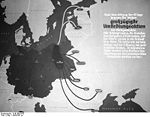 After the Germans occupied western Poland, they established a central registration bureau, called the German People's List (Deutsche Volksliste, DVL), whereby Polish citizens of German ethnicity were registered as Volksdeutsche. The Germans encouraged such registration, in many cases forcing it or subjecting Polish Germans to terror assaults if they refused. Those who joined this group were given benefits, including better food as well as a better social status.
The Volksdeutsche Mittelstelle organised large-scale looting of property and redistributed goods to the Volksdeutsche. They were given apartments, workshops, farms, furniture, and clothing confiscated from Jews and Poles. In turn, hundreds of thousands of the Volksdeutsche joined the German forces, either willingly or under compulsion.
During World War II
, Polish citizens of German ancestry, who often identified with the Polish nation, were confronted with the dilemma of registering in the Deutsche Volksliste. Many ethnic Germans had families who had lived in Poland for centuries; even the more recent immigrants had arrived 30 years or more before the war. They faced the choice of registering and being regarded as traitors by other Poles, or not signing and being treated by the Nazi occupation as traitors to the Germanic "race"
.
In Polish Silesia Catholic Church authorities lead by bishop Stanisław Adamski and with agreement from Polish Government in Exile
advised Poles to sign up to the Volksliste in order to avoid atrocities and mass murder that happened in other parts of the country
In occupied Poland, the status of "Volksdeutscher" gave many privileges, but one big disadvantage: Volksdeutsche were subject to conscription into the German army. In occupied Pomerania
, the Gauleiter
of the Danzig-West Prussia region Albert Forster
issued a secret order which mandated a creation of a list of people who were considered to be of German ethnicity, in 1941. Since the number of supposedly ethnic Germans who signed up voluntarily was insignificant by 1942, in February of that year Forster made signing of the Volksliste mandatory and empowered local police and other authorities to employ various methods, including physical force and threats, to implement the decree. Consequently, the initially insignificant number of signatories rose to almost a million persons, or about 55% of the population by 1944. The special case of Pomerania, where terror against civilians was particularly intense, and where, unlike in rest of occupied Poland, signing of the list was mandatory for many people, was recognized by the Polish Underground State and other anti-Nazi resistance movements, which tried to explain the situation to other Poles in underground publications.
The Deutsche Volksliste categorised German Poles into one of four categories:
Volksdeutsche of statuses 1 and 2 in the Polish areas annexed by Germany numbered 1,000,000, and Nos. 3 and 4 numbered 1,700,000. In the General Government
there were 120,000 Volksdeutsche. Volksdeutsche of Polish ethnic origins were treated by the Poles with special contempt, but were also committing high treason according to Polish law.
Because of actions by some Volksdeutsche and particularly the atrocities committed by Nazi Germany
, after the end of the war, the Polish authorities tried many Volksdeutsche for high treason. In the postwar period, many other ethnic Germans were expelled to the west and forced to leave everything. In 21st century Poland, the word Volksdeutsche is regarded as an insult, synonymous with "traitor".
In some cases, individuals consulted the Polish resistance first, before signing the Volksliste. There were Volksdeutsche who played important roles in intelligence activities of the Polish resistance, and were at times the primary source of information for the Allies
. Particularly in Pomerania and Silesia, many of the people who were forced to sign the Volksliste played crucial roles in the anti-Nazi underground, which was noted in a memo to the Polish Government in Exile
which stated "In Wielkopolska there's bitter hatred of the Volksdeutshe while in Silesia and Pomerania it's the opposite, the secret organization depends in large measure on the Volksdeutshe" (the memo referred to those of Category III, not I and II). In the turmoil of the postwar years, the Communist government did not consider this sufficient mitigation. It prosecuted many double-agent Volksdeutsche and sentenced some to death.
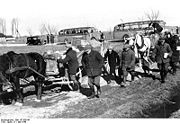
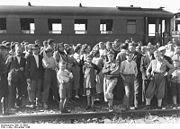
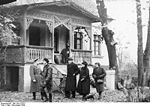

The Soviet invasion of Finland
, which had been covertly ceded under the Molotov-Ribbentrop Pact
secret protocols, created domestic problems for Hitler. Supporting the Soviet invasion became one of the most ideologically difficult aspects of the countries' relationship. The secret protocols caused Hitler to hurriedly evacuate ethnic German families, the Volksdeutsche, who had lived in Finland and the Baltic countries for centuries, while officially condoning the invasions. When the three Baltic countries, not knowing about the secret protocols, sent letters protesting the Soviet invasions to Berlin, Ribbentrop returned them.
In August 1940, Soviet Foreign minister Molotov told the Germans that, with the government change, they could close down their Baltic consulates by 1 September. The Soviet annexations in Romania caused further strain. While Germany had given the Soviets Bessarabia in the secret protocols, it had not given them Bucovina. Germany wanted guarantees of the safety of property of ethnic Germans, security for the 125,000 Volksdeutsche in Bessarabia and Bukovina, and reassurance that the train tracks carrying Romanian oil would be left alone.
In October 1940, Germany and the Soviet Union negotiated about the Volksdeutsche in Soviet-occupied territories and their property. Instead of permitting full indemnification, the Soviets put restrictions on the wealth that the Volksdeutsche could take with them and limited the totals that the Soviets would apply to the Reich's clearing accounts. The parties discussed total compensation of between 200 million and 350 million Reichsmarks for the Volksdeutsche, while the Soviets requested 50 million Reichsmarks for their property claims in German-occupied territories. The two nations reached general agreement on German shipments of 10.5-cm flak cannons, gold, machinery and other items.
On 10 January 1941, Germany and the Soviet Union signed the German–Soviet Border and Commercial Agreement
to settle all of the open disputes which the Soviets had argued. The agreement covered protected migration to Germany within two and a half months of Volksdeutsche, and similar migration to the Soviet Union of ethnic Russians, Baltic and "White Russian" "nationals" from German-held territories. In many cases, the resulting population transfers resulted in resettlement of Volksdeutsche on land previously held by ethnic Poles or Jews in now Nazi-occupied territories. The agreement formally defined the border between Germany and the Soviet Union areas between the Igorka River and the Baltic Sea
.
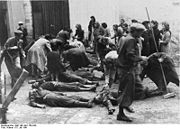
after the Russian Revolution of 1917
, the government granted the Volga German
s an autonomous republic. Joseph Stalin
abolished the Volga German ASSR
after Operation Barbarossa
, the German invasion of the USSR. He had many of the inhabitants deported to prison camps in Siberia
.
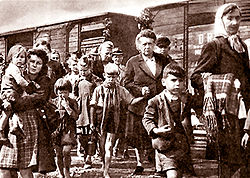
Most Volksdeutsche left or were expelled
from eastern European countries from 1945-1948 towards the end and after the war. Both those who became Volksdeutsche by registering and Reichsdeutsche retained German citizenship during the years of Allied military occupation, after the establishment of East Germany and West Germany
in 1949, and later in the reunified Germany.
An estimated 12 million Germans fled or were expelled from the Soviet Union and eastern Europe, many of them being Volksdeutsche. Most left the Soviet
-occupied territories of Eastern Europe; they comprised the largest migration of any European people in modern history. The Allies
had agreed to the expulsions during negotiations in the midst of war. The western powers hoped to avoid ethnic Germans being an issue again in eastern Europe.
Local authorities forced most of the remaining ethnic Germans to leave between 1945 and 1950. Remnants of the ethnic German community survive in the former Soviet
republics of Central Asia. A significant ethnic German community has continued in Siebenbürgen (Transylvania
) in Romania
but most of it migrated to West Germany throughout the 1980s. There are also remnant German populations near Mukachevo in western Ukraine.
Instead, ethnic Germans living outside of Germany are called "Auslandsdeutsche", or names more closely associated with their earlier places of residence, such as Wolgadeutsche
or Volga Germans, the ethnic Germans living in the Volga basin in Russia; and Baltic German
s, who generally called themselves Balts. They were relocated to German-occupied Poland during World War II by an agreement between Adolf Hitler
and Joseph Stalin
, and most were expelled to the West after the war.
Ethnic Germans were among the millions of displaced peoples on the roads of Europe in the years after the war.
Racial policy of Nazi Germany
The racial policy of Nazi Germany was a set of policies and laws implemented by Nazi Germany, asserting the superiority of the "Aryan race", and based on a specific racist doctrine which claimed scientific legitimacy...
the meanings of "folk" and "race" while adding the sense of superior civilization and blood. These terms were used by Nazis to define people in terms of their ethnicity rather than citizenship
German nationality law
German citizenship is based primarily on the principle of jus sanguinis. In other words one usually acquires German citizenship if a parent is a German citizen, irrespective of place of birth....
and thus included Germans
Germans
The Germans are a Germanic ethnic group native to Central Europe. The English term Germans has referred to the German-speaking population of the Holy Roman Empire since the Late Middle Ages....
living beyond the borders of the Reich. This is in contrast to Imperial Germans
Imperial Germans
Imperial Germans is the common translation of the German word Reichsdeutsche . It refers to German citizens, and by the word sense means people coming from the German Empire, i.e...
(Reichsdeutsche), German citizens living within Germany
Germany
Germany , officially the Federal Republic of Germany , is a federal parliamentary republic in Europe. The country consists of 16 states while the capital and largest city is Berlin. Germany covers an area of 357,021 km2 and has a largely temperate seasonal climate...
. The term also contrasts with the usage of the term Auslandsdeutsche (Germans abroad) since 1936, which generally denotes German citizens residing in other countries.
Volksdeutsche were further divided into Volksgruppen - a minority within a minority in a state - with a special cultural, social and historic development as described by Nazis.
Origin of the term
According to the historian Doris Bergen, Adolf Hitler is reputed to have coined the definition of "Volksdeutsche" which appeared in a 1938 memorandum of the German Reich Chancellery. In that document, the Volksdeutsche were defined as "people whose language and culture had German origins but who did not hold German citizenship."For Hitler
Adolf Hitler
Adolf Hitler was an Austrian-born German politician and the leader of the National Socialist German Workers Party , commonly referred to as the Nazi Party). He was Chancellor of Germany from 1933 to 1945, and head of state from 1934 to 1945...
and other ethnic Germans of his time, the term "Volksdeutsche" also carried overtones of blood and race not captured in the common English translation "ethnic Germans". According to German estimates in the 1930s, about 30 million Volksdeutsche and Auslandsdeutsche (= German citizens residing abroad, see McKale 1977: The Swastika Outside Germany, p. 4) were living outside the Reich. A significant proportion of them were in eastern Europe: Russia, Poland, Ukraine, the Baltic states, and Romania, Hungary and Yugoslavia, where many were located in villages along the Danube. Many of their ancestors had migrated to such areas of eastern Europe in the 18th century, invited by governments that wanted to repopulate areas decimated by the Ottoman Empire
Ottoman Empire
The Ottoman EmpireIt was usually referred to as the "Ottoman Empire", the "Turkish Empire", the "Ottoman Caliphate" or more commonly "Turkey" by its contemporaries...
occupation and sometimes by disease.
The Nazi goal of expansion to the east assigned the Volksdeutsche a special role in German plans, to bring them back to German citizenship and elevate them to power over the native populations in those areas. The Nazis detailed such goals in Generalplan Ost
Generalplan Ost
Generalplan Ost was a secret Nazi German plan for the colonization of Eastern Europe. Implementing it would have necessitated genocide and ethnic cleansing to be undertaken in the Eastern European territories occupied by Germany during World War II...
.
Ostsiedlung
Over the last thousand years, Germans emigrated from traditional German lands in Central EuropeCentral Europe
Central Europe or alternatively Middle Europe is a region of the European continent lying between the variously defined areas of Eastern and Western Europe...
and settled further east in Russia
Russia
Russia or , officially known as both Russia and the Russian Federation , is a country in northern Eurasia. It is a federal semi-presidential republic, comprising 83 federal subjects...
, present day Romania
Romania
Romania is a country located at the crossroads of Central and Southeastern Europe, on the Lower Danube, within and outside the Carpathian arch, bordering on the Black Sea...
and other countries. Many Germans settled in the Baltic
Baltic region
The terms Baltic region, Baltic Rim countries, and Baltic Rim refer to slightly different combinations of countries in the general area surrounding the Baltic Sea.- Etymology :...
and parts of present day Poland
Poland
Poland , officially the Republic of Poland , is a country in Central Europe bordered by Germany to the west; the Czech Republic and Slovakia to the south; Ukraine, Belarus and Lithuania to the east; and the Baltic Sea and Kaliningrad Oblast, a Russian exclave, to the north...
in colonies established by the Teutonic Knights
Teutonic Knights
The Order of Brothers of the German House of Saint Mary in Jerusalem , commonly the Teutonic Order , is a German medieval military order, in modern times a purely religious Catholic order...
beginning in the thirteenth century. The Knights were also granted rights in Transylvania
Transylvania
Transylvania is a historical region in the central part of Romania. Bounded on the east and south by the Carpathian mountain range, historical Transylvania extended in the west to the Apuseni Mountains; however, the term sometimes encompasses not only Transylvania proper, but also the historical...
, resulting in the settlement of many Germans there.
In the sixteenth century Vasili III
Vasili III of Russia
Vasili III Ivanovich was the Grand Prince of Moscow from 1505 to 1533. He was the son of Ivan III Vasiliyevich and Sophia Paleologue and was christened with the name Gavriil...
invited small numbers of German craftsmen, traders and professionals to settle in Russia so that the empire could exploit their skills. These settlers (many of whom intended to stay only temporarily) were generally confined to the German Quarter
German Quarter
German Quarter, also known as the Kukuy Quarter was a neighborhood in the northeast of Moscow, located on the right bank of the Yauza River east of Kukuy Creek , within present-day Basmanny District of Moscow....
in Moscow
Moscow
Moscow is the capital, the most populous city, and the most populous federal subject of Russia. The city is a major political, economic, cultural, scientific, religious, financial, educational, and transportation centre of Russia and the continent...
(which also included Dutch, British and other western or northern European settlers whom the Russians came to indiscriminately refer to as "Germans"). They were only gradually allowed in other cities, so as to prevent the spread of alien ideas to the general population.
In his youth, Peter the Great
Peter I of Russia
Peter the Great, Peter I or Pyotr Alexeyevich Romanov Dates indicated by the letters "O.S." are Old Style. All other dates in this article are New Style. ruled the Tsardom of Russia and later the Russian Empire from until his death, jointly ruling before 1696 with his half-brother, Ivan V...
spent much time in the German quarter. When he became Tsar, he brought more German experts (and other foreigners) into Russia, and particularly into government service, in his attempts to westernize the empire. He also brought in German engineers to supervise the construction of the new city of Saint Petersburg
Saint Petersburg
Saint Petersburg is a city and a federal subject of Russia located on the Neva River at the head of the Gulf of Finland on the Baltic Sea...
.
Catherine the Great
Catherine II of Russia
Catherine II, also known as Catherine the Great , Empress of Russia, was born in Stettin, Pomerania, Prussia on as Sophie Friederike Auguste von Anhalt-Zerbst-Dornburg...
, who was German, invited German farmers to immigrate and settle in Russian lands along the Volga River
Volga River
The Volga is the largest river in Europe in terms of length, discharge, and watershed. It flows through central Russia, and is widely viewed as the national river of Russia. Out of the twenty largest cities of Russia, eleven, including the capital Moscow, are situated in the Volga's drainage...
. She guaranteed them the right to retain their language, religion and culture. Germans were also sent in organized colonization attempts aiming at Germanization of conquered Polish areas.
Frederick the Great settled around 300,000 colonists in the eastern provinces of Prussia, acquired in Partitions of Poland
Partitions of Poland
The Partitions of Poland or Partitions of the Polish–Lithuanian Commonwealth took place in the second half of the 18th century and ended the existence of the Polish–Lithuanian Commonwealth, resulting in the elimination of sovereign Poland for 123 years...
, with the intention of replacing the Polish nobility. He treated the Poles with contempt and likened the 'slovenly Polish trash' in newly reconquered West Prussia to Iroquois
Iroquois
The Iroquois , also known as the Haudenosaunee or the "People of the Longhouse", are an association of several tribes of indigenous people of North America...
, the historic Native American
Indigenous peoples of the Americas
The indigenous peoples of the Americas are the pre-Columbian inhabitants of North and South America, their descendants and other ethnic groups who are identified with those peoples. Indigenous peoples are known in Canada as Aboriginal peoples, and in the United States as Native Americans...
confederacy based in the state of New York.
Prussia encouraged a second round of colonization with the goal of Germanisation after 1832. Prussia passed laws to encourage Germanisation of the provinces of Posen
Province of Posen
The Province of Posen was a province of Prussia from 1848–1918 and as such part of the German Empire from 1871 to 1918. The area was about 29,000 km2....
and West Prussia
West Prussia
West Prussia was a province of the Kingdom of Prussia from 1773–1824 and 1878–1919/20 which was created out of the earlier Polish province of Royal Prussia...
in the late 19th century. The Prussian Settlement Commission relocated 154,000 colonists, including locals.
Treaty of Versailles
The reconstitution of Poland following the Treaty of VersaillesTreaty of Versailles
The Treaty of Versailles was one of the peace treaties at the end of World War I. It ended the state of war between Germany and the Allied Powers. It was signed on 28 June 1919, exactly five years after the assassination of Archduke Franz Ferdinand. The other Central Powers on the German side of...
separated German minorities of the Prussian provinces
Provinces of Prussia
The Provinces of Prussia constituted the main administrative divisions of Prussia. Following the dissolution of the Holy Roman Empire in 1806 and the Congress of Vienna in 1815 the various princely states in Germany gained their nominal sovereignty, but the reunification process that culminated in...
of the German Empire
German Empire
The German Empire refers to Germany during the "Second Reich" period from the unification of Germany and proclamation of Wilhelm I as German Emperor on 18 January 1871, to 1918, when it became a federal republic after defeat in World War I and the abdication of the Emperor, Wilhelm II.The German...
from a German nation state. Ethnic German inhabitants of provinces of the dissolved Austro-Hungarian Empire, such as Sudeten Germans
Sudeten Germans
- Importance of Sudeten Germans :Czechoslovakia was inhabited by over 3 million ethnic Germans, comprising about 23 percent of the population of the republic and about 29.5% of Bohemia and Moravia....
, Danube Swabians
Danube Swabians
The Danube Swabians is a collective term for the German-speaking population who lived in the former Kingdom of Hungary, especially alongside the Danube River valley. Because of different developments within the territory settled, the Danube Swabians cannot be seen as a unified people...
and Transylvanian Saxons
Transylvanian Saxons
The Transylvanian Saxons are a people of German ethnicity who settled in Transylvania from the 12th century onwards.The colonization of Transylvania by Germans was begun by King Géza II of Hungary . For decades, the main task of the German settlers was to defend the southeastern border of the...
, became citizens of newly established Slavic or Magyar nation states. Tensions between the new administration and the ethnic German minority arose in the Polish Corridor
Polish Corridor
The Polish Corridor , also known as Danzig Corridor, Corridor to the Sea or Gdańsk Corridor, was a territory located in the region of Pomerelia , which provided the Second Republic of Poland with access to the Baltic Sea, thus dividing the bulk of Germany from the province of East...
.
The Nazi era before World War II
During the NaziNazism
Nazism, the common short form name of National Socialism was the ideology and practice of the Nazi Party and of Nazi Germany...
years, they used the term "Volksdeutsche" to refer to foreign-born Germans living in countries newly occupied by Nazi Germany and who applied for German citizenship. Prior to World War II
World War II
World War II, or the Second World War , was a global conflict lasting from 1939 to 1945, involving most of the world's nations—including all of the great powers—eventually forming two opposing military alliances: the Allies and the Axis...
, more than 10 million ethnic Germans lived in Central and Eastern Europe. They constituted an important minority far into Russia
Russia
Russia or , officially known as both Russia and the Russian Federation , is a country in northern Eurasia. It is a federal semi-presidential republic, comprising 83 federal subjects...
.
Pre-war relations with the Nazis
In 1931, prior to its rise to power, the Nazi party established the Auslandsorganisation der NSDAP (Foreign Organisation of the Nazi Party), which task was to disseminate Nazi propaganda among the ethnic German minorities living outside Germany (Volksdeutsche). In 1936, the government set up the Volksdeutsche Mittelstelle (Ethnic Germans' Welfare Office), commonly known as VoMi, under the jurisdiction of the SS as the liaison bureau. It was headed by SS-Obergruppenfuehrer Werner Lorenz.In 1936 the Nazis set up an office to act as a contact for the Volksdeutsche. According to the historian Lumans Valdiso,
- "[one of Himmler's goals was] centralizing control over the myriad of groups and individuals inside the Reich promoting the Volksdeutsche cause. Himmler did not initiate the process but rather discovered it in progress and directed it to its conclusion and to his advantage. His principal instrument in this effort was an office from outside the SS, a Nazi party organ, the Volksdeutsche Mittelstelle (VoMi), translated as the Ethnic German Liaison Office."
Internal propaganda
The suffering of Volksdeutsche in foreign lands was often depicted to Germans, before and during the war, to help justify the aggression. The annexation of Poland was presented as necessary to protect the German minorities there. Alleged massacres of Germans, such as Bloody Sunday were used in such propaganda, and the film HeimkehrHeimkehr
Heimkehr is a 1941 German anti-Polish propaganda film directed by Gustav Ucicky.It received the rare honor "Film of the Nation," bestowed on films considered to have made an outstanding contribution to the national cause...
drew on such attempts although allowing the Volksdeutsche depicted to survive, saved by the arrival of German tanks. Heimkehrs introduction explicitly states that hundreds of thousands of Germans in Poland suffered as the characters in the film did.
Menschen im Sturm
Menschen im Sturm
Menschen im Sturm is a 1941 German film. It was anti-Serbian propaganda and part of a concerted propaganda push against Serbs, attempting to split them from the Croats.-Synopsis:...
reprised Heimkehrs effort to justify the invasion of Slovania, using many of the same atrocities. In The Red Terror
The Red Terror (film)
The Red Terror is a 1942 German film directed by Karl Ritter.Released after the breakdown of the Molotov–Ribbentrop Pact, it is noteworthy for the crude, heavy-handed depiction of Communists.-Plot:...
, a Baltic German
Baltic German
The Baltic Germans were mostly ethnically German inhabitants of the eastern shore of the Baltic Sea, which today form the countries of Estonia and Latvia. The Baltic German population never made up more than 10% of the total. They formed the social, commercial, political and cultural élite in...
is able to avenge her family's deaths, but commits suicide after, unable to live with meaning in the Soviet Union. Flüchtlinge
Flüchtlinge
Flüchtlinge is a 1933 German film depicting Volga German refugees persecuted by the Bolsheviks on the Sino-Russian border in Manchuria in 1928.The film was directed by Gustav Ucicky and starred Hans Albers, Käthe von Nagy and Eugen Klopfer...
depicted the sufferings of Volga German
Volga German
The Volga Germans were ethnic Germans living along the River Volga in the region of southern European Russia around Saratov and to the south. Recruited as immigrants to Russia in the 18th century, they were allowed to maintain German culture, language, traditions and churches: Lutherans, Reformed,...
refugees in Manchuria, and how a heroic blond leader
Führerprinzip
The Führerprinzip , German for "leader principle", prescribes the fundamental basis of political authority in the governmental structures of the Third Reich...
saved them; it was the first movie to win the state prize. Friesennot
Friesennot
Friesennot is a 1935 German film directed by Peter Hagen.The film is also known as Dorf im roten Sturm and Frisions in Distress .- Plot :...
depicted the suffering of a village of Volga Germans in the Soviet Union; it also depicted the murder of a young woman for an affair with a Russian -- in accordance with Nazi principle of rassenschande
Rassenschande
Rassenschande or Blutschande was the Nazi term for sexual relations between Aryans and non-Aryans, which was punishable by law...
-- as an ancient German custom.
Rassenschande also featured in Die goldene Stadt
Die goldene Stadt
Die goldene Stadt , is a 1941 German film directed by Veit Harlan, starring Kristina Söderbaum, who won the Volpi Cup for Best Actress, and in Agfacolor.-Plot:...
, where the Sudeten German heroine faces not persecution but the allure of the big city; when she succumbs, in defiance of blood and soil
Blood and soil
Blood and Soil refers to an ideology that focuses on ethnicity based on two factors, descent and homeland/Heimat...
, she is seduced and abandoned by a Czech, and such a relationship leads to her drowning herself.
Collaboration with the Nazis
Before and during World War IIWorld War II
World War II, or the Second World War , was a global conflict lasting from 1939 to 1945, involving most of the world's nations—including all of the great powers—eventually forming two opposing military alliances: the Allies and the Axis...
, some Volksdeutsche, in countries such as Czechoslovakia, Poland and Yugoslavia, actively supported the Nazis. During the social and economic tensions of the Great Depression
Great Depression
The Great Depression was a severe worldwide economic depression in the decade preceding World War II. The timing of the Great Depression varied across nations, but in most countries it started in about 1929 and lasted until the late 1930s or early 1940s...
, some had begun to feel aggrieved with their minority status. They participated in espionage, sabotage and other means in their countries of origin.
In Yugoslavia, the 7th SS Volunteer Mountain Division Prinz Eugen
7th SS Volunteer Mountain Division Prinz Eugen
The 7th SS Volunteer Mountain Division Prinz Eugen. was formed on March 1942 from Volksdeutsche volunteers from Vojvodina, Croatia, Hungary and Romania, it was initially called the SS-Freiwilligen-Division Prinz Eugen....
was formed. It was conspicuous in its operations against the Resistance
Resistance during World War II
Resistance movements during World War II occurred in every occupied country by a variety of means, ranging from non-cooperation, disinformation and propaganda to hiding crashed pilots and even to outright warfare and the recapturing of towns...
partisans and among the population. About 300,000 Volksdeutsche from the Nazi-conquered lands and the satellite countries joined the Waffen-SS, the majority conscripted involuntarily. In Hungary, for instance, some 100,000 ethnic Germans volunteered for service in it. "After the initial rush of Volksdeutsche to join, voluntary enlistments tapered off, and the new unit did not reach division size. Therefore, in August 1941, the SS discarded the voluntary approach, and after a favourable judgement from the SS court in Belgrade, imposed a mandatory military obligation on all Volksdeutsche in Serbia-Banat, the first of its kind for non-Reich Germans."
Among the indigenous populations in the Nazi-occupied lands, Volksdeutsche became a term of ignominy.
During the early days of WWII (i.e., before the US entered the war), a small number of Americans of German origin returned to Germany; generally they were immigrants or children of immigrants, rather than descendants of migrations more distant in time. Some of these enlisted and fought in the German army.
Volksdeutsche in German-occupied western Poland
In September 1939 in German occupied Poland, an armed ethnic German militia called SelbstschutzSelbstschutz
Selbstschutz stands for two organisations:# A name used by a number of paramilitary organisations created by ethnic Germans in Central and Eastern Europe# A name for self-defence measures and units in ethnic German, Austrian, and Swiss civil defence....
(Self-Defence) was created. It organized the mass murder of Polish elites in Operation Tannenberg
Operation Tannenberg
Operation Tannenberg was the codename for one of the extermination actions directed at the Polish people during World War II, part of the Generalplan Ost...
. At the beginning of 1940, the Selbstschutz was disbanded and its members transferred to various units of the SS and German police. Throughout the invasion of Poland, some ethnic German minority groups assisted Nazi Germany in the war effort. They committed sabotage, diverted regular forces and committed numerous atrocities against civilian population.
The Volksdeutsche Mittelstelle organised large-scale looting of property and redistributed goods to the Volksdeutsche. They were given apartments, workshops, farms, furniture, and clothing confiscated from Jews and Poles. In turn, hundreds of thousands of the Volksdeutsche joined the German forces, either willingly or under compulsion.
During World War II
World War II
World War II, or the Second World War , was a global conflict lasting from 1939 to 1945, involving most of the world's nations—including all of the great powers—eventually forming two opposing military alliances: the Allies and the Axis...
, Polish citizens of German ancestry, who often identified with the Polish nation, were confronted with the dilemma of registering in the Deutsche Volksliste. Many ethnic Germans had families who had lived in Poland for centuries; even the more recent immigrants had arrived 30 years or more before the war. They faced the choice of registering and being regarded as traitors by other Poles, or not signing and being treated by the Nazi occupation as traitors to the Germanic "race"
Germanic peoples
The Germanic peoples are an Indo-European ethno-linguistic group of Northern European origin, identified by their use of the Indo-European Germanic languages which diversified out of Proto-Germanic during the Pre-Roman Iron Age.Originating about 1800 BCE from the Corded Ware Culture on the North...
.
In Polish Silesia Catholic Church authorities lead by bishop Stanisław Adamski and with agreement from Polish Government in Exile
Polish government in Exile
The Polish government-in-exile, formally known as the Government of the Republic of Poland in Exile , was the government in exile of Poland formed in the aftermath of the Invasion of Poland of September 1939, and the subsequent occupation of Poland by Nazi Germany and the Soviet Union, which...
advised Poles to sign up to the Volksliste in order to avoid atrocities and mass murder that happened in other parts of the country
In occupied Poland, the status of "Volksdeutscher" gave many privileges, but one big disadvantage: Volksdeutsche were subject to conscription into the German army. In occupied Pomerania
Pomerania
Pomerania is a historical region on the south shore of the Baltic Sea. Divided between Germany and Poland, it stretches roughly from the Recknitz River near Stralsund in the West, via the Oder River delta near Szczecin, to the mouth of the Vistula River near Gdańsk in the East...
, the Gauleiter
Gauleiter
A Gauleiter was the party leader of a regional branch of the NSDAP or the head of a Gau or of a Reichsgau.-Creation and Early Usage:...
of the Danzig-West Prussia region Albert Forster
Albert Forster
Albert Maria Forster was a Nazi German politician. Under his administration as the Gauleiter of Danzig-West Prussia during the Second World War, the local non-German population suffered ethnic cleansing, mass murder, and forceful Germanisation...
issued a secret order which mandated a creation of a list of people who were considered to be of German ethnicity, in 1941. Since the number of supposedly ethnic Germans who signed up voluntarily was insignificant by 1942, in February of that year Forster made signing of the Volksliste mandatory and empowered local police and other authorities to employ various methods, including physical force and threats, to implement the decree. Consequently, the initially insignificant number of signatories rose to almost a million persons, or about 55% of the population by 1944. The special case of Pomerania, where terror against civilians was particularly intense, and where, unlike in rest of occupied Poland, signing of the list was mandatory for many people, was recognized by the Polish Underground State and other anti-Nazi resistance movements, which tried to explain the situation to other Poles in underground publications.
The Deutsche Volksliste categorised German Poles into one of four categories:
- Category I: Persons of German descent committed to the Reich before 1939.
- Category II: Persons of German descent who had remained passive.
- Category III: Persons of German descent who had become partly "polonized", e.g., through marrying a Polish partner or through working relationships (especially SilesiaSilesiaSilesia is a historical region of Central Europe located mostly in Poland, with smaller parts also in the Czech Republic, and Germany.Silesia is rich in mineral and natural resources, and includes several important industrial areas. Silesia's largest city and historical capital is Wrocław...
ns and KashubiansKashubiansKashubians/Kaszubians , also called Kashubs, Kashubes, Kaszubians, Kassubians or Cassubians, are a West Slavic ethnic group in Pomerelia, north-central Poland. Their settlement area is referred to as Kashubia ....
). - Category IV: Persons of German ancestry who had become "polonized" but were supportive of "Germanisation".
Volksdeutsche of statuses 1 and 2 in the Polish areas annexed by Germany numbered 1,000,000, and Nos. 3 and 4 numbered 1,700,000. In the General Government
General Government
The General Government was an area of Second Republic of Poland under Nazi German rule during World War II; designated as a separate region of the Third Reich between 1939–1945...
there were 120,000 Volksdeutsche. Volksdeutsche of Polish ethnic origins were treated by the Poles with special contempt, but were also committing high treason according to Polish law.
| Annexed area Polish areas annexed by Nazi Germany At the beginning of World War II, nearly a quarter of the pre-war Polish areas were annexed by Nazi Germany and placed directly under German civil administration, while the rest of Nazi occupied Poland was named as General Government... |
Deutsche Volksliste, early 1944 | |||
| Cat. I | Cat. II | Cat. III | Cat. IV | |
| Warthegau | 230,000 | 190,000 | 65,000 | 25,000 |
| Reichsgau Danzig-West Prussia Reichsgau Danzig-West Prussia The Reichsgau Danzig-West Prussia was a Nazi German province created on 8 October 1939 from the territory of the annexed Free City of Danzig, the annexed Polish province Greater Pomeranian Voivodship , and the Nazi German Regierungsbezirk West Prussia of Gau East Prussia. Before 2 November 1939,... Note: In Pomerania, unlike in rest of occupied Poland, signing of the list was mandatory for a good portion of the population. |
115,000 | 95,000 | 725,000 | 2,000 |
| East Upper Silesia | 130,000 | 210,000 | 875,000 | 55,000 |
| South East Prussia | 9,000 | 22,000 | 13,000 | 1,000 |
| Total | 484,000 | 517,000 | 1,678,000 | 83,000 |
| Toal 2.75 million on Volkslisten plus non-German population(Polish) of 6.015 million- Grand Total 8.765 million in annexed territories. | ||||
| Source: Wilhelm Deist, Bernhard R Kroener, Germany (Federal Republic). Militärgeschichtliches Forschungsamt, Germany and the Second World War, Oxford University Press, 2003, pp. 132,133, ISBN 0-19-820873-1, citing Broszat, Nationalsozialistische Polenpolitik, p. 134 | ||||
Because of actions by some Volksdeutsche and particularly the atrocities committed by Nazi Germany
Nazi Germany
Nazi Germany , also known as the Third Reich , but officially called German Reich from 1933 to 1943 and Greater German Reich from 26 June 1943 onward, is the name commonly used to refer to the state of Germany from 1933 to 1945, when it was a totalitarian dictatorship ruled by...
, after the end of the war, the Polish authorities tried many Volksdeutsche for high treason. In the postwar period, many other ethnic Germans were expelled to the west and forced to leave everything. In 21st century Poland, the word Volksdeutsche is regarded as an insult, synonymous with "traitor".
In some cases, individuals consulted the Polish resistance first, before signing the Volksliste. There were Volksdeutsche who played important roles in intelligence activities of the Polish resistance, and were at times the primary source of information for the Allies
Allies
In everyday English usage, allies are people, groups, or nations that have joined together in an association for mutual benefit or to achieve some common purpose, whether or not explicit agreement has been worked out between them...
. Particularly in Pomerania and Silesia, many of the people who were forced to sign the Volksliste played crucial roles in the anti-Nazi underground, which was noted in a memo to the Polish Government in Exile
Polish government in Exile
The Polish government-in-exile, formally known as the Government of the Republic of Poland in Exile , was the government in exile of Poland formed in the aftermath of the Invasion of Poland of September 1939, and the subsequent occupation of Poland by Nazi Germany and the Soviet Union, which...
which stated "In Wielkopolska there's bitter hatred of the Volksdeutshe while in Silesia and Pomerania it's the opposite, the secret organization depends in large measure on the Volksdeutshe" (the memo referred to those of Category III, not I and II). In the turmoil of the postwar years, the Communist government did not consider this sufficient mitigation. It prosecuted many double-agent Volksdeutsche and sentenced some to death.
Volksdeutsche in the territories annexed by the Soviet Union in 1939-40
The Soviet invasion of Finland
Finland
Finland , officially the Republic of Finland, is a Nordic country situated in the Fennoscandian region of Northern Europe. It is bordered by Sweden in the west, Norway in the north and Russia in the east, while Estonia lies to its south across the Gulf of Finland.Around 5.4 million people reside...
, which had been covertly ceded under the Molotov-Ribbentrop Pact
Molotov-Ribbentrop Pact
The Molotov–Ribbentrop Pact, named after the Soviet foreign minister Vyacheslav Molotov and the German foreign minister Joachim von Ribbentrop, was an agreement officially titled the Treaty of Non-Aggression between Germany and the Soviet Union and signed in Moscow in the late hours of 23 August 1939...
secret protocols, created domestic problems for Hitler. Supporting the Soviet invasion became one of the most ideologically difficult aspects of the countries' relationship. The secret protocols caused Hitler to hurriedly evacuate ethnic German families, the Volksdeutsche, who had lived in Finland and the Baltic countries for centuries, while officially condoning the invasions. When the three Baltic countries, not knowing about the secret protocols, sent letters protesting the Soviet invasions to Berlin, Ribbentrop returned them.
In August 1940, Soviet Foreign minister Molotov told the Germans that, with the government change, they could close down their Baltic consulates by 1 September. The Soviet annexations in Romania caused further strain. While Germany had given the Soviets Bessarabia in the secret protocols, it had not given them Bucovina. Germany wanted guarantees of the safety of property of ethnic Germans, security for the 125,000 Volksdeutsche in Bessarabia and Bukovina, and reassurance that the train tracks carrying Romanian oil would be left alone.
In October 1940, Germany and the Soviet Union negotiated about the Volksdeutsche in Soviet-occupied territories and their property. Instead of permitting full indemnification, the Soviets put restrictions on the wealth that the Volksdeutsche could take with them and limited the totals that the Soviets would apply to the Reich's clearing accounts. The parties discussed total compensation of between 200 million and 350 million Reichsmarks for the Volksdeutsche, while the Soviets requested 50 million Reichsmarks for their property claims in German-occupied territories. The two nations reached general agreement on German shipments of 10.5-cm flak cannons, gold, machinery and other items.
On 10 January 1941, Germany and the Soviet Union signed the German–Soviet Border and Commercial Agreement
German–Soviet Border and Commercial Agreement
The German–Soviet Border and Commercial Agreement, signed on January 10, 1941, was a broad agreement settling border disputes and continuing raw materials and war machine trade between the Soviet Union and Nazi Germany...
to settle all of the open disputes which the Soviets had argued. The agreement covered protected migration to Germany within two and a half months of Volksdeutsche, and similar migration to the Soviet Union of ethnic Russians, Baltic and "White Russian" "nationals" from German-held territories. In many cases, the resulting population transfers resulted in resettlement of Volksdeutsche on land previously held by ethnic Poles or Jews in now Nazi-occupied territories. The agreement formally defined the border between Germany and the Soviet Union areas between the Igorka River and the Baltic Sea
Baltic Sea
The Baltic Sea is a brackish mediterranean sea located in Northern Europe, from 53°N to 66°N latitude and from 20°E to 26°E longitude. It is bounded by the Scandinavian Peninsula, the mainland of Europe, and the Danish islands. It drains into the Kattegat by way of the Øresund, the Great Belt and...
.
| Territory of origin | Year | Number of resettled Volksdeutsches |
|---|---|---|
| South Tyrol South Tyrol South Tyrol , also known by its Italian name Alto Adige, is an autonomous province in northern Italy. It is one of the two autonomous provinces that make up the autonomous region of Trentino-Alto Adige/Südtirol. The province has an area of and a total population of more than 500,000 inhabitants... (see South Tyrol Option Agreement South Tyrol Option Agreement The South Tyrol Option Agreement refers to the period between 1939 and 1943, when the native German and Ladin speaking people in South Tyrol and three communes in the province of Belluno were given the "option" of either emigrating to neighboring Nazi Germany or remaining in Fascist Italy and... ) |
1939–1940 | 83 000 |
| Latvia Latvia Latvia , officially the Republic of Latvia , is a country in the Baltic region of Northern Europe. It is bordered to the north by Estonia , to the south by Lithuania , to the east by the Russian Federation , to the southeast by Belarus and shares maritime borders to the west with Sweden... and Estonia Estonia Estonia , officially the Republic of Estonia , is a state in the Baltic region of Northern Europe. It is bordered to the north by the Gulf of Finland, to the west by the Baltic Sea, to the south by Latvia , and to the east by Lake Peipsi and the Russian Federation . Across the Baltic Sea lies... |
1939–1941 | 69 000 |
| Lithuania Lithuania Lithuania , officially the Republic of Lithuania is a country in Northern Europe, the biggest of the three Baltic states. It is situated along the southeastern shore of the Baltic Sea, whereby to the west lie Sweden and Denmark... |
1941 | 54 000 |
| Volhynia Volhynia Volhynia, Volynia, or Volyn is a historic region in western Ukraine located between the rivers Prypiat and Southern Bug River, to the north of Galicia and Podolia; the region is named for the former city of Volyn or Velyn, said to have been located on the Southern Bug River, whose name may come... , Galicia, Nerewdeutschland |
1939–1940 | 128 000 |
| General Government General Government The General Government was an area of Second Republic of Poland under Nazi German rule during World War II; designated as a separate region of the Third Reich between 1939–1945... |
1940 | 33 000 |
| North Bukovina and Bessarabia Bessarabia Bessarabia is a historical term for the geographic region in Eastern Europe bounded by the Dniester River on the east and the Prut River on the west.... |
1940 | 137 000 |
| Romania Romania Romania is a country located at the crossroads of Central and Southeastern Europe, on the Lower Danube, within and outside the Carpathian arch, bordering on the Black Sea... (South Bukovina and North Dobruja) |
1940 | 77 000 |
| Jugoslavia | 1941–1942 | 36 000 |
| USSR (pre-1939 borders) | 1939–1944 | 250 000 |
| Summary | 1939–1944 | 867 000 |
After the German invasion of the USSR
after the Russian Revolution of 1917
Russian Revolution of 1917
The Russian Revolution is the collective term for a series of revolutions in Russia in 1917, which destroyed the Tsarist autocracy and led to the creation of the Soviet Union. The Tsar was deposed and replaced by a provisional government in the first revolution of February 1917...
, the government granted the Volga German
Volga German
The Volga Germans were ethnic Germans living along the River Volga in the region of southern European Russia around Saratov and to the south. Recruited as immigrants to Russia in the 18th century, they were allowed to maintain German culture, language, traditions and churches: Lutherans, Reformed,...
s an autonomous republic. Joseph Stalin
Joseph Stalin
Joseph Vissarionovich Stalin was the Premier of the Soviet Union from 6 May 1941 to 5 March 1953. He was among the Bolshevik revolutionaries who brought about the October Revolution and had held the position of first General Secretary of the Communist Party of the Soviet Union's Central Committee...
abolished the Volga German ASSR
Volga German Autonomous Soviet Socialist Republic
The Volga German Autonomous Soviet Socialist Republic was an autonomous republic established in Soviet Russia, with its capital at the Volga port of Engels .-History:...
after Operation Barbarossa
Operation Barbarossa
Operation Barbarossa was the code name for Germany's invasion of the Soviet Union during World War II that began on 22 June 1941. Over 4.5 million troops of the Axis powers invaded the USSR along a front., the largest invasion in the history of warfare...
, the German invasion of the USSR. He had many of the inhabitants deported to prison camps in Siberia
Siberia
Siberia is an extensive region constituting almost all of Northern Asia. Comprising the central and eastern portion of the Russian Federation, it was part of the Soviet Union from its beginning, as its predecessor states, the Tsardom of Russia and the Russian Empire, conquered it during the 16th...
.
Expulsion and exodus from Eastern Europe at the end of the war
Most Volksdeutsche left or were expelled
German exodus from Eastern Europe
The German exodus from Eastern Europe describes the dramatic reduction of ethnic German populations in lands to the east of present-day Germany and Austria. The exodus began in the aftermath of World War I and was implicated in the rise of Nazism. It culminated in expulsions of Germans from...
from eastern European countries from 1945-1948 towards the end and after the war. Both those who became Volksdeutsche by registering and Reichsdeutsche retained German citizenship during the years of Allied military occupation, after the establishment of East Germany and West Germany
West Germany
West Germany is the common English, but not official, name for the Federal Republic of Germany or FRG in the period between its creation in May 1949 to German reunification on 3 October 1990....
in 1949, and later in the reunified Germany.
An estimated 12 million Germans fled or were expelled from the Soviet Union and eastern Europe, many of them being Volksdeutsche. Most left the Soviet
Soviet Union
The Soviet Union , officially the Union of Soviet Socialist Republics , was a constitutionally socialist state that existed in Eurasia between 1922 and 1991....
-occupied territories of Eastern Europe; they comprised the largest migration of any European people in modern history. The Allies
Allies
In everyday English usage, allies are people, groups, or nations that have joined together in an association for mutual benefit or to achieve some common purpose, whether or not explicit agreement has been worked out between them...
had agreed to the expulsions during negotiations in the midst of war. The western powers hoped to avoid ethnic Germans being an issue again in eastern Europe.
Local authorities forced most of the remaining ethnic Germans to leave between 1945 and 1950. Remnants of the ethnic German community survive in the former Soviet
Soviet Union
The Soviet Union , officially the Union of Soviet Socialist Republics , was a constitutionally socialist state that existed in Eurasia between 1922 and 1991....
republics of Central Asia. A significant ethnic German community has continued in Siebenbürgen (Transylvania
Transylvania
Transylvania is a historical region in the central part of Romania. Bounded on the east and south by the Carpathian mountain range, historical Transylvania extended in the west to the Apuseni Mountains; however, the term sometimes encompasses not only Transylvania proper, but also the historical...
) in Romania
Romania
Romania is a country located at the crossroads of Central and Southeastern Europe, on the Lower Danube, within and outside the Carpathian arch, bordering on the Black Sea...
but most of it migrated to West Germany throughout the 1980s. There are also remnant German populations near Mukachevo in western Ukraine.
Legacy
The Nazis defined and popularized the term Volksdeutsche, and exploited such peoples for their own purposes. As a result, the term is not much used today.Instead, ethnic Germans living outside of Germany are called "Auslandsdeutsche", or names more closely associated with their earlier places of residence, such as Wolgadeutsche
Volga German
The Volga Germans were ethnic Germans living along the River Volga in the region of southern European Russia around Saratov and to the south. Recruited as immigrants to Russia in the 18th century, they were allowed to maintain German culture, language, traditions and churches: Lutherans, Reformed,...
or Volga Germans, the ethnic Germans living in the Volga basin in Russia; and Baltic German
Baltic German
The Baltic Germans were mostly ethnically German inhabitants of the eastern shore of the Baltic Sea, which today form the countries of Estonia and Latvia. The Baltic German population never made up more than 10% of the total. They formed the social, commercial, political and cultural élite in...
s, who generally called themselves Balts. They were relocated to German-occupied Poland during World War II by an agreement between Adolf Hitler
Adolf Hitler
Adolf Hitler was an Austrian-born German politician and the leader of the National Socialist German Workers Party , commonly referred to as the Nazi Party). He was Chancellor of Germany from 1933 to 1945, and head of state from 1934 to 1945...
and Joseph Stalin
Joseph Stalin
Joseph Vissarionovich Stalin was the Premier of the Soviet Union from 6 May 1941 to 5 March 1953. He was among the Bolshevik revolutionaries who brought about the October Revolution and had held the position of first General Secretary of the Communist Party of the Soviet Union's Central Committee...
, and most were expelled to the West after the war.
Ethnic Germans were among the millions of displaced peoples on the roads of Europe in the years after the war.
See also
- GoralenvolkGoralenvolkGoralenvolk was the name given by the German Nazis in World War II during their occupation of Poland to the population of Podhale in the south near the Slovakian border. They postulated a different ethnicity for that population, in an effort to divide the Polish people. The word was derived from...
- SelbstschutzSelbstschutzSelbstschutz stands for two organisations:# A name used by a number of paramilitary organisations created by ethnic Germans in Central and Eastern Europe# A name for self-defence measures and units in ethnic German, Austrian, and Swiss civil defence....
- Imperial GermansImperial GermansImperial Germans is the common translation of the German word Reichsdeutsche . It refers to German citizens, and by the word sense means people coming from the German Empire, i.e...
, for a discussion of the different concepts and the shift of meaning between them. - Fifth columnFifth columnA fifth column is a group of people who clandestinely undermine a larger group such as a nation from within.-Origin:The term originated with a 1936 radio address by Emilio Mola, a Nationalist General during the 1936–39 Spanish Civil War...
- HeimatvertriebeneHeimatvertriebeneHeimatvertriebene are those around 12 million ethnic Germans who fled or were expelled after World War II from parts of Germany annexed by Poland and Russia, and from other countries, who found refuge in both West and East Germany, and Austria...
- UmvolkungUmvolkungUmvolkung is a term in Nazi ideology used to describe a process of assimilation of members of the German people so that they would forget about their language and their origin.The term is also utilized to describe the "re-Germanisation" of the German...
- German exodus from Eastern EuropeGerman exodus from Eastern EuropeThe German exodus from Eastern Europe describes the dramatic reduction of ethnic German populations in lands to the east of present-day Germany and Austria. The exodus began in the aftermath of World War I and was implicated in the rise of Nazism. It culminated in expulsions of Germans from...
- World War II evacuation and expulsionWorld War II evacuation and expulsionForced deportation, mass evacuation and displacement of peoples took place in many of the countries involved in World War II. These were caused both by the direct hostilities between Axis and Allied powers, and the border changes enacted in the pre-war settlement...
- Pursuit of Nazi collaboratorsPursuit of Nazi collaboratorsThe pursuit of Nazi collaborators refers to the post-World War II pursuit and apprehension of individuals who were not citizens of the Third Reich at the outbreak of World War II and collaborated with the Nazi regime during the war...
- Nur für DeutscheNur für DeutscheThe slogan Nur für Deutsche was during World War II, in many German-occupied countries, a racialist slogan indicating that certain establishments and transportation were reserved only for Germans...