

Old Norse

Encyclopedia
Old Norse is a North Germanic language
that was spoken by inhabitants of Scandinavia
and inhabitants of their overseas settlements during the Viking Age
, until about 1300.
Proto-Norse developed into Old Norse by the 8th century, and Old Norse began to develop into the modern North Germanic languages in the mid- to late 14th century, ending the language phase known as Old Norse. These dates, however, are not absolute, since written Old Norse is found well into the 15th century.
Old Norse was divided into three dialects: Old East Norse, Old West Norse, and Old Gutnish
. Old West and East Norse formed a dialect continuum
, with no clear geographical boundary between them. For example, Old East Norse traits were found in eastern Norway
, although Old Norwegian is classified as Old West Norse, and Old West Norse traits were found in western Sweden
. The most speakers spoke Old East Norse in what are present-day Denmark
and Sweden. Old Gutnish, the more obscure dialectal branch, is sometimes included in the Old East Norse dialect due to geographical associations. It developed unique features and shared in changes to both other branches.
The 12th century Icelandic Gray Goose Laws
state that Swedes, Norwegians, Icelanders and Danes spoke the same language, dǫnsk tunga. Speakers of Old East Norse would have said dansk tunga ("Danish tongue") or norrønt mál ("Nordic speech"). Today Old Norse has developed into the modern North Germanic languages (Icelandic
, Faroese
, Norwegian
, Danish
and Swedish
), and although distinct languages there is still considerable mutual intelligibility
.
In some instances the term Old Norse refers specifically to Old West Norse.
, and together they formed the Old West Norse dialect of Old Norse and were also spoken in settlements in Ireland
, Scotland
, the Isle of Man
, and Norwegian settlements in Normandy
. The Old East Norse dialect was spoken in Denmark, Sweden, settlements in Russia, England
, and Danish settlements in Normandy
. The Old Gutnish
dialect was spoken in Gotland
and in various settlements in the East. In the 11th century, Old Norse was the most widely spoken European language, ranging from Vinland
in the West to the Volga
in the East. In Russia, it survived the longest in Novgorod, probably lasting into the 13th century there. The age of the Swedish language's presence in Finland is strongly contested (see Swedish-speaking Finns), but by the time of the Second Swedish Crusade
in the 13th century, Swedish settlement spread the language into the region.
, Faroese
, Norwegian
and the extinct Norn language
of the Orkney and the Shetland Islands; the descendants of the Old East Norse dialect are the East Scandinavian languages of Danish
and Swedish
. Norwegian is descended from Old West Norse, but over the centuries it has been heavily influenced by East Norse, particularly during the Denmark–Norway
union.
Among these, Icelandic and the closely related Faroese have changed the least from Old Norse in the last thousand years, although with Danish rule of the Faroe Islands, Faroese has also been influenced by Danish. Old Norse also had an influence on English
dialects and Lowland Scots
, which contains many Old Norse loanword
s. It also influenced the development of the Norman language
.
Various other languages, which are not closely related, have been heavily influenced by Norse, particularly the Norman dialects, Scottish Gaelic and Waterford
Irish Gaelic. Russian
, Finnish
and Estonian
also have a number of Norse loanwords; the words Rus and Russia, according to one theory, may be named after the Rus' people, a Norse tribe; see Rus (name)
. The current Finnish and Estonian words for Sweden are Ruotsi and Rootsi, respectively.
Of the modern languages, Icelandic is the closest to Old Norse. Written modern Icelandic derives from the Old Norse phonemic
writing system. Contemporary Icelandic-speakers can read Old Norse, which differs slightly in spelling as well as semantics and word order. However, pronunciation, particularly of the vowel phonemes, has changed at least as much as in the other North Germanic languages.
Faroese retains many similarities but is influenced by Danish, Norwegian, and Gaelic
(Scottish and/or Irish
). Although Swedish, Danish and the Norwegian languages have diverged the most, they still retain asymmetric mutual intelligibility
. Speakers of modern Swedish, Norwegian and Danish can mostly understand each other without studying their neighboring languages, particularly if speaking slowly. The languages are also sufficiently similar in writing that they can mostly be understood across borders. This could be because these languages have been mutually affected by each other, as well as having a similar development influenced by Middle Low German
.
. All phonemes have, more or less, the expected phonetic realization.
Old Norse had nasalized versions of all nine vowel places. These occurred as allophones of the vowels before nasal consonants and in places where a nasal had followed it in an older form of the word, before it was absorbed into a neighboring sound. If the nasal was absorbed by a stressed vowel, it would also lengthen the vowel. These nasalizations also occurred in the other Germanic languages, but were not retained long. They were noted in the First Grammatical Treatise
, and otherwise might have remained unknown. The First Grammarian marked these with a dot above the letter. This notation did not catch on, and would soon be obsolete. Nasal and oral vowels probably merged around the 11th c. in most of Old East Norse.:3 However, the distinction still holds in Dalarna
.:4 The dots in the following vowel table separate the oral from nasal
phonemes.
Note: The low/low-mid vowels may be indicated differently:
= /ɛ/ = /ɔ/ = /a/
Sometime around the 13th century, Ǫ (/ɔ/) merged with Ø or O in all dialects except Old Danish. In Icelandic, all Ǫ merged with Ø. This can be determined by their distinction within the 12th-century First Grammatical Treatise
but not within the early 13th century Younger Edda. The nasals, also noted in the First Grammatical Treatise, are assumed to have been lost by this time. See Old Icelandic for the Œ ⇒ Æ and Ę ⇒ E mergers.
s of the Proto-Germanic language
(e.g. *b *[β] > [v] between vowels). The /ɡ/ phoneme is realized as [ɡ] after an n or another g and as [k] before /s/ and /t/. It is realized as a voiced velar fricative [ɣ], by some accounts inside words, and by others between vowels (and otherwise as [ɡ]). The Old East Norse /ʀ/ was an apical consonant
whose position isn't known precisely known, being reconstructed as as a palatal sibilant:2.
, which was written with the Elder Futhark
, runic Old Norse was originally written with the Younger Futhark
, which only had 16 letters. Because of the limited number of runes, the rune for the vowel u was also used for the vowels o, ø and y, and the rune for i was used for e. Medieval runes
came into use some time later.
As for the Latin alphabet
, there was no standardized orthography in use in the Middle Ages. A modified version of the letter wynn
called vend
was used briefly for the sounds /u/, /v/, and /w/. Long vowels were sometimes marked with acutes, but also sometimes left unmarked or geminated. The standardized Old Norse spelling was created in the 19th century, and is for the most part phonemic. The most notable deviation is that the non-phonemic difference between the voiced
and the unvoiced dental fricatives is marked — the oldest texts as well as runic inscriptions use þ exclusively. Long vowels are denoted with acutes. Most other letters are written with the same glyph as the IPA
phoneme, except as shown in the table below.
in Old Norse falls on the word stem
, so that hyrjar would be pronounced /ˈhyr.jar/. In compound words, secondary stress falls on the second stem (e.g. lærisveinn, /ˈlɛːɾ.iˌswɛinː/).:1
Modern Swedish and Norwegian have two tone contours (acute accent
and grave accent
in Swedish terminology, tone 1 and tone 2 in Norwegian). Words with tone 1 in Norwegian and acute accent in Swedish have stød in Danish. Because of these phenomena, it is posited that Old Norse, particularly East Old Norse, had developed tonal word accent
.
Stød is a glottal gesture considered a kind of creaky voice
, and it seems to have been documented by Swedish sources as early as the 16th century. The origin of Scandinavian word tones is unclear. They may have developed from a non-distinctive tonal feature thought to have existed in Proto-Norse which then became distinctive when the endings of words were reduced in continental Old Norse. No sign of the tonal system is found in Icelandic or Faroese.
patterns are groups of vowels which are swapped, or ablauted, in the nucleus of a word. Strong verbs ablaut the lemma's nucleus to derive the past forms of the verb. This parallels English conjugation, where, e.g., the nucleus of sing becomes sang in the past tense and sung in the past participle. Some verbs are derived by ablaut, as the present-in-past verbs do by consequence of being derived from the past tense forms of strong verbs.
process acting on vowels preceding a vowel or semivowel of a different vowel backness. In the case of i-umlaut and ʀ-umlaut, this entails a fronting of back vowels, with retention of lip rounding. In the case of u-umlaut, this entails labialization of unrounded vowels. Umlaut is phonemic and in many situations grammatically significant as a side effect of losing the Proto-Germanic morphological suffices whose vowels created the umlaut allophones.
Some /y/, /yː/, /ø/, /øː/, /ɛ/, /ɛː/, /øy/, and /ɛi/ were obtained by i-umlaut
from /u/, /uː/, /o/, /oː/, /a/, /aː/, /au/, and /ai/ respectively. Others were formed via ʀ-umlaut from /u/, /uː/, /a/, /aː/, and /au/.
Some /y/, /yː/, /ø/, /øː/, and all /ɔ/, /ɔː/ were obtained by u-umlaut
from /i/, /iː/, /e/, /eː/, and /a/, /aː/ respectively. See Old Icelandic for information on /ɔː/.
/œ/ was obtained through a simultaneous u- and i-umlaut of /a/. It appears in words like gøra (gjǫra, geyra), from Proto-Germanic *garwijaną, and commonly in verbs with a velar consonant before the suffix like søkkva < *sankwijaną.
OEN often preserves the original value of the vowel directly preceding runic ʀ while OWN receives ʀ-umlaut. Compare runic OEN glaʀ, haʀi, hrauʀ with OWN gler, heri (later héri), hrøyrr/hreyrr ("glass", "hare", "pile of rocks").
This is still a major difference between Swedish and Faroese and Icelandic today. Plurals of neuters do not have u-umlaut at all in Swedish, but in Faroese and Icelandic they do, for example the Faroese and Icelandic plurals of the word land: lond and lönd in contrast to the Swedish plural land and other numerous examples. That also applies to almost all feminine nouns, for example the largest feminine noun group, the o-stem nouns (except the Swedish noun jord mentioned above), and even i-stem nouns and rootnomina, such as Old West Norse mǫrk (mörk in Icelandic) in comparison with Modern and Old Swedish mark.
Some /ja/ or /jɔ/ and /jaː/ or /jɔː/ result from breaking of /e/ and /eː/ respectively.
The nominative of the strong masculine declension and some i-stem feminine nouns uses one such -r (Ʀ). Óðin-r (Óðin-Ʀ) becomes Óðinn instead of *Óðinr (*ÓðinƦ), but karl-r (karl-Ʀ) remains karl.
Blása, to blow, has blæss for "you blow" instead of *blæsr (*blæsƦ).
The rule is not hard and fast, with counter-examples such as vinr, which has the synonym vin, yet retains the unabsorbed version, and jǫtunn, where assimilation takes place even though the root vowel, Ǫ, is short.
Words with a final r in the word stem
, such as vetr, do not add another -r, as the sounds are already the same. The effect of the dropping usually results in the lack of distinction between some forms of the noun. In the case of vetr the dropping renders the nominative and accusative singular and plural identical; the nominative singular and nominative and accusative plural would otherwise have been *vetrr (*vintrƦ), while the accusative singular would still have been vetr. This is because the 3rd strong masculine declension, to which it belongs, marks the nominative singular and nominative and accusative plural, but not the accusative singular, with inflectional Rs.
.
, as in aftur, aftor (older aptr); North of Bergen, /i/ appeared in aftir, after; and East Norwegian used /a/, after, aftær.
language with high levels of nominal and verbal inflection. Most of the fused morphemes are retained in modern Icelandic, especially in regard to noun case declensions, whereas modern Norwegian in comparison has moved towards more analytical word structures.
s – masculine, feminine or neuter. Adjectives or pronouns referring to a noun must mirror the gender of that noun
, so that one says, "heill maðr!" but, "heilt barn!" Like in other languages, the grammatical gender of an impersonal noun is generally unrelated to an expected natural gender of that noun. While indeed karl, "man" is masculine, kona, "woman", is feminine, and hús, house, is neuter, so also are hrafn and kráka, for "raven" and "crow", masculine and feminine respectively, even in reference to a female raven or a male crow.
All neuter words have identical nominative and accusative forms, and all feminine words have identical nominative and accusative plurals.
The gender of some words' plurals does not agree with that of their singulars, such as lim and mund.References to words labelled heterogeneous in gender: Lilja-Linditre; Muna-Mundr Some words, such as hungr, have multiple genders, evidenced by their determiners being declined in different genders within a given sentence.
One generally sees adjectives in their neuter form when used pronominally
for this reason. For words more commonly used in this way (rather than to describe a noun) one sees their neuter forms more often than their masculine or feminine. Normally the masculine form would be the most beneficial form of an adjective to learn first, given that the majority of nouns are masculine. In these cases, however, the most practical form to learn first would be the neuter.
in four grammatical cases — nominative
, accusative
, genitive
and dative
, in singular and plural numbers. Adjectives and pronouns were additionally declined in three grammatical genders. Some pronouns (first and second person) could have dual number
in addition to singular and plural. The genitive is used partitively
, and quite often in compounds and kennings (e.g.: Urðarbrunnr
, the well of Urðr; Lokasenna
, the gibing of Loki).
There were several classes of nouns within each gender, the following is an example of the "strong" inflectional paradigms:
#445566>
In addition to these examples there were the numerous "weak" noun paradigms, which had a much higher degree of syncretism between the different cases in its paradigms, i.e. they didn't have as many different forms as the "strong" nouns.
A definite article was realised as a suffix, that retained an independendent declension e.g. troll (a troll) – trollit (the troll), hǫll ( a hall) – hǫllin (the hall), armr (an arm) – armrinn (the arm). This definite article, however, was a separate word, and did not become attached to the noun before later stages of the Old Norse period.
, from the 8th century. Runes continued to be commonly used until the 15th century and have been recorded to be in use in some form as late as the 19th century in some parts of Sweden. With the conversion to Christianity in the 11th century came the Latin alphabet
. The oldest preserved texts in Old Norse in the Latin alphabet date from the middle of the 12th century. Subsequently, Old Norse became the vehicle of a large and varied body of vernacular literature, unique in medieval Europe. Most of the surviving literature was written in Iceland. Best known are the Norse saga
s, the Icelanders' sagas
and the mythological literature, but there also survives a large body of religious literature, translations into Old Norse of courtly romances, classical mythology, and the Old Testament, as well as instructional material, grammatical treatises and a large body of letters and official documents.
and Old Norse stem from a Proto-Germanic mother language. In addition, a large number of common, everyday Old Norse words mainly of East Norse origin were adopted into the Old English language during the Viking age. A few examples of Old Norse loanword
s in modern English are (English/Viking age Old East Norse):
In a simple sentence like "They are both weak" the extent of the Old Norse loanwords becomes quite clear (Old East Norse with archaic pronunciation: "Þæiʀ eʀu báðiʀ wæikiʀ" while Old English "híe syndon bégen (þá) wáce"). The words "they" and "weak" are both borrowed from Old Norse, and the word "both" might also be a borrowing, though this is disputed. While the number of loanwords adopted from the Norse was not as numerous as that of Norman French or Latin, their depth and every day nature make them a substantial and very important part of every day English speech as they are part of the very core of the modern English vocabulary.
Words like "bull" and "Thursday" are more difficult when it comes to their origins. "Bull" may be from either Old English "bula" or Old Norse "buli" while "Thursday" may be a borrowing, or it could simply be from the Old English "Þunresdæg" which could have been influenced by the Old Norse cognate. The word "are" is from Old English "earun"/"aron" as well as the Old Norse cognates.
by Snorri Sturluson
:
Móðir Dyggva var Drótt, dóttir Danps konungs, sonar Rígs er fyrstr var konungr kallaðr á danska tungu.
Dyggve
's mother was Drott
, the daughter of king Danp, Ríg's son, who was the first to be called king in the Danish tongue.
…stirt var honum norrœnt mál, ok kylfdi mᴊǫk til orðanna, ok hǫfðu margir menn þat mᴊǫk at spotti.
…the Norse language was hard for him, and he often fumbled for words, which amused people greatly.
However, some changes were geographically limited and so created a dialectal difference between Old West Norse and Old East Norse.
As Proto-Norse evolved into Old Norse, in the 8th century, the effects of the umlauts
seem to have been very much the same over the whole Old Norse area. But in later dialects of the language a split occurred mainly between west and east as the use of umlauts began to vary. The typical umlauts (for example fylla from *fullian) were better preserved in the West due to later generalizations in the east where many instances of umlaut were removed (many archaic Eastern texts as well as eastern runic inscriptions however portray the same extent of umlauts as in later Western Old Norse).
All the while the changes resulting in breaking
(for example hiarta from *hertō) were more influential in the East probably once again due to generalizations within the inflectional system. This difference was one of the greatest reasons behind the dialectalization that took place in the 9th and 10th centuries shaping an Old West Norse dialect in Norway and the Atlantic settlements and an Old East Norse dialect in Denmark and Sweden.
Old West Norse and Old Gutnish did not take part in the monophthongization which changed æi (ei) into ē, øy (ey) and au into ø̄, nor did certain peripheral dialects of Swedish, as seen in modern Ostrobothnian
. Another difference was that Old West Norse lost certain combinations of consonants. The combinations -mp-, -nt-, and -nk- were assimilated into -pp-, -tt- and -kk- in Old West Norse, but this phenomenon was limited in Old East Norse.
Here is a comparison between the two dialects as well as Old Gutnish. It is a transcription from one of the Funbo Runestones
(U 990) meaning : Veðr and Thane and Gunnar raised this stone after Haursi, their father. God help his spirit:
The OEN original text above is transliterated according to traditional scholarly methods, wherein u-umlaut is not regarded in runic Old East Norse. Modern studies have shown that the positions where it applies are the same as for runic Old West Norse. An alternative and probably more accurate transliteration would therefore render the text in OEN as such:
An early difference between Old West Norse and the other dialects was that Old West Norse had the forms bú (dwelling), kú (accusative for cow) and trú (faith) whereas Old East Norse had bō, kō and trō. Old West Norse was also characterized by the preservation of u-umlaut, which meant that for example Proto-Norse
*tanþu (tooth) was pronounced tǫnn and not tann as in post-runic Old East Norse; OWN gǫ́s and runic OEN gǭs, while post-runic OEN gās (goose).
The earliest body of text appears in runic inscriptions
and in poems composed ca 900 by Tjodolf of Hvin. The earliest manuscripts are from the period 1150-1200 and concern both legal, religious and historical matters. During the 12th and 13th centuries, Trøndelag
and Vestlandet
were the most important areas of the Norwegian kingdom and they shaped Old West Norse as an archaic language with a rich set of declensions. In the body of text that has come down to us from until ca 1300, Old West Norse had little dialect variation, and Old Icelandic does not diverge much more than the Old Norwegian
dialects do from each other.
Old Norwegian differentiated early from Old Icelandic by the loss of the consonant h in initial position before l, n and r, thus whereas Old Icelandic manuscripts might use the form hnefi (fist), Old Norwegian manuscripts might use nefi.
From the late 13th century, Old Icelandic and Old Norwegian started to diverge more. After c. 1350, the Black Death
and following social upheavals seem to have accelerated language changes in Norway. From the late 14th century, the language used in Norway is generally referred to as Middle Norwegian.
Old West Norse underwent a lengthening of initial vowels at some point, especially in Norwegian, so that OWN eta became éta, ONW akr ⇒ ákr, OIC ek ⇒ ék.
A specifically Icelandic sound, the long, u-umlauted A, spelled Ǫ́ and pronounced /ɔː/, developed circa the early 11th century. It was short-lived, being marked in the Grammatical Treatises
and remaining until the end of the 12th century.
/w/ merged with /v/ during the 12th century. This caused /v/ to become an independent phoneme from /f/, and the written distinction of ⟨v⟩ for /v/ from medial and final ⟨f⟩ to become merely etymological.
Around the 13th century, Œ/Ǿ (/øː/) merged to Æ (/ɛː/). Thus, pre-13th century grœnn (green) became modern Icelandic grænn. The 12th century Grágás
manuscripts distinguish the vowels, and so the Codex Regius
copy does as well. However, the 13th century Codex Regius copy of the Elder Edda probably relied on newer and/or poorer quality sources — Demonstrating either difficulty with or total lack of natural distinction, the manuscripts show separation of the two phonemes in some places, but frequently mix up the letters chosen to distinguish them in others.
Towards the end of the 13th century, Ę (/ɛ/) merged to E (/e/).
Orthographic evidence suggests that, in a confined dialect of Old Norwegian, /ɔ/ may have been unrounded before /u/, so that u-umlaut was reversed where the u had not been eliminated. e.g. ǫll, ǫllum > ǫll, allum.
. The manuscript, AM 519 a 4to, is dated c. 1280. The facsimile demonstrates the sigla
used by scribes to write Old Norse. Many of these were borrowed from Latin. Without familiarity with these abbreviations, the facsimile will be unreadable to many. In addition, reading the manuscript itself requires familiarity with the letterforms of the native script. The abbreviations are expanded in a version with normalized spelling like the standard normalization system's. Comparing this to the spelling of the same text in Modern Icelandic shows that, while pronunciation has changed greatly, spelling has changed little.
* a printed in uncial. Uncials not encoded separately in Unicode as of this section's writing.
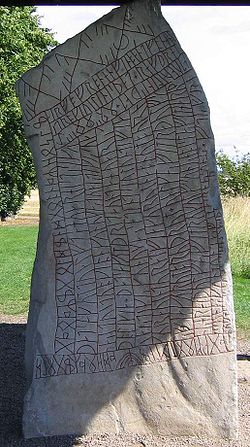 Old East Norse, between 800 and 1100, is in Sweden called Runic Swedish and in Denmark Runic Danish. The use of Swedish and Danish is not for linguistic reasons as the differences between them are minute at best during the more ancient stages of this dialect group. Changes had a tendency to occur earlier in the Danish region and until this day many Old Danish changes have still not taken place in modern Swedish rendering Swedish as the more archaic out of the two concerning both the ancient as well as modern languages, sometimes by a profound margin but in all differences are still minute. They are called runic because the body of text appears in the runic alphabet
.
Runic Old East Norse is characteristically archaic in form, especially Swedish (which is still true for modern Swedish compared to Danish). In essence it matches or surpasses the archaicness of post-runic Old West Norse which in its turn is generally more archaic than post-runic Old East Norse. While typically "Eastern" in structure, many later post-runic changes and trademarks of EON had yet to happen.
The phoneme ʀ, which evolved during the Proto-Norse period from z, was still clearly separated from r in most positions, even when being geminated, while in OWN it had already merged with r.
Monophthongization of æi > and øy, au > started in mid-10th century Denmark. Compare runic OEN: fæigʀ, gæiʀʀ, haugʀ, møydōmʀ, diūʀ; with Post-runic OEN: fēgher, gēr, hø̄gher, mø̄dōmber, diūr; OWN: feigr, geirr, haugr, meydómr, dýr; from PN *faigiaz, *gaizaz, *haugaz, *mawi- + dōmaz (maidendom; virginity), *diuza ((wild) animal).
Feminine o-stems often preserve the plural ending -aʀ while in OWN they more often merge with the feminine i-stems: (runic OEN) *sōlaʀ, *hafnaʀ/*hamnaʀ, *vāgaʀ while OWN sólir, hafnir and vágir (modern Swedish solar, hamnar, vågar; suns, havens, scales; Danish has mainly lost the distinction between the two stems with both endings now being rendered as -er or -e alternatively for the o-stems).
Vice versa, masculine i-stems with the root ending in either g or k tended to shift the plural ending to that of the ja-stems while OWN kept the original: drængiaʀ, *ælgiaʀ and *bænkiaʀ while OWN drengir, elgir (elks) and bekkir (modern Swedish drängar, älgar, bänkar).
The plural ending of ja-stems were mostly preserved while those of OWN often acquired that of the i-stems: *bæðiaʀ, *bækkiaʀ, *væfiaʀ while OWN beðir (beds), bekkir, vefir (modern Swedish bäddar, bäckar, vävar).
es going from Zealand to Svealand
.
In Old Danish, /hɾ/ merged with /ɾ/ during the 9th century. From the 11th to 14th centuries, the unstressed vowels -a, -o and -e (standard normalization -a, -u and -i) started to merge into -ə, represented with the letter e. This vowel came to be epenthetic
, particularly before -ʀ endings. At the same time, the voiceless stop consonant
s p, t and k became voiced stops and even fricatives. Resulting from these innovations, Danish has kage (cake), tunger (tongues) and gæster (guests) whereas (Standard) Swedish has retained older forms, kaka, tungor and gäster (OEN kaka, tungur, gæstir).
Moreover, the Danish tonal word accent shared with Norwegian and Swedish changed into stød
around this time.
The Dalecarlian
dialects developed as Old Swedish dialects, and as such can be considered separate languages from Swedish. One such language is Elfdalian, spoken in the Älvdalen
municipality of Sweden, by about 1,000–5,000 speakers (various sources). This language is not comprehensible to speakers of the other Scandinavian languages.
as a distinct dialect.
Translation:
's early isolation from the mainland, many features of Old Norse did not spread from or to the island, and Old Gutnish developed as an entirely separate branch from Old East and West Norse. For example, the diphthong ai in aigu, þair and waita was not retroactively umlauted to ei as in e.g. Old Icelandic eigu, þeir and veita. Breaking was especially active in Old Gutnish, leading to forms such as bjera and bjauþa, mainland bera and bjúþa. Dropping of /w/ in initial /wɾ/ is shared only with Old Icelandic.
is the longest text surviving from Old Gutnish
. It was written in the 13th century and dealt with the early history of the Gotlanders. This part relates to the agreement that the Gotlanders had with the Swedish king sometime before the 9th century:
Translation:
Dialectal information:
Dictionaries
Grammars
North Germanic languages
The North Germanic languages or Scandinavian languages, the languages of Scandinavians, make up one of the three branches of the Germanic languages, a sub-family of the Indo-European languages, along with the West Germanic languages and the extinct East Germanic languages...
that was spoken by inhabitants of Scandinavia
Scandinavia
Scandinavia is a cultural, historical and ethno-linguistic region in northern Europe that includes the three kingdoms of Denmark, Norway and Sweden, characterized by their common ethno-cultural heritage and language. Modern Norway and Sweden proper are situated on the Scandinavian Peninsula,...
and inhabitants of their overseas settlements during the Viking Age
Viking Age
Viking Age is the term for the period in European history, especially Northern European and Scandinavian history, spanning the late 8th to 11th centuries. Scandinavian Vikings explored Europe by its oceans and rivers through trade and warfare. The Vikings also reached Iceland, Greenland,...
, until about 1300.
Proto-Norse developed into Old Norse by the 8th century, and Old Norse began to develop into the modern North Germanic languages in the mid- to late 14th century, ending the language phase known as Old Norse. These dates, however, are not absolute, since written Old Norse is found well into the 15th century.
Old Norse was divided into three dialects: Old East Norse, Old West Norse, and Old Gutnish
Old Gutnish
Old Gutnish was the dialect of Old Norse that was spoken on the Baltic island of Gotland. It shows sufficient differences from the Old East Norse dialect that it is considered to be a separate branch...
. Old West and East Norse formed a dialect continuum
Dialect continuum
A dialect continuum, or dialect area, was defined by Leonard Bloomfield as a range of dialects spoken across some geographical area that differ only slightly between neighboring areas, but as one travels in any direction, these differences accumulate such that speakers from opposite ends of the...
, with no clear geographical boundary between them. For example, Old East Norse traits were found in eastern Norway
Norway
Norway , officially the Kingdom of Norway, is a Nordic unitary constitutional monarchy whose territory comprises the western portion of the Scandinavian Peninsula, Jan Mayen, and the Arctic archipelago of Svalbard and Bouvet Island. Norway has a total area of and a population of about 4.9 million...
, although Old Norwegian is classified as Old West Norse, and Old West Norse traits were found in western Sweden
Sweden
Sweden , officially the Kingdom of Sweden , is a Nordic country on the Scandinavian Peninsula in Northern Europe. Sweden borders with Norway and Finland and is connected to Denmark by a bridge-tunnel across the Öresund....
. The most speakers spoke Old East Norse in what are present-day Denmark
Denmark
Denmark is a Scandinavian country in Northern Europe. The countries of Denmark and Greenland, as well as the Faroe Islands, constitute the Kingdom of Denmark . It is the southernmost of the Nordic countries, southwest of Sweden and south of Norway, and bordered to the south by Germany. Denmark...
and Sweden. Old Gutnish, the more obscure dialectal branch, is sometimes included in the Old East Norse dialect due to geographical associations. It developed unique features and shared in changes to both other branches.
The 12th century Icelandic Gray Goose Laws
Gray Goose Laws
The Gray Goose Laws were a collection of laws from the Icelandic Commonwealth period. The term Grágás was originally used in a medieval source to refer to a collection of Norwegian laws and was probably mistakenly used to describe the existing collection of Icelandic law during the sixteenth...
state that Swedes, Norwegians, Icelanders and Danes spoke the same language, dǫnsk tunga. Speakers of Old East Norse would have said dansk tunga ("Danish tongue") or norrønt mál ("Nordic speech"). Today Old Norse has developed into the modern North Germanic languages (Icelandic
Icelandic language
Icelandic is a North Germanic language, the main language of Iceland. Its closest relative is Faroese.Icelandic is an Indo-European language belonging to the North Germanic or Nordic branch of the Germanic languages. Historically, it was the westernmost of the Indo-European languages prior to the...
, Faroese
Faroese language
Faroese , is an Insular Nordic language spoken by 48,000 people in the Faroe Islands and about 25,000 Faroese people in Denmark and elsewhere...
, Norwegian
Norwegian language
Norwegian is a North Germanic language spoken primarily in Norway, where it is the official language. Together with Swedish and Danish, Norwegian forms a continuum of more or less mutually intelligible local and regional variants .These Scandinavian languages together with the Faroese language...
, Danish
Danish language
Danish is a North Germanic language spoken by around six million people, principally in the country of Denmark. It is also spoken by 50,000 Germans of Danish ethnicity in the northern parts of Schleswig-Holstein, Germany, where it holds the status of minority language...
and Swedish
Swedish language
Swedish is a North Germanic language, spoken by approximately 10 million people, predominantly in Sweden and parts of Finland, especially along its coast and on the Åland islands. It is largely mutually intelligible with Norwegian and Danish...
), and although distinct languages there is still considerable mutual intelligibility
Mutual intelligibility
In linguistics, mutual intelligibility is recognized as a relationship between languages or dialects in which speakers of different but related languages can readily understand each other without intentional study or extraordinary effort...
.
In some instances the term Old Norse refers specifically to Old West Norse.
Geographical distribution
Old Icelandic was essentially identical to Old NorwegianOld Norwegian
Old Norwegian refers to a group of Old Norse dialects spoken and written in Norway in the Middle Ages. They bridged the dialect continuum from Old East Norse to Old West Norse.-Old Norwegian vs Common Norse:...
, and together they formed the Old West Norse dialect of Old Norse and were also spoken in settlements in Ireland
Ireland
Ireland is an island to the northwest of continental Europe. It is the third-largest island in Europe and the twentieth-largest island on Earth...
, Scotland
Scotland
Scotland is a country that is part of the United Kingdom. Occupying the northern third of the island of Great Britain, it shares a border with England to the south and is bounded by the North Sea to the east, the Atlantic Ocean to the north and west, and the North Channel and Irish Sea to the...
, the Isle of Man
Isle of Man
The Isle of Man , otherwise known simply as Mann , is a self-governing British Crown Dependency, located in the Irish Sea between the islands of Great Britain and Ireland, within the British Isles. The head of state is Queen Elizabeth II, who holds the title of Lord of Mann. The Lord of Mann is...
, and Norwegian settlements in Normandy
Normandy
Normandy is a geographical region corresponding to the former Duchy of Normandy. It is in France.The continental territory covers 30,627 km² and forms the preponderant part of Normandy and roughly 5% of the territory of France. It is divided for administrative purposes into two régions:...
. The Old East Norse dialect was spoken in Denmark, Sweden, settlements in Russia, England
England
England is a country that is part of the United Kingdom. It shares land borders with Scotland to the north and Wales to the west; the Irish Sea is to the north west, the Celtic Sea to the south west, with the North Sea to the east and the English Channel to the south separating it from continental...
, and Danish settlements in Normandy
Normandy
Normandy is a geographical region corresponding to the former Duchy of Normandy. It is in France.The continental territory covers 30,627 km² and forms the preponderant part of Normandy and roughly 5% of the territory of France. It is divided for administrative purposes into two régions:...
. The Old Gutnish
Old Gutnish
Old Gutnish was the dialect of Old Norse that was spoken on the Baltic island of Gotland. It shows sufficient differences from the Old East Norse dialect that it is considered to be a separate branch...
dialect was spoken in Gotland
Gotland
Gotland is a county, province, municipality and diocese of Sweden; it is Sweden's largest island and the largest island in the Baltic Sea. At 3,140 square kilometers in area, the region makes up less than one percent of Sweden's total land area...
and in various settlements in the East. In the 11th century, Old Norse was the most widely spoken European language, ranging from Vinland
Vinland
Vinland was the name given to an area of North America by the Norsemen, about the year 1000 CE.There is a consensus among scholars that the Vikings reached North America approximately five centuries prior to the voyages of Christopher Columbus...
in the West to the Volga
Volga River
The Volga is the largest river in Europe in terms of length, discharge, and watershed. It flows through central Russia, and is widely viewed as the national river of Russia. Out of the twenty largest cities of Russia, eleven, including the capital Moscow, are situated in the Volga's drainage...
in the East. In Russia, it survived the longest in Novgorod, probably lasting into the 13th century there. The age of the Swedish language's presence in Finland is strongly contested (see Swedish-speaking Finns), but by the time of the Second Swedish Crusade
Second Swedish Crusade
The Second Swedish Crusade was a Swedish military expedition to areas in present-day Finland by Birger jarl in the 13th century. As a result of the crusade, Finland became permanently part of Sweden for the next 550 years.-Year of the crusade:...
in the 13th century, Swedish settlement spread the language into the region.
Modern descendants
The modern descendants of the Old West Norse dialect are the West Scandinavian languages of IcelandicIcelandic language
Icelandic is a North Germanic language, the main language of Iceland. Its closest relative is Faroese.Icelandic is an Indo-European language belonging to the North Germanic or Nordic branch of the Germanic languages. Historically, it was the westernmost of the Indo-European languages prior to the...
, Faroese
Faroese language
Faroese , is an Insular Nordic language spoken by 48,000 people in the Faroe Islands and about 25,000 Faroese people in Denmark and elsewhere...
, Norwegian
Norwegian language
Norwegian is a North Germanic language spoken primarily in Norway, where it is the official language. Together with Swedish and Danish, Norwegian forms a continuum of more or less mutually intelligible local and regional variants .These Scandinavian languages together with the Faroese language...
and the extinct Norn language
Norn language
Norn is an extinct North Germanic language that was spoken in Shetland and Orkney, off the north coast of mainland Scotland, and in Caithness. After the islands were pledged to Scotland by Norway in the 15th century, it was gradually replaced by Scots and on the mainland by Scottish...
of the Orkney and the Shetland Islands; the descendants of the Old East Norse dialect are the East Scandinavian languages of Danish
Danish language
Danish is a North Germanic language spoken by around six million people, principally in the country of Denmark. It is also spoken by 50,000 Germans of Danish ethnicity in the northern parts of Schleswig-Holstein, Germany, where it holds the status of minority language...
and Swedish
Swedish language
Swedish is a North Germanic language, spoken by approximately 10 million people, predominantly in Sweden and parts of Finland, especially along its coast and on the Åland islands. It is largely mutually intelligible with Norwegian and Danish...
. Norwegian is descended from Old West Norse, but over the centuries it has been heavily influenced by East Norse, particularly during the Denmark–Norway
Denmark–Norway
Denmark–Norway is the historiographical name for a former political entity consisting of the kingdoms of Denmark and Norway, including the originally Norwegian dependencies of Iceland, Greenland and the Faroe Islands...
union.
Among these, Icelandic and the closely related Faroese have changed the least from Old Norse in the last thousand years, although with Danish rule of the Faroe Islands, Faroese has also been influenced by Danish. Old Norse also had an influence on English
English language
English is a West Germanic language that arose in the Anglo-Saxon kingdoms of England and spread into what was to become south-east Scotland under the influence of the Anglian medieval kingdom of Northumbria...
dialects and Lowland Scots
Scots language
Scots is the Germanic language variety spoken in Lowland Scotland and parts of Ulster . It is sometimes called Lowland Scots to distinguish it from Scottish Gaelic, the Celtic language variety spoken in most of the western Highlands and in the Hebrides.Since there are no universally accepted...
, which contains many Old Norse loanword
Loanword
A loanword is a word borrowed from a donor language and incorporated into a recipient language. By contrast, a calque or loan translation is a related concept where the meaning or idiom is borrowed rather than the lexical item itself. The word loanword is itself a calque of the German Lehnwort,...
s. It also influenced the development of the Norman language
Norman language
Norman is a Romance language and one of the Oïl languages. Norman can be classified as one of the northern Oïl languages along with Picard and Walloon...
.
Various other languages, which are not closely related, have been heavily influenced by Norse, particularly the Norman dialects, Scottish Gaelic and Waterford
Waterford
Waterford is a city in the South-East Region of Ireland. It is the oldest city in the country and fifth largest by population. Waterford City Council is the local government authority for the city and its immediate hinterland...
Irish Gaelic. Russian
Russian language
Russian is a Slavic language used primarily in Russia, Belarus, Uzbekistan, Kazakhstan, Tajikistan and Kyrgyzstan. It is an unofficial but widely spoken language in Ukraine, Moldova, Latvia, Turkmenistan and Estonia and, to a lesser extent, the other countries that were once constituent republics...
, Finnish
Finnish language
Finnish is the language spoken by the majority of the population in Finland Primarily for use by restaurant menus and by ethnic Finns outside Finland. It is one of the two official languages of Finland and an official minority language in Sweden. In Sweden, both standard Finnish and Meänkieli, a...
and Estonian
Estonian language
Estonian is the official language of Estonia, spoken by about 1.1 million people in Estonia and tens of thousands in various émigré communities...
also have a number of Norse loanwords; the words Rus and Russia, according to one theory, may be named after the Rus' people, a Norse tribe; see Rus (name)
Rus (name)
Originally, the name Rus referred to the people, the region, and the medieval states of the Rus' Khaganate and Kievan Rus' polities...
. The current Finnish and Estonian words for Sweden are Ruotsi and Rootsi, respectively.
Of the modern languages, Icelandic is the closest to Old Norse. Written modern Icelandic derives from the Old Norse phonemic
Phoneme
In a language or dialect, a phoneme is the smallest segmental unit of sound employed to form meaningful contrasts between utterances....
writing system. Contemporary Icelandic-speakers can read Old Norse, which differs slightly in spelling as well as semantics and word order. However, pronunciation, particularly of the vowel phonemes, has changed at least as much as in the other North Germanic languages.
Faroese retains many similarities but is influenced by Danish, Norwegian, and Gaelic
Goidelic languages
The Goidelic languages or Gaelic languages are one of the two branches of the Insular Celtic languages, the other consisting of the Brythonic languages. Goidelic languages historically formed a dialect continuum stretching from the south of Ireland through the Isle of Man to the north of Scotland...
(Scottish and/or Irish
Irish language
Irish , also known as Irish Gaelic, is a Goidelic language of the Indo-European language family, originating in Ireland and historically spoken by the Irish people. Irish is now spoken as a first language by a minority of Irish people, as well as being a second language of a larger proportion of...
). Although Swedish, Danish and the Norwegian languages have diverged the most, they still retain asymmetric mutual intelligibility
Mutual intelligibility
In linguistics, mutual intelligibility is recognized as a relationship between languages or dialects in which speakers of different but related languages can readily understand each other without intentional study or extraordinary effort...
. Speakers of modern Swedish, Norwegian and Danish can mostly understand each other without studying their neighboring languages, particularly if speaking slowly. The languages are also sufficiently similar in writing that they can mostly be understood across borders. This could be because these languages have been mutually affected by each other, as well as having a similar development influenced by Middle Low German
Middle Low German
Middle Low German is a language that is the descendant of Old Saxon and is the ancestor of modern Low German. It served as the international lingua franca of the Hanseatic League...
.
Vowels
The vowel phonemes mostly come in pairs of long and short. The standardized orthography marks the long vowels with an acute accent. In medieval manuscripts, it is often unmarked but sometimes marked with an accent or through geminationGemination
In phonetics, gemination happens when a spoken consonant is pronounced for an audibly longer period of time than a short consonant. Gemination is distinct from stress and may appear independently of it....
. All phonemes have, more or less, the expected phonetic realization.
Old Norse had nasalized versions of all nine vowel places. These occurred as allophones of the vowels before nasal consonants and in places where a nasal had followed it in an older form of the word, before it was absorbed into a neighboring sound. If the nasal was absorbed by a stressed vowel, it would also lengthen the vowel. These nasalizations also occurred in the other Germanic languages, but were not retained long. They were noted in the First Grammatical Treatise
First Grammatical Treatise
The First Grammatical Treatise is a 12th-century work on the phonology of the Old Norse or Old Icelandic language. It was given this name because it is the first of four grammatical works bound in the Icelandic manuscript Codex Wormianus...
, and otherwise might have remained unknown. The First Grammarian marked these with a dot above the letter. This notation did not catch on, and would soon be obsolete. Nasal and oral vowels probably merged around the 11th c. in most of Old East Norse.:3 However, the distinction still holds in Dalarna
Dalecarlian
Dalecarlian is a group of dialects or unofficial languages spoken in Dalecarlia, Sweden. The most prominent is Elfdalian.The group is as follows:*Old Swedish**Dalecarlian***Dalecarlian Dalecarlian (Dalmål in vernacular and Swedish) is a group of dialects or unofficial languages spoken in...
.:4 The dots in the following vowel table separate the oral from nasal
Nasal vowel
A nasal vowel is a vowel that is produced with a lowering of the velum so that air escapes both through nose as well as the mouth. By contrast, oral vowels are ordinary vowels without this nasalisation...
phonemes.
| | Front vowels | | Back vowels | |||||||
|---|---|---|---|---|---|---|---|---|
| Unrounded | | Rounded | Unrounded | | Rounded | |||||
| High | i • ĩ | iː • ĩː | y • ỹ | yː • ỹː | u • ũ | uː • ũː | ||
| Mid | e • ẽ | eː • ẽː | ø • ø̃ | øː • ø̃ː | o • õ | oː • õː | ||
| Low/Low-Mid | ɛ • ɛ̃ | ɛː • ɛ̃ː | œ • œ̃ | a • ã | aː • ãː | ɔ • ɔ̃ | ɔː • ɔ̃ː | |
Note: The low/low-mid vowels may be indicated differently:
= /ɛ/ = /ɔ/ = /a/
Sometime around the 13th century, Ǫ (/ɔ/) merged with Ø or O in all dialects except Old Danish. In Icelandic, all Ǫ merged with Ø. This can be determined by their distinction within the 12th-century First Grammatical Treatise
First Grammatical Treatise
The First Grammatical Treatise is a 12th-century work on the phonology of the Old Norse or Old Icelandic language. It was given this name because it is the first of four grammatical works bound in the Icelandic manuscript Codex Wormianus...
but not within the early 13th century Younger Edda. The nasals, also noted in the First Grammatical Treatise, are assumed to have been lost by this time. See Old Icelandic for the Œ ⇒ Æ and Ę ⇒ E mergers.
| | Front vowels | | Back vowels | |||||||
|---|---|---|---|---|---|---|---|---|
| Unrounded | | Rounded | Unrounded | | Rounded | |||||
| High | i | iː | y | yː | u | uː | ||
| Mid | e | eː | ø | øː | o | oː | ||
| Low/Low-Mid | ɛ | ɛː | a | aː | ||||
| Proto-Germanic | Northwest Germanic | Primitive Old Norse | Old Icelandic (1st Grammarian) | Later Old Icelandic | Example (Old Norse) |
|---|---|---|---|---|---|
| a | a | a <a> | a | a | land "land" < *landaN |
| a | a (+i-mut) | ɛ <ę> | e <e> | e | menn "men" < *manniz |
| a | a (+u/w-mut) | ɔ <ǫ> | ɔ | ø <ö> | lǫnd "lands" < *landu < *landoː; söngr "song" < sǫngr < *sangwaz |
| a | a (+i-mut +w-mut) | œ <ø₂> | ø | ø <ö> | gøra "to make" < *garwijanaN |
| æː | aː | aː <á> | aː | aː | láta "to let" < *læːtanaN |
| æː | aː (+i-mut) | ɛː <æ> | ɛː | ɛː | mæla "to speak" < *maːlijan < *mæːlijanaN |
| æː | aː (+u-mut) | ɔː <ǫ́> | ɔː | aː <á> | mǫ́l "meals" < *maːlu < *mæːloː |
| e | e | e <e> | e | e | sex "six" < *seks; bresta "to burst" < *brestanaN |
| e | e (+u/w-mut) | ø <ø₁> | ø | ø <ö> | tøgr "ten" < *teguz |
| e | e (broken) | ea <ea> | ja <ja> | ja | gjalda "to repay" < *geldanaN |
| e | e (broken +u/w-mut) | eo/io <eo/io> | jo > jɔ <jǫ> | jø <jö> | skjǫldr "shield" < *skelduz |
| eː | eː | eː <é> | eː | eː | lét "let (past tense)" < *leːt |
| i | i | i <i> | i | i | mikill "great" < *mikilaz |
| i | i (+w-mut) | y <y> | y | y(ː) | slyngva "to sling" < *slingwanaN; kykr "alive" < *kwikwaz |
| iː | iː | iː <í> | iː | iː | líta "to look" < *liːtanaN |
| oː | oː | oː <ó> | oː | oː | fór "went" < *foːr; mót "meeting" < moːtaN |
| oː | oː (+i-mut) | øː <œ> | øː | ɛː <æ> | mœðr "mothers" < *moːdriz |
| u | u | u <u> | u | u | una "to be content" < *unanaN |
| u | u (+i-mut) | y <y> | y | y | kyn "race" < *kunjoː |
| u | u (+a-mut) | o <o> | o | o | fogl "bird" < *fuglaz; morginn "morning" < *murganaz |
| uː | uː | uː <ú> | uː | uː | drúpa "to droop" < *druːpanaN |
| uː | uː (+i-mut) | yː <ý> | yː | yː | mýss "mice" < muːsiz |
| ai | ai | ai, ɛi <ei> | ɛi | ɛi | bein, Gut. bain "bone" < *bainaN |
| ai | ai (+w-mut) | øy <ey, øy> | øy <ey> | ɛy | kveykva "to kindle" < *kwaikwanaN |
| au | au | au <au> | au | au | lauss "loose" < *lausaz |
| au | au (+i-mut) | øy <ey, øy> | øy <ey> | ɛy | leysa "to loosen" < *lausijanaN |
| eu | eu | eu <eu> | jú <jú> | jú | djúpr "deep" < *deupaz |
| eu | eu (+dental) | eo <eo> | jó <jó> | jó | bjóða "to offer" < *beudanaN |
| Ṽ | Ṽ | Ṽ | Ṽ | lost | komȧ < *kwemanaN ; OWN vėtr/vėttr < vintr < *wintruz |
| Ṽː | Ṽː | Ṽː | Ṽː | lost | hȧ́r "shark" < *hanhaz; þė́l "file" < *finhloː; ȯ́rar "our" (pl.) < *unzaraz; ø̇́rȧ "younger" (acc. neut. wk.) < *junhizan |
Consonants
Old Norse has six stop phonemes. Of these /p/ is rare word-initially and /d/ and /b/ do not occur between vowels, except in compound words (e.g. veðrabati), because of the fricative allophoneAllophone
In phonology, an allophone is one of a set of multiple possible spoken sounds used to pronounce a single phoneme. For example, and are allophones for the phoneme in the English language...
s of the Proto-Germanic language
Proto-Germanic language
Proto-Germanic , or Common Germanic, as it is sometimes known, is the unattested, reconstructed proto-language of all the Germanic languages, such as modern English, Frisian, Dutch, Afrikaans, German, Luxembourgish, Danish, Norwegian, Icelandic, Faroese, and Swedish.The Proto-Germanic language is...
(e.g. *b *[β] > [v] between vowels). The /ɡ/ phoneme is realized as [ɡ] after an n or another g and as [k] before /s/ and /t/. It is realized as a voiced velar fricative [ɣ], by some accounts inside words, and by others between vowels (and otherwise as [ɡ]). The Old East Norse /ʀ/ was an apical consonant
Apical consonant
An apical consonant is a phone produced by obstructing the air passage with the apex of the tongue . This contrasts with laminal consonants, which are produced by creating an obstruction with the blade of the tongue .This is not a very common distinction, and typically applied only to fricatives...
whose position isn't known precisely known, being reconstructed as as a palatal sibilant:2.
| Labial | Dental | Alveolar | Postalveolar | Palatal | Velar | Labiovelar | Glottal | |
|---|---|---|---|---|---|---|---|---|
| Stop | p b | t d | k ɡ | |||||
| Nasal | m | n | (ŋ) | |||||
| Fricative | f (v) | θ (ð) | s | (ɣ) | h | |||
| Trill | r | |||||||
| Approximant | ʀ | j | w | |||||
| Lateral approximant | l |
Orthography
Unlike Proto-NorseProto-Norse language
Proto-Norse was an Indo-European language spoken in Scandinavia that is thought to have evolved as a northern dialect of Proto-Germanic over the first centuries AD...
, which was written with the Elder Futhark
Elder Futhark
The Elder Futhark is the oldest form of the runic alphabet, used by Germanic tribes for Northwest Germanic and Migration period Germanic dialects of the 2nd to 8th centuries for inscriptions on artifacts such as jewellery, amulets, tools, weapons and runestones...
, runic Old Norse was originally written with the Younger Futhark
Younger Futhark
The Younger Futhark, also called Scandinavian runes, is a runic alphabet, a reduced form of the Elder Futhark, consisting of only 16 characters, in use from ca. 800 CE...
, which only had 16 letters. Because of the limited number of runes, the rune for the vowel u was also used for the vowels o, ø and y, and the rune for i was used for e. Medieval runes
Medieval runes
The medieval runes, or the futhork, was a Scandinavian 27 letter runic alphabet that evolved from the Younger Futhark after the introduction of dotted runes at the end of the Viking Age and it was fully formed in the early 13th century...
came into use some time later.
As for the Latin alphabet
Latin alphabet
The Latin alphabet, also called the Roman alphabet, is the most recognized alphabet used in the world today. It evolved from a western variety of the Greek alphabet called the Cumaean alphabet, which was adopted and modified by the Etruscans who ruled early Rome...
, there was no standardized orthography in use in the Middle Ages. A modified version of the letter wynn
Wynn
Wynn is a letter of the Old English alphabet, where it is used to represent the sound ....
called vend
Vend (letter)
Vend is a letter of Old Norse. It was used to represent the sounds , , and .It was related to and probably derived from the Old English letter Wynn , except that the bowl was open on the top, not being connected to the stem, which made it somewhat resemble a letter Y...
was used briefly for the sounds /u/, /v/, and /w/. Long vowels were sometimes marked with acutes, but also sometimes left unmarked or geminated. The standardized Old Norse spelling was created in the 19th century, and is for the most part phonemic. The most notable deviation is that the non-phonemic difference between the voiced
Voiced dental fricative
The voiced dental non-sibilant fricative is a type of consonantal sound, used in some spoken languages. The symbol in the International Phonetic Alphabet that represents this sound, eth, is . The symbol was taken from the Old English letter eth, which could stand for either a voiced or unvoiced...
and the unvoiced dental fricatives is marked — the oldest texts as well as runic inscriptions use þ exclusively. Long vowels are denoted with acutes. Most other letters are written with the same glyph as the IPA
International Phonetic Alphabet
The International Phonetic Alphabet "The acronym 'IPA' strictly refers [...] to the 'International Phonetic Association'. But it is now such a common practice to use the acronym also to refer to the alphabet itself that resistance seems pedantic...
phoneme, except as shown in the table below.
Accent
Primary stressStress (linguistics)
In linguistics, stress is the relative emphasis that may be given to certain syllables in a word, or to certain words in a phrase or sentence. The term is also used for similar patterns of phonetic prominence inside syllables. The word accent is sometimes also used with this sense.The stress placed...
in Old Norse falls on the word stem
Word stem
In linguistics, a stem is a part of a word. The term is used with slightly different meanings.In one usage, a stem is a form to which affixes can be attached. Thus, in this usage, the English word friendships contains the stem friend, to which the derivational suffix -ship is attached to form a new...
, so that hyrjar would be pronounced /ˈhyr.jar/. In compound words, secondary stress falls on the second stem (e.g. lærisveinn, /ˈlɛːɾ.iˌswɛinː/).:1
Modern Swedish and Norwegian have two tone contours (acute accent
Acute accent
The acute accent is a diacritic used in many modern written languages with alphabets based on the Latin, Cyrillic, and Greek scripts.-Apex:An early precursor of the acute accent was the apex, used in Latin inscriptions to mark long vowels.-Greek:...
and grave accent
Grave accent
The grave accent is a diacritical mark used in written Breton, Catalan, Corsican, Dutch, French, Greek , Italian, Mohawk, Norwegian, Occitan, Portuguese, Scottish Gaelic, Vietnamese, Welsh, Romansh, and other languages.-Greek:The grave accent was first used in the polytonic orthography of Ancient...
in Swedish terminology, tone 1 and tone 2 in Norwegian). Words with tone 1 in Norwegian and acute accent in Swedish have stød in Danish. Because of these phenomena, it is posited that Old Norse, particularly East Old Norse, had developed tonal word accent
Pitch accent
Pitch accent is a linguistic term of convenience for a variety of restricted tone systems that use variations in pitch to give prominence to a syllable or mora within a word. The placement of this tone or the way it is realized can give different meanings to otherwise similar words...
.
Stød is a glottal gesture considered a kind of creaky voice
Creaky voice
In linguistics, creaky voice , is a special kind of phonation in which the arytenoid cartilages in the larynx are drawn together; as a result, the vocal folds are compressed rather tightly, becoming relatively slack and compact...
, and it seems to have been documented by Swedish sources as early as the 16th century. The origin of Scandinavian word tones is unclear. They may have developed from a non-distinctive tonal feature thought to have existed in Proto-Norse which then became distinctive when the endings of words were reduced in continental Old Norse. No sign of the tonal system is found in Icelandic or Faroese.
Ablaut
AblautIndo-European ablaut
In linguistics, ablaut is a system of apophony in Proto-Indo-European and its far-reaching consequences in all of the modern Indo-European languages...
patterns are groups of vowels which are swapped, or ablauted, in the nucleus of a word. Strong verbs ablaut the lemma's nucleus to derive the past forms of the verb. This parallels English conjugation, where, e.g., the nucleus of sing becomes sang in the past tense and sung in the past participle. Some verbs are derived by ablaut, as the present-in-past verbs do by consequence of being derived from the past tense forms of strong verbs.
Umlaut
Umlaut or mutation is an assimilatoryAssimilation (linguistics)
Assimilation is a common phonological process by which the sound of the ending of one word blends into the sound of the beginning of the following word. This occurs when the parts of the mouth and vocal cords start to form the beginning sounds of the next word before the last sound has been...
process acting on vowels preceding a vowel or semivowel of a different vowel backness. In the case of i-umlaut and ʀ-umlaut, this entails a fronting of back vowels, with retention of lip rounding. In the case of u-umlaut, this entails labialization of unrounded vowels. Umlaut is phonemic and in many situations grammatically significant as a side effect of losing the Proto-Germanic morphological suffices whose vowels created the umlaut allophones.
Some /y/, /yː/, /ø/, /øː/, /ɛ/, /ɛː/, /øy/, and /ɛi/ were obtained by i-umlaut
I-mutation
I-mutation is an important type of sound change, more precisely a category of regressive metaphony, in which a back vowel is fronted, and/or a front vowel is raised, if the following syllable contains /i/, /ī/ or /j/ I-mutation (also known as umlaut, front mutation, i-umlaut, i/j-mutation or...
from /u/, /uː/, /o/, /oː/, /a/, /aː/, /au/, and /ai/ respectively. Others were formed via ʀ-umlaut from /u/, /uː/, /a/, /aː/, and /au/.
Some /y/, /yː/, /ø/, /øː/, and all /ɔ/, /ɔː/ were obtained by u-umlaut
U-mutation
U-mutation, or u-umlaut, can refer to various processes that occurred in the history of some Germanic languages.* Old Norse u-umlaut — allophones of front vowels before back rounded vowels made distinctive around the 8th century...
from /i/, /iː/, /e/, /eː/, and /a/, /aː/ respectively. See Old Icelandic for information on /ɔː/.
/œ/ was obtained through a simultaneous u- and i-umlaut of /a/. It appears in words like gøra (gjǫra, geyra), from Proto-Germanic *garwijaną, and commonly in verbs with a velar consonant before the suffix like søkkva < *sankwijaną.
OEN often preserves the original value of the vowel directly preceding runic ʀ while OWN receives ʀ-umlaut. Compare runic OEN glaʀ, haʀi, hrauʀ with OWN gler, heri (later héri), hrøyrr/hreyrr ("glass", "hare", "pile of rocks").
U-umlaut
U-umlaut is more common in Old West Norse in both phonemic and allophonic positions, while it only occurs sparsely in post-runic Old East Norse and even in runic Old East Norse. Compare West Old Norse fǫður (accusative of faðir, father), vǫrðr (guardian/caretaker), ǫrn (eagle), jǫrð (in Modern Icelandic: jörð, earth), mjǫlk (in Modern Icelandic: mjólk) with Old Swedish faþur, varþer, örn, jorþ and Modern Swedish örn, jord, mjölk with the latter two demonstrating the u-umlaut found in Swedish.This is still a major difference between Swedish and Faroese and Icelandic today. Plurals of neuters do not have u-umlaut at all in Swedish, but in Faroese and Icelandic they do, for example the Faroese and Icelandic plurals of the word land: lond and lönd in contrast to the Swedish plural land and other numerous examples. That also applies to almost all feminine nouns, for example the largest feminine noun group, the o-stem nouns (except the Swedish noun jord mentioned above), and even i-stem nouns and rootnomina, such as Old West Norse mǫrk (mörk in Icelandic) in comparison with Modern and Old Swedish mark.
Breaking
Vowel breaking, or fracture, caused a front vowel to be split into a semivowel-vowel sequence before a back vowel in the following syllable. While West Norse only broke e, East Norse also broke i. The change was blocked by a v, l, or r preceding the potentially-broken vowel.:1Some /ja/ or /jɔ/ and /jaː/ or /jɔː/ result from breaking of /e/ and /eː/ respectively.
Assimilation or elision of inflectional r
When a noun, pronoun, adjective, or verb has a long vowel or diphthong in the accented syllable and its stem ends in a single -l, -n, or -s, the -r (or the elder r- or z-variant Ʀ) in an ending is assimilated. When the accented vowel is short, the ending is dropped.The nominative of the strong masculine declension and some i-stem feminine nouns uses one such -r (Ʀ). Óðin-r (Óðin-Ʀ) becomes Óðinn instead of *Óðinr (*ÓðinƦ), but karl-r (karl-Ʀ) remains karl.
Blása, to blow, has blæss for "you blow" instead of *blæsr (*blæsƦ).
The rule is not hard and fast, with counter-examples such as vinr, which has the synonym vin, yet retains the unabsorbed version, and jǫtunn, where assimilation takes place even though the root vowel, Ǫ, is short.
Words with a final r in the word stem
Word stem
In linguistics, a stem is a part of a word. The term is used with slightly different meanings.In one usage, a stem is a form to which affixes can be attached. Thus, in this usage, the English word friendships contains the stem friend, to which the derivational suffix -ship is attached to form a new...
, such as vetr, do not add another -r, as the sounds are already the same. The effect of the dropping usually results in the lack of distinction between some forms of the noun. In the case of vetr the dropping renders the nominative and accusative singular and plural identical; the nominative singular and nominative and accusative plural would otherwise have been *vetrr (*vintrƦ), while the accusative singular would still have been vetr. This is because the 3rd strong masculine declension, to which it belongs, marks the nominative singular and nominative and accusative plural, but not the accusative singular, with inflectional Rs.
Blocking of ii, uu
I/j adjacent to i, e, their u-umlauts, and æ was not possible, nor u/v adjacent to u, o, their i-umlauts, and ǫ. At the beginning of words, this manifested as a dropping of the initial i/j or u/v. Compare ON orð, úlfr with English word, wolf. In inflections, this manifested as the dropping of the inflectional vowels. Thus, klæði + ᴅᴀᴛ -i remains klæði, and sjáum in Icelandic progressed to sjǫ́um > sjǫ́m > sjám. The jj and vv of Proto-Germanic became ggj and ggw respectively in Old Norse, a change known as Holtzmann's lawHoltzmann's Law
Holtzmann's law is a Proto-Germanic sound law originally noted by Adolf Holtzmann in 1838.The law involves the gemination, or doubling, of PIE semivowels and in strong prosodic positions into Proto-Germanic and , which had two outcomes:* hardening into occlusive onsets:** / in North Germanic;**...
.
Epenthesis
An epenthetic vowel became popular by 1200 in Old Danish, 1250 in Old Swedish and Norwegian, and 1300 in Old Icelandic. An unstressed vowel was used which varied by dialect. Old Norwegian exhibited all three: /u/ was used in West Norwegian south of BergenBergen
Bergen is the second largest city in Norway with a population of as of , . Bergen is the administrative centre of Hordaland county. Greater Bergen or Bergen Metropolitan Area as defined by Statistics Norway, has a population of as of , ....
, as in aftur, aftor (older aptr); North of Bergen, /i/ appeared in aftir, after; and East Norwegian used /a/, after, aftær.
Syntax
Old Norse had a freer word order than English. Old Norse used different listing structures than the English, "a, b and c," and, "a, b or c." In those two cases, Old Norse would have, "a and b and c," or, "a and b or c."Grammar
Old Norse was a moderately inflectedInflection
In grammar, inflection or inflexion is the modification of a word to express different grammatical categories such as tense, grammatical mood, grammatical voice, aspect, person, number, gender and case...
language with high levels of nominal and verbal inflection. Most of the fused morphemes are retained in modern Icelandic, especially in regard to noun case declensions, whereas modern Norwegian in comparison has moved towards more analytical word structures.
Gender
Old Norse had three grammatical genderGrammatical gender
Grammatical gender is defined linguistically as a system of classes of nouns which trigger specific types of inflections in associated words, such as adjectives, verbs and others. For a system of noun classes to be a gender system, every noun must belong to one of the classes and there should be...
s – masculine, feminine or neuter. Adjectives or pronouns referring to a noun must mirror the gender of that noun
Agreement (linguistics)
In languages, agreement or concord is a form of cross-reference between different parts of a sentence or phrase. Agreement happens when a word changes form depending on the other words to which it relates....
, so that one says, "heill maðr!" but, "heilt barn!" Like in other languages, the grammatical gender of an impersonal noun is generally unrelated to an expected natural gender of that noun. While indeed karl, "man" is masculine, kona, "woman", is feminine, and hús, house, is neuter, so also are hrafn and kráka, for "raven" and "crow", masculine and feminine respectively, even in reference to a female raven or a male crow.
All neuter words have identical nominative and accusative forms, and all feminine words have identical nominative and accusative plurals.
The gender of some words' plurals does not agree with that of their singulars, such as lim and mund.References to words labelled heterogeneous in gender: Lilja-Linditre; Muna-Mundr Some words, such as hungr, have multiple genders, evidenced by their determiners being declined in different genders within a given sentence.
Hierarchy
Old Norse inherited the Proto-Germanic feature of having neuter as the default gender. This means that when the gender of a noun is unknown, adjectives and pronouns referencing it use the neuter gender forms, rather than the masculine or feminine. Thus, if speaking or writing to a general audience, one would say velkomit, "well is it come," rather than velkominn or velkomin, "well is [he or she] come," as one does not know whether the person hearing it is going to be male or female.One generally sees adjectives in their neuter form when used pronominally
Pronoun
In linguistics and grammar, a pronoun is a pro-form that substitutes for a noun , such as, in English, the words it and he...
for this reason. For words more commonly used in this way (rather than to describe a noun) one sees their neuter forms more often than their masculine or feminine. Normally the masculine form would be the most beneficial form of an adjective to learn first, given that the majority of nouns are masculine. In these cases, however, the most practical form to learn first would be the neuter.
Morphology
Nouns, adjectives and pronouns were declinedDeclension
In linguistics, declension is the inflection of nouns, pronouns, adjectives, and articles to indicate number , case , and gender...
in four grammatical cases — nominative
Nominative case
The nominative case is one of the grammatical cases of a noun or other part of speech, which generally marks the subject of a verb or the predicate noun or predicate adjective, as opposed to its object or other verb arguments...
, accusative
Accusative case
The accusative case of a noun is the grammatical case used to mark the direct object of a transitive verb. The same case is used in many languages for the objects of prepositions...
, genitive
Genitive case
In grammar, genitive is the grammatical case that marks a noun as modifying another noun...
and dative
Dative case
The dative case is a grammatical case generally used to indicate the noun to whom something is given, as in "George gave Jamie a drink"....
, in singular and plural numbers. Adjectives and pronouns were additionally declined in three grammatical genders. Some pronouns (first and second person) could have dual number
Dual (grammatical number)
Dual is a grammatical number that some languages use in addition to singular and plural. When a noun or pronoun appears in dual form, it is interpreted as referring to precisely two of the entities identified by the noun or pronoun...
in addition to singular and plural. The genitive is used partitively
Partitive case
The partitive case is a grammatical case which denotes "partialness", "without result", or "without specific identity". It is also used in contexts where a subgroup is selected from a larger group, or with numbers....
, and quite often in compounds and kennings (e.g.: Urðarbrunnr
Urðarbrunnr
Urðarbrunnr is a well in Norse mythology. Urðarbrunnr is attested in the Poetic Edda, compiled in the 13th century from earlier traditional sources, and the Prose Edda, written in the 13th century by Snorri Sturluson...
, the well of Urðr; Lokasenna
Lokasenna
Lokasenna is one of the poems of the Poetic Edda. The poem presents flyting between the gods and Loki....
, the gibing of Loki).
There were several classes of nouns within each gender, the following is an example of the "strong" inflectional paradigms:
| The strong masculine noun armr (English arm) | ||
|---|---|---|
| Case | Singular | Plural |
| Nominative | armr | armar |
| Accusative | arm | arma |
| Genitive | arms | arma |
| Dative | armi | ǫrmum/armum |
| The feminine noun hǫll (OWN), hall (OEN) (English hall) | ||
|---|---|---|
| Case | Singular | Plural |
| Nominative | hǫll/hall | hallir/hallar (OEN) |
| Accusative | hǫll/hall | hallir/hallar (OEN) |
| Genitive | hallar | halla |
| Dative | hǫllu/hallu | hǫllum/hallum |
| The neuter noun troll (English troll): | ||
|---|---|---|
| Case | Singular | Plural |
| Nominative | troll | troll |
| Accusative | troll | troll |
| Genitive | trolls | trolla |
| Dative | trolli | trollum |
In addition to these examples there were the numerous "weak" noun paradigms, which had a much higher degree of syncretism between the different cases in its paradigms, i.e. they didn't have as many different forms as the "strong" nouns.
A definite article was realised as a suffix, that retained an independendent declension e.g. troll (a troll) – trollit (the troll), hǫll ( a hall) – hǫllin (the hall), armr (an arm) – armrinn (the arm). This definite article, however, was a separate word, and did not become attached to the noun before later stages of the Old Norse period.
Texts
The earliest inscriptions in Old Norse are runicRunic alphabet
The runic alphabets are a set of related alphabets using letters known as runes to write various Germanic languages before the adoption of the Latin alphabet and for specialized purposes thereafter...
, from the 8th century. Runes continued to be commonly used until the 15th century and have been recorded to be in use in some form as late as the 19th century in some parts of Sweden. With the conversion to Christianity in the 11th century came the Latin alphabet
Latin alphabet
The Latin alphabet, also called the Roman alphabet, is the most recognized alphabet used in the world today. It evolved from a western variety of the Greek alphabet called the Cumaean alphabet, which was adopted and modified by the Etruscans who ruled early Rome...
. The oldest preserved texts in Old Norse in the Latin alphabet date from the middle of the 12th century. Subsequently, Old Norse became the vehicle of a large and varied body of vernacular literature, unique in medieval Europe. Most of the surviving literature was written in Iceland. Best known are the Norse saga
Norse saga
The sagas are stories about ancient Scandinavian and Germanic history, about early Viking voyages, the battles that took place during the voyages, about migration to Iceland and of feuds between Icelandic families...
s, the Icelanders' sagas
Icelanders' sagas
The Sagas of Icelanders —many of which are also known as family sagas—are prose histories mostly describing events that took place in Iceland in the 10th and early 11th centuries, during the so-called Saga Age. They are the best-known specimens of Icelandic literature.The Icelanders'...
and the mythological literature, but there also survives a large body of religious literature, translations into Old Norse of courtly romances, classical mythology, and the Old Testament, as well as instructional material, grammatical treatises and a large body of letters and official documents.
Relationship to English
Old English and Old Norse were closely related languages, and it is therefore not surprising that many words in Old Norse look familiar to English speakers, e.g. armr (arm), fótr (foot), land (land), fullr (full), hanga (to hang), standa (to stand), etc. This is because both EnglishEnglish language
English is a West Germanic language that arose in the Anglo-Saxon kingdoms of England and spread into what was to become south-east Scotland under the influence of the Anglian medieval kingdom of Northumbria...
and Old Norse stem from a Proto-Germanic mother language. In addition, a large number of common, everyday Old Norse words mainly of East Norse origin were adopted into the Old English language during the Viking age. A few examples of Old Norse loanword
Loanword
A loanword is a word borrowed from a donor language and incorporated into a recipient language. By contrast, a calque or loan translation is a related concept where the meaning or idiom is borrowed rather than the lexical item itself. The word loanword is itself a calque of the German Lehnwort,...
s in modern English are (English/Viking age Old East Norse):
- Nouns – anger (angr), bag (baggi), bait (bæit, bæita, bæiti), band (band), bark (bǫrkʀ, stem bark-), birth (byrðr), dirt (drit), dregs (dræggiaʀ), egg (ægg, related to OE. cognate "æg" which became Middle English "eye"/"eai"), fellow (félagi), gap (gap), husband (húsbóndi), cake (kaka), keel (kiǫlʀ, stem also kial-, kil-), kid (kið), knife (knífʀ), law (lǫg, stem lag-), leg (læggʀ), link (hlænkʀ), loan (lán, related to OE. cognate "læn", cf. lend), race (rǫs, stem rás-), root (rót, related to OE. cognate "wyrt", cf. wort), sale (sala), scrap (skrap), seat (sæti), sister (systir, related to OE. cognate "sweostor"), skill (skial/skil), skin (skinn), skirt (skyrta vs. the native English shirt of the same root), sky (ský), slaughter (slátr), snare (snara), steak (stæik), thrift (þrift), tidings (tíðindi), trust (traust), window (vindauga), wing (væ(i)ngʀ)
- Verbs – are (er, displacing OE "sind") blend (blanda), call (kalla), cast (kasta), clip (klippa), crawl (krafla), cut (possibly from ON kuta), die (døyia), gasp (gæispa), get (geta), give (gifa/gefa, related to OE. cognate "giefan"), glitter (glitra), hit (hitta), lift (lyfta), raise (ræisa), ransack (rannsaka), rid (ryðia), run (rinna, stem rinn-/rann-/runn-, related to OE. cognate "rinnan"), scare (skirra), scrape (skrapa), seem (søma), sprint (sprinta), take (taka), thrive (þrífa(s)), thrust (þrysta), want (vanta)
- Adjectives – flat (flatr), happy (happ), ill (illr), likely (líklígʀ), loose (lauss), low (lágʀ), meek (miúkʀ), odd (odda), rotten (rotinn/rutinn), scant (skamt), sly (sløgʀ), weak (væikʀ), wrong (vrangʀ)
- Adverbs – thwart/athwart (þvert)
- Prepositions – till (til), fro (frá)
- Conjunction – though/tho (þó)
- Interjection – hail (hæill), wassail (ves hæill)
- Personal pronoun – they (þæiʀ), their (þæiʀa), them (þæim) (for which the Anglo-Saxons said híe, hiera, him)
- Prenominal adjectives – same (sami)
In a simple sentence like "They are both weak" the extent of the Old Norse loanwords becomes quite clear (Old East Norse with archaic pronunciation: "Þæiʀ eʀu báðiʀ wæikiʀ" while Old English "híe syndon bégen (þá) wáce"). The words "they" and "weak" are both borrowed from Old Norse, and the word "both" might also be a borrowing, though this is disputed. While the number of loanwords adopted from the Norse was not as numerous as that of Norman French or Latin, their depth and every day nature make them a substantial and very important part of every day English speech as they are part of the very core of the modern English vocabulary.
Words like "bull" and "Thursday" are more difficult when it comes to their origins. "Bull" may be from either Old English "bula" or Old Norse "buli" while "Thursday" may be a borrowing, or it could simply be from the Old English "Þunresdæg" which could have been influenced by the Old Norse cognate. The word "are" is from Old English "earun"/"aron" as well as the Old Norse cognates.
Dialects
Most of the innovations that appeared in Old Norse spread evenly through the Old Norse area. As a result, the dialects were very similar and considered to be the same language, a language that they sometimes called the Danish tongue (dǫnsk tunga), sometimes Norse language (norrœnt mál), as evidenced in the following two quotes from HeimskringlaHeimskringla
Heimskringla is the best known of the Old Norse kings' sagas. It was written in Old Norse in Iceland by the poet and historian Snorri Sturluson ca. 1230...
by Snorri Sturluson
Snorri Sturluson
Snorri Sturluson was an Icelandic historian, poet, and politician. He was twice elected lawspeaker at the Icelandic parliament, the Althing...
:
Móðir Dyggva var Drótt, dóttir Danps konungs, sonar Rígs er fyrstr var konungr kallaðr á danska tungu.
Dyggve
Dyggve
In Norse mythology, Dyggvi or Dyggve was a Swedish king of the House of Ynglings. Dyggvi died and became the husband of Hel, Loki's daughter...
's mother was Drott
Drott
*Druhtinaz is a Common Germanic term meaning a military leader or warlord and is derived from *druhti "war band" and the "ruler suffix" -īna- *Druhtinaz (Old English: dryhten, Old Norse: dróttinn, Old English-Middle English: drihten, Middle English: driȝten) is a Common Germanic term meaning a...
, the daughter of king Danp, Ríg's son, who was the first to be called king in the Danish tongue.
…stirt var honum norrœnt mál, ok kylfdi mᴊǫk til orðanna, ok hǫfðu margir menn þat mᴊǫk at spotti.
…the Norse language was hard for him, and he often fumbled for words, which amused people greatly.
However, some changes were geographically limited and so created a dialectal difference between Old West Norse and Old East Norse.
As Proto-Norse evolved into Old Norse, in the 8th century, the effects of the umlauts
Germanic umlaut
In linguistics, umlaut is a process whereby a vowel is pronounced more like a following vowel or semivowel. The term umlaut was originally coined and is used principally in connection with the study of the Germanic languages...
seem to have been very much the same over the whole Old Norse area. But in later dialects of the language a split occurred mainly between west and east as the use of umlauts began to vary. The typical umlauts (for example fylla from *fullian) were better preserved in the West due to later generalizations in the east where many instances of umlaut were removed (many archaic Eastern texts as well as eastern runic inscriptions however portray the same extent of umlauts as in later Western Old Norse).
All the while the changes resulting in breaking
Breaking (linguistics)
In historical linguistics, vowel breaking is the change of a monophthong into a diphthong or triphthong. The change into a diphthong is also known as diphthongization...
(for example hiarta from *hertō) were more influential in the East probably once again due to generalizations within the inflectional system. This difference was one of the greatest reasons behind the dialectalization that took place in the 9th and 10th centuries shaping an Old West Norse dialect in Norway and the Atlantic settlements and an Old East Norse dialect in Denmark and Sweden.
Old West Norse and Old Gutnish did not take part in the monophthongization which changed æi (ei) into ē, øy (ey) and au into ø̄, nor did certain peripheral dialects of Swedish, as seen in modern Ostrobothnian
Swedish dialects in Ostrobothnia
Ostrobothnian Swedish is a variety of Finland-Swedish, spoken in Finland. Outside the autonomous island province of Åland, which is officially monolingually Swedish, Ostrobothnia is the only region of Finland besides Åland where the Swedish-speakers are in the majority...
. Another difference was that Old West Norse lost certain combinations of consonants. The combinations -mp-, -nt-, and -nk- were assimilated into -pp-, -tt- and -kk- in Old West Norse, but this phenomenon was limited in Old East Norse.
Here is a comparison between the two dialects as well as Old Gutnish. It is a transcription from one of the Funbo Runestones
Funbo Runestones
The Funbo runestones constitute a group of four runestones originally from Funbo in the province of Uppland, Sweden, which were raised by members of the same family during the eleventh century....
(U 990) meaning : Veðr and Thane and Gunnar raised this stone after Haursi, their father. God help his spirit:
- Veðr ok Þegn ok Gunnarr reistu stein þenna at Haursa, fǫður sinn. Guð hjalpi ǫnd hans. (OWN)
- Veðr ok Þegn ok Gunnarr ræistu stæin þenna at Haursa, faður sinn. Guð hialpi and hans (OEN)
- Veðr ok Þegn ok Gunnarr raistu stain þenna at Haursa, faður sinn. Guð hialpi and hans (OG)
The OEN original text above is transliterated according to traditional scholarly methods, wherein u-umlaut is not regarded in runic Old East Norse. Modern studies have shown that the positions where it applies are the same as for runic Old West Norse. An alternative and probably more accurate transliteration would therefore render the text in OEN as such:
- Veðr ok Þegn ok Gunnarr ræistu stæin þenna at Haursa, fǫður sinn. Guð hialpi ǫnd hans (OEN)
Old West Norse
The combinations -mp-, -nt-, and -nk- mostly merged to -pp-, -tt- and -kk- in Old West Norse at around the 7th century, marking the first distinction between the Eastern and Western dialects.:3 The following table illustrates this:| English | Old West Norse | Old East Norse | Proto-Norse Proto-Norse language Proto-Norse was an Indo-European language spoken in Scandinavia that is thought to have evolved as a northern dialect of Proto-Germanic over the first centuries AD... |
|---|---|---|---|
| mushroom | s(v)ǫppr | svamper | *swampu |
| steep | brattr | branter | *brantaz |
| widow | ekkja | ænkia | *ain(a)kjōn |
| to shrink | kreppa | krimpa | *krimpan |
| to sprint | spretta | sprinta | *sprintan |
| to sink | søkkva | sænkva | *sankwian |
An early difference between Old West Norse and the other dialects was that Old West Norse had the forms bú (dwelling), kú (accusative for cow) and trú (faith) whereas Old East Norse had bō, kō and trō. Old West Norse was also characterized by the preservation of u-umlaut, which meant that for example Proto-Norse
Proto-Norse language
Proto-Norse was an Indo-European language spoken in Scandinavia that is thought to have evolved as a northern dialect of Proto-Germanic over the first centuries AD...
*tanþu (tooth) was pronounced tǫnn and not tann as in post-runic Old East Norse; OWN gǫ́s and runic OEN gǭs, while post-runic OEN gās (goose).
The earliest body of text appears in runic inscriptions
Runic inscriptions
A runic inscription is an inscription made in one of the various runic alphabets. The body of runic inscriptions falls into the three categories of Elder Futhark , Anglo-Frisian Futhorc and Younger Futhark .The total 350 known inscriptions in the Elder...
and in poems composed ca 900 by Tjodolf of Hvin. The earliest manuscripts are from the period 1150-1200 and concern both legal, religious and historical matters. During the 12th and 13th centuries, Trøndelag
Trøndelag
Trøndelag is the name of a geographical region in the central part of Norway, consisting of the two counties Nord-Trøndelag and Sør-Trøndelag. The region is, together with Møre og Romsdal, part of a larger...
and Vestlandet
Vestlandet
Western Norway is the region along the Atlantic coast of southern Norway. It consists of the counties Rogaland, Hordaland, Sogn og Fjordane, and Møre og Romsdal and the region has a population of approximately 1.3 million people. The largest city is Bergen, second largest is Stavanger...
were the most important areas of the Norwegian kingdom and they shaped Old West Norse as an archaic language with a rich set of declensions. In the body of text that has come down to us from until ca 1300, Old West Norse had little dialect variation, and Old Icelandic does not diverge much more than the Old Norwegian
Old Norwegian
Old Norwegian refers to a group of Old Norse dialects spoken and written in Norway in the Middle Ages. They bridged the dialect continuum from Old East Norse to Old West Norse.-Old Norwegian vs Common Norse:...
dialects do from each other.
Old Norwegian differentiated early from Old Icelandic by the loss of the consonant h in initial position before l, n and r, thus whereas Old Icelandic manuscripts might use the form hnefi (fist), Old Norwegian manuscripts might use nefi.
From the late 13th century, Old Icelandic and Old Norwegian started to diverge more. After c. 1350, the Black Death
Black Death
The Black Death was one of the most devastating pandemics in human history, peaking in Europe between 1348 and 1350. Of several competing theories, the dominant explanation for the Black Death is the plague theory, which attributes the outbreak to the bacterium Yersinia pestis. Thought to have...
and following social upheavals seem to have accelerated language changes in Norway. From the late 14th century, the language used in Norway is generally referred to as Middle Norwegian.
Old West Norse underwent a lengthening of initial vowels at some point, especially in Norwegian, so that OWN eta became éta, ONW akr ⇒ ákr, OIC ek ⇒ ék.
Old Icelandic
In Iceland, initial /w/ before /ɾ/ was lost.Introduction to Letter R Compare Icelandic rangur with Norwegian vrangr, OEN vrangʀ. This change is shared with Old Gutnish.A specifically Icelandic sound, the long, u-umlauted A, spelled Ǫ́ and pronounced /ɔː/, developed circa the early 11th century. It was short-lived, being marked in the Grammatical Treatises
First Grammatical Treatise
The First Grammatical Treatise is a 12th-century work on the phonology of the Old Norse or Old Icelandic language. It was given this name because it is the first of four grammatical works bound in the Icelandic manuscript Codex Wormianus...
and remaining until the end of the 12th century.
/w/ merged with /v/ during the 12th century. This caused /v/ to become an independent phoneme from /f/, and the written distinction of ⟨v⟩ for /v/ from medial and final ⟨f⟩ to become merely etymological.
Around the 13th century, Œ/Ǿ (/øː/) merged to Æ (/ɛː/). Thus, pre-13th century grœnn (green) became modern Icelandic grænn. The 12th century Grágás
Gray Goose Laws
The Gray Goose Laws were a collection of laws from the Icelandic Commonwealth period. The term Grágás was originally used in a medieval source to refer to a collection of Norwegian laws and was probably mistakenly used to describe the existing collection of Icelandic law during the sixteenth...
manuscripts distinguish the vowels, and so the Codex Regius
Codex Regius
Cōdex Rēgius is an Icelandic manuscript in which the Poetic Edda is preserved. It is made up of 45 vellum leaves, thought to have been written in the 1270s. It originally contained a further 8 leaves, which are now missing...
copy does as well. However, the 13th century Codex Regius copy of the Elder Edda probably relied on newer and/or poorer quality sources — Demonstrating either difficulty with or total lack of natural distinction, the manuscripts show separation of the two phonemes in some places, but frequently mix up the letters chosen to distinguish them in others.
Towards the end of the 13th century, Ę (/ɛ/) merged to E (/e/).
Old Norwegian
Around the 11th century, Old Norwegian ⟨hl⟩, ⟨hn⟩, and ⟨hr⟩ became ⟨l⟩, ⟨n⟩, and ⟨r⟩. It is debatable whether the ⟨hC⟩ sequences represented a consonant cluster, /hC/, or a devoicing, /C̥/.Orthographic evidence suggests that, in a confined dialect of Old Norwegian, /ɔ/ may have been unrounded before /u/, so that u-umlaut was reversed where the u had not been eliminated. e.g. ǫll, ǫllum > ǫll, allum.
Greenlandic Norse
This dialect of Old West Norse was spoken by Icelandic colonies in Greenland. When the colonies died out around the 15th century, the dialect went with it. /θ/, and some /ð/ merged to /t/, so that Old Icelandic Þórðr becomes Tortr.Text example
The following text is from Alexanders saga, an Alexander romanceAlexander Romance
Alexander romance is any of several collections of legends concerning the mythical exploits of Alexander the Great. The earliest version is in Greek, dating to the 3rd century. Several late manuscripts attribute the work to Alexander's court historian Callisthenes, but the historical figure died...
. The manuscript, AM 519 a 4to, is dated c. 1280. The facsimile demonstrates the sigla
Scribal abbreviation
Scribal abbreviations are the abbreviations used by ancient and mediæval scribes writing in Latin and, later, in Greek and Old Norse...
used by scribes to write Old Norse. Many of these were borrowed from Latin. Without familiarity with these abbreviations, the facsimile will be unreadable to many. In addition, reading the manuscript itself requires familiarity with the letterforms of the native script. The abbreviations are expanded in a version with normalized spelling like the standard normalization system's. Comparing this to the spelling of the same text in Modern Icelandic shows that, while pronunciation has changed greatly, spelling has changed little.
| Digital facsimile of the manuscript text | The same text with normalized spelling | The same text in Modern Icelandic Icelandic language Icelandic is a North Germanic language, the main language of Iceland. Its closest relative is Faroese.Icelandic is an Indo-European language belonging to the North Germanic or Nordic branch of the Germanic languages. Historically, it was the westernmost of the Indo-European languages prior to the... |
|---|---|---|
[...] sem óvinir hans brigzluðu honum eftir því, sem síðarr man sagt verða. þessi sveinn Alexander var í skóla settr, sem siðvenja er til ríkra manna útanlands at láta gera við bǫrn sín. meistari var honum fenginn sá, er Aristoteles hét. hann var harðla góðr klerkr ok inn mesti spekingr at viti. ok er hann var 12 vetra gamall at aldri, náliga alroskinn at viti, en stórhugaðr umfram alla sína jafnaldra, [...] |
[...] sem óvinir hans brigsluðu honum eftir því, sem síðar mun sagt verða. Þessi sveinn Alexander var í skóla settur, sem siðvenja er til ríkra manna utanlands að láta gera við börn sín. Meistari var honum fenginn sá, er Aristóteles hét. Hann var harðla góður klerkur og hinn mesti spekingur að viti og er hann var 12 vetra gamall að aldri, nálega alroskinn að viti en stórhugaður umfram alla sína jafnaldra [...] |
Old East Norse
Runic alphabet
The runic alphabets are a set of related alphabets using letters known as runes to write various Germanic languages before the adoption of the Latin alphabet and for specialized purposes thereafter...
.
Runic Old East Norse is characteristically archaic in form, especially Swedish (which is still true for modern Swedish compared to Danish). In essence it matches or surpasses the archaicness of post-runic Old West Norse which in its turn is generally more archaic than post-runic Old East Norse. While typically "Eastern" in structure, many later post-runic changes and trademarks of EON had yet to happen.
The phoneme ʀ, which evolved during the Proto-Norse period from z, was still clearly separated from r in most positions, even when being geminated, while in OWN it had already merged with r.
Monophthongization of æi > and øy, au > started in mid-10th century Denmark. Compare runic OEN: fæigʀ, gæiʀʀ, haugʀ, møydōmʀ, diūʀ; with Post-runic OEN: fēgher, gēr, hø̄gher, mø̄dōmber, diūr; OWN: feigr, geirr, haugr, meydómr, dýr; from PN *faigiaz, *gaizaz, *haugaz, *mawi- + dōmaz (maidendom; virginity), *diuza ((wild) animal).
Feminine o-stems often preserve the plural ending -aʀ while in OWN they more often merge with the feminine i-stems: (runic OEN) *sōlaʀ, *hafnaʀ/*hamnaʀ, *vāgaʀ while OWN sólir, hafnir and vágir (modern Swedish solar, hamnar, vågar; suns, havens, scales; Danish has mainly lost the distinction between the two stems with both endings now being rendered as -er or -e alternatively for the o-stems).
Vice versa, masculine i-stems with the root ending in either g or k tended to shift the plural ending to that of the ja-stems while OWN kept the original: drængiaʀ, *ælgiaʀ and *bænkiaʀ while OWN drengir, elgir (elks) and bekkir (modern Swedish drängar, älgar, bänkar).
The plural ending of ja-stems were mostly preserved while those of OWN often acquired that of the i-stems: *bæðiaʀ, *bækkiaʀ, *væfiaʀ while OWN beðir (beds), bekkir, vefir (modern Swedish bäddar, bäckar, vävar).
Old Danish
Until the early 12th century, Old East Norse was very much a uniform dialect. It was in Denmark that the first innovations appeared that would differentiate Old Danish from Old Swedish:3 as these innovations spread north unevenly (unlike the earlier changes that spread more evenly over the East Norse area) creating a series of isoglossIsogloss
An isogloss—also called a heterogloss —is the geographical boundary of a certain linguistic feature, such as the pronunciation of a vowel, the meaning of a word, or use of some syntactic feature...
es going from Zealand to Svealand
Svealand
Svealand , Swealand or Sweden proper is the historical core region of Sweden. It is located in south central Sweden and is one of three lands of Sweden, bounded to the north by Norrland and to the south by Götaland. Deep forests, Tiveden, Tylöskog, Kolmården, separated Svealand from Götaland...
.
In Old Danish, /hɾ/ merged with /ɾ/ during the 9th century. From the 11th to 14th centuries, the unstressed vowels -a, -o and -e (standard normalization -a, -u and -i) started to merge into -ə, represented with the letter e. This vowel came to be epenthetic
Epenthesis
In phonology, epenthesis is the addition of one or more sounds to a word, especially to the interior of a word. Epenthesis may be divided into two types: excrescence, for the addition of a consonant, and anaptyxis for the addition of a vowel....
, particularly before -ʀ endings. At the same time, the voiceless stop consonant
Stop consonant
In phonetics, a plosive, also known as an occlusive or an oral stop, is a stop consonant in which the vocal tract is blocked so that all airflow ceases. The occlusion may be done with the tongue , lips , and &...
s p, t and k became voiced stops and even fricatives. Resulting from these innovations, Danish has kage (cake), tunger (tongues) and gæster (guests) whereas (Standard) Swedish has retained older forms, kaka, tungor and gäster (OEN kaka, tungur, gæstir).
Moreover, the Danish tonal word accent shared with Norwegian and Swedish changed into stød
Stød
Stød is a suprasegmental unit of Danish phonology, which in its most common form is a kind of creaky voice , but may also be realized as a glottal stop, above all in emphatic pronunciation...
around this time.
Old Swedish
At the end of the 10th and early 11th century initial h- before l, n and r was still preserved in the middle and northern parts of Sweden, and is sporadically still preserved in some northern dialects as g-, e.g. gly (lukewarm), from hlýʀ.The Dalecarlian
Dalecarlian
Dalecarlian is a group of dialects or unofficial languages spoken in Dalecarlia, Sweden. The most prominent is Elfdalian.The group is as follows:*Old Swedish**Dalecarlian***Dalecarlian Dalecarlian (Dalmål in vernacular and Swedish) is a group of dialects or unofficial languages spoken in...
dialects developed as Old Swedish dialects, and as such can be considered separate languages from Swedish. One such language is Elfdalian, spoken in the Älvdalen
Älvdalen
Älvdalen is a locality and the seat of Älvdalen Municipality in Dalarna County, Sweden, with 1,812 inhabitants in 2005....
municipality of Sweden, by about 1,000–5,000 speakers (various sources). This language is not comprehensible to speakers of the other Scandinavian languages.
Text example
This is an extract from the Westrogothic law (Västgötalagen). It is the oldest text written as a manuscript found in Sweden and from the 13th century. It is contemporaneous with most of the Icelandic literature. The text marks the beginning of Old SwedishOld Swedish
Old Swedish is the name for two separate stages of the Swedish language that were spoken in the Middle Ages: Early Old Swedish , spoken from around 1225 until 1375, and Late Old Swedish , spoken from 1375 until 1526.Old Swedish developed from Old East Norse, the eastern dialect of Old Norse...
as a distinct dialect.
- Dræpær maþar svænskan man eller smalenskæn, innan konongsrikis man, eigh væstgøskan, bøte firi atta ørtogher ok þrettan markær ok ænga ætar bot. […] Dræpar maþær danskan man allæ noræn man, bøte niv markum. Dræpær maþær vtlænskan man, eigh ma frid flyia or landi sinu oc j æth hans. Dræpær maþær vtlænskæn prest, bøte sva mykit firi sum hærlænskan man. Præstær skal i bondalaghum væræ. Varþær suþærman dræpin ællær ænskær maþær, ta skal bøta firi marchum fiurum þem sakinæ søkir, ok tvar marchar konongi.
Translation:
- If someone slays a SwedeSuionesThe Swedes e, "one's own [tribesmen/kinsmen]"; Old English: Sweonas; , Suehans or Sueones) were an ancient North Germanic tribe in Scandinavia...
or a SmålandSmåland' is a historical province in southern Sweden.Småland borders Blekinge, Scania or Skåne, Halland, Västergötland, Östergötland and the island Öland in the Baltic Sea. The name Småland literally means Small Lands. . The latinized form Smolandia has been used in other languages...
er, a man from the kingdom, but not a West GeatGeatGeats , and sometimes Goths) were a North Germanic tribe inhabiting what is now Götaland in modern Sweden...
, he will pay eight örtugar (20-pence coins) and thirteen marks, but no wergild. [...] If someone slays a Dane or a Norwegian, he will pay nine marks. If someone slays a foreigner, he shall not be banished and have to flee to his clan. If someone slays a foreign priest, he will pay as much as for a fellow countryman. A priest counts as a freeman. If a Southerner is slain or an Englishman, he shall pay four marks to the plaintiff and two marks to the king.
Old Gutnish
Due to GotlandGotland
Gotland is a county, province, municipality and diocese of Sweden; it is Sweden's largest island and the largest island in the Baltic Sea. At 3,140 square kilometers in area, the region makes up less than one percent of Sweden's total land area...
's early isolation from the mainland, many features of Old Norse did not spread from or to the island, and Old Gutnish developed as an entirely separate branch from Old East and West Norse. For example, the diphthong ai in aigu, þair and waita was not retroactively umlauted to ei as in e.g. Old Icelandic eigu, þeir and veita. Breaking was especially active in Old Gutnish, leading to forms such as bjera and bjauþa, mainland bera and bjúþa. Dropping of /w/ in initial /wɾ/ is shared only with Old Icelandic.
Text example
The GutasagaGutasaga
Gutasaga is a saga treating the history of Gotland before its Christianization. It was recorded in the 13th century and survives in only a single manuscript, the Codex Holm. B 64, dating to ca. 1350, kept at the Swedish Royal Library in Stockholm together with the Gutalag, the legal code of...
is the longest text surviving from Old Gutnish
Old Gutnish
Old Gutnish was the dialect of Old Norse that was spoken on the Baltic island of Gotland. It shows sufficient differences from the Old East Norse dialect that it is considered to be a separate branch...
. It was written in the 13th century and dealt with the early history of the Gotlanders. This part relates to the agreement that the Gotlanders had with the Swedish king sometime before the 9th century:
- So gingu gutar sielfs wiliandi vndir suia kunung þy at þair mattin frir Oc frelsir sykia suiariki j huerium staþ. vtan tull oc allar utgiftir. So aigu oc suiar sykia gutland firir vtan cornband ellar annur forbuþ. hegnan oc hielp sculdi kunungur gutum at waita. En þair wiþr þorftin. oc kallaþin. sendimen al oc kunungr oc ierl samulaiþ a gutnal þing senda. Oc latta þar taka scatt sinn. þair sendibuþar aighu friþ lysa gutum alla steþi til sykia yfir haf sum upsala kunungi til hoyrir. Oc so þair sum þan wegin aigu hinget sykia.
Translation:
- So, by their own will, the GotlanderGotlanderThe Gutes or the Gotlanders are the population of the island of Gotland. The ethnonym is identical to Goths , and both names were originally Proto-Germanic *Gutaniz. Their language is called Gutnish .-Early history:The oldest history of the Gutes is retold in the Gutasaga...
s became the subjects of the Swedish king, so that they could travel freely and without risk to any location in the Swedish kingdom without toll and other fees. Likewise, the SwedesSuionesThe Swedes e, "one's own [tribesmen/kinsmen]"; Old English: Sweonas; , Suehans or Sueones) were an ancient North Germanic tribe in Scandinavia...
had the right to go to Gotland without corn restrictions or other prohibitions. The king was to provide protection and help, when they needed it and asked for it. The king and the jarl shall send emissaries to the Gutnish thingThing (assembly)A thing was the governing assembly in Germanic and introduced into some Celtic societies, made up of the free people of the community and presided by lawspeakers, meeting in a place called a thingstead...
to receive the taxes. These emissaries shall declare free passage for the Gotlanders to all locations in the sea of the king at UppsalaGamla UppsalaGamla Uppsala is a parish and a village outside Uppsala in Sweden. It had 16,231 inhabitants in 1991.As early as the 3rd century AD and the 4th century AD and onwards, it was an important religious, economic and political centre...
(that is the Baltic SeaBaltic SeaThe Baltic Sea is a brackish mediterranean sea located in Northern Europe, from 53°N to 66°N latitude and from 20°E to 26°E longitude. It is bounded by the Scandinavian Peninsula, the mainland of Europe, and the Danish islands. It drains into the Kattegat by way of the Øresund, the Great Belt and...
was under Swedish control) and likewise for everyone who wanted to travel to Gotland.
Relationship to modern Scandinavian languages
| Proto-Germanic origin | Primitive Old Norse | Old Icelandic (1st Grammarian) | Modern Icelandic | Modern Faroese | Modern Swedish | Example |
|---|---|---|---|---|---|---|
| a | a <a> | a | a(ː) | a/ɛaː | a/ɑː <a> | Ic land /lant/?, Fa land /?/ "land"; dagur Ic /daɣʏr/, Fa /deavur/ "day" |
| æː | aː <á> | aː | au(ː) | ɔ/ɔaː | ɔ?/oː <å> | láta Ic [lauːta], Fa [lɔaːta] "to let" |
| aː (+i-mut) | ɛː <æ> | ɛː | ai(ː) | a/ɛaː | ɛ/ɛː <ä> | mæla Ic [maiːla], Fa [mɛaːla] "to speak" |
| a (+i-mut) | ɛ <ę> | e <e> | ɛ(ː) | ɛ/eː | menn Ic/Fa [mɛnn] "men" | |
| e | e <e> | |||||
| eː | eː <é> | eː | jɛ(ː) | a/ɛaː <æ> | ||
| i | i <i> | i | ɪ(ː) | ɪ/iː | ɪ/iː <i> | Ic/Fa kinn [cɪnn] "chin" |
| iː | iː <í> | iː | i(ː) | ʊɪ(ː) | ||
| a (+u/w-mut) | ɔ <ǫ> | ɔ | ø > œ(ː) <ö> | œ/øː <ø> | ||
| aː (+u-mut) | ɔː <ǫ́> | ɔː | aː > au(ː) <á> | ɔ/ɔaː <á> | Fa nátt [nɔtː], tá [tɔa] | |
| u (+a-mut) | o <o> | o | ɔ(ː) | ɔ/oː | ||
| oː | oː <ó> | oː | ou(ː) | œ/ɔuː | ʊ/u: <o> | bók Ic /bouk/, Fa [bɔuk], Sw bok /bu:k/ "book" |
| u | u <u> | u | ʏ(ː) | ʊ/uː | ɵ/ʉː? <u> | |
| uː | uː <ú> | uː | u(ː) | ʏ/ʉuː | hús Ic /huːs/, Fa [hʉuːs] "house" | |
| a (+i-mut +w-mut) | œ <ø₂> | ø | ø > œ(ː) <ö> | œ/øː <ø> | ||
| e (+u/w-mut) | ø <ø₁> | |||||
| oː (+i-mut) | øː <œ> | øː | ɛː > ai(ː) <æ> | |||
| u (+i-mut), i (+w-mut) | y <y> | y | ɪ(ː) | ɪ/iː | ʏ/y:? <y> | |
| uː (+i-mut) | yː <ý> | yː | i(ː) | ʊɪ(ː) | ||
| au | au <au> | au | øɪ(ː) | ɛ/ɛɪː <ey> | ɔ/ø: <o/ö> | Ic tvau /tvøɪː/, Fa tvey /tvɛɪː/ "two" |
| ai | ɛi <ei> | ɛi | ei(ː) | aɪ(ː) | ?/e: <e> | |
| ai (+w-mut), au (+i-mut) | øy <ey> | øy | ei(ː) | ɔɪ(ː) <oy> | ||
See also
- Old Norse orthographyOld Norse orthographyThe orthography of the Old Norse language was diverse, being written in both Runic and Latin alphabets, with many spelling conventions, variant letterforms, and unique letters and signs. In modern times, scholars established a standardized spelling for the language. When Old Norse names are used in...
— The spelling of the language. - Old Norse morphologyOld Norse morphologyOld Norse has three categories of verb and two categories of noun . Conjugation and declension are carried out by a mix of inflection and two nonconcatenative morphological processes: umlaut, a backness-based alteration to the root vowel; and ablaut, a replacement of the root vowel, in...
— The grammar of the language. - Proto-Norse — The Scandinavian dialect of Proto-Germanic that developed into Old Norse.
- An Introduction to Old NorseAn Introduction to Old NorseAn Introduction to Old Norse is an English textbook written by E.V. Gordon and first published in 1927 in Oxford at the Clarendon Press. It has been reprinted several times since. The Second Edition was revised by A.R. Taylor. The book is commonly accepted as a standard text for anyone studying...
— A common textbook on the language. - List of English words of Old Norse origin
- Old Norse poetryOld Norse poetryOld Norse poetry encompasses a range of verse forms written in Old Norse, during the period from the 8th century to as late as the far end of the 13th century...
- Germanic a-mutation
Dialectal information:
- Old SwedishOld SwedishOld Swedish is the name for two separate stages of the Swedish language that were spoken in the Middle Ages: Early Old Swedish , spoken from around 1225 until 1375, and Late Old Swedish , spoken from 1375 until 1526.Old Swedish developed from Old East Norse, the eastern dialect of Old Norse...
- History of DanishHistory of DanishThe Danish language originates from a common Germanic language. In the 8th century the language of Scandinavia, Proto-Norse, had undergone some changes and evolved into Old Norse...
- Greenlandic NorseGreenlandic NorseGreenlandic Norse is an extinct North Germanic language that was spoken in the Norse settlements of Greenland until their demise in the late 15th century...
- Old GutnishOld GutnishOld Gutnish was the dialect of Old Norse that was spoken on the Baltic island of Gotland. It shows sufficient differences from the Old East Norse dialect that it is considered to be a separate branch...
- History of Icelandic
- Old NorwegianOld NorwegianOld Norwegian refers to a group of Old Norse dialects spoken and written in Norway in the Middle Ages. They bridged the dialect continuum from Old East Norse to Old West Norse.-Old Norwegian vs Common Norse:...
Literature
Introductions- Gordon, Eric V. and A.R. Taylor. An Introduction to Old NorseAn Introduction to Old NorseAn Introduction to Old Norse is an English textbook written by E.V. Gordon and first published in 1927 in Oxford at the Clarendon Press. It has been reprinted several times since. The Second Edition was revised by A.R. Taylor. The book is commonly accepted as a standard text for anyone studying...
. Second. ed. OxfordOxfordThe city of Oxford is the county town of Oxfordshire, England. The city, made prominent by its medieval university, has a population of just under 165,000, with 153,900 living within the district boundary. It lies about 50 miles north-west of London. The rivers Cherwell and Thames run through...
: Clarendon Press, 1981. - O'Donoghue, Heather. Old Norse-Icelandic Literature: A Short Introduction (Blackwell Introductions to Literature) Blackwell Publishing Ltd., 2004.
- Henry Sweet, An Icelandic Primer, with Grammar, Notes, and Glossary (1895) Univerzita Karlova - UK
- Torp, Arne, Lars S. Vikør (1993), Hovuddrag i norsk språkhistorie (3.utgåve), Gyldendal Norsk Forlag AS 2003
Dictionaries
- An Icelandic-English Dictionary (1874), Richard CleasbyRichard CleasbyRichard Cleasby was an English philologist, author with Guðbrandur Vigfússon of the first Icelandic-English dictionary.-Life:He was eldest son of Stephen Cleasby, and brother of Anthony Cleasby, born on 30 November 1797...
and Gudbrand Vigfusson. @ Internet Archive, Germanic Lexicon Project (HTML, PNG, TIFF) - G. T. Zoëga, A Concise Dictionary of Old Icelandic (1910) http://norse.ulver.com/dct/zoega/index.html, Univerzita Karlova - UK
- "Ordbog over det norrøne prosasprog – A Dictionary of Old Norse Prose." Copenhagen 1989–. (Scientific dictionary yet to be completed. Edited volumes 1–3, word-list, Indices and all of the dictionary's unedited slips/citations (en-ǫ) available on-line. and )
- Jan de Vries, Altnordisches Etymologisches Wörterbuch (1977)
Grammars
- Bayldon, George. An Elementary Grammar of the Old Norse or Icelandic Language LondonLondonLondon is the capital city of :England and the :United Kingdom, the largest metropolitan area in the United Kingdom, and the largest urban zone in the European Union by most measures. Located on the River Thames, London has been a major settlement for two millennia, its history going back to its...
: Williams and Norgate, 1870. - Faarlund, Jan Terje. The Syntax of Old Norse New YorkNew YorkNew York is a state in the Northeastern region of the United States. It is the nation's third most populous state. New York is bordered by New Jersey and Pennsylvania to the south, and by Connecticut, Massachusetts and Vermont to the east...
: Oxford University PressOxford University PressOxford University Press is the largest university press in the world. It is a department of the University of Oxford and is governed by a group of 15 academics appointed by the Vice-Chancellor known as the Delegates of the Press. They are headed by the Secretary to the Delegates, who serves as...
, (2004).
External links
- Heimskringla.no, an online collection of Old Norse source material
- Indo-European Language Resources The resources in question are mostly Germanic, including two dictionaries of Old Icelandic , two grammars of Old Icelandic (one in English, one in German) and a grammar of Old Swedish .
- An English Dictionary of Runic Inscriptions of the Younger Futhark, at the university of Nottingham
- Old Norse for Beginners
- Old Norse Online, by Todd B. Krause and Jonathan Slocum from the Linguistics Research Center, University of Texas, Austin.
- Old Norse conjugator at Verbix.com
- Old Norse loans in Old and Middle English, and their legacy in the dialects of England and modern standard English