

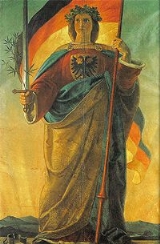
Pan-Germanism

Encyclopedia
Pan-nationalism
Pan-nationalism is a form of nationalism distinguished by the large-scale of the claimed national territory, and because it often defines the nation on the basis of a ‘’cluster’’ of cultures and ethnic groups. It shares the general nationalist ideology, that the nation is a fundamental unit of...
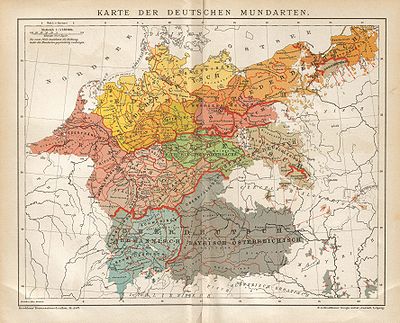
political idea. Pan-Germanists originally sought to unify the German-speaking populations of Europe
German-speaking Europe
The German language is spoken in a number of countries and territories in West, Central and Eastern Europe...
in a single nation-state
Nation-state
The nation state is a state that self-identifies as deriving its political legitimacy from serving as a sovereign entity for a nation as a sovereign territorial unit. The state is a political and geopolitical entity; the nation is a cultural and/or ethnic entity...
known as Großdeutschland (Greater Germany), where "German-speaking" was taken to include the Low German
Low German
Low German or Low Saxon is an Ingvaeonic West Germanic language spoken mainly in northern Germany and the eastern part of the Netherlands...
, Frisian and Dutch
Dutch language
Dutch is a West Germanic language and the native language of the majority of the population of the Netherlands, Belgium, and Suriname, the three member states of the Dutch Language Union. Most speakers live in the European Union, where it is a first language for about 23 million and a second...
-speaking populations of the Low Countries
Low Countries
The Low Countries are the historical lands around the low-lying delta of the Rhine, Scheldt, and Meuse rivers, including the modern countries of Belgium, the Netherlands, Luxembourg and parts of northern France and western Germany....
, and sometimes also as synonymous with Germanic-speaking
Germanic languages
The Germanic languages constitute a sub-branch of the Indo-European language family. The common ancestor of all of the languages in this branch is called Proto-Germanic , which was spoken in approximately the mid-1st millennium BC in Iron Age northern Europe...
, to the inclusion of Scandinavia
Scandinavia
Scandinavia is a cultural, historical and ethno-linguistic region in northern Europe that includes the three kingdoms of Denmark, Norway and Sweden, characterized by their common ethno-cultural heritage and language. Modern Norway and Sweden proper are situated on the Scandinavian Peninsula,...
.
Pan-Germanism was highly influential in German politics in the 19th century and the first half of the 20th century. From the late 19th century, many Pan-Germanist thinkers, since 1891 organized in the Pan-German League
Pan-German League
The Pan-German League was an extremist, ultra-nationalist political interest organization which was officially founded in 1891, a year after the Zanzibar Treaty was signed. It was concerned with a host of issues, concentrating on imperialism, anti-semitism, the so called Polish Question, and...
, had adopted openly ethnocentric
Ethnocentrism
Ethnocentrism is the tendency to believe that one's ethnic or cultural group is centrally important, and that all other groups are measured in relation to one's own. The ethnocentric individual will judge other groups relative to his or her own particular ethnic group or culture, especially with...
and racist
Racism
Racism is the belief that inherent different traits in human racial groups justify discrimination. In the modern English language, the term "racism" is used predominantly as a pejorative epithet. It is applied especially to the practice or advocacy of racial discrimination of a pernicious nature...
ideologies, and ultimately gave rise to the Heim ins Reich
Heim ins Reich
The Heim ins Reich initiative was a policy pursued by Adolf Hitler starting in 1938 and was one of the factors leading to World War II. The initiative attempted to convince people of German descent living outside of the German Reich that they should strive to bring these regions "home" into a...
policy pursued by Nazi Germany
Nazi Germany
Nazi Germany , also known as the Third Reich , but officially called German Reich from 1933 to 1943 and Greater German Reich from 26 June 1943 onward, is the name commonly used to refer to the state of Germany from 1933 to 1945, when it was a totalitarian dictatorship ruled by...
under Adolf Hitler
Adolf Hitler
Adolf Hitler was an Austrian-born German politician and the leader of the National Socialist German Workers Party , commonly referred to as the Nazi Party). He was Chancellor of Germany from 1933 to 1945, and head of state from 1934 to 1945...
from 1938, one of the primary factors leading to the outbreak of
Causes of World War II
The main causes of World War II were nationalistic tensions, unresolved issues, and resentments resulting from the World War I and the interwar period in Europe, plus the effects of the Great Depression in the 1930s....
World War II
World War II
World War II, or the Second World War , was a global conflict lasting from 1939 to 1945, involving most of the world's nations—including all of the great powers—eventually forming two opposing military alliances: the Allies and the Axis...
.
As a result of the disaster of World War II, Pan-Germanism is mostly seen as a taboo ideology in the postwar period in both the Federal Republic of Germany
West Germany
West Germany is the common English, but not official, name for the Federal Republic of Germany or FRG in the period between its creation in May 1949 to German reunification on 3 October 1990....
and the German Democratic Republic
German Democratic Republic
The German Democratic Republic , informally called East Germany by West Germany and other countries, was a socialist state established in 1949 in the Soviet zone of occupied Germany, including East Berlin of the Allied-occupied capital city...
, as well as the Republic of Austria, and even the reunification of Germany in 1990 was viewed with some suspicion. Pan-Germanism remains practically extinct as an ideology, at best limited to some fringe groups of Neo-Nazism in Germany and Austria.
Origins (before 1860)
Romantic nationalism
Romantic nationalism is the form of nationalism in which the state derives its political legitimacy as an organic consequence of the unity of those it governs...
during the Napoleonic Wars
Napoleonic Wars
The Napoleonic Wars were a series of wars declared against Napoleon's French Empire by opposing coalitions that ran from 1803 to 1815. As a continuation of the wars sparked by the French Revolution of 1789, they revolutionised European armies and played out on an unprecedented scale, mainly due to...
, with Friedrich Ludwig Jahn
Friedrich Ludwig Jahn
Friedrich Ludwig Jahn was a German gymnastics educator and nationalist. He is commonly known as Turnvater Jahn, roughly meaning "father of gymnastics" Jahn.- Life :...
and Ernst Moritz Arndt
Ernst Moritz Arndt
Ernst Moritz Arndt was a German nationalistic and antisemitic author and poet. Early in his life, he fought for the abolition of serfdom, later against Napoleonic dominance over Germany, and had to flee to Sweden for some time due to his anti-French positions...
being early proponents. Germans
Germans
The Germans are a Germanic ethnic group native to Central Europe. The English term Germans has referred to the German-speaking population of the Holy Roman Empire since the Late Middle Ages....
, for the most part, had been a loose and disunited people since the Reformation
Protestant Reformation
The Protestant Reformation was a 16th-century split within Western Christianity initiated by Martin Luther, John Calvin and other early Protestants. The efforts of the self-described "reformers", who objected to the doctrines, rituals and ecclesiastical structure of the Roman Catholic Church, led...
, when the Holy Roman Empire
Holy Roman Empire
The Holy Roman Empire was a realm that existed from 962 to 1806 in Central Europe.It was ruled by the Holy Roman Emperor. Its character changed during the Middle Ages and the Early Modern period, when the power of the emperor gradually weakened in favour of the princes...
was shattered into a patchwork of states
Kleinstaaterei
is a German word, mainly used for the political situation in Germany and neighbouring regions during the Holy Roman Empire and during the German Confederation...
following the end of the Thirty Year's War with the Peace of Westphalia
Peace of Westphalia
The Peace of Westphalia was a series of peace treaties signed between May and October of 1648 in Osnabrück and Münster. These treaties ended the Thirty Years' War in the Holy Roman Empire, and the Eighty Years' War between Spain and the Dutch Republic, with Spain formally recognizing the...
.
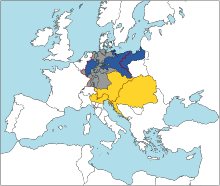
Advocates of the Großdeutschland (Greater Germany) solution sought to unite all the German-speaking people in Europe, including the Germans
Germans
The Germans are a Germanic ethnic group native to Central Europe. The English term Germans has referred to the German-speaking population of the Holy Roman Empire since the Late Middle Ages....
of the Austrian Empire
Austrian Empire
The Austrian Empire was a modern era successor empire, which was centered on what is today's Austria and which officially lasted from 1804 to 1867. It was followed by the Empire of Austria-Hungary, whose proclamation was a diplomatic move that elevated Hungary's status within the Austrian Empire...
, while others also advocated the inclusion of the Scandinavians
Scandinavians
Scandinavians are a group of Germanic peoples, inhabiting Scandinavia and to a lesser extent countries associated with Scandinavia, and speaking Scandinavian languages. The group includes Danes, Norwegians and Swedes, and additionally the descendants of Scandinavian settlers such as the Icelandic...
and the Dutch
Dutch people
The Dutch people are an ethnic group native to the Netherlands. They share a common culture and speak the Dutch language. Dutch people and their descendants are found in migrant communities worldwide, notably in Suriname, Chile, Brazil, Canada, Australia, South Africa, New Zealand, and the United...
. Pan-Germanism was widespread among the revolutionaries of 1848
Revolutions of 1848
The European Revolutions of 1848, known in some countries as the Spring of Nations, Springtime of the Peoples or the Year of Revolution, were a series of political upheavals throughout Europe in 1848. It was the first Europe-wide collapse of traditional authority, but within a year reactionary...
, notably among Richard Wagner
Richard Wagner
Wilhelm Richard Wagner was a German composer, conductor, theatre director, philosopher, music theorist, poet, essayist and writer primarily known for his operas...
and the Brothers Grimm
Brothers Grimm
The Brothers Grimm , Jacob Grimm and Wilhelm Grimm , were German academics, linguists, cultural researchers, and authors who collected folklore and published several collections of it as Grimm's Fairy Tales, which became very popular...
. Writers such as Friedrich List
Friedrich List
Georg Friedrich List was a leading 19th century German economist who developed the "National System" or what some would call today the National System of Innovation...
and Paul Anton Lagarde
Paul de Lagarde
Paul Anton de Lagarde was a polymath German biblical scholar and orientalist. He also took some part in politics. He belonged to the Prussian Conservative party, and was a violent antisemite. The bitterness which he felt appeared in his writings...
argued for German
Germans
The Germans are a Germanic ethnic group native to Central Europe. The English term Germans has referred to the German-speaking population of the Holy Roman Empire since the Late Middle Ages....
hegemony in Central and Eastern Europe, where German domination in some areas had begun as early as the 9th century AD with the Ostsiedlung
Ostsiedlung
Ostsiedlung , also called German eastward expansion, was the medieval eastward migration and settlement of Germans from modern day western and central Germany into less-populated regions and countries of eastern Central Europe and Eastern Europe. The affected area roughly stretched from Slovenia...
, Germanic expansion into Slavic and Baltic lands. For the Pan-Germanists this movement was seen as a Drang Nach Osten
Drang nach Osten
Drang nach Osten was a term coined in the 19th century to designate German expansion into Slavic lands. The term became a motto of the German nationalist movement in the late nineteenth century...
, in which Germans would be naturally inclined to seek Lebensraum
Lebensraum
was one of the major political ideas of Adolf Hitler, and an important component of Nazi ideology. It served as the motivation for the expansionist policies of Nazi Germany, aiming to provide extra space for the growth of the German population, for a Greater Germany...
by moving eastwards to reunite with the German minorities there.
The Deutschlandlied ("Song of Germany"), written in 1841 by Hoffmann von Fallersleben
August Heinrich Hoffmann von Fallersleben
' , who used Hoffmann von Fallersleben as his pen name, was a German poet. He is best known for writing "Das Lied der Deutschen", its third stanza now being the national anthem of Germany, and a number of popular children's songs.- Biography :Hoffmann was born in Fallersleben , Brunswick-Lüneburg,...
, in its first stanza defines Deutschland as reaching "
From the Meuse
Meuse River
The Maas or Meuse is a major European river, rising in France and flowing through Belgium and the Netherlands before draining into the North Sea...
to the Memel
Neman River
Neman or Niemen or Nemunas, is a major Eastern European river rising in Belarus and flowing through Lithuania before draining into the Curonian Lagoon and then into the Baltic Sea at Klaipėda. It is the northern border between Lithuania and Russia's Kaliningrad Oblast in its lower reaches...
/ From the Adige
Adige
The Adige is a river with its source in the Alpine province of South Tyrol near the Italian border with Austria and Switzerland. At in length, it is the second longest river in Italy, after the River Po with ....
to the Belt
Little Belt
The Little Belt is a strait between the Danish island of Funen and the Jutland Peninsula.The belt is about 50 km long and 800m to 28 km wide, the maximum depth is approximately 75 m, and contains numerous small Danish islands....
", i.e. as including East Prussia
East Prussia
East Prussia is the main part of the region of Prussia along the southeastern Baltic Coast from the 13th century to the end of World War II in May 1945. From 1772–1829 and 1878–1945, the Province of East Prussia was part of the German state of Prussia. The capital city was Königsberg.East Prussia...
and South Tyrol
South Tyrol
South Tyrol , also known by its Italian name Alto Adige, is an autonomous province in northern Italy. It is one of the two autonomous provinces that make up the autonomous region of Trentino-Alto Adige/Südtirol. The province has an area of and a total population of more than 500,000 inhabitants...
.
The German question
By the 1860s the Kingdom of PrussiaKingdom of Prussia
The Kingdom of Prussia was a German kingdom from 1701 to 1918. Until the defeat of Germany in World War I, it comprised almost two-thirds of the area of the German Empire...
and the Austrian Empire
Austrian Empire
The Austrian Empire was a modern era successor empire, which was centered on what is today's Austria and which officially lasted from 1804 to 1867. It was followed by the Empire of Austria-Hungary, whose proclamation was a diplomatic move that elevated Hungary's status within the Austrian Empire...
were the two most powerful nations dominated by German-speaking
German language
German is a West Germanic language, related to and classified alongside English and Dutch. With an estimated 90 – 98 million native speakers, German is one of the world's major languages and is the most widely-spoken first language in the European Union....
elites. Both sought to expand their influence and territory. The Austrian Empire — like the Holy Roman Empire
Holy Roman Empire
The Holy Roman Empire was a realm that existed from 962 to 1806 in Central Europe.It was ruled by the Holy Roman Emperor. Its character changed during the Middle Ages and the Early Modern period, when the power of the emperor gradually weakened in favour of the princes...
— was a multi-ethnic state, but German-speaking people there did not have an absolute numerical majority; the creation of the Austro-Hungarian Empire was one result of the growing nationalism of other ethnicities especially the Hungarians. Prussia
Prussia
Prussia was a German kingdom and historic state originating out of the Duchy of Prussia and the Margraviate of Brandenburg. For centuries, the House of Hohenzollern ruled Prussia, successfully expanding its size by way of an unusually well-organized and effective army. Prussia shaped the history...
under Otto von Bismarck
Otto von Bismarck
Otto Eduard Leopold, Prince of Bismarck, Duke of Lauenburg , simply known as Otto von Bismarck, was a Prussian-German statesman whose actions unified Germany, made it a major player in world affairs, and created a balance of power that kept Europe at peace after 1871.As Minister President of...
would ride on the coat-tails of nationalism to unite all of modern-day Germany. With the Unification of Germany
Unification of Germany
The formal unification of Germany into a politically and administratively integrated nation state officially occurred on 18 January 1871 at the Versailles Palace's Hall of Mirrors in France. Princes of the German states gathered there to proclaim Wilhelm of Prussia as Emperor Wilhelm of the German...
, the German Empire
German Empire
The German Empire refers to Germany during the "Second Reich" period from the unification of Germany and proclamation of Wilhelm I as German Emperor on 18 January 1871, to 1918, when it became a federal republic after defeat in World War I and the abdication of the Emperor, Wilhelm II.The German...
("Second Reich") was created in 1871 following the proclamation of Wilhelm I as head of a union of German-speaking states, while disregarding millions of its non-German subjects who desired self-determination from German rule.
There was also a rejection of Roman Catholicism with the Away from Rome!
Away from Rome!
Away from Rome! was a religious movement founded in Austria founded by the Pan-German politician Georg Ritter von Schönerer.It was founded while the Kulturkampf divided Imperial Germany, and advocated the conversion of all Roman Catholic German speakers of Austria to Lutheran Protestantism, or, in...
movement calling for German speakers to identify with Lutheran or Old Catholic churches.
German nationalism in Austria
After the Revolutions of 1848/49Revolutions of 1848 in the Habsburg areas
From March 1848 through July 1849, the Habsburg Austrian Empire was threatened by revolutionary movements. Much of the revolutionary activity was of a nationalist character: the empire, ruled from Vienna, included Austrian Germans, Hungarians, Slovenes, Poles, Czechs, Slovaks, Ruthenians,...
, in which the liberal nationalistic revolutionaries advocated the Greater German solution, the Austrian defeat in the Austro-Prussian War
Austro-Prussian War
The Austro-Prussian War was a war fought in 1866 between the German Confederation under the leadership of the Austrian Empire and its German allies on one side and the Kingdom of Prussia with its German allies and Italy on the...
(1866) with the effect that Austria was practically edged out of Germany, and increasing ethnic conflicts in the multinational Habsburg Monarchy, a German national movement evolved in Austria. Led by the radical German nationalist and anti-semite Georg von Schönerer
Georg Ritter von Schönerer
Georg Ritter von Schönerer was an Austrian politician active in the late 19th and early 20th centuries, and a major exponent of German nationalism in Austria....
, organisations as the Pan-German Society demanded the link-up of all German-speaking territories of the Danube Monarchy to the German Empire, and decidedly rejected Austrian patriotism. Schönerer's völkisch and racist German nationalism was an inspiration to Hitler's ideology. In 1933, Austrian Nazis
Austrian National Socialism
Austrian National Socialism was a Pan-German movement that was formed at the beginning of the 20th century. The movement took a concrete form on November 15, 1903 when the German Worker's Party was established in Austria with its secretariat stationed in the town of Aussig...
and the national-liberal Greater German People's Party
Greater German People's Party
The Greater German People's Party was a German nationalist and national liberal party during the First Republic of Austria.-Foundation:...
formed an action group, fighting together against the Austrofascist
Austrofascism
Austrofascism is a term which is frequently used by historians to describe the authoritarian rule installed in Austria with the May Constitution of 1934, which ceased with the forcible incorporation of the newly-founded Federal State of Austria into Nazi Germany in 1938...
regime which imposed a distinct Austrian national identity. With the "Anschluss
Anschluss
The Anschluss , also known as the ', was the occupation and annexation of Austria into Nazi Germany in 1938....
" of Austria in 1938, the historic aim of Austria's German nationalists was achieved. After 1945, the German national camp was revived in the Federation of Independents
Federation of Independents
The Federation of Independents was a German national and national-liberal political party in Austria active from 1949 to 1955...
and the Freedom Party of Austria
Freedom Party of Austria
The Freedom Party of Austria is a political party in Austria. Ideologically, the party is a direct descendant of the German national liberal camp, which dates back to the 1848 revolutions. The FPÖ itself was founded in 1956 as the successor to the short-lived Federation of Independents , which had...
.
Pan-German League
The Pan-German Movement was officially founded in 1891, when Ernst Hasse, a professor at the University of LeipzigUniversity of Leipzig
The University of Leipzig , located in Leipzig in the Free State of Saxony, Germany, is one of the oldest universities in the world and the second-oldest university in Germany...
and a member of the Reichstag
Reichstag (German Empire)
The Reichstag was the parliament of the North German Confederation , and of the German Reich ....
, who organized the Pan-German League
Pan-German League
The Pan-German League was an extremist, ultra-nationalist political interest organization which was officially founded in 1891, a year after the Zanzibar Treaty was signed. It was concerned with a host of issues, concentrating on imperialism, anti-semitism, the so called Polish Question, and...
an ultra-nationalist political interest organization which promoted imperialism
Imperialism
Imperialism, as defined by Dictionary of Human Geography, is "the creation and/or maintenance of an unequal economic, cultural, and territorial relationships, usually between states and often in the form of an empire, based on domination and subordination." The imperialism of the last 500 years,...
, anti-semitism
Anti-Semitism
Antisemitism is suspicion of, hatred toward, or discrimination against Jews for reasons connected to their Jewish heritage. According to a 2005 U.S...
, and support for Ethnic German
Ethnic German
Ethnic Germans historically also ), also collectively referred to as the German diaspora, refers to people who are of German ethnicity. Many are not born in Europe or in the modern-day state of Germany or hold German citizenship...
minorites in other countries. The organization achieved great support among the educated middle
Middle class
The middle class is any class of people in the middle of a societal hierarchy. In Weberian socio-economic terms, the middle class is the broad group of people in contemporary society who fall socio-economically between the working class and upper class....
and upper class
Upper class
In social science, the "upper class" is the group of people at the top of a social hierarchy. Members of an upper class may have great power over the allocation of resources and governmental policy in their area.- Historical meaning :...
, the organization promoted German nationalist
Nationalism
Nationalism is a political ideology that involves a strong identification of a group of individuals with a political entity defined in national terms, i.e. a nation. In the 'modernist' image of the nation, it is nationalism that creates national identity. There are various definitions for what...
consciousness, especially among Ethnic Germans outside Germany
German Empire
The German Empire refers to Germany during the "Second Reich" period from the unification of Germany and proclamation of Wilhelm I as German Emperor on 18 January 1871, to 1918, when it became a federal republic after defeat in World War I and the abdication of the Emperor, Wilhelm II.The German...
. In his three-volume work, Deutsche Politik (1905–07), Hasse called for German imperialist
Imperialism
Imperialism, as defined by Dictionary of Human Geography, is "the creation and/or maintenance of an unequal economic, cultural, and territorial relationships, usually between states and often in the form of an empire, based on domination and subordination." The imperialism of the last 500 years,...
expansion in Europe. Similar expansionist
Expansionism
In general, expansionism consists of expansionist policies of governments and states. While some have linked the term to promoting economic growth , more commonly expansionism refers to the doctrine of a state expanding its territorial base usually, though not necessarily, by means of military...
policies were preached by Munich
Munich
Munich The city's motto is "" . Before 2006, it was "Weltstadt mit Herz" . Its native name, , is derived from the Old High German Munichen, meaning "by the monks' place". The city's name derives from the monks of the Benedictine order who founded the city; hence the monk depicted on the city's coat...
professor Karl Haushofer
Karl Haushofer
Karl Ernst Haushofer was a German general, geographer and geopolitician. Through his student Rudolf Hess, Haushofer's ideas may have influenced the development of Adolf Hitler's expansionist strategies, although Haushofer denied direct influence on the Nazi regime.-Biography:Haushofer belonged to...
, Ewald Banse, and Hans Grimm
Hans Grimm
Hans Grimm was a German writer.His father, Julius Grimm, was a professor of law who retired early and devoted his time to private historical and literary studies and to political activity as a founder member of the National Liberal party, which he represented in the Prussian parliament, and was a...
, author of Volk ohne Raum
Volk ohne Raum
"Volk ohne Raum" was a political slogan used in the Weimar Republic and Nazi Germany. The term was coined by the nationalist writer Hans Grimm with his novel Volk ohne Raum...
and his brother Jacob
Jacob Grimm
Jacob Ludwig Carl Grimm was a German philologist, jurist and mythologist. He is best known as the discoverer of Grimm's Law, the author of the monumental Deutsches Wörterbuch, the author of Deutsche Mythologie and, more popularly, as one of the Brothers Grimm, as the editor of Grimm's Fairy...
who published a treaty about German "volksrecht". Georg Schönerer and Karl Hermann Wolf articulated Pan-Germanist sentiments in Austria-Hungary
Austria-Hungary
Austria-Hungary , more formally known as the Kingdoms and Lands Represented in the Imperial Council and the Lands of the Holy Hungarian Crown of Saint Stephen, was a constitutional monarchic union between the crowns of the Austrian Empire and the Kingdom of Hungary in...
.
The position of Pan-German league gradually evolved into biological racism, with belief that Germans are "superior race", and Germans need protection from mixing with other races, particularly Jews. By 1912 in publication "If I were the Keiser", the Pan-German League's leading member Heinrich Class
Heinrich Class
Heinrich Claß was a German right-wing politician and president of the Pan-German League from 1908 to 1939. He is commonly known for his books about far-right policy, written under the pseudonym Daniel Frymann or Einhart...
called on Germans to conquer Eastern territories inhabited by "inferior" Slavs, depopulate their territories and settle German colonists there.
Pan-Germanism in Scandinavia
Pan-Germanic tendencies were also widespread among the Norwegian independence movementNorwegian romantic nationalism
Norwegian romantic nationalism was a movement in Norway between 1840 and 1867 in art, literature, and popular culture that emphasized the aesthetics of Norwegian nature and the uniqueness of the Norwegian national identity...
, notably proposed by Peter Andreas Munch
Peter Andreas Munch
Peter Andreas Munch , usually known as P. A. Munch, was a Norwegian historian, known for his work on the medieval history of Norway. Munch’s scholarship included Norwegian archaeology, geography, ethnography, linguistics, and jurisprudence...
, and Bjørnstjerne Bjørnson
Bjørnstjerne Bjørnson
Bjørnstjerne Martinius Bjørnson was a Norwegian writer and the 1903 Nobel Prize in Literature laureate. Bjørnson is considered as one of The Four Greats Norwegian writers; the others being Henrik Ibsen, Jonas Lie, and Alexander Kielland...
. Also prominent cultural personalities like Knut Hamsun
Knut Hamsun
Knut Hamsun was a Norwegian author, who was awarded the Nobel Prize in Literature in 1920. He was praised by King Haakon VII of Norway as Norway's soul....
and Henrik Ibsen
Henrik Ibsen
Henrik Ibsen was a major 19th-century Norwegian playwright, theatre director, and poet. He is often referred to as "the father of prose drama" and is one of the founders of Modernism in the theatre...
expressed sympathy for the Pan-German idea. Bjørnson, who wrote the lyrics for the Norwegian national anthem
Ja, vi elsker dette landet
is the national anthem of Norway. It is commonly referred to as just "Ja, vi elsker" . The lyrics were written by Bjørnstjerne Bjørnson between 1859 and 1868, and the melody was written by his cousin Rikard Nordraak in 1864. It was first performed publicly on 17 May 1864 in connection with the 50th...
, proclaimed in 1901:
Jacob Grimm adopted Munch's anti-Danish Pan-Germanism and argued that the entire Peninsula of Jutland
Jutland
Jutland , historically also called Cimbria, is the name of the peninsula that juts out in Northern Europe toward the rest of Scandinavia, forming the mainland part of Denmark. It has the North Sea to its west, Kattegat and Skagerrak to its north, the Baltic Sea to its east, and the Danish–German...
had been populated by Germans in before the arrival of the Danes
Danes
Danish people or Danes are the nation and ethnic group that is native to Denmark, and who speak Danish.The first mention of Danes within the Danish territory is on the Jelling Rune Stone which mentions how Harald Bluetooth converted the Danes to Christianity in the 10th century...
and that there it could justifiably be reclaimed by Germany, whereas the rest of Denmark
Denmark
Denmark is a Scandinavian country in Northern Europe. The countries of Denmark and Greenland, as well as the Faroe Islands, constitute the Kingdom of Denmark . It is the southernmost of the Nordic countries, southwest of Sweden and south of Norway, and bordered to the south by Germany. Denmark...
should be incorporated into Sweden
Sweden
Sweden , officially the Kingdom of Sweden , is a Nordic country on the Scandinavian Peninsula in Northern Europe. Sweden borders with Norway and Finland and is connected to Denmark by a bridge-tunnel across the Öresund....
. This line of thinking was countered by Jens Jacob Asmussen Worsaae
Jens Jacob Asmussen Worsaae
Jens Jacob Asmussen Worsaae was a Danish archaeologist, historian and politician, who was the second director of the National Museum of Denmark . He played a key role in the foundation of scientific archaeology. Worsaae was the first to excavate and use stratigraphy to prove C.J...
, an archaeologist who had excavated parts of Danevirke
Danevirke
The Danevirke The Danevirke The Danevirke (modern Danish spelling: Dannevirke; in Old Norse Danavirki ; in German Danewerk ; is a system of Danish fortifications in Schleswig-Holstein (Northern Germany). This important linear defensive earthwork was constructed across the neck of the Cimbrian...
, who argued that there was no way of knowing the language of the earliest inhabitants of Danish territory, that Germans had more solid historical claims to large parts of France and England, and that Slavs by the same reasoning could annex parts of Eastern Germany. Regardless of the strength of Worsaae's arguments pan-Germanism spurred on the German nationalists of Schleswig
Schleswig
Schleswig or South Jutland is a region covering the area about 60 km north and 70 km south of the border between Germany and Denmark; the territory has been divided between the two countries since 1920, with Northern Schleswig in Denmark and Southern Schleswig in Germany...
and Holstein
Holstein
Holstein is the region between the rivers Elbe and Eider. It is part of Schleswig-Holstein, the northernmost state of Germany....
and lead to the First Schleswig War in 1848. This likely in turn contributed to the fact that Pan-Germanism never caught on in Denmark as much as it did in Norway.
1918 to 1945
World war I became the first attempt to carry out the Pan-German ideology in practice, and the Pan-German movement argued forcefully for an expansionist imperialism providing the German people with lebensraumLebensraum
was one of the major political ideas of Adolf Hitler, and an important component of Nazi ideology. It served as the motivation for the expansionist policies of Nazi Germany, aiming to provide extra space for the growth of the German population, for a Greater Germany...
.
Following the defeat in World War I
World War I
World War I , which was predominantly called the World War or the Great War from its occurrence until 1939, and the First World War or World War I thereafter, was a major war centred in Europe that began on 28 July 1914 and lasted until 11 November 1918...
, influence of German-speaking elites over Central
Central Europe
Central Europe or alternatively Middle Europe is a region of the European continent lying between the variously defined areas of Eastern and Western Europe...
and Eastern Europe
Eastern Europe
Eastern Europe is the eastern part of Europe. The term has widely disparate geopolitical, geographical, cultural and socioeconomic readings, which makes it highly context-dependent and even volatile, and there are "almost as many definitions of Eastern Europe as there are scholars of the region"...
was greatly limited. At the Treaty of Versailles
Treaty of Versailles
The Treaty of Versailles was one of the peace treaties at the end of World War I. It ended the state of war between Germany and the Allied Powers. It was signed on 28 June 1919, exactly five years after the assassination of Archduke Franz Ferdinand. The other Central Powers on the German side of...
Germany was substantially reduced in size. Austria-Hungary
Austria-Hungary
Austria-Hungary , more formally known as the Kingdoms and Lands Represented in the Imperial Council and the Lands of the Holy Hungarian Crown of Saint Stephen, was a constitutional monarchic union between the crowns of the Austrian Empire and the Kingdom of Hungary in...
was split up. A Rump-Austria, which to a certain extent corresponded to the German-speaking areas of Austria-Hungary (a complete split into language groups was impossible due to multi-lingual areas and language-exclaves) adopted the name "German Austria
German Austria
Republic of German Austria was created following World War I as the initial rump state for areas with a predominantly German-speaking population within what had been the Austro-Hungarian Empire, without the Kingdom of Hungary, which in 1918 had become the Hungarian Democratic Republic.German...
" in hope for union with Germany
Weimar Republic
The Weimar Republic is the name given by historians to the parliamentary republic established in 1919 in Germany to replace the imperial form of government...
. Union with Germany and the name German Austria was forbid by the Treaty of St Germain and had to be changed back to Austria.
It was in the post-World War I period that Adolf Hitler
Adolf Hitler
Adolf Hitler was an Austrian-born German politician and the leader of the National Socialist German Workers Party , commonly referred to as the Nazi Party). He was Chancellor of Germany from 1933 to 1945, and head of state from 1934 to 1945...
under the influence of the Dolchstosslegende
Dolchstosslegende
The stab-in-the-back legend is the notion, widely believed in right-wing circles in Germany after 1918, that the German Army did not lose World War I but was instead betrayed by the civilians on the home front, especially the republicans who overthrew the monarchy...
, first took up Pan-German ideas in his Mein Kampf
Mein Kampf
Mein Kampf is a book written by Nazi leader Adolf Hitler. It combines elements of autobiography with an exposition of Hitler's political ideology. Volume 1 of Mein Kampf was published in 1925 and Volume 2 in 1926...
. He met Heinrich Class
Heinrich Class
Heinrich Claß was a German right-wing politician and president of the Pan-German League from 1908 to 1939. He is commonly known for his books about far-right policy, written under the pseudonym Daniel Frymann or Einhart...
in 1918, and Class provided Hitler with support for the 1923 Beer Hall Putsch
Beer Hall Putsch
The Beer Hall Putsch was a failed attempt at revolution that occurred between the evening of 8 November and the early afternoon of 9 November 1923, when Nazi Party leader Adolf Hitler, Generalquartiermeister Erich Ludendorff, and other heads of the Kampfbund unsuccessfully tried to seize power...
. Hitler and his national socialists shared most of the basic Pan-German visions with the Pan-German league, but nonetheless differences in political style lead the two groups to open rivalry. The German Workers Party of Bohemia cut its ties to the Pan-German movement which was seen as being too dominated by the upper classes and joined forces with the German Workers Party lead by Anton Drexler
Anton Drexler
Anton Drexler was a German right-wing political leader of the 1920s, known for being Adolf Hitler's mentor during his early days in politics.-Biography:...
which later became The National Socialist German Workers Party
National Socialist German Workers Party
The National Socialist German Workers' Party , commonly known in English as the Nazi Party, was a political party in Germany between 1920 and 1945. Its predecessor, the German Workers' Party , existed from 1919 to 1920...
, lead by Adolf Hitler. The Heim ins Reich
Heim ins Reich
The Heim ins Reich initiative was a policy pursued by Adolf Hitler starting in 1938 and was one of the factors leading to World War II. The initiative attempted to convince people of German descent living outside of the German Reich that they should strive to bring these regions "home" into a...
initiative (German
German language
German is a West Germanic language, related to and classified alongside English and Dutch. With an estimated 90 – 98 million native speakers, German is one of the world's major languages and is the most widely-spoken first language in the European Union....
: literally Home into the Empire, meaning Back to Reich, see Reich
Reich
Reich is a German word cognate with the English rich, but also used to designate an empire, realm, or nation. The qualitative connotation from the German is " sovereign state." It is the word traditionally used for a variety of sovereign entities, including Germany in many periods of its history...
) was a policy pursued by Nazi Germany
Nazi Germany
Nazi Germany , also known as the Third Reich , but officially called German Reich from 1933 to 1943 and Greater German Reich from 26 June 1943 onward, is the name commonly used to refer to the state of Germany from 1933 to 1945, when it was a totalitarian dictatorship ruled by...
which attempted to convince people of German descent living outside of Germany
Germany
Germany , officially the Federal Republic of Germany , is a federal parliamentary republic in Europe. The country consists of 16 states while the capital and largest city is Berlin. Germany covers an area of 357,021 km2 and has a largely temperate seasonal climate...
(such as Sudetenland
Sudetenland
Sudetenland is the German name used in English in the first half of the 20th century for the northern, southwest and western regions of Czechoslovakia inhabited mostly by ethnic Germans, specifically the border areas of Bohemia, Moravia, and those parts of Silesia being within Czechoslovakia.The...
) that they should strive to bring these regions "home" into a Greater Germany.
History since 1945
World War IIWorld War II
World War II, or the Second World War , was a global conflict lasting from 1939 to 1945, involving most of the world's nations—including all of the great powers—eventually forming two opposing military alliances: the Allies and the Axis...
brought about the decline of Pan-Germanism, much as World War I
World War I
World War I , which was predominantly called the World War or the Great War from its occurrence until 1939, and the First World War or World War I thereafter, was a major war centred in Europe that began on 28 July 1914 and lasted until 11 November 1918...
had led to the demise of Pan-Slavism
Pan-Slavism
Pan-Slavism was a movement in the mid-19th century aimed at unity of all the Slavic peoples. The main focus was in the Balkans where the South Slavs had been ruled for centuries by other empires, Byzantine Empire, Austria-Hungary, the Ottoman Empire, and Venice...
. Parts of Germany
Germany
Germany , officially the Federal Republic of Germany , is a federal parliamentary republic in Europe. The country consists of 16 states while the capital and largest city is Berlin. Germany covers an area of 357,021 km2 and has a largely temperate seasonal climate...
itself were devastated, and the country was divided, firstly into Soviet
Soviet Union
The Soviet Union , officially the Union of Soviet Socialist Republics , was a constitutionally socialist state that existed in Eurasia between 1922 and 1991....
, French
France
The French Republic , The French Republic , The French Republic , (commonly known as France , is a unitary semi-presidential republic in Western Europe with several overseas territories and islands located on other continents and in the Indian, Pacific, and Atlantic oceans. Metropolitan France...
, American
United States
The United States of America is a federal constitutional republic comprising fifty states and a federal district...
, and British
United Kingdom
The United Kingdom of Great Britain and Northern IrelandIn the United Kingdom and Dependencies, other languages have been officially recognised as legitimate autochthonous languages under the European Charter for Regional or Minority Languages...
zones and then into West Germany
West Germany
West Germany is the common English, but not official, name for the Federal Republic of Germany or FRG in the period between its creation in May 1949 to German reunification on 3 October 1990....
and East Germany. To add to the disaster, Germany suffered even larger territorial losses than it did in the First World War, with huge portions of eastern Germany directly annexed by the Soviet Union
Soviet Union
The Soviet Union , officially the Union of Soviet Socialist Republics , was a constitutionally socialist state that existed in Eurasia between 1922 and 1991....
and Poland
Poland
Poland , officially the Republic of Poland , is a country in Central Europe bordered by Germany to the west; the Czech Republic and Slovakia to the south; Ukraine, Belarus and Lithuania to the east; and the Baltic Sea and Kaliningrad Oblast, a Russian exclave, to the north...
. The scale of the Germans' defeat was unprecedented. Nationalism and Pan-Germanism became almost taboo because they had been used so destructively by the Nazis. Indeed, the word "Volksdeutscher" in reference to ethnic Germans naturalized during World War II
World War II
World War II, or the Second World War , was a global conflict lasting from 1939 to 1945, involving most of the world's nations—including all of the great powers—eventually forming two opposing military alliances: the Allies and the Axis...
later developed into a mild epithet. However, reunification of Germany in 1990 revived the old debates.
See also
- German questionGerman questionThe German question was a debate in the 19th century, especially during the Revolutions of 1848, over the best way to achieve the Unification of Germany. From 1815–1871, a number of 37 independent German-speaking states existed within the German Confederation...
- German nationalismGerman nationalismGerman nationalism refers to the nationalism of Germans or of German culture. The origins of the beginning of a sense of German identity began with the Protestant Reformation begun by Martin Luther that resulted in the spread of a standardized common German language and literature...
- ScandinavismScandinavismScandinavism and Nordism are literary and political movements that support various degrees of cooperation between the Scandinavian or Nordic countries...
- Germanic peoplesGermanic peoplesThe Germanic peoples are an Indo-European ethno-linguistic group of Northern European origin, identified by their use of the Indo-European Germanic languages which diversified out of Proto-Germanic during the Pre-Roman Iron Age.Originating about 1800 BCE from the Corded Ware Culture on the North...
- GermaniaGermaniaGermania was the Greek and Roman geographical term for the geographical regions inhabited by mainly by peoples considered to be Germani. It was most often used to refer especially to the east of the Rhine and north of the Danube...
- Greater Germanic ReichGreater Germanic ReichThe Greater Germanic Reich , fully styled the Greater Germanic Reich of the German Nation is the official state name of the political entity that Nazi Germany tried to establish in Europe during World War II...
- Versailles Treaty
- Peace of WestphaliaPeace of WestphaliaThe Peace of Westphalia was a series of peace treaties signed between May and October of 1648 in Osnabrück and Münster. These treaties ended the Thirty Years' War in the Holy Roman Empire, and the Eighty Years' War between Spain and the Dutch Republic, with Spain formally recognizing the...
- Holy Roman Empire of the German Nation
- Völkisch movementVölkisch movementThe volkisch movement is the German interpretation of the populist movement, with a romantic focus on folklore and the "organic"...
- Ethnic nationalismEthnic nationalismEthnic nationalism is a form of nationalism wherein the "nation" is defined in terms of ethnicity. Whatever specific ethnicity is involved, ethnic nationalism always includes some element of descent from previous generations and the implied claim of ethnic essentialism, i.e...
- Pan-nationalismPan-nationalismPan-nationalism is a form of nationalism distinguished by the large-scale of the claimed national territory, and because it often defines the nation on the basis of a ‘’cluster’’ of cultures and ethnic groups. It shares the general nationalist ideology, that the nation is a fundamental unit of...
- Alldeutscher Verband
- Romantic nationalismRomantic nationalismRomantic nationalism is the form of nationalism in which the state derives its political legitimacy as an organic consequence of the unity of those it governs...
- FolkloreFolkloreFolklore consists of legends, music, oral history, proverbs, jokes, popular beliefs, fairy tales and customs that are the traditions of a culture, subculture, or group. It is also the set of practices through which those expressive genres are shared. The study of folklore is sometimes called...
- IrredentismIrredentismIrredentism is any position advocating annexation of territories administered by another state on the grounds of common ethnicity or prior historical possession, actual or alleged. Some of these movements are also called pan-nationalist movements. It is a feature of identity politics and cultural...
- ExpansionismExpansionismIn general, expansionism consists of expansionist policies of governments and states. While some have linked the term to promoting economic growth , more commonly expansionism refers to the doctrine of a state expanding its territorial base usually, though not necessarily, by means of military...
Further reading
- Jackisch, Barry Andrew. ‘Not a Large, but a Strong Right’: The Pan-German League, Radical Nationalism, and Rightist Party Politics in Weimar Germany, 1918-1939. Bell and Howell Information and Learning Company: Ann Arbor. 2000.
- Wertheimer, Mildred. The Pan-German League, 1890-1914. Columbia University Press: New York. 1924.
- Chickering, Roger. We Men Who Feel Most German: Cultural Study of the Pan-German League, 1886-1914. Harper Collins Publishers Ltd. 1984.