

Austrians

Encyclopedia
Austrians are a nation
and ethnic group
, consisting of the population of the Republic of Austria and its historical predecessor states
who share a common Austrian culture and Austrian descent.
The English term Austrians was applied to the population of Habsburg Austria from the 17th or 18th century. During the 19th century, it identified the citizens of the Empire of Austria (1804–1867), and until 1918 to the citizens of Cisleithania
, Austria-Hungary
's western half.
In the closest sense, the term Austria originally referred to the historical March of Austria
, corresponding roughly to the Vienna Basin
in what is today Lower Austria
.
word Austrian is a derivative of the proper name Austria, which is a latinization of Österreich, the German name for Austria. This word is derived from Ostarrîchi
, which first appears in 996. This, in turn, is probably a translation of the Latin Marcha Orientalis, which means "eastern borderland" (viz. delimiting the eastern border of the Holy Roman Empire
). It was a margraviate of the Duchy of Bavaria
, ruled by the House of Babenberg from AD 976.
During the 12th century, the Marcha Orientalis under the Babenbergs became independent of Bavaria. What is today known as Lower Austria
corresponds to the Marcha Orientalis, while Upper Austria
corresponds to the eastern half of the core territory of Bavaria (the western half forming part of the German state
of Bavaria
).
The adjective Austrian enters the English language in the early 17th century, at the time referring to Habsburg Austria.
As a noun, Austrians appears somewhat later, in the second half of the 17th century, at first in the sense of "members of the Austrian branch of the House of Habsburg" (the junior branch emerging from the dynastic split into Austrian and Spanish Habsburgs in 1521), but from the 18th century also "a native or inhabitant of Austria".
was divided into Raetia
, Noricum
and Pannonia
.
Noricum was a Celtic
kingdom, while the Pannonii were of Illyrian
stock. The Raetians were an ancient alpine
people probably akin to the Etruscans. During the Migration period
(ca. 6th century), these territories were settled by the Bavarians and other Germanic
groups in the west (Alemanni in Vorarlberg
, Lombards
in Tyrol), and by Slavic
groups, Huns
and Avars
in the east. In the 8th century, the former territories of Raetia and Noricum fell under Carolingian rule
, and were divided into the duchies of Swabia
, Bavaria
and Carinthia
. Pannonia until the end of the 8th century was part of the Avar Khaganate. The "East March" (Ostmark) during the 9th century was the boundary region separating East Francia from the Avars and the Magyars. The site of Vienna
had been settled since Celtic times (as Vindobona
), but the city only rose to importance in the High Middle Ages
as the chief settlement of the March of Austria (the March river just east of Vienna marks the ancient border between Francia and the Avars).
After the defeat of the Magyars at the Battle of Lechfeld
in 955, the East March or March of Austria
came to be the easternmost portion of the Holy Roman Empire
, bordering on Moravia
to the north and on the Kingdom of Hungary
to the east.
As a consequence, the national character of the Austro-Bavarian
speaking majority population of Austria throughout their early modern and modern history remained characterized by their neighbourhood to the West Slavs
to the north, the South Slavs
(Slovenians
, Carinthian Slovenes
, Burgenland Croats
) to the south, and the Hungarians to the east.
The unification of the various territories of Austria outside of the March of Austria proper
(i.e. parts of Bavaria, Swabia and Carinthia) was a gradual process of feudal politics
during the High and Late Middle Ages, at first in the Archduchy of Austria
under the House of Babenberg during the 12th to 13th centuries, and under the House of Habsburg after 1278 and throughout the 14th and 15th centuries. The various populations of these territories were not unified under the single name of "Austrians" before the early modern period.
, greatly increased their political prestige and power with the acquisition of the lands of the crowns of Hungary
and Bohemia
in 1526. The Hungarian aristocracy was more successful at retaining the Magyars' cultural and political preponderance in multi-ethnic Hungary than Bohemia, on three sides surrounded by German neighbours, which underwent a period of intense German colonisation, germanizing the leading classes of the Czech people as well. The common German identity of lands such as Carinthia, Styria, or Tyrol, and the ruling dynasty made it easier for these lands to accept the central government set up in Vienna in the mid-18th century.
The term Austrian in these times was used for identifying subjects of the Domus Austriae, the House of Austria, as the dynasty was called in Europe, regardless of their ethnic definition. Although not formally a united state, the lands ruled by the Habsburgs would sometimes as well be known by the name Austria. In reality they remained a disparate range of semi-autonomous states, most of which were part of the complex network of states that was the Holy Roman Empire
(the imperial institutions of which were themselves controlled for much of their later existence by the Habsburgs). However, the second half of the 18th century saw an increasingly centralised state begin to develop under the regency of Maria Theresa of Austria
and her son Joseph II
.
 After the French Revolution
and the rise of Napoleon, the emperor Franz II
formally founded the Austrian Empire
in 1804 and became as Franz I the first Austrian emperor. For the first time the citizens of the various territories were now subjects of the one same state, while most of the German states, Prussia
excluded, still cultivated their Kleinstaaterei
and didn't succeed in forming a homogenous empire before 1871 when the German Empire
was founded.
A further major change resulted from a reorganisation of the Austrian Empire in 1867 into a dual monarchy
, acknowledging the Kingdom of Hungary as an independent state bound to the remaining part of the empire, as well independent, by a personal and real union, the Emperor of Austria being the Apostolic King of Hungary (with both titles on the same level). The Austrian half, a patchwork of crown-lands, broadly coterminous with the modern-day Austria, the Czech Republic
, Slovenia
, and parts of Poland
, Ukraine
, Italy
, and Croatia
, was bound together by the common constitution of 1867, stating that all subjects now would carry the "uniform Austrian citizenship" and have the same fundamental rights. These non-Hungarian lands were not called Austrian Empire any more (the term would have recalled a period behind the newest development).
Until 1915, they officially were called "the Kingdoms and States Represented in the Imperial Council". Politicians used the technical term Cisleithania
(labelling the Hungarian lands as Transleithania), the general public called them Austria. In 1915, the non-parliamentary Cisleithanian government decreed to use this term officially, too.
) were members of the German Confederation
since 1815 as they had been part of the Holy Roman Empire until 1806. Until 1848, Austria and its chancellor Prince Metternich unanimously dominated the confederation. The developing sense of a German nationality had been accelerated massively as a consequence of the political turmoil and wars that engulfed Central Europe
following the French Revolution
and the rise to power of Napoleon Bonaparte. Although the years of peace after Napoleon's fall quickly saw German nationalism largely pushed out of the public political arena by reactionary absolutism, the Revolutions of 1848
established it as a significant political issue for a period of nearly hundred years.
Political debate now centred on the nature of a possible future German state to replace the Confederation, and part of that debate concerned the issue of whether or not the Austrian lands had a place in the Germany polity. When Emperor Franz Joseph I ordered to build a monument in Vienna in 1860 to Archduke Charles
, victor over Napoleon in the Battle of Aspern-Essling
in 1809, it carried the dedication "To the persistent fighter for Germany's honour", to underline the Germanic mission of the House of Austria.
Habsburg influence over the German Confederation, which was strongest in the southern member states, was rivalled by the increasingly powerful Prussia
n state. Political manoeuvering by the Prussian chancellor
Otto von Bismarck
resulted in military defeat of the Austrians in 1866 and the collapse of the Confederation, both effectively ending any future Austrian influence on German
political events.
The so-called Franco-Prussian War
and the establishment of a German Empire, headed by Prussia and pointedly excluding any of the Austrian lands, let the state turn away from Germany and turn its gaze towards the Balkan Peninsula. Thereby the influence of pan-Germanism was diminished in the Habsburg territories, but as the term "Austrians" still was used supra-national, German-speaking Austrians considered themselves Germans
(and were counted as such in the censuses). The state as a whole tried to work out a sense of a distinctively Austrian identity.
While the high bureaucracy of Austria and many Austrian army officers considered themselves "black-yellow" (the Habsburg colours), i.e. loyal to the dynasty, the term "Deutschösterreich" (German Austria) appeared in the media to mean all Austrian districts with a German majority among the inhabitants. Georg Ritter von Schönerer
s political party agitated against the "multi-national" Habsburgs and advocated for Deutschösterreich joining Imperial Germany.
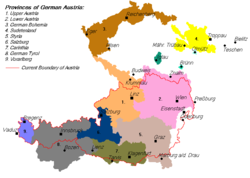 The last year of World War I
saw the collapse of Habsburg authority throughout an increasingly greater part of its empire. On October 16, 1918, emperor Karl I invited the nations of Austria to create national councils, with the aim to instigate a restructuring of the state under Habsburg rule. The nations followed the invitation (the Czechs had founded their national council already before the invitation) but ignored the will of the emperor to keep them in a restructured Austrian state. Their goal was total independence.
On October 21, the German members of the Austrian parliament, elected in 1911, met in Vienna to found the Provisional National Assembly of German Austria ("Provisorische Nationalversammlung für Deutschösterreich"). On October 30, 1918 they installed the first German Austrian government, leaving the question "monarchy or republic" open. (German nationalists and social democrats favoured the republic, the Christian Socialists wanted to keep the monarchy.) This government in the first days of November took over competences of the last imperial-royal government in a peaceful way. Initially the new state adopted the name German Austria
, reflecting the republic being the German part of the old Austria and showing the popular desire to unite with the new German republic. On November 12, 1918, the provisional national assembly voted for the republic and for unification with Germany with a large majority.
The creation of the Czecho-Slovak
and South Slav states, full independence for Hungary
, and the post-war treaties imposed by the victorious Allies combined to see the newly-established Austrian republic both with the boundaries it has today, and a largely homogeneous German-speaking population. In the Treaty of Saint-Germain
, in September, 1919 the union with Germany was prohibited, henceforth the new republic's name "Deutschösterreich" was ignored; instead the term "Republic of Austria" was used. (The westernmost province Vorarlberg
's wish to unite with Switzerland as well was ignored.) On October 21, 1919, the state changed its name accordingly. Many Austrian German communities were left scattered throughout the other new states, especially in Czechoslowakia, where more than 3 million of Austrian Germans had not been allowed their districts (most of them not neighboring with Austria) to become part of new Austria, as well as in the southern part of Tyrol which now found itself part of Italy. In total, more than 3.5 million Austrian Germans had to stay outside the republic of Austria.
Desire for unity with Germany was motivated both by a sense of common national identity, and also by a fear that the new state, stripped of its one-time imperial possessions, and surrounded by potentially hostile nation-states, would not be economically viable. Austrian identity emerged to some degree during the First Republic, and although Austria was still considered part of the "German Nation" by most, Austrian patriotism was encouraged by the anti-Nazi/anti-Socialist clerico-authoritarianist state ideology known as Austrofascism
from 1934-38. Dictator Kurt von Schuschnigg called Austria "the better German state".
By March 1938, with Nazi governments in control of both Berlin and Vienna, the country was annexed to Germany (Anschluss
) as Ostmark
. In 1942 the name was changed to the Danubian and Alpine Districts, thus eradicating any links with a special Austrian past.
During the war, Austrians' addiction to Germany faded when Hitler's series of victories ended. When social democrat Adolf Schärf
, from 1945 party president and vice-chancellor and from 1957 federal president of Austria, was visited by German friends who wanted to talk on post-war government, he spontaneously explained to his surprised visitors, "the love to Germany has been put out in Austrians". The Moscow Declaration
of 1943, in which the allies declared to reestablish an independent Austrian state after the victory, in Austria was only known to people secretly listening to enemy broadcasts ("Feindsender"), which was heavily persecuted as a criminal offence.
Though only small portions of Austrian society supported the Nazi regime, the Allied forces treated Austria as a belligerent party in the war and maintained occupation of it after the Nazi capitulation. But they treated Austria significantly different from Germany in accepting the Declaration of Independence, which Austrian politicians had signed at Vienna's city hall on April 27, 1945, and they made the first national elections possible in the autumn of that year. By the end of 1945, Austria, under the supervision of the Allied Council in Vienna, had a democratic parliament and government again, acknowledged in all four allied occupation zones.
The Austrian resistance
to the Nazi rule started with the Anschluss in 1938. Historians estimate that there were about 100.000 members of resistance facing 700.000 NSDAP members in Austria. The sign of the Austrian resistance was O5, where the 5 stands for E and OE is the abbreviation of Österreich with Ö as OE.
between Austria and them was signed to end occupation and to regain Austrian sovereignty.
The national concept developed by only few people before and during annexation emerged strongly in the postwar era. Austrians developed a self-image unambiguously separate from its German neighbour, basing itself on cultural achievements of the past, the Moscow Declaration
, geopolitical neutrality, language variation, Habsburg legacy (sans monarchism), and the historical separation of the Austrian and German empires in the 19th century. It proved favourable for Austrians not to be held guilty for World War II, genocide and war crimes, since Austria was considered victim of Nazi Germany. It was, for decades, widely ignored in Austria that many Austrians had either been Nazis or had collaborated with the Nazi regime up to terrible crimes.
Unlike earlier in the 20th century, in 1987 only 6 percent of the Austrians identified themselves as "Germans". Indeed, being (mis)identified as one can cause resentment. Today over 90 percent of the Austrians see themselves as an independent nation.
The logic of the existence of an independent Austrian state is no longer questioned as it was in the inter-war period.
Austria's multicultural history and geographical location has resulted in post-Soviet era immigration from Slovenia
, the Czech Republic
, Hungary
, Slovakia
, Romania
, and Poland
. As with neighbouring Germany, there has also been immigration from Turkey
and former Yugoslav
states such as Croatia
and Serbia
. Today, the largest group of immigrants are Germans.
since German is considered a pluricentric language today. Austrian German is defined by the Austrian dictionary (Österreichisches Wörterbuch), published under the authority of the ministry of education
, art
and culture
. Thus, all websites, official announcements and most of the media are carried out in Austrian German. The minority language
s Slovene, Croatian
and Hungarian
are spoken and officially recognized.
In terms of native language, it is generally not Austrian German that is used, but instead local dialects of the Austro-Bavarian
and Allemannic
(in Vorarlberg
and the Tiroler Außerfern) family. The Austro-Bavarian dialects are considered to belong either to the Central Austro-Bavarian
or Southern Austro-Bavarian
subgroups, with the latter encompassing the languages of the Tyrol, Carinthia
, and Styria
and the former including the dialects of Vienna
, Upper Austria
, and Lower Austria
. The vast majority of Austrians are however able to speak Austrian Standard German in addition to their native dialect, as it is taught in all modern day schools.
, Austria has been the target of heavy immigration
since the 1970s.
As with Germany, the largest immigrant group are Turks
. An estimated total of 350,000 ethnic Turks lived in Austria in 2010, accounting for 3% of Austrian population.
The rate of naturalization
has increased after 1995, since which dates Turks in Austria could retain their citizenship in Turkey
after naturalization in Austria (dual citizenship). After 2007, the rate of naturalizations has decreased due to a stricter nationality law enacted by the Austrian legislative.
During the 2000s, an average number of 27,127 foreign nationals per year was naturalized as Austrian citizens, compared to an
average 67,688 children per year born with Austrian nationality.
Consequently, an increasing portion of Austrians is not descended from the historical populations of Austria.
While the term "ethnic Austrian" has mostly been reserved for the context of overseas emigration from Austria (Austrian Americans, Austrian Argentines etc.), it can more recently also be used to distinguish the indigenous population from the naturalized immigrant population. Thus, the rapid growth of Islam in Austria
is due to the higher birth rate among immigrants compared to that among the indigenous "ethnic Austrian" population.
, Germany
, Hungary
and Bohemia
and the other Czech lands
.
, the capital city of Austria has long been an important center of musical innovation. Composers of the 18th and 19th centuries were drawn to the city by the patronage of the Habsburg
s, and made Vienna the European capital of classical music. Wolfgang Amadeus Mozart
, Ludwig van Beethoven
, and Johann Strauss, Jr.
, among others, were associated with the city. During the Baroque
period, Slavic
and Hungarian folk forms influenced Austrian music.
, Stefan Zweig
, Thomas Bernhard
, and Robert Musil
, and of poets Georg Trakl
, Franz Werfel
, Franz Grillparzer
, Rainer Maria Rilke
, and Adalbert Stifter
. Famous contemporary Austrian playwrights and novelists include Elfriede Jelinek
and Peter Handke
.
, Jewish
, Italian
and Polish
cuisines, from which both dishes and methods of food preparation have often been borrowed. Goulash is one example of this. Austrian cuisine is known primarily in the rest of the world for its pastries and sweets.
Roman Catholicism in Austria
has played a significant role both in the culture of Austria
and in the politics of Austria
. It enabled the House of Habsburg to rule Spain
and its empire
as a Catholic Monarchy from the 16th century, and it determined the role of Habsburg Austria in the Thirty Years' War
. The music in the tradition of Viennese classicism is sacral to a significant extent, including works such as Mozart's Great Mass in C minor, masses by Joseph Haydn (1750-1802), Beethoven's Mass in C major
(1807), down to Bruckner's Te Deum
(1903).
Secularism has been on the rise since the 1980s. An estimated 66% of Austrians adhered to Roman Catholicism in 2009, compared to 78% in 1991 and 89% in 1961.
There is a traditional Lutheran minority, accounting for 4% of the population in 2009 (down from 6% in 1961). An estimated 17% are nonreligious (as of 2005).
Islam in Austria
has grown rapidly during the 1990s and 2000s, rising from 0.8% in 1971 to an estimated 6% in 2010, overtaking the traditional size of the Lutheran community in Austria. This rapid growth was due to the significant immigration to Austria from Turkey
and Former Yugoslavia
during the 1990s to 2000s.
Nation
A nation may refer to a community of people who share a common language, culture, ethnicity, descent, and/or history. In this definition, a nation has no physical borders. However, it can also refer to people who share a common territory and government irrespective of their ethnic make-up...
and ethnic group
Ethnic group
An ethnic group is a group of people whose members identify with each other, through a common heritage, often consisting of a common language, a common culture and/or an ideology that stresses common ancestry or endogamy...
, consisting of the population of the Republic of Austria and its historical predecessor states
History of Austria
The history of Austria covers the history of the current country of Austria and predecessor states, from the Iron Age, through to a sovereign state, annexation by the German Third Reich, partition after the Second World War and later developments until the present day...
who share a common Austrian culture and Austrian descent.
The English term Austrians was applied to the population of Habsburg Austria from the 17th or 18th century. During the 19th century, it identified the citizens of the Empire of Austria (1804–1867), and until 1918 to the citizens of Cisleithania
Cisleithania
Cisleithania was a name of the Austrian part of Austria-Hungary, the Dual Monarchy created in 1867 and dissolved in 1918. The name was used by politicians and bureaucrats, but it had no official status...
, Austria-Hungary
Austria-Hungary
Austria-Hungary , more formally known as the Kingdoms and Lands Represented in the Imperial Council and the Lands of the Holy Hungarian Crown of Saint Stephen, was a constitutional monarchic union between the crowns of the Austrian Empire and the Kingdom of Hungary in...
's western half.
In the closest sense, the term Austria originally referred to the historical March of Austria
March of Austria
The March of Austria was created in 976 out of the territory that probably formed the earlier March of Pannonia. It is also called the Margraviate of Austria or the Bavarian Eastern March. In contemporary Latin, it was the marchia Austriae, Austrie marchionibus, or the marcha Orientalis...
, corresponding roughly to the Vienna Basin
Vienna Basin
The Vienna Basin is a sedimentary basin between the Alps and the Carpathian Mountains...
in what is today Lower Austria
Lower Austria
Lower Austria is the northeasternmost state of the nine states in Austria. The capital of Lower Austria since 1986 is Sankt Pölten, the most recently designated capital town in Austria. The capital of Lower Austria had formerly been Vienna, even though Vienna is not officially part of Lower Austria...
.
Name
The EnglishEnglish language
English is a West Germanic language that arose in the Anglo-Saxon kingdoms of England and spread into what was to become south-east Scotland under the influence of the Anglian medieval kingdom of Northumbria...
word Austrian is a derivative of the proper name Austria, which is a latinization of Österreich, the German name for Austria. This word is derived from Ostarrîchi
Ostarrîchi
The German name of Austria, , derives from the Old High German word . A variant is recorded in the Ostarrîchi Document of 996. This word is thought to be a translation of Latin Marchia Orientalis into a local dialect. This was a march, or borderland, of the Duchy of Bavaria created in 976. Reich...
, which first appears in 996. This, in turn, is probably a translation of the Latin Marcha Orientalis, which means "eastern borderland" (viz. delimiting the eastern border of the Holy Roman Empire
Holy Roman Empire
The Holy Roman Empire was a realm that existed from 962 to 1806 in Central Europe.It was ruled by the Holy Roman Emperor. Its character changed during the Middle Ages and the Early Modern period, when the power of the emperor gradually weakened in favour of the princes...
). It was a margraviate of the Duchy of Bavaria
Duchy of Bavaria
The Duchy of Bavaria was the only one of the stem duchies from the earliest days of East Francia and the Kingdom of Germany to preserve both its name and most of its territorial extent....
, ruled by the House of Babenberg from AD 976.
During the 12th century, the Marcha Orientalis under the Babenbergs became independent of Bavaria. What is today known as Lower Austria
Lower Austria
Lower Austria is the northeasternmost state of the nine states in Austria. The capital of Lower Austria since 1986 is Sankt Pölten, the most recently designated capital town in Austria. The capital of Lower Austria had formerly been Vienna, even though Vienna is not officially part of Lower Austria...
corresponds to the Marcha Orientalis, while Upper Austria
Upper Austria
Upper Austria is one of the nine states or Bundesländer of Austria. Its capital is Linz. Upper Austria borders on Germany and the Czech Republic, as well as on the other Austrian states of Lower Austria, Styria, and Salzburg...
corresponds to the eastern half of the core territory of Bavaria (the western half forming part of the German state
States of Germany
Germany is made up of sixteen which are partly sovereign constituent states of the Federal Republic of Germany. Land literally translates as "country", and constitutionally speaking, they are constituent countries...
of Bavaria
Bavaria
Bavaria, formally the Free State of Bavaria is a state of Germany, located in the southeast of Germany. With an area of , it is the largest state by area, forming almost 20% of the total land area of Germany...
).
The adjective Austrian enters the English language in the early 17th century, at the time referring to Habsburg Austria.
As a noun, Austrians appears somewhat later, in the second half of the 17th century, at first in the sense of "members of the Austrian branch of the House of Habsburg" (the junior branch emerging from the dynastic split into Austrian and Spanish Habsburgs in 1521), but from the 18th century also "a native or inhabitant of Austria".
Early history
The territory of what is today Austria in the Roman eraRoman Empire
The Roman Empire was the post-Republican period of the ancient Roman civilization, characterised by an autocratic form of government and large territorial holdings in Europe and around the Mediterranean....
was divided into Raetia
Raetia
Raetia was a province of the Roman Empire, named after the Rhaetian people. It was bounded on the west by the country of the Helvetii, on the east by Noricum, on the north by Vindelicia, on the west by Cisalpine Gaul and on south by Venetia et Histria...
, Noricum
Noricum
Noricum, in ancient geography, was a Celtic kingdom stretching over the area of today's Austria and a part of Slovenia. It became a province of the Roman Empire...
and Pannonia
Pannonia
Pannonia was an ancient province of the Roman Empire bounded north and east by the Danube, coterminous westward with Noricum and upper Italy, and southward with Dalmatia and upper Moesia....
.
Noricum was a Celtic
Celt
The Celts were a diverse group of tribal societies in Iron Age and Roman-era Europe who spoke Celtic languages.The earliest archaeological culture commonly accepted as Celtic, or rather Proto-Celtic, was the central European Hallstatt culture , named for the rich grave finds in Hallstatt, Austria....
kingdom, while the Pannonii were of Illyrian
Illyrians
The Illyrians were a group of tribes who inhabited part of the western Balkans in antiquity and the south-eastern coasts of the Italian peninsula...
stock. The Raetians were an ancient alpine
History of the Alps
The Alpine region has been populated since ancient times and, due to its central location, its history has always been closely entwined with that of Europe. Currently the Alps sprawl across eight countries...
people probably akin to the Etruscans. During the Migration period
Migration Period
The Migration Period, also called the Barbarian Invasions , was a period of intensified human migration in Europe that occurred from c. 400 to 800 CE. This period marked the transition from Late Antiquity to the Early Middle Ages...
(ca. 6th century), these territories were settled by the Bavarians and other Germanic
Germanic peoples
The Germanic peoples are an Indo-European ethno-linguistic group of Northern European origin, identified by their use of the Indo-European Germanic languages which diversified out of Proto-Germanic during the Pre-Roman Iron Age.Originating about 1800 BCE from the Corded Ware Culture on the North...
groups in the west (Alemanni in Vorarlberg
Vorarlberg
Vorarlberg is the westernmost federal-state of Austria. Although it is the second smallest in terms of area and population , it borders three countries: Germany , Switzerland and Liechtenstein...
, Lombards
Lombards
The Lombards , also referred to as Longobards, were a Germanic tribe of Scandinavian origin, who from 568 to 774 ruled a Kingdom in Italy...
in Tyrol), and by Slavic
Slavic settlement of the Eastern Alps
Slavic settlement of the Eastern Alps region was a historic process that took place between the 6th and 9th century AD, having culminated in the final quarter of the 6th century...
groups, Huns
Huns
The Huns were a group of nomadic people who, appearing from east of the Volga River, migrated into Europe c. AD 370 and established the vast Hunnic Empire there. Since de Guignes linked them with the Xiongnu, who had been northern neighbours of China 300 years prior to the emergence of the Huns,...
and Avars
Eurasian Avars
The Eurasian Avars or Ancient Avars were a highly organized nomadic confederacy of mixed origins. They were ruled by a khagan, who was surrounded by a tight-knit entourage of nomad warriors, an organization characteristic of Turko-Mongol groups...
in the east. In the 8th century, the former territories of Raetia and Noricum fell under Carolingian rule
Carolingian Empire
Carolingian Empire is a historiographical term which has been used to refer to the realm of the Franks under the Carolingian dynasty in the Early Middle Ages. This dynasty is seen as the founders of France and Germany, and its beginning date is based on the crowning of Charlemagne, or Charles the...
, and were divided into the duchies of Swabia
Swabia
Swabia is a cultural, historic and linguistic region in southwestern Germany.-Geography:Like many cultural regions of Europe, Swabia's borders are not clearly defined...
, Bavaria
Bavaria
Bavaria, formally the Free State of Bavaria is a state of Germany, located in the southeast of Germany. With an area of , it is the largest state by area, forming almost 20% of the total land area of Germany...
and Carinthia
Duchy of Carinthia
The Duchy of Carinthia was a duchy located in southern Austria and parts of northern Slovenia. It was separated from the Duchy of Bavaria in 976, then the first newly created Imperial State beside the original German stem duchies....
. Pannonia until the end of the 8th century was part of the Avar Khaganate. The "East March" (Ostmark) during the 9th century was the boundary region separating East Francia from the Avars and the Magyars. The site of Vienna
Vienna
Vienna is the capital and largest city of the Republic of Austria and one of the nine states of Austria. Vienna is Austria's primary city, with a population of about 1.723 million , and is by far the largest city in Austria, as well as its cultural, economic, and political centre...
had been settled since Celtic times (as Vindobona
Vindobona
Vindobona was originally a Celtic settlement, and later a Roman military camp on the site of the modern city of Vienna in Austria. Around 15 BC, the kingdom of Noricum was included in the Roman Empire...
), but the city only rose to importance in the High Middle Ages
High Middle Ages
The High Middle Ages was the period of European history around the 11th, 12th, and 13th centuries . The High Middle Ages were preceded by the Early Middle Ages and followed by the Late Middle Ages, which by convention end around 1500....
as the chief settlement of the March of Austria (the March river just east of Vienna marks the ancient border between Francia and the Avars).
After the defeat of the Magyars at the Battle of Lechfeld
Battle of Lechfeld
The Battle of Lechfeld , often seen as the defining event for holding off the incursions of the Hungarians into Western Europe, was a decisive victory by Otto I the Great, King of the Germans, over the Hungarian leaders, the harka Bulcsú and the chieftains Lél and Súr...
in 955, the East March or March of Austria
March of Austria
The March of Austria was created in 976 out of the territory that probably formed the earlier March of Pannonia. It is also called the Margraviate of Austria or the Bavarian Eastern March. In contemporary Latin, it was the marchia Austriae, Austrie marchionibus, or the marcha Orientalis...
came to be the easternmost portion of the Holy Roman Empire
Holy Roman Empire
The Holy Roman Empire was a realm that existed from 962 to 1806 in Central Europe.It was ruled by the Holy Roman Emperor. Its character changed during the Middle Ages and the Early Modern period, when the power of the emperor gradually weakened in favour of the princes...
, bordering on Moravia
Moravia
Moravia is a historical region in Central Europe in the east of the Czech Republic, and one of the former Czech lands, together with Bohemia and Silesia. It takes its name from the Morava River which rises in the northwest of the region...
to the north and on the Kingdom of Hungary
Kingdom of Hungary
The Kingdom of Hungary comprised present-day Hungary, Slovakia and Croatia , Transylvania , Carpatho Ruthenia , Vojvodina , Burgenland , and other smaller territories surrounding present-day Hungary's borders...
to the east.
As a consequence, the national character of the Austro-Bavarian
Austro-Bavarian
Bavarian , also Austro-Bavarian, is a major group of Upper German varieties spoken in the south east of the German language area.-History and origin:...
speaking majority population of Austria throughout their early modern and modern history remained characterized by their neighbourhood to the West Slavs
West Slavs
The West Slavs are Slavic peoples speaking West Slavic languages. They include Poles , Czechs, Slovaks, Lusatian Sorbs and the historical Polabians. The northern or Lechitic group includes, along with Polish, the extinct Polabian and Pomeranian languages...
to the north, the South Slavs
South Slavs
The South Slavs are the southern branch of the Slavic peoples and speak South Slavic languages. Geographically, the South Slavs are native to the Balkan peninsula, the southern Pannonian Plain and the eastern Alps...
(Slovenians
Slovenians
The Slovenes, Slovene people, Slovenians, or Slovenian people are a South Slavic people primarily associated with Slovenia and the Slovene language.-Population:Most Slovenes today live within the borders of the independent Slovenia...
, Carinthian Slovenes
Carinthian Slovenes
Carinthian Slovenes are the Slovene-speaking population group in the Austrian State of Carinthia. The Carinthian Slovenes send representatives to the National Ethnic Groups Advisory Council...
, Burgenland Croats
Burgenland Croats
Burgenland Croats are ethnic Croats in the Austrian state of Burgenland. Although an enclave hundreds of kilometres away from their original homeland, they have managed to preserve culture and language for centuries...
) to the south, and the Hungarians to the east.
The unification of the various territories of Austria outside of the March of Austria proper
(i.e. parts of Bavaria, Swabia and Carinthia) was a gradual process of feudal politics
Feudalism
Feudalism was a set of legal and military customs in medieval Europe that flourished between the 9th and 15th centuries, which, broadly defined, was a system for ordering society around relationships derived from the holding of land in exchange for service or labour.Although derived from the...
during the High and Late Middle Ages, at first in the Archduchy of Austria
Archduchy of Austria
The Archduchy of Austria , one of the most important states within the Holy Roman Empire, was the nucleus of the Habsburg Monarchy and the predecessor of the Austrian Empire...
under the House of Babenberg during the 12th to 13th centuries, and under the House of Habsburg after 1278 and throughout the 14th and 15th centuries. The various populations of these territories were not unified under the single name of "Austrians" before the early modern period.
Early Modern period
The Habsburg, who had ruled the territory of Austria since the Late Middle AgesLate Middle Ages
The Late Middle Ages was the period of European history generally comprising the 14th to the 16th century . The Late Middle Ages followed the High Middle Ages and preceded the onset of the early modern era ....
, greatly increased their political prestige and power with the acquisition of the lands of the crowns of Hungary
Kingdom of Hungary
The Kingdom of Hungary comprised present-day Hungary, Slovakia and Croatia , Transylvania , Carpatho Ruthenia , Vojvodina , Burgenland , and other smaller territories surrounding present-day Hungary's borders...
and Bohemia
Bohemia
Bohemia is a historical region in central Europe, occupying the western two-thirds of the traditional Czech Lands. It is located in the contemporary Czech Republic with its capital in Prague...
in 1526. The Hungarian aristocracy was more successful at retaining the Magyars' cultural and political preponderance in multi-ethnic Hungary than Bohemia, on three sides surrounded by German neighbours, which underwent a period of intense German colonisation, germanizing the leading classes of the Czech people as well. The common German identity of lands such as Carinthia, Styria, or Tyrol, and the ruling dynasty made it easier for these lands to accept the central government set up in Vienna in the mid-18th century.
The term Austrian in these times was used for identifying subjects of the Domus Austriae, the House of Austria, as the dynasty was called in Europe, regardless of their ethnic definition. Although not formally a united state, the lands ruled by the Habsburgs would sometimes as well be known by the name Austria. In reality they remained a disparate range of semi-autonomous states, most of which were part of the complex network of states that was the Holy Roman Empire
Holy Roman Empire
The Holy Roman Empire was a realm that existed from 962 to 1806 in Central Europe.It was ruled by the Holy Roman Emperor. Its character changed during the Middle Ages and the Early Modern period, when the power of the emperor gradually weakened in favour of the princes...
(the imperial institutions of which were themselves controlled for much of their later existence by the Habsburgs). However, the second half of the 18th century saw an increasingly centralised state begin to develop under the regency of Maria Theresa of Austria
Maria Theresa of Austria
Maria Theresa Walburga Amalia Christina was the only female ruler of the Habsburg dominions and the last of the House of Habsburg. She was the sovereign of Austria, Hungary, Croatia, Bohemia, Mantua, Milan, Lodomeria and Galicia, the Austrian Netherlands and Parma...
and her son Joseph II
Joseph II, Holy Roman Emperor
Joseph II was Holy Roman Emperor from 1765 to 1790 and ruler of the Habsburg lands from 1780 to 1790. He was the eldest son of Empress Maria Theresa and her husband, Francis I...
.
French Revolution
The French Revolution , sometimes distinguished as the 'Great French Revolution' , was a period of radical social and political upheaval in France and Europe. The absolute monarchy that had ruled France for centuries collapsed in three years...
and the rise of Napoleon, the emperor Franz II
Francis II, Holy Roman Emperor
Francis II was the last Holy Roman Emperor, ruling from 1792 until 6 August 1806, when he dissolved the Empire after the disastrous defeat of the Third Coalition by Napoleon at the Battle of Austerlitz...
formally founded the Austrian Empire
Austrian Empire
The Austrian Empire was a modern era successor empire, which was centered on what is today's Austria and which officially lasted from 1804 to 1867. It was followed by the Empire of Austria-Hungary, whose proclamation was a diplomatic move that elevated Hungary's status within the Austrian Empire...
in 1804 and became as Franz I the first Austrian emperor. For the first time the citizens of the various territories were now subjects of the one same state, while most of the German states, Prussia
Prussia
Prussia was a German kingdom and historic state originating out of the Duchy of Prussia and the Margraviate of Brandenburg. For centuries, the House of Hohenzollern ruled Prussia, successfully expanding its size by way of an unusually well-organized and effective army. Prussia shaped the history...
excluded, still cultivated their Kleinstaaterei
Kleinstaaterei
is a German word, mainly used for the political situation in Germany and neighbouring regions during the Holy Roman Empire and during the German Confederation...
and didn't succeed in forming a homogenous empire before 1871 when the German Empire
German Empire
The German Empire refers to Germany during the "Second Reich" period from the unification of Germany and proclamation of Wilhelm I as German Emperor on 18 January 1871, to 1918, when it became a federal republic after defeat in World War I and the abdication of the Emperor, Wilhelm II.The German...
was founded.
A further major change resulted from a reorganisation of the Austrian Empire in 1867 into a dual monarchy
Dual monarchy
Dual monarchy occurs when two separate kingdoms are ruled by the same monarch, follow the same foreign policy, exist in a customs union with each other and have a combined military but are otherwise self-governing...
, acknowledging the Kingdom of Hungary as an independent state bound to the remaining part of the empire, as well independent, by a personal and real union, the Emperor of Austria being the Apostolic King of Hungary (with both titles on the same level). The Austrian half, a patchwork of crown-lands, broadly coterminous with the modern-day Austria, the Czech Republic
Czech Republic
The Czech Republic is a landlocked country in Central Europe. The country is bordered by Poland to the northeast, Slovakia to the east, Austria to the south, and Germany to the west and northwest....
, Slovenia
Slovenia
Slovenia , officially the Republic of Slovenia , is a country in Central and Southeastern Europe touching the Alps and bordering the Mediterranean. Slovenia borders Italy to the west, Croatia to the south and east, Hungary to the northeast, and Austria to the north, and also has a small portion of...
, and parts of Poland
Poland
Poland , officially the Republic of Poland , is a country in Central Europe bordered by Germany to the west; the Czech Republic and Slovakia to the south; Ukraine, Belarus and Lithuania to the east; and the Baltic Sea and Kaliningrad Oblast, a Russian exclave, to the north...
, Ukraine
Ukraine
Ukraine is a country in Eastern Europe. It has an area of 603,628 km², making it the second largest contiguous country on the European continent, after Russia...
, Italy
Italy
Italy , officially the Italian Republic languages]] under the European Charter for Regional or Minority Languages. In each of these, Italy's official name is as follows:;;;;;;;;), is a unitary parliamentary republic in South-Central Europe. To the north it borders France, Switzerland, Austria and...
, and Croatia
Croatia
Croatia , officially the Republic of Croatia , is a unitary democratic parliamentary republic in Europe at the crossroads of the Mitteleuropa, the Balkans, and the Mediterranean. Its capital and largest city is Zagreb. The country is divided into 20 counties and the city of Zagreb. Croatia covers ...
, was bound together by the common constitution of 1867, stating that all subjects now would carry the "uniform Austrian citizenship" and have the same fundamental rights. These non-Hungarian lands were not called Austrian Empire any more (the term would have recalled a period behind the newest development).
Until 1915, they officially were called "the Kingdoms and States Represented in the Imperial Council". Politicians used the technical term Cisleithania
Cisleithania
Cisleithania was a name of the Austrian part of Austria-Hungary, the Dual Monarchy created in 1867 and dissolved in 1918. The name was used by politicians and bureaucrats, but it had no official status...
(labelling the Hungarian lands as Transleithania), the general public called them Austria. In 1915, the non-parliamentary Cisleithanian government decreed to use this term officially, too.
19th-century nationalism
The lands later called Cisleithania (except Galicia and DalmatiaDalmatia
Dalmatia is a historical region on the eastern coast of the Adriatic Sea. It stretches from the island of Rab in the northwest to the Bay of Kotor in the southeast. The hinterland, the Dalmatian Zagora, ranges from fifty kilometers in width in the north to just a few kilometers in the south....
) were members of the German Confederation
German Confederation
The German Confederation was the loose association of Central European states created by the Congress of Vienna in 1815 to coordinate the economies of separate German-speaking countries. It acted as a buffer between the powerful states of Austria and Prussia...
since 1815 as they had been part of the Holy Roman Empire until 1806. Until 1848, Austria and its chancellor Prince Metternich unanimously dominated the confederation. The developing sense of a German nationality had been accelerated massively as a consequence of the political turmoil and wars that engulfed Central Europe
Central Europe
Central Europe or alternatively Middle Europe is a region of the European continent lying between the variously defined areas of Eastern and Western Europe...
following the French Revolution
French Revolution
The French Revolution , sometimes distinguished as the 'Great French Revolution' , was a period of radical social and political upheaval in France and Europe. The absolute monarchy that had ruled France for centuries collapsed in three years...
and the rise to power of Napoleon Bonaparte. Although the years of peace after Napoleon's fall quickly saw German nationalism largely pushed out of the public political arena by reactionary absolutism, the Revolutions of 1848
Revolutions of 1848
The European Revolutions of 1848, known in some countries as the Spring of Nations, Springtime of the Peoples or the Year of Revolution, were a series of political upheavals throughout Europe in 1848. It was the first Europe-wide collapse of traditional authority, but within a year reactionary...
established it as a significant political issue for a period of nearly hundred years.
Political debate now centred on the nature of a possible future German state to replace the Confederation, and part of that debate concerned the issue of whether or not the Austrian lands had a place in the Germany polity. When Emperor Franz Joseph I ordered to build a monument in Vienna in 1860 to Archduke Charles
Archduke Charles, Duke of Teschen
Archduke Charles of Austria, Duke of Teschen was an Austrian field-marshal, the third son of emperor Leopold II and his wife Infanta Maria Luisa of Spain...
, victor over Napoleon in the Battle of Aspern-Essling
Battle of Aspern-Essling
In the Battle of Aspern-Essling , Napoleon attempted a forced crossing of the Danube near Vienna, but the French and their allies were driven back by the Austrians under Archduke Charles...
in 1809, it carried the dedication "To the persistent fighter for Germany's honour", to underline the Germanic mission of the House of Austria.
Habsburg influence over the German Confederation, which was strongest in the southern member states, was rivalled by the increasingly powerful Prussia
Prussia
Prussia was a German kingdom and historic state originating out of the Duchy of Prussia and the Margraviate of Brandenburg. For centuries, the House of Hohenzollern ruled Prussia, successfully expanding its size by way of an unusually well-organized and effective army. Prussia shaped the history...
n state. Political manoeuvering by the Prussian chancellor
Chancellor
Chancellor is the title of various official positions in the governments of many nations. The original chancellors were the Cancellarii of Roman courts of justice—ushers who sat at the cancelli or lattice work screens of a basilica or law court, which separated the judge and counsel from the...
Otto von Bismarck
Otto von Bismarck
Otto Eduard Leopold, Prince of Bismarck, Duke of Lauenburg , simply known as Otto von Bismarck, was a Prussian-German statesman whose actions unified Germany, made it a major player in world affairs, and created a balance of power that kept Europe at peace after 1871.As Minister President of...
resulted in military defeat of the Austrians in 1866 and the collapse of the Confederation, both effectively ending any future Austrian influence on German
political events.
The so-called Franco-Prussian War
Franco-Prussian War
The Franco-Prussian War or Franco-German War, often referred to in France as the 1870 War was a conflict between the Second French Empire and the Kingdom of Prussia. Prussia was aided by the North German Confederation, of which it was a member, and the South German states of Baden, Württemberg and...
and the establishment of a German Empire, headed by Prussia and pointedly excluding any of the Austrian lands, let the state turn away from Germany and turn its gaze towards the Balkan Peninsula. Thereby the influence of pan-Germanism was diminished in the Habsburg territories, but as the term "Austrians" still was used supra-national, German-speaking Austrians considered themselves Germans
Germans
The Germans are a Germanic ethnic group native to Central Europe. The English term Germans has referred to the German-speaking population of the Holy Roman Empire since the Late Middle Ages....
(and were counted as such in the censuses). The state as a whole tried to work out a sense of a distinctively Austrian identity.
While the high bureaucracy of Austria and many Austrian army officers considered themselves "black-yellow" (the Habsburg colours), i.e. loyal to the dynasty, the term "Deutschösterreich" (German Austria) appeared in the media to mean all Austrian districts with a German majority among the inhabitants. Georg Ritter von Schönerer
Georg Ritter von Schönerer
Georg Ritter von Schönerer was an Austrian politician active in the late 19th and early 20th centuries, and a major exponent of German nationalism in Austria....
s political party agitated against the "multi-national" Habsburgs and advocated for Deutschösterreich joining Imperial Germany.
World Wars
World War I
World War I , which was predominantly called the World War or the Great War from its occurrence until 1939, and the First World War or World War I thereafter, was a major war centred in Europe that began on 28 July 1914 and lasted until 11 November 1918...
saw the collapse of Habsburg authority throughout an increasingly greater part of its empire. On October 16, 1918, emperor Karl I invited the nations of Austria to create national councils, with the aim to instigate a restructuring of the state under Habsburg rule. The nations followed the invitation (the Czechs had founded their national council already before the invitation) but ignored the will of the emperor to keep them in a restructured Austrian state. Their goal was total independence.
On October 21, the German members of the Austrian parliament, elected in 1911, met in Vienna to found the Provisional National Assembly of German Austria ("Provisorische Nationalversammlung für Deutschösterreich"). On October 30, 1918 they installed the first German Austrian government, leaving the question "monarchy or republic" open. (German nationalists and social democrats favoured the republic, the Christian Socialists wanted to keep the monarchy.) This government in the first days of November took over competences of the last imperial-royal government in a peaceful way. Initially the new state adopted the name German Austria
German Austria
Republic of German Austria was created following World War I as the initial rump state for areas with a predominantly German-speaking population within what had been the Austro-Hungarian Empire, without the Kingdom of Hungary, which in 1918 had become the Hungarian Democratic Republic.German...
, reflecting the republic being the German part of the old Austria and showing the popular desire to unite with the new German republic. On November 12, 1918, the provisional national assembly voted for the republic and for unification with Germany with a large majority.
The creation of the Czecho-Slovak
Czechoslovakia
Czechoslovakia or Czecho-Slovakia was a sovereign state in Central Europe which existed from October 1918, when it declared its independence from the Austro-Hungarian Empire, until 1992...
and South Slav states, full independence for Hungary
Hungary
Hungary , officially the Republic of Hungary , is a landlocked country in Central Europe. It is situated in the Carpathian Basin and is bordered by Slovakia to the north, Ukraine and Romania to the east, Serbia and Croatia to the south, Slovenia to the southwest and Austria to the west. The...
, and the post-war treaties imposed by the victorious Allies combined to see the newly-established Austrian republic both with the boundaries it has today, and a largely homogeneous German-speaking population. In the Treaty of Saint-Germain
Treaty of Saint-Germain
The Treaty of Saint-Germain-en-Laye, was signed on 10 September 1919 by the victorious Allies of World War I on the one hand and by the new Republic of Austria on the other...
, in September, 1919 the union with Germany was prohibited, henceforth the new republic's name "Deutschösterreich" was ignored; instead the term "Republic of Austria" was used. (The westernmost province Vorarlberg
Vorarlberg
Vorarlberg is the westernmost federal-state of Austria. Although it is the second smallest in terms of area and population , it borders three countries: Germany , Switzerland and Liechtenstein...
's wish to unite with Switzerland as well was ignored.) On October 21, 1919, the state changed its name accordingly. Many Austrian German communities were left scattered throughout the other new states, especially in Czechoslowakia, where more than 3 million of Austrian Germans had not been allowed their districts (most of them not neighboring with Austria) to become part of new Austria, as well as in the southern part of Tyrol which now found itself part of Italy. In total, more than 3.5 million Austrian Germans had to stay outside the republic of Austria.
Desire for unity with Germany was motivated both by a sense of common national identity, and also by a fear that the new state, stripped of its one-time imperial possessions, and surrounded by potentially hostile nation-states, would not be economically viable. Austrian identity emerged to some degree during the First Republic, and although Austria was still considered part of the "German Nation" by most, Austrian patriotism was encouraged by the anti-Nazi/anti-Socialist clerico-authoritarianist state ideology known as Austrofascism
Austrofascism
Austrofascism is a term which is frequently used by historians to describe the authoritarian rule installed in Austria with the May Constitution of 1934, which ceased with the forcible incorporation of the newly-founded Federal State of Austria into Nazi Germany in 1938...
from 1934-38. Dictator Kurt von Schuschnigg called Austria "the better German state".
By March 1938, with Nazi governments in control of both Berlin and Vienna, the country was annexed to Germany (Anschluss
Anschluss
The Anschluss , also known as the ', was the occupation and annexation of Austria into Nazi Germany in 1938....
) as Ostmark
Ostmark (Austria)
Ostmark was the name used by Nazi propaganda to replace that of the formerly independent Austria after the Anschluss annexation of that country by Nazi Germany in 1938....
. In 1942 the name was changed to the Danubian and Alpine Districts, thus eradicating any links with a special Austrian past.
During the war, Austrians' addiction to Germany faded when Hitler's series of victories ended. When social democrat Adolf Schärf
Adolf Schärf
Adolf Schärf was, from 1957 to his death, the sixth President of Austria. Born into a poor working class family, he put himself through law school working part time and with a scholarship granted for academic excellence...
, from 1945 party president and vice-chancellor and from 1957 federal president of Austria, was visited by German friends who wanted to talk on post-war government, he spontaneously explained to his surprised visitors, "the love to Germany has been put out in Austrians". The Moscow Declaration
Moscow Declaration
The Moscow Declaration was signed during the Moscow Conference on October 30, 1943. The formal name of the declaration was "Declaration of the Four Nations on General Security". It was signed by the foreign secretaries of the Governments of the United States, the United Kingdom and the Soviet Union...
of 1943, in which the allies declared to reestablish an independent Austrian state after the victory, in Austria was only known to people secretly listening to enemy broadcasts ("Feindsender"), which was heavily persecuted as a criminal offence.
Though only small portions of Austrian society supported the Nazi regime, the Allied forces treated Austria as a belligerent party in the war and maintained occupation of it after the Nazi capitulation. But they treated Austria significantly different from Germany in accepting the Declaration of Independence, which Austrian politicians had signed at Vienna's city hall on April 27, 1945, and they made the first national elections possible in the autumn of that year. By the end of 1945, Austria, under the supervision of the Allied Council in Vienna, had a democratic parliament and government again, acknowledged in all four allied occupation zones.
The Austrian resistance
Austrian resistance
The Austrian resistance to the Nazi rule that started with the Anschluss in 1938 had a prehistory of socialist and communist activism against the era of Austrofascism from 1934. These activists, limited primarily to adherents of the political far left, operated in isolation from the Austrian...
to the Nazi rule started with the Anschluss in 1938. Historians estimate that there were about 100.000 members of resistance facing 700.000 NSDAP members in Austria. The sign of the Austrian resistance was O5, where the 5 stands for E and OE is the abbreviation of Österreich with Ö as OE.
Republic of Austria (1955 to present)
The end of World War II in 1945 saw the re-establishment of an independent Austria, although the Allied Powers remained in occupation until 1955, when the Austrian State TreatyAustrian State Treaty
The Austrian State Treaty or Austrian Independence Treaty re-established Austria as a sovereign state. It was signed on May 15, 1955, in Vienna at the Schloss Belvedere among the Allied occupying powers and the Austrian government...
between Austria and them was signed to end occupation and to regain Austrian sovereignty.
The national concept developed by only few people before and during annexation emerged strongly in the postwar era. Austrians developed a self-image unambiguously separate from its German neighbour, basing itself on cultural achievements of the past, the Moscow Declaration
Moscow Declaration
The Moscow Declaration was signed during the Moscow Conference on October 30, 1943. The formal name of the declaration was "Declaration of the Four Nations on General Security". It was signed by the foreign secretaries of the Governments of the United States, the United Kingdom and the Soviet Union...
, geopolitical neutrality, language variation, Habsburg legacy (sans monarchism), and the historical separation of the Austrian and German empires in the 19th century. It proved favourable for Austrians not to be held guilty for World War II, genocide and war crimes, since Austria was considered victim of Nazi Germany. It was, for decades, widely ignored in Austria that many Austrians had either been Nazis or had collaborated with the Nazi regime up to terrible crimes.
Unlike earlier in the 20th century, in 1987 only 6 percent of the Austrians identified themselves as "Germans". Indeed, being (mis)identified as one can cause resentment. Today over 90 percent of the Austrians see themselves as an independent nation.
The logic of the existence of an independent Austrian state is no longer questioned as it was in the inter-war period.
Austria's multicultural history and geographical location has resulted in post-Soviet era immigration from Slovenia
Slovenia
Slovenia , officially the Republic of Slovenia , is a country in Central and Southeastern Europe touching the Alps and bordering the Mediterranean. Slovenia borders Italy to the west, Croatia to the south and east, Hungary to the northeast, and Austria to the north, and also has a small portion of...
, the Czech Republic
Czech Republic
The Czech Republic is a landlocked country in Central Europe. The country is bordered by Poland to the northeast, Slovakia to the east, Austria to the south, and Germany to the west and northwest....
, Hungary
Hungary
Hungary , officially the Republic of Hungary , is a landlocked country in Central Europe. It is situated in the Carpathian Basin and is bordered by Slovakia to the north, Ukraine and Romania to the east, Serbia and Croatia to the south, Slovenia to the southwest and Austria to the west. The...
, Slovakia
Slovakia
The Slovak Republic is a landlocked state in Central Europe. It has a population of over five million and an area of about . Slovakia is bordered by the Czech Republic and Austria to the west, Poland to the north, Ukraine to the east and Hungary to the south...
, Romania
Romania
Romania is a country located at the crossroads of Central and Southeastern Europe, on the Lower Danube, within and outside the Carpathian arch, bordering on the Black Sea...
, and Poland
Poland
Poland , officially the Republic of Poland , is a country in Central Europe bordered by Germany to the west; the Czech Republic and Slovakia to the south; Ukraine, Belarus and Lithuania to the east; and the Baltic Sea and Kaliningrad Oblast, a Russian exclave, to the north...
. As with neighbouring Germany, there has also been immigration from Turkey
Turkey
Turkey , known officially as the Republic of Turkey , is a Eurasian country located in Western Asia and in East Thrace in Southeastern Europe...
and former Yugoslav
Yugoslavia
Yugoslavia refers to three political entities that existed successively on the western part of the Balkans during most of the 20th century....
states such as Croatia
Croatia
Croatia , officially the Republic of Croatia , is a unitary democratic parliamentary republic in Europe at the crossroads of the Mitteleuropa, the Balkans, and the Mediterranean. Its capital and largest city is Zagreb. The country is divided into 20 counties and the city of Zagreb. Croatia covers ...
and Serbia
Serbia
Serbia , officially the Republic of Serbia , is a landlocked country located at the crossroads of Central and Southeast Europe, covering the southern part of the Carpathian basin and the central part of the Balkans...
. Today, the largest group of immigrants are Germans.
Language
The official language of Austria is German, and the standard used is called Austrian GermanAustrian German
Austrian German , or Austrian Standard German, is the national standard variety of the German language spoken in Austria and in the autonomous Province of South Tyrol...
since German is considered a pluricentric language today. Austrian German is defined by the Austrian dictionary (Österreichisches Wörterbuch), published under the authority of the ministry of education
Education
Education in its broadest, general sense is the means through which the aims and habits of a group of people lives on from one generation to the next. Generally, it occurs through any experience that has a formative effect on the way one thinks, feels, or acts...
, art
Art
Art is the product or process of deliberately arranging items in a way that influences and affects one or more of the senses, emotions, and intellect....
and culture
Culture
Culture is a term that has many different inter-related meanings. For example, in 1952, Alfred Kroeber and Clyde Kluckhohn compiled a list of 164 definitions of "culture" in Culture: A Critical Review of Concepts and Definitions...
. Thus, all websites, official announcements and most of the media are carried out in Austrian German. The minority language
Minority language
A minority language is a language spoken by a minority of the population of a territory. Such people are termed linguistic minorities or language minorities.-International politics:...
s Slovene, Croatian
Croatian language
Croatian is the collective name for the standard language and dialects spoken by Croats, principally in Croatia, Bosnia and Herzegovina, the Serbian province of Vojvodina and other neighbouring countries...
and Hungarian
Hungarian language
Hungarian is a Uralic language, part of the Ugric group. With some 14 million speakers, it is one of the most widely spoken non-Indo-European languages in Europe....
are spoken and officially recognized.
In terms of native language, it is generally not Austrian German that is used, but instead local dialects of the Austro-Bavarian
Austro-Bavarian
Bavarian , also Austro-Bavarian, is a major group of Upper German varieties spoken in the south east of the German language area.-History and origin:...
and Allemannic
Alemannic German
Alemannic is a group of dialects of the Upper German branch of the Germanic language family. It is spoken by approximately ten million people in six countries: Switzerland, Germany, Austria, Liechtenstein, France and Italy...
(in Vorarlberg
Vorarlberg
Vorarlberg is the westernmost federal-state of Austria. Although it is the second smallest in terms of area and population , it borders three countries: Germany , Switzerland and Liechtenstein...
and the Tiroler Außerfern) family. The Austro-Bavarian dialects are considered to belong either to the Central Austro-Bavarian
Central Austro-Bavarian
The Central Bavarian Germanic dialects forming a subgroup of the Bavarian dialects. The subgroup covers all dialects spoken along the rivers Isar and Danube, on the northern side of the Alps....
or Southern Austro-Bavarian
Southern Austro-Bavarian
Southern Bavarian, or Southern Austro-Bavarian, is a cluster of Germanic dialects of the Bavarian group.They are primarily spoken in the Austrian federal-states of Tyrol, Carinthia and Styria, in the southern parts of Salzburg and Burgenland as well as in the Italian province of South Tyrol...
subgroups, with the latter encompassing the languages of the Tyrol, Carinthia
Carinthia (state)
Carinthia is the southernmost Austrian state or Land. Situated within the Eastern Alps it is chiefly noted for its mountains and lakes.The main language is German. Its regional dialects belong to the Southern Austro-Bavarian group...
, and Styria
Styria (state)
Styria is a state or Bundesland, located in the southeast of Austria. In area it is the second largest of the nine Austrian federated states, covering 16,401 km². It borders Slovenia as well as the other Austrian states of Upper Austria, Lower Austria, Salzburg, Burgenland, and Carinthia. ...
and the former including the dialects of Vienna
Vienna
Vienna is the capital and largest city of the Republic of Austria and one of the nine states of Austria. Vienna is Austria's primary city, with a population of about 1.723 million , and is by far the largest city in Austria, as well as its cultural, economic, and political centre...
, Upper Austria
Upper Austria
Upper Austria is one of the nine states or Bundesländer of Austria. Its capital is Linz. Upper Austria borders on Germany and the Czech Republic, as well as on the other Austrian states of Lower Austria, Styria, and Salzburg...
, and Lower Austria
Lower Austria
Lower Austria is the northeasternmost state of the nine states in Austria. The capital of Lower Austria since 1986 is Sankt Pölten, the most recently designated capital town in Austria. The capital of Lower Austria had formerly been Vienna, even though Vienna is not officially part of Lower Austria...
. The vast majority of Austrians are however able to speak Austrian Standard German in addition to their native dialect, as it is taught in all modern day schools.
Naturalization
Like all of Western EuropeWestern Europe
Western Europe is a loose term for the collection of countries in the western most region of the European continents, though this definition is context-dependent and carries cultural and political connotations. One definition describes Western Europe as a geographic entity—the region lying in the...
, Austria has been the target of heavy immigration
Immigration to Europe
Immigration to Europe increased from the 1980s onward, as a result of people from developing countries wanting to escape war, oppression, natural disasters or poverty. Some EU countries saw a dramatic growth in immigration after World War II until the 1970s. Most European nations today have...
since the 1970s.
As with Germany, the largest immigrant group are Turks
Turks in Austria
Turks in Austria are people of Turkish ethnicity living in Austria who form the largest ethnic minority in Austria.- History :-Early settlement:...
. An estimated total of 350,000 ethnic Turks lived in Austria in 2010, accounting for 3% of Austrian population.
The rate of naturalization
Naturalization
Naturalization is the acquisition of citizenship and nationality by somebody who was not a citizen of that country at the time of birth....
has increased after 1995, since which dates Turks in Austria could retain their citizenship in Turkey
Turkey
Turkey , known officially as the Republic of Turkey , is a Eurasian country located in Western Asia and in East Thrace in Southeastern Europe...
after naturalization in Austria (dual citizenship). After 2007, the rate of naturalizations has decreased due to a stricter nationality law enacted by the Austrian legislative.
During the 2000s, an average number of 27,127 foreign nationals per year was naturalized as Austrian citizens, compared to an
average 67,688 children per year born with Austrian nationality.
Consequently, an increasing portion of Austrians is not descended from the historical populations of Austria.
While the term "ethnic Austrian" has mostly been reserved for the context of overseas emigration from Austria (Austrian Americans, Austrian Argentines etc.), it can more recently also be used to distinguish the indigenous population from the naturalized immigrant population. Thus, the rapid growth of Islam in Austria
Islam in Austria
Islam is a minority religion in Austria with 4.22 % of the population in the 2001 census. In 2010, it is estimated to be around 400,000 to 500,000 Muslims in Austria, or up to about 6% of the total population...
is due to the higher birth rate among immigrants compared to that among the indigenous "ethnic Austrian" population.
Culture
Austrian culture has largely been influenced by its neighbours, ItalyItaly
Italy , officially the Italian Republic languages]] under the European Charter for Regional or Minority Languages. In each of these, Italy's official name is as follows:;;;;;;;;), is a unitary parliamentary republic in South-Central Europe. To the north it borders France, Switzerland, Austria and...
, Germany
Germany
Germany , officially the Federal Republic of Germany , is a federal parliamentary republic in Europe. The country consists of 16 states while the capital and largest city is Berlin. Germany covers an area of 357,021 km2 and has a largely temperate seasonal climate...
, Hungary
Hungary
Hungary , officially the Republic of Hungary , is a landlocked country in Central Europe. It is situated in the Carpathian Basin and is bordered by Slovakia to the north, Ukraine and Romania to the east, Serbia and Croatia to the south, Slovenia to the southwest and Austria to the west. The...
and Bohemia
Bohemia
Bohemia is a historical region in central Europe, occupying the western two-thirds of the traditional Czech Lands. It is located in the contemporary Czech Republic with its capital in Prague...
and the other Czech lands
Czech lands
Czech lands is an auxiliary term used mainly to describe the combination of Bohemia, Moravia and Czech Silesia. Today, those three historic provinces compose the Czech Republic. The Czech lands had been settled by the Celts , then later by various Germanic tribes until the beginning of 7th...
.
Music
ViennaVienna
Vienna is the capital and largest city of the Republic of Austria and one of the nine states of Austria. Vienna is Austria's primary city, with a population of about 1.723 million , and is by far the largest city in Austria, as well as its cultural, economic, and political centre...
, the capital city of Austria has long been an important center of musical innovation. Composers of the 18th and 19th centuries were drawn to the city by the patronage of the Habsburg
Habsburg
The House of Habsburg , also found as Hapsburg, and also known as House of Austria is one of the most important royal houses of Europe and is best known for being an origin of all of the formally elected Holy Roman Emperors between 1438 and 1740, as well as rulers of the Austrian Empire and...
s, and made Vienna the European capital of classical music. Wolfgang Amadeus Mozart
Wolfgang Amadeus Mozart
Wolfgang Amadeus Mozart , baptismal name Johannes Chrysostomus Wolfgangus Theophilus Mozart , was a prolific and influential composer of the Classical era. He composed over 600 works, many acknowledged as pinnacles of symphonic, concertante, chamber, piano, operatic, and choral music...
, Ludwig van Beethoven
Ludwig van Beethoven
Ludwig van Beethoven was a German composer and pianist. A crucial figure in the transition between the Classical and Romantic eras in Western art music, he remains one of the most famous and influential composers of all time.Born in Bonn, then the capital of the Electorate of Cologne and part of...
, and Johann Strauss, Jr.
Johann Strauss II
Johann Strauss II , also known as Johann Baptist Strauss or Johann Strauss, Jr., the Younger, or the Son , was an Austrian composer of light music, particularly dance music and operettas. He composed over 500 waltzes, polkas, quadrilles, and other types of dance music, as well as several operettas...
, among others, were associated with the city. During the Baroque
Baroque
The Baroque is a period and the style that used exaggerated motion and clear, easily interpreted detail to produce drama, tension, exuberance, and grandeur in sculpture, painting, literature, dance, and music...
period, Slavic
Slavic peoples
The Slavic people are an Indo-European panethnicity living in Eastern Europe, Southeast Europe, North Asia and Central Asia. The term Slavic represents a broad ethno-linguistic group of people, who speak languages belonging to the Slavic language family and share, to varying degrees, certain...
and Hungarian folk forms influenced Austrian music.
Literature
Complementing its status as a land of artists, Austria has always been a country of great poets, writers, and novelists. It was the home of novelists Arthur SchnitzlerArthur Schnitzler
Dr. Arthur Schnitzler was an Austrian author and dramatist.- Biography :Arthur Schnitzler, son of a prominent Hungarian-Jewish laryngologist Johann Schnitzler and Luise Markbreiter , was born in Praterstraße 16, Leopoldstadt, Vienna, in the Austro-Hungarian...
, Stefan Zweig
Stefan Zweig
Stefan Zweig was an Austrian novelist, playwright, journalist and biographer. At the height of his literary career, in the 1920s and 1930s, he was one of the most famous writers in the world.- Biography :...
, Thomas Bernhard
Thomas Bernhard
Thomas Bernhard was an Austrian novelist, playwright and poet. Bernhard, whose body of work has been called "the most significant literary achievement since World War II," is widely considered to be one of the most important German-speaking authors of the postwar era.- Life :Thomas Bernhard was...
, and Robert Musil
Robert Musil
Robert Musil was an Austrian writer. His unfinished long novel The Man Without Qualities is generally considered to be one of the most important modernist novels...
, and of poets Georg Trakl
Georg Trakl
Georg Trakl was an Austrian poet. He is considered one of the most important Austrian Expressionists.- Life and work :Trakl was born and lived the first 18 years of his life in Salzburg, Austria...
, Franz Werfel
Franz Werfel
Franz Werfel was an Austrian-Bohemian novelist, playwright, and poet.- Biography :Born in Prague , Werfel was the first of three children of a wealthy manufacturer of gloves and leather goods. His mother, Albine Kussi, was the daughter of a mill owner...
, Franz Grillparzer
Franz Grillparzer
Franz Seraphicus Grillparzer was an Austrian writer who is chiefly known for his dramas. He also wrote the oration for Ludwig van Beethoven's funeral.-Biography:...
, Rainer Maria Rilke
Rainer Maria Rilke
René Karl Wilhelm Johann Josef Maria Rilke , better known as Rainer Maria Rilke, was a Bohemian–Austrian poet. He is considered one of the most significant poets in the German language...
, and Adalbert Stifter
Adalbert Stifter
Adalbert Stifter was an Austrian writer, poet, painter, and pedagogue. He was especially notable for the vivid natural landscapes depicted in his writing, and has long been popular in the German-speaking world, while almost entirely unknown to English readers.-Life:Born in Oberplan in Bohemia , he...
. Famous contemporary Austrian playwrights and novelists include Elfriede Jelinek
Elfriede Jelinek
Elfriede Jelinek is an Austrian playwright and novelist. She was awarded the Nobel Prize in Literature in 2004 for her "musical flow of voices and counter-voices in novels and plays that, with extraordinary linguistic zeal, reveal the absurdity of society's clichés and their subjugating power."-...
and Peter Handke
Peter Handke
Peter Handke is an avant-garde Austrian novelist and playwright.-Early life:Handke and his mother lived in the Soviet-occupied Pankow district of Berlin from 1944 to 1948 before resettling in Griffen...
.
Cuisine
Austrian cuisine, which is often incorrectly equated with Viennese cuisine, is derived from the cuisine of the Austro-Hungarian Empire. In addition to native regional traditions it has been influenced above all by Hungarian, CzechCzech cuisine
Czech cuisine has both influenced and been influenced by the cuisines of surrounding countries. Many of the fine cakes and pastries that are popular in Central Europe originated in the Czech lands. Czech cuisine is marked by a strong emphasis on meat dishes. Pork is quite common, and beef and...
, Jewish
Jewish cuisine
Jewish Cuisine is a collection of the different cooking traditions of the Jewish people worldwide. It is a diverse cuisine that has evolved over many centuries, shaped by Jewish dietary laws and Jewish Festival and Sabbath traditions...
, Italian
Italian cuisine
Italian cuisine has developed through centuries of social and political changes, with roots as far back as the 4th century BCE. Italian cuisine in itself takes heavy influences, including Etruscan, ancient Greek, ancient Roman, Byzantine, Jewish and Arab cuisines...
and Polish
Polish cuisine
Polish cuisine is a style of cooking and food preparation originating from Poland. It has evolved over the centuries due to historical circumstances. Polish national cuisine shares some similarities with other Central European and Eastern European traditions as well as French and Italian...
cuisines, from which both dishes and methods of food preparation have often been borrowed. Goulash is one example of this. Austrian cuisine is known primarily in the rest of the world for its pastries and sweets.
Religion
The majority of Austrians is traditionally Roman Catholic.Roman Catholicism in Austria
Roman Catholicism in Austria
The Catholic Church of Austria, part of the worldwide Roman Catholic Church, is under the leadership of the Pope, the curia in Rome, and the Conference of Austrian Bishops. The Austrian church is the largest Christian denomination of Austria, with, according to the 2001 census, 5.9 million people...
has played a significant role both in the culture of Austria
Culture of Austria
Austrian culture has largely been influenced by its past and present neighbors: Italy, Poland, Germany, Hungary and Bohemia.-Music:Vienna, the capital city of Austria has long been an important center of musical innovation. Composers of the 18th and 19th centuries were drawn to the city by the...
and in the politics of Austria
Politics of Austria
The Politics of Austria take place in a framework of a federal parliamentary representative democratic republic, with a Federal Chancellor as the head of government, and a Federal President as head of state. Executive power is exercised by the governments, both local and federal...
. It enabled the House of Habsburg to rule Spain
Habsburg Spain
Habsburg Spain refers to the history of Spain over the 16th and 17th centuries , when Spain was ruled by the major branch of the Habsburg dynasty...
and its empire
Spanish Empire
The Spanish Empire comprised territories and colonies administered directly by Spain in Europe, in America, Africa, Asia and Oceania. It originated during the Age of Exploration and was therefore one of the first global empires. At the time of Habsburgs, Spain reached the peak of its world power....
as a Catholic Monarchy from the 16th century, and it determined the role of Habsburg Austria in the Thirty Years' War
Thirty Years' War
The Thirty Years' War was fought primarily in what is now Germany, and at various points involved most countries in Europe. It was one of the most destructive conflicts in European history....
. The music in the tradition of Viennese classicism is sacral to a significant extent, including works such as Mozart's Great Mass in C minor, masses by Joseph Haydn (1750-1802), Beethoven's Mass in C major
Mass in C major (Beethoven)
Ludwig van Beethoven wrote his Mass in C major, Op. 86, to a commission from Prince Nikolaus Esterházy II in 1807. In fulfilling this commission, Beethoven was extending a tradition established by Joseph Haydn, who following his return from England in 1795 had composed one mass per year for the...
(1807), down to Bruckner's Te Deum
Te Deum
The Te Deum is an early Christian hymn of praise. The title is taken from its opening Latin words, Te Deum laudamus, rendered literally as "Thee, O God, we praise"....
(1903).
Secularism has been on the rise since the 1980s. An estimated 66% of Austrians adhered to Roman Catholicism in 2009, compared to 78% in 1991 and 89% in 1961.
There is a traditional Lutheran minority, accounting for 4% of the population in 2009 (down from 6% in 1961). An estimated 17% are nonreligious (as of 2005).
Islam in Austria
Islam in Austria
Islam is a minority religion in Austria with 4.22 % of the population in the 2001 census. In 2010, it is estimated to be around 400,000 to 500,000 Muslims in Austria, or up to about 6% of the total population...
has grown rapidly during the 1990s and 2000s, rising from 0.8% in 1971 to an estimated 6% in 2010, overtaking the traditional size of the Lutheran community in Austria. This rapid growth was due to the significant immigration to Austria from Turkey
Turks in Austria
Turks in Austria are people of Turkish ethnicity living in Austria who form the largest ethnic minority in Austria.- History :-Early settlement:...
and Former Yugoslavia
Former Yugoslavia
The former Yugoslavia is a term used to describe the present day states which succeeded the collapse of the Socialist Federal Republic of Yugoslavia....
during the 1990s to 2000s.
See also
- Austrian American
- Austrian Argentine
- Austrian BrazilianAustrian BrazilianAn Austrian Brazilian is a Brazilian person of full, partial, or predominantly Austrian ancestry, or an Austrian-born person residing in Brazil.-Notable Austrian Brazilians:*Cláudio Heinrich...
- Austro-BavarianAustro-BavarianBavarian , also Austro-Bavarian, is a major group of Upper German varieties spoken in the south east of the German language area.-History and origin:...
- List of Austrians
- Demographics of AustriaDemographics of AustriaThis article is about the demographic features of the population of Austria, including population density, ethnicity, education level, health of the populace, economic status, religious affiliations and other aspects of the population....
- Germanic peoplesGermanic peoplesThe Germanic peoples are an Indo-European ethno-linguistic group of Northern European origin, identified by their use of the Indo-European Germanic languages which diversified out of Proto-Germanic during the Pre-Roman Iron Age.Originating about 1800 BCE from the Corded Ware Culture on the North...
- German nationalism in AustriaGerman nationalism in AustriaGerman nationalism is a political ideology and a current in Austrian politics. It has its origins in the German National Movement of the 19th century, a nationalist movement of the German-speaking population in the Austro-Hungarian Empire and had striven for a closer connection of the...
- Carinthian SlovenesCarinthian SlovenesCarinthian Slovenes are the Slovene-speaking population group in the Austrian State of Carinthia. The Carinthian Slovenes send representatives to the National Ethnic Groups Advisory Council...
- Burgenland CroatsBurgenland CroatsBurgenland Croats are ethnic Croats in the Austrian state of Burgenland. Although an enclave hundreds of kilometres away from their original homeland, they have managed to preserve culture and language for centuries...