
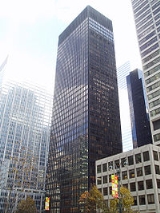
Modern architecture is generally characterized by simplification of form and creation of ornament from the structure and theme of the building. It is a term applied to an overarching movement, with its exact definition and scope varying widely. In a broader sense, modern architecture began at the turn of the 20th century with efforts to reconcile the principles underlying architectural design with rapid technological advancement and the
modernizationIn the social sciences, modernization or modernisation refers to a model of an evolutionary transition from a 'pre-modern' or 'traditional' to a 'modern' society. The teleology of modernization is described in social evolutionism theories, existing as a template that has been generally followed by...
of society. It would take the form of numerous movements, schools of design, and architectural styles, some in tension with one another, and often equally defying such classification.
The concept of
modernismModernism, in its broadest definition, is modern thought, character, or practice. More specifically, the term describes the modernist movement, its set of cultural tendencies and array of associated cultural movements, originally arising from wide-scale and far-reaching changes to Western society...
would be a central theme in these efforts. Gaining popularity after the Second World War, architectural modernism was adopted by many influential architects and architectural educators, and continues as a dominant architectural style for institutional and corporate buildings into the 21st century. Modernism eventually generated reactions, most notably
PostmodernismPostmodern architecture began as an international style the first examples of which are generally cited as being from the 1950s, but did not become a movement until the late 1970s and continues to influence present-day architecture...
which sought to preserve pre-modern elements.
Notable architects important to the history and development of the modernist movement include
Frank Lloyd WrightFrank Lloyd Wright was an American architect, interior designer, writer and educator, who designed more than 1,000 structures and completed 500 works. Wright believed in designing structures which were in harmony with humanity and its environment, a philosophy he called organic architecture...
,
Ludwig Mies van der RoheLudwig Mies van der Rohe was a German architect. He is commonly referred to and addressed as Mies, his surname....
,
Le CorbusierCharles-Édouard Jeanneret, better known as Le Corbusier , was a Swiss-born French architect, designer, urbanist, writer and painter, famous for being one of the pioneers of what now is called modern architecture. He was born in Switzerland and became a French citizen in 1930...
,
Oscar NiemeyerOscar Ribeiro de Almeida Niemeyer Soares Filho is a Brazilian architect specializing in international modern architecture...
,
Alvar AaltoHugo Alvar Henrik Aalto was a Finnish architect and designer. His work includes architecture, furniture, textiles and glassware...
,
Walter GropiusWalter Adolph Georg Gropius was a German architect and founder of the Bauhaus School who, along with Ludwig Mies van der Rohe and Le Corbusier, is widely regarded as one of the pioneering masters of modern architecture....
and Louis I Kahn.
Characteristics
Common themes of modern architecture include:
- the notion that "Form follows function
Form follows function is a principle associated with modern architecture and industrial design in the 20th century. The principle is that the shape of a building or object should be primarily based upon its intended function or purpose....
", a dictum originally expressed by Frank Lloyd Wright's early mentor Louis SullivanLouis Henri Sullivan was an American architect, and has been called the "father of skyscrapers" and "father of modernism" He is considered by many as the creator of the modern skyscraper, was an influential architect and critic of the Chicago School, was a mentor to Frank Lloyd Wright, and an...
, meaning that the result of design should derive directly from its purpose
- simplicity and clarity of forms and elimination of "unnecessary detail"
- visual expression of structure (as opposed to the hiding of structural elements)
- the related concept of "Truth to materials
Truth to materials is a tenet of modern architecture , which holds that any material should be used where it is most appropriate and its nature should not be hidden...
", meaning that the true nature or natural appearance of a material ought to be seen rather than concealed or altered to represent something else
- use of industrially-produced materials; adoption of the machine aesthetic
- particularly in International Style modernism, a visual emphasis on horizontal and vertical lines
Origins and early history
There are multiple lenses through which the evolution of modern architecture may be viewed. Some historians see it as a social matter, closely tied to the project of
ModernityModernity typically refers to a post-traditional, post-medieval historical period, one marked by the move from feudalism toward capitalism, industrialization, secularization, rationalization, the nation-state and its constituent institutions and forms of surveillance...
and thus the Enlightenment. Modern architecture developed, in their opinion, as a result of social and political revolutions. Others see Modern architecture as primarily driven by technological and engineering developments. Still other historians regard Modernism as a matter of taste, a reaction against
eclecticismEclecticism is a kind of mixed style in the fine arts: "the borrowing of a variety of styles from different sources and combining them" . Significantly, Eclecticism hardly ever constituted a specific style in art: it is characterized by the fact that it was not a particular style...
and the lavish stylistic excesses of
VictorianThe term Victorian architecture refers collectively to several architectural styles employed predominantly during the middle and late 19th century. The period that it indicates may slightly overlap the actual reign, 20 June 1837 – 22 January 1901, of Queen Victoria. This represents the British and...
and
Edwardian architectureEdwardian architecture is the style popular when King Edward VII of the United Kingdom was in power; he reigned from 1901 to 1910, but the architecture style is generally considered to be indicative of the years 1901 to 1914....
.
With the
Industrial RevolutionThe Industrial Revolution was a period from the 18th to the 19th century where major changes in agriculture, manufacturing, mining, transportation, and technology had a profound effect on the social, economic and cultural conditions of the times...
, the availability of newly-available building materials such as
ironIron is a chemical element with the symbol Fe and atomic number 26. It is a metal in the first transition series. It is the most common element forming the planet Earth as a whole, forming much of Earth's outer and inner core. It is the fourth most common element in the Earth's crust...
,
steelSteel is an alloy that consists mostly of iron and has a carbon content between 0.2% and 2.1% by weight, depending on the grade. Carbon is the most common alloying material for iron, but various other alloying elements are used, such as manganese, chromium, vanadium, and tungsten...
, and sheet glass drove the invention of new building techniques. In 1796,
ShrewsburyShrewsbury is the county town of Shropshire, in the West Midlands region of England. Lying on the River Severn, it is a civil parish home to some 70,000 inhabitants, and is the primary settlement and headquarters of Shropshire Council...
mill owner Charles Bage first used his '
fireproof-Track List for Original 2002 Release:# "Fireproof" – 3:46# "Just 2 Get By" – 4:17# "Echelon" – 3:25# "Stay Up" – 3:40# "Behind Closed Doors" – 2:55# "Epidemic" – 3:14# "Hindsight" – 2:57# "Light at My Feet" – 3:28# "A Shame" – 3:17...
' design, which relied on cast iron and brick with flag stone floors. Such construction greatly strengthened the structure of mills, which enabled them to accommodate much bigger machines. Due to poor knowledge of iron's properties as a construction material, a number of early mills collapsed. It was not until the early 1830s that
Eaton HodgkinsonEaton A. Hodgkinson was an English engineer, a pioneer of the application of mathematics to problems of structural design.-Early life:...
introduced the
section beamSection Beams are made of steel and they have a specific lengths and shapes like -beam, L, channel and I flanged beam. These types of section are usually used in steel structures and it is common to connected them with plates of steel.- Joints :...
, leading to widespread use of iron construction. This kind of austere industrial architecture utterly transformed the landscape of northern Britain, leading to the description of places like
ManchesterManchester is a city and metropolitan borough in Greater Manchester, England. According to the Office for National Statistics, the 2010 mid-year population estimate for Manchester was 498,800. Manchester lies within one of the UK's largest metropolitan areas, the metropolitan county of Greater...
and parts of
West YorkshireWest Yorkshire is a metropolitan county within the Yorkshire and the Humber region of England with a population of 2.2 million. West Yorkshire came into existence as a metropolitan county in 1974 after the passage of the Local Government Act 1972....
as "Dark satanic mills".
The Crystal PalaceThe Crystal Palace was a cast-iron and glass building originally erected in Hyde Park, London, England, to house the Great Exhibition of 1851. More than 14,000 exhibitors from around the world gathered in the Palace's of exhibition space to display examples of the latest technology developed in...
by
Joseph PaxtonSir Joseph Paxton was an English gardener and architect, best known for designing The Crystal Palace.-Early life:...
at the Great Exhibition of 1851 was an early example of iron and glass construction, followed in 1864 by the first glass and metal
curtain wallA curtain wall is an outer covering of a building in which the outer walls are non-structural, but merely keep out the weather. As the curtain wall is non-structural it can be made of a lightweight material reducing construction costs. When glass is used as the curtain wall, a great advantage is...
. A further development was that of the steel-framed skyscraper in
ChicagoChicago is the largest city in the US state of Illinois. With nearly 2.7 million residents, it is the most populous city in the Midwestern United States and the third most populous in the US, after New York City and Los Angeles...
around 1890 by
William Le Baron JenneyWilliam Le Baron Jenney was an American architect and engineer who became known as the Father of the American skyscraper.- Life and career :...
and
Louis SullivanLouis Henri Sullivan was an American architect, and has been called the "father of skyscrapers" and "father of modernism" He is considered by many as the creator of the modern skyscraper, was an influential architect and critic of the Chicago School, was a mentor to Frank Lloyd Wright, and an...
.
Around 1900 a number of architects and designers around the world began developing new solutions to integrate traditional precedents (
classicismClassicism, in the arts, refers generally to a high regard for classical antiquity, as setting standards for taste which the classicists seek to emulate. The art of classicism typically seeks to be formal and restrained: of the Discobolus Sir Kenneth Clark observed, "if we object to his restraint...
or
GothicGothic architecture is a style of architecture that flourished during the high and late medieval period. It evolved from Romanesque architecture and was succeeded by Renaissance architecture....
, for instance) with new technological possibilities. The work of
Louis SullivanLouis Henri Sullivan was an American architect, and has been called the "father of skyscrapers" and "father of modernism" He is considered by many as the creator of the modern skyscraper, was an influential architect and critic of the Chicago School, was a mentor to Frank Lloyd Wright, and an...
and
Frank Lloyd WrightFrank Lloyd Wright was an American architect, interior designer, writer and educator, who designed more than 1,000 structures and completed 500 works. Wright believed in designing structures which were in harmony with humanity and its environment, a philosophy he called organic architecture...
in Chicago,
Victor HortaVictor, Baron Horta was a Belgian architect and designer. John Julius Norwich described him as "undoubtedly the key European Art Nouveau architect." Indeed, Horta is one of the most important names in Art Nouveau architecture; the construction of his Hôtel Tassel in Brussels in 1892-3 means that...
in Brussels,
Antoni GaudiAntoni Gaudí i Cornet was a Spanish Catalan architect and figurehead of Catalan Modernism. Gaudí's works reflect his highly individual and distinctive style and are largely concentrated in the Catalan capital of Barcelona, notably his magnum opus, the Sagrada Família.Much of Gaudí's work was...
in Barcelona,
Otto WagnerOtto Koloman Wagner was an Austrian architect and urban planner, known for his lasting impact on the appearance of his home town Vienna, to which he contributed many landmarks.-Life:...
and the
Vienna SecessionThe Vienna Secession was formed in 1897 by a group of Austrian artists who had resigned from the Association of Austrian Artists, housed in the Vienna Künstlerhaus. This movement included painters, sculptors, and architects...
in Austria, and
Charles Rennie MackintoshCharles Rennie Mackintosh was a Scottish architect, designer, watercolourist and artist. He was a designer in the Arts and Crafts movement and also the main representative of Art Nouveau in the United Kingdom. He had a considerable influence on European design...
in Glasgow, among many others, can be seen as a common struggle between old and new. The work of some of these were a part of what is broadly categorized as
Art NouveauArt Nouveau is an international philosophy and style of art, architecture and applied art—especially the decorative arts—that were most popular during 1890–1910. The name "Art Nouveau" is French for "new art"...
("New Art"). Note that the
RussianRussian is a Slavic language used primarily in Russia, Belarus, Uzbekistan, Kazakhstan, Tajikistan and Kyrgyzstan. It is an unofficial but widely spoken language in Ukraine, Moldova, Latvia, Turkmenistan and Estonia and, to a lesser extent, the other countries that were once constituent republics...
word for Art Nouveau,
"Модерн", and the
SpanishSpanish , also known as Castilian , is a Romance language in the Ibero-Romance group that evolved from several languages and dialects in central-northern Iberia around the 9th century and gradually spread with the expansion of the Kingdom of Castile into central and southern Iberia during the...
word for Art Nouveau,
"Modernismo" are cognates of the
EnglishEnglish is a West Germanic language that arose in the Anglo-Saxon kingdoms of England and spread into what was to become south-east Scotland under the influence of the Anglian medieval kingdom of Northumbria...
word "Modern" though they carry different meanings. An early use of the term in print around this time, approaching its later meaning, was in the title of a book by
Otto WagnerOtto Koloman Wagner was an Austrian architect and urban planner, known for his lasting impact on the appearance of his home town Vienna, to which he contributed many landmarks.-Life:...
. The fallout of the First World War would result in additional experimentation and ideas. Following out of the experiments in Art Nouveau and its related movements around the world, modernism in architecture and design grew out of stylistic threads originating throughout world.
In the United States
Wright's
Larkin BuildingThe Larkin Building was designed in 1904 by Frank Lloyd Wright and built in 1906 for the Larkin Soap Company of Buffalo, New York. The five story dark red brick building used pink tinted mortar and utilized steel frame construction. It was noted for many innovations, including air conditioning,...
(1904) in
Buffalo, New YorkBuffalo is the second most populous city in the state of New York, after New York City. Located in Western New York on the eastern shores of Lake Erie and at the head of the Niagara River across from Fort Erie, Ontario, Buffalo is the seat of Erie County and the principal city of the...
,
Unity TempleUnity Temple is a Unitarian Universalist church in Oak Park, Illinois, and the home of the Unity Temple Unitarian Universalist Congregation. It was designed by the American architect Frank Lloyd Wright, and built between 1905 and 1908. Unity Temple is considered to be one of Wright's most important...
(1905) in
Oak Park, IllinoisOak Park, Illinois is a suburb bordering the west side of the city of Chicago in Cook County, Illinois, United States. It is the twenty-fifth largest municipality in Illinois. Oak Park has easy access to downtown Chicago due to public transportation such as the Chicago 'L' Blue and Green lines,...
, and the
Robie HouseThe Frederick C. Robie House is a U.S. National Historic Landmark in the Chicago, Illinois neighborhood of Hyde Park at 5757 S. Woodlawn Avenue on the South Side. It was designed and built between 1908 and 1910 by architect Frank Lloyd Wright and is renowned as the greatest example of his Prairie...
(1910) in
ChicagoChicago is the largest city in the US state of Illinois. With nearly 2.7 million residents, it is the most populous city in the Midwestern United States and the third most populous in the US, after New York City and Los Angeles...
, Illinois were some of the first examples of modern architecture in the United States.
Frank Lloyd Wright was a major influence on European architects, including both Walter Gropius (founder of the Bauhaus) and Ludwig Mies van der Rohe, as well as on the whole of
organic architectureOrganic architecture is a philosophy of architecture which promotes harmony between human habitation and the natural world through design approaches so sympathetic and well integrated with its site that buildings, furnishings, and surroundings become part of a unified, interrelated...
. Gropius claimed that his "bible" for forming the Bauhaus was 100 Frank Lloyd Wright drawings that the architect shared with Germany over a decade prior to this point, the
Wasmuth PortfolioThe Wasmuth portfolio is a two-volume folio of 100 lithographs of the work of the American architect Frank Lloyd Wright .Titled Ausgeführte Bauten und Entwürfe von Frank Lloyd Wright, it was published in Germany in 1910 by the Berlin publisher Ernst Wasmuth, with an accompanying monograph by Wright...
. While Wright's career would parallel that of European architects, he refused to be categorized with them, claiming that they copied his ideas. Many architects in Germany believed that Wright's life would be wasted in the United States, since the US wasn't ready for his newer architecture. It would be several decades before the European architects would bring in turn their version to the United States. During the 1930s, Wright would experiment with his Usonian ideas for a uniquely U.S. American (ergo "US-onian") take on modernism.
In Italy: Futurism
Futurist architecture began in the early-20th century, characterized by anti-historicism and long horizontal lines suggesting speed, motion and urgency. Technology and even violence were among the themes of the Futurists. The movement was founded by the poet
Filippo Tommaso MarinettiFilippo Tommaso Emilio Marinetti was an Italian poet and editor, the founder of the Futurist movement, and a fascist ideologue.-Childhood and adolescence:...
, who produced its first manifesto, the
Manifesto of Futurism in 1909. The movement attracted not only poets, musicians, artist (such as
Umberto BoccioniUmberto Boccioni was an Italian painter and sculptor. Like other Futurists, his work centered on the portrayal of movement , speed, and technology. He was born in Reggio Calabria, Italy.-Biography:...
,
Giacomo BallaGiacomo Balla was an Italian painter.-Biography:Born in Turin, in the Piedmont region of Italy, the son of an industrial chemist, as a child Giacomo Balla studied music....
,
Fortunato DeperoFortunato Depero was an Italian futurist painter, writer, sculptor and graphic designer.Although born in Fondo/Malosco , Depero grew up in Rovereto and it was here he first began exhibiting his works, while serving as an apprentice to a marble worker...
, and
Enrico PrampoliniEnrico Prampolini was an Italian Futurist painter, sculptor and scenographer. He assisted in the design of the Exhibition of the Fascist Revolution and was active in Aeropainting....
) but also a number of architects. Among the latter there was
Antonio Sant'EliaAntonio Sant'Elia was an extremely influential Italian architect.-Life:Antonio Sant'Elia was born in Como, Lombardy. A builder by training, he opened a design office in Milan in 1912 and became involved with the Futurist movement...
, who, though he built little (being killed in WWI), translated the Futurist vision into bold urban form. The unbuilt designs and theories of Futurists would go on to influence both the Constructivists and a branch of Italian
Fascist architectureRationalist-Fascist architecture was an Italian architectural style developed during the fascism regime and in particular starting from the late 1920s. It was promoted and practiced initially by the Gruppo 7 group, whose architects included Luigi Figini, Guido Frette, Sebastiano Larco, Gino...
.
In Russia: Constructivism
Following the 1917 revolutions in Russia, the societal upheaval and change was coupled with a desire for a new aesthetic, one more in keeping with the Communist philosophy and societal goals of the new state, in contrast to the ornate Neoclassicism that had prevailed prior. This resulted in a new style, Constructivism.
Konstantin MelnikovKonstantin Stepanovich Melnikov was a Russian architect and painter. His architectural work, compressed into a single decade , placed Melnikov on the front end of 1920s avant-garde architecture...
, a Russian
Constructivist architectConstructivist architecture was a form of modern architecture that flourished in the Soviet Union in the 1920s and early 1930s. It combined advanced technology and engineering with an avowedly Communist social purpose. Although it was divided into several competing factions, the movement produced...
, designed the Melnikov House (1927-29) near
Arbat StreetThe Arbat is an approximately one-kilometer long pedestrian street in the historical centre of Moscow. The Arbat has existed at least since the 15th century, thus laying claim to being one of the oldest surviving streets of the Russian capital. It forms the heart of the Arbat District of Moscow...
in
MoscowMoscow is the capital, the most populous city, and the most populous federal subject of Russia. The city is a major political, economic, cultural, scientific, religious, financial, educational, and transportation centre of Russia and the continent...
.
The style would prosper, but fell markedly out of favor during the design competition for the Palace of the Soviets from 1931 to 1933, losing to a more traditional revivalism of Russian architecture with nationalistic overtones, afterwards termed
PostconstructivismPostconstructivism was a transitional architectural style that existed in the Soviet Union in the 1930s, typical of early Stalinist architecture before World War II. The term postconstructivism was coined by Selim Khan-Magomedov, a historian of architecture, to describe the product of avant-garde...
. This resulted in the ultimate demise of the Russian branch of early architectural modernism, though not before it had a chance to influence architects elsewhere, such as Le Corbusier.
In Western Europe
Spanning the gap between the ideals of the
Arts and Crafts movementArts and Crafts was an international design philosophy that originated in England and flourished between 1860 and 1910 , continuing its influence until the 1930s...
, and the Modernism of the 1920s, was the
Deutscher WerkbundThe Deutscher Werkbund was a German association of artists, architects, designers, and industrialists. The Werkbund was to become an important event in the development of modern architecture and industrial design, particularly in the later creation of the Bauhaus school of design...
(German Work Federation) a
GermanGermany , officially the Federal Republic of Germany , is a federal parliamentary republic in Europe. The country consists of 16 states while the capital and largest city is Berlin. Germany covers an area of 357,021 km2 and has a largely temperate seasonal climate...
association of architects, designers and industrialists. It was founded in 1907 in
MunichMunich The city's motto is "" . Before 2006, it was "Weltstadt mit Herz" . Its native name, , is derived from the Old High German Munichen, meaning "by the monks' place". The city's name derives from the monks of the Benedictine order who founded the city; hence the monk depicted on the city's coat...
at the instigation of
Hermann MuthesiusAdam Gottlieb Hermann Muthesius , known as Hermann Muthesius, was a German architect, author and diplomat, perhaps best known for promoting many of the ideas of the English Arts and Crafts movement within Germany and for his subsequent influence on early pioneers of German architectural modernism...
. Muthesius was the author of a three-volume "The English House" of 1905, a survey of the practical lessons of the English Arts and Crafts movement and a leading political and cultural commentator. The purpose of the Werkbund was to sponsor the attempt to integrate traditional crafts with the techniques of industrial mass production. The organization originally included twelve architects and twelve business firms, but quickly expanded. The architects include
Peter BehrensPeter Behrens was a German architect and designer. He was important for the modernist movement, as several of the movements leading names worked for him when they were young.-Biography:Behrens attended the Christianeum Hamburg from September 1877 until Easter 1882...
,
Theodor FischerTheodor Fischer was a German architect and teacher.Fischer planned public housing projects for the city of Munich beginning in 1893. He was the joint founder and first chairman of the Deutscher Werkbund , as well as member of the German version of the Garden city movement...
(who served as its first president),
Josef HoffmannJosef Hoffmann was an Austrian architect and designer of consumer goods.- Biography :...
and
Richard RiemerschmidRichard Riemerschmid was a German architect, painter, designer and city planner from Munich. He was a major figure in Jugendstil, the German form of Art Nouveau, and a founder of architecture in the style...
. Joseph August Lux, an Austrian-born critic, helped formulate its agenda.
As a result of isolation during World War I, an art and design movement developed unique to the Netherlands, known as
De StijlDe Stijl , propagating the group's theories. Next to van Doesburg, the group's principal members were the painters Piet Mondrian , Vilmos Huszár , and Bart van der Leck , and the architects Gerrit Rietveld , Robert van 't Hoff , and J.J.P. Oud...
(literally "the style"), characterized by its use of line and primary colors. While producing little architectural design overall (with notable exception of the
Rietveld Schröder HouseThe Rietveld Schröder House in Utrecht was built in 1924 by Dutch architect Gerrit Rietveld for Mrs. Truus Schröder-Schräder and her three children. She commissioned the house to be designed preferably without walls. Rietveld worked side by side with Schröder-Schräder to create the house...
of 1924), its ideas would go on to impact the architects and designers of the 1920s.
Expressionism
Expressionism was an architectural movement that developed in Northern Europe during the first decades of the 20th century in parallel with the
expressionistExpressionism was a modernist movement, initially in poetry and painting, originating in Germany at the beginning of the 20th century. Its typical trait is to present the world solely from a subjective perspective, distorting it radically for emotional effect in order to evoke moods or ideas...
visual and performing arts. Making notable use of sculptural forms and the novel use of concrete as artistic elements, examples include
Rudolf Steiner'sRudolf Joseph Lorenz Steiner was an Austrian philosopher, social reformer, architect, and esotericist. He gained initial recognition as a literary critic and cultural philosopher...
Second GoetheanumThe Goetheanum, located in Dornach , Switzerland, is the world center for the anthroposophical movement. Named after Johann Wolfgang von Goethe, the center includes two performance halls , gallery and lecture spaces, a library, a bookstore, and administrative spaces for the Anthroposophical...
, built from 1926 near
BaselBasel or Basle In the national languages of Switzerland the city is also known as Bâle , Basilea and Basilea is Switzerland's third most populous city with about 166,000 inhabitants. Located where the Swiss, French and German borders meet, Basel also has suburbs in France and Germany...
,
SwitzerlandSwitzerland name of one of the Swiss cantons. ; ; ; or ), in its full name the Swiss Confederation , is a federal republic consisting of 26 cantons, with Bern as the seat of the federal authorities. The country is situated in Western Europe,Or Central Europe depending on the definition....
and the Einsteinturm in Potsdam, Germany.
The style was characterised by an early-modernist adoption of novel materials, formal innovation, and very unusual massing, sometimes inspired by natural biomorphic forms, sometimes by the new technical possibilities offered by the mass production of brick, steel and especially glass. Many expressionist architects fought in World War I and their experiences, combined with the political turmoil and social upheaval that followed the
German RevolutionThe German Revolution was the politically-driven civil conflict in Germany at the end of World War I, which resulted in the replacement of Germany's imperial government with a republic...
of 1919, resulted in a utopian outlook and a romantic socialist agenda. Economic conditions severely limited the number of built commissions between 1914 and the mid 1920s, resulting in many of the most important expressionist works remaining as projects on paper, such as
Bruno TautBruno Julius Florian Taut , was a prolific German architect, urban planner and author active during the Weimar period....
's
Alpine Architecture and
Hermann FinsterlinHermann Finsterlin was a visionary architect, painter, poet, essayist, toymaker and composer. He played an influential role in the German expressionist architecture movement of the early 20th century but due to the harsh economic climate realised none of his projects...
's
Formspiels. Ephemeral exhibition buildings were numerous and highly significant during this period.
Scenography-Usage:Whilst also aligned with the professional practice of the scenographer, it is important to distinguish the individual elements that comprise the 'design' of a performance event from the term 'scenography' which is as an artistic perspective concerning the visual, experiential and spatial...
for theatre and films provided another outlet for the expressionist imagination, and provided supplemental incomes for designers attempting to challenge conventions in a harsh economic climate. A particular type, using bricks to create its forms (rather than concrete) is known as
Brick ExpressionismThe term Brick Expressionism describes a specific variant of expressionist architecture that uses bricks, tiles or clinker bricks as the main visible building material...
.
Modernism reaches critical mass
It was at this time, during the 1920s, that the most important figures in Modern architecture established their reputations. The big three are commonly recognized as
Le CorbusierCharles-Édouard Jeanneret, better known as Le Corbusier , was a Swiss-born French architect, designer, urbanist, writer and painter, famous for being one of the pioneers of what now is called modern architecture. He was born in Switzerland and became a French citizen in 1930...
in France, and
Walter GropiusWalter Adolph Georg Gropius was a German architect and founder of the Bauhaus School who, along with Ludwig Mies van der Rohe and Le Corbusier, is widely regarded as one of the pioneering masters of modern architecture....
and
Ludwig Mies van der RoheLudwig Mies van der Rohe was a German architect. He is commonly referred to and addressed as Mies, his surname....
in Germany, all of whom trained under Peter Behrens.
Gropius and Mies van der Rohe would both serve as directors of the
Bauhaus', commonly known simply as Bauhaus, was a school in Germany that combined crafts and the fine arts, and was famous for the approach to design that it publicized and taught. It operated from 1919 to 1933. At that time the German term stood for "School of Building".The Bauhaus school was founded by...
, one of a number of European schools and associations concerned with reconciling craft tradition and industrial technology.
Mies van der Rohe designed the German pavilion (known afterward as the
Barcelona PavilionThe Barcelona Pavilion , designed by Ludwig Mies van der Rohe, was the German Pavilion for the 1929 International Exposition in Barcelona, Spain. This building was used for the official opening of the German section of the exhibition. It was an important building in the history of modern...
) at the
1929 Barcelona International ExpositionThe 1929 Barcelona International Exposition took place from 20 May 1929 to 15 January 1930 in Barcelona, Catalonia, Spain...
.
Villa SavoyeVilla Savoye is a modernist villa in Poissy, in the outskirts of Paris, France. It was designed by Swiss architects Le Corbusier and his cousin, Pierre Jeanneret, and built between 1928 and 1931....
, by Le Corbusier and his cousin, was built from 1928 to 1931.
As in Russia, political pressures turned against the modernists. With the rise of Nazism in 1933, the German experiments in modernism would be replaced by
more traditionalist architectural formsNazi architecture was an architectural plan which played a role in the Nazi party's plans to create a cultural and spiritual rebirth in Germany as part of the Third Reich....
.
Style Moderne: tradition and modernism
Following WWI, a stylistic movement would develop that embraced ideas of both modernism (or at least modernization) and traditionalism. It is characterized by the adoption of the machine aesthetic, glorification of technological advancement and new materials, while at the same time adopting or loosely retaining revivalist forms and motifs, and the continued use of ornament.
In the case of the
Art decoArt deco , or deco, is an eclectic artistic and design style that began in Paris in the 1920s and flourished internationally throughout the 1930s, into the World War II era. The style influenced all areas of design, including architecture and interior design, industrial design, fashion and...
, decorative motifs included both those evocative of technology (such as the lightning bolt (electricity) or the tire (the automobile)), and those of the exotic (such as drawing elements from Mesoamerican, African, and Ancient Egyptian designs). Frank Lloyd Wright himself experimented with Mayan Revival, culminating in the concrete cube-based
Ennis HouseThe Ennis House is a residential dwelling in the Los Feliz neighborhood of Los Angeles, California, USA, south of Griffith Park. The home was designed by Frank Lloyd Wright for Charles and Mabel Ennis in 1923, and built in 1924....
of 1924 in Los Angeles.
A later variant,
Streamline ModerneStreamline Moderne, sometimes referred to by either name alone or as Art Moderne, was a late type of the Art Deco design style which emerged during the 1930s...
, simultaneously both played a role in
industrial designIndustrial design is the use of a combination of applied art and applied science to improve the aesthetics, ergonomics, and usability of a product, but it may also be used to improve the product's marketability and production...
and borrowed forms from machines themselves.
More restrained forms with national imagery would also be adopted. In the United States, it took the form of "Stripped Classicism" (alternatively, "PWA Moderne" or "WPA Moderne") a stark version of the
NeoclassicismNeoclassicism is the name given to Western movements in the decorative and visual arts, literature, theatre, music, and architecture that draw inspiration from the "classical" art and culture of Ancient Greece or Ancient Rome...
of Federal buildings earlier in the century. It application ranged in scale from local post-offices to
the PentagonThe Pentagon is the headquarters of the United States Department of Defense, located in Arlington County, Virginia. As a symbol of the U.S. military, "the Pentagon" is often used metonymically to refer to the Department of Defense rather than the building itself.Designed by the American architect...
). At the same time (as noted above), the rise in nationalism would be reflected in the
Stalinist architectureStalinist architecture , also referred to as Stalinist Gothic, or Socialist Classicism, is a term given to architecture of the Soviet Union between 1933, when Boris Iofan's draft for Palace of the Soviets was officially approved, and 1955, when Nikita Khrushchev condemned "excesses" of the past...
of the
Soviet UnionThe Soviet Union , officially the Union of Soviet Socialist Republics , was a constitutionally socialist state that existed in Eurasia between 1922 and 1991....
,
Fascist architectureRationalist-Fascist architecture was an Italian architectural style developed during the fascism regime and in particular starting from the late 1920s. It was promoted and practiced initially by the Gruppo 7 group, whose architects included Luigi Figini, Guido Frette, Sebastiano Larco, Gino...
of Italy, and
Nazi architectureNazi architecture was an architectural plan which played a role in the Nazi party's plans to create a cultural and spiritual rebirth in Germany as part of the Third Reich....
of Germany, what historian Kenneth Frampton termed the "New Tradition". To a less political extent, such an idea of modernized tradition could also be seen in contemporaneous Mycenaean Revival architecture.
During and following World War II, this broad branch of modern architecture would decline, with the rise of the International Style and other mid-century architecture.
Wartime innovation
World War IIWorld War II, or the Second World War , was a global conflict lasting from 1939 to 1945, involving most of the world's nations—including all of the great powers—eventually forming two opposing military alliances: the Allies and the Axis...
(1939–1945) and its aftermath was a major factor in driving innovation in building technology, and in turn, architectural possibilities. The wartime industrial demands resulting in a supply shortage (of such things as steel and other metals), in turn leading to the adoption of new materials, and advancement or novel use of old ones. Similarly, surplus postwar industrial capacity would accelerate materials and techniques, particular architectural aluminum (as a result of advances made in its use in aircraft, etc., during the war). At the same time, there was a rapid demand for structures during the war (such as military and governmental facilities) as well as for housing after the war.
These factors would accelerate experiments with prefabricated building. Though examples of prefabrication have existed since the beginning of the Industrial Revolution, with notable examples during the Interwar period (such as the
dinerA diner, also spelled dinor in western Pennsylvania is a prefabricated restaurant building characteristic of North America, especially in the Midwest, in New York City, in Pennsylvania and in New Jersey, and in other areas of the Northeastern United States, although examples can be found throughout...
), they took several new forms during and after the war: the metal semi-circular
Nissen hutA Nissen hut is a prefabricated steel structure made from a half-cylindrical skin of corrugated steel, a variant of which was used extensively during World War II.-Description:...
s of World War I would be revived and inspire
Quonset hutA Quonset hut is a lightweight prefabricated structure of corrugated galvanized steel having a semicircular cross section. The design was based on the Nissen hut developed by the British during World War I...
s; others included the post-war enameled-steel
Lustron houseLustron houses are prefabricated enameled steel houses developed in the post-World War II era United States in response to the shortage of houses for returning GIs...
s (made from 1947–1950) and Buckminster Fuller's experimental aluminum
Dymaxion HouseThe Dymaxion House was developed by inventor and architect Buckminster Fuller to address several perceived shortcomings with existing homebuilding techniques. Fuller designed several versions of the house at different times, but they were all factory manufactured kits, assembled on site, intended...
.
International Style
In 1932 (prior to World War II), the International Exhibition of Modern Architecture was held at the
Museum of Modern ArtThe Museum of Modern Art is an art museum in Midtown Manhattan in New York City, on 53rd Street, between Fifth and Sixth Avenues. It has been important in developing and collecting modernist art, and is often identified as the most influential museum of modern art in the world...
in New York City.
Philip JohnsonPhilip Cortelyou Johnson was an influential American architect.In 1930, he founded the Department of Architecture and Design at the Museum of Modern Art in New York City, and later , as a trustee, he was awarded an American Institute of Architects Gold Medal and the first Pritzker Architecture...
and collaborator
Henry-Russell HitchcockHenry-Russell Hitchcock was the leading American architectural historian of his generation. A long-time professor at Smith College and New York University, he is best known for writings that helped to define Modern architecture.-Biography:...
drew together many distinct threads and trends in architecture, identified them as stylistically similar and having a common purpose, and consolidated them into the
International styleThe International style is a major architectural style that emerged in the 1920s and 1930s, the formative decades of Modern architecture. The term originated from the name of a book by Henry-Russell Hitchcock and Philip Johnson, The International Style...
. This was a turning point. However, for the remainder of the
Interwar periodInterwar period can refer to any period between two wars. The Interbellum is understood to be the period between the end of the Great War or First World War and the beginning of the Second World War in Europe....
, the Moderne styles would overshadow this movement.
With the labeling of modernist art and architecture in Germany as
degenerateDegenerate art is the English translation of the German entartete Kunst, a term adopted by the Nazi regime in Germany to describe virtually all modern art. Such art was banned on the grounds that it was un-German or Jewish Bolshevist in nature, and those identified as degenerate artists were...
, followed by
World War IIWorld War II, or the Second World War , was a global conflict lasting from 1939 to 1945, involving most of the world's nations—including all of the great powers—eventually forming two opposing military alliances: the Allies and the Axis...
, important figures of the
Bauhaus', commonly known simply as Bauhaus, was a school in Germany that combined crafts and the fine arts, and was famous for the approach to design that it publicized and taught. It operated from 1919 to 1933. At that time the German term stood for "School of Building".The Bauhaus school was founded by...
and
New ObjectivityThe New Objectivity is a term used to characterize the attitude of public life in Weimar Germany as well as the art, literature, music, and architecture created to adapt to it...
fled to the United States:
Marcel BreuerMarcel Lajos Breuer , was a Hungarian-born modernist, architect and furniture designer of Jewish descent. One of the masters of Modernism, Breuer displayed interest in modular construction and simple forms.- Life and work :Known to his friends and associates as Lajkó, Breuer studied and taught at...
and
Walter GropiusWalter Adolph Georg Gropius was a German architect and founder of the Bauhaus School who, along with Ludwig Mies van der Rohe and Le Corbusier, is widely regarded as one of the pioneering masters of modern architecture....
went to the
Harvard Graduate School of DesignThe Harvard Graduate School of Design is a graduate school at Harvard University offering degrees in Architecture, Landscape Architecture, and Urban Planning and Design.-History:...
(the former becoming part of a group known as the "
Harvard FiveThe Harvard Five was a group of architects that settled in New Canaan, Connecticut in the 1940s: John M. Johansen, Marcel Breuer, Landis Gores, Philip Johnson and Eliot Noyes...
"),
Ludwig Mies van der RoheLudwig Mies van der Rohe was a German architect. He is commonly referred to and addressed as Mies, his surname....
to Chicago, with others going to
Black Mountain CollegeBlack Mountain College, a school founded in 1933 in Black Mountain, North Carolina, was a new kind of college in the United States in which the study of art was seen to be central to a liberal arts education, and in which John Dewey's principles of education played a major role...
. Still others would flee to British Palestine, contributing to the design of the White City of Tel Aviv.
While high-style modernist architectural design never became dominant in single-dwelling residential buildings in the United States, in institutional and commercial architecture Modernism became the pre-eminent, and in the schools (for leaders of the architectural profession) the only acceptable, design solution from about 1932 to about 1984.
Architects who worked in the International style wanted to break with architectural tradition and design simple, unornamented buildings. The most commonly used materials are glass for the facade (usually a
curtain wallA curtain wall is an outer covering of a building in which the outer walls are non-structural, but merely keep out the weather. As the curtain wall is non-structural it can be made of a lightweight material reducing construction costs. When glass is used as the curtain wall, a great advantage is...
), steel for exterior support, and concrete for the floors and interior supports; floor plans were functional and logical. The style became most evident in the design of skyscrapers. Perhaps its most famous manifestations include the
United Nations headquartersThe headquarters of the United Nations is a complex in New York City. The complex has served as the official headquarters of the United Nations since its completion in 1952. It is located in the Turtle Bay neighborhood of Manhattan, on spacious grounds overlooking the East River...
(Le Corbusier,
Oscar NiemeyerOscar Ribeiro de Almeida Niemeyer Soares Filho is a Brazilian architect specializing in international modern architecture...
, Sir Howard Robertson), the
Seagram BuildingThe Seagram Building is a skyscraper, located at 375 Park Avenue, between 52nd Street and 53rd Street in Midtown Manhattan, New York City. It was designed by Ludwig Mies van der Rohe, in collaboration with Philip Johnson. Severud Associates were the structural engineering consultants. The building...
and the
Toronto-Dominion CentreThe Toronto-Dominion Centre, or Centre, is a cluster of buildings in downtown Toronto, Ontario, Canada, consisting of six towers and a pavilion covered in bronze-tinted glass and black painted steel. It serves as the global headquarters of the Toronto-Dominion Bank, as well as providing office and...
(Ludwig Mies van der Rohe), and
Lever HouseLever House, designed by Gordon Bunshaft of Skidmore, Owings and Merrill and located at 390 Park Avenue in New York City, is the quintessential and seminal glass-box skyscraper built in the International style according to the design principles of Ludwig Mies van der Rohe. Completed in 1952, it was...
(Skidmore, Owings, and Merrill).
In the United States, a prominent early residential example was the
Lovell HouseThe Lovell House or Lovell Health House is an International style modernist residence designed and built by Richard Neutra between 1927-29. The home, located at 4616 Dundee Drive in Los Angeles, California, was built for the physician and naturopath Philip Lovell...
in Los Angeles, designed by Austrian expatriate
Richard NeutraRichard Joseph Neutra is considered one of modernism's most important architects.- Biography :Neutra was born in Leopoldstadt, the 2nd district of Vienna, Austria Hungary, on April 8, 1892. He was born into both-Jewish wealthy family...
in the 1920s. Other examples include the
Case Study HousesThe Case Study Houses were experiments in American residential architecture sponsored by Arts & Architecture magazine, which commissioned major architects of the day, including Richard Neutra, Raphael Soriano, Craig Ellwood, Charles and Ray Eames, Pierre Koenig and Eero Saarinen, to design and...
. Commissioned between 1945 and 1966, the twenty or so homes that were built primarily in and around Los Angeles, designed by architects such as Neutra and Americans
Charles and Ray EamesCharles Ormond Eames, Jr and Bernice Alexandra "Ray" Eames were American designers, who worked in and made major contributions to modern architecture and furniture. They also worked in the fields of industrial and graphic design, fine art and film.-Charles Eames:Charles Eames, Jr was born in...
(the
Eames HouseThe Eames House is a landmark of mid-20th century modern architecture located at 203 North Chautauqua Boulevard in the Pacific Palisades neighborhood of Los Angeles...
) have attracted hundreds of thousands of visitors since their completion, and have influenced many architects over the years. These and other Modern residences tend to focus on humanizing the otherwise harsh ideal, making them more livable and ultimately more appealing to real people. Many of these designs use a similar tactic: blurring the line between indoor and outdoor spaces. This is achieved by embracing "the box" while at the same time dissolving it into the background with minimal structure and large glass walls, as was particularly the case with the Farnsworth House by Mies van der Rohe and the
Glass HouseThe Glass House or Johnson house, built in 1949 in New Canaan, Connecticut, was designed by Philip Johnson as his own residence and is a masterpiece in the use of glass. It was an important and influential project for Johnson and for modern architecture. The building is an essay in minimal...
by Philip Johnson, the later part of a set of residences by the "Harvard Five" in
New Canaan, ConnecticutNew Canaan is a town in Fairfield County, Connecticut, United States, northeast of Stamford, on the Fivemile River. The population was 19,738 according to the 2010 census.The town is one of the most affluent communities in the United States...
. Some critics claim that these spaces remain too cold and static for the average person to function, however. The materials utilized in a large number of Modern homes are not hidden behind a softening facade. While this may make them somewhat less desirable for the general public, most modernist architects see this as a necessary and pivotal tenet of Modernism: uncluttered and purely
MinimalMinimalism describes movements in various forms of art and design, especially visual art and music, where the work is set out to expose the essence, essentials or identity of a subject through eliminating all non-essential forms, features or concepts...
design.
Urban design and mass housing
The Congrès Internationaux d'Architecture Moderne (CIAM) would be a force in the shaping Modernist
urban planningUrban planning incorporates areas such as economics, design, ecology, sociology, geography, law, political science, and statistics to guide and ensure the orderly development of settlements and communities....
, and consequently the design of cities and the structures within, from 1928 to 1959. Its 1933 meeting resulted in the basis of what would become, via
Le CorbusierCharles-Édouard Jeanneret, better known as Le Corbusier , was a Swiss-born French architect, designer, urbanist, writer and painter, famous for being one of the pioneers of what now is called modern architecture. He was born in Switzerland and became a French citizen in 1930...
, the
Athens CharterThe Athens Charter, or Charte d'Athènes was a document about urban planning published by the Swiss architect, Le Corbusier in 1943. The work was based upon Le Corbusier’s Ville Radieuse book of 1935 and urban studies undertaken by the Congrès International d'Architecture Moderne in the early...
, which would drive urban planning practice for much of the mid-20th century.
Following its principles, in the late 1950s the entirely-new city of
BrasíliaBrasília is the capital city of Brazil. The name is commonly spelled Brasilia in English. The city and its District are located in the Central-West region of the country, along a plateau known as Planalto Central. It has a population of about 2,557,000 as of the 2008 IBGE estimate, making it the...
was built as a new capital for
BrazilBrazil , officially the Federative Republic of Brazil , is the largest country in South America. It is the world's fifth largest country, both by geographical area and by population with over 192 million people...
, designed by
Lucio CostaLucio Costa was a Brazilian architect and urban planner.-Career:Costa was born in Toulon, France.Educated at the Royal Grammar School, Newcastle upon Tyne, England and in Montreux until 1916, he graduated as an architect in 1924 from the School of Fine Art in Rio de Janeiro...
, with prominent works for it designed by
Oscar NiemeyerOscar Ribeiro de Almeida Niemeyer Soares Filho is a Brazilian architect specializing in international modern architecture...
. Le Corbusier himself would help design the city of
ChandigarhChandigarh is a union territory of India that serves as the capital of two states, Haryana and Punjab. The name Chandigarh translates as "The Fort of Chandi". The name is from an ancient temple called Chandi Mandir, devoted to the Hindu goddess Chandi, in the city...
in India.
The devastation that WWII wrought in Europe, Asia, and the Pacific and subsequent post-war housing shortages would result in a vast building and rebuilding of cities, with a variety of techniques employed for the creation of mass-housing. One attempt to solve this was by using the
Tower blockA tower block, high-rise, apartment tower, office tower, apartment block, or block of flats, is a tall building or structure used as a residential and/or office building...
. In the Eastern Bloc, mass housing would take the form of prefabricated
panel buildingPanel building may refer to buildings of one of the following types:*Built of structural insulated panels*Built of pre-fabricated concrete blocks, named differently in various countries....
s, such as the
PlattenbauPlattenbau is the German word for a building whose structure is constructed of large, prefabricated concrete slabs. The word is a compound of Platte and Bau...
of East Germany, Khrushchyovka of Russia and the
Panelákis a colloquial term in Czech and Slovak for a panel building constructed of pre-fabricated, pre-stressed concrete, such as those extant in Czech Republic and elsewhere in the former Soviet bloc...
of Czechoslovakia.
Mid-Century reactions
As the International Style took hold, others architects reacted to or strayed from its the purely functionalist forms, while at the same time retaining highly modernist characteristics.
Eero SaarinenEero Saarinen was a Finnish American architect and industrial designer of the 20th century famous for varying his style according to the demands of the project: simple, sweeping, arching structural curves or machine-like rationalism.-Biography:Eero Saarinen shared the same birthday as his father,...
,
Alvar AaltoHugo Alvar Henrik Aalto was a Finnish architect and designer. His work includes architecture, furniture, textiles and glassware...
and
Oscar NiemeyerOscar Ribeiro de Almeida Niemeyer Soares Filho is a Brazilian architect specializing in international modern architecture...
were three of the most prolific architects and designers in this movement, which has influenced contemporary modernism.
Le Corbusier once described buildings as "machines for living", but people are not machines and it was suggested that they do not want to live in machines. During the middle of the century, some architects began experimenting in organic forms that they felt were more human and accessible.
Mid-century modernMid-Century modern is an architectural, interior and product design form that generally describes mid-20th century developments in modern design, architecture, and urban development from roughly 1933 to 1965...
ism, or organic modernism, was very popular, due to its democratic and playful nature. Expressionist exploration of form was revived, such as in the
Sydney Opera HouseThe Sydney Opera House is a multi-venue performing arts centre in the Australian city of Sydney. It was conceived and largely built by Danish architect Jørn Utzon, finally opening in 1973 after a long gestation starting with his competition-winning design in 1957...
in Australia by
Jørn UtzonJørn Oberg Utzon, , AC was a Danish architect, most notable for designing the Sydney Opera House in Australia. When it was declared a World Heritage Site on 28 June 2007, Utzon became only the second person to have received such recognition for one of his works during his lifetime...
. Eero Saarinen would invoke suggestions of flight in his designs for the terminal at Dulles International Airport outside of Washington, D.C, or the TWA Terminal in New York, both finished in 1962. The
Mission 66Mission 66 was a US National Park Service ten-year program that was intended to dramatically expand Park Service visitor services by 1966, in time for the 50th anniversary of the establishment of the Park Service....
project of the United States National Park Service would also be built during this time.
Contributing to these expressions were structural advances that enabled new forms to be possible or desirable.
Félix CandelaFélix Candela Outeriño was a Spanish architect known for his significant role in the development of Mexican architecture and structural engineering. Candela’s major contribution to architecture was the development of thin shells made out of reinforced concrete...
, a Spanish expatriate living in Mexico, and Italian engineer
Pier Luigi NerviPier Luigi Nervi was an Italian engineer. He studied at the University of Bologna and qualified in 1913. Dr. Nervi taught as a professor of engineering at Rome University from 1946-61...
, would make particular strides in the use of reinforced concrete and
concrete shellA concrete shell, also commonly called thin shell concrete structure, is a structure composed of a relatively thin shell of concrete, usually with no interior columns or exterior buttresses. The shells are most commonly flat plates and domes, but may also take the form of ellipsoids or cylindrical...
construction. In 1954,
Buckminster FullerRichard Buckminster “Bucky” Fuller was an American systems theorist, author, designer, inventor, futurist and second president of Mensa International, the high IQ society....
patented the
geodesic domeA geodesic dome is a spherical or partial-spherical shell structure or lattice shell based on a network of great circles on the surface of a sphere. The geodesics intersect to form triangular elements that have local triangular rigidity and also distribute the stress across the structure. When...
.
Another stylistic reaction was "New Formalism" (or "Neo-Formalism", sometimes shortened to "Formalism"). Like the pre-war "Stripped Classicism", "New Formalism" would blend elements of
classicismClassicism, in the arts, refers generally to a high regard for classical antiquity, as setting standards for taste which the classicists seek to emulate. The art of classicism typically seeks to be formal and restrained: of the Discobolus Sir Kenneth Clark observed, "if we object to his restraint...
(at their most abstracted levels) with modernist designs. Characteristics drawing on classicism include rigid symmetry, use of columns and colonnades or arcades, and use of high-end materials (such as marble or granite), yet works in this vein also characteristically use the flat roofs common with the International Style. Architects working in this mode included Edward Durrell Stone,
Minoru Yamasakiwas a Japanese-American architect, best known for his design of the twin towers of the World Trade Center, buildings 1 and 2. Yamasaki was one of the most prominent architects of the 20th century...
, and some of the middle-period work of
Philip JohnsonPhilip Cortelyou Johnson was an influential American architect.In 1930, he founded the Department of Architecture and Design at the Museum of Modern Art in New York City, and later , as a trustee, he was awarded an American Institute of Architects Gold Medal and the first Pritzker Architecture...
, with examples in the United States including the Kennedy Center(1971) and the
National Museum of American HistoryThe National Museum of American History: Kenneth E. Behring Center collects, preserves and displays the heritage of the United States in the areas of social, political, cultural, scientific and military history. Among the items on display are the original Star-Spangled Banner and Archie Bunker's...
(1964) in Washington, D.C., and the
Lincoln Center for the Performing ArtsLincoln Center for the Performing Arts is a complex of buildings in the Lincoln Square neighborhood of New York City's Upper West Side. Reynold Levy has been its president since 2002.-History and facilities:...
(mid-1960s) in New York.
Arising shortly after the end of World War II, a particular set of stylistic tendencies in the United States during this time is known as Googie (or "populuxe"), derived from futuristic visions inspired by the imagery of the
Atomic AgeThe Atomic Age, also known as the Atomic Era, is a phrase typically used to delineate the period of history following the detonation of the first nuclear bomb Trinity on July 16, 1945...
and
Space AgeThe Space Age is a time period encompassing the activities related to the Space Race, space exploration, space technology, and the cultural developments influenced by these events. The Space Age is generally considered to have begun with Sputnik...
, with motifs such as atomic orbital patterns and "flying saucers", respectively, such as in the
Space NeedleThe Space Needle is a tower in Seattle, Washington and is a major landmark of the Pacific Northwest region of the United States and a symbol of Seattle. Located at the Seattle Center, it was built for the 1962 World's Fair, during which time nearly 20,000 people a day used the elevators, with over...
in Seattle. Though the style was unique to the United States, similar iconography can be seen in the
AtomiumThe Atomium is a monument in Brussels, originally built for Expo '58, the 1958 Brussels World's Fair. Designed by André Waterkeyn, it stands 102 metres tall...
in Brussels.
A distinctly Mexican take on modernism, "plastic integration", was a syncretization of Mexican artistic traditions (such as
muralismMexican muralism is a Mexican art movement. The most important period of this movement took place primarily from the 1920s to the 1960s, though it exerted an influence on later generations of Mexican artists...
) with International Style forms, and can be seen in the later works of
Luis BarragánLuis Barragán Morfin was a Mexican architect. He was self-trained.-Early life:Educated as an engineer, he graduated from the Escuela Libre de Ingenieros in Guadalajara in 1923 and was self-trained as an architect.After graduation, he travelled through Spain, France , and...
and
Juan O'GormanJuan O'Gorman was a Mexican painter and architect.-Biography:O'Gorman was born in Coyoacán, then a village to the south of Mexico City and now a borough of the Federal District, to an Irish father, Cecil Crawford O'Gorman and a Mexican mother...
, epitomized by the
Ciudad UniversitariaCiudad Universitaria , Mexico, is UNAM's main campus, located in Coyoacán borough in the southern part of Mexico City. Designed by architects Mario Pani and Enrique del Moral, it encloses the Olympic Stadium, about 40 faculties and institutes, the Cultural Center, an ecological reserve, the Central...
of
UNAMUNAM or UNaM may refer to:* National University of Misiones, a National University in Posadas, Argentina*National Autonomous University of Mexico , the large public autonomous university based in Mexico City...
in Mexico City.
Brutalism and monumentality
Architects such as
Louis KahnLouis Isadore Kahn was an American architect, based in Philadelphia, Pennsylvania, United States. After working in various capacities for several firms in Philadelphia, he founded his own atelier in 1935...
,
Paul RudolphPaul Marvin Rudolph was an American architect and the dean of the Yale School of Architecture for six years, known for use of concrete and highly complex floor plans...
,
Marcel BreuerMarcel Lajos Breuer , was a Hungarian-born modernist, architect and furniture designer of Jewish descent. One of the masters of Modernism, Breuer displayed interest in modular construction and simple forms.- Life and work :Known to his friends and associates as Lajkó, Breuer studied and taught at...
, I.M. Pei and others would respond to the "light" glass curtain walls advocated by Ludwig Mies van der Rohe, by creating architecture with an emphasis on more substantial materials, such as concrete and brick, and creating works with a "monumental" quality. "Brutalism" is a term derived from the use of "
Béton brutBéton brut is architectural concrete left unfinished or roughly-finished after pouring and left exposed visually. The imprint of the wood or plywood forms used for pouring is usually present on the final surface....
" ("raw concrete"), unadorned, often with the mold marks remaining, though as a stylistic tendency, Brutalism would ultimately be applied more broadly to include the use of other materials in a similar fashion, such as
brickworkBrickwork is masonry produced by a bricklayer, using bricks and mortar to build up brick structures such as walls. Brickwork is also used to finish corners, door, and window openings, etc...
. The term was first used in architecture by
Le CorbusierCharles-Édouard Jeanneret, better known as Le Corbusier , was a Swiss-born French architect, designer, urbanist, writer and painter, famous for being one of the pioneers of what now is called modern architecture. He was born in Switzerland and became a French citizen in 1930...
.
New structures, new forms
Tube architecture
In 1963, a new structural system of framed tubes appeared in
skyscraper design and constructionThe design and construction of skyscrapers involves creating safe, habitable spaces in very tall buildings. The buildings must support their weight, resist wind and earthquakes, and protect occupants from fire. Yet they must also be conveniently accessible, even on the upper floors, and provide...
. The
Bangladeshi architect and structure engineer
Fazlur KhanFazlur Rahman Khan was a Bangladeshi born architect and structural engineer. He is a central figure behind the "Second Chicago School" of architecture, and is regarded as the "Father of tubular design for high-rises"...
defined the framed tube structure as "a three dimensional space structure composed of three, four, or possibly more frames, braced frames, or shear walls, joined at or near their edges to form a vertical tube-like structural system capable of resisting lateral forces in any direction by cantilevering from the foundation." Closely spaced interconnected exterior columns form the tube. Horizontal loads, for example wind, are supported by the structure as a whole. About half the exterior surface is available for windows. Framed tubes allow fewer interior columns, and so create more usable floor space. Where larger openings like garage doors are required, the tube frame must be interrupted, with transfer girders used to maintain structural integrity.
The first building to apply the tube-frame construction was the DeWitt-Chestnut Apartment Building which Khan designed and was completed in
ChicagoChicago is the largest city in the US state of Illinois. With nearly 2.7 million residents, it is the most populous city in the Midwestern United States and the third most populous in the US, after New York City and Los Angeles...
by 1963. This laid the foundations for the tube structures of many other later skyscrapers, including his own
John Hancock CenterJohn Hancock Center at 875 North Michigan Avenue in the Streeterville area of Chicago, Illinois, is a 100-story, 1,127-foot tall skyscraper, constructed under the supervision of Skidmore, Owings and Merrill, with chief designer Bruce Graham and structural engineer Fazlur Khan...
and
Sears TowerSears' optimistic growth projections were not met. Competition from its traditional rivals continued, with new competition by retailing giants such as Kmart, Kohl's, and Wal-Mart. The fortunes of Sears & Roebuck declined in the 1970s as the company lost market share; its management grew more...
, and can been seen in the
construction of the World Trade CenterThe construction of the World Trade Center was conceived as an urban renewal project, spearheaded by David Rockefeller, to help revitalize Lower Manhattan. The project was developed by the Port Authority of New York and New Jersey, which hired architect Minoru Yamasaki who came up with the specific...
and most other supertall skyscrapers since the 1960s, such as the Petronas Towers and the
Jin Mao BuildingThe Jin Mao Tower is an 88-story landmark supertall skyscraper in the Lujiazui area of the Pudong district of Shanghai, People's Republic of China. It contains offices and the Shanghai Grand Hyatt hotel. Until 2007 it was the tallest building in the PRC, the fifth tallest in the world by roof...
. The architecture of Chicago employing the ideas developed by Khan is often known as the "
Second Chicago SchoolChicago's architecture is famous throughout the world and one style is referred to as the Chicago School. The style is also known as Commercial style. In the history of architecture, the Chicago School was a school of architects active in Chicago at the turn of the 20th century...
".
Postmodern architecture
Modern architecture met with some criticism, which began in the 1960s on the grounds that it seemed universal, elitist, and lacked meaning. Siegfried Giedion in the 1961 introduction to his evolving text,
Space, Time and Architecture (first written in 1941), began "At the moment a certain confusion exists in contemporary architecture, as in painting; a kind of pause, even a kind of exhaustion." At the Metropolitan Museum of Art, a 1961 symposium discussed the question "Modern Architecture: Death or Metamorphosis?"
The loss of traditionalist structures to make way for new modernist construction, especially via the
Urban RenewalUrban renewal is a program of land redevelopment in areas of moderate to high density urban land use. Renewal has had both successes and failures. Its modern incarnation began in the late 19th century in developed nations and experienced an intense phase in the late 1940s – under the rubric of...
movement, led to further criticism, particularly the demolition of Penn Station in New York in 1963. That same year, controversy materialized around the Pan Am Building that loomed over
Grand Central TerminalGrand Central Terminal —often incorrectly called Grand Central Station, or shortened to simply Grand Central—is a terminal station at 42nd Street and Park Avenue in Midtown Manhattan in New York City, United States...
, taking advantage of the modernist real estate concept of "
air rightsAir rights are a type of development right in real estate, referring to the empty space above a property. Generally speaking, owning or renting land or a building gives one the right to use and develop the air rights....
", In criticism by
Ada Louise HuxtableAda Louise Huxtable is an architecture critic and writer on architecture. In 1970 she was awarded the first ever Pulitzer Prize for Criticism for "distinguished criticism during 1969."...
and Douglass Haskell it was seen to "sever" the Park Avenue streetscape and "tarnish" the reputations of its consortium of architects:
Walter GropiusWalter Adolph Georg Gropius was a German architect and founder of the Bauhaus School who, along with Ludwig Mies van der Rohe and Le Corbusier, is widely regarded as one of the pioneering masters of modern architecture....
,
Pietro BelluschiPietro Belluschi was an American architect, a leader of the Modern Movement in architecture, and was responsible for the design of over one thousand buildings....
and the builders
Emery Roth & SonsEmery Roth was an American architect who designed many of the definitive New York City hotels and apartment buildings of the 1920s and 30s, incorporating Beaux-Arts and Art Deco details...
. The proposal for a tower over the terminal itself resulted in the landmark U.S. Supreme Court case
Penn Central Transportation Co. v. New York CityPenn Central Transportation Co. v. New York City, was a landmark United States Supreme Court decision on compensation for regulatory takings.-The New York City Landmarks Law:...
, upholding the city's landmark laws. Alongside these preservation efforts came the increasing respectability and fashionability of more traditional styles.
Architects explored
Postmodern architecturePostmodern architecture began as an international style the first examples of which are generally cited as being from the 1950s, but did not become a movement until the late 1970s and continues to influence present-day architecture...
which offered a blend of some pre-modern elements, and deliberately sought to move away from rectilinear designs, towards more eclectic styles. Even Philip Johnson would come to admit that he was "bored with the box." By the 1980s, postmodern architecture appeared to trend over modernism.
High Postmodern aesthetics lacked traction and by the mid-1990s, a new surge of modern architecture once again established international pre-eminence. As part of this revival, much of the criticism of the modernists was re-evaluated; and a modernistic style once again dominates in institutional and commercial contemporary practice. Although modern and postmodern design compete with a revival of traditional architectural design in commercial and institutional architecture; residential design continues to be dominated by a traditional aesthetic.
Neomodern architecture
Neomodernism is a reaction to Postmodernism and its embrace of pre-modern elements of design. Examples of modern architecture in the 21st Century include One World Trade Center (2013) in New York City and Tour First (2011), the tallest office building in the
ParisParis is the capital and largest city in France, situated on the river Seine, in northern France, at the heart of the Île-de-France region...
metropolitan area. Emporis named Chicago's Modern Aqua Tower (2009) its skyscraper of the year.
Preservation
Several works or collections of modern architecture have been designated by
UNESCOThe United Nations Educational, Scientific and Cultural Organization is a specialized agency of the United Nations...
as World Heritage Sites. In addition to the early experiments associated with Art Nouveau, these include a number of the structures mentioned above in this article: the
Rietveld Schröder HouseThe Rietveld Schröder House in Utrecht was built in 1924 by Dutch architect Gerrit Rietveld for Mrs. Truus Schröder-Schräder and her three children. She commissioned the house to be designed preferably without walls. Rietveld worked side by side with Schröder-Schräder to create the house...
in Utrecht, the
Bauhaus', commonly known simply as Bauhaus, was a school in Germany that combined crafts and the fine arts, and was famous for the approach to design that it publicized and taught. It operated from 1919 to 1933. At that time the German term stood for "School of Building".The Bauhaus school was founded by...
structures in Weimar and Dessau, the Berlin Modernism Housing Estates, the White City of Tel Aviv, the city of
BrasiliaBrasília is the capital city of Brazil. The name is commonly spelled Brasilia in English. The city and its District are located in the Central-West region of the country, along a plateau known as Planalto Central. It has a population of about 2,557,000 as of the 2008 IBGE estimate, making it the...
, the
Ciudad UniversitariaCiudad Universitaria , Mexico, is UNAM's main campus, located in Coyoacán borough in the southern part of Mexico City. Designed by architects Mario Pani and Enrique del Moral, it encloses the Olympic Stadium, about 40 faculties and institutes, the Cultural Center, an ecological reserve, the Central...
of
UNAMUNAM or UNaM may refer to:* National University of Misiones, a National University in Posadas, Argentina*National Autonomous University of Mexico , the large public autonomous university based in Mexico City...
in Mexico City and the University City of Caracas in Venezuela, and the
Sydney Opera HouseThe Sydney Opera House is a multi-venue performing arts centre in the Australian city of Sydney. It was conceived and largely built by Danish architect Jørn Utzon, finally opening in 1973 after a long gestation starting with his competition-winning design in 1957...
.
Private organizations such as
Docomomo InternationalDocomomo International is a non-profit organization whose full title is International Working Party for Documentation and Conservation of Buildings, Sites and Neighborhoods of the Modern Movement.-History:Its foundation was inspired by the work of ICOMOS, the International Council on Monuments and...
, the
World Monuments FundWorld Monuments Fund is a private, international, non-profit organization dedicated to the preservation of historic architecture and cultural heritage sites around the world through fieldwork, advocacy, grantmaking, education, and training....
, and the Recent Past Preservation Network are working to safeguard and document imperiled Modern architecture. In 2006, the World Monuments Fund launched
Modernism at Risk, an advocacy and conservation program.
Following the destruction caused by
Hurricane KatrinaHurricane Katrina of the 2005 Atlantic hurricane season was a powerful Atlantic hurricane. It is the costliest natural disaster, as well as one of the five deadliest hurricanes, in the history of the United States. Among recorded Atlantic hurricanes, it was the sixth strongest overall...
, Modern structures in New Orleans have been increasingly slated for demolition. Currently plans are underway to demolish many of the city's Modern public schools, as well as large portions of the city's Civic Plaza. FEMA funds will contribute to razing the State Office Building and State Supreme Court Building, both designed by the collaborating architectural firms of August Perez and Associates; Goldstein, Parham and Labouisse; and Favrot, Reed, Mathes and Bergman. The New Orleans Recovery School District has proposed demolitions of schools designed by Charles R. Colbert, Curtis and Davis, and Ricciuti Associates. The 1959 Lawrence and Saunders building for the New Orleans International Longshoremen's Association Local 1419 is currently threatened with demolition although the union supports its conservation.
External links