

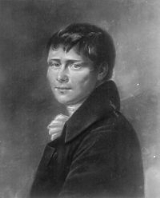
Heinrich von Kleist

Encyclopedia
Bernd Heinrich Wilhelm von Kleist (18 October 1777 – 21 November 1811) was a poet
, dramatist
, novel
ist and short story
writer. The Kleist Prize
, a prestigious prize for German literature, is named after him.
family in Frankfurt an der Oder
in the Margraviate of Brandenburg
. After a scanty education, he entered the Prussian Army
in 1792, served in the Rhine campaign
of 1796, and retired from the service in 1799 with the rank of lieutenant. He studied law and philosophy at the Viadrina University and in 1800 received a subordinate post in the Ministry of Finance at Berlin.
In the following year, Kleist's roving, restless spirit got the better of him, and procuring a lengthened leave of absence he visited Paris and then settled in Switzerland. Here he found congenial friends in Heinrich Zschokke
and Ludwig Friedrich August Wieland (d. 1819), son of the poet Christoph Martin Wieland
; and to them he read his first drama, a gloomy tragedy, The Schroffenstein Family (1803, originally entitled The Ghonorez Family).
In the autumn of 1802, Kleist returned to Germany; he visited Goethe
, Schiller
, and Wieland in Weimar
, stayed for a while in Leipzig
and Dresden
, again proceeded to Paris, and returning in 1804 to his post in Berlin was transferred to the Domänenkammer (department for the administration of crown lands) at Königsberg
. On a journey to Dresden in 1807, Kleist was arrested by the French as a spy; he remained a close prisoner of the France
at Châlons-sur-Marne. On regaining his liberty, he proceeded to Dresden, where, in conjunction with Adam Heinrich Müller
(1779–1829), he published the journal Phöbus
in 1808.
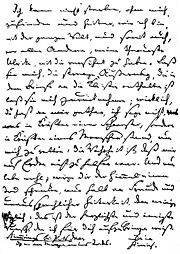 In 1809 Kleist went to Prague
, and ultimately settled in Berlin, where he edited (1810/1811) the Berliner Abendblätter. Captivated by the intellectual and musical accomplishments of the terminally ill Henriette Vogel, Kleist, who was himself more disheartened and embittered than ever, agreed to do her bidding and die with her, carrying out this resolution by first shooting Vogel and then himself on the shore of the Kleiner Wannsee
(Little Wannsee) near Potsdam
, on 21 November 1811.
According to the Encyclopædia Britannica Eleventh Edition
, "Kleist's whole life was filled by a restless striving after ideal and illusory happiness, and this is largely reflected in his work. He was by far the most important North German dramatist of the Romantic movement
, and no other of the Romanticists approaches him in the energy with which he expresses patriotic indignation."
of his later suicide
has been the fodder of his critics.
, The Schroffenstein Family (Die Familie Schroffenstein), has been already referred to; the material for the second, Penthesilea
(1808), queen of the Amazons, is taken from a Greek source
and presents a picture of wild passion. More successful than either of these was his romantic play, Käthchen of Heilbronn (Das Käthchen von Heilbronn) (1808), a poetic drama full of medieval bustle and mystery, which has retained its popularity.
In comedy
, Kleist made a name with The Broken Jug
(Der zerbrochne Krug) (1808), while Amphitryon (1808), an adaptation of Molière
's comedy, is of less importance. Of Kleist's other dramas, Die Hermannsschlacht (1809) is a dramatic work of anti-Napoleonic
propaganda, written as Austria and France went to war
. It has been described by Carl Schmitt
as the "greatest partisan work of all time". In it he gives vent to his hatred of his country's oppressors. This, together with the drama The Prince of Homburg
(Prinz Friedrich von Homburg oder die Schlacht bei Fehrbellin), which is among his best works, was first published by Ludwig Tieck
in Kleist's Hinterlassene Schriften (1821). Robert Guiskard, a drama conceived on a grand plan, was left a fragment.
Kleist was also a master in the art of narrative, and of his Gesammelte Erzählungen (Collected Short Stories) (1810–1811), Michael Kohlhaas
, in which the famous Brandenburg
horse dealer in Martin Luther
's day is immortalized, is one of the best German stories of its time. The Earthquake in Chile
(Das Erdbeben in Chili) and St. Cecilia, or the Power of Music
(Die heilige Cäcilie oder die Gewalt der Musik) are also fine examples of Kleist's story telling as is The Marquise of O (Die Marquise von O.). His short narratives have largely influenced Kafka
's. He also wrote patriotic lyrics in the context of the Napoleonic Wars
.
Seen as a precursor to Henrik Ibsen
and modern drama because of his attention to the real and detailed causes of characters’ emotional crises, he was also understood as a nationalist poet in the German context of the early twentieth century, and was instrumentalized by Nazi
scholars and critics as a kind of proto-Nazi author. To this day, many scholars see his play Die Hermannsschlacht ("The Battle of the Teutoburg Forest
", 1808) as prefiguring the subordination of the individual to the service of the Volk (nation) that became a principle of fascist ideology in the twentieth century. Kleist criticism of the last generation has repudiated nationalist criticism and concentrated instead mainly on psychological, structural and post-structural, philosophical, and narratological modes of reading.
Kleist wrote one of the lasting comedies and most staged plays of the German canon, The Broken Jug
(1803–05) in which a provincial judge gradually and inadvertently shows himself to have committed the crime under investigation. In the enigmatic drama The Prince of Homburg
(1811), a young officer struggles with conflicting impulses of romantic self-actualization and obedience to military discipline. Prince Friedrich, who had expected to be executed for his successful but unauthorized initiative in battle, is surprised to receive a laurel wreath from Princess Natalie. To his question, whether this is a dream, the regimental commander Kottwitz replies, "A dream, what else?"
Kleist wrote his eight novellas later in his life and they show his radically original prose style, which is at the same time careful and detailed, almost bureaucratic, but also full of grotesque, ironic illusions and various sexual, political, and philosophical references. His prose often concentrates on minute details that then serve to subvert the narrative and the narrator, and throw the whole process of narration into question. In Betrothal in St. Domingo (Die Verlobung in Santo Domingo) (1811) Kleist examines the themes of ethics, loyalty, and love in the context of the colonial rebellion
in Haiti
of 1803, driving the story with the expected forbidden love affair between a young white man and a black rebel woman, though the reader's expectations are confounded in typically Kleistian fashion, since the man is not really French and the woman is not really black. Here for the first time in German literature Kleist addresses the politics of a race-based colonial order and shows, through a careful exploration of a kind of politics of color (black, white, and intermediate shades), the self-deception and ultimate impossibility of existence in a world of absolutes.
and psychology which, to the closer look, show an unfathomable insight into the metaphysical questions discussed by philosophers of his time, such as Kant
, Fichte
and Schelling
.
's psychoanalytic model of the soul, especially to his notion of the "unconscious" and its hidden influences on the ego.
Kleist claims that most people are advised to speak only about what they already understand. Instead of talking about what you already know, Kleist admonishes his readers to speak to others with "the sensible intention of instructing yourself." Fostering a dialogue through the art of "skillful questioning" is the key behind achieving a rational or enlightened state of mind. And yet, Kleist employs the example of the French Revolution as the climactic event of the Enlightenment era whereby man broke free from his dark and feudal chains in favor of liberty, equality, fraternity
. It is not that easy though for Kleist. Man cannot simply guide himself into the future with a rational mind as his primary tool. Therefore, Kleist strongly advocates for the usefulness of reflection ex post facto or after the fact. In doing so, man will be able to mold his collective consciousness
in a manner conducive to the principles of free will
. By reflecting after the fact, man will avoid the seemingly detestable inhibitions offered in rational thought. In other words, the will to power
has "its splendid source in the feelings," and thus, man must overcome his "struggle with Fate" with a balanced mixture of wisdom
and passion
.
The metaphysical theory in and behind Kleist's first essay is that consciousness, man's ability to reflect, is the expression of a fall out of nature's harmony, which may either lead to disfunction, when the flow of feelings is interrupted or blocked by thought, or to the stimulation of ideas, when the flow of feelings is cooperating or struggling with thought. A state of total harmony, however, cannot be reached. Only in total harmony of thought and feeling life and consciousness would come to be identical through the total insight of the mind, an idea elaborated and ironically presented in Kleist's second essay "The Puppet Theatre" or "On the Marionette Theater" (Über das Marionettentheater).
This essay also shows Fichte's influence on Kleist. Similar to Kleist, Fichte had emphasised man's ability and necessity to develop his mind in infinity, without ever being able to reach identity with the absolute, because the individual's existence just hangs on the difference.
Without Kleist saying this expressedly, works of art, such as his own, may offer an artificial image of this ideal, though this is in itself wrenched out from the same sinful state of insufficiency and rupture that it wants to transcend.
Kleist's philosophy is the ironic rebuff of all theories of human perfection, whether this perfection is projected in a golden age at the beginníng (Hölderlin
, Novalis
), in the present (Hegel
), or in the future (as the philosophers of the enlightenment
and still Marx
would have seen it). His essays show man, like the literary works, torn apart by conflicting forces and held together on the surface only by illusions, like that of real love (if this was not the worst of all illusions). Jeronimo, for example, in Kleist's The Earthquake in Chile
, is presented as emotionally and socially repressed and incapable of self-control, but still clinging to religious ideas and hopes. At the end of a process marked by chance, luck and coincidence, and driven by greed, hatred and the lust for power, embodied in a repressive social order, the human being that at the beginning had been standing between execution and suicide, is murdered by a mob of brutalized maniacs who mistake their hatred for religious feelings.
The ending of this novella could be used to describe Kleist's concept of life as well as his philosophy and aesthetics, expressed in the ironic style which fits the content: "And sometimes ... it almost seemed to him, that he ought to be happy."
Poetry
Poetry is a form of literary art in which language is used for its aesthetic and evocative qualities in addition to, or in lieu of, its apparent meaning...
, dramatist
Playwright
A playwright, also called a dramatist, is a person who writes plays.The term is not a variant spelling of "playwrite", but something quite distinct: the word wright is an archaic English term for a craftsman or builder...
, novel
Novel
A novel is a book of long narrative in literary prose. The genre has historical roots both in the fields of the medieval and early modern romance and in the tradition of the novella. The latter supplied the present generic term in the late 18th century....
ist and short story
Short story
A short story is a work of fiction that is usually written in prose, often in narrative format. This format tends to be more pointed than longer works of fiction, such as novellas and novels. Short story definitions based on length differ somewhat, even among professional writers, in part because...
writer. The Kleist Prize
Kleist Prize
The Kleist Prize is an annual German literature prize. The prize was first awarded in 1912, on the occasion of the hundredth anniversary of the death of Heinrich von Kleist. The Kleist Prize was the most important literary award of the Weimar Republic, but was discontinued in 1933.In 1985 the prize...
, a prestigious prize for German literature, is named after him.
Life
Kleist was born into the von KleistVon Kleist
Von Kleist is a Pomeranian Prussian noble family. Notable members of this family include:* Ewald Jürgen Georg von Kleist ; co-inventor of the Leyden jar* Ewald Christian von Kleist ; German poet and soldier...
family in Frankfurt an der Oder
Frankfurt (Oder)
Frankfurt is a town in Brandenburg, Germany, located on the Oder River, on the German-Polish border directly opposite the town of Słubice which was a part of Frankfurt until 1945. At the end of the 1980s it reached a population peak with more than 87,000 inhabitants...
in the Margraviate of Brandenburg
Margraviate of Brandenburg
The Margraviate of Brandenburg was a major principality of the Holy Roman Empire from 1157 to 1806. Also known as the March of Brandenburg , it played a pivotal role in the history of Germany and Central Europe....
. After a scanty education, he entered the Prussian Army
Prussian Army
The Royal Prussian Army was the army of the Kingdom of Prussia. It was vital to the development of Brandenburg-Prussia as a European power.The Prussian Army had its roots in the meager mercenary forces of Brandenburg during the Thirty Years' War...
in 1792, served in the Rhine campaign
French Revolutionary Wars: Campaigns of 1796
The French Revolutionary Wars continued from 1795, with the French in an increasingly strong position as members of the First Coalition made separate peaces. Austria and Great Britain were the main remaining members of the coalition...
of 1796, and retired from the service in 1799 with the rank of lieutenant. He studied law and philosophy at the Viadrina University and in 1800 received a subordinate post in the Ministry of Finance at Berlin.
In the following year, Kleist's roving, restless spirit got the better of him, and procuring a lengthened leave of absence he visited Paris and then settled in Switzerland. Here he found congenial friends in Heinrich Zschokke
Heinrich Zschokke
Johann Heinrich Daniel Zschokke was a German author and reformer. Most of his life was spent, and most of his reputation earned, in Switzerland...
and Ludwig Friedrich August Wieland (d. 1819), son of the poet Christoph Martin Wieland
Christoph Martin Wieland
Christoph Martin Wieland was a German poet and writer.- Biography :He was born at Oberholzheim , which then belonged to the Free Imperial City of Biberach an der Riss in the south-east of the modern-day state of Baden-Württemberg...
; and to them he read his first drama, a gloomy tragedy, The Schroffenstein Family (1803, originally entitled The Ghonorez Family).
In the autumn of 1802, Kleist returned to Germany; he visited Goethe
Johann Wolfgang von Goethe
Johann Wolfgang von Goethe was a German writer, pictorial artist, biologist, theoretical physicist, and polymath. He is considered the supreme genius of modern German literature. His works span the fields of poetry, drama, prose, philosophy, and science. His Faust has been called the greatest long...
, Schiller
Friedrich Schiller
Johann Christoph Friedrich von Schiller was a German poet, philosopher, historian, and playwright. During the last seventeen years of his life , Schiller struck up a productive, if complicated, friendship with already famous and influential Johann Wolfgang von Goethe...
, and Wieland in Weimar
Weimar
Weimar is a city in Germany famous for its cultural heritage. It is located in the federal state of Thuringia , north of the Thüringer Wald, east of Erfurt, and southwest of Halle and Leipzig. Its current population is approximately 65,000. The oldest record of the city dates from the year 899...
, stayed for a while in Leipzig
Leipzig
Leipzig Leipzig has always been a trade city, situated during the time of the Holy Roman Empire at the intersection of the Via Regia and Via Imperii, two important trade routes. At one time, Leipzig was one of the major European centres of learning and culture in fields such as music and publishing...
and Dresden
Dresden
Dresden is the capital city of the Free State of Saxony in Germany. It is situated in a valley on the River Elbe, near the Czech border. The Dresden conurbation is part of the Saxon Triangle metropolitan area....
, again proceeded to Paris, and returning in 1804 to his post in Berlin was transferred to the Domänenkammer (department for the administration of crown lands) at Königsberg
Königsberg
Königsberg was the capital of East Prussia from the Late Middle Ages until 1945 as well as the northernmost and easternmost German city with 286,666 inhabitants . Due to the multicultural society in and around the city, there are several local names for it...
. On a journey to Dresden in 1807, Kleist was arrested by the French as a spy; he remained a close prisoner of the France
First French Empire
The First French Empire , also known as the Greater French Empire or Napoleonic Empire, was the empire of Napoleon I of France...
at Châlons-sur-Marne. On regaining his liberty, he proceeded to Dresden, where, in conjunction with Adam Heinrich Müller
Adam Müller
Adam Heinrich Müller was a German publicist, literary critic, political economist, theorist of the state and forerunner of economic romanticism.-Early life:...
(1779–1829), he published the journal Phöbus
Phöbus
Phöbus — Ein Journal für die Kunst was a literary journal published by Heinrich von Kleist and Adam Heinrich Müller in Dresden between January 1808 and December 1808, in twelve issues grouped into nine instalments...
in 1808.
Prague
Prague is the capital and largest city of the Czech Republic. Situated in the north-west of the country on the Vltava river, the city is home to about 1.3 million people, while its metropolitan area is estimated to have a population of over 2.3 million...
, and ultimately settled in Berlin, where he edited (1810/1811) the Berliner Abendblätter. Captivated by the intellectual and musical accomplishments of the terminally ill Henriette Vogel, Kleist, who was himself more disheartened and embittered than ever, agreed to do her bidding and die with her, carrying out this resolution by first shooting Vogel and then himself on the shore of the Kleiner Wannsee
Wannsee
Wannsee is a locality in the southwestern Berlin borough of Steglitz-Zehlendorf, Germany. It is the westernmost locality of Berlin. In the quarter there are two lakes, the larger Großer Wannsee and the Kleiner Wannsee , are located on the river Havel and are separated only by the Wannsee bridge...
(Little Wannsee) near Potsdam
Potsdam
Potsdam is the capital city of the German federal state of Brandenburg and part of the Berlin/Brandenburg Metropolitan Region. It is situated on the River Havel, southwest of Berlin city centre....
, on 21 November 1811.
According to the Encyclopædia Britannica Eleventh Edition
Encyclopædia Britannica Eleventh Edition
The Encyclopædia Britannica Eleventh Edition is a 29-volume reference work, an edition of the Encyclopædia Britannica. It was developed during the encyclopaedia's transition from a British to an American publication. Some of its articles were written by the best-known scholars of the time...
, "Kleist's whole life was filled by a restless striving after ideal and illusory happiness, and this is largely reflected in his work. He was by far the most important North German dramatist of the Romantic movement
German Romanticism
For the general context, see Romanticism.In the philosophy, art, and culture of German-speaking countries, German Romanticism was the dominant movement of the late 18th and early 19th centuries. German Romanticism developed relatively late compared to its English counterpart, coinciding in its...
, and no other of the Romanticists approaches him in the energy with which he expresses patriotic indignation."
A life with a plan
In the spring of 1799, the 21-year-old Kleist wrote a letter to his half-sister Ulrike in which he found it "incomprehensible how a human being can live without a plan for his life" (Lebensplan). In effect, Kleist sought and discovered an overwhelming sense of security by looking to the future with a definitive plan for his life. It brought him happiness and assured him of confidence, especially knowing that life without a plan only saw despair and discomfort. The ironyIrony
Irony is a rhetorical device, literary technique, or situation in which there is a sharp incongruity or discordance that goes beyond the simple and evident intention of words or actions...
of his later suicide
Suicide
Suicide is the act of intentionally causing one's own death. Suicide is often committed out of despair or attributed to some underlying mental disorder, such as depression, bipolar disorder, schizophrenia, alcoholism, or drug abuse...
has been the fodder of his critics.
Literary works
His first tragedyTragedy
Tragedy is a form of art based on human suffering that offers its audience pleasure. While most cultures have developed forms that provoke this paradoxical response, tragedy refers to a specific tradition of drama that has played a unique and important role historically in the self-definition of...
, The Schroffenstein Family (Die Familie Schroffenstein), has been already referred to; the material for the second, Penthesilea
Penthesilea (Kleist)
Penthesilea is a tragedy by the German playwright Heinrich von Kleist. The play, about the mythological Amazonian queen, Penthesilea, is an exploration of sexual frenzy. Goethe rejected the play as "unplayable".-Plot summary:...
(1808), queen of the Amazons, is taken from a Greek source
Penthesilea
Penthesilea or Penthesileia was an Amazonian queen in Greek mythology, the daughter of Ares and Otrera and the sister of Hippolyta, Antiope and Melanippe...
and presents a picture of wild passion. More successful than either of these was his romantic play, Käthchen of Heilbronn (Das Käthchen von Heilbronn) (1808), a poetic drama full of medieval bustle and mystery, which has retained its popularity.
In comedy
Comedy
Comedy , as a popular meaning, is any humorous discourse or work generally intended to amuse by creating laughter, especially in television, film, and stand-up comedy. This must be carefully distinguished from its academic definition, namely the comic theatre, whose Western origins are found in...
, Kleist made a name with The Broken Jug
The Broken Jug
The Broken Jug is a comedy written by the German playwright Heinrich von Kleist. Kleist first conceived the idea for the play in 1801, upon looking at a copper engraving in Heinrich Zschokke's house entitled "Le juge, ou la cruche cassée." In 1803, challenged over his ability to write comedy,...
(Der zerbrochne Krug) (1808), while Amphitryon (1808), an adaptation of Molière
Molière
Jean-Baptiste Poquelin, known by his stage name Molière, was a French playwright and actor who is considered to be one of the greatest masters of comedy in Western literature...
's comedy, is of less importance. Of Kleist's other dramas, Die Hermannsschlacht (1809) is a dramatic work of anti-Napoleonic
Napoleon I
Napoleon Bonaparte was a French military and political leader during the latter stages of the French Revolution.As Napoleon I, he was Emperor of the French from 1804 to 1815...
propaganda, written as Austria and France went to war
War of the Fifth Coalition
The War of the Fifth Coalition, fought in the year 1809, pitted a coalition of the Austrian Empire and the United Kingdom against Napoleon's French Empire and Bavaria. Major engagements between France and Austria, the main participants, unfolded over much of Central Europe from April to July, with...
. It has been described by Carl Schmitt
Carl Schmitt
Carl Schmitt was a German jurist, philosopher, political theorist, and professor of law.Schmitt published several essays, influential in the 20th century and beyond, on the mentalities that surround the effective wielding of political power...
as the "greatest partisan work of all time". In it he gives vent to his hatred of his country's oppressors. This, together with the drama The Prince of Homburg
The Prince of Homburg (play)
The Prince of Homburg is a play by Heinrich von Kleist written in 1809-10, but not performed until 1821, after the author's death. A performance during his lifetime was not possible because Princess Marianne of Prussia , by birth a member of the Hesse-Homburg family, to whom Kleist had given sight...
(Prinz Friedrich von Homburg oder die Schlacht bei Fehrbellin), which is among his best works, was first published by Ludwig Tieck
Ludwig Tieck
Johann Ludwig Tieck was a German poet, translator, editor, novelist, writer of Novellen, and critic, who was one of the founding fathers of the Romantic movement of the late 18th and early 19th centuries.-Early life:...
in Kleist's Hinterlassene Schriften (1821). Robert Guiskard, a drama conceived on a grand plan, was left a fragment.
Kleist was also a master in the art of narrative, and of his Gesammelte Erzählungen (Collected Short Stories) (1810–1811), Michael Kohlhaas
Michael Kohlhaas
Michael Kohlhaas is an 1811 novella by Heinrich von Kleist, based on a 16th-century story of Hans Kohlhase.Both the theme and the style are surprisingly modern...
, in which the famous Brandenburg
Brandenburg
Brandenburg is one of the sixteen federal-states of Germany. It lies in the east of the country and is one of the new federal states that were re-created in 1990 upon the reunification of the former West Germany and East Germany. The capital is Potsdam...
horse dealer in Martin Luther
Martin Luther
Martin Luther was a German priest, professor of theology and iconic figure of the Protestant Reformation. He strongly disputed the claim that freedom from God's punishment for sin could be purchased with money. He confronted indulgence salesman Johann Tetzel with his Ninety-Five Theses in 1517...
's day is immortalized, is one of the best German stories of its time. The Earthquake in Chile
The Earthquake in Chile
The Earthquake in Chile , is a novella written by Heinrich von Kleist . The novella's central characters are two lovers, caught up in the chaos of the 1647 Santiago earthquake in Chile.-Synopsis:...
(Das Erdbeben in Chili) and St. Cecilia, or the Power of Music
St. Cecilia, or the Power of Music
St. Cecilia, or the Power of Music is a short story by the German author Heinrich von Kleist. The story was written on October 27, 1810 as a gift for daughter of his friend Adam Müller, and was first published in November 1810 in Kleist's literary journal, the Berliner Abendblätter.- Plot summary...
(Die heilige Cäcilie oder die Gewalt der Musik) are also fine examples of Kleist's story telling as is The Marquise of O (Die Marquise von O.). His short narratives have largely influenced Kafka
Franz Kafka
Franz Kafka was a culturally influential German-language author of short stories and novels. Contemporary critics and academics, including Vladimir Nabokov, regard Kafka as one of the best writers of the 20th century...
's. He also wrote patriotic lyrics in the context of the Napoleonic Wars
Napoleonic Wars
The Napoleonic Wars were a series of wars declared against Napoleon's French Empire by opposing coalitions that ran from 1803 to 1815. As a continuation of the wars sparked by the French Revolution of 1789, they revolutionised European armies and played out on an unprecedented scale, mainly due to...
.
A German Romantic
Apparently a Romantic by context, predilection, and temperament, Kleist subverts clichéd ideas of Romantic longing and themes of nature and innocence and irony, instead taking up subjective emotion and contextual paradox to show individuals in moments of crises and doubt, with both tragic and comic outcomes, but as often as not his dramatic and narrative situations end without resolution.Seen as a precursor to Henrik Ibsen
Henrik Ibsen
Henrik Ibsen was a major 19th-century Norwegian playwright, theatre director, and poet. He is often referred to as "the father of prose drama" and is one of the founders of Modernism in the theatre...
and modern drama because of his attention to the real and detailed causes of characters’ emotional crises, he was also understood as a nationalist poet in the German context of the early twentieth century, and was instrumentalized by Nazi
Nazism
Nazism, the common short form name of National Socialism was the ideology and practice of the Nazi Party and of Nazi Germany...
scholars and critics as a kind of proto-Nazi author. To this day, many scholars see his play Die Hermannsschlacht ("The Battle of the Teutoburg Forest
Battle of the Teutoburg Forest
The Battle of the Teutoburg Forest took place in 9 CE, when an alliance of Germanic tribes led by Arminius of the Cherusci ambushed and decisively destroyed three Roman legions, along with their auxiliaries, led by Publius Quinctilius Varus.Despite numerous successful campaigns and raids by the...
", 1808) as prefiguring the subordination of the individual to the service of the Volk (nation) that became a principle of fascist ideology in the twentieth century. Kleist criticism of the last generation has repudiated nationalist criticism and concentrated instead mainly on psychological, structural and post-structural, philosophical, and narratological modes of reading.
Kleist wrote one of the lasting comedies and most staged plays of the German canon, The Broken Jug
The Broken Jug
The Broken Jug is a comedy written by the German playwright Heinrich von Kleist. Kleist first conceived the idea for the play in 1801, upon looking at a copper engraving in Heinrich Zschokke's house entitled "Le juge, ou la cruche cassée." In 1803, challenged over his ability to write comedy,...
(1803–05) in which a provincial judge gradually and inadvertently shows himself to have committed the crime under investigation. In the enigmatic drama The Prince of Homburg
The Prince of Homburg (play)
The Prince of Homburg is a play by Heinrich von Kleist written in 1809-10, but not performed until 1821, after the author's death. A performance during his lifetime was not possible because Princess Marianne of Prussia , by birth a member of the Hesse-Homburg family, to whom Kleist had given sight...
(1811), a young officer struggles with conflicting impulses of romantic self-actualization and obedience to military discipline. Prince Friedrich, who had expected to be executed for his successful but unauthorized initiative in battle, is surprised to receive a laurel wreath from Princess Natalie. To his question, whether this is a dream, the regimental commander Kottwitz replies, "A dream, what else?"
Kleist wrote his eight novellas later in his life and they show his radically original prose style, which is at the same time careful and detailed, almost bureaucratic, but also full of grotesque, ironic illusions and various sexual, political, and philosophical references. His prose often concentrates on minute details that then serve to subvert the narrative and the narrator, and throw the whole process of narration into question. In Betrothal in St. Domingo (Die Verlobung in Santo Domingo) (1811) Kleist examines the themes of ethics, loyalty, and love in the context of the colonial rebellion
Haitian Revolution
The Haitian Revolution was a period of conflict in the French colony of Saint-Domingue, which culminated in the elimination of slavery there and the founding of the Haitian republic...
in Haiti
Haiti
Haiti , officially the Republic of Haiti , is a Caribbean country. It occupies the western, smaller portion of the island of Hispaniola, in the Greater Antillean archipelago, which it shares with the Dominican Republic. Ayiti was the indigenous Taíno or Amerindian name for the island...
of 1803, driving the story with the expected forbidden love affair between a young white man and a black rebel woman, though the reader's expectations are confounded in typically Kleistian fashion, since the man is not really French and the woman is not really black. Here for the first time in German literature Kleist addresses the politics of a race-based colonial order and shows, through a careful exploration of a kind of politics of color (black, white, and intermediate shades), the self-deception and ultimate impossibility of existence in a world of absolutes.
Philosophical essays
Kleist is also famous for his essays on subjects of aestheticsAesthetics
Aesthetics is a branch of philosophy dealing with the nature of beauty, art, and taste, and with the creation and appreciation of beauty. It is more scientifically defined as the study of sensory or sensori-emotional values, sometimes called judgments of sentiment and taste...
and psychology which, to the closer look, show an unfathomable insight into the metaphysical questions discussed by philosophers of his time, such as Kant
Immanuel Kant
Immanuel Kant was a German philosopher from Königsberg , researching, lecturing and writing on philosophy and anthropology at the end of the 18th Century Enlightenment....
, Fichte
Johann Gottlieb Fichte
Johann Gottlieb Fichte was a German philosopher. He was one of the founding figures of the philosophical movement known as German idealism, a movement that developed from the theoretical and ethical writings of Immanuel Kant...
and Schelling
Friedrich Wilhelm Joseph Schelling
Friedrich Wilhelm Joseph Schelling , later von Schelling, was a German philosopher. Standard histories of philosophy make him the midpoint in the development of German idealism, situating him between Fichte, his mentor prior to 1800, and Hegel, his former university roommate and erstwhile friend...
.
On the Gradual Production of Thoughts Whilst Speaking
In the first of his larger essays, "On the gradual development of thoughts in the process of speaking", Kleist shows the conflict of thought and feeling in the soul of man, leading to unforeseeable results through incidents which in their turn provoke the inner forces of the soul to express themselves in a spontaneous flow of ideas and words, both stimulating one another to further development. Kleist's view of the hidden forces in the human soul and the quite instable and endangered position of the mind in their struggle can be compared to FreudSigmund Freud
Sigmund Freud , born Sigismund Schlomo Freud , was an Austrian neurologist who founded the discipline of psychoanalysis...
's psychoanalytic model of the soul, especially to his notion of the "unconscious" and its hidden influences on the ego.
Kleist claims that most people are advised to speak only about what they already understand. Instead of talking about what you already know, Kleist admonishes his readers to speak to others with "the sensible intention of instructing yourself." Fostering a dialogue through the art of "skillful questioning" is the key behind achieving a rational or enlightened state of mind. And yet, Kleist employs the example of the French Revolution as the climactic event of the Enlightenment era whereby man broke free from his dark and feudal chains in favor of liberty, equality, fraternity
Liberté, égalité, fraternité
Liberté, égalité, fraternité, French for "Liberty, equality, fraternity ", is the national motto of France, and is a typical example of a tripartite motto. Although it finds its origins in the French Revolution, it was then only one motto among others and was not institutionalized until the Third...
. It is not that easy though for Kleist. Man cannot simply guide himself into the future with a rational mind as his primary tool. Therefore, Kleist strongly advocates for the usefulness of reflection ex post facto or after the fact. In doing so, man will be able to mold his collective consciousness
Consciousness
Consciousness is a term that refers to the relationship between the mind and the world with which it interacts. It has been defined as: subjectivity, awareness, the ability to experience or to feel, wakefulness, having a sense of selfhood, and the executive control system of the mind...
in a manner conducive to the principles of free will
Free will
"To make my own decisions whether I am successful or not due to uncontrollable forces" -Troy MorrisonA pragmatic definition of free willFree will is the ability of agents to make choices free from certain kinds of constraints. The existence of free will and its exact nature and definition have long...
. By reflecting after the fact, man will avoid the seemingly detestable inhibitions offered in rational thought. In other words, the will to power
Will to power
The will to power is widely seen as a prominent concept in the philosophy of Friedrich Nietzsche. The will to power describes what Nietzsche may have believed to be the main driving force in man; achievement, ambition, the striving to reach the highest possible position in life; these are all...
has "its splendid source in the feelings," and thus, man must overcome his "struggle with Fate" with a balanced mixture of wisdom
Wisdom
Wisdom is a deep understanding and realization of people, things, events or situations, resulting in the ability to apply perceptions, judgements and actions in keeping with this understanding. It often requires control of one's emotional reactions so that universal principles, reason and...
and passion
Passion (emotion)
Passion is a term applied to a very strong feeling about a person or thing. Passion is an intense emotion compelling feeling, enthusiasm, or desire for something....
.
The metaphysical theory in and behind Kleist's first essay is that consciousness, man's ability to reflect, is the expression of a fall out of nature's harmony, which may either lead to disfunction, when the flow of feelings is interrupted or blocked by thought, or to the stimulation of ideas, when the flow of feelings is cooperating or struggling with thought. A state of total harmony, however, cannot be reached. Only in total harmony of thought and feeling life and consciousness would come to be identical through the total insight of the mind, an idea elaborated and ironically presented in Kleist's second essay "The Puppet Theatre" or "On the Marionette Theater" (Über das Marionettentheater).
On the Marionette Theater
In a simulated dialogue, Kleist has one of the interlocutors comment that marionettes possess a grace humans do not, a view which contradicts all aesthetic concepts of the past. Our consciousness and capacity for reflection cause us to doubt ourselves or become self-conscious, and prevent us from acting with the singlemindedness and purity of an animal or a puppet. And yet, consciousness is the effect of eating from the tree of knowledge, and we cannot escape it, as long as we are barred from Eden. The interlocutor suggests that the only way out of this dilemma would be to go all the way through, because the garden of Eden could possibly be open on the other side: if we continue to become more intelligent, wiser, and more self-aware, we may eventually be able to carry out the actions we choose, with the same confidence and harmony as a marionette dancing on the strings of a puppeteer. Consciousness creates a split in our nature, rendering us neither animals nor gods. The ultimate development of humankind would be to bring these two parts of ourselves into harmony and no longer suffer doubt or internal conflict. The ending of the essay might seem hopeful, but it leaves the question open as to whether this kind of perfection will ever be possible. It is difficult to determine Kleist's intentions or personal view, because the two interlocutors in the dialogue are obviously presented in an ironic way. Rather than a serious proposal of Kleist's ideas it seems more like an ironic play on the vain ideals of classicism and romanticism.This essay also shows Fichte's influence on Kleist. Similar to Kleist, Fichte had emphasised man's ability and necessity to develop his mind in infinity, without ever being able to reach identity with the absolute, because the individual's existence just hangs on the difference.
Without Kleist saying this expressedly, works of art, such as his own, may offer an artificial image of this ideal, though this is in itself wrenched out from the same sinful state of insufficiency and rupture that it wants to transcend.
Kleist's philosophy is the ironic rebuff of all theories of human perfection, whether this perfection is projected in a golden age at the beginníng (Hölderlin
Friedrich Hölderlin
Johann Christian Friedrich Hölderlin was a major German lyric poet, commonly associated with the artistic movement known as Romanticism. Hölderlin was also an important thinker in the development of German Idealism, particularly his early association with and philosophical influence on his...
, Novalis
Novalis
Novalis was the pseudonym of Georg Philipp Friedrich Freiherr von Hardenberg , an author and philosopher of early German Romanticism.-Biography:...
), in the present (Hegel
Georg Wilhelm Friedrich Hegel
Georg Wilhelm Friedrich Hegel was a German philosopher, one of the creators of German Idealism. His historicist and idealist account of reality as a whole revolutionized European philosophy and was an important precursor to Continental philosophy and Marxism.Hegel developed a comprehensive...
), or in the future (as the philosophers of the enlightenment
Age of Enlightenment
The Age of Enlightenment was an elite cultural movement of intellectuals in 18th century Europe that sought to mobilize the power of reason in order to reform society and advance knowledge. It promoted intellectual interchange and opposed intolerance and abuses in church and state...
and still Marx
Karl Marx
Karl Heinrich Marx was a German philosopher, economist, sociologist, historian, journalist, and revolutionary socialist. His ideas played a significant role in the development of social science and the socialist political movement...
would have seen it). His essays show man, like the literary works, torn apart by conflicting forces and held together on the surface only by illusions, like that of real love (if this was not the worst of all illusions). Jeronimo, for example, in Kleist's The Earthquake in Chile
The Earthquake in Chile
The Earthquake in Chile , is a novella written by Heinrich von Kleist . The novella's central characters are two lovers, caught up in the chaos of the 1647 Santiago earthquake in Chile.-Synopsis:...
, is presented as emotionally and socially repressed and incapable of self-control, but still clinging to religious ideas and hopes. At the end of a process marked by chance, luck and coincidence, and driven by greed, hatred and the lust for power, embodied in a repressive social order, the human being that at the beginning had been standing between execution and suicide, is murdered by a mob of brutalized maniacs who mistake their hatred for religious feelings.
The ending of this novella could be used to describe Kleist's concept of life as well as his philosophy and aesthetics, expressed in the ironic style which fits the content: "And sometimes ... it almost seemed to him, that he ought to be happy."
Sources
- G. Minde-Pouet, Heinrich von Kleist, seine Sprache und sein Stil (1897);
- R. Steig, Heinrich von Kleists Berliner Kämpfe (1901);
- F. Servaes, Heinrich von Kleist (1902);
- Joachim Maass Kleist : a biography, translated from the German by Ralph Manheim (1983);
- Carol Jacobs, Uncontainable romanticism : Shelley, Brontë, Kleist (1989)
- Heinz Ohff, Heinrich von Kleist: Ein preussisches Schicksal, Piper Verlag, Munich (2004) (ISBN 3-492-04651-7)
Sources
- I. Parry, 'Kleist on Puppets', in I. Parry, Hand to Mouth (1981) (repr. in Speak Silence Essays (1988)
- Banham, Martin, ed. 1998. The Cambridge Guide to Theatre. Cambridge: Cambridge University Press. ISBN 0521434378.
- Helbling, Robert. 1975. The Major Works of Heinrich von Kleist. New York: New Directions. ISBN 0811205640.
- Lamport, Francis John. 1990. German Classical Drama: Theatre, Humanity and Nation, 1750–1870. Cambridge: Cambridge University Press. ISBN 0521362709.
- Meldrum Brown, Hilda. 1998. Heinrich Von Kleist The Ambiguity of Art and the Necessity of Form. Oxford: Clarendon Press. ISBN 0198158955.
Further Reading
- Fischer, Bernd and Mehigan, Tim eds. Heinrich von Kleist and Modernity. Rochester, NY: Camden House, 2011. ISBN 9781571135063.
- Fischer, Bernd ed. A Companion to the Works of Heinrich von Kleist. Rochester, NY: Camden House, 2010. ISBN 9781571134516.
- Huff, Steven R. Heinrich von Kleist's Poetics of Passivity. Rochester, NY: Camden House, 2009. ISBN 9781571134226.
- Mehigan, Tim. Heinrich von Kleist: Writing after Kant. Rochester, NY: Camden House, 2011. ISBN 9781571135186.
- Mehigan, Tim. Heinrich von Kleist und die Aufklärung. Rochester, NY: Camden House, 2000. ISBN 9781571130471.
Opera adaptations
- Der Prinz von Homburg (1960), composed by Hans Werner HenzeHans Werner HenzeHans Werner Henze is a German composer of prodigious output best known for "his consistent cultivation of music for the theatre throughout his life"...
- Der zerbrochne KrugThe Broken JugThe Broken Jug is a comedy written by the German playwright Heinrich von Kleist. Kleist first conceived the idea for the play in 1801, upon looking at a copper engraving in Heinrich Zschokke's house entitled "Le juge, ou la cruche cassée." In 1803, challenged over his ability to write comedy,...
(1968/69), composed by Fritz GeißlerFritz GeißlerFritz Geißler was one of the most important composers of the German Democratic Republic.... - PenthesileaPenthesilea (opera)Penthesilea is a one-act opera by Othmar Schoeck, to a German-language libretto by the composer, after the work of the same name by Heinrich von Kleist. It was first performed at the Staatsoper in Dresden, Germany on 8 January 1927....
(1927), composed by Othmar SchoeckOthmar SchoeckOthmar Schoeck was a Swiss composer and conductor.He was known mainly for his considerable output of art songs and song cycles, though he also wrote a number of operas and instrumental compositions including two string quartets and...
Films
- 1969 Wie zwei fröhliche Luftschiffer (Like Two Merry Aeronauts), 85 min; writer and director: Jonatan BrielJonatan BrielJonatan Karl Dieter Briel was a German director, screenplay author, and actor. He was born in Bodenwerder, Lower Saxony, and died in Berlin...
; DFFB Production
- Plot: The last three days Kleist's life. With his lover, Henriette Vogel, dying of cancer, Kleist philosophizes about life and welcomes his planned suicide.
- The Marquise of O (1976), a film directed by Éric RohmerÉric RohmerÉric Rohmer was a French film director, film critic, journalist, novelist, screenwriter and teacher. A figure in the post-war New Wave cinema, he was a former editor of Cahiers du cinéma....
based on Kleist's Die Marquise von ODie Marquise von OThe Marquise of O is a novella by Heinrich von Kleist. It was first published in 1808.-Synopsis:The story begins with a one-sentence paragraph, in which the widowed Marquise von O...
. - Il principe di Homburg (1997), an Italian adaptation of Prinz Friedrich von Homburg oder die Schlacht bei Fehrbellin directed by Marco Bellocchio.
- The Jack BullThe Jack BullThe Jack Bull is a made for television western, produced for HBO, and directed by John Badham. The film is loosely based on Michael Kohlhaas, a novel by Heinrich von Kleist, with the script by Dick Cusack...
(1999), a film directed by John BadhamJohn Badham- External links :...
loosely based on Kleist's Michael KohlhaasMichael KohlhaasMichael Kohlhaas is an 1811 novella by Heinrich von Kleist, based on a 16th-century story of Hans Kohlhase.Both the theme and the style are surprisingly modern...
. - Il seme della discordiaIl seme della discordiaIl seme della discordia is a Golden Lion-nominated 2008 Italian film.The film is a modernisation of Heinrich von Kleist's novel The Marquise of O.- Plot :...
(2008), a modern Italian adaptation of Kleist's Die Marquise von ODie Marquise von OThe Marquise of O is a novella by Heinrich von Kleist. It was first published in 1808.-Synopsis:The story begins with a one-sentence paragraph, in which the widowed Marquise von O...
.
- The Marquise of O (1976), a film directed by Éric Rohmer