
All Topics  
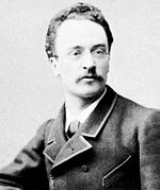
Rudolf Diesel


   Email Print
   Bookmark   Link


Rudolf Diesel


Early life
Diesel was born in ParisParis Summary

native_name = Ville de Paris|common_name = Paris...
, FranceFrance

France, officially the French Republic, is a country whose metropolitan territory is located in Western Europe and whi...
 in 1858 as the second of three children to Theodor and Elise Diesel. Diesel's parents were immigrants living in France according to a biographical book by John F. Moon. Theodor Diesel, a bookbinder by trade, had left his home town of AugsburgAugsburg

Augsburg is a city in south-central Germany....
, Kingdom of BavariaFacts About Kingdom of Bavaria

The Kingdom of Bavaria was a German state that existed from 1806–1918....
, in 1848. He met his wife, Elise Strobel, daughter of a NurembergNuremberg

Nuremberg is a city in the German state of Bavaria, in the administrative region of Middle Franconia....
 merchant, in Paris in 1855 and himself became a leathergoods manufacturer there.

Diesel spent his early childhood in France, but as a result of the outbreak of the Franco-Prussian WarFranco-Prussian War

The Franco-Prussian War was declared by France on Prussia, which was backed by the North German Confederation and the south...
 in 1870, the family was forced to leave and immigrated to LondonLondon

London is the capital city of England and of the United Kingdom....
. Before the end of the war, however, Diesel's mother sent 12-year-old Rudolf to Augsburg to live with his aunt and uncle, Barbara and Christoph Barnickel, so that he might learn to speak GermanGerman language

German is a West Germanic language....
 and visit the Königliche Kreis-Gewerbsschule or Royal County Trade School, where his uncle taught mathematics.

At age 14, Rudolf wrote to his parents that he wanted to become an engineer, and after finishing his basic education at the top of his class in 1873, he enrolled at the newly-founded Industrial School of Augsburg.


Discussion
Ask a question about 'Rudolf Diesel'
Start a new discussion about 'Rudolf Diesel'
Answer questions from other users
Full Discussion Forum


Timeline

1858   Born

1892   Rudolf Diesel patents the diesel engine.

1893   Rudolf Diesel receives a patent for the diesel engine

1913   Rudolf Diesel disappears en route to Britain

1913   Died


Quotations


The diesel engine can be fed with vegetable oils and would help considerably in the development of agriculture of the countries which use it.

1911

The use of vegetable oils for engine fuels may seem insignificant today. But such oils may become in course of time as important as petroleum and the coal tar products of the present time.

1912


Encyclopedia


Early life


Diesel was born in ParisParis Summary

native_name = Ville de Paris|common_name = Paris...
, FranceFrance

France, officially the French Republic, is a country whose metropolitan territory is located in Western Europe and whi...
 in 1858 as the second of three children to Theodor and Elise Diesel. Diesel's parents were immigrants living in France according to a biographical book by John F. Moon. Theodor Diesel, a bookbinder by trade, had left his home town of AugsburgAugsburg

Augsburg is a city in south-central Germany....
, Kingdom of BavariaFacts About Kingdom of Bavaria

The Kingdom of Bavaria was a German state that existed from 1806–1918....
, in 1848. He met his wife, Elise Strobel, daughter of a NurembergNuremberg

Nuremberg is a city in the German state of Bavaria, in the administrative region of Middle Franconia....
 merchant, in Paris in 1855 and himself became a leathergoods manufacturer there.

Diesel spent his early childhood in France, but as a result of the outbreak of the Franco-Prussian WarFranco-Prussian War

The Franco-Prussian War was declared by France on Prussia, which was backed by the North German Confederation and the south...
 in 1870, the family was forced to leave and immigrated to LondonLondon

London is the capital city of England and of the United Kingdom....
. Before the end of the war, however, Diesel's mother sent 12-year-old Rudolf to Augsburg to live with his aunt and uncle, Barbara and Christoph Barnickel, so that he might learn to speak GermanGerman language

German is a West Germanic language....
 and visit the Königliche Kreis-Gewerbsschule or Royal County Trade School, where his uncle taught mathematics.

At age 14, Rudolf wrote to his parents that he wanted to become an engineer, and after finishing his basic education at the top of his class in 1873, he enrolled at the newly-founded Industrial School of Augsburg. Later, in 1875, he received a merit scholarship from the Royal Bavarian Polytechnic in MunichMunich

colspan="2" bgcolor="BBDDFF" | Munich|-bgcolor="#FFFFFF"...
 which he accepted against the will of his perennially cash-strapped parents who would rather have seen him begin earning money.

In Munich, one of his professors was Carl von LindeCarl von Linde

Professor Doctor Carl Paul Gottfried von Linde was a German engineer who developed refrigeration and gas separation technolo...
. Diesel was unable to graduate with his class in July 1879 because of a bout with typhoid. While he waited for the next exam date, he gathered practical engineering experience at the Gebrüder Sulzer Maschinenfabrik in WinterthurWinterthur

Winterthur is a city in the Canton of Zurich in Switzerland....
, SwitzerlandSwitzerland

Switzerland , officially the Swiss Confederation, is a landlocked Alpine country in Central Europe....
. Diesel graduated with highest academic honors from his MunichMunich

colspan="2" bgcolor="BBDDFF" | Munich|-bgcolor="#FFFFFF"...
 alma mater in January 1880 and returned to ParisParis

native_name = Ville de Paris|common_name = Paris...
, where he assisted his former MunichMunich

colspan="2" bgcolor="BBDDFF" | Munich|-bgcolor="#FFFFFF"...
 professor Carl von LindeCarl von Linde

Professor Doctor Carl Paul Gottfried von Linde was a German engineer who developed refrigeration and gas separation technolo...
 with the design and construction of a modern refrigeration and ice plant. Diesel became the director of the plant a scant year later.

In 1883, Diesel married Martha Flasche, and continued to work for Linde, garnering numerous patents in both Germany and France.

In early 1890, Diesel moved his wife and their now three children Rudolf junior, Heddy and Eugen, to Berlin to assume management of Linde's corporate research and development department and to join several other corporate boards there. Because he was not allowed to use the patents he developed while an employee of Linde's for his own purposes, Diesel sought to expand into an area outside of refrigeration. He first toyed with steam, his research into fuel efficiency leading him to build a steam engine using ammoniaAmmonia

Ammonia is a compound of nitrogen and hydrogen with the formula NH3....
 vapor. During tests, this machine exploded with almost fatal consequences and resulted in many months in the hospital and a great deal of ill health and eyesight problems. He also began designing an engine based on the Carnot cycleCarnot cycle

The Carnot cycle is a particular thermodynamic cycle, modeled on the Carnot heat engine, studied by Nicolas Lonard Sadi Carn...
, and in 1893, soon after Gottlieb DaimlerGottlieb Daimler

Gottlieb Wilhelm Daimler was an engineer, industrial designer and industrialist, born in Schorndorf in what is now Germany....
 and Karl BenzKarl Benz

Karl Friedrich Benz was a German engine designer and automobile engineer, generally regarded as the inventor of the petrol-...
 had invented the automobile in 1887, Diesel published a treatise entitled Theorie und Construktion eines rationellen Wärmemotors zum Ersatz der Dampfmaschine und der heute bekannten Verbrennungsmotoren or Theory and Construction of a Rational Heat-engine to Replace the Steam Engine and Combustion Engines Known Today and formed the basis for his work on and invention of the Diesel engine.

Later life

The word "diesel" is derived from eponymous German inventor Rudolf Christian Karl Diesel (March 18, 1858 – September 30, 1913) who in 1892 invented the diesel engine. Diesel understood thermodynamics and the theoretical and practical constraints on fuel efficiency. He knew that even the best steam engines, of his era, were only 10-15% thermodynamically efficient. His work in engine design was driven by the goal of much higher efficiency ratios. He tried to design an engine based on the Carnot Cycle. However, he gave up on this, and eventually, designed his own engine, for which he received a patent. In his engine, fuel was injected at the end of the compression stroke, and the fuel was ignited by the high temperature resulting from this compression. In 1893, he published a book, in German, with the title "Theory and design of a rational thermal engine to replace the steam engine and the combustion engines known today" (English translation of the original title in German) with the help of Springer Verlag, Berlin. He managed to build a working engine according to his theory and design. His engine is now known as the diesel engine. Heinrich von Buz (1833-1918) was director (MAN AG) of an engine factory in Augsburg, Germany and from 1893-1897, he gave Rudolf Diesel the opportunity to test and develop his ideas. Rudolf Diesel obtained patents for his design in Germany and other countries including USA, for example, US Patent 542846 and US Patent 608845.

Death

In the evening of 29 September 1913, Diesel boarded the post office steamer Dresden in AntwerpAntwerp

The city and municipality of Antwerp is a centre of commerce in Flanders and Belgium and the capital of Antwerp province, i...
 on his way to a meeting of the "Consolidated Diesel Manufacturing Ltd." in London. He took dinner on board the ship and then retired to his cabin at about 10 p.m., leaving word for him to be called the next morning at 6:15 a.m. He was never seen alive again. Ten days later, the crew of the Dutch boat "Coertsen" came upon the corpse of a man floating in the sea. The body was in such a heavy state of decomposition that they did not bring it aboard. Instead, the crew retrieved personal items (pill case, wallet, pocket knife, eyeglass case) from the clothing of the dead man, and returned the body to the sea. On 13 October these items were identified by Rudolf's son, Eugen Diesel, as belonging to his father.

Legacy

After Diesel's death, the diesel engineDiesel engine Overview

The diesel engine is a type of internal combustion engine; more specifically, it is a compression ignition engine, in ...
 underwent much development, and became a very important replacement for the steam piston engine in many applications. Because the diesel engine required a heavier, more robust construction than a gasoline engine, it was not widely used in aviationAviation

Aviation refers to flying using aircraft, machines designed by humans for atmospheric flight....
 (but see aircraft diesel engineAircraft diesel engine Summary

The diesel engine has not been widely used as an aircraft engine....
). However, the diesel engine became widespread in many other applications, such as stationary engines, submarineSubmarine

A submarine is a specialized watercraft that can operate underwater....
s, shipsSHIPS

Ships is a Japanese clothing brand, founded in 1975. The president of the company is Yoshinori Miura....
, and much later, locomotiveDiesel locomotive

Diesel locomotives became the dominant type of locomotive in rail transport in the mid 20th-Century....
s, and in modern automobiles. Diesel engines are most often found in applications where a high torque requirement and low RPM requirement exist. Because of their generally more robust construction and high torque, Diesel engines have also become the workhorses of the trucking industry. Recently, diesel engines that have overcome this weight penalty have been designed, certified and flown in light aircraft. These engines are designed to run on either Diesel fuel or more commonly jet fuelJet fuel

Jet fuel is a type of aviation fuel designed for use in jet-engined aircraft....
.

The diesel engine has the benefit of running more fuel-efficiently than gasoline engines. Diesel was especially interested in using coal dustCoal dust

Coal dust is a fine powdered form of coal....
 or vegetable oil as fuel, and his engine in fact ran on peanut oil. Although these fuels were not immediately popular, recent rises in fuel prices coupled with concerns about oil reservesOil reserves

Oil reserves refer to portions of oil in place that are recoverable under economic constraints....
 have led to more widespread use of vegetable oil and biodieselBiodiesel

Biodiesel refers to a diesel-equivalent, processed fuel derived from biological sources....
. The primary source of fuel remains what became known as Diesel fuel, an oil byproduct derived from refinement of petroleumPetroleum Summary

Petroleum or crude oil is a black, dark brown or greenish liquid found in porous rock formations in the earth....
.

Patent dispute with Herbert Akroyd Stuart

Details of the claim that a patent submitted by Herbert Akroyd StuartFacts About Herbert Akroyd Stuart

Herbert Akroyd-StuartInventor of the hot bulb heavy oil engine....
 has pre-dated that of Rudolf Diesel can be found under the name of that inventor.

See also

Rudolf-Diesel-MedailleRudolf-Diesel-Medaille

The Rudolf-Diesel-Medaille is an award by the German Institute for Inventions in memory of Rudolf Diesel for inventions and ...
, German award in memory of Rudolf Diesel

External links