


Moselle

Encyclopedia
Moselle is a department in the east of France
named after the river Moselle.
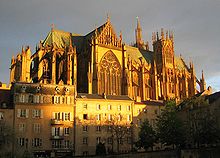 Moselle is one of the original 83 departments created during the French Revolution
on March 4, 1790. It was created from the former province
of Lorraine
.
In 1793, the foreign enclaves of Manderen
, Lixing-lès-Rouhling
, Momerstroff
, and Créhange
(Kriechingen), all possessions of princes of the German Holy Roman Empire
, were annexed by France and incorporated into the Moselle département.
By the Treaty of Paris of 1814
following the first defeat and abdication of Napoleon, France had to surrender almost all its conquests since 1792. On the northeastern border, France was not restored to its 1792 borders, but a new border was established to put an end to the convoluted nature of the border, with all its enclaves and exclaves. As a result, the French exclave of Tholey
(now in Saarland
, Germany
) as well as a few communes near Sierck-les-Bains
(both territories until then part of the Moselle département) were ceded to Austria. On the other hand, the French annexations of 1793 were confirmed, and furthermore, the south of the Napoleonic département of Sarre
was ceded to France, including the town of Lebach
, the city of Saarbrücken
, and the rich coal basin nearby. France was thus a net beneficiary of the Treaty of Paris, all the new territories ceded to her being far larger and more strategic than the few territories ceded to Austria. All these new territories were incorporated into the Moselle department, and so Moselle had now a larger territory than ever since 1790.
However, with the return of Napoleon and his final defeat at the Battle of Waterloo
, the Congress of Vienna
in 1815 imposed much harsher conditions on France. Tholey and the communes around Sierck-les-Bains were still to be ceded as agreed in 1814, but the south of the Sarre department with Saarbrücken was withdrawn from France. In addition, France had to cede to Austria
the area of Rehlingen
(now in Saarland) as well as the strategic fort-town of Saarlouis
and the territory around it, all territories and towns which had been French since the 17th century, and which were part of the Moselle department since 1790. In the end of 1815, Austria gave all these territories to Prussia
, and it is from them that Prussia invaded France in the Franco-Prussian War
of 1870-1871.
Thus, by the end of 1815, the Moselle department had finally the limits that it would keep until 1871. It was slightly smaller than at its creation in 1790, the incorporation of the Austrian enclaves not compensating for the loss of Saarlouis, Rehlingen, Tholey, and the communes around Sierck-les-Bains. Between 1815 and 1871, the department had an area of 5,387 km² (2,080 sq. miles). Its prefecture (capital) was Metz
. It had four arrondissements
: Metz, Briey
, Sarreguemines
, and Thionville
.
After the French defeat in the Franco-Prussian War
of 1870-1871, almost all of the Moselle department, along with Alsace
and portions of the Meurthe
and Vosges
departments, was returned to the German Empire
by the Treaty of Frankfurt
on the ground that the population in those areas spoke German dialects
. Only one-fifth of Moselle (arrondissement of Briey in the extreme west of the department) was spared annexation by Bismarck, as it was a French-speaking area. Bismarck later bitterly regretted his decision when it was discovered that the region of Briey and Longwy
was rich with iron ore. The Moselle department ceased to exist on May 18, 1871, and the territories returned to Germany became part of the Reichsland of Elsaß-Lothringen
. The remaining area of Briey was merged with the truncated Meurthe department to create the new Meurthe-et-Moselle
department (a new name chosen on purpose to remind people of the lost Moselle department) with its préfecture at Nancy.
In 1919, with the French victory in the First World War, Alsace-Lorraine was returned to France by Germany at the Treaty of Versailles
. However, it was not decided to recreate the old departments of Meurthe and Moselle by reverting to the old department borders of before 1871. Instead, Meurthe-et-Moselle was left untouched, and the four-fifths of Moselle that had been annexed by Germany in 1871 were merged with the one-third of Meurthe also annexed in 1871 to create a new department of Moselle. Thus, the Moselle department was reborn, but its borders were quite different from those before 1871. Having lost the area of Briey, it had now gained the areas of Château-Salins
and Sarrebourg
which before 1871 were in the Meurthe department (being one-third of it) and which had been part of the Reichsland of Elsaß-Lothringen since 1871.
The new Moselle department now had its current area of 6,216 km² (2,400 sq. miles), larger than the old Moselle because the areas of Château-Salins and Sarrebourg were far larger than the area of Briey and Longwy.
During World War II
Moselle was again stripped from France and became part of the Gau - Westmark according to the armistice of June 22, 1940. Adolf Hitler considered Moselle and Alsace part of Germany and as a result the inhabitants were drafted into the German Wehrmacht.
Moselle was liberated by the American
army in 1944 and returned to France, within the same frontiers that it had in 1919. As a result of the war and German aggression that led up to it, the Germanic heritage of the region was shunned by the French government and the local population as well. The dialect more or less fell into disuse in the public realm. Recently, efforts have been made to revive the dialect and distinct culture of the region as with the onset of open borders and cordial Franco-German relations the language no longer is associated with the war.
of Lorraine
and is surrounded by the French departments of Meurthe-et-Moselle
and Bas-Rhin
, as well as Germany
(states of Saarland
and Rhineland-Palatinate
) and Luxembourg
in the north. Parts of Moselle belong to Parc naturel régional de Lorraine.
The following are the most important rivers:
The population has remained relatively stable since World War II and now exceeds 1 million, located mostly in the urban area around Metz
and along the river Moselle.
If the Moselle department still existed in its limits of between 1815–1871, its population at the 1999 French census would have been 1,089,804 inhabitants. The current Moselle department, whose limits were set in 1919, had less population, with only 1,023,447 inhabitants. This is because the industrial area of Briey and Longwy lost in 1871 is more populated than the rural areas of Château-Salins and Sarrebourg gained in 1919.
A significant minority of inhabitants of the department (fewer than 100,000) speak a Germanic dialect known as platt lorrain or Lothringer Platt (see Lorraine Franconian
).
Linguistically
, Platt can be further subdivided into three varieties, going from east to west: Rhenish Franconian, Moselle Franconian
, and Luxembourgish
.
to its east have their own laws in certain fields. The statutes in question date primarily from the period 1871 - 1919 when the area was part of the German Empire
. With the return of Alsace-Lorraine to France
in 1919, many in central government assumed that the recovered territories would be subject to French law.
Local resistance to a total acceptance of French law arose because some of Bismarck
's reforms included strong protections for civil and social rights. After much discussion and uncertainty, Paris accepted in 1924 that pre-existing German law would apply in certain fields, notably hunting, economic life, local government relationships, health insurance, and social rights. Many of the relevant statues continue to be referred to in the original German, as they have never been formally translated.
One major difference with French law is the absence of the formal separation between church and state
: several mainstream denominations of the Christian church benefit from state funding, despite principles applied rigorously in the rest of France.
France
The French Republic , The French Republic , The French Republic , (commonly known as France , is a unitary semi-presidential republic in Western Europe with several overseas territories and islands located on other continents and in the Indian, Pacific, and Atlantic oceans. Metropolitan France...
named after the river Moselle.
History
French Revolution
The French Revolution , sometimes distinguished as the 'Great French Revolution' , was a period of radical social and political upheaval in France and Europe. The absolute monarchy that had ruled France for centuries collapsed in three years...
on March 4, 1790. It was created from the former province
Provinces of France
The Kingdom of France was organised into provinces until March 4, 1790, when the establishment of the département system superseded provinces. The provinces of France were roughly equivalent to the historic counties of England...
of Lorraine
Lorraine (province)
The Duchy of Upper Lorraine was an historical duchy roughly corresponding with the present-day northeastern Lorraine region of France, including parts of modern Luxembourg and Germany. The main cities were Metz, Verdun, and the historic capital Nancy....
.
In 1793, the foreign enclaves of Manderen
Manderen
Manderen is a commune in the Moselle department in Lorraine in north-eastern France....
, Lixing-lès-Rouhling
Lixing-lès-Rouhling
Lixing-lès-Rouhling is a commune in the Moselle department in Lorraine in north-eastern France.-Changes in population:-See also:*Communes of the Moselle department...
, Momerstroff
Momerstroff
Momerstroff is a commune in the Moselle department in Lorraine in north-eastern France....
, and Créhange
Créhange
Créhange is a commune in the Moselle department in Lorraine in north-eastern France.It has a population of 3900 .Until 1793, Créhange was the capital of the County of Kriechingen, a state of the Holy Roman Empire....
(Kriechingen), all possessions of princes of the German Holy Roman Empire
Holy Roman Empire
The Holy Roman Empire was a realm that existed from 962 to 1806 in Central Europe.It was ruled by the Holy Roman Emperor. Its character changed during the Middle Ages and the Early Modern period, when the power of the emperor gradually weakened in favour of the princes...
, were annexed by France and incorporated into the Moselle département.
By the Treaty of Paris of 1814
Treaty of Paris (1814)
The Treaty of Paris, signed on 30 May 1814, ended the war between France and the Sixth Coalition, part of the Napoleonic Wars, following an armistice signed on 23 May between Charles, Count of Artois, and the allies...
following the first defeat and abdication of Napoleon, France had to surrender almost all its conquests since 1792. On the northeastern border, France was not restored to its 1792 borders, but a new border was established to put an end to the convoluted nature of the border, with all its enclaves and exclaves. As a result, the French exclave of Tholey
Tholey
Tholey is a municipality in the district of Sankt Wendel, in Saarland, Germany. It is situated approx. 10 km west of Sankt Wendel, and 30 km north of Saarbrücken....
(now in Saarland
Saarland
Saarland is one of the sixteen states of Germany. The capital is Saarbrücken. It has an area of 2570 km² and 1,045,000 inhabitants. In both area and population, it is the smallest state in Germany other than the city-states...
, Germany
Germany
Germany , officially the Federal Republic of Germany , is a federal parliamentary republic in Europe. The country consists of 16 states while the capital and largest city is Berlin. Germany covers an area of 357,021 km2 and has a largely temperate seasonal climate...
) as well as a few communes near Sierck-les-Bains
Sierck-les-Bains
Sierck-les-Bains is a commune in the Moselle department in Lorraine in north-eastern France.-See also:*Communes of the Moselle department...
(both territories until then part of the Moselle département) were ceded to Austria. On the other hand, the French annexations of 1793 were confirmed, and furthermore, the south of the Napoleonic département of Sarre
Sarre (département)
Sarre is the name of a department of the First French Empire which is now part of Germany and Belgium. It is named after the river Saar. It was formed in 1798, when the left bank of the Rhine was annexed by France. Prior to the occupation, its territory was divided between the Archbishopric of...
was ceded to France, including the town of Lebach
Lebach
Lebach is a town in the district of Saarlouis, in Saarland, Germany. It is situated approx. 15 km northeast of Saarlouis, and 20 km north of Saarbrücken.-External links:*...
, the city of Saarbrücken
Saarbrücken
Saarbrücken is the capital of the state of Saarland in Germany. The city is situated at the heart of a metropolitan area that borders on the west on Dillingen and to the north-east on Neunkirchen, where most of the people of the Saarland live....
, and the rich coal basin nearby. France was thus a net beneficiary of the Treaty of Paris, all the new territories ceded to her being far larger and more strategic than the few territories ceded to Austria. All these new territories were incorporated into the Moselle department, and so Moselle had now a larger territory than ever since 1790.
However, with the return of Napoleon and his final defeat at the Battle of Waterloo
Battle of Waterloo
The Battle of Waterloo was fought on Sunday 18 June 1815 near Waterloo in present-day Belgium, then part of the United Kingdom of the Netherlands...
, the Congress of Vienna
Congress of Vienna
The Congress of Vienna was a conference of ambassadors of European states chaired by Klemens Wenzel von Metternich, and held in Vienna from September, 1814 to June, 1815. The objective of the Congress was to settle the many issues arising from the French Revolutionary Wars, the Napoleonic Wars,...
in 1815 imposed much harsher conditions on France. Tholey and the communes around Sierck-les-Bains were still to be ceded as agreed in 1814, but the south of the Sarre department with Saarbrücken was withdrawn from France. In addition, France had to cede to Austria
Austria
Austria , officially the Republic of Austria , is a landlocked country of roughly 8.4 million people in Central Europe. It is bordered by the Czech Republic and Germany to the north, Slovakia and Hungary to the east, Slovenia and Italy to the south, and Switzerland and Liechtenstein to the...
the area of Rehlingen
Rehlingen
Rehlingen is a municipality in the district of Lüneburg, in Lower Saxony, Germany....
(now in Saarland) as well as the strategic fort-town of Saarlouis
Saarlouis
Saarlouis is a city in the Saarland, Germany, capital of the district of Saarlouis. In 2006, the town had a population of 38,327. Saarlouis, as the name implies, is located at the river Saar....
and the territory around it, all territories and towns which had been French since the 17th century, and which were part of the Moselle department since 1790. In the end of 1815, Austria gave all these territories to Prussia
Prussia
Prussia was a German kingdom and historic state originating out of the Duchy of Prussia and the Margraviate of Brandenburg. For centuries, the House of Hohenzollern ruled Prussia, successfully expanding its size by way of an unusually well-organized and effective army. Prussia shaped the history...
, and it is from them that Prussia invaded France in the Franco-Prussian War
Franco-Prussian War
The Franco-Prussian War or Franco-German War, often referred to in France as the 1870 War was a conflict between the Second French Empire and the Kingdom of Prussia. Prussia was aided by the North German Confederation, of which it was a member, and the South German states of Baden, Württemberg and...
of 1870-1871.
Thus, by the end of 1815, the Moselle department had finally the limits that it would keep until 1871. It was slightly smaller than at its creation in 1790, the incorporation of the Austrian enclaves not compensating for the loss of Saarlouis, Rehlingen, Tholey, and the communes around Sierck-les-Bains. Between 1815 and 1871, the department had an area of 5,387 km² (2,080 sq. miles). Its prefecture (capital) was Metz
Metz
Metz is a city in the northeast of France located at the confluence of the Moselle and the Seille rivers.Metz is the capital of the Lorraine region and prefecture of the Moselle department. Located near the tripoint along the junction of France, Germany, and Luxembourg, Metz forms a central place...
. It had four arrondissements
Arrondissements of France
The 101 French departments are divided into 342 arrondissements, which may be translated into English as districts.The capital of an arrondissement/district is called a subprefecture...
: Metz, Briey
Briey
Briey is a commune in the Meurthe-et-Moselle department in north-eastern France.It is located above and in a steep section of the valley of the little River Woigot, some thirty kilometres to the west of the autoroute that connects Metz with Luxembourg...
, Sarreguemines
Sarreguemines
Sarreguemines is a commune in the Moselle department in Lorraine in north-eastern France.It is the seat of an arrondissement.-Geography:...
, and Thionville
Thionville
Thionville , is a commune in the Moselle department in Lorraine in north-eastern France. The city is located on the left bank of the river Moselle, opposite its suburb Yutz.-Demographics:...
.
After the French defeat in the Franco-Prussian War
Franco-Prussian War
The Franco-Prussian War or Franco-German War, often referred to in France as the 1870 War was a conflict between the Second French Empire and the Kingdom of Prussia. Prussia was aided by the North German Confederation, of which it was a member, and the South German states of Baden, Württemberg and...
of 1870-1871, almost all of the Moselle department, along with Alsace
Alsace
Alsace is the fifth-smallest of the 27 regions of France in land area , and the smallest in metropolitan France. It is also the seventh-most densely populated region in France and third most densely populated region in metropolitan France, with ca. 220 inhabitants per km²...
and portions of the Meurthe
Meurthe
Meurthe is a former département of France. Its préfecture was Nancy. It ceased to exist following the annexation of Alsace-Lorraine by Germany in 1871.-General characteristics:...
and Vosges
Vosges
Vosges is a French department, named after the local mountain range. It contains the hometown of Joan of Arc, Domrémy.-History:The Vosges department is one of the original 83 departments of France, created on February 9, 1790 during the French Revolution. It was made of territories that had been...
departments, was returned to the German Empire
German Empire
The German Empire refers to Germany during the "Second Reich" period from the unification of Germany and proclamation of Wilhelm I as German Emperor on 18 January 1871, to 1918, when it became a federal republic after defeat in World War I and the abdication of the Emperor, Wilhelm II.The German...
by the Treaty of Frankfurt
Treaty of Frankfurt (1871)
The Treaty of Frankfurt was a peace treaty signed in Frankfurt on 10 May 1871, at the end of the Franco-Prussian War.- Summary :The treaty did the following:...
on the ground that the population in those areas spoke German dialects
German dialects
German dialect is dominated by the geographical spread of the High German consonant shift, and the dialect continuum that connects the German with the Dutch language.-German dialects in relation to varieties of standard German:...
. Only one-fifth of Moselle (arrondissement of Briey in the extreme west of the department) was spared annexation by Bismarck, as it was a French-speaking area. Bismarck later bitterly regretted his decision when it was discovered that the region of Briey and Longwy
Longwy
Longwy is a commune in the Meurthe-et-Moselle department in north-eastern France.The inhabitants are known as Longoviciens.-Economy:Longwy has historically been an industrial center of the Lorraine iron mining district. The town is known for its artistic glazed pottery.-History:Longwy initially...
was rich with iron ore. The Moselle department ceased to exist on May 18, 1871, and the territories returned to Germany became part of the Reichsland of Elsaß-Lothringen
Alsace-Lorraine
The Imperial Territory of Alsace-Lorraine was a territory created by the German Empire in 1871 after it annexed most of Alsace and the Moselle region of Lorraine following its victory in the Franco-Prussian War. The Alsatian part lay in the Rhine Valley on the west bank of the Rhine River and east...
. The remaining area of Briey was merged with the truncated Meurthe department to create the new Meurthe-et-Moselle
Meurthe-et-Moselle
Meurthe-et-Moselle is a department in the Lorraine region of France, named after the Meurthe and Moselle rivers.- History :Meurthe-et-Moselle was created in 1871 at the end of the Franco-Prussian War from the parts of the former departments of Moselle and Meurthe which remained French...
department (a new name chosen on purpose to remind people of the lost Moselle department) with its préfecture at Nancy.
In 1919, with the French victory in the First World War, Alsace-Lorraine was returned to France by Germany at the Treaty of Versailles
Treaty of Versailles
The Treaty of Versailles was one of the peace treaties at the end of World War I. It ended the state of war between Germany and the Allied Powers. It was signed on 28 June 1919, exactly five years after the assassination of Archduke Franz Ferdinand. The other Central Powers on the German side of...
. However, it was not decided to recreate the old departments of Meurthe and Moselle by reverting to the old department borders of before 1871. Instead, Meurthe-et-Moselle was left untouched, and the four-fifths of Moselle that had been annexed by Germany in 1871 were merged with the one-third of Meurthe also annexed in 1871 to create a new department of Moselle. Thus, the Moselle department was reborn, but its borders were quite different from those before 1871. Having lost the area of Briey, it had now gained the areas of Château-Salins
Château-Salins
Château-Salins is a commune in the Moselle department in Lorraine in north-eastern France.-See also:*Communes of the Moselle department...
and Sarrebourg
Sarrebourg
Sarrebourg is a commune in the Moselle department in Lorraine in north-eastern France. It lies in on the upper course of the river Sarre.It should not be confused with Saarburg in Germany....
which before 1871 were in the Meurthe department (being one-third of it) and which had been part of the Reichsland of Elsaß-Lothringen since 1871.
The new Moselle department now had its current area of 6,216 km² (2,400 sq. miles), larger than the old Moselle because the areas of Château-Salins and Sarrebourg were far larger than the area of Briey and Longwy.
During World War II
World War II
World War II, or the Second World War , was a global conflict lasting from 1939 to 1945, involving most of the world's nations—including all of the great powers—eventually forming two opposing military alliances: the Allies and the Axis...
Moselle was again stripped from France and became part of the Gau - Westmark according to the armistice of June 22, 1940. Adolf Hitler considered Moselle and Alsace part of Germany and as a result the inhabitants were drafted into the German Wehrmacht.
Moselle was liberated by the American
United States
The United States of America is a federal constitutional republic comprising fifty states and a federal district...
army in 1944 and returned to France, within the same frontiers that it had in 1919. As a result of the war and German aggression that led up to it, the Germanic heritage of the region was shunned by the French government and the local population as well. The dialect more or less fell into disuse in the public realm. Recently, efforts have been made to revive the dialect and distinct culture of the region as with the onset of open borders and cordial Franco-German relations the language no longer is associated with the war.
Geography
Moselle is part of the current regionRégions of France
France is divided into 27 administrative regions , 22 of which are in Metropolitan France, and five of which are overseas. Corsica is a territorial collectivity , but is considered a region in mainstream usage, and is even shown as such on the INSEE website...
of Lorraine
Lorraine (région)
Lorraine is one of the 27 régions of France. The administrative region has two cities of equal importance, Metz and Nancy. Metz is considered to be the official capital since that is where the regional parliament is situated...
and is surrounded by the French departments of Meurthe-et-Moselle
Meurthe-et-Moselle
Meurthe-et-Moselle is a department in the Lorraine region of France, named after the Meurthe and Moselle rivers.- History :Meurthe-et-Moselle was created in 1871 at the end of the Franco-Prussian War from the parts of the former departments of Moselle and Meurthe which remained French...
and Bas-Rhin
Bas-Rhin
Bas-Rhin is a department of France. The name means "Lower Rhine". It is the more populous and densely populated of the two departments of the Alsace region, with 1,079,013 inhabitants in 2006.- History :...
, as well as Germany
Germany
Germany , officially the Federal Republic of Germany , is a federal parliamentary republic in Europe. The country consists of 16 states while the capital and largest city is Berlin. Germany covers an area of 357,021 km2 and has a largely temperate seasonal climate...
(states of Saarland
Saarland
Saarland is one of the sixteen states of Germany. The capital is Saarbrücken. It has an area of 2570 km² and 1,045,000 inhabitants. In both area and population, it is the smallest state in Germany other than the city-states...
and Rhineland-Palatinate
Rhineland-Palatinate
Rhineland-Palatinate is one of the 16 states of the Federal Republic of Germany. It has an area of and about four million inhabitants. The capital is Mainz. English speakers also commonly refer to the state by its German name, Rheinland-Pfalz ....
) and Luxembourg
Luxembourg
Luxembourg , officially the Grand Duchy of Luxembourg , is a landlocked country in western Europe, bordered by Belgium, France, and Germany. It has two principal regions: the Oesling in the North as part of the Ardennes massif, and the Gutland in the south...
in the north. Parts of Moselle belong to Parc naturel régional de Lorraine.
The following are the most important rivers:
- Moselle
- Sarre (Saar)
- Seille
Demographics
The inhabitants of the department are called Mosellans in French.The population has remained relatively stable since World War II and now exceeds 1 million, located mostly in the urban area around Metz
Metz
Metz is a city in the northeast of France located at the confluence of the Moselle and the Seille rivers.Metz is the capital of the Lorraine region and prefecture of the Moselle department. Located near the tripoint along the junction of France, Germany, and Luxembourg, Metz forms a central place...
and along the river Moselle.
If the Moselle department still existed in its limits of between 1815–1871, its population at the 1999 French census would have been 1,089,804 inhabitants. The current Moselle department, whose limits were set in 1919, had less population, with only 1,023,447 inhabitants. This is because the industrial area of Briey and Longwy lost in 1871 is more populated than the rural areas of Château-Salins and Sarrebourg gained in 1919.
A significant minority of inhabitants of the department (fewer than 100,000) speak a Germanic dialect known as platt lorrain or Lothringer Platt (see Lorraine Franconian
Lorraine Franconian
Lorraine Franconian is a designation, in practice ambiguous, for dialects of West Central German , a group of High German dialects spoken in the Moselle département in the north-eastern French region of Lorraine.The term Lorraine Franconian has multiple denotations...
).
Linguistically
Linguistics
Linguistics is the scientific study of human language. Linguistics can be broadly broken into three categories or subfields of study: language form, language meaning, and language in context....
, Platt can be further subdivided into three varieties, going from east to west: Rhenish Franconian, Moselle Franconian
Moselle Franconian
Moselle Franconian is a group of West Central German dialects, part of the Central Franconian language area.It is spoken in the southern Rhineland and along the course of the Moselle River, from the Siegerland in the German state of North Rhine-Westphalia throughout western Rhineland-Palatinate and...
, and Luxembourgish
Luxembourgish language
Luxembourgish is a High German language spoken mainly in Luxembourg. About 320,000 people worldwide speak Luxembourgish.-Language family:...
.
Law
Moselle and AlsaceAlsace
Alsace is the fifth-smallest of the 27 regions of France in land area , and the smallest in metropolitan France. It is also the seventh-most densely populated region in France and third most densely populated region in metropolitan France, with ca. 220 inhabitants per km²...
to its east have their own laws in certain fields. The statutes in question date primarily from the period 1871 - 1919 when the area was part of the German Empire
German Empire
The German Empire refers to Germany during the "Second Reich" period from the unification of Germany and proclamation of Wilhelm I as German Emperor on 18 January 1871, to 1918, when it became a federal republic after defeat in World War I and the abdication of the Emperor, Wilhelm II.The German...
. With the return of Alsace-Lorraine to France
Treaty of Versailles
The Treaty of Versailles was one of the peace treaties at the end of World War I. It ended the state of war between Germany and the Allied Powers. It was signed on 28 June 1919, exactly five years after the assassination of Archduke Franz Ferdinand. The other Central Powers on the German side of...
in 1919, many in central government assumed that the recovered territories would be subject to French law.
Local resistance to a total acceptance of French law arose because some of Bismarck
Otto von Bismarck
Otto Eduard Leopold, Prince of Bismarck, Duke of Lauenburg , simply known as Otto von Bismarck, was a Prussian-German statesman whose actions unified Germany, made it a major player in world affairs, and created a balance of power that kept Europe at peace after 1871.As Minister President of...
's reforms included strong protections for civil and social rights. After much discussion and uncertainty, Paris accepted in 1924 that pre-existing German law would apply in certain fields, notably hunting, economic life, local government relationships, health insurance, and social rights. Many of the relevant statues continue to be referred to in the original German, as they have never been formally translated.
One major difference with French law is the absence of the formal separation between church and state
Laïcité
French secularism, in French, laïcité is a concept denoting the absence of religious involvement in government affairs as well as absence of government involvement in religious affairs. French secularism has a long history but the current regime is based on the 1905 French law on the Separation of...
: several mainstream denominations of the Christian church benefit from state funding, despite principles applied rigorously in the rest of France.
See also
- Arrondissements of the Moselle department
- Cantons of the Moselle department
- Communes of the Moselle department
- German exonyms (Moselle)German exonyms (Moselle)Below is a list of German language exonyms for towns and villages in the French département of Moselle....