
All Topics  
Joseph Beuys

 
Joseph Beuys

   Email Print
   Bookmark   Link


Joseph Beuys


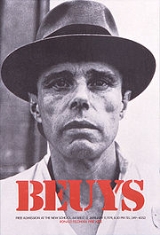
Joseph Beuys (; May 12, 1921 – January 23, 1986) was a German
Germany

Germany , officially the Federal Republic of Germany , is a country in Central Europe. It is bordered to the north by the North Sea, Denmark, and the Baltic Sea; to the east by Poland and the Czech Republic; to the south by Austria and Switzerland; and to the west by France, Luxembourg, Belgium, and the Netherlands....
 artist
Artist

The definition of an artist is wide-ranging and covers a broad spectrum of activities to do with creating art, practicing the arts and/or demonstrating an art....
 who came to prominence in the 1960s.

He is most famous for his ritual
Ritual

A ritual is a set of repeated actions, often thought to have symbolic value, the performance of which is usually prescribed by a religion or by the traditions of a community by religious or political laws because of the perceived efficacy of those actions....
istic public performances and his energetic championing of the healing potential of art and the power of a universal human creativity. As well as performances, Beuys produced sculpture
Sculpture

Sculpture is Three-dimensional space artwork created by shaping or combining hard and or plastic material, sound, and or text and or light, commonly Stone sculpture , metal, glass, or wood....
s, environments, vitrines, 450 prints
Printmaking

Printmaking is the process of making artworks by printing, normally on paper. Except in the case of monotyping, the process is capable of producing multiples of the same piece, which is called a 'print....
 and posters, and thousands of drawing
Drawing

Drawing is a visual art that makes use of any number of drawing instruments to mark a two-dimensional medium. Common instruments include graphite pencils, pen and ink, inked brushes, wax color pencils, crayons, charcoals, chalk, pastels, marker pens, stylus, or various metals like silverpoint....
s. He was also a committed teacher and increasingly devoted much of his energy to German politics.


Discussion
Ask a question about 'Joseph Beuys'
Start a new discussion about 'Joseph Beuys'
Answer questions from other users
Full Discussion Forum


Encyclopedia


Joseph Beuys (; May 12, 1921 – January 23, 1986) was a German
Germany

Germany , officially the Federal Republic of Germany , is a country in Central Europe. It is bordered to the north by the North Sea, Denmark, and the Baltic Sea; to the east by Poland and the Czech Republic; to the south by Austria and Switzerland; and to the west by France, Luxembourg, Belgium, and the Netherlands....
 artist
Artist

The definition of an artist is wide-ranging and covers a broad spectrum of activities to do with creating art, practicing the arts and/or demonstrating an art....
 who came to prominence in the 1960s.

He is most famous for his ritual
Ritual

A ritual is a set of repeated actions, often thought to have symbolic value, the performance of which is usually prescribed by a religion or by the traditions of a community by religious or political laws because of the perceived efficacy of those actions....
istic public performances and his energetic championing of the healing potential of art and the power of a universal human creativity. As well as performances, Beuys produced sculpture
Sculpture

Sculpture is Three-dimensional space artwork created by shaping or combining hard and or plastic material, sound, and or text and or light, commonly Stone sculpture , metal, glass, or wood....
s, environments, vitrines, 450 prints
Printmaking

Printmaking is the process of making artworks by printing, normally on paper. Except in the case of monotyping, the process is capable of producing multiples of the same piece, which is called a 'print....
 and posters, and thousands of drawing
Drawing

Drawing is a visual art that makes use of any number of drawing instruments to mark a two-dimensional medium. Common instruments include graphite pencils, pen and ink, inked brushes, wax color pencils, crayons, charcoals, chalk, pastels, marker pens, stylus, or various metals like silverpoint....
s. He was also a committed teacher and increasingly devoted much of his energy to German politics. A charismatic and controversial figure, the nature and value of Beuys’s contribution to Western art has elicited a hotly contested and often polarised debate.

Early life

Although he took great pride in being native to Kleve
Kleve

Kleve, traditionally known in English language and French language as Cleves, Kleef in Dutch language, is a city in the north-west of North Rhine-Westphalia in Germany, near the Netherlands border and the River Rhine, at ....
, Joseph Beuys was born in Krefeld
Krefeld

Krefeld , also known as Crefeld until 1929, is a city in North Rhine-Westphalia, Germany. It is located southwest of the Ruhr area, its center just a few kilometres to the west of the River Rhine; the borough of Uerdingen is situated directly on the Rhine....
 in 1921; Beuys was the son of the trader Josef Jakob Beuys and Johanna Maria Margarete Beuys.

The Beuys family soon moved to Kleve
Kleve

Kleve, traditionally known in English language and French language as Cleves, Kleef in Dutch language, is a city in the north-west of North Rhine-Westphalia in Germany, near the Netherlands border and the River Rhine, at ....
, an industrial town in the Lower Rhine region of Germany close to the Dutch border, and it was in this region that Beuys spent most of his childhood. An aspect of Beuys’s adolescence that has dominated much commentary on his practice is his involvement with the Hitler Youth
Hitler Youth

The Hitler Youth was a paramilitary organization of the Nazi Party. It existed from 1922 to 1945. The HJ was the second oldest paramilitary Nazi group, founded one year after its adult counterpart, the Sturmabteilung ....
 (to which adherence was, it should be noted, obligatory). From an early age Beuys displayed a keen interest in the natural sciences and had considered a career in medical studies before volunteering for the Luftwaffe
Luftwaffe

is a generic German term for an air force. It is also the official name for two of the four historic German air forces, the Wehrmacht air arm founded in 1933 and disbanded in 1946; and the current Bundeswehr air arm founded in 1956....
 in 1940. He began his military training as an aircraft radio operator in 1941, under the tutelage of Heinz Sielmann
Heinz Sielmann

Heinz Sielmann was a world renowned wildlife photographer, zoologist and documentary filmmaker.He made his first film in 1938. His feature film Zimmerleute des Waldes about woodpeckers was a huge success in the United Kingdom when broadcast by the BBC at the behest of David Attenborough....
 in Posen
Poznan

Poznan is a city in west-central Poland with over 567,882 inhabitants . Located on the Warta River, it is one of the oldest cities in Poland, making it an important historical centre and a vibrant centre of trade, industry, and education....
. During his leave, Beuys attended lectures in biology
Biology

Biology is a branch of the natural sciences concerned with the study of living organisms and their interaction with each other and their environment ....
, botany
Botany

Botany, plant science, phytology, or plant biology is a branch of biology and is the Scientific method of plant life and development....
, geography
Geography

Geography is the study of the Earth and its lands, features, inhabitants, and phenomena. A literal translation would be "to describe or write about the Earth"....
 and philosophy
Philosophy

Philosophy is the study of general problems concerning matters such as existence, knowledge, truth, beauty, justice, validity, mind, and language....
. It is also during this time that he began to seriously consider a career as an artist.

In 1942 Beuys was stationed in the Crimea
Crimea

Crimea or the Autonomous Republic of Crimea is an autonomous republic of Ukraine located on the northern coast of the Black Sea, occupying a peninsula of the same name....
 and was a member of various combat bomber units. On 16 March 1944 Beuys’s Ju 87
Junkers Ju 87

The Junkers Ju 87 or Stuka was a two-seat Nazi Germany ground-attack aircraft of World War II.Designed by Hermann Pohlmann, the Stuka first flew in 1935 and made its combat debut in 1936 as part of the Luftwaffe's Condor Legion during the Spanish Civil War....
 plane crashed on the Crimean Front. The pilot was killed but Beuys was found by a German search commando and brought to a military hospital where he stayed from March 17 to April 7. This incident, and Beuys’s subsequent embellishment of it, is perhaps the most controversial aspect of his artistic persona. Beuys later recounted how he had been rescued from the crash by Tartar tribesmen, who had wrapped his broken body in animal fat
Animal fat

Animal fats are Rendering tissue fat that can be obtained from a variety of animals....
 and felt
Felt

Felt is a non-weave cloth that is produced by matting, condensing and pressing fibers. While some types of felt are very soft, some are tough enough to form construction materials....
 and nursed him back to health. Beuys recounted the story in 1979:

“Had it not been for the Tartars I would not be alive today. They were the nomads of the Crimea, in what was then no man’s land between the Russian and German fronts, and favoured neither side. I had already struck up a good relationship with them, and often wandered off to sit with them. ‘Du nix njemcky’ they would say, ‘du Tartar,’ and try to persuade me to join their clan. Their nomadic ways attracted me of course, although by that time their movements had been restricted. Yet it was they who discovered me in the snow after the crash, when the German search parties had given up. I was still unconscious then and only came round completely after twelve days or so, and by then I was back in a German field hospital. So the memories I have of that time are images that penetrated my consciousness. The last thing I remember was that it was too late to jump, too late for the parachutes to open. That must have been a couple of seconds before hitting the ground. Luckily I was not strapped in – I always preferred free movement to safety belts… My friend was strapped in and he was atomized on impact – there was almost nothing to be found of him afterwards. But I must have shot through the windscreen as it flew back at the same speed as the plane hit the ground and that saved me, though I had bad skull and jaw injuries. Then the tail flipped over and I was completely buried in the snow. That’s how the Tartars found me days later. I remember voices saying ‘Voda’ (Water), then the felt of their tents, and the dense pungent smell of cheese, fat and milk. They covered my body in fat to help it regenerate warmth, and wrapped it in felt as an insulator to keep warmth in.”


Although entering Beuys’s rhetoric somewhat later than some commentators have acknowledged, this story has served as a powerful myth of origins for Beuys’s artistic identity, as well as providing an initial interpretive key to his use of unconventional materials (amongst which felt and fat were central).

After the war


After the war Beuys returned to his parents’ house in Rindern. In 1946, he met sculptor Walter Brüx and painter Hanns Lamers, who encouraged him to become an artist. He enrolled at Kunstakademie Düsseldorf
Kunstakademie Düsseldorf

The Staatliche Kunstakademie D?sseldorf is the Arts Academy of the city of D?sseldorf. It is well-known for having produced many famous artists, such as Joseph Beuys....
 in 1947 and after switching classes, joined the class of Ewald Mataré. Beuys began to read widely, evolving ideas around science, art, literature, philosophy and spirituality. Key figures in Beuys’s intellectual formation include Rudolf Steiner
Rudolf Steiner

Rudolf Steiner was an Austrians philosopher, literary scholar, educator, architect, playwright, social thinker, and Esotericism. After gaining initial recognition as a literary critic and cultural philosopher, at the beginning of the twentieth century he founded a new spiritual movement, Anthroposophy, as an esoteric philosophy growing...
, Carl Jung
Carl Jung

Carl Gustav Jung was a Swiss psychiatrist, an influential thinker and the founder of Analytical psychology. Jung's approach to psychology has been influential in the field of depth psychology and in counterculture movements across the globe....
, Novalis
Novalis

Novalis was the pseudonym of Georg Philipp Friedrich Freiherr von Hardenberg , an author and philosopher of early German Romanticism....
, Schiller, Leonardo da Vinci
Leonardo da Vinci

Leonardo di ser Piero da Vinci was an Italy polymath, being a scientist, mathematician, engineer, inventor, anatomist, Painting, sculptor, architect, botanist, musician and writer....
, James Joyce
James Joyce

James Augustine Aloysius Joyce was an Ireland expatriate author of the 20th century. He is best known for his landmark novel Ulysses and its controversial successor Finnegans Wake , as well as the short story collection Dubliners and the semi-autobiographical novel A Portrait of the Artist as a Young Man ....
 and the 16th century Swiss alchemist Paracelsus
Paracelsus

Paracelsus was a Medieval physician, botanist, alchemy, astrologer, and general occultist. Born Phillip von Hohenheim, he later took up the name Philippus Theophrastus Aureolus Bombastus von Hohenheim, and still later took the title Paracelsus, meaning "equal to or greater than Celsus", a Roman encyclopedist, Aulus Cornelius Celsus fro...
. Beuys finished his education in 1951, graduating as master pupil from Mataré’s class.

Throughout the 1950s, Beuys struggled with a dire financial situation and with the trauma of his wartime experiences. His output consisted mainly of thousands of drawings, but he also produced some sculptures. Through his drawing practice, Beuys explored a range of unconventional materials and developed his artistic agenda, exploring metaphorical and symbolic connections between natural phenomena and philosophical systems. Often difficult to interpret in themselves, these drawings constitute a speculative, contingent and rather hermetic exploration of the material world and how that world might be connected to the realm of myth and philosophy. In 1974, 327 drawings, the majority of which were made during the late 1940s and 1950s, were collected into a group entitled The Secret Block for a Secret Person in Ireland (a reference to Joyce), and exhibited in Oxford, Edinburgh, Dublin and Belfast.

In 1956, artistic self-doubt and material impoverishment led to a physical and psychological crisis, and Beuys entered a period of serious depression. He recovered at the house of his most important early patrons, the van der Grinten brothers, in Kranenburg. In 1958, Beuys participated in an international competition for an Auschwitz-Birkenau memorial, but his proposal did not win and his design was never realised. Also in 1958, Beuys begins a cycle of drawings related to Joyce’s Ulysses
Ulysses (novel)

Ulysses is a novel by James Joyce, first serialized in parts in the American journal The Little Review from March 1918 to December 1920, then published in its entirety by Sylvia Beach on February 2, 1922, in Paris....
. Completed in ca.1961, the six exercise books of drawings would constitute, Beuys declared, an extension of Joyce’s seminal novel. In 1959 Beuys married Eva Wurmbach. They had two children together, Wenzel (born 1961) and Jessyka (born 1964). In 1961 he was appointed professor of 'monumental sculpture' at the Kunstakademie Düsseldorf.

Artistic development and recognition

In 1962 Beuys befriended his Düsseldorf colleague Nam June Paik, a member of the Fluxus
Fluxus

Fluxus?a name taken from a Latin word meaning "to flow"?is an international network of artists, composers and designers noted for blending different artistic media and disciplines in the 1960s....
 movement. This was the beginning of what was to be a brief formal involvement with Fluxus, a loose international group of artists who championed a radical erosion of the boundaries of art, bringing aspects of creative practice outside of the institution and into the everyday. Although Beuys participated in a number of Fluxus events, it soon became clear that he viewed the implications of art’s economic and institutional framework differently. Indeed, whereas Fluxus was directly inspired by the radical Dada activities emerging during the First World War, Beuys in 1964 broadcast (from Second German Television Studio) a rather different message: ‘Das Schweigen von Marcel Duchamp
Marcel Duchamp

Marcel Duchamp was a France artist whose work is most often associated with the Dada and Surrealism movements. Duchamp's output influenced the development of post-World War I Western art....
 wird überbewertet’ (‘The Silence of Marcel Duchamp is Overrated’). Beuys’s relationship with the legacy of Duchamp and the Readymade is a central (if often unacknowledged) aspect of the controversy surrounding his practice.

What served to launch Beuys into the public consciousness was that which transpired following his performance at the Technical College Aachen in 1964. As part of a festival of new art coinciding with the 20th anniversary of an assassination attempt on Adolf Hitler, Beuys created a performance or Aktion. The performance was interrupted by a group of students, one of whom attacked Beuys, punching him in the face. A photograph of the artist, nose bloodied and arm raised, was circulated in the media. It was for this 1964 festival that Beuys produced an idiosyncratic CV, which he titled Lebenslauf/Werklauf (Life Course/Work Course). The document was a self-consciously fictionalised account of the artist’s life, in which historical events mingle with metaphorical and mythical speech (he refers to his birth as the ‘Exhibition of a wound;’ he claims his Ulysses Extension to have been carried out ‘at James Joyce’s request’ – impossible, given that the writer was by 1961 long-dead). This document marks a blurring of fact and fiction that was to be characteristic of Beuys’s self-created persona, as well as the source of much controversy (although, significantly, there is no mention here of the famous plane crash).

Beuys’s first solo exhibition in a private gallery opened on November 26 1965 with one of the artist’s most famous and compelling performances: How to Explain Pictures to a Dead Hare. The artist could be viewed through the glass of the gallery’s window. His face was covered in honey and gold leaf, an iron slab was attached to his boot. In his arms he cradled a dead hare, into whose ear he mumbled muffled noises as well as explanations of the drawings that lined the walls. Such materials and actions had specific symbolic value for Beuys. For example, honey was the product of bees who, for Beuys (following Rudolf Steiner), represented as ideal society of warmth and brotherhood. Gold had its importance within alchemical enquiry, and iron, the metal of Mars, stood for a masculine principle of strength and connection to the earth. A photograph from the performance, in which Beuys is sitting with the hare, has been described "by some critics as a new Mona Lisa of the 20th century," though Beuys did not agree with that. Beuys produced many such spectacular, ritualistic performances, and he developed a compelling persona whereby he took on a liminal, shamanistic role, as if to enable passage between different physical and spiritual states. Further examples of such performances include: EURASIA
Eurasia

Eurasia is a large landmass covering about 53,990,000 km? or about 10.6% of the Earth's surface . Often considered a single continent, Eurasia comprises the traditional continents of Europe and Asia, concepts which date back to classical antiquity and the borders for which are somewhat arbitrary....
 (1965), Celtic (Kinloch Rannoch) Scottish Symphony (1970), and I Like America and America Likes Me (1974).

Politics

It was during the 1960s that Beuys formulated his central theoretical concepts concerning the social, cultural and political function and potential of art. Indebted to Romantic writers such as Novalis and Schiller, Beuys was motivated by a utopian belief in the power of universal human creativity and was confident in the potential for art to bring about revolutionary change. This translated into Beuys’s formulation of the concept of Social Sculpture, in which society as a whole was to be regarded as one great work of art (the Wagnerian Gesamtkunstwerk) to which each person can contribute creatively (perhaps Beuys’s most famous phrase, borrowed from Novalis, is ‘Everyone is an artist’). In the video "Willoughby SHARP, Joseph Beuys, Public Dialogues (1974/120 min)", a record of Beuy's first major public discussion in the U.S., Beuys elaborates three principles: Freedom, Democracy, and Socialism, saying that each of them depends on the other two in order to be meaningful. In 1973, Beuys wrote:

“Only on condition of a radical widening of definitions will it be possible for art and activities related to art [to] provide evidence that art is now the only evolutionary-revolutionary power. Only art is capable of dismantling the repressive effects of a senile social system that continues to totter along the deathline: to dismantle in order to build ‘A SOCIAL ORGANISM AS A WORK OF ART’… EVERY HUMAN BEING IS AN ARTIST who – from his state of freedom – the position of freedom that he experiences at first-hand – learns to determine the other positions of the TOTAL ART WORK OF THE FUTURE SOCIAL ORDER.”


Beuys manifested these ideas most notoriously in abolishing entry requirements to his Düsseldorf class. Throughout the late 1960s this renegade policy caused great institutional friction, which came to a head in October 1972, when Beuys was eventually dismissed from his post. The dismissal, which Beuys would not accept, produced a wave of protests from students, artists and critics. Although now bereft of an institutional position, Beuys continued a voracious schedule of public lectures and discussions, as well as becoming increasingly active in German politics. Amongst other things, Beuys founded (or co-founded) the following political organisations: German Student Party (1967), Organization for Direct Democracy Through Referendum (1971), and Free International University for Creativity and Interdisciplinary Research (1974). Beuys became a pacifist, was a vocal opponent of nuclear weapons and campaigned strenuously for environmental causes (indeed, he was elected a Green Party
Alliance '90/The Greens

The Alliance '90/The Greens is a political party in Germany which originated from the merger of the party "The Greens" and Alliance 90....
 candidate for the European Parliament). In 1982 he was invited to create a work for Documenta
Documenta

documenta is an Art exhibition of modern art and contemporary art which now takes place every five years in Kassel, Germany. It was founded by artist, teacher and curator Arnold Bode in 1955 as part of the Bundesgartenschau which took place in Kassel at that time....
 7. He delivered a large pile of basalt stones. From above one could see that the pile of stones was a large arrow pointing to a single oak tree that he had planted. He announced that the stones sholud not be moved unless an oak tree was planted in the new location of the stone. 7,000 oak trees were then planted in Kassel, Germany. This project exemplified the idea that a Social Sculpture was defined as interdisciplinary and participatory.

The only major retrospective of Beuys work to be organised in Beuys’s lifetime opened at the Guggenheim Museum
Solomon R. Guggenheim Museum

The Solomon R. Guggenheim Museum, which opened on October 21, 1959, is one of the best-known museums in New York City and one of the 20th century's most important architectural landmarks....
 in New York in 1979. The exhibition has been described as a “lightning rod for American criticism,” eliciting as it did some powerful and polemical responses. He was a vigorous and original proponent of Rudolf Steiner's social ideas.

Critiques of Beuys


One thing that the Guggenheim retrospective and its catalogue did was to afford an American critical audience a comprehensive view of Beuys’s practice and rhetoric. Whereas Beuys had been a central figure in the post-war European artistic consciousness for some time, American audiences had previously only had partial and fleeting access to his work. In 1980, and building on the scepticism voiced by Belgian artist Marcel Broodthaers
Marcel Broodthaers

Marcel Broodthaers was a Belgium poet, filmmaker and artist with a highly literate and often witty approach to creating art works.He was born in Brussels, Belgium, where he was associated with the Groupe Surr?aliste-revolutionnaire from 1945 and dabbled in journalism, film, and poetry....
, who in 1972 Open Letter had compared Beuys to Wagner, art historian Benjamin Buchloh (who was teaching at Staatliche Kunstakademie, just like Beuys) launched a polemically forceful attack on Beuys. The essay was (and remains) the most vitriolic and thoroughgoing critique of both Beuys’s rhetoric (referred to as “simple-minded utopian drivel”) and persona (Buchloh regards Beuys as both infantile and messianic).

Firstly, Buchloh draws attention to Beuys’s falsification of his own biography, which he sees as symptomatic of a dangerous cultural tendency of dis-avowing a traumatic past and a retreat into the realms of myth and esoteric symbolism. Buchloh attacks Beuys for his failure to acknowledge and engage with Nazism, the Holocaust, and their implications. Secondly, Buchloh criticizes Beuys for displaying an inability or reluctance to engage with the consequences of the work of Marcel Duchamp
Marcel Duchamp

Marcel Duchamp was a France artist whose work is most often associated with the Dada and Surrealism movements. Duchamp's output influenced the development of post-World War I Western art....
. That is, a failure to acknowledge the framing function
Framing (social sciences)

A frame in social theory consists of a schema of interpretation ?that is, a collection of stereotypes?that individuals rely on to understand and respond to events....
 of the art institution and the inevitable dependence upon such institutions to create meaning for art objects. If Beuys championed art’s power to foster political transformation, he nevertheless failed to acknowledge the limits imposed upon such aspirations by the art museum and dealership networks that served somewhat less utopian ambitions. For Buchloh, rather than acknowledging the collective and contextual formation of meaning, Beuys instead attempted to prescribe and control the meanings of his art, and often in the form of dubious esoteric or symbolic codings. Buchloh’s critique has been developed by a number of commentators such as Stefan Germer and Rosalind Krauss.

Recuperations


Buchloh’s critique has been subject to revision. His attention is given to dismantling a mythologized artistic persona and utopian rhetoric, which he regarded to be irresponsible and even (it is implied) proto-fascist. Since Buchloh’s essay was written, however, a great deal of new archival material has come to light. Most significantly, Beuys’s proposal for an Auschwitz-Birkenau memorial, submitted in 1958. It has been claimed that the existence of such a project invalidates Buchloh’s claim that Beuys retreated from engaging with the Nazi legacy, a point that Buchloh himself has recently acknowledged, although the charges of romanticism and self-mythologizing remain.

Beuys’s charisma and eclecticism have polarised his audience. Beuys has attracted a huge number of admirers and devotees, the tendency of whom has been to uncritically accept Beuys’s own explanations as interpretive solutions to his work. In contrast, there are those who, following Buchloh, are relentlessly critical of Beuys’s rhetoric and use weaknesses in his argumentation to dismiss his work as bogus. Relatively few accounts have been concerned with an encounter with the works themselves, with exceptions arriving in the scholarship of art historians such as Gene Ray, Christa-Maria Lerm Hayes, Briony Fer, Alex Potts, and others. The drive here has been to wrest the potential of Beuys’s work away from the artist’s own rhetoric, and to further explore both the wider discursive formations within which Beuys operated (this time, productively), and the specific material properties of the works themselves.

Examples of contemporary artists who have drawn from the legacy of Beuys include AA Bronson
AA Bronson

AA Bronson, Order of Canada, is an artist who founded the artists' group General Idea with Jorge Zontal and Felix Partz in 1969. They worked and lived together for 25 years....
, former member of the artists' collaborative General Idea
General Idea

General Idea was a collective of three Canada artists, Felix Partz, Jorge Zontal and AA Bronson, who were active from 1967 to 1994.As pioneers of early conceptual and media-based art, their collaboration became a model for artist-initiated activities and continues to be a prominent influence on subsequent generations of artists....
, who, not without irony, adopts the subject position of the shaman to reclaim art's restorative, healing powers; and Peter Gallo
Peter Gallo

Peter Gallo , Rutland, VT is a reclusive artist and writer who lives in Hyde Park, VT and Montreal, Quebec. Gallo attended Middlebury College and Concordia University....
, whose drawing cycle "I wish I could draw like Joseph Beuys" features stretches of Beuys's writings combined with images traced from vintage gay pornography onto found pieces of paper.

Exhibitions


  • 1964 documenta
    Documenta

    documenta is an Art exhibition of modern art and contemporary art which now takes place every five years in Kassel, Germany. It was founded by artist, teacher and curator Arnold Bode in 1955 as part of the Bundesgartenschau which took place in Kassel at that time....
    , Kassel
    Kassel

    Kassel is a city situated along the Fulda River in northern Hessen, Germany, one of the two sources of the Weser river . It is the administrative seat of the Kassel and of the Kassel of the same name....
    , Germany
    Germany

    Germany , officially the Federal Republic of Germany , is a country in Central Europe. It is bordered to the north by the North Sea, Denmark, and the Baltic Sea; to the east by Poland and the Czech Republic; to the south by Austria and Switzerland; and to the west by France, Luxembourg, Belgium, and the Netherlands....


  • 1972 documenta
    Documenta

    documenta is an Art exhibition of modern art and contemporary art which now takes place every five years in Kassel, Germany. It was founded by artist, teacher and curator Arnold Bode in 1955 as part of the Bundesgartenschau which took place in Kassel at that time....
    , Kassel
    Kassel

    Kassel is a city situated along the Fulda River in northern Hessen, Germany, one of the two sources of the Weser river . It is the administrative seat of the Kassel and of the Kassel of the same name....
    , Germany
    Germany

    Germany , officially the Federal Republic of Germany , is a country in Central Europe. It is bordered to the north by the North Sea, Denmark, and the Baltic Sea; to the east by Poland and the Czech Republic; to the south by Austria and Switzerland; and to the west by France, Luxembourg, Belgium, and the Netherlands....


  • 1976 Venice Biennale
    Venice Biennale

    The Venice Biennale is a major contemporary art exhibition that takes place once every two years in Venice, Italy. The Venice Film Festival is part of it, as is the Venice Biennale of Architecture, which is held in even years....
    , Italy
    Italy

    Italy , officially the Italian Republic , is a country located on the Italian Peninsula in Southern Europe and on the two largest islands in the Mediterranean Sea, Sicily and Sardinia....


  • 1979 Solomon R. Guggenheim Museum
    Solomon R. Guggenheim Museum

    The Solomon R. Guggenheim Museum, which opened on October 21, 1959, is one of the best-known museums in New York City and one of the 20th century's most important architectural landmarks....
    , New York
    New York

    The State of New York is a U.S. state in the Mid-Atlantic States and Northeastern United States regions of the United States and is the nation's List of U.S....
    , U.S.
    United States

    The United States of America is a Federal government constitutional republic comprising U.S. state and a federal district. The country is situated mostly in central North America, where its Contiguous United States and Washington, D.C., the Capital districts and territories, lie between the Pacific Ocean and Atlantic Oceans, Borders of the U...


  • 1980 Rocca Paolina, Perugia
    Perugia

    Perugia is the capital city of the region of Umbria in central Italy, near the Tiber river, and the capital of the province of Perugia. The city symbol is the griffin, which can be seen in the form of plaques and statues on buildings around the city....
    , Italy
    Italy

    Italy , officially the Italian Republic , is a country located on the Italian Peninsula in Southern Europe and on the two largest islands in the Mediterranean Sea, Sicily and Sardinia....


  • 1984 Seibu-Museum, Tokyo
    Tokyo

    , officially , is one of the 47 prefectures of Japan of Japan and located on the eastern side of the main island Honshu. The twenty-three special wards of Tokyo, each governed as a city, cover the area that was once the Tokyo City in the eastern part of the prefecture, and total over 8 million people....
    , Japan
    Japan

    Japan is an island country in East Asia. Located in the Pacific Ocean, it lies to the east of the Sea of Japan, People's Republic of China, North Korea, South Korea and Russia, stretching from the Sea of Okhotsk in the north to the East China Sea and Taiwan in the south....


  • 2005 Tate Modern, London
    London

    London is the capital of both England and the United Kingdom, and the most populous municipality in the European Union. An important settlement for two millennia, History of London goes back to its founding by the Roman Empire....
    , United Kingdom
    United Kingdom

    The United Kingdom of Great Britain and Northern Ireland, commonly known as the United Kingdom , the UK or Britain,is a sovereign state located off the northwestern coast of continental Europe....
     'Joseph Beuys: Actions, Vitrines, Environments'


  • 2006 Museum kunst palast
    Museum kunst palast

    The Museum Kunst Palast is an art museum in D?sseldorf, Germany....
    , Düsseldorf
    Düsseldorf

    D?sseldorf is the capital city of the Germany state of North Rhine-Westphalia. It is an economic centre of Germany. The city is situated on the River Rhine and has a high population density - the Rhine-Ruhr metropolitan area has over 10 million inhabitants alone....
    ; Kunstmuseum Bonn
    Bonn

    Bonn is the 19th largest city in Germany. Located about 20 kilometres south of Cologne on the river Rhine in the Federal State of North Rhine-Westphalia, it was the Capital of Germany West Germany from 1949 to 1990 and the official seat of government of united Germany from 1990 to 1999....
    ; Museum Hamburger Bahnhof, Berlin
    Berlin

    Berlin is the Capital of Germany city and one of sixteen States of Germany of Germany. With a population of 3.4 million within its city limits, Berlin is the country's largest city....


  • 2006 The David Winton Bell Gallery, Brown University
    Brown University

    Brown University is a private university university located in , United States and is a member of the Ivy League. Founded in 1764 as the College of Rhode Island, it is the third-oldest institution of higher education in New England and Colonial Colleges in the United States....
    , Providence
    Providence, Rhode Island

    Providence is the Capital and the most populous city of the U.S. state of Rhode Island, and one of the first cities established in the United States....
    , U.S.
    United States

    The United States of America is a Federal government constitutional republic comprising U.S. state and a federal district. The country is situated mostly in central North America, where its Contiguous United States and Washington, D.C., the Capital districts and territories, lie between the Pacific Ocean and Atlantic Oceans, Borders of the U...


  • 2007 Zwirner & Wirth , New York City
    New York City

    The City of New York is the List of United States cities by population in the United States, while the New York metropolitan area ranks among the List of urban areas by population....
    , U.S.
    United States

    The United States of America is a Federal government constitutional republic comprising U.S. state and a federal district. The country is situated mostly in central North America, where its Contiguous United States and Washington, D.C., the Capital districts and territories, lie between the Pacific Ocean and Atlantic Oceans, Borders of the U...


  • 2007 National Gallery of Victoria, Melbourne, Australia -


  • 2008/2009 Hamburger Bahnhof – Museum für Gegenwart, Berlin, Germany -


External links

  • - Portrait (in Dutch)
  • introductory worksheets for use with kids and groups based on the works at Tate Modern
  • published on the Tellus Audio Cassette Magazine
    Tellus Audio Cassette Magazine

    Launched from the Lower East Side, Manhattan in 1983 as a subscription only bimonthly publication, the Tellus cassette series took full advantage of the popular cassette medium to promote cutting-edge downtown music, documenting the New York scene and advancing experimental composers of the time ? the first 2 issues being devoted to NY arti...
     @ Ubuweb
    UbuWeb

    UbuWeb is a large web-based educational resource for avant-garde material available on the internet, founded in 1996 by poet Kenneth Goldsmith. It offers visual, concrete and sound poetry, expanding to include film and sound art mp3 archives....


Further reading

  • Adriani, Götz, Winfried Konnertz, and Karin Thomas: Joseph Beuys: Life and Works. Trans. Patricia Lech. Woodbury, N.Y.: Barron’s Educational Series, 1979.
  • Bastian, Heiner: Joseph Beuys: The secret block for a secret person in Ireland. Text by Dieter Koepplin. Munich: Schirmer/Mosel, 1988.
  • Borer, Alain. The Essential Joseph Beuys. London: Thames and Hudson, 1996.
  • Buchloh, Benjamin H.D.: ‘Beuys: The Twilight of the Idol,’ Artforum, vol.5, no.18 (January 1980), pp.35-43.
  • Buchloh, Benjamin H.D., Krauss, Rosalind, Michelson, Annette: ‘Joseph Beuys at the Guggenheim,’ in: October, 12 (Spring 1980), pp 3-21
  • De Duve, Thierry: Kant After Duchamp, Cambridge (Mass.): MIT Press, 1996.
  • Oman Hiltrud: "Joseph Beuys. Die Kunst auf dem Weg zum Leben." München, Heyne (1998) ISBN 3-453-14135-0
  • Potts, Alex: ‘Tactility: The Interrogation of Medium in the Art of the 1960s,’ Art History, Vol.27, No.2 April 2004. 282-304.
  • Ray, Gene (ed.): Joseph Beuys, Mapping the Legacy. New York and Sarasota: D.A.P. 2001.
  • Rosenthal, Mark: Joseph Beuys: Actions, Vitrines, Environments, London: Tate, 2005.
  • Murken, Axel Hinrich: Joseph Beuys und die Medizin. F. Coppenrath, 1979. ISBN 3-920192-81-8
  • Stachelhaus, Heiner. Joseph Beuys. New York: Abbeville Press, 1991.
  • Temkin, Ann, and Bernice Rose. Thinking is Form: The Drawings of Joseph Beuys (exh. cat., Philadelphia Museum of Art). New York: Thames and Hudson, 1993.
  • Tisdall, Caroline: Joseph Beuys, New York: Guggenheim Museum, 1979.