

Nebraska

Encyclopedia
Nebraska is a state on the Great Plains
of the Midwestern United States
. The state's capital is Lincoln
and its largest city is Omaha
, on the Missouri River
.
Once considered part of the Great American Desert
, Nebraska is now a leading farming
and ranching
state. The Omaha
and Ho-Chunk
(Winnebago) are federally recognized American Indian
tribes, each with a reservation in Thurston County in eastern Nebraska, where they constitute the majority of population.
words Ñí Brásge, pronounced ɲĩbɾasꜜkɛ (contemporary Otoe Ñí Bráhge), or the Omaha
Ní Btháska, pronounced nĩbɫᶞasꜜka, meaning "flat water", after the Platte River
that flows through the state.
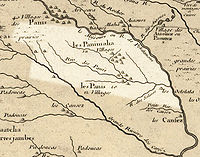 Varying cultures of indigenous peoples
lived in the region along the rivers for thousands of years before European exploration. Historical Native American tribes living in Nebraska have included the Omaha, Missouria, Ponca
, Pawnee, Otoe
, and various branches of the Lakota (Sioux
).
Long before the Lewis and Clark Expedition
of 1804–1806, French-Canadian explorers (including the Mallet brothers in 1739) traversed the territory of Nebraska on their way to trade in Santa Fe
, then claimed by Spain.
In 1819, the United States established Fort Atkinson
as the first US Army post west of the Missouri River, just east of present-day Fort Calhoun
. The army abandoned the fort in 1827 as migration moved further west.
European-American settlement did not begin in any numbers until after 1848 and the California Gold Rush
. On May 30, 1854, the US Congress created the Kansas
and the Nebraska
territories, divided by the Parallel 40° North
, under the Kansas-Nebraska Act
. The Nebraska Territory included parts of the current states of Colorado, North Dakota, South Dakota, Wyoming, and Montana. The territorial capital of Nebraska was Omaha.
In the 1860s, after the US government forced many of the Native American tribes to cede their lands and settle on reservations, it opened large tracts of land to agricultural development by Europeans and Americans. Under the Homestead Act
, thousands of new settlers migrated into Nebraska to claim free land granted by the federal government. Because so few trees grew on the prairies, many of the first farming settlers built their homes of sod
, as had the Native Americans such as the Omaha. The first wave of settlement gave the territory a sufficient population to apply for statehood.
Nebraska became the 37th state on March 1, 1867, approximately two years after the American Civil War
. At that time, the capital was moved from Omaha to the center at Lancaster, later renamed Lincoln
after the recently assassinated President of the United States, Abraham Lincoln
.
During the 1870s to the 1880s, Nebraska experienced a large growth in population. Several factors contributed to attracting new residents. The first was that the vast prairie land was perfect for cattle grazing. This helped settlers to learn the unfamiliar geography of the area. The second factor was the invention of several farming technologies. Agricultural inventions such as barbed wire, wind mills, and the steel plow, combined with good weather, enabled settlers to make use of Nebraska as prime farming land. By the 1880s, Nebraska's population had soared to more than 450,000 people.
The Arbor Day
holiday was founded in Nebraska. The National Arbor Day Foundation
is still headquartered in Nebraska City
, with some offices in Lincoln.
In the late nineteenth century, many African Americans migrated from the South to Nebraska as part of the Great Migration
, primarily to Omaha which offfered working class jobs in meatpacking, the railroads and other industries. Omaha has a long history of civil rights
activism. Blacks encountered discrimination from other Americans in Omaha and especially from recent European immigrants, ethnic whites who were competing for the same jobs. In 1912 African Americans founded the Omaha chapter of the National Association for the Advancement of Colored People
to work for improved conditions in the city and state. Activism has continued.
Since the 1960s, Native American
activism in the state has increased, both through open protest, activities to build alliances with state and local governments, and in the slower, more extensive work of building tribal institutions and infrastructure. Native Americans in federally recognized tribes have pressed for self-determination, sovereignty and recognition. They have created community schools to preserve their cultures, as well as tribal colleges and universities
. Tribal politicians have also collaborated with state and county officials on regional issues.
to the north; Iowa
to the east and Missouri
to the southeast, across the Missouri River
; Kansas
to the south; Colorado
to the southwest; and Wyoming
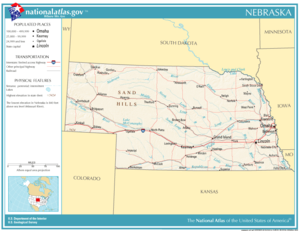
to the west. The state has 93 counties; it occupies the central portion of the Frontier Strip
. Nebraska is split into two time zones. The Central Time zone comprises the eastern half of the state, while the western half observes Mountain Time. Three rivers cross the state from west to east. The Platte River
, formed by the confluence of the North Platte and the South Platte, runs through the central portion of the state, the Niobrara River
flows through the northern part, and the Republican River
runs across the southern part.
Nebraska is composed of two major land regions: the Dissected Till Plains
and the Great Plains
. The easternmost portion of the state was scoured by Ice Age
glacier
s; the Dissected Till Plains were left behind after the glaciers retreated. The Dissected Till Plains is a region of gently rolling hills; Omaha and Lincoln are in this region.
The Great Plains occupy the majority of western Nebraska. The Great Plains region consists of several smaller, diverse land regions, including the Sandhills, the Pine Ridge
, the Rainwater Basin
, the High Plains
and the Wildcat Hills
. Panorama Point
, at 5,424 feet (1,653 m), is the highest point in Nebraska; despite its name and elevation, it is a relatively low rise near the Colorado and Wyoming borders.
 A past Nebraska tourism slogan was "Where the West Begins"; locations given for the beginning of the "West" include the Missouri River, the intersection of 13th and O Streets in Lincoln (where it is marked by a red brick star), the 100th meridian
, and Chimney Rock
. Nebraska is a triply landlocked state, as it does not border the ocean, nor do any of the states it borders, nor any that they border.
include:
Areas under the management of the National Forest Service include:
(Köppen climate classification
Dfa), and the western half, a semi-arid climate (Koppen BSk). The entire state experiences wide seasonal variations in temperature and precipitation. Average temperatures are fairly uniform across Nebraska, with hot summers and generally cold winters, while average annual precipitation decreases east to west from about 31.5 inches (800 mm) in the southeast corner of the state to about 13.8 inches (350 mm) in the Panhandle
. Humidity also decreases significantly from east to west. Snowfall across the state is fairly even, with most of Nebraska receiving between 25 and 35 inches (65 to 90 cm) of snow annually. Nebraska's highest recorded temperature is 118 °F (47.8 °C) at Minden
on July 24, 1936 and the lowest recorded temperature is -47 F at Camp Clarke on February 12, 1899.
 Nebraska is in Tornado Alley
; thunderstorm
s are common in the spring and summer months, and violent thunderstorms and tornado
es happen primarily during the spring and summer, though they can also occur in the autumn. The chinook wind
s from the Rocky Mountains
provide a temporary moderating effect on temperatures in western Nebraska during the winter months.
The center of population
of Nebraska is in Polk County
, in the city of Shelby
.
As of 2004, the population of Nebraska included about 84,000 foreign-born residents (4.8% of the population).
The five largest ancestry groups in Nebraska are German
(38.6%), Irish
(12.4%), English
(9.6%), Czech
(5.5%), and Swedish
(4.9%).
Nebraska has the largest Czech-American and non-Mormon Danish-American population (as a percentage of the total population) in the nation. German Americans are the largest ancestry group in most of the state, particularly in the eastern counties. Thurston County
(made up entirely of the Omaha
and Winnebago reservations) has an American Indian majority, and Butler County
is one of only two counties in the nation with a Czech-American plurality.
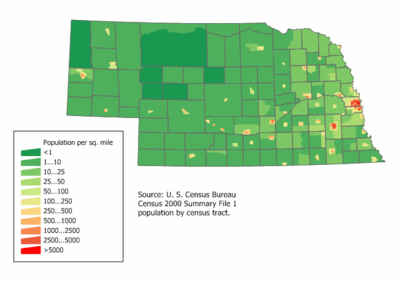 Eighty-nine percent of the cities in Nebraska have fewer than 3,000 people. Nebraska shares this characteristic with five other Midwestern states: Kansas
, Oklahoma
, North
and South Dakota
, and Iowa
. Hundreds of towns have a population of fewer than 1,000. Regional population declines have forced many rural schools to consolidate.
Fifty-three of Nebraska's 93 counties reported declining populations between 1990 and 2000, ranging from a 0.06% loss (Frontier County
) to a 17.04% loss (Hitchcock County
).
More urbanized areas of the state have experienced substantial growth. In 2000, the city of Omaha had a population of 390,007; in 2005, the city's estimated population was 414,521 (427,872 including the recently annexed city of Elkhorn
), a 6.3% increase over five years. The 2010 census showed that Omaha has a population of 408,958. The city of Lincoln had a 2000 population of 225,581 and a 2010 population of 258,379, a 14.5% increase.
The largest single denominations by number of adherents in 2000 were the Catholic Church (372,791), the Evangelical Lutheran Church in America
(128,570), the Lutheran Church - Missouri Synod
(117,419) and the United Methodist Church
(117,277).
. The portion of income from $0 to $2,400 is taxed at 2.56%; from $2,400 to $17,500, at 3.57%; from $17,500 to $27,000, at 5.12%; and income over $27,000, at 6.84%. The standard deduction for a single taxpayer is $5,700; the personal exemption is $118.
Nebraska has a state sales tax of 5.5%. In addition to the state tax, some Nebraska cities assess a city sales and use tax, up to a maximum of 1.5%. One county in Nebraska, Dakota County, levies a sales tax. All real property within the state of Nebraska is taxable unless specifically exempted by statute. Since 1992, only depreciable personal property is subject to tax and all other personal property is exempt from tax. Inheritance tax is collected at the county level.
estimates of Nebraska's gross state product in 2010 was $89.8 billion. Per capita personal income in 2004 was $31,339, 25th in the nation. Nebraska has a large agriculture sector, and is an important producer of beef, pork, corn (maize)
, and soybean
s. Other important economic sectors include freight transport (by rail and truck), manufacturing
, telecommunications, information technology, and insurance.
As of January 2010, the state's unemployment rate is 4.6%.
was created in 1927 by Edwin Perkins
in the city of Hastings
, which celebrates the event the second weekend of every August with Kool-Aid Days. Kool-Aid is the official soft drink of Nebraska. CliffsNotes
were developed by Clifton Hillegass
of Rising City
. He adapted his pamphlets from the Canadian publications, Coles Notes
.
Omaha is home to Berkshire Hathaway
, whose CEO Warren Buffett
was ranked in March 2009 by Forbes
magazine as the second richest person in the world. The city is also home to ConAgra, Mutual of Omaha
, InfoUSA
, TD Ameritrade
, West Corporation
, Valmont Industries
, Woodmen of the World
, Kiewit Corporation, and the Union Pacific Railroad
. UNIFI Companies, Sandhills Publishing Company
, and Duncan Aviation are based in Lincoln; The Buckle is based in Kearney. Sidney
is the national headquarters for Cabela's
, a specialty retailer of outdoor goods.
The world's largest train yard, Union Pacific
's Bailey Yard
, is in North Platte
. The Vise-Grip
was invented by William Petersen in 1924, and was manufactured in De Witt
until the plant was closed and moved to China in late 2008.
Lincoln's Kawasaki Motors Manufacturing is the only Kawasaki plant in the world to produce the Jet-Ski, ATV, and Mule lines of product. The facility employs more than 1200 people.
The Spade Ranch
, in the Sand Hills, is one of Nebraska's oldest and largest beef cattle operations.
, headquartered in Omaha, was incorporated on July 1, 1862, in the wake of the Pacific Railway Act of 1862
. Bailey Yard, in North Platte, is the largest railroad classification yard in the world. The route of the original transcontinental railroad
runs through the state.
Other major railroads with operations in the state are: Amtrak
; Burlington Northern & Santa Fe Railway; Canadian Pacific Railway
; and Iowa Interstate Railroad
.
Interstate Highways through the State of Nebraska


The U.S. Routes in Nebraska


Dave Heineman
. Other elected officials in the executive branch are the Lieutenant Governor Rick Sheehy
(elected on the same ticket as the Governor), Attorney General
Jon Bruning, Secretary of State
John A. Gale
, State Treasurer
Shane Osborn
, and State Auditor
Mike Foley. All elected officials in the executive branch serve four-year terms.
", and more commonly called the "Unicameral", its members call themselves "senators". Nebraska's Legislature is also the only state legislature in the United States that is nonpartisan. The senators are elected with no party affiliation next to their names on the ballot, and the speaker and committee chairs are chosen at large, so that members of any party can be chosen for these positions. The Nebraska Legislature can also override a governor's veto with a three-fifths majority, in contrast to the two-thirds majority required in some other states.
The Nebraska Legislature
meets in the third Nebraska State Capitol
building, built between 1922 and 1932. It was designed by Bertram G. Goodhue. Built from Indiana limestone, the Capitol's base is a cross within a square. A 400-foot domed tower rises from this base. The Golden Sower, a 19-foot bronze statue representing agriculture, crowns the Capitol. The state Capitol is considered an architectural achievement and has been recognized by the American Institute of Architects.
For years, US Senator George Norris and other Nebraskans encouraged the idea of a unicameral legislature, and demanded the issue be decided in a referendum
. Norris argued:
Unicameral supporters also argued that a bicameral
legislature had a significant undemocratic feature in the committees that reconciled Assembly and Senate legislation. Votes in these committees were secretive, and would sometimes add provisions to bills that neither house had approved. Nebraska's unicameral legislature today has rules that bills can contain only one subject, and must be given at least five days of consideration.
In 1934, due in part to the budgetary pressure of the Great Depression
, Nebraska citizens ran a state initiative to vote on a unicameral legislature, which was approved. In effect, the Assembly (the house) was abolished; as noted, today's Nebraska state legislators are commonly referred to as "Senators".
having administrative authority over all Nebraska courts. Nebraska uses the Missouri Plan
for the selection of judges at all levels. The lowest courts in Nebraska are the county courts, above that are twelve district courts (containing one or more counties). The Court of Appeals hears appeals from the district courts, juvenile courts, and workers' compensation courts. The Nebraska Supreme Court is the final court of appeal.
In 2008, the Nebraska Supreme Court ruled that the state's only method of execution, electrocution, was in conflict with the state's constitution. For the next year, Nebraska had no active death-penalty law. (Prior to that ruling, Nebraska was the only place in the world that used electrocution as the sole method of execution.) In May 2009, the legislature passed and the governor signed a bill that changed the method of execution in Nebraska to lethal injection, enabling capital punishment. Executions in Nebraska have been infrequent; none have been carried out in the 21st century. During the last few decades, residents have considered a moratorium on, or complete abolition of, capital punishment.
are Mike Johanns
(R), the junior senator, and Ben Nelson
(D), the senior senator.
Nebraska has three representatives in the House of Representatives
: Jeff Fortenberry
(R) of the 1st district
; Lee Terry
(R) of the 2nd district
; and Adrian M. Smith
(R) of the 3rd district
.
Nebraska is one of two states (with Maine
) that allow for a split in the state's allocation of electoral votes in presidential elections
. Under a 1991 law, two of Nebraska's five votes are awarded to the winner of the statewide popular vote, while the other three go to the highest vote-getter in each of the state's three congressional districts.
In the 2008 election
, the Democrat Barack Obama
won the 2nd congressional district
(which includes Omaha), giving him the electoral vote for that district. The Republican John McCain
won the statewide popular vote, with 58% of the vote to Obama's 42%; this, combined with his victories in the 1st and 3rd districts, gave him Nebraska's other four electoral votes.
. In the 2004 presidential election, George W. Bush
won the state's five electoral votes by a 33% margin (the fourth-most Republican vote among states) with 65.9% of the overall vote; only Thurston County
, which is majority-Native American, voted for John Kerry
.
Despite the current Republican domination of Nebraska politics, the state has a long tradition of electing centrist members of both parties to state and federal office; examples include George Norris (who served few years in the Senate as an independent), J. James Exon
, and Bob Kerrey
. Voters have tilted to the right in recent years with the election of conservative Mike Johanns
to the US Senate and the re-election of Ben Nelson
, who is currently considered the most conservative Democrat in the US Senate.
estimates.
Other areas
Great Plains
The Great Plains are a broad expanse of flat land, much of it covered in prairie, steppe and grassland, which lies west of the Mississippi River and east of the Rocky Mountains in the United States and Canada. This area covers parts of the U.S...
of the Midwestern United States
Midwestern United States
The Midwestern United States is one of the four U.S. geographic regions defined by the United States Census Bureau, providing an official definition of the American Midwest....
. The state's capital is Lincoln
Lincoln, Nebraska
The City of Lincoln is the capital and the second-most populous city of the US state of Nebraska. Lincoln is also the county seat of Lancaster County and the home of the University of Nebraska. Lincoln's 2010 Census population was 258,379....
and its largest city is Omaha
Omaha
Omaha may refer to:*Omaha , a Native American tribe that currently resides in the northeastern part of the U.S. state of Nebraska-Places:United States* Omaha, Nebraska* Omaha, Arkansas* Omaha, Georgia* Omaha, Illinois* Omaha, Texas...
, on the Missouri River
Missouri River
The Missouri River flows through the central United States, and is a tributary of the Mississippi River. It is the longest river in North America and drains the third largest area, though only the thirteenth largest by discharge. The Missouri's watershed encompasses most of the American Great...
.
Once considered part of the Great American Desert
Great American Desert
The term Great American Desert was used in the 19th century to describe the western part of the Great Plains east of the Rocky Mountains in North America....
, Nebraska is now a leading farming
Agriculture
Agriculture is the cultivation of animals, plants, fungi and other life forms for food, fiber, and other products used to sustain life. Agriculture was the key implement in the rise of sedentary human civilization, whereby farming of domesticated species created food surpluses that nurtured the...
and ranching
Agriculture
Agriculture is the cultivation of animals, plants, fungi and other life forms for food, fiber, and other products used to sustain life. Agriculture was the key implement in the rise of sedentary human civilization, whereby farming of domesticated species created food surpluses that nurtured the...
state. The Omaha
Omaha (tribe)
The Omaha are a federally recognized Native American nation which lives on the Omaha Reservation in northeastern Nebraska and western Iowa, United States...
and Ho-Chunk
Ho-Chunk
The Ho-Chunk, also known as Winnebago, are a tribe of Native Americans, native to what is now Wisconsin and Illinois. There are two federally recognized Ho-Chunk tribes, the Ho-Chunk Nation of Wisconsin and Winnebago Tribe of Nebraska....
(Winnebago) are federally recognized American Indian
Indigenous peoples of the Americas
The indigenous peoples of the Americas are the pre-Columbian inhabitants of North and South America, their descendants and other ethnic groups who are identified with those peoples. Indigenous peoples are known in Canada as Aboriginal peoples, and in the United States as Native Americans...
tribes, each with a reservation in Thurston County in eastern Nebraska, where they constitute the majority of population.
Etymology
Nebraska gets its name from the archaic OtoeChiwere language
Chiwere is a Siouan language originally spoken by the Missouria, Otoe, and Iowa peoples, who originated in the Great Lakes region but later moved throughout the midwest and plains. The language is closely related to Ho-Chunk, also known as Winnebago...
words Ñí Brásge, pronounced ɲĩbɾasꜜkɛ (contemporary Otoe Ñí Bráhge), or the Omaha
Omaha-Ponca language
Omaha–Ponca is a Siouan language spoken by the Omaha people of Nebraska and the Ponca people of Oklahoma and Nebraska. There are today only 60 speakers of Omaha, and 25 fluent speakers, all over 60; and a handful of semi-fluent speakers of Ponca...
Ní Btháska, pronounced nĩbɫᶞasꜜka, meaning "flat water", after the Platte River
Platte River
The Platte River is a major river in the state of Nebraska and is about long. Measured to its farthest source via its tributary the North Platte River, it flows for over . The Platte River is a tributary of the Missouri River, which in turn is a tributary of the Mississippi River which flows to...
that flows through the state.
History
Indigenous peoples
Indigenous peoples are ethnic groups that are defined as indigenous according to one of the various definitions of the term, there is no universally accepted definition but most of which carry connotations of being the "original inhabitants" of a territory....
lived in the region along the rivers for thousands of years before European exploration. Historical Native American tribes living in Nebraska have included the Omaha, Missouria, Ponca
Ponca
The Ponca are a Native American people of the Dhegihan branch of the Siouan-language group. There are two federally recognized Ponca tribes: the Ponca Tribe of Nebraska and the Ponca Tribe of Indians of Oklahoma...
, Pawnee, Otoe
Otoe tribe
The Otoe or Oto are a Native American people. The Otoe language, Chiwere, is part of the Siouan family and closely related to that of the related Iowa and Missouri tribes.-History:...
, and various branches of the Lakota (Sioux
Sioux
The Sioux are Native American and First Nations people in North America. The term can refer to any ethnic group within the Great Sioux Nation or any of the nation's many language dialects...
).
Long before the Lewis and Clark Expedition
Lewis and Clark Expedition
The Lewis and Clark Expedition, or ″Corps of Discovery Expedition" was the first transcontinental expedition to the Pacific Coast by the United States. Commissioned by President Thomas Jefferson and led by two Virginia-born veterans of Indian wars in the Ohio Valley, Meriwether Lewis and William...
of 1804–1806, French-Canadian explorers (including the Mallet brothers in 1739) traversed the territory of Nebraska on their way to trade in Santa Fe
Santa Fe, New Mexico
Santa Fe is the capital of the U.S. state of New Mexico. It is the fourth-largest city in the state and is the seat of . Santa Fe had a population of 67,947 in the 2010 census...
, then claimed by Spain.
In 1819, the United States established Fort Atkinson
Fort Atkinson (Nebraska)
Fort Atkinson was the first United States Army post to be established west of the Missouri River in the unorganized region of the Louisiana Purchase of the United States. Located just east of present-day Fort Calhoun, Nebraska, the fort was erected in 1819 and abandoned in 1827...
as the first US Army post west of the Missouri River, just east of present-day Fort Calhoun
Fort Calhoun, Nebraska
Fort Calhoun is a city in Washington County, Nebraska, United States. The population was 856 at the 2000 census.Fort Calhoun Nuclear Generating Station is built on...
. The army abandoned the fort in 1827 as migration moved further west.
European-American settlement did not begin in any numbers until after 1848 and the California Gold Rush
California Gold Rush
The California Gold Rush began on January 24, 1848, when gold was found by James W. Marshall at Sutter's Mill in Coloma, California. The first to hear confirmed information of the gold rush were the people in Oregon, the Sandwich Islands , and Latin America, who were the first to start flocking to...
. On May 30, 1854, the US Congress created the Kansas
Kansas Territory
The Territory of Kansas was an organized incorporated territory of the United States that existed from May 30, 1854, until January 29, 1861, when the eastern portion of the territory was admitted to the Union as the State of Kansas....
and the Nebraska
Nebraska Territory
The Territory of Nebraska was an organized incorporated territory of the United States that existed from May 30, 1854, until March 1, 1867, when the final extent of the territory was admitted to the Union as the State of Nebraska. The Nebraska Territory was created by the Kansas–Nebraska Act of 1854...
territories, divided by the Parallel 40° North
40th parallel north
The 40th parallel north is a circle of latitude that is 40 degrees north of the Earth's equatorial plane. It crosses Europe, the Mediterranean Sea, Asia, the Pacific Ocean, North America, and the Atlantic Ocean....
, under the Kansas-Nebraska Act
Kansas-Nebraska Act
The Kansas–Nebraska Act of 1854 created the territories of Kansas and Nebraska, opening new lands for settlement, and had the effect of repealing the Missouri Compromise of 1820 by allowing settlers in those territories to determine through Popular Sovereignty if they would allow slavery within...
. The Nebraska Territory included parts of the current states of Colorado, North Dakota, South Dakota, Wyoming, and Montana. The territorial capital of Nebraska was Omaha.
In the 1860s, after the US government forced many of the Native American tribes to cede their lands and settle on reservations, it opened large tracts of land to agricultural development by Europeans and Americans. Under the Homestead Act
Homestead Act
A homestead act is one of three United States federal laws that gave an applicant freehold title to an area called a "homestead" – typically 160 acres of undeveloped federal land west of the Mississippi River....
, thousands of new settlers migrated into Nebraska to claim free land granted by the federal government. Because so few trees grew on the prairies, many of the first farming settlers built their homes of sod
Sod house
The sod house or "soddy" was a corollary to the log cabin during frontier settlement of Canada and the United States. The prairie lacked standard building materials such as wood or stone; however, sod from thickly-rooted prairie grass was abundant...
, as had the Native Americans such as the Omaha. The first wave of settlement gave the territory a sufficient population to apply for statehood.
Nebraska became the 37th state on March 1, 1867, approximately two years after the American Civil War
American Civil War
The American Civil War was a civil war fought in the United States of America. In response to the election of Abraham Lincoln as President of the United States, 11 southern slave states declared their secession from the United States and formed the Confederate States of America ; the other 25...
. At that time, the capital was moved from Omaha to the center at Lancaster, later renamed Lincoln
Lincoln, Nebraska
The City of Lincoln is the capital and the second-most populous city of the US state of Nebraska. Lincoln is also the county seat of Lancaster County and the home of the University of Nebraska. Lincoln's 2010 Census population was 258,379....
after the recently assassinated President of the United States, Abraham Lincoln
Abraham Lincoln
Abraham Lincoln was the 16th President of the United States, serving from March 1861 until his assassination in April 1865. He successfully led his country through a great constitutional, military and moral crisis – the American Civil War – preserving the Union, while ending slavery, and...
.
During the 1870s to the 1880s, Nebraska experienced a large growth in population. Several factors contributed to attracting new residents. The first was that the vast prairie land was perfect for cattle grazing. This helped settlers to learn the unfamiliar geography of the area. The second factor was the invention of several farming technologies. Agricultural inventions such as barbed wire, wind mills, and the steel plow, combined with good weather, enabled settlers to make use of Nebraska as prime farming land. By the 1880s, Nebraska's population had soared to more than 450,000 people.
The Arbor Day
Arbor Day
Arbor Day is a holiday in which individuals and groups are encouraged to plant and care for trees. It originated in Nebraska City, Nebraska, United States during 1872 by J. Sterling Morton. The first Arbor Day was held on April 10, 1872, and an estimated 1 million trees were planted that day.Many...
holiday was founded in Nebraska. The National Arbor Day Foundation
National Arbor Day Foundation
The Arbor Day Foundation is the world's oldest and largest tree-planting organization. The foundation began September 3, 1971 with a mission "to inspire people to plant, nurture, and celebrate trees". The Foundation is supported by donations, selling trees and merchandise, and by corporate sponsors...
is still headquartered in Nebraska City
Nebraska City, Nebraska
Nebraska City is a city in Otoe County, Nebraska, United States. The population was 7,228 at the 2000 census. It is the county seat of Otoe County...
, with some offices in Lincoln.
In the late nineteenth century, many African Americans migrated from the South to Nebraska as part of the Great Migration
Great Migration (African American)
The Great Migration was the movement of 6 million blacks out of the Southern United States to the Northeast, Midwest, and West from 1910 to 1970. Some historians differentiate between a Great Migration , numbering about 1.6 million migrants, and a Second Great Migration , in which 5 million or more...
, primarily to Omaha which offfered working class jobs in meatpacking, the railroads and other industries. Omaha has a long history of civil rights
Civil rights movement in Omaha, Nebraska
The Civil rights movement in Omaha, Nebraska has roots that extend back until at least 1912. With a history of racial tension that starts before the founding of the city, Omaha has been the home of numerous overt efforts related to securing civil rights for African Americans since at least the...
activism. Blacks encountered discrimination from other Americans in Omaha and especially from recent European immigrants, ethnic whites who were competing for the same jobs. In 1912 African Americans founded the Omaha chapter of the National Association for the Advancement of Colored People
National Association for the Advancement of Colored People
The National Association for the Advancement of Colored People, usually abbreviated as NAACP, is an African-American civil rights organization in the United States, formed in 1909. Its mission is "to ensure the political, educational, social, and economic equality of rights of all persons and to...
to work for improved conditions in the city and state. Activism has continued.
Since the 1960s, Native American
Indigenous peoples of the Americas
The indigenous peoples of the Americas are the pre-Columbian inhabitants of North and South America, their descendants and other ethnic groups who are identified with those peoples. Indigenous peoples are known in Canada as Aboriginal peoples, and in the United States as Native Americans...
activism in the state has increased, both through open protest, activities to build alliances with state and local governments, and in the slower, more extensive work of building tribal institutions and infrastructure. Native Americans in federally recognized tribes have pressed for self-determination, sovereignty and recognition. They have created community schools to preserve their cultures, as well as tribal colleges and universities
Tribal colleges and universities
Tribal colleges and universities are a category of higher education, minority-serving institutions in the United States. The educational institutions are distinguished by being controlled and operated by Native American tribes; they have become part of American Indians' institution-building in...
. Tribal politicians have also collaborated with state and county officials on regional issues.
Geography
The state is bordered by South DakotaSouth Dakota
South Dakota is a state located in the Midwestern region of the United States. It is named after the Lakota and Dakota Sioux American Indian tribes. Once a part of Dakota Territory, South Dakota became a state on November 2, 1889. The state has an area of and an estimated population of just over...
to the north; Iowa
Iowa
Iowa is a state located in the Midwestern United States, an area often referred to as the "American Heartland". It derives its name from the Ioway people, one of the many American Indian tribes that occupied the state at the time of European exploration. Iowa was a part of the French colony of New...
to the east and Missouri
Missouri
Missouri is a US state located in the Midwestern United States, bordered by Iowa, Illinois, Kentucky, Tennessee, Arkansas, Oklahoma, Kansas and Nebraska. With a 2010 population of 5,988,927, Missouri is the 18th most populous state in the nation and the fifth most populous in the Midwest. It...
to the southeast, across the Missouri River
Missouri River
The Missouri River flows through the central United States, and is a tributary of the Mississippi River. It is the longest river in North America and drains the third largest area, though only the thirteenth largest by discharge. The Missouri's watershed encompasses most of the American Great...
; Kansas
Kansas
Kansas is a US state located in the Midwestern United States. It is named after the Kansas River which flows through it, which in turn was named after the Kansa Native American tribe, which inhabited the area. The tribe's name is often said to mean "people of the wind" or "people of the south...
to the south; Colorado
Colorado
Colorado is a U.S. state that encompasses much of the Rocky Mountains as well as the northeastern portion of the Colorado Plateau and the western edge of the Great Plains...
to the southwest; and Wyoming
Wyoming
Wyoming is a state in the mountain region of the Western United States. The western two thirds of the state is covered mostly with the mountain ranges and rangelands in the foothills of the Eastern Rocky Mountains, while the eastern third of the state is high elevation prairie known as the High...
to the west. The state has 93 counties; it occupies the central portion of the Frontier Strip
Frontier Strip
The Frontier Strip are the six states in the United States forming a north-south line from North Dakota to Texas. In the American Old West, westward from this strip was the frontier of the United States toward the latter part of the 19th century...
. Nebraska is split into two time zones. The Central Time zone comprises the eastern half of the state, while the western half observes Mountain Time. Three rivers cross the state from west to east. The Platte River
Platte River
The Platte River is a major river in the state of Nebraska and is about long. Measured to its farthest source via its tributary the North Platte River, it flows for over . The Platte River is a tributary of the Missouri River, which in turn is a tributary of the Mississippi River which flows to...
, formed by the confluence of the North Platte and the South Platte, runs through the central portion of the state, the Niobrara River
Niobrara River
The Niobrara River is a tributary of the Missouri River, approximately long, running through the U.S. states of Wyoming and Nebraska. The river drains one of the most arid sections of the Great Plains, and has a low flow for a river of its length...
flows through the northern part, and the Republican River
Republican River
The Republican River is a river in the central Great Plains of North America, flowing through the U.S. states of Nebraska and Kansas.-Geography:...
runs across the southern part.
Nebraska is composed of two major land regions: the Dissected Till Plains
Dissected Till Plains
The Dissected Till Plains are physiographic sections of the Central Lowlands province, which in turn is part of the Interior Plains physiographic division of the United States, located in southern and western Iowa, northeastern Kansas, the southwestern corner of Minnesota, northern Missouri,...
and the Great Plains
Great Plains
The Great Plains are a broad expanse of flat land, much of it covered in prairie, steppe and grassland, which lies west of the Mississippi River and east of the Rocky Mountains in the United States and Canada. This area covers parts of the U.S...
. The easternmost portion of the state was scoured by Ice Age
Ice age
An ice age or, more precisely, glacial age, is a generic geological period of long-term reduction in the temperature of the Earth's surface and atmosphere, resulting in the presence or expansion of continental ice sheets, polar ice sheets and alpine glaciers...
glacier
Glacier
A glacier is a large persistent body of ice that forms where the accumulation of snow exceeds its ablation over many years, often centuries. At least 0.1 km² in area and 50 m thick, but often much larger, a glacier slowly deforms and flows due to stresses induced by its weight...
s; the Dissected Till Plains were left behind after the glaciers retreated. The Dissected Till Plains is a region of gently rolling hills; Omaha and Lincoln are in this region.
The Great Plains occupy the majority of western Nebraska. The Great Plains region consists of several smaller, diverse land regions, including the Sandhills, the Pine Ridge
Pine Ridge (region)
The Pine Ridge is an escarpment between the Niobrara River and the White River in far northwestern Nebraska...
, the Rainwater Basin
Rainwater Basin
The Rainwater Basin is a 4,200 mi.2 region of shallow lakes, marshes and other wetlands located south of the Platte River in south-central Nebraska. In the spring and fall months, millions of migratory birds pass through the region to feed and rest...
, the High Plains
High Plains (United States)
The High Plains are a subregion of the Great Plains mostly in the Western United States, but also partly in the Midwest states of Nebraska, Kansas, and South Dakota, generally encompassing the western part of the Great Plains before the region reaches the Rocky Mountains...
and the Wildcat Hills
Wildcat Hills
The Wildcat Hills are an escarpment between the North Platte River and Pumpkin Creek in the western Nebraska Panhandle. Located in Banner, Morrill, and Scotts Bluff counties, the high tableland between the streams has been eroded by wind and water into a region of forested buttes, ridges and...
. Panorama Point
Panorama Point
Panorama Point is the highest natural point in Nebraska, at an elevation of above sea level.It is located in southwestern Kimball County, near the point where Nebraska and Wyoming meet on Colorado's northern boundary. Despite its name and elevation, Panorama Point is not a mountain or a hill; it...
, at 5,424 feet (1,653 m), is the highest point in Nebraska; despite its name and elevation, it is a relatively low rise near the Colorado and Wyoming borders.
100th meridian west
The meridian 100° west of Greenwich is a line of longitude that extends from the North Pole across the Arctic Ocean, North America, the Pacific Ocean, the Southern Ocean, and Antarctica to the South Pole....
, and Chimney Rock
Chimney Rock National Historic Site
Chimney Rock is a prominent geological rock formation in Morrill County in western Nebraska. Rising nearly 300 feet above the surrounding North Platte River valley, the peak of Chimney Rock is above sea level. During the middle 19th century it served as a landmark along the Oregon Trail, the...
. Nebraska is a triply landlocked state, as it does not border the ocean, nor do any of the states it borders, nor any that they border.
Federal land management
Areas under the management of the National Park ServiceNational Park Service
The National Park Service is the U.S. federal agency that manages all national parks, many national monuments, and other conservation and historical properties with various title designations...
include:
- Agate Fossil Beds National MonumentAgate Fossil Beds National MonumentAgate Fossil Beds National Monument is a U.S. National Monument near Harrison, Nebraska. The main features of the Monument are a valley of the Niobrara River, and the fossils found on Carnegie Hill and University Hill....
near HarrisonHarrison, NebraskaHarrison is a village in Sioux County, Nebraska, United States. The population was 279 at the 2000 census. It is the county seat of Sioux County.-Geography:Harrison is located at .... - California National Historic Trail
- Chimney Rock National Historic SiteChimney Rock National Historic SiteChimney Rock is a prominent geological rock formation in Morrill County in western Nebraska. Rising nearly 300 feet above the surrounding North Platte River valley, the peak of Chimney Rock is above sea level. During the middle 19th century it served as a landmark along the Oregon Trail, the...
near BayardBayard, NebraskaBayard is a city in Morrill County, Nebraska, United States. The population was 1,247 at the 2000 census.-Geography:Bayard is located at .According to the United States Census Bureau, the city has a total area of , all of it land.... - Homestead National Monument of AmericaHomestead National Monument of AmericaHomestead National Monument of America, a unit of the National Park System, commemorates passage of the Homestead Act of 1862, which allowed any qualified person to claim up to of federally owned land in exchange for five years of residence and the cultivation and improvement of the property...
in BeatriceBeatrice, NebraskaBeatrice is a city in and the county seat of Gage County, Nebraska.Beatrice is located south of Lincoln on the Big Blue River. It is surrounded by agricultural country. The population was 12,459 at the 2010 census.-History:... - Lewis & Clark National Historic Trail
- Missouri National Recreational RiverMissouri National Recreational RiverThe Missouri National Recreational River is located on the border between Nebraska and South Dakota. The designation was first applied in 1978 to a 59-mile section of the Missouri River between Gavins Point Dam and Ponca State Park. In 1991, an additional 39-mile section between Fort Randall Dam...
near PoncaPonca, NebraskaPonca is a city in Dixon County, Nebraska, United States. It is part of the Sioux City, IA–NE–SD Metropolitan Statistical Area. The population was 961 at the 2010 census... - Mormon Pioneer National Historic Trail
- Niobrara National Scenic RiverNiobrara National Scenic RiverThe Niobrara National Scenic River is located in north-central Nebraska, United States, approximately 300 miles northwest of Omaha. In 1991, Congress set aside 76 miles along two stretches of the Niobrara River for preservation under the management of the National Park Service with assistance...
near ValentineValentine, Nebraska-Demographics:As of the census of 2000, there were 2,820 people, 1,209 households, and 733 families residing in the city. The population density was 1,401.1 people per square mile . There were 1,373 housing units at an average density of 682.2 per square mile... - Oregon National Historic Trail
- Pony Express National Historic Trail
- Scotts Bluff National MonumentScotts Bluff National MonumentScotts Bluff National Monument in western Nebraska includes an important 19th century landmark on the Oregon Trail and Mormon Trail. The National Monument contains multiple bluffs located on the south side of the North Platte River; it is named for one prominent bluff called Scotts Bluff, which...
at GeringGering, NebraskaGering is a city in Scotts Bluff County, Nebraska, United States. It is part of the Scottsbluff, Nebraska Micropolitan Statistical Area. The population was 7,751 at the 2000 census. It is the county seat of Scotts Bluff County....
Areas under the management of the National Forest Service include:
- Nebraska National ForestNebraska National ForestThe Nebraska National Forest is a United States National Forest located in the U.S. state of Nebraska. The total area of the national forest is ....
- Oglala National GrasslandOglala National GrasslandThe Oglala National Grassland is a United States National Grassland in the northwest corner of Nebraska. It is in northern Sioux and northwestern Dawes counties, on the borders with South Dakota and Wyoming...
- Samuel R. McKelvie National ForestSamuel R. McKelvie National ForestThe Samuel R. McKelvie National Forest is located in the north-central Sandhills region of the U.S. state of Nebraska. Created on October 15, 1971 , the forest is named after former Governor Samuel R. McKelvie...
Climate
Two major climatic zones are represented in Nebraska: the eastern half of the state has a humid continental climateHumid continental climate
A humid continental climate is a climatic region typified by large seasonal temperature differences, with warm to hot summers and cold winters....
(Köppen climate classification
Köppen climate classification
The Köppen climate classification is one of the most widely used climate classification systems. It was first published by Crimea German climatologist Wladimir Köppen in 1884, with several later modifications by Köppen himself, notably in 1918 and 1936...
Dfa), and the western half, a semi-arid climate (Koppen BSk). The entire state experiences wide seasonal variations in temperature and precipitation. Average temperatures are fairly uniform across Nebraska, with hot summers and generally cold winters, while average annual precipitation decreases east to west from about 31.5 inches (800 mm) in the southeast corner of the state to about 13.8 inches (350 mm) in the Panhandle
Nebraska Panhandle
The Nebraska Panhandle is an area in the west of the state of Nebraska. A panhandle is an area extending from the rest of a political unit; the Nebraska panhandle is two-thirds as broad as the rest of the state. It is approximately 100 miles east to west and 125 miles north to south...
. Humidity also decreases significantly from east to west. Snowfall across the state is fairly even, with most of Nebraska receiving between 25 and 35 inches (65 to 90 cm) of snow annually. Nebraska's highest recorded temperature is 118 °F (47.8 °C) at Minden
Minden, Nebraska
Minden is a city in Kearney County, Nebraska, United States. The population was 2,964 at the 2000 census. It is the county seat of Kearney County...
on July 24, 1936 and the lowest recorded temperature is -47 F at Camp Clarke on February 12, 1899.
Tornado Alley
Tornado Alley is a colloquial and popular media term that most often refers to the area of the United States where tornadoes are most frequent. Although an official location is not defined, the area between the Rocky Mountains and Appalachian Mountains is usually associated with it.The areas...
; thunderstorm
Thunderstorm
A thunderstorm, also known as an electrical storm, a lightning storm, thundershower or simply a storm is a form of weather characterized by the presence of lightning and its acoustic effect on the Earth's atmosphere known as thunder. The meteorologically assigned cloud type associated with the...
s are common in the spring and summer months, and violent thunderstorms and tornado
Tornado
A tornado is a violent, dangerous, rotating column of air that is in contact with both the surface of the earth and a cumulonimbus cloud or, in rare cases, the base of a cumulus cloud. They are often referred to as a twister or a cyclone, although the word cyclone is used in meteorology in a wider...
es happen primarily during the spring and summer, though they can also occur in the autumn. The chinook wind
Chinook wind
Chinook winds , often called chinooks, commonly refers to foehn winds in the interior West of North America, where the Canadian Prairies and Great Plains meet various mountain ranges, although the original usage is in reference to wet, warm coastal winds in the Pacific Northwest.Chinook is claimed...
s from the Rocky Mountains
Rocky Mountains
The Rocky Mountains are a major mountain range in western North America. The Rocky Mountains stretch more than from the northernmost part of British Columbia, in western Canada, to New Mexico, in the southwestern United States...
provide a temporary moderating effect on temperatures in western Nebraska during the winter months.
Demographics
As of 2009, Nebraska has an estimated population of 1,796,619, which is an increase of 85,356, or 5%, since the year 2000. This includes a natural increase since the last census of 77,995 people (that is 187,564 births minus 109,569 deaths) and a decrease due to net migration of 9,319 people out of the state.The center of population
Center of population
In demographics, the center of population of a region is a geographical point that describes a centerpoint of the region's population...
of Nebraska is in Polk County
Polk County, Nebraska
-Demographics:As of the census of 2000, there were 5,639 people, 2,259 households, and 1,570 families residing in the county. The population density was 5/km² . There were 2,717 housing units at an average density of 2/km²...
, in the city of Shelby
Shelby, Nebraska
Shelby is a village in Polk County, Nebraska, United States. The population was 690 at the 2000 census. The center of population of Nebraska is located near Shelby . Shelby lies along the north side of U.S. Highway 81 near the eastern edge of Polk County...
.
As of 2004, the population of Nebraska included about 84,000 foreign-born residents (4.8% of the population).
The five largest ancestry groups in Nebraska are German
Germans
The Germans are a Germanic ethnic group native to Central Europe. The English term Germans has referred to the German-speaking population of the Holy Roman Empire since the Late Middle Ages....
(38.6%), Irish
Irish American
Irish Americans are citizens of the United States who can trace their ancestry to Ireland. A total of 36,278,332 Americans—estimated at 11.9% of the total population—reported Irish ancestry in the 2008 American Community Survey conducted by the U.S. Census Bureau...
(12.4%), English
English American
English Americans are citizens or residents of the United States whose ancestry originates wholly or partly in England....
(9.6%), Czech
Czech people
Czechs, or Czech people are a western Slavic people of Central Europe, living predominantly in the Czech Republic. Small populations of Czechs also live in Slovakia, Austria, the United States, the United Kingdom, Chile, Argentina, Canada, Germany, Russia and other countries...
(5.5%), and Swedish
Swedish American
Swedish Americans are Americans of Swedish descent, especially the descendants of about 1.2 million immigrants from Sweden during 1885-1915. Most were Lutherans who affiliated with the Evangelical Lutheran Church in America ; some were Methodists...
(4.9%).
Nebraska has the largest Czech-American and non-Mormon Danish-American population (as a percentage of the total population) in the nation. German Americans are the largest ancestry group in most of the state, particularly in the eastern counties. Thurston County
Thurston County, Nebraska
-History:Varying cultures of indigenous peoples lived along the rivers for thousands of years before European encounter.Thurston County was organized by European Americans in 1889 from land that had been divided between Dakota and Burt counties since the dissolution of Blackbird County in 1879. It...
(made up entirely of the Omaha
Omaha (tribe)
The Omaha are a federally recognized Native American nation which lives on the Omaha Reservation in northeastern Nebraska and western Iowa, United States...
and Winnebago reservations) has an American Indian majority, and Butler County
Butler County, Nebraska
-Demographics:As of the census of 2000, there were 8,767 people, 3,426 households, and 2,350 families residing in the county. The population density was 15 people per square mile . There were 3,901 housing units at an average density of 7 per square mile...
is one of only two counties in the nation with a Czech-American plurality.
Rural flight
Kansas
Kansas is a US state located in the Midwestern United States. It is named after the Kansas River which flows through it, which in turn was named after the Kansa Native American tribe, which inhabited the area. The tribe's name is often said to mean "people of the wind" or "people of the south...
, Oklahoma
Oklahoma
Oklahoma is a state located in the South Central region of the United States of America. With an estimated 3,751,351 residents as of the 2010 census and a land area of 68,667 square miles , Oklahoma is the 28th most populous and 20th-largest state...
, North
North Dakota
North Dakota is a state located in the Midwestern region of the United States of America, along the Canadian border. The state is bordered by Canada to the north, Minnesota to the east, South Dakota to the south and Montana to the west. North Dakota is the 19th-largest state by area in the U.S....
and South Dakota
South Dakota
South Dakota is a state located in the Midwestern region of the United States. It is named after the Lakota and Dakota Sioux American Indian tribes. Once a part of Dakota Territory, South Dakota became a state on November 2, 1889. The state has an area of and an estimated population of just over...
, and Iowa
Iowa
Iowa is a state located in the Midwestern United States, an area often referred to as the "American Heartland". It derives its name from the Ioway people, one of the many American Indian tribes that occupied the state at the time of European exploration. Iowa was a part of the French colony of New...
. Hundreds of towns have a population of fewer than 1,000. Regional population declines have forced many rural schools to consolidate.
Fifty-three of Nebraska's 93 counties reported declining populations between 1990 and 2000, ranging from a 0.06% loss (Frontier County
Frontier County, Nebraska
-History:Frontier County was formed in 1872. It was named for its location along the frontier border in the late 19th century.-Demographics:As of the census of 2000, there were 3,099 people, 1,192 households, and 828 families residing in the county. The population density was 3 people per square...
) to a 17.04% loss (Hitchcock County
Hitchcock County, Nebraska
-History:Hitchcock County was formed in 1873. It was named after the US Senator Phineas Warren Hitchcock.-Demographics:As of the census of 2000, there were 3,111 people, 1,287 households, and 899 families residing in the county. The population density was 4 people per square mile . There were...
).
More urbanized areas of the state have experienced substantial growth. In 2000, the city of Omaha had a population of 390,007; in 2005, the city's estimated population was 414,521 (427,872 including the recently annexed city of Elkhorn
Elkhorn, Nebraska
Elkhorn was a city in Douglas County, Nebraska, United States and is a present-day neighborhood on the western edge of Omaha. The population was 6,062 at the 2000 census and was estimated by the Census Bureau at 8,192 in 2005...
), a 6.3% increase over five years. The 2010 census showed that Omaha has a population of 408,958. The city of Lincoln had a 2000 population of 225,581 and a 2010 population of 258,379, a 14.5% increase.
Religion
The religious affiliations of the people of Nebraska are:- Christian – 90%
- CatholicRoman Catholicism in the United StatesThe Catholic Church in the United States is part of the worldwide Catholic Church, the Christian Church in full communion with the Pope. With more than 68.5 registered million members, it is the largest single religious denomination in the United States, comprising about 22 percent of the population...
– 28% - LutheranLutheranismLutheranism is a major branch of Western Christianity that identifies with the theology of Martin Luther, a German reformer. Luther's efforts to reform the theology and practice of the church launched the Protestant Reformation...
– 16% - MethodistMethodismMethodism is a movement of Protestant Christianity represented by a number of denominations and organizations, claiming a total of approximately seventy million adherents worldwide. The movement traces its roots to John Wesley's evangelistic revival movement within Anglicanism. His younger brother...
– 11% - BaptistBaptistBaptists comprise a group of Christian denominations and churches that subscribe to a doctrine that baptism should be performed only for professing believers , and that it must be done by immersion...
– 9% - PresbyterianPresbyterianismPresbyterianism refers to a number of Christian churches adhering to the Calvinist theological tradition within Protestantism, which are organized according to a characteristic Presbyterian polity. Presbyterian theology typically emphasizes the sovereignty of God, the authority of the Scriptures,...
– 4%- Other Protestant – 21%
- Other Christian – 1%
- Catholic
- Non-religious – 9%
- Other religions – 1%
The largest single denominations by number of adherents in 2000 were the Catholic Church (372,791), the Evangelical Lutheran Church in America
Evangelical Lutheran Church in America
The Evangelical Lutheran Church in America is a mainline Protestant denomination headquartered in Chicago, Illinois. The ELCA officially came into existence on January 1, 1988, by the merging of three churches. As of December 31, 2009, it had 4,543,037 baptized members, with 2,527,941 of them...
(128,570), the Lutheran Church - Missouri Synod
Lutheran Church - Missouri Synod
The Lutheran Church–Missouri Synod is a traditional, confessional Lutheran denomination in the United States. With 2.3 million members, it is both the eighth largest Protestant denomination and the second-largest Lutheran body in the U.S. after the Evangelical Lutheran Church in America. The Synod...
(117,419) and the United Methodist Church
United Methodist Church
The United Methodist Church is a Methodist Christian denomination which is both mainline Protestant and evangelical. Founded in 1968 by the union of The Methodist Church and the Evangelical United Brethren Church, the UMC traces its roots back to the revival movement of John and Charles Wesley...
(117,277).
Taxation
Nebraska has a progressive income taxProgressive tax
A progressive tax is a tax by which the tax rate increases as the taxable base amount increases. "Progressive" describes a distribution effect on income or expenditure, referring to the way the rate progresses from low to high, where the average tax rate is less than the marginal tax rate...
. The portion of income from $0 to $2,400 is taxed at 2.56%; from $2,400 to $17,500, at 3.57%; from $17,500 to $27,000, at 5.12%; and income over $27,000, at 6.84%. The standard deduction for a single taxpayer is $5,700; the personal exemption is $118.
Nebraska has a state sales tax of 5.5%. In addition to the state tax, some Nebraska cities assess a city sales and use tax, up to a maximum of 1.5%. One county in Nebraska, Dakota County, levies a sales tax. All real property within the state of Nebraska is taxable unless specifically exempted by statute. Since 1992, only depreciable personal property is subject to tax and all other personal property is exempt from tax. Inheritance tax is collected at the county level.
Economy
The Bureau of Economic AnalysisBureau of Economic Analysis
The Bureau of Economic Analysis is an agency in the United States Department of Commerce that provides important economic statistics including the gross domestic product of the United States. Its stated mission is to "promote a better understanding of the U.S...
estimates of Nebraska's gross state product in 2010 was $89.8 billion. Per capita personal income in 2004 was $31,339, 25th in the nation. Nebraska has a large agriculture sector, and is an important producer of beef, pork, corn (maize)
Maize
Maize known in many English-speaking countries as corn or mielie/mealie, is a grain domesticated by indigenous peoples in Mesoamerica in prehistoric times. The leafy stalk produces ears which contain seeds called kernels. Though technically a grain, maize kernels are used in cooking as a vegetable...
, and soybean
Soybean
The soybean or soya bean is a species of legume native to East Asia, widely grown for its edible bean which has numerous uses...
s. Other important economic sectors include freight transport (by rail and truck), manufacturing
Manufacturing
Manufacturing is the use of machines, tools and labor to produce goods for use or sale. The term may refer to a range of human activity, from handicraft to high tech, but is most commonly applied to industrial production, in which raw materials are transformed into finished goods on a large scale...
, telecommunications, information technology, and insurance.
As of January 2010, the state's unemployment rate is 4.6%.
Industry
Kool-AidKool-Aid
Kool-Aid is a brand of flavored drink mix owned by the Kraft Foods Company.-History:Kool-Aid was invented by Edwin Perkins in Hastings, Nebraska, United States. All of his experiments took place in his mother's kitchen. Its predecessor was a liquid concentrate called Fruit Smack...
was created in 1927 by Edwin Perkins
Edwin Perkins
Edwin Elijah Perkins , born in Lewis, Iowa, U.S., invented the powder drink mix Kool-Aid in 1927 in Hastings, Nebraska after his family had moved there from Iowa in 1893....
in the city of Hastings
Hastings, Nebraska
Hastings is a city in and the county seat of Adams County, Nebraska, United States. It is the principal city of the Hastings, Nebraska Micropolitan Statistical Area, which consists of Adams and Clay counties. The population was 24,907 at the 2010 census...
, which celebrates the event the second weekend of every August with Kool-Aid Days. Kool-Aid is the official soft drink of Nebraska. CliffsNotes
CliffsNotes
CliffsNotes are a series of student study guides available primarily in the United States. The guides present and explain literary and other works in pamphlet form or online. Detractors of the study guides claim they let students bypass reading the assigned literature...
were developed by Clifton Hillegass
Clifton Hillegass
Clifton K. Hillegass was the creator and publisher ofCliffsNotes.CliffsNotes are literary study guides in their familiar black and yellow covers that assist college and high school students in their literature course work. There are currently about 300 titles available in 7,000 retail outlets...
of Rising City
Rising City, Nebraska
Rising City is a village in Butler County, Nebraska, United States. The population was 386 at the 2000 census.-Geography:Rising City is located at ....
. He adapted his pamphlets from the Canadian publications, Coles Notes
Coles (bookstore)
Coles is a Canadian bookstore chain owned by Indigo Books and Music. Coles currently serves as Indigo's brand for small-scale bookstores in locations such as shopping malls...
.
Omaha is home to Berkshire Hathaway
Berkshire Hathaway
Berkshire Hathaway Inc. is an American multinational conglomerate holding company headquartered in Omaha, Nebraska, United States, that oversees and manages a number of subsidiary companies. The company averaged an annual growth in book value of 20.3% to its shareholders for the last 44 years,...
, whose CEO Warren Buffett
Warren Buffett
Warren Edward Buffett is an American business magnate, investor, and philanthropist. He is widely regarded as one of the most successful investors in the world. Often introduced as "legendary investor, Warren Buffett", he is the primary shareholder, chairman and CEO of Berkshire Hathaway. He is...
was ranked in March 2009 by Forbes
Forbes
Forbes is an American publishing and media company. Its flagship publication, the Forbes magazine, is published biweekly. Its primary competitors in the national business magazine category are Fortune, which is also published biweekly, and Business Week...
magazine as the second richest person in the world. The city is also home to ConAgra, Mutual of Omaha
Mutual of Omaha
Mutual of Omaha is a Fortune 500 mutual insurance and financial services company based in Omaha, Nebraska. The company was founded in 1909 as Mutual Benefit Health and Accident Association.- History :...
, InfoUSA
InfoUSA
Infogroup, Inc., is a data, research and marketing company which offers email marketing and other marketing services. The company's corporate headquarters are located in Papillion, Nebraska. Infogroup employs approximately 3,200 people and operates in 9 countries.- History :Infogroup was formed in...
, TD Ameritrade
TD Ameritrade
TD Ameritrade is an American online broker with over 6 million U.S. customers, and many more internationally, that has grown rapidly through acquisition to become the 746th-largest US firm in 2008. TD Ameritrade Holding Corporation is the owner of TD Ameritrade Inc...
, West Corporation
West Corporation
West Corporation is an American company that is a provider of outsourced services, including customer relationship management services, conference call services, privatized 911 service, automated business telephone systems , systems integration, help desks, business-to-business sales, responses...
, Valmont Industries
Valmont Industries
Valmont Industries, Inc. is a large, publicly-held American manufacturer of Valley center pivot and linear irrigation equipment, windmill support structures, lighting & traffic poles and steel utility poles....
, Woodmen of the World
Woodmen of the World
Woodmen of the World is a fraternal organization based in Omaha, Nebraska, United States, that operates a large privately held insurance company for its members....
, Kiewit Corporation, and the Union Pacific Railroad
Union Pacific Railroad
The Union Pacific Railroad , headquartered in Omaha, Nebraska, is the largest railroad network in the United States. James R. Young is president, CEO and Chairman....
. UNIFI Companies, Sandhills Publishing Company
Sandhills Publishing Company
Sandhills Publishing Company is a privately held American magazine publishing company. It publishes trade and consumer publications for the computer, trucking, agriculture, aircraft, and heavy machinery industries...
, and Duncan Aviation are based in Lincoln; The Buckle is based in Kearney. Sidney
Sidney, Nebraska
Sidney is a city in Cheyenne County, Nebraska, United States. The population was 6,282 at the 2000 census. It is the county seat of Cheyenne County.-History:The city was named for Sidney Dillon, a railroad attorney...
is the national headquarters for Cabela's
Cabela's
Cabela's is a direct marketer and specialty retailer of hunting, fishing, camping and related outdoor recreation merchandise, based in Sidney, Nebraska. It also has "Trophy Properties LLC , "Outdoor Adventures" , and the "Gun Library"...
, a specialty retailer of outdoor goods.
The world's largest train yard, Union Pacific
Union Pacific Railroad
The Union Pacific Railroad , headquartered in Omaha, Nebraska, is the largest railroad network in the United States. James R. Young is president, CEO and Chairman....
's Bailey Yard
Bailey Yard
Bailey Yard is the world’s largest railroad classification yard. Owned and operated by the Union Pacific Railroad , Bailey Yard is located in North Platte, Nebraska. The yard is named after former Union Pacific President Edd H. Bailey....
, is in North Platte
North Platte, Nebraska
North Platte is a city in and the county seat of Lincoln County, Nebraska, United States. It is located in the southwestern part of the state, along Interstate 80, at the confluence of the North and South Platte Rivers forming the Platte River...
. The Vise-Grip
Pliers
Pliers are a hand tool used to hold objects firmly, for bending, or physical compression. Generally, pliers consist of a pair of metal first-class levers joined at a fulcrum positioned closer to one end of the levers, creating short jaws on one side of the fulcrum, and longer handles on the other...
was invented by William Petersen in 1924, and was manufactured in De Witt
De Witt, Nebraska
De Witt is a village in Saline County, Nebraska, United States. The population was 513 at the 2010 census. The town was incorporated by the Nebraska Territorial Legislature in February 1857.-Geography:De Witt is located at ....
until the plant was closed and moved to China in late 2008.
Lincoln's Kawasaki Motors Manufacturing is the only Kawasaki plant in the world to produce the Jet-Ski, ATV, and Mule lines of product. The facility employs more than 1200 people.
The Spade Ranch
Spade Ranch (Nebraska)
The Spade Ranch is a large cattle ranch located in the Sandhills of western Nebraska between the towns of Gordon and Ellsworth. Founded in 1888 by Bartlett Richards, the ranch was placed on the National Register of Historic Places in 1980....
, in the Sand Hills, is one of Nebraska's oldest and largest beef cattle operations.
Railroads
Nebraska has a rich railroad history. The Union Pacific RailroadUnion Pacific Railroad
The Union Pacific Railroad , headquartered in Omaha, Nebraska, is the largest railroad network in the United States. James R. Young is president, CEO and Chairman....
, headquartered in Omaha, was incorporated on July 1, 1862, in the wake of the Pacific Railway Act of 1862
Pacific Railway Acts
The Pacific Railroad Acts were a series of acts of Congress that promoted the construction of the transcontinental railroad in the United States through authorizing the issuance of government bonds and the grants of land to railroad companies. The Pacific Railroad Act of 1862 was the original act...
. Bailey Yard, in North Platte, is the largest railroad classification yard in the world. The route of the original transcontinental railroad
First Transcontinental Railroad
The First Transcontinental Railroad was a railroad line built in the United States of America between 1863 and 1869 by the Central Pacific Railroad of California and the Union Pacific Railroad that connected its statutory Eastern terminus at Council Bluffs, Iowa/Omaha, Nebraska The First...
runs through the state.
Other major railroads with operations in the state are: Amtrak
Amtrak
The National Railroad Passenger Corporation, doing business as Amtrak , is a government-owned corporation that was organized on May 1, 1971, to provide intercity passenger train service in the United States. "Amtrak" is a portmanteau of the words "America" and "track". It is headquartered at Union...
; Burlington Northern & Santa Fe Railway; Canadian Pacific Railway
Canadian Pacific Railway
The Canadian Pacific Railway , formerly also known as CP Rail between 1968 and 1996, is a historic Canadian Class I railway founded in 1881 and now operated by Canadian Pacific Railway Limited, which began operations as legal owner in a corporate restructuring in 2001...
; and Iowa Interstate Railroad
Iowa Interstate Railroad
The Iowa Interstate Railroad is a Class II railroad operating in the central United States. The railroad is owned by Railroad Development Corporation of Pittsburgh, Pennsylvania.-History:...
.
Roads and highways
Interstate Highways through the State of Nebraska
The U.S. Routes in Nebraska
Law and government
Nebraska's government operates under the framework of the Nebraska Constitution, adopted in 1875, and is divided into three branches: executive, legislative, and judicial.Executive branch
The head of the executive branch is the GovernorGovernor of Nebraska
The Governor of Nebraska holds the "supreme executive power" of the State of Nebraska as provided by the fourth article of the Nebraska Constitution. The current Governor is Dave Heineman, a Republican, who assumed office on January 20, 2005 upon the resignation of Mike Johanns . He won a full...
Dave Heineman
Dave Heineman
David Eugene "Dave" Heineman is the 39th and current Governor of Nebraska. He is a member of the Republican Party.-Early life, education and career:...
. Other elected officials in the executive branch are the Lieutenant Governor Rick Sheehy
Rick Sheehy
Rick Sheehy has been the 38th Lieutenant Governor of Nebraska, since 2005.Appointed by Governor Dave Heineman on January 24, 2005, after Heineman became Governor upon Mike Johanns' appointment as United States Secretary of Agriculture in the Cabinet of President George W. Bush.Sheehy is a native...
(elected on the same ticket as the Governor), Attorney General
Nebraska Attorney General
The Nebraska Attorney General is the chief law enforcement officer and lawyer for the U.S. state of Nebraska.-List of Attorneys General:-Notes:Term began February 21, 1867.Joint Populist-Democratic ticket.Resigned....
Jon Bruning, Secretary of State
Secretary of State of Nebraska
The Secretary of State of Nebraska is one of the constitutional officers of the U.S. state of Nebraska. In Nebraska, the Secretary of State is elected for a four-year term. Vacancies are fill by appointment by the Governor....
John A. Gale
John A. Gale
John Gale is from North Platte, Nebraska, and has been Nebraska's 26th Secretary of State since 2000. He is a member of the Republican Party.-Early life:...
, State Treasurer
State Treasurer
In the state governments of the United States, 49 of the 50 states have the executive position of treasurer. Texas abolished the position of Texas State Treasurer in 1996....
Shane Osborn
Shane Osborn
Shane Osborn was the State Treasurer in Nebraska until he was succeeded by Don Stenberg on January 6, 2011....
, and State Auditor
State auditor
State auditors are executive officers of U.S. states who serve as auditors and comptrollers for state funds....
Mike Foley. All elected officials in the executive branch serve four-year terms.
Legislative branch
Nebraska is the only state in the United States with a unicameral legislature. Although this house is officially known simply as the "LegislatureNebraska Legislature
The Nebraska Legislature is the supreme legislative body of the State of Nebraska, in the Great Plains region of the United States. The Legislature meets at the Nebraska State Capitol in the City of Lincoln, Lancaster County....
", and more commonly called the "Unicameral", its members call themselves "senators". Nebraska's Legislature is also the only state legislature in the United States that is nonpartisan. The senators are elected with no party affiliation next to their names on the ballot, and the speaker and committee chairs are chosen at large, so that members of any party can be chosen for these positions. The Nebraska Legislature can also override a governor's veto with a three-fifths majority, in contrast to the two-thirds majority required in some other states.
The Nebraska Legislature
Nebraska Legislature
The Nebraska Legislature is the supreme legislative body of the State of Nebraska, in the Great Plains region of the United States. The Legislature meets at the Nebraska State Capitol in the City of Lincoln, Lancaster County....
meets in the third Nebraska State Capitol
Nebraska State Capitol
The Nebraska State Capitol, located in Lincoln, Nebraska, is the house of the Nebraska Legislature and houses other offices of the government of the U.S. state of Nebraska....
building, built between 1922 and 1932. It was designed by Bertram G. Goodhue. Built from Indiana limestone, the Capitol's base is a cross within a square. A 400-foot domed tower rises from this base. The Golden Sower, a 19-foot bronze statue representing agriculture, crowns the Capitol. The state Capitol is considered an architectural achievement and has been recognized by the American Institute of Architects.
For years, US Senator George Norris and other Nebraskans encouraged the idea of a unicameral legislature, and demanded the issue be decided in a referendum
Referendum
A referendum is a direct vote in which an entire electorate is asked to either accept or reject a particular proposal. This may result in the adoption of a new constitution, a constitutional amendment, a law, the recall of an elected official or simply a specific government policy. It is a form of...
. Norris argued:
Unicameral supporters also argued that a bicameral
Bicameralism
In the government, bicameralism is the practice of having two legislative or parliamentary chambers. Thus, a bicameral parliament or bicameral legislature is a legislature which consists of two chambers or houses....
legislature had a significant undemocratic feature in the committees that reconciled Assembly and Senate legislation. Votes in these committees were secretive, and would sometimes add provisions to bills that neither house had approved. Nebraska's unicameral legislature today has rules that bills can contain only one subject, and must be given at least five days of consideration.
In 1934, due in part to the budgetary pressure of the Great Depression
Great Depression
The Great Depression was a severe worldwide economic depression in the decade preceding World War II. The timing of the Great Depression varied across nations, but in most countries it started in about 1929 and lasted until the late 1930s or early 1940s...
, Nebraska citizens ran a state initiative to vote on a unicameral legislature, which was approved. In effect, the Assembly (the house) was abolished; as noted, today's Nebraska state legislators are commonly referred to as "Senators".
Judicial branch
The judicial system in Nebraska is unified, with the Nebraska Supreme CourtNebraska Supreme Court
The Nebraska Supreme Court is the highest court in the U.S. state of Nebraska. The Court consists of a Chief Justice and six Associate Justices. Each Justice is initially appointed by the Governor of Nebraska; using the Missouri Plan, each Justice is then subject to a retention vote for additional...
having administrative authority over all Nebraska courts. Nebraska uses the Missouri Plan
Missouri Plan
The Missouri Plan is a method for the selection of judges. It originated in Missouri in 1940, and has been adopted by several states of the United States...
for the selection of judges at all levels. The lowest courts in Nebraska are the county courts, above that are twelve district courts (containing one or more counties). The Court of Appeals hears appeals from the district courts, juvenile courts, and workers' compensation courts. The Nebraska Supreme Court is the final court of appeal.
In 2008, the Nebraska Supreme Court ruled that the state's only method of execution, electrocution, was in conflict with the state's constitution. For the next year, Nebraska had no active death-penalty law. (Prior to that ruling, Nebraska was the only place in the world that used electrocution as the sole method of execution.) In May 2009, the legislature passed and the governor signed a bill that changed the method of execution in Nebraska to lethal injection, enabling capital punishment. Executions in Nebraska have been infrequent; none have been carried out in the 21st century. During the last few decades, residents have considered a moratorium on, or complete abolition of, capital punishment.
Federal government representation
Nebraska's U.S. senatorsUnited States Senate
The United States Senate is the upper house of the bicameral legislature of the United States, and together with the United States House of Representatives comprises the United States Congress. The composition and powers of the Senate are established in Article One of the U.S. Constitution. Each...
are Mike Johanns
Mike Johanns
Michael Owen "Mike" Johanns is an American Republican politician who has been the junior United States Senator from Nebraska since 2009. Previously he was the 38th Governor of Nebraska from 1999 to 2005 and was U.S. Secretary of Agriculture from 2005 to 2007, becoming the fourth Nebraskan to hold...
(R), the junior senator, and Ben Nelson
Ben Nelson
Earl Benjamin "Ben" Nelson is the senior U.S. Senator from Nebraska. He is a member of the Democratic Party and was elected to the U.S. Senate in 2000....
(D), the senior senator.
Nebraska has three representatives in the House of Representatives
United States House of Representatives
The United States House of Representatives is one of the two Houses of the United States Congress, the bicameral legislature which also includes the Senate.The composition and powers of the House are established in Article One of the Constitution...
: Jeff Fortenberry
Jeff Fortenberry
Jeffrey Lane "Jeff" Fortenberry, born December 27, 1960) is the U.S. Representative for , serving since 2005. He is a member of the Republican Party. The district is based in Lincoln and includes most of the eastern third of the state outside the immediate Omaha area.-Early life, education and...
(R) of the 1st district
Nebraska's 1st congressional district
Nebraska's 1st congressional district seat encompasses most of the eastern quarter of the state. It includes the state capital, Lincoln, Fremont, Norfolk, Beatrice and South Sioux City. It is currently held by Jeff Fortenberry, a Republican. George W. Bush received 63% of the vote in this district...
; Lee Terry
Lee Terry
Lee Raymond Terry is the U.S. Representative for , serving since 1999. He is a member of the Republican Party.A lifelong Nebraskan, Congressman Lee Terry has worked continually to empower the people of the Second District. Terry has been a leader for Nebraska, advocating American energy...
(R) of the 2nd district
Nebraska's 2nd congressional district
Nebraska's 2nd congressional district encompasses the core of the Omaha metropolitan area. It includes all of Douglas County, which includes Omaha, and the urbanized areas of Sarpy County...
; and Adrian M. Smith
Adrian M. Smith
Adrian M. Smith is the U.S. Representative for , serving since 2007. He is a member of the Republican Party. He previously served in the Nebraska Legislature.-Early life, education and career:...
(R) of the 3rd district
Nebraska's 3rd congressional district
Nebraska's 3rd congressional district seat encompasses the western three-fourths of the state; it is one of the largest non-at-large Congressional districts in the country, covering nearly , two time zones and 68.5 counties. It includes Grand Island, Kearney, Hastings, North Platte, Scottsbluff and...
.
Nebraska is one of two states (with Maine
Maine
Maine is a state in the New England region of the northeastern United States, bordered by the Atlantic Ocean to the east and south, New Hampshire to the west, and the Canadian provinces of Quebec to the northwest and New Brunswick to the northeast. Maine is both the northernmost and easternmost...
) that allow for a split in the state's allocation of electoral votes in presidential elections
United States presidential election
Elections for President and Vice President of the United States are indirect elections in which voters cast ballots for a slate of electors of the U.S. Electoral College, who in turn directly elect the President and Vice President...
. Under a 1991 law, two of Nebraska's five votes are awarded to the winner of the statewide popular vote, while the other three go to the highest vote-getter in each of the state's three congressional districts.
In the 2008 election
United States presidential election, 2008
The United States presidential election of 2008 was the 56th quadrennial presidential election. It was held on November 4, 2008. Democrat Barack Obama, then the junior United States Senator from Illinois, defeated Republican John McCain, the senior U.S. Senator from Arizona. Obama received 365...
, the Democrat Barack Obama
Barack Obama
Barack Hussein Obama II is the 44th and current President of the United States. He is the first African American to hold the office. Obama previously served as a United States Senator from Illinois, from January 2005 until he resigned following his victory in the 2008 presidential election.Born in...
won the 2nd congressional district
Nebraska's 2nd congressional district
Nebraska's 2nd congressional district encompasses the core of the Omaha metropolitan area. It includes all of Douglas County, which includes Omaha, and the urbanized areas of Sarpy County...
(which includes Omaha), giving him the electoral vote for that district. The Republican John McCain
John McCain
John Sidney McCain III is the senior United States Senator from Arizona. He was the Republican nominee for president in the 2008 United States election....
won the statewide popular vote, with 58% of the vote to Obama's 42%; this, combined with his victories in the 1st and 3rd districts, gave him Nebraska's other four electoral votes.
Politics
For most of its history, Nebraska has been a solidly Republican state. Republicans have carried the state in all but one presidential election since 1940—the 1964 landslide election of Lyndon B. JohnsonLyndon B. Johnson
Lyndon Baines Johnson , often referred to as LBJ, was the 36th President of the United States after his service as the 37th Vice President of the United States...
. In the 2004 presidential election, George W. Bush
George W. Bush
George Walker Bush is an American politician who served as the 43rd President of the United States, from 2001 to 2009. Before that, he was the 46th Governor of Texas, having served from 1995 to 2000....
won the state's five electoral votes by a 33% margin (the fourth-most Republican vote among states) with 65.9% of the overall vote; only Thurston County
Thurston County, Nebraska
-History:Varying cultures of indigenous peoples lived along the rivers for thousands of years before European encounter.Thurston County was organized by European Americans in 1889 from land that had been divided between Dakota and Burt counties since the dissolution of Blackbird County in 1879. It...
, which is majority-Native American, voted for John Kerry
John Kerry
John Forbes Kerry is the senior United States Senator from Massachusetts, the 10th most senior U.S. Senator and chairman of the Senate Foreign Relations Committee. He was the presidential nominee of the Democratic Party in the 2004 presidential election, but lost to former President George W...
.
Despite the current Republican domination of Nebraska politics, the state has a long tradition of electing centrist members of both parties to state and federal office; examples include George Norris (who served few years in the Senate as an independent), J. James Exon
J. James Exon
John James "Jim" Exon was an American Democratic politician. He served as the 33rd Governor of Nebraska from 1971 to 1979, and as a U.S. Senator from Nebraska from 1979 to 1997. Exon was a Nebraska Democrat who never lost an election, and the only Democrat to hold his Nebraska's Senate Class 2 seat...
, and Bob Kerrey
Bob Kerrey
Joseph Robert "Bob" Kerrey was the 35th Governor of Nebraska from 1983 to 1987 and a U.S. Senator from Nebraska . Having served in the Vietnam War, earning the Medal of Honor for his actions, he moved into politics. He was an unsuccessful candidate for the Democratic presidential nomination in 1992...
. Voters have tilted to the right in recent years with the election of conservative Mike Johanns
Mike Johanns
Michael Owen "Mike" Johanns is an American Republican politician who has been the junior United States Senator from Nebraska since 2009. Previously he was the 38th Governor of Nebraska from 1999 to 2005 and was U.S. Secretary of Agriculture from 2005 to 2007, becoming the fourth Nebraskan to hold...
to the US Senate and the re-election of Ben Nelson
Ben Nelson
Earl Benjamin "Ben" Nelson is the senior U.S. Senator from Nebraska. He is a member of the Democratic Party and was elected to the U.S. Senate in 2000....
, who is currently considered the most conservative Democrat in the US Senate.
Important cities and towns
All population figures are 2010 Census BureauUnited States Census Bureau
The United States Census Bureau is the government agency that is responsible for the United States Census. It also gathers other national demographic and economic data...
estimates.
Largest cities
- OmahaOmaha, NebraskaOmaha is the largest city in the state of Nebraska, United States, and is the county seat of Douglas County. It is located in the Midwestern United States on the Missouri River, about 20 miles north of the mouth of the Platte River...
– 408,958 - LincolnLincoln, NebraskaThe City of Lincoln is the capital and the second-most populous city of the US state of Nebraska. Lincoln is also the county seat of Lancaster County and the home of the University of Nebraska. Lincoln's 2010 Census population was 258,379....
– 258,379 - BellevueBellevue, NebraskaBellevue is a city in Sarpy County, Nebraska, United States. The population was 50,137 at the 2010 census. Eight miles south of Omaha, Bellevue is part of the Omaha-Council Bluffs metropolitan area. Originally settled in the 1830s, It was the first state capitol. Bellevue was incorporated in...
– 50,137 - Grand IslandGrand Island, NebraskaGrand Island is a city in and the county seat of Hall County, Nebraska, United States. The population was 48,520 at the 2010 census.Grand Island is home to the Nebraska Law Enforcement Training Center which is the sole agency responsible for training law enforcement officers throughout the state,...
– 48,520 - KearneyKearney, NebraskaKearney is a city in and the county seat of Buffalo County, Nebraska, United States. The population was 30,787 at the 2010 census. It is home to the University of Nebraska-Kearney....
– 30,787 - FremontFremont, NebraskaFremont is a city in and the county seat of Dodge County, Nebraska, United States, near Omaha in the eastern part of the state. The population was 26,397 at the 2010 census....
– 26,397 - HastingsHastings, NebraskaHastings is a city in and the county seat of Adams County, Nebraska, United States. It is the principal city of the Hastings, Nebraska Micropolitan Statistical Area, which consists of Adams and Clay counties. The population was 24,907 at the 2010 census...
– 24,907 - North PlatteNorth Platte, NebraskaNorth Platte is a city in and the county seat of Lincoln County, Nebraska, United States. It is located in the southwestern part of the state, along Interstate 80, at the confluence of the North and South Platte Rivers forming the Platte River...
– 24,733 - NorfolkNorfolk, NebraskaNorfolk is a city in Madison County, Nebraska, United States, 113 miles northwest of Omaha and 83 miles west of Sioux City at the intersection of U.S. Routes 81 and 275. The population was 24,210 at the 2010 census, making it the ninth-largest city in Nebraska. It is the principal city of the...
– 24,210 - ColumbusColumbus, NebraskaColumbus is a city in east central Nebraska, United States. Its population was 22,111 at the 2010 census. It is the county seat of Platte County.-Pre-settlement history:...
– 22,111 - PapillionPapillion, NebraskaPapillion is a city in Sarpy County in the U.S. state of Nebraska. It is a suburb to the southwest of neighboring Omaha, and is the county seat of Sarpy County. The population of Papillion was 18,894 at the 2010 census. In 2009, Papillion was named the #3 best place to live in the United States by...
– 18,894 - La VistaLa Vista, NebraskaLa Vista is a city in Sarpy County, Nebraska, United States. The population was 15,758 at the 2010 census. The city was incorporated in 1960 and is the newest city in the state. La Vista is a suburb of Omaha, Nebraska and is one of the fastest growing cities in the state. La Vista is part of the...
– 15,758 - ScottsbluffScottsbluff, NebraskaScottsbluff is a city in Scotts Bluff County, Nebraska, United States. The population was 15,039 at the 2010 census. Scottsbluff is the largest city in the Nebraska Panhandle, and the 13th largest city in Nebraska....
– 15,039 - South Sioux CitySouth Sioux City, Nebraska-2000 Census:As of the census of 2000, there were 11,925 people, 4,304 households, and 2,961 families residing in the city. Of the 11,925 people, 48.6% are male and 51.4% are female. The population density was 2,431.6 people per square mile . There were 4,557 housing units at an average density of...
– 13,353 - BeatriceBeatrice, NebraskaBeatrice is a city in and the county seat of Gage County, Nebraska.Beatrice is located south of Lincoln on the Big Blue River. It is surrounded by agricultural country. The population was 12,459 at the 2010 census.-History:...
– 12,459 - LexingtonLexington, NebraskaLexington is a city in Dawson County, Nebraska, United States. The population was 10,230 at the 2010 census. It is the county seat of Dawson County. Lexington is located in southern Nebraska, on the Platte River, southeast of North Platte. It sits along the route of U.S. Route 30 and the Union...
– 10,230 - GeringGering, NebraskaGering is a city in Scotts Bluff County, Nebraska, United States. It is part of the Scottsbluff, Nebraska Micropolitan Statistical Area. The population was 7,751 at the 2000 census. It is the county seat of Scotts Bluff County....
– 8,500 - AllianceAlliance, Nebraska-External links:* * *...
– 8,491 - BlairBlair, NebraskaBlair is a city in and the county seat of Washington County, Nebraska, United States. The population was 7,990 at the 2000 census. Blair is a part of the Omaha-Council Bluffs Metropolitan Statistical Area.- History :...
– 7,990 - YorkYork, NebraskaYork is a city in York County, Nebraska, in the United States. As of the 2010 census, the city population was 7,766. It is the county seat of York County. It is the home of York College and the Nebraska Correctional Center for Women.-Geography:...
– 7,766
Urban areas
| Metropolitan area Metropolitan area The term metropolitan area refers to a region consisting of a densely populated urban core and its less-populated surrounding territories, sharing industry, infrastructure, and housing. A metropolitan area usually encompasses multiple jurisdictions and municipalities: neighborhoods, townships,... s |
Micropolitan areas | |
|---|---|---|
|
Grand Island, Nebraska Grand Island is a city in and the county seat of Hall County, Nebraska, United States. The population was 48,520 at the 2010 census.Grand Island is home to the Nebraska Law Enforcement Training Center which is the sole agency responsible for training law enforcement officers throughout the state,... – 71,596 Kearney, Nebraska Kearney is a city in and the county seat of Buffalo County, Nebraska, United States. The population was 30,787 at the 2010 census. It is home to the University of Nebraska-Kearney.... – 52,274 Norfolk, Nebraska Norfolk is a city in Madison County, Nebraska, United States, 113 miles northwest of Omaha and 83 miles west of Sioux City at the intersection of U.S. Routes 81 and 275. The population was 24,210 at the 2010 census, making it the ninth-largest city in Nebraska. It is the principal city of the... – 48,000 Hastings, Nebraska Hastings is a city in and the county seat of Adams County, Nebraska, United States. It is the principal city of the Hastings, Nebraska Micropolitan Statistical Area, which consists of Adams and Clay counties. The population was 24,907 at the 2010 census... – 39,529 Scottsbluff, Nebraska Scottsbluff is a city in Scotts Bluff County, Nebraska, United States. The population was 15,039 at the 2010 census. Scottsbluff is the largest city in the Nebraska Panhandle, and the 13th largest city in Nebraska.... – 37,512 |
North Platte, Nebraska North Platte is a city in and the county seat of Lincoln County, Nebraska, United States. It is located in the southwestern part of the state, along Interstate 80, at the confluence of the North and South Platte Rivers forming the Platte River... – 36,890 Fremont, Nebraska Fremont is a city in and the county seat of Dodge County, Nebraska, United States, near Omaha in the eastern part of the state. The population was 26,397 at the 2010 census.... – 35,640 Columbus, Nebraska Columbus is a city in east central Nebraska, United States. Its population was 22,111 at the 2010 census. It is the county seat of Platte County.-Pre-settlement history:... – 32,515 Lexington, Nebraska Lexington is a city in Dawson County, Nebraska, United States. The population was 10,230 at the 2010 census. It is the county seat of Dawson County. Lexington is located in southern Nebraska, on the Platte River, southeast of North Platte. It sits along the route of U.S. Route 30 and the Union... – 26,920 Beatrice, Nebraska Beatrice is a city in and the county seat of Gage County, Nebraska.Beatrice is located south of Lincoln on the Big Blue River. It is surrounded by agricultural country. The population was 12,459 at the 2010 census.-History:... – 22,653 |
Other areas
- Grand Island, Hastings and Kearney comprise the "Tri-Cities" area, with a combined population of 163,399.
- The northeast corner of Nebraska is part of the SiouxlandSiouxlandSiouxland is a vernacular region that encompasses the entire Big Sioux River drainage basin in the U.S. states of South Dakota, Minnesota, Nebraska and Iowa....
region.
Colleges and universities
University of Nebraska system University of Nebraska system The University of Nebraska system is the public university system in the state of Nebraska, USA. Founded in 1869 with one campus in Lincoln, the system now has four universities and an agricultural college....
Nebraska State College System Nebraska State College System The Nebraska State College System is the governing body for Nebraska's three public colleges that are not part of the University of Nebraska System.-Board of trustees:*Steve Lewis...
| Community Colleges
| Private colleges/universities
|
Culture
- Arbor DayArbor DayArbor Day is a holiday in which individuals and groups are encouraged to plant and care for trees. It originated in Nebraska City, Nebraska, United States during 1872 by J. Sterling Morton. The first Arbor Day was held on April 10, 1872, and an estimated 1 million trees were planted that day.Many...
was founded by J. Sterling Morton; the National Arbor Day FoundationNational Arbor Day FoundationThe Arbor Day Foundation is the world's oldest and largest tree-planting organization. The foundation began September 3, 1971 with a mission "to inspire people to plant, nurture, and celebrate trees". The Foundation is supported by donations, selling trees and merchandise, and by corporate sponsors...
has its headquarters near his home in Nebraska CityNebraska City, NebraskaNebraska City is a city in Otoe County, Nebraska, United States. The population was 7,228 at the 2000 census. It is the county seat of Otoe County...
. - The swing in the Hebron, NebraskaHebron, NebraskaHebron is a city in Thayer County, Nebraska, United States. The population was 1,565 at the 2000 census. It is the county seat of Thayer County.Hebron is the home of the world's largest porch swing.-Geography:Hebron is located at ....
city park at 5th and Jefferson streets is claimed to be the world's largest porch swing, long enough to fit 18 adults or 26 children. - Nebraska Huskers football influences many of Nebraska's residents. During home football games, Memorial StadiumMemorial Stadium, LincolnMemorial Stadium is located on the campus of the University of Nebraska-Lincoln in Lincoln, Nebraska, United States. It is the home of the Nebraska Cornhuskers football team....
in Lincoln, with a capacity of 85,500, becomes larger than Nebraska's third-largest city. - Job's DaughtersJob's Daughters InternationalJob's Daughters International is a Masonic-sponsored youth organization for girls and young women aged 10 to 20. The organization is commonly referred to as simply Job's Daughters, and sometimes abbreviated as JDI...
was founded in Omaha in 1920 by Ethel T. Wead Mick. There are now bethels in Canada, Australia, Brazil, and Philippines.
Sports
- Professional sports
- Lincoln SaltdogsLincoln SaltdogsThe Lincoln Saltdogs are a professional baseball team based in Lincoln, Nebraska, in the United States. The Saltdogs are a member of the North Division of the American Association of Independent Professional Baseball, which is not affiliated with Major League Baseball...
– American Association (independent minor league baseballMinor league baseballMinor league baseball is a hierarchy of professional baseball leagues in the Americas that compete at levels below Major League Baseball and provide opportunities for player development. All of the minor leagues are operated as independent businesses...
) - Nebraska DangerNebraska DangerThe Nebraska Danger is a professional indoor football team set to begin play in the Indoor Football League for the 2011 season. Based in Grand Island, the Danger will play its home games at Eihusen Arena....
– Indoor Football LeagueIndoor Football LeagueThe Indoor Football League began in 1999 as an offshoot of the troubled Professional Indoor Football League. Keary Ecklund, the owner of the Green Bay Bombers and Madison Mad Dogs, left the PIFL after its first, financially-troubled, season to start his own league. Unlike the PIFL, the IFL was an... - Omaha BeefOmaha BeefThe Omaha Beef are a professional indoor football team. They are a member of the Indoor Football League . They play their home games at Omaha Civic Auditorium, which was also once the home of the AHL's Omaha Ak-Sar-Ben Knights and is now the home of the Omaha Lancers of the United States Hockey...
– Indoor Football LeagueIndoor Football LeagueThe Indoor Football League began in 1999 as an offshoot of the troubled Professional Indoor Football League. Keary Ecklund, the owner of the Green Bay Bombers and Madison Mad Dogs, left the PIFL after its first, financially-troubled, season to start his own league. Unlike the PIFL, the IFL was an... - Omaha Storm Chasers – Pacific Coast LeaguePacific Coast LeagueThe Pacific Coast League is a minor-league baseball league operating in the Western, Midwestern and Southeastern United States. Along with the International League and the Mexican League, it is one of three leagues playing at the Triple-A level, which is one step below Major League Baseball.The...
(AAA minor league baseballMinor league baseballMinor league baseball is a hierarchy of professional baseball leagues in the Americas that compete at levels below Major League Baseball and provide opportunities for player development. All of the minor leagues are operated as independent businesses...
; affiliate of the Kansas City RoyalsKansas City RoyalsThe Kansas City Royals are a Major League Baseball team based in Kansas City, Missouri. The Royals are a member of the Central Division of Major League Baseball's American League. From 1973 to the present, the Royals have played in Kauffman Stadium...
) - Omaha NighthawksOmaha NighthawksThe Omaha Nighthawks are a professional American football team based in Omaha, Nebraska, which plays in the United Football League, joining the league as an expansion team in 2010. For their first season, the Nighthawks played their home games at Johnny Rosenblatt Stadium before moving to TD...
– United Football League - Omaha VipersOmaha VipersThe Omaha Vipers are a PASL-Pro team that began play in the MISL in the 2010-11 season. Based in Omaha, Nebraska, the Vipers play their home games at the Omaha Civic Auditorium. The move from the MISL to the PASL-Pro was announced on May 5, 2011....
– Major Indoor Soccer League
- Lincoln Saltdogs
- NCAANational Collegiate Athletic AssociationThe National Collegiate Athletic Association is a semi-voluntary association of 1,281 institutions, conferences, organizations and individuals that organizes the athletic programs of many colleges and universities in the United States...
Division I college sports- Creighton BluejaysCreighton BluejaysThe Creighton Bluejays, or Jays, are the athletic teams of Creighton University, a Jesuit/Catholic University located in Omaha, Nebraska, United States. Creighton competes in NCAA Division I athletics, competing in the Missouri Valley Conference...
- Nebraska CornhuskersNebraska CornhuskersThe Nebraska Cornhuskers is the name given to several sports teams of the University of Nebraska–Lincoln. The university is a member of the Big Ten Conference...
- University of Nebraska at OmahaUniversity of Nebraska at OmahaThe University of Nebraska at Omaha is a four-year state university located in Omaha, Nebraska, USA. Founded in 1908 as Omaha University, the institution became the public Municipal University of Omaha in 1931. It assumed its current name in 1968 following a merger into the University...
(currently ice hockey only; all other sports moving to Division I in fall 2012)
- Creighton Bluejays
- NCAANational Collegiate Athletic AssociationThe National Collegiate Athletic Association is a semi-voluntary association of 1,281 institutions, conferences, organizations and individuals that organizes the athletic programs of many colleges and universities in the United States...
Division II college sports- University of Nebraska at KearneyUniversity of Nebraska at KearneyThe University of Nebraska at Kearney , founded in 1905 as the Nebraska State Normal School at Kearney, is the Kearney, Nebraska, United States campus of the University of Nebraska system.-History:...
Antelopes (Lopers) - University of Nebraska at OmahaUniversity of Nebraska at OmahaThe University of Nebraska at Omaha is a four-year state university located in Omaha, Nebraska, USA. Founded in 1908 as Omaha University, the institution became the public Municipal University of Omaha in 1931. It assumed its current name in 1968 following a merger into the University...
Mavericks - Wayne State CollegeWayne State CollegeWayne State College is a four-year public college in the Nebraska State College System in Wayne, Nebraska. The current enrollment is 3,571. The college opened as a State Normal School in 1910 after the State purchased the private Nebraska Normal College . The State Normal College became State...
Wildcats - Chadron State CollegeChadron State CollegeChadron State College is a four-year public college in the Nebraska State College System in Chadron, Nebraska. The college is located in the northern part of the Nebraska Panhandle, in the Pine Ridge area....
Eagles
- University of Nebraska at Kearney
- Junior-level sports: United States Hockey LeagueUnited States Hockey LeagueThe United States Hockey League is the top junior ice hockey league in the United States. The USHL has 16 member teams located in the Midwestern United States, consisting of players who are 20 years of age and younger...
- Lincoln StarsLincoln StarsThe Lincoln Stars are a Tier 1 junior ice hockey team playing in the West Division of the United States Hockey League .The Stars' home ice is the Ice Box, on the Nebraska State Fair grounds and adjacent to the University of Nebraska-Lincoln....
- Omaha LancersOmaha LancersThe Omaha Lancers are a Tier 1 junior ice hockey team playing in the West Division of the United States Hockey League .From 2002-2009, the Lancers' home ice was the Mid-America Center in Council Bluffs, Iowa, across the Missouri River from Omaha. Until the 2001-2002 season, the Lancers played at...
- Tri-City StormTri-City StormThe Tri-City Storm is a Tier 1 junior ice hockey team playing in the West Division of the United States Hockey League .-History:Following the worst single season record by the team, it was announced that head coach Tom Rudrud was informed that he would not remain as the Storm head coach...
- Lincoln Stars
See also
- List of National Register of Historic Places in Nebraska
Surveys
- Chokecherry Places, Essays from the High Plains, Merrill Gilfillan, Johnson Press, Boulder, Colorado, trade paperback, ISBN 1-55566-227-7.
- Olson James C. and Ronald C. Naugle, History of Nebraska 2nd ed (1997)
- Andreas, Alfred T., History of the State of Nebraska (1882) (a highly detailed history)
- Creigh, Dorothy Weyers. Nebraska: A Bicentennial History (1977)
- Faulkner, Virginia, ed. Roundup: A Nebraska Reader (1957)
- Hickey, Donald R. Nebraska Moments: Glimpses of Nebraska's Past (1992).
- Miewald, Robert D., Nebraska Government & Politics (1984)
- Luebke Frederick C. Nebraska: An Illustrated History (1995)
- Morton, J. Sterling, ed. Illustrated History of Nebraska: A History of Nebraska from the Earliest Explorations of the Trans-Mississippi Region. 3 vols. (1905–13)
- Wishart, David J. ed. Encyclopedia of the Great Plains, University of Nebraska Press, 2004, ISBN 0-8032-4787-7. complete text online; 900 pages of scholarly articles
- Nebraska: A Guide to the Cornhusker State, WPA Guide, 1939; Online full-text PDF edition
Scholarly special studies
- Barnhart, John D. "Rainfall and the Populist Party in Nebraska." American Political Science Review 19 (1925): 527–40. in JSTOR
- Beezley, William H. "Homesteading in Nebraska, 1862–1872", Nebraska History 53 (spring 1972): 59–75
- Bentley, Arthur F. "The Condition of the Western Farmer as Illustrated by the Economic History of a Nebraska Township." Johns Hopkins University Studies in Historical and Political Science 11 (1893): 285–370
- Cherny, Robert W. Populism, Progressivism, and the Transformation of Nebraska Politics, 1885–1915 (1981)
- Bogue Allen G. Money at Interest: The Farm Mortgage on the Middle Border (1955)
- Brunner, Edmund de S. Immigrant Farmers and Their Children (1929)
- Chudacoff, Howard P. Mobile Americans: Residential and Social Mobility in Omaha, 1880–1920 (1972)
- Chudacoff, Howard P. "A New Look at Ethnic Neighborhoods: Residential Dispersion and the Concept of Visibility in a Medium-sized City." Journal of American History 60 (1973): 76–93. about Omaha; in JSTOR
- Coletta, Paolo E. William Jennings Bryan. 3 vols. (1964–69)
- Dick, Everett. The Sod-House Frontier: 1854–1890 (1937)
- Farragher, John Mack. Women and Men on the Overland Trail (1979)
- Fuller, Wayne E. The Old Country School: The Story of Rural Education in the Midwest (1982)
- Grant, Michael Johnston. "Down and Out on the Family Farm" (2002)
- Harper, Ivy. Walzing Matilda: Life and Times of Nebraska Senator Robert Kerrey (1992)
- Holter, Don W. Flames on the Plains: A History of United Methodism in Nebraska (1983)
- Jeffrey, Julie Roy. Frontier Women: The Trans-Mississippi West, 1840–1880 (1979)
- Klein, Maury. Union Pacific: The Birth of a Railroad, 1862–1893 (1986)
- Klein, Maury. Union Pacific: The Rebirth, 1894–1969 (1989)
- Larsen, Lawrence H. The Gate City: A History of Omaha (1982)
- Lowitt, Richard. George W. Norris 3 vols. (1971)
- Luebke, Frederick C. Immigrants and Politics: The Germans of Nebraska, 1880–1900 (1969)
- Luebke, Frederick C. "The German-American Alliance in Nebraska, 1910–1917." Nebraska History 49 (1969): 165–85
- Olson, James C. J. Sterling Morton (1942)
- Overton, Richard C. Burlington West: A Colonization History of the Burlington Railroad (1941)
- Parsons Stanley B. "Who Were the Nebraska Populists?" Nebraska History 44 (1963): 83–99
- Pierce, Neal. The Great Plains States (1973)
- Pederson, James F., and Kenneth D. Wald. Shall the People Rule? A History of the Democratic Party in Nebraska Politics (1972)
- Riley, Glenda. The Female Frontier. A Comparative View of Women on the Prairie and the Plains (1978)
- Wenger, Robert W. "The Anti-Saloon League in Nebraska Politics, 1898–1910." Nebraska History 52 (1971): 267–92
External links
- Nebraska state government
- Nebraska Division of Travel and Tourism
- Energy Profile for Nebraska
- USGS real-time, geographic, and other scientific resources of Nebraska
- U.S. Census Bureau
- Nebraska State Facts
- Nebraska Frequently Asked Questions
- Nebraska State Publications Online
- Nebraska city-data
- nebraskastudies.org – History of Nebraska from Nebraska Department of Education, Nebraska State Historical Society, and NET
- Nebraska State Databases – Annotated list of searchable databases produced by Nebraska state agencies and compiled by the Government Documents Roundtable of the American Library Association.