
All Topics  
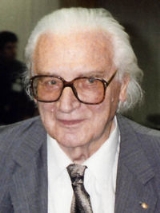
Konrad Zuse

 
Konrad Zuse

   Email Print
   Bookmark   Link


Konrad Zuse


Konrad Zuse (; June 22, 1910 Berlin
Berlin

Berlin is the Capital of Germany city and one of sixteen States of Germany of Germany. With a population of 3.4 million within its city limits, Berlin is the country's largest city....
 - December 18, 1995 Hünfeld
Hünfeld

H?nfeld is a town in the Fulda , in Hesse, Germany. It is situated 15 km northeast of Fulda....
) was a German
Germany

Germany , officially the Federal Republic of Germany , is a country in Central Europe. It is bordered to the north by the North Sea, Denmark, and the Baltic Sea; to the east by Poland and the Czech Republic; to the south by Austria and Switzerland; and to the west by France, Luxembourg, Belgium, and the Netherlands....
 civil engineer
Civil engineering

Civil engineering is a Professional Engineer discipline that deals with the design, construction and maintenance of the physical and naturally built environment, including works such as bridges, roads, canals, dams and buildings....
 and computer
Computer

A computer is a machine that manipulates Data according to a list of Code .The first devices that resemble modern computers date to the mid-20th century , although the computer concept and various machines similar to computers existed earlier....
 pioneer. His greatest achievement was the world's first functional program-controlled Turing-complete computer
Computer

A computer is a machine that manipulates Data according to a list of Code .The first devices that resemble modern computers date to the mid-20th century , although the computer concept and various machines similar to computers existed earlier....
, the Z3, in 1941 (the program was stored on a punched tape).


Discussion
Ask a question about 'Konrad Zuse'
Start a new discussion about 'Konrad Zuse'
Answer questions from other users
Full Discussion Forum


Recent Posts


Encyclopedia


Kzuse Denkmal
Konrad Zuse (; June 22, 1910 Berlin
Berlin

Berlin is the Capital of Germany city and one of sixteen States of Germany of Germany. With a population of 3.4 million within its city limits, Berlin is the country's largest city....
 - December 18, 1995 Hünfeld
Hünfeld

H?nfeld is a town in the Fulda , in Hesse, Germany. It is situated 15 km northeast of Fulda....
) was a German
Germany

Germany , officially the Federal Republic of Germany , is a country in Central Europe. It is bordered to the north by the North Sea, Denmark, and the Baltic Sea; to the east by Poland and the Czech Republic; to the south by Austria and Switzerland; and to the west by France, Luxembourg, Belgium, and the Netherlands....
 civil engineer
Civil engineering

Civil engineering is a Professional Engineer discipline that deals with the design, construction and maintenance of the physical and naturally built environment, including works such as bridges, roads, canals, dams and buildings....
 and computer
Computer

A computer is a machine that manipulates Data according to a list of Code .The first devices that resemble modern computers date to the mid-20th century , although the computer concept and various machines similar to computers existed earlier....
 pioneer. His greatest achievement was the world's first functional program-controlled Turing-complete computer
Computer

A computer is a machine that manipulates Data according to a list of Code .The first devices that resemble modern computers date to the mid-20th century , although the computer concept and various machines similar to computers existed earlier....
, the Z3, in 1941 (the program was stored on a punched tape). He received the Werner-von-Siemens-Ring in 1964 for the Z3.

Zuse also designed the first high-level
High-level programming language

In computing, a high-level programming language is a programming language with strong Abstraction from the details of the computer. In comparison to low-level programming languages, it may use natural language elements, be easier to use, or more Porting across platforms....
 programming language
Programming language

A programming language is a machine-readable artificial language designed to express computations that can be performed by a machine, particularly a computer....
, Plankalkül
Plankalkül

Plankalk?l is a computer language developed for engineering purposes by Konrad Zuse. It was the first high-level programming language von Neumann programming languages programming language to be designed for a computer and was designed between 1943 and 1945....
, first published in 1948, although this was a theoretical contribution, since the language was not implemented in his lifetime and did not directly influence early languages. One of the inventors of ALGOL
Algol

Algol , known colloquially as the Demon Star, is a bright star in the constellation Perseus . It is one of the best known eclipsing binary, the first such star to be discovered, and also one of the first variable stars to be discovered....
 (Rutishauser) wrote: "The very first attempt to devise an algorithmic language was undertaken in 1948 by K. Zuse. His notation was quite general, but the proposal never attained the consideration it deserved." In addition to his technical work, Zuse founded the first computer startup company
Startup company

A startup company or start-up is a company with a limited operating history. These companies, generally newly created, are in a phase of development and research for markets....
 in 1946. This company built the Z4
Z4 (computer)

The Z4 computer was the world's second commercial digital computer, designed by Germany engineer Konrad Zuse, built by his company Zuse Apparatebau....
, which became the second commercial computer leased to ETH Zürich in 1950. Due to World War II
World War II

World War II, or the Second World War , was a global military conflict which involved a Participants in World War II, including all of the great powers, organised into two opposing military alliances: the Allies of World War II and the Axis powers....
, however, Zuse's work went largely unnoticed in the UK
United Kingdom

The United Kingdom of Great Britain and Northern Ireland, commonly known as the United Kingdom , the UK or Britain,is a sovereign state located off the northwestern coast of continental Europe....
 and the USA
United States

The United States of America is a Federal government constitutional republic comprising U.S. state and a federal district. The country is situated mostly in central North America, where its Contiguous United States and Washington, D.C., the Capital districts and territories, lie between the Pacific Ocean and Atlantic Oceans, Borders of the U...
; possibly his first documented influence on a US company was IBM
IBM

International Business Machines Corporation, abbreviated IBM and nicknamed "Big Blue" , is a multinational corporation computer technology and consulting corporation headquartered in Armonk, New York, New York, United States....
's option on his patents in 1946. In the late 1960s, Zuse suggested the concept of a Calculating Space
Calculating Space

Calculating Space is the title of MIT's English translation of Konrad Zuse's 1969 book Rechnender Raum , the first book on digital physics....
 (a computation-based universe). There is a replica of the Z3, as well as the Z4, in the Deutsches Museum
Deutsches Museum

The Deutsches Museum in Munich, Germany, is the world's largest museum of technology and science, with approximately 1.3 million visitors per year and about 28,000 exhibited objects from 50 fields of science and technology....
 in Munich
Munich

Munich is the capital city of Bavaria, Germany. Munich is located on the River Isar north of the Northern Limestone Alps. Munich is the third largest city in Germany, after Berlin and Hamburg....
. The Deutsches Technikmuseum Berlin in Berlin
Berlin

Berlin is the Capital of Germany city and one of sixteen States of Germany of Germany. With a population of 3.4 million within its city limits, Berlin is the country's largest city....
 has an exhibition devoted to Zuse, displaying twelve of his machines, including a replica of the Z1
Z1 (computer)

The Z1 was a mechanical computer created by Konrad Zuse in 1936. It was a binary electrically driven mechanical calculator with limited programmability, reading instructions from punched tape....
, some original documents, including the specifications of Plankalkül, and several of Zuse's paintings.

Pre-WWII work and the Z1

Born in Berlin
Berlin

Berlin is the Capital of Germany city and one of sixteen States of Germany of Germany. With a population of 3.4 million within its city limits, Berlin is the country's largest city....
, Germany
Germany

Germany , officially the Federal Republic of Germany , is a country in Central Europe. It is bordered to the north by the North Sea, Denmark, and the Baltic Sea; to the east by Poland and the Czech Republic; to the south by Austria and Switzerland; and to the west by France, Luxembourg, Belgium, and the Netherlands....
, his parents moved to Braunsberg, East Prussia
East Prussia

East Prussia refers to the main part of the Prussia along the southeastern Baltic Sea from the 13th century to 1945. From 1772?1829 and 1878?1945, the Province of East Prussia was a province of the Germany state of Prussia....
 in 1912, where his father worked as a postal clerk. Zuse visited the Collegium Hosianum
Collegium Hosianum

The Collegium Hosianum was the Jesuit collegium in Royal Prussia, Poland, founded in 1565, 1566 by cardinal Stanislaus Hosius in Braniewo . The city of Braniewo was then part of the Diocese of Warmia , a semi-autonomous part of Poland with cardinal Hosius as its prince-bishop....
 in Braunsberg and after his family moved to Hoyerswerda
Hoyerswerda

Hoyerswerda is a town in the Germany Bundesland of Free State of Saxony. It is located in Lusatia, a region where many people speak the Sorbian languages in addition to German language....
, he passed his Abitur
Abitur

'Abitur' is a designation used in Germany and Finland for final exams that pupils take at the end of their secondary education, usually after 12 or 13 years of schooling ....
 in 1928. Zuse graduated in civil engineering
Civil engineering

Civil engineering is a Professional Engineer discipline that deals with the design, construction and maintenance of the physical and naturally built environment, including works such as bridges, roads, canals, dams and buildings....
 from the Technische Hochschule Berlin-Charlottenburg
Technical University of Berlin

The Technical University of Berlin is located in Berlin, Germany.It was founded in 1879 and, with nearly 30,000 students, is one of the largest technical universities in Germany....
 in 1935. In his engineering studies, Zuse had to perform many routine calculations by hand, which he found mind-numbingly boring. This led him to dream about performing calculations by machine.

He started as a design engineer at the Henschel aircraft factory in Berlin
Berlin

Berlin is the Capital of Germany city and one of sixteen States of Germany of Germany. With a population of 3.4 million within its city limits, Berlin is the country's largest city....
-Schönefeld but resigned a year later to build a program driven/programmable machine. Working in his parents' apartment in 1936, his first attempt, called the Z1
Z1 (computer)

The Z1 was a mechanical computer created by Konrad Zuse in 1936. It was a binary electrically driven mechanical calculator with limited programmability, reading instructions from punched tape....
, was a binary electrically driven mechanical calculator with limited programmability, reading instructions from a punched tape
Punched tape

Punched tape or paper tape is a largely obsolete form of data storage, consisting of a long strip of paper in which holes are punched to store data....
. In 1937 Zuse submitted two patents that anticipated a von-Neumann architecture. He finshed the Z1 in 1938. The Z1 never worked well, though, due to the lack of sufficiently precise mechanical parts. The Z1 and its original blueprint
Blueprint

A blueprint is a type of paper-based reproduction usually of a technical drawing, documenting an architecture or an engineering design. More generally, the term "blueprint" has come to be used to refer to any detailed plan....
s were destroyed during World War II.

Between 1987 and 1989, Zuse recreated the Z1, suffering a heart-attack midway through the project. It had 30,000 components, cost 800,000 DM, and required four individuals (including Zuse) to assemble it. Funding for this retrocomputing
Retrocomputing

Retrocomputing is a term used to describe the use of early computer computer hardware and computer software today. Retrocomputing is usually classed as a hobby and recreation rather than a practical application of technology; enthusiasts often collect rare and valuable hardware and software for nostalgia purposes....
 project was provided by Siemens and a consortium of five companies.

The WWII years; the Z2, Z3, and Z4

World War II made it impossible for Zuse and other German computer scientists to work with scientists in the UK and the USA, or even to stay in contact with them. In 1939, Zuse was called for military service but was able to convince the army to let him return to his computers. In 1940, he gained support from the Aerodynamische Versuchsanstalt (AVA, Aerodynamic Research Institute), which used his work for the production of glide bomb
Glide bomb

A glide bomb is an aerial bomb that is modified with aerodynamic surfaces to modify its flight path from a purely Ballistics one, to a flatter, gliding, one....
s. Zuse built the Z2, a revised version of the Z1, from telephone relay
Relay

A relay is an electrical switch that opens and closes under the control of another electrical circuit. In the original form, the switch is operated by an magnet to open or close one or many sets of contacts....
s. The same year, he started a company, Zuse Apparatebau (Zuse Apparatus Engineering), to manufacture his machines. Improving on the basic Z2 machine, he built the Z3 in 1941. It was a binary
Binary numeral system

The binary numeral system, or notation with a radix of 2. Owing to its straightforward implementation in digital electronic circuitry using logic gates, the binary system is used internally by all modern computers....
 64-bit floating point calculator featuring programmability with loops but without conditional jumps, with memory and a calculation unit based on telephone relays. The telephone relays used in his machines were largely collected from discarded stock. Despite the absence of conditional jumps, the Z3 was a Turing complete computer (ignoring the fact that no physical computer can be truly Turing complete because of limited storage size). However, Turing-completeness was never considered by Zuse (who had practical applications in mind) and only demonstrated in 1998 (see History of computing hardware
History of computing hardware

The history of computing hardware encompasses computer hardware, its Computer architecture, and its impact on Computer software.The elements of computing hardware have undergone significant improvement over their history....
). Zuse never received the support that computer pioneers in Allied countries, such as Alan Turing
Alan Turing

Alan Mathison Turing, Order of the British Empire, Fellow of the Royal Society was a British mathematician, logician and Cryptanalysis....
, got. The Z3 was financed only partly by the DVL (Deutsche Versuchsanstalt für Luftfahrt, i.e. German Experimentation-Institution for Aviation), which wanted their extensive calculations automated. A request by his co-worker Helmut Schreyer
Helmut Schreyer

Helmut T. Schreyer was a German people inventor. He is mostly known for his work on the Z3 , one of the first computers....
 for government funding for an electronic successor to the Z3 was denied as "strategically unimportant". In 1937 Schreyer had advised Zuse to use vacuum tube
Vacuum tube

In electronics, a vacuum tube, electron tube , thermionic valve, or just valve is a device used to amplifier, switch, otherwise modify, or create an Electricity signal by controlling the movement of electrons in a low-pressure space....
s as switching elements, who at this time considered it a crazy idea ("Schnapsidee" in his own words). Zuse's company (with the Z3) was destroyed in 1945 by an Allied attack. Fortunately, the partially finished, relay-based Z4
Z4 (computer)

The Z4 computer was the world's second commercial digital computer, designed by Germany engineer Konrad Zuse, built by his company Zuse Apparatebau....
 had been moved to a safe place earlier. Zuse designed the first high-level programming language, Plankalkül
Plankalkül

Plankalk?l is a computer language developed for engineering purposes by Konrad Zuse. It was the first high-level programming language von Neumann programming languages programming language to be designed for a computer and was designed between 1943 and 1945....
, from 1941 to 1945, although he did not publish it in its entirety until 1972. No compiler
Compiler

A compiler is a computer program that transforms source code written in a programming language into another computer language . The most common reason for wanting to transform source code is to create an executable program....
 or interpreter
Interpreter (computing)

In computer science, an interpreter normally means a computer program that execution , i.e. performs, instructions written in a programming language....
 was available for Plankalkül until a team from the Free University of Berlin
Free University of Berlin

The Free University of Berlin is the largest of the four universities in Berlin. Research at the university is focused on humanities and social sciences and on health science and natural sciences....
 implemented it in 2000.

Konrad Zuse married Gisela Brandes in January 1945 - employing a carriage, himself dressed in tailcoat and top hat and with Gisela in wedding veil, for Zuse attached importance to a noble ceremony. Their son Horst
Horst Zuse

Horst Zuse is a professor of Computer Science at the Technical University of Berlin and the son of the noted computer scientist Konrad Zuse....
 was born in November 1945.

Zuse the entrepreneur


In 1946 Zuse founded the world's first computer startup company: the Zuse-Ingenieurbüro Hopferau. Venture capital was raised through ETH Zürich and an IBM option on Zuse's patents. Zuse founded another company, Zuse KG, in 1949. The Z4
Z4 (computer)

The Z4 computer was the world's second commercial digital computer, designed by Germany engineer Konrad Zuse, built by his company Zuse Apparatebau....
 was finished and delivered to the ETH Zürich, Switzerland
Switzerland

Switzerland is a landlocked Swiss Alps country of roughly 7.7 million people in Western Europe with an area of 41,285 km?. Switzerland is a federal republic consisting of 26 states called Cantons of Switzerland....
 in September 1950. At that time, it was the only working computer in continental Europe, and the second computer in the world to be sold, only beaten by the BINAC
BINAC

BINAC, the Binary Automatic Computer, was an early electronic computer designed for Northrop Aircraft Company by the Eckert-Mauchly Computer Corporation in 1949....
. Other computers, all numbered with a leading Z, up to Z43, were built by Zuse and his company. Notable are the Z11
Z11

The Z11 was a computer, the first serially-produced machine of the Zuse KG.Weighing 800kg, in 1955 it was built with relays and stepwise relays....
, which was sold to the optics industry and to universities, and the Z22
Z22

See Z22 for the Palm, Inc. handheldThe Z22 was the seventh computer model Konrad Zuse developed . One of the early commercial computers, the Z22's design was finished about 1955....
, the first computer with a memory based on magnetic storage. By 1967, the Zuse KG had built a total of 251 computers. Due to financial problems, it was then sold to Siemens
Siemens AG

Siemens Aktiengesellschaft is Europe's largest engineering Conglomerate . Siemens' international headquarters are located in Berlin and Munich, Germany....
.

Calculating Space

In 1967 Zuse also suggested that the universe
Universe

The universe is defined as everything that physically exists: the entirety of space and time, all forms of matter, energy and momentum, and the physical laws and physical constants that govern them....
 itself is running on a grid of computers (digital physics
Digital physics

In physics and cosmology, digital physics is a collection of theoretical perspectives that start by assuming that the universe is, at heart, describable by information, and is therefore Computability theory ....
); in 1969 he published the book Rechnender Raum (translated into English as Calculating Space
Calculating Space

Calculating Space is the title of MIT's English translation of Konrad Zuse's 1969 book Rechnender Raum , the first book on digital physics....
). This idea has attracted a lot of attention, since there is no physical evidence against Zuse's thesis. Edward Fredkin
Edward Fredkin

Edward Fredkin is an early pioneer of digital physics . His main contributions include his work on reversible computing and cellular automata. While Konrad Zuse's book Calculating Space mentioned the importance of reversible computation, the Fredkin gate represented the essential breakthrough....
 (1980s), Juergen Schmidhuber (1990s), Stephen Wolfram
Stephen Wolfram

Stephen Wolfram is a British physicist, mathematician and businessman known for his work in theoretical particle physics, cosmology, cellular automaton, complexity theory, and computer algebra....
 (A New Kind of Science
A New Kind of Science

A New Kind of Science is a controversial book by Stephen Wolfram, published in 2002. It contains an empirical and systematic study of computational systems such as cellular automata....
) and others have expanded on it. Zuse received several awards for his work. After he retired, he focused on his hobby, painting. Zuse died on December 18 1995 in Hünfeld
Hünfeld

H?nfeld is a town in the Fulda , in Hesse, Germany. It is situated 15 km northeast of Fulda....
, Germany
Germany

Germany , officially the Federal Republic of Germany , is a country in Central Europe. It is bordered to the north by the North Sea, Denmark, and the Baltic Sea; to the east by Poland and the Czech Republic; to the south by Austria and Switzerland; and to the west by France, Luxembourg, Belgium, and the Netherlands....
, near Fulda
Fulda

Fulda is a city in Hesse, Germany; it is located on the Fulda River and is the administrative seat of the Fulda ....
.

Awards

  • Werner-von-Siemens-Ring in 1964 (together with Fritz Leonhardt
    Fritz Leonhardt

    Fritz Leonhardt was a German structural engineer who made major contributions to 20th century bridge engineering, especially in the development of cable-stayed bridges....
     and Walter Schottky)
  • Harry H. Goode Memorial Award in 1965 (together with George Stibitz
    George Stibitz

    George Robert Stibitz is internationally recognized as a father of the modern digital computer. He was a Bell Labs researcher known for his 1930s and 1940s work on the realization of Boolean logic digital circuits using electromechanical relays as the switching element....
    )
  • Bundesverdienstkreuz
    Bundesverdienstkreuz

    The Bundesverdienstkreuz is the only general state decoration of the Germany. This Federal Order of Merit has existed since September 7, 1951....
     in 1972 - Great Cross of Merit
  • Computer History Museum
    Computer History Museum

    The Computer History Museum is a museum established in 1996 in Mountain View, California, when The Computer Museum, Boston sent the majority of its historical collection to Moffett Federal Airfield, so that TCM could concentrate on computing-related exhibits for children....
     Fellow Award
    in 1999 -


Quotations

  • "The belief in a certain idea gives to the researcher the support for his work. Without this belief he would be lost in a sea of doubts and insufficiently verified proofs."
  • "The rattling of the Z4 is the only interesting thing about the Zürich nightlife
    Zürich

    Z?rich is the largest city in Switzerland and the capital of the canton of Z?rich. The city is Switzerland's main commercial and cultural centre and sometimes called the Cultural Capital of Switzerland, the political capital of Switzerland being Berne....
    ."


See also

  • List of pioneers in computer science
  • Z1
    Z1 (computer)

    The Z1 was a mechanical computer created by Konrad Zuse in 1936. It was a binary electrically driven mechanical calculator with limited programmability, reading instructions from punched tape....
    , Z2, Z3, Z4
    Z4 (computer)

    The Z4 computer was the world's second commercial digital computer, designed by Germany engineer Konrad Zuse, built by his company Zuse Apparatebau....
    , Z5
    Z5 (computer)

    The Z5 was a computer built by Zuse.The Z5 is the successor of the Z4. The Z5 is much more compact and powerful. Zuse implemented the machine with relays, as vacuum tubes were too unreliable at the time....
    , Z11
    Z11

    The Z11 was a computer, the first serially-produced machine of the Zuse KG.Weighing 800kg, in 1955 it was built with relays and stepwise relays....
    , Z22
    Z22

    See Z22 for the Palm, Inc. handheldThe Z22 was the seventh computer model Konrad Zuse developed . One of the early commercial computers, the Z22's design was finished about 1955....
  • Digital philosophy
    Digital philosophy

    Digital philosophy is a new direction in philosophy and physical cosmology advocated by certain mathematicians and theoretical physicists, e.g., Gregory Chaitin, Edward Fredkin, Stephen Wolfram, and Konrad Zuse ....
  • German inventors and discoverers
    German inventors and discoverers

    Under Construction, please be patient!This is a list of German Inventions and Discoveries of German people or inventors/discoverers of German heritage in alphabetical order....


Further reading

  • Jürgen Alex, Hermann Flessner, Wilhelm Mons, Horst Zuse: Konrad Zuse: Der Vater des Computers. Parzeller, Fulda 2000, ISBN 3-7900-0317-4
  • Raul Rojas (Hrsg.): Die Rechenmaschinen von Konrad Zuse. Springer, Berlin 1998, ISBN 3-540-63461-4.
  • Jürgen Alex: Wege und Irrwege des Konrad Zuse. In: Spektrum der Wissenschaft (dt. Ausgabe von Scientific American) 1/1997, ISSN 0170-2971.
  • Hadwig Dorsch: Der erste Computer. Konrad Zuses Z1 - Berlin 1936. Beginn und Entwicklung einer technischen Revolution. Mit Beiträgen von Konrad Zuse und Otto Lührs. Museum für Verkehr und Technik, Berlin 1989.
  • Clemens Kieser: „Ich bin zu faul zum Rechnen“ - Konrad Zuses Computer Z22 im Zentrum für Kunst und Medientechnologie Karlsruhe. In: Denkmalpflege in Baden-Württemberg, 4/34/2005, Esslingen am Neckar, S. 180-184, ISSN 0342-0027.
  • Arno Peters: Was ist und wie verwirklicht sich Computer-Sozialismus: Gespräche mit Konrad Zuse. Verlag Neues Leben, Berlin 2000, ISBN 3-355-01510-5.
  • Paul Janositz: Informatik und Konrad Zuse: Der Pionier des Computerbaus in Europa – Das verkannte Genie aus Adlershof. In: Der Tagesspiegel Nr. 19127, Berlin, 9. März 2006, Beilage Seite B3.
  • Jürgen Alex: Zum Einfluß elementarer Sätze der mathematischen Logik bei Alfred Tarski auf die drei Computerkonzepte des Konrad Zuse. TU Chemnitz 2006.
  • Jürgen Alex: Zur Entstehung des Computers - von Alfred Tarski zu Konrad Zuse. VDI-Verlag, Düsseldorf 2007, ISBN 978-3-18-150051-4, ISSN 0082-2361.


External links

  • – By Prof. Horst Zuse
    Horst Zuse

    Horst Zuse is a professor of Computer Science at the Technical University of Berlin and the son of the noted computer scientist Konrad Zuse....
     (K. Zuse's son); an extensive and well-written historical account
  • Computermuseum Kiel: , ,