
All Topics  
Old High German


   Email Print
   Bookmark   Link


Old High German


The term Old High German (OHG, German: , German abbr. Ahd.) refers to the earliest stage of the German language
German language

German is a West Germanic languages, thus related to and classified alongside English language and Dutch language. It is one of the world's world language and the most widely spoken mother tongue in the European Union....
 and it conventionally covers the period from around 500 to 1050. Coherent written texts do not appear until the second half of the 8th century, and some treat the period before 750 as 'prehistoric' and date the start of Old High German proper to 750 for this reason. There are, however, a number of Elder Futhark
Elder Futhark

The Elder Futhark is the oldest form of the runic alphabet, used by Germanic tribes for Northwest Germanic and Migration period Germanic dialects of the 2nd to 8th centuries for inscriptions on artifacts and runestones....
 inscriptions dating to the 6th century (notably the Pforzen buckle
Pforzen buckle

The Pforzen buckle is a silver belt buckle found in Pforzen, Ostallg?u in 1992. The Alemannic grave in which it was found dates to the end of the 6th century and was presumably that of a warrior, as it also contained a lance, spatha, seax and shield....
), as well as single words and many names found in Latin
Latin

Latin is an Italic language, historically spoken in Latium and Ancient Rome. Through the Military history of the Roman Empire, Latin spread throughout the Mediterranean and a large part of Europe....
 texts predating the 8th century.

main difference between Old High German and the West Germanic dialects
West Germanic languages

The West Germanic languages constitute the largest of the three traditional branches of the Germanic languages family of languages and include languages such as English language, Dutch language and Afrikaans, German language, the Frisian languages, as well as Yiddish language....
 from which it developed is that it underwent the Second Sound Shift or High German consonant shift
High German consonant shift

In historical linguistics, the High German consonant shift or second Germanic consonant shift was a phonological development which took place in the southern parts of the West Germanic dialect continuum in several phases, probably beginning between the 3rd and 5th centuries AD, and was almost complete before the earliest written recor...
.


Discussion
Ask a question about 'Old High German'
Start a new discussion about 'Old High German'
Answer questions from other users
Full Discussion Forum


Recent Posts


Encyclopedia


The term Old High German (OHG, German: , German abbr. Ahd.) refers to the earliest stage of the German language
German language

German is a West Germanic languages, thus related to and classified alongside English language and Dutch language. It is one of the world's world language and the most widely spoken mother tongue in the European Union....
 and it conventionally covers the period from around 500 to 1050. Coherent written texts do not appear until the second half of the 8th century, and some treat the period before 750 as 'prehistoric' and date the start of Old High German proper to 750 for this reason. There are, however, a number of Elder Futhark
Elder Futhark

The Elder Futhark is the oldest form of the runic alphabet, used by Germanic tribes for Northwest Germanic and Migration period Germanic dialects of the 2nd to 8th centuries for inscriptions on artifacts and runestones....
 inscriptions dating to the 6th century (notably the Pforzen buckle
Pforzen buckle

The Pforzen buckle is a silver belt buckle found in Pforzen, Ostallg?u in 1992. The Alemannic grave in which it was found dates to the end of the 6th century and was presumably that of a warrior, as it also contained a lance, spatha, seax and shield....
), as well as single words and many names found in Latin
Latin

Latin is an Italic language, historically spoken in Latium and Ancient Rome. Through the Military history of the Roman Empire, Latin spread throughout the Mediterranean and a large part of Europe....
 texts predating the 8th century.

Characteristics

The main difference between Old High German and the West Germanic dialects
West Germanic languages

The West Germanic languages constitute the largest of the three traditional branches of the Germanic languages family of languages and include languages such as English language, Dutch language and Afrikaans, German language, the Frisian languages, as well as Yiddish language....
 from which it developed is that it underwent the Second Sound Shift or High German consonant shift
High German consonant shift

In historical linguistics, the High German consonant shift or second Germanic consonant shift was a phonological development which took place in the southern parts of the West Germanic dialect continuum in several phases, probably beginning between the 3rd and 5th centuries AD, and was almost complete before the earliest written recor...
. This is generally dated very approximately to the late 5th and early 6th centuries—hence dating its start to around 500. The result of this sound change is that the consonant system of German
German language

German is a West Germanic languages, thus related to and classified alongside English language and Dutch language. It is one of the world's world language and the most widely spoken mother tongue in the European Union....
 remains different from all other West Germanic languages, including English
English language

English is a West Germanic language that originated in Anglo-Saxon England and has lingua franca status in many parts of the world as a result of the military, economic, scientific, political and cultural influence of the British Empire in the 18th, 19th and early 20th centuries and that of the United States from the mid 20th century onwa...
 and Low German
Low German

Low German or Low Saxon is any of the regional language varieties of the West Germanic languages spoken mainly in northern Germany and the eastern part of the Netherlands....
. Grammatically, however, Old High German remained very similar to Old English
Old English language

Old English is an early form of the English language that was spoken and written in parts of what are now England and south-eastern Scotland between the mid-5th century and the mid-12th century....
, Old Dutch
Old Dutch

Old Dutch is a linguistic term denoting the forms of West Franconian spoken and written during the early Middle Ages in the Netherlands and the northern part of present-day Belgium....
, and Old Saxon
Old Saxon

Old Saxon, also known as Old Low German , is the earliest recorded form of Low German, documented from the 9th century until the 12th century, when it evolved into Middle Low German....
.

By the mid 11th century the many different vowels found in unstressed syllables had all been reduced to "e". Since these vowels were part of the grammatical endings in the nouns and verbs, their loss led to radical simplification of the inflection
Inflection

In grammar, inflection or inflexion is the way language handles grammatical relations and relational categories such as grammatical tense, grammatical mood, grammatical voice, grammatical aspect, grammatical person, grammatical number, grammatical gender, grammatical case....
al grammar of German. For these reasons, 1050 is seen as the start of the Middle High German
Middle High German

Middle High German , abbreviated MHG , is the term used for the period in the history of the German language between 1050 and 1350. It is preceded by Old High German and followed by Early New High German....
 period, though in fact there are almost no texts in German for the next hundred years.

Examples of vowel reduction
Vowel reduction

Vowel reduction is the term in phonetics that refers to various changes in the acoustic quality of vowels, which are related to changes in stress , sonority, duration, loudness, articulation, or position in the word , and which are perceived as "weakening"....
 in unstressed syllables:
    Old High German     Middle High German     English
    to make, to do
    days
    to the
(The Modern German forms of these words are broadly the same as in Middle High German.)

Dialects

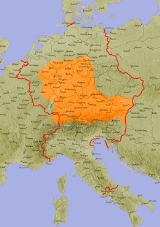
There was no standard or supra-regional variety of Old High German—every text is written in a particular dialect, or in some cases a mixture of dialects. Broadly speaking, the main dialect divisions of Old High German seem to have been similar to those of later periods—they are based on established territorial groupings and the effects of the Second Sound Shift, which have remained influential until the present day. But because the direct evidence for Old High German consists solely of manuscript
Manuscript

A manuscript is any document that is written by hand, as opposed to being printed or reproduced in some other way. The term may also be used for information that is hand-recorded in other ways than writing, for example inscriptions that are chiselled upon a hard material or scratched as with a knife point in plaster or with a stylus on a wa...
s produced in a few major ecclesiastical centres, there is no isogloss
Isogloss

An isogloss is the geographical boundary or delineation of a certain linguistics feature, e.g. the pronunciation of a vowel, the meaning of a word, or use of some syntactic feature....
 information of the sort on which modern dialect maps are based. For this reason the dialects may be termed monastery dialects.

The main dialects, with their bishoprics and monasteries:
  • Central German
    Central German

    Central German is a group of High German languages dialects spread from the Rhineland to Thuringia, south of Low German and Low Franconian and north of Upper German....
    • Middle Franconian: Trier
      Trier

      Trier is a city in Germany on the banks of the Moselle River. It is the oldest city in Germany, founded in or before 16 BC. Trier is not the only city claiming to be Germany's oldest, but it is the only one that bases this assertion on having the longest history as a city, as opposed to a mere settlement or army camp....
      , Echternach
      Echternach

      Echternach is a Communes of Luxembourg with List of cities in Luxembourg in the canton of Echternach , which is part of the district of Grevenmacher , in eastern Luxembourg....
      , Cologne
      Cologne

      Cologne is Germany's fourth-largest city , and is the largest city both in the German Federal State of North Rhine-Westphalia and within the Rhine-Ruhr, one of the major European metropolitan areas with more than ten million inhabitants....
    • Rhine Franconian
      Rhine Franconian

      Rhine Franconian , or Rhenish Franconian, is a dialect family of West Central German. It comprises the German dialects spoken across the western regions of the states of Saarland, Rhineland-Palatinate, and Hesse in Germany....
      : Lorsch
      Lorsch

      Lorsch is a town in the Kreis Bergstra?e in Hesse, Germany, 60 km south of Frankfurt. Lorsch is well known for the Lorsch Abbey, which has been named a World Heritage Site....
      , Speyer
      Speyer

      Speyer is a city in Germany with approx. 50,000 inhabitants, located beside the river Rhine. It lies 25 km south of Ludwigshafen and Mannheim....
      , Worms
      Worms, Germany

      Worms is a city in Rhineland-Palatinate, Germany, on the Rhine River. At the end of 2004, it had 85,829 inhabitants.Established by the Celts who called it Borbetomagus, Worms today remains embattled with the cities Trier and Cologne over title of "Oldest City in Germany"....
      , Mainz
      Mainz

      Mainz is a city in Germany and the capital of the Germany States of Germany of Rhineland-Palatinate. It was a politically important seat of the Prince-elector of Mainz under the Holy Roman Empire, and previously was a Roman Empire fort city which commanded the west bank of the Rhine River and formed part of the northernmost frontier of th...
      , Frankfurt
      Frankfurt

      is the largest city in the German States of Germany of Hesse and the List of cities in Germany with more than 100,000 inhabitants in Germany, with a 2008 population of 670,000....
    • South Rhine Franconian: Weissenburg im Elsaß
      Wissembourg

      Wissembourg is a small town and commune in France situated on the little River Lauter close to the border between France and Germany, in easternmost Alsace r?gion in France, approximately north of Strasbourg and west of Karlsruhe....
    • East Franconian: Fulda
      Fulda

      Fulda is a city in Hesse, Germany; it is located on the Fulda River and is the administrative seat of the Fulda ....
      , Bamberg
      Bamberg

      Bamberg is a town in Bavaria, Germany. It is located in Upper Franconia on the river Regnitz, close to its confluence with the river Main. Bamberg is one of the few cities in Germany that was not destroyed by World War II bombings because of a nearby Artillery Factory that prevented planes from getting near to Bamberg....
      , Würzburg
      Würzburg

      W?rzburg is a city in the region of Franconia which lies in the northern tip of Bavaria, Germany. Located on the Main River, it is the capital of the Regierungsbezirk Unterfranken....
    • Thuringian: (no texts)
    • West Franconian: conjectural dialect of the Franks in Northern Gaul
      Gaul

      Gaul is the name used for the region of Western Europe comprising part of present day northern Italy, France, Belgium, western Switzerland and the parts of the Netherlands and Germany on the west bank of the River Rhine....


  • Upper German
    Upper German

    Upper German is a family of High German languages dialects spoken primarily in southern Germany, Austria, Switzerland and Northern Italy....
    • Alemannic
      Alemannic

      The term Alemannic can have several, related meanings:* Alemannic is used to refer to the Alemanni/Alamanni, a Germanic tribe of the 1st millennium....
      : Murbach
      Murbach Abbey

      Murbach Abbey was a once famous Order of St. Benedict monastery in Murbach, southern Alsace, in a valley at the foot of the Grand Ballon in the Vosges....
      , Reichenau
      Reichenau Island

      Reichenau Island lies in Lake Constance in southern Germany, at approximately . It lies between the Gnadensee and the Untersee, almost due west of the city of Konstanz....
      , Sankt Gallen
      Abbey of St. Gall

      The Abbey of Saint Gall was for many centuries one of the chief Benedictine abbeys in Europe. It is located in the city of St. Gallen in present-day Switzerland....
      . Strasbourg
      Strasbourg

      Strasbourg is the capital and principal city of the Alsace Regions of France in northeastern France. With 702,412 inhabitants in 2007, its metropolitan area is the Aire urbaine....
    • Bavarian
      Austro-Bavarian

      Austro-Bavarian or Bavarian is a major group of Upper German variety . Like standard German, Austro-Bavarian is a High German languages, but they are not the same language....
      : Freising
      Freising

      Freising is a town in Bavaria, Germany, capital of the Freising . Total population 48,500.The city is located north of Munich at the Isar river, near the Munich International Airport....
      , Passau
      Passau

      Passau is a town in Lower Bavaria, Germany, known also as the Dreifl?ssestadt , because the Danube is joined there by the Inn River from the South, and the Ilz coming out of the Bavarian Forest to the North....
      , Regensburg
      Regensburg

      Regensburg is a city in Bavaria, Germany, located at the confluence of the Danube and Regen River rivers, at the northernmost bend in the Danube....
      , Augsburg
      Augsburg

      Augsburg is an Independent City city in the south-west of Bavaria. The College town is home of the Regierungsbezirk Swabia and also of the Swabia and the Augsburg ....
      , Ebersberg
      Ebersberg

      Ebersberg is the district seat of the like-named Districts of Germany in the Regierungsbezirk of Oberbayern, southern Germany. The Ebersberger Forst is one of Germany?s biggest continuous woodlands....
      , Wessobrunn
      Wessobrunn Abbey

      Wessobrunn Abbey was a Benedictine Order monastery near Weilheim in Oberbayern in Bavaria, Germany.It is celebrated as the home of the famous Wessobrunn Prayer and also of a Baroque Wessobrunner School and plasterers in the 18th century....
      , Tegernsee
      Tegernsee Abbey

      Tegernsee Abbey or the Imperial Abbey of Tegernsee is a former Order of St. Benedict monastery in the town and district of Tegernsee in Bavaria....
      , Salzburg
      Salzburg

      is the List of cities and towns in Austria#List of cities and towns by population size in Austria and the capital city of the states of Austria of Salzburg ....
      , Mondsee
      Mondsee Abbey

      Mondsee Abbey was a Order of St. Benedict monastery in Mondsee in Upper Austria....
    • Langobardic: (fragmentary, classification as OHG uncertain)


There are some important differences between the geographical spread of the Old High German dialects and that of Modern German:
  • no German dialects were spoken east of the Rivers Elbe
    Elbe

    The River Elbe is one of the major rivers of Central Europe. It originates in the Krkonose Mountains of northwestern Czech Republic before traversing much of Germany and flowing into the North Sea....
     and Saale
    Saale

    The Saale, also known as the Saxon Saale and Thuringian Saale , is a river in Germany and a left-bank tributary of the Elbe. It is not to be confused with the smaller Fr?nkische Saale, a right-bank tributary of the Main, or the Saale in Lower Saxony, a tributary of the Leine....
    —in the Old High German period this area was occupied by Slavic peoples
    Slavic peoples

    The Slavic Peoples are a linguistic branch of Indo-European peoples, living mainly in eastern Europe. From the early 6th century they spread from their original homeland to inhabit most of eastern Central Europe, Eastern Europe and the Balkans....
     since the Völkerwanderung and was not settled by German speakers until the late 10th and the early 11th century
  • the Langobardic dialect of the Lombards
    Lombards

    The Lombards were a Germanic peoples originally from Northern Europe who settled in the valley of the Danube and from there invaded Byzantine Italian peninsula in 568 under the leadership of Alboin....
     who invaded Northern Italy
    Northern Italy

    Northern Italy comprises two areas belonging to Italian NUTS level 1 regions:*North-West : Aosta Valley, Piedmont, Lombardy, Liguria;*North-East : Friuli-Venezia Giulia, Veneto, Trentino-Alto Adige/S?dtirol, Emilia-Romagna....
     in the 6th century is assumed to have been an Upper German dialect, though little evidence of it remains apart from names and individual words in Latin
    Latin

    Latin is an Italic language, historically spoken in Latium and Ancient Rome. Through the Military history of the Roman Empire, Latin spread throughout the Mediterranean and a large part of Europe....
     texts, and a few inscriptions


Frankish

The Franks
Franks

The Franks or Frankish people were a West Germanic ethnic group first identified in the 3rd century as living north and east of the Lower Rhine River....
 conquered Northern Gaul
Gaul

Gaul is the name used for the region of Western Europe comprising part of present day northern Italy, France, Belgium, western Switzerland and the parts of the Netherlands and Germany on the west bank of the River Rhine....
 as far south as the Loire
Loire

Loire is an departments of France in the east-central part of France occupying the River Loire's upper reaches....
; the linguistic boundary later stabilised approximately along the course of the Maas
Maas

Maas is a Dutch language and Low German surname allegedly from a short form of Thomas .Many believe Maas to be a shortened Americanized form of the surname Moskowitz...
 and Moselle
Moselle

Moselle is a departments of France in the east of France named after the Moselle River....
, with Frankish
Old Frankish language

Old Frankish was the language of the Franks and it is classified as a West Germanic language. Once it was spoken in areas covering modern Belgium, The Netherlands, Luxembourg and adjacent parts of France and Germany....
 speakers further west being romanised. However, Frankish is a special case among the old West Germanic languages, the Frankish tribes built their empire at the same time as the High German consonant shift
High German consonant shift

In historical linguistics, the High German consonant shift or second Germanic consonant shift was a phonological development which took place in the southern parts of the West Germanic dialect continuum in several phases, probably beginning between the 3rd and 5th centuries AD, and was almost complete before the earliest written recor...
 took place. This meant that the dialects of Frankish in the north of their empire, the Low Countries
Low Countries

The Low Countries, the historical region of de Nederlanden, are the country on low-lying land around the river delta of the Rhine, Scheldt, and Meuse River rivers....
, did not shift while the dialects in the south did. The dialects in the south are part of Old High German, the ones in the north are part of Old Dutch
Old Dutch

Old Dutch is a linguistic term denoting the forms of West Franconian spoken and written during the early Middle Ages in the Netherlands and the northern part of present-day Belgium....
.

With Charlemagne
Charlemagne

Charlemagne was List of Frankish kings from 768 to his death. He expanded the Franks kingdoms into a Carolingian Empire that incorporated much of Western Europe and Central Europe....
's conquest of the Lombards
Lombards

The Lombards were a Germanic peoples originally from Northern Europe who settled in the valley of the Danube and from there invaded Byzantine Italian peninsula in 568 under the leadership of Alboin....
 in 776, nearly all continental Germanic speaking peoples had been incorporated into the Frankish Empire
Frankish Empire

Francia or Frankia, later also called the Frankish Empire , Frankish Kingdom , Frankish Realm or occasionally Frankland, was the territory inhabited and ruled by the Franks from the 3rd to the 10th century....
, thus also bringing all continental West Germanic speakers under Frankish rule. However, since the language of both the administration and the Church was Latin, this unification did not lead to any development of a supra-regional variety of Frankish nor a standardized Old High German.

Phonology

The charts show the vowel and consonant systems of the East Franconian dialect in the 9th century. This is the dialect of the monastery of Fulda
Fulda

Fulda is a city in Hesse, Germany; it is located on the Fulda River and is the administrative seat of the Fulda ....
, and specifically of the Old High German Tatian
Tatian

Tatian the Assyrian was an early Christianity writer and theologian of the second century.Tatian's most influential work is the Diatessaron, a harmony of the four gospels that became the standard text of the four gospels in the Syriac-speaking churches until the 5th-century, when it gave way to the four separate gospels in the Peshitta ve...
. Dictionaries and grammars of OHG often use the spellings of the Tatian as a substitute for genuine standardised spellings, and these have the advantage of being recognizably close to the Middle High German
Middle High German

Middle High German , abbreviated MHG , is the term used for the period in the history of the German language between 1050 and 1350. It is preceded by Old High German and followed by Early New High German....
 forms of words, particularly with respect to the consonants.

Vowels


Short and long vowels
OHG had corresponding sets of five short and five long vowels, which could occur in both stressed and unstressed syllables.

Notes:
  1. It seems likely that all back vowels had front allophones as a result of Umlaut
    Germanic umlaut

    In linguistics, umlaut is a process whereby a vowel is pronounced more like a vowel or semivowel in a following syllable.The term umlaut was originally coined and is principally used in connection with the study of the Germanic languages....
    , which were then phonemicized in MHG. There was also a mid-close resulting from the Umlaut of and .
  2. It is probable that the short high and mid vowels are lower than their long equivalents, as in Modern German, but this is impossible to establish from the written sources.
  3. Towards the end of the period, short vowels and then long vowels tended to be replaced, when in unstressed syllables, by spellings, which may have represented or schwa
    Schwa

    In linguistics, specifically phonetics and phonology, schwa can mean the following:*An stress and tone neutral vowel sound in any language, often but not necessarily a mid-central vowel....
     .


Diphthongs
OHG diphthongs are indicated by the spellings: , , , , , .

Consonants


  1. There is wide variation in the consonant systems of the Old High German dialects arising mainly from the differing extent to which they are affected by the High German Sound Shift. Precise information about the articulation of consonants is impossible to establish.
  2. In the plosive and fricative series, where there are two consonants in a cell, the first is fortis
    Fortis

    Fortis may refer to:*Fortis , a linguistic term*Fortis , a financial services company, based in Belgium and the Netherlands*Fortis Healthcare Limited, a chain of hospitals based in India...
     the second lenis. The voicing of lenis consonants varied between dialects.
  3. OHG has long consonants, and the following double consonant spellings indicate not vowel length as in Modern German orthography, but rather genuine double consonants: pp, bb, tt, dd, ck (for ), gg, ff, ss, hh, zz, mm, nn, ll, rr.
  4. changes to in all dialects during the 9th century. The status in the Old High German Tatian (c. 830), reflected in modern Old High German dictionaries and glossaries, is that <th> is found in initial position, in other positions.
  5. It is not clear whether the distribution of palatal and velar allophones and (before front and back vowels, respectively) found in Modern German was already present in OHG.


Texts

The early part of the period saw considerable missionary activity, and by 800 the whole of the Frankish Empire
Frankish Empire

Francia or Frankia, later also called the Frankish Empire , Frankish Kingdom , Frankish Realm or occasionally Frankland, was the territory inhabited and ruled by the Franks from the 3rd to the 10th century....
 had, in principle, been Christianized. All the manuscripts which contain Old High German texts were written in ecclesiastical scriptoria
Scriptorium

Scriptorium, literally "a place for writing", is commonly used to refer to a room in medieval European monasteries devoted to the copying of manuscripts by monastic scribes....
 by scribe
Scribe

A scribe is a person who writes books or documents by hand as a profession. The profession, previously found in all literate cultures in some form, lost most of its importance and status with the advent of printing....
s whose main task was writing in Latin rather than German. Consequently, the majority of Old High German texts are religious in nature and show strong influence of ecclesiastical Latin
Ecclesiastical Latin

Ecclesiastical Latin is the Latin used by the Roman Catholic Church in all periods for ecclesiastical purposes. It can be distinguished from Classical Latin by some lexical variations, a simplified syntax in some cases, and, commonly, an Italianate pronunciation....
 on the vocabulary. In fact, most surviving prose texts are translations of Latin originals. Even secular works such as the Hildebrandslied are often preserved only because they were written on spare sheets in religious codices
Codex

A codex is a book in the format used for modern books, with separate pages normally bound together and given a cover. It was a Roman invention that replaced the scroll, which was the first form of book in all Eurasian cultures....
.

The earliest Old High German text is generally taken to be the Abrogans
Abrogans

The Abrogans, or Codex Abrogans , is probably the oldest extant book written in the German language. It is a manuscript dictionary of synonyms from Latin into Old High German dating from the 8th century ....
, a Latin-Old High German glossary variously dated between 750 and 780, probably from Reichenau
Reichenau Island

Reichenau Island lies in Lake Constance in southern Germany, at approximately . It lies between the Gnadensee and the Untersee, almost due west of the city of Konstanz....
. The 8th century Merseburg Incantations
Merseburg Incantations

The Merseburg Incantations are two Middle Ages magic spells, charms or incantations, written in Old High German. They are the only known examples of Germanic paganism preserved in this language....
 are the only remnant of pre-Christian
Germanic paganism

Germanic paganism refers to the religion beliefs of the Germanic peoples preceding Christianization. The best documented version of the Germanic pagan religions is 10th and 11th century Norse paganism, though other information can be found from Anglo-Saxon paganism and Continental Germanic mythology....
 German literature. The earliest texts not dependent on Latin originals would seem to be the Hildebrandslied and the Wessobrunn Prayer
Wessobrunn Prayer

The Wessobrunn Prayer , sometimes called the Wessobrunn Creation Poem , believed to date from c790, is among the earliest known poetic works in Old High German....
, both recorded in manuscripts of the early 9th century, though the texts are assumed to derive from earlier copies.

The Bavarian Muspilli
Muspilli

Muspilli is one of but two surviving pieces of Old High German epic poetry , dating to around 870 in poetry. One large fragment of the text has survived in the margins and empty pages of a codex marked as the possession of Louis the German and now in the Bayerische Staatsbibliothek ....
 is the sole survivor of what must have been a vast oral tradition. Other important works are the Evangelienbuch (Gospel harmony
Diatessaron

The Diatessaron is the most prominent Gospel harmony created by Tatian, an early Christian apologist and ascetic,. Tatian combined Gospel of Matthew, Gospel of Mark, Gospel of Luke, and Gospel of John into a single narrative....
) of Otfrid von Weissenburg
Otfrid of Weissenburg

Otfrid of Weissenburg was a monk at Weissenburg and the author of a Diatessaron in Couplet now called the Evangelienbuch. It is written in the South Rhine Franconian dialect of Old High German....
, the short but splendid Ludwigslied
Ludwigslied

The Ludwigslied is an Old High German poem of 59 rhyming couplets, celebrating the victory of the Frankish army, led by Louis III of France, over Danish raiders at the Battle of Saucourt-en-Vimeu on 3 August 881....
 and the 9th century Georgslied
Georgslied

The Georgslied is an incomplete Old High German poem, perhaps originally sung, about the life of Saint George.The poem in 57 or so verses is found in the Heidelberg manuscript which also contains one of the texts of the Evangelienbuch of Otfrid of Weissenburg ....
. The boundary to Early Middle High German (from ca. 1050) is not clear-cut. The most impressive example of EMHG literature is the Annolied
Annolied

The Annolied was composed in about 1100 in Early Middle High German rhyming couplets by a monk of Siegburg Abbey....
.

Samples

The Lord's Prayer
Lord's Prayer

The Lord's Prayer, also known as the Our Father or Pater noster, is probably the best-known prayer in Christianity. On Easter Sunday 2007 it was estimated that 2 billion Catholic, Protestant and Eastern Orthodox Christians read, recited, or sang the short prayer in hundreds of languages in houses of worship of all shapes and size...
 in four Old High German dialects. Because these are translations of a liturgical text, they are best not regarded as examples of idiomatic language, but they do show dialect variation very clearly.

Alemannic, 8th Century South Rhine Franconian, 9th Century East Franconian, c. 830 Bavarian, early 9th century
The St Gall Paternoster
Lord's Prayer

The Lord's Prayer, also known as the Our Father or Pater noster, is probably the best-known prayer in Christianity. On Easter Sunday 2007 it was estimated that 2 billion Catholic, Protestant and Eastern Orthodox Christians read, recited, or sang the short prayer in hundreds of languages in houses of worship of all shapes and size...
Weissenburg
Weissenburg

The German names Weissenburg and Wei?enburg can refer to:* Wei?enburg in Bayern in Germany* Alba Iulia in Romania* Wissembourg in France...
 Catechism
Catechism

A catechism is a summary or exposition of doctrine, traditionally used in Christian religious teaching from New Testament times to the present....
Old High German Tatian
Tatian

Tatian the Assyrian was an early Christianity writer and theologian of the second century.Tatian's most influential work is the Diatessaron, a harmony of the four gospels that became the standard text of the four gospels in the Syriac-speaking churches until the 5th-century, when it gave way to the four separate gospels in the Peshitta ve...
Freisinger Paternoster
    
Source: Braune/Ebbinghaus, Althochdeutsches Lesebuch, 17th edn (Niemeyer, 1994)

See also

  • Middle High German
    Middle High German

    Middle High German , abbreviated MHG , is the term used for the period in the history of the German language between 1050 and 1350. It is preceded by Old High German and followed by Early New High German....
  • Medieval German Literature
    Medieval German literature

    Medieval German literature refers to literature written in Germany, stretching from the Carolingian dynasty; various dates have been given for the end of the German literary Middle Ages, the Protestant Reformation being the last possible cut-off point....


External links


  • Joseph Wright, (1906)
  • - links to a range of online texts


Sources

  • Althochdeutches Lesebuch, ed. W.Braune, K.Helm, E.A.Ebbinghaus, 17th edn, Tübingen 1994. ISBN 3-484-10707-3
  • J. Knight Bostock, A Handbook on Old High German Literature, 2nd edn, revised by K.C.King and D.R.McLintock, Oxford 1976. ISBN 0-19-815392-9
  • R.E.Keller, The German Language, London 1978. ISBN 0-571-11159-9
  • Lexikon der Germanistischen Linguistik, ed. Hans Peter Althaus, Helmut Henne, Herbert Ernst Weigand, 2nd revised edition, Tübingen 1980. ISBN 3-484-10396-5
  • S.Sonderegger, Althochdeutsche Sprache und Literatur, de Gruyter 1974 ISBN 3-11-004559-1
  • C.J.Wells, German. A Linguistic History to 1945, Oxford 1987. ISBN 0-19-815809-2