
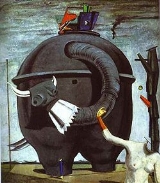
Surrealism is a cultural movement that began in the early 1920s, and is best known for the visual artworks and writings of the group members.
Surrealist works feature the element of surprise, unexpected juxtapositions and non sequitur; however, many Surrealist artists and writers regard their work as an expression of the philosophical movement first and foremost, with the works being an artifact. Leader
André BretonAndré Breton was a French writer, poet, and surrealist theorist, and is best known as the principal founder of Surrealism...
was explicit in his assertion that Surrealism was above all a revolutionary movement.
Surrealism developed out of the
DadaDada or Dadaism is a cultural movement that began in Zürich, Switzerland, during World War I and peaked from 1916 to 1922. The movement primarily involved visual arts, literature—poetry, art manifestoes, art theory—theatre, and graphic design, and concentrated its anti-war politics through a...
activities of World War I and the most important center of the movement was Paris. From the 1920s on, the movement spread around the globe, eventually affecting the visual arts, literature, film, and music, of many countries and languages, as well as political thought and practice, philosophy and social theory.
Founding of the movement
World War I scattered the writers and artists who had been based in Paris, and while away from Paris many involved themselves in the Dada movement, believing that excessive rational thought and bourgeois values had brought the terrifying conflict upon the world. The Dadaists protested with anti-rational
anti-artThe term Anti-art refers to art which presents a challenge to the currently existing definition of art. It is a term that by wide consensus seems to have been coined by Marcel Duchamp. This would have been around the time that he began making readymades around 1913. Some still regard the readymades...
gatherings, performances, writing and art works. After the war when they returned to Paris the Dada activities continued.
During the war Surrealism's soon-to-be leader
André BretonAndré Breton was a French writer, poet, and surrealist theorist, and is best known as the principal founder of Surrealism...
, who had trained in medicine and psychiatry, served in a neurological hospital where he used the psychoanalytic methods of
Sigmund FreudSigmund Freud , Sigismund Schlomo Freud , was an Austrian neurologist who founded the psychoanalytic school of psychology...
with soldiers who were shell-shocked. He also met the young writer
Jacques VachéJacques Vaché was a friend of André Breton, the founder of surrealism. Vaché was one of the chief inspirations behind the Surrealist movement. As Breton said:...
and felt that he was the spiritual son of writer and pataphysician
Alfred JarryAlfred Jarry was a French writer born in Laval, Mayenne, France, not far from the border of Brittany; he was of Breton descent on his mother's side....
, and he came to admire the young writer's anti-social attitude and disdain for established artistic tradition. Later Breton wrote, "In literature, I am successively taken with
RimbaudJean Nicolas Arthur Rimbaud was a French poet, born in Charleville, Ardennes. As part of the decadent movement, his influence on modern literature, music and art has been enduring and pervasive...
, with Jarry, with
ApollinaireWilhelm Albert Włodzimierz Apolinary Kostrowicki, known as Guillaume Apollinaire was a French poet, writer and art critic born in Italy to a Polish mother....
, with
NouveauGermain Nouveau born and died in Pourrières, Var, in France , was a French poet, associated with the symbolist movement. He was a friend of Rimbaud and Verlaine. In 1874 he traveled to London with Rimbaud. In 1876 he published Dixains réalistes, a parody of the Parnassians...
, with
LautréamontComte de Lautréamont was the pseudonym of Isidore Lucien Ducasse , an Uruguayan-born French poet....
, but it is Jacques Vaché to whom I owe the most."
Back in Paris, Breton joined in the Dada activities and also started the literary journal
Littérature along with
Louis AragonLouis Aragon Louis Aragon Louis Aragon , was a French poet, novelist and editor, a long-time political supporter of the Communist Party and a member of the Académie Goncourt.-Early life (1897-1939) :...
and
Philippe SoupaultPhilippe Soupault was a French writer and poet, novelist, critic, and political activist. He was characterized by the Dadaist style and later initiated the Surrealist style with André Breton...
. They began experimenting with
automatic writingAutomatism has taken on many forms: the automatic writing and drawing initially practiced by surrealists can be compared to similar, or perhaps parallel phenomena, such as the non-idiomatic improvisation of free jazz....
—spontaneously writing without censoring their thoughts—and published the "automatic" writings, as well as accounts of dreams, in
Littérature. Breton and Soupault delved deeper into automatism and wrote
The Magnetic Fields (Les Champs Magnétiques) Les Champs Magnétiques is a novel by André Breton and Philippe Soupault. It is famed as the first work of literary Surrealism...
in 1919. They continued the automatic writing, gathering more artists and writers into the group, and coming to believe that automatism was a better tactic for societal change than the Dada attack on prevailing values. In addition to Breton, Aragon and Soupault the original Surrealists included
Paul ÉluardPaul Éluard was the pen name of Eugène Émile Paul Grindel , a French poet who was one of the founders of the surrealist movement.-Biography:...
,
Benjamin PéretBenjamin Péret was a French poet and Surrealist.Benjamin Péret was born in Rezé on 4 July 1899, and enlisted in the army to avoid being jailed. He saw action in the Balkans, and served through the war. Afterwards, he joined the Dada movement, and in 1921 published Le Passager du transtlantique ...
,
René CrevelRené Crevel was a French writer involved with the surrealist movement.-Life:Crevel was born in Paris to a family of Parisian bourgeoisie. He had a traumatic religious upbringing. At the age of fourteen, during a difficult stage of his life, his father committed suicide by hanging himself. Crevel...
,
Robert DesnosRobert Desnos , was a French surrealist poet who played a key role in the surrealistic movement of his day. His last name is pronounced "Deznoss."- Biography :...
,
Jacques BaronJacques Baron was a French surrealist poet whose first collection of poems was published in Aventure in 1921. Although he was initially involved with the Dada movement, he became a founding member of the Surrealist movement following his meeting with André Breton in 1921, and contributed to La...
,
Max MoriseMax Morise was a French artist, writer & actor, associated with the Surrealist movement in Paris from 1924 to 1929. He was friends with Robert Desnos and Roger Vitrac before they joined the Surrealist movement. He contributed articles to La Revolution Surrealiste and took part in a series of...
, Marcel Noll,
Pierre NavillePierre Naville was a French writer and sociologist. A Surrealist, he was a prominent member of the 'Investigating Sex' group of Surrealist thinkers.In politics, he was a Communist and then a Trotskyist, before joining the PSU...
,
Roger VitracRoger Vitrac was a French surrealist playwright and poet.Born in Pinsac, Roger Vitrac moved to Paris in 1910. As a young man, he was influenced by symbolism and the writings of Lautréamont and Alfred Jarry, and he developed a passion for theatre and poetry...
, Simone Breton, Gala Éluard,
Max ErnstMax Ernst was a German painter, sculptor, graphic artist, and poet. A prolific artist, Ernst is considered to be one of the primary pioneers of the Dada movement and Surrealism.-Early life:...
,
Salvador DalíSalvador Domingo Felipe Jacinto Dalí i Domènech, 1st Marquis of Púbol was a Spanish Catalan surrealist painter born in Figueres....
,
Man RayMan Ray, born Emmanuel Radnitzky , was an American artist who spent most of his career in Paris, France. Perhaps best described simply as a modernist, he was a significant contributor to both the Dada and Surrealist movements, although his ties to each were informal...
, Hans Arp,
Georges MalkineGeorges Alexandre Malkine was the only painter to sign the Surrealist Manifesto of 1924; the other signatories were, for the most part, writers...
,
Michel LeirisJulien Michel Leiris was a French surrealist writer and ethnographer.-Biography:...
,
Georges LimbourGeorges Limbour was a French writer of prose and poetry.He was a member of the Surrealist Movement in Paris during the 1920s, but was expelled from the group in 1929. Before his association with André Breton and the Surrealists, Limbour co-edited, along with Roger Vitrac and Rene Crevel, the...
,
Antonin ArtaudAntoine Marie Joseph Artaud, better known as Antonin Artaud was a French playwright, poet, actor and theatre director...
,
Raymond QueneauRaymond Queneau was a French poet and novelist and the co-founder of Ouvroir de littérature potentielle .-Biography:...
,
André MassonAndré-Aimé-René Masson was a French artist.-Biography:Masson was born in Balagny-sur-Thérain, near Senlis in Picardy, but was brought up in Belgium. He studied art in Brussels and Paris. He fought for France in World War I and was seriously injured.Masson's early works display an interest in cubism...
,
Joan MiróJoan Miró i Ferrà was a Spanish Catalan painter, sculptor, and ceramist born in Barcelona.Earning international acclaim, his work has been interpreted as Surrealism, a sandbox for the subconscious mind, a re-creation of the childlike, and a manifestation of Catalan pride...
,
Marcel DuchampMarcel Duchamp was a French artist whose work is most often associated with the Dadaist and Surrealist movements. Duchamp's output influenced the development of post-World War I Western art...
,
Jacques PrévertJacques Prévert was a French poet and screenwriter. -Life:Prevert was born at Neuilly-sur-Seine and grew up in Paris, where he was bored by school. He often went to theatre with his father, a drama critic, and acquired a love of reading from his mother...
and
Yves TanguyRaymond Georges Yves Tanguy , known as Yves Tanguy was a surrealist painter.-Biography:Tanguy was born in Paris, France, the son of a retired navy captain. His parents were both of Breton origin...
.
As they developed their philosophy they felt that while Dada rejected categories and labels, Surrealism would advocate the idea that ordinary and depictive expressions are vital and important, but that the sense of their arrangement must be open to the full range of imagination according to the Hegelian Dialectic. They also looked to the Marxist dialectic and the work of such theorists as
Walter BenjaminWalter Bendix Schönflies Benjamin was a German-Jewish Marxist philosopher-sociologist, literary critic, translator and essayist. He was at times associated with the Frankfurt School of critical theory...
and
Herbert MarcuseHerbert Marcuse was a German-Jewish philosopher, political theorist and sociologist, and a member of the Frankfurt School. Celebrated as the "Father of the New Left," his best known works are Eros and Civilization, One-Dimensional Man and The Aesthetic Dimension...
.
Freud'sSigmund Freud , Sigismund Schlomo Freud , was an Austrian neurologist who founded the psychoanalytic school of psychology...
work with free association, dream analysis and the hidden unconscious was of the utmost importance to the Surrealists in developing methods to liberate imagination. However, they embraced
idiosyncrasyIdiosyncrasy, from Ancient Greek , idiosyngkrasía, "a peculiar temperament", "habit of body" is defined as an individualizing quality or characteristic of a person or group, and is often used to express eccentricity or peculiarity. The term can also be applied to symbols...
, while rejecting the idea of an underlying madness or darkness of the mind. (Later the idiosyncratic
Salvador DalíSalvador Domingo Felipe Jacinto Dalí i Domènech, 1st Marquis of Púbol was a Spanish Catalan surrealist painter born in Figueres....
explained it as: "There is only one difference between a madman and me. I am not mad.")
The group aimed to revolutionize human experience, including its personal, cultural, social, and political aspects, by freeing people from what they saw as false rationality, and restrictive customs and structures.
BretonAndré Breton was a French writer, poet, and surrealist theorist, and is best known as the principal founder of Surrealism...
proclaimed, the true aim of Surrealism is "long live the social revolution, and it alone!" To this goal, at various times surrealists aligned with
communismCommunism is a socioeconomic structure and political ideology that promotes the establishment of an egalitarian, classless, stateless society based on common ownership and control of the means of production and property in general. Karl Marx posited that communism would be the final stage in human...
and
anarchismAnarchism is a political philosophy encompassing theories and attitudes which consider the state, as compulsory government, to be unnecessary, harmful, and/or undesirable, and favors the absence of the state ....
.
In 1924 they declared their intents and philosophy with the issuance of the first
Surrealist ManifestoTwo Surrealist Manifestos were issued by the Surrealist movement, in 1924 and 1929, respectively. The first was written by André Breton, the second was supervised by him. Breton drafted a third Surrealist Manifesto, which was never issued.-First manifesto:...
. That same year they established the
Bureau of Surrealist ResearchThe Bureau of Surrealist Research, also known as the Centrale Surréaliste, was a Paris-based office in which a loosely affiliated group of Surrealist writers and artists gathered to meet, hold discussions, and conduct interviews with the goal of investigating speech under trance...
, and began publishing the journal
La Révolution surréalisteLa Révolution surréaliste was a publication by Surrealists in Paris. Twelve issues were published between 1924 and 1929....
.
Surrealist Manifesto
Breton wrote the
manifesto of 1924Two Surrealist Manifestos were issued by the Surrealist movement, in 1924 and 1929, respectively. The first was written by André Breton, the second was supervised by him. Breton drafted a third Surrealist Manifesto, which was never issued.-First manifesto:...
(another was issued in 1929) that defines the purposes of the group and includes citations of the influences on Surrealism, examples of Surrealist works and discussion of Surrealist automatism. He defined Surrealism as:
La Révolution surréaliste
Shortly after releasing the first
Surrealist ManifestoTwo Surrealist Manifestos were issued by the Surrealist movement, in 1924 and 1929, respectively. The first was written by André Breton, the second was supervised by him. Breton drafted a third Surrealist Manifesto, which was never issued.-First manifesto:...
in 1924, the Surrealists published the inaugural issue of
La Révolution surréalisteLa Révolution surréaliste was a publication by Surrealists in Paris. Twelve issues were published between 1924 and 1929....
and publication continued into 1929.
Pierre NavillePierre Naville was a French writer and sociologist. A Surrealist, he was a prominent member of the 'Investigating Sex' group of Surrealist thinkers.In politics, he was a Communist and then a Trotskyist, before joining the PSU...
and
Benjamin PéretBenjamin Péret was a French poet and Surrealist.Benjamin Péret was born in Rezé on 4 July 1899, and enlisted in the army to avoid being jailed. He saw action in the Balkans, and served through the war. Afterwards, he joined the Dada movement, and in 1921 published Le Passager du transtlantique ...
were the initial directors of the publication and modeled the format of the journal on the conservative scientific review
La Nature. The format was deceiving, and to the Surrealists' delight
La Révolution surréaliste was consistently scandalous and revolutionary. The journal focused on writing with most pages densely packed with columns of text, but also included reproductions of art, among them works by
Giorgio de ChiricoGiorgio de Chirico was a pre-Surrealist and then Surrealist Greek-Italian painter born in Volos, Greece, to a Genovese mother and a Sicilian father. He founded the scuola metafisica art movement...
,
Max ErnstMax Ernst was a German painter, sculptor, graphic artist, and poet. A prolific artist, Ernst is considered to be one of the primary pioneers of the Dada movement and Surrealism.-Early life:...
,
André MassonAndré-Aimé-René Masson was a French artist.-Biography:Masson was born in Balagny-sur-Thérain, near Senlis in Picardy, but was brought up in Belgium. He studied art in Brussels and Paris. He fought for France in World War I and was seriously injured.Masson's early works display an interest in cubism...
and
Man RayMan Ray, born Emmanuel Radnitzky , was an American artist who spent most of his career in Paris, France. Perhaps best described simply as a modernist, he was a significant contributor to both the Dada and Surrealist movements, although his ties to each were informal...
.
Bureau of Surrealist Research
The
Bureau of Surrealist ResearchThe Bureau of Surrealist Research, also known as the Centrale Surréaliste, was a Paris-based office in which a loosely affiliated group of Surrealist writers and artists gathered to meet, hold discussions, and conduct interviews with the goal of investigating speech under trance...
(Centrale Surréaliste) was the Paris office where the Surrealist writers and artists gathered to meet, hold discussions, and conduct interviews with the goal of investigating speech under trance.
Expansion
The movement in the mid-1920s was characterized by meetings in cafes where the Surrealists played collaborative drawing games and discussed the theories of Surrealism. The Surrealists developed a variety of
techniquesSurrealism in art, poetry, and literature uses numerous techniques and games to provide inspiration. Many of these are said to free imagination by producing a creative process free of conscious control. The importance of the unconscious as a source of inspiration is central to the nature of...
such as automatic drawing.
Breton initially doubted that visual arts could even be useful in the Surrealist movement since they appeared to be less malleable and open to chance and
automatismAutomatism has taken on many forms: the automatic writing and drawing initially practiced by surrealists can be compared to similar, or perhaps parallel phenomena, such as the non-idiomatic improvisation of free jazz....
. This caution was overcome by the discovery of such techniques as
frottageIn art, frottage is a surrealist and "automatic" method of creative production developed by Max Ernst.In frottage the artist takes a pencil or other drawing tool and makes a "rubbing" over a textured surface. The drawing can be left as is or used as the basis for further refinement...
, and
decalcomaniaDecalcomania, from the French décalcomanie, is a decorative technique by which engravings and prints may be transferred to pottery or other materials. It was invented in England about 1750 and imported into the United States at least as early as 1865...
.
Soon more visual artists joined Surrealism including
Giorgio de ChiricoGiorgio de Chirico was a pre-Surrealist and then Surrealist Greek-Italian painter born in Volos, Greece, to a Genovese mother and a Sicilian father. He founded the scuola metafisica art movement...
,
Salvador DalíSalvador Domingo Felipe Jacinto Dalí i Domènech, 1st Marquis of Púbol was a Spanish Catalan surrealist painter born in Figueres....
,
Enrico DonatiEnrico Donati was an American Surrealist painter and sculptor of Italian birth.-Life and work:Enrico Donati studied economics at the Università degli Studi, Pavia, and in 1934 moved to the USA, where he attended the New School for Social Research and the Art Students League of New York...
,
Alberto GiacomettiAlberto Giacometti was a Swiss sculptor, painter, draftsman, and printmaker. Alberto Giacometti was born in October 1901 in Italian-speaking Switzerland and came from an artistic background - his father, Giovanni, was a well known Post-Impressionist painter...
,
Valentine HugoValentine Hugo was an artist. She was born Valentine Gross in Boulogne-sur-Mer and died in Paris.Valentine studied painting in Paris, and in 1919 married French artist Jean Hugo , great-grandson of Victor Hugo...
,
Méret OppenheimMeret Oppenheim was a German-born Swiss, Surrealist artist, and photographer. Oppenheim is highly associated with the Dada movement because of her circle of friends. However, her art cannot be considered Dada: she did care about the aesthetics of the art object...
,
ToyenMarie Čermínová , known as Toyen, was a Czech painter, draftsman and illustrator, a member of the surrealist movement....
,
Grégoire MichonzeGrégoire Michonze was a Russian-French painter, born in 1902 in Kishinev , Russia Grégoire Michonze (1902-1982) (variant name Grégoire Michonznic) was a Russian-French painter, born in 1902 in Kishinev (Bessarabia), Russia Grégoire Michonze (1902-1982) (variant name Grégoire Michonznic) was a...
, and
Luis BuñuelLuis Buñuel Portolés was a Spanish-born filmmaker who acquired Mexican citizenship and worked in Mexico, France, and also in his native Spain and the United States...
. Though Breton admired
Pablo PicassoPablo Diego José Francisco de Paula Juan Nepomuceno María de los Remedios Cipriano de la Santísima Trinidad Ruiz y Picasso was a Spanish painter, draughtsman, and sculptor. Commonly known simply as Picasso, he is one of the most recognized figures in 20th-century art...
and
Marcel DuchampMarcel Duchamp was a French artist whose work is most often associated with the Dadaist and Surrealist movements. Duchamp's output influenced the development of post-World War I Western art...
and courted them to join the movement, they remained peripheral.
More writers also joined, including former Dadaist
Tristan TzaraTristan Tzara was a Romanian and French avant-garde poet, essayist and performance artist...
,
René CharRené Char was a 20th century French poet.-Biography:Born in L'Isle-sur-la-Sorgue in the Vaucluse department of France, he died in 1988, in Paris. In 1929 he met André Breton and Paul Éluard and joined the surrealist group but distanced himself gradually from the mid 1930s on.Char joined the...
,
Georges SadoulGeorges Sadoul was a French journalist and cinema writer.Once a surrealist, he became a communist in 1932. He was a journalist of the Lettres Françaises....
, André Thirion and Maurice Heine.
In 1925 an autonomous Surrealist group formed in Brussels becoming official in 1926. The group included the musician, poet and artist E.L.T. Mesens, painter and writer
René MagritteRené François Ghislain Magritte
[p] was a Belgian surrealist artist. He became well known for a number of witty and thought-provoking images...
,
Paul NougéPaul Nougé was a Belgian poet and philosopher. He was one of the most influential members of the Surrealist school in Belgium. He was a friend and associate of fellow artists Louis Scutenaire, Marcel Mariën and René Magritte...
,
Marcel LecomteMarcel Lecomte was a Belgian writer, member of the Belgian surrealist movement. In 1918 he was introduced to dadaism and Eastern philosophy by Clément Pansaers. He also started to study literature and philosophy at the Université Libre de Bruxelles that year, but he left the studies in 1920...
, Camille Goemans, and
André SourisAndré Souris was a Belgian composer and writer associated with the Surrealist movement.He was born in Marchienne-au-Pont, Belgium, and studied at the Conservatorium in Brussels. He won the Rubens prize in 1927. In 1947 he composed Polyphonie, an Avant-Garde/Surrealist work. He lived in Italy,...
. In 1927 they were joined by the writer
Louis ScutenaireLouis Scutenaire was a poet, anarchist, surrealist and civil servant. Born Jean Émile Louis Scutenaire in Ollignies, Belgium, June 29 1905; died Brussels, August 15 1987.-Life:...
. They corresponded regularly with the Paris group, and in 1927 both Goemans and Magritte moved to Paris and frequented Breton's circle.
The artists, with their roots in
DadaDada or Dadaism is a cultural movement that began in Zürich, Switzerland, during World War I and peaked from 1916 to 1922. The movement primarily involved visual arts, literature—poetry, art manifestoes, art theory—theatre, and graphic design, and concentrated its anti-war politics through a...
and
CubismCubism was a 20th century avant-garde art movement, pioneered by Pablo Picasso and Georges Braque, that revolutionized European painting and sculpture, and inspired related movements in music and literature. The first branch of cubism, known as "Analytic Cubism", was both radical and influential as...
, the abstraction of
Wassily KandinskyWassily Wassilyevich Kandinsky was a Russian painter, and art theorist. He is credited with painting the first modern abstract works....
and
ExpressionismExpressionism was a cultural movement originating in Germany at the start of the 20th-century as a reaction to positivism and other artistic movements such as naturalism and impressionism. It sought to express the meaning of "being alive" and emotional experience rather than physical reality...
, and
Post-ImpressionismPost-Impressionism is the term coined by the British artist and art critic Roger Fry in 1910 to describe the development of French art since Manet...
, also reached to older "bloodlines" such as
Hieronymus BoschHieronymus Bosch was an Early Netherlandish painter of the fifteenth and sixteenth centuries...
, and the so-called primitive and naive arts.
André MassonAndré-Aimé-René Masson was a French artist.-Biography:Masson was born in Balagny-sur-Thérain, near Senlis in Picardy, but was brought up in Belgium. He studied art in Brussels and Paris. He fought for France in World War I and was seriously injured.Masson's early works display an interest in cubism...
's automatic drawings of 1923, are often used as the point of the acceptance of visual arts and the break from Dada, since they reflect the influence of the idea of the
unconscious mindThe unconscious mind is a term invented by the 18th century German romantic philosopher Ser Christopher Riegel and later introduced into English by the poet and essayist Samuel Taylor Coleridge...
. Another example is
Alberto GiacomettiAlberto Giacometti was a Swiss sculptor, painter, draftsman, and printmaker. Alberto Giacometti was born in October 1901 in Italian-speaking Switzerland and came from an artistic background - his father, Giovanni, was a well known Post-Impressionist painter...
's 1925
Torso, which marked his movement to simplified forms and inspiration from preclassical sculpture.
However, a striking example of the line used to divide Dada and Surrealism among art experts is the pairing of 1925's
Little Machine Constructed by Minimax Dadamax in Person (Von minimax dadamax selbst konstruiertes maschinchen) with
The Kiss (Le Baiser) from 1927 by
ErnstMax Ernst was a German painter, sculptor, graphic artist, and poet. A prolific artist, Ernst is considered to be one of the primary pioneers of the Dada movement and Surrealism.-Early life:...
. The first is generally held to have a distance, and erotic subtext, whereas the second presents an erotic act openly and directly. In the second the influence of
MiróJoan Miró i Ferrà was a Spanish Catalan painter, sculptor, and ceramist born in Barcelona.Earning international acclaim, his work has been interpreted as Surrealism, a sandbox for the subconscious mind, a re-creation of the childlike, and a manifestation of Catalan pride...
and the drawing style of
PicassoPablo Diego José Francisco de Paula Juan Nepomuceno María de los Remedios Cipriano de la Santísima Trinidad Ruiz y Picasso was a Spanish painter, draughtsman, and sculptor. Commonly known simply as Picasso, he is one of the most recognized figures in 20th-century art...
is visible with the use of fluid curving and intersecting lines and colour, whereas the first takes a directness that would later be influential in movements such as
Pop artPop art is a visual art movement that emerged in the mid 1950s in Britain and in the late 1950s in the United States. Pop art challenged tradition by asserting that an artist's use of the mass-produced visual commodities of popular culture is contiguous with the perspective of fine art...
.
Giorgio de ChiricoGiorgio de Chirico was a pre-Surrealist and then Surrealist Greek-Italian painter born in Volos, Greece, to a Genovese mother and a Sicilian father. He founded the scuola metafisica art movement...
, and his previous development of
Metaphysical artMetaphysical art is the name of an Italian art movement, created by Giorgio de Chirico and Carlo Carrà. Their dream-like paintings of squares typical of idealized Italian cities, as well as apparently casual juxtapositions of objects, represented a visionary world which engaged most immediately...
, was one of the important joining figures between the philosophical and visual aspects of Surrealism. Between 1911 and 1917, he adopted an unornamented depictional style whose surface would be adopted by others later.
The Red Tower (La tour rouge) from 1913 shows the stark colour contrasts and illustrative style later adopted by Surrealist painters. His 1914
The Nostalgia of the Poet (La Nostalgie du poete) has the figure turned away from the viewer, and the juxtaposition of a bust with glasses and a fish as a relief defies conventional explanation. He was also a writer, and his novel
Hebdomeros presents a series of dreamscapes with an unusual use of punctuation, syntax and grammar designed to create a particular atmosphere and frame around its images. His images, including set designs for the
Ballets RussesThe Ballets Russes was an itinerant ballet company which performed under the directorship of Sergei Diaghilev between 1909 and 1929. Some of their places of residence included the Théâtre Mogador and the Théâtre du Châtelet, as Paris had a large Russian exile population...
, would create a decorative form of visual Surrealism, and he would be an influence on the two artists who would be even more closely associated with Surrealism in the public mind:
Salvador DalíSalvador Domingo Felipe Jacinto Dalí i Domènech, 1st Marquis of Púbol was a Spanish Catalan surrealist painter born in Figueres....
and
MagritteRené François Ghislain Magritte
[p] was a Belgian surrealist artist. He became well known for a number of witty and thought-provoking images...
. He would, however, leave the Surrealist group in 1928.
In 1924,
MiroJoan Miró i Ferrà was a Spanish Catalan painter, sculptor, and ceramist born in Barcelona.Earning international acclaim, his work has been interpreted as Surrealism, a sandbox for the subconscious mind, a re-creation of the childlike, and a manifestation of Catalan pride...
and
MassonAndré-Aimé-René Masson was a French artist.-Biography:Masson was born in Balagny-sur-Thérain, near Senlis in Picardy, but was brought up in Belgium. He studied art in Brussels and Paris. He fought for France in World War I and was seriously injured.Masson's early works display an interest in cubism...
applied Surrealism theory to painting explicitly leading to the
La Peinture Surrealiste exhibition of 1925.
La Peinture Surrealiste exhibition was the first ever Surrealist exhibition at Gallerie Pierre in Paris, and displayed works by
MassonAndré-Aimé-René Masson was a French artist.-Biography:Masson was born in Balagny-sur-Thérain, near Senlis in Picardy, but was brought up in Belgium. He studied art in Brussels and Paris. He fought for France in World War I and was seriously injured.Masson's early works display an interest in cubism...
,
Man RayMan Ray, born Emmanuel Radnitzky , was an American artist who spent most of his career in Paris, France. Perhaps best described simply as a modernist, he was a significant contributor to both the Dada and Surrealist movements, although his ties to each were informal...
,
KleePaul Klee was a Swiss painter of German nationality. His highly individual style was influenced by movements in art that included expressionism, cubism, and surrealism. He was, as well, a student of orientalism. Klee was a natural draftsman who experimented with and eventually mastered color...
,
MiróJoan Miró i Ferrà was a Spanish Catalan painter, sculptor, and ceramist born in Barcelona.Earning international acclaim, his work has been interpreted as Surrealism, a sandbox for the subconscious mind, a re-creation of the childlike, and a manifestation of Catalan pride...
, and others. The show confirmed that Surrealism had a component in the visual arts (though it had been initially debated whether this was possible), and techniques from Dada, such as
photomontagePhotomontage is the process of making a composite photograph by cutting and joining a number of other photographs. The composite picture was sometimes photographed so that the final image is converted back into a seamless photographic print. A similar method, although one that does not use film,...
, were used. The following year, on March 26, 1926 Galerie Surréaliste opened with an exhibition by
Man RayMan Ray, born Emmanuel Radnitzky , was an American artist who spent most of his career in Paris, France. Perhaps best described simply as a modernist, he was a significant contributor to both the Dada and Surrealist movements, although his ties to each were informal...
.
Breton published
Surrealism and Painting in 1928 which summarized the movement to that point, though he continued to update the work until the 1960s.
Writing continues
The first Surrealist work, according to leader
BretonAndré Breton was a French writer, poet, and surrealist theorist, and is best known as the principal founder of Surrealism...
, was
Magnetic Fields (Les Champs Magnétiques) Les Champs Magnétiques is a novel by André Breton and Philippe Soupault. It is famed as the first work of literary Surrealism...
(May–June 1919).
Littérature contained automatist works and accounts of dreams. The magazine and the portfolio both showed their disdain for literal meanings given to objects and focused rather on the undertones, the poetic undercurrents present. Not only did they give emphasis to the poetic undercurrents, but also to the connotations and the overtones which "exist in ambiguous relationships to the visual images."
Because Surrealist writers seldom, if ever, appear to organize their thoughts and the images they present, some people find much of their work difficult to parse. This notion however is a superficial comprehension, prompted no doubt by Breton's initial emphasis on automatic writing as the main route toward a higher reality. But — as in Breton's case itself — much of what is presented as purely automatic is actually edited and very "thought out". Breton himself later admitted that automatic writing's centrality had been overstated, and other elements were introduced, especially as the growing involvement of visual artists in the movement forced the issue, since automatic painting required a rather more strenuous set of approaches. Thus such elements as collage were introduced, arising partly from an ideal of startling juxtapositions as revealed in
Pierre ReverdyPierre Reverdy was a French poet associated with surrealism and cubism.Pierre Reverdy was born in Narbonne and grew up near the Montagne Noire in his father's house. Reverdy came from a family of sculptors. His father taught him to read and write. He studied at Toulouse and Narbonne.Reverdy...
's poetry. And — as in
Magritte'sRené François Ghislain Magritte
[p] was a Belgian surrealist artist. He became well known for a number of witty and thought-provoking images...
case (where there is no obvious recourse to either automatic techniques or collage) the very notion of convulsive joining became a tool for revelation in and of itself. Surrealism was meant to be always in flux — to be more modern than modern — and so it was natural there should be a rapid shuffling of the philosophy as new challenges arose.
Surrealists revived interest in Isidore Ducasse, known by his pseudonym "Le Comte de Lautréamont" and for the line "beautiful as the chance meeting on a dissecting table of a sewing machine and an umbrella", and
Arthur RimbaudJean Nicolas Arthur Rimbaud was a French poet, born in Charleville, Ardennes. As part of the decadent movement, his influence on modern literature, music and art has been enduring and pervasive...
, two late 19th century writers believed to be the precursors of Surrealism.
Examples of Surrealist literature are
Crevel'sRené Crevel was a French writer involved with the surrealist movement.-Life:Crevel was born in Paris to a family of Parisian bourgeoisie. He had a traumatic religious upbringing. At the age of fourteen, during a difficult stage of his life, his father committed suicide by hanging himself. Crevel...
Mr. Knife Miss Fork (1931),
Aragon'sLouis Aragon Louis Aragon Louis Aragon , was a French poet, novelist and editor, a long-time political supporter of the Communist Party and a member of the Académie Goncourt.-Early life (1897-1939) :...
Irene's Cunt (1927),
Breton'sAndré Breton was a French writer, poet, and surrealist theorist, and is best known as the principal founder of Surrealism...
Sur la route de San Romano (1948),
Péret'sBenjamin Péret was a French poet and Surrealist.Benjamin Péret was born in Rezé on 4 July 1899, and enlisted in the army to avoid being jailed. He saw action in the Balkans, and served through the war. Afterwards, he joined the Dada movement, and in 1921 published Le Passager du transtlantique ...
Death to the Pigs (1929), and
Artaud'sAntoine Marie Joseph Artaud, better known as Antonin Artaud was a French playwright, poet, actor and theatre director...
Le Pese-Nerfs (1926).
La Révolution surréalisteLa Révolution surréaliste was a publication by Surrealists in Paris. Twelve issues were published between 1924 and 1929....
continued publication into 1929 with most pages densely packed with columns of text, but also included reproductions of art, among them works by
de ChiricoGiorgio de Chirico was a pre-Surrealist and then Surrealist Greek-Italian painter born in Volos, Greece, to a Genovese mother and a Sicilian father. He founded the scuola metafisica art movement...
,
ErnstMax Ernst was a German painter, sculptor, graphic artist, and poet. A prolific artist, Ernst is considered to be one of the primary pioneers of the Dada movement and Surrealism.-Early life:...
,
MassonAndré-Aimé-René Masson was a French artist.-Biography:Masson was born in Balagny-sur-Thérain, near Senlis in Picardy, but was brought up in Belgium. He studied art in Brussels and Paris. He fought for France in World War I and was seriously injured.Masson's early works display an interest in cubism...
and
Man RayMan Ray, born Emmanuel Radnitzky , was an American artist who spent most of his career in Paris, France. Perhaps best described simply as a modernist, he was a significant contributor to both the Dada and Surrealist movements, although his ties to each were informal...
. Other works included books, poems, pamphlets, automatic texts and theoretical tracts.
Surrealist films
Early films by Surrealists include:
- Entr'acte
Entr'acte is French for "between the acts" . It can mean a pause between two parts of a stage production, synonymous to an intermission, but it more often indicates a piece of music performed between acts of a theatrical production...
by René ClairRené Clair born René-Lucien Chomette, was a French filmmaker.-Biography:He was born in Paris and grew up in the Les Halles quarter. He attended the Lycée Montaigne and the Lycée Louis-le-Grand. During World War I, he served as an ambulance driver. After the war, he started a career as a journalist...
(1924)
- La Coquille et le clergyman
The Seashell and the Clergyman is considered by many to be the first surrealist film. It was directed by Germaine Dulac, from an original scenario by Antonin Artaud, and premiered in Paris on 9 February 1928...
by Germaine DulacGermaine Dulac was a French film director and early film theorist.Famously, she directed The Seashell and the Clergyman , based on a scenario by Antonin Artaud. This film has been credited as the first surrealist film, released shortly before Un Chien Andalou by Luis Buñuel and Salvador Dalí...
, screenplay by Antonin ArtaudAntoine Marie Joseph Artaud, better known as Antonin Artaud was a French playwright, poet, actor and theatre director...
(1928)
- Un chien andalou
Un chien andalou is a sixteen minute silent surrealist film produced in France by the Spanish director Luis Buñuel and artist Salvador Dalí. Its title means "An Andalusian Dog", but it is normally released under its original French title in the English-speaking world...
by Luis BuñuelLuis Buñuel Portolés was a Spanish-born filmmaker who acquired Mexican citizenship and worked in Mexico, France, and also in his native Spain and the United States...
and Salvador DalíSalvador Domingo Felipe Jacinto Dalí i Domènech, 1st Marquis of Púbol was a Spanish Catalan surrealist painter born in Figueres....
(1929)
- L'Étoile de mer
L'Étoile de Mer is a 1928 film directed by Man Ray. The film is based on a script by Robert Desnos and depicts a couple acting through scenes that are shot out of focus.-Synopsis:...
by Man RayMan Ray, born Emmanuel Radnitzky , was an American artist who spent most of his career in Paris, France. Perhaps best described simply as a modernist, he was a significant contributor to both the Dada and Surrealist movements, although his ties to each were informal...
(1928)
- L'Âge d'Or
L'Âge d'Or is a 1930 surrealist film directed by Luis Buñuel and written by Buñuel and Salvador Dalí.The film cost a million francs to produce and was financed by the nobleman Vicomte Charles de Noailles, who beginning in 1928 commissioned a film every year for the birthday of his wife Marie-Laure...
by Luis Buñuel and Salvador DalíSalvador Domingo Felipe Jacinto Dalí i Domènech, 1st Marquis of Púbol was a Spanish Catalan surrealist painter born in Figueres....
(1930)
- Le sang d'un poète
The Blood of a Poet is an avant-garde film directed by Jean Cocteau and financed by Charles, Vicomte de Noailles. Photographer Lee Miller made her only film appearance in this movie, and it also features an appearance by the famed aerialist Barbette...
by Jean CocteauJean Maurice Eugène Clément Cocteau was a French poet, novelist, dramatist, designer, boxing manager, playwright, artist and filmmaker...
(1930)
Music by Surrealists
In the 1920s several composers were influenced by Surrealism, or by individuals in the Surrealist movement. Among them were
Bohuslav MartinůBohuslav Martinů Bohuslav Martinů (Martinu) Bohuslav Martinů (Martinu) was a prolific Bohemian Czech composer, who wrote six symphonies, 15 operas, 14 ballet scores and a large body of orchestral, chamber, vocal and instrumental works....
,
André SourisAndré Souris was a Belgian composer and writer associated with the Surrealist movement.He was born in Marchienne-au-Pont, Belgium, and studied at the Conservatorium in Brussels. He won the Rubens prize in 1927. In 1947 he composed Polyphonie, an Avant-Garde/Surrealist work. He lived in Italy,...
, and
Edgard VarèseEdgard Victor Achille Charles Varèse, whose name was also spelled Edgar Varèse , was an innovative French-born composer who spent the greater part of his career in the United States....
, who stated that his work Arcana
was drawn from a dream sequence. Souris in particular was associated with the movement: he had a long relationship with Magritte, and worked on Paul NougePaul Nougé was a Belgian poet and philosopher. He was one of the most influential members of the Surrealist school in Belgium. He was a friend and associate of fellow artists Louis Scutenaire, Marcel Mariën and René Magritte...
's publication Adieu Marie
.
Germaine TailleferreGermaine Tailleferre was a French composer and the only female member of the famous Group Les Six.-Biography:...
of the French group Les SixLes Six is a name, inspired by The Five, given in 1923 by critic Henri Collet in an article titled ‘Les cinq Russes, les six Français et M. Satie’ to a group of six composers working in Montparnasse whose music is often seen as a reaction against the musical style of Richard Wagner and...
wrote several works which could be considered to be inspired by Surrealism, including the 1948 Ballet Paris-Magie
(scenario by Lise DeharmeLise Deharme , was a French writer associated with the Surrealist movement.She was born in Paris in 1898, daughter of a famous doctor...
), the Operas La Petite Sirène
(book by Philippe Soupault) and Le Maître
(book by Eugène Ionesco). Tailleferre also wrote popular songs to texts by Claude Marci, the wife of Henri Jeanson, whose portrait had been painted by Magritte in the 1930s.
Even though Breton by 1946 responded rather negatively to the subject of music with his essay Silence is Golden, later Surrealists have been interested in—and found parallels to—Surrealism in the improvisation of
jazzJazz is a musical art form which originated at the beginning of the 20th century in African American communities in the Southern United States from a confluence of African and European music traditions....
and the
bluesBlues is the name given to both a musical form and a music genre created within the African-American communities in the Deep South of the United States at the end of the 19th century from spirituals, work songs, field hollers, shouts and chants, and rhymed simple narrative ballads...
. Surrealists such as
Paul GaronPaul Garon is an author, writer, and editor, noted for his meditations on surrealist works, and also a noted scholar on blues as a musical and cultural movement.- Works, Books, and References :...
have written articles and full-length books on the subject. Jazz and blues musicians have occasionally reciprocated this interest. For example, the 1976 World Surrealist Exhibition included performances by
Honeyboy EdwardsDavid "Honeyboy" Edwards is a Grammy Award-winning Delta blues guitarist and singer from the American South...
.
Surrealism and international politics
Surrealism as a political force developed unevenly around the world, in some places more emphasis was on artistic practices, in other places political and in other places still, Surrealist praxis looked to supersize both the arts and politics. During the 1930s the Surrealist idea spread from Europe to North America, South America (founding of the
MandrágoraFor other uses see Mandragora .La Mandrágora was a Chilean Surrealist group "officially founded" on 12 July, 1938 by Braulio Arenas , Teófilo Cid and Enrique Gómez Correa . The group had met in Talca and first started exchanging in 1932...
group in Chile in 1938),
Central AmericaManagua
Guatemala City
San Salvador
San Pedro Sula
Panama City
San José, Costa Rica
Santa Ana, El Salvador
León
San Miguel|-|}...
, the Caribbean, and throughout Asia. As both an artistic idea and as an ideology of political change.
Politically, Surrealism was ultra-leftist, communist, or anarchist. The split from Dada has been characterised as a split between anarchists and communists, with the Surrealists as communist. Breton and his comrades supported
Leon TrotskyLeon Trotsky , born Leyba Davidov Bronstein , was a Bolshevik revolutionary and Marxist theorist. He was one of the leaders of the Russian October Revolution, second only to Lenin...
and his International Left Opposition for a while, though there was an openness to anarchism that manifested more fully after World War II. Some Surrealists, such as
Benjamin PéretBenjamin Péret was a French poet and Surrealist.Benjamin Péret was born in Rezé on 4 July 1899, and enlisted in the army to avoid being jailed. He saw action in the Balkans, and served through the war. Afterwards, he joined the Dada movement, and in 1921 published Le Passager du transtlantique ...
, Mary Low, and Juan Breá, aligned with forms of
left communismLeft communism is the range of communist viewpoints held by the Communist Left, which criticizes the political ideas of the Bolsheviks from a position that is asserted to be more authentically Marxist and proletarian than the views of Leninism held by the Communist International after its first two...
.
DalíSalvador Domingo Felipe Jacinto Dalí i Domènech, 1st Marquis of Púbol was a Spanish Catalan surrealist painter born in Figueres....
supported capitalism and the fascist dictatorship of
Francisco FrancoFrancisco Franco Bahamonde, commonly known as Francisco Franco , or simply Franco, was a military general and dictator of Spain from October 1936, and de facto regent of the nominally restored Kingdom of Spain from 1947 until his death in 1975...
but cannot be said to represent a trend in Surrealism in this respect; in fact he was considered, by Breton and his associates, to have betrayed and left Surrealism. Péret, Low, and Breá joined the
POUMThe POUM or Partido Obrero Unificación Marxista was a Spanish communist political party formed during the Second Republic, and mainly active around the time of the Spanish Civil War...
during the
Spanish Civil WarThe Spanish Civil War was a major conflict that devastated Spain from 17 July 1936 to 1 April 1939. It began after an attempted coup d'état by a group of Spanish Army generals against the government of the Second Spanish Republic, then under the leadership of president Manuel Azaña...
.
Breton's followers, along with the
Communist PartyA political party described as a communist party includes those that advocate the application of the social principles of communism through a communist form of government. The name originates from the 1848 tract Manifesto of the Communist Party by Karl Marx, Friedrich Engels...
, were working for the "liberation of man." However, Breton's group refused to prioritize the proletarian struggle over radical creation such that their struggles with the Party made the late 1920s a turbulent time for both. Many individuals closely associated with Breton, notably
Louis AragonLouis Aragon Louis Aragon Louis Aragon , was a French poet, novelist and editor, a long-time political supporter of the Communist Party and a member of the Académie Goncourt.-Early life (1897-1939) :...
, left his group to work more closely with the Communists.
Surrealists have often sought to link their efforts with political ideals and activities. In the Declaration of January 27, 1925, for example, members of the Paris-based
Bureau of Surrealist ResearchThe Bureau of Surrealist Research, also known as the Centrale Surréaliste, was a Paris-based office in which a loosely affiliated group of Surrealist writers and artists gathered to meet, hold discussions, and conduct interviews with the goal of investigating speech under trance...
(including André Breton, Louis Aragon, and, Antonin Artaud, as well as some two dozen others) declared their affinity for revolutionary politics. While this was initially a somewhat vague formulation, by the 1930s many Surrealists had strongly identified themselves with communism. The foremost document of this tendency within Surrealism is the Manifesto for a Free Revolutionary Art, published under the names of Breton and
Diego RiveraDiego Rivera was born Diego María de la Concepción Juan Nepomuceno Estanislao de la Rivera y Barrientos Acosta y Rodríguez in Guanajuato, Gto. He was a world-famous Mexican painter, an active Communist, and husband of Frida Kahlo, 1929–1939 and 1940–1954...
, but actually co-authored by Breton and
Leon TrotskyLeon Trotsky , born Leyba Davidov Bronstein , was a Bolshevik revolutionary and Marxist theorist. He was one of the leaders of the Russian October Revolution, second only to Lenin...
.
However, in 1933 the Surrealists’ assertion that a 'proletarian literature' within a capitalist society was impossible led to their break with the Association des Ecrivains et Artistes Révolutionnaires, and the expulsion of Breton, Éluard and Crevel from the Communist Party.
In 1925, the Paris Surrealist group and the extreme left of the
French Communist PartyThe French Communist Party is a political party in France which advocates the principles of communism.Although its electoral support has declined in recent decades, it is the forth french party and remains the largest party in France advocating communist views, and retains a large membership The...
came together to support Abd-el-Krim, leader of the
RifThe Rif is a mainly mountainous region of northern Morocco, stretching from Cape Spartel and Tangier in the west to Ras Kebdana and the Moulouya River in the east, and from the Mediterranean Sea in the north to the river of Ouargha in the south.It is part of the Cordillera Bética that also...
uprising against French colonialism in
MoroccoMorocco, officially the Kingdom of Morocco, is a country located in North Africa with a population of nearly 32 million and an area just under . Its capital is Rabat, and its largest city is Casablanca. Morocco has a coast on the Atlantic Ocean that reaches past the Strait of Gibraltar into the...
. In an open letter to writer and French ambassador to Japan,
Paul ClaudelPaul Claudel was a French poet, dramatist and diplomat, and the younger brother of the sculptor Camille Claudel. He was most famous for his verse dramas, which often convey his devout Catholic faith.-Life:...
, the Paris group announced:
- "We Surrealists pronounced ourselves in favour of changing the imperialist war, in its chronic and colonial form, into a civil war. Thus we placed our energies at the disposal of the revolution, of the proletariat and its struggles, and defined our attitude towards the colonial problem, and hence towards the colour question."
The anticolonial revolutionary and proletarian politics of "Murderous Humanitarianism" (1932) which was drafted mainly by
René CrevelRené Crevel was a French writer involved with the surrealist movement.-Life:Crevel was born in Paris to a family of Parisian bourgeoisie. He had a traumatic religious upbringing. At the age of fourteen, during a difficult stage of his life, his father committed suicide by hanging himself. Crevel...
, signed by
André BretonAndré Breton was a French writer, poet, and surrealist theorist, and is best known as the principal founder of Surrealism...
,
Paul ÉluardPaul Éluard was the pen name of Eugène Émile Paul Grindel , a French poet who was one of the founders of the surrealist movement.-Biography:...
,
Benjamin PéretBenjamin Péret was a French poet and Surrealist.Benjamin Péret was born in Rezé on 4 July 1899, and enlisted in the army to avoid being jailed. He saw action in the Balkans, and served through the war. Afterwards, he joined the Dada movement, and in 1921 published Le Passager du transtlantique ...
,
Yves TanguyRaymond Georges Yves Tanguy , known as Yves Tanguy was a surrealist painter.-Biography:Tanguy was born in Paris, France, the son of a retired navy captain. His parents were both of Breton origin...
, and the Martiniquan Surrealists Pierre Yoyotte and J.M. Monnerot perhaps makes it the original document of what is later called 'black Surrealism', although it is the contact between
Aimé CésaireAimé Fernand David Césaire was an Afro-Martinican francophone poet, author and politician.-Student, Educator, and Poet:...
and Breton in the 1940s in Martinique that really lead to the communication of what is known as 'black Surrealism'.
Anticolonial revolutionary writers in the
NégritudeNégritude is a literary and political movement developed in France in the 1930s by a group that included the future Senegalese President Léopold Sédar Senghor, Martinican poet Aimé Césaire, and the Guianan Léon Damas. The Négritude writers found solidarity in a common black identity as a rejection...
movement of
MartiniqueMartinique is an island in the eastern Caribbean Sea, with a land area of . It is an overseas department of France. To the northwest lies Dominica, to the south St Lucia, and to the southeast Barbados. As with the other overseas departments, Martinique is also one of the twenty-six regions of...
, a French colony at the time, took up Surrealism as a revolutionary method - a critique of European culture and a radical subjective. This linked with other Surrealists and was very important for the subsequent development of Surrealism as a revolutionary praxis. The journal Tropiques, featuring the work of Cesaire along with
René MénilRené Ménil was a French surrealist writer and philosopher who lived on the island of Martinique.Born and raised on the island of Martinique, Ménil was one of several of the island's natives who studied in France and returned to influence the independence movement with the ideas of Marxism, and...
, Lucie Thésée, Aristide Maugée and others, was first published in 1940.
It is interesting to note that when in 1938 André Breton traveled with his wife the painter Jacqueline Lamba to
MexicoThe United Mexican States , commonly known as Mexico , is a federal constitutional republic in North America. It is bordered on the north by the United States; on the south and west by the Pacific Ocean; on the southeast by Guatemala, Belize, and the Caribbean Sea; and on the east by the Gulf of...
to meet Trotsky; staying as the guest of
Diego RiveraDiego Rivera was born Diego María de la Concepción Juan Nepomuceno Estanislao de la Rivera y Barrientos Acosta y Rodríguez in Guanajuato, Gto. He was a world-famous Mexican painter, an active Communist, and husband of Frida Kahlo, 1929–1939 and 1940–1954...
's former wife Guadalupe Marin; he met
Frida KahloFrida Kahlo was a Mexican painter. She painted using vibrant colors in a style that was influenced by indigenous cultures of Mexico and European influences including Realism, Symbolism, and Surrealism. Many of her works are self-portraits that symbolically articulate her own pain and sexuality...
and saw her paintings for the first time. Breton declared Kahlo to be an "innate" Surrealist painter.
Internal politics
In 1929 the satellite group around the journal Le Grand Jeu
, including Roger Gilbert-LecomteRoger Gilbert-Lecomte was a French avant-garde poet and co-founder of the artistic group and magazine Le Grand Jeu. The group, associated with surrealists, was "excommunicated" from the movement by André Breton...
, Maurice Henry and the Czech painter Josef SimaJosef Šíma was a renowned Czech painter, an important figure of modern European art.- Biography :After graduating from Academy of Arts in Prague where he was the student of Jan Preisler he was involved in the Devětsil movement and in Umělecká beseda in Prague before travelling to Paris in 1921. He...
, was ostracized. Also in February, Breton asked Surrealists to assess their "degree of moral competence", and theoretical refinements included in the second manifeste du surréalismeTwo Surrealist Manifestos were issued by the Surrealist movement, in 1924 and 1929, respectively. The first was written by André Breton, the second was supervised by him. Breton drafted a third Surrealist Manifesto, which was never issued.-First manifesto:...
excluded anyone reluctant to commit to collective action, a list which included
LeirisJulien Michel Leiris was a French surrealist writer and ethnographer.-Biography:...
,
Georges LimbourGeorges Limbour was a French writer of prose and poetry.He was a member of the Surrealist Movement in Paris during the 1920s, but was expelled from the group in 1929. Before his association with André Breton and the Surrealists, Limbour co-edited, along with Roger Vitrac and Rene Crevel, the...
,
Max MoriseMax Morise was a French artist, writer & actor, associated with the Surrealist movement in Paris from 1924 to 1929. He was friends with Robert Desnos and Roger Vitrac before they joined the Surrealist movement. He contributed articles to La Revolution Surrealiste and took part in a series of...
,
BaronJacques Baron was a French surrealist poet whose first collection of poems was published in Aventure in 1921. Although he was initially involved with the Dada movement, he became a founding member of the Surrealist movement following his meeting with André Breton in 1921, and contributed to La...
,
QueneauRaymond Queneau was a French poet and novelist and the co-founder of Ouvroir de littérature potentielle .-Biography:...
,
PrévertJacques Prévert was a French poet and screenwriter. -Life:Prevert was born at Neuilly-sur-Seine and grew up in Paris, where he was bored by school. He often went to theatre with his father, a drama critic, and acquired a love of reading from his mother...
,
DesnosRobert Desnos , was a French surrealist poet who played a key role in the surrealistic movement of his day. His last name is pronounced "Deznoss."- Biography :...
,
MassonAndré-Aimé-René Masson was a French artist.-Biography:Masson was born in Balagny-sur-Thérain, near Senlis in Picardy, but was brought up in Belgium. He studied art in Brussels and Paris. He fought for France in World War I and was seriously injured.Masson's early works display an interest in cubism...
and
BoiffardJacques-André Boiffard is a French photographer, born in Paris, lived in Roche-sur-Yon.He was a medical student until 1924 when he met André Breton through Pierre Naville, a Surrealist writer, and childhood friend...
. Excluded members launched a counterattack, sharply criticizing Breton in the pamphlet
Un CadavreUn Cadavre was the name of two separate surrealist pamphlets published in France in October of 1924, and January of 1930, respectively.-Pamphlet of October 18th, 1924:...
, which featured a picture of Breton wearing a crown of thornsIn Christianity, the Crown of Thorns, one of the instruments of the Passion, was woven of thorn branches and placed on Jesus before his crucifixion. It is mentioned in the Gospels of Matthew , Mark , and John and is often alluded to by the early Christian Fathers, such as Clement of Alexandria,...
. The pamphlet drew upon an earlier act of subversion by likening Breton to Anatole FranceAnatole France , born François-Anatole Thibault, was a French poet, journalist, and novelist. He was born in Paris, and died in Saint-Cyr-sur-Loire. He was a successful novelist, with several best-sellers. Ironic and skeptical, he was considered in his day the ideal French man of letters...
, whose unquestioned value Breton had challenged in 1924.
In hindsight, the disunion of 1929-30 and the effects of Un Cadavre had very little negative impact upon Surrealism as Breton saw it, since core figures such as Aragon, Crevel, Dalí and Buñuel remained true the idea of group action, at least for the time being. The success (or at least the controversy) of Dalí and Buñuel's film
L'Age d'OrL'Âge d'Or is a 1930 surrealist film directed by Luis Buñuel and written by Buñuel and Salvador Dalí.The film cost a million francs to produce and was financed by the nobleman Vicomte Charles de Noailles, who beginning in 1928 commissioned a film every year for the birthday of his wife Marie-Laure...
in December 1930 had a regenerative effect, drawing a number of new recruits, and encouraging countless new artistic works the following year and throughout the 1930s.
Disgruntled surrealists moved to the periodical
DocumentsDocuments was a late 1920s-era Surrealist journal edited and masterminded by Georges Bataille. Published in Paris from 1929 through 1930, Documents ran for 15 issues, each of which contained a wide range of original writing and photographs....
, edited by Georges BatailleGeorges Bataille was a French writer. Although subsequent philosophers have been significantly influenced by his thought, Bataille tended not to refer to himself as a philosopher.-Life and work:...
, whose anti-idealist materialism formed a hybrid Surrealism intending to expose the base instincts of humans. To the dismay of many, Documents fizzled out in 1931, just as Surrealism seemed to be gathering more steam.
There were a number of reconciliations after this period of disunion, such as between Breton and Bataille, while Aragon left the group after committing himself to the
communist partyA political party described as a communist party includes those that advocate the application of the social principles of communism through a communist form of government. The name originates from the 1848 tract Manifesto of the Communist Party by Karl Marx, Friedrich Engels...
in 1932. More members were ousted over the years for a variety of infractions, both political and personal, while others left of to pursue creativity of their own style.
By the end of World War II the surrealist group led by André Breton decided to explicitly embrace anarchism. In 1952 Breton wrote "It was in the black mirror of anarchism that surrealism first recognised itself." "Breton was consistent in his support for the Federation Anarchiste and he continued to offer his solidarity after the Platformists around Fontenis transformed the FA into the Federation Communiste Libertaire. He was one of the few intellectuals who continued to offer his support to the FCL during the Algerian war when the FCL suffered severe repression and was forced underground. He sheltered Fontenis whilst he was in hiding. He refused to take sides on the splits in the French anarchist movement and both he and Peret expressed solidarity as well with the new FA set up by the synthesist anarchists and worked in the Antifascist Committees of the 60s alongside the FA."
Golden age
Throughout the 1930s, Surrealism continued to become more visible to the public at large. A
Surrealist group developed in Britain*Eileen Agar *Emmy Bridgwater *David Gascoyne *Humphrey Jennings *Len Lye *Conroy Maddox *ELT Mesens *Roland Penrose *Toni del Renzio...
and, according to Breton, their 1936
London International Surrealist ExhibitionThe International Surrealist Exhibition was held from 11 June to 4 July 1936 at the New Burlington Galleries in London, England.The exhibition was organised by:* Hugh Sykes Davies* David Gascoyne* Humphrey Jennings* Rupert Lee* Diana Brinton Lee...
was a high water mark of the period and became the model for international exhibitions.
Dalí and Magritte created the most widely recognized images of the movement. Dalí joined the group in 1929, and participated in the rapid establishment of the visual style between 1930 and 1935.
Surrealism as a visual movement had found a method: to expose psychological truth by stripping ordinary objects of their normal significance, in order to create a compelling image that was beyond ordinary formal organization, in order to evoke empathy from the viewer.
1931 marked a year when several Surrealist painters produced works which marked turning points in their stylistic evolution: Magritte's Voice of Space (La Voix des airs)
http://www.guggenheimcollection.org/site/movement_work_md_Surrealism_92_2.html is an example of this process, where three large spheres representing bells hang above a landscape. Another Surrealist landscape from this same year is Yves TanguyRaymond Georges Yves Tanguy , known as Yves Tanguy was a surrealist painter.-Biography:Tanguy was born in Paris, France, the son of a retired navy captain. His parents were both of Breton origin...
's Promontory Palace (Palais promontoire)
, with its molten forms and liquid shapes. Liquid shapes became the trademark of Dalí, particularly in his The Persistence of MemoryLa persistencia de la memoria or The Persistence of Memory – also known by some as Melting Clocks – is the most famous painting by artist Salvador Dalí....
, which features the image of watches that sag as if they are melting.
The characteristics of this style - a combination of the depictive, the abstract, and the psychological - came to stand for the alienation which many people felt in the
modernModernism, in its broadest definition, is modern thought, character, or practice. More specifically, the term describes both a set of cultural tendencies and an array of associated cultural movements, originally arising from wide-scale and far-reaching changes to Western society in the late...
period, combined with the sense of reaching more deeply into the psyche, to be "made whole with one's individuality".
From 1936 through 1938
Wolfgang PaalenWolfgang Paalen was an Austrian-Mexican painter and theorist.- Life :Wolfgang Paalen was born in Vienna in 1905 as the first of four sons of the Austrian-Jewish merchant and inventor Gustav Robert Paalen, and his German wife, the actress Clothilde Emilie Gunkel...
,
Gordon Onslow FordGordon Onslow Ford was one of the last surviving members of the 1930s Paris surrealist group surrounding André Breton....
and
Roberto MattaRoberto Antonio Sebastián Matta Echaurren , usually known as Roberto Matta, was one of Chile's and France's and America's best-known painters and a seminal figure in 20th century abstract expressionist and surrealist art.Born in Santiago, he initially studied architecture at the Pontificia...
joined the group. Paalen contributed
FumageFumage is a surrealist technique invented by Wolfgang Paalen in which impressions are made by the smoke of a candle or kerosene lamp on a piece of paper or canvas.It was later employed by Salvador Dalí, who called it "sfumato."...
and Onslow Ford Coulage as new pictorial automatic techniques.
Long after personal, political and professional tensions fragmented the Surrealist group, Magritte and Dalí continued to define a visual program in the arts. This program reached beyond painting, to encompass photography as well, as can be seen from a
Man RayMan Ray, born Emmanuel Radnitzky , was an American artist who spent most of his career in Paris, France. Perhaps best described simply as a modernist, he was a significant contributor to both the Dada and Surrealist movements, although his ties to each were informal...
self portrait, whose use of assemblage influenced
Robert RauschenbergRobert Rauschenberg was an American artist who came to prominence in the 1950s transition from Abstract Expressionism to Pop Art. Rauschenberg is perhaps most famous for his "Combines" of the 1950s, in which non-traditional materials and objects were employed in innovative combinations...
's collage boxes.
During the 1930s
Peggy GuggenheimMarguerite "Peggy" Guggenheim was an American art collector. Born to a wealthy New York City family, she was the daughter of Benjamin Guggenheim, who went down with the Titanic in 1912 and the niece of Solomon R. Guggenheim, who would establish the Solomon R. Guggenheim Foundation...
, an important American art collector, married
Max ErnstMax Ernst was a German painter, sculptor, graphic artist, and poet. A prolific artist, Ernst is considered to be one of the primary pioneers of the Dada movement and Surrealism.-Early life:...
and began promoting work by other Surrealists such as
TanguyRaymond Georges Yves Tanguy , known as Yves Tanguy was a surrealist painter.-Biography:Tanguy was born in Paris, France, the son of a retired navy captain. His parents were both of Breton origin...
and the British artist
John TunnardJohn Samuel Tunnard was an English Surrealist and Modernist designer and painter. He was the cousin of landscape architect Christopher Tunnard.-Life:...
.
Major exhibitions in the 1930s
- 1936 - London International Surrealist Exhibition
The International Surrealist Exhibition was held from 11 June to 4 July 1936 at the New Burlington Galleries in London, England.The exhibition was organised by:* Hugh Sykes Davies* David Gascoyne* Humphrey Jennings* Rupert Lee* Diana Brinton Lee...
is organised in London by the art historian Herbert ReadSir Herbert Edward Read, DSO, MC was an English anarchist poet, and critic of literature and art. He was one of the earliest English writers to take notice of existentialism, and was strongly influenced by proto-existentialist thinker Max Stirner.-Early life:He was born in Kirkbymoorside in North...
, with an introduction by André BretonAndré Breton was a French writer, poet, and surrealist theorist, and is best known as the principal founder of Surrealism...
.
- 1936 - Museum of Modern Art
The Museum of Modern Art is an art museum located in Midtown Manhattan in New York City, USA, on 53rd Street, between Fifth and Sixth Avenues. It has been singularly important in developing and collecting modernist art, and is often identified as the most influential museum of modern art in the...
in New York shows the exhibition Fantastic Art, Dada and Surrealism.
- 1938 - A new International Surrealist Exhibition was held at the Beaux-arts Gallery, Paris, with more than 60 artists from different countries, and showed around 300 paintings, objects, collages, photographs and installations. The Surrealists wanted to create an exhibition which in itself would be a creative act and called on Marcel Duchamp
Marcel Duchamp was a French artist whose work is most often associated with the Dadaist and Surrealist movements. Duchamp's output influenced the development of post-World War I Western art...
to do so. At the exhibition's entrance he placed Salvador DalíSalvador Domingo Felipe Jacinto Dalí i Domènech, 1st Marquis of Púbol was a Spanish Catalan surrealist painter born in Figueres....
's Rainy Taxi (an old taxi rigged to produce a steady drizzle of water down the inside of the windows, and a shark-headed creature in the driver's seat and a blond mannequin crawling with live snails in the back) greeted the patrons who were in full evening dress. Surrealist Street filled one side of the lobby with mannequins dressed by various Surrealists. He designed the main hall to seem like subterranean cave with 1,200 coal bags suspended from the ceiling over a coal brazier with a single light bulb which provided the only lighting,http://www.toutfait.com/issues/volume2/issue_4/interviews/hirschhorn/popup_8.html so patrons were given flashlights with which to view the art. The floor was carpeted with dead leaves, ferns and grasses and the aroma of roasting coffee filled the air. Much to the Surrealists' satisfaction the exhibition scandalized the viewers.
World War II and the Post War period
World War II created havoc not only for the general population of Europe but especially for the European artists and writers that opposed Fascism, and Nazism. Many important artists fled to North America, and relative safety in the United States. The art community in New York City in particular was already grappling with Surrealist ideas and several artists like
Arshile GorkyArshile Gorky , was an Armenian-born American painter who had a seminal influence on Abstract Expressionism.-Biography:...
,
Jackson PollockPaul Jackson Pollock was an influential American painter and a major figure in the abstract expressionist movement. During his lifetime, Pollock enjoyed considerable fame and notoriety. He was regarded as a mostly reclusive artist. He had a volatile personality and struggled with alcoholism all of...
,
Robert MotherwellRobert Motherwell was an American abstract expressionist painter and printmaker. He was one of the youngest of the New York School , which also included Jackson Pollock, Mark Rothko, Willem de Kooning, and Philip Guston.Motherwell was born in Aberdeen, Washington...
, and
Roberto MattaRoberto Antonio Sebastián Matta Echaurren , usually known as Roberto Matta, was one of Chile's and France's and America's best-known painters and a seminal figure in 20th century abstract expressionist and surrealist art.Born in Santiago, he initially studied architecture at the Pontificia...
, converged closely with the surrealist artists themselves, albeit with some suspicion and reservations. Ideas concerning the unconscious and dream imagery were quickly embraced. By the Second World War, the taste of the American
avant-gardeAvant-garde means "advance guard" or "vanguard". The adjective form is used in English, to refer to people or works that are experimental or innovative, particularly with respect to art, culture, and politics....
swung decisively towards
Abstract ExpressionismAbstract expressionism was an American post-World War II art movement. It was the first specifically American movement to achieve worldwide influence and put New York City at the center of the western art world, a role formerly filled by Paris....
with the support of key taste makers, including
Peggy GuggenheimMarguerite "Peggy" Guggenheim was an American art collector. Born to a wealthy New York City family, she was the daughter of Benjamin Guggenheim, who went down with the Titanic in 1912 and the niece of Solomon R. Guggenheim, who would establish the Solomon R. Guggenheim Foundation...
,
Leo SteinbergLeo Steinberg is an American art critic and art historian and a naturalized citizen of the U.S. He is the son of Isaac Nachman Steinberg.Steinberg has won literary awards as well as awards for his criticism...
and
Clement GreenbergClement Greenberg was an influential American art critic closely associated with Modern art in the United States...
. However, it should not be easily forgotten that Abstract Expressionism itself grew directly out of the meeting of American (particularly New York) artists with European Surrealists self-exiled during World War II. In particular,
Arshile GorkyArshile Gorky , was an Armenian-born American painter who had a seminal influence on Abstract Expressionism.-Biography:...
and
Wolfgang PaalenWolfgang Paalen was an Austrian-Mexican painter and theorist.- Life :Wolfgang Paalen was born in Vienna in 1905 as the first of four sons of the Austrian-Jewish merchant and inventor Gustav Robert Paalen, and his German wife, the actress Clothilde Emilie Gunkel...
influenced the development of this American art form, which, as Surrealism did, celebrated the instantaneous human act as the well-spring of creativity. The early work of many Abstract Expressionists reveals a tight bond between the more superficial aspects of both movements, and the emergence (at a later date) of aspects of Dadaistic humor in such artists as Rauschenberg sheds an even starker light upon the connection. Up until the emergence of
Pop ArtPop art is a visual art movement that emerged in the mid 1950s in Britain and in the late 1950s in the United States. Pop art challenged tradition by asserting that an artist's use of the mass-produced visual commodities of popular culture is contiguous with the perspective of fine art...
, Surrealism can be seen to have been the single most important influence on the sudden growth in American arts, and even in Pop, some of the humor manifested in Surrealism can be found, often turned to a cultural criticism.
The Second World War overshadowed, for a time, almost all intellectual and artistic production. In 1940
Yves TanguyRaymond Georges Yves Tanguy , known as Yves Tanguy was a surrealist painter.-Biography:Tanguy was born in Paris, France, the son of a retired navy captain. His parents were both of Breton origin...
married American Surrealist painter
Kay SageKatherine Linn Sage , usually known as Kay Sage, was an American Surrealist artist and poet.-Biography:...
.
In 1941, Breton went to the United States, where he co-founded the short-lived magazine VVV
with Max ErnstMax Ernst was a German painter, sculptor, graphic artist, and poet. A prolific artist, Ernst is considered to be one of the primary pioneers of the Dada movement and Surrealism.-Early life:...
, Marcel Duchamp, and the American artist David HareDavid Hare was an American artist, associated with the Surrealist movement. He is primarily known for his sculpture, though he also worked extensively in photography and painting....
. However, it was the American poet, Charles Henri FordCharles Henri Ford was an American poet, novelist, filmmaker, photographer, and collage artist best known for his editorship of the Surrealist magazine View in New York City, and as the partner of the artist Pavel Tchelitchew.-Life:Born in Brookhaven, Mississippi, he dropped out of high school...
, and his magazine ViewView was an American literary and art magazine published from 1940 to 1947 by artist and writer Charles Henri Ford, and writer and film critic Parker Tyler. The magazine is best known for introducing Surrealism to the American public....
which offered Breton a channel for promoting Surrealism in the United States. The View special issue on Duchamp was crucial for the public understanding of Surrealism in America. It stressed his connections to Surrealist methods, offered interpretations of his work by Breton, as well as Breton's view that Duchamp represented the bridge between early modern movements, such as
FuturismFuturism was an artistic and social movement that originated in Italy in the early 20th century. It was largely an Italian phenomenon, though there were parallel movements in Russia, England and elsewhere...
and
CubismCubism was a 20th century avant-garde art movement, pioneered by Pablo Picasso and Georges Braque, that revolutionized European painting and sculpture, and inspired related movements in music and literature. The first branch of cubism, known as "Analytic Cubism", was both radical and influential as...
, to Surrealism.
Wolfgang PaalenWolfgang Paalen was an Austrian-Mexican painter and theorist.- Life :Wolfgang Paalen was born in Vienna in 1905 as the first of four sons of the Austrian-Jewish merchant and inventor Gustav Robert Paalen, and his German wife, the actress Clothilde Emilie Gunkel...
left the group in 1942 due to political/philosophical differences with Breton, founding his journal
DynDyn or DYN may refer to:* DYN * Dyne, unit of force* Dyndns...
.
Though the war proved disruptive for Surrealism, the works continued. Many Surrealist artists continued to explore their vocabularies, including Magritte. Many members of the Surrealist movement continued to correspond and meet. While Dalí may have been excommunicated by Breton, he neither abandoned his themes from the 1930s, including references to the "persistence of time" in a later painting, nor did he become a depictive pompier. His classic period did not represent so sharp a break with the past as some descriptions of his work might portray, and some, such as Thirion, argued that there were works of his after this period that continued to have some relevance for the movement.
During the 1940s Surrealism's influence was also felt in England and America.
Mark RothkoMark Rothko, born Marcus Rothkowitz , was a Latvian-born American painter and printmaker. He is classified as an abstract expressionist, although he himself rejected this label, and even resisted the classification as an "abstract painter".- Childhood :Mark Rothko was born in Dvinsk, Vitebsk...
took an interest in
biomorphicBiomorphism is an art movement that began in the 20th century.The term was first used in 1936, by Alfred H. Barr, Jr. Biomorphist art focuses on the power of natural life and uses organic shapes, with shapeless and vaguely spherical hints of the forms of biology...
figures, and in England
Henry Moore Henry Spencer Moore OM CH FBA was an English sculptor and artist. He was best known for his abstract monumental bronze sculptures which are located around the world as public works of art....
,
Lucian FreudLucian Michael Freud, OM, CH is a British painter of German origin.- Early life and family :He is the son of Jewish parents Ernst Ludwig Freud, an architect, and Lucie née Brasch...
,
Francis BaconFrancis Bacon was an Irish-born British figurative painter. His artwork is known for its bold, austere, homoerotic and often violent or nightmarish imagery, which typically shows room-bound masculine figures isolated in glass or steel geometrical cages set against flat, nondescript backgrounds...
and
Paul NashPaul Nash was an English landscape painter,surrealist and war artist.-Early life:He was the son of a successful lawyer, and born in London on 11 May, 1889. Nash was educated at St Paul's School and spent a year at the Slade School of Art...
used or experimented with Surrealist techniques. However,
Conroy MaddoxConroy Maddox , was an English surrealist painter, collagist, writer and lecturer; and a key figure in the Birmingham Surrealist movement....
, one of the first British Surrealists whose work in this genre dated from 1935, remained within the movement, and organized an exhibition of current Surrealist work in 1978 in response to an earlier show which infuriated him because it did not properly represent Surrealism. Maddox's exhibition, titled Surrealism Unlimited
, was held in Paris and attracted international attention. He held his last one-man show in 2002, and died three years later.
Magritte's work became more realistic in its depiction of actual objects, while maintaining the element of juxtaposition, such as in 1951's Personal Values (Les Valeurs Personneles)
http://www.sfmoma.org/MSoMA/newAWScreen.asp?awScreenNum=5139 and 1954's Empire of Light (L’Empire des lumières)
.http://www.guggenheimcollection.org/site/artist_work_lg_92_1.html Magritte continued to produce works which have entered artistic vocabulary, such as Castle in the Pyrenees (La Chateau des Pyrenees)
,http://bertc.com/images/magritte_12ai.jpg which refers back to Voix from 1931, in its suspension over a landscape.
Other figures from the Surrealist movement were expelled. Several of these artists, like
Roberto MattaRoberto Antonio Sebastián Matta Echaurren , usually known as Roberto Matta, was one of Chile's and France's and America's best-known painters and a seminal figure in 20th century abstract expressionist and surrealist art.Born in Santiago, he initially studied architecture at the Pontificia...
(by his own description) "remained close to Surrealism."
After the crushing of the Hungarian Revolution of 1956,
Endre Rozsda----Endre Rozsda was a Hungarian-French painter.- Life :Rozsda was born in Mohács, south Hungary on 18 November, 1913. At the age of 18 he started to paint in the school of Vilmos Aba-Novak. He had his first solo exhibition at the Tamas Gallery in Budapest in 1936, with great success...
returned to Paris to continue creating his own word that had been transcended the surrealism. The preface to his first exhibition in the Furstenberg Gallery (1957) was written by Breton yet.
Many new artists explicitly took up the Surrealist banner for themselves.
Dorothea TanningDorothea Tanning is an American painter, printmaker, sculptor and writer. She has also designed sets and costumes for ballet and theatre.-Biography:...
and
Louise BourgeoisLouise Bourgeois is an artist and sculptor. Her most famous works are possibly the spider structures, titled Maman, from the last dozen years.-Early life:...
continued to work, for example, with Tanning's Rainy Day Canape
from 1970. Duchamp continued to produce sculpture in secret including an installation with the realistic depiction of a woman viewable only through a peephole.
Breton continued to write and espouse the importance of liberating of the human mind, as with the publication The Tower of Light in 1952. Breton's return to France after the War, began a new phase of Surrealist activity in Paris, and his critiques of rationalism and dualism found a new audience. Breton insisted that Surrealism was an ongoing revolt against the reduction of humanity to market relationships, religious gestures and misery and to espouse the importance of liberating the human mind.
Major exhibitions of the 1940s, '50s and '60s
- 1942 - First Papers of Surrealism - New York - The Surrealists again called on Duchamp to design an exhibition. This time he wove a 3-dimensional web of string throughout the rooms of the space, in some cases making it almost impossible to see the works.http://www.toutfait.com/issues/volume2/issue_4/interviews/hirschhorn/popup_9.html He made a secret arrangement with an associate's son to bring his friends to the opening of the show, so that when the finely dressed patrons arrived they found a dozen children in athletic clothes kicking and passing balls, and skipping rope. His design for the show's catalog included "found", rather than posed, photographs of the artists.
- 1947 - International Surrealist Exhibition - Paris
- 1959 - International Surrealist Exhibition - Paris
- 1960 - Surrealist Intrusion in the Enchanters' Domain - New York
Post-Breton Surrealism
There is no clear consensus about the end, or if there was an end, to the Surrealist movement. Some art historians suggest that World War II effectively disbanded the movement. However, art historian
Sarane AlexandrianSarane Alexandrian was a French philosopher, essayist, and art critic. He served as the last secretary of surrealist André Breton. Alexandrian was an advocate of the philosophy Nietzsche advanced in The Gay Science...
(1970) states, "the death of André Breton in 1966 marked the end of Surrealism as an organized movement." There have also been attempts to tie the obituary of the movement to the 1989 death of Salvador Dalí.
In the 1960s, the artists and writers grouped around the Situationist International were closely associated with Surrealism. While
Guy DebordGuy Ernest Debord was a French Marxist theorist, writer, filmmaker, hypergraphist and founding member of the groups Lettrist International and Situationist International . He was also briefly a member of Socialisme ou Barbarie.-Life:Guy Debord was born in Paris...
was critical of and distanced himself from Surrealism, others, such as
Asger JornAsger Oluf Jorn was a founding member of the Situationist International, and a prolific artist and essayist. He was born in Vejrum, in the northwest corner of Jutland, Denmark and baptized Asger Oluf Jørgensen....
, were explicitly using Surrealist techniques and methods. The events of May 1968 in France included a number of Surrealist ideas, and among the slogans the students spray-painted on the walls of the Sorbonne were familiar Surrealist ones.
Joan MiróJoan Miró i Ferrà was a Spanish Catalan painter, sculptor, and ceramist born in Barcelona.Earning international acclaim, his work has been interpreted as Surrealism, a sandbox for the subconscious mind, a re-creation of the childlike, and a manifestation of Catalan pride...
would commemorate this in a painting titled May 1968. There were also groups who associated with both currents and were more attached to Surrealism, such as the Revolutionary Surrealist Group.
In Europe and all over the world since the 1960s, artists have combined Surrealism with what is believed to be a classical 16th century technique called
mischtechnikMischtechnik is a method of painting where egg tempera is used to build up volume, and is then glazed with oil paints mixed with resin, producing a jewel-like effect....
, a kind of mix of egg tempera and oil paint rediscovered by
Ernst FuchsErnst Fuchs is an Austrian visionary painter, draftsman, printmaker, sculptor, architect, stage designer, composer, poet, singer and one of the founders of the Vienna School of Fantastic Realism.-Life and Work:...
, a contemporary of Dalí, and now practiced and taught by many followers, including
Robert VenosaRobert Venosa is an American artist living in Boulder, Colorado, USA. He studied with what are termed the New Masters. His artworks reside in collections over the world.-Life and works:...
and
Chris MarsChris Mars is an American artist and musician. He was the drummer for seminal Minneapolis, Minnesota alternative rock band The Replacements and later joined informal supergroup Golden Smog before launching a solo career. He is also a painter, and has more or less left music behind to concentrate...
. The former curator of the
San Francisco Museum of Modern ArtThe San Francisco Museum of Modern Art is a modern art museum in San Francisco, California.It opened in 1935 under director Grace L. McCann Morley as the San Francisco Museum of Art, the first museum on the West Coast devoted solely to 20th-century art. Morley was the director until 1958. George D...
, Michael Bell, has called this style "veristic Surrealism", which depicts with meticulous clarity and great detail a world analogous to the dream world. Other
temperaTempera, also known as egg tempera, is a permanent fast drying painting medium consisting of colored pigment mixed with a water-soluble binder medium . Tempera also refers to the paintings done in this medium. Tempera paintings are very long lasting, and examples from the first centuries AD still...
artists, such as
Robert VickreyRobert Vickrey is a Massachusetts-based artist and author who specializes in the ancient medium of egg tempera. His paintings are surreal dreamlike visions of sunset shadows of bicycles, nuns in front of mural-painted brick walls, and children playing.Robert Vickrey graduated from the Pomfret...
, regularly depict Surreal imagery.
During the 1980s, behind the
Iron CurtainThe concept of the Iron Curtain symbolized the ideological and physical boundary dividing Europe into two separate areas from the end of World War II in 1945 until the end of the Cold War in 1991...
, Surrealism again entered into politics with an underground artistic opposition movement known as the
Orange AlternativeOrange Alternative is a name for an underground protest movement which was started in Wrocław, a town in south-west Poland and led by Waldemar Fydrych , commonly known as Major in the 1980s...
. The Orange Alternative was created in 1981 by Waldemar Fydrych (alias 'Major'), a graduate of history and art history at the University of Wrocław. They used Surrealist symbolism and terminology in their large scale happenings organized in the major Polish cities during the Jaruzelski regime, and painted Surrealist graffiti on spots covering up anti-regime slogans. Major himself was the author of a "Manifesto of Socialist Surrealism". In this manifesto, he stated that the socialist (communist) system had become so Surrealistic that it could be seen as an expression of art itself.
Surrealistic art also remains popular with museum patrons. The
Guggenheim MuseumThe Solomon R. Guggenheim Museum opened its doors on October 21, 1959 and is one of the best-known museums in New York City and one of the 20th century's most important architectural landmarks...
in New York City held an exhibit, Two Private Eyes
, in 1999, and in 2001 Tate ModernThe Tate Modern in London is Britain's national museum of international modern art and is, with Tate Britain, Tate Liverpool, Tate St Ives, and Tate Online, part of the group now known simply as Tate....
held an exhibition of Surrealist art that attracted over 170,000 visitors. In 2002 the Met in New York City held a show, Desire Unbound,
and the Centre Georges PompidouCentre Georges Pompidou is a complex in the Beaubourg area of the 4th arrondissement of Paris, near Les Halles, rue Montorgueil and the Marais...
in Paris a show called La Révolution surréaliste.
Impact of Surrealism
While Surrealism is typically associated with the arts, it has been said to transcend them; Surrealism has had an impact in many other fields. In this sense, Surrealism does not specifically refer only to self-identified "Surrealists", or those sanctioned by Breton, rather, it refers to a range of creative acts of revolt and efforts to liberate imagination.
In addition to Surrealist ideas that are grounded in the ideas of
HegelGeorg Wilhelm Friedrich Hegel was a German philosopher, one of the creators of German Idealism, and along with Immanuel Kant, one of the most influential philosophers of the Age of Enlightenment....
,
MarxKarl Heinrich Marx was a Germanphilosopher, political economist, historian, political theorist, sociologist, communist and revolutionary, whose ideas are credited as the foundation of modern communism...
and
FreudSigmund Freud , Sigismund Schlomo Freud , was an Austrian neurologist who founded the psychoanalytic school of psychology...
, Surrealism is seen by its advocates as being inherently dynamic and as dialectical in its thought. Surrealists have also drawn on sources as seemingly diverse as
Clark Ashton SmithClark Ashton Smith was a poet, sculptor, painter and author of fantasy, horror and science fiction short stories. It is for these stories, and his literary friendship with H. P. Lovecraft from 1922 until Lovecraft's death in 1937, that he is mostly remembered today. With Lovecraft and Robert E...
,
Montague SummersAugustus Montague Summers was an eccentric English author and clergyman. He is known primarily for his 1928 English translation of the medieval witch hunter's manual, the Malleus Maleficarum, as well as for several studies on witches, vampires, and werewolves, in all of which he professed to...
, Horace Walpole,
FantomasFantômas is a fictional character created by French writers Marcel Allain and Pierre Souvestre .One of the most popular characters in the history of French crime fiction, Fantômas was created in 1911 and appeared in a total of 32 volumes written by the two collaborators, then a subsequent 11...
,
The ResidentsThe Residents is an American avant-garde music and visual arts group who have been active since 1969. Their first official release under the name of The Residents was in 1972, and since then the band have gone on to release over sixty albums, numerous music videos and short films, three CD-ROM...
,
Bugs BunnyBugs Bunny is a fictional character who appears in the Looney Tunes and Merrie Melodies series of animated films produced by Leon Schlesinger Productions, which became Warner Bros. Cartoons in 1945. In 2002, he was named by TV Guide as the greatest cartoon character of all time, an honor he shares...
, comic strips, the obscure poet
Samuel GreenbergSamuel Greenberg was an Austrian-American Jewish poet and artist. Greenberg grew up in poverty on the Lower East Side of New York City and spent the last years of his life in and out of charity hospitals. He died of tuberculosis in the Manhattan State Hospital on Wards Island...
and the
hoboA hobo is a migratory worker or homeless vagabond, often penniless. The term originated in the western—probably northwestern—United States during the last decade of the 19th century. Unlike tramps, who worked only when they were forced to, and bums, who didn't work at all, hobos were...
writer and humourist
T-Bone SlimMatti Valentine Huhta , better known by his pen name T-Bone Slim, was a humourist, poet, songwriter, hobo and labor activist in the Industrial Workers of the World.Very little is known of his early life or his death...
. One might say that Surrealist strands may be found in movements such as
Free JazzFree jazz is an approach to jazz music that was first developed in the 1950s and 1960s.Though the music produced by free jazz pioneers varied widely, the common feature was a dissatisfaction with the limitations of bebop, hard bop, and modal jazz, which had developed in the 1940s and 1950s...
(
Don CherryDon Cherry was an innovative African-American jazz trumpeter whose career began with a long association with saxophonist Ornette Coleman, and who would go on to live and work with a wide variety of musicians in many parts of the world.-Biography:Cherry was born in Oklahoma City, Oklahoma and...
,
Sun RaSun Ra Sun Ra Sun Ra (birth name: Herman Poole Blount, legal name Le Sony'r Ra; (b. May 22, 1914 - May 30, 1993) was born in Birmingham, Alabama. He was a prolific jazz composer, bandleader, piano and synthesizer player, poet and philosopher known for his "cosmic philosophy," musical compositions...
,
Cecil TaylorCecil Percival Taylor is an American pianist and poet. Classically trained, Taylor is generally acknowledged as one of the pioneers of free jazz. His music is characterized by an extremely energetic, physical approach, producing complex improvised sounds, frequently involving tone clusters and...
etc.) and even in the daily lives of people in confrontation with limiting social conditions. Thought of as the effort of humanity to liberate imagination as an act of insurrection against society, Surrealism finds precedents in the
alchemistsAlchemy is both a philosophy and a practice with an aim of achieving ultimate wisdom as well as immortality, involving the improvement of the alchemist as well as the making of several substances described as possessing unusual properties...
, possibly
DanteDurante degli Alighieri , commonly known as Dante, was an Italian poet of the Middle Ages. His central work, the Divina Commedia , is often considered the greatest literary work composed in the Italian language and a masterpiece of world literature.In...
,
Hieronymus BoschHieronymus Bosch was an Early Netherlandish painter of the fifteenth and sixteenth centuries...
, Marquis de Sade,
Charles FourierFrançois Marie Charles Fourier was a French utopian socialist and philosopher. Fourier is credited by modern scholars with having originated the word féminisme in 1837; as early as 1808, he had argued, in the Theory of the Four Movements, that the extension of the liberty of women was the general...
,
Comte de LautreamontComte de Lautréamont was the pseudonym of Isidore Lucien Ducasse , an Uruguayan-born French poet....
and
Arthur RimbaudJean Nicolas Arthur Rimbaud was a French poet, born in Charleville, Ardennes. As part of the decadent movement, his influence on modern literature, music and art has been enduring and pervasive...
.
Surrealists believe that non-Western cultures also provide a continued source of inspiration for Surrealist activity because some may strike up a better balance between instrumental reason and imagination in flight than Western culture. Surrealism has had an identifiable impact on radical and revolutionary politics, both directly — as in some Surrealists joining or allying themselves with radical political groups, movements and parties — and indirectly — through the way in which Surrealists' emphasize the intimate link between freeing imagination and the mind, and liberation from repressive and archaic social structures. This was especially visible in the
New LeftThe New Left were the left-wing movements in different countries in the 1960s and 1970s that, unlike the earlier leftist focus on union activism, instead adopted a broader definition of political activism commonly called social activism. The U.S...
of the 1960s and 1970s and the French revolt of May 1968, whose slogan "All power to the imagination" rose directly from French Surrealist thought and practice.
Many significant literary movements in the later half of the 20th century were directly or indirectly influenced by Surrealism. This period is known as the Postmodern era; though there's no widely agreed upon central definition of
PostmodernismPostmodernism literally means 'after the modernist movement'. While "modern" itself refers to something "related to the present", the movement of modernism and the following reaction of postmodernism are defined by a set of perspectives...
, many themes and techniques commonly identified as Postmodern are nearly identical to Surrealism. Perhaps the writers within the Postmodern era who have the most in common with Surrealism are the playwrights of
Theatre of the AbsurdThe Theatre of the Absurd is a designation for particular plays written by a number of primarily European playwrights in the late 1940s, 1950s, and 1960s, as well as to the style of theatre which has evolved from their work....
. Though not an organized movement, these playwrights were grouped together based on some similarities of theme and technique; these similarities can perhaps be traced to influence from the Surrealists.
Eugène IonescoEugène Ionesco was a Romanian and French playwright and dramatist, one of the foremost playwrights of the Theatre of the Absurd...
in particular was fond of Surrealism, claiming at one point that Breton was one of the most important thinkers in history.
Samuel BeckettSamuel Barclay Beckett was an Irish writer, dramatist and poet. Beckett's work offers a bleak outlook on human culture and both formally and philosophically became increasingly minimalist....
was also fond of Surrealists, even translating much of the poetry into English; he may have had closer ties had the Surrealists not been critical of Beckett's mentor and friend
James JoyceJames Augustine Aloysius Joyce was an Irish expatriate author, playwright and poet of the 20th century. He is known for his landmark novel Ulysses and its controversial successor Finnegans Wake , as well as the short story collection Dubliners and the semi-autobiographical novel A Portrait of...
. Many writers from and associated with the
Beat GenerationThe Beat Generation is a term used to describe a group of American writers who came to prominence in the 1950s, and the cultural phenomena that they wrote about and inspired...
were influenced greatly by Surrealists.
Philip LamantiaPhilip Lamantia was an American poet and lecturer. Lamantia's visionary poems were ecstatic, terror-filled, and erotic which explored the subconscious world of dreams and linked it to the experience of daily life....
and
Ted JoansTheodore "Ted" Joans was an American trumpeter, jazz poet and painter.Born on a riverboat in Cairo, Illinois, Joans earned a degree in fine arts from Indiana University. He later associated with writers of the Beat Generation in Greenwich Village and San Francisco. He was a contemporary and friend...
are often categorized as both Beat and Surrealist writers. Many other Beat writers claimed Surrealism as a significant influence. A few examples include
Bob KaufmanBob Kaufman , born Robert Garnell Kaufman, was an American Beat poet and surrealist inspired by jazz music...
,
Gregory CorsoGregory Nunzio Corso was an American poet, youngest of the inner circle of Beat Generation writers .-Poetry:...
, and
Allen GinsbergIrwin Allen Ginsberg was an American poet. Ginsberg is best known for the poem "Howl" , in which he celebrates fellow members of the Beat Generation and critiques what he saw as the destructive forces of materialism and conformity in the United States.-Early life and family:Ginsberg was born into...
. In popular culture much of the stream of consciousness song writing of the young
Bob DylanBob Dylan is an American singer-songwriter, musician, poet and painter who has been a major figure in popular music for five decades. Much of his most celebrated work dates from the 1960s when he was, at first, an informal chronicler and then an apparently reluctant figurehead of social unrest...
, c. 1960s and including some of
DylanBob Dylan is an American singer-songwriter, musician, poet and painter who has been a major figure in popular music for five decades. Much of his most celebrated work dates from the 1960s when he was, at first, an informal chronicler and then an apparently reluctant figurehead of social unrest...
's more recent writing as well, (c. mid - 1980s-2006) clearly have Surrealist connections and undertones.
Magic RealismMagic realism, or magical realism, is an artistic genre in which magical elements or illogical scenarios appear in an otherwise realistic or even "normal" setting...
, a popular technique among novelists of the latter half of the 20th century especially among Latin American writers, has some obvious similarities to Surrealism with its juxtaposition of the normal and the dream-like. The prominence of Magic Realism in Latin American literature is often credited in some part to the direct influence of Surrealism on Latin American artists (
Frida KahloFrida Kahlo was a Mexican painter. She painted using vibrant colors in a style that was influenced by indigenous cultures of Mexico and European influences including Realism, Symbolism, and Surrealism. Many of her works are self-portraits that symbolically articulate her own pain and sexuality...
, for example).
Surrealist groups
- See also :Category:Surrealist groups.
Surrealist individuals and groups have attempted to carry on with Surrealism after the death of André Breton in 1966. The original Paris Surrealist Group was disbanded by member Jean Schuster in 1969.
Surrealism and theatre
Surrealist theater depicts the subconscious experience, moody tone and disjointed structure, sometimes imposing a unifying idea.
Antonin ArtaudAntoine Marie Joseph Artaud, better known as Antonin Artaud was a French playwright, poet, actor and theatre director...
, one of the original Surrealists, rejected Western theatre as a perversion of the original intent of theatre, which he felt should be a religious and mystical experience. He thought that rational discourse comprised "falsehood and illusion", which embodied the worst of discourse. Endeavouring to create a new theatrical form that would be immediate and direct, linking the unconscious minds of performers and spectators, a sort of ritual event, Artaud created the
Theatre of CrueltyThe Theatre of Cruelty is a concept in Antonin Artaud's book The Theatre and its Double. “Without an element of cruelty at the root of every spectacle, the theatre is not possible. In our present state of degeneration it is through the skin that metaphysics must be made to re-enter our minds”...
where emotions, feelings, and the metaphysical were expressed not through text or dialogue but physically, creating a mythological, archetypal, allegorical vision, closely related to the world of dreams.
These sentiments also led to the
Theatre of the AbsurdThe Theatre of the Absurd is a designation for particular plays written by a number of primarily European playwrights in the late 1940s, 1950s, and 1960s, as well as to the style of theatre which has evolved from their work....
whose inspiration came, in part, from silent film and comedy, as well as the tradition of verbal nonsense in early sound film (
Laurel and HardyLaurel and Hardy were a popular comedy team composed of thin, English-born Stan Laurel and heavy, American-born Oliver Hardy . They became famous during the early half of the 20th century for their work in motion pictures and also appeared on stage throughout America and Europe.The two comedians...
,
W. C. FieldsW. C. Fields was an American comedian, actor and juggler. Fields created one of the great American comic personas of the first half of the 20th century: a misanthropic and hard-drinking egotist who remained a sympathetic character despite his snarling contempt for dogs, children, and women.The...
, the
Marx BrothersThe Marx Brothers were an American family comedy act, originally from New York City, that enjoyed success in vaudeville, Broadway, and motion pictures from the early 1900s to around 1950...
).
Virginia WoolfAdeline Virginia Woolf was an English novelist, essayist, epistler, publisher, feminist, and writer of short stories, regarded as one of the foremost modernist literary figures of the twentieth century....
's only play Freshwater conjurs surreal images by suggestion using a collective identity.
Surrealism and film
- See also, List of surrealist films.
Feminist
Feminists have in the past critiqued the Surrealist movement, claiming that it is fundamentally a male movement and a male fellowship, despite the occasional few celebrated woman Surrealist painters and poets. They believe that it adopts archaic attitudes toward women, such as worshipping them symbolically through stereotypes and sexist norms. Women are often made to represent higher values and transformed into objects of desire and of mystery.
One of the pioneers in feminist critique of Surrealism was Xavière Gauthier. Her book Surréalisme et sexualité (1971) inspired further important scholarship related to the marginalization of women in relation to "the
avant-gardeAvant-garde means "advance guard" or "vanguard". The adjective form is used in English, to refer to people or works that are experimental or innovative, particularly with respect to art, culture, and politics....
." However these criticisms are perhaps more so of other avant-garde movements like Situationism, where women had a much more subordinate role to the men. Also, despite the theoretical objectification, Surrealism as a living praxis allowed room for women artists, and painters in particular.,
to work and produce work on their own terms. One who produces surreal photographs and image-text pieces is the avant-garde artist
Barbara RosenthalBarbara Rosenthal is an American avant-garde artist and writer. Her existential themes have contributed to contemporary art and art philosophy...
, who has written “I gave my subconscious a camera, and promised not to interfere.”
Freudian
Freud initiated the psychoanalytic critique of Surrealism with his remark that what interested him most about the Surrealists was not their unconscious but their conscious. His meaning was that the manifestations of and experiments with psychic automatism highlighted by Surrealists as the liberation of the unconscious were highly structured by ego activity, similar to the activities of the dream censorship in dreams, and that therefore it was in principle a mistake to regard Surrealist poems and other art works as direct manifestations of the unconscious, when they were indeed highly shaped and processed by the ego. In this view, the Surrealists may have been producing great works, but they were products of the conscious, not the unconscious mind, and they deceived themselves with regard to what they were doing with the unconscious. In psychoanalysis proper, the unconscious does not just express itself automatically but can only be uncovered through the analysis of resistance and transference in the psychoanalytic process.
Situationist
While some individuals and groups on the core and fringes of the Situationist International were Surrealists themselves, others were very critical of the movement, or indeed what remained of the movement in the late 1950s and '60s. The Situationist International could therefore be seen as a break and continuation of the Surrealist praxis.
See also
- Anti-art
The term Anti-art refers to art which presents a challenge to the currently existing definition of art. It is a term that by wide consensus seems to have been coined by Marcel Duchamp. This would have been around the time that he began making readymades around 1913. Some still regard the readymades...
- Acéphale
Acéphale designates both a public review created by Georges Bataille and a secret and esoteric society formed by Bataille and some other members who had sworn to keep silence...
- Chicago Surrealist Group
The Chicago Surrealist Group was founded in Chicago, Illinois in July, 1966 by Franklin and Penelope Rosemont after a 1965 trip to Paris, during which they had been in contact with André Breton...
- Fantastic art
Fantastic Art is an art genre. The parameters of fantastic art has been fairly rigorously defined in the scholarship on the subject ever since the time of Jules Verne and HG Wells. There was a movement of sci-fi/fantasy artists prior to and during the Great Depression, which were mainly cover art...
- Le Surrealisme au service de la revolution
Le Surréalisme au service de la révolution was a periodical issued by the Surrealist Group in Paris between 1930 and 1933...
- Magic realism
Magic realism, or magical realism, is an artistic genre in which magical elements or illogical scenarios appear in an otherwise realistic or even "normal" setting...
- Neo-Fauvism
Neo-Fauvism was a poetic style of painting from the mid-1920s proposed as a challenge to Surrealism.The magazine Cahiers d'Art was launched in 1926 and its writers mounted a challenge to the Surrealist practice of automatism by seeing it not in terms of unconscious expression, but as another...
- Visionary art
Visionary art is art that purports to transcend the physical world and portray a wider vision of awareness including spiritual or mystical themes, or is based in such experiences....
André Breton writings
Overview websites