


Gentry

Encyclopedia
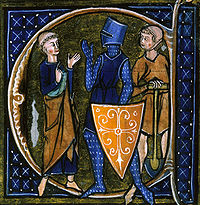
Social class
Social classes are economic or cultural arrangements of groups in society. Class is an essential object of analysis for sociologists, political scientists, economists, anthropologists and social historians. In the social sciences, social class is often discussed in terms of 'social stratification'...
, especially in the past.
Gentry, in its widest connotation, refers to people of good social position connected to landed estates (see Manorialism
Manorialism
Manorialism, an essential element of feudal society, was the organizing principle of rural economy that originated in the villa system of the Late Roman Empire, was widely practiced in medieval western and parts of central Europe, and was slowly replaced by the advent of a money-based market...
), including various ranks of nobility, clerical upper crust and "gentle" families of long descent who never obtained official right to bear a coat of arms
Coat of arms
A coat of arms is a unique heraldic design on a shield or escutcheon or on a surcoat or tabard used to cover and protect armour and to identify the wearer. Thus the term is often stated as "coat-armour", because it was anciently displayed on the front of a coat of cloth...
.
In England, the term often refers to the social class of the landed aristocracy or to the minor aristocracy
Aristocracy
Aristocracy , is a form of government in which a few elite citizens rule. The term derives from the Greek aristokratia, meaning "rule of the best". In origin in Ancient Greece, it was conceived of as rule by the best qualified citizens, and contrasted with monarchy...
(see landed gentry
Landed gentry
Landed gentry is a traditional British social class, consisting of land owners who could live entirely off rental income. Often they worked only in an administrative capacity looking after the management of their own lands....
) whose income derives from their large landholdings and thus designates the more narrow definition. The idea of gentry in the continental sense of "noblesse
Nobility
Nobility is a social class which possesses more acknowledged privileges or eminence than members of most other classes in a society, membership therein typically being hereditary. The privileges associated with nobility may constitute substantial advantages over or relative to non-nobles, or may be...
" is extinct in England, despite the efforts of enthusiasts to revive it (see A.C. Fox-Davies, Armorial Families, Edinburgh, 1895; The Right to Bear Arms, 1900). Though the untitled nobility in England are normally termed gentry the older sense of "nobility" is that of a quality identical with gentry. Arms sex legally ensigns of nobility, that is, gentility.
The fundamental social cleavage in most parts of Europe in the Middle Ages was between the "nobiles", i.e. the tenants in chivalry, whether counts, barons, knights, esquires or franklins
Franklin (class)
The term franklin denotes a member of a social class or rank in England in the 12th to 15th centuries.In the period when Middle English was in use, a franklin was simply a freeman;...
, and the "ignobiles", i.e. the villeins, citizens and burgesses; and between the most powerful noble and the humblest franklin there was, until the 15th century, no "separate class of gentlemen".
The division into nobles and ignobles in smaller regions of Europe in the Middle Ages
Middle Ages
The Middle Ages is a periodization of European history from the 5th century to the 15th century. The Middle Ages follows the fall of the Western Roman Empire in 476 and precedes the Early Modern Era. It is the middle period of a three-period division of Western history: Classic, Medieval and Modern...
, such as Sweden (including the province of Finland
Finland
Finland , officially the Republic of Finland, is a Nordic country situated in the Fennoscandian region of Northern Europe. It is bordered by Sweden in the west, Norway in the north and Russia in the east, while Estonia lies to its south across the Gulf of Finland.Around 5.4 million people reside...
), was less exact due to a more rudimentary feudal order. As such, the difference in the late Middle Ages between the medieval Swedish nobility and the wealthier strata of the peasantry was small. After the Reformation
Reformation
- Movements :* Protestant Reformation, an attempt by Martin Luther to reform the Roman Catholic Church that resulted in a schism, and grew into a wider movement...
, intermingling between the noble class and the often hereditary clerical upper class became a distinctive feature in several Nordic countries
Nordic countries
The Nordic countries make up a region in Northern Europe and the North Atlantic which consists of Denmark, Finland, Iceland, Norway and Sweden and their associated territories, the Faroe Islands, Greenland and Åland...
.
The adjective patrician ("of or like a person of high social rank") describes most closely members of the governing elites found within metropolitan areas such as the medieval free cities
City-state
A city-state is an independent or autonomous entity whose territory consists of a city which is not administered as a part of another local government.-Historical city-states:...
of Italy (Venice
Venice
Venice is a city in northern Italy which is renowned for the beauty of its setting, its architecture and its artworks. It is the capital of the Veneto region...
, Genoa
Genoa
Genoa |Ligurian]] Zena ; Latin and, archaically, English Genua) is a city and an important seaport in northern Italy, the capital of the Province of Genoa and of the region of Liguria....
), free imperial cities
Free Imperial City
In the Holy Roman Empire, a free imperial city was a city formally ruled by the emperor only — as opposed to the majority of cities in the Empire, which were governed by one of the many princes of the Empire, such as dukes or prince-bishops...
of Germany
Germany
Germany , officially the Federal Republic of Germany , is a federal parliamentary republic in Europe. The country consists of 16 states while the capital and largest city is Berlin. Germany covers an area of 357,021 km2 and has a largely temperate seasonal climate...
and Switzerland
Switzerland
Switzerland name of one of the Swiss cantons. ; ; ; or ), in its full name the Swiss Confederation , is a federal republic consisting of 26 cantons, with Bern as the seat of the federal authorities. The country is situated in Western Europe,Or Central Europe depending on the definition....
and the areas of the Hanseatic League
Hanseatic League
The Hanseatic League was an economic alliance of trading cities and their merchant guilds that dominated trade along the coast of Northern Europe...
, which, by virtue of their urban milieu, differed from the gentry. Still, many urban patricians, e.g., in Venice, had rural residences in the countryside (e.g., Veneto
Veneto
Veneto is one of the 20 regions of Italy. Its population is about 5 million, ranking 5th in Italy.Veneto had been for more than a millennium an independent state, the Republic of Venice, until it was eventually annexed by Italy in 1866 after brief Austrian and French rule...
). Following the admired example of the Roman patrician, the Venetian patrician reverted, especially in the Renaissance
Renaissance
The Renaissance was a cultural movement that spanned roughly the 14th to the 17th century, beginning in Italy in the Late Middle Ages and later spreading to the rest of Europe. The term is also used more loosely to refer to the historical era, but since the changes of the Renaissance were not...
, to a life more focused on his rural estate.
Indo-European caste systems
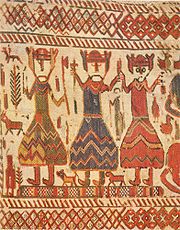
Proto-Indo-Europeans
The Proto-Indo-Europeans were the speakers of the Proto-Indo-European language , a reconstructed prehistoric language of Eurasia.Knowledge of them comes chiefly from the linguistic reconstruction, along with material evidence from archaeology and archaeogenetics...
who settled Europe, Western Asia and the Indian Subcontinent conceived their societies to be ordered (not divided) in a tripartite fashion, the three parts being castes. Castes came to be further divided, perhaps as a result of greater specialisation.
The "classic" formulation of the caste system as largely described by Georges Dumézil
Georges Dumézil
Georges Dumézil was a French comparative philologist best known for his analysis of sovereignty and power in Proto-Indo-European religion and society...
was that of a priestly or religiously occupied caste, a warrior caste, and a worker caste.
Dumézil
Georges Dumézil
Georges Dumézil was a French comparative philologist best known for his analysis of sovereignty and power in Proto-Indo-European religion and society...
divided the Proto-Indo-Europeans
Proto-Indo-European society
Proto-Indo-European refers to the single ancestor language common to all Indo-European languages. It is therefore a linguistic concept, not an ethnic, social or cultural one, so there is no direct evidence of the nature of Proto-Indo-European 'society'. Much depends on the unsettled Indo-European...
into three categories: sovereignty
Sovereignty
Sovereignty is the quality of having supreme, independent authority over a geographic area, such as a territory. It can be found in a power to rule and make law that rests on a political fact for which no purely legal explanation can be provided...
, military
Military
A military is an organization authorized by its greater society to use lethal force, usually including use of weapons, in defending its country by combating actual or perceived threats. The military may have additional functions of use to its greater society, such as advancing a political agenda e.g...
, and productivity (see Trifunctional hypothesis
Trifunctional hypothesis
The trifunctional hypothesis of prehistoric Proto-Indo-European society postulates a tripartite ideology reflected in the existence of three classes or castes—priests, warriors, and commoners —corresponding to the three functions of the sacral, the martial and the economic, respectively...
). He further subdivided sovereignty
Sovereignty
Sovereignty is the quality of having supreme, independent authority over a geographic area, such as a territory. It can be found in a power to rule and make law that rests on a political fact for which no purely legal explanation can be provided...
into two distinct and complementary sub-parts. One part was formal, juridical, and priestly, but rooted in this world. The other was powerful, unpredictable, and also priestly, but rooted in the "other", the supernatural and spiritual world. The second main division was connected with the use of force, the military
Military
A military is an organization authorized by its greater society to use lethal force, usually including use of weapons, in defending its country by combating actual or perceived threats. The military may have additional functions of use to its greater society, such as advancing a political agenda e.g...
, and war. Finally, there was a third group, ruled by the other two, whose role was productivity: herding, farming, and crafts.
This caste system can be seen to be that which flourished on the Indian Subcontinent and amongst the Italic peoples.
Examples of the Indo-European Castes:
- Indo-Iranian - BrahminBrahminBrahmin Brahman, Brahma and Brahmin.Brahman, Brahmin and Brahma have different meanings. Brahman refers to the Supreme Self...
/Athravan, Kshatriyas/Rathaestar, Vaishyas - Roman - FlaminesFlamenIn ancient Roman religion, a flamen was a priest assigned to one of fifteen deities with official cults during the Roman Republic. The most important three were the flamines maiores , who served the three chief Roman gods of the Archaic Triad. The remaining twelve were the flamines minores...
, MilitesMilitesMilites were the trained private footsoldiers of Rome. These men were the non-specialist regular soldiers that made up the bulk of a Legion's numbers. Alongside soldiering, they also performed guard duties, labour work, building and other non-combat roles...
, QuiritesQuiritesQuirites was the earliest name of the burgesses of Ancient Rome. The singular is quiris .Combined in the phrase populus Romanus Quirites it denoted the individual citizen as contrasted with the community. Hence ius Quiritium in Roman law is full Roman citizenship... - Celtic - DruidDruidA druid was a member of the priestly class in Britain, Ireland, and Gaul, and possibly other parts of Celtic western Europe, during the Iron Age....
s, Equites, PlebesPlebsThe plebs was the general body of free land-owning Roman citizens in Ancient Rome. They were distinct from the higher order of the patricians. A member of the plebs was known as a plebeian...
(according to Julius CaesarJulius CaesarGaius Julius Caesar was a Roman general and statesman and a distinguished writer of Latin prose. He played a critical role in the gradual transformation of the Roman Republic into the Roman Empire....
) - Anglo-Saxon - Gebedmen (prayer-men), Fyrdmen (army-men), Weorcmen (workmen) (according to Alfred the GreatAlfred the GreatAlfred the Great was King of Wessex from 871 to 899.Alfred is noted for his defence of the Anglo-Saxon kingdoms of southern England against the Vikings, becoming the only English monarch still to be accorded the epithet "the Great". Alfred was the first King of the West Saxons to style himself...
) - Slavic - Volkhvs, Voin, Krestyanin/Smerd
- Nordic - EarlEarlAn earl is a member of the nobility. The title is Anglo-Saxon, akin to the Scandinavian form jarl, and meant "chieftain", particularly a chieftain set to rule a territory in a king's stead. In Scandinavia, it became obsolete in the Middle Ages and was replaced with duke...
, ChurlChurlA churl , in its earliest Old English meaning, was simply "a man", but the word soon came to mean "a non-servile peasant", still spelt ċeorl, and denoting the lowest rank of freemen...
, ThrallThrallThrall was the term for a serf or unfree servant in Scandinavian culture during the Viking Age.Thralls were the lowest in the social order and usually provided unskilled labor during the Viking era.-Etymology:...
(according to the Lay of RigPoetic EddaThe Poetic Edda is a collection of Old Norse poems primarily preserved in the Icelandic mediaeval manuscript Codex Regius. Along with Snorri Sturluson's Prose Edda, the Poetic Edda is the most important extant source on Norse mythology and Germanic heroic legends, and from the early 19th century...
) - Greece (Attica) - EupatridaeEupatridaeEupatridae refers to the ancient nobility of the Greek region of Attica....
, GeomoriGeomoriGeomori or Geomoroi is the name of the second of the three classes into which Theseus is said to have divided the inhabitants of Attica. Geomori or Geomoroi is the name of the second of the three classes into which Theseus is said to have divided the inhabitants of Attica. Geomori or Geomoroi is...
, DemiurgiDemiurgeThe demiurge is a concept from the Platonic, Neopythagorean, Middle Platonic, and Neoplatonic schools of philosophy for an artisan-like figure responsible for the fashioning and maintenance of the physical universe. The term was subsequently adopted by the Gnostics... - Greece (Sparta) - HomoioiSpartiateThe Spartiates or Homoioi were the males of Sparta known to the Spartans as "peers" or "men of equal status". From a young age, male Spartiates were trained for battle and put through grueling challenges intended to craft them into fearless warriors...
, Perioeci, HelotsHelotsThe helots: / Heílôtes) were an unfree population group that formed the main population of Laconia and the whole of Messenia . Their exact status was already disputed in antiquity: according to Critias, they were "especially slaves" whereas to Pollux, they occupied a status "between free men and...
Kings were born out of the warrior or noble class.
End of caste system and replacement by class system
The revolutions in British America and France and then elsewhere directly challenged Indo-European culture and swept away the native caste system and replaced it with a system based on class, but it is noticeable that in many countries, the class system then followed a tripartite division like the caste system: for example, the upper, middle and lower class used in Britain and the Dreiklassen system in Germany.Two principal estates of the realm
The gentry is formed on the bases of the medieval societies' two higher estates of the realm, nobilityNobility
Nobility is a social class which possesses more acknowledged privileges or eminence than members of most other classes in a society, membership therein typically being hereditary. The privileges associated with nobility may constitute substantial advantages over or relative to non-nobles, or may be...
and clergy
Clergy
Clergy is the generic term used to describe the formal religious leadership within a given religion. A clergyman, churchman or cleric is a member of the clergy, especially one who is a priest, preacher, pastor, or other religious professional....
, both exempted from tax. Subsequent "gentle" families of long descent who never obtained official rights to bear a coat of arms were also admitted to the rural upper-class society: the gentry.
The three estates
The widespread three estates order was particularly characteristic of France:
- First estate included the group of all clergy, that is, members of the higher clergy and the lower clergy.
- Second estate has been encapsulated by the nobility. Here too, it did not matter whether they came from a lower or higher nobility or if they were impoverished members.
- Third estate included all nominally free citizens; in some places, free peasants.
At the top of the pyramid were the princes and estates of the king or emperor, or with the clergy, the bishops and the pope.
The feudal system was, for the people of the Middle Ages and early modern period, fitted into a God-given order. The nobility and the third estate were born into their class, and change in social position was slow, if possible at all. Wealth had little influence on what estate one belonged to. The exception was the Medieval Church, which was the only institution where competent men (and women) of merit could reach, in one lifetime, the highest positions in society.
The first estate comprised the entire clergy, traditionally divided into "higher" and "lower" clergy. Although there was no formal demarcation between the two categories, the upper clergy were, effectively, clerical nobility, from the families of the second estate or as in the case of Cardinal Wolsey, from more humble backgrounds.
The second estate was the nobility. Being wealthy or influential did not automatically make one a noble, and not all nobles were wealthy and influential (aristocratic families have lost their fortunes in various ways, and the concept of the "poor nobleman" is almost as old as nobility itself). Countries without a feudal tradition did not have a nobility as such.
The nobility of a person might be either inherited or earned. Nobility in its most general and strict sense is an acknowledged preeminence that is hereditary: legitimate descendants (or all male descendants, in some societies) of nobles are nobles, unless explicitly stripped of the privilege. The terms aristocrat and aristocracy are a less formal means to refer to persons belonging to this social milieu.
Historically in some cultures, members of an upper class often did not have to work for a living, as they were supported by earned or inherited investments (often real estate), although members of the upper class may have had less actual money than merchants. Upper-class status commonly derived from the social position of one's family and not from one's own achievements or wealth. Much of the population that comprised the upper class consisted of aristocrats, ruling families, titled people, and religious hierarchs. These people were usually born into their status, and historically, there was not much movement across class boundaries. This is to say that it was much harder for an individual to move up in class simply because of the structure of society.
In many countries, the term upper class was intimately associated with hereditary land ownership and titles. Political power was often in the hands of the landowners in many pre-industrial societies (which was one of the causes of the French Revolution), despite there being no legal barriers to land ownership for other social classes. Power began to shift from upper-class landed families to the general population in the early modern age, leading to marital alliances between the two groups, providing the foundation for the modern upper classes in the West. Upper-class landowners in Europe were often also members of the titled nobility, though not necessarily: the prevalence of titles of nobility varied widely from country to country. Some upper classes were almost entirely untitled, for example, the Szlachta of the Polish-Lithuanian Commonwealth.
Before the Age of Absolutism
Absolutism (European history)
Absolutism or The Age of Absolutism is a historiographical term used to describe a form of monarchical power that is unrestrained by all other institutions, such as churches, legislatures, or social elites...
, institutions, such as the church, legislatures, or social elites, restrained monarchical power. Absolutism was characterized by the ending of feudal partitioning, consolidation of power with the monarch, rise of state, rise of professional standing armies, professional bureaucracies, the codification of state laws, and the rise of ideologies that justify the absolutist monarchy. Hence, Absolutism was made possible by new innovations and characterized as a phenomenon of Early Modern Europe
Early modern Europe
Early modern Europe is the term used by historians to refer to a period in the history of Europe which spanned the centuries between the end of the Middle Ages and the beginning of the Industrial Revolution, roughly the late 15th century to the late 18th century...
, rather than that of the Middle Ages, where the clergy and nobility counterbalanced as a result of mutual rivalry.
German
In Germany, nobility and titles pertaining to it were bestowed on a person by higher sovereigns and then passed down through legitimate children of a nobleman. Alternatively, unlike men, women could legally become members of nobility by marrying a noble, although they could not pass it on. Nobility and titles (except for most reigning titles) were always inherited equally by all legitimate descendants of a nobleman.Divisions of nobility in Germany
- UradelUradelThe German and Scandinavian term Uradel refers to nobility who can trace back their noble ancestry at least to the year 1400 and probably originates from leadership positions during the Migration Period.-Divisions of German nobility:Uradel : Nobility that originates from leadership positions held...
(ancient nobility): Nobility that dates back to at least the 16th century. This contrasts with:
- Briefadel (patent nobility): Nobility by letters patent. The first known such document is from September 30, 1360, for Wyker Frosch in Mainz.
- Hochadel (high nobility): Nobility that was sovereign or had a high degree of sovereignty. This contrasts with:
- Niederer Adel (lower nobility): Nobility that had a lower degree of sovereignty.
Edler
Edler
Edler was until 1919 the lowest title of nobility in Austria-Hungary and Germany, just beneath a Ritter, but above nobles without title who used only the preposition von before their surname. It was mostly given to civil servants and military officers, as well as those upon whom the second rank of...
(Edler von) was, until 1919, the lowest title of nobility
Nobility
Nobility is a social class which possesses more acknowledged privileges or eminence than members of most other classes in a society, membership therein typically being hereditary. The privileges associated with nobility may constitute substantial advantages over or relative to non-nobles, or may be...
in Austria-Hungary
Austria-Hungary
Austria-Hungary , more formally known as the Kingdoms and Lands Represented in the Imperial Council and the Lands of the Holy Hungarian Crown of Saint Stephen, was a constitutional monarchic union between the crowns of the Austrian Empire and the Kingdom of Hungary in...
and Germany, just beneath a Ritter
Ritter
Ritter is a designation used as a title of nobility in German-speaking areas. Traditionally it denotes the second lowest rank within the nobility, standing above "Edler" and below "Freiherr"...
, but above nobles without title, who used only the preposition von before their surname. It was mostly given to civil servants and military officers, as well as those upon whom the second rank of an Order
Order (decoration)
An order or order of merit is a visible honour, awarded by a government, dynastic house or international organization to an individual, usually in recognition of distinguished service to a nation or to humanity. The distinction between orders and decorations is somewhat vague, except that most...
had been conferred. Women were styled Edle (Edle von).
Originally, from the Middle Ages, under the feudal system (in Europe and elsewhere), the nobility were generally those who held a fief, often in the form of heritable land worked by vassals.
Ritter
Ritter
Ritter is a designation used as a title of nobility in German-speaking areas. Traditionally it denotes the second lowest rank within the nobility, standing above "Edler" and below "Freiherr"...
(German
German language
German is a West Germanic language, related to and classified alongside English and Dutch. With an estimated 90 – 98 million native speakers, German is one of the world's major languages and is the most widely-spoken first language in the European Union....
for "knight
Knight
A knight was a member of a class of lower nobility in the High Middle Ages.By the Late Middle Ages, the rank had become associated with the ideals of chivalry, a code of conduct for the perfect courtly Christian warrior....
") is a designation used as a title
Title
A title is a prefix or suffix added to someone's name to signify either veneration, an official position or a professional or academic qualification. In some languages, titles may even be inserted between a first and last name...
of nobility
Nobility
Nobility is a social class which possesses more acknowledged privileges or eminence than members of most other classes in a society, membership therein typically being hereditary. The privileges associated with nobility may constitute substantial advantages over or relative to non-nobles, or may be...
in German-speaking areas. Traditionally, it denotes the second lowest rank within the nobility, standing above Edler
Edler
Edler was until 1919 the lowest title of nobility in Austria-Hungary and Germany, just beneath a Ritter, but above nobles without title who used only the preposition von before their surname. It was mostly given to civil servants and military officers, as well as those upon whom the second rank of...
and below Freiherr
Freiherr
The German titles Freiherr and Freifrau and Freiin are titles of nobility, used preceding a person's given name or, after 1919, before the surname...
. For its historical association with warfare and the landed gentry
Landed gentry
Landed gentry is a traditional British social class, consisting of land owners who could live entirely off rental income. Often they worked only in an administrative capacity looking after the management of their own lands....
in the Middle Ages
Middle Ages
The Middle Ages is a periodization of European history from the 5th century to the 15th century. The Middle Ages follows the fall of the Western Roman Empire in 476 and precedes the Early Modern Era. It is the middle period of a three-period division of Western history: Classic, Medieval and Modern...
, it can be considered roughly equal to the titles of "Knight
Knight
A knight was a member of a class of lower nobility in the High Middle Ages.By the Late Middle Ages, the rank had become associated with the ideals of chivalry, a code of conduct for the perfect courtly Christian warrior....
" or "Baronet
Baronet
A baronet or the rare female equivalent, a baronetess , is the holder of a hereditary baronetcy awarded by the British Crown...
". As with most title
Title
A title is a prefix or suffix added to someone's name to signify either veneration, an official position or a professional or academic qualification. In some languages, titles may even be inserted between a first and last name...
s and designations within the nobility
Nobility
Nobility is a social class which possesses more acknowledged privileges or eminence than members of most other classes in a society, membership therein typically being hereditary. The privileges associated with nobility may constitute substantial advantages over or relative to non-nobles, or may be...
in German-speaking areas, the rank was normally hereditary and would generally be used together with the designation of von before a family name.
In the Austrian Empire
Austrian Empire
The Austrian Empire was a modern era successor empire, which was centered on what is today's Austria and which officially lasted from 1804 to 1867. It was followed by the Empire of Austria-Hungary, whose proclamation was a diplomatic move that elevated Hungary's status within the Austrian Empire...
, the title of "Ritter von" would be bestowed upon citizens who deserved more than the plain "von".
In German, the meaning of Ritter is "rider", and likewise for the Dutch
Dutch language
Dutch is a West Germanic language and the native language of the majority of the population of the Netherlands, Belgium, and Suriname, the three member states of the Dutch Language Union. Most speakers live in the European Union, where it is a first language for about 23 million and a second...
and Scandinavian
North Germanic languages
The North Germanic languages or Scandinavian languages, the languages of Scandinavians, make up one of the three branches of the Germanic languages, a sub-family of the Indo-European languages, along with the West Germanic languages and the extinct East Germanic languages...
title ridder. These words are cognates derived from Germanic rīdan, "to ride", from Proto-Indo-European reidh-.
Junker
Junker
A Junker was a member of the landed nobility of Prussia and eastern Germany. These families were mostly part of the German Uradel and carried on the colonization and Christianization of the northeastern European territories during the medieval Ostsiedlung. The abbreviation of Junker is Jkr...
in German
German language
German is a West Germanic language, related to and classified alongside English and Dutch. With an estimated 90 – 98 million native speakers, German is one of the world's major languages and is the most widely-spoken first language in the European Union....
means "country squire" and is probably derived from the German words Junger Herr (English: "young lord"). As part of the nobility, many Junker families have particles like von
Von
In German, von is a preposition which approximately means of or from.When it is used as a part of a German family name, it is usually a nobiliary particle, like the French, Spanish and Portuguese "de". At certain times and places, it has been illegal for anyone who was not a member of the nobility...
or zu before their family names. In the Middle Ages
Middle Ages
The Middle Ages is a periodization of European history from the 5th century to the 15th century. The Middle Ages follows the fall of the Western Roman Empire in 476 and precedes the Early Modern Era. It is the middle period of a three-period division of Western history: Classic, Medieval and Modern...
, a Junker was simply a lesser noble, often poor and politically insignificant. Over the centuries, they rose from mercenary captains to influential commanders and landowners in the 19th century, especially in the Kingdom of Prussia
Kingdom of Prussia
The Kingdom of Prussia was a German kingdom from 1701 to 1918. Until the defeat of Germany in World War I, it comprised almost two-thirds of the area of the German Empire...
.
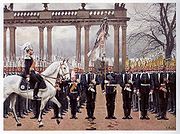
Being the bulwark of Hohenzollern
House of Hohenzollern
The House of Hohenzollern is a noble family and royal dynasty of electors, kings and emperors of Prussia, Germany and Romania. It originated in the area around the town of Hechingen in Swabia during the 11th century. They took their name from their ancestral home, the Burg Hohenzollern castle near...
Prussia, the Junkers controlled the Prussian Army
Prussian Army
The Royal Prussian Army was the army of the Kingdom of Prussia. It was vital to the development of Brandenburg-Prussia as a European power.The Prussian Army had its roots in the meager mercenary forces of Brandenburg during the Thirty Years' War...
, led in political influence
Politics
Politics is a process by which groups of people make collective decisions. The term is generally applied to the art or science of running governmental or state affairs, including behavior within civil governments, but also applies to institutions, fields, and special interest groups such as the...
and social status
Social status
In sociology or anthropology, social status is the honor or prestige attached to one's position in society . It may also refer to a rank or position that one holds in a group, for example son or daughter, playmate, pupil, etc....
, and owned immense estates
Estate (house)
An estate comprises the houses and outbuildings and supporting farmland and woods that surround the gardens and grounds of a very large property, such as a country house or mansion. It is the modern term for a manor, but lacks the latter's now abolished jurisdictional authority...
, especially in the north-eastern half of Germany (Brandenburg
Province of Brandenburg
The Province of Brandenburg was a province of the Kingdom of Prussia and the Free State of Prussia from 1815 to 1946.-History:The first people who are known to have inhabited Brandenburg were the Suevi. They were succeeded by the Slavonians, whom Henry II conquered and converted to Christianity in...
, Mecklenburg
Mecklenburg
Mecklenburg is a historical region in northern Germany comprising the western and larger part of the federal-state Mecklenburg-Vorpommern...
, Pomerania, East Prussia
Province of East Prussia
The Province of East Prussia was a province of Prussia from 1773–1829 and 1878-1945. Composed of the historical region East Prussia, the province's capital was Königsberg ....
, Saxony
Province of Saxony
The Province of Saxony was a province of the Kingdom of Prussia and later the Free State of Prussia from 1816 until 1945. Its capital was Magdeburg.-History:The province was created in 1816 out of the following territories:...
and Silesia
Province of Silesia
The Province of Silesia was a province of the Kingdom of Prussia from 1815 to 1919.-Geography:The territory comprised the bulk of the former Bohemian crown land of Silesia and the County of Kladsko, which King Frederick the Great had conquered from the Austrian Habsburg Monarchy in the 18th...
).
Monarchism
Monarchism is the advocacy of the establishment, preservation, or restoration of a monarchy as a form of government in a nation. A monarchist is an individual who supports this form of government out of principle, independent from the person, the Monarch.In this system, the Monarch may be the...
and military traditions, they were often reactionary
Reactionary
The term reactionary refers to viewpoints that seek to return to a previous state in a society. The term is meant to describe one end of a political spectrum whose opposite pole is "radical". While it has not been generally considered a term of praise it has been adopted as a self-description by...
and protectionist; they were often anti-liberal
Liberalism
Liberalism is the belief in the importance of liberty and equal rights. Liberals espouse a wide array of views depending on their understanding of these principles, but generally, liberals support ideas such as constitutionalism, liberal democracy, free and fair elections, human rights,...
, siding with the conservative monarchist forces during the 1848 Revolution
Revolutions of 1848 in the German states
The Revolutions of 1848 in the German states, also called the March Revolution – part of the Revolutions of 1848 that broke out in many countries of Europe – were a series of loosely coordinated protests and rebellions in the states of the German Confederation, including the Austrian Empire...
. Their political interests were served by the German Conservative Party
German Conservative Party
The German Conservative Party was a right-wing political party of the German Empire, founded in 1876.- Policies :It was generally seen as representing the interests of the German nobility, the East Elbian Junkers and the Evangelical Church of the Prussian Union, and had its political stronghold...
in the Reichstag
Reichstag (German Empire)
The Reichstag was the parliament of the North German Confederation , and of the German Reich ....
and the extraparliamentary Agrarian League. This political class held tremendous power over the industrial classes and the government. When Chancellor Caprivi
Leo von Caprivi
Georg Leo Graf von Caprivi de Caprera de Montecuccoli was a German major general and statesman, who succeeded Otto von Bismarck as Chancellor of Germany...
reduced the protective duties on imports of grain, these landed magnates demanded and obtained his dismissal; and in 1902, they brought about a restoration of such duties on foodstuffs as would keep the prices of their own products at a high level.
As landed aristocrats, the Junkers owned most of the arable land in the Prussian and eastern German states. This was in contrast to the Catholic southern states, such as Bavaria
Bavaria
Bavaria, formally the Free State of Bavaria is a state of Germany, located in the southeast of Germany. With an area of , it is the largest state by area, forming almost 20% of the total land area of Germany...
, Württemberg
Württemberg
Württemberg , formerly known as Wirtemberg or Wurtemberg, is an area and a former state in southwestern Germany, including parts of the regions Swabia and Franconia....
or Baden
Baden
Baden is a historical state on the east bank of the Rhine in the southwest of Germany, now the western part of the Baden-Württemberg of Germany....
, where land was owned by small farms, or the mixed agriculture of the western states, such as Hesse
Hesse
Hesse or Hessia is both a cultural region of Germany and the name of an individual German state.* The cultural region of Hesse includes both the State of Hesse and the area known as Rhenish Hesse in the neighbouring Rhineland-Palatinate state...
or Westphalia
Westphalia
Westphalia is a region in Germany, centred on the cities of Arnsberg, Bielefeld, Dortmund, Minden and Münster.Westphalia is roughly the region between the rivers Rhine and Weser, located north and south of the Ruhr River. No exact definition of borders can be given, because the name "Westphalia"...
. This gave the Junkers a virtual monopoly on all agriculture in the German states east of the River Elbe
Elbe
The Elbe is one of the major rivers of Central Europe. It rises in the Krkonoše Mountains of the northwestern Czech Republic before traversing much of Bohemia , then Germany and flowing into the North Sea at Cuxhaven, 110 km northwest of Hamburg...
.
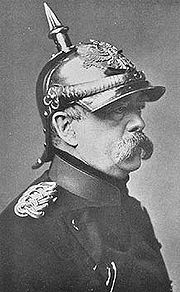
The German statesman Otto von Bismarck
Otto von Bismarck
Otto Eduard Leopold, Prince of Bismarck, Duke of Lauenburg , simply known as Otto von Bismarck, was a Prussian-German statesman whose actions unified Germany, made it a major player in world affairs, and created a balance of power that kept Europe at peace after 1871.As Minister President of...
was a noted Junker, as were President Paul von Hindenburg
Paul von Hindenburg
Paul Ludwig Hans Anton von Beneckendorff und von Hindenburg , known universally as Paul von Hindenburg was a Prussian-German field marshal, statesman, and politician, and served as the second President of Germany from 1925 to 1934....
and Generalfeldmarschall
Generalfeldmarschall
Field Marshal or Generalfeldmarschall in German, was a rank in the armies of several German states and the Holy Roman Empire; in the Austrian Empire, the rank Feldmarschall was used...
Gerd von Rundstedt
Gerd von Rundstedt
Karl Rudolf Gerd von Rundstedt was a Generalfeldmarschall of the German Army during World War II. He held some of the highest field commands in all phases of the war....
.
Dutch
RidderRidder (title)
Ridder is a noble title in the Netherlands and Belgium. The collective term for its holders in a certain locality is the Ridderschap . In the Netherlands and Belgium no female equivalent exists...
(Dutch "knight
Knight
A knight was a member of a class of lower nobility in the High Middle Ages.By the Late Middle Ages, the rank had become associated with the ideals of chivalry, a code of conduct for the perfect courtly Christian warrior....
") is a noble title in the Netherlands and Belgium. The collective term for its holders in a certain locality is the Ridderschap (e.g. Ridderschap van Holland, Ridderschap van Friesland, etc.). In the Netherlands and Belgium, no female equivalent exists. It is placed between the first name(s) and the family name (as ridder, not Ridder, as in Dutch, titles are written in lower case, which in this case also avoids confusion between the family name and the title).
The title Ridder descends in two ways: "op allen" (to all - i.e., every descendant, male or female, in the male line, is entitled to the title) and "met het recht op eerstgeboorte" (with the right of the first-born - i.e., descent by Salic law
Salic law
Salic law was a body of traditional law codified for governing the Salian Franks in the early Middle Ages during the reign of King Clovis I in the 6th century...
, i.e., the eldest male descendant of the title's first bearer may take the title, but not the others).
Jonkheer
Jonkheer
Jonkheer is a Dutch honorific of nobility.-Honorific of nobility:"Jonkheer" or "Jonkvrouw" is literally translated as "young lord" or "young lady". In medieval times such a person was a young and unmarried son or daughter of a high ranking knight or nobleman...
, or Jonkvrouw, is literally translated as "young lord
Lord
Lord is a title with various meanings. It can denote a prince or a feudal superior . The title today is mostly used in connection with the peerage of the United Kingdom or its predecessor countries, although some users of the title do not themselves hold peerages, and use it 'by courtesy'...
" or "young lady
Lady
The word lady is a polite term for a woman, specifically the female equivalent to, or spouse of, a lord or gentleman, and in many contexts a term for any adult woman...
", or "esquire
Esquire
Esquire is a term of West European origin . Depending on the country, the term has different meanings...
". In medieval times, such a person was a young and unmarried son or daughter of a high-ranking knight or nobleman. Many noble families could not support all their sons to become a knight because of the expensive equipment. So the eldest son of a knight was a young lord, and his brothers remained as esquires.
However, in the low countries (and other parts of continental Europe), only the head of most noble families did and does carry a title and inheritability of it is via the male lineage. This resulted, therefore, that most of the nobility was and is nowadays untitled in the Netherlands and Belgium. Jonkheer, and its female equivalent jonkvrouw, developed quite early into a different but general meaning, i.e., an honorific to show that someone does belong to the nobility, but does not possess a title. The abbreviation jhr., or jkvr. for women, is placed in front of the name (preceding academic, but not state titles).
British
The British upper classes consist of two entities, the peeragePeerage
The Peerage is a legal system of largely hereditary titles in the United Kingdom, which constitute the ranks of British nobility and is part of the British honours system...
and landed gentry
Landed gentry
Landed gentry is a traditional British social class, consisting of land owners who could live entirely off rental income. Often they worked only in an administrative capacity looking after the management of their own lands....
; any male member of either may regard himself as a gentleman, in a special sense mutually understood between hereditary members of the class, which will often exclude life peers. In the British peerage, only the senior family member (typically the oldest son) inherits a substantive title (duke, marquess, earl, viscount, baron); these are referred to as peers or lords. The rest of the nobility is referred as landed gentry (abbreviation, gentry), and with the exceptions of the baronet
Baronet
A baronet or the rare female equivalent, a baronetess , is the holder of a hereditary baronetcy awarded by the British Crown...
, which is a title akin to a hereditary knighthood; those that are knighted (for life), being called Sir X Y; Scottish barons, who bear the designation Baron of X after their name; and Scottish lairds
Laird
A Laird is a member of the gentry and is a heritable title in Scotland. In the non-peerage table of precedence, a Laird ranks below a Baron and above an Esquire.-Etymology:...
, whose names include a description of their lands in the form of a territorial designation
Territorial designation
A territorial designation follows modern peerage titles, linking them to a specific place or places. It is also an integral part of all baronetcies...
, they bear no titles apart from the qualifications of esquire or gentleman (which are ranks recognised in law, although now without any legal consequence).
The term landed gentry, although originally used to mean nobility, came to be used of the lesser nobility in England around 1540. Once identical, eventually these terms became complementary, in the sense that their definitions began to fill in parts of what the other lacked. The term gentry by itself as commonly used by historians, so Peter Coss
Peter Coss
Peter R. Coss is a British historian, specialising on the history of the English medieval gentry. He is currently Professor of Medieval History at the School of History and Archeology at Cardiff University, Wales...
argues, is a construct that historians have applied loosely to rather different societies. Any particular model may not fit a specific society, yet a single definition nevertheless remains desirable.
Titles, while often considered central to the upper class, are not strictly so. Both Captain Mark Phillips
Mark Phillips
-Ancestry:-Issue:-Sources:...
and Vice Admiral Timothy Laurence
Timothy Laurence
Vice Admiral Sir Timothy James Hamilton Laurence, KCVO, CB, ADC is a senior British naval officer and the second husband of HRH The Princess Royal, the only daughter of HM The Queen...
, the respective first and second husbands of HRH The Princess Anne
Anne, Princess Royal
Princess Anne, Princess Royal , is the only daughter of Elizabeth II and Prince Philip, Duke of Edinburgh...
, lacked any rank of peerage
Peerage
The Peerage is a legal system of largely hereditary titles in the United Kingdom, which constitute the ranks of British nobility and is part of the British honours system...
, yet could scarcely be considered anything other than upper class. The same is true of Francis Fulford
Francis Fulford (born 1953)
Francis Fulford of Great Fulford is the 23rd Fulford of Great Fulford, an armiger and the head of an ancient landed family. He is a TV personality, property commentator, and regular contributor to radio and television....
, who was memorably featured in a Channel 4
Channel 4
Channel 4 is a British public-service television broadcaster which began working on 2 November 1982. Although largely commercially self-funded, it is ultimately publicly owned; originally a subsidiary of the Independent Broadcasting Authority , the station is now owned and operated by the Channel...
documentary and whose family has owned estates in Devon
Devon
Devon is a large county in southwestern England. The county is sometimes referred to as Devonshire, although the term is rarely used inside the county itself as the county has never been officially "shired", it often indicates a traditional or historical context.The county shares borders with...
for over 800 years. In fact, the Fulfords represent the group that makes up the largest component of the upper class: the landed gentry
Landed gentry
Landed gentry is a traditional British social class, consisting of land owners who could live entirely off rental income. Often they worked only in an administrative capacity looking after the management of their own lands....
.
Landed gentry
Landed gentry
Landed gentry is a traditional British social class, consisting of land owners who could live entirely off rental income. Often they worked only in an administrative capacity looking after the management of their own lands....
is a traditional British social class
Social class
Social classes are economic or cultural arrangements of groups in society. Class is an essential object of analysis for sociologists, political scientists, economists, anthropologists and social historians. In the social sciences, social class is often discussed in terms of 'social stratification'...
consisting of gentlemen in the original sense; that is, those who owned land in the form of country estates to such an extent that they were not required to actively work, except in an administrative capacity on their own lands. The estates were often (but not always) made up of tenanted farms, in which case the gentleman could live entirely off rent
Renting
Renting is an agreement where a payment is made for the temporary use of a good, service or property owned by another. A gross lease is when the tenant pays a flat rental amount and the landlord pays for all property charges regularly incurred by the ownership from landowners...
income.
Burke's Landed Gentry
Burke's Landed Gentry
Burke's Landed Gentry is the result of nearly two centuries of intense work by the Burke family, and others since, in building a collection of books of genealogical and heraldic interest,...
In the 18th and 19th centuries, the names and families of those with titles (specifically peers
Peers
Peers is a surname, and may refer to:* Donald Peers* Edgar Allison Peers, an English academician* Gavin Peers* Kerry Peers* Michael Peers* Teddy Peers , Welsh international footballer...
and baronets, less often including those with the non-hereditary title of knight
Knight
A knight was a member of a class of lower nobility in the High Middle Ages.By the Late Middle Ages, the rank had become associated with the ideals of chivalry, a code of conduct for the perfect courtly Christian warrior....
) were often listed in books or manuals known as "Peerages", "Baronetages", or combinations of these categories, such as the "Peerage, Baronetage, Knightage, and Companionage". As well as listing genealogical information, these books often also included details of a given family right to a coat of arms
Coat of arms
A coat of arms is a unique heraldic design on a shield or escutcheon or on a surcoat or tabard used to cover and protect armour and to identify the wearer. Thus the term is often stated as "coat-armour", because it was anciently displayed on the front of a coat of cloth...
. Jane Austen
Jane Austen
Jane Austen was an English novelist whose works of romantic fiction, set among the landed gentry, earned her a place as one of the most widely read writers in English literature, her realism and biting social commentary cementing her historical importance among scholars and critics.Austen lived...
, who was herself a member of the gentry, shrewdly summarised the appeal of these works, which was particularly strong for those included in them, in the opening words of her novel Persuasion
Persuasion (novel)
Persuasion is Jane Austen's last completed novel. She began it soon after she had finished Emma, completing it in August 1816. She died, aged 41, in 1817; Persuasion was published in December that year ....
(1818):
- "Sir Walter Elliot, of Kellynch Hall, in Somersetshire, was a man who, for his own amusement, never took up any book but the Baronetage; there he found occupation for an idle hour, and consolation in a distressed one; there his faculties were roused into admiration and respect, by contemplating the limited remnant of the earliest patents; there any unwelcome sensations, arising from domestic affairs changed naturally into pity and contempt as he turned over the almost endless creations of the last century; and there, if every other leaf were powerless, he could read his own history with an interest which never failed."
Esquire
Esquire
Esquire is a term of West European origin . Depending on the country, the term has different meanings...
(abbreviated Esq.) is a term of British origin (ultimately from Latin scutarius, in the sense of shield bearer, via Old French esquier), referring only to males, and used to denote a high but indeterminate social status.
The most common occurrence of term Esquire today is the conferral as the suffix Esq. in order to pay an informal compliment to a male recipient by way of implying gentle birth. Today, there remain respected protocols, especially in the US, for identifying those to whom it is thought most proper that the suffix should be given in very formal or in official circumstances. The social rank of Esquire is that above gentlemen. Nineteenth-century tables of precedences further distinguished between esquires by birth and esquires by office (and likewise for gentlemen)..
According to one typical definition, esquires in English law included:
- The eldest sons of knightKnightA knight was a member of a class of lower nobility in the High Middle Ages.By the Late Middle Ages, the rank had become associated with the ideals of chivalry, a code of conduct for the perfect courtly Christian warrior....
s, and their eldest sons in perpetual succession - The eldest sons of younger sons of peerPeerageThe Peerage is a legal system of largely hereditary titles in the United Kingdom, which constitute the ranks of British nobility and is part of the British honours system...
s, and their eldest sons in perpetual succession (children of peers already had higher precedence) - Esquires created by letters patentLetters patentLetters patent are a type of legal instrument in the form of a published written order issued by a monarch or president, generally granting an office, right, monopoly, title, or status to a person or corporation...
or other investiture, and their eldest sons - Esquires by virtue of their offices, as Justices of the PeaceJustice of the PeaceA justice of the peace is a puisne judicial officer elected or appointed by means of a commission to keep the peace. Depending on the jurisdiction, they might dispense summary justice or merely deal with local administrative applications in common law jurisdictions...
and others who bear any office of trust under the CrownThe CrownThe Crown is a corporation sole that in the Commonwealth realms and any provincial or state sub-divisions thereof represents the legal embodiment of governance, whether executive, legislative, or judicial... - Esquires of knights constituted at their investiture
- Foreign noblemen
- Persons who are so styled under the Royal sign manualRoyal sign-manualThe royal sign manual is the formal name given in the Commonwealth realms to the autograph signature of the sovereign, by the affixing of which the monarch expresses his or her pleasure either by order, commission, or warrant. A sign-manual warrant may be either an executive actfor example, an...
(officers of the Armed ForcesBritish Armed ForcesThe British Armed Forces are the armed forces of the United Kingdom of Great Britain and Northern Ireland.Also known as Her Majesty's Armed Forces and sometimes legally the Armed Forces of the Crown, the British Armed Forces encompasses three professional uniformed services, the Royal Navy, the...
of or above the rank of Captain in the ArmyBritish ArmyThe British Army is the land warfare branch of Her Majesty's Armed Forces in the United Kingdom. It came into being with the unification of the Kingdom of England and Scotland into the Kingdom of Great Britain in 1707. The new British Army incorporated Regiments that had already existed in England...
or its equivalent) - BarristerBarristerA barrister is a member of one of the two classes of lawyer found in many common law jurisdictions with split legal professions. Barristers specialise in courtroom advocacy, drafting legal pleadings and giving expert legal opinions...
s (but not SolicitorSolicitorSolicitors are lawyers who traditionally deal with any legal matter including conducting proceedings in courts. In the United Kingdom, a few Australian states and the Republic of Ireland, the legal profession is split between solicitors and barristers , and a lawyer will usually only hold one title...
s)
A slightly later source defines the term as
In the post-mediaeval world, the title of esquire came to belong to all men of the higher landed gentry
Landed gentry
Landed gentry is a traditional British social class, consisting of land owners who could live entirely off rental income. Often they worked only in an administrative capacity looking after the management of their own lands....
; an esquire ranked socially above a gentleman
Gentleman
The term gentleman , in its original and strict signification, denoted a well-educated man of good family and distinction, analogous to the Latin generosus...
but below a knight
Knight
A knight was a member of a class of lower nobility in the High Middle Ages.By the Late Middle Ages, the rank had become associated with the ideals of chivalry, a code of conduct for the perfect courtly Christian warrior....
. In the modern world, where all men are assumed to be gentlemen, the term has correspondingly often been extended (albeit only in very formal writing) to all men without any higher title. It is used post-nominally, usually in abbreviated form: "Thomas Smith, Esq.", for example.
The linguistic and social development of squire is paralleled by that of the German
German language
German is a West Germanic language, related to and classified alongside English and Dutch. With an estimated 90 – 98 million native speakers, German is one of the world's major languages and is the most widely-spoken first language in the European Union....
junker
Junker
A Junker was a member of the landed nobility of Prussia and eastern Germany. These families were mostly part of the German Uradel and carried on the colonization and Christianization of the northeastern European territories during the medieval Ostsiedlung. The abbreviation of Junker is Jkr...
, which originally meant "young lord" and denoted the poorer and unimportant part of the aristocracy, but "went up in the world" in much the same time as squire did in England.
Knight
Knight
A knight was a member of a class of lower nobility in the High Middle Ages.By the Late Middle Ages, the rank had become associated with the ideals of chivalry, a code of conduct for the perfect courtly Christian warrior....
, from Old English cniht ("boy" or "servant"), is a cognate
Cognate
In linguistics, cognates are words that have a common etymological origin. This learned term derives from the Latin cognatus . Cognates within the same language are called doublets. Strictly speaking, loanwords from another language are usually not meant by the term, e.g...
of the German
German language
German is a West Germanic language, related to and classified alongside English and Dutch. With an estimated 90 – 98 million native speakers, German is one of the world's major languages and is the most widely-spoken first language in the European Union....
word Knecht ("laborer" or "servant"). A knight can be either a medieval tenant giving military service as a mounted man-at-arms to a feudal landholder, or a medieval gentleman-soldier, usually high-born, raised by a sovereign to privileged military status after training as a page and squire (contemporary reference, see British honours system
British honours system
The British honours system is a means of rewarding individuals' personal bravery, achievement, or service to the United Kingdom and the British Overseas Territories...
).
In the century or so following Charlemagne's death, his newly empowered warrior class grew stronger still, and Charles the Bald
Charles the Bald
Charles the Bald , Holy Roman Emperor and King of West Francia , was the youngest son of the Emperor Louis the Pious by his second wife Judith.-Struggle against his brothers:He was born on 13 June 823 in Frankfurt, when his elder...
declared their fiefs to be hereditary. The period of chaos in the 9th and 10th centuries, between the fall of the Carolingian central authority and the rise of separate Western and Eastern Frankish kingdoms (later to become France and Germany respectively), only entrenched this newly landed warrior class. This was because governing power, and defense against Viking
Viking
The term Viking is customarily used to refer to the Norse explorers, warriors, merchants, and pirates who raided, traded, explored and settled in wide areas of Europe, Asia and the North Atlantic islands from the late 8th to the mid-11th century.These Norsemen used their famed longships to...
, Magyar and Saracen
Saracen
Saracen was a term used by the ancient Romans to refer to a people who lived in desert areas in and around the Roman province of Arabia, and who were distinguished from Arabs. In Europe during the Middle Ages the term was expanded to include Arabs, and then all who professed the religion of Islam...
attack, became an essentially local affair that revolved around these new hereditary local lord
Lord
Lord is a title with various meanings. It can denote a prince or a feudal superior . The title today is mostly used in connection with the peerage of the United Kingdom or its predecessor countries, although some users of the title do not themselves hold peerages, and use it 'by courtesy'...
s and their demesne
Demesne
In the feudal system the demesne was all the land, not necessarily all contiguous to the manor house, which was retained by a lord of the manor for his own use and support, under his own management, as distinguished from land sub-enfeoffed by him to others as sub-tenants...
s. The resulting hereditary, landed class of mounted elite warriors, the knights, were increasingly seen as the only true soldiers of Europe, hence the exclusive use of miles (Latin, "soldier") for them.
All nobles of military age were generally considered as knights; knighthood still had to be earned through some exploit involving the use of arms. The general route for a son of a nobleman would be to first serve as page, then as squire, before being knighted.
In formal protocol, Sir
Sir
Sir is an honorific used as a title , or as a courtesy title to address a man without using his given or family name in many English speaking cultures...
is the correct styling
Style (manner of address)
A style of office, or honorific, is a legal, official, or recognized title. A style, by tradition or law, precedes a reference to a person who holds a post or political office, and is sometimes used to refer to the office itself. An honorific can also be awarded to an individual in a personal...
for a knight
Knight
A knight was a member of a class of lower nobility in the High Middle Ages.By the Late Middle Ages, the rank had become associated with the ideals of chivalry, a code of conduct for the perfect courtly Christian warrior....
or a baronet
Baronet
A baronet or the rare female equivalent, a baronetess , is the holder of a hereditary baronetcy awarded by the British Crown...
(the UK nobiliary rank just below all peers of the realm
Peerage
The Peerage is a legal system of largely hereditary titles in the United Kingdom, which constitute the ranks of British nobility and is part of the British honours system...
), used with (one of) the knight's given name
Given name
A given name, in Western contexts often referred to as a first name, is a personal name that specifies and differentiates between members of a group of individuals, especially in a family, all of whose members usually share the same family name...
(s) or full name, but not with the surname
Family name
A family name is a type of surname and part of a person's name indicating the family to which the person belongs. The use of family names is widespread in cultures around the world...
alone. The equivalent for a woman is Dame
Dame (title)
The title of Dame is the female equivalent of the honour of knighthood in the British honours system . It is also the equivalent form address to 'Sir' for a knight...
, that is, for one who holds the title in her own right; for such women, the title Dame is used as Sir for a man, that is, never before the surname on its own. This usage was devised in 1917, derived from the practice, up to the 17th century (and still also in legal proceedings), for the wife of a knight. The wife of a knight or baronet now, however, is styled "Lady
Lady
The word lady is a polite term for a woman, specifically the female equivalent to, or spouse of, a lord or gentleman, and in many contexts a term for any adult woman...
[Surname]".
Until the 17th century, it was also a title of priests (the related word monsignor
Monsignor
Monsignor, pl. monsignori, is the form of address for those members of the clergy of the Catholic Church holding certain ecclesiastical honorific titles. Monsignor is the apocopic form of the Italian monsignore, from the French mon seigneur, meaning "my lord"...
, from French monseigneur, is still used for Catholic prelates). In Icelandic
Icelandic language
Icelandic is a North Germanic language, the main language of Iceland. Its closest relative is Faroese.Icelandic is an Indo-European language belonging to the North Germanic or Nordic branch of the Germanic languages. Historically, it was the westernmost of the Indo-European languages prior to the...
, the cognate word séra is used exclusively to address a priest, together with his first name: a priest named Jón Jónsson would be addressed as séra Jón and referred to as presturinn séra Jón Jónsson ("the priest, séra Jón Jónsson").
The Peerage
Peerage
The Peerage is a legal system of largely hereditary titles in the United Kingdom, which constitute the ranks of British nobility and is part of the British honours system...
is a system of titles in the United Kingdom, which represents the upper ranks of British nobility
British nobility
-General History of British Nobility:The nobility of the four constituent home nations of the United Kingdom has played a major role in shaping the history of the country, although in the present day even hereditary peers have no special rights, privileges or responsibilities, except for residual...
and is part of the British honours system
British honours system
The British honours system is a means of rewarding individuals' personal bravery, achievement, or service to the United Kingdom and the British Overseas Territories...
. The term is used both collectively to refer to the entire body of titles, and individually to refer to a specific title. All modern British honours, including peerage dignities, are created directly by the British monarch
Monarchy of the United Kingdom
The monarchy of the United Kingdom is the constitutional monarchy of the United Kingdom and its overseas territories. The present monarch, Queen Elizabeth II, has reigned since 6 February 1952. She and her immediate family undertake various official, ceremonial and representational duties...
, taking effect when letters patent
Letters patent
Letters patent are a type of legal instrument in the form of a published written order issued by a monarch or president, generally granting an office, right, monopoly, title, or status to a person or corporation...
are affixed with the Great Seal of the Realm
Great Seal of the Realm
The Great Seal of the Realm or Great Seal of the United Kingdom is a seal that is used to symbolise the Sovereign's approval of important state documents...
. The Sovereign is considered the fount of honour
Fount of honour
The fount of honour refers to a nation's head of state, who, by virtue of his or her official position, has the exclusive right of conferring legitimate titles of nobility and orders of chivalry to other persons.- Origin :...
, and as "the fountain and source of all dignities cannot hold a dignity from himself", cannot hold a peerage.
The modern peerage system is a vestige of the custom of English kings in the 12th and 13th centuries in summoning wealthy individuals (along with church officials and elected representatives for commoners) to form a Parliament. The economic system at the time was manorialism
Manorialism
Manorialism, an essential element of feudal society, was the organizing principle of rural economy that originated in the villa system of the Late Roman Empire, was widely practiced in medieval western and parts of central Europe, and was slowly replaced by the advent of a money-based market...
(or feudalism
Feudalism
Feudalism was a set of legal and military customs in medieval Europe that flourished between the 9th and 15th centuries, which, broadly defined, was a system for ordering society around relationships derived from the holding of land in exchange for service or labour.Although derived from the...
), and the burden or privilege of being summoned to Parliament was related to the amount of land one controlled (a "barony"). In the late 14th century, this right (or "title") began to be granted by decree, and titles also became inherited with the rest of an estate under the system of primogeniture
Primogeniture
Primogeniture is the right, by law or custom, of the firstborn to inherit the entire estate, to the exclusion of younger siblings . Historically, the term implied male primogeniture, to the exclusion of females...
. Non-hereditary positions began to be created again in 1867 for Law Lords, and 1958 generally.
- The Peerage of EnglandPeerage of EnglandThe Peerage of England comprises all peerages created in the Kingdom of England before the Act of Union in 1707. In that year, the Peerages of England and Scotland were replaced by one Peerage of Great Britain....
— all titles created by the Kings and Queens of England before the Act of Union in 1707. - The Peerage of ScotlandPeerage of ScotlandThe Peerage of Scotland is the division of the British Peerage for those peers created in the Kingdom of Scotland before 1707. With that year's Act of Union, the Kingdom of Scotland and the Kingdom of England were combined into the Kingdom of Great Britain, and a new Peerage of Great Britain was...
— all titles created by the Kings and Queens of ScotlandScotlandScotland is a country that is part of the United Kingdom. Occupying the northern third of the island of Great Britain, it shares a border with England to the south and is bounded by the North Sea to the east, the Atlantic Ocean to the north and west, and the North Channel and Irish Sea to the...
before 1707. - The Peerage of IrelandPeerage of IrelandThe Peerage of Ireland is the term used for those titles of nobility created by the English and later British monarchs of Ireland in their capacity as Lord or King of Ireland. The creation of such titles came to an end in the 19th century. The ranks of the Irish peerage are Duke, Marquess, Earl,...
— titles created for the Kingdom of IrelandKingdom of IrelandThe Kingdom of Ireland refers to the country of Ireland in the period between the proclamation of Henry VIII as King of Ireland by the Crown of Ireland Act 1542 and the Act of Union in 1800. It replaced the Lordship of Ireland, which had been created in 1171...
before the Act of UnionAct of Union 1800The Acts of Union 1800 describe two complementary Acts, namely:* the Union with Ireland Act 1800 , an Act of the Parliament of Great Britain, and...
of 1801, and some titles created later. - The Peerage of Great BritainPeerage of Great BritainThe Peerage of Great Britain comprises all extant peerages created in the Kingdom of Great Britain after the Act of Union 1707 but before the Act of Union 1800...
— titles created for the Kingdom of Great Britain between 1707 and 1801. - The Peerage of the United KingdomPeerage of the United KingdomThe Peerage of the United Kingdom comprises most peerages created in the United Kingdom of Great Britain and Ireland after the Act of Union in 1801, when it replaced the Peerage of Great Britain...
— most titles created since 1801.
Peers are of five ranks, in descending order of hierarchy:
- DukeDukeA duke or duchess is a member of the nobility, historically of highest rank below the monarch, and historically controlling a duchy...
comes from the LatinLatinLatin is an Italic language originally spoken in Latium and Ancient Rome. It, along with most European languages, is a descendant of the ancient Proto-Indo-European language. Although it is considered a dead language, a number of scholars and members of the Christian clergy speak it fluently, and...
dux, leader. Created in 1337. - MarquessMarquessA marquess or marquis is a nobleman of hereditary rank in various European peerages and in those of some of their former colonies. The term is also used to translate equivalent oriental styles, as in imperial China, Japan, and Vietnam...
comes from the French marquis, which is a derivative of marche, or march. This is a reference to the borders ("marchesMarchesA march or mark refers to a border region similar to a frontier, such as the Welsh Marches, the borderland between England and Wales. During the Frankish Carolingian Dynasty, the word spread throughout Europe....
") between England, Scotland and Wales, a relationship more evident in the feminine form: Marchioness. Created in 1385. - EarlEarlAn earl is a member of the nobility. The title is Anglo-Saxon, akin to the Scandinavian form jarl, and meant "chieftain", particularly a chieftain set to rule a territory in a king's stead. In Scandinavia, it became obsolete in the Middle Ages and was replaced with duke...
comes from the Old English or Anglo-Saxon eorl, a military leader. The meaning may have been affected by the Old NorseOld NorseOld Norse is a North Germanic language that was spoken by inhabitants of Scandinavia and inhabitants of their overseas settlements during the Viking Age, until about 1300....
jarl, meaning free-born warrior or nobleman, during the DanelawDanelawThe Danelaw, as recorded in the Anglo-Saxon Chronicle , is a historical name given to the part of England in which the laws of the "Danes" held sway and dominated those of the Anglo-Saxons. It is contrasted with "West Saxon law" and "Mercian law". The term has been extended by modern historians to...
, thus giving rise to the modern sense. Since there was no feminine Old English or Old Norse equivalent for the term, "Countess" is used (an Earl is analogous to the ContinentalContinental EuropeContinental Europe, also referred to as mainland Europe or simply the Continent, is the continent of Europe, explicitly excluding European islands....
countCountA count or countess is an aristocratic nobleman in European countries. The word count came into English from the French comte, itself from Latin comes—in its accusative comitem—meaning "companion", and later "companion of the emperor, delegate of the emperor". The adjective form of the word is...
), from the Latin comes. Created circa 800–1000. - ViscountViscountA viscount or viscountess is a member of the European nobility whose comital title ranks usually, as in the British peerage, above a baron, below an earl or a count .-Etymology:...
comes from the Latin vicecomes, vice-count. Created in 1440. - BaronBaronBaron is a title of nobility. The word baron comes from Old French baron, itself from Old High German and Latin baro meaning " man, warrior"; it merged with cognate Old English beorn meaning "nobleman"...
comes from the Old Germanic baro, freeman. Created in 1066.
Portrait gallery of British Gentry
The portraits (below) are an illustration of people and surnames from the gentry.
Swedish (and Finnish)
The Swedish nobility (Adeln) were historically a legally privileged classSocial class
Social classes are economic or cultural arrangements of groups in society. Class is an essential object of analysis for sociologists, political scientists, economists, anthropologists and social historians. In the social sciences, social class is often discussed in terms of 'social stratification'...
in Sweden, part of the so-called frälse (a classification defined by tax exemptions and representation in the diet
Diet (assembly)
In politics, a diet is a formal deliberative assembly. The term is mainly used historically for the Imperial Diet, the general assembly of the Imperial Estates of the Holy Roman Empire, and for the legislative bodies of certain countries.-Etymology:...
that also applied to clergy
Clergy
Clergy is the generic term used to describe the formal religious leadership within a given religion. A clergyman, churchman or cleric is a member of the clergy, especially one who is a priest, preacher, pastor, or other religious professional....
).
Generally, the nobility grew from wealthier or more powerful members of the peasantry, those who were capable of assigning work or wealth to provide the requisite cavalrymen. In Sweden, there never existed outright serfdom
Serfdom
Serfdom is the status of peasants under feudalism, specifically relating to Manorialism. It was a condition of bondage or modified slavery which developed primarily during the High Middle Ages in Europe and lasted to the mid-19th century...
. Hence, nobility was basically a class of well-off citizens, not owners of other human beings. In the Middle Ages and much of the modern age, nobles and other wealthy men were landowners, as well as lords of villeins and servants. Members of the nobility utilized their economic power and sometimes also other powers to have small-farm owners sell their lands to manor lords, so landowning centralized gradually more in the hands of the noble class.
There was a special group of petty nobility, the so-called knap
Knap
Knap is a surname, and may refer to:* Josef Knap , Czech writer, poet and literary critic* Ted Knap , American journalist* Tony Knap , college football head coach at Utah State, Boise State, and UNLV...
adel, derived from the last centuries of the Middle Ages, who generally were not able to produce a royal letter of ennoblement to support their status. Regarding certain districts where there existed a disproportionally high number of such families, their introduction to the House of Nobility was often denied. However, in most cases, such petty noble families were ultimately registered as nobles (the concept of "ancient nobility" was a loose one, in many cases demonstrated only by privileges enjoyed for a long time, for example in taxation or holding offices). Thus, quite many families confirmed in their nobility in the 17th century were presumably actually without any original royal ennoblement, but only became frälse by decisions of past royal bailiffs of castles and such.
At the head of the Swedish clergy stood the Archbishop of Uppsala since 1164. The clergy encompassed almost all the educated men of the day and furthermore was strengthened by considerable wealth, and thus it came naturally to play a significant political role. Until the Reformation, the clergy was the first estate but was relegated to the secular estate in the Protestant North Europe. Clerical (pastor) Families is a concept in genealogy to characterize some families in the Swedish Church after the Reformation, in which members of the family had served for generations in the Swedish Church either as active clergy in the Church, educational institutions or in the civil service.
Divisions of nobility in Sweden
Swedish nobility is organized into three classes according to a scheme introduced in riddarhusordningen (Standing orders of the House of Knights), 1626
- CountCountA count or countess is an aristocratic nobleman in European countries. The word count came into English from the French comte, itself from Latin comes—in its accusative comitem—meaning "companion", and later "companion of the emperor, delegate of the emperor". The adjective form of the word is...
s (greve) and baronBaronBaron is a title of nobility. The word baron comes from Old French baron, itself from Old High German and Latin baro meaning " man, warrior"; it merged with cognate Old English beorn meaning "nobleman"...
s (friherre, "baron") in the Class of Lords (these two titles were introduced in 1561 by Erik XIV), - the Class of Knights , untitled descendants of Swedish Privy CouncillorsPrivy Council of SwedenThe High Council of Sweden or Council of the Realm consisted originally of those men of noble, common and clergical background, that the king saw fit for advisory service...
, and - the Class of EsquireEsquireEsquire is a term of West European origin . Depending on the country, the term has different meanings...
s , other untitled nobles.
The last two classes contain the so-called untitled nobility
Nobility
Nobility is a social class which possesses more acknowledged privileges or eminence than members of most other classes in a society, membership therein typically being hereditary. The privileges associated with nobility may constitute substantial advantages over or relative to non-nobles, or may be...
. The division into classes has roots in the Middle Ages
Middle Ages
The Middle Ages is a periodization of European history from the 5th century to the 15th century. The Middle Ages follows the fall of the Western Roman Empire in 476 and precedes the Early Modern Era. It is the middle period of a three-period division of Western history: Classic, Medieval and Modern...
when the nobility frälse was divided into lords in the Privy Council, knights and esquires.
Surnames
Surnames in Sweden can be traced to the 15th century, when they were first used by the Gentry (Frälse), i.e., priests and nobles. The names of these were usually in Swedish, Latin, German or Greek.
The adoption of Latin names was first used by the Catholic clergy in the 15th century. The given name was preceded by Herr (Sir), such as Herr Lars, Herr Olof, Herr Hans, followed by a Latinized form of patronymic names, e.g., Lars Petersson Latinized as Laurentius Petri. Starting form the time of the Reformation, the Latinized form of their birthplace (Laurentius Petri Gothus
Laurentius Petri Gothus
Laurentius Petri Gothus was the second Swedish Lutheran Archbishop of Uppsala, Sweden, 1575-1579.He was born in 1529 or 1530 in the province Östergötland, from where the name Gothus is derived as the means of separating him from his predecessor as archbishop, Laurentius Petri Nericius.He was a...
, from Östergötland) became a common naming practice for the clergy. The Swedish family Benzelius
Benzelius family
Benzelius is the name of one of Sweden's oldest clerical families which derives its surname from the village of Bensby in Luleå.The family descended from Henrik Jacobsson and his wife Margaret Jönsdotter. Henrik Jacobsson must have been born in Kalix, and his wife from Luleå...
was derived from Bentseby (Bentse village) in Luleå
Luleå
- Transportation :Local buses are run by .A passenger train service is available from Luleå Centralstation on Sweden's national SJ railway service northbound to Narvik on the Norwegian coast, or southbound to Stockholm. See Rail transport in Sweden....
, the birthplace of Ericus Henrici Benzelius Bothniensis
Erik Benzelius the Elder
Erik Benzelius was a Swedish theologian and Archbishop of Uppsala.Benzelius was born at the Bentseby farm in the parish of Luleå in northern Sweden, son of the farmer and lay assessor Henrik Jakobsson...
, who was the first to adopt the family name. The Retzius
Retzius
Retzius may refer to:*A Swedish family, which counts among its members prominent scientists:**Anders Jahan Retzius , naturalist**Anders Retzius , anatomist; son of Anders Jahan Retzius...
surname was from Lake Ressen, near the Odensvi parish vicarage in Västervik
Västervik Municipality
Västervik Municipality is a municipality in Kalmar County, south-eastern Sweden, with its seat in the city of Västervik....
. Later merchants and other social groups discarded the formerly used family names (such as patronymic surnames) and adopted high-sounding Latin surnames, which conjured an image of an old family pedigree.
Another subsequent practice was the use of the Greek language with the ending of ander, the Greek word for man (e.g., Micrander
Julius Micrander
Julius Erici Micrander Uplandiensis , born December 25, 1640 in the rectory of Bro in Upland, died 1702 was a Swedish professor, rector of Uppsala University, member of parliament and the superintendent....
, Mennander
Karl Fredrik Mennander
Carl Fredrik Mennander was Bishop of Turku, Finland, from 1757–1775 and then Archbishop of Uppsala in the Church of Sweden from 1775 to his death.He arrived as a student at the University of Uppsala in 1731 and got acquainted with the botanist Carl...
). The use of surnames was still quite uncommon in the 17th century among the nobility and the educated class. Furthermore, the concept of hereditary surnames was also limited to a few families.
When a family was ennobled, it was usually given a name—just as lordships of England and other Western European countries. In the 17th and 18th centuries, the surname was only rarely the original family name of the ennobled; usually, a more imposing new name was chosen. This was a period which produced a myriad of two-word Swedish-language family names for the nobility (very favored prefixes were Adler, "eagle"; Ehren - "ära", "honor"; Silfver, "silver"; and Gyllen, "golden"). The regular difference with Britain was that it became the new surname of the whole house, and the old surname was dropped altogether. The ennoblement (in 1632) of Peder Joenson is a case in point, where the use the old surname was discontinued, and thus, after the ennoblement, "Peder Gyllensvärd" came in to use. An illustration of the old name having an addition to it can be seen in the ennoblement of the brothers Johan Henrik Lang and Lars Adam Lang (in 1772) taking the surname Langenskjöld.
Usually, the descendants of a bishop where ennobled, but not the bishop himself or any other member of the clergy. This was due to the fact that clergy represented the clerical estate and hence would have no use of nobility. The medieval tradition continued in Catholic countries, which meant that the clergy was the first estate, and noblemen who took orders should not in principle use their own family coat of arms.
Portrait gallery of Swedish (Finnish) Gentry
The portraits (below) are an illustration of people and surnames from the gentry.
Grand Principality of Finland

At the time of Late Middle Ages
Late Middle Ages
The Late Middle Ages was the period of European history generally comprising the 14th to the 16th century . The Late Middle Ages followed the High Middle Ages and preceded the onset of the early modern era ....
, Latin was still the language of instruction from the secondary school upwards and in use among the educated class and priests. As Finland was part of Sweden for 500 years, Swedish
Swedish language
Swedish is a North Germanic language, spoken by approximately 10 million people, predominantly in Sweden and parts of Finland, especially along its coast and on the Åland islands. It is largely mutually intelligible with Norwegian and Danish...
was the language of the nobility, administration and education. Hence the two highest estates of the realm
Estates of the realm
The Estates of the realm were the broad social orders of the hierarchically conceived society, recognized in the Middle Ages and Early Modern period in Christian Europe; they are sometimes distinguished as the three estates: the clergy, the nobility, and commoners, and are often referred to by...
, i.e. nobles
Nobility
Nobility is a social class which possesses more acknowledged privileges or eminence than members of most other classes in a society, membership therein typically being hereditary. The privileges associated with nobility may constitute substantial advantages over or relative to non-nobles, or may be...
and priests
Clergy
Clergy is the generic term used to describe the formal religious leadership within a given religion. A clergyman, churchman or cleric is a member of the clergy, especially one who is a priest, preacher, pastor, or other religious professional....
, had Swedish as the language of the gentry. In the two minor estates, burghers
Bourgeoisie
In sociology and political science, bourgeoisie describes a range of groups across history. In the Western world, between the late 18th century and the present day, the bourgeoisie is a social class "characterized by their ownership of capital and their related culture." A member of the...
and peasant
Peasant
A peasant is an agricultural worker who generally tend to be poor and homeless-Etymology:The word is derived from 15th century French païsant meaning one from the pays, or countryside, ultimately from the Latin pagus, or outlying administrative district.- Position in society :Peasants typically...
s, Swedish also held sway, but in a more varying degree depending on regional differences.
In the Middle Ages, celibacy in the Catholic Church was a natural barrier to the formation of an hereditary priestly class. After compulsory celibacy was abolished in Sweden during the Reformation
Protestant Reformation
The Protestant Reformation was a 16th-century split within Western Christianity initiated by Martin Luther, John Calvin and other early Protestants. The efforts of the self-described "reformers", who objected to the doctrines, rituals and ecclesiastical structure of the Roman Catholic Church, led...
, the formation of an hereditary priestly class became possible, whereby wealth and clerical positions were frequently inheritable. Hence the bishops and the vicars, who formed the clerical upper class, would frequently have manors
Manorialism
Manorialism, an essential element of feudal society, was the organizing principle of rural economy that originated in the villa system of the Late Roman Empire, was widely practiced in medieval western and parts of central Europe, and was slowly replaced by the advent of a money-based market...
similar to those of the nobility. Hence continued the medieval Church legacy of the intermingling between noble class and clerical upper class and the intermarriage as the distinctive element in several Nordic countries after the Reformation. As a result, the gentry in Finland was constituted by nobles, clerical and some burgher families.
Among the nobility, a very large proportion of the families arrived directly from Sweden, but a significant amount had foreign origins (predominantly German
Germans
The Germans are a Germanic ethnic group native to Central Europe. The English term Germans has referred to the German-speaking population of the Holy Roman Empire since the Late Middle Ages....
) but their descendants normally adopted Swedish as their first language. The clergy in the earlier part of the formation of the Lutheran Church (in its High Church
High Church Lutheranism
"High Church Lutheranism" is the name given in Europe for the 20th century Lutheran movement that emphasizes worship practices and doctrines that are similar to those found within both Roman Catholicism and the Anglo-Catholic wing of Anglicanism...
form) was constituted most often of the wealthier strata of the peasantry with the closely linked medieval Finnish nobility
Finnish nobility
The Finnish nobility was historically a privileged class in Finland, deriving from its period as part of Sweden and the Russian Empire. Noble families and their descendants are still a part of Finnish republican society today, but except for the titles themselves, no longer retain any specific or...
and the rising burgher class in the expanding cities. Their descendants usually adopted Swedish as their first language, but, as the Church required fluency in Finnish from clergymen serving in predominantly or totally Finnish-speaking parishes (most of the country), they tended to maintain a high degree of functional bilingualism. In the Middle Ages, commerce in the Swedish realm, including Finland, was dominated by German merchants who immigrated in large numbers to the cities and towns of Sweden and Finland. As a result, the wealthier burghers in Sweden (and in Finnish cities such as Åbo
Abo
Abo may refer to:* ABO blood group system, a human blood type and blood group system** ABO , enzyme encoded by the ABO gene that determines the ABO blood group of an individual* Abo of Tiflis , an Arab East Orthodox Catholic saint...
and Vyborg
Vyborg
Vyborg is a town in Leningrad Oblast, Russia, situated on the Karelian Isthmus near the head of the Bay of Vyborg, to the northwest of St. Petersburg and south from Russia's border with Finland, where the Saimaa Canal enters the Gulf of Finland...
) during the late Middle Ages tended to be of German origin. In the 19th century, a new wave of immigration came from German-speaking countries predominantly connected to commercial activities, which has to date formed a notable part of the Swedish-speaking grand bourgeoisie in Finland.
The lowest, non-titled level of hereditary nobility was "adelsman" (i.e., "noble"). The untitled nobility was basically a rank without a fief. In practice, however, the majority of noble houses were fief holders until the late 19th century.
In contrast to the United Kingdom and the Benelux
Benelux
The Benelux is an economic union in Western Europe comprising three neighbouring countries, Belgium, the Netherlands, and Luxembourg. These countries are located in northwestern Europe between France and Germany...
countries, it has been impossible to grant hereditary titles or honours since 1917. The last baron created was August Langhoff in 1912; he was Finnish Minister Secretary of State
Finnish Minister Secretary of State
The Minister–Secretary of State for Finland represented Finnish interests in the Imperial Court in Saint Petersburg. Before 1834 the title was secretary of state...
.
Hungarian
Nobility in the Kingdom of HungaryThe origin of the nobility
Nobility
Nobility is a social class which possesses more acknowledged privileges or eminence than members of most other classes in a society, membership therein typically being hereditary. The privileges associated with nobility may constitute substantial advantages over or relative to non-nobles, or may be...
in the Kingdom of Hungary
Kingdom of Hungary
The Kingdom of Hungary comprised present-day Hungary, Slovakia and Croatia , Transylvania , Carpatho Ruthenia , Vojvodina , Burgenland , and other smaller territories surrounding present-day Hungary's borders...
can be traced back to the "men distinguished by birth and dignity" (maiores natu et dignitate) mentioned in the charters of the first kings. They descended partly from the leaders of the Magyar tribes
Magyar tribes
The Magyar tribes were the fundamental political units whose framework the Hungarians lived within, until these clans from Asia, more accurately from the region of Ural Mountains, invaded the Carpathian Basin and established the Principality of Hungary.The locality in which the Hungarians, the...
and clan
Clan
A clan is a group of people united by actual or perceived kinship and descent. Even if lineage details are unknown, clan members may be organized around a founding member or apical ancestor. The kinship-based bonds may be symbolical, whereby the clan shares a "stipulated" common ancestor that is a...
s and partly from the immigrant (mainly German
Germans
The Germans are a Germanic ethnic group native to Central Europe. The English term Germans has referred to the German-speaking population of the Holy Roman Empire since the Late Middle Ages....
, Italian and French
French people
The French are a nation that share a common French culture and speak the French language as a mother tongue. Historically, the French population are descended from peoples of Celtic, Latin and Germanic origin, and are today a mixture of several ethnic groups...
) knights who settled in the kingdom in the course of the 10th-12th centuries. By the 13th century, the royal servants
Royal servant (Kingdom of Hungary)
A royal servant was a freeman in the Kingdom of Hungary in the 13th century who owned possession and was subordinate only to the king. The expression was documented for the first time in a charter issued in 1217...
(servientes regis), who mainly descended from the wealthier freemen (liberi), managed to ensure their liberties and their privileges were confirmed in the Golden Bull
Golden Bull of 1222
The Golden Bull of 1222 was a golden bull, or edict, issued by King Andrew II of Hungary. The law established the rights of the Hungarian nobility, including the right to disobey the King when he acted contrary to law . The nobles and the church were freed from all taxes and could not be forced to...
issued by King Andrew II of Hungary
Andrew II of Hungary
Andrew II the Jerosolimitan was King of Hungary and Croatia . He was the younger son of King Béla III of Hungary, who invested him with the government of the Principality of Halych...
in 1222. Several families of the soldiers of the royal fortresses
Royal castle's serf (Kingdom of Hungary)
A "royal castle's serf" was a wealthier member of the group of peoples living within the royal castle system in the Kingdom of Hungary in the 11-15th centuries....
(iobagio castri) could also strengthen their liberties, and they received the status of the "true nobles of the realm" (veri nobiles regni) by the end of the 13th century, although most of them lost their liberties and became subordinate to private-castle holders. Many leaders of the mainly Slavic
Slavic peoples
The Slavic people are an Indo-European panethnicity living in Eastern Europe, Southeast Europe, North Asia and Central Asia. The term Slavic represents a broad ethno-linguistic group of people, who speak languages belonging to the Slavic language family and share, to varying degrees, certain...
, German
Germans
The Germans are a Germanic ethnic group native to Central Europe. The English term Germans has referred to the German-speaking population of the Holy Roman Empire since the Late Middle Ages....
and Romanian
Romanians
The Romanians are an ethnic group native to Romania, who speak Romanian; they are the majority inhabitants of Romania....
colonists who immigrated to the kingdom during the 11th-15th centuries also merged into the nobility. Moreover, the kings had the authority to reward commoners with nobility, and thenceforward, they enjoyed all the liberties of other nobles.
From the 14th century, the idea of "one and the same liberty" (una eademque libertas) appeared in the public law
Public law
Public law is a theory of law governing the relationship between individuals and the state. Under this theory, constitutional law, administrative law and criminal law are sub-divisions of public law...
of the kingdom; the idea suggested that all the nobles enjoyed the same privileges independently of their offices, birth or wealth. Moreover, public law
Public law
Public law is a theory of law governing the relationship between individuals and the state. Under this theory, constitutional law, administrative law and criminal law are sub-divisions of public law...
also recognized the existence of some groups of the "conditional nobility" (conditionarius) whose privileges were limited; e.g., the "nobles of the Church
Nobles of the Church (Kingdom of Hungary)
The "nobles of the Church" were a group of privileged people in the Kingdom of Hungary who possessed lands on the domains of wealthier prelates and were obliged to provide military and other services to their lords....
" (nobilis ecclesiæ) were burdened with defined services to be provided to certain prelate
Prelate
A prelate is a high-ranking member of the clergy who is an ordinary or who ranks in precedence with ordinaries. The word derives from the Latin prælatus, the past participle of præferre, which means "carry before", "be set above or over" or "prefer"; hence, a prelate is one set over others.-Related...
s. In some cases, not individuals but a group of people was granted a legal status similar to that of the nobility; e.g., the Hajdú people enjoyed the privileges of the nobility not as individuals but as a community.
Spanish
Spanish nobles are classified either as Grandes de España (also called in English grandeeGrandee
Grandee is the word used to render in English the Iberic high aristocratic title Grande , used by the Spanish nobility; Portuguese nobility, and Brazilian nobility....
s), or as titled nobles. Formerly, grandees were divided into the first, second and third classes, but now, all grandees enjoy the same privileges. Lower nobility held titles such as hidalgo
Hidalgo (Spanish nobility)
A hidalgo or fidalgo is a member of the Spanish and Portuguese nobility. In popular usage it has come to mean the non-titled nobility. Hidalgos were exempt from paying taxes, but did not necessarily own real property...
, infanzon
Infanzón
Infanzón is a village and municipality in Catamarca Province in northwestern Argentina.-References:...
(Aragonese equivalent to hidalgo), and escudero (esquire), but these do not correspond to baron
Baron
Baron is a title of nobility. The word baron comes from Old French baron, itself from Old High German and Latin baro meaning " man, warrior"; it merged with cognate Old English beorn meaning "nobleman"...
, a title unknown to Spanish nobility but in Catalonia. Hidalgo (plural: hijosdalgo) was the most common one, all the people of Biscay
Biscay
Biscay is a province of Spain and a historical territory of the Basque Country, heir of the ancient Lord of Biscay. Its capital city is Bilbao...
having been granted that noble title. All titled and untitled nobles are considered hidalgos.
Grandee (Grandeza de España)
The dignity of grandee ("grand one") was apparently originally assumed by the most important nobles. Being a grandee formerly implied certain privileges, notably that of the ancient uses of remaining covered or seated in the presence of royalty.
Hidalgo
An hidalgo or fidalgo is a member of the Spanish nobility
Nobility
Nobility is a social class which possesses more acknowledged privileges or eminence than members of most other classes in a society, membership therein typically being hereditary. The privileges associated with nobility may constitute substantial advantages over or relative to non-nobles, or may be...
. In popular usage, it has come to mean the non-titled nobility. Hidalgos were exempt from paying tax
Tax
To tax is to impose a financial charge or other levy upon a taxpayer by a state or the functional equivalent of a state such that failure to pay is punishable by law. Taxes are also imposed by many subnational entities...
es, but did not necessarily own real property
Real property
In English Common Law, real property, real estate, realty, or immovable property is any subset of land that has been legally defined and the improvements to it made by human efforts: any buildings, machinery, wells, dams, ponds, mines, canals, roads, various property rights, and so forth...
.
Since at least the 12th century, the phrase fijo dalgo (often literally translated as "son of something"), or its common contraction, fidalgo, was used in the Kingdoms of Castile
Kingdom of Castile
Kingdom of Castile was one of the medieval kingdoms of the Iberian Peninsula. It emerged as a political autonomous entity in the 9th century. It was called County of Castile and was held in vassalage from the Kingdom of León. Its name comes from the host of castles constructed in the region...
and Portugal
Kingdom of Portugal
The Kingdom of Portugal was Portugal's general designation under the monarchy. The kingdom was located in the west of the Iberian Peninsula, Europe and existed from 1139 to 1910...
to refer to the nobility
Nobility
Nobility is a social class which possesses more acknowledged privileges or eminence than members of most other classes in a society, membership therein typically being hereditary. The privileges associated with nobility may constitute substantial advantages over or relative to non-nobles, or may be...
. In Portugal, the cognate remained fidalgo
Fidalgo
Fidalgo , from Galician and Portuguese filho de algo—sometimes translated into English as "son of somebody" or "son of some "—is a traditional title used in Portugal to refer to a member of the titled or untitled nobility...
, although these "nobles" had a somewhat different status from the Spanish hidalgos. In the Kingdom of Aragon
Kingdom of Aragon
The Kingdom of Aragon was a medieval and early modern kingdom in the Iberian Peninsula, corresponding to the modern-day autonomous community of Aragon, in Spain...
the counterpart of the Castilian hidalgos were called infanzones (singular: infanzón). With the changes in Spanish pronunciation that occurred in the late Middle Ages, the [f
Voiceless labiodental fricative
The voiceless labiodental fricative is a type of consonantal sound, used in some spoken languages. The symbol in the International Phonetic Alphabet that represents this sound is .-Features:Features of the voiceless labiodental fricative:...
] became silent, giving rise to the modern pronunciation and spelling, hidalgo. (See History of the Spanish language
History of the Spanish language
The language known today as Spanish is derived from a dialect of spoken Latin that developed in the north-central part of the Iberian Peninsula in what is now northern Spain. Over the past 1,000 years, the language expanded south to the Mediterranean Sea, and was later transferred to the Spanish...
.)
The term is a calque
Calque
In linguistics, a calque or loan translation is a word or phrase borrowed from another language by literal, word-for-word or root-for-root translation.-Calque:...
of the Arabic
Arabic influence on the Spanish language
Arabic influence on the Spanish language has been significant due to the Islamic presence in the Iberian peninsula between 711 and 1492 A.D. ....
expressions which used ibn ("son") or bint ("daughter") and an noun to describe someone. Although the word algo generally means "something", in this expression, the word specifically denotes "riches" or "wealth"; therefore, it was originally a synonym
Synonym
Synonyms are different words with almost identical or similar meanings. Words that are synonyms are said to be synonymous, and the state of being a synonym is called synonymy. The word comes from Ancient Greek syn and onoma . The words car and automobile are synonyms...
of "noble" or ricohombre (literally a "rich man") in the Spanish of the period.
In literature, the hidalgo is usually portrayed as a noble who has lost nearly all of his family's wealth but still held on to the privileges and honours of the nobility. The prototypical fictional hidalgo is Don Quixote
Don Quixote (ballet)
Don Quixote is a ballet originally staged in four acts and eight scenes, based on an episode taken from the famous novel Don Quixote de la Mancha by Miguel de Cervantes. It was originally choreographed by Marius Petipa to the music of Ludwig Minkus and was first presented by the Ballet of the...
, who was given the sobriquet
Sobriquet
A sobriquet is a nickname, sometimes assumed, but often given by another. It is usually a familiar name, distinct from a pseudonym assumed as a disguise, but a nickname which is familiar enough such that it can be used in place of a real name without the need of explanation...
"the Ingenious Hidalgo" by his creator, Miguel de Cervantes
Miguel de Cervantes
Miguel de Cervantes Saavedra was a Spanish novelist, poet, and playwright. His magnum opus, Don Quixote, considered the first modern novel, is a classic of Western literature, and is regarded amongst the best works of fiction ever written...
. In the novel, Cervantes has Don Quixote satirically present himself as an hidalgo de sangre and aspire to live the life of a knight-errant
Knight-errant
A knight-errant is a figure of medieval chivalric romance literature. "Errant," meaning wandering or roving, indicates how the knight-errant would typically wander the land in search of adventures to prove himself as a knight, such as in a pas d'armes.The first known appearance of the term...
despite the fact that his economic position does not allow him to truly do so. Don Quixote's possessions allowed to him a meager life devoted to his reading obsession
Obsessive-compulsive disorder
Obsessive–compulsive disorder is an anxiety disorder characterized by intrusive thoughts that produce uneasiness, apprehension, fear, or worry, by repetitive behaviors aimed at reducing the associated anxiety, or by a combination of such obsessions and compulsions...
, yet his concept of honour led him to emulate the knights-errant.
Polish
SzlachtaThe Polish term szlachta designates the formalized, hereditary noble class. In official Latin documents, the old Commonwealth
Polish-Lithuanian Commonwealth
The Polish–Lithuanian Commonwealth was a dualistic state of Poland and Lithuania ruled by a common monarch. It was the largest and one of the most populous countries of 16th- and 17th‑century Europe with some and a multi-ethnic population of 11 million at its peak in the early 17th century...
hereditary szlachta is referred to as nobilitas and is equivalent to the English nobility.
The Polish nobility probably derived from a Slavic warrior class, forming a distinct element within the ancient Polonic tribal groupings. This is uncertain, however, as there is little surviving documentation on the early history of Poland, or of the movements of the Slavonic people into what became the territory so designated. The szlachta themselves claimed descent from the Sarmatians (see paragraph 2.2 below) who came to Europe in the 5th century C.E. Around the 14th century, there was little difference between knights and the szlachta in Poland, apart from legal and economic. Members of the szlachta had the personal obligation to defend the country (pospolite ruszenie), thereby becoming the kingdom's privileged social class.
All children of the Polish nobility inherited their noble status from a noble mother and father. Any individual could attain ennoblement () for special services to the state. A foreign noble might be naturalised as a Polish noble (Polish: indygenat) by the Polish king (later, from 1641, only by a general sejm
General sejm
The general sejm was the parliament of Poland for four centuries from the late 15th until the late 18th century.-Genesis:The power of early sejms grew during the period of Poland's fragmentation , when the power of individual rulers waned and that of various councils and wiece grew...
).
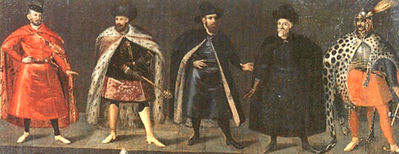
Czartoryski
Czartoryski is the surname of a Polish-Ukrainian-Lithuanian magnate family also known as the Familia. They used the Czartoryski Coat of arms and were the leading noble family of the Polish-Lithuanian Commonwealth in the 18th century.-History:The Czartoryski is a family of a Grand Ducal...
, who sported honorary aristocratic titles recognized in Poland or received from foreign courts, such as "Prince
Prince
Prince is a general term for a ruler, monarch or member of a monarch's or former monarch's family, and is a hereditary title in the nobility of some European states. The feminine equivalent is a princess...
" or "Count
Count
A count or countess is an aristocratic nobleman in European countries. The word count came into English from the French comte, itself from Latin comes—in its accusative comitem—meaning "companion", and later "companion of the emperor, delegate of the emperor". The adjective form of the word is...
". (See also The Princely Houses of Poland
The Princely Houses of Poland
The Princely Houses of Poland differed from other princely houses in Europe. Most importantly, Polish nobility could not be granted nobility titles by the Polish kings in the Polish-Lithuanian Commonwealth...
.) All other szlachta simply addressed each other by their given name or as "Sir Brother" (Panie bracie) or the feminine equivalent. The other forms of address would be "Illustrious and Magnificent Lord", "Magnificent Lord", "Generous Lord" or "Noble Lord" (in decreasing order), or simply "His/Her Grace Lord/Lady".
According to their financial standing, the nobility were in common speech divided into:
- magnates: the wealthiest class; owners of vast lands, towns, many villages, thousands of peasants
- middle nobility (średnia szlachta): owners of one or more villages, often having some official titles or Envoys from the local Land Assemblies to the General Assembly,
- petty nobilityPetty nobilityPetty nobility is dated at least back to 13th century and was formed by Nobles/Knights around their strategic interests. The idea was more capable peasants with leader roles in local community that were given tax exemption for taking care of services like for example guard duties of local primitive...
(drobna szlachta): owners of a part of a village or owning no land at all, often referred to by a variety of colourful Polish terms such as:- szaraczkowa - "grey nobility", from their grey, woolWoolWool is the textile fiber obtained from sheep and certain other animals, including cashmere from goats, mohair from goats, qiviut from muskoxen, vicuña, alpaca, camel from animals in the camel family, and angora from rabbits....
len, uncoloured żupanZupanŻupan was a long garment, always lined, worn by almost all males of the noble social class in the Polish-Lithuanian Commonwealth, typical male attire from the beginning of the 16th to half of the 18th century, still surviving as a part of the Polishnational dress.- Derivation :The name żupan has...
s - okoliczna - "local nobility", similar to zaściankowa
- zagrodowa - from zagroda, a farm, often little different from a peasant's dwelling
- zagonowa - from zagon, a small unit of land measure, "hide nobility"
- cząstkowa - "partial", owners of only part of a single village
- panek - little pan (i.e. lordling), term used in KaszubyKashubiaKashubia or Cassubia - is a language area in the historic Eastern Pomerania region of northwestern Poland. Located west of Gdańsk and the mouth of the Vistula river, it is inhabited by members of the Kashubian ethnic group....
, the Kashubian region, also one of the legal terms for legally separated lower nobility in late medieval and early modern Poland - hreczkosiej - "buckwheatBuckwheatBuckwheat refers to a variety of plants in the dicot family Polygonaceae: the Eurasian genus Fagopyrum, the North American genus Eriogonum, and the Northern Hemisphere genus Fallopia. Either of the latter two may be referred to as "wild buckwheat"...
sowers" - those who had to work their fields themselves - zaściankowa - from zaścianek, a name for plural nobility settlement, "neighbourhood nobility"; just like hreczkosiej, zaściankowa nobility would have no peasants
- brukowa - "cobbleCobblestoneCobblestones are stones that were frequently used in the pavement of early streets. "Cobblestone" is derived from the very old English word "cob", which had a wide range of meanings, one of which was "rounded lump" with overtones of large size...
nobility", for those living in towns like townsfolk - gołota - "naked nobility", i.e., the landless. Gołota szlachta would be considered the 'lowest of the high'.
- szaraczkowa - "grey nobility", from their grey, wool
The rise of the aristocrat magnate
For many centuries, wealthy and powerful members of the szlachta sought to gain legal privileges over their peers. Few szlachta were wealthy enough to be known as magnates (karmazyni — the "Crimson
Crimson
Crimson is a strong, bright, deep red color. It is originally the color of the dye produced from a scale insect, Kermes vermilio, but the name is now also used as a generic term for those slightly bluish-red colors that are between red and rose; besides crimson itself, these colors include...
s", from the crimson colour of their boots). A proper magnate should have been able to trace noble ancestors back for many generations and owned at least 20 villages or estate
Folwark
Folwark is a Polish word for a primarily serfdom-based farm and agricultural enterprise , often very large. Folwarks were operated in the Crown of Poland from the 14th century and in the Grand Duchy of Lithuania since the 15th century, from the second half of the 16th century in the joint...
s. He should also have held a major office in the Commonwealth.
Some historians estimate the number of magnates as 1% of the number of szlachta. Out of approximately one million szlachta, tens of thousands of families, only 200-300 persons could be classed as great magnates with country-wide possessions and influence, and 30-40 of them could be viewed as those with significant impact on Poland's politics.
Baltic

Livonian Crusade
The Livonian Crusade refers to the German and Danish conquest and colonization of medieval Livonia, the territory constituting modern Latvia and Estonia, during the Northern Crusades...
in the territories comprising present-day Estonia
Estonia
Estonia , officially the Republic of Estonia , is a state in the Baltic region of Northern Europe. It is bordered to the north by the Gulf of Finland, to the west by the Baltic Sea, to the south by Latvia , and to the east by Lake Peipsi and the Russian Federation . Across the Baltic Sea lies...
and Latvia
Latvia
Latvia , officially the Republic of Latvia , is a country in the Baltic region of Northern Europe. It is bordered to the north by Estonia , to the south by Lithuania , to the east by the Russian Federation , to the southeast by Belarus and shares maritime borders to the west with Sweden...
. Most of the nobles in Livonia
Livonia
Livonia is a historic region along the eastern shores of the Baltic Sea. It was once the land of the Finnic Livonians inhabiting the principal ancient Livonian County Metsepole with its center at Turaida...
were Baltic German
Baltic German
The Baltic Germans were mostly ethnically German inhabitants of the eastern shore of the Baltic Sea, which today form the countries of Estonia and Latvia. The Baltic German population never made up more than 10% of the total. They formed the social, commercial, political and cultural élite in...
s, but Poles
Poland
Poland , officially the Republic of Poland , is a country in Central Europe bordered by Germany to the west; the Czech Republic and Slovakia to the south; Ukraine, Belarus and Lithuania to the east; and the Baltic Sea and Kaliningrad Oblast, a Russian exclave, to the north...
and Swedes
Sweden
Sweden , officially the Kingdom of Sweden , is a Nordic country on the Scandinavian Peninsula in Northern Europe. Sweden borders with Norway and Finland and is connected to Denmark by a bridge-tunnel across the Öresund....
joined as well, and Russia
Russia
Russia or , officially known as both Russia and the Russian Federation , is a country in northern Eurasia. It is a federal semi-presidential republic, comprising 83 federal subjects...
ns later under the Russian empire
Russian Empire
The Russian Empire was a state that existed from 1721 until the Russian Revolution of 1917. It was the successor to the Tsardom of Russia and the predecessor of the Soviet Union...
.
The Baltic nobility of Livonia was a source of officers and other servants to Swedish and Polish kings in the 16th and particularly 17th centuries, when Couronian, Estonia
Swedish Estonia
The Duchy of Estonia , also known as Swedish Estonia, was a dominion of the Swedish Empire from 1561 until 1721, when it was ceded to Russia in the Treaty of Nystad, following its capitulation in the Great Northern War. The dominion arose when the northern parts of present-day Estonia were united...
n, Livonia
Livonia
Livonia is a historic region along the eastern shores of the Baltic Sea. It was once the land of the Finnic Livonians inhabiting the principal ancient Livonian County Metsepole with its center at Turaida...
n and Oeselian lands belonged to them. Russian emperors used Baltic nobles in government.
They were organized in the Estonian Noble Corporation in Reval, Couronian Noble Corporation in Mitau, and Livonian Noble Corporation in Riga
Riga
Riga is the capital and largest city of Latvia. With 702,891 inhabitants Riga is the largest city of the Baltic states, one of the largest cities in Northern Europe and home to more than one third of Latvia's population. The city is an important seaport and a major industrial, commercial,...
.
It should be noted that in the course of their 700-year history, Baltic German families often had not only ethnic German roots, but also mixed with peoples of non-German origin, such as native Estonians, Livonians and Latvians, as well as with Danes, Swedes, English, Scots, Poles, Dutch, and Hungarians.
In those cases where intermarriage occurred, the other ethnic group usually assimilated into the German culture and adopted the German language and customs, which often included "Germanizing" their names and surnames. They were then considered Baltic Germans as well. (See also: Ethnogenesis
Ethnogenesis
Ethnogenesis is the process by which a group of human beings comes to be understood or to understand themselves as ethnically distinct from the wider social landscape from which their grouping emerges...
.)
In the Imperial census of 1897, 98,573 Germans (7.58% of total population) lived in the Governorate of Livonia, 51,017 (7.57%) in the Governorate of Curonia, and 16,037 (3.89%) in the Governorate of Estonia
Governorate of Estonia
The Governorate of Estonia or Estland, also known as the Government of Estonia or Province of Estonia, was a governorate of the Russian Empire in what is now northern Estonia.-Historical overview:...
.
The Lithuanian gentry consisted mainly of Lithuanians
Lithuanians
Lithuanians are the Baltic ethnic group native to Lithuania, where they number around 2,765,600 people. Another million or more make up the Lithuanian diaspora, largely found in countries such as the United States, Brazil, Canada, Colombia, Russia, United Kingdom and Ireland. Their native language...
, but due to strong ties to Poland, had been culturally Polonized. After the Union of Lublin
Union of Lublin
The Union of Lublin replaced the personal union of the Kingdom of Poland and the Grand Duchy of Lithuania with a real union and an elective monarchy, since Sigismund II Augustus, the last of the Jagiellons, remained childless after three marriages. In addition, the autonomy of Royal Prussia was...
in 1569, they became less distinguishable from Polish szlachta
Szlachta
The szlachta was a legally privileged noble class with origins in the Kingdom of Poland. It gained considerable institutional privileges during the 1333-1370 reign of Casimir the Great. In 1413, following a series of tentative personal unions between the Grand Duchy of Lithuania and the Kingdom of...
, although preserved Lithuania
Lithuania
Lithuania , officially the Republic of Lithuania is a country in Northern Europe, the biggest of the three Baltic states. It is situated along the southeastern shore of the Baltic Sea, whereby to the west lie Sweden and Denmark...
n national awareness.
The Lithuanian nobility was historically a legally privileged class in the Grand Duchy of Lithuania
Grand Duchy of Lithuania
The Grand Duchy of Lithuania was a European state from the 12th /13th century until 1569 and then as a constituent part of Polish-Lithuanian Commonwealth until 1791 when Constitution of May 3, 1791 abolished it in favor of unitary state. It was founded by the Lithuanians, one of the polytheistic...
, from the historical regions of Lithuania Proper
Lithuania proper
Lithuania proper refers to a region which existed within Grand Duchy of Lithuania, and spoke Lithuanian language. The primary meaning is identical to the Duchy of Lithuania, a land around which Grand Duchy of Lithuania evolved...
and Samogitia
Samogitia
Samogitia is one of the five ethnographic regions of Lithuania. It is located in northwestern Lithuania. Its largest city is Šiauliai/Šiaulē. The region has a long and distinct cultural history, reflected in the existence of the Samogitian dialect...
, and in some cases Ruthenia
Ruthenia
Ruthenia is the Latin word used onwards from the 13th century, describing lands of the Ancient Rus in European manuscripts. Its geographic and culturo-ethnic name at that time was applied to the parts of Eastern Europe. Essentially, the word is a false Latin rendering of the ancient place name Rus...
n noble families. Families were primarily granted privileges for their military service to the Grand Duchy.
The Church had been from the beginning the foundation of the learned society in the Baltic region. It was not only the religious, but also the social and political aspects of which were intervowen in the life of the Church in the Middle Ages. A noticeable part of the clergy were recruited from the local inhabitants, and the celibacy of clergy constrained the rise of structure-based inheritable privileges in the Church.
The Protestant Reformation brought about great change in the Baltic Region of Europe. The Church in Lithuania remained Catholic, but a large part of Livonia came under the sway of the Reformation. The first to accept the ideas of the Reformation where the merchants of Riga
Riga
Riga is the capital and largest city of Latvia. With 702,891 inhabitants Riga is the largest city of the Baltic states, one of the largest cities in Northern Europe and home to more than one third of Latvia's population. The city is an important seaport and a major industrial, commercial,...
and Reval, which subsequently functioned as the centers of the Reformation. The Lutheran Church in the Baltics did not come to have the institutional importance or independence its counterpart had in the Nordic countries. Up until the 20th century, the Lutheran Church was dominated by the German segment of the population. The clergy were mostly constituted of German-speaking inhabitance or had often come from Germany. Financially, the clergy where tied to the Baltic German nobilities' estates, which provided revunues. All this added to the notion of the Lutheran Church by the ethnic majority of Estonians and Latvians as Baltic German and not their own. Following the independence of Latvia and Estonia, the refounded national churches took steps to distance itself from its Baltic German association and emphasize Estonian and Latvian aspects.
Noble titles in Estonia and Livonia
- Duke (only one)- Schleswig-Holstein-Sonderburg-BeckSchleswig-Holstein-Sonderburg-BeckSchleswig-Holstein-Sonderburg-Beck was a branch of the Schleswig-Holstein-Sonderburg branch of the House of Oldenburg. It consists of August Philipp, Duke of Schleswig-Holstein-Sonderburg-Beck , and his male-line descendants...
, Ex. Peter August, Duke of Schleswig-Holstein-Sonderburg-BeckPeter August, Duke of Schleswig-Holstein-Sonderburg-BeckPeter Augustus of Schleswig-Holstein-Sonderburg-Beck was the eighth Duke of Schleswig-Holstein-Sonderburg-Beck... - Fürst (usually translated into English as PrincePrincePrince is a general term for a ruler, monarch or member of a monarch's or former monarch's family, and is a hereditary title in the nobility of some European states. The feminine equivalent is a princess...
)- Ex. Barclay de Tolly. Fürst Michael Andreas Barclay de TollyMichael Andreas Barclay de TollyPrince Michael Andreas Barclay de Tolly , was a Russian Field Marshal and Minister of War during Napoleon's invasion in 1812 and War of the Sixth Coalition.-Early life:... - Marquis (only one)- Ex. Paulucci, Marquis Philip Osipovich PaulucciPhilip Osipovich PaulucciPhilip Osipovich Paulucci was a marquis and a Russian adjutant general.-Life:He first served in the French army in 1807 before moving to the Russian service with the rank of colonel...
- Count- Ex. Anrep-Elmpt, Count Joseph Carl von Anrep
- Baron (or the corresponding title of FreiherrFreiherrThe German titles Freiherr and Freifrau and Freiin are titles of nobility, used preceding a person's given name or, after 1919, before the surname...
)- Ex. von Buddenbrock, Baron Henrik Magnus von Buddenbrock
Baltic German gentry from Curonia, Estonia and Livonia
Holy Roman Empire - Austrian Empire
Western Ukrainian ClergyThe Western Ukrainian Clergy of the Ukrainian Greek Catholic Church
Ukrainian Greek Catholic Church
The Ukrainian Greek Catholic Church , Ukrainska Hreko-Katolytska Tserkva), is the largest Eastern Rite Catholic sui juris particular church in full communion with the Holy See, and is directly subject to the Pope...
were a hereditary tight-knit social caste that dominated western Ukrainian society from the late eighteenth until the mid-20th centuries, following the reforms instituted by Joseph II, Emperor of Austria
Joseph II, Holy Roman Emperor
Joseph II was Holy Roman Emperor from 1765 to 1790 and ruler of the Habsburg lands from 1780 to 1790. He was the eldest son of Empress Maria Theresa and her husband, Francis I...
. Because, like their Orthodox brethren, Ukrainian Catholic priests could marry, they were able to establish "priestly dynasties", often associated with specific regions, for many generations. Numbering approximately 2,000-2,500 by the 19th century, priestly families tended to marry within their group, constituting a tight-knit hereditary caste. In the absence of a significant native nobility and enjoying a virtual monopoly on education and wealth within western Ukrainian society, the clergy came to form that group's native aristocracy. The clergy adopted Austria's role for them as bringers of culture and education to the Ukrainian countryside. Most Ukrainian social and political movements in Austrian-controlled territory emerged or were highly influenced by the clergy themselves or by their children. This influence was so great that western Ukrainians were accused of wanting to create a theocracy in western Ukraine by their Polish rivals. The central role played by the Ukrainian clergy or their children in western Ukrainian society would weaken somewhat at the end of the 19th century but would continue until the mid-20th century.
United States of America
Colonial families of the United States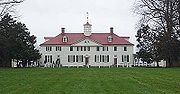
Thirteen Colonies
The Thirteen Colonies were English and later British colonies established on the Atlantic coast of North America between 1607 and 1733. They declared their independence in the American Revolution and formed the United States of America...
use of gentry followed the British usage (i.e., landed gentry
Landed gentry
Landed gentry is a traditional British social class, consisting of land owners who could live entirely off rental income. Often they worked only in an administrative capacity looking after the management of their own lands....
); before the independence of the United States, Southern
Southern United States
The Southern United States—commonly referred to as the American South, Dixie, or simply the South—constitutes a large distinctive area in the southeastern and south-central United States...
plantation
Plantation
A plantation is a long artificially established forest, farm or estate, where crops are grown for sale, often in distant markets rather than for local on-site consumption...
owners were often the younger sons of British landowners, who perpetuated the British system in rural Virginia and Charleston, South Carolina, by employing tenant farmers, indentured servants, and chattel slaves
Slavery
Slavery is a system under which people are treated as property to be bought and sold, and are forced to work. Slaves can be held against their will from the time of their capture, purchase or birth, and deprived of the right to leave, to refuse to work, or to demand compensation...
. In the Northeastern United States
Northeastern United States
The Northeastern United States is a region of the United States as defined by the United States Census Bureau.-Composition:The region comprises nine states: the New England states of Connecticut, Maine, Massachusetts, New Hampshire, Rhode Island and Vermont; and the Mid-Atlantic states of New...
, the gentry included (colonial and British) offshoot families who established the city of Boston, Massachusetts, and Harvard and Yale colleges.
The families of Virginia (see First Families of Virginia
First Families of Virginia
First Families of Virginia were those families in Colonial Virginia who were socially prominent and wealthy, but not necessarily the earliest settlers. They originated with colonists from England who primarily settled at Jamestown, Williamsburg, and along the James River and other navigable waters...
, Colonial families of Maryland
Colonial families of Maryland
The Colonial families of Maryland were the leading families in the Province of Maryland. Several also had interests in the Colony of Virginia, and the two are sometimes referred to as the Chesapeake Colonies. Many of the early settlers came from the West Midlands in England, although the Maryland...
) formed the Virginia gentry class as the old guard of plantation owners in United States.
As General Robert E. Lee
Robert E. Lee
Robert Edward Lee was a career military officer who is best known for having commanded the Confederate Army of Northern Virginia in the American Civil War....
's paternal ancestors were among the earliest settlers in Virginia, his family was considered among the oldest of the Virginia gentry class.
The concept of the gentleman farmer as a man who farms mainly for pleasure rather than for profit was not only a model for the Southern gentry, but very much an ideal befitting some of founding fathers of America, such as Thomas Jefferson and George Washington. Thomas Jefferson, the patron of American agrarianism, wrote in his Notes on Virginia (1785), "Those who labor in the earth are the chosen people of God, if He ever had a chosen people, whose breasts He has made His peculiar deposit for substantial and genuine virtue."
George Washington resumed himself the life of a gentleman farmer at his Mount Vernon estate in Virginia following his resignation as commander in chief of the army in December 1783. Washington lived an aristocratic lifestyle—fox hunting was a favorite leisure activity. Like most Virginia planters, he imported luxuries and other goods from England and paid for them by exporting his tobacco crop. Extravagant spending and the unpredictability of the tobacco market meant that many Virginia planters of Washington's day were losing money.
The American gentry, even in cases where the family never had obtained official rights to bear a coat of arms in history, bore all the same hallmarks of traditional elite as in the old continent.
The first Families of Virginia and Maryland
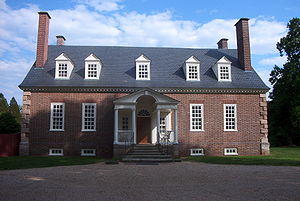
.jpg)
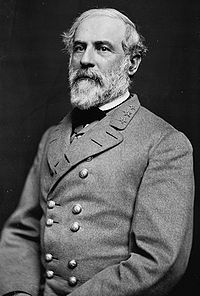
Jamestown, Virginia
Jamestown was a settlement in the Colony of Virginia. Established by the Virginia Company of London as "James Fort" on May 14, 1607 , it was the first permanent English settlement in what is now the United States, following several earlier failed attempts, including the Lost Colony of Roanoke...
and along the James River
James River (Virginia)
The James River is a river in the U.S. state of Virginia. It is long, extending to if one includes the Jackson River, the longer of its two source tributaries. The James River drains a catchment comprising . The watershed includes about 4% open water and an area with a population of 2.5 million...
and other navigable waters in the Colony of Virginia during the 17th century. As there was a propensity to marry within their narrow social scope for many generations, many descendants bear surnames which became common in the growing colony.
Many of the original English colonists considered members of the First Families of Virginia migrated to the Colony of Virginia during the English Civil War
English Civil War
The English Civil War was a series of armed conflicts and political machinations between Parliamentarians and Royalists...
and English Interregnum
English Interregnum
The English Interregnum was the period of parliamentary and military rule by the Lord Protector Oliver Cromwell under the Commonwealth of England after the English Civil War...
period (1642–1660). Royalists left England on the accession to power of Oliver Cromwell and his Parliament. Because most of Virginia's leading families recognized Charles II
Charles II of England
Charles II was monarch of the three kingdoms of England, Scotland, and Ireland.Charles II's father, King Charles I, was executed at Whitehall on 30 January 1649, at the climax of the English Civil War...
as King following the execution of Charles I
Charles I of England
Charles I was King of England, King of Scotland, and King of Ireland from 27 March 1625 until his execution in 1649. Charles engaged in a struggle for power with the Parliament of England, attempting to obtain royal revenue whilst Parliament sought to curb his Royal prerogative which Charles...
in 1649, Charles II is reputed to have called Virginia his "Old Dominion", a nickname that endures today. The affinity of many early aristocratic Virginia settlers for the Crown led to the term "distressed Cavaliers", often applied to the Virginia oligarchy. Many Cavaliers who served under King Charles I fled to Virginia. Thus, it came to be that FFVs often refer to Virginia as "Cavalier Country". These men were offered rewards of land, etc., by King Charles II, but they had settled Virginia and so remained in Virginia.
Most of such early settlers in Virginia were so-called "Second Sons". Primogeniture
Primogeniture
Primogeniture is the right, by law or custom, of the firstborn to inherit the entire estate, to the exclusion of younger siblings . Historically, the term implied male primogeniture, to the exclusion of females...
favored the first sons' inheriting lands and titles in England. Virginia evolved in a society of second or third sons of English aristocracy who inherited land grant
Land grant
A land grant is a gift of real estate – land or its privileges – made by a government or other authority as a reward for services to an individual, especially in return for military service...
s or land in Virginia. They formed part of the southern elite in America.
Many of the great Virginia dynasties traced their roots to families like the Lees
Lee family
The Lee family of the United States is a historically significant Virginia and Maryland political family, whose many prominent members are known for their accomplishments in politics and the military. Through the past few hundred years it was believed that Colonel Richard Lee of Virginia descended...
and the Fitzhughs, who traced lineage to England's county families and baronial legacies. But not all: even the most humble Virginia immigrants aspired to the English manorial trappings of their betters. Virginia history is not the sole province of English aristocrats. Such families as the Shackelfords, who gave their name to a Virginia hamlet, rose from modest beginnings in Hampshire to a place in the Virginia firmament based on hard work and smart marriages. At the same time, other once-great families were decimated not only by the English Civil War
English Civil War
The English Civil War was a series of armed conflicts and political machinations between Parliamentarians and Royalists...
, but also by the enormous power of the London merchants to whom they were in debt and who could move markets with the stroke of a pen.
The Colonial families of Maryland were the leading families in the Province of Maryland
Province of Maryland
The Province of Maryland was an English and later British colony in North America that existed from 1632 until 1776, when it joined the other twelve of the Thirteen Colonies in rebellion against Great Britain and became the U.S...
. Several also had interests in the Colony of Virginia, and the two are sometimes referred to as the Chesapeake Colonies. Many of the early settlers came from the West Midlands
West Midlands (region)
The West Midlands is an official region of England, covering the western half of the area traditionally known as the Midlands. It contains the second most populous British city, Birmingham, and the larger West Midlands conurbation, which includes the city of Wolverhampton and large towns of Dudley,...
in England, although the Maryland families were composed of a variety of European nationalities, e.g., French, Irish, Welsh, Scottish, and Swedish, in addition to English.
The Carroll family is an example a prominent political family from Maryland, of Irish descent and origin in the ancient kingdom of Éile, commonly anglicized Ely, as a branch of the ruling O'Carroll family. Another is the Mason family of Virginia, who descended from the progenitor of the Mason family, George Mason I
George Mason I
George Mason I was the progenitor of the prominent American landholding and political Mason family. Mason was the great-grandfather of George Mason IV, a Founding Father of the United States.-Early life:...
, a Cavalier
Cavalier
Cavalier was the name used by Parliamentarians for a Royalist supporter of King Charles I and son Charles II during the English Civil War, the Interregnum, and the Restoration...
member of the Parliament of England
Parliament of England
The Parliament of England was the legislature of the Kingdom of England. In 1066, William of Normandy introduced a feudal system, by which he sought the advice of a council of tenants-in-chief and ecclesiastics before making laws...
born in Worcestershire, England.
Charles I of England
Charles I of England
Charles I was King of England, King of Scotland, and King of Ireland from 27 March 1625 until his execution in 1649. Charles engaged in a struggle for power with the Parliament of England, attempting to obtain royal revenue whilst Parliament sought to curb his Royal prerogative which Charles...
granted the province palatinate
County palatine
A county palatine or palatinate is an area ruled by an hereditary nobleman possessing special authority and autonomy from the rest of a kingdom or empire. The name derives from the Latin adjective palatinus, "relating to the palace", from the noun palatium, "palace"...
status under Cecilius Calvert, 2nd Baron Baltimore
Cecilius Calvert, 2nd Baron Baltimore
Cecilius Calvert, 2nd Baron Baltimore, 1st Proprietor and 1st Proprietary Governor of Maryland, 9th Proprietary Governor of Newfoundland , was an English peer who was the first proprietor of the Province of Maryland. He received the proprietorship after the death of his father, George Calvert, the...
. The foundational charter created an aristocracy of lords of the manor for Maryland. Maryland was uniquely created as a colony for Catholic aristocracy and landed gentry
Landed gentry
Landed gentry is a traditional British social class, consisting of land owners who could live entirely off rental income. Often they worked only in an administrative capacity looking after the management of their own lands....
, but Anglicanism
Anglicanism
Anglicanism is a tradition within Christianity comprising churches with historical connections to the Church of England or similar beliefs, worship and church structures. The word Anglican originates in ecclesia anglicana, a medieval Latin phrase dating to at least 1246 that means the English...
eventually came to dominate, partly through influence from neighboring Virginia.
Church
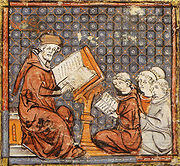
Decline of the Roman Empire
The decline of the Roman Empire refers to the gradual societal collapse of the Western Roman Empire. Many theories of causality prevail, but most concern the disintegration of political, economic, military, and other social institutions, in tandem with foreign invasions and usurpers from within the...
authority in the West completely collapsed, and the western provinces soon became a patchwork of Germanic kingdoms. However, the city of Rome, under the guidance of the Catholic Church, still remained a centre of learning and did much to preserve classic Roman thought in Western Europe.
The only universal European institution was the Catholic Church, and even there, a fragmentation of authority was the rule; all the power within the church hierarchy was in the hands of the local bishops and finally the Bishop of Rome
Primacy of the Roman Pontiff
The primacy of the Bishop of Rome is an ecclesiastical doctrine held by some branches of Christianity, most notably the Catholic Church, the Eastern Orthodox Church and the Anglican Communion. The doctrine concerns the respect and authority that is due to the Bishop of Rome from bishops and their...
. The clergy encompassed almost all of the time's educated men and was furthermore strengthen by considerable wealth, and thus, it came naturally to play a significant political role.
Education
During the Early Middle Ages, the monasteries of the Catholic Church
Roman Catholic Church
The Catholic Church, also known as the Roman Catholic Church, is the world's largest Christian church, with over a billion members. Led by the Pope, it defines its mission as spreading the gospel of Jesus Christ, administering the sacraments and exercising charity...
were the centres of education and literacy, preserving the Church's selection from Latin learning and maintaining the art of writing. Medieval universities had been run for centuries as Christian
Christianity
Christianity is a monotheistic religion based on the life and teachings of Jesus as presented in canonical gospels and other New Testament writings...
episcopal
Bishop
A bishop is an ordained or consecrated member of the Christian clergy who is generally entrusted with a position of authority and oversight. Within the Catholic Church, Eastern Orthodox, Oriental Orthodox Churches, in the Assyrian Church of the East, in the Independent Catholic Churches, and in the...
or monastic
Monastery
Monastery denotes the building, or complex of buildings, that houses a room reserved for prayer as well as the domestic quarters and workplace of monastics, whether monks or nuns, and whether living in community or alone .Monasteries may vary greatly in size – a small dwelling accommodating only...
schools (scholae monasticae), in which monk
Monk
A monk is a person who practices religious asceticism, living either alone or with any number of monks, while always maintaining some degree of physical separation from those not sharing the same purpose...
s and nun
Nun
A nun is a woman who has taken vows committing her to live a spiritual life. She may be an ascetic who voluntarily chooses to leave mainstream society and live her life in prayer and contemplation in a monastery or convent...
s taught classes; evidence of these immediate forerunners dates back to the 6th century AD.
With the increasing growth and urbanization of European society during the 12th and 13th centuries, a demand grew for professional clergy
Clergy
Clergy is the generic term used to describe the formal religious leadership within a given religion. A clergyman, churchman or cleric is a member of the clergy, especially one who is a priest, preacher, pastor, or other religious professional....
. Before the 12th century, the intellectual life of Western Europe had been largely relegated to monasteries
Monastery
Monastery denotes the building, or complex of buildings, that houses a room reserved for prayer as well as the domestic quarters and workplace of monastics, whether monks or nuns, and whether living in community or alone .Monasteries may vary greatly in size – a small dwelling accommodating only...
, which were mostly concerned with performing the liturgy
Liturgy
Liturgy is either the customary public worship done by a specific religious group, according to its particular traditions or a more precise term that distinguishes between those religious groups who believe their ritual requires the "people" to do the "work" of responding to the priest, and those...
and prayer; relatively few monasteries could boast true intellectuals.
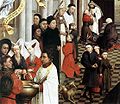
Gregorian Reform
The Gregorian Reforms were a series of reforms initiated by Pope Gregory VII and the circle he formed in the papal curia, circa 1050–80, which dealt with the moral integrity and independence of the clergy...
's emphasis on canon law and the study of the sacrament
Sacrament
A sacrament is a sacred rite recognized as of particular importance and significance. There are various views on the existence and meaning of such rites.-General definitions and terms:...
s, bishops formed cathedral school
Cathedral school
Cathedral schools began in the Early Middle Ages as centers of advanced education, some of them ultimately evolving into medieval universities. Throughout the Middle Ages and beyond, they were complemented by the monastic schools...
s to train the clergy in Canon law
Canon law (Catholic Church)
The canon law of the Catholic Church, is a fully developed legal system, with all the necessary elements: courts, lawyers, judges, a fully articulated legal code and principles of legal interpretation. It lacks the necessary binding force present in most modern day legal systems. The academic...
, but also in the more secular aspects of religious administration, including logic and disputation for use in preaching and theological discussion, and accounting to control finances more effectively. Learning became essential to advancing in the ecclesiastical hierarchy, and teachers also gained prestige.
Modern systems of education in Europe derive their origins from the schools of the High Middle Ages
High Middle Ages
The High Middle Ages was the period of European history around the 11th, 12th, and 13th centuries . The High Middle Ages were preceded by the Early Middle Ages and followed by the Late Middle Ages, which by convention end around 1500....
. Most schools during this era were founded upon religious principles with the primary purpose of training the clergy. Many of the earliest universities, such as the University of Paris
University of Paris
The University of Paris was a university located in Paris, France and one of the earliest to be established in Europe. It was founded in the mid 12th century, and officially recognized as a university probably between 1160 and 1250...
founded in 1160, had a Christian
Christianity
Christianity is a monotheistic religion based on the life and teachings of Jesus as presented in canonical gospels and other New Testament writings...
basis. In addition to this, a number of secular universities existed, such as the University of Bologna
University of Bologna
The Alma Mater Studiorum - University of Bologna is the oldest continually operating university in the world, the word 'universitas' being first used by this institution at its foundation. The true date of its founding is uncertain, but believed by most accounts to have been 1088...
, founded in 1088. Free education for the poor was officially mandated by the Church at the Third Lateran Council (1179), which decreed that every cathedral must assign a master to teach boys too poor to pay the regular fee; parishes and monasteries also established free schools teaching at least basic literary skills. With few exceptions, priests and brothers taught locally, and their salaries were frequently subsidized by towns. Private, independent schools reappeared in medieval Europe during this time, but they, too, were religious in nature and mission.
By the 13th century, almost half of the highest offices in the Church were occupied by degreed masters (abbot
Abbot
The word abbot, meaning father, is a title given to the head of a monastery in various traditions, including Christianity. The office may also be given as an honorary title to a clergyman who is not actually the head of a monastery...
s, archbishop
Archbishop
An archbishop is a bishop of higher rank, but not of higher sacramental order above that of the three orders of deacon, priest , and bishop...
s, cardinals
Cardinal (Catholicism)
A cardinal is a senior ecclesiastical official, usually an ordained bishop, and ecclesiastical prince of the Catholic Church. They are collectively known as the College of Cardinals, which as a body elects a new pope. The duties of the cardinals include attending the meetings of the College and...
), and over one-third of the second-highest offices were occupied by masters. In addition, some of the greatest theologians of the High Middle Ages
High Middle Ages
The High Middle Ages was the period of European history around the 11th, 12th, and 13th centuries . The High Middle Ages were preceded by the Early Middle Ages and followed by the Late Middle Ages, which by convention end around 1500....
, Thomas Aquinas
Thomas Aquinas
Thomas Aquinas, O.P. , also Thomas of Aquin or Aquino, was an Italian Dominican priest of the Catholic Church, and an immensely influential philosopher and theologian in the tradition of scholasticism, known as Doctor Angelicus, Doctor Communis, or Doctor Universalis...
and Robert Grosseteste
Robert Grosseteste
Robert Grosseteste or Grossetete was an English statesman, scholastic philosopher, theologian and Bishop of Lincoln. He was born of humble parents at Stradbroke in Suffolk. A.C...
, were products of the medieval university.
Social Rituals
Social rituals have formed a part of human culture
Culture
Culture is a term that has many different inter-related meanings. For example, in 1952, Alfred Kroeber and Clyde Kluckhohn compiled a list of 164 definitions of "culture" in Culture: A Critical Review of Concepts and Definitions...
for tens of thousands of years. Anthropologists see social rituals as one of many cultural universals.
The Christian clergy has traditionally officiated over of acts worship, reverence, rituals and ceremonies. The basic social function it has served as, has been the expressing, fixing and reinforcing of shared values and beliefs of a society. Among these central traditions have been baptism
Baptism
In Christianity, baptism is for the majority the rite of admission , almost invariably with the use of water, into the Christian Church generally and also membership of a particular church tradition...
, Confirmation
Confirmation (Catholic Church)
Confirmation is one of the seven sacraments through which Catholics pass in the process of their religious upbringing. According to Catholic doctrine, in this sacrament they receive the Holy Spirit and become adult members of the Catholic Church....
, Penance
Sacrament of Penance (Catholic Church)
In the teachings of the Roman Catholic Church, the Sacrament of Penance and Reconciliation is the method by which individual men and women may be freed from sins committed after receiving the sacrament of Baptism...
, Anointing of the Sick
Anointing of the Sick
Anointing of the Sick, known also by other names, is distinguished from other forms of religious anointing or "unction" in that it is intended, as its name indicates, for the benefit of a sick person...
, Holy Orders
Holy Orders
The term Holy Orders is used by many Christian churches to refer to ordination or to those individuals ordained for a special role or ministry....
, marriage, the Mass
Mass
Mass can be defined as a quantitive measure of the resistance an object has to change in its velocity.In physics, mass commonly refers to any of the following three properties of matter, which have been shown experimentally to be equivalent:...
or the Divine Service, and coronation
Coronation
A coronation is a ceremony marking the formal investiture of a monarch and/or their consort with regal power, usually involving the placement of a crown upon their head and the presentation of other items of regalia...
s.
Coronation
In the past, concepts of royalty, coronation and deity were often inexorably linked. In some ancient cultures, rulers were considered to be divine or partially divine: the Egyptian
Ancient Egypt
Ancient Egypt was an ancient civilization of Northeastern Africa, concentrated along the lower reaches of the Nile River in what is now the modern country of Egypt. Egyptian civilization coalesced around 3150 BC with the political unification of Upper and Lower Egypt under the first pharaoh...
Pharaoh
Pharaoh
Pharaoh is a title used in many modern discussions of the ancient Egyptian rulers of all periods. The title originates in the term "pr-aa" which means "great house" and describes the royal palace...
was believed to be the son of Ra
Ra
Ra is the ancient Egyptian sun god. By the Fifth Dynasty he had become a major deity in ancient Egyptian religion, identified primarily with the mid-day sun...
, the sun god, while in Japan, the Emperor
Emperor of Japan
The Emperor of Japan is, according to the 1947 Constitution of Japan, "the symbol of the state and of the unity of the people." He is a ceremonial figurehead under a form of constitutional monarchy and is head of the Japanese Imperial Family with functions as head of state. He is also the highest...
was believed to be a descendant of Amaterasu
Amaterasu
, or is apart of the Japanese myth cycle and also a major deity of the Shinto religion. She is the goddess of the sun, but also of the universe. the name Amaterasu derived from Amateru meaning "shining in heaven." The meaning of her whole name, Amaterasu-ōmikami, is "the great August kami who...
, the sun goddess. Rome
Ancient Rome
Ancient Rome was a thriving civilization that grew on the Italian Peninsula as early as the 8th century BC. Located along the Mediterranean Sea and centered on the city of Rome, it expanded to one of the largest empires in the ancient world....
promulgated the practice of emperor worship; in Medieval Europe, monarchs claimed to have a divine right
Divine Right of Kings
The divine right of kings or divine-right theory of kingship is a political and religious doctrine of royal and political legitimacy. It asserts that a monarch is subject to no earthly authority, deriving his right to rule directly from the will of God...
to rule.
The European coronation ceremonies of the Middle Ages were essentially a combination of the Christian rite of anointing
Anointing
To anoint is to pour or smear with perfumed oil, milk, water, melted butter or other substances, a process employed ritually by many religions. People and things are anointed to symbolize the introduction of a sacramental or divine influence, a holy emanation, spirit, power or God...
with additional elements. In some European countries prior to the adoption of Christianity, the ruler upon his election was raised on a shield
Shield
A shield is a type of personal armor, meant to intercept attacks, either by stopping projectiles such as arrows or redirecting a hit from a sword, mace or battle axe to the side of the shield-bearer....
and, while standing upon it, was borne on the shoulders of several chief men of the nation (or tribe) in a procession around his assembled subjects. Following Europe's conversion to Christianity, crowning ceremonies became more and more ornate, depending on the country in question, and their Christian elements—especially anointing—became the paramount concern.
The coronation
Coronation
A coronation is a ceremony marking the formal investiture of a monarch and/or their consort with regal power, usually involving the placement of a crown upon their head and the presentation of other items of regalia...
of the Holy Roman Emperor
Holy Roman Emperor
The Holy Roman Emperor is a term used by historians to denote a medieval ruler who, as German King, had also received the title of "Emperor of the Romans" from the Pope...
refers to a ceremony in which the ruler of Europe's then-largest political entity received the Imperial Regalia
Imperial Regalia
The Imperial Regalia, insignia, or crown jewels are the regalia of the Emperors and Kings of the Holy Roman Empire. The most important parts are the Imperial Crown, the Holy Lance and the Imperial Sword...
at the hands of the Pope
Pope
The Pope is the Bishop of Rome, a position that makes him the leader of the worldwide Catholic Church . In the Catholic Church, the Pope is regarded as the successor of Saint Peter, the Apostle...
, symbolizing the pope's alleged right to crown Christian
Christian
A Christian is a person who adheres to Christianity, an Abrahamic, monotheistic religion based on the life and teachings of Jesus of Nazareth as recorded in the Canonical gospels and the letters of the New Testament...
sovereigns and the emperor's role as protector of the Roman Catholic Church
Roman Catholic Church
The Catholic Church, also known as the Roman Catholic Church, is the world's largest Christian church, with over a billion members. Led by the Pope, it defines its mission as spreading the gospel of Jesus Christ, administering the sacraments and exercising charity...
. The Holy Roman Empire
Holy Roman Empire
The Holy Roman Empire was a realm that existed from 962 to 1806 in Central Europe.It was ruled by the Holy Roman Emperor. Its character changed during the Middle Ages and the Early Modern period, when the power of the emperor gradually weakened in favour of the princes...
was last established in 962 AD under Otto the Great, though Otto was not the first Western sovereign to have been crowned Imperator
Imperator
The Latin word Imperator was originally a title roughly equivalent to commander under the Roman Republic. Later it became a part of the titulature of the Roman Emperors as part of their cognomen. The English word emperor derives from imperator via Old French Empreur...
Augustus
Augustus
Augustus ;23 September 63 BC – 19 August AD 14) is considered the first emperor of the Roman Empire, which he ruled alone from 27 BC until his death in 14 AD.The dates of his rule are contemporary dates; Augustus lived under two calendars, the Roman Republican until 45 BC, and the Julian...
by the Pope
Pope
The Pope is the Bishop of Rome, a position that makes him the leader of the worldwide Catholic Church . In the Catholic Church, the Pope is regarded as the successor of Saint Peter, the Apostle...
. Charlemagne
Charlemagne
Charlemagne was King of the Franks from 768 and Emperor of the Romans from 800 to his death in 814. He expanded the Frankish kingdom into an empire that incorporated much of Western and Central Europe. During his reign, he conquered Italy and was crowned by Pope Leo III on 25 December 800...
was crowned as Emperor by Pope Leo III
Pope Leo III
Pope Saint Leo III was Pope from 795 to his death in 816. Protected by Charlemagne from his enemies in Rome, he subsequently strengthened Charlemagne's position by crowning him as Roman Emperor....
on 25 December 800, but his dominions were divided between his heirs, with the eastern portions ultimately reunited under Otto I.
Anointing a king was equivalent to crowning him; in fact, in Israel, a crown was not required . Thus, David
David
David was the second king of the united Kingdom of Israel according to the Hebrew Bible and, according to the Gospels of Matthew and Luke, an ancestor of Jesus Christ through both Saint Joseph and Mary...
was anointed as king by the prophet Samuel:
Then Samuel took the horn of oil, and anointed him in the midst of his brethren: and the Spirit of the Lord came upon David from that day forward. So Samuel rose up, and went to Ramah.—.
Clergy - Priests and Pastors
The Catholic, Eastern Orthodox
Eastern Orthodox Church
The Orthodox Church, officially called the Orthodox Catholic Church and commonly referred to as the Eastern Orthodox Church, is the second largest Christian denomination in the world, with an estimated 300 million adherents mainly in the countries of Belarus, Bulgaria, Cyprus, Georgia, Greece,...
, Anglican
Anglicanism
Anglicanism is a tradition within Christianity comprising churches with historical connections to the Church of England or similar beliefs, worship and church structures. The word Anglican originates in ecclesia anglicana, a medieval Latin phrase dating to at least 1246 that means the English...
and the Church of Sweden
Church of Sweden
The Church of Sweden is the largest Christian church in Sweden. The church professes the Lutheran faith and is a member of the Porvoo Communion. With 6,589,769 baptized members, it is the largest Lutheran church in the world, although combined, there are more Lutherans in the member churches of...
(including former dominions of the Swedish Empire
Swedish Empire
The Swedish Empire refers to the Kingdom of Sweden between 1561 and 1721 . During this time, Sweden was one of the great European powers. In Swedish, the period is called Stormaktstiden, literally meaning "the Great Power Era"...
: Finland
History of Finland
The land area that now makes up Finland was settled immediately after the Ice Age, beginning from around 8500 BCE. Most of the region was part of the Kingdom of Sweden from the 13th century to 1809, when it was ceded to the Russian Empire, becoming the autonomous Grand Duchy of Finland. The...
, Estonia
Swedish Estonia
The Duchy of Estonia , also known as Swedish Estonia, was a dominion of the Swedish Empire from 1561 until 1721, when it was ceded to Russia in the Treaty of Nystad, following its capitulation in the Great Northern War. The dominion arose when the northern parts of present-day Estonia were united...
and Livonia
Swedish Livonia
- Swedish infantry and cavalry regiments:Infantry regiments:* Garnisonsregementet i Riga * Guvenörsregementet i Riga * Livländsk infanteribataljon I...
) have applied the formal, church-based leadership or an ordained
Ordination
In general religious use, ordination is the process by which individuals are consecrated, that is, set apart as clergy to perform various religious rites and ceremonies. The process and ceremonies of ordination itself varies by religion and denomination. One who is in preparation for, or who is...
clergy in matters of either the church or broader political and sociocultural import.
Until the reformation, the clergy was the first estate but was relegated to the secular estate in the Protestant Northern Europe
Northern Europe
Northern Europe is the northern part or region of Europe. Northern Europe typically refers to the seven countries in the northern part of the European subcontinent which includes Denmark, Estonia, Latvia, Lithuania, Norway, Finland and Sweden...
. Clerical (pastor) Families is a concept in genealogy to characterize some families in the Swedish Church after the reformation, in which members of the family had served for generations in the Swedish Church either as active clergy in the Church, educational institutions or in the civil service.
After compulsory celibacy was abolished in Sweden during the Reformation, the formation of an hereditary priestly class became possible, whereby wealth and clerical positions were frequently inheritable. Hence the bishops and the vicars, who formed the clerical upper class, would frequently have manors similar to those of the nobility.
Historically, Sweden, including the former Swedish province of Finland, has had a more elaborate form of liturgy, which preserved more than other Nordic countries links to the Medieval Catholic tradition. In Germany, the high church movement is much smaller than in Sweden. Because of several unions between Lutheran and Reformed churches since the Prussian Union
Prussian Union (Evangelical Christian Church)
The Prussian Union was the merger of the Lutheran Church and the Reformed Church in Prussia, by a series of decrees – among them the Unionsurkunde – by King Frederick William III...
, resulting in the simple spread of Calvinist concepts from the Reformed Churches by "osmosis", Lutheranism has often taken on a Reformed context.
Ecclestical residences
A rectory is the residence, or former residence, of a rector
Rector
The word rector has a number of different meanings; it is widely used to refer to an academic, religious or political administrator...
, most often a Christian
Christian
A Christian is a person who adheres to Christianity, an Abrahamic, monotheistic religion based on the life and teachings of Jesus of Nazareth as recorded in the Canonical gospels and the letters of the New Testament...
cleric, but in some cases, an academic rector or other person with that title. Many former rectories may still be referred to locally as a rectory once a church or religious organisation has vacated the property.
Bishop's Palace refers to the official residence of any bishop. Often the most grand ecclestical palaces were built by Prince-Bishop
Prince-Bishop
A Prince-Bishop is a bishop who is a territorial Prince of the Church on account of one or more secular principalities, usually pre-existent titles of nobility held concurrently with their inherent clerical office...
s.
Military and clerical tradition of the gentry
Historically, the nobles in Europe became soldiers. Actually, the aristocracy in Europe can trace their origins to military leaders from the migration period and the Middle Ages. For many years, the British Army, together with the Church, was seen as the ideal career for the younger sons of the aristocracy, those who would not inherit their fathers' titles or estates. Although now much diminished, the practice has not totally disappeared, the slang term Rupert being used to describe such blue-blooded, usually British public-school-educated, officers. Such practices are not unique to the British either geographically or historically.As a very practical form of displaying patriotism, it has been at times "fashionable" for "gentlemen" to participate in the military, usually the militia, to fulfill societal expectations. It has been said that the title "Colonel" was the ultimate fashion accessory for a Southern gentleman.
Superiority of the fighting man
The fundamental idea of gentry, symbolised in this grant of coat-armour, had come to be that of the essential superiority of the fighting man; and, as Selden points out (page 707), the fiction was usually maintained in the granting of arms "to an ennobled person though of the long Robe wherein he hath little use of them as they mean a shield."At the last, the wearing of a sword on all occasions was the outward and visible sign of a "gentleman"; the custom survives in the sword worn with "court dress".
A suggestion that a gentleman must have a coat of arms was vigorously advanced by certain 19th- and 20th-century heraldists, notably Arthur Charles Fox-Davies in England and Thomas Innes of Learney in Scotland, but the suggestion is discredited by an examination, in England, of the records of the High Court of Chivalry and, in Scotland, by a judgment of the Court of Session (per Lord Mackay in Maclean of Ardgour v. Maclean [1941] SC 613 at 650). The significance of a right to a coat of arms was that it was definitive proof of the status of gentleman, but it recognised rather than conferred such a status, and the status could be and frequently was accepted without a right to a coat of arms.
Chivalry
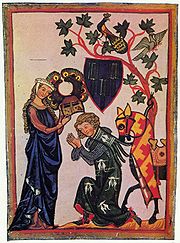
Knightly Virtues
Knightly Virtues were part of a medieval chivalric code of honor. The virtues were a set of 'standards' that Knights of the High Middle Ages tried to adhere to in their daily living and interactions with others. Today, this term still carries similar meanings.Some organizations attempt to continue...
, honor
Honour
Honour or honor is an abstract concept entailing a perceived quality of worthiness and respectability that affects both the social standing and the self-evaluation of an individual or corporate body such as a family, school, regiment or nation...
and courtly love
Courtly love
Courtly love was a medieval European conception of nobly and chivalrously expressing love and admiration. Generally, courtly love was secret and between members of the nobility. It was also generally not practiced between husband and wife....
. The word is derived from the French
French language
French is a Romance language spoken as a first language in France, the Romandy region in Switzerland, Wallonia and Brussels in Belgium, Monaco, the regions of Quebec and Acadia in Canada, and by various communities elsewhere. Second-language speakers of French are distributed throughout many parts...
word chevalerie, itself derived from chevalier, which means "knight", derived from cheval, "horse" (indicating one who rides a horse).
Christianity had a modifying influence on the virtues of chivalry. The Peace and Truce of God
Peace and Truce of God
The Peace and Truce of God was a medieval European movement of the Catholic Church that applied spiritual sanctions in order to limit the violence of private war in feudal society. The movement constituted the first organized attempt to control civil society in medieval Europe through non-violent...
in the 10th century was one such example, with limits placed on knights to protect and honor the weaker members of society and also help the church maintain peace. At the same time, the church became more tolerant of war in the defense of faith, espousing theories of the just war
Just War
Just war theory is a doctrine of military ethics of Roman philosophical and Catholic origin, studied by moral theologians, ethicists and international policy makers, which holds that a conflict ought to meet philosophical, religious or political criteria.-Origins:The concept of justification for...
, and liturgies were introduced which blessed a knight's sword, and a bath of chivalric purification. In the 11th century, the concept of a "knight of Christ" (miles Christi) gained currency in France, Spain and Italy. These concepts of "religious chivalry" were further elaborated in the era of the Crusades
Crusades
The Crusades were a series of religious wars, blessed by the Pope and the Catholic Church with the main goal of restoring Christian access to the holy places in and near Jerusalem...
, with the Crusades themselves often being seen as chivalrous enterprises. Their ideas of chivalry were also further influenced by Saladin
Saladin
Ṣalāḥ ad-Dīn Yūsuf ibn Ayyūb , better known in the Western world as Saladin, was an Arabized Kurdish Muslim, who became the first Sultan of Egypt and Syria, and founded the Ayyubid dynasty. He led Muslim and Arab opposition to the Franks and other European Crusaders in the Levant...
, who was viewed as a chivalrous knight by medieval Christian writers.
The relationship between knights and the nobility varied based on region. In France, being dubbed a knight also bestowed noble status. In Germany and the Low Countries, knights and the nobility were distinctly different classes. In England, the relations between knights, nobles and land-owning landed gentry were complex.
In the later Middle Ages, wealthy merchants strove to adopt chivalric attitudes - the sons of the bourgeoisie were educated at aristocratic courts, where they were trained in the manners of the knightly class. This was a democratization of chivalry, leading to a new genre called the courtesy book
Courtesy book
A Courtesy book or Book of Manners was a book dealing with issues of etiquette, behaviour and morals, with a particular focus on the life at princely courts...
, which were guides to the behavior of "gentlemen". Thus, the post-medieval gentlemanly code of the value of a man's honor, respect for women, and a concern for those less fortunate, is directly derived from earlier ideals of chivalry and historical forces which created it.
When examining medieval literature
Medieval literature
Medieval literature is a broad subject, encompassing essentially all written works available in Europe and beyond during the Middle Ages . The literature of this time was composed of religious writings as well as secular works...
, chivalry can be classified into three basic but overlapping areas:
- Duties to countrymen and fellow Christians: this contains virtues such as mercy, courage, valor, fairness, protection of the weak and the poor, and in the servant-hood of the knight to his lord. This also brings with it the idea of being willing to give one's life for another's; whether he would be giving his life for a poor man or his lord.
- Duties to God: this would contain being faithful to God, protecting the innocent, being faithful to the church, being the champion of good against evil, being generous and obeying God above the feudal lord.
- Duties to women: this is probably the most familiar aspect of chivalry. This would contain what is often called courtly loveCourtly loveCourtly love was a medieval European conception of nobly and chivalrously expressing love and admiration. Generally, courtly love was secret and between members of the nobility. It was also generally not practiced between husband and wife....
, the idea that the knight is to serve a lady, and after her all other ladies. Most especially in this category is a general gentleness and graciousness to all women.
These three areas obviously overlap quite frequently in chivalry and are often indistinguishable.
Different weight given to different areas produced different strands of chivalry:
- warrior chivalry, in which a knight's chief duty is to his lord, as exemplified by Sir GawainGawainGawain is King Arthur's nephew and a Knight of the Round Table who appears very early in the Arthurian legend's development. He is one of a select number of Round Table members to be referred to as the greatest knight, most notably in Sir Gawain and the Green Knight...
in Sir Gawain and the Green KnightSir Gawain and the Green KnightSir Gawain and the Green Knight is a late 14th-century Middle English alliterative romance outlining an adventure of Sir Gawain, a knight of King Arthur's Round Table. In the poem, Sir Gawain accepts a challenge from a mysterious warrior who is completely green, from his clothes and hair to his...
and The Wedding of Sir Gawain and Dame RagnelleThe Wedding of Sir Gawain and Dame RagnelleThe Wedding of Sir Gawain and Dame Ragnelle is a 15th-century English poem, one of several versions of the "loathly lady" story popular during the Middle Ages... - religious chivalry, in which a knight's chief duty is to protect the innocent and serve God, as exemplified by Sir GalahadGalahadSir Galahad |Round Table]] and one of the three achievers of the Holy Grail in Arthurian legend. He is the illegitimate son of Lancelot and Elaine of Corbenic, and is renowned for his gallantry and purity. Emerging quite late in the medieval Arthurian tradition, he is perhaps the knightly...
or Sir PercivalPercivalPercival or Perceval is one of King Arthur's legendary Knights of the Round Table. In Welsh literature his story is allotted to the historical Peredur...
in the Grail legendsHoly GrailThe Holy Grail is a sacred object figuring in literature and certain Christian traditions, most often identified with the dish, plate, or cup used by Jesus at the Last Supper and said to possess miraculous powers... - courtly love chivalry, in which a knight's chief duty is to his own lady, and after her, all ladies, as exemplified by Sir LancelotLancelotSir Lancelot du Lac is one of the Knights of the Round Table in the Arthurian legend. He is the most trusted of King Arthur's knights and plays a part in many of Arthur's victories...
in his love for Queen GuinevereGuinevereGuinevere was the legendary queen consort of King Arthur. In tales and folklore, she was said to have had a love affair with Arthur's chief knight Sir Lancelot...
or Sir TristanTristanTristan is one of the main characters of the Tristan and Iseult story, a Cornish hero and one of the Knights of the Round Table featuring in the Matter of Britain...
in his love for IseultIseultIseult is the name of several characters in the Arthurian story of Tristan and Iseult. The most prominent is Iseult of Ireland, wife of Mark of Cornwall and adulterous lover of Sir Tristan. Her mother, the Queen of Ireland, is also named Iseult...
One particular similarity between all three of these categories is honor. Honor is the foundational and guiding principle of chivalry. Thus, for the knight, honor would be one of the guides of action.
Gentleman
The term gentleman (from LatinLatin
Latin is an Italic language originally spoken in Latium and Ancient Rome. It, along with most European languages, is a descendant of the ancient Proto-Indo-European language. Although it is considered a dead language, a number of scholars and members of the Christian clergy speak it fluently, and...
gentilis, belonging to a race or gens, and "man", cognate
Cognate
In linguistics, cognates are words that have a common etymological origin. This learned term derives from the Latin cognatus . Cognates within the same language are called doublets. Strictly speaking, loanwords from another language are usually not meant by the term, e.g...
with the French
French language
French is a Romance language spoken as a first language in France, the Romandy region in Switzerland, Wallonia and Brussels in Belgium, Monaco, the regions of Quebec and Acadia in Canada, and by various communities elsewhere. Second-language speakers of French are distributed throughout many parts...
word gentilhomme, the Spanish hombre gentil and the Italian
Italian language
Italian is a Romance language spoken mainly in Europe: Italy, Switzerland, San Marino, Vatican City, by minorities in Malta, Monaco, Croatia, Slovenia, France, Libya, Eritrea, and Somalia, and by immigrant communities in the Americas and Australia...
gentil uomo or gentiluomo), in its original and strict signification, denoted a man of good family, analogous to the Latin generosus (its invariable translation in English-Latin documents). In this sense the word equates with the French gentilhomme ("nobleman"), which was in Great Britain long confined to the peerage
Peerage
The Peerage is a legal system of largely hereditary titles in the United Kingdom, which constitute the ranks of British nobility and is part of the British honours system...
. The term gentry (from the Old French genterise for gentelise) has much of the social-class significance of the French noblesse or of the German
German language
German is a West Germanic language, related to and classified alongside English and Dutch. With an estimated 90 – 98 million native speakers, German is one of the world's major languages and is the most widely-spoken first language in the European Union....
Adel, but without the strict technical requirements of those traditions (such as quarters of nobility
Quarters of nobility
Quarters of nobility is an expression used in the bestowal of hereditary titles and refers to the number of generations in which noble status has been held by a family regardless of whether a title was actually in use by each person in the ancestral line in question.For example, a person having...
). This was what the rebels under John Ball
John Ball (priest)
John Ball was an English Lollard priest who took a prominent part in the Peasants' Revolt of 1381. In that year, Ball gave a sermon in which he asked the rhetorical question, "When Adam delved and Eve span, who was then the gentleman?".-Biography:Little is known of Ball's early years. He lived in...
in the 14th century meant when they repeated:
To a degree, gentleman signified a man with an income derived from property, a legacy or some other source and was thus independently wealthy and did not need to work.
Confucianism
The Far East
East Asia
East Asia or Eastern Asia is a subregion of Asia that can be defined in either geographical or cultural terms...
also held similar ideas to the West of what a gentleman is, which are based on Confucian
Confucianism
Confucianism is a Chinese ethical and philosophical system developed from the teachings of the Chinese philosopher Confucius . Confucianism originated as an "ethical-sociopolitical teaching" during the Spring and Autumn Period, but later developed metaphysical and cosmological elements in the Han...
principles. The term Jūnzǐ
Junzi
Junzi or nobleman, was a term used by Confucius , to describe his ideal human. To Confucius, the functions of government and social stratification were facts of life to be sustained by ethical values; thus his ideal human was the junzi...
(君子) is a term crucial to classical Confucianism. Literally meaning "son of a ruler", "prince" or "noble", the ideal of a "gentleman", "proper man", "exemplary person", or "perfect man" is that for which Confucianism exhorts all people to strive. A succinct description of the "perfect man" is one who "combine[s] the qualities of saint, scholar, and gentleman" (CE
Catholic Encyclopedia
The Catholic Encyclopedia, also referred to as the Old Catholic Encyclopedia and the Original Catholic Encyclopedia, is an English-language encyclopedia published in the United States. The first volume appeared in March 1907 and the last three volumes appeared in 1912, followed by a master index...
). (In modern times, the masculine bias in Confucianism may have weakened, but the same term is still used; the masculine translation in English is also traditional and still frequently used.) A hereditary elitism was bound up with the concept, and gentlemen were expected to act as moral guides to the rest of society. They were to:
- cultivate themselves morally;
- participate in the correct performance of ritual;
- show filial piety and loyalty where these are due; and
- cultivate humaneness.
The opposite of the Jūnzǐ was the Xiǎorén (小人), literally "small person" or "petty person". Like English "small", the word in this context in Chinese can mean petty in mind and heart, narrowly self-interested, greedy, superficial, and materialistic.
Noblesse oblige
The idea of Noblesse obligeNoblesse oblige
Noblesse oblige is a French phrase literally meaning "nobility obliges".The Dictionnaire de l’Académie française defines it thus:# Whoever claims to be noble must conduct himself nobly....
, "nobility obliges", among gentry is, as the Oxford English Dictionary
Oxford English Dictionary
The Oxford English Dictionary , published by the Oxford University Press, is the self-styled premier dictionary of the English language. Two fully bound print editions of the OED have been published under its current name, in 1928 and 1989. The first edition was published in twelve volumes , and...
expresses, that the term "suggests noble ancestry constrains to honourable behavior; privilege entails to responsibility". Being a noble meant that one had responsibilities to lead, manage and so on. One was not to simply spend one's time in idle pursuits.
General Robert E. Lee
Robert E. Lee
Robert Edward Lee was a career military officer who is best known for having commanded the Confederate Army of Northern Virginia in the American Civil War....
's definition speaks only to conduct.
- The forbearing use of power does not only form a touchstone, but the manner in which an individual enjoys certain advantages over others is a test of a true gentleman.
- The power which the strong have over the weak, the employer over the employed, the educated over the unlettered, the experienced over the confiding, even the clever over the silly — the forbearing or inoffensive use of all this power or authority, or a total abstinence from it when the case admits it, will show the gentleman in a plain light.
- The gentleman does not needlessly and unnecessarily remind an offender of a wrong he may have committed against him. He can not only forgive, he can forget; and he strives for that nobleness of self and mildness of character which impart sufficient strength to let the past be but the past. A true man of honor feels humbled himself when he cannot help humbling others.
Heraldry
Coat of armsA coat of arms is a heraldic device dating to the 12th century in Europe. It was originally a cloth tunic worn over or in place of armour to establish identity in battle. The coat of arms is drawn with heraldic rules for a person, family or organization. Family coats of arms where originally derived from personal ones, which then became extended in time to the whole family. In Scotland, family coats of arms are still personal ones and are mainly used by the head of the family.
Ecclesiastical heraldry
Ecclesiastical heraldry is the tradition of heraldryHeraldry
Heraldry is the profession, study, or art of creating, granting, and blazoning arms and ruling on questions of rank or protocol, as exercised by an officer of arms. Heraldry comes from Anglo-Norman herald, from the Germanic compound harja-waldaz, "army commander"...
developed by Christian
Christianity
Christianity is a monotheistic religion based on the life and teachings of Jesus as presented in canonical gospels and other New Testament writings...
clergy
Clergy
Clergy is the generic term used to describe the formal religious leadership within a given religion. A clergyman, churchman or cleric is a member of the clergy, especially one who is a priest, preacher, pastor, or other religious professional....
. Initially used to mark documents, ecclesiastical
Ecclesiology
Today, ecclesiology usually refers to the theological study of the Christian church. However when the word was coined in the late 1830s, it was defined as the science of the building and decoration of churches and it is still, though rarely, used in this sense.In its theological sense, ecclesiology...
heraldry evolved as a system for identifying people and diocese
Diocese
A diocese is the district or see under the supervision of a bishop. It is divided into parishes.An archdiocese is more significant than a diocese. An archdiocese is presided over by an archbishop whose see may have or had importance due to size or historical significance...
s. It is most formalized within the Catholic Church, where most bishop
Bishop
A bishop is an ordained or consecrated member of the Christian clergy who is generally entrusted with a position of authority and oversight. Within the Catholic Church, Eastern Orthodox, Oriental Orthodox Churches, in the Assyrian Church of the East, in the Independent Catholic Churches, and in the...
s, including the pope
Pope
The Pope is the Bishop of Rome, a position that makes him the leader of the worldwide Catholic Church . In the Catholic Church, the Pope is regarded as the successor of Saint Peter, the Apostle...
, have a personal coat of arms
Coat of arms
A coat of arms is a unique heraldic design on a shield or escutcheon or on a surcoat or tabard used to cover and protect armour and to identify the wearer. Thus the term is often stated as "coat-armour", because it was anciently displayed on the front of a coat of cloth...
. Clergy in Anglican
Anglicanism
Anglicanism is a tradition within Christianity comprising churches with historical connections to the Church of England or similar beliefs, worship and church structures. The word Anglican originates in ecclesia anglicana, a medieval Latin phrase dating to at least 1246 that means the English...
, Lutheran
Lutheranism
Lutheranism is a major branch of Western Christianity that identifies with the theology of Martin Luther, a German reformer. Luther's efforts to reform the theology and practice of the church launched the Protestant Reformation...
, Eastern Catholic, and Orthodox churches
Eastern Christianity
Eastern Christianity comprises the Christian traditions and churches that developed in the Balkans, Eastern Europe, Asia Minor, the Middle East, Northeastern Africa, India and parts of the Far East over several centuries of religious antiquity. The term is generally used in Western Christianity to...
follow similar customs.
Four occupations (East Asia)
The four divisions of society refers to the model of society in ancient China and was a meritocratic social classSocial class
Social classes are economic or cultural arrangements of groups in society. Class is an essential object of analysis for sociologists, political scientists, economists, anthropologists and social historians. In the social sciences, social class is often discussed in terms of 'social stratification'...
system in China and other subsequently influenced Confucian societies. The four castes—gentry, farmers, artisans and merchants—are combined to form the term Shìnónggōngshāng (士農工商).
Gentry
(士) This means different things in different countries.
In China, Korea, and Vietnam, this meant that the Confucian scholar gentry that would - for the most part - make up most of the bureaucracy. This caste would comprise both the more-or-less hereditary aristocracy as well as the meritocratic scholars that rise through the rank by public service and, later, by imperial exams.
In Japan, this caste essentially equates to the samurai
Samurai
is the term for the military nobility of pre-industrial Japan. According to translator William Scott Wilson: "In Chinese, the character 侍 was originally a verb meaning to wait upon or accompany a person in the upper ranks of society, and this is also true of the original term in Japanese, saburau...
class. In the Edo period
Edo period
The , or , is a division of Japanese history which was ruled by the shoguns of the Tokugawa family, running from 1603 to 1868. The political entity of this period was the Tokugawa shogunate....
, with the creation of the Domains (han) under the rule of Toyotomi Hideyoshi
Toyotomi Hideyoshi
was a daimyo warrior, general and politician of the Sengoku period. He unified the political factions of Japan. He succeeded his former liege lord, Oda Nobunaga, and brought an end to the Sengoku period. The period of his rule is often called the Momoyama period, named after Hideyoshi's castle...
, all land was confiscated and reissued as fiefdoms to the daimyo
Daimyo
is a generic term referring to the powerful territorial lords in pre-modern Japan who ruled most of the country from their vast, hereditary land holdings...
. The small lords, the , were ordered either to give up their swords and rights and remain on their lands as peasants or to move to the castle cities to become paid retainers of the daimyo. Only a few samurai were allowed to remain in the countryside; the . Some 5% of the population were samurai. Only the samurai could have proper surnames, which after the Meiji Restoration
Meiji Restoration
The , also known as the Meiji Ishin, Revolution, Reform or Renewal, was a chain of events that restored imperial rule to Japan in 1868...
, became compulsory to all inhabitants (see Japanese name
Japanese name
in modern times usually consist of a family name , followed by a given name. "Middle names" are not generally used.Japanese names are usually written in kanji, which are characters of usually Chinese origin in Japanese pronunciation...
).
Farmers
(農) In a largely agrarian society, the farmers occupy a high position in Chinese, Japanese, Korean, and Vietnamese society, at least in theory. Some sources, such as Xunzi, list them before the gentry, based on the Confucian view that they directly contributed to the welfare of the state. In China, the farmer lifestyle is also closely linked with the ideals of Confucian gentlemen, and aging scholars and bureaucrats often retire to a life of farming—again, at least in theory.
Hierarchical structure of Feudal Japan
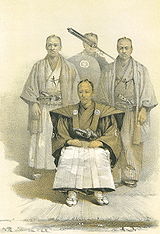
Daimyo
is a generic term referring to the powerful territorial lords in premodern Japan who ruled most of the country from their vast, hereditary land holdings. In the term, literally means "large", and myō stands for , meaning private land.
They were the most powerful feudal
Feudalism
Feudalism was a set of legal and military customs in medieval Europe that flourished between the 9th and 15th centuries, which, broadly defined, was a system for ordering society around relationships derived from the holding of land in exchange for service or labour.Although derived from the...
rulers from the 10th century to the early 19th century in Japan
History of Japan
The history of Japan encompasses the history of the islands of Japan and the Japanese people, spanning the ancient history of the region to the modern history of Japan as a nation state. Following the last ice age, around 12,000 BC, the rich ecosystem of the Japanese Archipelago fostered human...
following the Shogun
Shogun
A was one of the hereditary military dictators of Japan from 1192 to 1867. In this period, the shoguns, or their shikken regents , were the de facto rulers of Japan though they were nominally appointed by the emperor...
.
From the shugo
Shugo
was a title, commonly translated as "Governor," given to certain officials in feudal Japan. They were each appointed by the shogun to oversee one or more of the provinces of Japan...
of the Muromachi period
Muromachi period
The is a division of Japanese history running from approximately 1336 to 1573. The period marks the governance of the Muromachi or Ashikaga shogunate, which was officially established in 1338 by the first Muromachi shogun, Ashikaga Takauji, two years after the brief Kemmu restoration of imperial...
through the Sengoku
Sengoku period
The or Warring States period in Japanese history was a time of social upheaval, political intrigue, and nearly constant military conflict that lasted roughly from the middle of the 15th century to the beginning of the 17th century. The name "Sengoku" was adopted by Japanese historians in reference...
to the daimyo of the Edo period
Edo period
The , or , is a division of Japanese history which was ruled by the shoguns of the Tokugawa family, running from 1603 to 1868. The political entity of this period was the Tokugawa shogunate....
, the rank had a long and varied history.
The term daimyo is also sometimes used to refer to the leading figures of such clans, also called "lord
Lord
Lord is a title with various meanings. It can denote a prince or a feudal superior . The title today is mostly used in connection with the peerage of the United Kingdom or its predecessor countries, although some users of the title do not themselves hold peerages, and use it 'by courtesy'...
". It was usually, though not exclusively, from these warlords that a shogun
Shogun
A was one of the hereditary military dictators of Japan from 1192 to 1867. In this period, the shoguns, or their shikken regents , were the de facto rulers of Japan though they were nominally appointed by the emperor...
arose or a regent
Regent
A regent, from the Latin regens "one who reigns", is a person selected to act as head of state because the ruler is a minor, not present, or debilitated. Currently there are only two ruling Regencies in the world, sovereign Liechtenstein and the Malaysian constitutive state of Terengganu...
was chosen.
After the Meiji Restoration
In 1869, the year after the Meiji Restoration
Meiji Restoration
The , also known as the Meiji Ishin, Revolution, Reform or Renewal, was a chain of events that restored imperial rule to Japan in 1868...
, the daimyo, together with the kuge
Kuge
The was a Japanese aristocratic class that dominated the Japanese imperial court in Kyoto until the rise of the Shogunate in the 12th century at which point it was eclipsed by the daimyo...
, formed a new aristocracy, the kazoku
Kazoku
The was the hereditary peerage of the Empire of Japan that existed between 1869 and 1947.-Origins:Following the Meiji Restoration of 1868, the ancient court nobility of Kyoto regained some of its lost status...
. In 1871, the han were abolished
Abolition of the han system
The was an act, in 1871, of the new Meiji government of the Empire of Japan to replace the traditional feudal domain system and to introduce centralized government authority . This process marked the culmination of the Meiji Restoration in that all daimyo were required to return their authority...
, and prefectures
Prefectures of Japan
The prefectures of Japan are the country's 47 subnational jurisdictions: one "metropolis" , Tokyo; one "circuit" , Hokkaidō; two urban prefectures , Osaka and Kyoto; and 43 other prefectures . In Japanese, they are commonly referred to as...
were established, thus effectively ending the daimyo era in Japan. In the wake of this change, many daimyo remained in control of their lands, being appointed as prefectural governors; however, they were soon relieved of this duty and called en masse to Tokyo, thereby cutting off any independent base of power from which to potentially rebel. Despite this, members of former daimyo families remained prominent in government and society and, in some cases, continue to remain prominent to the present day. (For example, Morihiro Hosokawa
Morihiro Hosokawa
is a Japanese politician who was the 79th Prime Minister of Japan from August 9, 1993 to April 28, 1994. His coalition was the first non-Liberal Democratic Party government since 1955.- Early life :...
, the former prime minister, is a descendant of the daimyo of Kumamoto, but these cases are very few now.)
Samurai
is the term for the military nobility of pre-industrial
Pre-industrial society
Pre-industrial society refers to specific social attributes and forms of political and cultural organization that were prevalent before the advent of the Industrial Revolution. It is followed by the industrial society....
Japan. According to translator William Scott Wilson
William Scott Wilson
William Scott Wilson is known for translating several works of Japanese literature, mostly those relating to the martial tradition of that country. He is recognized by as "today’s foremost translator of classic Samurai texts." Mr. Wilson is also described as the world's foremost expert on the...
: "In Chinese, the character 侍 was originally a verb meaning to wait upon or accompany a person in the upper ranks of society, and this is also true of the original term in Japanese, saburau. In both countries the terms were nominalized to mean 'those who serve in close attendance to the nobility', the pronunciation in Japanese changing to saburai." According to Wilson, an early reference to the word samurai appears in the Kokin Wakashū (905-914), the first imperial anthology of poems, completed in the first part of the 9th century.
By the end of the 12th century, samurai became almost entirely synonymous with bushi (武士), and the word was closely associated with the middle and upper echelons of the warrior class. The samurai followed a set of written rules called the Bushidō
Bushido
, meaning "Way of the Warrior-Knight", is a Japanese word which is used to describe a uniquely Japanese code of conduct and a way of the samurai life, loosely analogous to the concept of chivalry. It originates from the samurai moral code and stresses frugality, loyalty, martial arts mastery, and...
. They numbered less than 10% of Japan's population. Samurai teachings can still be found today in modern-day society with the martial art Kendō
Kendo
, meaning "Way of The Sword", is a modern Japanese martial art of sword-fighting based on traditional Japanese swordsmanship, or kenjutsu.Kendo is a physically and mentally challenging activity that combines strong martial arts values with sport-like physical elements.-Practitioners:Practitioners...
, meaning "the way of the sword".
As de facto aristocrats for centuries, samurai developed their own cultures that influenced Japanese culture as a whole. The culture associated with the samurai such as the tea ceremony, monochrome ink painting, rock gardens and poetry were adopted by warrior patrons throughout the years 1200-1600. These practices were adapted from the Chinese arts. Zen monks introduced them to Japan, and they were allowed to flourish due to the interest of powerful warrior elites. Muso Soseki (1275–1351) was a Zen monk who was advisor to both Emperor Go-Daigo and General Ashikaga Takauji (1304–58). Muso as well as other monks acted as political and cultural diplomats between Japan and China. Muso was particularly well known for his garden design. Another Ashikaga patron of the arts was Yoshimasa. His cultural advisor, the Zen monk Zeami, introduced tea ceremony to him. Previously, tea had been used primarily for Buddhist monks to stay awake during meditation.
In general, samurai, aristocrats, and priests had a very high literacy rate in Kanji.
"The Nobles send their sons to monasteries to be educated as soon as they are 8 years old, and they remain there until they are 19 or 20, learning reading, writing and religion; as soon as they come out, they marry and apply themselves to politics."
Emperor Meiji
Emperor Meiji
The or was the 122nd emperor of Japan according to the traditional order of succession, reigning from 3 February 1867 until his death...
abolished the samurai's right to be the only armed force in favor of a more modern, Western-style, conscripted army in 1873. Samurai became Shizoku , who retained some of their salaries, but the right to wear a katana in public was eventually abolished along with the right to execute commoners who paid them disrespect.
In defining how a modern Japan should be, members of the Meiji government decided to follow in the footsteps of the United Kingdom and Germany, basing the country on the concept of noblesse oblige
Noblesse oblige
Noblesse oblige is a French phrase literally meaning "nobility obliges".The Dictionnaire de l’Académie française defines it thus:# Whoever claims to be noble must conduct himself nobly....
. Samurai were not to be a political force under the new order.
The difference between the Japanese and European feudal systems was that European feudalism was grounded in Roman legal structure
Roman law
Roman law is the legal system of ancient Rome, and the legal developments which occurred before the 7th century AD — when the Roman–Byzantine state adopted Greek as the language of government. The development of Roman law comprises more than a thousand years of jurisprudence — from the Twelve...
, while Japan feudalism had Chinese Confucian morality
Confucianism
Confucianism is a Chinese ethical and philosophical system developed from the teachings of the Chinese philosopher Confucius . Confucianism originated as an "ethical-sociopolitical teaching" during the Spring and Autumn Period, but later developed metaphysical and cosmological elements in the Han...
as its basis.
, meaning "Way of the Warrior", is a name in common usage since the late 19th century which is used to describe a uniquely Japan
Japan
Japan is an island nation in East Asia. Located in the Pacific Ocean, it lies to the east of the Sea of Japan, China, North Korea, South Korea and Russia, stretching from the Sea of Okhotsk in the north to the East China Sea and Taiwan in the south...
ese code of conduct
Code of Conduct
A code of conduct is a set of rules outlining the responsibilities of or proper practices for an individual, party or organization. Related concepts include ethical codes and honor codes....
adhered to by samurai
Samurai
is the term for the military nobility of pre-industrial Japan. According to translator William Scott Wilson: "In Chinese, the character 侍 was originally a verb meaning to wait upon or accompany a person in the upper ranks of society, and this is also true of the original term in Japanese, saburau...
since time immemorial. This code is said to have emphasized virtues such as loyalty
Loyalty
Loyalty is faithfulness or a devotion to a person, country, group, or cause There are many aspects to...
, honor, obedience, duty, filial piety
Filial piety
In Confucian ideals, filial piety is one of the virtues to be held above all else: a respect for the parents and ancestors. The Confucian classic Xiao Jing or Classic of Xiào, thought to be written around 470 BCE, has historically been the authoritative source on the Confucian tenet of xiào /...
, and self-sacrifice.
The Kojiki
Kojiki
is the oldest extant chronicle in Japan, dating from the early 8th century and composed by Ō no Yasumaro at the request of Empress Gemmei. The Kojiki is a collection of myths concerning the origin of the four home islands of Japan, and the Kami...
is Japan's oldest extant book. Written in 712, it contains passages about legendary prince Yamato Takeru
Yamato Takeru
, originally Prince Ousu was a Japanese legendary prince of the Yamato dynasty, son of Keikō of Yamato, a legendary monarch who is traditionally counted as the 12th Tennō or Emperor of Japan. The tragic tale of this impressive figure is told in the Japanese chronicles Kojiki and Nihon Shoki...
and provides an early indication of the values and literary self-image of the Bushidō ideal.
Seven virtues of Bushidō
The Bushidō code is typified by seven virtues:
Associated virtues
Kazoku (Meiji Restoration)
The was the hereditary peerage
Peerage
The Peerage is a legal system of largely hereditary titles in the United Kingdom, which constitute the ranks of British nobility and is part of the British honours system...
of the Empire of Japan
Empire of Japan
The Empire of Japan is the name of the state of Japan that existed from the Meiji Restoration on 3 January 1868 to the enactment of the post-World War II Constitution of...
that existed between 1869 and 1947.
Under the Peerage Act of 7 July 1884, pushed through by Itō Hirobumi
Ito Hirobumi
Prince was a samurai of Chōshū domain, Japanese statesman, four time Prime Minister of Japan , genrō and Resident-General of Korea. Itō was assassinated by An Jung-geun, a Korean nationalist who was against the annexation of Korea by the Japanese Empire...
after visiting Europe, the Meiji government expanded the hereditary peerage with the award of kazoku status to persons regarded as having performed outstanding services to the nation. The government also divided the kazoku into five ranks explicitly based on the British peerage, but with titles deriving from the ancient Chinese nobility
Chinese nobility
Chinese sovereignty and peerage, the nobility of China, were an important feature of traditional social and political organization of Imperial China. While the concepts of hereditary sovereign and peerage titles and noble families were featured as early as the semi-mythical, early historical...
:
Korea
Korean monarchy and native nobility existed in KoreaKorea
Korea ) is an East Asian geographic region that is currently divided into two separate sovereign states — North Korea and South Korea. Located on the Korean Peninsula, Korea is bordered by the People's Republic of China to the northwest, Russia to the northeast, and is separated from Japan to the...
until the end of the Japanese occupation
Korea under Japanese rule
Korea was under Japanese rule as part of Japan's 35-year imperialist expansion . Japanese rule ended in 1945 shortly after the Japanese defeat in World War II....
. (In Imperial Japan, Korean nobles continued to hold noble titles.) The system is roughly the same as that of the Chinese nobility
Chinese nobility
Chinese sovereignty and peerage, the nobility of China, were an important feature of traditional social and political organization of Imperial China. While the concepts of hereditary sovereign and peerage titles and noble families were featured as early as the semi-mythical, early historical...
. It included che, wang and kun.
As the Jesuits and other monastical orders did during Europe's Dark Ages, the Buddhist monks became the purveyors and guardians of Korea's literary traditions while documenting Korea's written history and legacies from the Silla
Silla
Silla was one of the Three Kingdoms of Korea, and one of the longest sustained dynasties in...
period to the end of the Goryeo
Goryeo
The Goryeo Dynasty or Koryŏ was a Korean dynasty established in 918 by Emperor Taejo. Korea gets its name from this kingdom which came to be pronounced Korea. It united the Later Three Kingdoms in 936 and ruled most of the Korean peninsula until it was removed by the Joseon dynasty in 1392...
dynasty. Korean Buddhist monks also developed and used the first movable metal type printing presses in history—some 500 years before Gutenberg—to print ancient Buddhist texts. Buddhist monks also engaged in record keeping, food storage and distribution, as well as the ability to exercise power by influencing the Goryeo royal court.
Gentry noun
"Posing as a member of the gentry upper classes, privileged classes, elite, high society, haut monde, smart set; establishment, aristocracy; informal upper crust, top drawer." (The New Oxford American Dictionary (NOAD), Second Edition)See also
- Aristocracy (class)Aristocracy (class)The aristocracy are people considered to be in the highest social class in a society which has or once had a political system of Aristocracy. Aristocrats possess hereditary titles granted by a monarch, which once granted them feudal or legal privileges, or deriving, as in Ancient Greece and India,...
- Estates of the realmEstates of the realmThe Estates of the realm were the broad social orders of the hierarchically conceived society, recognized in the Middle Ages and Early Modern period in Christian Europe; they are sometimes distinguished as the three estates: the clergy, the nobility, and commoners, and are often referred to by...
- FeudalismFeudalismFeudalism was a set of legal and military customs in medieval Europe that flourished between the 9th and 15th centuries, which, broadly defined, was a system for ordering society around relationships derived from the holding of land in exchange for service or labour.Although derived from the...
- Gentleman farmer
- GentlewomanGentlewomanA gentlewoman in the original and strict sense is a woman of good family, analogous to the Latin generosus and generosa...
- HochwohlgeborenHochwohlgeborenHochwohlgeboren is a form of address for members of the lower German nobility or landed gentry. The English translation is High Well Born.-German usage:...
- JunziJunziJunzi or nobleman, was a term used by Confucius , to describe his ideal human. To Confucius, the functions of government and social stratification were facts of life to be sustained by ethical values; thus his ideal human was the junzi...
- Landed gentryLanded gentryLanded gentry is a traditional British social class, consisting of land owners who could live entirely off rental income. Often they worked only in an administrative capacity looking after the management of their own lands....
- Landed propertyLanded propertyLanded property or landed estates is a real estate term that usually refers to a property that generates income for the owner without the owner having to do the actual work of the estate. In Europe, agrarian landed property typically consisted of a manor, several tenant farms, and some privileged...
- ManorialismManorialismManorialism, an essential element of feudal society, was the organizing principle of rural economy that originated in the villa system of the Late Roman Empire, was widely practiced in medieval western and parts of central Europe, and was slowly replaced by the advent of a money-based market...
- Patrician (ancient Rome)
- Patrician (post-Roman Europe)
- Old MoneyOld MoneyOld money is "the inherited wealth of established upper-class families " or "a person, family, or lineage possessing inherited wealth." The term typically describes a class of the super-rich, who have been able to maintain their wealth across multiple generations.- United States :American locations...
- PeeragePeerageThe Peerage is a legal system of largely hereditary titles in the United Kingdom, which constitute the ranks of British nobility and is part of the British honours system...
- Burke's Landed GentryBurke's Landed GentryBurke's Landed Gentry is the result of nearly two centuries of intense work by the Burke family, and others since, in building a collection of books of genealogical and heraldic interest,...
- Burke's PeerageBurke's PeerageBurke's Peerage publishes authoritative, in-depth historical guides to the royal and titled families of the United Kingdom, such as Burke's Peerage, Baronetage & Knightage, and of many other countries. Founded in 1826 by British genealogist John Burke Esq., and continued by his son, Sir John...
- Debrett's Peerage
- Burke's Landed Gentry
- Polish landed gentryPolish landed gentryPolish landed gentry historically was a social group of hereditary landowners who held manorial estates. Historically ziemiane consisted of hereditary nobles and landed commoners. The Constitution of 1496 restricted the right to hold manorial lordships to the hereditary nobility proper only...
- MagnateMagnateMagnate, from the Late Latin magnas, a great man, itself from Latin magnus 'great', designates a noble or other man in a high social position, by birth, wealth or other qualities...
- SzlachtaSzlachtaThe szlachta was a legally privileged noble class with origins in the Kingdom of Poland. It gained considerable institutional privileges during the 1333-1370 reign of Casimir the Great. In 1413, following a series of tentative personal unions between the Grand Duchy of Lithuania and the Kingdom of...
- Redorer son blasonRedorer son blasonRedorer son blason was a social practice taking place in France before the French Revolution whereby a poor aristocratic family married a daughter with a rich commoner. This enabled the aristocratic family to recover financially through the hefty dowry usually asked from the commoner...
- Ecclesiastical AddressesEcclesiastical Addresses-United States:* Cardinal: Cardinal John Smith ; His Eminence; Your Eminence* Cardinal who is also an archbishop: Cardinal John Smith , Archbishop of New York; His Eminence; Your Eminence...
- Forms of address in the United KingdomForms of Address in the United KingdomForms of address used in the United Kingdom are given below.Several terms have been abbreviated in the table below. The forms used in the table are given first, followed by alternative acceptable abbreviations in parentheses.-Abbreviations:*His/Her Majesty: HM...
- Royal and noble ranksRoyal and noble ranksTraditional rank amongst European royalty, peers, and nobility is rooted in Late Antiquity and the Middle Ages. Although they vary over time and between geographic regions , the following is a reasonably comprehensive list that provides information on both general ranks and specific differences.-...
- Royal and noble stylesRoyal and noble stylesStyles represent the fashion by which monarchs and noblemen are properly addressed. Throughout history, many different styles were used, with little standardization...
- Style (manner of address)Style (manner of address)A style of office, or honorific, is a legal, official, or recognized title. A style, by tradition or law, precedes a reference to a person who holds a post or political office, and is sometimes used to refer to the office itself. An honorific can also be awarded to an individual in a personal...
- Social environmentSocial environmentThe social environment of an individual, also called social context or milieu, is the culture that s/he was educated or lives in, and the people and institutions with whom the person interacts....
- Status–income disequilibrium
- HonourHonourHonour or honor is an abstract concept entailing a perceived quality of worthiness and respectability that affects both the social standing and the self-evaluation of an individual or corporate body such as a family, school, regiment or nation...
- Symbolic capitalSymbolic capitalIn sociology and anthropology, symbolic capital can be referred to as the resources available to an individual on the basis of honor, prestige or recognition, and functions as an authoritative embodiment of cultural value...