
All Topics  
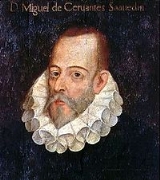
Miguel de Cervantes

 
Miguel De Cervantes

   Email Print
   Bookmark   Link


Miguel de Cervantes


Miguel de Cervantes Saavedra ( in modern Spanish
Spanish language

Spanish or Castilian is a Romance languages that originated in northern Spain, and gradually spread in the Kingdom of Castile and evolved into the principal language of government and trade....
; September 29, 1547 – April 23, 1616) was a Spanish novelist, poet, and playwright. His magnum opus
Magnum opus

Magnum opus , from the Latin meaning great work, refers to the largest, and perhaps the best, greatest, most popular, or most renowned achievement of an author, artist, or composer....
, Don Quixote
Don Quixote

, fully titled is an early novel written by Spain author Miguel de Cervantes. Cervantes created a fictional origin for the story based upon a manuscript by the invented Moors historian, Cide Hamete Benengeli....
, considered the first modern novel
Modern novel

The first 'modern novel' has generally been ascribed to a series of picaresque novels, most famously Don Quixote by Cervantes.Later candidates to the title "modern novel" include Pamela by Richardson, Jacques the Fatalist by Denis Diderot, Pride and Prejudice by Jane Austen, The Red and the Black by Stendhal, and M...
 by many, is a classic of Western literature
Western literature

Western literature refers to the literature written in the languages of Europe, including the ones belonging to the Indo-European languages as well as several geographically or historically related languages such as Basque language, Hungarian language, and so forth....
 and is regularly regarded among the best novels ever written. His work is considered among the most important in all of literature. His influence on the Spanish language
Spanish language

Spanish or Castilian is a Romance languages that originated in northern Spain, and gradually spread in the Kingdom of Castile and evolved into the principal language of government and trade....
 has been so great, that Spanish is often called la lengua de Cervantes (The language of Cervantes).


Discussion
Ask a question about 'Miguel de Cervantes'
Start a new discussion about 'Miguel de Cervantes'
Answer questions from other users
Full Discussion Forum


Recent Posts


Quotations


Tis the part of a wise man to keep himself today for tomorrow, and not venture all his eggs in one basket.

Part I, Book III, ch. 9

Twill grieve me so to the heart that I shall cry my eyes out.

Part I, Book III, ch. 11

A private sin is not so prejudicial in this world as a public indecency.

Part II, Book III, ch. 22

Absence, that common cure of love.

Part I, Book III, ch. 10

An honest man's word is as good as his bond.

Part II, Book IV, ch. 34

As well look for a needle in a bottle of hay.

Part II, Book III, ch. 10


Encyclopedia


Miguel de Cervantes Saavedra ( in modern Spanish
Spanish language

Spanish or Castilian is a Romance languages that originated in northern Spain, and gradually spread in the Kingdom of Castile and evolved into the principal language of government and trade....
; September 29, 1547 – April 23, 1616) was a Spanish novelist, poet, and playwright. His magnum opus
Magnum opus

Magnum opus , from the Latin meaning great work, refers to the largest, and perhaps the best, greatest, most popular, or most renowned achievement of an author, artist, or composer....
, Don Quixote
Don Quixote

, fully titled is an early novel written by Spain author Miguel de Cervantes. Cervantes created a fictional origin for the story based upon a manuscript by the invented Moors historian, Cide Hamete Benengeli....
, considered the first modern novel
Modern novel

The first 'modern novel' has generally been ascribed to a series of picaresque novels, most famously Don Quixote by Cervantes.Later candidates to the title "modern novel" include Pamela by Richardson, Jacques the Fatalist by Denis Diderot, Pride and Prejudice by Jane Austen, The Red and the Black by Stendhal, and M...
 by many, is a classic of Western literature
Western literature

Western literature refers to the literature written in the languages of Europe, including the ones belonging to the Indo-European languages as well as several geographically or historically related languages such as Basque language, Hungarian language, and so forth....
 and is regularly regarded among the best novels ever written. His work is considered among the most important in all of literature. His influence on the Spanish language
Spanish language

Spanish or Castilian is a Romance languages that originated in northern Spain, and gradually spread in the Kingdom of Castile and evolved into the principal language of government and trade....
 has been so great, that Spanish is often called la lengua de Cervantes (The language of Cervantes). He has been dubbed el Príncipe de los Ingenios the Prince of Wits.

Cervantes, born at Alcalá de Henares
Alcalá de Henares

Alcal? de Henares, meaning Castle on the river Henares, is a Spain city, whose historical centre is one of UNESCO's World Heritage Sites, and one of the first bishoprics founded in Spain....
, was the fourth of seven children of Rodrigo de Cervantes, a surgeon born at Alcalá de Henares in a family whose origins may have been of the minor gentry
Gentry

Gentry generally refers to people of high social class, especially in the past. The word derives from the Latin gentis, meaning a clan or extended family....
, and wife, married in 1543, Leonor de Cortinas, who died on October 19, 1593. The family moved from town to town, and little is known of Cervantes's early years. In 1569, Cervantes moved to Italy, where he entered as valet into the service of Giulio Acquaviva, a wealthy priest who was elevated to cardinal
Cardinal (Catholicism)

A cardinal is a senior Ecclesiology official, usually a Bishop , of the Catholic Church. They are collectively known as the College of Cardinals, which as a body elects a new pope....
 the next year. By then Cervantes had enlisted as a soldier in a Spanish infantry regiment and continued his military life until 1575, when he was captured by Algerian pirates. He was ransomed by his captors and the Trinitarians and returned to his family in Madrid
Madrid

Madrid is the Capital and largest city of Spain. It is the Largest cities of the European Union by population within city limits in the European Union after Greater London and Berlin, and its Madrid metropolitan area is the Largest urban areas of the European Union in the European Union after Paris aire urbaine, Greater London Urban Area, a...
.

In 1585, Cervantes published a pastoral novel, La Galatea
La Galatea

La Galatea was Miguel de Cervantes? first book, published in 1585.Under the guise of pastoral characters, it is an examination of love and contains many allusions to contemporary literary figures....
. Because of financial problems, Cervantes worked as a purveyor for the Spanish Armada
Spanish Armada

The Spanish Armada was the Habsburg Spain fleet that sailed against England under the command of the Alonso de Guzm?n El Bueno, 7th Duke of Medina Sidonia in 1588, leading to the Drake-Norris Expedition of 1589, also known as the English Armada....
, and later as a tax collector
Tax collector

A tax collector is a person who collects unpaid taxes from other people or corporations. Tax collectors are often portrayed in fiction as being evil, and in the modern world share a somewhat similar stereotype to that of lawyers....
. In 1597 discrepancies in his accounts of three years previous landed him in the Crown Jail of Seville. In 1605 he was in Valladolid
Valladolid

||-||} is a historic city and municipality in north-central Spain, upon the Pisuerga River and within the Ribera del Duero wine-making region. It is the capital of the Valladolid and of the autonomous communities of Spain of Castile and Leon, therefore is part of the historical region of Castile ....
, just when the immediate success of the first part of his Don Quijote, published in Madrid, signaled his return to the literary world. In 1607, he settled in Madrid, where he lived and worked until his death. During the last nine years of his life, Cervantes solidified his reputation as a writer; he published the Exemplary Novels (Novelas ejemplares) in 1613, the Journey to Parnassus
Viaje al Parnaso

Viaje al Parnaso is a poetic work by Miguel de Cervantes, generally rated as his second greatest work after the novel Don Quixote. It was first published in 1614, two years before the author's death....
 in 1614, and in 1615, the Ocho comedias y ocho entremeses and the second part of Don Quixote. Carlos Fuentes
Carlos Fuentes

Carlos Fuentes Mac?as is a Mexican writer and one of the best-known living novelists and essayists in the Spanish-speaking world. Fuentes has influenced contemporary Latin American literature, and his works have been widely translated into English and other languages....
 noted that, "Cervantes leaves open the pages of a book where the reader knows himself to be written."

Biography


Birth and early life


Miguel de Cervantes was born in Alcalá de Henares
Alcalá de Henares

Alcal? de Henares, meaning Castle on the river Henares, is a Spain city, whose historical centre is one of UNESCO's World Heritage Sites, and one of the first bishoprics founded in Spain....
, a Castilian city about 15 miles from Madrid
Madrid

Madrid is the Capital and largest city of Spain. It is the Largest cities of the European Union by population within city limits in the European Union after Greater London and Berlin, and its Madrid metropolitan area is the Largest urban areas of the European Union in the European Union after Paris aire urbaine, Greater London Urban Area, a...
, probably on September 29 (the feast day of St. Michael) 1547. The actual date of his birth was determined from records in the church register. He was baptized on October 9. Miguel's father Rodrigo was a barber-surgeon, who set bones, performed bloodlettings, and attended "lesser medical needs". His mother was the third daughter of a nobleman, who lost his fortune and had to sell his daughter into matrimony. This led to a very awkward marriage and several affairs on the father's part.

Little is known of Cervantes' early years. He was a brash young man and possessed a very idealistic nature. This is later reflected in his literary work, such as El Trabajo de San Juan. It seems that he spent much of his childhood moving from town to town with his family. During this time he met a young barmaid, Josefina Catalina De Parez. The couple fell madly in love and plotted to run away together. Sadly her father discovered their plans and forbade Josefina from ever seeing Cervantes again. It seems that, much like Dickens' father, Miguel's father was embargoed for debt. The court records of the proceedings show a very poor household. While some of his biographers argue that he studied at the University of Salamanca
University of Salamanca

The University of Salamanca , located in the town of Salamanca, west of Madrid, is the oldest university in Spain , and List of oldest universities in continuous operation in Europe....
, there is no solid evidence for supposing that he did so. There has been speculation also that Cervantes studied with the Jesuits in Córdoba
Córdoba, Spain

viktor chucchuc he sucsuck my dick||-||-|File:Cordoba Water Wheel.jpg|}Cordova is a city in Andalusia, southern Spain, and the capital of the C?rdoba ....
 or Sevilla.

Military history and captivity


the Battle of Lepanto By Paolo Veronese
The reasons that forced Cervantes to leave Castilla remain uncertain. Whether he was a "student" of the same name, a "sword-wielding fugitive from justice", or fleeing from a royal warrant of arrest, for having wounded a certain Antonio de Sigura in a duel, is another mystery. In any event, in going to Italy, Cervantes was doing what many young Spaniards of the time did to further their careers in one way or another. Rome would reveal to the young artist its ecclesiastic pomp, ritual
Ritual

A ritual is a set of repeated actions, often thought to have symbolic value, the performance of which is usually prescribed by a religion or by the traditions of a community by religious or political laws because of the perceived efficacy of those actions....
, and majesty. In a city teeming with ruins Cervantes could focus his attention on Renaissance
Renaissance

The Renaissance was a cultural movement that spanned roughly the 14th to the 17th century, beginning in Italy in the late Middle Ages and later spreading to the rest of Europe....
 art, architecture, and poetry (knowledge of Italian literature
Italian literature

Italian literature is literature written in the Italian language, particularly within Italy. It may also refer to literature written by Italian people or in Italy in other languages spoken in Italy, often languages that are closely related to modern Italian....
 is so readily discernible in his own productions) and on rediscovering antiquity. He could find in the ancients "a powerful impetus to revive the contemporary world in light of its accomplishments". Thus, Cervantes' continuing desire for Italy, as revealed in his later works, was in part a desire for a return to the Renaissance.

By 1570 Cervantes had enlisted as a soldier in a regiment of the Spanish naval elite corps, Infantería de Marina
Infanteria de Marina

The Infanter?a de Marina or Spanish Navy Marines is a corps within the Spanish Navy responsible for providing amphibious warfare from the sea utilizing naval platforms and resources....
, stationed in Naples
Naples

Naples is a city in southern Italy, the capital of the region of Campania and of the province of Naples. The city is known for its rich history, art, culture and gastronomy, playing an important role throughout much of its existence; it is over 2,800 years old....
, then a possession of the Spanish crown. He was there for about a year before he saw active service. In September 1571 Cervantes sailed on board the Marquesa, part of the galley fleet of the Holy League
Holy League (Mediterranean)

The Holy League of 1571 was arranged by Pope Pius V and included almost all the major Roman Catholic Church Maritime nation in the Mediterranean....
 (a coalition of the Pope
Pope Pius V

Pope Saint Pius V , born Antonio Ghislieri was Pope from 1566 to 1572 and is a saint of the Roman Catholic Church. He is chiefly notable for his role in the implementation of the Council of Trent, the Counterreformation and the standardisation of the liturgy....
, Spain, Venice
Republic of Venice

The Most Serene Republic of Venice or Venetian Republic was a state originating from the city of Venice . It existed for over a millennium, from the late 7th century AD until the year 1797....
, Republic of Genoa
Republic of Genoa

The Most Serene Republic of Genoa was an independent state in Liguria on the northwestern Italy coast from the 11th century to 1797, when it was invaded by armies of First French Republic under Napoleon I of France....
, Duchy of Savoy
Duchy of Savoy

From 1416 to 1714, the territories of the House of Savoy were known as the Duchy of Savoy . The Duchy was a state in the northern part of the Italian Peninsula, with some territories that are now in France....
, the Knights of Malta
Knights Hospitaller

The Sovereign Military Hospitaller Order of Saint John of Jerusalem, of Rhodes and of Malta is a Roman Catholic Church order based in Rome, Italy....
, and others, under the command of John of Austria
John of Austria

John of Austria , in English traditionally known as Don John of Austria, and in Spanish as Don Juan de Austria, was an illegitimate son of Charles V, Holy Roman Emperor....
) that defeated the Ottoman
Ottoman Empire

The Ottoman Empire , also known by its contemporaries as the Turkish Empire or Turkey , was an empire that lasted from 1299?1923. It was Treaty of Lausanne by the Republic of Turkey, which was officially proclaimed on October 29, 1923....
 fleet on October 7 in the Gulf of Lepanto
Battle of Lepanto

Three battles have been known as the Battle of Lepanto:*Battle of Zonchio, an Ottoman victory during the Ottoman-Venetian Wars *Battle of Lepanto , an Ottoman victory during the Ottoman-Venetian Wars ...
 near Corinth. Though taken down with fever, Cervantes refused to stay below, and begged to be allowed to take part in the battle, saying that he would rather die for his God and his king than keep under cover. He fought bravely on board a vessel, and received three gunshot wounds – two in the chest, and one which rendered his left arm useless, resulting in amputation. In Journey to Parnassus he was to say that he "had lost the movement of the left hand for the glory of the right" (he was thinking of the success of the first part of Don Quixote). Cervantes always looked back on his conduct in the battle with pride: he believed that he had taken part in an event that would shape the course of European history.
"What I cannot help taking amiss is that he charges me with being old and one-handed, as if it had been in my power to keep time from passing over me, or as if the loss of my hand had been brought about in some tavern, and not on the grandest occasion the past or present has seen, or the future can hope to see. If my wounds have no beauty to the beholder's eye, they are, at least, honourable in the estimation of those who know where they were received; for the soldier shows to greater advantage dead in battle than alive in flight."
Miguel de Cervantes (Don Quixote Part II, "The Author's Preface" translated by John Ormsby
John Ormsby

John Ormsby was a nineteenth-century British translator. He is most famous for his 1885 English translation of Miguel de Cervantes' Don Quixote de la Mancha, perhaps the most scholarly and accurate English translation of the novel up to that time....
)


After the Battle of Lepanto
Battle of Lepanto (1571)

The Battle of Lepanto took place on 7 October 1571 when a galley fleet of the Holy League , a coalition of the Republic of Venice, the Pope , Spain , the Republic of Genoa, the Duchy of Savoy, the Knights Hospitaller and others, decisively defeated the main fleet of Ottoman Empire war galleys....
 Cervantes remained in hospital for around six months, before his wounds were sufficiently healed to allow his joining the colors again. From 1572 to 1575, based mainly in Naples, he continued his soldier's life: he participated in expeditions to Corfu
Corfu

Corfu is a Greece list of islands of Greece in the Ionian Sea. It is the second largest of the Ionian Islands, and lies off the coast of Sarand?, Albania, from which it is separated by straits varying in breadth from 3 to 23 km , including one near ancient Butrint and a longer one west of Thesprotia....
 and Navarino
Pylos

This article is about the Greek geographical feature and town. For the mythological figure see Pylus . For board game see Pylos .Pylos, or P?los , is a large bay and a town on the west coast of the Peloponnese, in the district of Messenia in southern Greece....
, and saw the fall of Tunis
Tunis

Tunis is the Capital of the Tunisian Republic and also the Tunis Governorate, with a population of 1 200,000 in 2008 and over 3,980,500 in the municipal area....
 and La Goletta to the Turks
Ottoman Turks

The Ottoman Turks were the subdivision of the Ottoman Muslim Millet that dominated the ruling class of the Ottoman Empire. Reliable information about the early history of the Ottomans is scarce....
 in 1574.

On 6 or 7 September 1575 Cervantes set sail on the galley Sol from Naples to Barcelona
Barcelona

Barcelona is the capital and most populous city of the Autonomous communities of Spain of Catalonia and the second largest city in Spain, with a population of 1,615,908 in 2008, while the population of the Metropolitan Area was 3,161,081....
, Spain, with letters of commendation to the king from the duke de Sessa
Sessa

Sessa is a Municipalities of Switzerland in the district of Lugano in the Cantons of Switzerland of Ticino in Switzerland.External links...
 and Don Juan himself. On the morning of September 26, as the Sol approached the Catalan coast, it was attacked by Algeria
Algeria

Algeria , officially the People's Democratic Republic of Algeria, is a country located in North Africa. It is the largest country of the Mediterranean sea, second largest in the Arab World, and the second largest on the African continent and the eleventh-largest country in the world in terms of land area....
n corsairs. After significant resistance, in which the captain and many crew members were killed, the surviving passengers were taken to Algiers
Algiers

Algiers Nicknamed El-Bahdja or Alger la Blanche for the glistening white of its buildings as seen rising up from the sea, Algiers is situated on the west side of a bay of the Mediterranean Sea....
 as captives. After five years spent as a slave in Algiers, and four unsuccessful escape attempts, he was ransomed by his parents and the Trinitarians and returned to his family in Madrid. Not surprisingly, this period of Cervantes' life supplied subject matter for several of his literary works, notably the Captive's tale in Don Quixote and the two plays set in Algiers El Trato de Argel (The Treaty of Algiers) and Los Baños de Argel (The Baths of Algiers) as well as episodes in a number of other writings, although never in straight autobiographical form.

Literary pursuits


In Toledo
Toledo, Spain

Toledo is a city and municipality located in central Spain, 70 km south of Madrid. It is the capital city of the province of Toledo and of the autonomous communities of Spain of Castile-La Mancha....
, Esquivias
Esquivias

Esquivias is a municipality located in the Toledo , Castile-La Mancha, Spain. According to the 2006 census , the municipality has a population of 4,812 inhabitants....
, on 12 December 1584, he married the much younger Catalina de Salazar y Palacios (Toledo
Toledo, Spain

Toledo is a city and municipality located in central Spain, 70 km south of Madrid. It is the capital city of the province of Toledo and of the autonomous communities of Spain of Castile-La Mancha....
, Esquivias
Esquivias

Esquivias is a municipality located in the Toledo , Castile-La Mancha, Spain. According to the 2006 census , the municipality has a population of 4,812 inhabitants....
 – Madrid
Madrid

Madrid is the Capital and largest city of Spain. It is the Largest cities of the European Union by population within city limits in the European Union after Greater London and Berlin, and its Madrid metropolitan area is the Largest urban areas of the European Union in the European Union after Paris aire urbaine, Greater London Urban Area, a...
, 31 October 1626) daughter of Fernando de Salazar y Vozmediano and wife Catalina de Palacios, and whose uncle Alonso de Quesada y Salazar is said to have inspired the character of Don Quixote. During the next 20 years he led a nomadic existence, working as a purchasing agent for the Spanish Armada
Spanish Armada

The Spanish Armada was the Habsburg Spain fleet that sailed against England under the command of the Alonso de Guzm?n El Bueno, 7th Duke of Medina Sidonia in 1588, leading to the Drake-Norris Expedition of 1589, also known as the English Armada....
 and as a tax collector. He suffered a bankruptcy and was imprisoned at least twice (1597 and 1602) for irregularities in his accounts. Between the years 1596 and 1600 he lived primarily in Seville
Seville

||-||}Seville is the artistic, cultural, and financial capital of southern Spain. It is the capital of Andalusia and of the province of Seville ....
. In 1606 Cervantes settled permanently in Madrid, where he remained for the rest of his life. In 1585 Cervantes published his first major work, La Galatea, a pastoral romance, at the same time that some of his plays, now lost except for El Trato de Argel (wherein he dealt with the life of Christian slaves in Algiers) and El Cerco de Numancia were playing on the stages of Madrid. La Galatea received little contemporary notice; and Cervantes never wrote the continuation for it, which he repeatedly promised. Cervantes next turned his attention to the drama, hoping to derive an income from that source; but the plays which he composed failed to achieve their purpose. Aside from his plays, his most ambitious work in verse was Viaje del Parnaso (1614) an allegory which consisted largely of a rather tedious though good-natured review of contemporary poets. Cervantes himself realized that he was deficient in poetic gifts.

If a remark which Cervantes himself makes in the prologue of Don Quixote is to be taken literally, the idea of the work (though hardly the writing of its First Part, as some have maintained) occurred to him in prison at Argamasilla de Alba
Argamasilla de Alba

Argamasilla de Alba is a municipality in Ciudad Real, Castile-La Mancha, Spain. It has a population of 6,791....
 in La Mancha. Cervantes' idea was to give a picture of real life and manners, and to express himself in clear language. The intrusion of everyday speech into a literary context was acclaimed by the reading public. The author stayed poor until 1605, when the first part of Don Quixote appeared. Although it did not make Cervantes rich, it brought him international appreciation as a man of letters. (He wrote many plays, only two of which have survived, and short novels.) The vogue obtained by Cervantes's story of Don Quixote led to the publication of a continuation of it by an unknown writer, who masqueraded under the name of Alonso Fernández de Avellaneda
Alonso Fernández de Avellaneda

In 1614 a sequel to Cervantes' Don Quixote was published under the pseudonym Alonso Fern?ndez de Avellaneda. The identity of Fern?ndez de Avellaneda has been the subject of many theories, but there is no consensus on who he was....
. In self-defence Cervantes produced his own continuation, or Second Part, of Don Quixote, which made its appearance in 1615. (Nota Bene: Cervantes had already promised the publication of a second part of Don Quixote in 1613 in the foreword to the Novelas Ejemplares, a year before the publication of Avellanda's book. It is therefore anachronistic to say that he produced his continuation "in self-defence".)

For the world at large, interest in Cervantes centers particularly on Don Quixote, which has been regarded chiefly as a novel of purpose. It is stated again and again that he wrote it in order to satirize the romances of chivalry, and to challenge the popularity of a form of literature, which for much more than a century had been a fad
FAD

In biochemistry, flavin adenine dinucleotide is a redox Cofactor involved in several important reactions in metabolism. FAD can exist in two different redox states and its biochemical role usually involves changing between these two states....
 with the general public.

Don Quixote certainly reveals much narrative power, considerable humor, a mastery of dialogue, and a forceful style. Of the two parts written by Cervantes, the first is the more popular with the general public containing the famous episodes of the tilting at windmills, the attack on the flock of sheep, the vigil in the courtyard of the inn, and the episode with the barber and the shaving basin. The second part is inferior in humorous effect, but shows more constructive insight, better delineation of character, improved style, and more realism and probability in its action.

In 1613 he published a collection of tales, the Exemplary Novels, some of which had been written earlier. On the whole, the Exemplary Novels are worthy of the fame of Cervantes: they bear the same stamp of genius as Don Quixote does. The picaroon
Picaresque novel

The picaresque novel is a popular sub-genre of prose fiction which is usually satire and depicts in realism and often humorous detail the adventures of a roguish hero of low social class who lives by his or her wits in a corrupt society....
 strain, already made familiar in Spain through the Picaresque novels of Lazarillo de Tormes
Lazarillo de Tormes

The Life of Lazarillo de Tormes and of His Fortunes and Adversities is a Spanish novella, published anonymously, because of its heresy content....
 and his successors, appears in one or another of them, especially in the Rinconete y Cortadillo, which is the best of all. In 1614 he published the Viaje del Parnaso and in 1615 the Eight Comedies and Eight New Interludes. At the same time, Cervantes continued working on Los Trabajos de Persiles y Sigismunda, a novel of adventurous travel
Byzantine novel

Under the Comnenus dynasty, Byzantine Empire writers of twelfth century Constantinople reintroduced the ancient Greek romance Novel#Individual_Novels_Discussed, imitating its form and time but Christianizing its content....
, completed just before his death, and appearing posthumously in January 1617.

Death


Cervantes died in Madrid on 23 April 1616. In honour of the date on which both Miguel de Cervantes and William Shakespeare
William Shakespeare

William Shakespeare was an English people poet and playwright, widely regarded as the greatest writer in the English language and the world's preeminent dramatist....
 died, UNESCO
UNESCO

United Nations Educational, Scientific and Cultural Organization is a specialized agency of the United Nations established on 16 November 1945....
 established April 23 as the International Day of the Book.

The Encyclopedia Hispanica claims that the date widely quoted as Cervantes' date of death, namely April 23, is actually the date on his tombstone, which, in accordance with the traditions of the time, would be the date of his burial, rather than the date of his death. If this is true, then, according to Hispanica, it means that Cervantes probably died on April 22 and was buried on April 23, but the true date of his death is unknown.

Of his burial-place nothing is known, except that he was buried, in accordance with his will, in the neighboring convent of Trinitarian nuns. Isabel de Saavedra, Cervantes' daughter, was supposedly a member of this convent. A few years afterwards the nuns moved to another convent and carried their dead with them. Whether the remains of Cervantes were included in the removal or not no one knows, and the clue to their final resting place is now lost.

Works


Novels


Cervantes's novels, listed chronologically, are as follows:

  • La Galatea
    La Galatea

    La Galatea was Miguel de Cervantes? first book, published in 1585.Under the guise of pastoral characters, it is an examination of love and contains many allusions to contemporary literary figures....
     (1585): a pastoral
    Pastoral

    Pastoral, as an adjective, refers to the lifestyle of shepherds and pastoralists, moving livestock around larger areas of land according to seasons and availability of water and food....
     romance
    Romance (genre)

    As a literary genre of high culture, romance or chivalric romance refers to a style of heroic prose and Verse narrative that was particularly current in aristocratic literature of Middle Ages and Early Modern Europe, that narrated fantastic stories about the marvellous adventures of a chivalrous, heroic knight, often of super-human ab...
     in prose and verse, based upon the genre introduced into Spain by Jorge de Montemayor's Diana (1559). Its theme is the fortunes and misfortunes in love of a number of shepherds and shepherdesses, who spend their life singing and playing musical instruments.
  • El Ingenioso Hidalgo Don Quijote de la Mancha (1605): First volume of Don Quixote
    Don Quixote

    , fully titled is an early novel written by Spain author Miguel de Cervantes. Cervantes created a fictional origin for the story based upon a manuscript by the invented Moors historian, Cide Hamete Benengeli....
    .
  • Novelas Ejemplares (1613): a collection of twelve short stories of varied types about the social, political, and historical problems of Cervantes' Spain:


  1. La Gitanilla (The Gypsy Girl)
  2. El Amante Liberal (The Generous Lover)
  3. Rinconete y Cortadillo (Rinconete & Cortadillo)
  4. La Española Inglesa (The English Spanish Lady)
  5. El Licenciado Vidriera (The Lawyer of Glass)
  6. La Fuerza de la Sangre (The Power of Blood)
  7. El Celoso Extremeño (The Jealous Old Man From Extremadura)
  8. La Ilustre Fregona (The Illustrious Kitchen-Maid)
  9. Novela de las Dos Doncellas (The Two Damsels)
  10. Novela de la Señora Cornelia (Lady Cornelia)
  11. Novela del Casamiento Engañoso (The Deceitful Marriage)
  12. El Coloquio de los Perros (The Dialogue of the Dogs)


  • Segunda Parte del Ingenioso Hidalgo Don Quijote de la Mancha (1615): Second volume of Don Quixote.
  • Los Trabajos de Persiles y Sigismunda (1617).
Los Trabajos is the best evidence not only of the survival of Byzantine novel
Byzantine novel

Under the Comnenus dynasty, Byzantine Empire writers of twelfth century Constantinople reintroduced the ancient Greek romance Novel#Individual_Novels_Discussed, imitating its form and time but Christianizing its content....
 themes but also of the survival of forms and ideas of the Spanish novel of the second Renaissance
Renaissance

The Renaissance was a cultural movement that spanned roughly the 14th to the 17th century, beginning in Italy in the late Middle Ages and later spreading to the rest of Europe....
. In this work, published after the author's death, Cervantes relates the ideal love and unbelievable vicissitudes of a couple, who, starting from the Arctic regions, arrive in Rome, where they find a happy ending to their complicated adventures.


La Galatea

La Galatea
La Galatea

La Galatea was Miguel de Cervantes? first book, published in 1585.Under the guise of pastoral characters, it is an examination of love and contains many allusions to contemporary literary figures....
, the pastoral
Pastoral

Pastoral, as an adjective, refers to the lifestyle of shepherds and pastoralists, moving livestock around larger areas of land according to seasons and availability of water and food....
 romance, which Cervantes wrote in his youth, is an imitation of the Diana of Jorge de Montemayor and bears an even closer resemblance to Gil Polo's continuation of that romance. Next to Don Quixote and the Novelas Ejemplares, it is particularly worthy of attention, as it manifests in a striking way the poetic direction in which the genius of Cervantes moved even at an early period of life.

Don Quixote
Don Quixote
Quijoteivcentenario
Don Quixote (spelled "Quijote" in modern Spanish) is two separate books that cover the adventures of Don Quixote, also known as the knight or man of La Mancha
La Mancha

La Mancha is an arid, fertile, elevated plateau of central Spain, south of Madrid, stretching between the Montes de Toledo and the western spurs of the Cerros de Cuenca, and bounded on the south by the Sierra Morena and on the north by the La Alcarria region....
, a hero who carries his enthusiasm and self-deception to unintentional and comic ends. On one level, Don Quixote works as a satire
Satire

Satire is often strictly defined as a literary genre; although, in practice, it is also found in the graphic arts and performing arts. In satire, human or individual vices, follies, abuses, or shortcomings are held up to censure by means of ridicule, derision, burlesque, irony, or other methods, ideally with the intent to bring about improv...
 of the romances of chivalry
Chivalry

Chivalry is a term relating to the medieval institution of knighthood. It is usually associated with ideals of knightly virtues, honor and courtly love....
, which ruled the literary environment of Cervantes' time. However, the novel also allows Cervantes to illuminate various aspects of human nature, by using the ridiculous example of the delusional Quixote. Because the novel, particularly the first part, was written in individually published sections, the composition includes several incongruities. Cervantes himself however pointed out some of these errors in the preface to the second part; but he disdained to correct them, because he conceived that they had been too severely condemned by his critics.

Cervantes felt a passion for the vivid painting of character. Don Quixote is noble-minded, an enthusiastic admirer of everything good and great, yet having all these fine qualities accidentally blended with a relative kind of madness. He is paired with a character of opposite qualities, Sancho Panza
Sancho Panza

Sancho Panza is a fictional character in the novel Don Quixote written by Spain author Miguel de Cervantes in 1602. Sancho acts as squire to Don Quixote, and provides comments throughout the novel, known as sanchismos, that are a combination of broad humor, ironic Spanish proverbs, and earthy wit....
, a man of low self-esteem, who is a compound of grossness and simplicity.

Don Quixote is cited as the first classic model of the modern romance or novel, and it has served as the prototype of the comic novel. The humorous situations are mostly burlesque, and it includes satire. Don Quixote is one of the Encyclopedia Britannica's Great Books of the Western World
Great Books of the Western World

Great Books of the Western World is a series of books originally published in the United States in 1952 by Encyclop?dia Britannica Inc. to present the western canon in a single package of 54 volumes....
, and the Russian author Fyodor Dostoyevsky called it "the ultimate and most sublime work of human thinking".

Novelas Ejemplares

It would be scarcely possible to arrange the other works of Cervantes according to a critical judgment of their importance, for the merits of some consist in the admirable finish of the whole, while others exhibit the impress of genius in the invention, or some other individual feature.

A distinguished place must however be assigned to the Novelas Ejemplares ("Moral or Instructive Tales"). They are unequal in merit as well as in character. Cervantes doubtless intended that they should be to the Spaniards nearly what the novella
Novella

A novella is a writing, fictional, prose narrative longer than a novelette but shorter than a novel. While there is disagreement as to what length defines a novella, the Science Fiction and Fantasy Writers of America Nebula Awards for science fiction define the novella as having a word count between 17,500 and 40,000....
s of Boccaccio
Giovanni Boccaccio

Giovanni Boccaccio was an Italy author and poet, a friend and correspondent of Petrarch, an important Renaissance humanism and the author of a number of notable works including the Decameron, On Famous Women, and his poetry in the Italian vernacular....
 were to the Italians. Some are mere anecdotes; some are romances in miniature; some are serious, some comic; and all are written in a light, smooth, conversational style.

Four of them are perhaps of less interest than the rest: El Amante Liberal, La Señora Cornelia, Las Dos Doncellas, and La Española Inglesa. The theme common to these is basically the traditional one of the Byzantine novel
Byzantine novel

Under the Comnenus dynasty, Byzantine Empire writers of twelfth century Constantinople reintroduced the ancient Greek romance Novel#Individual_Novels_Discussed, imitating its form and time but Christianizing its content....
: pairs of lovers separated by lamentable and complicated happenings are finally reunited and find the happiness they have longed for. The heroines are all of most perfect beauty and of sublime morality; they and their lovers are capable of the highest sacrifices; and they exert their souls in the effort to elevate themselves to the ideal of moral and aristocratic distinction which illuminates their lives.

In El Amante Liberal, to cite an example, the beautiful Leonisa and her lover Ricardo are carried off by Turkish pirates. Both fight against serious material and moral dangers. Ricardo conquers all obstacles, returns to his homeland with Leonisa, and is ready to renounce his passion and to hand Leonisa over to her former lover in an outburst of generosity; but Leonisa's preference naturally settles on Ricardo in the end.

Another group of "exemplary" novels is formed by La Fuerza de la Sangre, La Ilustre Fregona, La Gitanilla, and El Celoso Extremeño. The first three offer examples of love and adventure happily resolved, while the last unravels itself tragically. Its plot deals with the old Felipe Carrizales, who, after traveling widely and becoming rich in America, decides to marry, taking all the precautions necessary to forestall being deceived. He weds a very young girl and isolates her from the world, by having her live in a house with no windows facing the street. But in spite of his defensive measures, a bold youth succeeds in penetrating the fortress of conjugal honour; and one day Carrizales surprises his wife in the arms of her seducer. Surprisingly enough he pardons the adulterers, recognizing that he is more to blame than they, and dies of sorrow over the grievous error he has committed. Cervantes here deviated from literary tradition, which demanded the death of the adulterers; but he transformed the punishment inspired, or rather required, by the social ideal of honour
Honour

File:Hamilton-burr-duel.jpgHonour or Honor , is the evaluation of a person's trustworthiness and social social status based on that individual's espousals and actions....
 into a criticism of the responsibility of the individual.

Rinconete y Cortadillo, El Casamiento Engañoso, El Licenciado Vidriera, and El Coloquio de los Perros, four works of art which are concerned more with the personalities of the characters who figure in them than with the subject matter, form the final group of these stories. The protagonists are two young vagabonds, Rincón and Cortado, Lieutenant Campuzano, a student Tomás Rodaja (who goes mad and believes himself to have been changed into a witty man of glass, offering Cervantes the opportunity to ?chain? witty jokes) and finally two dogs, Cipión and Berganza, whose wandering existence serves to mirror the most varied aspects of Spanish life.

Rinconete y Cortadillo is one of the most delightful of Cervantes' works. Its two young vagabonds come to Seville
Seville

||-||}Seville is the artistic, cultural, and financial capital of southern Spain. It is the capital of Andalusia and of the province of Seville ....
, attracted by the riches and disorder that the sixteenth-century commerce with the Americas had brought to that metropolis. There they come into contact with a brotherhood of thieves, the Thieves' Guild
Thieves' Guild

Thieves' Guilds are a common feature of old-fashioned organized crime in various types of fiction.A central feature of Cervantes' story Rinconete y Cortadillo, set in 16th Century Seville, is the city's strong and well-organized Thieves' Guild - built to the model of the Medieval Guild....
, led by the unforgettable Monipodio, whose house is the headquarters of the Sevillian underworld. Under the bright Andalusian sky, people and objects take form with the brilliance and subtle drama of a Velázquez
Diego Velázquez

Diego Rodr?guez de Silva y Vel?zquez was a Spain painting who was the leading artist in the Noble court of King Philip IV of Spain. He was an individualistic artist of the contemporary baroque period, important as a portrait painting....
. A distant and discreet irony endows the figures, insignificant in themselves, as they move within a ritual pomp that is in sharp contrast with their morally deflated lives. When Monipodio appears, serious and solemn among his silent subordinates, "all who were looking at him performed a deep protracted bow." Rincón and Cortado had initiated their mutual friendship beforehand "with saintly and praiseworthy ceremonies." The solemn ritual of this band of ruffians is all the more comic for being ?concealed? presented in Cervantes' drily humorous style.

Los Trabajos de Persiles y Sigismunda

The romance of Persiles and Sigismunda, which Cervantes finished shortly before his death, must be regarded as an interesting appendix to his other works. The language and the whole composition of the story exhibit the purest simplicity, combined with singular precision and polish. The idea of this romance was not new, and scarcely deserved to be reproduced in a new manner; but it appears that Cervantes, at the close of his glorious career, took a fancy to imitate Heliodorus
Heliodorus

Heliodorus is a Greek name meaning "Gift of the Sun". Several persons named Heliodorus are known to us from ancient times, the best known of which are:...
. He has maintained the interest of the situations; but the whole work is merely a romantic description of travels, rich enough in fearful adventures, both by sea and land. Real and fabulous geography and history are mixed together in an absurd and monstrous manner; and the second half of the romance, in which the scene is transferred to Spain and Italy, does not exactly harmonize with the spirit of the first half.

Poetry


Some of his poems are found in La Galatea
La Galatea

La Galatea was Miguel de Cervantes? first book, published in 1585.Under the guise of pastoral characters, it is an examination of love and contains many allusions to contemporary literary figures....
.
He also wrote Dos Canciones a la Armada Invencible. His best work however is found in the sonnets, particularly Al Túmulo del Rey Felipe en Sevilla. Among his most important poems, Canto de Calíope, Epístola a Mateo Vázquez, and the Viaje del Parnaso (Journey to Parnassus 1614) stand out. The latter is his most ambitious work in verse, an allegory
Allegory

Allegory is generally treated as a figure of rhetoric, but an allegory does not have to be expressed in language: it may be addressed to the eye, and is often found in realistic painting, sculpture or some other form of Mimesis, or representative art....
 which consists largely of reviews of contemporary poets.

Compared to his ability as a novelist, Cervantes is often considered a mediocre poet, although he himself always harbored a hope that he would be recognized for having poetic gifts.

Viaje del Parnaso

The prose of the Galatea, which is in other respects so beautiful, is occasionally overloaded with epithet. Cervantes displays a totally different kind of poetic talent in the Viaje del Parnaso, a work which cannot properly be ranked in any particular class of literary composition, but which, next to Don Quixote, is considered by a few the most exquisite production of its author. Many critics however would argue with that, citing the Novelas Ejemplares and the Entemeses as the finest examples of his work next to Don Quixote.

Plays


Comparisons have also diminished the reputation of his plays; but two of them (El Trato de Argel and La Numancia
La Numancia

The Siege of Numantia is a tragedy by Miguel de Cervantes set at the siege of Numantia. In terms of its dramatic composition, the play conforms to no rules save those that the author prescribed for himself; Cervantes felt no inclination to imitate the Greek forms....
 1582) made a big impact and were not surpassed until Lope de Vega
Lope de Vega

Lope de Vega was a Spain Spanish Baroque literature playwright and poet. His reputation in the world of Spanish language letters is second only to that of Miguel de Cervantes, while the sheer volume of his literary output is unequalled:...
 appeared.

The first of these, El Trato de Argel, is written in five acts. Based on his experiences as a captive of the Moors, the play deals with the life of Christian slaves in Algiers. The other play, Numancia, is a description of the siege of Numantia by the Romans. It is stuffed with horrors, and has been described as utterly devoid of the requisites of dramatic art.

Cervantes's later production consists of 16 dramatic works, among which are eight full-length plays:

El Gallardo Español, Los Baños de Argel, La Gran Sultana, Doña Catalina de Oviedo, La Casa de los Celos, El Laberinto de Amor, the cloak and dagger play La Entretenida, El Rufián Dichoso, and finally Pedro de Urdemalas, a sensitive play about a picaro, who joins a group of Gypsies for love of a girl.

He also wrote eight short farces (entremeses): El Juez de los Divorcios, El Rufián Viudo Llamado Trampagos, La Elección de los Alcaldes de Daganzo, La Guarda Cuidadosa (The Vigilant Sentinel), El Vizcaíno Fingido, El Retablo de las Maravillas, La Cueva de Salamanca, and El Viejo Celoso (The Jealous Old Man).

These plays and entremeses made up Ocho Comedias y Ocho Entremeses Nuevos, Nunca Representados (Eight Comedies and Eight New Interludes, Never Before Acted) which appeared in 1615. Cervantes' entremeses, whose dates and order of composition are not known, must not have been performed in their time. Faithful to the spirit of Lope de Rueda, Cervantes endowed them with novelistic elements, such as simplified plot, the type of description normally associated with the novel, and character development. The dialogue is sensitive and agile.

Cervantes includes some of his dramas among those productions with which he was himself most satisfied, and he seems to have regarded them with self-complacency in proportion to their neglect by the public. This conduct has sometimes been attributed to a spirit of contradiction and sometimes to vanity. That the penetrating and profound Cervantes should have so mistaken the limits of his dramatic talent would not be sufficiently accounted for had he not unquestionably proved by his tragedy of Numantia how pardonable was the self-deception of which he could not divest himself.

Cervantes was entitled to consider himself endowed with a genius for dramatic poetry; but he could not preserve his independence in the conflict that he had to maintain with the Spanish public, who required certain conditions of dramatic composition; and when he sacrificed his independence, and submitted to rules imposed by others, his invention and language were reduced to the level of a poet of inferior talent. The intrigues, adventures, and surprises, which in that age characterized the Spanish drama (and which, we may assume, characterize all drama in every age) were ill suited to the genius of Cervantes. His natural style was too profound and precise to be reconciled to fantastical ideas, expressed in irregular verse; but he was Spaniard enough to be gratified with dramas which as a poet he could not imitate; and he imagined himself capable of imitating them, because he would have shone in another species of dramatic composition had the public taste accommodated itself to his genius.

La Numancia

This play is a dramatization of the long and brutal siege of the Celtiberian
Celtiberians

The Celtiberians were a Celtic languages-speaking people of the Iberian Peninsula in the final centuries BCE. The group originated when Celts migrated from Gaul and integrated with the local Pre-Indo-European populations of Iberia, in particular the Iberians....
 town Numantia, Hispania
Hispania

Hispania was the name given by the Ancient Rome to the whole of the Iberian Peninsula . When Rome was a Roman Republic, Hispania was divided into Roman provinces: Hispania Citerior and Hispania Ulterior....
, by the Roman forces of Scipio Africanus
Scipio Africanus

Publius Cornelius Scipio Africanus also known as Scipio Africanus, Scipio the Elder, and Africanus the Elder was a general in the Second Punic War and statesman of the Roman Republic....
.

Cervantes invented, along with the subject of his piece, a peculiar style of tragic composition; and, in doing so, he did not pay much regard to the theory of Aristotle. His object was to produce a piece full of tragic situations, combined with the charm of the marvellous. In order to accomplish this goal, Cervantes relied heavily on allegory and on mythological elements.

The tragedy is written in conformity with no rules, save those which the author prescribed for himself, for he felt no inclination to imitate the Greek forms. The play is divided into four acts, jornadas; and no chorus is introduced. The dialogue is sometimes in tercets, and sometimes in redondillas, and for the most part in octaves without any regard to rule.

Cervantes' historical importance and influence

Cervantes' novel Don Quixote has had a tremendous influence on the development of prose fiction. It has been translated into all major languages and has appeared in 700 editions. The first translation was in English, made by Thomas Shelton
Thomas Shelton

Thomas Shelton , England translator of Don Quixote. Shelton's was the first translation of the novel into any language.In the dedication of The delightfull history of the wittie knight, Don Quiskote he explains to his patron, Theophilus Howard, 2nd Earl of Suffolk, that he had translated Don Quixote from Spanish language into Engli...
 in 1608, but not published until 1612. Shakespeare
William Shakespeare

William Shakespeare was an English people poet and playwright, widely regarded as the greatest writer in the English language and the world's preeminent dramatist....
 had evidently read Don Quixote, but it is most unlikely that Cervantes had ever heard of Shakespeare. Carlos Fuentes
Carlos Fuentes

Carlos Fuentes Mac?as is a Mexican writer and one of the best-known living novelists and essayists in the Spanish-speaking world. Fuentes has influenced contemporary Latin American literature, and his works have been widely translated into English and other languages....
 raised the possibility that Cervantes and Shakespeare were the same person (see Shakespearean authorship question). Francis Carr
Francis Carr

Francis Carr was a United States House of Representatives from the District of Maine, which was then part of Massachusetts. He was also the father of U.S....
 has suggested that Francis Bacon
Francis Bacon

Francis Bacon, 1st Viscount St Alban King's Counsel , son of Nicholas Bacon by his second wife Anne Bacon, was an English philosopher, statesman, scientist, lawyer, jurist, and author....
 wrote Shakespeare's plays and Don Quixote.

Don Quixote has been the subject of a variety of works in other fields of art, including operas by the Italian composer Giovanni Paisiello
Giovanni Paisiello

Giovanni Paisiello , was an Italy composer of the classical music era....
, the French Jules Massenet
Jules Massenet

Jules Massenet was a France composer best known for his operas. His compositions were very popular in the late 19th and early 20th centuries, and he ranks as one of the greatest melodists of his era....
, and the Spanish Manuel de Falla
Manuel de Falla

Manuel de Falla y Matheu was a Spain composer of European classical music....
, a Russian ballet by the Russian-German composer Ludwig Minkus
Ludwig Minkus

Ludwig Minkus aka L?on Fyodorovich Minkus was a composer of ballet music and a violin virtuoso.He is most noted for the ballets he composed while serving as the First ballet composer to the St....
, a tone poem by the German composer Richard Strauss
Richard Strauss

Richard Georg Strauss was a German composer of the late Romantic music and early modern eras, particularly of operas, Lieder and tone poems. Strauss was also a prominent Conducting....
, a German film (1933) directed by G. W. Pabst, a Soviet film (1957) directed by Grigori Kozintsev
Grigori Kozintsev

Grigori Mikhailovich Kozintsev was a Soviet Russian Theatre director and film director. He was named People's Artist of the USSR in 1964.He studied in the Imperial Academy of Arts....
, a 1965 ballet (no relation to the one by Minkus) with choreography by George Balanchine
George Balanchine

George Balanchine , born Giorgi Melitonis dze Balanchivadze in Saint Petersburg, Russia, to Georgians parents, was one of the 20th century's foremost choreographers, a pioneer of ballet in the United States, co-founder and balletmaster of New York City Ballet: his work created modern ballet, based on his deep knowledge of classical for...
, and an American musical Man of La Mancha
Man of La Mancha

Man of La Mancha is a musical theater with a book by Dale Wasserman, lyrics by Joe Darion and music by Mitch Leigh. It is adapted from Wasserman's non-musical 1959 teleplay I, Don Quixote, which was in turn inspired by Miguel de Cervantes's seventeenth century masterpiece Don Quixote....
 (1965) by Dale Wasserman
Dale Wasserman

Dale Wasserman was an United States playwright. His protagonists are a bit like Wasserman himself: raffish rebels, fiercely independent fools?poets, madmen and misfits?societal outcasts who defy authority and ?tilt at windmills?, reluctant heroes , who are called upon to make some extraordinary sacrifice in order to protect or preserve the...
, Mitch Leigh
Mitch Leigh

Mitch Leigh is an United States musical theatre composer and theatrical producer best known for the show Man Of La Mancha.Born Irwin Michnick and graduating from Yale University under Paul Hindemith, he began as a jazz musician and writing commercials for radio and television....
, and Joe Darion
Joe Darion

Joe Darion, was an American musical theatre lyricist, most famous for Man of La Mancha.Darion was born in New York City and died in Lebanon, New Hampshire....
. Man of La Mancha was made into a film in 1972, directed by Arthur Hiller
Arthur Hiller

Arthur Hiller, Order of Canada is a Canadian film director.Hiller was born in Edmonton, Alberta, and graduated from the University of Toronto with a Bachelor of Arts degree in 1947, a Master of Arts degree in psychology in 1950 and received an Honorary degree Doctor of Laws in 1995....
.

Don Quixote 's influence can be seen in the work of Smollett
Tobias Smollett

Tobias George Smollett was a Scotland poet and author. He was best known for his picaresque novels, such as The Adventures of Roderick Random and The Adventures of Peregrine Pickle , which influenced later novelists such as Charles Dickens....
, Defoe
Daniel Defoe

Daniel Defoe , born Daniel Foe, was an United Kingdom writer, journalist, and pamphleteer, who gained enduring fame for his novel Robinson Crusoe....
, Fielding
Henry Fielding

File:Henry Fielding - Jonathan Wild.pngHenry Fielding was an England novelist and dramatist known for his rich earthy humour and satire prowess, and as the author of the novel The History of Tom Jones, a Foundling....
, and Sterne
Laurence Sterne

Laurence Sterne was an Ireland-born England novelist and an Anglican clergyman. He is best known for his novels The Life and Opinions of Tristram Shandy, Gentleman, and A Sentimental Journey Through France and Italy; but he also published Sermons of Laurence Sterne, wrote memoirs, and was involved in local politics....
, as well as in the classic 19th-century novelists Scott, Dickens
Charles Dickens

Charles John Huffam Dickens, Royal Society of Arts , pen-name "Boz", was the most popular English people novelist of the Victorian era, as well as a vigorous Reform movement....
, Flaubert
Gustave Flaubert

Gustave Flaubert was a France writer who is counted among the greatest Western literature. He is known especially for his first published novel, Madame Bovary , and for his scrupulous devotion to his art and style....
, Melville
Herman Melville

Herman Melville was an American novelist, short story writer, essayist and poet. His first three books gained much attention, the first becoming a bestseller, but after a fast-blooming literary success in the late 1840s, his popularity declined precipitously in the mid-1850s and never recovered during his lifetime....
, and Dostoevsky
Fyodor Dostoevsky

Fyodor Mikhaylovich Dostoyevsky "An Honest Thief"* "Elka i svad'ba" ; English translation: "A Christmas Tree and a Wedding"* Belye nochi ; English translation: White Nights ...
, and in the works of James Joyce
James Joyce

James Augustine Aloysius Joyce was an Ireland expatriate author of the 20th century. He is best known for his landmark novel Ulysses and its controversial successor Finnegans Wake , as well as the short story collection Dubliners and the semi-autobiographical novel A Portrait of the Artist as a Young Man ....
 and Jorge Luis Borges
Jorge Luis Borges

Jorge Francisco Isidoro Luis Borges was an Argentina writer born in Buenos Aires. He was brought up bilingual in Spanish and English. In 1914, his family moved to Switzerland where he attended school, then traveled around Spain....
. The theme of the novel also inspired the 19th-century French artists Honoré Daumier
Honoré Daumier

Honor? Daumier , was a France printmaker, caricaturist, Painting, and sculptor, whose many works offer commentary on social and political life in France in the 19th century....
 and Gustave Doré
Gustave Doré

Paul Gustave Dor? was a France artist, engraver, illustrator and sculpture. Dor? worked primarily with wood engraving and steel engraving....
.

The Euro
Euro

The euro is the official currency of 16 out of 27 European Union member state of the European Union . The states, known collectively as the Eurozone are: Austria, Belgium, Cyprus, Finland, France, Germany, Greece, Republic of Ireland, Italy, Luxembourg, Malta, the Netherlands, Portugal, Slovakia, Slovenia, and Spain....
 coins of €0.10, €0.20, and €0.50 made for Spain bear the portrait and signature of Cervantes.

The Biblioteca Virtual Miguel de Cervantes
Biblioteca Virtual Miguel de Cervantes

The Biblioteca Virtual Miguel de Cervantes is a large-scale digital library project, hosted and maintained by the University of Alicante in Alicante, Spain....
, a digital library
Digital library

A digital library is a library in which collections are stored in digital formats and accessible by computers. The digital content may be stored locally, or accessed remotely via computer networks....
, hosted by the University of Alicante
University of Alicante

The University of Alicante was established in 1979 on the basis of the Center for University Studies , which was founded in 1968. The University is located in San Vicente del Raspeig, Alicante , Spain, right next to the city of Alicante....
, the largest digital archive of Spanish-language historical and literary works in the world, is named after Cervantes.

Ethnic and Religious Heritage

Cervantes has been declared an Old Christian
Old Christian

Old Christian was a social and law-effective category used in the Iberian Peninsula from the late 15th and early 16th century onwards, to distinguish Portugal and Spain attested as having Limpieza de sangre from the populations categorized as New Christian, mainly persons of partial or full Jewish or Moors descent who converted to Christiani...
 of "pure blood", a New Christian
New Christian

New Christian was a term used to refer to Iberian peninsulan Sephardic Jewss and Moors who converted to Roman Catholicism, and their known Baptism descendants....
 or "converso", a secularist, and a Christian humanist
Humanism

Humanism is a broad category of ethics that affirm the dignity and worth of all people, based on the ability to determine right and wrong by appealing to universal human qualities, particularly rationalism, without resorting to the supernatural or alleged divine authority from religious texts....
. For more information consult Cuarto Milenio, which seek deep in his Jewish origins.

New Christians were called so for their or their elder's recent conversion to the Christian faith, but were suspected of secretly practising Judaism, the religion from which they had supposedly converted. Jews had been expelled from Spain and all Spanish domains by the Catholic Kings in 1492, and those who stayed were forcibly baptised. Nevertheless, those Jews who remained as New Christians were always suspected of continuing their Jewish religious practices and therefore were constantly under the eye of the Inquisition. Jews were not allowed to own landed property and suffered significant legal discrimination. Thus, they could only earn a living by trade or skilled labor. Any gentleman who wanted to prosper in the social scale or gain privileges (nobility was tax free) had to prove his "purity of blood" genealogical pedigree which gave the status of Old Christian important economic, legal, and social consequences.

Proponents of the New Christian theory, established by Americo Castro
Americo Castro

Am?rico Castro y Quesada was a Spain cultural historian, philologist, and literary critic who challenged some of the prevailing notions of Spanish identity, raising heated controversy with his conclusions that Spaniards didn't become the distinct group they are today until after the Umayyad conquest of Hispania of 711 CE, an event that turn...
, often suggest it to be on Cervantes' mother's side. The theory is almost exclusively supported by circumstantial evidence, but would "explain" some mysteries of Cervantes' life. It has been supported by authors such as Anthony Cascardi and Canavaggio. Others, such as Claudio Sánchez-Albornoz (or Francisco Olmos Garcia, who considers it a "tired issue" and only supported by Americo Castro) reject the theory strongly.

The second origin theory suggests Cervantes is of Old Christian stock. Most of the evidence for this is supported by documents. However, it must be noted that the only surviving document addressing Cervantes' pedigree is the 1569 "Informacion de la Limpieza de Miguel de Cervantes, Estante en Roma" which addresses Cervantes directly as an Old Christian.

More information


Online sources


External links

  • Spanish web site with multiple Cervantes links and audio of whole of Don Quixote
  • with biographies and chronology