
All Topics  
Thomas Aquinas


   Email Print
   Bookmark   Link


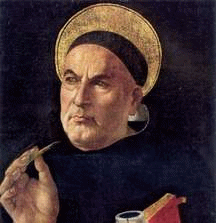
Thomas Aquinas


Saint Thomas Aquinas, O.P.
Dominican Order

The Order of Preachers , after the 15th century more commonly known as the Dominican Order or Dominicans, is a Roman Catholic religious order founded by Saint Dominic in the early 13th century in France....
 (also Thomas of Aquin or Aquino; born ca. 1225; died 7 March 1274) was a priest of the Roman Catholic Church
Roman Catholic Church

The Roman Catholic Church, officially known as the Catholic Church is the world's largest Christianity Ecclesia , representing over half of all Christians and one-sixth of the world population....
 in the Dominican Order from Italy, and an immensely influential philosopher and theologian in the tradition of scholasticism
Scholasticism

Scholasticism was the dominant form of theology and philosophy in the Western Europe in the Middle Ages, particularly in the 12th, 13th, and 14th centuries....
, known as Doctor Angelicus and Doctor Communis. He is frequently referred to as Thomas because "Aquinas" refers to his residence rather than his surname.


Discussion
Ask a question about 'Thomas Aquinas'
Start a new discussion about 'Thomas Aquinas'
Answer questions from other users
Full Discussion Forum


Recent Posts


Quotations


Concerning perfect blessedness which consists in a vision of God.

The Summa Theologica (1273)

Law: an ordinance of reason for the common good, made by him who has care of the community.

The Summa Theologica (1273)

Reason in man is rather like God in the world.

Opuscule II, De Regno

Down in adoration falling,Lo! the sacred Host we hail;Lo! o'er ancient forms departing,Newer rites of grace prevail;Faith for all defects supplying,Where the feeble senses fail.

Pange, Lingua, stanza 5 (Tantum Ergo)

O saving Victim, opening wideThe gate of heaven to man below,Our foes press on from every side,Thine aid supply, Thy strength bestow.

Verbum Supernum Prodiens (hymn for Lauds on Corpus Christi), stanza 5 (O Salutaris Hostia)

Three things are necessary for the salvation of man: to know what he ought to believe; to know what he ought to desire; and to know what he ought to do.

Two Precepts of Charity (1273)


Encyclopedia


Saint Thomas Aquinas, O.P.
Dominican Order

The Order of Preachers , after the 15th century more commonly known as the Dominican Order or Dominicans, is a Roman Catholic religious order founded by Saint Dominic in the early 13th century in France....
 (also Thomas of Aquin or Aquino; born ca. 1225; died 7 March 1274) was a priest of the Roman Catholic Church
Roman Catholic Church

The Roman Catholic Church, officially known as the Catholic Church is the world's largest Christianity Ecclesia , representing over half of all Christians and one-sixth of the world population....
 in the Dominican Order from Italy, and an immensely influential philosopher and theologian in the tradition of scholasticism
Scholasticism

Scholasticism was the dominant form of theology and philosophy in the Western Europe in the Middle Ages, particularly in the 12th, 13th, and 14th centuries....
, known as Doctor Angelicus and Doctor Communis. He is frequently referred to as Thomas because "Aquinas" refers to his residence rather than his surname. He was the foremost classical proponent of natural theology
Natural theology

Natural theology is a branch of theology based on reason and ordinary experience. Thus it is distinguished from revealed theology which is based on scripture and religious experiences of various kinds; and also from transcendental theology, theology from a priori reasoning ....
, and the father of the Thomistic school of philosophy and theology. His influence on Western thought is considerable, and much of modern philosophy was conceived as a reaction against, or as an agreement with, his ideas, particularly in the areas of ethics, natural law and political theory.

Aquinas is held in the Catholic Church to be the model teacher for those studying for the priesthood. The works for which he is best-known are the Summa Theologica
Summa Theologica

The Summa Theologica is the most famous work of Thomas Aquinas although it was never finished. It was intended as a manual for beginners as a compilation of all of the main theology teachings of that time....
 and the Summa Contra Gentiles
Summa contra Gentiles

The Summa contra Gentiles was written by St. Thomas Aquinas between 1258 and 1264. The work has occasioned much debate as to its purpose, its intended audience, and its relationship to his other works....
. One of the 33 Doctors of the Church
Doctor of the Church

Doctor of the Church is a title given by a variety of Christian churches to individuals whom they recognize as having been of particular importance, particularly regarding their additions to theological or doctrinal matters....
, he is considered by many Catholics to be the Church's greatest theologian and philosopher. Aquinas is the patron of The Pontifical and Royal University of Santo Tomas, The Catholic University of the Philippines. Consequently, many institutions of learning have been named after him
Institutions named after Thomas Aquinas

Institutions of learning named after Thomas Aquinas include the following:...
.

Biography


Early life and desire to become a Dominican (1225-1244)

Aquinas was born c. 1225 out of his father Count Landulf's castle of Roccasecca in the Kingdom of Sicily
Kingdom of Sicily

The Kingdom of Sicily was a state that existed in the south of Italy from its founding by Roger II of Sicily in 1130 until 1816. The Kingdom of Sicily covered not only the island of Sicily itself, but also the whole Mezzogiorno region of southern Italy and, until 1530, the islands of Malta and Gozo....
, in the present-day Lazio. Through his mother, Theodora Countess of Theate, Aquinas was related to the Hohenstaufen
Hohenstaufen

The House of Hohenstaufen was a dynasty of List of German Kings and Emperors , many of whom were also crowned Holy Roman Emperor and Duke of Swabia....
 dynasty of Holy Roman emperor
Holy Roman Emperor

Image:HRR 14Jh.jpgThe Roman of the Emperor's title was a reflection of the translatio imperii principle that regarded the Holy Roman Emperors as the inheritors of the title of Emperor of the Western Roman Empire, a title left unclaimed in the West after the death of Julius Nepos in 480....
s. Landulf's brother Sinibald was abbot
Abbot

The word abbot, meaning father, is a title given to the head of a monastery in various traditions, including Christianity. The office may also be given as an honorary title to a clergyman who is not actually the head of a monastery....
 of the original Benedictine
Benedictine

Benedictine refers to the spirituality and consecrated life in accordance with the Rule of St Benedict, written by Benedict of Nursia in the sixth century for the cenobitic communities he founded in central Italy....
 abbey
Abbey

An abbey , is a Christianity monastery or convent, under the government of an Abbot or an Abbess, who serves as the spiritual father or mother of the community....
 at Monte Cassino
Monte Cassino

Monte Cassino is a rocky hill about 130 km southeast of Rome, Italy, c. 2 km to the west of the town of Cassino, Italy and 520 m altitude....
. While the rest of the Aquinas sons pursued a military career, the family intended for Aquinas to follow his uncle into the abbacy; this would have been a normal career path for a younger son of southern Italian nobility.

At the age of five, Aquinas began his early education at Monte Cassino but after the military conflict that broke out between the Emperor Frederick II and Pope Gregory IX
Pope Gregory IX

Pope Gregory IX, born Ugolino di Conti, was pope from March 19, 1227 to August 22, 1241.The successor of Pope Honorius III , he fully inherited the traditions of Pope Gregory VII and of his uncle Pope Innocent III , and zealously continued their policy of Papal supremacy....
 spilled into the abbey in early 1239, Landulf and Theodora had Aquinas enrolled at the studium generale (university) recently established by Frederick in Naples
Naples

Naples is a city in southern Italy, the capital of the region of Campania and of the province of Naples. The city is known for its rich history, art, culture and gastronomy, playing an important role throughout much of its existence; it is over 2,800 years old....
. It was here that Aquinas was probably introduced to Aristotle, Averroes and Maimonides, all of whom would influence his theological philosophy. It was also during his study at Naples that Aquinas came under the influence of John of St. Julian, a Dominican preacher in Naples, who was part of the active effort by the Dominican order to recruit devout followers. Here his teacher in arithmetic, geometry, astronomy, and music was Petrus de Ibernia
Petrus de Ibernia

Petrus de Ibernia, also known as Peter of Ireland, writer and lecturer, fl. 1224–1252Peter lectured in natural philosophy at the University of Naples during Thomas Aquinas's term of attendance ....
.

Aquinas' change of heart did not please his family. In an attempt to prevent interference by Theodora in Aquinas' choice, the Dominicans arranged for Aquinas to be removed to Rome, and from Rome, sent to Paris
Paris

Paris is the Capital of France and the country's largest city. It is situated on the river Seine, in northern France, at the heart of the ?le-de-France Regions of France ....
. On his way to Rome, his brothers, per Theodora's instructions, seized him as he was drinking from a spring and took him back to his parents at the castle of Monte San Giovanni Campano
Monte San Giovanni Campano

Monte San Giovanni Campano is a comune of c. 12,800 inhabitants in the province of Frosinone in the Italy region Lazio, located about 90 km southeast of Rome and about 14 km east of Frosinone....
. He was held for two years in the family homes at Monte San Giovanni and Rocasecca in an attempt to prevent him from assuming the Dominican habit and to push him into renouncing his new aspiration. Political concerns prevented the Pope from ordering Aquinas' release, extending the detention, a detention which Aquinas spent tutoring his sisters and communicating with members of the Dominican Order. Family members became desperate to dissuade Aquinas, who remained determined to join the Dominicans. At one point, two of his brothers hired a prostitute to seduce him, but he drove her away, wielding a burning stick. According to legend, that night two angels appeared to him as he slept and strengthened his determination to remain celibate. By 1244, seeing that all of her attempts to dissuade Aquinas had failed, Theodora sought to save face, arranging for Aquinas to escape at night through his window. In her mind, a secret escape from detention was less damaging than an open surrender to the Dominicans. Aquinas was sent first to Naples and then to Rome to meet Johannes von Wildeshausen
Johannes von Wildeshausen

Johannes von Wildeshausen was the fourth master general of the Dominican order.He joined the Dominican Order in Bologna. From 1224 he accompanied the papal legates in Germany....
, the Master General of the Dominican Order.

Paris, Cologne, Albert Magnus, and First Paris Regency (1245-1259)


In 1245, Aquinas was sent to study at the University of Paris' Faculty of Arts where he most likely met Dominican scholar Albertus Magnus
Albertus Magnus

Saint Albertus Magnus, Ordo Praedicatorum , also known as Saint Albert the Great and Albert of Cologne, was a Dominican Order Dominican friar and bishop who achieved fame for his comprehensive knowledge of and advocacy for the peaceful Relationship between religion and science....
, then the Chair of Theology at the College of St. James in Paris. When Albertus was sent by his superiors to teach at the a new studium generale at Cologne in 1248, Aquinas followed him, declining Pope Innocent IV
Pope Innocent IV

Pope Innocent IV, born Sinibaldo Fieschi, was pope from June 28, 1243, to December 7, 1254....
's offer to appoint him abbot of Monte Cassino as a Dominican. Albertus then appointed the reluctant Aquinas magister studentium. After failing in his first theological disputation, Albertus prophetically exclaimed: "We call him the dumb ox, but in his teaching he will one day produce such a bellowing that it will be heard throughout the world."

Aquinas taught in Cologne as an apprentice professor (baccalaureus biblicus), instructing students on the books of the Old Testament and writing Expositio super Isaiam ad litteram (Literal Commentary on Isaiah), Postilla super Ieremiam (Commentary on Jeremiah) and Postilla super Threnos (Commentary on Lamentations). Then in 1252 he returned to Paris to study for the master's degree in theology. He lectured on the Bible as an apprentice professor, and upon becoming a baccalaureus Sententiarum (bachelor of the Sentences) devoted his final three years of study to commenting on Peter Lombard's Sentences. In the first of his four theological syntheses, Aquinas composed a massive commentary on the Sentences entitled Scriptum super libros Sententiarium (Commentary on the Sentences). Aside from his masters writings, he wrote De ente et essentia (On Being and Essence) for his fellow Dominicans in Paris.

In spring of 1256, Aquinas was appointed regent master in theology at Paris and one of his first works upon assuming this office was Contra impugnantes Dei cultum et religionem (Against Those Who Assail the Worship of God and Religion), defending the mendicant orders which had come under attack by William of Saint-Amour
William of Saint-Amour

William of Saint-Amour was a minor figure in thirteenth-century scholasticism, chiefly notable for his withering attacks on the friars....
. During his tenure from 1256 to 1259, Aquinas wrote numerous works, including: Questiones disputatae de veritate (Disputed Questions on Truth), a collection of twenty-nine disputed questions on aspects of faith and the human condition prepared for the public university debates he presided over on Lent
Lent

Lent, in Christianity, is the period of the liturgical year leading up to Easter. Conventionally it is described as being forty days long, though different Christian denominations calculate the forty days differently....
 and Advent
Advent

Advent is a Liturgical year of the Christianity, the period of expectant waiting and preparation for the celebration of the Nativity of Jesus; in other words, the period immediately before Christmas....
; Quaestiones quodlibetales (Quodlibetal Questions), a collection of his responses to questions posed to him by the academic audience; and both Expositio super librum Boethii De trinitate (Commentary on Boethius's De trinitate) and Expositio super librum Boethii De hebdomadibus (Commentary on Boethius's De hebdomadibus), commentaries on the works of 6th century philosopher Anicius Manlius Severinus Boethius
Anicius Manlius Severinus Boethius

Anicius Manlius Severinus Bo?thius was a Christian or pagan philosopher of the 6th century. He was born in Rome to an ancient and important family which included emperors Petronius Maximus and Olybrius and many Roman consul....
. By the end of his regency, Aquinas was working on one of his most famous works, Summa contra Gentiles.

Naples, Orvieto, Rome, and Santa Sabina (1259-1269)

Around 1259, Aquinas returned to Naples where he lived until he arrived in Orvieto
Orvieto

Orvieto is a city in southwestern Umbria, Italy situated on the flat summit of a large butte of volcanic tuff. The site of the city is among the most dramatic in Europe, rising above the almost-vertical faces of tuff cliffs that are completed by defensive walls built of the same stone....
 around September 1261. In Orvieto, he was appointed conventual lector, in charge of the education of friars unable to attend a studium generale
Studium Generale

Studium Generale is the old name for a medieval university which was registered as an institution of international excellence by the Holy Roman Empire....
. During his stay in Orvieto, Aquinas completed his Summa contra Gentiles, and wrote the Catena Aurea (The Golden Chain). He also wrote the liturgy for the newly created feast of Corpus Christi and produced works for Pope Urban IV
Pope Urban IV

Pope Urban IV , born Jacques Pantal?on, was Pope, from 1261 to 1264. He was not a Cardinal , and there have been several Popes since him who have not been Cardinals, including Urban V and Urban VI....
 concerning Greek Orthodox theology, e.g. Contra errores graecorum. In 1265 he was ordered by the Dominicans to establish a studium for the Order in Rome at the priory of Santa Sabina
Santa Sabina

The Basilica of Saint Sabina at the Aventine is a titular minor basilica and mother church of the Roman Catholic Dominican order in Rome, Italy....
, which he did from 1265 until he was called back to Paris in 1268. It was in Rome that Aquinas began his most famous work, Summa Theologica, and wrote a variety of other works like his unfinished Compendium Theologiae and Responsio ad fr. Ioannem Vercellensem de articulis 108 sumptis ex opere Petri de Tarentasia (Reply to Brother John of Vercelli Regarding 108 Articles Drawn from the Work of Peter of Tarentaise). In his position as head of the studium, conducted a series of important disputations on the power of God, which he compiled into his De potentia.

The Quarrelsome Second Paris Regency (1269-1272)


In 1268 the Dominican Order assigned Aquinas to be regent master at the University of Paris for a second time, a position he held until the spring of 1272. Part of the reason for this sudden reassignment appears to have arisen from the rise of "Averroism
Averroism

Averroism is the term applied to either of two philosophy trends among scholasticism in the late 13th century, the first of which was based on the Early Islamic philosophy Averroes's interpretations of Aristotle and his reconciliation of Aristotelianism with the Islamic faith....
" or "radical Aristotelianism
Aristotelianism

Aristotelianism is a Tradition#Philosophical tradition of philosophy that takes its defining inspiration from the work of Aristotle. Sometimes contrasted by critics with the rationalism and Platonic idealism of Plato, Aristotelianism is understood by its proponents as critically developing Plato?s theories....
" in the universities. In response to these perceived evils, Aquinas wrote two works, one of them being De unitate intellectus, contra Averroistas (On the Unicity of Intellect, against the Averroists) in which he blasts Averroism as incompatible with Christian doctrine. During his second regency, he finished the second part of the Summa and wrote De virtutibus and De aeternitati mundi, the latter of which dealt with controversial Averroist and Aristotelian beginninglessness of the universe.

Disputes with some important Franciscans such as Bonaventure
Bonaventure

Saint Bonaventure of Bagnoregio , born John of Fidanza , was an Italian medieval Scholasticism theologian and philosopher, the eighth Minister General of the Order of Friars Minor, commonly called the Franciscans....
 and John Peckham
John Peckham

John Peckham or Pecham , was Archbishop of Canterbury in the years 1279–1292. He was a native of Sussex who was educated at Lewes Priory and became a Franciscan friar about 1250....
 conspired to make his second regency much more difficult and troubled than the first. A year before Aquinas re-assumed the regency at the 1266-67 Paris disputations, Franciscan master William of Baglione accused Aquinas of encouraging Averroists, calling him the "blind leader of the blind". Aquinas called these individuals the murmurantes (Grumblers). In reality, Aquinas was deeply disturbed by the spread of Averroism and was angered when he discovered Siger of Brabant
Siger of Brabant

Siger of Brabant was a 13th century philosopher from the southern Low Countries who was an important proponent of Averroism. He was considered a radical by the conservative members of the Roman Catholic Church, but it is suggested that he played as important a role as his contemporary Thomas Aquinas in the shaping of Western attitudes toward...
 teaching Averroistic interpretations of Aristotle to Parisian students.

On 10 December 1270, the bishop of Paris, Etienne Tempier
Étienne Tempier

?tienne Tempier was a France bishop of Paris during the thirteenth century. He is best remembered for promulgating a Condemnations of 219 philosophical and theological propositions that addressed ideas and concepts that were being discussed and disputed in the faculty of Arts at the University of Paris....
, issued an edict condemning thirteen Aristotlelian and Averroistic propositions as heretical and excommunicating anyone who continued to support them. Many in the ecclesiastical community, the so-called Augustinians, were fearful that this introduction of Aristotelianism and the more extreme Averroism might somehow contaminate the purity of the Christian faith. In what appears to be an attempt to counteract the growing fear of Aristotelian thought, Aquinas conducted a series of disputations between 1270 and 1272: De virtutibus in communi (On Virtues in General), De virtutibus cardinalibus (On Cardinal Virtues) De spe (On Hope).

Final days and "Straw" (1272-1274)


In 1272 Aquinas took leave from the University of Paris when the Dominicans from his home province called upon him to establish a studium generale wherever he liked and staff it as he pleased. He chose to establish the institution in Naples, and moved there to take his post as regent master. He took his time at Naples to work on the third part of the Summa while giving lectures on various religious topics. On 6 December 1273 Aquinas was celebrating the Mass of St Nicholas when he unexpectedly abandoned his routine and refused to dictate to his socius Reginald of Piperno
Reginald of Piperno

Reginald of Piperno was an Italian Dominican Order, theologian and companion of St. Thomas Aquinas....
. When Reginald begged him to get back to work, Aquinas replied: "Reginald, I cannot, because all that I have written seems like straw to me." (mihi videtur ut palea). What exactly triggered Aquinas's experience is not known. Some have posited that he suffered a stroke, while others point to a physical or nervous breakdown. Some think it was a combination of all three—a complete collapse. After taking to his bed, he did recover some strength.

Looking to find a way to reunite the Eastern and Western churches, Pope Gregory X
Pope Gregory X

Pope Gregory X , born Tebaldo Visconti, was Pope from 1271 to 1276. He was elected by the papal election, 1268?1271, the longest papal election in the history of the Roman Catholic Church....
 convened the Second Council of Lyons to be held on 1 May 1274 and summoned Aquinas to attend. At the meeting, Aquinas' work for Pope Urban IV concerning the Greeks, Contra errores graecorum, was to be presented. On his way to the Council, riding on a donkey along the Appian Way
Appian Way

The Appian Way was one of the earliest and strategically most important Roman roads of the ancient Roman Republic. It connected Rome to Brindisi, Apulia, in southeast Italy....
, he struck his head on the branch of a fallen tree and became seriously ill again. He was then quickly escorted to Monte Cassino to convalesce. After resting for a while, he set out again, but stopped at the Cistercian Fossanova Abbey
Fossanova Abbey

Fossanova Abbey, earlier Fossa Nuova, is a Cistercian monastery in Italy, in the province of Rome, near the railway-station of Priverno, c....
 after again falling ill. The monks nursed him for several days, and as he received his last rites he prayed: "I receive Thee, ransom of my soul. For love of Thee have I studied and kept vigil, toiled, preached and taught..." He died on 7 March 1274 while giving commentary on the Song of Songs
Song of songs

Song of Songs is a book of the Hebrew Bible or Old Testament. It may also refer to:In music:*Song of songs , the debut album by David and the Giants...
.

Condemnation of 1277 and Subsequent Canonization


In 1277, the same bishop of France, Etienne Tempier, who had issued the condemnation of 1270 issued another, more extensive condemnation. This new condemnation was aimed to clarify that God's absolute power transcended any principles of logic that Aristotle or Averroes might place on it. More specifically, it contained a list of 219 propositions that the bishop had determined to violate the omnipotence of God, and included in this list were twenty Thomistic propositions. Their inclusion badly damaged Aquinas' reputation for many years.

In The Divine Comedy
The Divine Comedy

The Divine Comedy , written by Dante Alighieri between 1308 and his death in 1321, is widely considered the central epic poem of Italian literature, and is seen as one of the greatest works of world literature....
, Dante
DANTE

DANTE is a not-for-profit organisation that plans, builds and operates the international networks that interconnect the various National Research and Education Networks in Europe and surrounding regions....
 sees the glorified spirit of Aquinas in the Heaven of the Sun with the other great exemplars of religious wisdom. Dante also asserts that Aquinas died by poisoning, on the order of Charles of Anjou Villani (ix. 218) cites this belief, and the Anonimo Fiorentino describes the crime and its motive. But the historian Ludovico Antonio Muratori
Ludovico Antonio Muratori

Ludovico Antonio Muratori was an Italy historian, notable as a leading scholar of his age, and for his discovery of the Muratorian fragment, the earliest known list of New Testament books....
 reproduces the account made by one of Aquinas' friends, and this version of the story gives no hint of foul play.

Fifty years after the death of Aquinas, Pope John XXII
Pope John XXII

Pope John XXII , born Jacques Du?ze , was pope from 1316 to 1334. He was the second Pope of the Avignon Papacy , elected by a Papal conclave in Lyon assembled by Philip V of France....
, seated in Avignon
Avignon

Avignon is a Communes of France in the Vaucluse Departments of France in southeastern France with an estimated mid-2004 population of 89,300 in the city itself and a population of 290,466 in the aire urbaine at the 1999 census....
, pronounced Thomas a saint
Saint

A saint in Christianity is a human being who has been called to holiness. The term is used differently by various denominations, with some, such as the Anglicans, Methodists, and Lutherans distinguishing between Saints and saints....
. Aquinas' theology had begun its rise to prestige. Two centuries later, in 1567, Pope Pius V
Pope Pius V

Pope Saint Pius V , born Antonio Ghislieri was Pope from 1566 to 1572 and is a saint of the Roman Catholic Church. He is chiefly notable for his role in the implementation of the Council of Trent, the Counterreformation and the standardisation of the liturgy....
 ranked the festival of St. Thomas Aquinas with those of the four great Latin fathers: Ambrose
Ambrose

Saint Ambrose was a Roman Catholic Archdiocese of Milan who became one of the most influential ecclesiastical figures of the fourth century. He is counted as one of the four original doctors of the Church....
, Augustine of Hippo, Jerome
Jerome

Saint Jerome was a Christian priest and Christian apologetics best known for translating the Vulgate. He is recognized by the Catholic Church as a canonized saint and Doctor of the Church, and his version of the Bible is still an important text in Catholicism....
, and Gregory
Gregory

Gregory is a common masculine first name and family name. It is derived from the Latin "Gregorius," which was from the late Greek language name "G????????" , which was derived from "???????" meaning "watchful, alert"....
. However, in the same period the Council of Trent
Council of Trent

The Council of Trent was the 16th century Ecumenical Council of the Roman Catholic Church. Considered one of the Church's most important councils, it convened in Trento between December 13, 1545, and December 4, 1563 in twenty-five sessions for three periods....
 would still turn to Duns Scotus
Duns Scotus

The Beatification John Duns Scotus, Order of Friars Minor was one of the most important theology and philosopher of the High Middle Ages. He was nicknamed Doctor Subtilis for his penetrating and subtle manner of thought....
 before Thomas, as a source of arguments in defence of the Church. Even though Duns Scotus was consulted at the Council of Trent, Aquinas still maintained the honor of having his Summa Theologica placed on the altar alongside the Bible
Bible

The Bible is the central religious text of Judaism and Christianity. The exact Books of the Bible is dependent on the religious traditions of specific denominations....
 and the Decretals. It was not until the First Vatican Council
First Vatican Council

The First Vatican Council was convoked by Pope Pius IX on 29 June 1868, after a period of planning and preparation that began on 6 December 1864....
 that Thomas was elevated to the preeminent status of "teacher of the church".

In his encyclical
Encyclical

An encyclical was originally a Flyer letter sent to all the churches of a particular area in the ancient Christian church. At that time, the word could be used for a letter sent out by any bishop....
 of 4 August 1879, Pope Leo XIII
Pope Leo XIII

Pope Leo XIII , born Count Vincenzo Gioacchino Raffaele Luigi Pecci, was the 256th Pope of the Roman Catholic Church, reigning from 1878 to 1903, succeeding Pope Pius IX....
 stated that Aquinas' theology was a definitive exposition of Catholic doctrine. Thus, he directed the clergy to take the teachings of Aquinas as the basis of their theological positions. Leo XIII also decreed that all Catholic seminaries and universities must teach Aquinas' doctrines, and where Aquinas did not speak on a topic, the teachers were "urged to teach conclusions that were reconcilable with his thinking." In 1880, Aquinas was declared patron of all Catholic educational establishments.

In a monastery at Naples, near the cathedral of St. Januarius, a cell in which he supposedly lived is still shown to visitors. His remains were placed in the Church of the Jacobins in Toulouse
Toulouse

Toulouse is a commune of France in southwest France on the banks of the Garonne, half-way between the Atlantic Ocean and the Mediterranean Sea....
 in 1369. Between 1789 and 1974, they were held in Basilique de Saint-Sernin, Toulouse. In 1974, they were returned to the Church of the Jacobins, where they have remained ever since.

In the Roman Catholic Church, Aquinas has two feast days. In the Roman Catholic calendar of saints
Roman Catholic calendar of saints

The General Roman Calendar indicates the days of the year to which are assigned the liturgical celebrations of Saint and of the mysteries of the Jesus Christ that are to be observed wherever the Roman Rite is used....
, he is remembered with a memorial on 28 January, the date of the translation of his relics to Toulouse. The General Roman Calendar of 1962
General Roman Calendar of 1962

This article lists the feast days of the General Roman Calendar as it was in 1962, following the reforms of Pope John XXIII introduced with his motu proprio of 23 July 1960....
 commemorates Aquinas on 7 March, his day of death.

Philosophy

"Nihil est in intellectu quod non fuerit prius in sensu." (Nothing is in the intellect that was not first in the senses) — Aquinas's peripatetic axiom
Peripatetic axiom

The Peripatetic axiom is: "Nothing is in the intellect that was not first in the senses" . It is found in De veritate, q. 2 a. 3 arg. 19....


The philosophy of Aquinas has exerted enormous influence on subsequent Christian theology, especially that of the Roman Catholic Church, extending to Western philosophy in general, where he stands as a vehicle and modifier of Aristotelianism, which he fused with the thought of Augustine. Philosophically, his most important and enduring work is the Summa Theologica, in which he expounds his systematic theology of the quinquae viae
Quinquae viae

The Quinque viae, Five Ways, or Five Proofs are five Logical argument for the existence of God summarized by the 13th century Roman Catholic theologian St....
.

Epistemology

Aquinas believed "that for the knowledge of any truth whatsoever man needs divine help, that the intellect may be moved by God to its act." However, he believed that human beings have the natural capacity to know many things without special divine revelation, even though such revelation occurs from time to time, "especially in regard to [topics of] faith." Aquinas was also an Aristotelian and an empiricist. He substantially influenced these two streams of Western thought.

Revelation
Aquinas believed that truth is known through reason (natural revelation) and faith (supernatural revelation). Supernatural revelation has its origin in the inspiration of the Holy Spirit and is made available through the teaching of the prophets, summed up in Holy Scripture, and transmitted by the Magisterium
Magisterium

Magisterium is a "teaching authority, of the Roman Catholic Church". The word is derived from Latin magisterium, which originally meant the office of a president, chief, director, superintendent, etc....
, the sum of which is called "Tradition". Natural revelation is the truth available to all people through their human nature; certain truths all men can attain from correct human reasoning. For example, he felt this applied to rational proofs for the existence of God.

Though one may deduce the existence of God and his Attributes (One, Truth, Good, Power, Knowledge) through reason, certain specifics may be known only through special revelation (such as the Trinity). In Aquinas' view, special revelation is equivalent to the revelation of God in Jesus Christ. The major theological components of Christianity
Christianity

Christianity is a Monotheistic religion #Christian view religion centered on the life and teachings of Jesus as New Testament view on Jesus' life....
, such as the Trinity
Trinity

In Christianity doctrine, the Trinity is the unity of God the Father, God the Son, and Holy Spirit as three persons in monotheism. The doctrine states that God is the Triune God, existing as three persons, or in the Greek hypostasis , but one being....
 and the Incarnation
Incarnation

Incarnation which literally means embodied in flesh, refers to the Conception and birth of a Sentience creature who is the material manifestation of an entity or force whose original nature is immaterial....
, are revealed in the teachings of the Church and the Scriptures and may not otherwise be deduced.

Supernatural revelation (faith) and natural revelation (reason) are complementary rather than contradictory in nature, for they pertain to the same unity: truth.

Analogy
An important element in Aquinas's philosophy is his theory of analogy
Analogy

Analogy is both the cognition process of transferring information from a particular subject to another particular subject , and a language expression corresponding to such a process....
. Aquinas noted three forms of descriptive language: univocal, analogical, and equivocal.
  • Univocality is the use of a descriptor in the same sense when applied to two objects or groups of objects. For instance, when the word "milk
    Milk

    Milk is an opaque white liquid produced by the mammary glands of female mammals . It provides the primary source of nutrition for newborn mammals before they are able to digestion other types of food....
    " is applied both to milk produced by cows
    Cattle

    Cattle, colloquially referred to as cows, are domestication ungulates, a member of the subfamily Bovinae of the family Bovidae. They are raised as livestock for meat , dairy products , leather and as draft animals ....
     and by any other female mammal
    Mammal

    Mammals are a class of vertebrate animals whose name is derived from their distinctive feature, mammary glands, with which they feed their young....
    .
  • Analogy, Aquinas maintained, occurs when a descriptor changes some but not all of its meaning. For example, the word "healthy" is analogical in that it applies both to a healthy person or animal (those that enjoy of good health) and to some food or drink (if it is good for the health). Analogy is necessary when talking about God, for some of the aspects of the divine nature are hidden (Deus absconditus) and others revealed (Deus revelatus) to finite human minds. In Aquinas's mind, we can know about God through his creation (general revelation), but only in an analogous manner. We can speak of God's goodness only by understanding that goodness as applied to humans is similar to, but not identical with, the goodness of God.
  • Equivocation is the complete change in meaning of the descriptor and is an informal fallacy
    Informal fallacy

    An informal fallacy is an Logical argument whose stated premises fail to support their proposed conclusion. The deviation in an informal fallacy often stems from a flaw in the path of reasoning that links the premises to the conclusion....
    . For example, when the word "bank" is applied to river banks and financial banks. Modern philosophers talk of ambiguity
    Ambiguity

    Ambiguity is the property of being ambiguous, where a word, term, notation, sign, symbol, phrase, Sentence , or any other form used for communication, is called ambiguous if it can be interpreted in more than one way....
    .


Ethics

Aquinas's ethics are based on the concept of "first principles of action." In his Summa Theologica
Summa Theologica

The Summa Theologica is the most famous work of Thomas Aquinas although it was never finished. It was intended as a manual for beginners as a compilation of all of the main theology teachings of that time....
, he wrote:

Aquinas defined the four cardinal virtues
Cardinal virtues

In some Christian traditions, there are four cardinal virtues:*Prudence - able to judge between actions with regard to appropriate actions at a given time...
 as prudence
Prudence

Prudence is the exercise of sound judgment in practical affairs. It is classically considered to be a virtue, and in particular one of the four Cardinal virtues ....
, temperance
Temperance (virtue)

Temperance is the practice of moderation. It was one of the four "cardinal" virtues held to be vital to society in Ancient Greece culture. It is one of the Four Cardinal Virtues considered central to Christian behaviour by the Catholic Church and is an important tenet of the moral codes of other world religions—for example, it is...
, justice
Justice

Justice is the concept of morality rightness based on ethics, rationality, law, natural law, fairness and equity."...
, and fortitude. The cardinal virtues are natural and revealed in nature, and they are binding on everyone. There are, however, three theological virtues
Theological virtues

In Christian philosophy, theological virtues are the character qualities associated with salvation. The three theological virtues are:*Faith in Christianity - steadfastness in belief...
: faith
Faith

Faith is the confident belief in the truth of or trustworthiness of a person, idea, or thing. It is also used for a belief, characteristically without proof....
, hope
Hope

Hope is a belief in a positive outcome related to events and circumstances in one's life. Hope is the feeling that what is wanted can be had or that events will turn out for the best....
, and charity
Charity (virtue)

In Christian theology charity, or Love #Christian , means an unlimited loving-kindness toward all others.The term should not be confused with the more restricted modern use of the word charity to mean benevolent giving....
. These are supernatural and are distinct from other virtues in their object, namely, God:

Furthermore, Aquinas distinguished four kinds of law: eternal, natural, human, and divine. Eternal law is the decree of God that governs all creation. Natural law
Natural law

Natural law or the law of nature is a theory that posits the existence of a law whose content is set by nature and that therefore has validity everywhere....
 is the human "participation" in the eternal law and is discovered by reason. Natural law, of course, is based on "first principles":

The desires to live and to procreate are counted by Aquinas among those basic (natural) human values on which all human values are based.

Human law is positive law
Positive law

Positive law is a legal term that is sometimes understood to have more than one meaning. But in the strictest sense, it is law made by human beings, that is, "Law actually and specifically enacted or adopted by proper authority for the government of an organized jural society." This term is also sometimes used to refer to the legal philosophy...
: the natural law applied by governments to societies. Divine law is the specially revealed law in the scriptures.

Aquinas also greatly influenced Catholic understandings of mortal
Mortal sin

Mortal sin, according to the beliefs of Roman Catholicism, and some Protestant denominations, is a sin that, unless confessed and absolved , condemns a person's soul to Hell after death....
 and venial sin
Venial sin

According to Roman Catholicism, a venial sin is a lesser sin that does not result in a complete separation from God and eternal damnation in Hell....
s.

Aquinas denied that human beings have any duty of charity to animals because they are not persons. Otherwise, it would be unlawful to use them for food. But this does not give us license to be cruel to them, for "cruel habits might carry over into our treatment of human beings."

Theology

Aquinas viewed theology
Theology

Theology is the study of the existence or attributes of a deity or gods, or more generally the study of religion or spirituality. It is sometimes contrasted with religious studies: theology is understood as the study of religion from an internal perspective , and religious studies as the study of religion from an external perspective....
, or the sacred
SACRED

SACRED was a Cubesat built by the Student Satellite Program of the University of Arizona. It was the product of the work of about 50 students, ranging from college freshmen to Ph....
 doctrine
Doctrine

Doctrine is a codification of beliefs or "a body of teachers" or "instructions", taught principles or positions, as the body of teachings in a branch of knowledge or belief system....
, as a science, the raw material data of which consists of written scripture
Sacred Tradition

Sacred Tradition or Holy Tradition is a technical theological term used in some Christian traditions, primarily in the Roman Catholic and Eastern Orthodox and Oriental Orthodox traditions, to refer to the fundamental basis of church authority....
 and the tradition
Tradition

The word tradition comes from the Latin traditionem, acc. of traditio which means "handing over, passing on", and is used in a number of ways in the English language:...
 of the Catholic Church. These sources of data were produced by the self-revelation of God to individuals and groups of people throughout history. Faith and reason, while distinct but related, are the two primary tools for processing the data of theology. Aquinas believed both were necessary - or, rather, that the confluence of both was necessary - for one to obtain true knowledge of God. Aquinas blended Greek philosophy and Christian doctrine by suggesting that rational thinking and the study of nature, like revelation, were valid ways to understand God. According to Aquinas, God reveals himself through nature, so to study nature is to study God. The ultimate goals of theology, in Aquinas’ mind, are to use reason to grasp the truth about God and to experience salvation through that truth.

Nature of God

Aquinas believed that the existence of God
Existence of God

Arguments for and against the existence of God have been proposed by scientists, philosophers, theologians, and others. In Philosophy terminology, "existence-of-God" arguments concern schools of thought on the epistemology of the ontology of God....
 is neither obvious nor unprovable. In the Summa Theologica
Summa Theologica

The Summa Theologica is the most famous work of Thomas Aquinas although it was never finished. It was intended as a manual for beginners as a compilation of all of the main theology teachings of that time....
, he considered in great detail five reasons for the existence of God. These are widely known as the quinquae viae
Quinquae viae

The Quinque viae, Five Ways, or Five Proofs are five Logical argument for the existence of God summarized by the 13th century Roman Catholic theologian St....
, or the "Five Ways."

Concerning the nature of God, Aquinas felt the best approach, commonly called the via negativa
Negative theology

Negative theology?also known as the Via Negativa and Apophatic theology?is a theology that attempts to describe God, the Divine Good, by negation, to speak only in terms of what may not be said about the perfect goodness that is God....
, is to consider what God is not. This led him to propose five statements about the divine qualities:
  1. God is simple, without composition of parts, such as body and soul, or matter and form.
  2. God is perfect, lacking nothing. That is, God is distinguished from other beings on account of God's complete actuality.
  3. God is infinite. That is, God is not finite in the ways that created beings are physically, intellectually, and emotionally limited. This infinity is to be distinguished from infinity of size and infinity of number.
  4. God is immutable, incapable of change on the levels of God's essence and character.
  5. God is one, without diversification within God's self. The unity of God is such that God's essence is the same as God's existence. In Aquinas's words, "in itself the proposition 'God exists' is necessarily true, for in it subject and predicate are the same."


In this approach, he is following, among others, the Jewish philosopher Maimonides
Maimonides

Moses Maimonides, also known as Rabbi Moses ben Maimon , the Rambam, and Musa ibn Maymun , was born in C?rdoba, Spain, Spain on March 30, 1135, and died in Egypt on December 13, 1204.....
.

Nature of the Trinity

Aquinas argued that God, while perfectly united, also is perfectly described by Three Interrelated Persons
Trinity

In Christianity doctrine, the Trinity is the unity of God the Father, God the Son, and Holy Spirit as three persons in monotheism. The doctrine states that God is the Triune God, existing as three persons, or in the Greek hypostasis , but one being....
. These three persons (Father, Son, and Holy Spirit) are constituted by their relations within the essence of God. The Father generates the Son (or the Word) by the relation of self-awareness. This eternal generation then produces an eternal Spirit "who enjoys the divine nature as the Love of God, the Love of the Father for the Word."

This Trinity exists independently from the world. It transcends the created world, but the Trinity also decided to communicate God's self and God's goodness to human beings. This takes place through the Incarnation
Incarnation (Christianity)

The Incarnation is the belief in Christianity that Jesus Christ is God in human body. The word Incarnate derives from Latin meaning "in the flesh." The incarnation is a fundamental theological teaching of Nicene Creed, based on its understanding of the New Testament....
 of the Word in the person of Jesus Christ and through the indwelling of the Holy Spirit
Holy Spirit

In Christianity, the Holy Ghost or Holy Spirit is the spirit of God. The term Christ , is also used to refer to this presence. That is, the Spirit is considered to act in concert with and share an essential nature with God the Father and God the Son ....
 (indeed, the very essence of the Trinity itself) within those who have experienced salvation
Salvation

In religion, salvation is the concept that God saves humanity from death. As commonly conceived, He has both Will of God and omnipotence to realize human salvation....
 by God.

Nature of Jesus Christ

In the Summa Theologica
Summa Theologica

The Summa Theologica is the most famous work of Thomas Aquinas although it was never finished. It was intended as a manual for beginners as a compilation of all of the main theology teachings of that time....
, Aquinas begins his discussion of Jesus Christ by recounting the biblical story of Adam and Eve
Adam and Eve

Adam and Eve are the First man or woman created by God in the Hebrew creation story told in Genesis 1-2....
 and by describing the negative effects of original sin
Original sin

Original sin is, according to a doctrine in Christian theology, humanity's state of sin resulting from the Fall of Man. While the Old Testament and the New Testament, which frequently speak of the sinfulness of humans, do not contain the terms "original sin" or "ancestral sin", the doctrine expressed by these terms is claimed to be based on t...
. The purpose of Christ's Incarnation was to restore human nature by removing "the contamination of sin", which humans cannot do by themselves. "Divine Wisdom judged it fitting that God should become man, so that thus one and the same person would be able both to restore man and to offer satisfaction."

Aquinas argued against several specific contemporary and historical theologians who held differing views about Christ. In response to Photinus
Photinus

Photinus was the Christian bishop of Sirmium in Pannonia, a residence of the Emperor Constantius II. He was deposed on charges of heresy but his exact beliefs are unclear....
, Aquinas stated that Jesus was truly divine and not simply a human being. Against Nestorius
Nestorius

Nestorius was Patriarch of Constantinople from 10 April 428 to 22 June 431. He was accused by his political enemy Cyril of Alexandria of a heresy that later bore his name, Nestorianism, because he objected to the popular practice of calling the Virgin Mary the "Mother of God" theotokos; he instead preached that "Mother of Christ" would be m...
, who suggested that Son of God was merely conjoined to the man Christ, Aquinas argued that the fullness of God was an integral part of Christ's existence. However, countering Apollinaris
Apollinaris

Apollinaris is a Latin adjective which refers tothe Greece and Roman god Apollo, as in:*Legio XV Apollinaris, a Roman legion*Apollinaris , an effervescent mineral water....
' views, Aquinas held that Christ had a truly human (rational) soul
Soul

In many religions and parts of philosophy, the soul is the immaterial part of a person. It is usually thought to consist of one's thoughts and Personality psychology, and can be synonymous with the spirit, mind or self....
, as well. This produced a duality of natures in Christ. Aquinas argued against Eutyches
Eutyches

Eutyches was a presbyter and archimandrite at Constantinople. He first came to notice in 431 at the council of Ephesus, for his vehement opposition to the teachings of Nestorius; his condemnation of Nestorianism as heresy precipitated his being denounced as a heretic himself....
 that this duality persisted after the Incarnation. Aquinas stated that these two natures existed simultaneously yet distinguishably in one real human body, unlike the teachings of Manichaeus and Valentinus
Valentinus

Valentinus is a Roman masculine given name. It is derived from the Latin word "valens" meaning "healthy, strong". Valentinus may refer to:*Pope Valentine, pope for thirty or forty days in 827...
.

In short, "Christ had a real body of the same nature of ours, a true rational soul, and, together with these, perfect Deity." Thus, there is both unity (in his one hypostasis
Hypostasis

Hypostasis may refer to:* Hypostatic abstraction* Hypostasis , personification of entities* Hypostasis , an Australian-based not-for-profit organization...
) and diversity (in his two natures, human and Divine) in Christ.

Goal of human life

In Aquinas's thought, the goal of human existence is union and eternal fellowship with God. Specifically, this goal is achieved through the beatific vision
Beatific vision

In Christian theology, the beatific vision is the eternal and direct perception of God enjoyed by those who are in Heaven, imparting supreme happiness or blessedness....
, an event in which a person experiences perfect, unending happiness by seeing the very essence of God. This vision, which occurs after death, is a gift from God given to those who have experienced salvation and redemption through Christ while living on earth.

This ultimate goal carries implications for one's present life on earth. Aquinas stated that an individual's will
Free will

The question of free will is whether, and in what sense, rational agents exercise control over their actions and decisions. Addressing this question requires understanding the relationship between freedom and Causality, and determining whether the laws of nature are causally deterministic....
 must be ordered toward right things, such as charity, peace, and holiness. He sees this as the way to happiness. Aquinas orders his treatment of the moral life around the idea of happiness. The relationship between will and goal is antecedent in nature "because rectitude of the will consists in being duly ordered to the last end [that is, the beatific vision]." Those who truly seek to understand and see God will necessarily love what God loves. Such love requires morality and bears fruit in everyday human choices.

Modern influence


Many modern ethicists both within and outside the Catholic Church (notably Philippa Foot
Philippa Foot

Philippa Ruth Foot is a United Kingdom Philosophy, most notable for her works in ethics. She is one of the founders of contemporary virtue ethics....
 and Alasdair MacIntyre
Alasdair MacIntyre

Alasdair Chalmers MacIntyre is a philosopher primarily known for his contribution to moral philosophy and political philosophy but known also for his work in history of philosophy and theology....
) have recently commented on the possible use of Aquinas's virtue ethics as a way of avoiding utilitarianism
Utilitarianism

Utilitarianism is the idea that the morality of an action is determined solely by its contribution to overall utility: that is, its contribution to happiness or pleasure as summed among all persons....
 or Kantian "sense of duty" (called deontology). Through the work of twentieth century philosophers such as Elizabeth Anscombe
G. E. M. Anscombe

G. E. M. Anscombe , born Gertrude Elizabeth Margaret Anscombe, but better known as Elizabeth Anscombe, was a United Kingdom Analytic philosophy....
 (especially in her book Intention), Aquinas's principle of double effect
Principle of double effect

The principle of double effect; also known as the rule of double effect; the doctrine of double effect, abbreviated to DDE; double-effect reasoning; or simply double effect, is a set of ethical criteria for evaluating the permissibility of acting when one's otherwise legitimate act will also cause an effect one...
 specifically and his theory of intentional activity generally have been influential.

It is remarkable that Aquinas's aesthetic theories, especially the concept of claritas, deeply influenced the literary practice of modernist writer James Joyce
James Joyce

James Augustine Aloysius Joyce was an Ireland expatriate author of the 20th century. He is best known for his landmark novel Ulysses and its controversial successor Finnegans Wake , as well as the short story collection Dubliners and the semi-autobiographical novel A Portrait of the Artist as a Young Man ....
, who used to extol Aquinas as being second only to Aristotle among Western philosophers. The influence of Aquinas's aesthetics also can be found in the works of the Italian semiotician
Semiotics

'Semiotics, also called semiotic studies or semiology, is the study of sign processes , or signification and communication, sign and symbols, both individually and grouped into sign systems....
 Umberto Eco
Umberto Eco

Umberto Eco is an Italy medievalist, Semiotics, philosopher, Literary criticism and novelist, best known for his novel The Name of the Rose , an intellectual mystery combining semiotics in fiction, biblical analysis, medieval studies and literary theory....
, who wrote an essay on aesthetic ideas in Aquinas (published in 1956 and republished in 1988 in a revised edition).

The Eastern Orthodox Church
Eastern Orthodox Church

The Eastern Orthodox Church is the second largest single Christian communion in the world with an estimated 225 million members worldwide. It is considered by its adherents to be the Four Marks of the Church established by Jesus Christ and his Apostles nearly 2000 years ago....
 has had a complex relationship with Aquinas' work. For a long time, Aquinas and scholastic or schoolbook theology was a standard part of the education of Orthodox seminarians. His philosophy found a strong advocate in the person of at least one Patriarch of Constantinople, Gennadius Scholarius. However, in the twentieth century, there was a reaction against this "Latin captivity" of the Orthodox theology (Georges Florovsky
Georges Florovsky

Georges Vasilievich Florovsky was an Eastern Orthodox theologian, historian and pioneering ecumenist. He is considered, along with Sergei Bulgakov, Vladimir Lossky and Dumitru Staniloae, to be one of the most important Eastern Orthodox theologians of the 20th Century....
), and Orthodox writers have emphasized the otherness of Scholasticism.

The pioneer of neurodynamics
Neurodynamics

Neurodynamics is an area of research in the cognitive sciences which places a strong focus upon the spatio-temporal character of neural activity in describing brain function....
, cognitive neuroscientist Walter Freeman
Walter Freeman

Dr. Walter Jackson Freeman II was an American physician. He is mainly remembered as a prolific lobotomy and an advocate of psychosurgery.Freeman was born in Philadelphia, Pennsylvania into an affluent and distinguished family....
, considers the work of Aquinas important in modeling intentionality
Intentionality

The term intentionality is often simplistically summarized as "aboutness". According to the Oxford English Dictionary, it is "the distinguishing property of mind of being necessarily directed upon an Object , whether real or imaginary"....
, the directedness of the mind toward what it is aware of.

Other views


Sacraments

For Aquinas' writing justifying the sacraments, see Aquinas and the Sacraments
Aquinas and the Sacraments

Aquinas and the Sacraments: The following article is a condensation of the writings of St. Thomas Aquinas in Summa Contra Gentiles and Summa Theologica....
.

Various topics

For Aquinas' discussion of the death penalty, usury, existentialism, and forced baptism of the children of Jews and heretics, see Thought of Thomas Aquinas
Thought of Thomas Aquinas

This article contains selected thoughts of Thomas Aquinas on various topics....
.

Biographies

Many biographies of Aquinas have been written over the centuries, one of the most notable by G. K. Chesterton
G. K. Chesterton

Gilbert Keith Chesterton was one of the most influential English writers of the 20th century. His prolific and diverse output included journalism, philosophy, poetry, biography, Christian apologetics, fantasy and detective fiction....
.

See also

  • Scholasticism
    Scholasticism

    Scholasticism was the dominant form of theology and philosophy in the Western Europe in the Middle Ages, particularly in the 12th, 13th, and 14th centuries....
  • Works by Thomas Aquinas
    Works by Thomas Aquinas

    The works of Thomas Aquinas are tremendous both in number and in philosophical and theological depth. It has been said that few philosophers or theologians have written so much of high quality in the amount of time used by St....
  • Pontifical University of St. Thomas Aquinas (Angelicum)
  • Dominican Order
    Dominican Order

    The Order of Preachers , after the 15th century more commonly known as the Dominican Order or Dominicans, is a Roman Catholic religious order founded by Saint Dominic in the early 13th century in France....
  • Institutions named after Thomas Aquinas
    Institutions named after Thomas Aquinas

    Institutions of learning named after Thomas Aquinas include the following:...
  • Pontifical Academy of St. Thomas Aquinas
    Pontifical Academy of St. Thomas Aquinas

    The Pontifical Academy of St. Thomas Aquinas was established on 15 October 1879 by Pope Leo XIII. The first Prefect was Cardinal Giuseppe Pecci a noted Thomist at the time....
  • Thomism
    Thomism

    Thomism is the philosophical school that arose as a legacy of the work and thought of Thomas Aquinas. The word comes from the name of its originator, whose Summa Theologica is arguably second only to the Bible in importance to the Roman Catholic Church....
  • Aristotelianism
    Aristotelianism

    Aristotelianism is a Tradition#Philosophical tradition of philosophy that takes its defining inspiration from the work of Aristotle. Sometimes contrasted by critics with the rationalism and Platonic idealism of Plato, Aristotelianism is understood by its proponents as critically developing Plato?s theories....
  • School of Salamanca
    School of Salamanca

    The School of Salamanca is the renaissance of thought in diverse intellectual areas by Spain theology, rooted in the intellectual and pedagogical work of Francisco de Vitoria....
    , 16th century Spanish Thomists
  • Bartholomew of Lucca
    Bartholomew of Lucca

    Bartholomew of Lucca was a The Middle Ages Italy historian.Born in Lucca, at an early age he entered the Dominican Order. He was distinguished for piety, and his intense application to study, for which reasons he won the respect and warm friendship of St....
    , Aquinas's friend and confessor
  • Etienne Gilson
    Étienne Gilson

    ?tienne Gilson was a France Thomism philosopher and historian of philosophy. In 1946 he attained the distinction of being elected an "Immortal" of the Acad?mie fran?aise....
    , Jacques Maritain
    Jacques Maritain

    Jacques Maritain was a France Catholic philosopher. Raised as a protestant, he converted to Catholicism in 1906. An author of more than 60 books, he is responsible for reviving St....
    , G.E.M. Anscombe, and Alasdair MacIntyre
    Alasdair MacIntyre

    Alasdair Chalmers MacIntyre is a philosopher primarily known for his contribution to moral philosophy and political philosophy but known also for his work in history of philosophy and theology....
     (all recent Thomists)
  • High Middle Ages
    High Middle Ages

    The High Middle Ages was the periodization of history of Europe in the 11th, 12th, and 13th centuries . The High Middle Ages were preceded by the Early Middle Ages and followed by the Late Middle Ages, which by convention end around 1500....
  • Christian mystics
  • Flying Saints
  • Medieval university
    Medieval university

    Medieval university is such an institution of higher learning which was established during Gothic art period and is a corporation.The first Europe medieval institutions generally considered to be University were established in Italy, France, and England in the late 11th and the 12th centuries for the study of Liberal arts, law, medicine, a...
  • University of Santo Tomas
    University of Santo Tomas

    The Pontifical and Royal University of Santo Tomas, The Catholic University of the Philippines , is a private Roman Catholic university run by the Dominican Order in Manila....


Books

  • Craig Paterson & Matthew S. Pugh (eds.), Analytical Thomism: Traditions in Dialogue. Ashgate, 2006.


External links


By Aquinas

  • ()
  • (partial)
- the works of St. Thomas Aquinas
  • : texts, concordances and frequency lists
(On the teacher q. 11, a.1 of de Veritate)

About Aquinas

  • published by Ave Maria Press
  • * by the Jacques Maritain Center of Notre Dame University
  • (Warning: protected by copyright outside of Australia)
  • * at SWIF/University of Bari/Italy
  • from The Thirteenth, the Greatest of Centuries, ch. XVII. by James Joseph Walsh
    James Joseph Walsh

    James Joseph Walsh, M.D., LL.D., Litt.D., Sc.D. was an United States physician and author, born in City of New York. He graduated from Fordham University in 1884 and from the University of Pennsylvania in 1895....
  • news and newsletter devoted to the academic study of Thomas Aquinas
  • at Find A Grave
    Find A Grave

    Find A Grave is a website providing access and input to an online database of cemetery records....