

Knight-errant

Encyclopedia
A knight-errant is a figure of medieval
chivalric
romance literature
. "Errant," meaning wandering or roving, indicates how the knight-errant would typically wander the land in search of adventures to prove himself as a knight
, such as in a pas d'armes
.
The first known appearance of the term "knight-errant" in English was in the 14th century poem Sir Gawain and the Green Knight
, where Sir Gawain arrives at the castle of Sir Bercilak de Haudesert after long journeys, and Sir Bercilak goes to welcome the "knygt erraunt."
. A knight-errant typically performed all his deeds in the name of a lady, and invoked her name before performing an exploit. In more sublimated forms of knight-errantry, pure metaphysical idealism rather than romantic inspiration motivated the knight-errant (as in the case of Sir Galahad
). Such a knight might well be outside the structure of feudalism
, wandering solely to perform noble exploits (and perhaps to find a lord to give his service to), but might also be in service to a king or lord, traveling either in pursuit of a specific duty that his overlord charged him with, or to put down evildoers in general. This quest
sends a knight on adventures much like the ones of a knight in search of them, as he happens on the same marvels. In The Faerie Queen, St. George is sent to rescue Una's parents' kingdom from a dragon, and Guyon has no such quest, but both knights encounter perils and adventures.
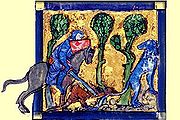 In the romances, his adventures frequently included greater foes than other knights, including giant
s, enchantress
es, or dragon
s. They may also gain help that is out of ordinary. Sir Ywain
assisted a lion against a serpent, and was thereafter accompanied by it, becoming the Knight of the Lion
. Other knights-errant have been assisted by wild men of the woods, as in Valentine and Orson
, or, like Guillaume de Palerme
, by wolves that were, in fact, enchanted princes.
feature bogatyr
s, knights-errant who served as protectors of their homeland, and occasionally as adventurers. Some of them are presumed to be historical figures, while others are fictional and possibly descend from Slavic mythology
. Most tales about bogatyrs revolve around the court of Vladimir I of Kiev
. Three popular Russian knights—Ilya Muromets
, Dobrynya Nikitich
and Alyosha Popovich
(famously painted by Victor Vasnetsov)—are said to have served him.
Youxia, Chinese
knights-errant, traveled solo protecting common folk from oppressive regimes. Unlike their European counterpart, they did not come from any particular social caste and were anything from soldiers to poets. There is even a popular literary tradition arose during the Tang Dynasty
which centered on Negrito
-slaves who used supernatural physical abilities to save kidnapped damsels in distress
and to swim to the bottom of raging rivers to retrieve treasures for their Feudal Lords.
In Japan the expression Musha shugyō
described a Samurai who wanted to test his abilities in real life conditions would travel the land and engage in duels along the way.
Middle Ages
The Middle Ages is a periodization of European history from the 5th century to the 15th century. The Middle Ages follows the fall of the Western Roman Empire in 476 and precedes the Early Modern Era. It is the middle period of a three-period division of Western history: Classic, Medieval and Modern...
chivalric
Chivalry
Chivalry is a term related to the medieval institution of knighthood which has an aristocratic military origin of individual training and service to others. Chivalry was also the term used to refer to a group of mounted men-at-arms as well as to martial valour...
romance literature
Romance (genre)
As a literary genre of high culture, romance or chivalric romance is a style of heroic prose and verse narrative that was popular in the aristocratic circles of High Medieval and Early Modern Europe. They were fantastic stories about marvel-filled adventures, often of a knight errant portrayed as...
. "Errant," meaning wandering or roving, indicates how the knight-errant would typically wander the land in search of adventures to prove himself as a knight
Knight
A knight was a member of a class of lower nobility in the High Middle Ages.By the Late Middle Ages, the rank had become associated with the ideals of chivalry, a code of conduct for the perfect courtly Christian warrior....
, such as in a pas d'armes
Pas d'Armes
The pas d'armes or passage of arms was a type of chivalric hastilude that evolved in the late 14th century and remained popular through the 15th century...
.
The first known appearance of the term "knight-errant" in English was in the 14th century poem Sir Gawain and the Green Knight
Sir Gawain and the Green Knight
Sir Gawain and the Green Knight is a late 14th-century Middle English alliterative romance outlining an adventure of Sir Gawain, a knight of King Arthur's Round Table. In the poem, Sir Gawain accepts a challenge from a mysterious warrior who is completely green, from his clothes and hair to his...
, where Sir Gawain arrives at the castle of Sir Bercilak de Haudesert after long journeys, and Sir Bercilak goes to welcome the "knygt erraunt."
Description
Many knights-errant fit the ideal of the "knight in shining armor". To modern day readers, the figure of the knight-errant suggests a sort of lawful or righteous vigilanteVigilante
A vigilante is a private individual who legally or illegally punishes an alleged lawbreaker, or participates in a group which metes out extralegal punishment to an alleged lawbreaker....
. A knight-errant typically performed all his deeds in the name of a lady, and invoked her name before performing an exploit. In more sublimated forms of knight-errantry, pure metaphysical idealism rather than romantic inspiration motivated the knight-errant (as in the case of Sir Galahad
Galahad
Sir Galahad |Round Table]] and one of the three achievers of the Holy Grail in Arthurian legend. He is the illegitimate son of Lancelot and Elaine of Corbenic, and is renowned for his gallantry and purity. Emerging quite late in the medieval Arthurian tradition, he is perhaps the knightly...
). Such a knight might well be outside the structure of feudalism
Feudalism
Feudalism was a set of legal and military customs in medieval Europe that flourished between the 9th and 15th centuries, which, broadly defined, was a system for ordering society around relationships derived from the holding of land in exchange for service or labour.Although derived from the...
, wandering solely to perform noble exploits (and perhaps to find a lord to give his service to), but might also be in service to a king or lord, traveling either in pursuit of a specific duty that his overlord charged him with, or to put down evildoers in general. This quest
Quest
In mythology and literature, a quest, a journey towards a goal, serves as a plot device and as a symbol. Quests appear in the folklore of every nation and also figure prominently in non-national cultures. In literature, the objects of quests require great exertion on the part of the hero, and...
sends a knight on adventures much like the ones of a knight in search of them, as he happens on the same marvels. In The Faerie Queen, St. George is sent to rescue Una's parents' kingdom from a dragon, and Guyon has no such quest, but both knights encounter perils and adventures.
Giant (mythology)
The mythology and legends of many different cultures include monsters of human appearance but prodigious size and strength. "Giant" is the English word commonly used for such beings, derived from one of the most famed examples: the gigantes of Greek mythology.In various Indo-European mythologies,...
s, enchantress
Enchantress
Enchantress may refer to:*Magician , a magician or spell-caster, sometimes called an enchantress or witch when female*Seduction, the enticement of one person by another, called a seductress or enchantress when it is a beautiful and charismatic woman-Literature:*"The Enchantress of Venus", a 1949...
es, or dragon
Dragon
A dragon is a legendary creature, typically with serpentine or reptilian traits, that feature in the myths of many cultures. There are two distinct cultural traditions of dragons: the European dragon, derived from European folk traditions and ultimately related to Greek and Middle Eastern...
s. They may also gain help that is out of ordinary. Sir Ywain
Ywain
Sir Ywain is a Knight of the Round Table and the son of King Urien in Arthurian legend...
assisted a lion against a serpent, and was thereafter accompanied by it, becoming the Knight of the Lion
Yvain, the Knight of the Lion
Yvain, the Knight with the Lion is a romance by Chrétien de Troyes. It was probably written in the 1170s simultaneously with Lancelot, the Knight of the Cart, and includes several references to the action in that poem...
. Other knights-errant have been assisted by wild men of the woods, as in Valentine and Orson
Valentine and Orson
Valentine and Orson is a romance which has been attached to the Carolingian cycle.-Synopsis:It is the story of twin brothers, abandoned in the woods in infancy. Valentine is brought up as a knight at the court of Pippin, while Orson grows up in a bear's den to be a wild man of the woods, until he...
, or, like Guillaume de Palerme
Guillaume de Palerme
Guillaume de Palerme is a French romance poem, which has been translated into English.The French verse romance was composed circa 1200, commissioned by Countess Yolande...
, by wolves that were, in fact, enchanted princes.
In other cultures
The Russian bylinaBylina
Bylina or Bylyna is a traditional Russian oral epic narrative poem. Byliny singers loosely utilize historical fact greatly embellished with fantasy or hyperbole to create their songs...
feature bogatyr
Bogatyr
The bogatyr was a medieval heroic warrior of Kievan Rus' and the Novgorodian Republic, akin to a Western European knight errant.- Kievan Rus' :...
s, knights-errant who served as protectors of their homeland, and occasionally as adventurers. Some of them are presumed to be historical figures, while others are fictional and possibly descend from Slavic mythology
Slavic mythology
Slavic mythology is the mythological aspect of the polytheistic religion that was practised by the Slavs before Christianisation.The religion possesses many common traits with other religions descended from the Proto-Indo-European religion....
. Most tales about bogatyrs revolve around the court of Vladimir I of Kiev
Vladimir I of Kiev
Vladimir Sviatoslavich the Great Old East Slavic: Володимѣръ Свѧтославичь Old Norse as Valdamarr Sveinaldsson, , Vladimir, , Volodymyr, was a grand prince of Kiev, ruler of Kievan Rus' in .Vladimir's father was the prince Sviatoslav of the Rurik dynasty...
. Three popular Russian knights—Ilya Muromets
Ilya Muromets
Ilya Muromets is a Kievan Rus' epic hero. He is celebrated in numerous byliny . Along with Dobrynya Nikitich and Alyosha Popovich he is regarded as the greatest of all the legendary bogatyrs...
, Dobrynya Nikitich
Dobrynya Nikitich
Dobrynya Nikitich is one of the most popular bogatyrs after Ilya Murometz from the Kievan Rus era. Many byliny center on Dobrynya completing tasks set him by the prince. Dobrynya is often portrayed as being close to the royal family, undertaking sensitive and diplomatic missions.As a courtier,...
and Alyosha Popovich
Alyosha Popovich
Alyosha Popovich , alongside Dobrynya Nikitich and Ilya Muromets, is a bogatyr . He is the youngest of the 3 main bogatyrs of Kiev Rus.The three of them are represented together at Vasnetsov's famous painting Bogatyrs....
(famously painted by Victor Vasnetsov)—are said to have served him.
Youxia, Chinese
China
Chinese civilization may refer to:* China for more general discussion of the country.* Chinese culture* Greater China, the transnational community of ethnic Chinese.* History of China* Sinosphere, the area historically affected by Chinese culture...
knights-errant, traveled solo protecting common folk from oppressive regimes. Unlike their European counterpart, they did not come from any particular social caste and were anything from soldiers to poets. There is even a popular literary tradition arose during the Tang Dynasty
Tang Dynasty
The Tang Dynasty was an imperial dynasty of China preceded by the Sui Dynasty and followed by the Five Dynasties and Ten Kingdoms Period. It was founded by the Li family, who seized power during the decline and collapse of the Sui Empire...
which centered on Negrito
Negrito
The Negrito are a class of several ethnic groups who inhabit isolated parts of Southeast Asia.Their current populations include 12 Andamanese peoples of the Andaman Islands, six Semang peoples of Malaysia, the Mani of Thailand, and the Aeta, Agta, Ati, and 30 other peoples of the Philippines....
-slaves who used supernatural physical abilities to save kidnapped damsels in distress
Damsel in distress
The subject of the damsel in distress, or persecuted maiden, is a classic theme in world literature, art, and film. She is usually a beautiful young woman placed in a dire predicament by a villain or monster and who requires a hero to achieve her rescue. She has become a stock character of fiction,...
and to swim to the bottom of raging rivers to retrieve treasures for their Feudal Lords.
In Japan the expression Musha shugyō
Musha shugyo
is a samurai warrior's quest or pilgrimage. The concept is similar to Knight Errantry in feudal Europe. A warrior, called a shugyōsha, would wander the land practicing and honing his skills without the protection of his family or school. Possible activities include training with other schools,...
described a Samurai who wanted to test his abilities in real life conditions would travel the land and engage in duels along the way.