


Emperor Meiji

Encyclopedia
The or was the 122nd emperor of Japan
according to the traditional order of succession, reigning from 3 February 1867 until his death. He presided over a time of rapid change in Japan, as the nation rose from a feudal shogunate to become a world power.
His personal name was , and although outside of Japan he is sometimes called by this name or Emperor Mutsuhito, in Japan deceased emperors are referred to only by their posthumous name
s.
At the time of his birth in 1852, Japan was an isolated, pre-industrial
, feudal
country dominated by the Tokugawa Shogunate
and the daimyo
, who ruled over the country's more than 250 decentralized domains
. By the time of his death in 1912, Japan had undergone a political, social, and industrial revolution at home (See Meiji Restoration
) and emerged as one of the great power
s on the world stage.
A detailed account of the state funeral in the New York Times concluded with an observation: "The contrast between that which preceded the funeral car and that which followed it was striking indeed. Before it went old Japan; after it came new Japan."
had established itself in the early 17th century. Under its rule, the shogun
governed Japan. About 180 lords, known as daimyo
, ruled autonomous realms under the shogun, who occasionally called upon the daimyo for gifts, but did not tax them. The shogun controlled the daimyo in other ways; only the shogun could approve their marriages, and the shogun could divest a daimyo of his lands.
In 1615, the first Tokugawa shogun, Tokugawa Ieyasu
, who had officially retired from his position, and his son Tokugawa Hidetada
, the titular shogun, issued a code of behavior for the nobility. Under it, the emperor was required to devote his time to scholarship and the arts. The emperors under the shogunate appear to have closely adhered to this code, studying Confucian classics and devoting time to poetry and calligraphy. They were only taught the rudiments of Japanese and Chinese history and geography. The shogun did not seek the consent or advice of the emperor for his actions.
Emperors almost never left their palace compound, or Gosho in Kyoto
, except after an emperor retired or to take shelter in a temple if the palace caught on fire. Few emperors lived long enough to retire; of the Emperor Meiji's five predecessors, only his grandfather lived into his forties, and died aged forty-six. The imperial family suffered very high rates of infant mortality; all five of the emperor's brothers and sisters died as infants, and only five of fifteen of his own children would reach adulthood.
Soon after taking control in the early seventeenth century, shogunate officials (known generically as bakufu) ended much Western trade with Japan, and barred missionaries from the islands. Only the Dutch continued trade with Japan, maintaining a post on the island of Dejima
by Nagasaki
. However, by the early 19th century, European and American vessels appeared in the waters around Japan with increasing frequency.
was a concubine (gon no tenji) to the Emperor Kōmei
and the daughter of the acting major counselor, Nakayama Tadayasu. The young prince was given the name Sachinomiya, or Prince Sachi.
The young prince was born at a time of change for Japan. This change was symbolized dramatically when Commodore Matthew Perry and his squadron of what the Japanese dubbed "the Black Ships
", sailed into the harbor
at Edo
(known since 1868 as Tokyo) in July 1853. Perry sought to open Japan to trade, and warned the Japanese of military consequences if they did not agree. During the crisis brought on by Perry's arrival, the bakufu took the highly unusual step of consulting with the Imperial Court, and the Emperor Kōmei's officials advised that they felt the Americans should be allowed to trade and asked that they be informed in advance of any steps to be taken upon Perry's return. This request was initially honored by the bakufu, and for the first time in at least 250 years, they consulted with the Imperial Court before making a decision. Feeling that it could not win a war, the Japanese government allowed trade and submitted to what it dubbed the "Unequal Treaties
", giving up tariff authority and the right to try foreigners in its own courts. The bakufu willingness to consult with the Court was short-lived: in 1858, word of a treaty arrived with a letter stating that due to shortness of time, it had not been possible to consult. The Emperor Kōmei was so incensed that he threatened to abdicate—though even this action would have required the consent of the Shogun.
Much of the Emperor's boyhood is known only through later accounts, which his biographer, Donald Keene points out are often contradictory. One contemporary described the young prince as healthy and strong, somewhat of a bully and exceptionally talented at sumo
. Another states that the prince was delicate and often ill. Some biographers state that he fainted when he first heard gunfire, while others deny this account. On 16 August 1860, Sachinomiya was proclaimed as prince of the blood and heir to the throne, and was formally adopted by his father's consort
. Later that year on 11 November, he was proclaimed as the crown prince and given an adult name, Mutsuhito. The prince began his education at the age of seven. He proved an indifferent student, and later in life wrote poems regretting that he had not applied himself more in writing practice.
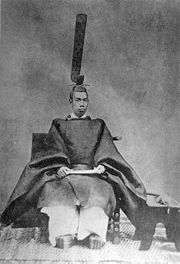
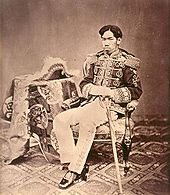 By the early 1860s, the shogunate was under several threats. Representatives of foreign powers sought to increase their influence in Japan. Many daimyo were increasingly dissatisfied with bakufu handling foreign affairs. Large numbers of young samurai
, known as shishi
or "men of high purpose" began to meet and speak against the shogunate. The shishi revered the Emperor Kōmei and favored direct violent action to cure societal ills. While they initially desired the death or expulsion of all foreigners, the shishi would later prove more pragmatic, and begin to advocate the modernization of the country. The bakufu enacted several measures to appease the various groups, and hoped to drive a wedge between the shishi and daimyo.
Kyoto was a major center for the shishi, who had influence over the Emperor Kōmei. In 1863, they persuaded him to issue an "Order to expel barbarians
". The Order placed the shogunate in a difficult position, since it knew it lacked the power to carry it out. Several attacks were made on foreigners or their ships, and foreign forces retaliated. Bakufu forces were able to drive most of the shishi out of Kyoto, and an attempt by them to return in 1864 was driven back. Neverless, unrest continued throughout Japan.
 The prince's awareness of the political turmoil is uncertain. During this time, he studied tanka
poetry, first with his father, then with the court poets. As the prince continued his classical education in 1866, a new shogun, Tokugawa Yoshinobu
took office, a reformer who desired to transform Japan into a Western-style state. Yoshinobu, who would prove to be the final shogun, met with resistance from among the bakufu, even as unrest and military actions continued. In mid-1866, a bakufu army set forth to punish rebels in southern Japan. The army was defeated.
The Emperor Kōmei had always enjoyed excellent health, and was only 36 years old in January 1867. In that month, however, he fell seriously ill. Though he appeared to make some recovery, he suddenly worsened and died on 30 January. Many historians believe the Emperor Kōmei was poisoned, a view not unknown at the time: British diplomat Sir Ernest Satow wrote, "it is impossible to deny that[the Emperor Kōmei's] disappearance from the political scene, leaving as his successor a boy of fifteen or sixteen [actually fourteen] , was most opportune".
The crown prince formally ascended to the throne on 3 February 1867, in a brief ceremony in Kyoto. The new Emperor continued his classical education, which did not include matters of politics. In the meantime, the shogun, Yoshinobu, struggled to maintain power. He repeatedly asked for the Emperor's confirmation of his actions, which he eventually received, but there is no indication that the young Emperor was himself involved in the decisions. The shishi and other rebels continued to shape their vision of the new Japan, and while they revered the Emperor, they had no thought of having him play an active part in the political process.
The political struggle reached its climax in late 1867. In November, an agreement was reached by which Yoshinobu would maintain his title and some of his power, but the lawmaking power would be vested in a bicameral legislature on the British model. The following month, the agreement fell apart as the rebels marched on Kyoto, taking control of the Imperial Palace. On 4 January 1868, the Emperor ceremoniously read out a document before the court proclaiming the "restoration" of Imperial rule, and the following month, documents were sent to foreign powers:
Yoshinobu resisted only briefly
, but it was not until late 1869 that the final bakufu holdouts were finally defeated
.
In the ninth month of the following year, the era
was changed to Meiji, or “enlightened rule”, which was later used for the emperor's posthumous name. This marked the beginning of the custom of an era coinciding with an emperor's reign, and posthumously naming the emperor after the era during which he ruled.
Soon after his accession, the Emperor's officials presented Ichijō Haruko to him as a possible bride. The future Empress was the daughter of an Imperial official, and was three years older than the groom, who would have to wait to wed until after his gembuku (manhood ceremony). The two married on 11 January 1869. Known posthumously as Empress Shōken, she was the first Imperial Consort to receive the title of kōgō (literally, the Emperor's wife, translated as Empress Consort
), in several hundred years. Although she was the first Japanese Empress Consort to play a public role, she bore no children. However, the Meiji emperor had fifteen children by five official ladies-in-waiting. Only five of his children, a prince born to Lady Naruko (1855–1943), the daughter of Yanagiwara Mitsunaru, and four princesses born to Lady Sachiko (1867–1947), the eldest daughter of Count
Sono Motosachi, lived to adulthood. They were:
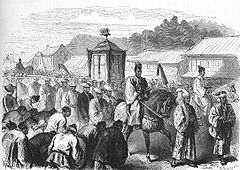 Despite the ouster of the bakufu, no effective central government had been put in place by the rebels.
On 23 March, foreign envoys were first permitted to visit Kyoto and pay formal calls on the Emperor On 7 April 1868, the Emperor was presented with the Charter Oath
, a five-point statement of the nature of the new government, designed to win over those who had not yet committed themselves to the new regime. This document, which the Emperor then formally promulgated, abolished feudalism
and proclaimed a modern democratic government for Japan. The Charter Oath would later be cited by Emperor Hirohito in the Humanity Declaration as support for the imposed changes in Japanese government following World War II. In mid-May, he left the Imperial precincts in Kyoto for the first time since early childhood to take command of the forces pursuing the remnants of the bakufu armies. Traveling in slow stages, he took three days to travel from Kyoto to Osaka, through roads lined with crowds. There was no conflict in Osaka; the new leaders wanted the Emperor to be more visible to his people and to foreign envoys. At the end of May, after two weeks in Osaka (in a much less formal atmosphere than in Kyoto), the Emperor returned to his home. Shortly after his return, it was announced that the Emperor would begin to preside over all state business, reserving further literary study for his leisure time. Only from 1871 did the Emperor's studies include materials on contemporary affairs.
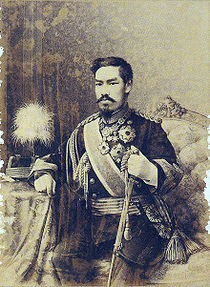 On 19 September 1868, the Emperor announced that the name of the city of Edo was being changed to Tokyo, or "eastern capital". He was formally crowned in Kyoto on 15 October (a ceremony which had been postponed from the previous year due to the unrest). Shortly before the coronation, he announced that the new era, or nengō, would be called Meiji or "enlightened rule". Heretofore the nengō had often been changed multiple times in an emperor's reign; from now on, it was announced, there would only be one nengō per reign.
Soon after his coronation, the Emperor journeyed to Tokyo by road
, visiting it for the first time. He arrived in late November, and began an extended stay by distributing sake among the population. The population of Tokyo was eager for an Imperial visit; it had been the site of the Shogun's court and the population feared that with the abolition of the shogunate, the city might fall into decline. It would not be until 1889 that a final decision was made to move the capital to Tokyo. While in Tokyo, the Emperor boarded a Japanese naval vessel for the first time, and the following day gave instructions for studies to see how Japan's navy could be strengthened. Soon after his return to Kyoto, a rescript
was issued in the Emperor's name (but most likely written by court officials). It indicated his intent to be involved in government affairs, and indeed he attended cabinet meetings and innumerable other government functions, though rarely speaking, almost until the day of his death.
later stated that some officials "were afraid the extremists might go further and abolish the Mikado".
Japan's new leaders sought to reform the patchwork system of domains governed by the daimyo. In 1869, several of the daimyo who had supported the revolution gave their lands to the Emperor and were reappointed as governors, with considerable salaries. By the following year, all other daimyo had followed suit.
In 1871, the Emperor announced that domains were entirely abolished
, as Japan was organized into 72 prefectures
. The daimyo were compensated with annual salaries equal to ten percent of their former revenues (from which they did not now have to deduct the cost of governing), but were required to move to the new capital, Tokyo. Most retired from politics.
The new administration gradually abolished most privileges of the samurai, including their right to a stipend from the government. However, unlike the daimyo, many samurai suffered financially from this change. Most other class-based distinctions were abolished. Legalized discrimination against the burakumin
ended. However, these classes continue to suffer discrimination in Japan to the present time.
Although a parliament
was formed, it had no real power, and neither did the emperor. Power had passed from the Tokugawa into the hands of those Daimyo and other samurai who had led the Restoration. Japan was thus controlled by the Genro
, an oligarchy
, which comprised the most powerful men of the military, political, and economic spheres. The emperor, if nothing else, showed greater political longevity than his recent predecessors, as he was the first Japanese monarch to remain on the throne past the age of 50 since the abdication of Emperor Ōgimachi
in 1586.
The Japanese take pride in the Meiji Restoration, as it and the accompanying industrialization allowed Japan to become the preeminent power in the Pacific and a major player in the world within a generation
. Yet, the Meiji emperor's role in the Restoration remains debatable. He certainly did not control Japan, but how much influence he wielded is unknown. It is unlikely it will ever be clear whether he supported the Sino-Japanese War (1894–1895) or the Russo-Japanese War
(1904–1905). One of the few windows we have into the Emperor's own feelings is his poetry, which seems to indicate a pacifist
streak, or at least a man who wished war could be avoided. He composed the following pacifist poem or tanka
:
Near the end of his life several anarchists, including Kotoku Shusui
, were executed (1911) on charges of having conspired to murder the sovereign. This conspiracy was known as the High Treason Incident
(1910).
, and gastroenteritis
, died of uremia
. Although the official announcement said he died at 00:42 on 30 July 1912, the actual death was at 22:40 on 29 July.
 The Meiji era ushered in many far-reaching changes to the ancient feudal society of Japan. A timeline of major events might include:
Emperor of Japan
The Emperor of Japan is, according to the 1947 Constitution of Japan, "the symbol of the state and of the unity of the people." He is a ceremonial figurehead under a form of constitutional monarchy and is head of the Japanese Imperial Family with functions as head of state. He is also the highest...
according to the traditional order of succession, reigning from 3 February 1867 until his death. He presided over a time of rapid change in Japan, as the nation rose from a feudal shogunate to become a world power.
His personal name was , and although outside of Japan he is sometimes called by this name or Emperor Mutsuhito, in Japan deceased emperors are referred to only by their posthumous name
Posthumous name
A posthumous name is an honorary name given to royalty, nobles, and sometimes others, in East Asia after the person's death, and is used almost exclusively instead of one's personal name or other official titles during his life...
s.
At the time of his birth in 1852, Japan was an isolated, pre-industrial
Pre-industrial society
Pre-industrial society refers to specific social attributes and forms of political and cultural organization that were prevalent before the advent of the Industrial Revolution. It is followed by the industrial society....
, feudal
Feudalism
Feudalism was a set of legal and military customs in medieval Europe that flourished between the 9th and 15th centuries, which, broadly defined, was a system for ordering society around relationships derived from the holding of land in exchange for service or labour.Although derived from the...
country dominated by the Tokugawa Shogunate
Tokugawa shogunate
The Tokugawa shogunate, also known as the and the , was a feudal regime of Japan established by Tokugawa Ieyasu and ruled by the shoguns of the Tokugawa family. This period is known as the Edo period and gets its name from the capital city, Edo, which is now called Tokyo, after the name was...
and the daimyo
Daimyo
is a generic term referring to the powerful territorial lords in pre-modern Japan who ruled most of the country from their vast, hereditary land holdings...
, who ruled over the country's more than 250 decentralized domains
Han (Japan)
The or domain was the name of the estate belonging to a warrior in Japan after the 17th century. The fiefs of the daimyos of the samurai class of Japan during the Edo period were called han.-Edo period:...
. By the time of his death in 1912, Japan had undergone a political, social, and industrial revolution at home (See Meiji Restoration
Meiji Restoration
The , also known as the Meiji Ishin, Revolution, Reform or Renewal, was a chain of events that restored imperial rule to Japan in 1868...
) and emerged as one of the great power
Great power
A great power is a nation or state that has the ability to exert its influence on a global scale. Great powers characteristically possess military and economic strength and diplomatic and cultural influence which may cause small powers to consider the opinions of great powers before taking actions...
s on the world stage.
A detailed account of the state funeral in the New York Times concluded with an observation: "The contrast between that which preceded the funeral car and that which followed it was striking indeed. Before it went old Japan; after it came new Japan."
Background
The Tokugawa ShogunateTokugawa shogunate
The Tokugawa shogunate, also known as the and the , was a feudal regime of Japan established by Tokugawa Ieyasu and ruled by the shoguns of the Tokugawa family. This period is known as the Edo period and gets its name from the capital city, Edo, which is now called Tokyo, after the name was...
had established itself in the early 17th century. Under its rule, the shogun
Shogun
A was one of the hereditary military dictators of Japan from 1192 to 1867. In this period, the shoguns, or their shikken regents , were the de facto rulers of Japan though they were nominally appointed by the emperor...
governed Japan. About 180 lords, known as daimyo
Daimyo
is a generic term referring to the powerful territorial lords in pre-modern Japan who ruled most of the country from their vast, hereditary land holdings...
, ruled autonomous realms under the shogun, who occasionally called upon the daimyo for gifts, but did not tax them. The shogun controlled the daimyo in other ways; only the shogun could approve their marriages, and the shogun could divest a daimyo of his lands.
In 1615, the first Tokugawa shogun, Tokugawa Ieyasu
Tokugawa Ieyasu
was the founder and first shogun of the Tokugawa shogunate of Japan , which ruled from the Battle of Sekigahara in 1600 until the Meiji Restoration in 1868. Ieyasu seized power in 1600, received appointment as shogun in 1603, abdicated from office in 1605, but...
, who had officially retired from his position, and his son Tokugawa Hidetada
Tokugawa Hidetada
was the second shogun of the Tokugawa dynasty, who ruled from 1605 until his abdication in 1623. He was the third son of Tokugawa Ieyasu, the first shogun of the Tokugawa shogunate.-Early life :...
, the titular shogun, issued a code of behavior for the nobility. Under it, the emperor was required to devote his time to scholarship and the arts. The emperors under the shogunate appear to have closely adhered to this code, studying Confucian classics and devoting time to poetry and calligraphy. They were only taught the rudiments of Japanese and Chinese history and geography. The shogun did not seek the consent or advice of the emperor for his actions.
Emperors almost never left their palace compound, or Gosho in Kyoto
Kyoto
is a city in the central part of the island of Honshū, Japan. It has a population close to 1.5 million. Formerly the imperial capital of Japan, it is now the capital of Kyoto Prefecture, as well as a major part of the Osaka-Kobe-Kyoto metropolitan area.-History:...
, except after an emperor retired or to take shelter in a temple if the palace caught on fire. Few emperors lived long enough to retire; of the Emperor Meiji's five predecessors, only his grandfather lived into his forties, and died aged forty-six. The imperial family suffered very high rates of infant mortality; all five of the emperor's brothers and sisters died as infants, and only five of fifteen of his own children would reach adulthood.
Soon after taking control in the early seventeenth century, shogunate officials (known generically as bakufu) ended much Western trade with Japan, and barred missionaries from the islands. Only the Dutch continued trade with Japan, maintaining a post on the island of Dejima
Dejima
was a small fan-shaped artificial island built in the bay of Nagasaki in 1634. This island, which was formed by digging a canal through a small peninsula, remained as the single place of direct trade and exchange between Japan and the outside world during the Edo period. Dejima was built to...
by Nagasaki
Nagasaki
is the capital and the largest city of Nagasaki Prefecture on the island of Kyushu in Japan. Nagasaki was founded by the Portuguese in the second half of the 16th century on the site of a small fishing village, formerly part of Nishisonogi District...
. However, by the early 19th century, European and American vessels appeared in the waters around Japan with increasing frequency.
Boyhood
Mutsuhito was born on 3 November 1852 in a small house on his maternal grandfather's property at the north end of the Gosho. At the time, a birth was believed to be polluting, and so imperial princes were not born in the Palace, but usually in a structure, often temporary, near the pregnant woman's father's house. The boy's mother, Nakayama YoshikoNakayama Yoshiko
was a Japanese lady-in-waiting in the court of the Imperial House of Japan. She was a concubine of Emperor Kōmei and the mother of Emperor Meiji.-Biography:...
was a concubine (gon no tenji) to the Emperor Kōmei
Emperor Komei
was the 121st emperor of Japan, according to the traditional order of succession. Kōmei's reign spanned the years from 1846 through 1867.-Genealogy:Before Kōmei's accession to the Chrysanthemum Throne, his personal name was ;, his title was ....
and the daughter of the acting major counselor, Nakayama Tadayasu. The young prince was given the name Sachinomiya, or Prince Sachi.
The young prince was born at a time of change for Japan. This change was symbolized dramatically when Commodore Matthew Perry and his squadron of what the Japanese dubbed "the Black Ships
Black Ships
The Black Ships was the name given to Western vessels arriving in Japan in the 16th and 19th centuries.In 1543 Portuguese initiated the first contacts, establishing a trade route linking Goa to Nagasaki...
", sailed into the harbor
Tokyo Bay
is a bay in the southern Kantō region of Japan. Its old name was .-Geography:Tokyo Bay is surrounded by the Bōsō Peninsula to the east and the Miura Peninsula to the west. In a narrow sense, Tokyo Bay is the area north of the straight line formed by the on the Miura Peninsula on one end and on...
at Edo
Edo
, also romanized as Yedo or Yeddo, is the former name of the Japanese capital Tokyo, and was the seat of power for the Tokugawa shogunate which ruled Japan from 1603 to 1868...
(known since 1868 as Tokyo) in July 1853. Perry sought to open Japan to trade, and warned the Japanese of military consequences if they did not agree. During the crisis brought on by Perry's arrival, the bakufu took the highly unusual step of consulting with the Imperial Court, and the Emperor Kōmei's officials advised that they felt the Americans should be allowed to trade and asked that they be informed in advance of any steps to be taken upon Perry's return. This request was initially honored by the bakufu, and for the first time in at least 250 years, they consulted with the Imperial Court before making a decision. Feeling that it could not win a war, the Japanese government allowed trade and submitted to what it dubbed the "Unequal Treaties
Unequal Treaties
“Unequal treaty” is a term used in specific reference to a number of treaties imposed by Western powers, during the 19th and early 20th centuries, on Qing Dynasty China and late Tokugawa Japan...
", giving up tariff authority and the right to try foreigners in its own courts. The bakufu willingness to consult with the Court was short-lived: in 1858, word of a treaty arrived with a letter stating that due to shortness of time, it had not been possible to consult. The Emperor Kōmei was so incensed that he threatened to abdicate—though even this action would have required the consent of the Shogun.
Much of the Emperor's boyhood is known only through later accounts, which his biographer, Donald Keene points out are often contradictory. One contemporary described the young prince as healthy and strong, somewhat of a bully and exceptionally talented at sumo
Sumo
is a competitive full-contact sport where a wrestler attempts to force another wrestler out of a circular ring or to touch the ground with anything other than the soles of the feet. The sport originated in Japan, the only country where it is practiced professionally...
. Another states that the prince was delicate and often ill. Some biographers state that he fainted when he first heard gunfire, while others deny this account. On 16 August 1860, Sachinomiya was proclaimed as prince of the blood and heir to the throne, and was formally adopted by his father's consort
Empress Eisho
was the empress consort of Emperor Kōmei of Japan. She is also known under the technically incorrect name .- Early life :As the daughter of Kujō Hisatada, who was a former kampaku, Kujō Asako could anticipate a life unfolding entirely within the ambit of the Imperial court; but she could not have...
. Later that year on 11 November, he was proclaimed as the crown prince and given an adult name, Mutsuhito. The prince began his education at the age of seven. He proved an indifferent student, and later in life wrote poems regretting that he had not applied himself more in writing practice.
Unrest and accession
Samurai
is the term for the military nobility of pre-industrial Japan. According to translator William Scott Wilson: "In Chinese, the character 侍 was originally a verb meaning to wait upon or accompany a person in the upper ranks of society, and this is also true of the original term in Japanese, saburau...
, known as shishi
Shishi (organization)
Shishi was a term used to describe Japanese political activists of the late Edo period...
or "men of high purpose" began to meet and speak against the shogunate. The shishi revered the Emperor Kōmei and favored direct violent action to cure societal ills. While they initially desired the death or expulsion of all foreigners, the shishi would later prove more pragmatic, and begin to advocate the modernization of the country. The bakufu enacted several measures to appease the various groups, and hoped to drive a wedge between the shishi and daimyo.
Kyoto was a major center for the shishi, who had influence over the Emperor Kōmei. In 1863, they persuaded him to issue an "Order to expel barbarians
Order to expel barbarians
The was an edict issued by the Japanese Emperor Kōmei in 1863 against the Westernization of Japan following the opening of the country by Commodore Perry in 1854.-The order:...
". The Order placed the shogunate in a difficult position, since it knew it lacked the power to carry it out. Several attacks were made on foreigners or their ships, and foreign forces retaliated. Bakufu forces were able to drive most of the shishi out of Kyoto, and an attempt by them to return in 1864 was driven back. Neverless, unrest continued throughout Japan.
Waka (poetry)
Waka or Yamato uta is a genre of classical Japanese verse and one of the major genres of Japanese literature...
poetry, first with his father, then with the court poets. As the prince continued his classical education in 1866, a new shogun, Tokugawa Yoshinobu
Tokugawa Yoshinobu
was the 15th and last shogun of the Tokugawa shogunate of Japan. He was part of a movement which aimed to reform the aging shogunate, but was ultimately unsuccessful...
took office, a reformer who desired to transform Japan into a Western-style state. Yoshinobu, who would prove to be the final shogun, met with resistance from among the bakufu, even as unrest and military actions continued. In mid-1866, a bakufu army set forth to punish rebels in southern Japan. The army was defeated.
The Emperor Kōmei had always enjoyed excellent health, and was only 36 years old in January 1867. In that month, however, he fell seriously ill. Though he appeared to make some recovery, he suddenly worsened and died on 30 January. Many historians believe the Emperor Kōmei was poisoned, a view not unknown at the time: British diplomat Sir Ernest Satow wrote, "it is impossible to deny that
The crown prince formally ascended to the throne on 3 February 1867, in a brief ceremony in Kyoto. The new Emperor continued his classical education, which did not include matters of politics. In the meantime, the shogun, Yoshinobu, struggled to maintain power. He repeatedly asked for the Emperor's confirmation of his actions, which he eventually received, but there is no indication that the young Emperor was himself involved in the decisions. The shishi and other rebels continued to shape their vision of the new Japan, and while they revered the Emperor, they had no thought of having him play an active part in the political process.
The political struggle reached its climax in late 1867. In November, an agreement was reached by which Yoshinobu would maintain his title and some of his power, but the lawmaking power would be vested in a bicameral legislature on the British model. The following month, the agreement fell apart as the rebels marched on Kyoto, taking control of the Imperial Palace. On 4 January 1868, the Emperor ceremoniously read out a document before the court proclaiming the "restoration" of Imperial rule, and the following month, documents were sent to foreign powers:
The Emperor of Japan announces to the sovereigns of all foreign countries and to their subjects that permission has been granted to the Shogun Tokugawa Yoshinobu to return the governing power in accordance with his own request. We shall henceforward exercise supreme authority in all the internal and external affairs of the country. Consequently the title of Emperor must be substituted for that of TycoonTaikunTaikun is an archaic Japanese term of respect derived from Chinese I Ching which once referred to an independent ruler who did not have an imperial lineage. Its literal meaning is "Great Lord/Prince" or "Supreme Commander". In the Edo Period, this word was used as a diplomatic title designating...
, in which the treaties have been made. Officers are being appointed by us to the conduct of foreign affairs. It is desirable that the representatives of the treaty powers recognize this announcement.
Mutsuhito
Yoshinobu resisted only briefly
Battle of Toba-Fushimi
The occurred between pro-Imperial and Tokugawa shogunate forces during the Boshin War in Japan. The battle started on 27 January 1868 , when the forces of the Tokugawa shogunate and the allied forces of Chōshū, Satsuma and Tosa domains clashed near Fushimi...
, but it was not until late 1869 that the final bakufu holdouts were finally defeated
Boshin War
The was a civil war in Japan, fought from 1868 to 1869 between forces of the ruling Tokugawa shogunate and those seeking to return political power to the imperial court....
.
In the ninth month of the following year, the era
Japanese era name
The Japanese era calendar scheme is a common calendar scheme used in Japan, which identifies a year by the combination of the and the year number within the era...
was changed to Meiji, or “enlightened rule”, which was later used for the emperor's posthumous name. This marked the beginning of the custom of an era coinciding with an emperor's reign, and posthumously naming the emperor after the era during which he ruled.
Soon after his accession, the Emperor's officials presented Ichijō Haruko to him as a possible bride. The future Empress was the daughter of an Imperial official, and was three years older than the groom, who would have to wait to wed until after his gembuku (manhood ceremony). The two married on 11 January 1869. Known posthumously as Empress Shōken, she was the first Imperial Consort to receive the title of kōgō (literally, the Emperor's wife, translated as Empress Consort
Queen consort
A queen consort is the wife of a reigning king. A queen consort usually shares her husband's rank and holds the feminine equivalent of the king's monarchical titles. Historically, queens consort do not share the king regnant's political and military powers. Most queens in history were queens consort...
), in several hundred years. Although she was the first Japanese Empress Consort to play a public role, she bore no children. However, the Meiji emperor had fifteen children by five official ladies-in-waiting. Only five of his children, a prince born to Lady Naruko (1855–1943), the daughter of Yanagiwara Mitsunaru, and four princesses born to Lady Sachiko (1867–1947), the eldest daughter of Count
Count
A count or countess is an aristocratic nobleman in European countries. The word count came into English from the French comte, itself from Latin comes—in its accusative comitem—meaning "companion", and later "companion of the emperor, delegate of the emperor". The adjective form of the word is...
Sono Motosachi, lived to adulthood. They were:
- Crown Prince Yoshihito (Haru no miya Yoshihito Shinnō), 3rd son, (31 August 1879 – 25 December 1926) (see Emperor TaishōEmperor TaishōThe was the 123rd emperor of Japan, according to the traditional order of succession, reigning from 30 July 1912, until his death in 1926.The Emperor’s personal name was . According to Japanese customs, the emperor has no name during his reign and is only called the Emperor...
). - Princess Masako (Tsune-no-miya Masako Naishinnō), 6th daughter, (30 September 1888 – 8 March 1940), titled Tsune-no-miya (Princess Tsune) until marriage; m. at Imperial Palace, Tokyo, 30 April 1908 to Prince Takeda TsunehisaPrince Takeda Tsunehisawas the founder of the Takeda-no-miya collateral branch of Japanese Imperial Family.- Biography :Prince Takeda Tsunehisa was the eldest son of Prince Kitashirakawa Yoshihisa and thus the brother of Prince Kitashirakawa Naruhisa...
(Takeda-no-miya Tsunehisa ō, 22 September 1882 – 23 April 1919), and had issue (offspringOffspringIn biology, offspring is the product of reproduction, of a new organism produced by one or more parents.Collective offspring may be known as a brood or progeny in a more general way...
). - Princess Fusako (Kane-no-miya Fusako Naishinnō), 7th daughter, (28 January 1890 – 11 August 1974), titled Kane-no-miya (Princess Kane) until marriage; m. at Imperial Palace, Tokyo 29 April 1909 to Prince Kitashirakawa NaruhisaPrince Kitashirakawa Naruhisa, was the 3rd head of a collateral branch of the Japanese Imperial Family.-Early life:Prince Kitashirakawa Naruhisa was the son of Prince Kitashirakawa Yoshihisa and Princess Tomiko. Prince Naruhisa succeeded as head of the house of Kitashirakawa-no-miya after the death of his father in November...
(Kitashirakawa-no-miya Naruhisa ō, 1 April 1887 – 2 April 1923), and had issue. - Princess Nobuko (Fumi-no-miya Nobuko Naishinnō), 8th daughter, (7 August 1891 – 3 November 1933); titled Fumi-no-miya (Princess Fumi) until marriage; m. at Imperial Palace, Tokyo 6 May 1909 to Prince Asaka Yasuhiko (Asaka-no-miya Yasuhiko ō, 2 October 1887 – 13 April 1981), and had issue.
- Princess Toshiko (Yasu-no-miya Toshiko Naishinnō), 9th daughter, (11 May 1896 – 5 March 1978); titled Yasu-no-miya (Princess Yasu) until marriage; m. at Imperial Palace, Tokyo 18 May 1915 to Prince Higashikuni Naruhiko (Higashikuni-no-miya Naruhiko ô, 3 December 1887 – 20 January 1990), and had issue.
Consolidation of power
On 23 March, foreign envoys were first permitted to visit Kyoto and pay formal calls on the Emperor On 7 April 1868, the Emperor was presented with the Charter Oath
Five Charter Oath
The was promulgated at the enthronement of Emperor Meiji of Japan on 7 April 1868. The Oath outlined the main aims and the course of action to be followed during Emperor Meiji's reign, setting the legal stage for Japan's modernization...
, a five-point statement of the nature of the new government, designed to win over those who had not yet committed themselves to the new regime. This document, which the Emperor then formally promulgated, abolished feudalism
Feudalism
Feudalism was a set of legal and military customs in medieval Europe that flourished between the 9th and 15th centuries, which, broadly defined, was a system for ordering society around relationships derived from the holding of land in exchange for service or labour.Although derived from the...
and proclaimed a modern democratic government for Japan. The Charter Oath would later be cited by Emperor Hirohito in the Humanity Declaration as support for the imposed changes in Japanese government following World War II. In mid-May, he left the Imperial precincts in Kyoto for the first time since early childhood to take command of the forces pursuing the remnants of the bakufu armies. Traveling in slow stages, he took three days to travel from Kyoto to Osaka, through roads lined with crowds. There was no conflict in Osaka; the new leaders wanted the Emperor to be more visible to his people and to foreign envoys. At the end of May, after two weeks in Osaka (in a much less formal atmosphere than in Kyoto), the Emperor returned to his home. Shortly after his return, it was announced that the Emperor would begin to preside over all state business, reserving further literary study for his leisure time. Only from 1871 did the Emperor's studies include materials on contemporary affairs.
Soon after his coronation, the Emperor journeyed to Tokyo by road
Tokaido (road)
The ' was the most important of the Five Routes of the Edo period, connecting Edo to Kyoto in Japan. Unlike the inland and less heavily travelled Nakasendō, the Tōkaidō travelled along the sea coast of eastern Honshū, hence the route's name....
, visiting it for the first time. He arrived in late November, and began an extended stay by distributing sake among the population. The population of Tokyo was eager for an Imperial visit; it had been the site of the Shogun's court and the population feared that with the abolition of the shogunate, the city might fall into decline. It would not be until 1889 that a final decision was made to move the capital to Tokyo. While in Tokyo, the Emperor boarded a Japanese naval vessel for the first time, and the following day gave instructions for studies to see how Japan's navy could be strengthened. Soon after his return to Kyoto, a rescript
Rescript
A rescript is a document that is issued not on the initiative of the author, but in response to a specific demand made by its addressee...
was issued in the Emperor's name (but most likely written by court officials). It indicated his intent to be involved in government affairs, and indeed he attended cabinet meetings and innumerable other government functions, though rarely speaking, almost until the day of his death.
Political reform
The successful revolutionaries organized themselves into a Council of State, and subsequently into a system where three main ministers led the government. This structure would last until the establishment of a prime minister, who would lead a cabinet in the western fashion, in 1885. Initially, not even the retention of the emperor was certain; revolutionary leader Gotō ShōjirōGoto Shojiro
Count was a Japanese samurai and politician during the Bakumatch and early Meiji period of Japanese history. He was a leader of which would evolve into a political party.- Early life :...
later stated that some officials "were afraid the extremists might go further and abolish the Mikado".
Japan's new leaders sought to reform the patchwork system of domains governed by the daimyo. In 1869, several of the daimyo who had supported the revolution gave their lands to the Emperor and were reappointed as governors, with considerable salaries. By the following year, all other daimyo had followed suit.
In 1871, the Emperor announced that domains were entirely abolished
Abolition of the han system
The was an act, in 1871, of the new Meiji government of the Empire of Japan to replace the traditional feudal domain system and to introduce centralized government authority . This process marked the culmination of the Meiji Restoration in that all daimyo were required to return their authority...
, as Japan was organized into 72 prefectures
Prefectures of Japan
The prefectures of Japan are the country's 47 subnational jurisdictions: one "metropolis" , Tokyo; one "circuit" , Hokkaidō; two urban prefectures , Osaka and Kyoto; and 43 other prefectures . In Japanese, they are commonly referred to as...
. The daimyo were compensated with annual salaries equal to ten percent of their former revenues (from which they did not now have to deduct the cost of governing), but were required to move to the new capital, Tokyo. Most retired from politics.
The new administration gradually abolished most privileges of the samurai, including their right to a stipend from the government. However, unlike the daimyo, many samurai suffered financially from this change. Most other class-based distinctions were abolished. Legalized discrimination against the burakumin
Burakumin
are a Japanese social minority group. The burakumin are one of the main minority groups in Japan, along with the Ainu of Hokkaidō, the Ryukyuans of Okinawa and Japanese residents of Korean and Chinese descent....
ended. However, these classes continue to suffer discrimination in Japan to the present time.
Although a parliament
Diet of Japan
The is Japan's bicameral legislature. It is composed of a lower house, called the House of Representatives, and an upper house, called the House of Councillors. Both houses of the Diet are directly elected under a parallel voting system. In addition to passing laws, the Diet is formally...
was formed, it had no real power, and neither did the emperor. Power had passed from the Tokugawa into the hands of those Daimyo and other samurai who had led the Restoration. Japan was thus controlled by the Genro
Genro
was an unofficial designation given to certain retired elder Japanese statesmen, considered the "founding fathers" of modern Japan, who served as informal extraconstitutional advisors to the emperor, during the Meiji, Taishō and early Shōwa periods in Japanese history.The institution of genrō...
, an oligarchy
Oligarchy
Oligarchy is a form of power structure in which power effectively rests with an elite class distinguished by royalty, wealth, family ties, commercial, and/or military legitimacy...
, which comprised the most powerful men of the military, political, and economic spheres. The emperor, if nothing else, showed greater political longevity than his recent predecessors, as he was the first Japanese monarch to remain on the throne past the age of 50 since the abdication of Emperor Ōgimachi
Emperor Ogimachi
Emperor Ōgimachi was the 106th Emperor of Japan, according to the traditional order of succession. He reigned from October 27, 1557 to December 17, 1586, corresponding to the transition between the Warring States Era and the Azuchi-Momoyama period...
in 1586.
The Japanese take pride in the Meiji Restoration, as it and the accompanying industrialization allowed Japan to become the preeminent power in the Pacific and a major player in the world within a generation
Generation
Generation , also known as procreation in biological sciences, is the act of producing offspring....
. Yet, the Meiji emperor's role in the Restoration remains debatable. He certainly did not control Japan, but how much influence he wielded is unknown. It is unlikely it will ever be clear whether he supported the Sino-Japanese War (1894–1895) or the Russo-Japanese War
Russo-Japanese War
The Russo-Japanese War was "the first great war of the 20th century." It grew out of rival imperial ambitions of the Russian Empire and Japanese Empire over Manchuria and Korea...
(1904–1905). One of the few windows we have into the Emperor's own feelings is his poetry, which seems to indicate a pacifist
Pacifism
Pacifism is the opposition to war and violence. The term "pacifism" was coined by the French peace campaignerÉmile Arnaud and adopted by other peace activists at the tenth Universal Peace Congress inGlasgow in 1901.- Definition :...
streak, or at least a man who wished war could be avoided. He composed the following pacifist poem or tanka
Tanka
Tanka may refer to:* Tanka, a form of Japanese waka * Tanka prose, a literary genre which combines tanka poems and prose* Thangka, a pictorial representation in Tibetan Buddhism...
:
- よもの海
- みなはらからと思ふ世に
- など波風のたちさわぐらむ
- Yomo no umi
- mina harakara to omofu yo ni
- nado namikaze no tachi sawaguramu
- The seas of the four directions—
- all are born of one womb:
- why, then, do the wind and waves rise in discord?
Near the end of his life several anarchists, including Kotoku Shusui
Kotoku Shusui
, better known by the nom de plume , was a Japanese socialist and anarchist who played a leading role in introducing anarchism to Japan in the early 20th century, particularly by translating the works of contemporary European and Russian anarchists, such as Peter Kropotkin, into Japanese...
, were executed (1911) on charges of having conspired to murder the sovereign. This conspiracy was known as the High Treason Incident
High Treason Incident
The , also known as the , was a socialist-anarchist plot to assassinate the Japanese Emperor Meiji in 1910, leading to a mass arrest of leftists, and the execution of 12 alleged conspirators in 1911....
(1910).
Death
Emperor Meiji, suffering from diabetes, nephritisNephritis
Nephritis is inflammation of the nephrons in the kidneys. The word "nephritis" was imported from Latin, which took it from Greek: νεφρίτιδα. The word comes from the Greek νεφρός - nephro- meaning "of the kidney" and -itis meaning "inflammation"....
, and gastroenteritis
Gastroenteritis
Gastroenteritis is marked by severe inflammation of the gastrointestinal tract involving both the stomach and small intestine resulting in acute diarrhea and vomiting. It can be transferred by contact with contaminated food and water...
, died of uremia
Uremia
Uremia or uraemia is a term used to loosely describe the illness accompanying kidney failure , in particular the nitrogenous waste products associated with the failure of this organ....
. Although the official announcement said he died at 00:42 on 30 July 1912, the actual death was at 22:40 on 29 July.
Timeline of events during the life and reign of the Meiji Emperor
- 3 November 1852: the Meiji emperor (then known as Sachinomiya) is born to the imperial concubine Nakayama Yoshiko and Emperor KomeiEmperor Komeiwas the 121st emperor of Japan, according to the traditional order of succession. Kōmei's reign spanned the years from 1846 through 1867.-Genealogy:Before Kōmei's accession to the Chrysanthemum Throne, his personal name was ;, his title was ....
- 1853: A fleet of ships headed by CommodoreCommodore (rank)Commodore is a military rank used in many navies that is superior to a navy captain, but below a rear admiral. Non-English-speaking nations often use the rank of flotilla admiral or counter admiral as an equivalent .It is often regarded as a one-star rank with a NATO code of OF-6, but is not always...
Matthew Perry arrives in Japan on 8 July; considered by German Japanologist Johannes Justus Rein and described by Francis L. Hawks and Commodore Matthew Perry in their 1856 work, Narrative of the Expedition of an American Squadron to the China Seas and Japan Performed in the Years 1852, 1853 and 1854 under the Command of Commodore M.C. Perry, United States Navy., as the "Opening" of Japan. Death of the Shogun.
- 1854–55: Treaties are signed with the United StatesUnited StatesThe United States of America is a federal constitutional republic comprising fifty states and a federal district...
by the Bakufu
- late 1850s–1860s: The "Sonnō jōiSonno joiis a Japanese political philosophy and a social movement derived from Neo-Confucianism; it became a political slogan in the 1850s and 1860s in the movement to overthrow the Tokugawa bakufu, during the Bakumatsu period.-Origin:...
" movement is in full force.
- 1858: The Bakufu sign treaties with the NetherlandsNetherlandsThe Netherlands is a constituent country of the Kingdom of the Netherlands, located mainly in North-West Europe and with several islands in the Caribbean. Mainland Netherlands borders the North Sea to the north and west, Belgium to the south, and Germany to the east, and shares maritime borders...
, Imperial Russia, and Great Britain.
- March 1860: The TairoTairoTairō was a high-ranking official position in the bakuhan taisei government of Japan. The tairō would preside over the governing Rōjū council in the event of an emergency. A tairō would be nominated from among a group of samurai families who supported Tokugawa Ieyasu...
, Ii NaosukeIi Naosukewas daimyo of Hikone and also Tairō of Tokugawa Shogunate, Japan, a position he held from April 23, 1858 until his death on March 24, 1860. He is most famous for signing the Harris Treaty with the United States, granting access to ports for trade to American merchants and seamen and...
, is assassinated.
- 11 November: Sachinomiya is formally proclaimed Crown Prince and given the personal name Mutsuhito.
- 1862: Namamugi IncidentNamamugi IncidentThe was a samurai assault on foreign nationals in Japan on September 14, 1862, which resulted in the August 1863 bombardment of Kagoshima, during the Late Tokugawa shogunate...
- 1864–65: Bombardment of ShimonosekiBombardment of ShimonosekiThe Battles for Shimonoseki refers to a series of military engagements in 1863 and 1864, fought to control Shimonoseki Straits by joint naval forces from the Great Britain, France, the Netherlands and the United States, against the Japanese feudal domain of Chōshū, which took place off and on the...
by British, American, French, and Dutch ships; fighting ensues between the shogunate and Chōshū.
- 1866: Death of the Shogun Tokugawa IemochiTokugawa Iemochiwas the 14th shogun of the Tokugawa shogunate of Japan, who held office 1858 to 1866. During his reign there was much internal turmoil as a result of Japan's first major contact with the United States, which occurred under Commodore Perry in 1853 and 1854, and of the subsequent "re-opening" of...
on 29 August; appointment of Tokugawa YoshinobuTokugawa Yoshinobuwas the 15th and last shogun of the Tokugawa shogunate of Japan. He was part of a movement which aimed to reform the aging shogunate, but was ultimately unsuccessful...
as ShogunShogunA was one of the hereditary military dictators of Japan from 1192 to 1867. In this period, the shoguns, or their shikken regents , were the de facto rulers of Japan though they were nominally appointed by the emperor...
.
- 31 January 1867: Death of Emperor KomeiEmperor Komeiwas the 121st emperor of Japan, according to the traditional order of succession. Kōmei's reign spanned the years from 1846 through 1867.-Genealogy:Before Kōmei's accession to the Chrysanthemum Throne, his personal name was ;, his title was ....
from hemorrhagic smallpoxSmallpoxSmallpox was an infectious disease unique to humans, caused by either of two virus variants, Variola major and Variola minor. The disease is also known by the Latin names Variola or Variola vera, which is a derivative of the Latin varius, meaning "spotted", or varus, meaning "pimple"...
, unofficial accession of Mutsuhito to the throne.
- 4 January 1868: Formal restoration of imperial rule; end of 265 years of rule by the Tokugawa ShogunateTokugawa shogunateThe Tokugawa shogunate, also known as the and the , was a feudal regime of Japan established by Tokugawa Ieyasu and ruled by the shoguns of the Tokugawa family. This period is known as the Edo period and gets its name from the capital city, Edo, which is now called Tokyo, after the name was...
- 12 September: Formal coronationCoronationA coronation is a ceremony marking the formal investiture of a monarch and/or their consort with regal power, usually involving the placement of a crown upon their head and the presentation of other items of regalia...
of the emperor Meiji.
- 23 October: The nengo is changed to the first year of Meiji.
- 6 November: The capital is moved from KyotoKyotois a city in the central part of the island of Honshū, Japan. It has a population close to 1.5 million. Formerly the imperial capital of Japan, it is now the capital of Kyoto Prefecture, as well as a major part of the Osaka-Kobe-Kyoto metropolitan area.-History:...
to Edo, renamed Tokyo.
- 5 November 1872: Emperor Meiji Receives The Grand Duke Alexei Alexandrovich of RussiaGrand Duke Alexei Alexandrovich of RussiaGrand Duke Alexei Alexandrovich of Russia was the sixth child and the fourth son of Alexander II of Russia and his first wife Maria Alexandrovna . Destined to a naval career, Alexei Alexandrovich started his military training at the age of 7...
- late 1860s–1881: Period of rebellion and assassination in Japan.
- 11 January 1869: Marriage of Meiji to Ichijo Haruko, thenceforth the Empress Shoken.
- 4 September: Meiji receives The Duke of Edinburgh.
- 1871: The abolition of the han domains is proclaimed.
- 1873: Edo castleEdo Castle, also known as , is a flatland castle that was built in 1457 by Ōta Dōkan. It is located in Chiyoda in Tokyo, then known as Edo, Toshima District, Musashi Province. Tokugawa Ieyasu established the Tokugawa shogunate here. It was the residence of the shogun and location of the shogunate, and also...
is destroyed in a conflagrationConflagrationA conflagration or a blaze is an uncontrolled burning that threatens human life, health, or property. A conflagration can be accidentally begun, naturally caused , or intentionally created . Arson can be accomplished for the purpose of sabotage or diversion, and also can be the consequence of...
; the emperor moves to the Akasaka Palace. Meiji's first children are born, but die at birth.
- 1877: The Satsuma RebellionSatsuma RebellionThe was a revolt of Satsuma ex-samurai against the Meiji government from January 29 to September 24, 1877, 9 years into the Meiji Era. It was the last, and the most serious, of a series of armed uprisings against the new government.-Background:...
- 1878: Assassination of Okubo ToshimichiOkubo Toshimichi, was a Japanese statesman, a samurai of Satsuma, and one of the three great nobles who led the Meiji Restoration. He is regarded as one of the main founders of modern Japan.-Early life:...
.
- 31 August 1879: Prince YoshihitoYoshihitoYoshihito is a male Japanese given name. People named Yoshihito include the following:*Emperor Taishō , previously known as Prince Yoshihito*Prince Katsura Yoshihito is a male Japanese given name. People named Yoshihito include the following:*Emperor Taishō (1879-1926), previously known as Prince...
, the future Taisho TennoEmperor TaishōThe was the 123rd emperor of Japan, according to the traditional order of succession, reigning from 30 July 1912, until his death in 1926.The Emperor’s personal name was . According to Japanese customs, the emperor has no name during his reign and is only called the Emperor...
and Meiji's only surviving son, is born.
- 1881: Receives the first state visit of a foreign monarch, King KalakauaKalakauaKalākaua, born David Laamea Kamanakapuu Mahinulani Nalaiaehuokalani Lumialani Kalākaua and sometimes called The Merrie Monarch , was the last reigning king of the Kingdom of Hawaii...
of Hawaii.
- 1889: Meiji ConstitutionMeiji ConstitutionThe ', known informally as the ', was the organic law of the Japanese empire, in force from November 29, 1890 until May 2, 1947.-Outline:...
promulgated; Ito HirobumiIto HirobumiPrince was a samurai of Chōshū domain, Japanese statesman, four time Prime Minister of Japan , genrō and Resident-General of Korea. Itō was assassinated by An Jung-geun, a Korean nationalist who was against the annexation of Korea by the Japanese Empire...
becomes first Prime Minister of JapanPrime Minister of JapanThe is the head of government of Japan. He is appointed by the Emperor of Japan after being designated by the Diet from among its members, and must enjoy the confidence of the House of Representatives to remain in office...
. - 1894: Sino-Japanese WarFirst Sino-Japanese WarThe First Sino-Japanese War was fought between Qing Dynasty China and Meiji Japan, primarily over control of Korea...
; Japanese victory establishes Japan as a regional power. - 1904–1905: Russo-Japanese WarRusso-Japanese WarThe Russo-Japanese War was "the first great war of the 20th century." It grew out of rival imperial ambitions of the Russian Empire and Japanese Empire over Manchuria and Korea...
; Japanese victory earns Japan the status of a great power. - 1912: The emperor dies.
Personal information
- Father
- Emperor KōmeiEmperor Komeiwas the 121st emperor of Japan, according to the traditional order of succession. Kōmei's reign spanned the years from 1846 through 1867.-Genealogy:Before Kōmei's accession to the Chrysanthemum Throne, his personal name was ;, his title was ....
- Emperor Kōmei
- Mother
- Nakayama Yoshiko, a concubine of Emperor Komei,
- Wife
- Ichijo Masako, the Empress Shōken, also known as "Haruko"
- Concubines
- Lady Mitsuko (1853–1873), not much is known about Lady Mitsuko, however she gave birth to the Emperor's first son. She died in childbirth.
- Lady Natsuko (1856–1873), not much is known about Lady Natsuko, however she gave birth to the Emperor's first daughter and also died in childbirth.
- Yanagiwara Naruko (1855–1943)
- Chigusa Kotoko (1855–1944)
- Sono Sachiko (1867–1947)
- Children
Name Birth Death Mother Marriage A prince
稚瑞照彦尊18 September 1873 18 September 1873 Lady Mitsuko
葉室光子A princess
稚高依姫尊13 November 1873 13 November 1873 Lady Natsuko
橋本夏子Shigeko, Princess Ume
梅宮薫子内親王25 January 1875 8 June 1876 Lady Naruko
柳原愛子Yukihito, Prince Take
建宮敬仁親王23 September 1877 26 July 1878 Lady Naruko
柳原愛子Yoshihito, Prince Haru (Emperor Taishō Emperor TaishōThe was the 123rd emperor of Japan, according to the traditional order of succession, reigning from 30 July 1912, until his death in 1926.The Emperor’s personal name was . According to Japanese customs, the emperor has no name during his reign and is only called the Emperor...
)
明宮嘉仁親王(大正天皇)31 August 1879 Lady Naruko
柳原愛子九条節子 Akiko, Princess Shige
滋宮韶子内親王3 August 1881 6 September 1883 Lady Kotoko
千種任子Fumiko, Princess Masu
増宮章子内親王26 January 1883 8 September 1883 Lady Kotoko
千種任子Shizuko, Princess Hisa
久宮静子内親王10 February 1886 4 April 1887 Lady Sachiko Michihito, Prince Aki
昭宮猷仁親王22 August 1887 12 November 1888 Lady Sachiko Masako, Princess Tsune
常宮昌子内親王30 September 1888 Lady Sachiko Tsunehisa, Prince Takeda Prince Takeda Tsunehisawas the founder of the Takeda-no-miya collateral branch of Japanese Imperial Family.- Biography :Prince Takeda Tsunehisa was the eldest son of Prince Kitashirakawa Yoshihisa and thus the brother of Prince Kitashirakawa Naruhisa...
竹田宮恒久王Fusako, Princess Kane
周宮房子内親王28 January 1890 Lady Sachiko Naruhisa, Prince Kitashirakawa Prince Kitashirakawa Naruhisa, was the 3rd head of a collateral branch of the Japanese Imperial Family.-Early life:Prince Kitashirakawa Naruhisa was the son of Prince Kitashirakawa Yoshihisa and Princess Tomiko. Prince Naruhisa succeeded as head of the house of Kitashirakawa-no-miya after the death of his father in November...
北白川宮成久王Nobuko, Princess Fumi
富美宮允子内親王7 August 1891 Lady Sachiko Yasuhiko, Prince Asaka
朝香宮鳩彦王Teruhito, Prince Mitsu
満宮輝仁親王30 November 1893 17 August 1894 Lady Sachiko Toshiko, Princess Yasu
泰宮聡子内親王11 May 1896 Lady Sachiko Naruhiko, Prince Higashikuni
東久邇宮稔彦王Takiko, Princess Sada
貞宮多喜子内親王1897 1899 Lady Sachiko
External links
- Meiji Shrine
- Meiji Emperor
- The New Student's Reference Work/Mutsuhito, Emperor of Japan