
All Topics  
Silla

 
Silla

   Email Print
   Bookmark   Link


Silla


Silla (57 BC – 935 AD) (IPA
International Phonetic Alphabet

The International Phonetic Alphabet "The acronym 'IPA' strictly refers [...] to the 'International Phonetic Association'. But it is now such a common practice to use the acronym also to refer to the alphabet itself that resistance seems pedantic....
: ) was one of the Three Kingdoms of Korea
Three Kingdoms of Korea

The Three Kingdoms of Korea refer to the ancient Korean empire of Goguryeo, and kingdom of Baekje and Silla, which dominated the Korean peninsula and parts of Manchuria for much of the 1st millennium CE....
, and the longest sustaining dynasty in Asian history. Although it was founded by King Park Hyeokgeose
Bak Hyeokgeose of Silla

Hyeokgeose of Silla , commonly called Bak Hyeokgeose, was the founding monarch of Silla, one of the Three Kingdoms of Korea. He is the progenitor of all Park clans in Korea....
, who is also known to be the originator of the Korean family name Park
Park (Korean name)

Park or Pak is a common Korean name, whose origin goes back to King Hyeokgeose of Silla, the founder of the Silla dynasty in 57 BCE.When written with a Chinese character , it uses a character that means "sincere," "simple" and "unadorned." When the case is based on the surname, it means plain....
 (?, ?), the dynasty was to see the Kyungju Kim
Kim (Korean name)

Kim is the most common Korean name in Korea. The name is common in both modern-day North Korea and South Korea. The Chinese character used for the name means "gold," and although the character is usually pronounced "geum" in Korea, it is pronounced "gim" when used for the family name and names of some cities, e.g., Gimhae and Gimpo...
 (?, ?) clan hold rule for most of its 992-year history. What began as a chiefdom
Chiefdom

A chiefdom is a type of complex society of varying degrees of centralization that is led by an individual known as a Tribal chief.In anthropology, one model of human social development rooted in ideas of cultural evolution describes a chiefdom as a form of social organization more complex than a tribe or a band society, and less complex tha...
 in the Samhan
Samhan

Samhan refers to the ancient confederacies of Mahan confederacy, Jinhan confederacy, and Byeonhan confederacy in central and southern Korean peninsula, which were eventually absorbed into two of the Three Kingdoms of Korea....
 confederacies, once allied with China
China

China is a Culture of China, an ancient civilization, and, depending on perspective, a national or multinational entity extending over a large area in East Asia....
, Silla eventually conquered the other two kingdoms, Baekje
Baekje

Baekje , or Paekche , was a kingdom located in southwest Korea. It was one of the Three Kingdoms of Korea, together with Goguryeo and Silla....
 in 660 and Goguryeo
Goguryeo

Goguryeo or Koguryo was an ancient Koreans Empire located in the northern and central parts of the Korean peninsula, southern Manchuria, and southern Primorsky Krai....
 in 668.


Discussion
Ask a question about 'Silla'
Start a new discussion about 'Silla'
Answer questions from other users
Full Discussion Forum


Timeline

4   Namhae Chachaung succeeds Bak Hyeokgeose as king of the Korean kingdom of Silla (traditional date)

24   Ascension of King Yuri to the Silla (Korea) throne.

57   Accession of Silla king Talhae.

57   Died

66   Baekje invades Silla in Korean peninsula and captured Castle Ugok.

85   Baekje invades outskirts of Silla in Korean peninsula. The War continues till the peace treaty of 105.

105   Peace treaty between Baekje and Silla in Korean peninsula. The war started in 85.

167   King Chogo of Baekje waged war against Silla in Korean peninsula.

261   Michu ascends the Silla throne, becoming the first king of the long Kim line.

356   Naemul becomes king of the Silla dynasty.


Encyclopedia


Silla (57 BC – 935 AD) (IPA
International Phonetic Alphabet

The International Phonetic Alphabet "The acronym 'IPA' strictly refers [...] to the 'International Phonetic Association'. But it is now such a common practice to use the acronym also to refer to the alphabet itself that resistance seems pedantic....
: ) was one of the Three Kingdoms of Korea
Three Kingdoms of Korea

The Three Kingdoms of Korea refer to the ancient Korean empire of Goguryeo, and kingdom of Baekje and Silla, which dominated the Korean peninsula and parts of Manchuria for much of the 1st millennium CE....
, and the longest sustaining dynasty in Asian history. Although it was founded by King Park Hyeokgeose
Bak Hyeokgeose of Silla

Hyeokgeose of Silla , commonly called Bak Hyeokgeose, was the founding monarch of Silla, one of the Three Kingdoms of Korea. He is the progenitor of all Park clans in Korea....
, who is also known to be the originator of the Korean family name Park
Park (Korean name)

Park or Pak is a common Korean name, whose origin goes back to King Hyeokgeose of Silla, the founder of the Silla dynasty in 57 BCE.When written with a Chinese character , it uses a character that means "sincere," "simple" and "unadorned." When the case is based on the surname, it means plain....
 (?, ?), the dynasty was to see the Kyungju Kim
Kim (Korean name)

Kim is the most common Korean name in Korea. The name is common in both modern-day North Korea and South Korea. The Chinese character used for the name means "gold," and although the character is usually pronounced "geum" in Korea, it is pronounced "gim" when used for the family name and names of some cities, e.g., Gimhae and Gimpo...
 (?, ?) clan hold rule for most of its 992-year history. What began as a chiefdom
Chiefdom

A chiefdom is a type of complex society of varying degrees of centralization that is led by an individual known as a Tribal chief.In anthropology, one model of human social development rooted in ideas of cultural evolution describes a chiefdom as a form of social organization more complex than a tribe or a band society, and less complex tha...
 in the Samhan
Samhan

Samhan refers to the ancient confederacies of Mahan confederacy, Jinhan confederacy, and Byeonhan confederacy in central and southern Korean peninsula, which were eventually absorbed into two of the Three Kingdoms of Korea....
 confederacies, once allied with China
China

China is a Culture of China, an ancient civilization, and, depending on perspective, a national or multinational entity extending over a large area in East Asia....
, Silla eventually conquered the other two kingdoms, Baekje
Baekje

Baekje , or Paekche , was a kingdom located in southwest Korea. It was one of the Three Kingdoms of Korea, together with Goguryeo and Silla....
 in 660 and Goguryeo
Goguryeo

Goguryeo or Koguryo was an ancient Koreans Empire located in the northern and central parts of the Korean peninsula, southern Manchuria, and southern Primorsky Krai....
 in 668. Thereafter, Unified Silla
Unified Silla

Unified Silla or Later Silla is the name often applied to the kingdom of Silla, one of the Three Kingdoms of Korea, when it conquered Baekje in 660 and Goguryeo in 668....
 or Later Silla
Unified Silla

Unified Silla or Later Silla is the name often applied to the kingdom of Silla, one of the Three Kingdoms of Korea, when it conquered Baekje in 660 and Goguryeo in 668....
, as it is often referred to, occupied most of the Korean Peninsula
Korean Peninsula

The Korean Peninsula is a peninsula in East Asia. It extends southwards for about 684 miles from continental Asia into the Pacific Ocean and is surrounded by the Sea of Japan on the east, the East China Sea to the south, and the Yellow Sea to the west, the Korea Strait connecting the first two bodies of water....
, while the northern part re-emerged as Balhae
Balhae

Balhae was an ancient multiethnic empire established after the fall of Goguryeo. After Goguryeo's capital and southern territories fell to Unified Silla, Dae Jo-young, a former Goguryeo general, whose father was Dae Jung-sang, established Jin , later called Balhae....
, a successor-state of Goguryeo
Goguryeo

Goguryeo or Koguryo was an ancient Koreans Empire located in the northern and central parts of the Korean peninsula, southern Manchuria, and southern Primorsky Krai....
. After nearly 1000 years of rule, Silla fragmented into the brief Later Three Kingdoms
Later Three Kingdoms

The Later Three Kingdoms of Korea consisted of Silla, Hubaekje , and Taebong . The latter two were viewed as heirs to the earlier Three Kingdoms of Korea, which had been united by Silla....
, handing over power to its successor dynasty Goryeo
Goryeo

The Goryeo Dynasty was a sovereign state established in 918 by Taejo of Goryeo. It united the Later Three Kingdoms in 936 and ruled most of the Korean peninsula until it was removed by the Joseon dynasty in 1392....
 in 935.

Name


From its founding until its growth into a full-fledged kingdom, Silla was recorded with various hanja
Hanja

Hanja is the Korean language name for Chinese characters. More specifically, it refers to those Chinese characters borrowed from Chinese language and incorporated into the Korean language with Korean pronunciation....
 (Chinese characters) phonetically approximating its native Korean name: ?? (??, Saro), ?? (??, Sara), ??(?) (??(?), Seona(beol)), ??(?) (??(?), Seoya(beol)), ??(?) (??(?), Seora(beol)), ?? (??, Seobeol). In 503, King Jijeung
Jijeung of Silla

Jijeung of Silla was the 22nd ruler of the Korean kingdom of Silla. He is remembered for strengthening royal authority and building Silla into a centralized kingdom....
 standardized on the characters ??(??), which in Modern Korean are read together as Silla; however, Korean /s/ is often palatalized
Palatalization

Palatalization or palatalisation generally refers to two phenomena:*As a process or the result of a process, the effect that front vowels and the palatal approximant frequently have on consonants;...
 before /i/, so that the actual phonetic result tends to sound more like "Shilla" to the ear of an English speaker.

An etymological hypothesis (there are various other speculations) suggests that, the native name Seorabeol might have been the origin of the native word Seoul meaning "capital city" and also the name of the present capital of South Korea, a city which was previously known as Hanseong or Hanyang. The name of the Silla capital, might have been changed into, in the Late Middle Korean form Syeobeul meaning "royal capital city," which soon might have altered into Syeoul, and finally resulted in Seoul in the Modern Korean language.

The name of either Silla or its capital Seora-beol was also widely used throughout Northeast Asia as the ethnonym for the people of Silla, appearing as Shiragi or Shiragi-bito (???, literally "Silla-people") in the language of the Yamato Japanese and as Sogol or Solho in the language of the medieval Jurchens and their later descendants, the Manchus respectively.

Silla was also referred to as Gyerim
Gyerim

The Gyerim is a small woodland in Gyeongju National Park, Gyeongju, South Korea. The name literally means "chicken forest." The grove lies near the old site of the Silla kingdom palace in central Gyeongju....
 (??, ??), literally "chicken forest", a name that has its origins in the forest near the Silla capital where by legend the state's founder was hatched from the egg of a cockatrice
Cockatrice

A cockatrice is a legendary creature, resembling a large rooster with a lizard-like tail, "an ornament in the drama and poetry of the Elizabethans" Laurence Breiner described it; "the cockatrice, which no one ever saw, was born by accident at the end of the twelfth century and died in the middle of the seventeenth, a victim of the new scien...
 (kor. ??, literally chicken-dragon).

History

Scholars have traditionally divided Silla history into three distinct periods: Early (trad. 57 BCE–654 CE), Middle (654–780), and Late (780–935).

Shifting of Power

Silla was ruled by three clans, which were the Park
Park (Korean name)

Park or Pak is a common Korean name, whose origin goes back to King Hyeokgeose of Silla, the founder of the Silla dynasty in 57 BCE.When written with a Chinese character , it uses a character that means "sincere," "simple" and "unadorned." When the case is based on the surname, it means plain....
(?),Seok
Seok

Seok is a Korean name, held by about 56,500 South Koreans and many others in North Korea and around the world. It can represent two different hanja names, ? meaning "stone," or ? meaning "ancient."...
(?), and the Kim
Kim

Kim may refer to:...
(?). Historical records do not mention any bloodshed in these shiftings of power, but historians have come to the conclusion that bloodless power shifts could not have happened. The Park
Park (Korean name)

Park or Pak is a common Korean name, whose origin goes back to King Hyeokgeose of Silla, the founder of the Silla dynasty in 57 BCE.When written with a Chinese character , it uses a character that means "sincere," "simple" and "unadorned." When the case is based on the surname, it means plain....
(?) clan held power for three generations before being faced with a coup by the Seok clan. During the reign of the first Seok ruler, Talhae of Silla
Talhae of Silla

Talhae of Silla was the fourth king of Silla, one of the Three Kingdoms of Korea. He is commonly called Talhae Isageum, isageum being the royal title in early Silla....
, the Kim clan's presence in Silla is mentioned in the form of a tale in which Kim Alji
Kim Alji

Kim Alji was a historical figure in Korean history. His descendents formed the Kim Royal Family of Silla of Silla, one of the Three Kingdoms of Korea....
 is born from a golden egg. The Bak and Seok clans constantly fight each other for power and both are eventually overthrown by the Kim clan. The Kim
Kim

Kim may refer to:...
 clan solely rules over Silla for many generations with the Bak and Seok clans as nobility. The final ruler of Later Silla
Unified Silla

Unified Silla or Later Silla is the name often applied to the kingdom of Silla, one of the Three Kingdoms of Korea, when it conquered Baekje in 660 and Goguryeo in 668....
, King Gyeongsun
Gyeongsun of Silla

Gyeongsun of Silla was the 56th and final ruler of the Korean kingdom of Silla. A sixth-generation descendant of Munseong of Silla, he was the son of Ichan Hyojong by Princess Gyea, who was the daughter of Heongang of Silla....
, was a member of the Kim Clan.

Founding

During the Proto-Three Kingdoms period, the city-states of central and southern Korea were grouped into three confederacies called Samhan
Samhan

Samhan refers to the ancient confederacies of Mahan confederacy, Jinhan confederacy, and Byeonhan confederacy in central and southern Korean peninsula, which were eventually absorbed into two of the Three Kingdoms of Korea....
. Silla began as Saro-guk, a statelet within the 12-member confederacy called Jinhan. Saro-guk consisted of six villages and six clans.

According to Korean records, Silla was founded by King Park Hyeokgeose
Bak Hyeokgeose of Silla

Hyeokgeose of Silla , commonly called Bak Hyeokgeose, was the founding monarch of Silla, one of the Three Kingdoms of Korea. He is the progenitor of all Park clans in Korea....
 in 57 BCE, around present-day Gyeongju
Gyeongju

Gyeongju is an city and one of the most popular Tourism in South Korea destinations in South Korea. It lies in the far southeastern corner of North Gyeongsang Province, on the coast of the Sea of Japan....
. Hyeokgeose is said to have been hatched from an egg laid from a white horse, and when he turned 13, six clans submitted to him as king and established Saro (or Seona). He is also the progenitor of the Park
Park (Korean name)

Park or Pak is a common Korean name, whose origin goes back to King Hyeokgeose of Silla, the founder of the Silla dynasty in 57 BCE.When written with a Chinese character , it uses a character that means "sincere," "simple" and "unadorned." When the case is based on the surname, it means plain....
(?) clan, now one of the most common family names in Korea.

The earliest recording of this date is found in the Samguk Sagi
Samguk Sagi

Samguk Sagi is a historical record of the Three Kingdoms of Korea: Goguryeo, Baekje and Silla. The Samguk Sagi is written in Classical Chinese and its compilation was ordered by Goryeo King Injong and undertaken by the government official and historian Kim Busik and a team of junior scholars....
, a 12th century Korean history. Current archeological evidence indicates that while a polity may have been established even earlier than this in the Gyeongju region, it is too early to call it a kingdom. The author of the Samguk Sagi, Kim Bu-sik
Kim Bu-sik

Kim Busik was an official and a scholar during Korea's Goryeo period. He is best known for compiling the Samguk Sagi, the oldest extant record of Korean history....
, probably attempted to legitimize Silla rule by giving it historical seniority over its rival kingdoms Baekje
Baekje

Baekje , or Paekche , was a kingdom located in southwest Korea. It was one of the Three Kingdoms of Korea, together with Goguryeo and Silla....
 and Goguryeo
Goguryeo

Goguryeo or Koguryo was an ancient Koreans Empire located in the northern and central parts of the Korean peninsula, southern Manchuria, and southern Primorsky Krai....
.

Early Period

In the early years, leadership rotated among the three strongest clans, Park
Park (Korean name)

Park or Pak is a common Korean name, whose origin goes back to King Hyeokgeose of Silla, the founder of the Silla dynasty in 57 BCE.When written with a Chinese character , it uses a character that means "sincere," "simple" and "unadorned." When the case is based on the surname, it means plain....
, Seok
Seok

Seok is a Korean name, held by about 56,500 South Koreans and many others in North Korea and around the world. It can represent two different hanja names, ? meaning "stone," or ? meaning "ancient."...
, and Kim
Kim (Korean name)

Kim is the most common Korean name in Korea. The name is common in both modern-day North Korea and South Korea. The Chinese character used for the name means "gold," and although the character is usually pronounced "geum" in Korea, it is pronounced "gim" when used for the family name and names of some cities, e.g., Gimhae and Gimpo...
.

By the 2nd century, Silla existed as a distinct state in the southeastern area of the Korean peninsula
Korean Peninsula

The Korean Peninsula is a peninsula in East Asia. It extends southwards for about 684 miles from continental Asia into the Pacific Ocean and is surrounded by the Sea of Japan on the east, the East China Sea to the south, and the Yellow Sea to the west, the Korea Strait connecting the first two bodies of water....
. It expanded its influence over neighboring Jinhan chiefdoms, but through the 3rd century, it was probably no more than the strongest city-state in a loose federation.

To the west, Baekje
Baekje

Baekje , or Paekche , was a kingdom located in southwest Korea. It was one of the Three Kingdoms of Korea, together with Goguryeo and Silla....
 had centralized into a kingdom by about 250, by overtaking the Mahan confederacy
Mahan confederacy

Mahan was a loose confederacy of statelets that existed from around the 100BCE-300CE in the southern Korean peninsula in the Chungcheong Province....
. To the southwest, Byeonhan
Byeonhan confederacy

Byeonhan, also known as Byeonjin, was a loose confederacy of chiefdoms that existed from around the beginning of the Common Era to the 4th century in the southern Korean peninsula....
 was being replaced by the Gaya confederacy
Gaya confederacy

Gaya was a confederacy of territorial polities in the Nakdong River basin of southern Korea, growing out of the Byeonhan confederacy of the Samhan period....
. In northern Korea, Goguryeo
Goguryeo

Goguryeo or Koguryo was an ancient Koreans Empire located in the northern and central parts of the Korean peninsula, southern Manchuria, and southern Primorsky Krai....
, a kingdom by about 50 CE, destroyed the last Chinese commandery in 313, and had grown into a threatening regional power.

Emergence of a Centralized Monarchy

King Naemul
Naemul of Silla

Naemul of Silla was the 17th ruler of the Korean kingdom of Silla. He was the nephew of Michu of Silla. He married Michu's daughter, Lady Boban....
 (356–402) of the Kim clan established a hereditary monarchy, eliminating the rotating power-sharing scheme, and the leader's now truly royal title became Maripgan (from the native Korean root Han or Gan, "leader" or "great", which was previously used for ruling princes in southern Korea, and which may have some relationship with the Mongol/Turkic title Khan). In 377, it sent emissaries to China and established relations with Goguryeo
Goguryeo

Goguryeo or Koguryo was an ancient Koreans Empire located in the northern and central parts of the Korean peninsula, southern Manchuria, and southern Primorsky Krai....
.

Facing pressure from Baekje
Baekje

Baekje , or Paekche , was a kingdom located in southwest Korea. It was one of the Three Kingdoms of Korea, together with Goguryeo and Silla....
 in the west and Japan in the south , in the later part of the 4th century, Silla allied with Goguryeo
Goguryeo

Goguryeo or Koguryo was an ancient Koreans Empire located in the northern and central parts of the Korean peninsula, southern Manchuria, and southern Primorsky Krai....
. However, when Goguryeo began to expand its territory southward, moving its capital to Pyongyang
Pyongyang

Pyongyang is the Capital and largest city of North Korea, located on the Taedong River, at . According to preliminary results from the 2008 population census, it has a population of 3,255,388....
 in 427, Nulji
Nulji of Silla

Nulji was the nineteenth king of Silla, one of the Three Kingdoms of Korea. He was the son of Naemul of Silla and Lady Boban, who was the daughter of Michu of Silla....
 was forced to ally with Baekje.

By the time of King Beopheung
Beopheung of Silla

King Beopheung was the 23rd monarch of Silla, one of the Three Kingdoms of Korea of Korea. He was preceded by Jijeung of Silla and succeeded by Jinheung of Silla....
 (514–540), Silla was a full-fledged kingdom, with Buddhism as state religion, and its own era name systems
Korean era name

Korean era names were used during the period of Silla, Goguryeo, Balhae, Taebong, Goryeo, Joseon, and the Korean Empire. Dangun-giwon, the era name originating from the foundation of Gojoseon is also widely used in Korea as an indication of long civilisation of Korea....
. Silla absorbed the Gaya confederacy during the Gaya–Silla Wars
Gaya - Silla Wars

The Gaya-Silla Wars were a series of conflicts between the ancient Korean Kingdom of Silla and the Gaya confederacy.Silla began as one of the six ruling clans of Saro....
, annexing Geumgwan Gaya
Geumgwan Gaya

Geumgwan Gaya , or "Crown Gaya", also known as Bon-Gaya or Garakguk , was the ruling city-state of the Gaya confederacy during the Three Kingdoms of Korea in Korea....
 in 532 and conquering Daegaya
Daegaya

Daegaya was a city-state in the Gaya confederacy during the Korean Three Kingdoms of Korea period. Daegaya was located in present-day Goryeong County, in North Gyeongsang Province of South Korea....
 in 562, thereby expanding its borders to the Nakdong River
Nakdong River

The Nakdong River is the longest river in South Korea, and passes through major cities such as Daegu and Busan....
 basin.

King Jinheung
Jinheung of Silla

King Jinheung was the 24th monarch of Silla, one of the Three Kingdoms of Korea.He followed King Beopheung of Silla and was followed by King Jinji of Silla ....
 (540–576) established a strong military force. Silla helped Baekje drive Goguryeo out of the Han River (Seoul
Seoul

Seoul is the Capital and largest city of South Korea. With a population of over 10 million, It is one of the world's List of cities proper by population.The Seoul National Capital Area - which includes the major port city of Incheon and satellite towns in Gyeonggi-do, has 24.5 million inhabitants and is the world's second largest List of me...
) territory, and then wrested control of the entire strategic region from Baekje in 553, breaching the 120-year Baekje-Silla alliance. also King Jinheung was establishment Hwarang
Hwarang

The Hwarang were an elite group of male youth in Silla, an ancient Korean kingdom that lasted until the 10th century. They were educational institutions as well as social clubs where members gathered for all aspects of study, originally for arts and culture steeped in Korean Buddhism and Korean Taoism....
.

The early period ended with the demise of the “hallowed bone” (seonggol
Bone rank system

The bone rank system was the system of Aristocracy rank used in the ancient Korean kingdom of Silla. It was used to segregate society, and particularly the layers of the aristocracy, on the basis of their hereditary proximity to the throne and the level of authority they were permitted to wield....
) rank with the death of Queen Jindeok
Jindeok of Silla

Queen Jindeok of Silla reigned as queen regnant of Silla, one of the Three Kingdoms of Korea, from 647 to 654. She was the kingdom's 28th ruler, and its second reigning queen following her predecessor Queen Seondeok of Silla....
.

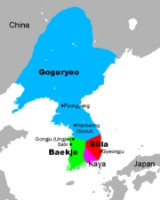
Three Kingdoms of Korea Map

Later Silla


In the 7th century Silla allied itself with the Chinese
China

China is a Culture of China, an ancient civilization, and, depending on perspective, a national or multinational entity extending over a large area in East Asia....
 Tang dynasty
Tang Dynasty

The Tang Dynasty was an Dynasties in Chinese history preceded by the Sui Dynasty and followed by the Five Dynasties and Ten Kingdoms Period. It was founded by the Li family, who seized power during the decline and collapse of the Sui Empire....
. In 660, under King Muyeol
Muyeol of Silla

King Taejong Muyeol , was the 29th monarch of the southern Korean kingdom of Silla and ruled from 654 to 661. He is credited for leading the unification of the Three Kingdoms of Korea....
 (654-661), Silla subjugated Baekje. In 668, under King Munmu (King Muyeol's successor) and the General Kim Yu-shin, Silla conquered Goguryeo to its north. Silla then fought for nearly a decade to expel Chinese forces on the peninsula intent on creating Tang colonies there to finally establish a unified kingdom as far north as modern Pyongyang. The northern region of the defunct Goguryeo state later reemerged as Balhae
Balhae

Balhae was an ancient multiethnic empire established after the fall of Goguryeo. After Goguryeo's capital and southern territories fell to Unified Silla, Dae Jo-young, a former Goguryeo general, whose father was Dae Jung-sang, established Jin , later called Balhae....
.

Silla's middle period is characterized by the rising power of the monarchy at the expense of the jingol
Bone rank system

The bone rank system was the system of Aristocracy rank used in the ancient Korean kingdom of Silla. It was used to segregate society, and particularly the layers of the aristocracy, on the basis of their hereditary proximity to the throne and the level of authority they were permitted to wield....
 nobility. This was made possible by the new wealth and prestige garnered as a result of Silla's unification of the peninsula, as well as the monarchy's successful suppression of several armed aristocratic revolts following early upon unification, which afforded the king the opportunity of purging the most powerful families and rivals to central authority. Further, for a brief period of about a century from the late 7th to late 8th centuries the monarchy made an attempt to divest aristocratic officialdom of their landed base by instituting a system of salary payments, or office land (jikjeon, ??, ??), in lieu of the former system whereby aristocratic officials were given grants of land to exploit as salary (the so–called tax villages, or nogeup, ??, ??).

By the late 8th century, however, these royal initiatives had failed to check the power of the entrenched aristocracy. The mid to late 8th century saw renewed revolts led by branches of the Kim clan which effectively limited royal authority. Most prominent of these was a revolt led by Kim Daegong that persisted for three years. One key evidence of the erosion of kingly authority was the rescinding of the office land system and the reinstitution of the former tax village system as salary land for aristocratic officialdom in 757.

The middle period of Silla came to an end with the assassination of King Hyegong
Hyegong of Silla

Hyegong of Silla was the 36th ruler of the Korean kingdom of Silla. He was the son of Gyeongdeok of Silla by Lady Manwol. Hyegong was the last descendant of Muyeol of Silla to sit on the throne....
 in 780, terminating the kingly line of succession of King Muyeol
Muyeol of Silla

King Taejong Muyeol , was the 29th monarch of the southern Korean kingdom of Silla and ruled from 654 to 661. He is credited for leading the unification of the Three Kingdoms of Korea....
, the architect of Silla's unification of the peninsula. Hyegong‘s demise was a bloody one, the culmination of an extended civil war involving most of the kingdom‘s high–ranking noble families. With Hyegong‘s death, during the remaining years of Silla the king was reduced to little more than a figurehead as powerful aristocratic families became increasingly independent of central control.

Thereafter the Silla kingship was fixed in the house of King Wonseong
Wonseong of Silla

Wonseong of Silla was the 38th to rule the Korean kingdom of Silla. He was a twelfth-generation descendant of Naemul of Silla. His father was Kim Hyo-yang, and his mother was Lady Gye-o, the daughter of Pak Chang-do....
 (785–798), though the office itself was continually contested among various branches of the Kim lineage.

Nevertheless, the middle period of Silla witnessed the state at its zenith, the brief consolidation of royal power, and the attempt to institute a Chinese style bureaucratic system.

Decline and Fall

The final century and a half of the Silla state was one of nearly constant upheaval and civil war as the king was reduced to little more than a figurehead and powerful aristocratic families rose to actual dominance outside the capital and royal court.

The tail end of this period, called the Later Three Kingdoms
Later Three Kingdoms

The Later Three Kingdoms of Korea consisted of Silla, Hubaekje , and Taebong . The latter two were viewed as heirs to the earlier Three Kingdoms of Korea, which had been united by Silla....
 period, briefly saw the emergence of the kingdoms of Later Baekje and Later Goguryeo, which were really composed of military forces capitalizing on their respective region's historic background, and Silla's submission to the Goryeo
Goryeo

The Goryeo Dynasty was a sovereign state established in 918 by Taejo of Goryeo. It united the Later Three Kingdoms in 936 and ruled most of the Korean peninsula until it was removed by the Joseon dynasty in 1392....
 dynasty.

Silla Society and Politics

From at least the 6th century, when Silla acquired a detailed system of law and governance, social status and official advancement were dictated by the bone rank system
Bone rank system

The bone rank system was the system of Aristocracy rank used in the ancient Korean kingdom of Silla. It was used to segregate society, and particularly the layers of the aristocracy, on the basis of their hereditary proximity to the throne and the level of authority they were permitted to wield....
. This rigid lineage-based system also dictated clothing, house size and the permitted range of marriage.

Since its emergence as a centralized polity Silla society had been characterized by its strict aristocratic makeup. Silla had two royal classes: "sacred bone" (seonggol, ??, ??) and "true bone" (jingol, ??, ??). Up until the reign of King Muyeol this aristocracy had been divided into "sacred bone" and "true bone" aristocrats, with the former differentiated by their eligibility to attain the kingship. This duality had ended when Queen Jindeok, the last ruler from the "sacred bone" class, died in 654. The numbers of "sacred bone" aristocrats had been decreasing, as the title was only conferred to those whose parents were both "sacred bones", whereas children of a "sacred" and a "true bone" parent were considered as "true bones".

Following unification Silla began to rely more upon Chinese models of bureaucracy to administer its greatly expanded territory. This was a marked change from pre-unification days when the Silla monarchy stressed Buddhism, and the Silla monarch's role as a "Buddha-king". Another salient factor in post-unification politics were the increasing tensions between the Korean monarchy and aristocracy.

Military

The early Silla military was built around a small number of Silla royal guards designed to protect royalty and nobility and in times of war served as the primary military force if needed. Due to the frequency of conflicts between Baekje
Baekje

Baekje , or Paekche , was a kingdom located in southwest Korea. It was one of the Three Kingdoms of Korea, together with Goguryeo and Silla....
 and Goguryeo
Goguryeo

Goguryeo or Koguryo was an ancient Koreans Empire located in the northern and central parts of the Korean peninsula, southern Manchuria, and southern Primorsky Krai....
 as well as Yamato
Yamato

Yamato is an ancient names of Japan. The term was extension to mean ?Japan? or ?Japanese? in general. As such, the Ryukyuans sometimes use this name in contrasting mainland Japan with Okinawa Prefecture, and in the Okinawan language, Yamato is called "Yamatu"....
 Japan, Silla created six local garrisons one for each district. The royal guards eventually morphed into "sworn banner" or Sodang units. In 625 another group of Sodang was created. Garrison soldiers were responsible for local defense and also served as a police force.

A number of Silla's greatest generals and military leaders were Hwarang
Hwarang

The Hwarang were an elite group of male youth in Silla, an ancient Korean kingdom that lasted until the 10th century. They were educational institutions as well as social clubs where members gathered for all aspects of study, originally for arts and culture steeped in Korean Buddhism and Korean Taoism....
. Originally a social group, due to the continuous military rivalry between the Three Kingdoms of Korea
Three Kingdoms of Korea

The Three Kingdoms of Korea refer to the ancient Korean empire of Goguryeo, and kingdom of Baekje and Silla, which dominated the Korean peninsula and parts of Manchuria for much of the 1st millennium CE....
, they eventually transformed from a group of elite male aristocratic youth into soldiers and military leaders. Hwarang were key in the fall of Goguryeo (which resulted in the unification of the Korean Peninsula
Korean Peninsula

The Korean Peninsula is a peninsula in East Asia. It extends southwards for about 684 miles from continental Asia into the Pacific Ocean and is surrounded by the Sea of Japan on the east, the East China Sea to the south, and the Yellow Sea to the west, the Korea Strait connecting the first two bodies of water....
 under Unified Silla
Unified Silla

Unified Silla or Later Silla is the name often applied to the kingdom of Silla, one of the Three Kingdoms of Korea, when it conquered Baekje in 660 and Goguryeo in 668....
) and the Silla-Tang war, which expelled Tang forces in the other two Korean kingdoms.

Culture

The capital of the Silla kingdom was Gyeongju
Gyeongju

Gyeongju is an city and one of the most popular Tourism in South Korea destinations in South Korea. It lies in the far southeastern corner of North Gyeongsang Province, on the coast of the Sea of Japan....
. A great number of Silla tombs can still be found in the centre of Gyeongju. Silla tombs took the form of a stone chamber which was surrounded by a soil mound. A great number of remains from the Silla period can be found all over Gyeongju. The historic area around Gyeongju was added to the UNESCO
UNESCO

United Nations Educational, Scientific and Cultural Organization is a specialized agency of the United Nations established on 16 November 1945....
 World Heritage list in 2000. Much of it is also protected as part of Gyeongju National Park
Gyeongju National Park

Gyeongju National Park is one of 20 national parks in South Korea. It was first designated a national park in 1968. The park covers many of the principal Silla historical sites in Gyeongju City....
. Additionally, two villages near Gyeongju area names of which are Hahoe and Yangdong would be submitted for UNESCO heritages in 2008 or later by related cities and South Korean government.

The Bronze Bell of King Seongdeok the Great attracts a large number of tourists. The bell produces a distinctive sound, about which there is a legend. Cheomseongdae
Cheomseongdae

Cheomseongdae is an astronomical observatory in Gyeongju, South Korea. Cheomseongdae means star-gazing tower in Korean language. Cheomseongdae is one of the oldest surviving observatories in East Asia, and one of the oldest scientific installations on Earth....
 near Gyeongju is the oldest extant astronomical observatory in East Asia, while some disagree on its exact functions. It was built during the reign of Queen Seondeok
Queen Seondeok of Silla

Seondeok reigned as queen regnant of Silla, one of the Three Kingdoms of Korea, from 632 to 647. She was Silla's twenty-seventh ruler, and its first reigning queen....
 (623-647).

Muslim traders brought the name "Silla" to the world outside the traditional East Asian sphere through the Silk Road
Silk Road

The Silk Road is an extensive interconnected network of trade routes across the Asian continent connecting East, South, and Western Asia with the Mediterranean world, including North Africa and Europe....
. Geographers of the Arab and Persian world, including ibn Khurdadhbih, al-Masudi, Dimashiki, al-Nuwairi, and al-Maqrizi
Al-Maqrizi

Taqi al-Din Ahmad ibn 'Ali ibn 'Abd al-Qadir ibn Muhammad al-Maqrizi ; Arabic Language: , was an Egyptian historian more commonly known as al-Maqrizi or Makrizi....
, left records about Silla.

The current descendants to the Silla dynasty fall under the Kim name. Family records since the last ruler have been provided, but these records have yet to be fully verified.

Buddhism

Buddhism was formally adopted by Silla in 527 under King Beopheung
Beopheung of Silla

King Beopheung was the 23rd monarch of Silla, one of the Three Kingdoms of Korea of Korea. He was preceded by Jijeung of Silla and succeeded by Jinheung of Silla....
, though it had been exposed to the religion for over a century during which the faith had certainly made inroads into the native populace. It was the Buddhist monk Ado who first exposed Silla to Buddhism when he arrived to proselytize from Goguryeo in the mid 5th century. However, according to legend, the Silla monarchy was convinced to adopt the faith by the martyrdom of the Silla court noble Ichadon
Ichadon

Ichadon , also known as Geochadon or by his courtesy name Yeomchok or Yeomdo, was a Buddhist monk and advisor to the Silla king Beopheung of Silla....
, who was executed for his Buddhist faith by the Silla king in 527 only to have his blood flow the color of milk.

The importance of Buddhism
Buddhism

Buddhism is a family of beliefs and practices considered by most to be a religionand is based on the teachings attributed to Siddhartha Gautama, commonly known as "The Buddha" , who was born in what is today Nepal....
 in Silla society of the late early period is difficult to exaggerate. From King Beopheung and for the following six reigns Silla kings adopted Buddhist names and came to portray themselves as Buddha–kings. Buddhism in Silla was, more so than in the case of Baekje and Goguryeo, an officially sponsored faith. Its state–protection aspects were emphasized. The Hwarang
Hwarang

The Hwarang were an elite group of male youth in Silla, an ancient Korean kingdom that lasted until the 10th century. They were educational institutions as well as social clubs where members gathered for all aspects of study, originally for arts and culture steeped in Korean Buddhism and Korean Taoism....
 corps, an elite corps of youthful warriors that would play a central role in Silla unification of the peninsula, had strong connections to Buddhism, particularly the worship of the Maitreya
Maitreya

Maitreya or Metteyya is a future Buddhahood of this world in Buddhist eschatology. In some Buddhist literature, such as the Amitabha Sutra and the Lotus Sutra, he is referred to as Ajita Bodhisattva....
 Buddha. The late early period of Silla saw Buddhism‘s apogee there. A great number of temples were built, often financed and sponsored by high ranking nobility, the most notable being Hwangyongsa, Bulguksa
Bulguksa

Bulguksa is a Buddhism temple in the North Gyeongsang province in South Korea. It is home to seven National treasures of South Korea, including Dabotap and Seokgatap stone pagodas, Cheongun-gyo , and two gilt-bronze statues of Buddha....
 and Seokguram
Seokguram

The Seokguram Grotto is a Hermitage and part of the Bulguksa temple complex. It lies four kilometers east of the temple on Mt. Tohamsan, in Gyeongju, South Korea....
. Hwangyongsa (Imperial Dragon) temple in particular emphasized the power of the monarchy and Buddhism‘s role in state protection and aggrandizement. The nine stories of its wooden pagoda, perhaps the tallest manmade structure in East Asia of the period, were said to symbolize the nine nations destined to submit to Silla rule. Silla attached great importance to the pagoda, building them of stone as well as wood.

With Silla unification Buddhism came to play a less perceptible role in politics as the monarchy attempted to adopt Chinese Confucian institutions of statecraft to govern an enlarged state and to curb the power of the aristocratic families. Nevertheless, Buddhism still enjoyed a central place in larger Silla society. Hundreds of Silla monks traveled to Tang China in search of education and for the procurement of much needed Buddhism sutras.

Silla‘s strong Buddhist nature is also reflected by the thousands of remnant Buddhist stone figures and carvings, mostly importantly on Namsan
Namsan (Gyeongju)

Namsan is a 494-meter peak in the heart of Gyeongju National Park, just south of Gyeongju, South Korea. The mountain is within easy reach from the city and attracts a large number of national tourists....
.

Gallery


See also

  • List of Silla people
    List of Silla people

    This is a partial list of people who lived in Silla, 57 BCE - 935 CE....


External links