

Baronet

Encyclopedia
A baronet or the rare female equivalent, a baronetess (abbreviation Btss), is the holder of a hereditary baronetcy awarded by the British Crown. The practice of awarding baronetcies was originally introduced in England and Ireland by James I of England
in 1611 in order to raise funds, and is now practically obsolete as hereditary honours are generally no longer recommended.
A baronetcy is the only hereditary honour which is not a peerage
; baronets are commoners. A baronet is styled "Sir" like a knight, but ranks above all knighthoods except for the Order of the Garter
and, in Scotland, the Order of the Thistle
. A baronetcy is not a knighthood and the recipient does not receive an accolade
.
According to The Official Roll of the Baronetage:
The term baronet was applied to the noblemen who lost the right of individual summons to Parliament, and was used in this sense in a statute of Richard II
. A similar rank of lower stature is the banneret.
The revival of baronetcies can be dated to Sir Robert Cotton
's discovery in the late 16th or early 17th century of William de la Pole's patent
(issued in the 13th year of Edward III
's reign), conferring upon him the dignity of a baronet in return for a sum of money.
Subsequent baronetcies fall into the following five creations:
 Since 1965 only one new baronetcy has been created, that for the husband of former Prime Minister Margaret Thatcher
(now Baron
ess Thatcher), Sir Denis Thatcher
. Their eldest son, Sir Mark Thatcher
became the 2nd Baronet, upon the death of his father in 2003.
" before their Christian name. Baronetesses in their own right use "Dame
", while wives of baronets use "Lady
", followed by the husband's surname, by longstanding courtesy. However, unlike knighthoods - which apply to an individual only - a baronetcy is hereditary. The eldest son of a baronet who is born in wedlock succeeds to the baronetcy upon the death of his father, but he will not be officially recognised until his name is on the Roll. With a few exceptions granted at creation by special remainder in the Letters Patent, baronetcies can be inherited only by or through males. Wives of baronets are not baronetesses; only females holding baronetcies in their own right are baronetesses.
A full list of extant baronets appears in Burke's Peerage and Baronetage, which also covers some extinct baronetcies.
A baronetcy is not a peerage, so baronets, like knights, are commoners as opposed to noblemen. According to the Home Office there is a tangible benefit to the honour. According to law, a baronet is entitled to have "a pall supported by two men, a principal mourner and four others" assisting at his funeral. Originally baronets also had other rights, including the right to have the eldest son knighted on his 21st birthday. However, beginning in the reign of George IV
, these rights have been gradually revoked by Order in Privy Council
on the grounds that sovereigns should not be bound by acts made by their predecessors.
Baronets of Scotland
or Nova Scotia
were granted the Arms of Nova Scotia in their armorial bearings and the right to wear about the neck the badge of Nova Scotia, suspended by an orange-tawny ribbon. This consists of an escutcheon argent with a saltire azure thereon, an inescutcheon of the arms of Scotland
, with an Imperial Crown above the escutcheon, and encircled with the motto Fax mentis Honestae Gloria. This Badge may be shown suspended by the ribbon below the shield of arms.
Baronets of England
and Ireland
applied to King Charles I
for permission to wear a badge. Although a badge was worn in the 17th century, it was not until 1929 that King George V
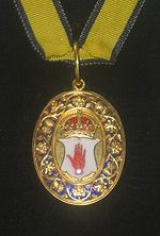
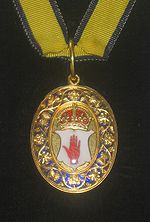
granted permission for all baronets (other than those of Scotland) to wear a badge.
as a canton
or inescutcheon in armorial bearings, argent
a sinister hand couped at the wrist and erect gules
, known as the Badge of Ulster (although the Ulster hand is dexter).
" (using his forename). The correct style on an envelope for a baronet who has no other titles is "Sir , Bt." or "Sir , Bart." The letter would commence: "Dear Sir ".
The wife of a baronet is addressed and referred to as "Lady"; at the head of a letter as "Dear Lady ". Her given name is used only when necessary to distinguish between two holders of the same title. For example, if a baronet has died and the title has passed to his son, the widow (the new baronet's mother) will remain "Lady " if he is unmarried, but if he is married his wife becomes "Lady " while his mother will be known by the style ", Lady ". Alternatively, the mother may prefer to be known as "The Dowager
Lady". A previous wife will also become ", Lady Bloggs" to distinguish her from the current wife of the incumbent baronet. She would not be "Lady ", a style which is reserved for the daughters of peers
.
In 1976 Lord Lyon
said that, without examining the Patent of every Scottish Baronetcy, he was not in a position to confirm that only these four can pass through the female line.
Leigh Rayment's online baronetage page lists a fifth baronetess, (Dame) Emilia Stuart Belshes, third holder of the Wishart baronetcy of Clifton Hall of Edinburgh
. The page calls her heir general and says she "was apparently allowed to succeed", later saying "Assuming she did succeed, [...]".
, Btss" on the envelope. At the head of the letter, one would write "Dear Dame ," and to refer to her, you would say "Dame " or "Dame " (never "Dame ").
. So, for example, there are Baronetcies Moore of Colchester, Moore of Hancox, Moore of Kyleburn and Moore of Moore Lodge.
, Pearson of Gressingham
, Finlay of Epping
and Thatcher of Scotney
). It showed the total number created from 1611 to 1964 to have been 3482. They include five of Oliver Cromwell
, several of which were recreated by Charles II
. Twenty-five were created between 1688 and 1784 by James II
in exile after his dethronement, by his son James Stuart ("The Old Pretender")
and his grandson Charles Edward Stuart ("Bonny Prince Charlie")
. These Jacobite baronetcies were never accepted by the English Crown, have all disappeared and should properly be excluded from the 3,482, making the effective number of creations 3,457. A close examination of Parry's publication shows he missed one or two, so there have evidently been some more.
The total number of baronetcies today is approximately 1,380, although only some 1,300 are on the Official Roll. It is unknown whether some baronetcies remain extant and it may be that nobody can prove himself to be the heir incumbent. Over 200 baronetcies are now held by peers and others, such as the Knox line, have been made tenuous due to internal family dispute.
) in the United Kingdom Order of Precedence
.
The current holder of the title is Sir Nicholas Bacon, 14th Baronet
, whose title was created by King James I
in 1611.
of Gordonstoun and Letterfourie until the extinction of that title in 1908. Following then, the Premier Scottish Baronets were the Innes Baronets
of that Ilk (cr. 28th May 1625).
The current holder of the title is Guy Innes-Ker, 10th Duke of Roxburghe
.
in 1619, and was held by his successors until the attainder of the 4th Viscount Sarsfield
in 1691. Since then the descendants of Sir Francis Annesley Bt.
, the Annesley Baronets have been the Premier Baronets of Ireland.
The current holder of the title is Francis William Dighton Annesley, 16th Viscount Valentia.
The practice ended as a result of the Nickle Resolution.
James I of England
James VI and I was King of Scots as James VI from 24 July 1567 and King of England and Ireland as James I from the union of the English and Scottish crowns on 24 March 1603...
in 1611 in order to raise funds, and is now practically obsolete as hereditary honours are generally no longer recommended.
A baronetcy is the only hereditary honour which is not a peerage
Peerage
The Peerage is a legal system of largely hereditary titles in the United Kingdom, which constitute the ranks of British nobility and is part of the British honours system...
; baronets are commoners. A baronet is styled "Sir" like a knight, but ranks above all knighthoods except for the Order of the Garter
Order of the Garter
The Most Noble Order of the Garter, founded in 1348, is the highest order of chivalry, or knighthood, existing in England. The order is dedicated to the image and arms of St...
and, in Scotland, the Order of the Thistle
Order of the Thistle
The Most Ancient and Most Noble Order of the Thistle is an order of chivalry associated with Scotland. The current version of the Order was founded in 1687 by King James VII of Scotland who asserted that he was reviving an earlier Order...
. A baronetcy is not a knighthood and the recipient does not receive an accolade
Accolade
In the Middle Ages, the accolade was the central act in the rite-of-passage ceremonies conferring knighthood.-Ceremony:...
.
History of the term
The term baronet is of medieval origin. Sir Thomas de la More, describing the Battle of Battenberg (1321), mentioned that baronets took part, along with barons and knights.According to The Official Roll of the Baronetage:
- "the BaronetageStanding Council of the BaronetageThe Standing Council of the Baronetage is a United Kingdom organisation which deals with the affairs of baronets. It was first established in January 1898 as Honourable Society of the Baronetage...
is of far more ancient origin than many people may think. The term baronet is believed to have been first applied to nobilityNobilityNobility is a social class which possesses more acknowledged privileges or eminence than members of most other classes in a society, membership therein typically being hereditary. The privileges associated with nobility may constitute substantial advantages over or relative to non-nobles, or may be...
who for one reason or another had lost the right of summons to Parliament. The earliest mention of baronets was in the Battle of Barrenberg in 1321. There is a further mention of them in 1328 when Edward III is known to have created eight baronets. Further creations were made in 1340, 1446 and 1551. At least one of these, Sir William de la Pole in 1340, was created for payment of money, presumably expended by the King to help maintain his army. It is not known if these early creations were hereditary but all seem to have died out.
- "The present hereditary Order of Baronets in EnglandEnglandEngland is a country that is part of the United Kingdom. It shares land borders with Scotland to the north and Wales to the west; the Irish Sea is to the north west, the Celtic Sea to the south west, with the North Sea to the east and the English Channel to the south separating it from continental...
dates from 22 May 1611 when it was erected by James IJames I of EnglandJames VI and I was King of Scots as James VI from 24 July 1567 and King of England and Ireland as James I from the union of the English and Scottish crowns on 24 March 1603...
who granted the first Letters PatentLetters patentLetters patent are a type of legal instrument in the form of a published written order issued by a monarch or president, generally granting an office, right, monopoly, title, or status to a person or corporation...
to 200 gentlemen of good birth with an income of at least £1000 a year. His intention was two fold. Firstly he wanted to fill the gap between peers of the realm and knights so he decided that the baronets were to form the sixth division of the aristocracy following the five degrees of the peerage. Secondly, and probably more importantly, he needed money to pay for soldiers to carry out the pacification of IrelandIrelandIreland is an island to the northwest of continental Europe. It is the third-largest island in Europe and the twentieth-largest island on Earth...
. Therefore those of the first creation, in return for the honour, were each required to pay for the upkeep of thirty soldiers for three years amounting to £1095, in those days a very large sum.
- "In 1619 James I erected the Baronetage of Ireland and laid plans for a further new Baronetage with the object of assisting the colonisation of Nova ScotiaNova ScotiaNova Scotia is one of Canada's three Maritime provinces and is the most populous province in Atlantic Canada. The name of the province is Latin for "New Scotland," but "Nova Scotia" is the recognized, English-language name of the province. The provincial capital is Halifax. Nova Scotia is the...
. However in 1624 he died before this could be implemented. In 1625 Charles ICharles I of EnglandCharles I was King of England, King of Scotland, and King of Ireland from 27 March 1625 until his execution in 1649. Charles engaged in a struggle for power with the Parliament of England, attempting to obtain royal revenue whilst Parliament sought to curb his Royal prerogative which Charles...
took up the previous plans and erected the Baronetage of ScotlandScotlandScotland is a country that is part of the United Kingdom. Occupying the northern third of the island of Great Britain, it shares a border with England to the south and is bounded by the North Sea to the east, the Atlantic Ocean to the north and west, and the North Channel and Irish Sea to the...
and Nova Scotia. The new baronets were each required to pay 2000 marks or to support six settlers for two years. Over a hundred of these baronetcies, now known as Scottish baronetcies, have survived to this day. The Duke of RoxburgheDuke of RoxburgheThe Duke of Roxburghe is a title in the peerage of Scotland created in 1707 along with the titles Marquess of Bowmont and Cessford, Earl of Kelso and Viscount Broxmouth. John Ker, 5th Earl of Roxburghe became the first holder of these titles...
is the Premier Baronet of Scotland by his Baronetcy of Innes-Ker of Innes created in 1625.
- "As a result of the union of England and Scotland in 1707 all future creations were styled Baronets of Great Britain. With the union of Great Britain and Ireland in 1801 new creations were styled as Baronets of the United KingdomUnited KingdomThe United Kingdom of Great Britain and Northern IrelandIn the United Kingdom and Dependencies, other languages have been officially recognised as legitimate autochthonous languages under the European Charter for Regional or Minority Languages...
. The position at 31 December 1999, including baronetcies where succession was dormant or unproven, was that there were a total of 1314 baronetcies divided into five classes of creation included on the Official Roll. Of these there were 146 of England, 63 of Ireland, 119 of Scotland, 133 of Great Britain and 853 of the United Kingdom. The Premier Baronet is Sir Nicholas BaconSir Nicholas Bacon, 14th BaronetSir Nicholas Hickman Ponsonby Bacon, 14th and 15th Baronet, OBE DL , is a British landowner, businessman and philanthropist. Sir Nicholas is also the Premier Baronet of England.-Life and education:...
, 14th Baronet of Redgrave created in 1611.
- "Under the two Royal WarrantRoyal WarrantRoyal warrants of appointment have been issued for centuries to those who supply goods or services to a royal court or certain royal personages. The warrant enables the supplier to advertise the fact that they supply to the royal family, so lending prestige to the supplier...
s of 1612 and 1613 issued by James I certain privileges were accorded to baronets of England. Firstly, no person or persons should have place between baronets and the younger sons of peers. Secondly, the right of knighthood was established for the eldest sons of baronets, this was to be revoked by George IVGeorge IV of the United KingdomGeorge IV was the King of the United Kingdom of Great Britain and Ireland and also of Hanover from the death of his father, George III, on 29 January 1820 until his own death ten years later...
in 1827, and thirdly baronets were allowed to add the Arms of UlsterUlsterUlster is one of the four provinces of Ireland, located in the north of the island. In ancient Ireland, it was one of the fifths ruled by a "king of over-kings" . Following the Norman invasion of Ireland, the ancient kingdoms were shired into a number of counties for administrative and judicial...
as an inescutcheon to their armorial bearings. This last consisted of "in a field Argent, a hand Geules, or a bloudy hand". These privileges were extended to baronets of Ireland and, less the Arms of Ulster, to baronets of Scotland. They continue to this day for all baronets of Great Britain and the United Kingdom created subsequently."
The term baronet was applied to the noblemen who lost the right of individual summons to Parliament, and was used in this sense in a statute of Richard II
Richard II of England
Richard II was King of England, a member of the House of Plantagenet and the last of its main-line kings. He ruled from 1377 until he was deposed in 1399. Richard was a son of Edward, the Black Prince, and was born during the reign of his grandfather, Edward III...
. A similar rank of lower stature is the banneret.
The revival of baronetcies can be dated to Sir Robert Cotton
Robert Bruce Cotton
Sir Robert Bruce Cotton, 1st Baronet was an English antiquarian and Member of Parliament, founder of the important Cotton library....
's discovery in the late 16th or early 17th century of William de la Pole's patent
Patent
A patent is a form of intellectual property. It consists of a set of exclusive rights granted by a sovereign state to an inventor or their assignee for a limited period of time in exchange for the public disclosure of an invention....
(issued in the 13th year of Edward III
Edward III of England
Edward III was King of England from 1327 until his death and is noted for his military success. Restoring royal authority after the disastrous reign of his father, Edward II, Edward III went on to transform the Kingdom of England into one of the most formidable military powers in Europe...
's reign), conferring upon him the dignity of a baronet in return for a sum of money.
Subsequent baronetcies fall into the following five creations:
- King James I erected the hereditary Order of Baronets in EnglandEnglandEngland is a country that is part of the United Kingdom. It shares land borders with Scotland to the north and Wales to the west; the Irish Sea is to the north west, the Celtic Sea to the south west, with the North Sea to the east and the English Channel to the south separating it from continental...
on 22 May 1611 for the settlement of IrelandIrelandIreland is an island to the northwest of continental Europe. It is the third-largest island in Europe and the twentieth-largest island on Earth...
. He offered the dignity to 200 gentlemen of good birth, with a clear estate of £Pound sterlingThe pound sterling , commonly called the pound, is the official currency of the United Kingdom, its Crown Dependencies and the British Overseas Territories of South Georgia and the South Sandwich Islands, British Antarctic Territory and Tristan da Cunha. It is subdivided into 100 pence...
1,000 a year, on condition that each one paid a sum equivalent to three years' pay for 30 soldiers at 8d£sd£sd was the popular name for the pre-decimal currencies used in the Kingdom of England, later the United Kingdom, and ultimately in much of the British Empire...
per day per man into the King's ExchequerExchequerThe Exchequer is a government department of the United Kingdom responsible for the management and collection of taxation and other government revenues. The historical Exchequer developed judicial roles...
. The idea came from the Earl of SalisburyEarl of SalisburyEarl of Salisbury is a title that has been created several times in British history. It has a complex history, being first created for Patrick de Salisbury in the middle twelfth century. It was eventually inherited by Alice, wife of Thomas, Earl of Lancaster...
, who averred: "The Honour will do the Gentry very little Harm," while doing the Exchequer a lot of good. - The Baronetage of Ireland was erected on 30 September 1611.
- King Charles ICharles I of EnglandCharles I was King of England, King of Scotland, and King of Ireland from 27 March 1625 until his execution in 1649. Charles engaged in a struggle for power with the Parliament of England, attempting to obtain royal revenue whilst Parliament sought to curb his Royal prerogative which Charles...
erected the hereditary Baronetage of ScotlandScotlandScotland is a country that is part of the United Kingdom. Occupying the northern third of the island of Great Britain, it shares a border with England to the south and is bounded by the North Sea to the east, the Atlantic Ocean to the north and west, and the North Channel and Irish Sea to the...
or Nova ScotiaNova ScotiaNova Scotia is one of Canada's three Maritime provinces and is the most populous province in Atlantic Canada. The name of the province is Latin for "New Scotland," but "Nova Scotia" is the recognized, English-language name of the province. The provincial capital is Halifax. Nova Scotia is the...
on 28 May 1625, for the establishment of the plantation of Nova Scotia. - After the union of England and Scotland in 1707, no further Baronets of England or Scotland were created, the style being changed to Baronet of Great BritainKingdom of Great BritainThe former Kingdom of Great Britain, sometimes described as the 'United Kingdom of Great Britain', That the Two Kingdoms of Scotland and England, shall upon the 1st May next ensuing the date hereof, and forever after, be United into One Kingdom by the Name of GREAT BRITAIN. was a sovereign...
. - After the union of Great Britain and IrelandAct of Union 1800The Acts of Union 1800 describe two complementary Acts, namely:* the Union with Ireland Act 1800 , an Act of the Parliament of Great Britain, and...
on 1 January 1801 to create the United Kingdom of Great Britain and IrelandUnited KingdomThe United Kingdom of Great Britain and Northern IrelandIn the United Kingdom and Dependencies, other languages have been officially recognised as legitimate autochthonous languages under the European Charter for Regional or Minority Languages...
, all baronetcies created were under the style of the United Kingdom.
Margaret Thatcher
Margaret Hilda Thatcher, Baroness Thatcher, was Prime Minister of the United Kingdom from 1979 to 1990...
(now Baron
Baron
Baron is a title of nobility. The word baron comes from Old French baron, itself from Old High German and Latin baro meaning " man, warrior"; it merged with cognate Old English beorn meaning "nobleman"...
ess Thatcher), Sir Denis Thatcher
Denis Thatcher
Major Sir Denis Thatcher, 1st Baronet, MBE, TD was a British businessman, and the husband of the former British Prime Minister, Margaret Thatcher. He was born in Lewisham, London, the elder child of a New Zealand-born British businessman, Thomas Herbert Thatcher, and his wife Kathleen, née Bird...
. Their eldest son, Sir Mark Thatcher
Mark Thatcher
Sir Mark Thatcher, 2nd Baronet is the son of Sir Denis Thatcher and Baroness Thatcher, the former British Prime Minister, and twin brother of Carol Thatcher...
became the 2nd Baronet, upon the death of his father in 2003.
Conventions
Like knights, baronets use the style "SirSir
Sir is an honorific used as a title , or as a courtesy title to address a man without using his given or family name in many English speaking cultures...
" before their Christian name. Baronetesses in their own right use "Dame
Dame (title)
The title of Dame is the female equivalent of the honour of knighthood in the British honours system . It is also the equivalent form address to 'Sir' for a knight...
", while wives of baronets use "Lady
Lady
The word lady is a polite term for a woman, specifically the female equivalent to, or spouse of, a lord or gentleman, and in many contexts a term for any adult woman...
", followed by the husband's surname, by longstanding courtesy. However, unlike knighthoods - which apply to an individual only - a baronetcy is hereditary. The eldest son of a baronet who is born in wedlock succeeds to the baronetcy upon the death of his father, but he will not be officially recognised until his name is on the Roll. With a few exceptions granted at creation by special remainder in the Letters Patent, baronetcies can be inherited only by or through males. Wives of baronets are not baronetesses; only females holding baronetcies in their own right are baronetesses.
A full list of extant baronets appears in Burke's Peerage and Baronetage, which also covers some extinct baronetcies.
A baronetcy is not a peerage, so baronets, like knights, are commoners as opposed to noblemen. According to the Home Office there is a tangible benefit to the honour. According to law, a baronet is entitled to have "a pall supported by two men, a principal mourner and four others" assisting at his funeral. Originally baronets also had other rights, including the right to have the eldest son knighted on his 21st birthday. However, beginning in the reign of George IV
George IV of the United Kingdom
George IV was the King of the United Kingdom of Great Britain and Ireland and also of Hanover from the death of his father, George III, on 29 January 1820 until his own death ten years later...
, these rights have been gradually revoked by Order in Privy Council
Privy council
A privy council is a body that advises the head of state of a nation, typically, but not always, in the context of a monarchic government. The word "privy" means "private" or "secret"; thus, a privy council was originally a committee of the monarch's closest advisors to give confidential advice on...
on the grounds that sovereigns should not be bound by acts made by their predecessors.
Baronets of Scotland
Scotland
Scotland is a country that is part of the United Kingdom. Occupying the northern third of the island of Great Britain, it shares a border with England to the south and is bounded by the North Sea to the east, the Atlantic Ocean to the north and west, and the North Channel and Irish Sea to the...
or Nova Scotia
Nova Scotia
Nova Scotia is one of Canada's three Maritime provinces and is the most populous province in Atlantic Canada. The name of the province is Latin for "New Scotland," but "Nova Scotia" is the recognized, English-language name of the province. The provincial capital is Halifax. Nova Scotia is the...
were granted the Arms of Nova Scotia in their armorial bearings and the right to wear about the neck the badge of Nova Scotia, suspended by an orange-tawny ribbon. This consists of an escutcheon argent with a saltire azure thereon, an inescutcheon of the arms of Scotland
Scotland
Scotland is a country that is part of the United Kingdom. Occupying the northern third of the island of Great Britain, it shares a border with England to the south and is bounded by the North Sea to the east, the Atlantic Ocean to the north and west, and the North Channel and Irish Sea to the...
, with an Imperial Crown above the escutcheon, and encircled with the motto Fax mentis Honestae Gloria. This Badge may be shown suspended by the ribbon below the shield of arms.
Baronets of England
England
England is a country that is part of the United Kingdom. It shares land borders with Scotland to the north and Wales to the west; the Irish Sea is to the north west, the Celtic Sea to the south west, with the North Sea to the east and the English Channel to the south separating it from continental...
and Ireland
Ireland
Ireland is an island to the northwest of continental Europe. It is the third-largest island in Europe and the twentieth-largest island on Earth...
applied to King Charles I
Charles I of England
Charles I was King of England, King of Scotland, and King of Ireland from 27 March 1625 until his execution in 1649. Charles engaged in a struggle for power with the Parliament of England, attempting to obtain royal revenue whilst Parliament sought to curb his Royal prerogative which Charles...
for permission to wear a badge. Although a badge was worn in the 17th century, it was not until 1929 that King George V
George V of the United Kingdom
George V was King of the United Kingdom and the British Dominions, and Emperor of India, from 6 May 1910 through the First World War until his death in 1936....
granted permission for all baronets (other than those of Scotland) to wear a badge.
The left hand
Baronets were granted the Arms of UlsterUlster
Ulster is one of the four provinces of Ireland, located in the north of the island. In ancient Ireland, it was one of the fifths ruled by a "king of over-kings" . Following the Norman invasion of Ireland, the ancient kingdoms were shired into a number of counties for administrative and judicial...
as a canton
Canton (heraldry)
Canton is a square charge placed in the upper dexter corner. It is classed by some heraldic writers as one of the honorable ordinaries; but, strictly speaking, it is a diminutive of the Quarter, being two-thirds the area of that ordinary. However, in the roll of Henry III the quarter appears in...
or inescutcheon in armorial bearings, argent
Argent
In heraldry, argent is the tincture of silver, and belongs to the class of light tinctures, called "metals". It is very frequently depicted as white and usually considered interchangeable with it...
a sinister hand couped at the wrist and erect gules
Gules
In heraldry, gules is the tincture with the colour red, and belongs to the class of dark tinctures called "colours". In engraving, it is sometimes depicted as a region of vertical lines or else marked with gu. as an abbreviation....
, known as the Badge of Ulster (although the Ulster hand is dexter).
The Badge may be shown suspended by its riband below the shield of arms.
Somewhere along the line a mistake has been made, as the Red Hand of UlsterRed Hand of UlsterThe Red Hand of Ulster is a symbol used in heraldry to denote the Irish province of Ulster. It is less commonly known as the Red Hand of O'Neill. Its origins are said to be attributed to the mythical Irish figure Labraid Lámh Dhearg , and appear in other mythical tales passed down from generation...
is definitely a dexter or right one.
The Baronets' Badge was created by Royal WarrantRoyal WarrantRoyal warrants of appointment have been issued for centuries to those who supply goods or services to a royal court or certain royal personages. The warrant enables the supplier to advertise the fact that they supply to the royal family, so lending prestige to the supplier...
of George V, dated 13 April 1929. The relevant part of the text is as follows:
"A shield of the Arms of Ulster on a silver field, viz. on a silver field a left hand Gules surmounted by an Imperial CrownImperial crownAn Imperial Crown is a crown used for the coronation of emperors.- Imperial Crowns with Mitre :-Legal usage:Throughout the Commonwealth Realms, The Crown is an abstract concept which represents the legal authority for the existence of any government...
enamelled in its proper colours the whole enclosed by an oval border embossed with gilt scrollwork having a design of roses, of shamrocks and of roses and thistles combined for those Baronets who were created Baronets of England, of Ireland and of Great Britain respectively and for all other Baronets other than Baronets of Scotland a design of roses, thistles and shamrocks combined such Badge to be suspended from an orange riband with a narrow edge of dark blue on both sides the total breadth of the riband to be one inch and three quarters and the breadth of each edge to be one quarter of an inch."
Addressing a baronet
A baronet is referred to and addressed as, for example, "SirThe wife of a baronet is addressed and referred to as "Lady
Dowager
A dowager is a widow who holds a title or property, or dower, derived from her deceased husband. As an adjective, "Dowager" usually appears in association with monarchical and aristocratic titles....
Lady
Peerage
The Peerage is a legal system of largely hereditary titles in the United Kingdom, which constitute the ranks of British nobility and is part of the British honours system...
.
Baronetesses
There have been only four baronetesses:- Dame Daisy Dunbar, 8th Btss of Hempriggs (1906–97), cr.1706
- Dame Mary Bolles, 1st Btss (1579–1662); the only woman to be created a baronetess. Her grandson succeeded to the title, after which it died out.
- Dame Eleanor Dalyell, 10th BtssDalyell BaronetsThe Dalyell Baronetcy is a baronetcy in the Baronetage of Nova Scotia, which was created 7 November 1685 for the Scottish General, Thomas Dalyell of the Binns. The succession of the title is interesting in that it was created with remainder to his eldest son and heirs male, yet failing that, could...
(1895–1972) (cr.1685), whose title passed to her son, the LabourLabour Party (UK)The Labour Party is a centre-left democratic socialist party in the United Kingdom. It surpassed the Liberal Party in general elections during the early 1920s, forming minority governments under Ramsay MacDonald in 1924 and 1929-1931. The party was in a wartime coalition from 1940 to 1945, after...
politician Tam DalyellTam DalyellSir Thomas Dalyell Loch, 11th Baronet , known as Tam Dalyell, is a British Labour Party politician, who was a Member of Parliament in the House of Commons from 1962 to 2005, first for West Lothian and then for Linlithgow.-Early life:...
. - Dame Anne Maxwell Macdonald, 11th BtssStirling-Maxwell BaronetsThe Maxwell, later Stirling-Maxwell Baronetcy, of Pollock in the County of Renfrew, is a title in the Baronetage of Nova Scotia. It was created on 12 April 1682 for John Maxwell, with remainder to the heirs of the body. In 1707 he was given a new patent extending the remainder to heirs of entail in...
(1906-2011) was recognised by Lyon Court in 2005 as 11th holder of the baronetcy (formerly Stirling-Maxwell) under the 1707 remainder and succeeded her father in 1956.
In 1976 Lord Lyon
Lord Lyon King of Arms
The Lord Lyon King of Arms, the head of Lyon Court, is the most junior of the Great Officers of State in Scotland and is the Scottish official with responsibility for regulating heraldry in that country, issuing new grants of arms, and serving as the judge of the Court of the Lord Lyon, the oldest...
said that, without examining the Patent of every Scottish Baronetcy, he was not in a position to confirm that only these four can pass through the female line.
Leigh Rayment's online baronetage page lists a fifth baronetess, (Dame) Emilia Stuart Belshes, third holder of the Wishart baronetcy of Clifton Hall of Edinburgh
Wishart Baronets
Wishart Baronets of Clifton Hall,Edinburgh. Created in the Baronetage of Nova Scotia 17 June 1706 for George Wishart.* Sir George Wishart, 1st Baronet. Died by 1722* Sir William Stuart, 2nd Baronet. Died 6 Dec 1777....
. The page calls her heir general and says she "was apparently allowed to succeed", later saying "Assuming she did succeed, [...]".
Addressing a baronetess
For baronetess, one should write "DameTerritorial designations
All Baronetcies are distinguished by having a territorial designationTerritorial designation
A territorial designation follows modern peerage titles, linking them to a specific place or places. It is also an integral part of all baronetcies...
. So, for example, there are Baronetcies Moore of Colchester, Moore of Hancox, Moore of Kyleburn and Moore of Moore Lodge.
The number of baronetcies
The first publication listing all baronetcies ever created was C.J. Parry's Index of Baronetcy Creations (1967). This listed them in alphabetical order, other than the last five creations (Dodd of West Chillington, Redmayne of RushcliffeRedmayne Baronets
The Redmayne Baronetcy of Rushcliffe in the County of Nottingham, is a title in the Baronetage of the United Kingdom. It was created on 29 December 1964 for the Conservative politician Martin Redmayne. In 1966 he was created a life peer as Baron Redmayne of Rushcliffe in the County of Nottingham,...
, Pearson of Gressingham
Pearson Baronets
There have been three Baronetcies for persons with the surname Pearson, all in the Baronetage of the United Kingdom. Two of the creations are extant as of 2010....
, Finlay of Epping
Finlay Baronets
The Finlay Baronetcy, of Epping in the County of Essex, is a title in the Baronetage of the United Kingdom. It was created on 31 December 1964 for the Conservative politician Graeme Finlay. He had previously represented Epping in the House of Commons...
and Thatcher of Scotney
Thatcher Baronets
The Thatcher Baronetcy, of Scotney in the County of Kent, is a title in the Baronetage of the United Kingdom. It was created on 7 December 1990 for the businessman Denis Thatcher, the husband of Margaret Thatcher, Conservative Prime Minister from 1979 to 1990. His wife was created a life peer as...
). It showed the total number created from 1611 to 1964 to have been 3482. They include five of Oliver Cromwell
Oliver Cromwell
Oliver Cromwell was an English military and political leader who overthrew the English monarchy and temporarily turned England into a republican Commonwealth, and served as Lord Protector of England, Scotland, and Ireland....
, several of which were recreated by Charles II
Charles II of England
Charles II was monarch of the three kingdoms of England, Scotland, and Ireland.Charles II's father, King Charles I, was executed at Whitehall on 30 January 1649, at the climax of the English Civil War...
. Twenty-five were created between 1688 and 1784 by James II
James II of England
James II & VII was King of England and King of Ireland as James II and King of Scotland as James VII, from 6 February 1685. He was the last Catholic monarch to reign over the Kingdoms of England, Scotland, and Ireland...
in exile after his dethronement, by his son James Stuart ("The Old Pretender")
James Francis Edward Stuart
James Francis Edward, Prince of Wales was the son of the deposed James II of England...
and his grandson Charles Edward Stuart ("Bonny Prince Charlie")
Charles Edward Stuart
Prince Charles Edward Louis John Casimir Sylvester Severino Maria Stuart commonly known as Bonnie Prince Charlie or The Young Pretender was the second Jacobite pretender to the thrones of Great Britain , and Ireland...
. These Jacobite baronetcies were never accepted by the English Crown, have all disappeared and should properly be excluded from the 3,482, making the effective number of creations 3,457. A close examination of Parry's publication shows he missed one or two, so there have evidently been some more.
The total number of baronetcies today is approximately 1,380, although only some 1,300 are on the Official Roll. It is unknown whether some baronetcies remain extant and it may be that nobody can prove himself to be the heir incumbent. Over 200 baronetcies are now held by peers and others, such as the Knox line, have been made tenuous due to internal family dispute.
Some Notable baronets
- Sir Thomas AdamsSir Thomas Adams, 1st BaronetSir Thomas Adams, 1st Baronet was the Lord Mayor of the City of London and a Member of Parliament for the City of London from 1654–1655 and 1656-1658.-Early life:...
, 1st Bt, (Lord Mayor of London, endowed an Arabic chair at Cambridge University) (1586–1667/68) - Sir Nicholas L'EstrangeNicholas L'EstrangeSir Nicholas le Strange was an English Member of Parliament . The son of Sir Thomas Le Strange, he was knighted in 1547. He was appointed as steward of the manors of the Duchess of Richmond in 1546, and also Chamberlain to the Duke of Norfolk...
, 1st Bt (MP and Chamberlain to the Duke of Norfolk (1604-1655)descended from Roger le Strange, 5th Baron Strange de/of Knockin (c. 1326–1392) and John Hastings, de jure 15th Baron Hastings (1531–1542) - Sir Hamon L'EstrangeHamon L'EstrangeHamon L'Estrange was an English writer on history, theology and liturgy, of Calvinist views, loyal both to Charles I and the Church of England. Along with Edward Stephens, he contributed to the seventeenth-century revival of interest in ancient liturgies; with John Cosin and Anthony Sparrow he...
, 2nd Bt (1631-1656) - Sir Nicholas L'EstrangeNicholas L'EstrangeSir Nicholas le Strange was an English Member of Parliament . The son of Sir Thomas Le Strange, he was knighted in 1547. He was appointed as steward of the manors of the Duchess of Richmond in 1546, and also Chamberlain to the Duke of Norfolk...
, 3rd Bt (1632-1669) - Sir Nicholas L'EstrangeNicholas L'EstrangeSir Nicholas le Strange was an English Member of Parliament . The son of Sir Thomas Le Strange, he was knighted in 1547. He was appointed as steward of the manors of the Duchess of Richmond in 1546, and also Chamberlain to the Duke of Norfolk...
, 4th Bt (1661-1724) - Sir Roger L'EstrangeRoger L'EstrangeSir Roger L'Estrange was an English pamphleteer and author, and staunch defender of royalist claims. L'Estrange was involved in political controversy throughout his life...
, 7th Bt (d. 1762)Surveyor of the Imprimery (Printing Press)and Licenser of the Press - Sir Crispin Agnew of LochnawCrispin Agnew of LochnawMajor Sir Crispin Hamlyn Agnew of Lochnaw, 11th Baronet QC is an Advocate, officer of arms former explorer and Chief of the Name and Arms of Agnew....
, 11th Bt (Chief of Clan Agnew, Her Majesty's Rothesay Herald of ArmsRothesay HeraldRothesay Herald of Arms in Ordinary is a current Scottish herald of arms in Ordinary of the Court of the Lord Lyon.The office was created after 1398 when the dukedom of Rothesay was conferred on David, eldest son of King Robert III, on 28 April 1398...
) (born 1944) - Sir Robert Baden-Powell, 1st Bt (founder of the world ScoutingScoutingScouting, also known as the Scout Movement, is a worldwide youth movement with the stated aim of supporting young people in their physical, mental and spiritual development, that they may play constructive roles in society....
movement) (1857–1941) - Sir James Matthew Barrie, 1st Bt (J M Barrie, Scottish author, creator of Peter PanPeter PanPeter Pan is a character created by Scottish novelist and playwright J. M. Barrie . A mischievous boy who can fly and magically refuses to grow up, Peter Pan spends his never-ending childhood adventuring on the small island of Neverland as the leader of his gang the Lost Boys, interacting with...
) (1860–1937) - Sir Michael Hicks Beach, 1st Earl St Aldwyn, 9th Bt (Conservative politician, Chancellor of the Exchequer)
- Sir Thomas BeechamThomas BeechamSir Thomas Beecham, 2nd Baronet CH was an English conductor and impresario best known for his association with the London Philharmonic and the Royal Philharmonic orchestras. He was also closely associated with the Liverpool Philharmonic and Hallé orchestras...
, 2nd Bt (conductor) - Sir William Bowman, 1st Bt (histologist & anatomist)
- Sir George CayleyGeorge CayleySir George Cayley, 6th Baronet was a prolific English engineer and one of the most important people in the history of aeronautics. Many consider him the first true scientific aerial investigator and the first person to understand the underlying principles and forces of flight...
, 6th Bt (aviationAviationAviation is the design, development, production, operation, and use of aircraft, especially heavier-than-air aircraft. Aviation is derived from avis, the Latin word for bird.-History:...
pioneer) - Sir Samuel CunardSamuel CunardSir Samuel Cunard, 1st Baronet was a British shipping magnate, born at Halifax, Nova Scotia, who founded the Cunard Line...
, 1st Bt (shipping magnateMagnateMagnate, from the Late Latin magnas, a great man, itself from Latin magnus 'great', designates a noble or other man in a high social position, by birth, wealth or other qualities...
) - Sir Humphry DavyHumphry DavySir Humphry Davy, 1st Baronet FRS MRIA was a British chemist and inventor. He is probably best remembered today for his discoveries of several alkali and alkaline earth metals, as well as contributions to the discoveries of the elemental nature of chlorine and iodine...
, 1st Bt (chemistChemistA chemist is a scientist trained in the study of chemistry. Chemists study the composition of matter and its properties such as density and acidity. Chemists carefully describe the properties they study in terms of quantities, with detail on the level of molecules and their component atoms...
) - Sir Edward ElgarEdward ElgarSir Edward William Elgar, 1st Baronet OM, GCVO was an English composer, many of whose works have entered the British and international classical concert repertoire. Among his best-known compositions are orchestral works including the Enigma Variations, the Pomp and Circumstance Marches, concertos...
, 1st (and last) Bt (composer) (1857–1934) - Sir Ranulph FiennesRanulph FiennesSir Ranulph Twisleton-Wykeham-Fiennes, 3rd Baronet, OBE , better known as Ranulph Fiennes, is a British adventurer and holder of several endurance records. He is also a prolific writer. Fiennes served in the British Army for eight years including a period on counter-insurgency service while...
, 3rd Bt (explorer) - Sir De Villiers Graaff, 2nd Bt (South African politician).
- Sir Benjamin GuinnessBenjamin GuinnessSir Benjamin Lee Guinness, 1st Baronet was an Irish brewer and philanthropist.-Brewer:Born in Dublin, he was the third son of the second Arthur Guinness , and his wife Anne Lee, and a grandson of the latter's namesake who founded the Guinness brewery in 1759...
, 1st Bt (Irish brewerBrewingBrewing is the production of beer through steeping a starch source in water and then fermenting with yeast. Brewing has taken place since around the 6th millennium BCE, and archeological evidence suggests that this technique was used in ancient Egypt...
and philanthropist). - Sir Thomas JacksonSir Thomas Jackson, 1st BaronetSir Thomas Jackson, 1st Baronet, was the chief manager of The Hongkong and Shanghai Banking Corporation. He was responsible for financing the development of Colonial Hong Kong under the first large scale bank.-Early years:...
, 1st Bt (chief manager of original HSBC) - Sir Thomas Graham JacksonThomas Graham JacksonSir Thomas Graham Jackson, 1st Baronet RA was one of the most distinguished English architects of his generation...
, 1st Bt (Architect and Royal Academician) (1835–1924) - Sir Edward Coley Burne-JonesEdward Burne-JonesSir Edward Coley Burne-Jones, 1st Baronet was a British artist and designer closely associated with the later phase of the Pre-Raphaelite movement, who worked closely with William Morris on a wide range of decorative arts as a founding partner in Morris, Marshall, Faulkner, and Company...
, 1st Bt (artist) - Sir Keith JosephKeith JosephKeith St John Joseph, Baron Joseph, Bt, CH, PC , was a British barrister and politician. A member of the Conservative Party, he served in the Cabinet under three Prime Ministers , and is widely regarded to have been the "power behind the throne" in the creation of what came to be known as...
, 2nd Bt (politician) (1918–1994) - Sir Godfrey KnellerGodfrey KnellerSir Godfrey Kneller, 1st Baronet was the leading portrait painter in England during the late 17th and early 18th centuries, and was court painter to British monarchs from Charles II to George I...
, 1st Bt (1646–1723), artist - Sir John Lauder, Lord FountainhallJohn Lauder, Lord FountainhallSir John Lauder of Fountainhall, 2nd Baronet, Lord Fountainhall was one of Scotland's leading jurists who remains to this day an oft consulted authority...
, 2nd Bt., Scottish judgeJudgeA judge is a person who presides over court proceedings, either alone or as part of a panel of judges. The powers, functions, method of appointment, discipline, and training of judges vary widely across different jurisdictions. The judge is supposed to conduct the trial impartially and in an open...
and Legal writer - Sir Frederic Leighton, 1st Baron LeightonFrederic Leighton, 1st Baron LeightonFrederic Leighton, 1st Baron Leighton PRA , known as Sir Frederic Leighton, Bt, between 1886 and 1896, was an English painter and sculptor. His works depicted historical, biblical and classical subject matter...
, 1st Bt (artist) - Sir Charles LyellCharles LyellSir Charles Lyell, 1st Baronet, Kt FRS was a British lawyer and the foremost geologist of his day. He is best known as the author of Principles of Geology, which popularised James Hutton's concepts of uniformitarianism – the idea that the earth was shaped by slow-moving forces still in operation...
, 1st Bt (geologistGeologistA geologist is a scientist who studies the solid and liquid matter that constitutes the Earth as well as the processes and history that has shaped it. Geologists usually engage in studying geology. Geologists, studying more of an applied science than a theoretical one, must approach Geology using...
) (1797–1875) - Sir John Everett MillaisJohn Everett MillaisSir John Everett Millais, 1st Baronet, PRA was an English painter and illustrator and one of the founders of the Pre-Raphaelite Brotherhood.-Early life:...
, 1st Bt, artist - Sir Iain Moncreiffe of that IlkIain Moncreiffe of that IlkSir Rupert Iain Kay Moncreiffe of that Ilk, 11th Baronet, CVO, QC was a British officer of arms and genealogist. He used various forms of his name: His columns for Books and Bookmen wete signed Iain Moncreiffe; Royal Highness is by Sir Iain Moncreiffe of that Ilk, Bt.; Simple Heraldry is by...
, 11th Bt (heraldHeraldA herald, or, more correctly, a herald of arms, is an officer of arms, ranking between pursuivant and king of arms. The title is often applied erroneously to all officers of arms....
, genealogistGenealogyGenealogy is the study of families and the tracing of their lineages and history. Genealogists use oral traditions, historical records, genetic analysis, and other records to obtain information about a family and to demonstrate kinship and pedigrees of its members...
, writer) - Sir Oswald MosleyOswald MosleySir Oswald Ernald Mosley, 6th Baronet, of Ancoats, was an English politician, known principally as the founder of the British Union of Fascists...
, 6th Bt (politician) - Sir Charles Hubert Hastings ParryHubert ParrySir Charles Hubert Hastings Parry, 1st Baronet was an English composer, teacher and historian of music.Parry's first major works appeared in 1880. As a composer he is best known for the choral song "Jerusalem", the coronation anthem "I was glad" and the hymn tune "Repton", which sets the words...
, 1st Bt (musician and composer) - Sir Robert PeelRobert PeelSir Robert Peel, 2nd Baronet was a British Conservative statesman who served as Prime Minister of the United Kingdom from 10 December 1834 to 8 April 1835, and again from 30 August 1841 to 29 June 1846...
, 2nd Bt (Prime MinisterPrime Minister of the United KingdomThe Prime Minister of the United Kingdom of Great Britain and Northern Ireland is the Head of Her Majesty's Government in the United Kingdom. The Prime Minister and Cabinet are collectively accountable for their policies and actions to the Sovereign, to Parliament, to their political party and...
) - Sir Edward PoynterEdward PoynterSir Edward John Poynter, 1st Baronet, PRA was an English painter, designer, and draughtsman who served as President of the Royal Academy.-Life:...
, 1st Bt (artist) - Sir John PringleJohn PringleSir John Pringle, 1st Baronet, FRS was a Scottish physician who has been called the "father of military medicine" ....
, Bt (Royal Physician) - Sir Jacob Rothschild, 5th Bt, Lord RothschildJacob Rothschild, 4th Baron RothschildNathaniel Charles Jacob Rothschild, 4th Baron Rothschild, Bt, OM, GBE, FBA is a British investment banker and a member of the prominent Rothschild family of bankers...
; member of the Rothschild banking family of EnglandRothschild banking family of EnglandThe Rothschild banking family of England was founded in 1798 by Nathan Mayer von Rothschild who first settled in Manchester but then moved to London. Nathan was sent there from his home in Frankfurt by his father, Mayer Amschel Rothschild... - Sir Henry RoyceHenry RoyceSir Frederick Henry Royce, 1st Baronet, OBE was a pioneering car manufacturer, who with Charles Stewart Rolls founded the Rolls-Royce company.-Early life:...
, 1st Bt (engineer and founder Rolls-RoyceRolls-Royce LimitedRolls-Royce Limited was a renowned British car and, from 1914 on, aero-engine manufacturing company founded by Charles Stewart Rolls and Henry Royce on 15 March 1906 as the result of a partnership formed in 1904....
) - Sir Walter ScottWalter ScottSir Walter Scott, 1st Baronet was a Scottish historical novelist, playwright, and poet, popular throughout much of the world during his time....
, 1st Bt (writer) (1771–1832) - Sir George Gabriel StokesGeorge Gabriel StokesSir George Gabriel Stokes, 1st Baronet FRS , was an Irish mathematician and physicist, who at Cambridge made important contributions to fluid dynamics , optics, and mathematical physics...
, 1st Bt (mathematicianMathematicianA mathematician is a person whose primary area of study is the field of mathematics. Mathematicians are concerned with quantity, structure, space, and change....
and physicistPhysicistA physicist is a scientist who studies or practices physics. Physicists study a wide range of physical phenomena in many branches of physics spanning all length scales: from sub-atomic particles of which all ordinary matter is made to the behavior of the material Universe as a whole...
) - Sir Denis ThatcherDenis ThatcherMajor Sir Denis Thatcher, 1st Baronet, MBE, TD was a British businessman, and the husband of the former British Prime Minister, Margaret Thatcher. He was born in Lewisham, London, the elder child of a New Zealand-born British businessman, Thomas Herbert Thatcher, and his wife Kathleen, née Bird...
, 1st Bt (businessman; husband of Margaret ThatcherMargaret ThatcherMargaret Hilda Thatcher, Baroness Thatcher, was Prime Minister of the United Kingdom from 1979 to 1990...
) - Sir Frederick Treves, 1st Bt (doctor, treated King Edward VIIEdward VII of the United KingdomEdward VII was King of the United Kingdom and the British Dominions and Emperor of India from 22 January 1901 until his death in 1910...
and Joseph MerrickJoseph MerrickJoseph Carey Merrick , sometimes incorrectly referred to as John Merrick, was an English man with severe deformities who was exhibited as a human curiosity named the Elephant Man. He became well known in London society after he went to live at the London Hospital...
, "The Elephant Man") - Sir Brook WatsonBrook WatsonSir Brook Watson, 1st Baronet was a British merchant, soldier, and later Lord Mayor of London, perhaps most famous as the subject of Watson and the Shark , a painting by John Singleton Copley which depicted a shark attack on Watson as a boy, as a result of which he lost his right leg below the...
, 1st Bt (merchant, politician, Lord Mayor of London and subject of Watson and the SharkWatson and the SharkWatson and the Shark is the title of a 1778 oil painting by John Singleton Copley, depicting the rescue of Brook Watson from a shark attack in Havana, Cuba. The original of three versions by Copley is in the National Gallery of Art, Washington, D.C.....
) - Sir Charles Wood, 3rd Bt and 1st Viscount HalifaxCharles Wood, 1st Viscount HalifaxCharles Wood, 1st Viscount Halifax GCB PC , known as Sir Charles Wood, 3rd Bt between 1846 and 1866, was a British Whig politician and Member of Parliament. He served as Chancellor of the Exchequer from 1846 to 1852....
, GCB PC, Chancellor of the ExchequerChancellor of the ExchequerThe Chancellor of the Exchequer is the title held by the British Cabinet minister who is responsible for all economic and financial matters. Often simply called the Chancellor, the office-holder controls HM Treasury and plays a role akin to the posts of Minister of Finance or Secretary of the...
(1800–1885) - Sir John YeamansJohn YeamansSir John Yeamans, 1st Baronet was an English colonial administrator described in his day as "a pirate ashore".-Life:...
, 2nd Bt (slave- and sugar-merchant; Governor of CarolinaProvince of CarolinaThe Province of Carolina, originally chartered in 1629, was an English and later British colony of North America. Because the original Heath charter was unrealized and was ruled invalid, a new charter was issued to a group of eight English noblemen, the Lords Proprietors, in 1663...
) - Sir George Young MPSir George Young, 6th BaronetSir George Samuel Knatchbull Young, 6th Baronet is a British politician. He is currently the Leader of the House of Commons and Lord Privy Seal, and has served as a Conservative Party Member of Parliament since 1974, having represented North West Hampshire since 1997, and Ealing Acton before...
, 6th Bt (Leader of the House of CommonsLeader of the House of CommonsThe Leader of the House of Commons is a member of the Cabinet of the United Kingdom who is responsible for arranging government business in the House of Commons...
)
Baronetcies with special remainders
- James IIJames II of EnglandJames II & VII was King of England and King of Ireland as James II and King of Scotland as James VII, from 6 February 1685. He was the last Catholic monarch to reign over the Kingdoms of England, Scotland, and Ireland...
made Cornelis Speelman a baronet in 1686. He was a Dutch general. By a special clause his mother was given the rank of widow of a Baronet of England. His descendant, Sir Cornelis, became the 8th Baronet. - When Sir George Stonhouse, 1st Baronet was made a Baronet, the remainder specifically excluded his eldest son.
- When Sir Jamsetjee JejeebhoyJejeebhoy BaronetsThe Jejeebhoy Baronetcy , of Bombay, is a title in the Baronetage of the United Kingdom. It was created 6 August 1857 for Jamsetjee Jeejeebhoy, a Parsee merchant. When Sir Jamsetjee Jejeebhoy was made a baronet, it was realised that the Parsee custom was for a change of names for each generation...
was made a baronet in 1857, it was realised that the Parsi custom was for a change of names for each generation. An Act was passed providing that all the male heirs should take these names and no other. Similar provision was made for subsequent Parsi baronets.
Baronets who do not use their style
- Tam DalyellTam DalyellSir Thomas Dalyell Loch, 11th Baronet , known as Tam Dalyell, is a British Labour Party politician, who was a Member of Parliament in the House of Commons from 1962 to 2005, first for West Lothian and then for Linlithgow.-Early life:...
- Major General David EgertonGrey Egerton BaronetsThe Egerton, later Grey Egerton Baronetcy, of Egerton and Oulton in the County of Chester, is a title in the Baronetage of England. It was created on 5 April 1617 for Roland Egerton. He later represented Wootton Bassett in Parliament...
- Rev John Walter Brooke HalseySir John Walter Brooke Halsey, 4th BaronetJohn Walter Brooke Halsey is an English clergyman and baronet who does not use his inherited title. He is now known as Brother John Halsey.-Early life:...
- Charles Richard Musgrave Harvey
- Trevor Oswin Lewis, 4th Baron Merthyr, 4th Bt - who also disclaimed his peerage 1977
- Richard Nigel Charles Mordaunt
- Robert Shane McConnell
- Kyle Rhys Wortley, 3rd Baronet of RichmondRichmond, North YorkshireRichmond is a market town and civil parish on the River Swale in North Yorkshire, England and is the administrative centre of the district of Richmondshire. It is situated on the edge of the Yorkshire Dales National Park, and serves as the Park's main tourist centre...
, YorkshireYorkshireYorkshire is a historic county of northern England and the largest in the United Kingdom. Because of its great size in comparison to other English counties, functions have been increasingly undertaken over time by its subdivisions, which have also been subject to periodic reform...
. - Ferdinand MountFerdinand MountSir William Robert Ferdinand Mount, 3rd Baronet , usually known as Ferdinand Mount, is a British writer and novelist, columnist for The Sunday Times and commentator on politics, and Conservative Party politician...
- Adam NicolsonAdam NicolsonAdam Nicolson, Baron Carnock, FRSL, FSA , is a British author who writes about English history, landscape and the sea....
, 5th Baron Carnock (does not use the Barony either) - Jonathon PorrittJonathon PorrittJonathon Espie Porritt, CBE, is an English environmentalist and writer. Porritt appears frequently in the media, writing in magazines, newspapers and books, and appearing on radio and television regularly.-Early life and family background:...
(he has not proved or claimed the baronetcy) - Tom ShakespeareTom ShakespeareSir Thomas William Shakespeare, 3rd Baronet , better known as Tom Shakespeare, is a geneticist and sociologist. He has achondroplasia....
- John Standing, otherwise Sir John Leon, 4th BtJohn StandingSir John Ronald Leon Standing, 4th Baronet is an English actor.-Early life:Standing was born John Ronald Leon in London, the son of Kay Hammond , an actress, and Sir Ronald George Leon, a stockbroker...
- John Brewer Sutherland
- Sebastian Verney (he has not proved or claimed the baronetcy)
England
The Premier Baronet (of England) is the unofficial title afforded to the current holder of the oldest extant baronetcy in the realm. The Premier Baronet is regarded as the senior member of the Baronetage, and comes above other baronets (unless they hold a title of peeragePeerage
The Peerage is a legal system of largely hereditary titles in the United Kingdom, which constitute the ranks of British nobility and is part of the British honours system...
) in the United Kingdom Order of Precedence
United Kingdom order of precedence
The Order of precedence in the United Kingdom is the sequential hierarchy for nobility, clergy and holders of the various Orders of Chivalry in the constituent countries of the United Kingdom:* England and Wales* Scotland* Northern Ireland...
.
The current holder of the title is Sir Nicholas Bacon, 14th Baronet
Sir Nicholas Bacon, 14th Baronet
Sir Nicholas Hickman Ponsonby Bacon, 14th and 15th Baronet, OBE DL , is a British landowner, businessman and philanthropist. Sir Nicholas is also the Premier Baronet of England.-Life and education:...
, whose title was created by King James I
James I of England
James VI and I was King of Scots as James VI from 24 July 1567 and King of England and Ireland as James I from the union of the English and Scottish crowns on 24 March 1603...
in 1611.
Scotland
The Premier Baronets of Nova Scotia (Scotland) were the Gordon BaronetsGordon Baronets
- Gordon of Letterfourie, Sutherland :The creation of Robert Gordon of Gordonstoun, 4th son of the Alexander Gordon, 12th Earl of Sutherland, to the Baronetage of Nova Scotia was the first such in that Baronetage, and until the line failed in 1908 were the premier baronets in Scotland.-Gordon of...
of Gordonstoun and Letterfourie until the extinction of that title in 1908. Following then, the Premier Scottish Baronets were the Innes Baronets
Innes Baronets
There have been four Baronetcies created for persons with the surname Innes, three in the Baronetage of Nova Scotia and one in the Baronetage of the United Kingdom...
of that Ilk (cr. 28th May 1625).
The current holder of the title is Guy Innes-Ker, 10th Duke of Roxburghe
Guy Innes-Ker, 10th Duke of Roxburghe
thumb|right|Portrait by [[Allan Warren]]Guy David Innes-Ker, 10th Duke of Roxburghe , is a British aristocrat. He was the elder son of the 9th Duke by his second wife Elisabeth McConnel...
.
Ireland
The Premier Baronetcy of Ireland was created for Sir Dominic SarsfieldDominick Sarsfield, 1st Viscount Sarsfield
Dominick Sarsfield, 1st Viscount Sarsfield of Kilmallock was an Irish peer and judge who became Chief Justice of the Irish Common Pleas, but was removed from office for corruption and died in disgrace.-Early history:...
in 1619, and was held by his successors until the attainder of the 4th Viscount Sarsfield
Viscount Sarsfield
The title Viscount Sarsfield was created in 1627 in the Peerage of Ireland for Sir Dominick Sarsfield.who was Chief Justice of the Irish Common Pleas. The title was forfeit in 1691 by the 4th Viscount for his part in the Williamite war in Ireland....
in 1691. Since then the descendants of Sir Francis Annesley Bt.
Francis Annesley, 1st Viscount Valentia
Francis Annesley, 1st Viscount Valentia PC was an English statesman during the colonisation of Ireland in the seventeenth century. He was a Member of Parliament for both the English and Irish houses, and was elevated to the Irish peerage as Baron Mountnorris, and later Viscount Valentia.-Rise to...
, the Annesley Baronets have been the Premier Baronets of Ireland.
The current holder of the title is Francis William Dighton Annesley, 16th Viscount Valentia.
Australia
- Sir Samuel Way, 1st Baronet, of Montefiore, in South Australia (1899), extinct 1916
- Sir William Clarke, 1st BaronetSir William Clarke, 1st BaronetSir William John Clarke, 1st Baronet was an Australian landowner.He was born on 31 March 1831 at Lovely Banks, Van Diemen's Land, the eldest of three sons of William John Turner Clarke, and his wife Eliza, née Dowling....
, of Rupertswood, in the Colony of Victoria (1882), extant - Sir Daniel Cooper, 1st Baronet, of Woollahra, in New South Wales (1863), extant
- Sir Charles Nicholson, 1st BaronetCharles NicholsonSir Charles Nicholson, 1st Baronet was a British-Australian politician, university founder, explorer, pastoralist, antiquarian and philanthropist...
, of Luddenham, in New South Wales (1859), extinct 1986
The Bahamas
- Sir Harry Oakes, 1st BaronetHarry OakesSir Harry Oakes, 1st Baronet was an American-born British Canadian gold-mine owner, entrepreneur, investor and philanthropist. He earned his fortune in Canada and moved to the Bahamas in the 1930s for tax purposes. He was murdered in 1943 under notorious circumstances in the Bahamas...
, of Nassau, in the Bahama Islands (1939), extant
Canada
- See also :Category:Canadian Baronets
- Sir James Stuart, 1st BaronetSir James Stuart, 1st BaronetSir James Stuart, 1st Baronet of Oxford was a lawyer, judge and political figure in Lower Canada.He was born in Fort Hunter, New York in 1780, the son of Anglican priest John Stuart, a United Empire Loyalist...
, of Oxford, in the County of Oxford (1841), extinct 1915 - Sir Louis-Hippolyte Lafontaine, 1st Baronet, of the City of Montreal, in the County of Montreal (1854), extinct 1867
- Sir John Beverley Robinson, 1st Baronet, of Toronto, in the Province of Canada (1854), extant
- Sir Allan Napier MacNab, 1st Baronet, of Dundurn Castle, in the Dominion of Canada (1858), extinct 1862
- Sir George-Étienne Cartier, 1st BaronetGeorge-Étienne CartierSir George-Étienne Cartier, 1st Baronet, PC was a French-Canadian statesman and Father of Confederation.The English spelling of the name, George, instead of Georges, the usual French spelling, is explained by his having been named in honour of King George III....
, of Montreal, in the Dominion of Canada (1868), extinct 1873 - Sir John Rose, 1st Baronet, of Montreal, in the Dominion of Canada (1872), extant
- Sir George Stephen, 1st BaronetGeorge Stephen, 1st Baron Mount StephenGeorge Stephen, 1st Baron of Mount Stephen , known as Sir Stephen, between 1778 and 1891.-Canadian Pacific Railway syndicate:...
, of Montreal, in the Dominion of Canada (1886) - also created Baron Mount Stephen (1891), extinct 1921 - Sir Charles Tupper, 1st BaronetCharles TupperSir Charles Tupper, 1st Baronet, GCMG, CB, PC was a Canadian father of Confederation: as the Premier of Nova Scotia from 1864 to 1867, he led Nova Scotia into Confederation. He later went on to serve as the sixth Prime Minister of Canada, sworn in to office on May 1, 1896, seven days after...
, of Armdale, in Halifax in Nova Scotia (1888), extant - Sir Edward Seaborne Clouston, 1st Baronet, of Montreal, in the Dominion of Canada (1908), extinct 1912
- Sir Henry Vincent Meredith, 1st Baronet, of Montreal, in the Dominion of Canada (1916), extinct 1929
- Sir Joseph Wesley Flavelle, 1st Baronet, of Toronto, in the Dominion of Canada (1917), extinct 1985
- Sir James Stuart, 1st Baronet
The practice ended as a result of the Nickle Resolution.
India
- Sir Dinshaw Maneckji Petit, 1st BaronetDinshaw Maneckji PetitSir Dinshaw Maneckji Petit, 1st Baronet , Parsi entrepreneur and founder of the first textile mills in India. He was also the grandfather of Rattanbai Petit Jinnah, who later became the wife of the founder of Pakistan, Mr...
, of Petit Hall, on the Island of Bombay (1890), extant - Sir Jehangir Cowasji Jehangir Readymoney, 1st BaronetJehangir Cowasji Jehangir ReadymoneySir Jehangir Cowasji Jehangir Readymoney, 1st Baronet, KCIE was a prominent member of the Bombay Parsi community. He was the nephew and heir to the childless Sir Cowasji Jehangir Readymoney ....
, of Bombay (1908), extant - Sir Jamsetjee Jejeebhoy, 1st Baronet, of Bombay (1857), extant
- Sir Chinubhai Madhowlal Ranchhodlal, 1st Baronet, of Shahpur, in Ahmedabad (1913), extant
- Sir Currimbhoy Ebrahim, 1st Baronet, of Pabaney Villa, of Bombay (1910), extant
Iraq
- Sir Albert Abdullah David Sassoon, 1st BaronetAlbert Abdullah David SassoonSir Albert Abdullah David Sassoon, 1st Baronet, KCB, CSI, , a British Indian philanthropist and merchant, was born a Jew in Baghdad, a member of a family that had lived there since the beginning of the 16th century, having been expelled from Spain in the 1490s. He was named Abdullah at birth, but...
, of Kensington Gore (1890), extinct 1939 - Sir Jacob Elias Sassoon, 1st Baronet, of Bombay (1909), extinct 1961
The Netherlands
- Sir William de Boreel, 1st BaronetBoreel BaronetsThe Boreel, later Boreel Baronetcy, of Amsterdam in the Netherlands, is a title in the Baronetage of England. It was created on 21 March 1645 for William Boreel. He was Dutch Ambassador to England, Sweden and Venice. The title descended in the direct line until the death of his grandson, the third...
, of Amsterdam, in the Netherlands (1645) - the 8th Baronet also became JonkheerJonkheerJonkheer is a Dutch honorific of nobility.-Honorific of nobility:"Jonkheer" or "Jonkvrouw" is literally translated as "young lord" or "young lady". In medieval times such a person was a young and unmarried son or daughter of a high ranking knight or nobleman...
in the Dutch nobility, extant - Sir Joseph van Colster, 1st Baronet, of Amsterdam, in the Netherlands (1645), extinct 1665
- Sir Walter (?) de Raedt, 1st Baronet, of the Hague (1660), dormant - surname may have changed to "Rhett"
- Sir Cornelis Tromp, 1st BaronetCornelis TrompSir Cornelis Maartenszoon Tromp, 1st Baronet was a Dutch naval officer. He was the son of Lieutenant Admiral Maarten Tromp. He became Lieutenant Admiral General in the Dutch Navy and briefly Admiral General in the Danish Navy...
, of Holland (1675) - also created RidderRidder (title)Ridder is a noble title in the Netherlands and Belgium. The collective term for its holders in a certain locality is the Ridderschap . In the Netherlands and Belgium no female equivalent exists...
in the Dutch nobility, extinct 1691 - Sir Richard Tulp, 1st Baronet, of Amsterdam, in Holland (1675), extinct or dormant 1690
- Sir Gelebrand Sas van Bosch, 1st Baronet, of Holland (1680), extinct 1720
- Sir Cornelis Speelman, 1st BaronetSpeelman BaronetsThe Speelman Baronetcy, of the Netherlands, is a title in the Baronetage of England. It was created on 9 September 1686 for the two-year-old Cornelis Speelman, who later became a General in the Dutch Army. At the same time his mother was given the rank of the widow of a Baronet...
, of the Netherlands (1686) - the 3rd Baronet also became JonkheerJonkheerJonkheer is a Dutch honorific of nobility.-Honorific of nobility:"Jonkheer" or "Jonkvrouw" is literally translated as "young lord" or "young lady". In medieval times such a person was a young and unmarried son or daughter of a high ranking knight or nobleman...
in the Dutch nobility, extant - Sir John Peter Vanderbrande, 1st BaronetVanderbrande BaronetsThe Vanderbrande Baronetcy, of Cleverskirke, was a title in the Baronetage of England. It was created on 9 June 1699 for John Peter Vanderbrande. The title is presumed to have become extinct on the death of the second Baronet some time after 1713....
of Cleverskirke (1699), extinct after 1713
New Zealand
- Sir Joseph Ward, 1st Baronet, of Wellington, in New Zealand (1911), extant
- Sir Charles Clifford, 1st Baronet, of Flaxbourne, in New Zealand (1887), extant
South Africa
- Sir Andries Stockenstrom, 1st Baronet, of Cape of Good Hope (1840), extinct 1957
- Sir Julius Wernher, 1st Baronet, of Luton Hoo Park, in the Parish of Luton and County of Bedford (1905), extinct 1973
- Sir Joseph Robinson, 1st Baronet, of Hawthornden, in the Cape Province, and Dudley House, in Westminster (1908), extanct
- Sir David Graaff, 1st BaronetSir David Graaff, 1st BaronetSir David Pieter de Villiers Graaff, 1st Baronet was a South African cold storage magnate and politician. Graaff revolutionized the cold storage industry in Africa. He founded the Imperial Cold Storage and Supply Company in 1899, and aggressively ran it until he left to serve in government. ...
, of Cape Town, in the Cape of Good Hope Province, of the Union of South Africa (1911), extant - Sir George Farrar, 1st Baronet, of Chicheley Hall, in Buckinghamshire (1911), extinct 1915
- Sir Leander Starr Jameson, 1st Baronet, of Down Street, in London (1911), extinct 1917
- Sir George Albu, 1st Baronet, of Johannesburg (1912), extant
- Sir Lionel Phillips, 1st Baronet, of Tylney Hall (1912), extant
- Sir Sothern Holland, 1st Baronet, of Westwell Manor, in the County of Oxford (1917), extinct 1997
- Sir Abe Bailey, 1st Baronet, of South Africa (1919), extant
- Sir Bernard Oppenheimer, 1st Baronet, of Stoke Poges, in the County of Buckingham (1921), extant
- Sir Otto Beit, 1st Baronet, of Tewin Water (1924), dormant or extinct 1994
- Sir Lewis Richardson, 1st Baronet, of Yellow Woods, in the Cape of Good Hope Province, in South Africa (1924), extant
Sweden
- Sir John Frederick van Freisendorf, 1st Baronet, of Hirdech (1661) - also created Friherre in the Swedish nobilitySwedish nobilityThe Swedish nobility were historically a legally and/or socially privileged class in Sweden, part of the so-called frälse . Today, the nobility is still very much a part of Swedish society but they do not maintain many of their former privileges...
, status unknown - Sir Erik Ohlson, 1st Baronet, of Scarborough, in the North Riding of the County of York (1920), extant
In fiction
- Sir Anthony Absolute, Sheridan's The RivalsThe RivalsThe Rivals, a play by Richard Brinsley Sheridan, is a comedy of manners in five acts. It was first performed on 17 January 1775.- Production :...
- Sir Michael Audley, Mary Elizabeth Braddon's Lady Audley's SecretLady Audley's SecretLady Audley's Secret is a sensation novel by Mary Elizabeth Braddon published in 1862. It was Braddon's most successful and well known novel. Critic John Sutherland described the work as "the most sensationally successful of all the sensation novels." The plot centers on "accidental bigamy" which...
- Sir Charles Baskerville and Sir Henry Baskerville, The Hound of the BaskervillesThe Hound of the BaskervillesThe Hound of the Baskervilles is the third of four crime novels by Sir Arthur Conan Doyle featuring the detective Sherlock Holmes. Originally serialised in The Strand Magazine from August 1901 to April 1902, it is set largely on Dartmoor in Devon in England's West Country and tells the story of an...
- Sir Thomas Bertram, Jane Austen's Mansfield ParkMansfield Park (novel)Mansfield Park is a novel by Jane Austen, written at Chawton Cottage between 1812 and 1814. It was published in July 1814 by Thomas Egerton, who published Jane Austen's two earlier novels, Sense and Sensibility and Pride and Prejudice...
- Sir Percy Blakeney, The Scarlet PimpernelThe Scarlet PimpernelThe Scarlet Pimpernel is a play and adventure novel by Baroness Emmuska Orczy, set during the Reign of Terror following the start of the French Revolution. The story is a precursor to the "disguised superhero" tales such as Zorro and Batman....
- Sir Hilary Bray, On Her Majesty's Secret Service
- Sir Felix Carbury, Anthony Trollope's The Way We Live NowThe Way We Live NowThe Way We Live Now is a satirical novel published in London in 1875 by Anthony Trollope, after a popular serialisation. In 1872 Trollope returned to England from abroad and was appalled by the greed which was loose in the land. His scolding rebuke was his longest novel.Containing over a hundred...
- Sir Clifford Chatterley, D.H. Lawrence's Lady Chatterley's LoverLady Chatterley's LoverLady Chatterley's Lover is a novel by D. H. Lawrence, first published in 1928. The first edition was printed privately in Florence, Italy with assistance from Pino Orioli; it could not be published openly in the United Kingdom until 1960...
- Sir Pitt Crawley and his eldest son Sir Pitt Crawley, Vanity Fair
- Sir George Crofts, George Bernard Shaw's Mrs. Warren's ProfessionMrs. Warren's ProfessionMrs Warren's Profession is a play written by George Bernard Shaw in 1893. The story centers on the relationship between Mrs Kitty Warren, a brothel owner, described by the author as "on the whole, a genial and fairly presentable old blackguard of a woman" and her daughter, Vivie...
- Sir Leicester Dedlock, Charles Dickens's Bleak HouseBleak HouseBleak House is the ninth novel by Charles Dickens, published in twenty monthly installments between March 1852 and September 1853. It is held to be one of Dickens's finest novels, containing one of the most vast, complex and engaging arrays of minor characters and sub-plots in his entire canon...
- Sir Walter Elliot, Jane Austen's PersuasionPersuasion (novel)Persuasion is Jane Austen's last completed novel. She began it soon after she had finished Emma, completing it in August 1816. She died, aged 41, in 1817; Persuasion was published in December that year ....
- Sir Percival Glyde, Collin's The Woman in WhiteThe Woman in White (novel)The Woman in White is an epistolary novel written by Wilkie Collins in 1859, serialized in 1859–1860, and first published in book form in 1860...
- Sir Julius Hanbury, The Ghost in the MachineThe Ghost in the MachineThe Ghost in the Machine is Arthur Koestler's, 1967, non-fiction polemic against any such ghost. The phrase of the title was coined by Gilbert Ryle, with whom he shares the concept that the mind of a person is not an independent entity, temporarily inhabiting and governing the body...
, Inspector MorseInspector MorseInspector Morse is a fictional character in the eponymous series of detective novels by British author Colin Dexter, as well as the 33-episode 1987–2000 television adaptation of the same name, in which the character was portrayed by John Thaw. Morse is a senior CID officer with the Thames Valley... - Sir Topham Hatt, The Fat ControllerThe Fat ControllerThe Fat Controller is the head of the railway in The Railway Series of books written by the Rev. W. V. Awdry. In the first two books in the series he is known as The Fat Director...
, W.V. AwdryW.V. AwdryWilbert Vere Awdry, OBE , was an English clergyman, railway enthusiast and children's author, better known as the Reverend W. Awdry and creator of Thomas the Tank Engine, who starred in Awdry's acclaimed Railway Series.-Life:Awdry was born at Ampfield vicarage near Romsey, Hampshire in 1911...
's The Railway SeriesThe Railway SeriesThe Railway Series is a set of story books about a railway system located on the fictional Island of Sodor. There are 42 books in the series, the first being published in 1945. Twenty-six were written by the Rev. W. Awdry, up to 1972. A further 16 were written by his son, Christopher Awdry; 14... - Sir Michael Mont, John Galsworthy'sJohn GalsworthyJohn Galsworthy OM was an English novelist and playwright. Notable works include The Forsyte Saga and its sequels, A Modern Comedy and End of the Chapter...
The Forsyte SagaThe Forsyte SagaThe Forsyte Saga is a series of three novels and two interludes published between 1906 and 1921 by John Galsworthy. They chronicle the vicissitudes of the leading members of an upper-middle-class British family, similar to Galsworthy's own... - Sir Ruthven Murgatroyd, the living baronet, and Sir Despard Murgatroyd, his younger brother, who took the title believing him to be dead; Gilbert & Sullivan's RuddigoreRuddigoreRuddigore; or, The Witch's Curse, originally called Ruddygore, is a comic opera in two acts, with music by Arthur Sullivan and libretto by W. S. Gilbert. It is one of the Savoy Operas and the tenth of fourteen comic operas written together by Gilbert and Sullivan...
- Ghosts: also in Gilbert & Sullivan's Ruddigore
- Sir Conrad Murgatroyd The Twelfth Baronet
- Sir Desmond Murgatroyd The Sixteenth Baronet
- Sir Gilbert Murgatroyd The Eighteenth Baronet
- Sir Jasper Murgatroyd The Third Baronet
- Sir Lionel Murgatroyd The Sixth Baronet
- Sir Mervyn Murgatroyd The Twentieth Baronet
- Sir Roderic Murgatroyd The Twenty-first Baronet
- Sir Rupert Murgatroyd The First Baronet
- Sir Marmaduke Pointdexter, Gilbert & Sullivan's The SorcererThe SorcererThe Sorcerer is a two-act comic opera, with a libretto by W. S. Gilbert and music by Arthur Sullivan. It was the British duo's third operatic collaboration. The plot of The Sorcerer is based on a Christmas story, An Elixir of Love, that Gilbert wrote for The Graphic magazine in 1876...
- Sir Ross Poldark, PoldarkPoldarkPoldark is a BBC television series based on the novels written by Winston Graham which was first transmitted in the UK between 1975 and 1977.-Outline:...
- Sir Adam Sinclair, Katherine KurtzKatherine KurtzKatherine Kurtz is the author of numerous fantasy novels, most notably the Deryni novels. Although born in America, for the past several years, up until just recently, she has lived in a castle in Ireland...
& Deborah Turner-Harris' The Adept series - Sir Roderick Spode, PG Wodehouse's Jeeves and WoosterJeeves and Wooster-External links:*—An episode guide to the series, including information about which episodes were adapted from which Wodehouse stories.*—Episode guides, screenshots and quotes from the four series....
- Sir Buckstone Abbott, PG Wodehouse's Summer MoonshineSummer Moonshinethumb|1st US editionSummer Moonshine is a novel by P. G. Wodehouse, first published in the United States on October 8, 1937 by Doubleday, Doran, New York, and in the United Kingdom on February 11, 1938 by Herbert Jenkins, London...
- Sir Helmsley Thwarte, Edith Wharton's unfinished The BuccaneersThe BuccaneersThe Buccaneers is the last novel written by Edith Wharton. It was unfinished at the time of her death in 1937, and published in that form in 1938. Wharton's manuscript ends with Lizzy inviting Nan to a house party to which Guy Thwarte has been invited too...
- Sir Gregory Upshott The Green Man
- Sir Robert Smithson, John Fowles's The French Lieutenant's WomanThe French Lieutenant's WomanThe French Lieutenant’s Woman , by John Fowles, is a period novel inspired by the 1823 novel Ourika, by Claire de Duras, which Fowles translated into English in 1977...
See also
- Standing Council of the BaronetageStanding Council of the BaronetageThe Standing Council of the Baronetage is a United Kingdom organisation which deals with the affairs of baronets. It was first established in January 1898 as Honourable Society of the Baronetage...
- List of extant baronetcies
- List of baronetcies (currently incomplete)
- British Honours SystemBritish honours systemThe British honours system is a means of rewarding individuals' personal bravery, achievement, or service to the United Kingdom and the British Overseas Territories...
- Letters patent
- Addressing a baronet