


Biscay

Encyclopedia
Biscay is a province of Spain
and a historical territory of the Basque Country
, heir of the ancient Lord of Biscay
. Its capital city is Bilbao
. It is one of the most prosperous and important provinces of Spain
as a result of the massive industrialization of the last years of the 19th century and first half of the 20th century. Currently, the industrial activity has given away space to an important activity in the services sector, especially since the deep deindustrialization of the 1970s.
, etc.) that Bizkaia, the original Basque term, is a cognate of bizkar (cf. Biscarrosse
in Aquitaine
), with both place-name variants well attested in the whole Basque Country and out meaning 'low ridge' or 'prominence' (Iheldo bizchaya attested in 1141 for the hill Igeldo in Donostia).
denomination recommended by the Royal Academy of the Basque language
, and it is commonly used on official documents on that language. It is also used on documents in Spanish
, and it is the most used denomination by the media in Spanish in the Basque Country
. It is also the denomination used in the Basque version of the Spanish constitution
and in the Basque version of the Statute of Autonomy of the Basque Country
.
Bizkaia is also the only official denomination approved for the historical territory by the Juntas Generales of the province.
, recommended by the Royal Spanish Academy
. It is used in non-official documents and, in general, by Spanish speakers. It is also the Spanish denomination used in the Spanish version of the Constitution and in the Spanish version of the Statute of Autonomy of the Basque Country.
, as attested by the archaeological remains and cave paintings found in its many caves. The Roman
presence had little impact in the region and the Basque language
and traditions have survived to this day.
Biscay itself appears in the Middle Ages
, as a dependency of the kingdom of Pampelune (XI cent.) that became autonomous and finally a part of the Crown of Castile
. The first mention of the name Biscay is appearing in a donation act to the monastery of Bickaga, located on the ria of Mundaka. According to Anton Erkoreka, the Vikings had a commercial base there from which they were expelled by 825. The ria of Mundaka is a easiest way to the river Ebro and at the end of it, the mediterranean trade.
In the modern age
, the province became a major commercial and industrial area. Its prime harbour of Bilbao
soon became the main Castilian gateway to Europe
. Later, in the 19th and 20th centuries, the abundance of prime quality iron ore and the lack of feudal castes
favored rapid industrialization.
people) in Biscay happens in this period of prehistory. Mousterian
artifacts have been found in three sites in Biscay: Benta Laperra (Karrantza), Kurtzia (Getxo) and Murua (Durangoaldea).
Most important settlements by modern humans (H. sapiens) can be considered the following:
Paleolithic art is also present. Benta Laperra cave shows the oldest paintings, maybe from the Aurignacian or Solutrean period. Bison and bear are the animals depicted, together with abstract signs. From later periods (Magdalenian) are the murals of Arenaza (Sodupe) and Santimamiñe. In Arenaza female deers are the dominant motive, Santimamiñe shows bisons, horses, goats and deers.
sometimes) is dominated in Biscay by the Azilian
culture. Tools become smaller and more refined and, while hunting remains, fishing and seafood gathering become more important, finding now clear evidence of wild fruits too. Again Santimamiñe is one of the most important sites of this period. Others are Arenaza, Atxeta (not far from Santimamiñe), Lumentxa and nearby Urtiaga and Santa Catalina, together with Bolinkoba and neighbour Silibranka.
contact in the Basque Country can be dated to the 4th millennium BCE, it will be not until the beginning of the 3rd one that the area accepts, gradually and without radical changes, the agricultural and specially shepherding advances. Biscay is not particularly affected by this change and only three sites can be mentioned for this period: Arenaza, Santimamiñe and Kobeaga (Ea) and the advances adopted seem limited initially to sheep, domestic goat
s and very scarce pottery
.
Together with Neolithic technologies, Megalith
ism also arrives. It will be the most common form of burial (simple dolmen
) until c. 1500 BCE.
. Hunting becomes gradually a less important source of meat, replaced by sheep, goats and some bovine cattle. Metallic tools become more common but stone-made ones are also used.
Pottery types shows great continuity (not decorated) until the bell beaker
makes its appearance.
The sites of this period now cover all the territory of Biscay, many being open air settlements, but the most important caves of the Paleolithic are still in use as well.
and Autrigones
. The Caristii dwelt in nuclear Biscay, east of the firth of Bilbao, extending also into Northern Araba
and some areas of Gipuzkoa, up to the river Deba. The Autrigones dwelt in the westernmost part of Biscay and Araba, extending also into the provinces of Cantabria
, Burgos
and La Rioja. Based in toponimy, historical and archaeological evidence, it is thought that these tribes spoke Basque language
http://www.gara.net/idatzia/20060616/art169077.php. The borders of the Biscayan dialect of Basque seem to be exactly those of the Caristian territory, exception made of the areas that have lost the old language.
There is no indication to resistance to Roman occupation in all the Basque area (excepting Aquitaine
) until the late feudalizing period. Roman sources mention several towns in the area, Flaviobriga and Portus Amanus, though they have not been located. The site of Forua, near Gernika, has yielded archaeological evidence of Roman presence http://www.gara.net/idatzia/20060616/art169085.php.
In the late Roman period, together with the rest of the Basque Country, it seems to have revolted against Roman domination and the process of feudalization
.
, the history of Biscay cannot be separated from that of the Basque Country as a whole. The area was de facto independent although Visigoths and Franks attempted to stabilish their domination from time to time. Encounters between the Visigoths and Basques usually led to defeat for the latter and the Visigoths managed to establish an outlying post at the later city of Vitoria
to counter incursions and the migration of basques from the coastal regions to the north.
In 905, Leonese chronicles mention the Kingdom of Pamplona as including all the western Basque provinces, as well as the Rioja region for the first time. The territories that would later constitute Biscay were then part of that state.
In the conflicts that the newly sovereign Kingdom of Castile
and Pamplona/Navarre had in the 11th and 12th century, the Castilians were supported by many landowners from La Rioja, who sought to consolidate their holdings under Castilian feudal law. These pro-Castilian lords were led by the house of Haro, who were eventually granted the rule of newly created Biscay, initially made up of the valleys of Uribe
, Busturia
, Markina, Zornotza and Arratia, plus several towns and the city of Urduina
. It is unclear when this happened exactly but it is claimed that Iñigo López was the first Lord of Biscay
in 1043.
The region soon reverted to Navarre
, remaining so until the Castilian invasion of 1199-1200.
The title to the lordship was inherited by Iñigo López's descendants until, by inheritance, in 1370 it passed to John I of Castile
, becoming one of the titles of the king of Castile. Since then it remained connected to the crown, first to that of Castile and then, from Carlos I
, to that of Spain, always with the condition that the Lord swore to defend and to maintain the fuero
(Biscayan laws, derived from Navarrese and Basque customary rights) that affirmed that the possessors of the sovereignty of the Lordship were the Biscayans themselves and that, at least in theory, they could refute the Lord.
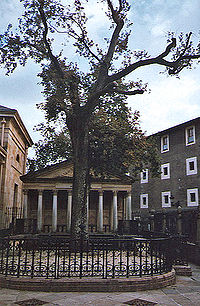
The Lords and later the kings, came to swear the Statutes to the oak of Gernika
, where the assembly of the Lordship sits.

In the modern age
s commerce on took great importance, specially for the Port of Bilbao
, to which the kings granted privileges on trade with the ports of the Spanish Empire
in 1511. Bilbao was already then the main Castilian harbour, from where wool
was shipped to Flanders
and other goods were imported.
In 1628, the separate territory of Durango was incorporated to Biscay. In the same century the so-called chartered municipalities west of Biscay were also incorporated in different dates, becoming another subdivision of Biscay: Encartaciones (Enkarterriak).
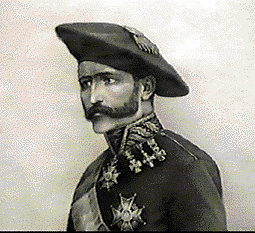
The coastal towns had a sizeable fleet of their own, mostly dedicated to fishing and trade. Along with other Basque towns of Gipuzkoa and Labourd
, they were largely responsible for the partial extinction of North Atlantic Right Whale
s in the Bay of Biscay
and of the first unstable settlement by Europeans in Newfoundland
. They also were able to sign separate treaties with other powers, particularly England.
After the Napoleonic wars, Biscay, along with the other Basque provinces were threatened to have their self-rule cut by the now Liberal
Spanish Cortes. This caused the successive Carlist Wars
, where the Biscayan government, along with the other Basque provinces supported the reactionary faction.
Many of the towns though, notably Bilbao, were aligned with the Liberal government of Madrid
. In the end the wars resulted in successive cuts of the wide autonomy of Biscay and the other provinces.
In the 1850s extensive prime quality iron resources were discovered in Biscay. This brought a lot of foreign investment mainly from England and France, which made it one of Spain's richest and most industrialized provinces. Together with the industrialisation
appeared important bourgeois families such as Ybarra, Chávarri and Lezama-Leguizamón. The great industrial (Iberdrola
, Altos Hornos de Vizcaya
) and financial (Banco Bilbao Vizcaya Argentaria
- BBVA) groups were created.
 During the Second Spanish Republic
, the Basque Nationalist Party
(PNV) governed the province. When the Spanish Civil War
broke out, Biscay supported the Republican side against the army of Francisco Franco
, of fascist ideology.
Soon after, the Republic acknowledged a statute of autonomy for the Basque Country but, due to fascist control of large parts of it, the first short-lived Basque Autonomous Community had power only over Biscay and a few nearby villages.
As the fascist army advanced westward from Navarre, defenses were planned and erected around Bilbao, called the Iron Belt. But the engineer in charge, José Goicoechea, defected to the fascists, causing the unfinished defenses to be of little value. In 1937, German airplanes under Franco's control destroyed the historic city of Gernika, not before having bombed Durango with some less severity few weeks before. Some months later, Bilbao fell to the fascists. The Basque army (Eusko Gudarostea) retreated to Santoña, beyond the limits of Biscay. There they pacted their surrender with the Italian forces (Santoña Agreement
), but these gave them away to Franco. This surrender was seen negatively by the rest of Republican forces, who felt that the Basques had betrayed them.
Under the dictatorship of Franco, Biscay and Gipuzkoa (exclusively) were declared "traitor provinces" and stripped from any sort of self-rule.
Only after Franco's death in 1975, democracy was restored in Spain
. The 1978 constitution, accepted the particular Basque laws (fuero
s) In 1979 the Statute of Guernica was approved and Biscay, Araba
and Gipuzkoa formed the Autonomous Community of the Basque Country
. The Autonomous Community of the Basque Country has its own parliament.
For all of the recent democratic period the winner of all the elections held in Biscay has been the Basque Nationalist Party. Recently the foral law was amended to extend it to the towns and the city of Urduina, that had always used the general Spanish Civil law
.
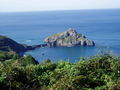 Biscay is bordered by the community of Cantabria
and the province of Burgos (in the Castile and León
community) to the west, the Basque provinces of Gipuzkoa to the east, and Álava
to the south, and by the Cantabrian Sea (Bay of Biscay
) to the north. Orduña
(Urduña) is a Biscayan exclave located between Alava and Burgos provinces.
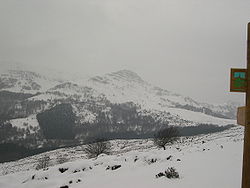
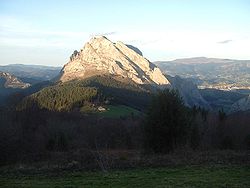 The climate is oceanic
, with high precipitation all year round and moderate temperatures, which allow the lush vegetation to grow. Temperatures are more extreme in the higher lands of inner Biscay, where snow is more common during winter.
), which were two, the Constituent ones and the ones incorporated later.
The constituent ones were (the number indicates their position on the map):
Incorporated later:
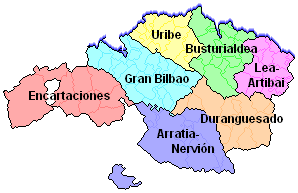
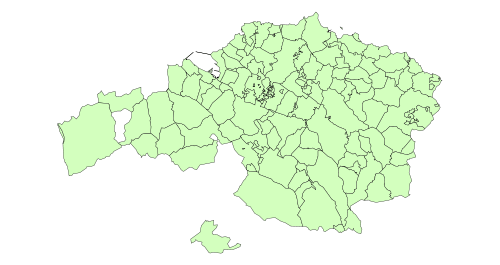 Currently, Biscay is divided into seven comarcas or regions, each one with its own capital city, subdivisions and municipalities.
These are:
census
, Biscay has a population of 1.153.724, and its population density of 519,9 hab/km, only surpassed by the one of Madrid and Barcelona. In 1981 Biscay was the fifth Spanish province
in population, and despite the strong demographic
crisis the province has been living since the Transition
it is today the ninth province in population.
are the Juntas Generales de Vizcaya
and the Foral Diputation of Biscay.
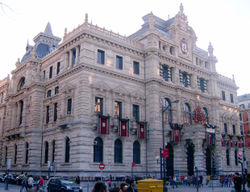 The Juntas Generales
of Biscay are an unicameral assembly that has normative authority in the province. Its members, called apoderados, are elected by universal suffrage
. The elections are held each four years.
After the 2011 elections, the configuration of the Juntas is the following:
Provinces of Spain
Spain and its autonomous communities are divided into fifty provinces .In other languages of Spain:*Catalan/Valencian , sing. província.*Galician , sing. provincia.*Basque |Galicia]] — are not also the capitals of provinces...
and a historical territory of the Basque Country
Basque Country (autonomous community)
The Basque Country is an autonomous community of northern Spain. It includes the Basque provinces of Álava, Biscay and Gipuzkoa, also called Historical Territories....
, heir of the ancient Lord of Biscay
Lord of Biscay
Lord of Biscay is a historical title of the head of state of the autonomous territory of Biscay, Basque Country.- History :The first known Lord of Biscay , Íñigo López "Ezkerra" was a lieutenant of the Kingdom of Pamplona , and this was until the Castilian conquest of Gipuzkoa in 1200...
. Its capital city is Bilbao
Bilbao
Bilbao ) is a Spanish municipality, capital of the province of Biscay, in the autonomous community of the Basque Country. With a population of 353,187 , it is the largest city of its autonomous community and the tenth largest in Spain...
. It is one of the most prosperous and important provinces of Spain
Spain
Spain , officially the Kingdom of Spain languages]] under the European Charter for Regional or Minority Languages. In each of these, Spain's official name is as follows:;;;;;;), is a country and member state of the European Union located in southwestern Europe on the Iberian Peninsula...
as a result of the massive industrialization of the last years of the 19th century and first half of the 20th century. Currently, the industrial activity has given away space to an important activity in the services sector, especially since the deep deindustrialization of the 1970s.
Etymology
It is nowadays accepted in linguistics (Koldo MitxelenaKoldo Mitxelena
Koldo Mitxelena Elissalt was an eminent Basque linguist...
, etc.) that Bizkaia, the original Basque term, is a cognate of bizkar (cf. Biscarrosse
Biscarrosse
Biscarrosse is a commune in the Landes department in Aquitaine in south-western France. It is located southwest of Bordeaux, and inland from the seaside resort of Biscarrosse-Plage on the Atlantic coast....
in Aquitaine
Aquitaine
Aquitaine , archaic Guyenne/Guienne , is one of the 27 regions of France, in the south-western part of metropolitan France, along the Atlantic Ocean and the Pyrenees mountain range on the border with Spain. It comprises the 5 departments of Dordogne, :Lot et Garonne, :Pyrénées-Atlantiques, Landes...
), with both place-name variants well attested in the whole Basque Country and out meaning 'low ridge' or 'prominence' (Iheldo bizchaya attested in 1141 for the hill Igeldo in Donostia).
Bizkaia
“Bizkaia” is the BasqueBasque language
Basque is the ancestral language of the Basque people, who inhabit the Basque Country, a region spanning an area in northeastern Spain and southwestern France. It is spoken by 25.7% of Basques in all territories...
denomination recommended by the Royal Academy of the Basque language
Euskaltzaindia
Euskaltzaindia is the official academic language regulatory institution which watches over the Basque language. It carries out research on the language, seeks to protect it, and establishes standards of use...
, and it is commonly used on official documents on that language. It is also used on documents in Spanish
Spanish language
Spanish , also known as Castilian , is a Romance language in the Ibero-Romance group that evolved from several languages and dialects in central-northern Iberia around the 9th century and gradually spread with the expansion of the Kingdom of Castile into central and southern Iberia during the...
, and it is the most used denomination by the media in Spanish in the Basque Country
Basque Country (autonomous community)
The Basque Country is an autonomous community of northern Spain. It includes the Basque provinces of Álava, Biscay and Gipuzkoa, also called Historical Territories....
. It is also the denomination used in the Basque version of the Spanish constitution
Spanish Constitution of 1978
-Structure of the State:The Constitution recognizes the existence of nationalities and regions . Preliminary Title As a result, Spain is now composed entirely of 17 Autonomous Communities and two autonomous cities with varying degrees of autonomy, to the extent that, even though the Constitution...
and in the Basque version of the Statute of Autonomy of the Basque Country
Statute of Autonomy of the Basque Country
The Statute of Autonomy of the Basque Country is the legal document organizing the political system of the Autonomous Community of the Basque Country' which includes the historical territories of Alava, Biscay and Gipuzkoa. It forms the region into one of the autonomous communities envisioned in...
.
Bizkaia is also the only official denomination approved for the historical territory by the Juntas Generales of the province.
Vizcaya
“Vizcaya” is the denomination in SpanishSpanish language
Spanish , also known as Castilian , is a Romance language in the Ibero-Romance group that evolved from several languages and dialects in central-northern Iberia around the 9th century and gradually spread with the expansion of the Kingdom of Castile into central and southern Iberia during the...
, recommended by the Royal Spanish Academy
Real Academia Española
The Royal Spanish Academy is the official royal institution responsible for regulating the Spanish language. It is based in Madrid, Spain, but is affiliated with national language academies in twenty-one other hispanophone nations through the Association of Spanish Language Academies...
. It is used in non-official documents and, in general, by Spanish speakers. It is also the Spanish denomination used in the Spanish version of the Constitution and in the Spanish version of the Statute of Autonomy of the Basque Country.
History
Biscay has been inhabited since the Middle PaleolithicPaleolithic
The Paleolithic Age, Era or Period, is a prehistoric period of human history distinguished by the development of the most primitive stone tools discovered , and covers roughly 99% of human technological prehistory...
, as attested by the archaeological remains and cave paintings found in its many caves. The Roman
Roman Empire
The Roman Empire was the post-Republican period of the ancient Roman civilization, characterised by an autocratic form of government and large territorial holdings in Europe and around the Mediterranean....
presence had little impact in the region and the Basque language
Basque language
Basque is the ancestral language of the Basque people, who inhabit the Basque Country, a region spanning an area in northeastern Spain and southwestern France. It is spoken by 25.7% of Basques in all territories...
and traditions have survived to this day.
Biscay itself appears in the Middle Ages
Middle Ages
The Middle Ages is a periodization of European history from the 5th century to the 15th century. The Middle Ages follows the fall of the Western Roman Empire in 476 and precedes the Early Modern Era. It is the middle period of a three-period division of Western history: Classic, Medieval and Modern...
, as a dependency of the kingdom of Pampelune (XI cent.) that became autonomous and finally a part of the Crown of Castile
Crown of Castile
The Crown of Castile was a medieval and modern state in the Iberian Peninsula that formed in 1230 as a result of the third and definitive union of the crowns and parliaments of the kingdoms of Castile and León upon the accession of the then King Ferdinand III of Castile to the vacant Leonese throne...
. The first mention of the name Biscay is appearing in a donation act to the monastery of Bickaga, located on the ria of Mundaka. According to Anton Erkoreka, the Vikings had a commercial base there from which they were expelled by 825. The ria of Mundaka is a easiest way to the river Ebro and at the end of it, the mediterranean trade.
In the modern age
Modern Age
Modern Age is an American conservative academic quarterly journal, founded in 1957 by Russell Kirk in close collaboration with Henry Regnery...
, the province became a major commercial and industrial area. Its prime harbour of Bilbao
Port of Bilbao
The Port of Bilbao is located on the Bilbao Abra bay, and along the Estuary of Bilbao, in Biscay . The main facilities are in the Santurtzi and Zierbena municipalities, approximately 15 km west of Bilbao...
soon became the main Castilian gateway to Europe
Europe
Europe is, by convention, one of the world's seven continents. Comprising the westernmost peninsula of Eurasia, Europe is generally 'divided' from Asia to its east by the watershed divides of the Ural and Caucasus Mountains, the Ural River, the Caspian and Black Seas, and the waterways connecting...
. Later, in the 19th and 20th centuries, the abundance of prime quality iron ore and the lack of feudal castes
Serfdom
Serfdom is the status of peasants under feudalism, specifically relating to Manorialism. It was a condition of bondage or modified slavery which developed primarily during the High Middle Ages in Europe and lasted to the mid-19th century...
favored rapid industrialization.
Middle Paleolithic
The first evidence of human dwellings (NeanderthalNeanderthal
The Neanderthal is an extinct member of the Homo genus known from Pleistocene specimens found in Europe and parts of western and central Asia...
people) in Biscay happens in this period of prehistory. Mousterian
Mousterian
Mousterian is a name given by archaeologists to a style of predominantly flint tools associated primarily with Homo neanderthalensis and dating to the Middle Paleolithic, the middle part of the Old Stone Age.-Naming:...
artifacts have been found in three sites in Biscay: Benta Laperra (Karrantza), Kurtzia (Getxo) and Murua (Durangoaldea).
Late Paleolithic
- ChatelperronianChâtelperronianChâtelperronian was the earliest industry of the Upper Palaeolithic in central and south western France, extending also into Northern Spain. It derives its name from the site of la Grotte des Fées, in Châtelperron, Allier, France....
culture (normally associated with Neanderthals as well) can be found in SantimamiñeSantimamiñeSantimamiñe cave, Kortezubi, Biscay, Basque Country, Spain, is one of the most important archaeological sites of the Basque Country, including a nearly complete sequence from the Middle Paleolithic to the Iron Age....
cave (Busturialdea).
Most important settlements by modern humans (H. sapiens) can be considered the following:
- AurignacianAurignacianThe Aurignacian culture is an archaeological culture of the Upper Palaeolithic, located in Europe and southwest Asia. It lasted broadly within the period from ca. 45,000 to 35,000 years ago in terms of conventional radiocarbon dating, or between ca. 47,000 and 41,000 years ago in terms of the most...
culture: Benta Laperra, Kurztia, and Lumentxa (Lekeitio) - GravettianGravettianthumb|right|Burins to the Gravettian culture.The Gravettian toolmaking culture was a specific archaeological industry of the European Upper Palaeolithic era prevalent before the last glacial epoch. It is named after the type site of La Gravette in the Dordogne region of France where its...
culture: Santimamiñe, Bolinkoba (Durangoaldea) and Atxurra (Markina) - SolutreanSolutreanThe Solutrean industry is a relatively advanced flint tool-making style of the Upper Palaeolithic, from around 22,000 to 17,000 BP.-Details:...
culture: Santimamiñe and Bolinkoba - MagdalenianMagdalenianThe Magdalenian , refers to one of the later cultures of the Upper Paleolithic in western Europe, dating from around 17,000 BP to 9,000 BP...
culture: Santimamiñe and Lumentxa
Paleolithic art is also present. Benta Laperra cave shows the oldest paintings, maybe from the Aurignacian or Solutrean period. Bison and bear are the animals depicted, together with abstract signs. From later periods (Magdalenian) are the murals of Arenaza (Sodupe) and Santimamiñe. In Arenaza female deers are the dominant motive, Santimamiñe shows bisons, horses, goats and deers.
Epi-paleolithic
This period (also called MesolithicMesolithic
The Mesolithic is an archaeological concept used to refer to certain groups of archaeological cultures defined as falling between the Paleolithic and the Neolithic....
sometimes) is dominated in Biscay by the Azilian
Azilian
The Azilian is a name given by archaeologists to an industry of the Epipaleolithic in northern Spain and southern France.It probably dates to the period of the Allerød Oscillation around 10,000 years ago and followed the Magdalenian culture...
culture. Tools become smaller and more refined and, while hunting remains, fishing and seafood gathering become more important, finding now clear evidence of wild fruits too. Again Santimamiñe is one of the most important sites of this period. Others are Arenaza, Atxeta (not far from Santimamiñe), Lumentxa and nearby Urtiaga and Santa Catalina, together with Bolinkoba and neighbour Silibranka.
Neolithic
While the first evidences of NeolithicNeolithic
The Neolithic Age, Era, or Period, or New Stone Age, was a period in the development of human technology, beginning about 9500 BC in some parts of the Middle East, and later in other parts of the world. It is traditionally considered as the last part of the Stone Age...
contact in the Basque Country can be dated to the 4th millennium BCE, it will be not until the beginning of the 3rd one that the area accepts, gradually and without radical changes, the agricultural and specially shepherding advances. Biscay is not particularly affected by this change and only three sites can be mentioned for this period: Arenaza, Santimamiñe and Kobeaga (Ea) and the advances adopted seem limited initially to sheep, domestic goat
Goat
The domestic goat is a subspecies of goat domesticated from the wild goat of southwest Asia and Eastern Europe. The goat is a member of the Bovidae family and is closely related to the sheep as both are in the goat-antelope subfamily Caprinae. There are over three hundred distinct breeds of...
s and very scarce pottery
Pottery
Pottery is the material from which the potteryware is made, of which major types include earthenware, stoneware and porcelain. The place where such wares are made is also called a pottery . Pottery also refers to the art or craft of the potter or the manufacture of pottery...
.
Together with Neolithic technologies, Megalith
Megalith
A megalith is a large stone that has been used to construct a structure or monument, either alone or together with other stones. Megalithic describes structures made of such large stones, utilizing an interlocking system without the use of mortar or cement.The word 'megalith' comes from the Ancient...
ism also arrives. It will be the most common form of burial (simple dolmen
Dolmen
A dolmen—also known as a portal tomb, portal grave, dolmain , cromlech , anta , Hünengrab/Hünenbett , Adamra , Ispun , Hunebed , dös , goindol or quoit—is a type of single-chamber megalithic tomb, usually consisting of...
) until c. 1500 BCE.
Chalcolithic and Bronze Age
While open air settlement starts to become something common as population grows, caves and natural shelters are still used in Biscay in the Chalcolithic and Bronze AgeBronze Age
The Bronze Age is a period characterized by the use of copper and its alloy bronze as the chief hard materials in the manufacture of some implements and weapons. Chronologically, it stands between the Stone Age and Iron Age...
. Hunting becomes gradually a less important source of meat, replaced by sheep, goats and some bovine cattle. Metallic tools become more common but stone-made ones are also used.
Pottery types shows great continuity (not decorated) until the bell beaker
Beaker culture
The Bell-Beaker culture , ca. 2400 – 1800 BC, is the term for a widely scattered cultural phenomenon of prehistoric western Europe starting in the late Neolithic or Chalcolithic running into the early Bronze Age...
makes its appearance.
The sites of this period now cover all the territory of Biscay, many being open air settlements, but the most important caves of the Paleolithic are still in use as well.
Iron Age
Very few sites have been identified for this period. Caves are abandoned for the most part but they still give some remains. The main caves of prehistory (Arenaza, Santimamiñe, Lumentxa) were still inhabited.Roman period
Roman geographers have let us know that the territory of what is now Biscay dwelt two tribes: CaristiiCaristii
The Caristii were a tribe reported by Roman historians in Northern Hispania west of the Deba and east of the Nervion rivers, in modern Biscay and Alava...
and Autrigones
Autrigones
Location of the tribe of the Autrigones.The Autrigones were a pre-Roman people of ancient Spain, described by the Roman historian Paulus Orosius as neighbours of the Gallaeci, and thus had their homeland in the northwest of Hispania.-Location:Their historical territory now lies split between the...
. The Caristii dwelt in nuclear Biscay, east of the firth of Bilbao, extending also into Northern Araba
Álava
Álava is a province of Spain and a historical territory of the Basque Country, heir of the ancient Lord of Álava. Its capital city is Vitoria-Gasteiz which is also the capital of the autonomous community...
and some areas of Gipuzkoa, up to the river Deba. The Autrigones dwelt in the westernmost part of Biscay and Araba, extending also into the provinces of Cantabria
Cantabria
Cantabria is a Spanish historical region and autonomous community with Santander as its capital city. It is bordered on the east by the Basque Autonomous Community , on the south by Castile and León , on the west by the Principality of Asturias, and on the north by the Cantabrian Sea.Cantabria...
, Burgos
Burgos (province)
The province of Burgos is a province of northern Spain, in the northeastern part of the autonomous community of Castile and León. It is bordered by the provinces of Palencia, Cantabria, Vizcaya, Álava, La Rioja, Soria, Segovia, and Valladolid. Its capital is the city of Burgos...
and La Rioja. Based in toponimy, historical and archaeological evidence, it is thought that these tribes spoke Basque language
Basque language
Basque is the ancestral language of the Basque people, who inhabit the Basque Country, a region spanning an area in northeastern Spain and southwestern France. It is spoken by 25.7% of Basques in all territories...
http://www.gara.net/idatzia/20060616/art169077.php. The borders of the Biscayan dialect of Basque seem to be exactly those of the Caristian territory, exception made of the areas that have lost the old language.
There is no indication to resistance to Roman occupation in all the Basque area (excepting Aquitaine
Aquitaine
Aquitaine , archaic Guyenne/Guienne , is one of the 27 regions of France, in the south-western part of metropolitan France, along the Atlantic Ocean and the Pyrenees mountain range on the border with Spain. It comprises the 5 departments of Dordogne, :Lot et Garonne, :Pyrénées-Atlantiques, Landes...
) until the late feudalizing period. Roman sources mention several towns in the area, Flaviobriga and Portus Amanus, though they have not been located. The site of Forua, near Gernika, has yielded archaeological evidence of Roman presence http://www.gara.net/idatzia/20060616/art169085.php.
In the late Roman period, together with the rest of the Basque Country, it seems to have revolted against Roman domination and the process of feudalization
Feudalism
Feudalism was a set of legal and military customs in medieval Europe that flourished between the 9th and 15th centuries, which, broadly defined, was a system for ordering society around relationships derived from the holding of land in exchange for service or labour.Although derived from the...
.
Middle Ages
In the Early Middle AgesMiddle Ages
The Middle Ages is a periodization of European history from the 5th century to the 15th century. The Middle Ages follows the fall of the Western Roman Empire in 476 and precedes the Early Modern Era. It is the middle period of a three-period division of Western history: Classic, Medieval and Modern...
, the history of Biscay cannot be separated from that of the Basque Country as a whole. The area was de facto independent although Visigoths and Franks attempted to stabilish their domination from time to time. Encounters between the Visigoths and Basques usually led to defeat for the latter and the Visigoths managed to establish an outlying post at the later city of Vitoria
Vitoria-Gasteiz
Vitoria-Gasteiz is the capital city of the province of Álava and of the autonomous community of the Basque Country in northern Spain with a population of 235,661 people. It is the second largest Basque city...
to counter incursions and the migration of basques from the coastal regions to the north.
In 905, Leonese chronicles mention the Kingdom of Pamplona as including all the western Basque provinces, as well as the Rioja region for the first time. The territories that would later constitute Biscay were then part of that state.
In the conflicts that the newly sovereign Kingdom of Castile
Kingdom of Castile
Kingdom of Castile was one of the medieval kingdoms of the Iberian Peninsula. It emerged as a political autonomous entity in the 9th century. It was called County of Castile and was held in vassalage from the Kingdom of León. Its name comes from the host of castles constructed in the region...
and Pamplona/Navarre had in the 11th and 12th century, the Castilians were supported by many landowners from La Rioja, who sought to consolidate their holdings under Castilian feudal law. These pro-Castilian lords were led by the house of Haro, who were eventually granted the rule of newly created Biscay, initially made up of the valleys of Uribe
Uribe
The Merindad de Uribe or Uribealdea is a historical subdivision of Biscay, Basque Country, Spain. Today, the "Uribe" is usually defined by subdivisions caused by the urban development of the Greater Bilbao conurbation...
, Busturia
Busturia
Busturia is a town and municipality located in the province of Biscay, in the autonomous community of Basque Country, northern Spain.-External links:*...
, Markina, Zornotza and Arratia, plus several towns and the city of Urduina
Orduña
Orduña is a town and municipality of 4,057 inhabitants located in the province of Biscay, in the autonomous community of Basque Country, in the North of Spain....
. It is unclear when this happened exactly but it is claimed that Iñigo López was the first Lord of Biscay
Lord of Biscay
Lord of Biscay is a historical title of the head of state of the autonomous territory of Biscay, Basque Country.- History :The first known Lord of Biscay , Íñigo López "Ezkerra" was a lieutenant of the Kingdom of Pamplona , and this was until the Castilian conquest of Gipuzkoa in 1200...
in 1043.
The region soon reverted to Navarre
Navarre
Navarre , officially the Chartered Community of Navarre is an autonomous community in northern Spain, bordering the Basque Country, La Rioja, and Aragon in Spain and Aquitaine in France...
, remaining so until the Castilian invasion of 1199-1200.
The title to the lordship was inherited by Iñigo López's descendants until, by inheritance, in 1370 it passed to John I of Castile
John I of Castile
John I was the king of Crown of Castile, was the son of Henry II and of his wife Juana Manuel of Castile, daughter of Juan Manuel, Prince of Villena, head of a younger branch of the royal house of Castile...
, becoming one of the titles of the king of Castile. Since then it remained connected to the crown, first to that of Castile and then, from Carlos I
Charles V, Holy Roman Emperor
Charles V was ruler of the Holy Roman Empire from 1519 and, as Charles I, of the Spanish Empire from 1516 until his voluntary retirement and abdication in favor of his younger brother Ferdinand I and his son Philip II in 1556.As...
, to that of Spain, always with the condition that the Lord swore to defend and to maintain the fuero
Fuero
Fuero , Furs , Foro and Foru is a Spanish legal term and concept.The word comes from Latin forum, an open space used as market, tribunal and meeting place...
(Biscayan laws, derived from Navarrese and Basque customary rights) that affirmed that the possessors of the sovereignty of the Lordship were the Biscayans themselves and that, at least in theory, they could refute the Lord.
The Lords and later the kings, came to swear the Statutes to the oak of Gernika
Gernikako Arbola
Gernikako Arbola is an oak tree that symbolizes traditional freedoms for the Biscayan people, and by extension for the Basque people as a whole...
, where the assembly of the Lordship sits.
Modern age
In the modern age
Modern Age
Modern Age is an American conservative academic quarterly journal, founded in 1957 by Russell Kirk in close collaboration with Henry Regnery...
s commerce on took great importance, specially for the Port of Bilbao
Port of Bilbao
The Port of Bilbao is located on the Bilbao Abra bay, and along the Estuary of Bilbao, in Biscay . The main facilities are in the Santurtzi and Zierbena municipalities, approximately 15 km west of Bilbao...
, to which the kings granted privileges on trade with the ports of the Spanish Empire
Spanish Empire
The Spanish Empire comprised territories and colonies administered directly by Spain in Europe, in America, Africa, Asia and Oceania. It originated during the Age of Exploration and was therefore one of the first global empires. At the time of Habsburgs, Spain reached the peak of its world power....
in 1511. Bilbao was already then the main Castilian harbour, from where wool
Wool
Wool is the textile fiber obtained from sheep and certain other animals, including cashmere from goats, mohair from goats, qiviut from muskoxen, vicuña, alpaca, camel from animals in the camel family, and angora from rabbits....
was shipped to Flanders
Flanders
Flanders is the community of the Flemings but also one of the institutions in Belgium, and a geographical region located in parts of present-day Belgium, France and the Netherlands. "Flanders" can also refer to the northern part of Belgium that contains Brussels, Bruges, Ghent and Antwerp...
and other goods were imported.
In 1628, the separate territory of Durango was incorporated to Biscay. In the same century the so-called chartered municipalities west of Biscay were also incorporated in different dates, becoming another subdivision of Biscay: Encartaciones (Enkarterriak).
The coastal towns had a sizeable fleet of their own, mostly dedicated to fishing and trade. Along with other Basque towns of Gipuzkoa and Labourd
Labourd
Labourd is a former French province and part of the present-day Pyrénées Atlantiques département. It is historically one of the seven provinces of the traditional Basque Country....
, they were largely responsible for the partial extinction of North Atlantic Right Whale
North Atlantic Right Whale
The North Atlantic right whale which means "good, or true, whale of the ice") is a baleen whale, one of three right whale species belonging to the genus Eubalaena, formerly classified as a single species. With only 400 in existence, North Atlantic right whales are among the most endangered whales...
s in the Bay of Biscay
Bay of Biscay
The Bay of Biscay is a gulf of the northeast Atlantic Ocean located south of the Celtic Sea. It lies along the western coast of France from Brest south to the Spanish border, and the northern coast of Spain west to Cape Ortegal, and is named in English after the province of Biscay, in the Spanish...
and of the first unstable settlement by Europeans in Newfoundland
Newfoundland and Labrador
Newfoundland and Labrador is the easternmost province of Canada. Situated in the country's Atlantic region, it incorporates the island of Newfoundland and mainland Labrador with a combined area of . As of April 2011, the province's estimated population is 508,400...
. They also were able to sign separate treaties with other powers, particularly England.
After the Napoleonic wars, Biscay, along with the other Basque provinces were threatened to have their self-rule cut by the now Liberal
Liberalism
Liberalism is the belief in the importance of liberty and equal rights. Liberals espouse a wide array of views depending on their understanding of these principles, but generally, liberals support ideas such as constitutionalism, liberal democracy, free and fair elections, human rights,...
Spanish Cortes. This caused the successive Carlist Wars
Carlist Wars
The Carlist Wars in Spain were the last major European civil wars in which contenders fought to establish their claim to a throne. Several times during the period from 1833 to 1876 the Carlists — followers of Infante Carlos and his descendants — rallied to the cry of "God, Country, and King" and...
, where the Biscayan government, along with the other Basque provinces supported the reactionary faction.
Many of the towns though, notably Bilbao, were aligned with the Liberal government of Madrid
Madrid
Madrid is the capital and largest city of Spain. The population of the city is roughly 3.3 million and the entire population of the Madrid metropolitan area is calculated to be 6.271 million. It is the third largest city in the European Union, after London and Berlin, and its metropolitan...
. In the end the wars resulted in successive cuts of the wide autonomy of Biscay and the other provinces.
In the 1850s extensive prime quality iron resources were discovered in Biscay. This brought a lot of foreign investment mainly from England and France, which made it one of Spain's richest and most industrialized provinces. Together with the industrialisation
Industrial Revolution
The Industrial Revolution was a period from the 18th to the 19th century where major changes in agriculture, manufacturing, mining, transportation, and technology had a profound effect on the social, economic and cultural conditions of the times...
appeared important bourgeois families such as Ybarra, Chávarri and Lezama-Leguizamón. The great industrial (Iberdrola
Iberdrola
Iberdrola , headquartered in Bilbao, is a private utility with a global footprint and over 150 years of experience...
, Altos Hornos de Vizcaya
Altos Hornos de Vizcaya
Altos Hornos de Vizcaya was a ironworks business that began in 1902 in Bilbao with the merger of three iron and steel businesses: Altos Hornos de Bilbao, La Vizcaya, and La Iberia...
) and financial (Banco Bilbao Vizcaya Argentaria
Banco Bilbao Vizcaya Argentaria
Banco Bilbao Vizcaya Argentaria, S.A. is a multinational Spanish banking group. It was formed in 1999 from the merger of Banco Bilbao Vizcaya and Argentaria, both of which in turn had previously amalgamated three important banks in Spain, namely Banco de Bilbao, Banco de Vizcaya, Banco Exterior de...
- BBVA) groups were created.
Twentieth century
Second Spanish Republic
The Second Spanish Republic was the government of Spain between April 14 1931, and its destruction by a military rebellion, led by General Francisco Franco....
, the Basque Nationalist Party
Basque Nationalist Party
The Basque National Party is the largest and oldest Basque nationalist party. It is currently the largest political party in the Basque Autonomous Community also with a minor presence in Navarre and a marginal one in the French Basque Country...
(PNV) governed the province. When the Spanish Civil War
Spanish Civil War
The Spanish Civil WarAlso known as The Crusade among Nationalists, the Fourth Carlist War among Carlists, and The Rebellion or Uprising among Republicans. was a major conflict fought in Spain from 17 July 1936 to 1 April 1939...
broke out, Biscay supported the Republican side against the army of Francisco Franco
Francisco Franco
Francisco Franco y Bahamonde was a Spanish general, dictator and head of state of Spain from October 1936 , and de facto regent of the nominally restored Kingdom of Spain from 1947 until his death in November, 1975...
, of fascist ideology.
Soon after, the Republic acknowledged a statute of autonomy for the Basque Country but, due to fascist control of large parts of it, the first short-lived Basque Autonomous Community had power only over Biscay and a few nearby villages.
As the fascist army advanced westward from Navarre, defenses were planned and erected around Bilbao, called the Iron Belt. But the engineer in charge, José Goicoechea, defected to the fascists, causing the unfinished defenses to be of little value. In 1937, German airplanes under Franco's control destroyed the historic city of Gernika, not before having bombed Durango with some less severity few weeks before. Some months later, Bilbao fell to the fascists. The Basque army (Eusko Gudarostea) retreated to Santoña, beyond the limits of Biscay. There they pacted their surrender with the Italian forces (Santoña Agreement
Santoña Agreement
The Santoña Agreement or Pact of Santoña was an agreement signed in the town of Guriezo, near Santoña, Cantabria, the August 24, 1937, during the Spanish Civil War, between politicians close to the Basque Nationalist Party , fighting with the Republican Side, and Italian forces fighting with the...
), but these gave them away to Franco. This surrender was seen negatively by the rest of Republican forces, who felt that the Basques had betrayed them.
Under the dictatorship of Franco, Biscay and Gipuzkoa (exclusively) were declared "traitor provinces" and stripped from any sort of self-rule.
Only after Franco's death in 1975, democracy was restored in Spain
Spanish transition to democracy
The Spanish transition to democracy was the era when Spain moved from the dictatorship of Francisco Franco to a liberal democratic state. The transition is usually said to have begun with Franco’s death on 20 November 1975, while its completion has been variously said to be marked by the Spanish...
. The 1978 constitution, accepted the particular Basque laws (fuero
Fuero
Fuero , Furs , Foro and Foru is a Spanish legal term and concept.The word comes from Latin forum, an open space used as market, tribunal and meeting place...
s) In 1979 the Statute of Guernica was approved and Biscay, Araba
Álava
Álava is a province of Spain and a historical territory of the Basque Country, heir of the ancient Lord of Álava. Its capital city is Vitoria-Gasteiz which is also the capital of the autonomous community...
and Gipuzkoa formed the Autonomous Community of the Basque Country
Basque Country (autonomous community)
The Basque Country is an autonomous community of northern Spain. It includes the Basque provinces of Álava, Biscay and Gipuzkoa, also called Historical Territories....
. The Autonomous Community of the Basque Country has its own parliament.
For all of the recent democratic period the winner of all the elections held in Biscay has been the Basque Nationalist Party. Recently the foral law was amended to extend it to the towns and the city of Urduina, that had always used the general Spanish Civil law
Civil law (legal system)
Civil law is a legal system inspired by Roman law and whose primary feature is that laws are codified into collections, as compared to common law systems that gives great precedential weight to common law on the principle that it is unfair to treat similar facts differently on different...
.
Geography
Cantabria
Cantabria is a Spanish historical region and autonomous community with Santander as its capital city. It is bordered on the east by the Basque Autonomous Community , on the south by Castile and León , on the west by the Principality of Asturias, and on the north by the Cantabrian Sea.Cantabria...
and the province of Burgos (in the Castile and León
Castile and León
Castile and León is an autonomous community in north-western Spain. It was so constituted in 1983 and it comprises the historical regions of León and Old Castile...
community) to the west, the Basque provinces of Gipuzkoa to the east, and Álava
Álava
Álava is a province of Spain and a historical territory of the Basque Country, heir of the ancient Lord of Álava. Its capital city is Vitoria-Gasteiz which is also the capital of the autonomous community...
to the south, and by the Cantabrian Sea (Bay of Biscay
Bay of Biscay
The Bay of Biscay is a gulf of the northeast Atlantic Ocean located south of the Celtic Sea. It lies along the western coast of France from Brest south to the Spanish border, and the northern coast of Spain west to Cape Ortegal, and is named in English after the province of Biscay, in the Spanish...
) to the north. Orduña
Orduña
Orduña is a town and municipality of 4,057 inhabitants located in the province of Biscay, in the autonomous community of Basque Country, in the North of Spain....
(Urduña) is a Biscayan exclave located between Alava and Burgos provinces.
Climate
Oceanic climate
An oceanic climate, also called marine west coast climate, maritime climate, Cascadian climate and British climate for Köppen climate classification Cfb and subtropical highland for Köppen Cfb or Cwb, is a type of climate typically found along the west coasts at the middle latitudes of some of the...
, with high precipitation all year round and moderate temperatures, which allow the lush vegetation to grow. Temperatures are more extreme in the higher lands of inner Biscay, where snow is more common during winter.
Features
The main geographical features of the province are:- The southern high mountainMountainImage:Himalaya_annotated.jpg|thumb|right|The Himalayan mountain range with Mount Everestrect 58 14 160 49 Chomo Lonzorect 200 28 335 52 Makalurect 378 24 566 45 Mount Everestrect 188 581 920 656 Tibetan Plateaurect 250 406 340 427 Rong River...
ranges, part of the Basque mountainsBasque mountainsThe Basque Mountains are a mountain range situated in the northern Iberian Peninsula. Geographically it is considered as the eastern section of the larger Cantabrian Range...
, that form a continuous barrier with passes not lower than 600 m AMSL, forming the water divideWater divideA drainage divide, water divide, divide or watershed is the line separating neighbouring drainage basins...
of the Atlantic and Mediterranean basins. These ranges are divided from west to east in Ordunte (Zalama, 1390 m), Salbada (1100 m), GorbeaGorbeaGorbea or Gorbeia is a mountain and massif, the highest in Biscay and Alava , with a height of 1,481 m AMSL. The massif covers a wide area between the two provinces. The main mountain is a round grass-covered summit where a 20-metre-tall metallic cross has been constructed to reach the altitude of...
(1481 m) and UrkiolaUrkiolaUrkiola is a mountain range of the Basque mountains in Biscay near Durango, in the western Basque Country, Spain. The range's highest mountain is Anboto...
(AnbotoAnbotoAnboto is a limestone mountain of the Western Basque Country, the highest peak of the Urkiola range and not far from the pass of Urkiolamendi between Durango and Vitoria-Gasteiz.- Description :...
, 1331 m). - The middle section which is occupied by the main river's valleys: NervionNerviónThe river Nervión runs through the city of Bilbao, Spain into the Cantabrian Sea .It is also known as Estuary of Bilbao on its final tract, from the joining with Ibaizabal river to the sea.-Geography:...
, IbaizabalIbaizabalThe river Ibaizabal drains southeastern Biscay to the Estuary of Bilbao. It is 43 km long from its source at Elorrio to the Nervion, and it passes by the towns of Durango and Amorebieta and joins the Nervion river at Basauri. Both rivers run then together for a short length until they merge...
and Kadagua. Kadagua runs west to east from Ordunte, Nervion south to north from Orduña and Ibaizabal east to west from Urkiola. Arratia river runs northwards from Gorbea and joins Ibaizabal. Each valley is separated by medium mountains like GanekogortaGanekogortaGanekogorta is a mountain in the border of the provinces of Biscay and Alava , just between Bilbao and Llodio. It has a height of 998 m AMSL and it's the main peak of a massif that comprises some smaller mountains like Pagasarri, Ganeta, Pasatorenkorta, Arnotegi or Arraiz...
(998m). Other mountains , like OizOizMount Oiz , is one of the most popular summits of Biscay in the Basque Country . Its summits form part of a long range that feeds several rivers: Ibaizabal, Artibai, Lea, Oka and Deva in Gipuzkoa all of them running to the Bay of Biscay....
, separate the main valleys from the northern valleys. The northern rivers are: Artibai, Lea, Oka and Butron.
- The coast: the main features are the estuary of BilbaoEstuary of BilbaoThe Estuary of Bilbao lies at the common mouth of the rivers Nervion, Ibaizabal and Cadagua, that drain most of Biscay and part of Alava in the Basque Country, Spain. It is a large estuary long that extends from Bilbao to the Bilbao Abra bay, a widening that makes the final transition between...
where the main rivers meet the sea and the estuary of Gernika (UrdaibaiUrdaibaiThe Urdaibai estuary is a natural region and a Biosphere Reserve of Biscay, Basque Country. It is also referred as Mundaka or Gernika estuary....
). The coast is usually high, with cliffs and small inlets and coves.
Historical
Historically, Biscay was divided into merindades (called eskualdeak in BasqueBasque language
Basque is the ancestral language of the Basque people, who inhabit the Basque Country, a region spanning an area in northeastern Spain and southwestern France. It is spoken by 25.7% of Basques in all territories...
), which were two, the Constituent ones and the ones incorporated later.
The constituent ones were (the number indicates their position on the map):
- UribeUribeThe Merindad de Uribe or Uribealdea is a historical subdivision of Biscay, Basque Country, Spain. Today, the "Uribe" is usually defined by subdivisions caused by the urban development of the Greater Bilbao conurbation...
1 - BusturiaBusturiaBusturia is a town and municipality located in the province of Biscay, in the autonomous community of Basque Country, northern Spain.-External links:*...
2 - Markina3
- Bedia4
- Amorebieta (also Zornotza)5
- Arratia6
Incorporated later:
- Durango
- Enkarterri
- OrozkoOrozkoOrozko is a town and municipality located in the province of Biscay, in the autonomous community of Basque Country in northern Spain.-External links:*...
- OrduñaOrduñaOrduña is a town and municipality of 4,057 inhabitants located in the province of Biscay, in the autonomous community of Basque Country, in the North of Spain....
- Some other independent cities and towns.
Modern
These are:
- Greater Bilbao, usually divided into subregions:
- BilbaoBilbaoBilbao ) is a Spanish municipality, capital of the province of Biscay, in the autonomous community of the Basque Country. With a population of 353,187 , it is the largest city of its autonomous community and the tenth largest in Spain...
- Left BankLeft Bank (Biscay)The left bank of the Estuary of Bilbao is a part of the Greater Bilbao region, its main towns are Barakaldo, Sestao, Santurtzi and Portugalete and in addition to the iron mines , was the heart of the intense industrialisation of Biscay...
- Uribe-KostaUribe-KostaUribe-Kosta is a modern conventional division of the Basque province of Biscay. It includes part of the coastal strip of the historical division of Uribealdea. The division is used for statistical and electoral purposes. It includes the following...
- TxorierriTxorierriTxorierri is a valley of Biscay, Basque Country, separated from Bilbao by low mountains Monte Artxanda and Monte Abril. It includes the municipalities of Erandio, Loiu, Sondika, Derio, Zamudio, Lezama and Larrabetzu. It holds the international airport of Bilbao. It includes industrial and...
- Hego UribeHego UribeHego Uribe is a modern conventional subdivision of Biscay, Basque Country. It includes the towns of Basauri, Galdakao and Arrigorriaga among others. It is noted for its production of high quality wool....
- Bilbao
- MungialdeaMungialdeaMungialdea is a comarca of the province of Biscay, in the Basque Country, Spain. Mungialdea is the heir of the historical region of Uribe, which was one of the merindades of Biscay. It comprises the most rural area of the historical region of Uribe, drained by the river Butron and with some small...
- Enkarterri
- BusturialdeaBusturialdeaBusturialdea, also named Busturialde - Urdaibai is a comarca of the province of Biscay, in the Basque Country, Spain. It is the heir of "Busturia", one of the original merindades that used to compose the province of Biscay, which should not be confused with Busturia, which is a municipality located...
- DurangaldeaDurangaldeaDurangaldea is a comarca of Biscay located in the Basque Country, Spain. It is one of the seven comarcas or regions that compose the province of Biscay. The capital city of Durangaldea is Durango.- Geography :...
- Lea-ArtibaiLea-ArtibaiLea-Artibai is a comarca of the province of Biscay, in the Basque Country, Spain. Lea-Artibai is the heir of the historical merindad of Markina, which was one of the merindades of Biscay. Currently, Lea-Artibai is one of the seven comarcas that compose the province. Its capital city is...
- Arratia-NerbioiArratia-NerbioiArratia-Nerbioi is a comarca of the province of Biscay, in the Basque Country, Spain. It is formed by the valleys of the Arratia river and the Nervión river. It is one of the seven comarcas that compose the province of Biscay....
Population
According to the 2010 INEInstituto Nacional de Estadística (Spain)
The National Institute of Statistics is the official organisation in Spain that collects statistics about demography, economy, and Spanish society. Every 10 years, this organisation conducts a national census. The last census took place in 2001....
census
Census
A census is the procedure of systematically acquiring and recording information about the members of a given population. It is a regularly occurring and official count of a particular population. The term is used mostly in connection with national population and housing censuses; other common...
, Biscay has a population of 1.153.724, and its population density of 519,9 hab/km, only surpassed by the one of Madrid and Barcelona. In 1981 Biscay was the fifth Spanish province
Provinces of Spain
Spain and its autonomous communities are divided into fifty provinces .In other languages of Spain:*Catalan/Valencian , sing. província.*Galician , sing. provincia.*Basque |Galicia]] — are not also the capitals of provinces...
in population, and despite the strong demographic
Demographics
Demographics are the most recent statistical characteristics of a population. These types of data are used widely in sociology , public policy, and marketing. Commonly examined demographics include gender, race, age, disabilities, mobility, home ownership, employment status, and even location...
crisis the province has been living since the Transition
Spanish transition to democracy
The Spanish transition to democracy was the era when Spain moved from the dictatorship of Francisco Franco to a liberal democratic state. The transition is usually said to have begun with Franco’s death on 20 November 1975, while its completion has been variously said to be marked by the Spanish...
it is today the ninth province in population.
| Demographic evolution of Biscay and percentage of the national total |
|||||||
|---|---|---|---|---|---|---|---|
| 1857 | 1900 | 1910 | 1920 | 1930 | 1940 | 1950 | |
| Population | 160.579 | 311.361 | 349.923 | 409.550 | 485.205 | 511.135 | 569.188 |
| Percentage | 1,04% | 1,67% | 1,75% | 1,91% | 2,05% | 1,96% | 2,02% |
| 1960 | 1970 | 1981 | 1991 | 1996 | 2001 | 2006 | |
| Population | 754.383 | 1.043.310 | 1.181.401 | 1.156.245 | 1.140.026 | 1.132.616 | 1.139.863 |
| Percentage | 2,47% | 3,07% | 3,13% | 2,93% | 2,87% | 2,75% | 2,55% |
| Most populated municipalities (2010) |
||
|---|---|---|
| Position | Municipality | Inhabitants |
| 1st | Bilbao Bilbao Bilbao ) is a Spanish municipality, capital of the province of Biscay, in the autonomous community of the Basque Country. With a population of 353,187 , it is the largest city of its autonomous community and the tenth largest in Spain... |
353.187 |
| 2nd | Barakaldo Barakaldo Barakaldo , is a municipality in the Basque Country in Spain. It is located in the Biscay province, administratively included in the "Basque Autonomous Community", on the left bank of the Estuary of Bilbao.Barakaldo is part of Bilbao's metropolitan area , and its official population... |
99.321 |
| 3rd | Getxo Getxo Getxo is a town located in the province of Biscay, in the autonomous community of the Basque Country, in the north of Spain.It is part of the metropolitan area of Bilbao , and has about 83,000 inhabitants... |
80.277 |
| 4th | Portugalete Portugalete Portugalete is a town lying to the west of Bilbao in the province of Biscay in the Autonomous Community of Basque Country, northern Spain.The town has 51,066 inhabitants and is part of Bilbao's metropolitan area. It is located at the mouth of the Estuary of Bilbao, on the left bank... |
47.856 |
| 5th | Santurtzi Santurtzi Santurtzi is a port town in the province of Biscay, in the autonomous community of Basque Country, Spain. It is located in the Bilbao Abra bay, near the mouth of the Nervión river, on its left bank, 14km downriver from Bilbao and forms part of the Greater Bilbao agglomeration... |
47.004 |
| 6th | Basauri Basauri Basauri is a major municipality of Biscay, in the Basque Country, an Autonomous Community in northern Spain.The town is a part of the Greater Bilbao conurbation, being only a few kilometers south of Bilbao. It is an industrial town that also includes monuments such as the tower-house of Ariz. It... |
42.452 |
| 7th | Leioa Leioa Leioa is a municipality in Biscay, Basque Country, in northern Spain. Today it is part of the Bilbao conurbation, and it is the name of a metro station in the Bilbao metro... |
29.217 |
| 8th | Sestao Sestao Sestao is a town and municipality of 30,000 inhabitants located in the province of Biscay, in the autonomous community of Basque Country, northern Spain... |
29.224 |
| 9th | Galdakao Galdakao Galdakao is a town and municipality located in the province of Biscay, in the autonomous community of Basque Country, northern Spain.It is located in the Greater Bilbao, in the valley of the Ibaizabal river, near the Ganguren mountain range... |
29.254 |
| 10th | Durango Durango Durango officially Estado Libre y Soberano de Durango is one of the 31 states which, with the Federal District, comprise the 32 Federal Entities of Mexico. The state is located in Northwest Mexico. With a population of 1,632,934, it has Mexico's second-lowest population density, after Baja... |
28.261 |
| 11ª | Erandio Erandio Erandio is a town and municipality located in the province of Biscay, in the autonomous community of Basque Country, northern Spain.In 1415, during the War of the Bands, the corregidor, the royally-appointed governor of the Biscayan hermandad, acting on royal orders, siphoned off Biscayan wheat to... |
24.294 |
| 12th | Amorebieta-Etxano Amorebieta-Etxano Amorebieta-Etxano or Zornotza are two different names for the same town and municipality located in Biscay in the Basque Country, an Autonomous Community in northern Spain. Athletic Bilbao defender Xabier Etxeita was born in Zornotza, as is Beñat Intxausti, a professional cyclist.-External links:*... |
17.969 |
| 13th | Bermeo Bermeo Bermeo is a town and municipality in the sub-region of Busturialdea and the wider province of Biscay, part of the autonomous region of the Basque Country, in Northern Spain. Bermeo has 17,026 inhabitants and is the most important fishing port of the Basque Country. The town was founded in 1236 and... |
17.026 |
| 14th | Mungia Mungia Mungia is a town and municipality located in the province of Biscay, in the Basque Country of northern Spain. Thetown has 15,000 inhabitants.-Geography:... |
16.527 |
| 15th | Gernika-Lumo | 16.295 |
Government and Foral institutions
The government and foral institutions of Biscay, as a historial territory of the Basque CountryBasque Country (autonomous community)
The Basque Country is an autonomous community of northern Spain. It includes the Basque provinces of Álava, Biscay and Gipuzkoa, also called Historical Territories....
are the Juntas Generales de Vizcaya
Juntas Generales
The Juntas Generales are representative assemblies in the Southern Basque Country that go back to the 14th century. The three main Juntas Generals in the Basque Country were - and are - the Juntas Generales of Biscay, the Juntas Generales of Gipuzkoa and the Juntas Generales of Álava.They were...
and the Foral Diputation of Biscay.
Juntas Generales
Juntas Generales
The Juntas Generales are representative assemblies in the Southern Basque Country that go back to the 14th century. The three main Juntas Generals in the Basque Country were - and are - the Juntas Generales of Biscay, the Juntas Generales of Gipuzkoa and the Juntas Generales of Álava.They were...
of Biscay are an unicameral assembly that has normative authority in the province. Its members, called apoderados, are elected by universal suffrage
Universal suffrage
Universal suffrage consists of the extension of the right to vote to adult citizens as a whole, though it may also mean extending said right to minors and non-citizens...
. The elections are held each four years.
After the 2011 elections, the configuration of the Juntas is the following:
| Elecciones a las Juntas Generales 2011 |
||||
| Party | Apoderados | |||
| Basque Nationalist Party Basque Nationalist Party The Basque National Party is the largest and oldest Basque nationalist party. It is currently the largest political party in the Basque Autonomous Community also with a minor presence in Navarre and a marginal one in the French Basque Country... |
22 | |||
| Bildu Bildu Bildu is a Basque nationalist, separatist and abertzale leftist political coalition active in the Basque Country and Navarre. It was official launched on 3 April 2011... |
12 | |||
| Socialist Party of the Basque Country – Basque Country Left | 9 | |||
| People's Party People's Party (Spain) The People's Party is a conservative political party in Spain.The People's Party was a re-foundation in 1989 of the People's Alliance , a party led and founded by Manuel Fraga Iribarne, a former Minister of Tourism during Francisco Franco's dictatorship... |
8 | |||
Foral Diputation
The Foral Diputation has an executive function and reglamentary authority in Biscay. The Foral Diputation is configured by a General Deputy, who currently is José Luis Bilbao (PNVBasque Nationalist Party
The Basque National Party is the largest and oldest Basque nationalist party. It is currently the largest political party in the Basque Autonomous Community also with a minor presence in Navarre and a marginal one in the French Basque Country...
) and who is chosen by the Juntas Generales and by the rest of deputies.
Roads
Biscay is connected to the rest of provinces by two main highways, the Cantabric HighwayAutopista AP-8
The Autopista AP-8 is a highway in the north of Spain and crosses the Basque Country from east to west. It is known as the Autopista del Cantábrico and connects the French Border with Bilbao...
, which connects Bilbao
Bilbao
Bilbao ) is a Spanish municipality, capital of the province of Biscay, in the autonomous community of the Basque Country. With a population of 353,187 , it is the largest city of its autonomous community and the tenth largest in Spain...
and Durango with the French border
France
The French Republic , The French Republic , The French Republic , (commonly known as France , is a unitary semi-presidential republic in Western Europe with several overseas territories and islands located on other continents and in the Indian, Pacific, and Atlantic oceans. Metropolitan France...
, with accesses in Eibar
Éibar
Eibar is a city and municipality within the province of Gipuzkoa, in the Basque Country of Spain. The city was chartered by Alfonso XI of Castile in 1346...
, Zarautz
Zarautz
Zarautz is a coastal town located in the province of Gipuzkoa, in the Basque Country, northern Spain.The town is a popular tourist destination with the population swelling from its usual 22,812 to around 60,000 in summer. The Palace of Narros, located adjacent to Zarautz's 2.8 km long beach,...
and Donostia (the three of them in the province of Gipuzkoa), and the Basque-Aragonese Highway
Autopista AP-68
The Autopista AP-68 is a highway in Spain. It connects Zaragoza with Bilbao via Tudela, Calahorra and Logroño.It has junctions with Autovía A-2, Autovía A-15, Autovía A-1 and ending at the Autovía A-8....
, which connects Bilbao with Zaragoza
Zaragoza
Zaragoza , also called Saragossa in English, is the capital city of the Zaragoza Province and of the autonomous community of Aragon, Spain...
via Tudela
Tudela, Navarre
Tudela is a municipality in Spain, the second city of the autonomous community of Navarre. Its population is around 35,000. Tudela is sited in the Ebro valley. Fast trains running on two-track electrified railways serve the city and two freeways join close to it...
, Calahorra
Calahorra
Calahorra, , La Rioja, Spain is a municipality in the comarca of Rioja Baja, near the border with Navarre on the right bank of the Ebro. During ancient Roman times, Calahorra was a municipium known as Calagurris.-Location:...
and Logroño
Logroño
Logroño is a city in northern Spain, on the Ebro River. It is the capital of the autonomous community of La Rioja, formerly known as La Rioja Province.The population of Logroño in 2008 was 153,736 and a metropolitan population of nearly 197,000 inhabitants...
.
As well, many secondary roads connect Bilbao
Bilbao
Bilbao ) is a Spanish municipality, capital of the province of Biscay, in the autonomous community of the Basque Country. With a population of 353,187 , it is the largest city of its autonomous community and the tenth largest in Spain...
with the different towns located in the province.
Air
Biscay's main and only airport is Bilbao AirportBilbao Airport
Bilbao Airport is a public airport located north of Bilbao, in the municipality of Loiu, in the Basque Country. It is the most important airport of the Basque Country and northern Spain, with 4,172,903 passengers on 2008...
, which is the most important hub in northern Spain, and the number of passengers using the new terminal continues to rise. It is located in the municipalities of Loiu
Loiu
Loiu is a town and municipality located in the province of Biscay, in the autonomous community of Basque Country, northern Spain.The new Bilbao Airport terminal has been built within the municipality limits.-External links:*...
and Sondika
Sondika
Sondika is a town and municipality located in the province of Biscay, in the Autonomous Community of Basque Country, northern Spain....
.
Commuter rail
Biscay has different commuter rail services, operated by different companies. Cercanías BilbaoCercanías Bilbao
Cercanías Bilbao is a commuter rail network in Bilbao, serving the city and its metropolitan area. It is operated by Cercanías, as part of Renfe, the national railway company...
is the commuter rail service "cercanías
Cercanías
Cercanías is the name given to the commuter rail systems of Spain's major metropolitan areas. In Catalonia and Valencia, however, the term is replaced by Rodalies , while the designation Aldirikoak is used in the Basque Country....
" offered by Renfe
RENFE
Renfe Operadora is the state-owned company which operates freight and passenger trains on the 1668-mm "Iberian gauge" and 1435-mm "European gauge" networks of the Spanish national railway infrastructure company ADIF .- History :The name RENFE is derived from that of the former Spanish National...
, the national rail company. It connects Bilbao
Bilbao
Bilbao ) is a Spanish municipality, capital of the province of Biscay, in the autonomous community of the Basque Country. With a population of 353,187 , it is the largest city of its autonomous community and the tenth largest in Spain...
and its neighborhoods with other municipalities and regions inside Biscay, like Barakaldo
Barakaldo
Barakaldo , is a municipality in the Basque Country in Spain. It is located in the Biscay province, administratively included in the "Basque Autonomous Community", on the left bank of the Estuary of Bilbao.Barakaldo is part of Bilbao's metropolitan area , and its official population...
, Santurtzi
Santurtzi
Santurtzi is a port town in the province of Biscay, in the autonomous community of Basque Country, Spain. It is located in the Bilbao Abra bay, near the mouth of the Nervión river, on its left bank, 14km downriver from Bilbao and forms part of the Greater Bilbao agglomeration...
, Portugalete
Portugalete
Portugalete is a town lying to the west of Bilbao in the province of Biscay in the Autonomous Community of Basque Country, northern Spain.The town has 51,066 inhabitants and is part of Bilbao's metropolitan area. It is located at the mouth of the Estuary of Bilbao, on the left bank...
, Muskiz
Muskiz
Muskiz is a town and municipality located in the province of Biscay, in the autonomous community of Basque Country, northern Spain.- Neighborhoods :Muskiz is administratively divided into six neighborhoods or wards:- Demography :- Economy :...
, Orduña
Orduña
Orduña is a town and municipality of 4,057 inhabitants located in the province of Biscay, in the autonomous community of Basque Country, in the North of Spain....
and others.
EuskoTren
EuskoTren
EuskoTren is a commuter rail service which operates in the Basque Country provinces of Biscay and Gipuzkoa. It is one of the three commercial brands of the public society owned by the Basque Government, Eusko Trenbideak - Ferrocarriles Vascos...
has three commuter rail lines in the province; all of them start in Bilbao
Bilbao
Bilbao ) is a Spanish municipality, capital of the province of Biscay, in the autonomous community of the Basque Country. With a population of 353,187 , it is the largest city of its autonomous community and the tenth largest in Spain...
; one connects the city and Greater Bilbao with the comarca of Durangaldea
Durangaldea
Durangaldea is a comarca of Biscay located in the Basque Country, Spain. It is one of the seven comarcas or regions that compose the province of Biscay. The capital city of Durangaldea is Durango.- Geography :...
and finished in Donostia (in the province of Gipuzkoa), other line connecting Greater Bilbao with Busturialdea
Busturialdea
Busturialdea, also named Busturialde - Urdaibai is a comarca of the province of Biscay, in the Basque Country, Spain. It is the heir of "Busturia", one of the original merindades that used to compose the province of Biscay, which should not be confused with Busturia, which is a municipality located...
and other serving the Txorierri
Txorierri
Txorierri is a valley of Biscay, Basque Country, separated from Bilbao by low mountains Monte Artxanda and Monte Abril. It includes the municipalities of Erandio, Loiu, Sondika, Derio, Zamudio, Lezama and Larrabetzu. It holds the international airport of Bilbao. It includes industrial and...
region. FEVE
FEVE
FEVE is a state-owned Spanish railway company, which operates most of Spain's of metre gauge railway.-History:...
also offers a commuter rail service connecting the regions of the Greater Bilbao with Enkarterri.
Long distance railways
Bilbao-AbandoBilbao-Abando
Estación de Abando Indalecio Prieto, also known as Bilbao-Abando and locally named as Estación del Norte is a railway terminal station located on Abando, the sixth district of Bilbao. It is the main and most important train station of Bilbao...
is Biscay's main train station, with regular trains to other Spanish provinces like Burgos, Madrid and Barcelona offered by Renfe
RENFE
Renfe Operadora is the state-owned company which operates freight and passenger trains on the 1668-mm "Iberian gauge" and 1435-mm "European gauge" networks of the Spanish national railway infrastructure company ADIF .- History :The name RENFE is derived from that of the former Spanish National...
. FEVE
FEVE
FEVE is a state-owned Spanish railway company, which operates most of Spain's of metre gauge railway.-History:...
also offers long distance trains to Cantabria
Cantabria
Cantabria is a Spanish historical region and autonomous community with Santander as its capital city. It is bordered on the east by the Basque Autonomous Community , on the south by Castile and León , on the west by the Principality of Asturias, and on the north by the Cantabrian Sea.Cantabria...
and the Province of León in the Castile and León
Castile and León
Castile and León is an autonomous community in north-western Spain. It was so constituted in 1983 and it comprises the historical regions of León and Old Castile...
community.
The Basque Y
Basque Y
Basque Y is the name given to the Spanish high-speed rail network being built between the three cities of the Basque Country autonomous community; Bilbao, Vitoria-Gasteiz and Donostia-San Sebastián, Spain.-Characteristics:...
is the name given to the future high-speed rail
High-speed rail
High-speed rail is a type of passenger rail transport that operates significantly faster than the normal speed of rail traffic. Specific definitions by the European Union include for upgraded track and or faster for new track, whilst in the United States, the U.S...
that will connect the three cities of the Basque Country; Bilbao (in Biscay), Donostia (in Gipuzkoa) and Vitoria-Gasteiz
Vitoria-Gasteiz
Vitoria-Gasteiz is the capital city of the province of Álava and of the autonomous community of the Basque Country in northern Spain with a population of 235,661 people. It is the second largest Basque city...
in Álava
Álava
Álava is a province of Spain and a historical territory of the Basque Country, heir of the ancient Lord of Álava. Its capital city is Vitoria-Gasteiz which is also the capital of the autonomous community...
.
Metro
Metro BilbaoMetro Bilbao
Metro Bilbao is a rapid transit system serving the city of Bilbao and the region of Greater Bilbao. Its lines have a "Y" shape, with two lines that transit both banks of the Nervión river and then combine to form one line that ends in the south of Bilbao...
is a metro system serving the city of Bilbao
Bilbao
Bilbao ) is a Spanish municipality, capital of the province of Biscay, in the autonomous community of the Basque Country. With a population of 353,187 , it is the largest city of its autonomous community and the tenth largest in Spain...
and its metropolitan area, the Greater Bilbao region. It connects the city with other municipalities like Basauri
Basauri
Basauri is a major municipality of Biscay, in the Basque Country, an Autonomous Community in northern Spain.The town is a part of the Greater Bilbao conurbation, being only a few kilometers south of Bilbao. It is an industrial town that also includes monuments such as the tower-house of Ariz. It...
, Barakaldo
Barakaldo
Barakaldo , is a municipality in the Basque Country in Spain. It is located in the Biscay province, administratively included in the "Basque Autonomous Community", on the left bank of the Estuary of Bilbao.Barakaldo is part of Bilbao's metropolitan area , and its official population...
, Santurtzi
Santurtzi
Santurtzi is a port town in the province of Biscay, in the autonomous community of Basque Country, Spain. It is located in the Bilbao Abra bay, near the mouth of the Nervión river, on its left bank, 14km downriver from Bilbao and forms part of the Greater Bilbao agglomeration...
and Getxo
Getxo
Getxo is a town located in the province of Biscay, in the autonomous community of the Basque Country, in the north of Spain.It is part of the metropolitan area of Bilbao , and has about 83,000 inhabitants...
, among others.
Tourism
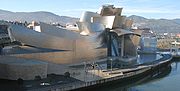
Bilbao
Bilbao ) is a Spanish municipality, capital of the province of Biscay, in the autonomous community of the Basque Country. With a population of 353,187 , it is the largest city of its autonomous community and the tenth largest in Spain...
, is famous for the Guggenheim Museum Bilbao
Guggenheim Museum Bilbao
The Guggenheim Museum Bilbao is a museum of modern and contemporary art, designed by Canadian-American architect Frank Gehry, built by Ferrovial, and located in Bilbao, Basque Country, Spain. It is built alongside the Nervion River, which runs through the city of Bilbao to the Atlantic Coast. The...
and for its estuary
Estuary of Bilbao
The Estuary of Bilbao lies at the common mouth of the rivers Nervion, Ibaizabal and Cadagua, that drain most of Biscay and part of Alava in the Basque Country, Spain. It is a large estuary long that extends from Bilbao to the Bilbao Abra bay, a widening that makes the final transition between...
.
Monuments and places of general interest
- Casa de Juntas (House of the Juntas) and the Tree of GernikaGernikako ArbolaGernikako Arbola is an oak tree that symbolizes traditional freedoms for the Biscayan people, and by extension for the Basque people as a whole...
, both in Gernika. - Casa de Juntas (House of the Juntas) of Avellanada, in the Enkarterri region.
- Caves of Pozalagua
- Vizcaya Bridge
- SantimamiñeSantimamiñeSantimamiñe cave, Kortezubi, Biscay, Basque Country, Spain, is one of the most important archaeological sites of the Basque Country, including a nearly complete sequence from the Middle Paleolithic to the Iron Age....
and the Forest of Oma - Euskalduna Conference Centre and Concert HallEuskalduna Conference Centre and Concert HallThe Euskalduna Conference Centre and Concert Hall is located in the city of Bilbao, in the Basque Country , beside the Estuary of Bilbao, built in part of the area that was formerly occupied by the Euskalduna shipyards.It was designed by architects Federico Soriano and Dolores Palacios and work...
in BilbaoBilbaoBilbao ) is a Spanish municipality, capital of the province of Biscay, in the autonomous community of the Basque Country. With a population of 353,187 , it is the largest city of its autonomous community and the tenth largest in Spain...
. - Gaztelugatxe
- UrdaibaiUrdaibaiThe Urdaibai estuary is a natural region and a Biosphere Reserve of Biscay, Basque Country. It is also referred as Mundaka or Gernika estuary....
biosphere reserve
External links
- Official website
- Señores de Vizcaya: list of all claimed Lords of Biscay and interesting historical maps.