


Anglicanism

Encyclopedia
Anglicanism is a tradition within Christianity
comprising churches with historical connections to the Church of England
or similar beliefs, worship and church structures. The word Anglican originates in ecclesia anglicana, a medieval Latin phrase dating to at least 1246 that means the English Church. Adherents of Anglicanism are called Anglicans. The great majority of Anglicans are members of churches which are part of the international Anglican Communion
. There are, however, a number of churches outside of the Anglican Communion which also consider themselves to be Anglican, most notably those referred to as Continuing Anglican churches.
The faith of Anglicans is founded in the scriptures, the traditions of the apostolic church, the apostolic succession
– "historic episcopate" and the early Church Fathers. Anglicanism forms one of the branches of Western Christianity
; having definitively declared its independence from the Roman pontiff
at the time of the Elizabethan Religious Settlement
, in what has been otherwise termed the British monachism. Many of the new Anglican formularies of the mid 16th century corresponded closely to those of contemporary Reformed Protestantism
and these reforms in the Church of England were understood by one of those most responsible for them, the then Archbishop of Canterbury
, Thomas Cranmer
, as navigating a middle way between two of the emerging Protestant traditions, namely Lutheranism and the Calvinism. By the end of the century, the retention in Anglicanism of many traditional liturgical forms and of the episcopate was already seen as unacceptable by those promoting the most developed Protestant principles. In the first half of the 17th century the Church of England and associated episcopal churches in Ireland and in England's American colonies were presented by some Anglican divines as comprising a distinct Christian tradition, with theologies, structures and forms of worship representing a different kind of middle way, or via media, between Reformed Protestantism and Roman Catholicism — a perspective that came to be highly influential in later theories of Anglican identity, and was expressed in the description "Catholic and Reformed". Following the American Revolution
, Anglican congregations in the United States and Canada
were each reconstituted into autonomous churches with their own bishops and self-governing structures; which, through the expansion of the British Empire
and the activity of Christian missions, was adopted as the model for many newly formed churches, especially in Africa
, Australasia
and the regions of the Pacific. In the 19th century the term Anglicanism was coined to describe the common religious tradition of these churches; as also that of the Scottish Episcopal Church
, which, though originating earlier within the Church of Scotland
, had come to be recognised as sharing this common identity.
The degree of distinction between Reformed and western Catholic tendencies within the Anglican tradition is routinely a matter of debate both within specific Anglican churches and throughout the Anglican Communion
. Unique to Anglicanism is the Book of Common Prayer
, the collection of services that worshippers in most Anglican churches used for centuries. While it has since undergone many revisions and Anglican churches in different countries have developed other service books, the Prayer Book is still acknowledged as one of the ties that bind the Anglican Communion together. There is no single Anglican Church with universal juridical authority, since each national or regional church has full autonomy. As the name suggests, the Churches of the Anglican Communion are linked by affection and common loyalty. They are in full communion with the See
of Canterbury and thus the Archbishop of Canterbury
, in his person, is a unique focus of Anglican unity. He calls the once-a-decade Lambeth Conference, chairs the meeting of Primates, and is President of the Anglican Consultative Council With a membership estimated at around 80 million members the Anglican Communion is the third largest Christian communion in the world, after the Roman Catholic Church and the Eastern Orthodox Church
es.
of Canterbury
. It has come to be used to refer to the claim of these churches to a unique religious and theological tradition apart from all other Christian churches, be they Orthodox, Roman Catholic or Protestant
; and is entirely distinct from the allegiance of some of these churches to the British Crown.
The word "Anglican" originates in , a Medieval Latin
phrase dating to at least 1246 meaning the "English
Church". As an adjective, "Anglican" is used to describe the people, institutions and churches, as well as the liturgical traditions and theological concepts, developed by the Church of England
. As a noun, an Anglican is a member of a church in the Anglican Communion
. The word is also used by followers of separated groups which have left the communion or have been founded separately from it, though this is sometimes considered as a misuse.
Although the term "Anglican" is found referring to the Church of England as far back as the 16th century, its use did not become general until the latter half of the 19th century. In British parliamentary legislation referring to the English Established Church, it is described as the "Protestant Episcopal Church", thereby distinguishing it from the counterpart established "Protestant Presbyterian Church
" in Scotland. High Church
men, who objected to the term "Protestant", initially promoted the term "Reformed Episcopal Church"; and it remains the case that the word "Episcopal" is preferred in the title of the Episcopal Church
(the province of the Anglican Communion covering the United States) and the Scottish Episcopal Church
. Outside of the British Isles, however, the term "Anglican Church" came to be preferred; as it distinguished these churches from others that claimed an episcopal polity
; although some churches, in particular the Scottish Episcopal Church, the Church of Ireland
and the Church in Wales
continue to use the term only with reservations.
of that era. As such, it is often referred to as being a via media (or "middle way") between these traditions. The faith of Anglicans is founded in the Scriptures and the Gospels, the traditions of the Apostolic
Church, the historical episcopate
, the first seven ecumenical councils
and the early Church Fathers
. Anglicans understand the Old
and New Testament
s as "containing all things necessary for salvation" and as being the rule and ultimate standard of faith. Anglicans understand the Apostles' Creed
as the baptismal symbol and the Nicene Creed
as the sufficient statement of the Christian faith
.
 Anglicans believe the Catholic and apostolic faith is revealed in Holy Scripture and the Catholic creeds and interpret these in light of the Christian tradition of the historic church, scholarship, reason and experience.
Anglicans celebrate the traditional sacraments, with special emphasis being given to the Holy Eucharist, also called Holy Communion, the Lord's Supper or the Mass
. The Eucharist is central to worship for most Anglicans as a communal offering of prayer and praise in which the life, death and resurrection of Jesus Christ are proclaimed through prayer, reading of the Bible, singing, and the offering of the bread and wine, giving God thanks over them for the innumerable benefits obtained through the passion of Christ, the breaking of the bread, and reception of the body and blood of Christ as instituted at the Last Supper
. While many Anglicans celebrate the Eucharist in similar ways to the predominant western Catholic tradition, a considerable degree of liturgical freedom is permitted, and worship styles range from the simple to elaborate.
Unique to Anglicanism is the Book of Common Prayer
(BCP), the collection of services that worshippers in most Anglican churches used for centuries. It was called common prayer originally because it was intended for use in all Church of England churches which had previously followed differing local liturgies. The term was kept when the church became international because all Anglicans used to share in its use around the world. In 1549, the first Book of Common Prayer was compiled by Thomas Cranmer
, who was then Archbishop of Canterbury
. Whilst it has since undergone many revisions and Anglican churches in different countries have developed other service books, the Prayer Book is still acknowledged as one of the ties that bind the Anglican Communion together.
with the services in the Book of Common Prayer
, under the leadership and organisation of a continuing episcopate; and over the years these traditions themselves came to command adherence and loyalty. Potentially this would create a crisis of identity, were secular and religious loyalties to conflict – and such a crisis indeed occurred in 1776 with the American Declaration of Independence, most of whose signatories were, at least nominally, Anglican. For these American Patriots, even the forms of Anglican services were in doubt, since the Prayer Book rites of Matins
, Evensong
and Holy Communion, all included specific prayers for the British Royal Family. Consequently, the conclusion of the War of Independence
resulted in the creation of two new Anglican churches, The Episcopal Church in the United States of America in those States that had achieved independence; and The Church of England in Canada
in those North American colonies remaining under British control and to which many Loyalist churchmen had migrated. Reluctantly, legislation was passed in the British Parliament (the Consecration of Bishops Abroad Act 1786) to allow bishops to be consecrated for an American church outside of allegiance to the British Crown (whereas no bishoprics had ever been established in the former American colonies). Both in the United States and in Canada, the new Anglican churches developed novel models of self-government, collective decision-making, and self-supported financing; that would be consistent with separation of religious and secular identities.
In the following century, two further factors acted to accelerate the development of a distinct Anglican identity. From 1828 and 1829, Dissenters and Roman Catholics could be elected to the House of Commons, which consequently ceased to be a body drawn purely from the established churches of Scotland, England and Ireland; but which nevertheless, over the following ten years, engaged in extensive reforming legislation affecting the interests of the established United Church of England and Ireland. The propriety of this legislation was bitterly contested by the Oxford Movement
(Tractarians), who in response developed a vision of Anglicanism as religious tradition deriving ultimately from the Ecumenical Councils of the patristic church. Those within the Church of England opposed to the Tractarians, and to their revived ritual practices, introduced a stream of Parliamentary Bills aimed to control innovations in worship; but this only made the dilemma more acute, with consequent continual litigation in the secular and ecclesiastical courts.
Over the same period Anglican churches engaged vigorously in Christian missions
, resulting in the creation, by the end of the century, of over ninety colonial bishoprics; which gradually coalesced into new self-governing churches on the Canadian and American models. However, the case of John William Colenso
Bishop of Natal
, reinstated in 1865 by the English Judicial Committee of the Privy Council
over the heads of the Church in South Africa, demonstrated acutely that the extension of episcopacy had to be accompanied by a recognised Anglican ecclesiology of ecclesiastical authority, distinct from secular power.
Consequently, at the instigation of the bishops of Canada and South Africa, the first Lambeth Conference was called in 1867; to be followed by further conferences in 1878 and 1888, and thereafter at ten year intervals. The various papers and declarations of successive Lambeth Conferences, have served to frame the continued Anglican debate on identity, especially as relating to the possibility of ecumenical discussion with other churches. This ecumenical aspiration became much more of a possibility, as other denominational groups rapidly followed the example of the Anglican Communion in founding their own transnational alliances: the Alliance of Reformed Churches
, the Ecumenical Methodist Council
, the International Congregational Council
, and the Baptist World Alliance
.
and in particular John Henry Newman – looked back to the writings of 17th century Anglican divines, finding in these texts the idea of the English church as a via media between the Protestant and Catholic traditions. This view was associated – especially in the writings of Edward Bouverie Pusey
– with the theory of Anglicanism as one of three "branches
" (alongside the Roman Catholic and Orthodox churches) historically arising out of the common tradition of the earliest Ecumenical Councils. Newman himself subsequently rejected the theory of the via media, as essentially historicist and static; and hence unable to accommodate any dynamic development within the church. Nevertheless, the aspiration to ground Anglican identity in the writings of the 17th century divines, and in faithfulness to the traditions of the Church Fathers
reflects a continuing theme of Anglican ecclesiology, most recently in the writings of Henry Robert McAdoo.
The Tractarian formulation of the theory of the via media was essentially a party platform, and not acceptable to Anglicans outside the confines of the Oxford Movement
. However, the theory of the via media was reworked in the ecclesiological writings of Frederick Denison Maurice, in a more dynamic form that became widely influential. Both Maurice and Newman saw the Church of England of their day as sorely deficient in faith; but whereas Newman had looked back to a distant past when the light of faith might have appeared to burn brighter, Maurice looked forward to the possibility of a brighter revelation of faith in the future. Maurice saw the Protestant and Catholic strands within the Church of England as contrary but complementary, both maintaining elements of the true church, but incomplete without the other; such that a true catholic and evangelical church might come into being by a union of opposites. Central to Maurice's perspective, is his belief that the collective elements of family, nation and church represent a divine order of structures through which God unfolds his continuing work of creation. Hence, for Maurice, the Protestant tradition has maintained the elements of national distinction which are amongst the marks of the true universal church, but which have been lost within Roman Catholicism in the internationalism of centralised Papal Authority. Within the coming universal church that Maurice foresaw, national churches would each maintain the six signs of Catholicity: baptism, Eucharist, the creeds, Scripture, an episcopally ordered ministry, and a fixed liturgy (which could take a variety of forms in accordance with divinely ordained distinctions in national characteristics). Not surprisingly, this vision of a becoming universal church as a congregation of autonomous national churches, proved highly congenial in Anglican circles; and Maurice's six signs were adapted to form the Chicago-Lambeth Quadrilateral
of 1888.
In the latter decades of the 20th century, Maurice's theory, and the various strands of Anglican thought that derived from it, have been criticised by Stephen Sykes
; who argues that the terms Protestant and Catholic as used in these approaches are synthetic constructs denoting ecclesiastic identities unacceptable to those to whom the labels are applied. Hence, the Roman Catholic Church does not regard itself as a party or strand within the universal church – but rather identifies itself as the universal church. Moreover, Sykes criticises the proposition, implicit in theories of via media, that there is no distinctive body of Anglican doctrine, other than those of the universal church; accusing this of being an excuse not to undertake systematic doctrine at all. Contrariwise, Sykes notes a high degree of commonality in Anglican liturgical forms, and in the doctrinal understandings expressed within those liturgies. He proposes that Anglican identity might rather be found within a shared consistent pattern of prescriptive liturgies, established and maintained through canon law, and embodying both a historic deposit of formal statements of doctrine, and also framing the regular reading and proclamation of scripture. Sykes nevertheless agrees with those heirs of Maurice who emphasise the incompleteness of Anglicanism as a positive feature, and quotes with qualified approval the words of Michael Ramsay:
the nature of Anglicanism was based on questions of jurisdiction – specifically, the belief of the Crown that national church
es should be autonomous – rather than theological disagreement. The effort was to create a national church in legal continuity with its traditions, but inclusive of certain doctrinal and liturgical beliefs of the Reformers
. The result has been a movement with a distinctive self-image among Christian movements. The question often arises as to whether the Anglican Communion should be identified as a Protestant or Catholic
church, or perhaps as a distinct branch of Christianity altogether.
The distinction between Reformed and Catholic, and the coherence of the two, is routinely a matter of debate both within specific Anglican Churches and throughout the Anglican Communion by members themselves. Since the Oxford Movement
of the mid-19th century, many Churches of the Communion have revived and extended liturgical and pastoral practices similar to Roman Catholic theology. This extends beyond the ceremony of High Church
services to even more theologically significant territory, such as sacramental theology (see Anglican sacraments
). While Anglo-Catholic practices, particularly liturgical ones, have resurfaced and become more common within the tradition over the last century, there remain many places where practices and beliefs remain on the more Reformed or Evangelical side (see Sydney Anglicanism).
 For 'High Church' Anglicans, doctrine is neither established by a magisterium
, nor derived from the theology of an eponymous founder (such as Calvinism
), nor summed up in a confession of faith beyond the ecumenical creeds (such as the Lutheran Book of Concord
). For them, the earliest Anglican theological documents are its prayer books, which they see as the products of profound theological reflection, compromise, and synthesis. They emphasise the Book of Common Prayer
as a key expression of Anglican doctrine. The principle of looking to the prayer books as a guide to the parameters of belief and practice is called by the Latin name lex orandi, lex credendi
("the law of prayer is the law of belief"). Within the prayer books are the fundamentals of Anglican doctrine: The Apostles'
and Nicene Creed
s, the Athanasian Creed
(rarely recited today), the scriptures (via the lectionary), the sacraments, daily prayer, the catechism
, and apostolic succession in the context of the historic threefold ministry. For some 'Low Church' Anglicans, the 16th-century Reformed Thirty-Nine Articles form the basis of doctrine.
Specific Anglican Beliefs
The Thirty-Nine Articles
initially played a significant role in Anglican doctrine and practice. Following the passing of the 1604 Canons, all Anglican clergy had to formally subscribe to the Articles. Today, however, the articles are no longer binding, but are seen as a historical document that has played a significant role in the shaping of Anglican identity. The degree to which each of the Articles has remained influential varies. On the doctrine of justification
, for example, there is a wide range of beliefs within the Anglican Communion
, with some Anglo-Catholics arguing for a faith with good works and the Sacraments. At the same time, however, some Evangelical Anglicans ascribe to the Reformed emphasis on Sola fide
in their doctrine of justification (see Sydney Anglicanism.) Still, other Anglicans adopt a nuanced view of justification, taking elements from the early Church Fathers
, Catholicism
, Protestantism
, liberal theology
and latitudinarian
thought. Arguably, the most influential of the original Articles has been Article VI on the sufficiency of Scripture, which states that Scripture containeth all things necessary to salvation: so that whatsoever is not read therein, nor may be proved thereby, is not to be required of any man, that it should be believed as an article of the Faith, or be thought requisite or necessary to salvation. This article has informed Anglican biblical exegesis
and hermeneutics since earliest times.
Anglicans look for authority in their "standard divines" (see below). Historically, the most influential of these – apart from Cranmer – has been the 16th century cleric and theologian Richard Hooker who after 1660 was increasingly portrayed as the founding father of Anglicanism. Hooker's description of Anglican authority as being derived primarily from Scripture, informed by reason (the intellect and the experience of God) and tradition (the practices and beliefs of the historical church), has influenced Anglican self-identity and doctrinal reflection perhaps more powerfully than any other formula. The analogy of the "three-legged stool" of scripture
, reason
, and tradition
is often incorrectly attributed to Hooker. Rather Hooker's description is a hierarchy of authority, with scripture as foundational, and reason and tradition as vitally important, but secondary, authorities.
Finally, the extension of Anglicanism into non-English cultures, the growing diversity of prayer books, and the increasing interest in ecumenical dialogue, has led to further reflection on the parameters of the Anglican identity. Many Anglicans look to the Chicago-Lambeth Quadrilateral
of 1888 as the "sine qua non" of Communal identity. In brief, the Quadrilateral's four points are the Holy Scriptures, as containing all things necessary to salvation; the Creeds (specifically, the Apostles' and Nicene Creeds), as the sufficient statement of Christian faith; the dominical sacraments of Baptism
and Holy Communion; and the historic episcopate.
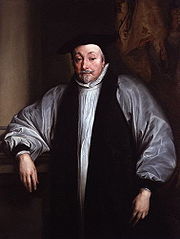 Within the Anglican tradition, divines are theological writers whose works have been considered standards for faith, doctrine, worship, and spirituality. While there is no authoritative list of these Anglican divines, there are some whose names would likely be found on most lists – those who are commemorated in lesser feasts of the Church, and those whose works are frequently anthologised
.
The corpus produced by Anglican divines is diverse. What they have in common is a commitment to the faith as conveyed by Scripture and the Book of Common Prayer, thus regarding prayer and theology in a manner akin to that of the Apostolic Fathers
. On the whole, Anglican divines view the via media of Anglicanism, not as a compromise, but "a positive position, witnessing to the universality of God and God's kingdom working through the fallible, earthly ecclesia Anglicana." These theologians regard Scripture as interpreted through tradition and reason as authoritative in matters concerning salvation. Reason and tradition, indeed, is extant in and presupposed by Scripture, thus implying co-operation between God and humanity, God and nature, and between the sacred and secular. Faith is thus regarded as incarnation
al, and authority as dispersed.
Among the early Anglican divines of the 16th and 17th centuries, the names of Thomas Cranmer
, John Jewel
, Matthew Parker
, Richard Hooker, Lancelot Andrewes
, and Jeremy Taylor
predominate. The influential character of Hooker's Of the Laws of Ecclesiastical Polity cannot be overestimated. Published in 1593 and subsequently, Hooker's eight volume work is primarily a treatise on Church-state relations, but it deals comprehensively with issues of biblical interpretation, soteriology
, ethics
, and sanctification
. Throughout the work, Hooker makes clear that theology involves prayer and is concerned with ultimate issues, and that theology is relevant to the social mission of the church.
 The 18th century saw the rise of two important movements in Anglicanism: Cambridge Platonism
, with its mystical understanding of reason as the "candle of the Lord," and the Evangelical
Revival, with its emphasis on the personal experience of the Holy Spirit
. The Cambridge Platonist movement evolved into a school called Latitudinarianism, which emphasised reason as the barometer of discernment and took a stance of indifference towards doctrinal and ecclesiological differences. The Evangelical Revival, influenced by such figures as John Wesley
and Charles Simeon
, re-emphasised the importance of justification through faith
and the consequent importance of personal conversion. Some in this movement, such as Wesley and George Whitefield
, took the message to the United States
, influencing the First Great Awakening
, and created an Anglo-American movement called Methodism
that would eventually break away, structurally, from the Anglican churches after the American Revolution.
By the 19th century, there was a renewed interest in pre-Reformation English religious thought and practice: Theologians such as John Keble
, Edward Bouverie Pusey
, and John Henry Newman had widespread influence in the realm of polemics, homiletics, and theological and devotional works, not least because they largely repudiated the Old High Church tradition and replaced it with a dynamic appeal to antiquity which looked beyond the Reformers and Anglican formularies. Their work is largely credited with the development of the Oxford Movement
, which sought to reassert Catholic identity and practice in the Anglican Church. In contrast to this movement, such churchmen as the Bishop of Liverpool, John Charles Ryle
sought to uphold the distinctly Protestant identity of the Church of England. He was not a servant of the status quo, but argued for a lively religion which emphasized grace, holy and charitable living, and for the plain use of the 1662 Common Prayer without additional rituals. Frederick Denison Maurice, through such works as The Kingdom of Christ, played a pivotal role in inaugurating another movement, Christian socialism
. In this, Maurice transformed Hooker's emphasis on the incarnation
al nature of Anglican spirituality to an imperative for social justice. In the 19th century, Anglican biblical scholarship began to assume a distinct character, represented by the so-called "Cambridge triumvirate" of Joseph Lightfoot, F. J. A. Hort
, and Brooke Foss Westcott
. Their orientation is best summed up by Lightfoot's observation that "Life which Christ is and which Christ communicates, the life which fills our whole beings as we realise its capacities, is active fellowship with God."
The 20th century is marked by figures such as Charles Gore
, with his emphasis on natural revelation, William Temple
's focus on Christianity and society, J.A.T. Robinson
's provocative discussions of deism and theism, Darwell Stone's and E. L. Mascall's Thomism and defence of Catholic orthodoxy, and Kenneth Kirk
's Moral Theology. Outside England, one sees such figures as William Porcher DuBose
, William Meade
, and Charles Henry Brent
in the United States. More recently, theologians such as Henry Chadwick
, John Macquarrie
and Don Cupitt
, who rejected all the doctrines of historic Christianity in favour of a "Christian Buddhism", Jeffrey John
, N. T. Wright, and Rowan Williams
have added to the mix.
The range of Anglican belief and practice became particularly divisive during the 19th century when some clergy were disciplined and even imprisoned on charges of ritual heresy while, at the same time, others were criticised for engaging in public worship services with ministers of Reformed churches. Resistance to the growing acceptance and restoration of traditional Catholic ceremonial by the mainstream of Anglicanism ultimately led to the formation of small breakaway churches such as the Free Church of England
in England (1844) and the Reformed Episcopal Church
in North America (1873).
Anglo-Catholic (and some Broad Church) Anglicans celebrate public liturgy in ways that understand worship to be something very special and of utmost importance. Vestments are worn by the clergy, sung settings are often used and incense
may be used. Nowadays, in most Anglican churches, the Eucharist is celebrated in a manner similar to the usage of Roman Catholics and some Lutherans though, in many churches, more traditional, "pre-Vatican II", models of worship are common, (e.g. an "eastward orientation" at the altar). Whilst many Anglo-Catholics derive much of their liturgical practice from that of the pre-Reformation English church, others more closely follow traditional Roman Catholic practices. The Eucharist may be sometimes be celebrated, in the form known as High Mass
, with a priest, deacon and subdeacon
dressed in traditional vestments, with incense and sanctus bells and with prayers adapted from the Roman missal
or other sources by the celebrant. Such churches may also have forms of Eucharistic adoration
such as Benediction of the Blessed Sacrament. In terms of personal piety some Anglicans may recite the rosary and angelus
, be involved in a devotional society dedicated to "Our Lady" (the Blessed Virgin Mary) and seek the intercession of the saints.
In recent years the prayer books of several provinces have, out of deference to a greater agreement with Eastern Conciliarism
(and a perceived greater respect accorded Anglicanism by Eastern Orthodoxy than by Roman Catholicism), instituted a number of historically Eastern and Oriental Orthodox elements in their liturgies, including introduction of the Trisagion
and deletion of the filioque clause from the Nicene Creed
.
For their part, those Evangelical
(and some Broad Church) Anglicans who emphasise the more Protestant aspects of the Church stress the Reformation theme of salvation by grace through faith. They emphasise the two dominical sacraments of Baptism and Eucharist, viewing the other five as "lesser rites". Some Evangelical Anglicans may even tend to take the inerrancy of Scripture literally, adopting the view of Article VI that it contains all things necessary to salvation in an explicit sense. Worship in churches influenced by these principles tends to be significantly less elaborate, with greater emphasis on the Liturgy of the Word (the reading of the scriptures, the sermon and the intercessory prayers). The Order for Holy Communion may be celebrated bi-weekly or monthly (in preference to the daily offices), by priests attired in choir habit, or more regular clothes, rather than Eucharistic vestments. Ceremony may be in keeping with their view of the provisions of the 17th century Puritans – being a Reformed interpretation of the Ornaments Rubric
– no candles, no incense, no bells and a minimum of manual actions by the presiding celebrant (such as touching the elements at the Words of Institution
).
In recent decades there has been a growth of charismatic
worship among Anglicans. Both Anglo-Catholics and Evangelicals have been affected by this movement such that it is not uncommon to find typically charismatic postures, music, and other themes evident during the services of otherwise Anglo-Catholic or Evangelical parishes.
The spectrum of Anglican beliefs and practice is too large to be fit into these labels. Many Anglicans locate themselves somewhere in the spectrum of the Broad Church tradition and consider themselves an amalgam of Evangelical and Catholic. Such Anglicans stress that Anglicanism is the "via media" (middle way) between the two major strains of Western Christianity and that Anglicanism is like a "bridge" between the two strains.
, Anglican sacramental theology expresses elements in keeping with its status as being both a church in the Catholic
tradition as well as a Reformed
church. With respect to sacramental theology the Catholic heritage is perhaps most strongly asserted in the importance Anglicanism places on the sacrament
s as a means of grace
, sanctification
and salvation
as expressed in the church's liturgy
and doctrine.
Of the seven sacraments, all Anglicans recognise Baptism
and the Eucharist
as being directly instituted by Christ. The other five — Confession and absolution, Matrimony, Confirmation, Holy Orders
(also called Ordination) and Anointing of the Sick
(also called Unction) — are regarded variously as full sacraments by Anglo-Catholics, many High Church
and some Broad Church
Anglicans, but merely as "sacramental rites" by other Broad Church and Low Church
Anglicans, especially Evangelical
s associated with Reform UK
and the Diocese of Sydney
.
but deny that the presence of Christ is carnal or is necessarily localised in the bread and wine. Despite explicit criticism in the Thirty-Nine Articles
, many High Church or Anglo-Catholic Anglicans hold, more or less, the Roman Catholic view of the Real Presence, as expressed in the doctrine of transubstantiation
, seeing the Eucharist as a liturgical representation of Christ's atoning sacrifice with the elements actually transformed into Christ's Body and Blood.
The majority of Anglicans, however, have in common a belief in the Real Presence, defined in one way or another. To that extent, they are in the company of the continental reformer Martin Luther
rather than Ulrich Zwingli. Luther taught consubstantiation
or "Sacramental Union", a form of which had first been articulated by the Lollards.
A famous Anglican aphorism regarding Christ's presence in the sacrament is found in a poem by John Donne
:
An Anglican position on the eucharistic sacrifice ("Sacrifice of the Mass") was expressed in the response Saepius Officio of the Archbishops of Canterbury and York to Pope Leo XIII
's Papal Encyclical Apostolicae curae
.
Anglican and Roman Catholic representatives declared that they had "substantial agreement on the doctrine of the Eucharist" in the Windsor Statement on Eucharistic Doctrine from the Anglican-Roman Catholic International Consultation and the Elucidation of the ARCIC Windsor Statement. Despite this agreement, other ecclesiological differences between the two churches prevent full intercommunion.
(BCP) is the foundational prayer book of Anglicanism. The original book of 1549 (revised 1552) was one of the instruments of the English Reformation
, replacing the various 'uses' or rites in Latin that had been used in different parts of the country with a single compact volume in the language of the people, so that "now from henceforth all the Realm shall have but one use". Suppressed under Queen Mary I
, it was revised in 1559, and then again in 1662, after the Restoration
of Charles II
. This version was made mandatory in England and Wales by the Act of Uniformity
and was in standard use until the mid 20th century.
With British colonial
expansion from the 17th century onwards, the Anglican church was planted around the globe. These churches at first used and then revised the Book of Common Prayer, until they, like their parent church, produced prayer books which took into account the developments in liturgical study and practice in the 19th and 20th centuries, which come under the general heading of the Liturgical Movement
.
, who aimed to create a set order of service like that of the pre-Reformation church but less complex in its seasonal variety and said in English rather than Latin
. This use of a set order of service is not unlike the Roman Catholic tradition. Traditionally the pattern was that laid out in the Book of Common Prayer
. Although many Anglican churches now use a wide range of modern service books written in the local language, the structures of the Book of Common Prayer are largely retained. Churches which call themselves Anglican will have identified themselves so because they use some form or variant of the Book of Common Prayer in the shaping of their worship.
Anglican worship, however, is as diverse as Anglican theology. A contemporary "low church
" or Evangelical service may differ little from the worship of many mainstream Protestant churches. The service is constructed around a sermon focused on Biblical exposition and opened with one or more Bible readings and closed by a series of prayers (both set and extemporised) and hymns or songs. A "high church
" or Anglo-Catholic service, by contrast, is usually a more formal liturgy
celebrated by clergy in distinctive vestments and may be almost indistinguishable from a Roman Catholic service, often resembling the "pre-Vatican II" Tridentine rite
. Between these extremes are a variety of styles of worship, often involving a robed choir and the use of the organ to accompany the singing and to provide music before and after the service. Anglican churches tend to have pew
s or chairs and it is usual for the congregation to kneel for some prayers but to stand for hymns and other parts of the service such as the Gloria, Collect, Gospel reading, Creed and either the Preface or all of the Eucharistic Prayer. High Anglicans may genuflect or cross themselves in the same way as Roman Catholics.
Until the mid-20th century the main Sunday service was typically morning prayer, but the Eucharist
has once again become the standard form of Sunday worship in many Anglican churches; this again is similar to Roman Catholic practice. Other common Sunday services include an early morning Eucharist without music, an abbreviated Eucharist following a service of morning prayer and a service of evening prayer
, sometimes in the form of sung Evensong
, usually celebrated between 3 and 6 pm The late-evening service of Compline
was revived in parish use in the early 20th century. Many Anglican churches will also have daily morning and evening prayer and some have midweek or even daily celebration of the Eucharist.
An Anglican service (whether or not a Eucharist) will include readings from the Bible that are generally taken from a standardised lectionary
, which provides for much of the Bible (and some passages from the Apocrypha
) to be read out loud in the church over a three year cycle. The sermon
(or homily
) is typically about ten to twenty minutes in length, though it may be much longer in Evangelical churches. Even in the most informal Evangelical services it is common for set prayers such as the weekly Collect
to be read. There are also set forms for intercessory prayer, though this is now more often extemporaneous. In high and Anglo-Catholic churches there are generally prayers for the dead.
Although Anglican public worship is usually ordered according to the canonically approved services, in practice many Anglican churches use forms of service outside these norms. Many Evangelical churches sit lightly to the set forms of morning and evening prayer, though generally respecting the canonical order of Holy Communion. Liberal churches may use freely structured or experimental forms of worship, including patterns borrowed from ecumenical traditions such as those of Taizé Community
or the Iona Community
.
Anglo-Catholic parishes might use the modern Roman Catholic liturgy of the Mass
or more traditional forms, such as the Tridentine Mass
(which is translated into English in the English Missal
), the Anglican Missal
, or, less commonly, the Sarum Rite
. Traditional Catholic devotions such as the Rosary
, Angelus
and Benediction of the Blessed Sacrament
are also common among Anglo-Catholics.
persons are eligible to receive communion, although in many churches communion is restricted to those who have not only been baptised but also confirmed. In many Anglican provinces, however, all baptised Christians are now often invited to receive communion and some dioceses have regularised a system for admitting baptised young people to communion before they are confirmed.
The discipline of fasting before communion is practised by some Anglicans. Most Anglican priests require the presence of at least one other person for the celebration of the Eucharist (referring back to Christ's statement in Math 18:20 "When two or more are gathered in my name, I will be in the midst of them"), though some Anglo-Catholic priests (like Roman Catholic priests) may say private Masses. As in the Roman Catholic Church, it is a canonical requirement to use fermented wine
for the Communion; unlike in mainstream Roman Catholicism, however, the consecrated bread and wine are always offered together to the congregation in a Eucharistic service ("Communion in Both Kinds"). This practice is gradually being adopted in the Roman Catholic Church too, especially through the Neocatechumenal Way
. In some churches the sacrament is reserved in a tabernacle or aumbry
with a lighted candle or lamp nearby. Only a priest or a bishop may be the celebrant at the Eucharist, though Sydney Anglicans may soon authorise lay people to celebrate the Eucharist (or Lord's Supper).
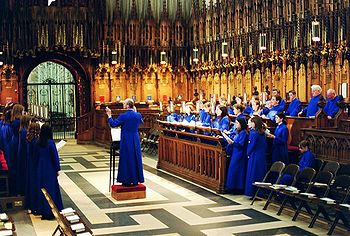 All Anglican prayer books contain offices for Morning Prayer (Matins) and Evening Prayer
(Evensong). In the original Book of Common Prayer these were derived from combinations of the ancient monastic offices of Matins
and Lauds
; and Vespers
and Compline
respectively. The prayer offices have an important place in Anglican history. Prior to the Catholic revival
of the 19th century, which eventually restored the Holy Eucharist as the principal Sunday liturgy, and especially during the 18th century, a morning service combining Matins, the Litany
and ante-Communion comprised the usual expression of common worship; while Matins and Evensong were sung daily in cathedrals and some collegiate chapels. This nurtured a tradition of distinctive Anglican chant
applied to the canticle
s and psalms used at the offices (although plainsong
is often used as well).
In some official and many unofficial Anglican service books these offices are supplemented by other offices such as the Little Hours
of Prime
and prayer during the day such as (Terce
, Sext
, None
and Compline
). Some Anglican monastic communities have a Daily Office based on that of the Book of Common Prayer but with additional antiphons and canticles, etc. for specific days of the week, specific psalms, etc. See, for example, Order of the Holy Cross
and Order of St Helena, editors, A Monastic Breviary (Wilton, Conn.: Morehouse-Barlow, 1976). The All Saints Sisters of the Poor, with convents in Catonsville, Maryland and elsewhere use an elaborated version of the Anglican Daily Office. The Society of St. Francis publishes Celebrating Common Prayer which has become especially popular for use among Anglicans.
In England, the United States, Canada, Australia, New Zealand and some other Anglican provinces the modern prayer books contain four offices:
In addition, most prayer books include a section of prayers and devotions for family use. In the US, these offices are further supplemented by an "Order of Worship for the Evening", a prelude to or an abbreviated form of Evensong, partly derived from Orthodox
prayers. In the United Kingdom, the publication of Daily Prayer, the third volume of Common Worship
was published in 2005. It retains the services for Morning and Evening Prayer and Compline and includes a section entitled "Prayer during the Day". 'A New Zealand Prayer Book' of 1989 provides different outlines for Matins and Evensong on each day of the week, as well as "Midday Prayer", "Night Prayer" and "Family Prayer".
Some Anglicans who pray the office on daily basis use the present Divine Office
of the Roman Catholic Church. In many cities, especially in England, Anglican and Roman Catholic priests and lay people often meet several times a week to pray the office in common. A small but enthusiastic minority use the Anglican Breviary
, or other translations and adaptations of the Pre-Vatican II Roman Rite and Sarum Rite
, along with supplemental material from cognate western sources, to provide such things as a common of Octaves, a common of Holy Women and other additional material. Others may privately use idiosyncratic forms borrowed from a wide range of Christian traditions.
In the late medieval period, many English cathedrals and monasteries had established small choirs of trained lay clerk
s and boy choristers
to perform polyphonic
settings of the Mass
in their Lady Chapel
s. Although these "Lady Masses" were discontinued at the Reformation, the associated musical tradition was maintained in the Elizabethan Settlement through the establishment of choral foundations for daily singing of the Divine Office by expanded choirs of men and boys. This resulted from an explicit addition by Elizabeth herself to the injunctions accompanying the 1559 Book of Common Prayer
(that had itself made no mention of choral worship) by which existing choral foundations and choir schools were instructed to be continued, and their endowments secured. Consequently, some thirty-four cathedrals, collegiate churches and royal chapels maintained paid establishments of lay singing men and choristers in the late 16th century. All save four of these have – with an interruption during the Commonwealth
– continued daily choral prayer and praise to this day. In the Offices of Matins
and Evensong
in the 1662 Book of Common Prayer, these choral establishments are specified as "Quires and Places where they sing".
For nearly three centuries, this round of daily professional choral worship represented a tradition entirely distinct from that embodied in the intoning of Parish Clerks, and the singing of "west gallery choirs
" which commonly accompanied weekly worship in English parish churches. However, in 1841, the rebuilt Leeds Parish Church
established a surpliced choir
to accompany parish services; drawing explicitly on the musical traditions of the ancient choral foundations; and over the next century, the Leeds example proved immensely popular and influential for choirs in cathedrals, parish churches and schools throughout the Anglican communion. More or less extensively adapted, this choral tradition also became the direct inspiration for robed choirs leading congregational worship in a wide range of Christian denominations.
In 1719 the cathedral choirs of Gloucester
, Hereford
and Worcester
combined to establish the annual Three Choirs Festival
, the precursor for the multitude of summer music festivals since. By the 20th century, the choral tradition had become for many the most accessible face of worldwide Anglicanism – especially as promoted through the regular broadcasting of choral evensong by the BBC
; and also in the annual televising of the festival of Nine lessons and carols
from King's College, Cambridge
. Composers closely concerned with this tradition include Edward Elgar
, Ralph Vaughan Williams
, Gustav Holst
, Charles Villiers Stanford
and Benjamin Britten
. A number of important 20th century works by non-Anglican composers were originally commissioned for the Anglican choral tradition – for example the Chichester Psalms
of Leonard Bernstein
, and the Nunc dimittis
of Arvo Pärt
.
). The monarch has no constitutional role in Anglican churches in other parts of the world, although the prayer books of several countries where she is head of state maintain prayers for her as sovereign.
A characteristic of Anglicanism is that it has no international juridical authority. All thirty-nine provinces of the Anglican Communion are autonomous, each with their own primate
and governing structure. These provinces may take the form of national churches (such as in Canada, Uganda, or Japan) or a collection of nations (such as the West Indies, Central Africa, or South Asia), or geographical regions (such as Vanuatu and Solomon Islands) etc. Within these Communion provinces may exist subdivisions, called ecclesiastical province
s, under the jurisdiction of a metropolitan archbishop. All provinces of the Anglican Communion consist of diocese
s, each under the jurisdiction of a bishop. In the Anglican tradition, bishops must be consecrated according to the strictures of apostolic succession
, which Anglicans consider one of the marks of Catholicity
. Apart from bishops, there are two other orders of ordained ministry: deacon
and priest
. No requirement is made for clerical celibacy
, though many Anglo-Catholic priests have traditionally been bachelors. Because of innovations that occurred at various points after the latter half of the 20th century, women may be ordained as deacons in almost all provinces, as priests in some, and as bishops in a few provinces. Anglican religious order
s and communities, suppressed in England during the Reformation, have re-emerged, especially since the mid-19th century, and now have an international presence and influence.
Government in the Anglican Communion is synod
ical, consisting of three houses of laity
(usually elected parish representatives), clergy
, and bishops. National, provincial, and diocesan synods maintain different scopes of authority, depending on their canons and constitutions
. Anglicanism is not congregational
in its polity: It is the diocese, not the parish church, which is the smallest unit of authority in the church. (See Episcopal polity
).
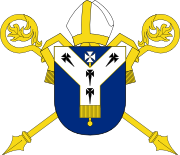 The Archbishop of Canterbury
has a precedence of honour over the other primates of the Anglican Communion, and for a province to be considered a part of the Communion means specifically to be in full communion with the See
of Canterbury
. The Archbishop is, therefore, recognised as primus inter pares
, or first amongst equals even though he does not exercise any direct authority in any province outside England, of which he is chief primate. Rowan Williams
, the Archbishop of Canterbury since 2003, was the first archbishop appointed from outside the Church of England since the Reformation: he was formerly the Archbishop of Wales
.
As "spiritual head" of the Communion, the Archbishop of Canterbury maintains a certain moral authority, and has the right to determine which churches will be in communion with his See
. He hosts and chairs the Lambeth Conferences of Anglican Communion bishops, and decides who will be invited to them. He also hosts and chairs the Anglican Communion Primates' Meeting
and is responsible for the invitations to it. He acts as president of the secretariat of the Anglican Communion Office, and its deliberative body, the Anglican Consultative Council
.
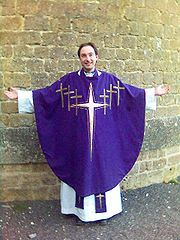 Like the Orthodox
and Roman Catholic churches, the Anglican Communion maintains the threefold ministry of deacons, priests and bishops.
s, who possess the fullness of Christian priesthood, are the successors of the Apostles. Primates, archbishops and metropolitans
are all bishops and members of the historical episcopate
who derive their authority through apostolic succession
– an unbroken line of bishops that can be traced back to the 12 apostles of Jesus
.
s. Most ordained ministers in the Anglican Communion are priest
s, who usually work in parish
es within a diocese
. Priests are in charge of the spiritual life of parishes and are usually called the rector
or vicar
. A curate
(or, more correctly, an 'assistant curate') is a term often used for a priest or deacon who assists the parish priest. Non-parochial priests may earn their living by any vocation, although employment by educational institutions or charitable organizations is most common. Priests also serve as chaplains of hospitals, schools, prisons, and in the armed forces.
An archdeacon
is a priest or deacon responsible for administration of an archdeaconry, which is often the name given to the principal subdivisions of a diocese
. An archdeacon represents the diocesan bishop in his or her archdeaconry. In the Church of England
the position of archdeacon can only be held by someone in priestly orders who has been ordained for at least six years. In some other parts of the Anglican Communion the position can also be held by deacons. In parts of the Anglican Communion where women cannot be ordained as priests or bishops but can be ordained as deacons, the position of archdeacon is effectively the most senior office an ordained woman can be appointed to.
A dean is a priest who is the principal cleric of a cathedral or other collegiate church and the head of the chapter of canons. If the cathedral or collegiate church has its own parish, the dean is usually also rector of the parish. However, in the Church of Ireland the roles are often separated and most cathedrals in the Church of England do not have associated parishes. In the Church in Wales, however, most cathedrals are parish churches and their deans are now also vicars of their parishes.
The Anglican Communion recognizes Roman Catholic and Eastern Orthodox
ordinations as valid. Outside the Anglican Communion, Anglican ordinations (at least of male priests) are recognized by the Old Catholic Church
and various Independent Catholic churches.
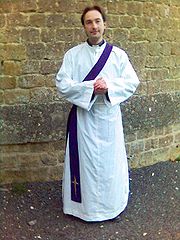
In Anglican churches, deacons often work directly in ministry to the marginalised inside and outside the church: the poor, the sick, the hungry, the imprisoned. Unlike Orthodox and Roman Catholic deacons who may be married only before ordination, deacons are permitted to marry freely both before and after ordination, as are priests. Most deacons are preparing for priesthood, and usually only remain as deacons for about a year before being ordained priests. However, there are some deacons who remain deacons. Many provinces of the Anglican Communion
ordain both women and men as deacons. Many of those provinces that ordain women to the priesthood previously allowed them to be ordained only to the diaconate. The effect of this was the creation of a large and overwhelmingly female diaconate for a time, as most men proceeded to be ordained priest after a short time as a deacon.
Deacons may baptize
and in some dioceses are granted licences to solemnize matrimony
, usually under the instruction of their parish priest and bishop
. They sometimes officiate at Benediction of the Blessed Sacrament
, in the churches that have this service. Deacons are not permitted to preside at the Eucharist
(but can lead worship with the distribution of already-consecrated Communion where this is permitted), absolve sins or pronounce a blessing
in the name of the Church, (however, these last two are sometimes permitted in an indirect form). It is the prohibition against deacons pronouncing a blessing in the Church's name that leads some in the church to believe that a deacon cannot properly solemnize matrimony. In most cases, deacons minister alongside other clergy.
, truly equal in dignity and in the work to build the church. Some non-ordained people also have a formal public ministry, often on a full-time and life-long basis – such as lay reader
s (also known as readers), churchwarden
s, verger
s and sextons
. Other lay positions include acolytes (male or female, often children), lay eucharistic minister
s (also known as chalice bearers) and lay eucharistic visitors (who deliver consecrated bread and wine to "shut-ins" or members of the parish who are unable to leave home or hospital to attend the eucharist). Lay people also serve on the parish altar guild (preparing the altar and caring for its candles, linens, flowers, etc.), in the choir and as cantors, as ushers and greeters and on the church council (called the "vestry" in some countries) which is the governing body of a parish.
and communities. Shortly after the beginning of the Catholic Revival in the Church of England, there was a renewal of interest in re-establishing religious and monastic orders and communities. One of Henry VIII's earliest acts was their dissolution
and seizure of their assets. In 1841 Marian Rebecca Hughes became the first woman to take the vows of religion in communion with the Province of Canterbury
since the Reformation. In 1848, Priscilla Lydia Sellon became the superior of the Society of the Most Holy Trinity at Devonport, Plymouth, the first organised religious order. Sellon is called "the restorer, after three centuries, of the religious life in the Church of England." For the next one hundred years, religious orders for both men and women proliferated throughout the world, becoming a numerically small but disproportionately influential feature of global Anglicanism.
Anglican religious life at one time boasted hundreds of orders and communities, and thousands of religious
. An important aspect of Anglican religious life is that most communities of both men and women lived their lives consecrated to God
under the vow
s of poverty
, chastity
and obedience
(or in Benedictine
communities, Stability, Conversion of Life, and Obedience) by practicing a mixed life of reciting the full eight services of the Breviary
in choir, along with a daily Eucharist
, plus service to the poor. The mixed life, combining aspects of the contemplative orders and the active orders remains to this day a hallmark of Anglican religious life. Another distinctive feature of Anglican religious life is the existence of some mixed-gender communities.
Since the 1960s there has been a sharp decline in the number of professed religious in most parts of the Anglican Communion, especially in North America, Europe, and Australia. Many once large and international communities have been reduced to a single convent
or monastery
with memberships of elderly men or women. In the last few decades of the 20th century, novices have for most communities been few and far between. Some orders and communities have already become extinct. There are however, still thousands of Anglican religious working today in approximately 200 communities around the world, and religious life in many parts of the Communion – especially in developing nations – flourishes.
The most significant growth has been in the Melanesia
n countries of the Solomon Islands
, Vanuatu
and Papua New Guinea
. The Melanesian Brotherhood
, founded at Tabalia
, Guadalcanal, in 1925 by Ini Kopuria, is now the largest Anglican Community in the world with over 450 brothers
in the Solomon Islands, Vanuatu, Papua New Guinea, the Philippines
and the United Kingdom. The Sisters of the Church, started by Mother Emily Ayckbowm in England in 1870, has more sisters
in the Solomons than all their other communities. The Community of the Sisters of Melanesia
, started in 1980 by Sister Nesta Tiboe, is a growing community of women throughout the Solomon Islands. The Society of Saint Francis
, founded as a union of various Franciscan
orders in the 1920s, has experienced great growth in the Solomon Islands. Other communities of religious have been started by Anglicans in Papua New Guinea and in Vanuatu. Most Melanesian Anglican religious are in their early to mid 20s – vows may be temporary and it is generally assumed that brothers, at least, will leave and marry in due course – making the average age 40 to 50 years younger than their brothers and sisters in other countries. Growth of religious orders, especially for women, is marked in certain parts of Africa
.
es. The number of Anglicans in the world is well over 85 million as of 2011. The 11 provinces in Africa saw explosive growth in the last two decades. They now include 36.7 million members, more Anglicans than there are in England. England remains the largest single Anglican province, with 26 million members. In most industrialised countries, church attendance has decreased since the 19th century. Anglicanism's presence in the rest of the world is due to large-scale emigration, the establishment of expatriate communities or the work of missionaries.
The Church of England
has been a church of missionaries
since the 17th century when the Church first left English shores with colonists who founded what would become the United States, Australia, Canada, New Zealand and South Africa and established Anglican churches. For example, an Anglican chaplain, Robert Wolfall
, with Martin Frobisher
's Arctic
expedition celebrated the Eucharist in 1578 in Frobisher Bay
.
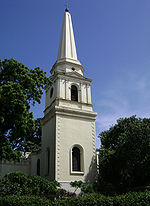 The first Anglican church in the Americas was built at Jamestown, Virginia
, in 1607. By the 18th century, missionaries worked to establish Anglican churches in Asia, Africa and Latin America. The great Church of England missionary societies were founded; for example the Society for Promoting Christian Knowledge (SPCK) in 1698. Society for the Propagation of the Gospel in Foreign Parts (SPG) in 1701, and the Church Mission Society
(CMS) in 1799. The 19th century saw the founding and expansion of social oriented evangelism with societies such as the Church Pastoral Aid Society
(CPAS) in 1836, Mission to Seafarers
in 1856, Mothers' Union
in 1876 and Church Army
in 1882 all carrying out a personal form of evangelism. The 20th century saw the Church of England developing new forms of evangelism such as the Alpha course
in 1990 which was developed and propagated from Holy Trinity Brompton Church
in London
. In the 21st century, there has been renewed effort to reach children and youth. Fresh expressions
is a Church of England missionary initiative to youth begun in 2005, and has ministries at a skate park through the efforts of St George's Church, Benfleet
, Essex
– Diocese of Chelmsford
– or youth groups with evocative names, like the C.L.A.W (Christ Little Angels – Whatever!) youth group at Coventry Cathedral
. And for the unchurched who do not actually wish to visit a bricks and mortar church there are Internet ministries such as the Diocese of Oxford
's online Anglican i-Church which appeared on the web in 2005.
dialogue can be traced back to the time of the Reformation and dialogues with both Orthodox and Lutheran churches in the 16th century. In the 19th century, with the rise of the Oxford Movement, there arose greater concern for reunion of the churches of "Catholic confession." This desire to work towards full communion
with other denominations led to the development of the Chicago-Lambeth Quadrilateral
, approved by the Third Lambeth Conference of 1888. The four points (the sufficiency of scripture, the historic creeds, the two dominical sacraments, and the historic episcopate) were proposed as a basis for discussion, although they have frequently been taken as a non-negotiable bottom-line for any form of reunion.
and Protestantism
, while tolerating a range of expressions of evangelicalism
and ceremony. Clergy and laity from all Anglican churchmanship
traditions have been active in the formation of the Continuing movement.
While there are high church
, broad church
, and low church
Continuing Anglicans, many Continuing churches are Anglo-Catholic with highly ceremonial liturgical practices. Others belong to a more Evangelical or low church
tradition and tend to support the Thirty-nine Articles
and simpler worship services. Morning Prayer, for instance, is often used instead of the Holy Eucharist for Sunday worship services, although this is not necessarily true of all low church parishes.
Most Continuing churches in the United States reject the 1979 revision of the Book of Common Prayer
by the Episcopal Church and use the 1928 version for their services instead. In addition, Anglo-Catholic bodies may use the Anglican Missal
or English Missal
in celebrating the Eucharist.
, the Anglican Province of Christ the King
, and the United Episcopal Church of North America
entered into discussions about possible organic unity. In January 2009 one bishop from each jurisdiction consecrated three suffragan bishops in St. Louis, just a few miles from where the Congress of St. Louis
first met. The three new bishops will serve all three jurisdictions.
In addition, the Anglican Episcopal Church
and the Diocese of the Great Lakes
formed the North American Anglican Conference for mutual assistance between Evangelical Anglican churches. A suffragan bishop was consecrated for the Anglican Episcopal Church in late 2008 by its presiding bishop and three bishops of the Diocese of the Great Lakes.
The principles of the Affirmation of St. Louis
and, to a lesser extent, the Thirty-nine Articles
of Religion, provide some basis for unity in the movement, but the jurisdictions are numerous, usually quite small in membership and often splinter and recombine. Reports put the number of jurisdictions at somewhere between 20 and 40, mostly in North America, but fewer than a dozen of the churches popularly called Continuing churches can be traced back to the meeting in St. Louis.
running through Anglican social thought – a theology which sees God, nature, and humanity in dynamic interaction, and the interpenetration of the secular and the sacred in the make-up of the cosmos. Such theology is informed by a traditional English spiritual ethos, rooted in Celtic Christianity and reinforced by Anglicanism's origins as an established church, bound up by its structure in the life and interests of civil society.
Repeatedly, throughout Anglican history, this principle has reasserted itself in movements of social justice. For instance, in the 18th century the influential Evangelical Anglican William Wilberforce
, along with others, campaigned against the slave trade. In the 19th century, the dominant issues concerned the adverse effects of industrialisation. The usual Anglican response was to focus on education and give support to 'The National Society for the Education of the Children of the Poor in the principles of the Church of England'. Lord Shaftesbury, a devout Evangelical, campaigned to improve the conditions in factories, in mines, for chimney sweeps, and for the education of the very poor. For years he was chairman of the Ragged School Board. Frederick Denison Maurice was a leading figure advocating reform, founding so-called "producer's co-operatives" and the Working Men's College
. His work was instrumental in the establishment of the Christian socialist
movement, although he himself was not in any real sense a socialist but, "a Tory paternalist with the unusual desire to theories his acceptance of the traditional obligation to help the poor", influenced Anglo-Catholics such as Charles Gore, who wrote that, "the principle of the incarnation is denied unless the Christian spirit can be allowed to concern itself with everything that interests and touches human life." Anglican focus on labour issues culminated in the work of William Temple
in the 1930s and 1940s.
emerged as a distinct reform organisation, seeking to make pacifism a clearly defined part of Anglican theology. The group rapidly gained popularity amongst Anglican intellectuals, including Vera Brittain
, Evelyn Underhill
and former British political leader George Lansbury
. Furthermore, the Reverend Dick Sheppard
, who during the 1930s was one of Britain's most famous Anglican priests due to his landmark sermon broadcasts for BBC
radio
, founded the Peace Pledge Union
a secular pacifist organisation for the non-religious that gained considerable support throughout the 1930s.
Whilst never actively endorsed by the Anglican Church, many Anglicans unofficially have adopted the Augustinian "Just War
" doctrine. The Anglican Pacifist Fellowship remain highly active throughout the Anglican world. It rejects this doctrine of "just war" and seeks to reform the Church by reintroducing the pacifism inherent in the beliefs of many of the earliest Christians and present in their interpretation of Christ's Sermon on the Mount
. The principles of the Anglican Pacifist Fellowhip are often formulated as a statement of belief that "Jesus' teaching is incompatible with the waging of war, that a Christian church should never support or justify war and that our Christian witness should include opposing the waging or justifying of war."
Confusing the matter was the fact that the 37th Article of Religion in the Book of Common Prayer states that "it is lawful for Christian men, at the commandment of the Magistrate, to wear weapons, and serve in the wars." Therefore, the Lambeth Council in the modern era has sought to provide a clearer position by repudiating modern war and developed a statement that has been affirmed at each subsequent meeting of the Council. This statement was strongly reasserted when "the 67th General Convention of the Episcopal Church reaffirms the statement made by the Anglican Bishops assembled at Lambeth in 1978 and adopted by the 66th General Convention of the Episcopal Church in 1979, calling "Christian people everywhere ... to engage themselves in non-violent action for justice and peace and to support others so engaged, recognizing that such action will be controversial and may be personally very costly... this General Convention, in obedience to this call, urges all members of this Church to support by prayer and by such other means as they deem appropriate, those who engaged in such non-violent action, and particularly those who suffer for conscience' sake as a result; and be it further Resolved, that this General Convention calls upon all members of this Church seriously to consider the implications for their own lives of this call to resist war and work for peace for their own lives."
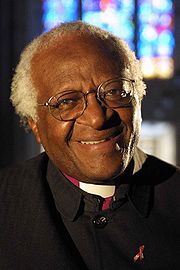 The focus on other social issues became increasingly diffuse after the Second World War. On the one hand, the growing independence and strength of Anglican churches in the global south brought new emphasis to issues of global poverty, the inequitable distribution of resources, and the lingering effects of colonialism. In this regard, figures such as Desmond Tutu
and Ted Scott
were instrumental in mobilizing Anglicans worldwide against the apartheid policies of South Africa
. Rapid social change in the industrialised world during the 20th century compelled the church to examine issues of gender, sexuality and marriage.
These changes led to Lambeth Conference resolutions countenancing contraception
and the remarriage
of divorced persons. They led to most provinces approving the ordination of women
. In more recent years it has led some jurisdictions to permit the ordination of people in same-sex relationships and to authorise rites for the blessing of same-sex unions (see homosexuality and Anglicanism). More conservative elements within Anglicanism (primarily African churches and factions within North American Anglicanism) have opposed these proposals. Some liberal and moderate Anglicans see this opposition as representing a new fundamentalism
within Anglicanism. Others see the advocacy for these proposals as representing a breakdown of Christian theology and commitment. The lack of social consensus among and within provinces of diverse cultural traditions has resulted in considerable conflict and even schism concerning some or all of these developments (see Anglican realignment
). Some Anglicans opposed to various liberalising changes, in particular the ordination of women
, have converted to Roman Catholicism. Others have, at various times, joined the Continuing Anglican movement
.
These latter trends reflect a countervailing tendency in Anglicanism towards insularity, reinforced perhaps by the "big tent" nature of the movement, which seeks to be comprehensive of various views and tendencies. The insularity and complacency of the early established Church of England
has tended to influence Anglican self-identity, and inhibit engagement with the broader society in favour of internal debate and dialogue. Nonetheless, there is significantly greater cohesion among Anglicans when they turn their attention outward. Anglicans worldwide are active in many areas of social and environmental concern.
in the belief that traditional forms of Anglican faith, worship and order have been unacceptably revised or abandoned within some Anglican Communion churches in recent decades. They therefore claim that they are "continuing" traditional Anglicanism. The modern Continuing Anglican movement principally dates to the Congress of St. Louis
, held in the United States in 1977, at which participants rejected changes that had been made in the Episcopal Church's Book of Common Prayer
and also the Episcopal Church's approval of the ordination of women
to the priesthood. More recent changes in the North American churches of the Anglican Communion, such as the introduction of same-sex marriage rites and the ordination of gay and lesbian people to the priesthood and episcopate, have created further separations.
Continuing churches have generally been formed by people who have left the Anglican Communion. The original Anglican churches are charged by the Continuing Anglicans with being greatly compromised by secular cultural standards and liberal theology. Many Continuing Anglicans believe that the faith of some churches in communion with the Archbishop of Canterbury has become either unorthodox or un-Christian and therefore have not sought to also be in communion with him.
Although the word Anglican usually refers to those churches in communion
with the Archbishop of Canterbury, many Continuing Anglican bodies in the United States use the term Anglican to both assert their heritage and also to differentiate themselves from the Episcopal Church.
The original generation of continuing parishes in the United States were found mainly in metropolitan areas. Since the late 1990s a number have appeared in smaller communities, often as a result of a division in the town's existing Episcopal churches. The 2007–08 Directory of Traditional Anglican and Episcopal Parishes, published by The Fellowship of Concerned Churchmen, contained information on over 900 parishes affiliated with either the Continuing Anglican churches or the Anglican realignment movement, a more recent wave of Anglicans withdrawing from the Anglican Communion's North American provinces.
issued an apostolic constitution
, Anglicanorum Coetibus, to allow groups of former Anglicans to enter into full communion
with the Roman Catholic Church
as members of personal ordinariate
s. The announcement of the imminent constitution on 20 October 2009 mentioned:
For each personal ordinariate the ordinary
may be a former Anglican bishop or priest. It is expected that provision will be made to allow the retention of aspects of Anglican liturgy; cf. Anglican Use
.
Christianity
Christianity is a monotheistic religion based on the life and teachings of Jesus as presented in canonical gospels and other New Testament writings...
comprising churches with historical connections to the Church of England
Church of England
The Church of England is the officially established Christian church in England and the Mother Church of the worldwide Anglican Communion. The church considers itself within the tradition of Western Christianity and dates its formal establishment principally to the mission to England by St...
or similar beliefs, worship and church structures. The word Anglican originates in ecclesia anglicana, a medieval Latin phrase dating to at least 1246 that means the English Church. Adherents of Anglicanism are called Anglicans. The great majority of Anglicans are members of churches which are part of the international Anglican Communion
Anglican Communion
The Anglican Communion is an international association of national and regional Anglican churches in full communion with the Church of England and specifically with its principal primate, the Archbishop of Canterbury...
. There are, however, a number of churches outside of the Anglican Communion which also consider themselves to be Anglican, most notably those referred to as Continuing Anglican churches.
The faith of Anglicans is founded in the scriptures, the traditions of the apostolic church, the apostolic succession
Apostolic Succession
Apostolic succession is a doctrine, held by some Christian denominations, which asserts that the chosen successors of the Twelve Apostles, from the first century to the present day, have inherited the spiritual, ecclesiastical and sacramental authority, power, and responsibility that were...
– "historic episcopate" and the early Church Fathers. Anglicanism forms one of the branches of Western Christianity
Western Christianity
Western Christianity is a term used to include the Latin Rite of the Catholic Church and groups historically derivative thereof, including the churches of the Anglican and Protestant traditions, which share common attributes that can be traced back to their medieval heritage...
; having definitively declared its independence from the Roman pontiff
Pope
The Pope is the Bishop of Rome, a position that makes him the leader of the worldwide Catholic Church . In the Catholic Church, the Pope is regarded as the successor of Saint Peter, the Apostle...
at the time of the Elizabethan Religious Settlement
Elizabethan Religious Settlement
The Elizabethan Religious Settlement was Elizabeth I’s response to the religious divisions created over the reigns of Henry VIII, Edward VI and Mary I. This response, described as "The Revolution of 1559", was set out in two Acts of the Parliament of England...
, in what has been otherwise termed the British monachism. Many of the new Anglican formularies of the mid 16th century corresponded closely to those of contemporary Reformed Protestantism
Protestantism
Protestantism is one of the three major groupings within Christianity. It is a movement that began in Germany in the early 16th century as a reaction against medieval Roman Catholic doctrines and practices, especially in regards to salvation, justification, and ecclesiology.The doctrines of the...
and these reforms in the Church of England were understood by one of those most responsible for them, the then Archbishop of Canterbury
Archbishop of Canterbury
The Archbishop of Canterbury is the senior bishop and principal leader of the Church of England, the symbolic head of the worldwide Anglican Communion, and the diocesan bishop of the Diocese of Canterbury. In his role as head of the Anglican Communion, the archbishop leads the third largest group...
, Thomas Cranmer
Thomas Cranmer
Thomas Cranmer was a leader of the English Reformation and Archbishop of Canterbury during the reigns of Henry VIII, Edward VI and, for a short time, Mary I. He helped build a favourable case for Henry's divorce from Catherine of Aragon which resulted in the separation of the English Church from...
, as navigating a middle way between two of the emerging Protestant traditions, namely Lutheranism and the Calvinism. By the end of the century, the retention in Anglicanism of many traditional liturgical forms and of the episcopate was already seen as unacceptable by those promoting the most developed Protestant principles. In the first half of the 17th century the Church of England and associated episcopal churches in Ireland and in England's American colonies were presented by some Anglican divines as comprising a distinct Christian tradition, with theologies, structures and forms of worship representing a different kind of middle way, or via media, between Reformed Protestantism and Roman Catholicism — a perspective that came to be highly influential in later theories of Anglican identity, and was expressed in the description "Catholic and Reformed". Following the American Revolution
American Revolution
The American Revolution was the political upheaval during the last half of the 18th century in which thirteen colonies in North America joined together to break free from the British Empire, combining to become the United States of America...
, Anglican congregations in the United States and Canada
Canada
Canada is a North American country consisting of ten provinces and three territories. Located in the northern part of the continent, it extends from the Atlantic Ocean in the east to the Pacific Ocean in the west, and northward into the Arctic Ocean...
were each reconstituted into autonomous churches with their own bishops and self-governing structures; which, through the expansion of the British Empire
British Empire
The British Empire comprised the dominions, colonies, protectorates, mandates and other territories ruled or administered by the United Kingdom. It originated with the overseas colonies and trading posts established by England in the late 16th and early 17th centuries. At its height, it was the...
and the activity of Christian missions, was adopted as the model for many newly formed churches, especially in Africa
Africa
Africa is the world's second largest and second most populous continent, after Asia. At about 30.2 million km² including adjacent islands, it covers 6% of the Earth's total surface area and 20.4% of the total land area...
, Australasia
Australasia
Australasia is a region of Oceania comprising Australia, New Zealand, the island of New Guinea, and neighbouring islands in the Pacific Ocean. The term was coined by Charles de Brosses in Histoire des navigations aux terres australes...
and the regions of the Pacific. In the 19th century the term Anglicanism was coined to describe the common religious tradition of these churches; as also that of the Scottish Episcopal Church
Scottish Episcopal Church
The Scottish Episcopal Church is a Christian church in Scotland, consisting of seven dioceses. Since the 17th century, it has had an identity distinct from the presbyterian Church of Scotland....
, which, though originating earlier within the Church of Scotland
Church of Scotland
The Church of Scotland, known informally by its Scots language name, the Kirk, is a Presbyterian church, decisively shaped by the Scottish Reformation....
, had come to be recognised as sharing this common identity.
The degree of distinction between Reformed and western Catholic tendencies within the Anglican tradition is routinely a matter of debate both within specific Anglican churches and throughout the Anglican Communion
Anglican Communion
The Anglican Communion is an international association of national and regional Anglican churches in full communion with the Church of England and specifically with its principal primate, the Archbishop of Canterbury...
. Unique to Anglicanism is the Book of Common Prayer
Book of Common Prayer
The Book of Common Prayer is the short title of a number of related prayer books used in the Anglican Communion, as well as by the Continuing Anglican, "Anglican realignment" and other Anglican churches. The original book, published in 1549 , in the reign of Edward VI, was a product of the English...
, the collection of services that worshippers in most Anglican churches used for centuries. While it has since undergone many revisions and Anglican churches in different countries have developed other service books, the Prayer Book is still acknowledged as one of the ties that bind the Anglican Communion together. There is no single Anglican Church with universal juridical authority, since each national or regional church has full autonomy. As the name suggests, the Churches of the Anglican Communion are linked by affection and common loyalty. They are in full communion with the See
Episcopal See
An episcopal see is, in the original sense, the official seat of a bishop. This seat, which is also referred to as the bishop's cathedra, is placed in the bishop's principal church, which is therefore called the bishop's cathedral...
of Canterbury and thus the Archbishop of Canterbury
Archbishop of Canterbury
The Archbishop of Canterbury is the senior bishop and principal leader of the Church of England, the symbolic head of the worldwide Anglican Communion, and the diocesan bishop of the Diocese of Canterbury. In his role as head of the Anglican Communion, the archbishop leads the third largest group...
, in his person, is a unique focus of Anglican unity. He calls the once-a-decade Lambeth Conference, chairs the meeting of Primates, and is President of the Anglican Consultative Council With a membership estimated at around 80 million members the Anglican Communion is the third largest Christian communion in the world, after the Roman Catholic Church and the Eastern Orthodox Church
Eastern Orthodox Church
The Orthodox Church, officially called the Orthodox Catholic Church and commonly referred to as the Eastern Orthodox Church, is the second largest Christian denomination in the world, with an estimated 300 million adherents mainly in the countries of Belarus, Bulgaria, Cyprus, Georgia, Greece,...
es.
Terminology
The word Anglicanism is a neologism from the 19th century; constructed from the older word Anglican. The word refers to the teachings and rites of Christians throughout the world in communion with the seeEpiscopal See
An episcopal see is, in the original sense, the official seat of a bishop. This seat, which is also referred to as the bishop's cathedra, is placed in the bishop's principal church, which is therefore called the bishop's cathedral...
of Canterbury
Diocese of Canterbury
The Diocese of Canterbury is a Church of England diocese covering eastern Kent, founded by St. Augustine of Canterbury in 597. It is centred on Canterbury Cathedral, and is the oldest see of the Church of England....
. It has come to be used to refer to the claim of these churches to a unique religious and theological tradition apart from all other Christian churches, be they Orthodox, Roman Catholic or Protestant
Protestantism
Protestantism is one of the three major groupings within Christianity. It is a movement that began in Germany in the early 16th century as a reaction against medieval Roman Catholic doctrines and practices, especially in regards to salvation, justification, and ecclesiology.The doctrines of the...
; and is entirely distinct from the allegiance of some of these churches to the British Crown.
The word "Anglican" originates in , a Medieval Latin
Medieval Latin
Medieval Latin was the form of Latin used in the Middle Ages, primarily as a medium of scholarly exchange and as the liturgical language of the medieval Roman Catholic Church, but also as a language of science, literature, law, and administration. Despite the clerical origin of many of its authors,...
phrase dating to at least 1246 meaning the "English
England
England is a country that is part of the United Kingdom. It shares land borders with Scotland to the north and Wales to the west; the Irish Sea is to the north west, the Celtic Sea to the south west, with the North Sea to the east and the English Channel to the south separating it from continental...
Church". As an adjective, "Anglican" is used to describe the people, institutions and churches, as well as the liturgical traditions and theological concepts, developed by the Church of England
Church of England
The Church of England is the officially established Christian church in England and the Mother Church of the worldwide Anglican Communion. The church considers itself within the tradition of Western Christianity and dates its formal establishment principally to the mission to England by St...
. As a noun, an Anglican is a member of a church in the Anglican Communion
Anglican Communion
The Anglican Communion is an international association of national and regional Anglican churches in full communion with the Church of England and specifically with its principal primate, the Archbishop of Canterbury...
. The word is also used by followers of separated groups which have left the communion or have been founded separately from it, though this is sometimes considered as a misuse.
Although the term "Anglican" is found referring to the Church of England as far back as the 16th century, its use did not become general until the latter half of the 19th century. In British parliamentary legislation referring to the English Established Church, it is described as the "Protestant Episcopal Church", thereby distinguishing it from the counterpart established "Protestant Presbyterian Church
Church of Scotland
The Church of Scotland, known informally by its Scots language name, the Kirk, is a Presbyterian church, decisively shaped by the Scottish Reformation....
" in Scotland. High Church
High church
The term "High Church" refers to beliefs and practices of ecclesiology, liturgy and theology, generally with an emphasis on formality, and resistance to "modernization." Although used in connection with various Christian traditions, the term has traditionally been principally associated with the...
men, who objected to the term "Protestant", initially promoted the term "Reformed Episcopal Church"; and it remains the case that the word "Episcopal" is preferred in the title of the Episcopal Church
Episcopal Church (United States)
The Episcopal Church is a mainline Anglican Christian church found mainly in the United States , but also in Honduras, Taiwan, Colombia, Ecuador, Haiti, the Dominican Republic, Venezuela, the British Virgin Islands and parts of Europe...
(the province of the Anglican Communion covering the United States) and the Scottish Episcopal Church
Scottish Episcopal Church
The Scottish Episcopal Church is a Christian church in Scotland, consisting of seven dioceses. Since the 17th century, it has had an identity distinct from the presbyterian Church of Scotland....
. Outside of the British Isles, however, the term "Anglican Church" came to be preferred; as it distinguished these churches from others that claimed an episcopal polity
Episcopal polity
Episcopal polity is a form of church governance that is hierarchical in structure with the chief authority over a local Christian church resting in a bishop...
; although some churches, in particular the Scottish Episcopal Church, the Church of Ireland
Church of Ireland
The Church of Ireland is an autonomous province of the Anglican Communion. The church operates in all parts of Ireland and is the second largest religious body on the island after the Roman Catholic Church...
and the Church in Wales
Church in Wales
The Church in Wales is the Anglican church in Wales, composed of six dioceses.As with the primus of the Scottish Episcopal Church, the Archbishop of Wales serves concurrently as one of the six diocesan bishops. The current archbishop is Barry Morgan, the Bishop of Llandaff.In contrast to the...
continue to use the term only with reservations.
Definition
Anglicanism, in its structures, theology and forms of worship, is commonly understood as a distinct Christian tradition representing a middle ground between what are perceived to be the extremes of the claims of 16th century Roman Catholicism and the Lutheran and Reformed varieties of ProtestantismProtestantism
Protestantism is one of the three major groupings within Christianity. It is a movement that began in Germany in the early 16th century as a reaction against medieval Roman Catholic doctrines and practices, especially in regards to salvation, justification, and ecclesiology.The doctrines of the...
of that era. As such, it is often referred to as being a via media (or "middle way") between these traditions. The faith of Anglicans is founded in the Scriptures and the Gospels, the traditions of the Apostolic
Apostle (Christian)
The term apostle is derived from Classical Greek ἀπόστολος , meaning one who is sent away, from στέλλω + από . The literal meaning in English is therefore an "emissary", from the Latin mitto + ex...
Church, the historical episcopate
Historical episcopate
The episcopate is the collective body of all bishops of a church. In the Roman Catholic, Anglican, Eastern Orthodox, Eastern Rite Catholic, Oriental Orthodox, Old-Catholic, Moravian Church, and Independent Catholic churches as well as in the Assyrian Church of the East, it is held that only a...
, the first seven ecumenical councils
First seven Ecumenical Councils
In the history of Christianity, the first seven Ecumenical Councils, from the First Council of Nicaea to the Second Council of Nicaea , represent an attempt to reach an orthodox consensus and to establish a unified Christendom as the State church of the Roman Empire...
and the early Church Fathers
Church Fathers
The Church Fathers, Early Church Fathers, Christian Fathers, or Fathers of the Church were early and influential theologians, eminent Christian teachers and great bishops. Their scholarly works were used as a precedent for centuries to come...
. Anglicans understand the Old
Old Testament
The Old Testament, of which Christians hold different views, is a Christian term for the religious writings of ancient Israel held sacred and inspired by Christians which overlaps with the 24-book canon of the Masoretic Text of Judaism...
and New Testament
New Testament
The New Testament is the second major division of the Christian biblical canon, the first such division being the much longer Old Testament....
s as "containing all things necessary for salvation" and as being the rule and ultimate standard of faith. Anglicans understand the Apostles' Creed
Apostles' Creed
The Apostles' Creed , sometimes titled Symbol of the Apostles, is an early statement of Christian belief, a creed or "symbol"...
as the baptismal symbol and the Nicene Creed
Nicene Creed
The Nicene Creed is the creed or profession of faith that is most widely used in Christian liturgy. It is called Nicene because, in its original form, it was adopted in the city of Nicaea by the first ecumenical council, which met there in the year 325.The Nicene Creed has been normative to the...
as the sufficient statement of the Christian faith
Statement of faith
A statement of faith is a statement of the core beliefs of a religious group.A typical statement of faith is said to be a non-comprehensive summary of the core beliefs of a particular faith within a tradition . Even religious organizations without affiliation will use a statement of faith for...
.
Anglicans celebrate the traditional sacraments, with special emphasis being given to the Holy Eucharist, also called Holy Communion, the Lord's Supper or the Mass
Mass (liturgy)
"Mass" is one of the names by which the sacrament of the Eucharist is called in the Roman Catholic Church: others are "Eucharist", the "Lord's Supper", the "Breaking of Bread", the "Eucharistic assembly ", the "memorial of the Lord's Passion and Resurrection", the "Holy Sacrifice", the "Holy and...
. The Eucharist is central to worship for most Anglicans as a communal offering of prayer and praise in which the life, death and resurrection of Jesus Christ are proclaimed through prayer, reading of the Bible, singing, and the offering of the bread and wine, giving God thanks over them for the innumerable benefits obtained through the passion of Christ, the breaking of the bread, and reception of the body and blood of Christ as instituted at the Last Supper
Last Supper
The Last Supper is the final meal that, according to Christian belief, Jesus shared with his Twelve Apostles in Jerusalem before his crucifixion. The Last Supper provides the scriptural basis for the Eucharist, also known as "communion" or "the Lord's Supper".The First Epistle to the Corinthians is...
. While many Anglicans celebrate the Eucharist in similar ways to the predominant western Catholic tradition, a considerable degree of liturgical freedom is permitted, and worship styles range from the simple to elaborate.
Unique to Anglicanism is the Book of Common Prayer
Book of Common Prayer
The Book of Common Prayer is the short title of a number of related prayer books used in the Anglican Communion, as well as by the Continuing Anglican, "Anglican realignment" and other Anglican churches. The original book, published in 1549 , in the reign of Edward VI, was a product of the English...
(BCP), the collection of services that worshippers in most Anglican churches used for centuries. It was called common prayer originally because it was intended for use in all Church of England churches which had previously followed differing local liturgies. The term was kept when the church became international because all Anglicans used to share in its use around the world. In 1549, the first Book of Common Prayer was compiled by Thomas Cranmer
Thomas Cranmer
Thomas Cranmer was a leader of the English Reformation and Archbishop of Canterbury during the reigns of Henry VIII, Edward VI and, for a short time, Mary I. He helped build a favourable case for Henry's divorce from Catherine of Aragon which resulted in the separation of the English Church from...
, who was then Archbishop of Canterbury
Archbishop of Canterbury
The Archbishop of Canterbury is the senior bishop and principal leader of the Church of England, the symbolic head of the worldwide Anglican Communion, and the diocesan bishop of the Diocese of Canterbury. In his role as head of the Anglican Communion, the archbishop leads the third largest group...
. Whilst it has since undergone many revisions and Anglican churches in different countries have developed other service books, the Prayer Book is still acknowledged as one of the ties that bind the Anglican Communion together.
Development
By the Elizabethan Settlement, the Churches of England and Ireland had been established through legislation in their respective Parliaments; and assumed allegiance and loyalty to the British Crown in all their members. However, from the first, the Elizabethan Church began to develop distinct religious traditions; assimilating some of the theology of Reformed churchesReformed churches
The Reformed churches are a group of Protestant denominations characterized by Calvinist doctrines. They are descended from the Swiss Reformation inaugurated by Huldrych Zwingli but developed more coherently by Martin Bucer, Heinrich Bullinger and especially John Calvin...
with the services in the Book of Common Prayer
Book of Common Prayer
The Book of Common Prayer is the short title of a number of related prayer books used in the Anglican Communion, as well as by the Continuing Anglican, "Anglican realignment" and other Anglican churches. The original book, published in 1549 , in the reign of Edward VI, was a product of the English...
, under the leadership and organisation of a continuing episcopate; and over the years these traditions themselves came to command adherence and loyalty. Potentially this would create a crisis of identity, were secular and religious loyalties to conflict – and such a crisis indeed occurred in 1776 with the American Declaration of Independence, most of whose signatories were, at least nominally, Anglican. For these American Patriots, even the forms of Anglican services were in doubt, since the Prayer Book rites of Matins
Matins
Matins is the early morning or night prayer service in the Roman Catholic, Anglican, Lutheran and Eastern Orthodox liturgies of the canonical hours. The term is also used in some Protestant denominations to describe morning services.The name "Matins" originally referred to the morning office also...
, Evensong
Evensong
The term evensong can refer to the following:* Evening Prayer , the Anglican liturgy of Evening Prayer, especially so called when it is sung...
and Holy Communion, all included specific prayers for the British Royal Family. Consequently, the conclusion of the War of Independence
American Revolutionary War
The American Revolutionary War , the American War of Independence, or simply the Revolutionary War, began as a war between the Kingdom of Great Britain and thirteen British colonies in North America, and ended in a global war between several European great powers.The war was the result of the...
resulted in the creation of two new Anglican churches, The Episcopal Church in the United States of America in those States that had achieved independence; and The Church of England in Canada
Anglican Church of Canada
The Anglican Church of Canada is the Province of the Anglican Communion in Canada. The official French name is l'Église Anglicane du Canada. The ACC is the third largest church in Canada after the Roman Catholic Church and the United Church of Canada, consisting of 800,000 registered members...
in those North American colonies remaining under British control and to which many Loyalist churchmen had migrated. Reluctantly, legislation was passed in the British Parliament (the Consecration of Bishops Abroad Act 1786) to allow bishops to be consecrated for an American church outside of allegiance to the British Crown (whereas no bishoprics had ever been established in the former American colonies). Both in the United States and in Canada, the new Anglican churches developed novel models of self-government, collective decision-making, and self-supported financing; that would be consistent with separation of religious and secular identities.
In the following century, two further factors acted to accelerate the development of a distinct Anglican identity. From 1828 and 1829, Dissenters and Roman Catholics could be elected to the House of Commons, which consequently ceased to be a body drawn purely from the established churches of Scotland, England and Ireland; but which nevertheless, over the following ten years, engaged in extensive reforming legislation affecting the interests of the established United Church of England and Ireland. The propriety of this legislation was bitterly contested by the Oxford Movement
Oxford Movement
The Oxford Movement was a movement of High Church Anglicans, eventually developing into Anglo-Catholicism. The movement, whose members were often associated with the University of Oxford, argued for the reinstatement of lost Christian traditions of faith and their inclusion into Anglican liturgy...
(Tractarians), who in response developed a vision of Anglicanism as religious tradition deriving ultimately from the Ecumenical Councils of the patristic church. Those within the Church of England opposed to the Tractarians, and to their revived ritual practices, introduced a stream of Parliamentary Bills aimed to control innovations in worship; but this only made the dilemma more acute, with consequent continual litigation in the secular and ecclesiastical courts.
Over the same period Anglican churches engaged vigorously in Christian missions
Mission (Christian)
Christian missionary activities often involve sending individuals and groups , to foreign countries and to places in their own homeland. This has frequently involved not only evangelization , but also humanitarian work, especially among the poor and disadvantaged...
, resulting in the creation, by the end of the century, of over ninety colonial bishoprics; which gradually coalesced into new self-governing churches on the Canadian and American models. However, the case of John William Colenso
John William Colenso
John William Colenso , first Anglican bishop of Natal, mathematician, theologian, Biblical scholar and social activist.-Biography:Colenso was born at St Austell, Cornwall, on 24 January 1814...
Bishop of Natal
Bishop of Natal
The Bishop of Natal exercises episcopal leadership over the Diocese of Natal of the Church of Southern Africa.-Succession:-See also:*Anglican Church of Southern Africa*Anglican Diocese of Natal-References:...
, reinstated in 1865 by the English Judicial Committee of the Privy Council
Judicial Committee of the Privy Council
The Judicial Committee of the Privy Council is one of the highest courts in the United Kingdom. Established by the Judicial Committee Act 1833 to hear appeals formerly heard by the King in Council The Judicial Committee of the Privy Council (JCPC) is one of the highest courts in the United...
over the heads of the Church in South Africa, demonstrated acutely that the extension of episcopacy had to be accompanied by a recognised Anglican ecclesiology of ecclesiastical authority, distinct from secular power.
Consequently, at the instigation of the bishops of Canada and South Africa, the first Lambeth Conference was called in 1867; to be followed by further conferences in 1878 and 1888, and thereafter at ten year intervals. The various papers and declarations of successive Lambeth Conferences, have served to frame the continued Anglican debate on identity, especially as relating to the possibility of ecumenical discussion with other churches. This ecumenical aspiration became much more of a possibility, as other denominational groups rapidly followed the example of the Anglican Communion in founding their own transnational alliances: the Alliance of Reformed Churches
World Alliance of Reformed Churches
The World Alliance of Reformed Churches is a fellowship of more than 200 churches with roots in the 16th-century Reformation, and particularly in the theology of John Calvin...
, the Ecumenical Methodist Council
World Methodist Council
The World Methodist Council, founded in 1881, is an association of churches in the Methodist tradition which comprises most of the world's Wesleyan denominations.- Extension and organization:...
, the International Congregational Council
World Alliance of Reformed Churches
The World Alliance of Reformed Churches is a fellowship of more than 200 churches with roots in the 16th-century Reformation, and particularly in the theology of John Calvin...
, and the Baptist World Alliance
Baptist World Alliance
The Baptist World Alliance is a worldwide alliance of Baptist churches and organizations, formed in 1905 at Exeter Hall in London during the first Baptist World Congress.-History:...
.
Theories
In their rejection of absolute parliamentary authority, the TractariansOxford Movement
The Oxford Movement was a movement of High Church Anglicans, eventually developing into Anglo-Catholicism. The movement, whose members were often associated with the University of Oxford, argued for the reinstatement of lost Christian traditions of faith and their inclusion into Anglican liturgy...
and in particular John Henry Newman – looked back to the writings of 17th century Anglican divines, finding in these texts the idea of the English church as a via media between the Protestant and Catholic traditions. This view was associated – especially in the writings of Edward Bouverie Pusey
Edward Bouverie Pusey
Edward Bouverie Pusey was an English churchman and Regius Professor of Hebrew at Christ Church, Oxford. He was one of the leaders of the Oxford Movement.-Early years:...
– with the theory of Anglicanism as one of three "branches
Branch theory
The Branch Theory is a theological concept within Anglicanism, holding that the Roman Catholic Church, the Eastern Orthodox Church and the Anglican Communion are the three principal branches of the One, Holy, Catholic, and Apostolic Church.-Theory:...
" (alongside the Roman Catholic and Orthodox churches) historically arising out of the common tradition of the earliest Ecumenical Councils. Newman himself subsequently rejected the theory of the via media, as essentially historicist and static; and hence unable to accommodate any dynamic development within the church. Nevertheless, the aspiration to ground Anglican identity in the writings of the 17th century divines, and in faithfulness to the traditions of the Church Fathers
Church Fathers
The Church Fathers, Early Church Fathers, Christian Fathers, or Fathers of the Church were early and influential theologians, eminent Christian teachers and great bishops. Their scholarly works were used as a precedent for centuries to come...
reflects a continuing theme of Anglican ecclesiology, most recently in the writings of Henry Robert McAdoo.
The Tractarian formulation of the theory of the via media was essentially a party platform, and not acceptable to Anglicans outside the confines of the Oxford Movement
Oxford Movement
The Oxford Movement was a movement of High Church Anglicans, eventually developing into Anglo-Catholicism. The movement, whose members were often associated with the University of Oxford, argued for the reinstatement of lost Christian traditions of faith and their inclusion into Anglican liturgy...
. However, the theory of the via media was reworked in the ecclesiological writings of Frederick Denison Maurice, in a more dynamic form that became widely influential. Both Maurice and Newman saw the Church of England of their day as sorely deficient in faith; but whereas Newman had looked back to a distant past when the light of faith might have appeared to burn brighter, Maurice looked forward to the possibility of a brighter revelation of faith in the future. Maurice saw the Protestant and Catholic strands within the Church of England as contrary but complementary, both maintaining elements of the true church, but incomplete without the other; such that a true catholic and evangelical church might come into being by a union of opposites. Central to Maurice's perspective, is his belief that the collective elements of family, nation and church represent a divine order of structures through which God unfolds his continuing work of creation. Hence, for Maurice, the Protestant tradition has maintained the elements of national distinction which are amongst the marks of the true universal church, but which have been lost within Roman Catholicism in the internationalism of centralised Papal Authority. Within the coming universal church that Maurice foresaw, national churches would each maintain the six signs of Catholicity: baptism, Eucharist, the creeds, Scripture, an episcopally ordered ministry, and a fixed liturgy (which could take a variety of forms in accordance with divinely ordained distinctions in national characteristics). Not surprisingly, this vision of a becoming universal church as a congregation of autonomous national churches, proved highly congenial in Anglican circles; and Maurice's six signs were adapted to form the Chicago-Lambeth Quadrilateral
Chicago-Lambeth Quadrilateral
The Chicago-Lambeth Quadrilateral, frequently referred to as the Lambeth Quadrilateral or the Lambeth-Chicago Quadrilateral, is a four-point articulation of Anglican identity, often cited as encapsulating the fundamentals of the Communion's doctrine and as a reference-point for ecumenical...
of 1888.
In the latter decades of the 20th century, Maurice's theory, and the various strands of Anglican thought that derived from it, have been criticised by Stephen Sykes
Stephen Sykes
Stephen Whitefield Sykes retired as Principal of St John's College, Durham at the end of August 2006. He was formerly the Church of England Bishop of Ely and held professorial chairs in divinity at both Durham University and Cambridge University.Sykes studied at St John's College, Cambridge,...
; who argues that the terms Protestant and Catholic as used in these approaches are synthetic constructs denoting ecclesiastic identities unacceptable to those to whom the labels are applied. Hence, the Roman Catholic Church does not regard itself as a party or strand within the universal church – but rather identifies itself as the universal church. Moreover, Sykes criticises the proposition, implicit in theories of via media, that there is no distinctive body of Anglican doctrine, other than those of the universal church; accusing this of being an excuse not to undertake systematic doctrine at all. Contrariwise, Sykes notes a high degree of commonality in Anglican liturgical forms, and in the doctrinal understandings expressed within those liturgies. He proposes that Anglican identity might rather be found within a shared consistent pattern of prescriptive liturgies, established and maintained through canon law, and embodying both a historic deposit of formal statements of doctrine, and also framing the regular reading and proclamation of scripture. Sykes nevertheless agrees with those heirs of Maurice who emphasise the incompleteness of Anglicanism as a positive feature, and quotes with qualified approval the words of Michael Ramsay:
Catholic and Reformed
In the time of Henry VIIIHenry VIII of England
Henry VIII was King of England from 21 April 1509 until his death. He was Lord, and later King, of Ireland, as well as continuing the nominal claim by the English monarchs to the Kingdom of France...
the nature of Anglicanism was based on questions of jurisdiction – specifically, the belief of the Crown that national church
National church
National church is a concept of a Christian church associated with a specific ethnic group or nation state. The idea was notably discussed during the 19th century, during the emergence of modern nationalism....
es should be autonomous – rather than theological disagreement. The effort was to create a national church in legal continuity with its traditions, but inclusive of certain doctrinal and liturgical beliefs of the Reformers
Protestant Reformers
Protestant Reformers were those theologians, churchmen, and statesmen whose careers, works, and actions brought about the Protestant Reformation of the sixteenth century...
. The result has been a movement with a distinctive self-image among Christian movements. The question often arises as to whether the Anglican Communion should be identified as a Protestant or Catholic
Catholic
The word catholic comes from the Greek phrase , meaning "on the whole," "according to the whole" or "in general", and is a combination of the Greek words meaning "about" and meaning "whole"...
church, or perhaps as a distinct branch of Christianity altogether.
The distinction between Reformed and Catholic, and the coherence of the two, is routinely a matter of debate both within specific Anglican Churches and throughout the Anglican Communion by members themselves. Since the Oxford Movement
Oxford Movement
The Oxford Movement was a movement of High Church Anglicans, eventually developing into Anglo-Catholicism. The movement, whose members were often associated with the University of Oxford, argued for the reinstatement of lost Christian traditions of faith and their inclusion into Anglican liturgy...
of the mid-19th century, many Churches of the Communion have revived and extended liturgical and pastoral practices similar to Roman Catholic theology. This extends beyond the ceremony of High Church
High church
The term "High Church" refers to beliefs and practices of ecclesiology, liturgy and theology, generally with an emphasis on formality, and resistance to "modernization." Although used in connection with various Christian traditions, the term has traditionally been principally associated with the...
services to even more theologically significant territory, such as sacramental theology (see Anglican sacraments
Anglican sacraments
In keeping with its prevailing self-identity as a via media or "middle path" of Western Christianity, Anglican sacramental theology expresses elements in keeping with its status as a church in the Catholic tradition and a church of the Reformation...
). While Anglo-Catholic practices, particularly liturgical ones, have resurfaced and become more common within the tradition over the last century, there remain many places where practices and beliefs remain on the more Reformed or Evangelical side (see Sydney Anglicanism).
Guiding principles
Magisterium
In the Catholic Church the Magisterium is the teaching authority of the Church. This authority is understood to be embodied in the episcopacy, which is the aggregation of the current bishops of the Church in union with the Pope, led by the Bishop of Rome , who has authority over the bishops,...
, nor derived from the theology of an eponymous founder (such as Calvinism
Calvinism
Calvinism is a Protestant theological system and an approach to the Christian life...
), nor summed up in a confession of faith beyond the ecumenical creeds (such as the Lutheran Book of Concord
Book of Concord
The Book of Concord or Concordia is the historic doctrinal standard of the Lutheran Church, consisting of ten credal documents recognized as authoritative in Lutheranism since the 16th century...
). For them, the earliest Anglican theological documents are its prayer books, which they see as the products of profound theological reflection, compromise, and synthesis. They emphasise the Book of Common Prayer
Book of Common Prayer
The Book of Common Prayer is the short title of a number of related prayer books used in the Anglican Communion, as well as by the Continuing Anglican, "Anglican realignment" and other Anglican churches. The original book, published in 1549 , in the reign of Edward VI, was a product of the English...
as a key expression of Anglican doctrine. The principle of looking to the prayer books as a guide to the parameters of belief and practice is called by the Latin name lex orandi, lex credendi
Lex orandi, lex credendi
Lex orandi, lex credendi refers to the relationship between worship and belief, and is an ancient Christian principle which provided a measure for developing the ancient Christian creeds, the canon of scripture and other doctrinal matters based on the prayer texts of the Church, that is, the...
("the law of prayer is the law of belief"). Within the prayer books are the fundamentals of Anglican doctrine: The Apostles'
Apostles' Creed
The Apostles' Creed , sometimes titled Symbol of the Apostles, is an early statement of Christian belief, a creed or "symbol"...
and Nicene Creed
Nicene Creed
The Nicene Creed is the creed or profession of faith that is most widely used in Christian liturgy. It is called Nicene because, in its original form, it was adopted in the city of Nicaea by the first ecumenical council, which met there in the year 325.The Nicene Creed has been normative to the...
s, the Athanasian Creed
Athanasian Creed
The Athanasian Creed is a Christian statement of belief, focusing on Trinitarian doctrine and Christology. The Latin name of the creed, Quicumque vult, is taken from the opening words, "Whosoever wishes." The Athanasian Creed has been used by Christian churches since the sixth century...
(rarely recited today), the scriptures (via the lectionary), the sacraments, daily prayer, the catechism
Catechism
A catechism , i.e. to indoctrinate) is a summary or exposition of doctrine, traditionally used in Christian religious teaching from New Testament times to the present...
, and apostolic succession in the context of the historic threefold ministry. For some 'Low Church' Anglicans, the 16th-century Reformed Thirty-Nine Articles form the basis of doctrine.
Specific Anglican Beliefs
The Thirty-Nine Articles
Thirty-Nine Articles
The Thirty-Nine Articles of Religion are the historically defining statements of doctrines of the Anglican church with respect to the controversies of the English Reformation. First established in 1563, the articles served to define the doctrine of the nascent Church of England as it related to...
initially played a significant role in Anglican doctrine and practice. Following the passing of the 1604 Canons, all Anglican clergy had to formally subscribe to the Articles. Today, however, the articles are no longer binding, but are seen as a historical document that has played a significant role in the shaping of Anglican identity. The degree to which each of the Articles has remained influential varies. On the doctrine of justification
Justification (theology)
Rising out of the Protestant Reformation, Justification is the chief article of faith describing God's act of declaring or making a sinner righteous through Christ's atoning sacrifice....
, for example, there is a wide range of beliefs within the Anglican Communion
Anglican Communion
The Anglican Communion is an international association of national and regional Anglican churches in full communion with the Church of England and specifically with its principal primate, the Archbishop of Canterbury...
, with some Anglo-Catholics arguing for a faith with good works and the Sacraments. At the same time, however, some Evangelical Anglicans ascribe to the Reformed emphasis on Sola fide
Sola fide
Sola fide , also historically known as the doctrine of justification by faith alone, is a Christian theological doctrine that distinguishes most Protestant denominations from Catholicism, Eastern Christianity, and some in the Restoration Movement.The doctrine of sola fide or "by faith alone"...
in their doctrine of justification (see Sydney Anglicanism.) Still, other Anglicans adopt a nuanced view of justification, taking elements from the early Church Fathers
Church Fathers
The Church Fathers, Early Church Fathers, Christian Fathers, or Fathers of the Church were early and influential theologians, eminent Christian teachers and great bishops. Their scholarly works were used as a precedent for centuries to come...
, Catholicism
Catholicism
Catholicism is a broad term for the body of the Catholic faith, its theologies and doctrines, its liturgical, ethical, spiritual, and behavioral characteristics, as well as a religious people as a whole....
, Protestantism
Protestantism
Protestantism is one of the three major groupings within Christianity. It is a movement that began in Germany in the early 16th century as a reaction against medieval Roman Catholic doctrines and practices, especially in regards to salvation, justification, and ecclesiology.The doctrines of the...
, liberal theology
Liberal Christianity
Liberal Christianity, sometimes called liberal theology, is an umbrella term covering diverse, philosophically and biblically informed religious movements and ideas within Christianity from the late 18th century and onward...
and latitudinarian
Latitudinarian
Latitudinarian was initially a pejorative term applied to a group of 17th-century English theologians who believed in conforming to official Church of England practices but who felt that matters of doctrine, liturgical practice, and ecclesiastical organization were of relatively little importance...
thought. Arguably, the most influential of the original Articles has been Article VI on the sufficiency of Scripture, which states that Scripture containeth all things necessary to salvation: so that whatsoever is not read therein, nor may be proved thereby, is not to be required of any man, that it should be believed as an article of the Faith, or be thought requisite or necessary to salvation. This article has informed Anglican biblical exegesis
Exegesis
Exegesis is a critical explanation or interpretation of a text, especially a religious text. Traditionally the term was used primarily for exegesis of the Bible; however, in contemporary usage it has broadened to mean a critical explanation of any text, and the term "Biblical exegesis" is used...
and hermeneutics since earliest times.
Anglicans look for authority in their "standard divines" (see below). Historically, the most influential of these – apart from Cranmer – has been the 16th century cleric and theologian Richard Hooker who after 1660 was increasingly portrayed as the founding father of Anglicanism. Hooker's description of Anglican authority as being derived primarily from Scripture, informed by reason (the intellect and the experience of God) and tradition (the practices and beliefs of the historical church), has influenced Anglican self-identity and doctrinal reflection perhaps more powerfully than any other formula. The analogy of the "three-legged stool" of scripture
Bible
The Bible refers to any one of the collections of the primary religious texts of Judaism and Christianity. There is no common version of the Bible, as the individual books , their contents and their order vary among denominations...
, reason
Reason
Reason is a term that refers to the capacity human beings have to make sense of things, to establish and verify facts, and to change or justify practices, institutions, and beliefs. It is closely associated with such characteristically human activities as philosophy, science, language, ...
, and tradition
Sacred Tradition
Sacred Tradition or Holy Tradition is a theological term used in some Christian traditions, primarily in the Roman Catholic, Anglican, Eastern Orthodox and Oriental Orthodox traditions, to refer to the fundamental basis of church authority....
is often incorrectly attributed to Hooker. Rather Hooker's description is a hierarchy of authority, with scripture as foundational, and reason and tradition as vitally important, but secondary, authorities.
Finally, the extension of Anglicanism into non-English cultures, the growing diversity of prayer books, and the increasing interest in ecumenical dialogue, has led to further reflection on the parameters of the Anglican identity. Many Anglicans look to the Chicago-Lambeth Quadrilateral
Chicago-Lambeth Quadrilateral
The Chicago-Lambeth Quadrilateral, frequently referred to as the Lambeth Quadrilateral or the Lambeth-Chicago Quadrilateral, is a four-point articulation of Anglican identity, often cited as encapsulating the fundamentals of the Communion's doctrine and as a reference-point for ecumenical...
of 1888 as the "sine qua non" of Communal identity. In brief, the Quadrilateral's four points are the Holy Scriptures, as containing all things necessary to salvation; the Creeds (specifically, the Apostles' and Nicene Creeds), as the sufficient statement of Christian faith; the dominical sacraments of Baptism
Baptism
In Christianity, baptism is for the majority the rite of admission , almost invariably with the use of water, into the Christian Church generally and also membership of a particular church tradition...
and Holy Communion; and the historic episcopate.
Anglican divines
Anthology
An anthology is a collection of literary works chosen by the compiler. It may be a collection of poems, short stories, plays, songs, or excerpts...
.
The corpus produced by Anglican divines is diverse. What they have in common is a commitment to the faith as conveyed by Scripture and the Book of Common Prayer, thus regarding prayer and theology in a manner akin to that of the Apostolic Fathers
Apostolic Fathers
The Apostolic Fathers are a small number of Early Christian authors who lived and wrote in the second half of the first century and the first half of the second century. They are acknowledged as leaders in the early church, although their writings were not included in the New Testament...
. On the whole, Anglican divines view the via media of Anglicanism, not as a compromise, but "a positive position, witnessing to the universality of God and God's kingdom working through the fallible, earthly ecclesia Anglicana." These theologians regard Scripture as interpreted through tradition and reason as authoritative in matters concerning salvation. Reason and tradition, indeed, is extant in and presupposed by Scripture, thus implying co-operation between God and humanity, God and nature, and between the sacred and secular. Faith is thus regarded as incarnation
Incarnation
Incarnation literally means embodied in flesh or taking on flesh. It refers to the conception and birth of a sentient creature who is the material manifestation of an entity, god or force whose original nature is immaterial....
al, and authority as dispersed.
Among the early Anglican divines of the 16th and 17th centuries, the names of Thomas Cranmer
Thomas Cranmer
Thomas Cranmer was a leader of the English Reformation and Archbishop of Canterbury during the reigns of Henry VIII, Edward VI and, for a short time, Mary I. He helped build a favourable case for Henry's divorce from Catherine of Aragon which resulted in the separation of the English Church from...
, John Jewel
John Jewel
John Jewel was an English bishop of Salisbury.-Life:He was the son of John Jewel of Buden, Devon, was educated under his uncle John Bellamy, rector of Hampton, and other private tutors until his matriculation at Merton College, Oxford, in July 1535.There he was taught by John Parkhurst,...
, Matthew Parker
Matthew Parker
Matthew Parker was Archbishop of Canterbury from 1559 until his death in 1575. He was also an influential theologian and arguably the co-founder of Anglican theological thought....
, Richard Hooker, Lancelot Andrewes
Lancelot Andrewes
Lancelot Andrewes was an English bishop and scholar, who held high positions in the Church of England during the reigns of Queen Elizabeth I and King James I. During the latter's reign, Andrewes served successively as Bishop of Chichester, Ely and Winchester and oversaw the translation of the...
, and Jeremy Taylor
Jeremy Taylor
Jeremy Taylor was a clergyman in the Church of England who achieved fame as an author during the Protectorate of Oliver Cromwell. He is sometimes known as the "Shakespeare of Divines" for his poetic style of expression and was often presented as a model of prose writing...
predominate. The influential character of Hooker's Of the Laws of Ecclesiastical Polity cannot be overestimated. Published in 1593 and subsequently, Hooker's eight volume work is primarily a treatise on Church-state relations, but it deals comprehensively with issues of biblical interpretation, soteriology
Soteriology
The branch of Christian theology that deals with salvation and redemption is called Soteriology. It is derived from the Greek sōtērion + English -logy....
, ethics
Ethics
Ethics, also known as moral philosophy, is a branch of philosophy that addresses questions about morality—that is, concepts such as good and evil, right and wrong, virtue and vice, justice and crime, etc.Major branches of ethics include:...
, and sanctification
Sanctification
Sanctity is an ancient concept widespread among religions, a property of a thing or person sacred or set apart within the religion, from totem poles through temple vessels to days of the week, to a human believer who achieves this state. Sanctification is the act or process of acquiring sanctity,...
. Throughout the work, Hooker makes clear that theology involves prayer and is concerned with ultimate issues, and that theology is relevant to the social mission of the church.
Cambridge Platonists
The Cambridge Platonists were a group of philosophers at Cambridge University in the middle of the 17th century .- Programme :...
, with its mystical understanding of reason as the "candle of the Lord," and the Evangelical
Evangelicalism
Evangelicalism is a Protestant Christian movement which began in Great Britain in the 1730s and gained popularity in the United States during the series of Great Awakenings of the 18th and 19th century.Its key commitments are:...
Revival, with its emphasis on the personal experience of the Holy Spirit
Holy Spirit
Holy Spirit is a term introduced in English translations of the Hebrew Bible, but understood differently in the main Abrahamic religions.While the general concept of a "Spirit" that permeates the cosmos has been used in various religions Holy Spirit is a term introduced in English translations of...
. The Cambridge Platonist movement evolved into a school called Latitudinarianism, which emphasised reason as the barometer of discernment and took a stance of indifference towards doctrinal and ecclesiological differences. The Evangelical Revival, influenced by such figures as John Wesley
John Wesley
John Wesley was a Church of England cleric and Christian theologian. Wesley is largely credited, along with his brother Charles Wesley, as founding the Methodist movement which began when he took to open-air preaching in a similar manner to George Whitefield...
and Charles Simeon
Charles Simeon
Charles Simeon , was an English evangelical clergyman.He was born at Reading, Berkshire and educated at Eton College and King's College, Cambridge. In 1782 he became fellow of King's College, and took orders, receiving the living of Holy Trinity Church, Cambridge, in the following year...
, re-emphasised the importance of justification through faith
Sola fide
Sola fide , also historically known as the doctrine of justification by faith alone, is a Christian theological doctrine that distinguishes most Protestant denominations from Catholicism, Eastern Christianity, and some in the Restoration Movement.The doctrine of sola fide or "by faith alone"...
and the consequent importance of personal conversion. Some in this movement, such as Wesley and George Whitefield
George Whitefield
George Whitefield , also known as George Whitfield, was an English Anglican priest who helped spread the Great Awakening in Britain, and especially in the British North American colonies. He was one of the founders of Methodism and of the evangelical movement generally...
, took the message to the United States
United States
The United States of America is a federal constitutional republic comprising fifty states and a federal district...
, influencing the First Great Awakening
First Great Awakening
The First Awakening was a Christian revitalization movement that swept Protestant Europe and British America, and especially the American colonies in the 1730s and 1740s, leaving a permanent impact on American religion. It resulted from powerful preaching that gave listeners a sense of personal...
, and created an Anglo-American movement called Methodism
Methodism
Methodism is a movement of Protestant Christianity represented by a number of denominations and organizations, claiming a total of approximately seventy million adherents worldwide. The movement traces its roots to John Wesley's evangelistic revival movement within Anglicanism. His younger brother...
that would eventually break away, structurally, from the Anglican churches after the American Revolution.
By the 19th century, there was a renewed interest in pre-Reformation English religious thought and practice: Theologians such as John Keble
John Keble
John Keble was an English churchman and poet, one of the leaders of the Oxford Movement, and gave his name to Keble College, Oxford.-Early life:...
, Edward Bouverie Pusey
Edward Bouverie Pusey
Edward Bouverie Pusey was an English churchman and Regius Professor of Hebrew at Christ Church, Oxford. He was one of the leaders of the Oxford Movement.-Early years:...
, and John Henry Newman had widespread influence in the realm of polemics, homiletics, and theological and devotional works, not least because they largely repudiated the Old High Church tradition and replaced it with a dynamic appeal to antiquity which looked beyond the Reformers and Anglican formularies. Their work is largely credited with the development of the Oxford Movement
Oxford Movement
The Oxford Movement was a movement of High Church Anglicans, eventually developing into Anglo-Catholicism. The movement, whose members were often associated with the University of Oxford, argued for the reinstatement of lost Christian traditions of faith and their inclusion into Anglican liturgy...
, which sought to reassert Catholic identity and practice in the Anglican Church. In contrast to this movement, such churchmen as the Bishop of Liverpool, John Charles Ryle
John Charles Ryle
John Charles Ryle was the first Anglican bishop of Liverpool.-Life:Ryle was born at Macclesfield, and was educated at Eton and at Christ Church, Oxford, where he was Craven Scholar in 1836...
sought to uphold the distinctly Protestant identity of the Church of England. He was not a servant of the status quo, but argued for a lively religion which emphasized grace, holy and charitable living, and for the plain use of the 1662 Common Prayer without additional rituals. Frederick Denison Maurice, through such works as The Kingdom of Christ, played a pivotal role in inaugurating another movement, Christian socialism
Christian socialism
Christian socialism generally refers to those on the Christian left whose politics are both Christian and socialist and who see these two philosophies as being interrelated. This category can include Liberation theology and the doctrine of the social gospel...
. In this, Maurice transformed Hooker's emphasis on the incarnation
Incarnation
Incarnation literally means embodied in flesh or taking on flesh. It refers to the conception and birth of a sentient creature who is the material manifestation of an entity, god or force whose original nature is immaterial....
al nature of Anglican spirituality to an imperative for social justice. In the 19th century, Anglican biblical scholarship began to assume a distinct character, represented by the so-called "Cambridge triumvirate" of Joseph Lightfoot, F. J. A. Hort
Fenton John Anthony Hort
Fenton John Anthony Hort was an Irish theologian and editor, with Brooke Westcott of a critical edition of The New Testament in the Original Greek.-Life:...
, and Brooke Foss Westcott
Brooke Foss Westcott
Brooke Foss Westcott was a British bishop, Biblical scholar and theologian, serving as Bishop of Durham from 1890 until his death.-Early life and education:...
. Their orientation is best summed up by Lightfoot's observation that "Life which Christ is and which Christ communicates, the life which fills our whole beings as we realise its capacities, is active fellowship with God."
The 20th century is marked by figures such as Charles Gore
Charles Gore
Charles Gore was a British theologian and Anglican bishop.-Early life and education:Gore was the third son of the Honourable Charles Alexander Gore, and brother of the fourth Earl of Arran...
, with his emphasis on natural revelation, William Temple
William Temple (archbishop)
William Temple was a priest in the Church of England. He served as Bishop of Manchester , Archbishop of York , and Archbishop of Canterbury ....
's focus on Christianity and society, J.A.T. Robinson
John A.T. Robinson
John Arthur Thomas Robinson was a New Testament scholar, author and a former Anglican Bishop of Woolwich, England....
's provocative discussions of deism and theism, Darwell Stone's and E. L. Mascall's Thomism and defence of Catholic orthodoxy, and Kenneth Kirk
Kenneth E. Kirk
Kenneth Escott Kirk was the Bishop of Oxford in the Church of England from 1937–1954. He was also an influential moral theologian, serving for five years as Regius Professor of Moral and Pastoral Theology at Oxford....
's Moral Theology. Outside England, one sees such figures as William Porcher DuBose
William Porcher DuBose
William Porcher DuBose was an American priest and theologian in the Episcopal Church in the United States. He spent most of his career as a professor at the University of the South in Sewanee, Tennessee. He is remembered on August 18 on the Episcopal Calendar of Lesser Feasts and Fasts...
, William Meade
William Meade
William Meade , was a United States Episcopal bishop.The son of Richard Kidder Meade , one of George Washington's aides during the War of Independence, he was born near Millwood, in what is now Clarke County, Virginia. He graduated as valedictorian in 1808 at the college of New Jersey ; studied...
, and Charles Henry Brent
Charles Henry Brent
Charles Henry Brent was an American Episcopal bishop who served in the Philippines and western New York.Born in Canada and educated at Trinity College, Toronto, Brent was originally stationed at St. Stephen's Episcopal Church in the South End of Boston, where he served as an associate priest...
in the United States. More recently, theologians such as Henry Chadwick
Henry Chadwick (theologian)
Henry Chadwick KBE was a British academic and Church of England clergyman. A former Dean of Christ Church Cathedral, Oxford — and as such also head of Christ Church, Oxford — he also served as Master of Peterhouse, Cambridge, becoming the first person in four centuries to have headed a college at...
, John Macquarrie
John Macquarrie
John Macquarrie FBA TD was a Scottish theologian and philosopher, the author of Principles of Christian Theology and Jesus Christ in Modern Thought...
and Don Cupitt
Don Cupitt
Don Cupitt is an English philosopher of religion and scholar of Christian theology. He is an Anglican priest, heretic and an emeritus professor of the University of Cambridge, though is better known as a popular writer, broadcaster and commentator...
, who rejected all the doctrines of historic Christianity in favour of a "Christian Buddhism", Jeffrey John
Jeffrey John
Jeffrey Philip Hywel John SCP is a Church of England priest and the current Dean of St Albans. He made headlines in 2003 when he was the first person to have openly been in a same-sex relationship to be nominated as a Church of England bishop...
, N. T. Wright, and Rowan Williams
Rowan Williams
Rowan Douglas Williams FRSL, FBA, FLSW is an Anglican bishop, poet and theologian. He is the 104th and current Archbishop of Canterbury, Metropolitan of the Province of Canterbury and Primate of All England, offices he has held since early 2003.Williams was previously Bishop of Monmouth and...
have added to the mix.
Churchmanship
"Churchmanship" can be defined as the manifestation of theology in the realms of liturgy, piety and, to some extent, spirituality. Anglican diversity in this respect has tended to reflect the diversity in the tradition's Reformed and Catholic identity. Different individuals, groups, parishes, dioceses and provinces may identify more closely with one or the other, or some mixture of the two.The range of Anglican belief and practice became particularly divisive during the 19th century when some clergy were disciplined and even imprisoned on charges of ritual heresy while, at the same time, others were criticised for engaging in public worship services with ministers of Reformed churches. Resistance to the growing acceptance and restoration of traditional Catholic ceremonial by the mainstream of Anglicanism ultimately led to the formation of small breakaway churches such as the Free Church of England
Free Church of England
The Free Church of England is an Anglican church which separated from the established Church of England in the course of the 19th century. The church was founded by evangelical clergy and congregations in response to the rise of Anglo-Catholicism. The first congregations were formed in 1844...
in England (1844) and the Reformed Episcopal Church
Reformed Episcopal Church
The Reformed Episcopal Church is an Anglican church in the United States and Canada and a founding member of the Anglican Church in North America...
in North America (1873).
Anglo-Catholic (and some Broad Church) Anglicans celebrate public liturgy in ways that understand worship to be something very special and of utmost importance. Vestments are worn by the clergy, sung settings are often used and incense
Incense
Incense is composed of aromatic biotic materials, which release fragrant smoke when burned. The term "incense" refers to the substance itself, rather than to the odor that it produces. It is used in religious ceremonies, ritual purification, aromatherapy, meditation, for creating a mood, and for...
may be used. Nowadays, in most Anglican churches, the Eucharist is celebrated in a manner similar to the usage of Roman Catholics and some Lutherans though, in many churches, more traditional, "pre-Vatican II", models of worship are common, (e.g. an "eastward orientation" at the altar). Whilst many Anglo-Catholics derive much of their liturgical practice from that of the pre-Reformation English church, others more closely follow traditional Roman Catholic practices. The Eucharist may be sometimes be celebrated, in the form known as High Mass
Solemn Mass
Solemn Mass , sometimes also referred to as Solemn High Mass or simply High Mass, is, when used not merely as a description, the full ceremonial form of the Tridentine Mass, celebrated by a priest with a deacon and a subdeacon, requiring most of the parts of the Mass to be sung, and the use of...
, with a priest, deacon and subdeacon
Subdeacon
-Subdeacons in the Orthodox Church:A subdeacon or hypodeacon is the highest of the minor orders of clergy in the Orthodox Church. This order is higher than the reader and lower than the deacon.-Canonical Discipline:...
dressed in traditional vestments, with incense and sanctus bells and with prayers adapted from the Roman missal
Missal
A missal is a liturgical book containing all instructions and texts necessary for the celebration of Mass throughout the year.-History:Before the compilation of such books, several books were used when celebrating Mass...
or other sources by the celebrant. Such churches may also have forms of Eucharistic adoration
Eucharistic adoration
Eucharistic adoration is a practice in the Roman Catholic Church, and in a few Anglican and Lutheran churches, in which the Blessed Sacrament is exposed to and adored by the faithful....
such as Benediction of the Blessed Sacrament. In terms of personal piety some Anglicans may recite the rosary and angelus
Angelus
The Angelus is a Christian devotion in memory of the Incarnation. The name Angelus is derived from the opening words: Angelus Domini nuntiavit Mariæ The Angelus (Latin for "angel") is a Christian devotion in memory of the Incarnation. The name Angelus is derived from the opening words: Angelus...
, be involved in a devotional society dedicated to "Our Lady" (the Blessed Virgin Mary) and seek the intercession of the saints.
In recent years the prayer books of several provinces have, out of deference to a greater agreement with Eastern Conciliarism
Conciliarism
Conciliarism, or the conciliar movement, was a reform movement in the 14th, 15th and 16th century Roman Catholic Church which held that final authority in spiritual matters resided with the Roman Church as a corporation of Christians, embodied by a general church council, not with the pope...
(and a perceived greater respect accorded Anglicanism by Eastern Orthodoxy than by Roman Catholicism), instituted a number of historically Eastern and Oriental Orthodox elements in their liturgies, including introduction of the Trisagion
Trisagion
The Trisagion , sometimes called by its opening line Agios O Theos or by the Latin Tersanctus, is a standard hymn of the Divine Liturgy in most of the Eastern Orthodox Churches, Oriental Orthodox Churches and Catholic Churches.In those Churches which use the Byzantine Rite, the Trisagion is chanted...
and deletion of the filioque clause from the Nicene Creed
Nicene Creed
The Nicene Creed is the creed or profession of faith that is most widely used in Christian liturgy. It is called Nicene because, in its original form, it was adopted in the city of Nicaea by the first ecumenical council, which met there in the year 325.The Nicene Creed has been normative to the...
.
For their part, those Evangelical
Evangelicalism
Evangelicalism is a Protestant Christian movement which began in Great Britain in the 1730s and gained popularity in the United States during the series of Great Awakenings of the 18th and 19th century.Its key commitments are:...
(and some Broad Church) Anglicans who emphasise the more Protestant aspects of the Church stress the Reformation theme of salvation by grace through faith. They emphasise the two dominical sacraments of Baptism and Eucharist, viewing the other five as "lesser rites". Some Evangelical Anglicans may even tend to take the inerrancy of Scripture literally, adopting the view of Article VI that it contains all things necessary to salvation in an explicit sense. Worship in churches influenced by these principles tends to be significantly less elaborate, with greater emphasis on the Liturgy of the Word (the reading of the scriptures, the sermon and the intercessory prayers). The Order for Holy Communion may be celebrated bi-weekly or monthly (in preference to the daily offices), by priests attired in choir habit, or more regular clothes, rather than Eucharistic vestments. Ceremony may be in keeping with their view of the provisions of the 17th century Puritans – being a Reformed interpretation of the Ornaments Rubric
Ornaments Rubric
The "Ornaments Rubric" is found just before the beginning of Morning Prayer in the Book of Common Prayer of the Church of England. It runs as follows:"THE Morning and Evening Prayer shall be used in the accustomed Place of the Church, Chapel, or Chancel; except it shall be otherwise determined by...
– no candles, no incense, no bells and a minimum of manual actions by the presiding celebrant (such as touching the elements at the Words of Institution
Words of Institution
The Words of Institution are words echoing those of Jesus himself at his Last Supper that, when consecrating bread and wine, Christian Eucharistic liturgies include in a narrative of that event...
).
In recent decades there has been a growth of charismatic
Charismatic movement
The term charismatic movement is used in varying senses to describe 20th century developments in various Christian denominations. It describes an ongoing international, cross-denominational/non-denominational Christian movement in which individual, historically mainstream congregations adopt...
worship among Anglicans. Both Anglo-Catholics and Evangelicals have been affected by this movement such that it is not uncommon to find typically charismatic postures, music, and other themes evident during the services of otherwise Anglo-Catholic or Evangelical parishes.
The spectrum of Anglican beliefs and practice is too large to be fit into these labels. Many Anglicans locate themselves somewhere in the spectrum of the Broad Church tradition and consider themselves an amalgam of Evangelical and Catholic. Such Anglicans stress that Anglicanism is the "via media" (middle way) between the two major strains of Western Christianity and that Anglicanism is like a "bridge" between the two strains.
Sacramental doctrine and practice
In accord with its prevailing self-identity as a via media or "middle path" of Western ChristianityWestern Christianity
Western Christianity is a term used to include the Latin Rite of the Catholic Church and groups historically derivative thereof, including the churches of the Anglican and Protestant traditions, which share common attributes that can be traced back to their medieval heritage...
, Anglican sacramental theology expresses elements in keeping with its status as being both a church in the Catholic
Catholicism
Catholicism is a broad term for the body of the Catholic faith, its theologies and doctrines, its liturgical, ethical, spiritual, and behavioral characteristics, as well as a religious people as a whole....
tradition as well as a Reformed
English Reformation
The English Reformation was the series of events in 16th-century England by which the Church of England broke away from the authority of the Pope and the Roman Catholic Church....
church. With respect to sacramental theology the Catholic heritage is perhaps most strongly asserted in the importance Anglicanism places on the sacrament
Sacrament
A sacrament is a sacred rite recognized as of particular importance and significance. There are various views on the existence and meaning of such rites.-General definitions and terms:...
s as a means of grace
Divine grace
In Christian theology, grace is God’s gift of God’s self to humankind. It is understood by Christians to be a spontaneous gift from God to man - "generous, free and totally unexpected and undeserved" - that takes the form of divine favour, love and clemency. It is an attribute of God that is most...
, sanctification
Sanctification
Sanctity is an ancient concept widespread among religions, a property of a thing or person sacred or set apart within the religion, from totem poles through temple vessels to days of the week, to a human believer who achieves this state. Sanctification is the act or process of acquiring sanctity,...
and salvation
Salvation
Within religion salvation is the phenomenon of being saved from the undesirable condition of bondage or suffering experienced by the psyche or soul that has arisen as a result of unskillful or immoral actions generically referred to as sins. Salvation may also be called "deliverance" or...
as expressed in the church's liturgy
Liturgy
Liturgy is either the customary public worship done by a specific religious group, according to its particular traditions or a more precise term that distinguishes between those religious groups who believe their ritual requires the "people" to do the "work" of responding to the priest, and those...
and doctrine.
Of the seven sacraments, all Anglicans recognise Baptism
Baptism
In Christianity, baptism is for the majority the rite of admission , almost invariably with the use of water, into the Christian Church generally and also membership of a particular church tradition...
and the Eucharist
Eucharist
The Eucharist , also called Holy Communion, the Sacrament of the Altar, the Blessed Sacrament, the Lord's Supper, and other names, is a Christian sacrament or ordinance...
as being directly instituted by Christ. The other five — Confession and absolution, Matrimony, Confirmation, Holy Orders
Holy Orders
The term Holy Orders is used by many Christian churches to refer to ordination or to those individuals ordained for a special role or ministry....
(also called Ordination) and Anointing of the Sick
Anointing of the Sick
Anointing of the Sick, known also by other names, is distinguished from other forms of religious anointing or "unction" in that it is intended, as its name indicates, for the benefit of a sick person...
(also called Unction) — are regarded variously as full sacraments by Anglo-Catholics, many High Church
High church
The term "High Church" refers to beliefs and practices of ecclesiology, liturgy and theology, generally with an emphasis on formality, and resistance to "modernization." Although used in connection with various Christian traditions, the term has traditionally been principally associated with the...
and some Broad Church
Broad church
Broad church is a term referring to latitudinarian churchmanship in the Church of England, in particular, and Anglicanism, in general. From this, the term is often used to refer to secular political organisations, meaning that they encompass a broad range of opinion.-Usage:After the terms high...
Anglicans, but merely as "sacramental rites" by other Broad Church and Low Church
Low church
Low church is a term of distinction in the Church of England or other Anglican churches initially designed to be pejorative. During the series of doctrinal and ecclesiastic challenges to the established church in the 16th and 17th centuries, commentators and others began to refer to those groups...
Anglicans, especially Evangelical
Evangelicalism
Evangelicalism is a Protestant Christian movement which began in Great Britain in the 1730s and gained popularity in the United States during the series of Great Awakenings of the 18th and 19th century.Its key commitments are:...
s associated with Reform UK
Reform (Anglican)
Reform is an Evangelical organisation within Anglicanism, active in the Church of England and the Church of Ireland. Reform in England describes itself as a "network of churches and individuals within the Church of England, committed to the reform of ourselves, our congregation and our world by the...
and the Diocese of Sydney
Anglican Diocese of Sydney
The Diocese of Sydney is a diocese within the Anglican Church of Australia. The majority of the diocese is Evangelical and low church in tradition and committed to Reformed and Calvinist theology....
.
Eucharistic theology
Anglican Eucharistic theology is divergent in practice, reflecting the essential comprehensiveness of the tradition. Some Low Church Anglicans take a strictly memorialist (Zwinglian) view of the sacrament. In other words, they see Holy Communion as a memorial to Christ's suffering, and participation in the Eucharist as both a re-enactment of the Last Supper and a foreshadowing of the heavenly banquet – the fulfilment of the Eucharistic promise. Other Low Church Anglicans believe in the Real PresenceReal Presence
Real Presence is a term used in various Christian traditions to express belief that in the Eucharist, Jesus Christ is really present in what was previously just bread and wine, and not merely present in symbol, a figure of speech , or by his power .Not all Christian traditions accept this dogma...
but deny that the presence of Christ is carnal or is necessarily localised in the bread and wine. Despite explicit criticism in the Thirty-Nine Articles
Thirty-Nine Articles
The Thirty-Nine Articles of Religion are the historically defining statements of doctrines of the Anglican church with respect to the controversies of the English Reformation. First established in 1563, the articles served to define the doctrine of the nascent Church of England as it related to...
, many High Church or Anglo-Catholic Anglicans hold, more or less, the Roman Catholic view of the Real Presence, as expressed in the doctrine of transubstantiation
Transubstantiation
In Roman Catholic theology, transubstantiation means the change, in the Eucharist, of the substance of wheat bread and grape wine into the substance of the Body and Blood, respectively, of Jesus, while all that is accessible to the senses remains as before.The Eastern Orthodox...
, seeing the Eucharist as a liturgical representation of Christ's atoning sacrifice with the elements actually transformed into Christ's Body and Blood.
The majority of Anglicans, however, have in common a belief in the Real Presence, defined in one way or another. To that extent, they are in the company of the continental reformer Martin Luther
Martin Luther
Martin Luther was a German priest, professor of theology and iconic figure of the Protestant Reformation. He strongly disputed the claim that freedom from God's punishment for sin could be purchased with money. He confronted indulgence salesman Johann Tetzel with his Ninety-Five Theses in 1517...
rather than Ulrich Zwingli. Luther taught consubstantiation
Consubstantiation
Consubstantiation is a theological doctrine that attempts to describe the nature of the Christian Eucharist in concrete metaphysical terms. It holds that during the sacrament, the fundamental "substance" of the body and blood of Christ are present alongside the substance of the bread and wine,...
or "Sacramental Union", a form of which had first been articulated by the Lollards.
A famous Anglican aphorism regarding Christ's presence in the sacrament is found in a poem by John Donne
John Donne
John Donne 31 March 1631), English poet, satirist, lawyer, and priest, is now considered the preeminent representative of the metaphysical poets. His works are notable for their strong and sensual style and include sonnets, love poetry, religious poems, Latin translations, epigrams, elegies, songs,...
:
- He was the Word that spake it;
- He took the bread and brake it;
- and what that Word did make it;
- I do believe and take it.
An Anglican position on the eucharistic sacrifice ("Sacrifice of the Mass") was expressed in the response Saepius Officio of the Archbishops of Canterbury and York to Pope Leo XIII
Pope Leo XIII
Pope Leo XIII , born Vincenzo Gioacchino Raffaele Luigi Pecci to an Italian comital family, was the 256th Pope of the Roman Catholic Church, reigning from 1878 to 1903...
's Papal Encyclical Apostolicae curae
Apostolicae Curae
Apostolicae Curae is the title of a papal bull, issued in 1896 by Pope Leo XIII, declaring all Anglican ordinations to be "absolutely null and utterly void"...
.
Anglican and Roman Catholic representatives declared that they had "substantial agreement on the doctrine of the Eucharist" in the Windsor Statement on Eucharistic Doctrine from the Anglican-Roman Catholic International Consultation and the Elucidation of the ARCIC Windsor Statement. Despite this agreement, other ecclesiological differences between the two churches prevent full intercommunion.
Practices
In Anglicanism there is a distinction between liturgy, which is the formal public and communal worship of the Church, and personal prayer and devotion which may be public or private. Liturgy is regulated by the prayer books and consists of the Holy Eucharist (some call it Holy Communion or Mass), the other six Sacraments, and the Divine Office or Liturgy of the Hours.Book of Common Prayer
The Book of Common PrayerBook of Common Prayer
The Book of Common Prayer is the short title of a number of related prayer books used in the Anglican Communion, as well as by the Continuing Anglican, "Anglican realignment" and other Anglican churches. The original book, published in 1549 , in the reign of Edward VI, was a product of the English...
(BCP) is the foundational prayer book of Anglicanism. The original book of 1549 (revised 1552) was one of the instruments of the English Reformation
English Reformation
The English Reformation was the series of events in 16th-century England by which the Church of England broke away from the authority of the Pope and the Roman Catholic Church....
, replacing the various 'uses' or rites in Latin that had been used in different parts of the country with a single compact volume in the language of the people, so that "now from henceforth all the Realm shall have but one use". Suppressed under Queen Mary I
Mary I of England
Mary I was queen regnant of England and Ireland from July 1553 until her death.She was the only surviving child born of the ill-fated marriage of Henry VIII and his first wife Catherine of Aragon. Her younger half-brother, Edward VI, succeeded Henry in 1547...
, it was revised in 1559, and then again in 1662, after the Restoration
English Restoration
The Restoration of the English monarchy began in 1660 when the English, Scottish and Irish monarchies were all restored under Charles II after the Interregnum that followed the Wars of the Three Kingdoms...
of Charles II
Charles II of England
Charles II was monarch of the three kingdoms of England, Scotland, and Ireland.Charles II's father, King Charles I, was executed at Whitehall on 30 January 1649, at the climax of the English Civil War...
. This version was made mandatory in England and Wales by the Act of Uniformity
Act of Uniformity 1662
The Act of Uniformity was an Act of the Parliament of England, 13&14 Ch.2 c. 4 ,The '16 Charles II c. 2' nomenclature is reference to the statute book of the numbered year of the reign of the named King in the stated chapter...
and was in standard use until the mid 20th century.
With British colonial
British Empire
The British Empire comprised the dominions, colonies, protectorates, mandates and other territories ruled or administered by the United Kingdom. It originated with the overseas colonies and trading posts established by England in the late 16th and early 17th centuries. At its height, it was the...
expansion from the 17th century onwards, the Anglican church was planted around the globe. These churches at first used and then revised the Book of Common Prayer, until they, like their parent church, produced prayer books which took into account the developments in liturgical study and practice in the 19th and 20th centuries, which come under the general heading of the Liturgical Movement
Liturgical Movement
The Liturgical Movement began as a movement of scholarship for the reform of worship within the Roman Catholic Church. It has grown over the last century and a half and has affected many other Christian Churches, including the Church of England and other Churches of the Anglican Communion, and some...
.
Worship
Anglican worship services are open to all visitors. Anglican worship originates principally in the reforms of Thomas CranmerThomas Cranmer
Thomas Cranmer was a leader of the English Reformation and Archbishop of Canterbury during the reigns of Henry VIII, Edward VI and, for a short time, Mary I. He helped build a favourable case for Henry's divorce from Catherine of Aragon which resulted in the separation of the English Church from...
, who aimed to create a set order of service like that of the pre-Reformation church but less complex in its seasonal variety and said in English rather than Latin
Latin
Latin is an Italic language originally spoken in Latium and Ancient Rome. It, along with most European languages, is a descendant of the ancient Proto-Indo-European language. Although it is considered a dead language, a number of scholars and members of the Christian clergy speak it fluently, and...
. This use of a set order of service is not unlike the Roman Catholic tradition. Traditionally the pattern was that laid out in the Book of Common Prayer
Book of Common Prayer
The Book of Common Prayer is the short title of a number of related prayer books used in the Anglican Communion, as well as by the Continuing Anglican, "Anglican realignment" and other Anglican churches. The original book, published in 1549 , in the reign of Edward VI, was a product of the English...
. Although many Anglican churches now use a wide range of modern service books written in the local language, the structures of the Book of Common Prayer are largely retained. Churches which call themselves Anglican will have identified themselves so because they use some form or variant of the Book of Common Prayer in the shaping of their worship.
Anglican worship, however, is as diverse as Anglican theology. A contemporary "low church
Low church
Low church is a term of distinction in the Church of England or other Anglican churches initially designed to be pejorative. During the series of doctrinal and ecclesiastic challenges to the established church in the 16th and 17th centuries, commentators and others began to refer to those groups...
" or Evangelical service may differ little from the worship of many mainstream Protestant churches. The service is constructed around a sermon focused on Biblical exposition and opened with one or more Bible readings and closed by a series of prayers (both set and extemporised) and hymns or songs. A "high church
High church
The term "High Church" refers to beliefs and practices of ecclesiology, liturgy and theology, generally with an emphasis on formality, and resistance to "modernization." Although used in connection with various Christian traditions, the term has traditionally been principally associated with the...
" or Anglo-Catholic service, by contrast, is usually a more formal liturgy
Liturgy
Liturgy is either the customary public worship done by a specific religious group, according to its particular traditions or a more precise term that distinguishes between those religious groups who believe their ritual requires the "people" to do the "work" of responding to the priest, and those...
celebrated by clergy in distinctive vestments and may be almost indistinguishable from a Roman Catholic service, often resembling the "pre-Vatican II" Tridentine rite
Tridentine Mass
The Tridentine Mass is the form of the Roman Rite Mass contained in the typical editions of the Roman Missal that were published from 1570 to 1962. It was the most widely celebrated Mass liturgy in the world until the introduction of the Mass of Paul VI in December 1969...
. Between these extremes are a variety of styles of worship, often involving a robed choir and the use of the organ to accompany the singing and to provide music before and after the service. Anglican churches tend to have pew
Pew
A pew is a long bench seat or enclosed box used for seating members of a congregation or choir in a church, or sometimes in a courtroom.-Overview:Churches were not commonly furnished with permanent pews before the Protestant Reformation...
s or chairs and it is usual for the congregation to kneel for some prayers but to stand for hymns and other parts of the service such as the Gloria, Collect, Gospel reading, Creed and either the Preface or all of the Eucharistic Prayer. High Anglicans may genuflect or cross themselves in the same way as Roman Catholics.
Until the mid-20th century the main Sunday service was typically morning prayer, but the Eucharist
Eucharist
The Eucharist , also called Holy Communion, the Sacrament of the Altar, the Blessed Sacrament, the Lord's Supper, and other names, is a Christian sacrament or ordinance...
has once again become the standard form of Sunday worship in many Anglican churches; this again is similar to Roman Catholic practice. Other common Sunday services include an early morning Eucharist without music, an abbreviated Eucharist following a service of morning prayer and a service of evening prayer
Evening Prayer (Anglican)
Evening Prayer is a liturgy in use in the Anglican Communion and celebrated in the late afternoon or evening...
, sometimes in the form of sung Evensong
Evening Prayer (Anglican)
Evening Prayer is a liturgy in use in the Anglican Communion and celebrated in the late afternoon or evening...
, usually celebrated between 3 and 6 pm The late-evening service of Compline
Compline
Compline is the final church service of the day in the Christian tradition of canonical hours. The English word Compline is derived from the Latin completorium, as Compline is the completion of the working day. The word was first used in this sense about the beginning of the 6th century by St...
was revived in parish use in the early 20th century. Many Anglican churches will also have daily morning and evening prayer and some have midweek or even daily celebration of the Eucharist.
An Anglican service (whether or not a Eucharist) will include readings from the Bible that are generally taken from a standardised lectionary
Lectionary
A Lectionary is a book or listing that contains a collection of scripture readings appointed for Christian or Judaic worship on a given day or occasion.-History:...
, which provides for much of the Bible (and some passages from the Apocrypha
Biblical apocrypha
The word "apocrypha" is today often used to refer to the collection of ancient books printed in some editions of the Bible in a separate section between the Old and New Testaments...
) to be read out loud in the church over a three year cycle. The sermon
Sermon
A sermon is an oration by a prophet or member of the clergy. Sermons address a Biblical, theological, religious, or moral topic, usually expounding on a type of belief, law or behavior within both past and present contexts...
(or homily
Homily
A homily is a commentary that follows a reading of scripture. In Catholic, Anglican, Lutheran, and Eastern Orthodox Churches, a homily is usually given during Mass at the end of the Liturgy of the Word...
) is typically about ten to twenty minutes in length, though it may be much longer in Evangelical churches. Even in the most informal Evangelical services it is common for set prayers such as the weekly Collect
Collect
In Christian liturgy, a collect is both a liturgical action and a short, general prayer. In the Middle Ages, the prayer was referred to in Latin as collectio, but in the more ancient sources, as oratio. In English, and in this usage, "collect" is pronounced with the stress on the first syllable...
to be read. There are also set forms for intercessory prayer, though this is now more often extemporaneous. In high and Anglo-Catholic churches there are generally prayers for the dead.
Although Anglican public worship is usually ordered according to the canonically approved services, in practice many Anglican churches use forms of service outside these norms. Many Evangelical churches sit lightly to the set forms of morning and evening prayer, though generally respecting the canonical order of Holy Communion. Liberal churches may use freely structured or experimental forms of worship, including patterns borrowed from ecumenical traditions such as those of Taizé Community
Taizé Community
The Taizé Community is an ecumenical monastic order in Taizé, Saône-et-Loire, Burgundy, France. It is composed of about 100 brothers who come from Protestant, Eastern Orthodox and Catholic traditions. The brothers come from about 30 countries across the world. The monastic order has a strong...
or the Iona Community
Iona Community
The Iona Community, founded in 1938 by the Rev George MacLeod, is an ecumenical Christian community of men and women from different walks of life and different traditions in the Christian church....
.
Anglo-Catholic parishes might use the modern Roman Catholic liturgy of the Mass
Mass (liturgy)
"Mass" is one of the names by which the sacrament of the Eucharist is called in the Roman Catholic Church: others are "Eucharist", the "Lord's Supper", the "Breaking of Bread", the "Eucharistic assembly ", the "memorial of the Lord's Passion and Resurrection", the "Holy Sacrifice", the "Holy and...
or more traditional forms, such as the Tridentine Mass
Tridentine Mass
The Tridentine Mass is the form of the Roman Rite Mass contained in the typical editions of the Roman Missal that were published from 1570 to 1962. It was the most widely celebrated Mass liturgy in the world until the introduction of the Mass of Paul VI in December 1969...
(which is translated into English in the English Missal
English Missal
The English Missal is a translation of the Roman Missal used by some liturgically advanced Anglo-Catholic parish churches. After its publication by W. Knott & Son Limited in 1912, the English Missal was rapidly endorsed by the growing Ritualist movement of Anglo-Catholic clergy, who viewed the...
), the Anglican Missal
Anglican Missal
The Anglican Missal is a liturgical book often used at Mass by Anglo-Catholics and other High Church Anglicans instead of the Book of Common Prayer.-History:...
, or, less commonly, the Sarum Rite
Sarum Rite
The Sarum Rite was a variant of the Roman Rite widely used for the ordering of Christian public worship, including the Mass and the Divine Office...
. Traditional Catholic devotions such as the Rosary
Rosary
The rosary or "garland of roses" is a traditional Catholic devotion. The term denotes the prayer beads used to count the series of prayers that make up the rosary...
, Angelus
Angelus
The Angelus is a Christian devotion in memory of the Incarnation. The name Angelus is derived from the opening words: Angelus Domini nuntiavit Mariæ The Angelus (Latin for "angel") is a Christian devotion in memory of the Incarnation. The name Angelus is derived from the opening words: Angelus...
and Benediction of the Blessed Sacrament
Benediction of the Blessed Sacrament
Benediction of the Blessed Sacrament is a devotional ceremony celebrated within the Latin Rite of the Roman Catholic Church, as well as in some Anglican and Lutheran Churches, Liberal Catholic churches, Western Rite Orthodox churches, and Latinised Eastern Catholic Churches.Benediction of the...
are also common among Anglo-Catholics.
Eucharistic discipline
Only baptisedBaptism
In Christianity, baptism is for the majority the rite of admission , almost invariably with the use of water, into the Christian Church generally and also membership of a particular church tradition...
persons are eligible to receive communion, although in many churches communion is restricted to those who have not only been baptised but also confirmed. In many Anglican provinces, however, all baptised Christians are now often invited to receive communion and some dioceses have regularised a system for admitting baptised young people to communion before they are confirmed.
The discipline of fasting before communion is practised by some Anglicans. Most Anglican priests require the presence of at least one other person for the celebration of the Eucharist (referring back to Christ's statement in Math 18:20 "When two or more are gathered in my name, I will be in the midst of them"), though some Anglo-Catholic priests (like Roman Catholic priests) may say private Masses. As in the Roman Catholic Church, it is a canonical requirement to use fermented wine
Wine
Wine is an alcoholic beverage, made of fermented fruit juice, usually from grapes. The natural chemical balance of grapes lets them ferment without the addition of sugars, acids, enzymes, or other nutrients. Grape wine is produced by fermenting crushed grapes using various types of yeast. Yeast...
for the Communion; unlike in mainstream Roman Catholicism, however, the consecrated bread and wine are always offered together to the congregation in a Eucharistic service ("Communion in Both Kinds"). This practice is gradually being adopted in the Roman Catholic Church too, especially through the Neocatechumenal Way
Neocatechumenal Way
The Neocatechumenal Way, also known as the Neocatechumenate, NC Way or, colloquially, The Way or The Neocats is an itinerary within the Catholic Church dedicated to the Christian formation of adults...
. In some churches the sacrament is reserved in a tabernacle or aumbry
Aumbry
In the Middle Ages an aumbry was a cabinet in the wall of a Christian church or in the sacristy which was used to store chalices and other vessels, as well as for the reserved sacrament, the consecrated elements from the Eucharist. This latter use was infrequent in pre-Reformation churches,...
with a lighted candle or lamp nearby. Only a priest or a bishop may be the celebrant at the Eucharist, though Sydney Anglicans may soon authorise lay people to celebrate the Eucharist (or Lord's Supper).
Divine office
Evening Prayer (Anglican)
Evening Prayer is a liturgy in use in the Anglican Communion and celebrated in the late afternoon or evening...
(Evensong). In the original Book of Common Prayer these were derived from combinations of the ancient monastic offices of Matins
Matins
Matins is the early morning or night prayer service in the Roman Catholic, Anglican, Lutheran and Eastern Orthodox liturgies of the canonical hours. The term is also used in some Protestant denominations to describe morning services.The name "Matins" originally referred to the morning office also...
and Lauds
Lauds
Lauds is a divine office that takes place in the early morning hours and is one of the two major hours in the Roman Catholic Liturgy of the Hours. In the Eastern Orthodox tradition, it forms part of the Office of Matins...
; and Vespers
Vespers
Vespers is the evening prayer service in the Western Catholic, Eastern Catholic, and Eastern Orthodox, Anglican, and Lutheran liturgies of the canonical hours...
and Compline
Compline
Compline is the final church service of the day in the Christian tradition of canonical hours. The English word Compline is derived from the Latin completorium, as Compline is the completion of the working day. The word was first used in this sense about the beginning of the 6th century by St...
respectively. The prayer offices have an important place in Anglican history. Prior to the Catholic revival
Oxford Movement
The Oxford Movement was a movement of High Church Anglicans, eventually developing into Anglo-Catholicism. The movement, whose members were often associated with the University of Oxford, argued for the reinstatement of lost Christian traditions of faith and their inclusion into Anglican liturgy...
of the 19th century, which eventually restored the Holy Eucharist as the principal Sunday liturgy, and especially during the 18th century, a morning service combining Matins, the Litany
Litany
A litany, in Christian worship and some forms of Jewish worship, is a form of prayer used in services and processions, and consisting of a number of petitions...
and ante-Communion comprised the usual expression of common worship; while Matins and Evensong were sung daily in cathedrals and some collegiate chapels. This nurtured a tradition of distinctive Anglican chant
Anglican chant
Anglican chant is a way to sing un-metrical texts, such as prose translations of the psalms, canticles, and other, similar biblical texts by matching the natural speech-rhythm of the words in each verse to a short piece of metrical music. It may be fairly described as "harmonized recitative"...
applied to the canticle
Canticle
A canticle is a hymn taken from the Bible. The term is often expanded to include ancient non-biblical hymns such as the Te Deum and certain psalms used liturgically.-Roman Catholic Church:From the Old Testament, the Roman Breviary takes seven canticles for use at Lauds, as follows:*...
s and psalms used at the offices (although plainsong
Plainsong
Plainsong is a body of chants used in the liturgies of the Catholic Church. Though the Eastern Orthodox churches and the Catholic Church did not split until long after the origin of plainchant, Byzantine chants are generally not classified as plainsong.Plainsong is monophonic, consisting of a...
is often used as well).
In some official and many unofficial Anglican service books these offices are supplemented by other offices such as the Little Hours
Little Hours
The Little Hours are the fixed daytime hours of prayer in the Divine Office of Christians, in both Western Christianity and the Eastern Orthodox Church. These Hours are called 'little' due to their shorter and simpler structure compared to the Night Hours...
of Prime
Prime (liturgy)
Prime, or the First Hour, is a fixed time of prayer of the traditional Divine Office , said at the first hour of daylight , between the morning Hour of Lauds and the 9 a.m. Hour of Terce. It is part of the Christian liturgies of Eastern Christianity, but in the Latin Rite it was suppressed by the...
and prayer during the day such as (Terce
Terce
Terce, or Third Hour, is a fixed time of prayer of the Divine Office of almost all the Christian liturgies. It consists mainly of psalms and is said at 9 a.m. Its name comes from Latin and refers to the third hour of the day after dawn....
, Sext
Sext
Sext, or Sixth Hour, is a fixed time of prayer of the Divine Office of almost all the traditional Christian liturgies. It consists mainly of psalms and is said at noon...
, None
None (liturgy)
None , or the Ninth Hour, is a fixed time of prayer of the Divine Office of almost all the traditional Christian liturgies. It consists mainly of psalms and is said around 3 p.m...
and Compline
Compline
Compline is the final church service of the day in the Christian tradition of canonical hours. The English word Compline is derived from the Latin completorium, as Compline is the completion of the working day. The word was first used in this sense about the beginning of the 6th century by St...
). Some Anglican monastic communities have a Daily Office based on that of the Book of Common Prayer but with additional antiphons and canticles, etc. for specific days of the week, specific psalms, etc. See, for example, Order of the Holy Cross
Order of the Holy Cross
The Order of the Holy Cross is an international Anglican monastic Order that follows the Rule of St. Benedict.-History:The Order was founded in 1884 by the Rev. James Otis Sargent Huntington, an Episcopal priest, in New York City. The Order moved to Maryland briefly before settling in West Park,...
and Order of St Helena, editors, A Monastic Breviary (Wilton, Conn.: Morehouse-Barlow, 1976). The All Saints Sisters of the Poor, with convents in Catonsville, Maryland and elsewhere use an elaborated version of the Anglican Daily Office. The Society of St. Francis publishes Celebrating Common Prayer which has become especially popular for use among Anglicans.
In England, the United States, Canada, Australia, New Zealand and some other Anglican provinces the modern prayer books contain four offices:
- Morning Prayer, corresponding to Matins, Lauds and Prime.
- Prayer During the Day, roughly corresponding to the combination of Terce, Sext and None (Noonday Prayer in the USA)
- Evening Prayer, corresponding to Vespers (and Compline).
- Compline
In addition, most prayer books include a section of prayers and devotions for family use. In the US, these offices are further supplemented by an "Order of Worship for the Evening", a prelude to or an abbreviated form of Evensong, partly derived from Orthodox
Eastern Orthodox Church
The Orthodox Church, officially called the Orthodox Catholic Church and commonly referred to as the Eastern Orthodox Church, is the second largest Christian denomination in the world, with an estimated 300 million adherents mainly in the countries of Belarus, Bulgaria, Cyprus, Georgia, Greece,...
prayers. In the United Kingdom, the publication of Daily Prayer, the third volume of Common Worship
Common Worship
Common Worship is the name given to the series of services authorised by the General Synod of the Church of England and launched on the first Sunday of Advent in 2000. It represents the most recent stage of development of the Liturgical Movement within the Church and is the successor to the...
was published in 2005. It retains the services for Morning and Evening Prayer and Compline and includes a section entitled "Prayer during the Day". 'A New Zealand Prayer Book' of 1989 provides different outlines for Matins and Evensong on each day of the week, as well as "Midday Prayer", "Night Prayer" and "Family Prayer".
Some Anglicans who pray the office on daily basis use the present Divine Office
Liturgy of the hours
The Liturgy of the Hours or Divine Office is the official set of daily prayers prescribed by the Catholic Church to be recited at the canonical hours by the clergy, religious orders, and laity. The Liturgy of the Hours consists primarily of psalms supplemented by hymns and readings...
of the Roman Catholic Church. In many cities, especially in England, Anglican and Roman Catholic priests and lay people often meet several times a week to pray the office in common. A small but enthusiastic minority use the Anglican Breviary
Anglican Breviary
The Anglican Breviary is a privately published Anglo-Catholic edition of the Divine Office translated into English. It is based on the Roman Breviary as it existed prior to both the Second Vatican Council and the 1955 liturgical reforms of Pope Pius XII....
, or other translations and adaptations of the Pre-Vatican II Roman Rite and Sarum Rite
Sarum Rite
The Sarum Rite was a variant of the Roman Rite widely used for the ordering of Christian public worship, including the Mass and the Divine Office...
, along with supplemental material from cognate western sources, to provide such things as a common of Octaves, a common of Holy Women and other additional material. Others may privately use idiosyncratic forms borrowed from a wide range of Christian traditions.
"Quires and Places where they sing"
In the late medieval period, many English cathedrals and monasteries had established small choirs of trained lay clerk
Lay clerk
A lay clerk, also known as a lay vicar, song man or a vicar choral, is a professional adult singer in a Cathedral or collegiate choir in the United Kingdom. The Vicars Choral were substitutes for the Canons...
s and boy choristers
Choir
A choir, chorale or chorus is a musical ensemble of singers. Choral music, in turn, is the music written specifically for such an ensemble to perform.A body of singers who perform together as a group is called a choir or chorus...
to perform polyphonic
Polyphony
In music, polyphony is a texture consisting of two or more independent melodic voices, as opposed to music with just one voice or music with one dominant melodic voice accompanied by chords ....
settings of the Mass
Mass (music)
The Mass, a form of sacred musical composition, is a choral composition that sets the invariable portions of the Eucharistic liturgy to music...
in their Lady Chapel
Lady chapel
A Lady chapel, also called Mary chapel or Marian chapel, is a traditional English term for a chapel inside a cathedral, basilica, or large church dedicated to the Blessed Virgin Mary...
s. Although these "Lady Masses" were discontinued at the Reformation, the associated musical tradition was maintained in the Elizabethan Settlement through the establishment of choral foundations for daily singing of the Divine Office by expanded choirs of men and boys. This resulted from an explicit addition by Elizabeth herself to the injunctions accompanying the 1559 Book of Common Prayer
Book of Common Prayer
The Book of Common Prayer is the short title of a number of related prayer books used in the Anglican Communion, as well as by the Continuing Anglican, "Anglican realignment" and other Anglican churches. The original book, published in 1549 , in the reign of Edward VI, was a product of the English...
(that had itself made no mention of choral worship) by which existing choral foundations and choir schools were instructed to be continued, and their endowments secured. Consequently, some thirty-four cathedrals, collegiate churches and royal chapels maintained paid establishments of lay singing men and choristers in the late 16th century. All save four of these have – with an interruption during the Commonwealth
English Interregnum
The English Interregnum was the period of parliamentary and military rule by the Lord Protector Oliver Cromwell under the Commonwealth of England after the English Civil War...
– continued daily choral prayer and praise to this day. In the Offices of Matins
Matins
Matins is the early morning or night prayer service in the Roman Catholic, Anglican, Lutheran and Eastern Orthodox liturgies of the canonical hours. The term is also used in some Protestant denominations to describe morning services.The name "Matins" originally referred to the morning office also...
and Evensong
Evening Prayer (Anglican)
Evening Prayer is a liturgy in use in the Anglican Communion and celebrated in the late afternoon or evening...
in the 1662 Book of Common Prayer, these choral establishments are specified as "Quires and Places where they sing".
For nearly three centuries, this round of daily professional choral worship represented a tradition entirely distinct from that embodied in the intoning of Parish Clerks, and the singing of "west gallery choirs
West gallery music
West Gallery Music, also known as "Georgian psalmody" refers to the sacred music sung and played in English parish churches, as well as nonconformist chapels, from 1700 to around 1850...
" which commonly accompanied weekly worship in English parish churches. However, in 1841, the rebuilt Leeds Parish Church
Leeds Parish Church
Leeds Parish Church, or the Parish Church of Saint Peter-at-Leeds, in Leeds, West Yorkshire is a large Church of England parish church of major architectural and liturgical significance. It has been designated a grade I listed building by English Heritage...
established a surpliced choir
Choir
A choir, chorale or chorus is a musical ensemble of singers. Choral music, in turn, is the music written specifically for such an ensemble to perform.A body of singers who perform together as a group is called a choir or chorus...
to accompany parish services; drawing explicitly on the musical traditions of the ancient choral foundations; and over the next century, the Leeds example proved immensely popular and influential for choirs in cathedrals, parish churches and schools throughout the Anglican communion. More or less extensively adapted, this choral tradition also became the direct inspiration for robed choirs leading congregational worship in a wide range of Christian denominations.
In 1719 the cathedral choirs of Gloucester
Gloucester Cathedral
Gloucester Cathedral, or the Cathedral Church of St Peter and the Holy and Indivisible Trinity, in Gloucester, England, stands in the north of the city near the river. It originated in 678 or 679 with the foundation of an abbey dedicated to Saint Peter .-Foundations:The foundations of the present...
, Hereford
Hereford Cathedral
The current Hereford Cathedral, located at Hereford in England, dates from 1079. Its most famous treasure is Mappa Mundi, a mediæval map of the world dating from the 13th century. The cathedral is a Grade I listed building.-Origins:...
and Worcester
Worcester Cathedral
Worcester Cathedral is an Anglican cathedral in Worcester, England; situated on a bank overlooking the River Severn. It is the seat of the Anglican Bishop of Worcester. Its official name is The Cathedral Church of Christ and the Blessed Mary the Virgin of Worcester...
combined to establish the annual Three Choirs Festival
Three Choirs Festival
The Three Choirs Festival is a music festival held each August alternately at the cathedrals of the Three Counties and originally featuring their three choirs, which remain central to the week-long programme...
, the precursor for the multitude of summer music festivals since. By the 20th century, the choral tradition had become for many the most accessible face of worldwide Anglicanism – especially as promoted through the regular broadcasting of choral evensong by the BBC
BBC
The British Broadcasting Corporation is a British public service broadcaster. Its headquarters is at Broadcasting House in the City of Westminster, London. It is the largest broadcaster in the world, with about 23,000 staff...
; and also in the annual televising of the festival of Nine lessons and carols
Nine Lessons and Carols
The Festival of Nine Lessons and Carols is a format for a service of Christian worship celebrating the birth of Jesus that is traditionally followed at Christmas...
from King's College, Cambridge
King's College, Cambridge
King's College is a constituent college of the University of Cambridge, England. The college's full name is "The King's College of our Lady and Saint Nicholas in Cambridge", but it is usually referred to simply as "King's" within the University....
. Composers closely concerned with this tradition include Edward Elgar
Edward Elgar
Sir Edward William Elgar, 1st Baronet OM, GCVO was an English composer, many of whose works have entered the British and international classical concert repertoire. Among his best-known compositions are orchestral works including the Enigma Variations, the Pomp and Circumstance Marches, concertos...
, Ralph Vaughan Williams
Ralph Vaughan Williams
Ralph Vaughan Williams OM was an English composer of symphonies, chamber music, opera, choral music, and film scores. He was also a collector of English folk music and song: this activity both influenced his editorial approach to the English Hymnal, beginning in 1904, in which he included many...
, Gustav Holst
Gustav Holst
Gustav Theodore Holst was an English composer. He is most famous for his orchestral suite The Planets....
, Charles Villiers Stanford
Charles Villiers Stanford
Sir Charles Villiers Stanford was an Irish composer who was particularly notable for his choral music. He was professor at the Royal College of Music and University of Cambridge.- Life :...
and Benjamin Britten
Benjamin Britten
Edward Benjamin Britten, Baron Britten, OM CH was an English composer, conductor, and pianist. He showed talent from an early age, and first came to public attention with the a cappella choral work A Boy Was Born in 1934. With the premiere of his opera Peter Grimes in 1945, he leapt to...
. A number of important 20th century works by non-Anglican composers were originally commissioned for the Anglican choral tradition – for example the Chichester Psalms
Chichester Psalms
Chichester Psalms is a choral work by Leonard Bernstein for boy treble or countertenor, solo quartet, choir and orchestra...
of Leonard Bernstein
Leonard Bernstein
Leonard Bernstein August 25, 1918 – October 14, 1990) was an American conductor, composer, author, music lecturer and pianist. He was among the first conductors born and educated in the United States of America to receive worldwide acclaim...
, and the Nunc dimittis
Nunc dimittis
The Nunc dimittis is a canticle from a text in the second chapter of Luke named after its first words in Latin, meaning 'Now dismiss...'....
of Arvo Pärt
Arvo Pärt
Arvo Pärt is an Estonian classical composer and one of the most prominent living composers of sacred music. Since the late 1970s, Pärt has worked in a minimalist style that employs his self-made compositional technique, tintinnabuli. His music also finds its inspiration and influence from...
.
Principles of governance
Contrary to popular misconception, the British monarch is not the constitutional "head" but in law the "Supreme Governor" of the Church of England, nor does he or she have any role in provinces outside England. The role of the crown in the Church of England is practically limited to the appointment of bishops, including the Archbishop of Canterbury, and even this role is limited, as the Church presents the government with a short list of candidates to choose from. This process is accomplished through collaboration with and consent of ecclesial representatives (see Ecclesiastical CommissionersEcclesiastical Commissioners
Ecclesiastical Commissioners were, in England and Wales, a body corporate, whose full title is Ecclesiastical and Church Estates Commissioners for England. The commissioners were authorized to determine the distribution of revenues of the Church of England, and they made extensive changes in how...
). The monarch has no constitutional role in Anglican churches in other parts of the world, although the prayer books of several countries where she is head of state maintain prayers for her as sovereign.
A characteristic of Anglicanism is that it has no international juridical authority. All thirty-nine provinces of the Anglican Communion are autonomous, each with their own primate
Primate (religion)
Primate is a title or rank bestowed on some bishops in certain Christian churches. Depending on the particular tradition, it can denote either jurisdictional authority or ceremonial precedence ....
and governing structure. These provinces may take the form of national churches (such as in Canada, Uganda, or Japan) or a collection of nations (such as the West Indies, Central Africa, or South Asia), or geographical regions (such as Vanuatu and Solomon Islands) etc. Within these Communion provinces may exist subdivisions, called ecclesiastical province
Ecclesiastical Province
An ecclesiastical province is a large jurisdiction of religious government, so named by analogy with a secular province, existing in certain hierarchical Christian churches, especially in the Catholic Church and Orthodox Churches and in the Anglican Communion...
s, under the jurisdiction of a metropolitan archbishop. All provinces of the Anglican Communion consist of diocese
Diocese
A diocese is the district or see under the supervision of a bishop. It is divided into parishes.An archdiocese is more significant than a diocese. An archdiocese is presided over by an archbishop whose see may have or had importance due to size or historical significance...
s, each under the jurisdiction of a bishop. In the Anglican tradition, bishops must be consecrated according to the strictures of apostolic succession
Apostolic Succession
Apostolic succession is a doctrine, held by some Christian denominations, which asserts that the chosen successors of the Twelve Apostles, from the first century to the present day, have inherited the spiritual, ecclesiastical and sacramental authority, power, and responsibility that were...
, which Anglicans consider one of the marks of Catholicity
Catholicism
Catholicism is a broad term for the body of the Catholic faith, its theologies and doctrines, its liturgical, ethical, spiritual, and behavioral characteristics, as well as a religious people as a whole....
. Apart from bishops, there are two other orders of ordained ministry: deacon
Deacon
Deacon is a ministry in the Christian Church that is generally associated with service of some kind, but which varies among theological and denominational traditions...
and priest
Priest
A priest is a person authorized to perform the sacred rites of a religion, especially as a mediatory agent between humans and deities. They also have the authority or power to administer religious rites; in particular, rites of sacrifice to, and propitiation of, a deity or deities...
. No requirement is made for clerical celibacy
Clerical celibacy
Clerical celibacy is the discipline by which some or all members of the clergy in certain religions are required to be unmarried. Since these religions consider deliberate sexual thoughts, feelings, and behavior outside of marriage to be sinful, clerical celibacy also requires abstension from these...
, though many Anglo-Catholic priests have traditionally been bachelors. Because of innovations that occurred at various points after the latter half of the 20th century, women may be ordained as deacons in almost all provinces, as priests in some, and as bishops in a few provinces. Anglican religious order
Anglican religious order
Anglican religious orders are communities of laity and/or clergy in the Anglican Communion who live under a common rule of life. The members of religious orders take vows of poverty, chastity, and obedience, and lead a common life of work and prayer...
s and communities, suppressed in England during the Reformation, have re-emerged, especially since the mid-19th century, and now have an international presence and influence.
Government in the Anglican Communion is synod
Synod
A synod historically is a council of a church, usually convened to decide an issue of doctrine, administration or application. In modern usage, the word often refers to the governing body of a particular church, whether its members are meeting or not...
ical, consisting of three houses of laity
Laity
In religious organizations, the laity comprises all people who are not in the clergy. A person who is a member of a religious order who is not ordained legitimate clergy is considered as a member of the laity, even though they are members of a religious order .In the past in Christian cultures, the...
(usually elected parish representatives), clergy
Clergy
Clergy is the generic term used to describe the formal religious leadership within a given religion. A clergyman, churchman or cleric is a member of the clergy, especially one who is a priest, preacher, pastor, or other religious professional....
, and bishops. National, provincial, and diocesan synods maintain different scopes of authority, depending on their canons and constitutions
Canon law
Canon law is the body of laws & regulations made or adopted by ecclesiastical authority, for the government of the Christian organization and its members. It is the internal ecclesiastical law governing the Catholic Church , the Eastern and Oriental Orthodox churches, and the Anglican Communion of...
. Anglicanism is not congregational
Congregationalist polity
Congregationalist polity, often known as congregationalism, is a system of church governance in which every local church congregation is independent, ecclesiastically sovereign, or "autonomous"...
in its polity: It is the diocese, not the parish church, which is the smallest unit of authority in the church. (See Episcopal polity
Episcopal polity
Episcopal polity is a form of church governance that is hierarchical in structure with the chief authority over a local Christian church resting in a bishop...
).
Archbishop of Canterbury
Archbishop of Canterbury
The Archbishop of Canterbury is the senior bishop and principal leader of the Church of England, the symbolic head of the worldwide Anglican Communion, and the diocesan bishop of the Diocese of Canterbury. In his role as head of the Anglican Communion, the archbishop leads the third largest group...
has a precedence of honour over the other primates of the Anglican Communion, and for a province to be considered a part of the Communion means specifically to be in full communion with the See
Episcopal See
An episcopal see is, in the original sense, the official seat of a bishop. This seat, which is also referred to as the bishop's cathedra, is placed in the bishop's principal church, which is therefore called the bishop's cathedral...
of Canterbury
Province of Canterbury
The Province of Canterbury, also called the Southern Province, is one of two ecclesiastical provinces making up the Church of England...
. The Archbishop is, therefore, recognised as primus inter pares
Primus inter pares
Primus inter pares is Latin phrase describing the most senior person of a group sharing the same rank or office.When not used in reference to a specific title, it may indicate that the person so described is formally equal, but looked upon as an authority of special importance by their peers...
, or first amongst equals even though he does not exercise any direct authority in any province outside England, of which he is chief primate. Rowan Williams
Rowan Williams
Rowan Douglas Williams FRSL, FBA, FLSW is an Anglican bishop, poet and theologian. He is the 104th and current Archbishop of Canterbury, Metropolitan of the Province of Canterbury and Primate of All England, offices he has held since early 2003.Williams was previously Bishop of Monmouth and...
, the Archbishop of Canterbury since 2003, was the first archbishop appointed from outside the Church of England since the Reformation: he was formerly the Archbishop of Wales
Archbishop of Wales
The post of Archbishop of Wales was created in 1920 when the Church in Wales was separated from the Church of England , and disestablished...
.
As "spiritual head" of the Communion, the Archbishop of Canterbury maintains a certain moral authority, and has the right to determine which churches will be in communion with his See
Episcopal See
An episcopal see is, in the original sense, the official seat of a bishop. This seat, which is also referred to as the bishop's cathedra, is placed in the bishop's principal church, which is therefore called the bishop's cathedral...
. He hosts and chairs the Lambeth Conferences of Anglican Communion bishops, and decides who will be invited to them. He also hosts and chairs the Anglican Communion Primates' Meeting
Anglican Communion Primates' Meeting
The Anglican Communion Primates' Meetings are regular meetings of the Anglican Primates, i.e. the chief archbishops or bishops of each ecclesiastical province of the Anglican Communion. There are currently 38 Primates of the Anglican Communion. The Primates come together from the geographic...
and is responsible for the invitations to it. He acts as president of the secretariat of the Anglican Communion Office, and its deliberative body, the Anglican Consultative Council
Anglican Consultative Council
The Anglican Consultative Council or ACC is one of the four "Instruments of Communion" of the Anglican Communion. It was created by a resolution of the 1968 Lambeth Conference...
.
Conferences
The Anglican Communion has no international juridical organisation. All international bodies are consultative and collaborative, and their resolutions are not legally binding on the autonomous provinces of the Communion. There are three international bodies of note.- The Lambeth Conference is the oldest international consultation. It was first convened by Archbishop Charles Longley in 1867 as a vehicle for bishops of the Communion to "discuss matters of practical interest, and pronounce what we deem expedient in resolutions which may serve as safe guides to future action." Since then, it has been held roughly every ten years. Invitation is by the Archbishop of Canterbury.
- The Anglican Consultative CouncilAnglican Consultative CouncilThe Anglican Consultative Council or ACC is one of the four "Instruments of Communion" of the Anglican Communion. It was created by a resolution of the 1968 Lambeth Conference...
was created by a 1968 Lambeth Conference resolution, and meets biennially. The council consists of representative bishops, clergy, and laity chosen by the thirty-eight provinces. The body has a permanent secretariat, the Anglican Communion Office, of which the Archbishop of Canterbury is president. - The Anglican Communion Primates' MeetingAnglican Communion Primates' MeetingThe Anglican Communion Primates' Meetings are regular meetings of the Anglican Primates, i.e. the chief archbishops or bishops of each ecclesiastical province of the Anglican Communion. There are currently 38 Primates of the Anglican Communion. The Primates come together from the geographic...
is the most recent manifestation of international consultation and deliberation, having been first convened by Archbishop Donald CogganDonald CogganFrederick Donald Coggan, Baron Coggan, PC was the 101st Archbishop of Canterbury from 1974 to 1980, during which time he visited Rome and met the Pontiff, in company with Bishop Cormac Murphy-O'Connor, future Cardinal of England and Wales.-Background:Coggan was born in Highgate, London, England...
in 1978 as a forum for "leisurely thought, prayer and deep consultation".
Ordained ministry
Eastern Orthodox Church
The Orthodox Church, officially called the Orthodox Catholic Church and commonly referred to as the Eastern Orthodox Church, is the second largest Christian denomination in the world, with an estimated 300 million adherents mainly in the countries of Belarus, Bulgaria, Cyprus, Georgia, Greece,...
and Roman Catholic churches, the Anglican Communion maintains the threefold ministry of deacons, priests and bishops.
Episcopate
BishopBishop
A bishop is an ordained or consecrated member of the Christian clergy who is generally entrusted with a position of authority and oversight. Within the Catholic Church, Eastern Orthodox, Oriental Orthodox Churches, in the Assyrian Church of the East, in the Independent Catholic Churches, and in the...
s, who possess the fullness of Christian priesthood, are the successors of the Apostles. Primates, archbishops and metropolitans
Metropolitan bishop
In Christian churches with episcopal polity, the rank of metropolitan bishop, or simply metropolitan, pertains to the diocesan bishop or archbishop of a metropolis; that is, the chief city of a historical Roman province, ecclesiastical province, or regional capital.Before the establishment of...
are all bishops and members of the historical episcopate
Historical episcopate
The episcopate is the collective body of all bishops of a church. In the Roman Catholic, Anglican, Eastern Orthodox, Eastern Rite Catholic, Oriental Orthodox, Old-Catholic, Moravian Church, and Independent Catholic churches as well as in the Assyrian Church of the East, it is held that only a...
who derive their authority through apostolic succession
Apostolic Succession
Apostolic succession is a doctrine, held by some Christian denominations, which asserts that the chosen successors of the Twelve Apostles, from the first century to the present day, have inherited the spiritual, ecclesiastical and sacramental authority, power, and responsibility that were...
– an unbroken line of bishops that can be traced back to the 12 apostles of Jesus
Jesus
Jesus of Nazareth , commonly referred to as Jesus Christ or simply as Jesus or Christ, is the central figure of Christianity...
.
Priesthood
Bishops are assisted by priests and deaconDeacon
Deacon is a ministry in the Christian Church that is generally associated with service of some kind, but which varies among theological and denominational traditions...
s. Most ordained ministers in the Anglican Communion are priest
Priest
A priest is a person authorized to perform the sacred rites of a religion, especially as a mediatory agent between humans and deities. They also have the authority or power to administer religious rites; in particular, rites of sacrifice to, and propitiation of, a deity or deities...
s, who usually work in parish
Parish
A parish is a territorial unit historically under the pastoral care and clerical jurisdiction of one parish priest, who might be assisted in his pastoral duties by a curate or curates - also priests but not the parish priest - from a more or less central parish church with its associated organization...
es within a diocese
Diocese
A diocese is the district or see under the supervision of a bishop. It is divided into parishes.An archdiocese is more significant than a diocese. An archdiocese is presided over by an archbishop whose see may have or had importance due to size or historical significance...
. Priests are in charge of the spiritual life of parishes and are usually called the rector
Rector
The word rector has a number of different meanings; it is widely used to refer to an academic, religious or political administrator...
or vicar
Vicar
In the broadest sense, a vicar is a representative, deputy or substitute; anyone acting "in the person of" or agent for a superior . In this sense, the title is comparable to lieutenant...
. A curate
Curate
A curate is a person who is invested with the care or cure of souls of a parish. In this sense "curate" correctly means a parish priest but in English-speaking countries a curate is an assistant to the parish priest...
(or, more correctly, an 'assistant curate') is a term often used for a priest or deacon who assists the parish priest. Non-parochial priests may earn their living by any vocation, although employment by educational institutions or charitable organizations is most common. Priests also serve as chaplains of hospitals, schools, prisons, and in the armed forces.
An archdeacon
Archdeacon
An archdeacon is a senior clergy position in Anglicanism, Syrian Malabar Nasrani, Chaldean Catholic, and some other Christian denominations, above that of most clergy and below a bishop. In the High Middle Ages it was the most senior diocesan position below a bishop in the Roman Catholic Church...
is a priest or deacon responsible for administration of an archdeaconry, which is often the name given to the principal subdivisions of a diocese
Diocese
A diocese is the district or see under the supervision of a bishop. It is divided into parishes.An archdiocese is more significant than a diocese. An archdiocese is presided over by an archbishop whose see may have or had importance due to size or historical significance...
. An archdeacon represents the diocesan bishop in his or her archdeaconry. In the Church of England
Church of England
The Church of England is the officially established Christian church in England and the Mother Church of the worldwide Anglican Communion. The church considers itself within the tradition of Western Christianity and dates its formal establishment principally to the mission to England by St...
the position of archdeacon can only be held by someone in priestly orders who has been ordained for at least six years. In some other parts of the Anglican Communion the position can also be held by deacons. In parts of the Anglican Communion where women cannot be ordained as priests or bishops but can be ordained as deacons, the position of archdeacon is effectively the most senior office an ordained woman can be appointed to.
A dean is a priest who is the principal cleric of a cathedral or other collegiate church and the head of the chapter of canons. If the cathedral or collegiate church has its own parish, the dean is usually also rector of the parish. However, in the Church of Ireland the roles are often separated and most cathedrals in the Church of England do not have associated parishes. In the Church in Wales, however, most cathedrals are parish churches and their deans are now also vicars of their parishes.
The Anglican Communion recognizes Roman Catholic and Eastern Orthodox
Eastern Orthodox Church
The Orthodox Church, officially called the Orthodox Catholic Church and commonly referred to as the Eastern Orthodox Church, is the second largest Christian denomination in the world, with an estimated 300 million adherents mainly in the countries of Belarus, Bulgaria, Cyprus, Georgia, Greece,...
ordinations as valid. Outside the Anglican Communion, Anglican ordinations (at least of male priests) are recognized by the Old Catholic Church
Old Catholic Church
The term Old Catholic Church is commonly used to describe a number of Ultrajectine Christian churches that originated with groups that split from the Roman Catholic Church over certain doctrines, most importantly that of Papal Infallibility...
and various Independent Catholic churches.
Diaconate
In Anglican churches, deacons often work directly in ministry to the marginalised inside and outside the church: the poor, the sick, the hungry, the imprisoned. Unlike Orthodox and Roman Catholic deacons who may be married only before ordination, deacons are permitted to marry freely both before and after ordination, as are priests. Most deacons are preparing for priesthood, and usually only remain as deacons for about a year before being ordained priests. However, there are some deacons who remain deacons. Many provinces of the Anglican Communion
Anglican Communion
The Anglican Communion is an international association of national and regional Anglican churches in full communion with the Church of England and specifically with its principal primate, the Archbishop of Canterbury...
ordain both women and men as deacons. Many of those provinces that ordain women to the priesthood previously allowed them to be ordained only to the diaconate. The effect of this was the creation of a large and overwhelmingly female diaconate for a time, as most men proceeded to be ordained priest after a short time as a deacon.
Deacons may baptize
Baptism
In Christianity, baptism is for the majority the rite of admission , almost invariably with the use of water, into the Christian Church generally and also membership of a particular church tradition...
and in some dioceses are granted licences to solemnize matrimony
Wedding
A wedding is the ceremony in which two people are united in marriage or a similar institution. Wedding traditions and customs vary greatly between cultures, ethnic groups, religions, countries, and social classes...
, usually under the instruction of their parish priest and bishop
Bishop
A bishop is an ordained or consecrated member of the Christian clergy who is generally entrusted with a position of authority and oversight. Within the Catholic Church, Eastern Orthodox, Oriental Orthodox Churches, in the Assyrian Church of the East, in the Independent Catholic Churches, and in the...
. They sometimes officiate at Benediction of the Blessed Sacrament
Benediction of the Blessed Sacrament
Benediction of the Blessed Sacrament is a devotional ceremony celebrated within the Latin Rite of the Roman Catholic Church, as well as in some Anglican and Lutheran Churches, Liberal Catholic churches, Western Rite Orthodox churches, and Latinised Eastern Catholic Churches.Benediction of the...
, in the churches that have this service. Deacons are not permitted to preside at the Eucharist
Eucharist
The Eucharist , also called Holy Communion, the Sacrament of the Altar, the Blessed Sacrament, the Lord's Supper, and other names, is a Christian sacrament or ordinance...
(but can lead worship with the distribution of already-consecrated Communion where this is permitted), absolve sins or pronounce a blessing
Blessing
A blessing, is the infusion of something with holiness, spiritual redemption, divine will, or one's hope or approval.- Etymology and Germanic paganism :...
in the name of the Church, (however, these last two are sometimes permitted in an indirect form). It is the prohibition against deacons pronouncing a blessing in the Church's name that leads some in the church to believe that a deacon cannot properly solemnize matrimony. In most cases, deacons minister alongside other clergy.
Laity
All baptised members of the church are called Christian faithfulFaithful (baptized Catholic)
Faithful is a Roman Catholic term referring to those who:The term comes from the Latin word fideles, from fides, faith....
, truly equal in dignity and in the work to build the church. Some non-ordained people also have a formal public ministry, often on a full-time and life-long basis – such as lay reader
Lay Reader
A lay reader is a layperson authorized by a bishop of the Anglican Church to read some parts of a service of worship. They are members of the congregation called to preach or lead services, but not called to full-time ministry.Anglican lay readers are licensed by the bishop to a particular parish...
s (also known as readers), churchwarden
Churchwarden
A churchwarden is a lay official in a parish church or congregation of the Anglican Communion, usually working as a part-time volunteer. Holders of these positions are ex officio members of the parish board, usually called a vestry, parish council, parochial church council, or in the case of a...
s, verger
Verger
A verger is a person, usually a layman, who assists in the ordering of religious services, particularly in Anglican churches.-History:...
s and sextons
Sexton (office)
A sexton is a church, congregation or synagogue officer charged with the maintenance of its buildings and/or the surrounding graveyard. In smaller places of worship, this office is often combined with that of verger...
. Other lay positions include acolytes (male or female, often children), lay eucharistic minister
Eucharistic Minister
-Roman Catholic Church:In the Roman Catholic Church, the only minister of the Eucharist is the priest.The phrase "Eucharistic minister" has sometimes been used improperly to refer to an extraordinary minister of Holy Communion....
s (also known as chalice bearers) and lay eucharistic visitors (who deliver consecrated bread and wine to "shut-ins" or members of the parish who are unable to leave home or hospital to attend the eucharist). Lay people also serve on the parish altar guild (preparing the altar and caring for its candles, linens, flowers, etc.), in the choir and as cantors, as ushers and greeters and on the church council (called the "vestry" in some countries) which is the governing body of a parish.
Religious life
A small yet influential aspect of Anglicanism is its religious ordersAnglican religious order
Anglican religious orders are communities of laity and/or clergy in the Anglican Communion who live under a common rule of life. The members of religious orders take vows of poverty, chastity, and obedience, and lead a common life of work and prayer...
and communities. Shortly after the beginning of the Catholic Revival in the Church of England, there was a renewal of interest in re-establishing religious and monastic orders and communities. One of Henry VIII's earliest acts was their dissolution
Dissolution of the Monasteries
The Dissolution of the Monasteries, sometimes referred to as the Suppression of the Monasteries, was the set of administrative and legal processes between 1536 and 1541 by which Henry VIII disbanded monasteries, priories, convents and friaries in England, Wales and Ireland; appropriated their...
and seizure of their assets. In 1841 Marian Rebecca Hughes became the first woman to take the vows of religion in communion with the Province of Canterbury
Province of Canterbury
The Province of Canterbury, also called the Southern Province, is one of two ecclesiastical provinces making up the Church of England...
since the Reformation. In 1848, Priscilla Lydia Sellon became the superior of the Society of the Most Holy Trinity at Devonport, Plymouth, the first organised religious order. Sellon is called "the restorer, after three centuries, of the religious life in the Church of England." For the next one hundred years, religious orders for both men and women proliferated throughout the world, becoming a numerically small but disproportionately influential feature of global Anglicanism.
Anglican religious life at one time boasted hundreds of orders and communities, and thousands of religious
Religious order
A religious order is a lineage of communities and organizations of people who live in some way set apart from society in accordance with their specific religious devotion, usually characterized by the principles of its founder's religious practice. The order is composed of initiates and, in some...
. An important aspect of Anglican religious life is that most communities of both men and women lived their lives consecrated to God
God
God is the English name given to a singular being in theistic and deistic religions who is either the sole deity in monotheism, or a single deity in polytheism....
under the vow
Vow
A vow is a promise or oath.-Marriage vows:Marriage vows are binding promises each partner in a couple makes to the other during a wedding ceremony. Marriage customs have developed over history and keep changing as human society develops...
s of poverty
Poverty
Poverty is the lack of a certain amount of material possessions or money. Absolute poverty or destitution is inability to afford basic human needs, which commonly includes clean and fresh water, nutrition, health care, education, clothing and shelter. About 1.7 billion people are estimated to live...
, chastity
Sexual abstinence
Sexual abstinence is the practice of refraining from some or all aspects of sexual activity for medical, psychological, legal, social, philosophical or religious reasons.Common reasons for practicing sexual abstinence include:*poor health - medical celibacy...
and obedience
Vow of obedience
The Vow of Obedience in Catholicism concerns one of the three counsels of perfection. It forms part of the vows that Christian monks and nuns must make to enter the consecrated life, whether as a member of a religious institute living in community or as consecrated hermit...
(or in Benedictine
Benedictine
Benedictine refers to the spirituality and consecrated life in accordance with the Rule of St Benedict, written by Benedict of Nursia in the sixth century for the cenobitic communities he founded in central Italy. The most notable of these is Monte Cassino, the first monastery founded by Benedict...
communities, Stability, Conversion of Life, and Obedience) by practicing a mixed life of reciting the full eight services of the Breviary
Breviary
A breviary is a liturgical book of the Latin liturgical rites of the Catholic Church containing the public or canonical prayers, hymns, the Psalms, readings, and notations for everyday use, especially by bishops, priests, and deacons in the Divine Office...
in choir, along with a daily Eucharist
Eucharist
The Eucharist , also called Holy Communion, the Sacrament of the Altar, the Blessed Sacrament, the Lord's Supper, and other names, is a Christian sacrament or ordinance...
, plus service to the poor. The mixed life, combining aspects of the contemplative orders and the active orders remains to this day a hallmark of Anglican religious life. Another distinctive feature of Anglican religious life is the existence of some mixed-gender communities.
Since the 1960s there has been a sharp decline in the number of professed religious in most parts of the Anglican Communion, especially in North America, Europe, and Australia. Many once large and international communities have been reduced to a single convent
Convent
A convent is either a community of priests, religious brothers, religious sisters, or nuns, or the building used by the community, particularly in the Roman Catholic Church and in the Anglican Communion...
or monastery
Monastery
Monastery denotes the building, or complex of buildings, that houses a room reserved for prayer as well as the domestic quarters and workplace of monastics, whether monks or nuns, and whether living in community or alone .Monasteries may vary greatly in size – a small dwelling accommodating only...
with memberships of elderly men or women. In the last few decades of the 20th century, novices have for most communities been few and far between. Some orders and communities have already become extinct. There are however, still thousands of Anglican religious working today in approximately 200 communities around the world, and religious life in many parts of the Communion – especially in developing nations – flourishes.
The most significant growth has been in the Melanesia
Melanesia
Melanesia is a subregion of Oceania extending from the western end of the Pacific Ocean to the Arafura Sea, and eastward to Fiji. The region comprises most of the islands immediately north and northeast of Australia...
n countries of the Solomon Islands
Solomon Islands
Solomon Islands is a sovereign state in Oceania, east of Papua New Guinea, consisting of nearly one thousand islands. It covers a land mass of . The capital, Honiara, is located on the island of Guadalcanal...
, Vanuatu
Vanuatu
Vanuatu , officially the Republic of Vanuatu , is an island nation located in the South Pacific Ocean. The archipelago, which is of volcanic origin, is some east of northern Australia, northeast of New Caledonia, west of Fiji, and southeast of the Solomon Islands, near New Guinea.Vanuatu was...
and Papua New Guinea
Papua New Guinea
Papua New Guinea , officially the Independent State of Papua New Guinea, is a country in Oceania, occupying the eastern half of the island of New Guinea and numerous offshore islands...
. The Melanesian Brotherhood
Melanesian Brotherhood
The Melanesian Brotherhood is an Anglican religious community of men in simple vows based primarily in the Solomon Islands, Vanuatu, and Papua New Guinea.- History :...
, founded at Tabalia
Tabalia
Tabalia is the name of the Mother House of the Melanesian Brotherhood on northeastern Guadalcanal in the Solomon Islands.Tabalia was given by Ini Kopuria to the Melanesian Brotherhood...
, Guadalcanal, in 1925 by Ini Kopuria, is now the largest Anglican Community in the world with over 450 brothers
Monk
A monk is a person who practices religious asceticism, living either alone or with any number of monks, while always maintaining some degree of physical separation from those not sharing the same purpose...
in the Solomon Islands, Vanuatu, Papua New Guinea, the Philippines
Philippines
The Philippines , officially known as the Republic of the Philippines , is a country in Southeast Asia in the western Pacific Ocean. To its north across the Luzon Strait lies Taiwan. West across the South China Sea sits Vietnam...
and the United Kingdom. The Sisters of the Church, started by Mother Emily Ayckbowm in England in 1870, has more sisters
Nun
A nun is a woman who has taken vows committing her to live a spiritual life. She may be an ascetic who voluntarily chooses to leave mainstream society and live her life in prayer and contemplation in a monastery or convent...
in the Solomons than all their other communities. The Community of the Sisters of Melanesia
Community of the Sisters of Melanesia
The Community of the Sisters of Melanesia, more usually called The Sisters of Melanesia, is the third order for women to be established in the Church of Melanesia, which is the Anglican Church of Solomon Islands and Vanuatu....
, started in 1980 by Sister Nesta Tiboe, is a growing community of women throughout the Solomon Islands. The Society of Saint Francis
Society of Saint Francis
The Society of Saint Francis is a Franciscan religious order within the Anglican Communion.The Society of Saint Francis comprises: The Brothers of the First Order; The Sisters of the First Order; The Sisters of the Second Order; The Brothers and Sisters of the Third Order...
, founded as a union of various Franciscan
Franciscan
Most Franciscans are members of Roman Catholic religious orders founded by Saint Francis of Assisi. Besides Roman Catholic communities, there are also Old Catholic, Anglican, Lutheran, ecumenical and Non-denominational Franciscan communities....
orders in the 1920s, has experienced great growth in the Solomon Islands. Other communities of religious have been started by Anglicans in Papua New Guinea and in Vanuatu. Most Melanesian Anglican religious are in their early to mid 20s – vows may be temporary and it is generally assumed that brothers, at least, will leave and marry in due course – making the average age 40 to 50 years younger than their brothers and sisters in other countries. Growth of religious orders, especially for women, is marked in certain parts of Africa
Africa
Africa is the world's second largest and second most populous continent, after Asia. At about 30.2 million km² including adjacent islands, it covers 6% of the Earth's total surface area and 20.4% of the total land area...
.
Worldwide distribution
Anglicanism represents the third largest Christian communion in the world, after the Roman Catholic Church and the Eastern Orthodox ChurchEastern Orthodox Church
The Orthodox Church, officially called the Orthodox Catholic Church and commonly referred to as the Eastern Orthodox Church, is the second largest Christian denomination in the world, with an estimated 300 million adherents mainly in the countries of Belarus, Bulgaria, Cyprus, Georgia, Greece,...
es. The number of Anglicans in the world is well over 85 million as of 2011. The 11 provinces in Africa saw explosive growth in the last two decades. They now include 36.7 million members, more Anglicans than there are in England. England remains the largest single Anglican province, with 26 million members. In most industrialised countries, church attendance has decreased since the 19th century. Anglicanism's presence in the rest of the world is due to large-scale emigration, the establishment of expatriate communities or the work of missionaries.
The Church of England
Church of England
The Church of England is the officially established Christian church in England and the Mother Church of the worldwide Anglican Communion. The church considers itself within the tradition of Western Christianity and dates its formal establishment principally to the mission to England by St...
has been a church of missionaries
Missionary
A missionary is a member of a religious group sent into an area to do evangelism or ministries of service, such as education, literacy, social justice, health care and economic development. The word "mission" originates from 1598 when the Jesuits sent members abroad, derived from the Latin...
since the 17th century when the Church first left English shores with colonists who founded what would become the United States, Australia, Canada, New Zealand and South Africa and established Anglican churches. For example, an Anglican chaplain, Robert Wolfall
Robert Wolfall
The priest Robert Wolfall, chaplain to Martin Frobisher's expedition to the Arctic, celebrated the first Anglican Eucharist on what is now Canadian territory in 1578 in Frobisher Bay....
, with Martin Frobisher
Martin Frobisher
Sir Martin Frobisher was an English seaman who made three voyages to the New World to look for the Northwest Passage...
's Arctic
Arctic
The Arctic is a region located at the northern-most part of the Earth. The Arctic consists of the Arctic Ocean and parts of Canada, Russia, Greenland, the United States, Norway, Sweden, Finland, and Iceland. The Arctic region consists of a vast, ice-covered ocean, surrounded by treeless permafrost...
expedition celebrated the Eucharist in 1578 in Frobisher Bay
Frobisher Bay
Frobisher Bay is a relatively large inlet of the Labrador Sea in the Qikiqtaaluk Region of Nunavut, Canada. It is located in the southeastern corner of Baffin Island...
.
Jamestown, Virginia
Jamestown was a settlement in the Colony of Virginia. Established by the Virginia Company of London as "James Fort" on May 14, 1607 , it was the first permanent English settlement in what is now the United States, following several earlier failed attempts, including the Lost Colony of Roanoke...
, in 1607. By the 18th century, missionaries worked to establish Anglican churches in Asia, Africa and Latin America. The great Church of England missionary societies were founded; for example the Society for Promoting Christian Knowledge (SPCK) in 1698. Society for the Propagation of the Gospel in Foreign Parts (SPG) in 1701, and the Church Mission Society
Church Mission Society
The Church Mission Society, also known as the Church Missionary Society, is a group of evangelistic societies working with the Anglican Communion and Protestant Christians around the world...
(CMS) in 1799. The 19th century saw the founding and expansion of social oriented evangelism with societies such as the Church Pastoral Aid Society
Church Pastoral Aid Society
is an Anglican evangelical mission agency which works with a wide variety of churches across the UK and the Republic of Ireland. Its aim is to ‘enable churches to help every person hear and discover the good news of Jesus’. It provides a range of tools, training and resources to churches to develop...
(CPAS) in 1836, Mission to Seafarers
Mission to Seafarers
The Mission to Seafarers is an international not-for-profit charity serving sailor sailors in over 230 ports around the world. It is supported entirely by donations from the public, whose generosity has funded its work for more than a century and a half...
in 1856, Mothers' Union
Mothers' Union
Mothers’ Union is an international Christian charity that seeks to support families worldwide. Its members are not all mothers or even all women, as there are many parents, men, widows, singles and grandparents involved in its work...
in 1876 and Church Army
Church Army
Church Army is an evangelistic Church of England organisation operating in many parts of the Anglican Communion.-History:Church Army was founded in England in 1882 by the Revd Wilson Carlile , who banded together in an orderly army of soldiers, officers, and a few working men and women, whom he and...
in 1882 all carrying out a personal form of evangelism. The 20th century saw the Church of England developing new forms of evangelism such as the Alpha course
Alpha course
The Alpha course is a course which seeks to explore the basics of the Christian faith, described as "an opportunity to explore the meaning of life" . Alpha courses are currently being run in churches, homes, workplaces, prisons, universities and a wide variety of other locations...
in 1990 which was developed and propagated from Holy Trinity Brompton Church
Holy Trinity Brompton Church
Holy Trinity Brompton with St Paul's, Onslow Square is an Anglican church in Brompton, London, United Kingdom. The church consists of three church buildings, HTB Brompton Road, HTB Onslow Square and HTB Queen's Gate, as well as being the home for Worship Central, St Paul's Theological Centre and...
in London
London
London is the capital city of :England and the :United Kingdom, the largest metropolitan area in the United Kingdom, and the largest urban zone in the European Union by most measures. Located on the River Thames, London has been a major settlement for two millennia, its history going back to its...
. In the 21st century, there has been renewed effort to reach children and youth. Fresh expressions
Fresh expressions
Fresh expressions are any of a number of new church groups that have developed within the Church of England since 1990. These believe that 21st century British society is very different from the society when most British churches were formed and that traditional expressions of church have become...
is a Church of England missionary initiative to youth begun in 2005, and has ministries at a skate park through the efforts of St George's Church, Benfleet
Benfleet
South Benfleet is a town in the Castle Point district of Essex, 30 miles east of London. The Benfleet post town includes South Benfleet, Thundersley and Hadleigh. The Battle of Benfleet took place here between the Vikings and Saxons in 894....
, Essex
Essex
Essex is a ceremonial and non-metropolitan county in the East region of England, and one of the home counties. It is located to the northeast of Greater London. It borders with Cambridgeshire and Suffolk to the north, Hertfordshire to the west, Kent to the South and London to the south west...
– Diocese of Chelmsford
Diocese of Chelmsford
The Diocese of Chelmsford is a Church of England diocese, part of the Province of Canterbury. The diocese covers Essex and the five East London boroughs of Barking and Dagenham, Havering, Newham, Redbridge, and Waltham Forest, and is co-terminous with the boundaries of the Catholic Diocese of...
– or youth groups with evocative names, like the C.L.A.W (Christ Little Angels – Whatever!) youth group at Coventry Cathedral
Coventry Cathedral
Coventry Cathedral, also known as St Michael's Cathedral, is the seat of the Bishop of Coventry and the Diocese of Coventry, in Coventry, West Midlands, England. The current bishop is the Right Revd Christopher Cocksworth....
. And for the unchurched who do not actually wish to visit a bricks and mortar church there are Internet ministries such as the Diocese of Oxford
Diocese of Oxford
-History:The Diocese of Oxford was created in 1541 out of part of the Diocese of Lincoln.In 1836 the Archdeaconry of Berkshire was transferred from the Diocese of Salisbury to Oxford...
's online Anglican i-Church which appeared on the web in 2005.
Ecumenism
Anglican interest in ecumenicalEcumenism
Ecumenism or oecumenism mainly refers to initiatives aimed at greater Christian unity or cooperation. It is used predominantly by and with reference to Christian denominations and Christian Churches separated by doctrine, history, and practice...
dialogue can be traced back to the time of the Reformation and dialogues with both Orthodox and Lutheran churches in the 16th century. In the 19th century, with the rise of the Oxford Movement, there arose greater concern for reunion of the churches of "Catholic confession." This desire to work towards full communion
Communion (Christian)
The term communion is derived from Latin communio . The corresponding term in Greek is κοινωνία, which is often translated as "fellowship". In Christianity, the basic meaning of the term communion is an especially close relationship of Christians, as individuals or as a Church, with God and with...
with other denominations led to the development of the Chicago-Lambeth Quadrilateral
Chicago-Lambeth Quadrilateral
The Chicago-Lambeth Quadrilateral, frequently referred to as the Lambeth Quadrilateral or the Lambeth-Chicago Quadrilateral, is a four-point articulation of Anglican identity, often cited as encapsulating the fundamentals of the Communion's doctrine and as a reference-point for ecumenical...
, approved by the Third Lambeth Conference of 1888. The four points (the sufficiency of scripture, the historic creeds, the two dominical sacraments, and the historic episcopate) were proposed as a basis for discussion, although they have frequently been taken as a non-negotiable bottom-line for any form of reunion.
Theological diversity
Anglicanism in general has always sought a balance between the emphases of CatholicismCatholicism
Catholicism is a broad term for the body of the Catholic faith, its theologies and doctrines, its liturgical, ethical, spiritual, and behavioral characteristics, as well as a religious people as a whole....
and Protestantism
Protestantism
Protestantism is one of the three major groupings within Christianity. It is a movement that began in Germany in the early 16th century as a reaction against medieval Roman Catholic doctrines and practices, especially in regards to salvation, justification, and ecclesiology.The doctrines of the...
, while tolerating a range of expressions of evangelicalism
Evangelicalism
Evangelicalism is a Protestant Christian movement which began in Great Britain in the 1730s and gained popularity in the United States during the series of Great Awakenings of the 18th and 19th century.Its key commitments are:...
and ceremony. Clergy and laity from all Anglican churchmanship
Churchmanship
Within Anglicanism the term churchmanship is sometimes used to refer to distinct understandings of church doctrine and liturgical practice by members of the Church of England and other churches of the Anglican communion...
traditions have been active in the formation of the Continuing movement.
While there are high church
High church
The term "High Church" refers to beliefs and practices of ecclesiology, liturgy and theology, generally with an emphasis on formality, and resistance to "modernization." Although used in connection with various Christian traditions, the term has traditionally been principally associated with the...
, broad church
Broad church
Broad church is a term referring to latitudinarian churchmanship in the Church of England, in particular, and Anglicanism, in general. From this, the term is often used to refer to secular political organisations, meaning that they encompass a broad range of opinion.-Usage:After the terms high...
, and low church
Low church
Low church is a term of distinction in the Church of England or other Anglican churches initially designed to be pejorative. During the series of doctrinal and ecclesiastic challenges to the established church in the 16th and 17th centuries, commentators and others began to refer to those groups...
Continuing Anglicans, many Continuing churches are Anglo-Catholic with highly ceremonial liturgical practices. Others belong to a more Evangelical or low church
Low church
Low church is a term of distinction in the Church of England or other Anglican churches initially designed to be pejorative. During the series of doctrinal and ecclesiastic challenges to the established church in the 16th and 17th centuries, commentators and others began to refer to those groups...
tradition and tend to support the Thirty-nine Articles
Thirty-Nine Articles
The Thirty-Nine Articles of Religion are the historically defining statements of doctrines of the Anglican church with respect to the controversies of the English Reformation. First established in 1563, the articles served to define the doctrine of the nascent Church of England as it related to...
and simpler worship services. Morning Prayer, for instance, is often used instead of the Holy Eucharist for Sunday worship services, although this is not necessarily true of all low church parishes.
Most Continuing churches in the United States reject the 1979 revision of the Book of Common Prayer
Book of Common Prayer
The Book of Common Prayer is the short title of a number of related prayer books used in the Anglican Communion, as well as by the Continuing Anglican, "Anglican realignment" and other Anglican churches. The original book, published in 1549 , in the reign of Edward VI, was a product of the English...
by the Episcopal Church and use the 1928 version for their services instead. In addition, Anglo-Catholic bodies may use the Anglican Missal
Anglican Missal
The Anglican Missal is a liturgical book often used at Mass by Anglo-Catholics and other High Church Anglicans instead of the Book of Common Prayer.-History:...
or English Missal
English Missal
The English Missal is a translation of the Roman Missal used by some liturgically advanced Anglo-Catholic parish churches. After its publication by W. Knott & Son Limited in 1912, the English Missal was rapidly endorsed by the growing Ritualist movement of Anglo-Catholic clergy, who viewed the...
in celebrating the Eucharist.
Basis for Unity
In 2008 various jurisdictions made attempts at overcoming the movement's divisions. The Anglican Catholic ChurchAnglican Catholic Church
The Anglican Catholic Church is a body of Anglican Christians in the continuing Anglican movement, separate from the Anglican Communion centered on the Archbishop of Canterbury....
, the Anglican Province of Christ the King
Anglican Province of Christ the King
The Anglican Province of Christ the King is a Continuing Anglican church with traditional forms both of doctrine and liturgy. It is considered one of the more Anglo-Catholic jurisdictions among Continuing Anglican church bodies.-History:...
, and the United Episcopal Church of North America
United Episcopal Church of North America
The United Episcopal Church of North America is a traditional Anglican Christian church that is part of the Continuing Anglican movement...
entered into discussions about possible organic unity. In January 2009 one bishop from each jurisdiction consecrated three suffragan bishops in St. Louis, just a few miles from where the Congress of St. Louis
Congress of St. Louis
The 1977 Congress of St. Louis was an international gathering of nearly 2,000 Anglicans united in their rejection of theological changes introduced by the Anglican Church of Canada and by the Episcopal Church in the United States of America in its General Convention of 1976...
first met. The three new bishops will serve all three jurisdictions.
In addition, the Anglican Episcopal Church
Anglican Episcopal Church
The Anglican Episcopal Church is a Continuing Anglican church consisting of parishes in California, Arizona, Nevada, and Florida served by two bishops and 18 other clergy. The AEC was founded at St...
and the Diocese of the Great Lakes
Diocese of the Great Lakes
The Diocese of the Great Lakes is a Continuing Anglican church body in the United States and Canada. Although all of its worship centers and clergy are currently located in the American Great Lakes states and the Canadian Province of Ontario, the diocese is non-geographical in structure and open...
formed the North American Anglican Conference for mutual assistance between Evangelical Anglican churches. A suffragan bishop was consecrated for the Anglican Episcopal Church in late 2008 by its presiding bishop and three bishops of the Diocese of the Great Lakes.
The principles of the Affirmation of St. Louis
Affirmation of St. Louis
The Affirmation of St. Louis is the founding document of the Continuing Anglican Movement churches. It was first presented to the Congress of Saint Louis, the 1977 meeting of former members of the Episcopal Church in the United States of America and the Anglican Church of Canada who approved the...
and, to a lesser extent, the Thirty-nine Articles
Thirty-Nine Articles
The Thirty-Nine Articles of Religion are the historically defining statements of doctrines of the Anglican church with respect to the controversies of the English Reformation. First established in 1563, the articles served to define the doctrine of the nascent Church of England as it related to...
of Religion, provide some basis for unity in the movement, but the jurisdictions are numerous, usually quite small in membership and often splinter and recombine. Reports put the number of jurisdictions at somewhere between 20 and 40, mostly in North America, but fewer than a dozen of the churches popularly called Continuing churches can be traced back to the meeting in St. Louis.
Role in civilisation
Anglican concern with broader issues of social justice can be traced to its earliest divines. Richard Hooker, for instance, wrote that "God hath created nothing simply for itself, but each thing in all things, and of every thing each part in other have such interest, that in the whole world nothing is found whereunto any thing created can say, 'I need thee not.'" This, and related statements, reflect the deep thread of incarnational theologyIncarnation
Incarnation literally means embodied in flesh or taking on flesh. It refers to the conception and birth of a sentient creature who is the material manifestation of an entity, god or force whose original nature is immaterial....
running through Anglican social thought – a theology which sees God, nature, and humanity in dynamic interaction, and the interpenetration of the secular and the sacred in the make-up of the cosmos. Such theology is informed by a traditional English spiritual ethos, rooted in Celtic Christianity and reinforced by Anglicanism's origins as an established church, bound up by its structure in the life and interests of civil society.
Repeatedly, throughout Anglican history, this principle has reasserted itself in movements of social justice. For instance, in the 18th century the influential Evangelical Anglican William Wilberforce
William Wilberforce
William Wilberforce was a British politician, a philanthropist and a leader of the movement to abolish the slave trade. A native of Kingston upon Hull, Yorkshire, he began his political career in 1780, eventually becoming the independent Member of Parliament for Yorkshire...
, along with others, campaigned against the slave trade. In the 19th century, the dominant issues concerned the adverse effects of industrialisation. The usual Anglican response was to focus on education and give support to 'The National Society for the Education of the Children of the Poor in the principles of the Church of England'. Lord Shaftesbury, a devout Evangelical, campaigned to improve the conditions in factories, in mines, for chimney sweeps, and for the education of the very poor. For years he was chairman of the Ragged School Board. Frederick Denison Maurice was a leading figure advocating reform, founding so-called "producer's co-operatives" and the Working Men's College
Working Men's College
The Working Men's College- WMC, being among the earliest adult education institutions established in the United Kingdom, is Europe's oldest extant centre for adult education and perhaps one of its smallest...
. His work was instrumental in the establishment of the Christian socialist
Christian socialism
Christian socialism generally refers to those on the Christian left whose politics are both Christian and socialist and who see these two philosophies as being interrelated. This category can include Liberation theology and the doctrine of the social gospel...
movement, although he himself was not in any real sense a socialist but, "a Tory paternalist with the unusual desire to theories his acceptance of the traditional obligation to help the poor", influenced Anglo-Catholics such as Charles Gore, who wrote that, "the principle of the incarnation is denied unless the Christian spirit can be allowed to concern itself with everything that interests and touches human life." Anglican focus on labour issues culminated in the work of William Temple
William Temple (archbishop)
William Temple was a priest in the Church of England. He served as Bishop of Manchester , Archbishop of York , and Archbishop of Canterbury ....
in the 1930s and 1940s.
Pacifism
A question of whether or not Christianity is a pacifist religion has remained a matter of debate for Anglicans. In 1937, the Anglican Pacifist FellowshipAnglican Pacifist Fellowship
The Anglican Pacifist Fellowship is a body of people within the Anglican Communion who reject war as a means of solving international disputes, and believe that peace and justice should be sought through non-violent means .-Origins and early history:...
emerged as a distinct reform organisation, seeking to make pacifism a clearly defined part of Anglican theology. The group rapidly gained popularity amongst Anglican intellectuals, including Vera Brittain
Vera Brittain
Vera Mary Brittain was a British writer, feminist and pacifist, best remembered as the author of the best-selling 1933 memoir Testament of Youth, recounting her experiences during World War I and the beginning of her journey towards pacifism.-Life:Born in Newcastle-under-Lyme, Brittain was the...
, Evelyn Underhill
Evelyn Underhill
Evelyn Underhill was an English Anglo-Catholic writer and pacifist known for her numerous works on religion and spiritual practice, in particular Christian mysticism....
and former British political leader George Lansbury
George Lansbury
George Lansbury was a British politician, socialist, Christian pacifist and newspaper editor. He was a Member of Parliament from 1910 to 1912 and from 1922 to 1940, and leader of the Labour Party from 1932 to 1935....
. Furthermore, the Reverend Dick Sheppard
Hugh Richard Lawrie Sheppard
Hugh Richard Lawrie "Dick" Sheppard was an English Anglican priest, Dean of Canterbury and pacifist....
, who during the 1930s was one of Britain's most famous Anglican priests due to his landmark sermon broadcasts for BBC
BBC
The British Broadcasting Corporation is a British public service broadcaster. Its headquarters is at Broadcasting House in the City of Westminster, London. It is the largest broadcaster in the world, with about 23,000 staff...
radio
Radio
Radio is the transmission of signals through free space by modulation of electromagnetic waves with frequencies below those of visible light. Electromagnetic radiation travels by means of oscillating electromagnetic fields that pass through the air and the vacuum of space...
, founded the Peace Pledge Union
Peace Pledge Union
The Peace Pledge Union is a British pacifist non-governmental organization. It is open to everyone who can sign the PPU pledge: "I renounce war, and am therefore determined not to support any kind of war...
a secular pacifist organisation for the non-religious that gained considerable support throughout the 1930s.
Whilst never actively endorsed by the Anglican Church, many Anglicans unofficially have adopted the Augustinian "Just War
Just War
Just war theory is a doctrine of military ethics of Roman philosophical and Catholic origin, studied by moral theologians, ethicists and international policy makers, which holds that a conflict ought to meet philosophical, religious or political criteria.-Origins:The concept of justification for...
" doctrine. The Anglican Pacifist Fellowship remain highly active throughout the Anglican world. It rejects this doctrine of "just war" and seeks to reform the Church by reintroducing the pacifism inherent in the beliefs of many of the earliest Christians and present in their interpretation of Christ's Sermon on the Mount
Sermon on the Mount
The Sermon on the Mount is a collection of sayings and teachings of Jesus, which emphasizes his moral teaching found in the Gospel of Matthew...
. The principles of the Anglican Pacifist Fellowhip are often formulated as a statement of belief that "Jesus' teaching is incompatible with the waging of war, that a Christian church should never support or justify war and that our Christian witness should include opposing the waging or justifying of war."
Confusing the matter was the fact that the 37th Article of Religion in the Book of Common Prayer states that "it is lawful for Christian men, at the commandment of the Magistrate, to wear weapons, and serve in the wars." Therefore, the Lambeth Council in the modern era has sought to provide a clearer position by repudiating modern war and developed a statement that has been affirmed at each subsequent meeting of the Council. This statement was strongly reasserted when "the 67th General Convention of the Episcopal Church reaffirms the statement made by the Anglican Bishops assembled at Lambeth in 1978 and adopted by the 66th General Convention of the Episcopal Church in 1979, calling "Christian people everywhere ... to engage themselves in non-violent action for justice and peace and to support others so engaged, recognizing that such action will be controversial and may be personally very costly... this General Convention, in obedience to this call, urges all members of this Church to support by prayer and by such other means as they deem appropriate, those who engaged in such non-violent action, and particularly those who suffer for conscience' sake as a result; and be it further Resolved, that this General Convention calls upon all members of this Church seriously to consider the implications for their own lives of this call to resist war and work for peace for their own lives."
After World War II
Desmond Tutu
Desmond Mpilo Tutu is a South African activist and retired Anglican bishop who rose to worldwide fame during the 1980s as an opponent of apartheid...
and Ted Scott
Ted Scott
Edward "Ted" Scott, CC was a Canadian Anglican bishop.Scott was born in Edmonton, Alberta in 1919 and grew up in Vancouver, where his father was a rector. He attended Anglican Theological College and was ordained in 1942...
were instrumental in mobilizing Anglicans worldwide against the apartheid policies of South Africa
South Africa
The Republic of South Africa is a country in southern Africa. Located at the southern tip of Africa, it is divided into nine provinces, with of coastline on the Atlantic and Indian oceans...
. Rapid social change in the industrialised world during the 20th century compelled the church to examine issues of gender, sexuality and marriage.
These changes led to Lambeth Conference resolutions countenancing contraception
Contraception
Contraception is the prevention of the fusion of gametes during or after sexual activity. The term contraception is a contraction of contra, which means against, and the word conception, meaning fertilization...
and the remarriage
Remarriage
Remarriage is a marriage that takes place after a previous marital union has ended, as through divorce or widowhood.Some individuals are more likely to remarry than others; the likelihood can differ based on previous relationship status , level of interest in establishing a new romantic...
of divorced persons. They led to most provinces approving the ordination of women
Ordination of women
Ordination in general religious usage is the process by which a person is consecrated . The ordination of women is a regular practice among some major religious groups, as it was of several religions of antiquity...
. In more recent years it has led some jurisdictions to permit the ordination of people in same-sex relationships and to authorise rites for the blessing of same-sex unions (see homosexuality and Anglicanism). More conservative elements within Anglicanism (primarily African churches and factions within North American Anglicanism) have opposed these proposals. Some liberal and moderate Anglicans see this opposition as representing a new fundamentalism
Fundamentalism
Fundamentalism is strict adherence to specific theological doctrines usually understood as a reaction against Modernist theology. The term "fundamentalism" was originally coined by its supporters to describe a specific package of theological beliefs that developed into a movement within the...
within Anglicanism. Others see the advocacy for these proposals as representing a breakdown of Christian theology and commitment. The lack of social consensus among and within provinces of diverse cultural traditions has resulted in considerable conflict and even schism concerning some or all of these developments (see Anglican realignment
Anglican realignment
The term Anglican realignment refers to a movement among some Anglicans to align themselves under new or alternative oversight within or outside the Anglican Communion. This movement is primarily active in parts of the Episcopal Church in the United States and the Anglican Church of Canada...
). Some Anglicans opposed to various liberalising changes, in particular the ordination of women
Ordination of women
Ordination in general religious usage is the process by which a person is consecrated . The ordination of women is a regular practice among some major religious groups, as it was of several religions of antiquity...
, have converted to Roman Catholicism. Others have, at various times, joined the Continuing Anglican movement
Continuing Anglican Movement
The term Continuing Anglican movement refers to a number of churches in various countries that have been formed outside of the Anglican Communion. These churches generally believe that "traditional" forms of Anglican faith and worship have been unacceptably revised or abandoned within some...
.
These latter trends reflect a countervailing tendency in Anglicanism towards insularity, reinforced perhaps by the "big tent" nature of the movement, which seeks to be comprehensive of various views and tendencies. The insularity and complacency of the early established Church of England
Church of England
The Church of England is the officially established Christian church in England and the Mother Church of the worldwide Anglican Communion. The church considers itself within the tradition of Western Christianity and dates its formal establishment principally to the mission to England by St...
has tended to influence Anglican self-identity, and inhibit engagement with the broader society in favour of internal debate and dialogue. Nonetheless, there is significantly greater cohesion among Anglicans when they turn their attention outward. Anglicans worldwide are active in many areas of social and environmental concern.
Continuing Anglicanism
The term Continuing Anglicanism refers to a number of church bodies which have formed outside of the Anglican CommunionAnglican Communion
The Anglican Communion is an international association of national and regional Anglican churches in full communion with the Church of England and specifically with its principal primate, the Archbishop of Canterbury...
in the belief that traditional forms of Anglican faith, worship and order have been unacceptably revised or abandoned within some Anglican Communion churches in recent decades. They therefore claim that they are "continuing" traditional Anglicanism. The modern Continuing Anglican movement principally dates to the Congress of St. Louis
Congress of St. Louis
The 1977 Congress of St. Louis was an international gathering of nearly 2,000 Anglicans united in their rejection of theological changes introduced by the Anglican Church of Canada and by the Episcopal Church in the United States of America in its General Convention of 1976...
, held in the United States in 1977, at which participants rejected changes that had been made in the Episcopal Church's Book of Common Prayer
Book of Common Prayer
The Book of Common Prayer is the short title of a number of related prayer books used in the Anglican Communion, as well as by the Continuing Anglican, "Anglican realignment" and other Anglican churches. The original book, published in 1549 , in the reign of Edward VI, was a product of the English...
and also the Episcopal Church's approval of the ordination of women
Ordination of women
Ordination in general religious usage is the process by which a person is consecrated . The ordination of women is a regular practice among some major religious groups, as it was of several religions of antiquity...
to the priesthood. More recent changes in the North American churches of the Anglican Communion, such as the introduction of same-sex marriage rites and the ordination of gay and lesbian people to the priesthood and episcopate, have created further separations.
Continuing churches have generally been formed by people who have left the Anglican Communion. The original Anglican churches are charged by the Continuing Anglicans with being greatly compromised by secular cultural standards and liberal theology. Many Continuing Anglicans believe that the faith of some churches in communion with the Archbishop of Canterbury has become either unorthodox or un-Christian and therefore have not sought to also be in communion with him.
Although the word Anglican usually refers to those churches in communion
Communion (Christian)
The term communion is derived from Latin communio . The corresponding term in Greek is κοινωνία, which is often translated as "fellowship". In Christianity, the basic meaning of the term communion is an especially close relationship of Christians, as individuals or as a Church, with God and with...
with the Archbishop of Canterbury, many Continuing Anglican bodies in the United States use the term Anglican to both assert their heritage and also to differentiate themselves from the Episcopal Church.
The original generation of continuing parishes in the United States were found mainly in metropolitan areas. Since the late 1990s a number have appeared in smaller communities, often as a result of a division in the town's existing Episcopal churches. The 2007–08 Directory of Traditional Anglican and Episcopal Parishes, published by The Fellowship of Concerned Churchmen, contained information on over 900 parishes affiliated with either the Continuing Anglican churches or the Anglican realignment movement, a more recent wave of Anglicans withdrawing from the Anglican Communion's North American provinces.
Ordinariates within the Roman Catholic Church
On 4 November 2009 Pope Benedict XVIPope Benedict XVI
Benedict XVI is the 265th and current Pope, by virtue of his office of Bishop of Rome, the Sovereign of the Vatican City State and the leader of the Catholic Church as well as the other 22 sui iuris Eastern Catholic Churches in full communion with the Holy See...
issued an apostolic constitution
Apostolic constitution
An apostolic constitution is the highest level of decree issued by the Pope. The use of the term constitution comes from Latin constitutio, which referred to any important law issued by the Roman emperor, and is retained in church documents because of the inheritance that the canon law of the...
, Anglicanorum Coetibus, to allow groups of former Anglicans to enter into full communion
Full communion
In Christian ecclesiology, full communion is a relationship between church organizations or groups that mutually recognize their sharing the essential doctrines....
with the Roman Catholic Church
Roman Catholic Church
The Catholic Church, also known as the Roman Catholic Church, is the world's largest Christian church, with over a billion members. Led by the Pope, it defines its mission as spreading the gospel of Jesus Christ, administering the sacraments and exercising charity...
as members of personal ordinariate
Personal Ordinariate
A personal ordinariate is a canonical structure within the Catholic Church enabling former Anglicans to maintain some degree of corporate identity and autonomy with regard to the bishops of the geographical dioceses of the Catholic Church and to preserve elements of their distinctive Anglican...
s. The announcement of the imminent constitution on 20 October 2009 mentioned:
For each personal ordinariate the ordinary
Ordinary
In those hierarchically organised churches of Western Christianity which have an ecclesiastical law system, an ordinary is an officer of the church who by reason of office has ordinary power to execute the church's laws...
may be a former Anglican bishop or priest. It is expected that provision will be made to allow the retention of aspects of Anglican liturgy; cf. Anglican Use
Anglican Use
The term Anglican Use has two meanings. First, it refers to parish churches founded by former Episcopalians, members of the United States' branch of the Anglican Communion, who have joined the Catholic Church...
.
Further reading
- Hein, David, and Charles R. Henery, editors (2010). Spiritual Counsel in the Anglican Tradition. Eugene, OR: Wipf & Stock; Cambridge, UK: James Clarke & Co.
- Hein, David. "Thoughtful Holiness: The Rudiments of Anglican Identity." Sewanee Theological Review 52 (2009): 266–75.