


Prussian Army

Encyclopedia

Army
An army An army An army (from Latin arma "arms, weapons" via Old French armée, "armed" (feminine), in the broadest sense, is the land-based military of a nation or state. It may also include other branches of the military such as the air force via means of aviation corps...
of the Kingdom of Prussia
Kingdom of Prussia
The Kingdom of Prussia was a German kingdom from 1701 to 1918. Until the defeat of Germany in World War I, it comprised almost two-thirds of the area of the German Empire...
. It was vital to the development of Brandenburg-Prussia
Brandenburg-Prussia
Brandenburg-Prussia is the historiographic denomination for the Early Modern realm of the Brandenburgian Hohenzollerns between 1618 and 1701. Based in the Electorate of Brandenburg, the main branch of the Hohenzollern intermarried with the branch ruling the Duchy of Prussia, and secured succession...
as a European power.
The Prussian Army had its roots in the meager mercenary forces of Brandenburg during the Thirty Years' War
Thirty Years' War
The Thirty Years' War was fought primarily in what is now Germany, and at various points involved most countries in Europe. It was one of the most destructive conflicts in European history....
. Elector Frederick William
Frederick William, Elector of Brandenburg
|align=right|Frederick William was Elector of Brandenburg and Duke of Prussia – and thus ruler of Brandenburg-Prussia – from 1640 until his death. A member of the House of Hohenzollern, he is popularly known as the "Great Elector" because of his military and political prowess...
developed it into a viable standing army
Standing army
A standing army is a professional permanent army. It is composed of full-time career soldiers and is not disbanded during times of peace. It differs from army reserves, who are activated only during wars or natural disasters...
, while King Frederick William I of Prussia
Frederick William I of Prussia
Frederick William I of the House of Hohenzollern, was the King in Prussia and Elector of Brandenburg from 1713 until his death...
drastically increased its size. King Frederick the Great
Frederick II of Prussia
Frederick II was a King in Prussia and a King of Prussia from the Hohenzollern dynasty. In his role as a prince-elector of the Holy Roman Empire, he was also Elector of Brandenburg. He was in personal union the sovereign prince of the Principality of Neuchâtel...
led the disciplined Prussian troops to victory during the 18th century Silesian Wars
Silesian Wars
The Silesian Wars were a series of wars between Prussia and Austria for control of Silesia. They formed parts of the larger War of the Austrian Succession and Seven Years' War. They eventually ended with Silesia being incorporated into Prussia, and Austrian recognition of this...
and increased the prestige of the Kingdom of Prussia.
The army was outdated by the beginning of the Napoleonic Wars
Napoleonic Wars
The Napoleonic Wars were a series of wars declared against Napoleon's French Empire by opposing coalitions that ran from 1803 to 1815. As a continuation of the wars sparked by the French Revolution of 1789, they revolutionised European armies and played out on an unprecedented scale, mainly due to...
, and Prussia was defeated by France
First French Empire
The First French Empire , also known as the Greater French Empire or Napoleonic Empire, was the empire of Napoleon I of France...
in the War of the Fourth Coalition. However, under the leadership of Gerhard von Scharnhorst
Gerhard von Scharnhorst
Gerhard Johann David Waitz von Scharnhorst was a general in Prussian service, Chief of the Prussian General Staff, noted for both his writings, his reforms of the Prussian army, and his leadership during the Napoleonic Wars....
, Prussian reformers began modernizing the Prussian Army, which contributed greatly to the defeat of Napoleon Bonaparte
Napoleon I of France
Napoleon Bonaparte was a French military and political leader during the latter stages of the French Revolution.As Napoleon I, he was Emperor of the French from 1804 to 1815...
during the War of the Sixth Coalition
War of the Sixth Coalition
In the War of the Sixth Coalition , a coalition of Austria, Prussia, Russia, the United Kingdom, Portugal, Sweden, Spain and a number of German States finally defeated France and drove Napoleon Bonaparte into exile on Elba. After Napoleon's disastrous invasion of Russia, the continental powers...
. Conservatives halted some of the reforms, however, and the army subsequently became a bulwark of the conservative Prussian government.
The Prussian Army was successful in 19th century wars against Denmark, Austria
Austro-Prussian War
The Austro-Prussian War was a war fought in 1866 between the German Confederation under the leadership of the Austrian Empire and its German allies on one side and the Kingdom of Prussia with its German allies and Italy on the...
and France
Franco-Prussian War
The Franco-Prussian War or Franco-German War, often referred to in France as the 1870 War was a conflict between the Second French Empire and the Kingdom of Prussia. Prussia was aided by the North German Confederation, of which it was a member, and the South German states of Baden, Württemberg and...
, allowing Prussia to unify Germany
Unification of Germany
The formal unification of Germany into a politically and administratively integrated nation state officially occurred on 18 January 1871 at the Versailles Palace's Hall of Mirrors in France. Princes of the German states gathered there to proclaim Wilhelm of Prussia as Emperor Wilhelm of the German...
and create the German Empire
German Empire
The German Empire refers to Germany during the "Second Reich" period from the unification of Germany and proclamation of Wilhelm I as German Emperor on 18 January 1871, to 1918, when it became a federal republic after defeat in World War I and the abdication of the Emperor, Wilhelm II.The German...
in 1871. The Prussian Army formed the core of the Imperial German Army
German Army (German Empire)
The German Army was the name given the combined land forces of the German Empire, also known as the National Army , Imperial Army or Imperial German Army. The term "Deutsches Heer" is also used for the modern German Army, the land component of the German Bundeswehr...
, which was replaced after World War I with the Reichswehr
Reichswehr
The Reichswehr formed the military organisation of Germany from 1919 until 1935, when it was renamed the Wehrmacht ....
.
Creation of the army
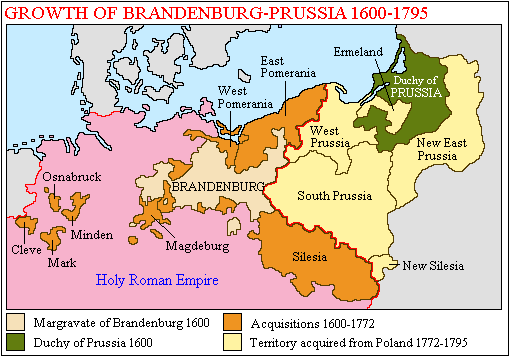
Frederick William, Elector of Brandenburg
|align=right|Frederick William was Elector of Brandenburg and Duke of Prussia – and thus ruler of Brandenburg-Prussia – from 1640 until his death. A member of the House of Hohenzollern, he is popularly known as the "Great Elector" because of his military and political prowess...
of Brandenburg
Margraviate of Brandenburg
The Margraviate of Brandenburg was a major principality of the Holy Roman Empire from 1157 to 1806. Also known as the March of Brandenburg , it played a pivotal role in the history of Germany and Central Europe....
(1640–1688). Hohenzollern
House of Hohenzollern
The House of Hohenzollern is a noble family and royal dynasty of electors, kings and emperors of Prussia, Germany and Romania. It originated in the area around the town of Hechingen in Swabia during the 11th century. They took their name from their ancestral home, the Burg Hohenzollern castle near...
Brandenburg-Prussia
Brandenburg-Prussia
Brandenburg-Prussia is the historiographic denomination for the Early Modern realm of the Brandenburgian Hohenzollerns between 1618 and 1701. Based in the Electorate of Brandenburg, the main branch of the Hohenzollern intermarried with the branch ruling the Duchy of Prussia, and secured succession...
had primarily used ineffective Landsknecht
Landsknecht
Landsknechte were European, predominantly German mercenary pikemen and supporting foot soldiers from the late 15th to the late 16th century, and achieved the reputation for being the universal mercenary of Early modern Europe.-Etymology:The term is from German, Land "land, country" + Knecht...
mercenaries
Mercenary
A mercenary, is a person who takes part in an armed conflict based on the promise of material compensation rather than having a direct interest in, or a legal obligation to, the conflict itself. A non-conscript professional member of a regular army is not considered to be a mercenary although he...
during the Thirty Years' War
Thirty Years' War
The Thirty Years' War was fought primarily in what is now Germany, and at various points involved most countries in Europe. It was one of the most destructive conflicts in European history....
, in which Brandenburg was devastated. Swedish
Swedish Empire
The Swedish Empire refers to the Kingdom of Sweden between 1561 and 1721 . During this time, Sweden was one of the great European powers. In Swedish, the period is called Stormaktstiden, literally meaning "the Great Power Era"...
and Imperial
Holy Roman Empire
The Holy Roman Empire was a realm that existed from 962 to 1806 in Central Europe.It was ruled by the Holy Roman Emperor. Its character changed during the Middle Ages and the Early Modern period, when the power of the emperor gradually weakened in favour of the princes...
forces traversed and occupied the country essentially at will. After acceding to the electoral throne, Frederick William started building a standing army
Standing army
A standing army is a professional permanent army. It is composed of full-time career soldiers and is not disbanded during times of peace. It differs from army reserves, who are activated only during wars or natural disasters...
to better defend his state in spring 1644.
By 1643-44, the developing army numbered only 5,500 troops, including 500 musketeer
Musketeer
A musketeer was an early modern type of infantry soldier equipped with a musket. Musketeers were an important part of early modern armies, particularly in Europe. They sometimes could fight on horseback, like a dragoon or a cavalryman...
s in Frederick William's bodyguard. The elector's confidant Johann von Norprath recruited forces in the Duchy of Cleves
Duchy of Cleves
The Duchy of Cleves was a State of the Holy Roman Empire. It was situated in the northern Rhineland on both sides of the Lower Rhine, around its capital Cleves and the town of Wesel, bordering the lands of the Prince-Bishopric of Münster in the east and the Duchy of Brabant in the west...
and organized an army of 3,000 Dutch
Dutch Republic
The Dutch Republic — officially known as the Republic of the Seven United Netherlands , the Republic of the United Netherlands, or the Republic of the Seven United Provinces — was a republic in Europe existing from 1581 to 1795, preceding the Batavian Republic and ultimately...
and German
Germans
The Germans are a Germanic ethnic group native to Central Europe. The English term Germans has referred to the German-speaking population of the Holy Roman Empire since the Late Middle Ages....
soldiers in the Rhineland
Rhineland
Historically, the Rhinelands refers to a loosely-defined region embracing the land on either bank of the River Rhine in central Europe....
by 1646. Garrisons were also slowly augmented in Brandenburg and the Duchy of Prussia. Frederick William sought assistance from France, the traditional rival of Habsburg Austria
Habsburg Monarchy
The Habsburg Monarchy covered the territories ruled by the junior Austrian branch of the House of Habsburg , and then by the successor House of Habsburg-Lorraine , between 1526 and 1867/1918. The Imperial capital was Vienna, except from 1583 to 1611, when it was moved to Prague...
, and began receiving French subsidies. He based his reforms on those of Louvois
François-Michel le Tellier, Marquis de Louvois
François Michel Le Tellier, Marquis de Louvois was the French Secretary of State for War for a significant part of the reign of Louis XIV. Louvois and his father, Michel le Tellier, would increase the French Army to 400,000 soldiers, an army that would fight four wars between 1667 and 1713...
, the War Minister
Secretary of State for War (France)
The Secretary of State for War was one of the four or five specialized secretaries of state in France during the Ancien Régime. The position was responsible for the Army and for overseeing French border provinces...
of King Louis XIV of France
Louis XIV of France
Louis XIV , known as Louis the Great or the Sun King , was a Bourbon monarch who ruled as King of France and Navarre. His reign, from 1643 to his death in 1715, began at the age of four and lasted seventy-two years, three months, and eighteen days...
. The growth of his army allowed Frederick William to achieve considerable territorial acquisitions in the 1648 Treaty of Westphalia, despite Brandenburg's relative lack of success during the war.
The provincial estates desired a reduction in the army's size during peacetime, but the elector avoided their demands through political concessions, evasion and economy. In the 1653 Brandenburg Recess between Frederick William and the estates of Brandenburg, the nobility provided the sovereign with 530,000 thaler
Thaler
The Thaler was a silver coin used throughout Europe for almost four hundred years. Its name lives on in various currencies as the dollar or tolar. Etymologically, "Thaler" is an abbreviation of "Joachimsthaler", a coin type from the city of Joachimsthal in Bohemia, where some of the first such...
s in return for affirmation of their privileges. The Junker
Junker
A Junker was a member of the landed nobility of Prussia and eastern Germany. These families were mostly part of the German Uradel and carried on the colonization and Christianization of the northeastern European territories during the medieval Ostsiedlung. The abbreviation of Junker is Jkr...
s thus cemented their political power at the expense of the peasantry. Once the elector and his army were strong enough, Frederick William was able to suppress the estates of Cleves
Duchy of Cleves
The Duchy of Cleves was a State of the Holy Roman Empire. It was situated in the northern Rhineland on both sides of the Lower Rhine, around its capital Cleves and the town of Wesel, bordering the lands of the Prince-Bishopric of Münster in the east and the Duchy of Brabant in the west...
, Mark and Prussia.
Frederick William attempted to professionalize his soldiers during a time of soldiers of fortune. In addition to individually creating regiments and appointing colonels, the elector imposed harsh punishment for transgressions, such as punishing by hanging
Hanging
Hanging is the lethal suspension of a person by a ligature. The Oxford English Dictionary states that hanging in this sense is "specifically to put to death by suspension by the neck", though it formerly also referred to crucifixion and death by impalement in which the body would remain...
for looting
Looting
Looting —also referred to as sacking, plundering, despoiling, despoliation, and pillaging—is the indiscriminate taking of goods by force as part of a military or political victory, or during a catastrophe, such as during war, natural disaster, or rioting...
. Acts of violence by officers against civilians resulted in decommission for a year. He developed a cadet institution for the nobility; although the upper class was resistant to the idea in the short term, the integration of the nobility into the officer corps
Officer (armed forces)
An officer is a member of an armed force or uniformed service who holds a position of authority. Commissioned officers derive authority directly from a sovereign power and, as such, hold a commission charging them with the duties and responsibilities of a specific office or position...
allied them with the Hohenzollern monarchy in the long term. Field Marshals of Brandenburg-Prussia included Derfflinger
Georg von Derfflinger
Georg von Derfflinger was a field marshal in the army of Brandenburg-Prussia during and after the Thirty Years' War .-Early years:...
, John George II
John George II, Prince of Anhalt-Dessau
John George II, Prince of Anhalt-Dessau was a German prince of the House of Ascania and ruler of the principality of Anhalt-Dessau...
, Spaen
Alexander von Spaen
Alexander Freiherr von Spaen was a Generalfeldmarschall of Brandenburg-Prussia.Spaen was born in the Duchy of Cleves as the son of Bernhard von Spaen, the lord of Kreuzfort....
and Sparr
Otto Christoph von Sparr
Otto Christoph Freiherr von Sparr was a Generalfeldmarschall of Brandenburg-Prussia.Sparr came from a noble family from the Margraviate of Brandenburg. He was born either in Lichterfelde near Eberswalde in 1599 or Prenden near Bernau in 1605.Sparr was an imperial officer during the Thirty Years' War...
. The elector's troops traditionally were organized into disconnected provincial forces. In 1655, Frederick William began the unification of the various detachments by placing them under the overall command of Sparr. Unification also increased through the appointment of Generalkriegskommissar Platen as head of supplies. These measures decreased the authority of the largely mercenary colonels who had been so prominent during the Thirty Years' War.
Campaigns of the Great Elector
Brandenburg-Prussia's new army survived its trial by fire through victory in the 1656 Battle of WarsawBattle of Warsaw (1656)
The Battle of Warsaw was a battle which took place near Warsaw on , between the armies of the Polish-Lithuanian Commonwealth on the one hand and of Sweden and Brandenburg on the other. It was a major battle in the Second Northern War between Poland and Sweden in the period 1655–1660, also known as...
, during the Northern Wars
Northern Wars
Northern Wars is a term used for a series of wars fought in northern and northeastern Europe in the 16th and 17th century. An internationally agreed nomenclature for these wars has not yet been devised...
. Observers were impressed with the discipline of the Brandenburger troops, as well as their treatment of civilians, which was considered more humane than that of their allies, the Swedish Army
Swedish Army
The Swedish Army is one of the oldest standing armies in the world and a branch of the Swedish Armed Forces; it is in charge of land operations. General Sverker Göranson is the Supreme Commander-in-Chief of the Army.- Organization :...
. Hohenzollern success enabled Frederick William to assume sovereignty over the Duchy of Prussia in the 1657 Treaty of Wehlau, by which Brandenburg-Prussia allied itself with the Polish-Lithuanian Commonwealth
Polish-Lithuanian Commonwealth
The Polish–Lithuanian Commonwealth was a dualistic state of Poland and Lithuania ruled by a common monarch. It was the largest and one of the most populous countries of 16th- and 17th‑century Europe with some and a multi-ethnic population of 11 million at its peak in the early 17th century...
. Despite having expelled Swedish forces from the territory, the elector did not acquire Vorpommern in the 1660 Treaty of Oliva
Treaty of Oliva
The Treaty or Peace of Oliva of 23 April /3 May 1660 was one of the peace treaties ending the Second Northern War...
, as the balance of power
Balance of power in international relations
In international relations, a balance of power exists when there is parity or stability between competing forces. The concept describes a state of affairs in the international system and explains the behavior of states in that system...
had been restored.
In the early 1670s, Frederick William supported Imperial attempts to reclaim Alsace
Alsace
Alsace is the fifth-smallest of the 27 regions of France in land area , and the smallest in metropolitan France. It is also the seventh-most densely populated region in France and third most densely populated region in metropolitan France, with ca. 220 inhabitants per km²...
and counter the expansion of Louis XIV of France. Swedish troops invaded Brandenburg in 1674 while the bulk of the elector's troops were in winter quarters in Franconia
Franconia
Franconia is a region of Germany comprising the northern parts of the modern state of Bavaria, a small part of southern Thuringia, and a region in northeastern Baden-Württemberg called Tauberfranken...
. In 1675 Frederick William marched his troops northward and surrounded Wrangel's troops. The elector achieved his greatest victory in the Battle of Fehrbellin
Battle of Fehrbellin
The Battle of Fehrbellin was fought on June 18, 1675 between Swedish and Brandenburg-Prussian troops. The Swedes, under Count Waldemar von Wrangel , had invaded and occupied parts of Brandenburg from their possessions in Pomerania, but were repelled by the forces of Frederick William, the Great...
; although a minor battle, it brought fame to the Brandenburg-Prussian army and gave Frederick William the nickname "the Great Elector". After Sweden invaded Prussia in late 1678, Frederick William's forces expelled the Swedish invaders during "the Great Sleigh Drive
The Great Sleigh Drive
"The Great Sleigh Drive" was a daring and bold maneuver by Frederick William, the Great Elector of Brandenburg-Prussia, to drive Swedish forces out of the Duchy of Prussia, a territory of his which had been invaded by the Swedes during the winter of 1678....
" of 1678-79; Thomas Carlyle
Thomas Carlyle
Thomas Carlyle was a Scottish satirical writer, essayist, historian and teacher during the Victorian era.He called economics "the dismal science", wrote articles for the Edinburgh Encyclopedia, and became a controversial social commentator.Coming from a strict Calvinist family, Carlyle was...
compared the wintertime Swedish retreat to that of Napoleon
Napoleon I of France
Napoleon Bonaparte was a French military and political leader during the latter stages of the French Revolution.As Napoleon I, he was Emperor of the French from 1804 to 1815...
from Moscow.
Frederick William built the Hohenzollern army up to a peacetime size of 7,000 and a wartime size of 15,000-30,000. Its success in battle against Sweden and Poland increased Brandenburg-Prussia's prestige, while also allowing the Great Elector to pursue absolutist
Absolutism (European history)
Absolutism or The Age of Absolutism is a historiographical term used to describe a form of monarchical power that is unrestrained by all other institutions, such as churches, legislatures, or social elites...
policies against estates and towns. In his political testament of 1667, the elector wrote, "Alliances, to be sure, are good, but forces of one's own still better. Upon them one can rely with more security, and a lord is of no consideration if he does not have means and troops of his own".
The growing power of the Hohenzollerns in Berlin led Frederick William's son and successor, Elector Frederick III (1688–1713), to proclaim the Kingdom of Prussia
Kingdom of Prussia
The Kingdom of Prussia was a German kingdom from 1701 to 1918. Until the defeat of Germany in World War I, it comprised almost two-thirds of the area of the German Empire...
with himself as King Frederick I
Frederick I of Prussia
Frederick I , of the Hohenzollern dynasty, was Elector of Brandenburg and Duke of Prussia in personal union . The latter function he upgraded to royalty, becoming the first King in Prussia . From 1707 he was in personal union the sovereign prince of the Principality of Neuchâtel...
in 1701. Although he emphasized Baroque
Baroque
The Baroque is a period and the style that used exaggerated motion and clear, easily interpreted detail to produce drama, tension, exuberance, and grandeur in sculpture, painting, literature, dance, and music...
opulence and the arts in imitation of Versailles
Palace of Versailles
The Palace of Versailles , or simply Versailles, is a royal château in Versailles in the Île-de-France region of France. In French it is the Château de Versailles....
, the new king recognized that the importance of the army and continued its expansion to 40,000 men.
The Soldier-King
Frederick I was succeeded by his son, Frederick William I (1713–1740), the "Soldier-King" obsessed with the army and achieving self-sufficiency for his country. The new king dismissed most of the artisans from his father's court and granted military officers precedence over court officials. Ambitious and intelligent young men began to enter the military instead of law and administration. Frederick William I wore his simple blue military uniform at court, a style henceforth imitated by the rest of the Prussian court and his royal successors. In Prussia, pigtails replaced the full-bottomed wigs common at most German courts.Frederick William I had begun his military innovations in his Kronprinz regiment during the War of the Spanish Succession
War of the Spanish Succession
The War of the Spanish Succession was fought among several European powers, including a divided Spain, over the possible unification of the Kingdoms of Spain and France under one Bourbon monarch. As France and Spain were among the most powerful states of Europe, such a unification would have...
. His friend, Leopold I, Prince of Anhalt-Dessau
Leopold I, Prince of Anhalt-Dessau
Leopold I, Prince of Anhalt-Dessau was a German prince of the House of Ascania and ruler of the principality of Anhalt-Dessau. He was also a Generalfeldmarschall in the Prussian army...
, served as the royal drill sergeant for the Prussian Army. Leopold introduced the iron ramrod
Ramrod
A ramrod is a device used with early firearms to push the projectile up against the propellant . It is also commonly referred to as a "scouring stick"...
, increasing Prussian firepower, and the slow march, or goose-step. The new king trained and drilled the army relentlessly, focusing on the firing speed of their flintlock
Flintlock
Flintlock is the general term for any firearm based on the flintlock mechanism. The term may also apply to the mechanism itself. Introduced at the beginning of the 17th century, the flintlock rapidly replaced earlier firearm-ignition technologies, such as the doglock, matchlock and wheellock...
muskets and formation maneuverability. The changes gave the army flexibility, precision, and a rate of fire that was largely unequaled for that time period. Through drilling and the iron ramrod, each soldier was expected to fire six times in a minute, three times as fast as most armies.
Punishments were draconian in nature, such as running the gauntlet
Running the gauntlet
Running the gauntlet is a form of physical punishment wherein a captive is compelled to run between two rows—a gauntlet—of soldiers who strike him as he passes.-Etymology:...
, and despite the threat of hanging, many soldiers deserted when they could. Uniforms and weaponry were standardized. Pigtails and, in those regiments which wore it, facial hair were to be of uniform length within a regiment; soldiers who could not adequately grow beards or moustaches were expected to paint an outline on their faces.
Frederick William I reduced the size of Frederick I's gaudy royal guard
Royal Guard
A Royal Guard describes any group of military bodyguards, soldiers or armed retainers responsible for the protection of a royal person, such as Emperor/Empress, King/Queen, or Prince/Princess...
to a single regiment, a troop of taller-than-average soldiers known as the Potsdam Giants
Potsdam Giants
The Potsdam Giants was the Prussian infantry regiment No 6, composed of taller-than-average soldiers. The regiment was founded in 1675 and dissolved in 1806 after the Prussian defeat against Napoleon...
which he privately funded. The cavalry
Cavalry
Cavalry or horsemen were soldiers or warriors who fought mounted on horseback. Cavalry were historically the third oldest and the most mobile of the combat arms...
was reorganized into 55 squadrons of 150 horses; the infantry was turned into 50 battalion
Battalion
A battalion is a military unit of around 300–1,200 soldiers usually consisting of between two and seven companies and typically commanded by either a Lieutenant Colonel or a Colonel...
s (25 regiment
Regiment
A regiment is a major tactical military unit, composed of variable numbers of batteries, squadrons or battalions, commanded by a colonel or lieutenant colonel...
s); and the artillery consisted of two battalions. These changes allowed him to increase the army from 39,000 to 45,000 troops; by the end of Frederick William I's reign, the army had doubled in size. The General War Commissary, responsible for the army and revenue, was removed from interference by the estates and placed strictly under the control of officials appointed by the king.
Frederick William I restricted enrollment in the officer corps to Germans and compelled the Junkers, the Prussian aristocracy
Aristocracy
Aristocracy , is a form of government in which a few elite citizens rule. The term derives from the Greek aristokratia, meaning "rule of the best". In origin in Ancient Greece, it was conceived of as rule by the best qualified citizens, and contrasted with monarchy...
, to serve in the army, Although initially reluctant about the army, the nobles eventually saw the officer corps as its natural profession. Until 1730 the common soldiers consisted largely of peasantry recruited or impressed
Impressment
Impressment, colloquially, "the Press", was the act of taking men into a navy by force and without notice. It was used by the Royal Navy, beginning in 1664 and during the 18th and early 19th centuries, in wartime, as a means of crewing warships, although legal sanction for the practice goes back to...
from Brandenburg-Prussia, leading many to flee to neighboring countries. In order to halt this trend, Frederick William I divided Prussia into regimental cantons
Cantonist (Prussia)
Cantonists were recruits in the Prussian Army from 1733-1813, liable for draft in one of the cantons. Each canton was responsible for creating its own regiment. The canton system was introduced by King Frederick William I of Prussia....
. Every youth was required to serve as a soldier in these recruitment districts for three months each year; this met agrarian needs and added extra troops to bolster the regular ranks.
The General Directory which developed during Frederick William I's reign continued the absolutist tendencies of his grandfather and collected the increased taxes necessary for the expanded military. The middle class
Middle class
The middle class is any class of people in the middle of a societal hierarchy. In Weberian socio-economic terms, the middle class is the broad group of people in contemporary society who fall socio-economically between the working class and upper class....
of the towns was required to quarter soldiers and enroll in the bureaucracy. Because the excise tax was only applied in towns, the king was reluctant to engage in war, as deployment of his expensive army in foreign lands would have deprived him of taxes from the town-based military.
By the end of Frederick William I's reign, Prussia had the fourth-largest army (60,000 soldiers) in Europe, but was twelfth in population size (2.5 million). This was maintained with a budget of five million thalers (out of a total state budget of seven million thalers).
Silesian Wars
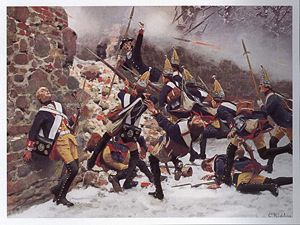
Frederick II of Prussia
Frederick II was a King in Prussia and a King of Prussia from the Hohenzollern dynasty. In his role as a prince-elector of the Holy Roman Empire, he was also Elector of Brandenburg. He was in personal union the sovereign prince of the Principality of Neuchâtel...
("the Great) (1740–86). Frederick immediately disbanded the expensive Potsdam Giants and used their funding to create seven new regiments and 10,000 troops. The new king also added sixteen battalions, five squadrons of hussar
Hussar
Hussar refers to a number of types of light cavalry which originated in Hungary in the 14th century, tracing its roots from Serbian medieval cavalry tradition, brought to Hungary in the course of the Serb migrations, which began in the late 14th century....
s, and a squadron of life guards
Life Guards
Life Guards may refer to several military regiments:*Life Guards *Life Guards *Russian Imperial Guard*Garde du Corps , during the Ancien Régime...
.
Disregarding the Pragmatic Sanction
Pragmatic sanction
A pragmatic sanction is a sovereign's solemn decree on a matter of primary importance and has the force of fundamental law. In the late history of the Holy Roman Empire it referred more specifically to an edict issued by the Emperor....
, Frederick began the Silesian Wars
Silesian Wars
The Silesian Wars were a series of wars between Prussia and Austria for control of Silesia. They formed parts of the larger War of the Austrian Succession and Seven Years' War. They eventually ended with Silesia being incorporated into Prussia, and Austrian recognition of this...
shortly after taking the throne. Although the inexperienced king retreated from the battle, the Prussian Army achieved victory over Austria
Habsburg Monarchy
The Habsburg Monarchy covered the territories ruled by the junior Austrian branch of the House of Habsburg , and then by the successor House of Habsburg-Lorraine , between 1526 and 1867/1918. The Imperial capital was Vienna, except from 1583 to 1611, when it was moved to Prague...
in the Battle of Mollwitz
Battle of Mollwitz
The Battle of Mollwitz was fought by Prussia and Austria on April 10, 1741, during the early stages of the War of the Austrian Succession. It was the first battle of the new Prussian King Frederick II, in which both sides made numerous military blunders but Frederick the Great still managed to...
(1741) under the leadership of Field Marshal Schwerin
Kurt Christoph Graf von Schwerin
Kurt Christoph Graf von Schwerin was a Prussian Generalfeldmarschall, one of the leading commanders under Frederick the Great.-Biography:...
. The Prussian cavalry under Schulenburg had performed poorly at Mollwitz; the cuirassier
Cuirassier
Cuirassiers were mounted cavalry soldiers equipped with armour and firearms, first appearing in late 15th-century Europe. They were the successors of the medieval armoured knights...
s, originally trained on heavy horses, were subsequently retrained on more maneuverable, lighter horses. The hussars and dragoon
Dragoon
The word dragoon originally meant mounted infantry, who were trained in horse riding as well as infantry fighting skills. However, usage altered over time and during the 18th century, dragoons evolved into conventional light cavalry units and personnel...
s of General Zieten
Hans Joachim von Zieten
Hans Joachim von Zieten , also known as Zieten aus dem Busch, was a cavalry general in the Prussian Army...
were also expanded. These changes led to a Prussian victory at Chotusitz
Battle of Chotusitz
The Battle of Chotusitz, or Chotusice, sometimes called the Battle of Czaslau, was fought on May 17, 1742 in Bohemia between the Austrians under Prince Charles Alexander of Lorraine and the Prussians under Frederick the Great. The battle was a part of the War of the Austrian Succession sometimes...
(1742), and Austria conceded Silesia to Frederick with the Peace of Breslau.
In September 1743, Frederick held the first fall maneuver (Herbstübung), in which the different branches of the army tested new formations and tactics; the fall maneuvers become annual traditions of the Prussian Army. Austria tried to reclaim Silesia in the Second Silesian War. Although successful in outmaneuvering Frederick in 1744, the Austrians were crushed in the Battle of Hohenfriedberg
Battle of Hohenfriedberg
The Battle of Hohenfriedberg or Hohenfriedeberg, also known as the battle of Striegau, now Dobromierz, was one of the crowning achievements of Frederick the Great...
(1745). The Prussian cavalry excelled during the battle, especially the Zieten-Hussars. For his great services at Hohenfriedberg the close fellow of King Frederick, Hans Karl von Winterfeldt
Hans Karl von Winterfeldt
Hans Karl von Winterfeldt , Prussian general, was born at Vanselow Castle in Swedish Pomerania, he was Lord of several estates. His education was imperfect, and in later life he always regretted his want of familiarity with the French language...
, rose to prominence.
Austria then allied with its traditional rival, France, in the Diplomatic Revolution
Diplomatic Revolution
The Diplomatic Revolution of 1756 is a term applied to the reversal of longstanding diplomatic alliances which were upheld until the War of the Austrian Succession and then reversed in the Seven Years' War; the shift has also been known as "the great change of partners"...
(1756); Austria, France, and Russia
Russian Empire
The Russian Empire was a state that existed from 1721 until the Russian Revolution of 1917. It was the successor to the Tsardom of Russia and the predecessor of the Soviet Union...
were all aligned against Prussia. Frederick preemptively attacked his enemies with an army of 150,000, beginning the Seven Years' War
Seven Years' War
The Seven Years' War was a global military war between 1756 and 1763, involving most of the great powers of the time and affecting Europe, North America, Central America, the West African coast, India, and the Philippines...
. The Austrian Army had been reformed by Kaunitz, and the improvements showed in their success over Prussia at Kolin
Battle of Kolin
-Results:The battle was Frederick's first defeat in this war. This disaster forced him to abandon his intended march on Vienna, raise his siege of Prague, and fall back on Litoměřice...
. Frederick achieved his easiest victory, however, at Rossbach
Battle of Rossbach
The Battle of Rossbach took place during the Seven Years' War near the village of Roßbach, in the Electorate of Saxony. Frederick the Great defeated the allied armies of France and the Holy Roman/Austrian Empire...
, where the Prussian cavalry of Seydlitz
Friedrich Wilhelm von Seydlitz
Friedrich Wilhelm Freiherr von Seydlitz was a Prussian soldier and one of the greatest German cavalry generals.-Early life:...
smashed a larger Franco-Imperial army with minimal casualties, despite being outnumbered two to one. Frederick then rushed eastward to Silesia, where Austria had defeated the Prussian army under the Duke of Bevern. After a series of complicated formations and deployments hidden from the Austrians, the Prussians successfully struck their enemy's flank at Leuthen
Battle of Leuthen
In the Battle of Leuthen or Lissa, fought on 5 December 1757, Frederick the Great's Prussian army used maneuver and terrain to decisively defeat a much larger Austrian army under Charles of Lorraine, thus ensuring Prussian control of Silesia during the Seven Years' War.- Background :While Frederick...
; the Austrian position in the province collapsed from the battle.
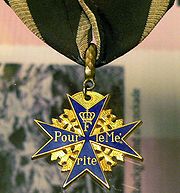
Battle of Zorndorf
The Battle of Zorndorf was a battle fought on August 25, 1758 during the Seven Years' War, fought between the forces of the Russians troops under the command of Count William Fermor – and a Prussian army under King Frederick the Great...
, however, and Prussian forces were crushed at Kunersdorf
Battle of Kunersdorf
The Battle of Kunersdorf, fought in the Seven Year's War, was Frederick the Great's most devastating defeat. On August 12, 1759, near Kunersdorf , east of Frankfurt , 50,900 Prussians were defeated by a combined allied army 59,500 strong consisting of 41,000 Russians and 18,500 Austrians under...
(1759). Prussia was ill-suited for lengthy wars, and a Prussian collapse seemed imminent on account of casualties and lack of resources, but Frederick was saved by the "Miracle of the House of Brandenburg" — the Russian exit from the war after the sudden death of Empress Elizabeth in 1762. Prussian control of Silesia was confirmed in the Treaty of Hubertusburg
Treaty of Hubertusburg
thumb|right|300px|Hubertusburg, WermsdorfThe Treaty of Hubertusburg was signed on 15 February 1763 at Hubertusburg by Prussia, Austria, and Saxony. Together with the Treaty of Paris, it marked the end of the French and Indian War and of the Seven Years' War. The treaty ended the continental...
(1763). Severe casualties had led the king to admit middle class officers during the war, but this trend was reversed afterwards.
The offensive-minded Frederick advocated the oblique order
Oblique order
The Oblique Order is a military tactic where an attacking army focuses its forces to attack a single enemy flank. The force commander concentrates the majority of his strength on one flank and uses the remainder to fix the enemy line. This allows a commander with weaker or equal forces to...
of battle, which required considerable discipline and mobility. Although this tactic failed at Kunersdorf, it was used to great success at Leuthen. After a few initial salvo
Salvo
A salvo is the simultaneous discharge of artillery or firearms including the firing of guns either to hit a target or to perform a salute.Troops armed with muzzleloaders required time in which to refill their arms with gun powder and shot...
s, the infantry was to advance quickly for a bayonet
Bayonet
A bayonet is a knife, dagger, sword, or spike-shaped weapon designed to fit in, on, over or underneath the muzzle of a rifle, musket or similar weapon, effectively turning the gun into a spear...
charge. The Prussian cavalry was to attack as a large formation with swords before the opposing cavalry could attack.
An army with a country
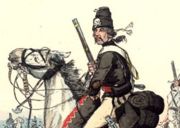
Garrison
Garrison is the collective term for a body of troops stationed in a particular location, originally to guard it, but now often simply using it as a home base....
began construction in Berlin in 1764. While Frederick William I wanted to have a mostly native-born army, Frederick II wanted to have a mostly foreign-born army, preferring to have native Prussians be taxpayers and producers. The Prussian army consisted of 187,000 soldiers in 1776, 90,000 of whom were Prussian subjects in central and eastern Prussia. The remainder were foreign (both German and non-German) volunteers or conscripts. Frederick established the Gardes du Corps as the royal guard. Many troops were disloyal, such as mercenaries or those acquired through impressment, while troops recruited from the canton system displayed strong regional, and nascent national, pride. During the Seven Years' War, the elite regiments of the army were almost entirely composed of native Prussians.
By the end of Frederick's reign, the army had become an integral part of Prussian society and numbered 193,000 soldiers. The social classes were all expected to serve the state and its army — the nobility led the army, the middle class supplied the army, and the peasants composed the army. Minister Friedrich von Schrötter
Friedrich von Schrötter
Friedrich Leopold Freiherr von Schrötter was a Junker and Prussian government minister.Schrötter was born in Wohnsdorf near Friedland and served in a dragoon regiment during the Seven Years War...
remarked that, "Prussia was not a country with an army, but an army with a country".
Napoleonic era
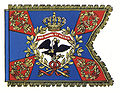
Defeat
Frederick the Great's successor, his nephew Frederick William IIFrederick William II of Prussia
Frederick William II was the King of Prussia, reigning from 1786 until his death. He was in personal union the Prince-Elector of Brandenburg and the sovereign prince of the Principality of Neuchâtel.-Early life:...
(1786–97), relaxed conditions in Prussia and had little interest in war. He delegated responsibility to the aged Charles William Ferdinand, Duke of Brunswick
Charles William Ferdinand, Duke of Brunswick
Charles William Ferdinand , Duke of Brunswick-Wolfenbüttel, was a sovereign prince of the Holy Roman Empire, and a professional soldier who served as a Generalfeldmarschall of the Kingdom of Prussia...
, and the army began to degrade in quality. Led by veterans of the Silesian Wars, the Prussian Army was ill-equipped to deal with Revolutionary France
French Revolution
The French Revolution , sometimes distinguished as the 'Great French Revolution' , was a period of radical social and political upheaval in France and Europe. The absolute monarchy that had ruled France for centuries collapsed in three years...
. The officers retained the same training, tactics and weaponry used by Frederick the Great some forty years earlier. In comparison, the revolutionary army of France, especially under Napoleon Bonaparte
Napoleon I of France
Napoleon Bonaparte was a French military and political leader during the latter stages of the French Revolution.As Napoleon I, he was Emperor of the French from 1804 to 1815...
, was developing new methods of organization, supply, mobility, and command.
Prussia withdrew from the First Coalition
First Coalition
The War of the First Coalition was the first major effort of multiple European monarchies to contain Revolutionary France. France declared war on the Habsburg monarchy of Austria on 20 April 1792, and the Kingdom of Prussia joined the Austrian side a few weeks later.These powers initiated a series...
in the Peace of Basel
Peace of Basel
The Peace of Basel of 1795 consists of three peace treaties involving France .* The first of the three treaties of 1795, France made peace with Prussia on 5 April; , * The Second was with Spain on 22 July, ending the War of the Pyrenees; and*...
(1795), ceding the Rhenish territories to France. Upon Frederick William II's death in 1797, the state was bankrupt and the army outdated. He was succeeded by his son, Frederick William III
Frederick William III of Prussia
Frederick William III was king of Prussia from 1797 to 1840. He was in personal union the sovereign prince of the Principality of Neuchâtel .-Early life:...
(1797–1840), who involved Prussia in the disastrous Fourth Coalition. The Prussian Army was decisively defeated in the battles of Saalfeld
Battle of Saalfeld
The Battle of Saalfeld saw Marshal Lannes and a division of his V Corps defeat 8,300 Prussians under Prince Louis Ferdinand.-Battle:Prince Louis Ferdinand was one of the principal advocates of resuming war against the French....
, Jena and Auerstedt
Battle of Jena-Auerstedt
The twin battles of Jena and Auerstedt were fought on 14 October 1806 on the plateau west of the river Saale in today's Germany, between the forces of Napoleon I of France and Frederick William III of Prussia...
in 1806. The Prussians' famed discipline collapsed and led to widescale surrendering among infantry, cavalry and garrisons. While some Prussian commanders acquitted themselves well, such as L'Estocq
Anton Wilhelm von L'Estocq
Anton Wilhelm von L'Estocq was a Prussian cavalry general best known for his command of the Prussian troops at the Battle of Eylau.-Biography:...
at Eylau
Battle of Eylau
The Battle of Eylau or Battle of Preussisch-Eylau, 7 and 8 February 1807, was a bloody and inconclusive battle between Napoléon's Grande Armée and a Russian Empire army under Levin August, Count von Bennigsen near the town of Preußisch Eylau in East Prussia. Late in the battle, the Russians...
, Gneisenau
August von Gneisenau
August Wilhelm Antonius Graf Neidhardt von Gneisenau was a Prussian field marshal. He was a prominent figure in the reform of the Prussian military and the War of Liberation.-Early life:...
at Kolberg, and Blücher
Gebhard Leberecht von Blücher
Gebhard Leberecht von Blücher, Fürst von Wahlstatt , Graf , later elevated to Fürst von Wahlstatt, was a Prussian Generalfeldmarschall who led his army against Napoleon I at the Battle of the Nations at Leipzig in 1813 and at the Battle of Waterloo in 1815 with the Duke of Wellington.He is...
at Lübeck, they were not enough to reverse Jena-Auerstedt. Prussia submitted to major territorial losses, a standing army of only 42,000 men, and an alliance with France in the Treaty of Tilsit
Treaties of Tilsit
The Treaties of Tilsit were two agreements signed by Napoleon I of France in the town of Tilsit in July, 1807 in the aftermath of his victory at Friedland. The first was signed on 7 July, between Tsar Alexander I of Russia and Napoleon I of France, when they met on a raft in the middle of the Neman...
(1807).
Reform
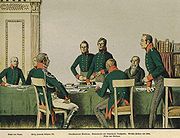
Frederick II of Prussia
Frederick II was a King in Prussia and a King of Prussia from the Hohenzollern dynasty. In his role as a prince-elector of the Holy Roman Empire, he was also Elector of Brandenburg. He was in personal union the sovereign prince of the Principality of Neuchâtel...
victories. While Stein
Heinrich Friedrich Karl Reichsfreiherr vom und zum Stein
Heinrich Friedrich Karl Reichsfreiherr vom und zum Stein , commonly known as Baron vom Stein, was a Prussian statesman who introduced the Prussian reforms that paved the way for the unification of Germany...
and Hardenberg
Karl August von Hardenberg
Karl August Fürst von Hardenberg was a Prussian statesman and Prime Minister of Prussia. While during his late career he acquiesced to reactionary policies, earlier in his career he implemented a variety of Liberal reforms...
began modernizing the Prussian state, Scharnhorst
Gerhard von Scharnhorst
Gerhard Johann David Waitz von Scharnhorst was a general in Prussian service, Chief of the Prussian General Staff, noted for both his writings, his reforms of the Prussian army, and his leadership during the Napoleonic Wars....
began to reform the military. He led a Military Reorganization Committee, which included Gneisenau, Grolman, Boyen
Hermann von Boyen
Leopold Hermann Ludwig von Boyen was a Prussian army officer who helped to reform the Prussian Army in the early 19th century...
, and the civilians Stein and Könen. Clausewitz
Carl von Clausewitz
Carl Philipp Gottfried von Clausewitz was a Prussian soldier and German military theorist who stressed the moral and political aspects of war...
assisted with the reorganization as well. Dismayed by the populace's indifferent reaction to the 1806 defeats, the reformers wanted to cultivate patriotism
Patriotism
Patriotism is a devotion to one's country, excluding differences caused by the dependencies of the term's meaning upon context, geography and philosophy...
within the country. Stein's reforms abolished serfdom
Serfdom
Serfdom is the status of peasants under feudalism, specifically relating to Manorialism. It was a condition of bondage or modified slavery which developed primarily during the High Middle Ages in Europe and lasted to the mid-19th century...
in 1807 and initiated local city government in 1808.
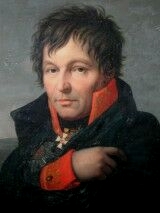
Bogislav Friedrich Emanuel von Tauentzien
Bogislav Friedrich Emanuel Graf Tauentzien von Wittenberg was a Prussian general of the Napoleonic Wars....
remained by the Sixth Coalition
War of the Sixth Coalition
In the War of the Sixth Coalition , a coalition of Austria, Prussia, Russia, the United Kingdom, Portugal, Sweden, Spain and a number of German States finally defeated France and drove Napoleon Bonaparte into exile on Elba. After Napoleon's disastrous invasion of Russia, the continental powers...
; many were allowed to redeem their reputations in the war of 1813. The officer corps was reopened to the middle class in 1808, while advancement into the higher ranks became based on education. King Frederick William III created the War Ministry
Prussian Minister of War
The Prussian War Ministry was gradually established between 1808 and 1809 as part of a series of reforms initiated by the Military Reorganization Commission created after the disastrous Treaty of Paris. The War Ministry was to help bring the army under constitutional control, and, along with the...
in 1809, and Scharnhorst founded an officers training school, the later Prussian War Academy, in Berlin in 1810.
Scharnhorst advocated adopting the levée en masse
Levée en masse
Levée en masse is a French term for mass conscription during the French Revolutionary Wars, particularly for the one from 16 August 1793.- Terminology :...
, the military conscription used by France. He created the Krümpersystem, by which companies replaced 3-5 men monthly, allowing up to 60 extra men to be trained annually per company. This system granted the army a larger reserve of 30,000-150,000 extra troops. The Krümpersystem was also the beginning of short-term compulsory service in Prussia, as opposed to the long-term conscription previously used. Because the occupying French prohibited the Prussians from forming divisions, the Prussian Army was divided into six brigade
Brigade
A brigade is a major tactical military formation that is typically composed of two to five battalions, plus supporting elements depending on the era and nationality of a given army and could be perceived as an enlarged/reinforced regiment...
s, each consisting of seven to eight infantry battalions and twelve squadrons of cavalry. The combined brigades were supplemented with three brigades of artillery.
Corporal punishment
Corporal punishment
Corporal punishment is a form of physical punishment that involves the deliberate infliction of pain as retribution for an offence, or for the purpose of disciplining or reforming a wrongdoer, or to deter attitudes or behaviour deemed unacceptable...
was by and large abolished, while soldiers were trained in the field and in tirailleur
Tirailleur
Tirailleur literally means a shooting skirmisher in French from tir—shot. The term dates back to the Napoleonic period where it was used to designate light infantry trained to skirmish ahead of the main columns...
tactics. Scharnhorst promoted the integration of the infantry, cavalry and artillery through combined arms
Combined arms
Combined arms is an approach to warfare which seeks to integrate different branches of a military to achieve mutually complementary effects...
, as opposed to their previous independent states. Equipment and tactics were updated in respect to the Napoleonic campaigns. The field manual issued by Yorck in 1812 emphasized combined arms and faster marching speeds. In 1813, Scharnhorst succeeded in attaching a chief of staff trained at the academy to each field commander.
Some reforms were opposed by Frederician traditionalists, such as Yorck, who felt that middle class officers would erode the privileges of the aristocratic officer corps and promote the ideas of the French Revolution
French Revolution
The French Revolution , sometimes distinguished as the 'Great French Revolution' , was a period of radical social and political upheaval in France and Europe. The absolute monarchy that had ruled France for centuries collapsed in three years...
. The army reform movement was cut short by Scharnhorst's death in 1813, and the shift to a more democratic and middle class military began to lose momentum in the face of the reactionary government.
Wars of Liberation
Austrian Empire
The Austrian Empire was a modern era successor empire, which was centered on what is today's Austria and which officially lasted from 1804 to 1867. It was followed by the Empire of Austria-Hungary, whose proclamation was a diplomatic move that elevated Hungary's status within the Austrian Empire...
in its 1809 campaign against France. When the cautious king refused to support a new Prussian war, however, Schill
Ferdinand von Schill
Ferdinand Baptista von Schill was a Prussian officer who revolted unsuccessfully against French domination in May 1809.-Life:...
led his hussar regiment against the occupying French, expecting to provoke a national uprising. The king considered Schill a mutineer
Mutiny
Mutiny is a conspiracy among members of a group of similarly situated individuals to openly oppose, change or overthrow an authority to which they are subject...
, and the major's rebellion was crushed at Stralsund
Stralsund
- Main sights :* The Brick Gothic historic centre is a UNESCO World Heritage Site.* The heart of the old town is the Old Market Square , with the Gothic Town Hall . Behind the town hall stands the imposing Nikolaikirche , built in 1270-1360...
by French allies. The Franco-Prussian treaty of 1812 forced Prussia to provide 20,000 troops to Napoleon's Grande Armée, first under the leadership of Grawert
Julius von Grawert
Julius August Reinhold von Grawert was a Prussian general. During the Battle of Jena-Auerstedt on 14 October 1806, he led a division under Frederick Louis, Prince of Hohenlohe-Ingelfingen at Jena....
and then under Yorck. The French occupation of Prussia was reaffirmed, and 300 demoralized Prussian officers resigned in protest.
During Napoleon's retreat from Russia in 1812, Yorck independently signed the Convention of Tauroggen
Convention of Tauroggen
The Convention of Tauroggen was a truce signed 30 December 1812 at Tauroggen , between Generalleutnant Ludwig Yorck von Wartenburg on behalf of his Prussian troops, and by General Hans Karl von Diebitsch of the Russian Army...
with Russia, breaking the Franco-Prussian alliance. Stein arrived in East Prussia and led the raising of a Landwehr
Landwehr
Landwehr, or Landeswehr, is a German language term used in referring to certain national armies, or militias found in nineteenth- and early twentieth-century Europe. In different context it refers to large scale, low strength fortifications...
, or militia to defend the province. With Prussia's joining of the Sixth Coalition
War of the Sixth Coalition
In the War of the Sixth Coalition , a coalition of Austria, Prussia, Russia, the United Kingdom, Portugal, Sweden, Spain and a number of German States finally defeated France and drove Napoleon Bonaparte into exile on Elba. After Napoleon's disastrous invasion of Russia, the continental powers...
out of his hands, Frederick William III quickly began to mobilize the army, and the East Prussian Landwehr was duplicated in the rest of the country. In comparison to 1806, the Prussian populace, especially the middle class, was supportive of the war, and thousands of volunteers joined the army. Prussian troops under the leadership of Blücher and Gneisenau proved vital at the Battles of Leipzig
Battle of Leipzig
The Battle of Leipzig or Battle of the Nations, on 16–19 October 1813, was fought by the coalition armies of Russia, Prussia, Austria and Sweden against the French army of Napoleon. Napoleon's army also contained Polish and Italian troops as well as Germans from the Confederation of the Rhine...
(1813) and Waterloo
Battle of Waterloo
The Battle of Waterloo was fought on Sunday 18 June 1815 near Waterloo in present-day Belgium, then part of the United Kingdom of the Netherlands...
(1815). Later staff officers were impressed with the simultaneous operations of separate groups of the Prussian Army.
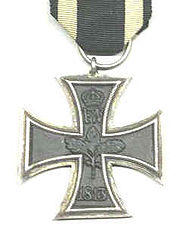
The Iron Cross
Iron Cross
The Iron Cross is a cross symbol typically in black with a white or silver outline that originated after 1219 when the Kingdom of Jerusalem granted the Teutonic Order the right to combine the Teutonic Black Cross placed above a silver Cross of Jerusalem....
was introduced as a military decoration
Military decoration
A military decoration is a decoration given to military personnel or units for heroism in battle or distinguished service. They are designed to be worn on military uniform....
by King Frederick William III in 1813. After the publication of his On War
On War
Vom Kriege is a book on war and military strategy by Prussian general Carl von Clausewitz , written mostly after the Napoleonic wars, between 1816 and 1830, and published posthumously by his wife in 1832. It has been translated into English several times as On War...
, Clausewitz became a widely-studied philosopher of war.
Bulwark of conservatism
German General Staff
The German General Staff was an institution whose rise and development gave the German armed forces a decided advantage over its adversaries. The Staff amounted to its best "weapon" for nearly a century and a half....
, which developed out of meetings of the Great Elector with his senior officers and the informal meeting of the Napoleonic Era reformers, was formally created in 1814. In the same year Boyen and Grolman drafted a law for universal conscription, by which men would successively serve in the standing army, the Landwehr and the local Landsturm
Landsturm
German-speaking countries used the word Landsturm to refer to third-class infantry or militias.- 1813 :King Frederick William III of Prussia established the Prussian Landsturm as irregular military forces on 21 April 1813 by royal edict – the decree appeared in the preussische Gesetzesammlung...
until the age of 39. Troops of the 136,000-strong standing army served for three years and were in the reserves for two, while militiamen of the 163,000-strong Landwehr served a few weeks annually for seven years. Boyen and Blücher strongly supported the 'civilian army' of the Landwehr, which was to unite military and civilian society, as an equal to the standing army.
During a constitutional crisis in 1819, Frederick William III recognized Prussia's adherence to the anti-revolutionary Carlsbad Decrees
Carlsbad Decrees
The Carlsbad Decrees were a set of reactionary restrictions introduced in the states of the German Confederation by resolution of the Bundesversammlung on 20 September 1819 after a conference held in the spa town of Carlsbad, Bohemia...
. Conservative forces within Prussia, such as Wittgenstein, remained opposed to conscription and the more democratic Landwehr. Frederick William III reduced the militia's size and placed it under the control of the regular army in 1819, leading to the resignations of Boyen and Grolman and the ending of the reform movement. Boyen's ideal of an enlightened citizen soldier was replaced with the idea of a professional military separate or alienated from civilian society.
By the middle of the 19th century, Prussia was seen by many German Liberals
Liberalism
Liberalism is the belief in the importance of liberty and equal rights. Liberals espouse a wide array of views depending on their understanding of these principles, but generally, liberals support ideas such as constitutionalism, liberal democracy, free and fair elections, human rights,...
as the country best-suited to unify the many German states
German Confederation
The German Confederation was the loose association of Central European states created by the Congress of Vienna in 1815 to coordinate the economies of separate German-speaking countries. It acted as a buffer between the powerful states of Austria and Prussia...
, but the conservative government used the army to repress liberal and democratic tendencies during the 1830s and 1840s. Liberals resented the usage of the army in essentially police actions. King Frederick William IV
Frederick William IV of Prussia
|align=right|Upon his accession, he toned down the reactionary policies enacted by his father, easing press censorship and promising to enact a constitution at some point, but he refused to enact a popular legislative assembly, preferring to work with the aristocracy through "united committees" of...
(1840–61) initially appeared to be a liberal ruler, but he was opposed to issuing the written constitution called for by reformers. When barricades were raised in Berlin during the 1848 revolution
Revolutions of 1848 in the German states
The Revolutions of 1848 in the German states, also called the March Revolution – part of the Revolutions of 1848 that broke out in many countries of Europe – were a series of loosely coordinated protests and rebellions in the states of the German Confederation, including the Austrian Empire...
, the king reluctantly agreed to the creation of a civilian defense force (Bürgerwehr) in his capital. A national assembly to write a constitution was convened for the first time, but its slowness allowed the reactionary forces to regroup. Wrangel
Friedrich Graf von Wrangel
Friedrich Heinrich Ernst Graf von Wrangel was a Generalfeldmarschall of the Prussian Army. He was nicknamed Papa Wrangel....
led the reconquest of Berlin, which was supported by a middle class weary of a people's revolution. Prussian troops were subsequently used to suppress the revolution in many other German cities.
At the end of 1848, Frederick William finally issued the Constitution of the Kingdom of Prussia
Constitution of the Kingdom of Prussia
The Constitution of the Kingdom of Prussia was adopted in 1850 and amended in the following years. This constitution was far less liberal than the federal constitution of the German Empire....
. The liberal opposition secured the creation of a parliament
Parliament
A parliament is a legislature, especially in those countries whose system of government is based on the Westminster system modeled after that of the United Kingdom. The name is derived from the French , the action of parler : a parlement is a discussion. The term came to mean a meeting at which...
, but the constitution was largely a conservative document reaffirming the monarchy's predominance. The army was a praetorian guard
Praetorian Guard
The Praetorian Guard was a force of bodyguards used by Roman Emperors. The title was already used during the Roman Republic for the guards of Roman generals, at least since the rise to prominence of the Scipio family around 275 BC...
outside of the constitution, subject only to the king. The Prussian Minister of War
Prussian Minister of War
The Prussian War Ministry was gradually established between 1808 and 1809 as part of a series of reforms initiated by the Military Reorganization Commission created after the disastrous Treaty of Paris. The War Ministry was to help bring the army under constitutional control, and, along with the...
was the only soldier required to swear an oath defending the constitution, leading ministers such as Strotha, Bonin
Eduard von Bonin
Eduard von Bonin was a Prussian general who served as Prussian Minister of War from 1852–54 and 1858-59.-Life:...
and Waldersee to be criticized by either the king or the parliament, depending on their political views. The army's budget had to be approved by the Lower House of Parliament. Novels and memoirs glorifying the army, especially its involvement in the Napoleonic Wars, began to be published to sway public opinion. The defeat at Olmütz of the liberals' plan to unite Germany through Prussia encouraged reactionary forces. In 1856 during peacetime Prussian Army consisted of 86436 infantrymen, 152 cavalry squadrons and 9 artillery regiments.
After Frederick William IV suffered a stroke, his brother William I
William I, German Emperor
William I, also known as Wilhelm I , of the House of Hohenzollern was the King of Prussia and the first German Emperor .Under the leadership of William and his Chancellor Otto von Bismarck, Prussia achieved the unification of Germany and the...
became regent (1857) and king (1861–88). He desired to reform the army, which conservatives such as Roon
Albrecht Graf von Roon
Albrecht Theodor Emil Graf von Roon was a Prussian soldier and statesman. As Minister of War 1859–1873 Roon, along with Otto von Bismarck and Helmuth von Moltke, was a dominating figure in Prussia's government during the key decade of the 1860s, when a series of successful wars against Denmark,...
considered to have degraded since 1820 because of liberalism. The king wanted to expand the army — while the populace had risen from 10 million to 18 million since 1820, the annual army recruits had remained 40,000. Although Bonin opposed Roon's desired weakening of the Landwehr, William I was alarmed by the nationalistic Second Italian War of Independence
Second Italian War of Independence
The Second War of Italian Independence, Franco-Austrian War, Austro-Sardinian War, or Austro-Piedmontese War , was fought by Napoleon III of France and the Kingdom of Piedmont-Sardinia against the Austrian Empire in 1859...
. Bonin resigned as Minister of War and was replaced with Roon.
Junker
A Junker was a member of the landed nobility of Prussia and eastern Germany. These families were mostly part of the German Uradel and carried on the colonization and Christianization of the northeastern European territories during the medieval Ostsiedlung. The abbreviation of Junker is Jkr...
s.
Moltke the Elder
Moltke the ElderHelmuth von Moltke the Elder
Helmuth Karl Bernhard Graf von Moltke was a German Field Marshal. The chief of staff of the Prussian Army for thirty years, he is regarded as one of the great strategists of the latter 19th century, and the creator of a new, more modern method of directing armies in the field...
, Chief of the General Staff from 1857–88, modernized the Prussian Army during his tenure. He expanded the General Staff, creating peacetime subdivisions such as the Mobilization, Geographical-Statistical and Military History Sections. In 1869, he issued a handbook for warfare on the operational
Operational warfare
Operational mobility, beginning as a military theory concept during the period of mechanisation of armed forces, became a method of managing movement of forces by strategic commanders from the staging area to their Tactical Area of Responsibility....
level, Instructions for Large Unit Commanders, writing, "The modern conduct of war is marked by the striving for a great and rapid decision". Moltke was a strong proponent of war game
Military simulation
Military simulations, also known informally as war games, are simulations in which theories of warfare can be tested and refined without the need for actual hostilities. Many professional contemporary analysts object to the term wargames as this is generally taken to be referring to the civilian...
training for officers and introduced the breech-loading needle gun
Needle gun
The Dreyse needle-gun was a military breechloading rifle, famous as the main infantry weapon of the Prussians, who adopted it for service in 1848 as the Dreyse Zündnadelgewehr, or Prussian Model 1848...
to troops, which allowed them to fire significantly faster than their adversaries. Moltke took advantage of the railroad, guiding the construction of rail lines within Prussia to likely places of deployment. Because modern armies had become too large and unwieldy for a single commander to control, Moltke supported multiple and independent smaller armies in concentric operations. Once one army encountered the enemy and pinned it down, a second army would arrive and attack the enemy's flank or rear. He advocated a Kesselschlacht, or battle of encirclement.
It was in Moltke’s ‘Instructions for Large Unit Commanders’ and his concept of separated armies that we begin to see the emergence of modern German doctrine. The system of moving units separately and concentrating as an army before a battle resulted in more efficient supply and lower vulnerability to modern firepower. To enable a successful flanking attack, he asserted that concentration could only take place after the commencement of a battle. This was a development of the Scharnhorst concept of 'March Divided, Fight United.’
A major consequence of this innovation was the commander's loss of overall control of his forces due to his available means of communication which, at that time were visual (line-of-sight) or couriers, either mounted or on foot. The traditional concept of the elimination of uncertainty by means of ‘total obedience’ was now obsolete and operational initiative, direction and control had to be assigned to a point further down the chain of command. In this new concept, commanders of distant detachments were required to exercise initiative in their decision making and von Moltke emphasised the benefits of developing officers who could do this within the limits of the senior commander’s intention.
At the same time Moltke had worked out the conditions of the march and supply of an army. Only one army corps could be moved along one road in the same day; to put two or three corps on the same road meant that the rear corps could not be made use of in a battle at the front. Several corps stationed close together in a small area could not be fed for more than a day or two. Accordingly he inferred that the essence of strategy lay in arrangements for the separation of the corps for marching and their concentration in time for battle. In order to make a large army manageable, it must be broken up into separate armies or groups of corps, each group under a commander authorized to regulate its movements and action subject to the instructions of the commander-in-chief as regards the direction and purpose of its operations.
Moltke's main thesis was that military strategy
Strategy
Strategy, a word of military origin, refers to a plan of action designed to achieve a particular goal. In military usage strategy is distinct from tactics, which are concerned with the conduct of an engagement, while strategy is concerned with how different engagements are linked...
had to be understood as a system of options since only the beginning of a military operation was plannable. As a result, he considered the main task of military leaders to consist in the extensive preparation of all possible outcomes. His thesis can be summed up by two statements, one famous and one less so, translated into English as No plan of operations extends with certainty beyond the first encounter with the enemy's main strength (no plan survives contact with the enemy). and Strategy is a system of expedients.
However, as can be seen from the descriptions of his planning for the war with Austria and the war with France, his planning for war was very detailed and took into account thousands of variables. It is a mistake to think that Moltke thought war plans were of no use (which a simple reading of "No battle plan survives contact with the enemy" would seem to indicate).
Moltke originated the use of the colors blue for friendly forces and red for hostile forces in strategy or wargaming
Wargaming
A wargame is a strategy game that deals with military operations of various types, real or fictional. Wargaming is the hobby dedicated to the play of such games, which can also be called conflict simulations, or consims for short. When used professionally to study warfare, it is generally known as...
. Hence the term blue on blue
Blue On Blue
Blue on Blue is Leigh Nash's debut solo album. Nash began working on the album a year after Sixpence None the Richer disbanded. Produced by Pierre Marchand who is famous for his collaborations with Sarah McLachlan, the album consists of pop songs....
fire in friendly fire situations.
He accomplished this by means of directives stating his intentions, rather than detailed orders, and he was willing to accept deviations from a directive provided that it was within the general framework of the mission. Von Moltke held this view firmly and it later became a fundamental of all German military theory.
Wars of unification
Denmark
Denmark is a Scandinavian country in Northern Europe. The countries of Denmark and Greenland, as well as the Faroe Islands, constitute the Kingdom of Denmark . It is the southernmost of the Nordic countries, southwest of Sweden and south of Norway, and bordered to the south by Germany. Denmark...
forces in the Battle of Dybbøl
Battle of Dybbøl
The Battle of Dybbøl was the key battle of the Second War of Schleswig and occurred on the morning of 18 April 1864 following a siege lasting from 7 April. Denmark suffered a severe defeat against the German Confederation which decided the war...
during the Second Schleswig War (1864), allowing Prussia and Austria to claim Schleswig
Schleswig
Schleswig or South Jutland is a region covering the area about 60 km north and 70 km south of the border between Germany and Denmark; the territory has been divided between the two countries since 1920, with Northern Schleswig in Denmark and Southern Schleswig in Germany...
and Holstein
Holstein
Holstein is the region between the rivers Elbe and Eider. It is part of Schleswig-Holstein, the northernmost state of Germany....
, respectively. Disputes orchestrated by the Prussian Prime Minister
Prime Minister of Prussia
The office of Minister President or Prime Minister of Prussia existed in one form or another from 1702 until the dissolution of Prussia in 1947. When Prussia was an independent kingdom the Minister President or Prime Minister functioned as the King's Chief Minister and presided over the Prussian...
, Otto von Bismarck
Otto von Bismarck
Otto Eduard Leopold, Prince of Bismarck, Duke of Lauenburg , simply known as Otto von Bismarck, was a Prussian-German statesman whose actions unified Germany, made it a major player in world affairs, and created a balance of power that kept Europe at peace after 1871.As Minister President of...
, led to the Austro-Prussian War
Austro-Prussian War
The Austro-Prussian War was a war fought in 1866 between the German Confederation under the leadership of the Austrian Empire and its German allies on one side and the Kingdom of Prussia with its German allies and Italy on the...
(1866). The needle guns of the Prussian infantry were highly successful against the Austrians, who were defeated at Königgrätz
Battle of Königgrätz
The Battle of Königgrätz , also known as the Battle of Sadowa, Sadová, or Hradec Králové, was the decisive battle of the Austro-Prussian War, in which the Kingdom of Prussia defeated the Austrian Empire...
. Under the leadership of Moltke, the Prussian Army then proved victorious over France
Second French Empire
The Second French Empire or French Empire was the Imperial Bonapartist regime of Napoleon III from 1852 to 1870, between the Second Republic and the Third Republic, in France.-Rule of Napoleon III:...
in the Franco-Prussian War
Franco-Prussian War
The Franco-Prussian War or Franco-German War, often referred to in France as the 1870 War was a conflict between the Second French Empire and the Kingdom of Prussia. Prussia was aided by the North German Confederation, of which it was a member, and the South German states of Baden, Württemberg and...
(1870). Unlike the Austrians, the French had the powerful Chassepot
Chassepot
The Chassepot, officially known as Fusil modèle 1866, was a bolt action military breechloading rifle, famous as the arm of the French forces in the Franco-Prussian War of 1870 and 1871. It replaced an assortment of Minie muzzleloading rifles many of which were converted in 1867 to breech loading...
rifle, which outclassed the Prussian needle gun. However, the Prussian artillery was effective against the French, who were frequently flanked or surrounded by the mobile Prussians. Patriotism in Prussia from the victories began to undermine liberal resistance to absolutism.
The battlefield successes of Prussia allowed the unification of Germany
Unification of Germany
The formal unification of Germany into a politically and administratively integrated nation state officially occurred on 18 January 1871 at the Versailles Palace's Hall of Mirrors in France. Princes of the German states gathered there to proclaim Wilhelm of Prussia as Emperor Wilhelm of the German...
in 1871 and the crowning of King William I of Prussia as William I, German Emperor
William I, German Emperor
William I, also known as Wilhelm I , of the House of Hohenzollern was the King of Prussia and the first German Emperor .Under the leadership of William and his Chancellor Otto von Bismarck, Prussia achieved the unification of Germany and the...
. The Prussian Army formed the main component of the Reichsheer
German Army (German Empire)
The German Army was the name given the combined land forces of the German Empire, also known as the National Army , Imperial Army or Imperial German Army. The term "Deutsches Heer" is also used for the modern German Army, the land component of the German Bundeswehr...
, the army of the German Empire
German Empire
The German Empire refers to Germany during the "Second Reich" period from the unification of Germany and proclamation of Wilhelm I as German Emperor on 18 January 1871, to 1918, when it became a federal republic after defeat in World War I and the abdication of the Emperor, Wilhelm II.The German...
.
Imperial Germany
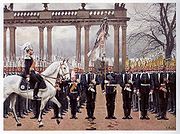
By the end of the 19th century, most Prussian officers could be divided into two groups: those who argued for boldness and self-sacrifice, and those who advocated technology and maneuver in order to minimize casualties. First encountered during the Franco-Prussian War
Franco-Prussian War
The Franco-Prussian War or Franco-German War, often referred to in France as the 1870 War was a conflict between the Second French Empire and the Kingdom of Prussia. Prussia was aided by the North German Confederation, of which it was a member, and the South German states of Baden, Württemberg and...
, new technological military innovations such as the machine gun
Machine gun
A machine gun is a fully automatic mounted or portable firearm, usually designed to fire rounds in quick succession from an ammunition belt or large-capacity magazine, typically at a rate of several hundred rounds per minute....
increased the power of defensive units. For the Prussians, who advocated offensive operations, infantry attacks would risk becoming sacrificial assaults.
With regard to a possible future two-front war, Schlieffen, the Chief of the General Staff from 1891–1906, had suggested a deployment scheme which became known as the Schlieffen Plan
Schlieffen Plan
The Schlieffen Plan was the German General Staff's early 20th century overall strategic plan for victory in a possible future war in which the German Empire might find itself fighting on two fronts: France to the west and Russia to the east...
. Modified by Moltke the Younger
Helmuth von Moltke the Younger
Helmuth Johann Ludwig von Moltke , also known as Moltke the Younger, was a nephew of Field Marshal Count Moltke and served as the Chief of the German General Staff from 1906 to 1914. The two are often differentiated as Moltke the Elder and Moltke the Younger...
, it was nearly successful in quickly defeating France during World War I. On the Western Front
Western Front (World War I)
Following the outbreak of World War I in 1914, the German Army opened the Western Front by first invading Luxembourg and Belgium, then gaining military control of important industrial regions in France. The tide of the advance was dramatically turned with the Battle of the Marne...
, the German advance stalled into trench warfare
Trench warfare
Trench warfare is a form of occupied fighting lines, consisting largely of trenches, in which troops are largely immune to the enemy's small arms fire and are substantially sheltered from artillery...
after the First Battle of the Marne
First Battle of the Marne
The Battle of the Marne was a First World War battle fought between 5 and 12 September 1914. It resulted in an Allied victory against the German Army under Chief of Staff Helmuth von Moltke the Younger. The battle effectively ended the month long German offensive that opened the war and had...
. On the Eastern Front
Eastern Front (World War I)
The Eastern Front was a theatre of war during World War I in Central and, primarily, Eastern Europe. The term is in contrast to the Western Front. Despite the geographical separation, the events in the two theatres strongly influenced each other...
, however, the Prussian operations succeeded in encircling and smashing the Russians at Tannenberg
Battle of Tannenberg (1914)
The Battle of Tannenberg was an engagement between the Russian Empire and the German Empire in the first days of World War I. It was fought by the Russian First and Second Armies against the German Eighth Army between 23 August and 30 August 1914. The battle resulted in the almost complete...
. Unable to break through the French and British lines on the Western Front, the Germans eventually lost the war of attrition.
The Imperial German Army was replaced after World War I with the volunteer Reichswehr
Reichswehr
The Reichswehr formed the military organisation of Germany from 1919 until 1935, when it was renamed the Wehrmacht ....
of the Weimar Republic
Weimar Republic
The Weimar Republic is the name given by historians to the parliamentary republic established in 1919 in Germany to replace the imperial form of government...
. Although the Treaty of Versailles
Treaty of Versailles
The Treaty of Versailles was one of the peace treaties at the end of World War I. It ended the state of war between Germany and the Allied Powers. It was signed on 28 June 1919, exactly five years after the assassination of Archduke Franz Ferdinand. The other Central Powers on the German side of...
attempted to disarm Germany, the Reichswehr discreetly maintained many of the traditions of the Prussian Army. The General Staff
General Staff
A military staff, often referred to as General Staff, Army Staff, Navy Staff or Air Staff within the individual services, is a group of officers and enlisted personnel that provides a bi-directional flow of information between a commanding officer and subordinate military units...
was camouflaged as a non-descript Truppenamt
Truppenamt
The Truppenamt or 'Troop Office' was the cover organisation for the German General Staff from 1919 through until 1933 when the General Staff was re-created. This subterfuge was deemed necessary in order for Germany to be seen to meet the requirements of the Versailles Treaty...
(troops office), while the War Academy was replaced with decentralized divisional schools. Seeckt
Hans von Seeckt
Johannes Friedrich "Hans" von Seeckt was a German military officer noted for his organization of the German Army during the Weimar Republic.-Early life:...
, the head of the Reichswehr
Reichswehr
The Reichswehr formed the military organisation of Germany from 1919 until 1935, when it was renamed the Wehrmacht ....
, designated the new military's battalions as successors of the traditions of Prussian regiments.
During the interwar era, German officers contemplated how to apply maneuver warfare after the experiences of the Great War. Innovations in armor
Panzer
A Panzer is a German language word that, when used as a noun, means "tank". When it is used as an adjective, it means either tank or "armoured" .- Etymology :...
and air
Airpower
Airpower or air power comprises the application of military strategy and strategic theory to the realm of aerial warfare. Airpower is difficult to define and lacks a widely agreed definition as it represents a "complex operating environment that has been subjected to considerable debate".British...
were adopted to the war of movement, resulting in the doctrine of Blitzkrieg
Blitzkrieg
For other uses of the word, see: Blitzkrieg Blitzkrieg is an anglicized word describing all-motorised force concentration of tanks, infantry, artillery, combat engineers and air power, concentrating overwhelming force at high speed to break through enemy lines, and, once the lines are broken,...
.
Characteristics
Since the 17th century, the army of Brandenburg-Prussia was characterized by its initiative, maneuverability, and aggressive command at the operationalOperational warfare
Operational mobility, beginning as a military theory concept during the period of mechanisation of armed forces, became a method of managing movement of forces by strategic commanders from the staging area to their Tactical Area of Responsibility....
level of war. The Hohenzollern state often had fewer resources and manpower than its rivals, and thus the Prussians focused on quickly achieving a decisive victory to avoid a war of attrition. The Prussians practiced what became known as Bewegungskrieg, or war of movement
Maneuver warfare
Maneuver warfare, or manoeuvre warfare , is the term used by military theorists for a concept of warfare that advocates attempting to defeat an adversary by incapacitating their decision-making through shock and disruption brought about by movement...
, in an attempt to strike at the flanks
Flanking maneuver
In military tactics, a flanking maneuver, also called a flank attack, is an attack on the sides of an opposing force. If a flanking maneuver succeeds, the opposing force would be surrounded from two or more directions, which significantly reduces the maneuverability of the outflanked force and its...
or rear of the enemy. The Prussian emphasis on decisive battles instead of wars of attrition led to its being inexperienced in siege warfare, at which the Prussians have been considered incompetent.
The Great Elector
Frederick William, Elector of Brandenburg
|align=right|Frederick William was Elector of Brandenburg and Duke of Prussia – and thus ruler of Brandenburg-Prussia – from 1640 until his death. A member of the House of Hohenzollern, he is popularly known as the "Great Elector" because of his military and political prowess...
practized many of the concepts applied to the Prussian Army in later centuries, including flank attacks at Warsaw
Battle of Warsaw (1656)
The Battle of Warsaw was a battle which took place near Warsaw on , between the armies of the Polish-Lithuanian Commonwealth on the one hand and of Sweden and Brandenburg on the other. It was a major battle in the Second Northern War between Poland and Sweden in the period 1655–1660, also known as...
and, at Fehrbellin
Battle of Fehrbellin
The Battle of Fehrbellin was fought on June 18, 1675 between Swedish and Brandenburg-Prussian troops. The Swedes, under Count Waldemar von Wrangel , had invaded and occupied parts of Brandenburg from their possessions in Pomerania, but were repelled by the forces of Frederick William, the Great...
, the willingness to attack when outnumbered. The elector advocated campaigns that were "short and lively".
During the 1740s, Frederick the Great issued a series of new regulations and documents regarding his army's experiences during the first two Silesian wars and how they would relate to future wars. The doctrines he espoused focused on speed and offense. Lighter and faster cavalry were preferred over heavy cavalry; while hussars were treated as luxury troops by Frederick William I, his son made them an integral part of the army. The artillery was to use light three-pound guns which made up for their lack of power with versatility. After being outmaneuvered by the Austrians in the Second Silesian War, Frederick began emphasizing an overwhelming attack instead of a war of attrition. Rather than frontal attacks, the Prussian king tried to apply the oblique order
Oblique order
The Oblique Order is a military tactic where an attacking army focuses its forces to attack a single enemy flank. The force commander concentrates the majority of his strength on one flank and uses the remainder to fix the enemy line. This allows a commander with weaker or equal forces to...
, by which his army's strongest wing was focused against the enemy's weakest wing or flank, while restraining his own weaker wing. Frederick the Great summed up the Prussian style of war at Leuthen
Battle of Leuthen
In the Battle of Leuthen or Lissa, fought on 5 December 1757, Frederick the Great's Prussian army used maneuver and terrain to decisively defeat a much larger Austrian army under Charles of Lorraine, thus ensuring Prussian control of Silesia during the Seven Years' War.- Background :While Frederick...
, advocating an attack on the enemy "even if he should be on top of the Zobtenberg".
The Prussian emphasis on attack was well-ingrained in its officer corps. Flies unsuccessfully went on the offensive in the Battle of Langensalza, despite being outnumbered by the Hanoverians and having Falckenstein's
Eduard Vogel von Falckenstein
Eduard Ernst Friedrich Hannibal Vogel von Falkenstein was a Prussian General der Infanterie.-Biography:...
troops nearby. Similarly, Kirchbach
Hugo von Kirchbach
Hugo Ewald Graf von Kirchbach was a Prussian general who commanded the Prussian V Corps during the Franco-Prussian War....
was willing to endure excessive casualties at Wörth without waiting for reinforcements. Moltke wanted a quick campaign in Bohemia
Bohemia
Bohemia is a historical region in central Europe, occupying the western two-thirds of the traditional Czech Lands. It is located in the contemporary Czech Republic with its capital in Prague...
against Austria so that Russia or France would not become involved in the Austro-Prussian war. Although Moltke considered Prince Frederick Charles
Prince Frederick Charles of Prussia
Prince Friedrich Carl Nicolaus of Prussia was the son of Prince Charles of Prussia and his wife Princess Marie of Saxe-Weimar-Eisenach . Prince Frederick Charles was a grandson of King Frederick William III of Prussia and a nephew of Frederick William IV and William I...
' march through Bohemia to be too slow, Hans Delbrück
Hans Delbrück
Hans Delbrück was a German historian. Delbrück was one of the first modern military historians, basing his method of research on the critical examination of ancient sources, the use of auxiliary disciplines, like demography and economics, to complete the analysis and the comparison between...
found the "Red Prince's" eventual attack at Königgrätz
Battle of Königgrätz
The Battle of Königgrätz , also known as the Battle of Sadowa, Sadová, or Hradec Králové, was the decisive battle of the Austro-Prussian War, in which the Kingdom of Prussia defeated the Austrian Empire...
to have been in the Prussian tradition, "which, by daring to lose a battle, wins it".
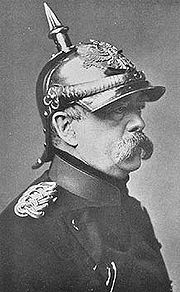
Unification of Germany
The formal unification of Germany into a politically and administratively integrated nation state officially occurred on 18 January 1871 at the Versailles Palace's Hall of Mirrors in France. Princes of the German states gathered there to proclaim Wilhelm of Prussia as Emperor Wilhelm of the German...
, but failed when it was applied by the Wehrmacht Heer to the Soviet Union
Eastern Front (World War II)
The Eastern Front of World War II was a theatre of World War II between the European Axis powers and co-belligerent Finland against the Soviet Union, Poland, and some other Allies which encompassed Northern, Southern and Eastern Europe from 22 June 1941 to 9 May 1945...
and Northern Africa
Afrika Korps
The German Africa Corps , or the Afrika Korps as it was popularly called, was the German expeditionary force in Libya and Tunisia during the North African Campaign of World War II...
. The Prussian and later German systems were weak regarding intelligence
Intelligence
Intelligence has been defined in different ways, including the abilities for abstract thought, understanding, communication, reasoning, learning, planning, emotional intelligence and problem solving....
, counterintelligence, and logistics
Logistics
Logistics is the management of the flow of goods between the point of origin and the point of destination in order to meet the requirements of customers or corporations. Logistics involves the integration of information, transportation, inventory, warehousing, material handling, and packaging, and...
. If the enemy successfully endured the initial operational attacks, the Prussian system had great difficulty in Stellungskrieg, or war of position
Static battle
In a static battle, both sides suffer heavy casualties and battlefronts move so slowly that the result is "static" . Movement is limited by the amount of casualties.Examples from history include:The Battle of Moyry Pass...
.
The Prussian Army is often considered to have used the flexible command of Auftragstaktik (mission tactics), by which subordinate officers led using personal initiative. This developed out of the relationship between the Junker
Junker
A Junker was a member of the landed nobility of Prussia and eastern Germany. These families were mostly part of the German Uradel and carried on the colonization and Christianization of the northeastern European territories during the medieval Ostsiedlung. The abbreviation of Junker is Jkr...
aristocracy, who made up most of the officer corps, and the monarchy. In return for political support from the nobles, the monarchs granted them greater privileges on their estates and greater initiative on the battlefield. According to the theory of Auftragstaktik, the commander would issue a mission to his subordinate officers, who were to pursue the directive as they saw fit. Gneisenau was an early proponent of Auftragstaktik, and Moltke interpreted the theory as "the higher the authority, the shorter and more general" the orders; considerable leeway was granted to subordinates in order to pursue the goal. 19th century historians saw Leuthen
Battle of Leuthen
In the Battle of Leuthen or Lissa, fought on 5 December 1757, Frederick the Great's Prussian army used maneuver and terrain to decisively defeat a much larger Austrian army under Charles of Lorraine, thus ensuring Prussian control of Silesia during the Seven Years' War.- Background :While Frederick...
as one of the best examples of Auftragstaktik and an early example of combined arms
Combined arms
Combined arms is an approach to warfare which seeks to integrate different branches of a military to achieve mutually complementary effects...
.
Often stereotypically associated with the Prussian Army was the Pickelhaube
Pickelhaube
The Pickelhaube , also "Pickelhelm," was a spiked helmet worn in the 19th and 20th centuries by German military, firefighters, and police...
, or spiked helmet, in use in the 19th and early 20th centuries. Victorious battles were celebrated through military marches
March (music)
A march, as a musical genre, is a piece of music with a strong regular rhythm which in origin was expressly written for marching to and most frequently performed by a military band. In mood, marches range from the moving death march in Wagner's Götterdämmerung to the brisk military marches of John...
, such as the "Hohenfriedberger Marsch", allegedly written by Frederick the Great after Hohenfriedberg
Battle of Hohenfriedberg
The Battle of Hohenfriedberg or Hohenfriedeberg, also known as the battle of Striegau, now Dobromierz, was one of the crowning achievements of Frederick the Great...
, and the "Königgrätzer Marsch
Königgrätzer Marsch
The Königgrätzer Marsch is a famous German military march composed by Johann Gottfried Piefke after the Battle of Königgrätz, 1866, the decisive battle of the Austro-Prussian War, in which the Kingdom of Prussia defeated the Austrian Empire.It was one of Adolf Hitler's favorite marches and was...
", by the march composer Piefke
Johann Gottfried Piefke
Johann Gottfried Piefke was a German conductor, Kapellmeister and composer of military music....
. The Prussian Großer Zapfenstreich
Großer Zapfenstreich
The is a military ceremony performed in Germany and Austria. It is similar to the military tattoo ceremony carried out in English-speaking countries, and is the most important ceremonial act executed by the German federal armed forces, the Bundeswehr...
military tattoo is still in use by the modern Bundeswehr
Bundeswehr
The Bundeswehr consists of the unified armed forces of Germany and their civil administration and procurement authorities...
. The Iron Cross
Iron Cross
The Iron Cross is a cross symbol typically in black with a white or silver outline that originated after 1219 when the Kingdom of Jerusalem granted the Teutonic Order the right to combine the Teutonic Black Cross placed above a silver Cross of Jerusalem....
was adopted by the German Empire and its successor states, and is also still used as a symbol of the Bundeswehr.
One man said this about the Prussian army, "Whereas some states possess an army, the Prussian army possess a state."
See also
- Prussian NavyPrussian NavyThroughout the centuries, Prussia’s military consistently concentrated on its land power, and never sought a similar power at sea. Yet historically there were always Prussian naval forces , beginning in the days when "Prussia" meant only the Margraviate of Brandenburg.- The Navy of Electoral...
- German General StaffGerman General StaffThe German General Staff was an institution whose rise and development gave the German armed forces a decided advantage over its adversaries. The Staff amounted to its best "weapon" for nearly a century and a half....
- Prussian virtuesPrussian virtuesThe term Prussian virtues refers to an unfixed canon of several Lutheran virtues dating from the Enlightenment. Prussian virtues and the Prussian value system have influenced aspects of wider German culture.- Historical Development :...