

Proto-Indo-Europeans

Encyclopedia
The Proto-Indo-Europeans were the speakers of the Proto-Indo-European language
(PIE), a reconstructed
prehistoric
language of Eurasia
.
Knowledge of them comes chiefly from the linguistic reconstruction, along with material evidence from archaeology
and archaeogenetics
. Linguistic reconstruction is fraught with significant uncertainties and room for speculation, and PIE speakers cannot be assumed to have been a single, identifiable people or tribe. Rather, they were a group of loosely related populations ancestral to the later, still partially prehistoric, Bronze Age
Indo-Europeans.
The Proto-Indo-Europeans in this sense likely lived during the Copper Age
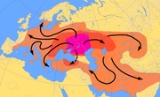
, or roughly the 5th to 4th millennia BC. Mainstream scholarship places them in the general region of the Pontic-Caspian steppe
in Eastern Europe
and Central Asia
. Some scholars would extend the time depth of PIE or Pre-PIE to the Neolithic
or even the last glacial maximum
, and suggest alternative location hypotheses
.
By the late-3rd millennium BC offshoots of the Proto-Indo-Europeans had reached Anatolia
, the Aegean
, Western Europe
, and the Iranian plateau; they reached northern India later.
The Proto-Indo-Europeans were a patrilineal society, probably half-nomadic, relying on animal husbandry
, notably of cattle
and sheep. They domesticated the horse
– (cf. Latin equus). The cow () played a central role, in religion and mythology as well as in daily life. A man's wealth would have been measured by the number of his animals (small livestock), (cf. English fee, Latin pecunia).
They practiced a polytheistic religion
centered on sacrificial
rites, probably administered by a priestly caste
. Burial
s in barrow
s or tomb
chambers apply to the kurgan culture
, in accordance with the original version of the Kurgan hypothesis
, but not to the previous Sredny Stog culture
nor to the contemporary Corded Ware culture
, both of which cultures are also generally associated with PIE. Important leaders would have been buried with their belongings in kurgans, and possibly also with members of their households or wives (human sacrifice
, suttee
).
Many Indo-European societies know a threefold division of priests, a warrior
class, and a class of peasant
s or husbandmen. Such a division was suggested for the Proto-Indo-European society by Georges Dumézil
.
If there was a separate class of warriors, it probably consisted of single young men. They would have followed a separate warrior code unacceptable in the society outside their peer-group. Traces of initiation rites in several Indo-European societies suggest that this group identified itself with wolves or dog
s (see also Berserker
, werewolf
).
As for technology, reconstruction suggests a culture of the early Bronze Age
, with bronze
tools and weapons. Silver
and gold
were known. Sheep were kept for wool, and textiles were woven
. The wheel
was known, certainly for ox
-drawn carts, and late Proto-Indo European warfare may also have made use of horse-drawn chariot
s.
The native name of this people cannot be reconstructed with certainty. Aryo- (interpreted by some as meaning those who plow), sometimes upheld as a self-identification of the Proto-Indo-Europeans (see Aryan
), is attested as an ethnic designation only in the Indo-Iranian
subfamily, since it appears on written inscriptions; however, the earlier Proto-Indo-Europeans had themselves never adopted writing
because writing had not yet been invented, so there is no way to ever verify that Aryo- was their self-identification.
The scholars of the 19th century who first tackled the question of the Indo-Europeans' original homeland (also called Urheimat
, from German
), were essentially confined to linguistic evidence. A rough localization was attempted by reconstructing the names of plants and animals (importantly the beech
and the salmon
) as well as the culture and technology (a Bronze Age culture centered on animal husbandry and having domesticated the horse
). The scholarly opinions became basically divided between a European hypothesis, positing migration from Europe to Asia, and an Asian hypothesis, holding that the migration took place in the opposite direction.
In early 20th century scientific racism
, the question was associated with the expansion of a supposed "Aryan race
". The question is still contentious within some flavours of ethnic nationalism
(see also Indigenous Aryans
).
The Kurgan hypothesis
is currently the most widely held theory, is based on linguistic, archaeological, and genetic evidence, but is not universally accepted. It suggests PIE origin in the Pontic-Caspian steppe
during the Chalcolithic. A minority of scholars prefers the Anatolian hypothesis
, suggesting origin in Anatolia
during the Neolithic. Other theories (Armenian hypothesis
, Out of India theory
, Paleolithic Continuity Theory
) have only marginal scientific support, if any. .
 In the 20th century, Marija Gimbutas
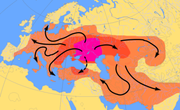
created the Kurgan hypothesis
, a modern variation of the traditional invasion theory. The name is taken from the kurgan
s (burial mounds) of the Eurasian steppes. The hypothesis is that the Indo-Europeans were a nomad
ic tribe of the Pontic-Caspian steppe
(now Eastern Ukraine
and Southern Russia
) and expanded in several waves during the 3rd millennium BC. Their expansion coincided with the taming of the horse
. Leaving archaeological signs of their presence (see battle-axe people), they subjugated the peaceful European Neolithic farmers of Gimbutas' Old Europe. As Gimbutas' beliefs evolved, she put increasing emphasis on the patriarchal
, patrilinear nature of the invading culture, sharply contrasting it with the supposedly egalitarian, if not matrilinear culture of the invaded, to a point of formulating essentially feminist archaeology.
Her theory has found genetic support in remains from the Neolithic culture of Scandinavia, where bone remains in Neolithic graves indicated that the megalith
culture was either matrilocal or matrilineal as the people buried in the same grave were related through the women. Likewise there is evidence of remaining matrilineal traditions among the Picts
. A modified form of this theory by JP Mallory
, dating the migrations earlier to around 4000 BC and putting less insistence on their violent or quasi-military nature, is still widely held.
The Anatolian hypothesis
is that the Indo-European languages spread peacefully into Europe from Asia Minor
from around 7000 BC with the advance of farming
(wave of advance). The leading propagator of the theory is Colin Renfrew. However, this theory is contradicted by the fact that ancient Anatolia is known to have been inhabited by non-Indo-European people, namely the Hattians
, Khalib/Karub, and Khaldi/Kardi. Also, the culture of the Indo-Europeans as inferred by linguistic reconstruction contradicts this theory, since the early Neolithic cultures in Anatolia had neither the horse, nor the wheel, nor metal, terms for all of which are securely reconstructed for Proto-Indo-European.
A scenario that could reconcile Renfrew's and the Kurgan hypotheses suggests that Indo-European migrations are somehow related to the disputed Black Sea deluge theory
, the hypothesized submersion of the northeastern part of the Black Sea around 5600 BC: while a splinter group who became the proto-
Hittite speakers moved into northeastern Anatolia around 7000 BC, the remaining population would have gone northward, evolving into the Kurgan culture, while others may have escaped far to the northeast (Tocharian
s) and the southeast (Indo-Iranians
). While the time-frame of this scenario is consistent with Renfrew, it is incompatible with his core assumption that Indo-European spread with the advance of agriculture.
Using stochastic models
of word evolution to study the presence or absence of different words across Indo-European languages, Gray & Atkinson suggest that the origin of Indo-European goes back about 8500 years, the first split being that of Hittite
from the rest, supporting the Indo-Hittite
hypothesis. They go to great lengths to avoid the problems associated with traditional glottochronology
, and they carry out various sensitivity tests of their assumptions. However, their calculations rely entirely on Swadesh list
s, and while the results are quite robust for well attested branches, their crucial calculation of the age of Hittite rests on a 200–word Swadesh list of one single language. A more recent paper (Atkinson et al., 2005) analyzing 24 mostly ancient languages, including three Anatolian languages
, produced the same time estimates and early Anatolian split. These claims are still controversial, however, and most traditional linguists consider these methods too inaccurate to prove the Anatolian hypothesis.
Another hypothesis connected with the Black Sea deluge theory suggests that PIE originated as the language of trade between early Neolithic Black Sea tribes. Under this hypothesis, University of Pennsylvania
archaeologist Fredrik T. Hiebert proposes that the transition from PIE to IE dispersion occurred during the deluge.
The Armenian hypothesis
is based on the Glottalic theory
and suggests that the Proto-Indo-European language was spoken during the 4th millennium BC
in the Armenian Highland
. It is an Indo-Hittite
model and does not include the Anatolian languages
in its scenario. The phonological peculiarities of PIE proposed in the Glottalic theory would be best preserved in the Armenian language
and the Germanic languages
, the former assuming the role of the dialect which remained in situ, implied to be particularly archaic in spite of its late attestation. Proto-Greek would be practically equivalent to Mycenean Greek and date to the 17th century BC, closely associating Greek migration to Greece with the Indo-Aryan migration
to India at about the same time (viz., Indo-European expansion at the transition to the Late Bronze Age, including the possibility of Indo-European Kassites
).
The Armenian hypothesis argues for the latest possible date of Proto-Indo-European (sans Anatolian), a full millennium later than the mainstream Kurgan hypothesis
. In this, it figures as an opposite to the Anatolian hypothesis
, in spite of the geographical proximity of the respective Urheimaten suggested, diverging from the timeframe suggested there by a full three millennia.
R1a1a (R-M17 or R-M198) is the most commonly associated with Indo-European speakers. Most discussions purportedly of R1a
origins are actually about the origins of the dominant R1a1a (R-M17 or R-M198) subclade. Data so far collected indicates that there are two widely separated areas of high frequency, one in South Asia
, around North India
, and the other in Eastern Europe
, around Poland
and Ukraine
. The historical and prehistoric possible reasons for this are the subject of on-going discussion and attention amongst population geneticists and genetic genealogists, and are considered to be of potential interest to linguists and archaeologists also. In 2009, several large studies of both old and new STR
data concluded that while these two separate "poles of the expansion" are of similar age, South Asian R1a1a is apparently older than Eastern European R1a1a, suggesting that South Asia is the more likely locus of origin.
Out of 10 human male remains assigned to the Andronovo horizon from the Krasnoyarsk region, 9 possessed the R1a
Y-chromosome haplogroup
and one C
haplogroup (xC3). mtDNA haplogroups of nine individuals assigned to the same Andronovo horizon and region were as follows: U4 (2 individuals), U2e, U5a1, Z, T1, T4, H, and K2b.
90% of the Bronze Age period mtDNA haplogroups were of west Eurasian origin and the study determined that at least 60% of the individuals overall (out of the 26 Bronze and Iron Age human remains' samples of the study that could be tested) had light hair and blue or green eyes.
A 2004 study also established that during the Bronze Age/Iron Age period, the majority of the population of Kazakhstan
(part of the Andronovo culture during Bronze Age), was of west Eurasian origin (with mtDNA haplogroups such as U, H, HV, T, I and W), and that prior to the 13th-7th century BCE, all Kazakh samples belonged to European lineages.
Luigi Luca Cavalli-Sforza
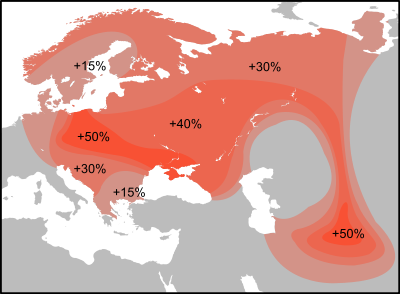
and Alberto Piazza argue that Renfrew and Gimbutas reinforce rather than contradict each other. states that "It is clear that, genetically speaking, peoples of the Kurgan steppe descended at least in part from people of the Middle Eastern Neolithic who immigrated there from Turkey." Piazza & Cavalli-Sforza (2006) state that:
 Spencer Wells
suggests in a (2001) study that the origin, distribution and age of the R1a1 haplotype
points to an ancient migration, possibly corresponding to the spread by the Kurgan
people in their expansion across the Eurasian steppe
around 3000 BC. About his old teacher Cavalli-Sforza's proposal, states that "there is nothing to contradict this model, although the genetic patterns do not provide clear support either", and instead argues that the evidence is much stronger for Gimbutas' model:
Y-chromosome DNA haplogroup R1a1, thought to have originated in the Eurasian Steppes north of the Black and Caspian Seas, is associated with the Kurgan culture, or the "Indus Valley" the Indo-European languages, as well as with the postglacial Ahrensburg culture
which has been suggested to have spread the haplogroup originally. Alternatively, it has been suggested that R1a arrived in southern Scandinavia during the time of the Corded Ware culture
. The mutations that characterize haplogroup R1a occurred ~10,000 years bp. Its defining mutation (M17) occurred about 10,000 to 14,000 years ago. Ornella Semino et al. propose a postglacial spread of the R1a1 haplogroup from north of the Black Sea during the time of the Late Glacial Maximum, subsequently magnified by the expansion of the Kurgan culture into Europe and eastward.
Proto-Indo-European language
The Proto-Indo-European language is the reconstructed common ancestor of the Indo-European languages, spoken by the Proto-Indo-Europeans...
(PIE), a reconstructed
Linguistic reconstruction
Linguistic reconstruction is the practice of establishing the features of the unattested ancestor of one or more given languages. There are two kinds of reconstruction. Internal reconstruction uses irregularities in a single language to make inferences about an earlier stage of that language...
prehistoric
Prehistory
Prehistory is the span of time before recorded history. Prehistory can refer to the period of human existence before the availability of those written records with which recorded history begins. More broadly, it refers to all the time preceding human existence and the invention of writing...
language of Eurasia
Eurasia
Eurasia is a continent or supercontinent comprising the traditional continents of Europe and Asia ; covering about 52,990,000 km2 or about 10.6% of the Earth's surface located primarily in the eastern and northern hemispheres...
.
Knowledge of them comes chiefly from the linguistic reconstruction, along with material evidence from archaeology
Archaeology
Archaeology, or archeology , is the study of human society, primarily through the recovery and analysis of the material culture and environmental data that they have left behind, which includes artifacts, architecture, biofacts and cultural landscapes...
and archaeogenetics
Archaeogenetics
Archaeogenetics, a term coined by Colin Renfrew, refers to the application of the techniques of molecular population genetics to the study of the human past. This can involve:*the analysis of DNA recovered from archaeological remains, i.e...
. Linguistic reconstruction is fraught with significant uncertainties and room for speculation, and PIE speakers cannot be assumed to have been a single, identifiable people or tribe. Rather, they were a group of loosely related populations ancestral to the later, still partially prehistoric, Bronze Age
Bronze Age
The Bronze Age is a period characterized by the use of copper and its alloy bronze as the chief hard materials in the manufacture of some implements and weapons. Chronologically, it stands between the Stone Age and Iron Age...
Indo-Europeans.
The Proto-Indo-Europeans in this sense likely lived during the Copper Age
Copper Age
The Chalcolithic |stone]]") period or Copper Age, also known as the Eneolithic/Æneolithic , is a phase of the Bronze Age in which the addition of tin to copper to form bronze during smelting remained yet unknown by the metallurgists of the times...
, or roughly the 5th to 4th millennia BC. Mainstream scholarship places them in the general region of the Pontic-Caspian steppe
Pontic-Caspian steppe
The Pontic-Caspian steppe is the vast steppeland stretching from the north of the Black Sea as far as the east of the Caspian Sea, from western Ukraine across the Southern Federal District and the Volga Federal District of Russia to western Kazakhstan,...
in Eastern Europe
Eastern Europe
Eastern Europe is the eastern part of Europe. The term has widely disparate geopolitical, geographical, cultural and socioeconomic readings, which makes it highly context-dependent and even volatile, and there are "almost as many definitions of Eastern Europe as there are scholars of the region"...
and Central Asia
Central Asia
Central Asia is a core region of the Asian continent from the Caspian Sea in the west, China in the east, Afghanistan in the south, and Russia in the north...
. Some scholars would extend the time depth of PIE or Pre-PIE to the Neolithic
Neolithic
The Neolithic Age, Era, or Period, or New Stone Age, was a period in the development of human technology, beginning about 9500 BC in some parts of the Middle East, and later in other parts of the world. It is traditionally considered as the last part of the Stone Age...
or even the last glacial maximum
Last Glacial Maximum
The Last Glacial Maximum refers to a period in the Earth's climate history when ice sheets were at their maximum extension, between 26,500 and 19,000–20,000 years ago, marking the peak of the last glacial period. During this time, vast ice sheets covered much of North America, northern Europe and...
, and suggest alternative location hypotheses
Proto-Indo-European Urheimat hypotheses
The Proto-Indo-European Urheimat hypotheses are designed to explain the origins of the Proto-Indo-European language and the people. The identity of the Proto-Indo-Europeans has been a recurring topic in Indo-European studies since the 19th century. Many hypotheses for an Urheimat have been...
.
By the late-3rd millennium BC offshoots of the Proto-Indo-Europeans had reached Anatolia
Hittites
The Hittites were a Bronze Age people of Anatolia.They established a kingdom centered at Hattusa in north-central Anatolia c. the 18th century BC. The Hittite empire reached its height c...
, the Aegean
Mycenaean Greece
Mycenaean Greece was a cultural period of Bronze Age Greece taking its name from the archaeological site of Mycenae in northeastern Argolis, in the Peloponnese of southern Greece. Athens, Pylos, Thebes, and Tiryns are also important Mycenaean sites...
, Western Europe
Urnfield culture
The Urnfield culture was a late Bronze Age culture of central Europe. The name comes from the custom of cremating the dead and placing their ashes in urns which were then buried in fields...
, and the Iranian plateau; they reached northern India later.
Culture
The following traits of the Proto-Indo-Europeans and their environment are widely agreed-upon but still hypothetical due to their reconstructed nature. Some of the basic facts are:- stockbreeding and animal husbandryPastoralismPastoralism or pastoral farming is the branch of agriculture concerned with the raising of livestock. It is animal husbandry: the care, tending and use of animals such as camels, goats, cattle, yaks, llamas, and sheep. It may have a mobile aspect, moving the herds in search of fresh pasture and...
, including domesticated cattle, horses, and dogs - agriculture and cereal cultivation, including technology commonly ascribed to early farming communities
- a climate with winter snow
- transportation by or across water
- the solid wheelWheelA wheel is a device that allows heavy objects to be moved easily through rotating on an axle through its center, facilitating movement or transportation while supporting a load, or performing labor in machines. Common examples found in transport applications. A wheel, together with an axle,...
, used for cartCartA cart is a vehicle designed for transport, using two wheels and normally pulled by one or a pair of draught animals. A handcart is pulled or pushed by one or more people...
s, but not yet chariotChariotThe chariot is a type of horse carriage used in both peace and war as the chief vehicle of many ancient peoples. Ox carts, proto-chariots, were built by the Proto-Indo-Europeans and also built in Mesopotamia as early as 3000 BC. The original horse chariot was a fast, light, open, two wheeled...
s with spokeSpokeA spoke is one of some number of rods radiating from the center of a wheel , connecting the hub with the round traction surface....
d wheels - worship of a sky god, *dyeusDyeus*Dyēus is the reconstructed chief deity of the Proto-Indo-European pantheon. He was the god of the daylight sky, and his position may have mirrored the position of the patriarch or monarch in society....
ph2tēr (lit. "sky father"; > Ancient GreekAncient GreekAncient Greek is the stage of the Greek language in the periods spanning the times c. 9th–6th centuries BC, , c. 5th–4th centuries BC , and the c. 3rd century BC – 6th century AD of ancient Greece and the ancient world; being predated in the 2nd millennium BC by Mycenaean Greek...
Ζευς (πατηρ) / Zeus (patēr); *dieu-ph2tēr > LatinLatinLatin is an Italic language originally spoken in Latium and Ancient Rome. It, along with most European languages, is a descendant of the ancient Proto-Indo-European language. Although it is considered a dead language, a number of scholars and members of the Christian clergy speak it fluently, and...
Jupiter; Illyrian Deipaturos) - oral heroic poetry or song lyrics that used stock phrases such as imperishable fame
- a patrilineal kinship system based on relationships between men
The Proto-Indo-Europeans were a patrilineal society, probably half-nomadic, relying on animal husbandry
Animal husbandry
Animal husbandry is the agricultural practice of breeding and raising livestock.- History :Animal husbandry has been practiced for thousands of years, since the first domestication of animals....
, notably of cattle
Cattle
Cattle are the most common type of large domesticated ungulates. They are a prominent modern member of the subfamily Bovinae, are the most widespread species of the genus Bos, and are most commonly classified collectively as Bos primigenius...
and sheep. They domesticated the horse
Horse
The horse is one of two extant subspecies of Equus ferus, or the wild horse. It is a single-hooved mammal belonging to the taxonomic family Equidae. The horse has evolved over the past 45 to 55 million years from a small multi-toed creature into the large, single-toed animal of today...
– (cf. Latin equus). The cow () played a central role, in religion and mythology as well as in daily life. A man's wealth would have been measured by the number of his animals (small livestock), (cf. English fee, Latin pecunia).
They practiced a polytheistic religion
Religion
Religion is a collection of cultural systems, belief systems, and worldviews that establishes symbols that relate humanity to spirituality and, sometimes, to moral values. Many religions have narratives, symbols, traditions and sacred histories that are intended to give meaning to life or to...
centered on sacrificial
Sacrifice
Sacrifice is the offering of food, objects or the lives of animals or people to God or the gods as an act of propitiation or worship.While sacrifice often implies ritual killing, the term offering can be used for bloodless sacrifices of cereal food or artifacts...
rites, probably administered by a priestly caste
Priestly caste
The priestly caste is a social group responsible for officiating over sacrifices and leading prayers or other religious functions, particularly in nomadic and tribal societies....
. Burial
Burial
Burial is the act of placing a person or object into the ground. This is accomplished by excavating a pit or trench, placing an object in it, and covering it over.-History:...
s in barrow
Tumulus
A tumulus is a mound of earth and stones raised over a grave or graves. Tumuli are also known as barrows, burial mounds, Hügelgrab or kurgans, and can be found throughout much of the world. A tumulus composed largely or entirely of stones is usually referred to as a cairn...
s or tomb
Tomb
A tomb is a repository for the remains of the dead. It is generally any structurally enclosed interment space or burial chamber, of varying sizes...
chambers apply to the kurgan culture
Yamna culture
The Yamna culture is a late copper age/early Bronze Age culture of the Southern Bug/Dniester/Ural region , dating to the 36th–23rd centuries BC...
, in accordance with the original version of the Kurgan hypothesis
Kurgan hypothesis
The Kurgan hypothesis is one of the proposals about early Indo-European origins, which postulates that the people of an archaeological "Kurgan culture" in the Pontic steppe were the most likely speakers of the Proto-Indo-European language...
, but not to the previous Sredny Stog culture
Sredny Stog culture
The Sredny Stog culture dates from the 4500-3500 BC. It was situated just north of the Sea of Azov between the Dnieper and the Don...
nor to the contemporary Corded Ware culture
Corded Ware culture
The Corded Ware culture , alternatively characterized as the Battle Axe culture or Single Grave culture, is an enormous European archaeological horizon that begins in the late Neolithic , flourishes through the Copper Age and culminates in the early Bronze Age.Corded Ware culture is associated with...
, both of which cultures are also generally associated with PIE. Important leaders would have been buried with their belongings in kurgans, and possibly also with members of their households or wives (human sacrifice
Human sacrifice
Human sacrifice is the act of killing one or more human beings as part of a religious ritual . Its typology closely parallels the various practices of ritual slaughter of animals and of religious sacrifice in general. Human sacrifice has been practised in various cultures throughout history...
, suttee
Sati (practice)
For other uses, see Sati .Satī was a religious funeral practice among some Indian communities in which a recently widowed woman either voluntarily or by use of force and coercion would have immolated herself on her husband’s funeral pyre...
).
Many Indo-European societies know a threefold division of priests, a warrior
Warrior
A warrior is a person skilled in combat or warfare, especially within the context of a tribal or clan-based society that recognizes a separate warrior class.-Warrior classes in tribal culture:...
class, and a class of peasant
Peasant
A peasant is an agricultural worker who generally tend to be poor and homeless-Etymology:The word is derived from 15th century French païsant meaning one from the pays, or countryside, ultimately from the Latin pagus, or outlying administrative district.- Position in society :Peasants typically...
s or husbandmen. Such a division was suggested for the Proto-Indo-European society by Georges Dumézil
Georges Dumézil
Georges Dumézil was a French comparative philologist best known for his analysis of sovereignty and power in Proto-Indo-European religion and society...
.
If there was a separate class of warriors, it probably consisted of single young men. They would have followed a separate warrior code unacceptable in the society outside their peer-group. Traces of initiation rites in several Indo-European societies suggest that this group identified itself with wolves or dog
Dog
The domestic dog is a domesticated form of the gray wolf, a member of the Canidae family of the order Carnivora. The term is used for both feral and pet varieties. The dog may have been the first animal to be domesticated, and has been the most widely kept working, hunting, and companion animal in...
s (see also Berserker
Berserker
Berserkers were Norse warriors who are reported in the Old Norse literature to have fought in a nearly uncontrollable, trance-like fury, a characteristic which later gave rise to the English word berserk. Berserkers are attested in numerous Old Norse sources...
, werewolf
Werewolf
A werewolf, also known as a lycanthrope , is a mythological or folkloric human with the ability to shapeshift into a wolf or an anthropomorphic wolf-like creature, either purposely or after being placed under a curse...
).
As for technology, reconstruction suggests a culture of the early Bronze Age
Bronze Age
The Bronze Age is a period characterized by the use of copper and its alloy bronze as the chief hard materials in the manufacture of some implements and weapons. Chronologically, it stands between the Stone Age and Iron Age...
, with bronze
Bronze
Bronze is a metal alloy consisting primarily of copper, usually with tin as the main additive. It is hard and brittle, and it was particularly significant in antiquity, so much so that the Bronze Age was named after the metal...
tools and weapons. Silver
Silver
Silver is a metallic chemical element with the chemical symbol Ag and atomic number 47. A soft, white, lustrous transition metal, it has the highest electrical conductivity of any element and the highest thermal conductivity of any metal...
and gold
Gold
Gold is a chemical element with the symbol Au and an atomic number of 79. Gold is a dense, soft, shiny, malleable and ductile metal. Pure gold has a bright yellow color and luster traditionally considered attractive, which it maintains without oxidizing in air or water. Chemically, gold is a...
were known. Sheep were kept for wool, and textiles were woven
Weaving
Weaving is a method of fabric production in which two distinct sets of yarns or threads are interlaced at right angles to form a fabric or cloth. The other methods are knitting, lace making and felting. The longitudinal threads are called the warp and the lateral threads are the weft or filling...
. The wheel
Wheel
A wheel is a device that allows heavy objects to be moved easily through rotating on an axle through its center, facilitating movement or transportation while supporting a load, or performing labor in machines. Common examples found in transport applications. A wheel, together with an axle,...
was known, certainly for ox
Ox
An ox , also known as a bullock in Australia, New Zealand and India, is a bovine trained as a draft animal. Oxen are commonly castrated adult male cattle; castration makes the animals more tractable...
-drawn carts, and late Proto-Indo European warfare may also have made use of horse-drawn chariot
Chariot
The chariot is a type of horse carriage used in both peace and war as the chief vehicle of many ancient peoples. Ox carts, proto-chariots, were built by the Proto-Indo-Europeans and also built in Mesopotamia as early as 3000 BC. The original horse chariot was a fast, light, open, two wheeled...
s.
The native name of this people cannot be reconstructed with certainty. Aryo- (interpreted by some as meaning those who plow), sometimes upheld as a self-identification of the Proto-Indo-Europeans (see Aryan
Aryan
Aryan is an English language loanword derived from Sanskrit ārya and denoting variously*In scholarly usage:**Indo-Iranian languages *in dated usage:**the Indo-European languages more generally and their speakers...
), is attested as an ethnic designation only in the Indo-Iranian
Indo-Iranian languages
The Indo-Iranian language group constitutes the easternmost extant branch of the Indo-European family of languages. It consists of three language groups: the Indo-Aryan, Iranian and Nuristani...
subfamily, since it appears on written inscriptions; however, the earlier Proto-Indo-Europeans had themselves never adopted writing
Writing
Writing is the representation of language in a textual medium through the use of a set of signs or symbols . It is distinguished from illustration, such as cave drawing and painting, and non-symbolic preservation of language via non-textual media, such as magnetic tape audio.Writing most likely...
because writing had not yet been invented, so there is no way to ever verify that Aryo- was their self-identification.
History of research
There have been many attempts to claim that particular prehistoric cultures can be identified with the Proto-Indo-European-speaking peoples, but all have been speculative. All attempts to identify an actual people with an unattested language depend on a sound reconstruction of that language that allows identification of cultural concepts and environmental factors which may be associated with particular cultures (such as the use of metals, agriculture vs. pastoralism, geographically distinctive plants and animals, etc.).The scholars of the 19th century who first tackled the question of the Indo-Europeans' original homeland (also called Urheimat
Urheimat
Urheimat is a linguistic term denoting the original homeland of the speakers of a proto-language...
, from German
German language
German is a West Germanic language, related to and classified alongside English and Dutch. With an estimated 90 – 98 million native speakers, German is one of the world's major languages and is the most widely-spoken first language in the European Union....
), were essentially confined to linguistic evidence. A rough localization was attempted by reconstructing the names of plants and animals (importantly the beech
Beech
Beech is a genus of ten species of deciduous trees in the family Fagaceae, native to temperate Europe, Asia and North America.-Habit:...
and the salmon
Salmon
Salmon is the common name for several species of fish in the family Salmonidae. Several other fish in the same family are called trout; the difference is often said to be that salmon migrate and trout are resident, but this distinction does not strictly hold true...
) as well as the culture and technology (a Bronze Age culture centered on animal husbandry and having domesticated the horse
Domestication of the horse
There are a number of hypotheses on many of the key issues regarding the domestication of the horse. Although horses appeared in Paleolithic cave art as early as 30,000 BCE, these were truly wild horses and were probably hunted for meat. How and when horses became domesticated is disputed...
). The scholarly opinions became basically divided between a European hypothesis, positing migration from Europe to Asia, and an Asian hypothesis, holding that the migration took place in the opposite direction.
In early 20th century scientific racism
Scientific racism
Scientific racism is the use of scientific techniques and hypotheses to sanction the belief in racial superiority or racism.This is not the same as using scientific findings and the scientific method to investigate differences among the humans and argue that there are races...
, the question was associated with the expansion of a supposed "Aryan race
Aryan race
The Aryan race is a concept historically influential in Western culture in the period of the late 19th century and early 20th century. It derives from the idea that the original speakers of the Indo-European languages and their descendants up to the present day constitute a distinctive race or...
". The question is still contentious within some flavours of ethnic nationalism
Ethnic nationalism
Ethnic nationalism is a form of nationalism wherein the "nation" is defined in terms of ethnicity. Whatever specific ethnicity is involved, ethnic nationalism always includes some element of descent from previous generations and the implied claim of ethnic essentialism, i.e...
(see also Indigenous Aryans
Indigenous Aryans
The notion of Indigenous Aryans posits that speakers of Indo-Aryan languages are "indigenous" to the Indian subcontinent.The "Indigenous Aryans" position may entail an Indian origin of Indo-European languages, and in recent years, the concept has been increasingly conflated with an "Out of India"...
).
The Kurgan hypothesis
Kurgan hypothesis
The Kurgan hypothesis is one of the proposals about early Indo-European origins, which postulates that the people of an archaeological "Kurgan culture" in the Pontic steppe were the most likely speakers of the Proto-Indo-European language...
is currently the most widely held theory, is based on linguistic, archaeological, and genetic evidence, but is not universally accepted. It suggests PIE origin in the Pontic-Caspian steppe
Pontic-Caspian steppe
The Pontic-Caspian steppe is the vast steppeland stretching from the north of the Black Sea as far as the east of the Caspian Sea, from western Ukraine across the Southern Federal District and the Volga Federal District of Russia to western Kazakhstan,...
during the Chalcolithic. A minority of scholars prefers the Anatolian hypothesis
Anatolian hypothesis
The Anatolian hypothesis is also called Renfrew's Neolithic Discontinuity Theory ; it proposes that the dispersal of Proto-Indo-Europeans originated in Neolithic Anatolia...
, suggesting origin in Anatolia
Anatolia
Anatolia is a geographic and historical term denoting the westernmost protrusion of Asia, comprising the majority of the Republic of Turkey...
during the Neolithic. Other theories (Armenian hypothesis
Armenian hypothesis
The Armenian hypothesis of the Proto-Indo-European Urheimat, based on the Glottalic theory suggests that the Proto-Indo-European language was spoken during the 4th millennium BC in the Armenian Highland or Aryan Highland. It is an Indo-Hittite model and does not include the Anatolian languages in...
, Out of India theory
Out of India theory
The Out of India theory is the proposition that the Indo-European language family originated in the Indian subcontinent and spread to the remainder of the Indo-European region through a series of migrations...
, Paleolithic Continuity Theory
Paleolithic Continuity Theory
The Paleolithic Continuity Theory , since 2010 relabelled as the Paleolithic Continuity Paradigm , is a hypothesis suggesting that the Proto-Indo-European language can be traced back to the Upper Paleolithic, several millennia earlier than the Chalcolithic or at the most Neolithic estimates in other...
) have only marginal scientific support, if any. .
Urheimat hypotheses
Marija Gimbutas
Marija Gimbutas , was a Lithuanian-American archeologist known for her research into the Neolithic and Bronze Age cultures of "Old Europe", a term she introduced. Her works published between 1946 and 1971 introduced new views by combining traditional spadework with linguistics and mythological...
created the Kurgan hypothesis
Kurgan hypothesis
The Kurgan hypothesis is one of the proposals about early Indo-European origins, which postulates that the people of an archaeological "Kurgan culture" in the Pontic steppe were the most likely speakers of the Proto-Indo-European language...
, a modern variation of the traditional invasion theory. The name is taken from the kurgan
Kurgan
Kurgan is the Turkic term for a tumulus; mound of earth and stones raised over a grave or graves, originating with its use in Soviet archaeology, now widely used for tumuli in the context of Eastern European and Central Asian archaeology....
s (burial mounds) of the Eurasian steppes. The hypothesis is that the Indo-Europeans were a nomad
Nomad
Nomadic people , commonly known as itinerants in modern-day contexts, are communities of people who move from one place to another, rather than settling permanently in one location. There are an estimated 30-40 million nomads in the world. Many cultures have traditionally been nomadic, but...
ic tribe of the Pontic-Caspian steppe
Pontic-Caspian steppe
The Pontic-Caspian steppe is the vast steppeland stretching from the north of the Black Sea as far as the east of the Caspian Sea, from western Ukraine across the Southern Federal District and the Volga Federal District of Russia to western Kazakhstan,...
(now Eastern Ukraine
Ukraine
Ukraine is a country in Eastern Europe. It has an area of 603,628 km², making it the second largest contiguous country on the European continent, after Russia...
and Southern Russia
Russia
Russia or , officially known as both Russia and the Russian Federation , is a country in northern Eurasia. It is a federal semi-presidential republic, comprising 83 federal subjects...
) and expanded in several waves during the 3rd millennium BC. Their expansion coincided with the taming of the horse
Horse
The horse is one of two extant subspecies of Equus ferus, or the wild horse. It is a single-hooved mammal belonging to the taxonomic family Equidae. The horse has evolved over the past 45 to 55 million years from a small multi-toed creature into the large, single-toed animal of today...
. Leaving archaeological signs of their presence (see battle-axe people), they subjugated the peaceful European Neolithic farmers of Gimbutas' Old Europe. As Gimbutas' beliefs evolved, she put increasing emphasis on the patriarchal
Patriarchy
Patriarchy is a social system in which the role of the male as the primary authority figure is central to social organization, and where fathers hold authority over women, children, and property. It implies the institutions of male rule and privilege, and entails female subordination...
, patrilinear nature of the invading culture, sharply contrasting it with the supposedly egalitarian, if not matrilinear culture of the invaded, to a point of formulating essentially feminist archaeology.
Her theory has found genetic support in remains from the Neolithic culture of Scandinavia, where bone remains in Neolithic graves indicated that the megalith
Megalith
A megalith is a large stone that has been used to construct a structure or monument, either alone or together with other stones. Megalithic describes structures made of such large stones, utilizing an interlocking system without the use of mortar or cement.The word 'megalith' comes from the Ancient...
culture was either matrilocal or matrilineal as the people buried in the same grave were related through the women. Likewise there is evidence of remaining matrilineal traditions among the Picts
Picts
The Picts were a group of Late Iron Age and Early Mediaeval people living in what is now eastern and northern Scotland. There is an association with the distribution of brochs, place names beginning 'Pit-', for instance Pitlochry, and Pictish stones. They are recorded from before the Roman conquest...
. A modified form of this theory by JP Mallory
JP Mallory
James Patrick Mallory is an Irish-American archaeologist and Indo-Europeanist. Mallory is a professor at the Queen's University, Belfast.-Biography:...
, dating the migrations earlier to around 4000 BC and putting less insistence on their violent or quasi-military nature, is still widely held.
The Anatolian hypothesis
Anatolian hypothesis
The Anatolian hypothesis is also called Renfrew's Neolithic Discontinuity Theory ; it proposes that the dispersal of Proto-Indo-Europeans originated in Neolithic Anatolia...
is that the Indo-European languages spread peacefully into Europe from Asia Minor
Asia Minor
Asia Minor is a geographical location at the westernmost protrusion of Asia, also called Anatolia, and corresponds to the western two thirds of the Asian part of Turkey...
from around 7000 BC with the advance of farming
Neolithic Revolution
The Neolithic Revolution was the first agricultural revolution. It was the transition from hunting and gathering to agriculture and settlement. Archaeological data indicates that various forms of plants and animal domestication evolved independently in 6 separate locations worldwide circa...
(wave of advance). The leading propagator of the theory is Colin Renfrew. However, this theory is contradicted by the fact that ancient Anatolia is known to have been inhabited by non-Indo-European people, namely the Hattians
Hattians
The Hattians were an ancient people who inhabited the land of Hatti in present-day central part of Anatolia, Turkey, noted at least as early as the empire of Sargon of Akkad , until they were gradually displaced and absorbed ca...
, Khalib/Karub, and Khaldi/Kardi. Also, the culture of the Indo-Europeans as inferred by linguistic reconstruction contradicts this theory, since the early Neolithic cultures in Anatolia had neither the horse, nor the wheel, nor metal, terms for all of which are securely reconstructed for Proto-Indo-European.
A scenario that could reconcile Renfrew's and the Kurgan hypotheses suggests that Indo-European migrations are somehow related to the disputed Black Sea deluge theory
Black Sea deluge theory
The Black Sea deluge is a hypothesized catastrophic rise in the level of the Black Sea circa 5600 BC due to waters from the Mediterranean Sea breaching a sill in the Bosporus Strait. The hypothesis made headlines when The New York Times published it in December 1996, shortly before it was published...
, the hypothesized submersion of the northeastern part of the Black Sea around 5600 BC: while a splinter group who became the proto-
Proto-language
A proto-language in the tree model of historical linguistics is the common ancestor of the languages that form a language family. Occasionally, the German term Ursprache is used instead.Often the proto-language is not known directly...
Hittite speakers moved into northeastern Anatolia around 7000 BC, the remaining population would have gone northward, evolving into the Kurgan culture, while others may have escaped far to the northeast (Tocharian
Tocharian
Tocharian may refer to:* Tocharians, an ancient people who inhabited the Tarim Basin in Central Asia* Tocharian languages, two Indo-European languages spoken by those people...
s) and the southeast (Indo-Iranians
Indo-Iranians
Indo-Iranian peoples are a linguistic group consisting of the Indo-Aryan, Iranian, Dardic and Nuristani peoples; that is, speakers of Indo-Iranian languages, a major branch of the Indo-European language family....
). While the time-frame of this scenario is consistent with Renfrew, it is incompatible with his core assumption that Indo-European spread with the advance of agriculture.
Using stochastic models
Stochastic process
In probability theory, a stochastic process , or sometimes random process, is the counterpart to a deterministic process...
of word evolution to study the presence or absence of different words across Indo-European languages, Gray & Atkinson suggest that the origin of Indo-European goes back about 8500 years, the first split being that of Hittite
Hittite language
Hittite is the extinct language once spoken by the Hittites, a people who created an empire centred on Hattusa in north-central Anatolia...
from the rest, supporting the Indo-Hittite
Indo-Hittite
In Indo-European linguistics, the term Indo-Hittite refers to Sturtevant's 1926 hypothesis that the Anatolian languages may have split off the Proto-Indo-European language considerably earlier than the separation of the remaining Indo-European languages...
hypothesis. They go to great lengths to avoid the problems associated with traditional glottochronology
Glottochronology
Glottochronology is that part of lexicostatistics dealing with the chronological relationship between languages....
, and they carry out various sensitivity tests of their assumptions. However, their calculations rely entirely on Swadesh list
Swadesh list
A Swadesh list is one of several lists of vocabulary with basic meanings, developed by Morris Swadesh from 1940 onward, with the final, posthumously published version 1971 [1972], which is used in lexicostatistics and glottochronology .- Versions and authors :There are several versions of Swadesh...
s, and while the results are quite robust for well attested branches, their crucial calculation of the age of Hittite rests on a 200–word Swadesh list of one single language. A more recent paper (Atkinson et al., 2005) analyzing 24 mostly ancient languages, including three Anatolian languages
Anatolian languages
The Anatolian languages comprise a group of extinct Indo-European languages that were spoken in Asia Minor, the best attested of them being the Hittite language.-Origins:...
, produced the same time estimates and early Anatolian split. These claims are still controversial, however, and most traditional linguists consider these methods too inaccurate to prove the Anatolian hypothesis.
Another hypothesis connected with the Black Sea deluge theory suggests that PIE originated as the language of trade between early Neolithic Black Sea tribes. Under this hypothesis, University of Pennsylvania
University of Pennsylvania
The University of Pennsylvania is a private, Ivy League university located in Philadelphia, Pennsylvania, United States. Penn is the fourth-oldest institution of higher education in the United States,Penn is the fourth-oldest using the founding dates claimed by each institution...
archaeologist Fredrik T. Hiebert proposes that the transition from PIE to IE dispersion occurred during the deluge.
The Armenian hypothesis
Armenian hypothesis
The Armenian hypothesis of the Proto-Indo-European Urheimat, based on the Glottalic theory suggests that the Proto-Indo-European language was spoken during the 4th millennium BC in the Armenian Highland or Aryan Highland. It is an Indo-Hittite model and does not include the Anatolian languages in...
is based on the Glottalic theory
Glottalic theory
The glottalic theory holds that Proto-Indo-European had ejective stops, , but not the murmured ones, , of traditional Proto-Indo-European phonological reconstructions....
and suggests that the Proto-Indo-European language was spoken during the 4th millennium BC
4th millennium BC
The 4th millennium BC saw major changes in human culture. It marked the beginning of the Bronze Age and of writing.The city states of Sumer and the kingdom of Egypt were established and grew to prominence. Agriculture spread widely across Eurasia...
in the Armenian Highland
Armenian Highland
The Armenian Highland is the central-most and highest of three land-locked plateaus that together form the northern sector of the Middle East...
. It is an Indo-Hittite
Indo-Hittite
In Indo-European linguistics, the term Indo-Hittite refers to Sturtevant's 1926 hypothesis that the Anatolian languages may have split off the Proto-Indo-European language considerably earlier than the separation of the remaining Indo-European languages...
model and does not include the Anatolian languages
Anatolian languages
The Anatolian languages comprise a group of extinct Indo-European languages that were spoken in Asia Minor, the best attested of them being the Hittite language.-Origins:...
in its scenario. The phonological peculiarities of PIE proposed in the Glottalic theory would be best preserved in the Armenian language
Armenian language
The Armenian language is an Indo-European language spoken by the Armenian people. It is the official language of the Republic of Armenia as well as in the region of Nagorno-Karabakh. The language is also widely spoken by Armenian communities in the Armenian diaspora...
and the Germanic languages
Germanic languages
The Germanic languages constitute a sub-branch of the Indo-European language family. The common ancestor of all of the languages in this branch is called Proto-Germanic , which was spoken in approximately the mid-1st millennium BC in Iron Age northern Europe...
, the former assuming the role of the dialect which remained in situ, implied to be particularly archaic in spite of its late attestation. Proto-Greek would be practically equivalent to Mycenean Greek and date to the 17th century BC, closely associating Greek migration to Greece with the Indo-Aryan migration
Indo-Aryan migration
Models of the Indo-Aryan migration discuss scenarios of prehistoric migrations of the proto-Indo-Aryans to their historically attested areas of settlement in the northwest of the Indian subcontinent...
to India at about the same time (viz., Indo-European expansion at the transition to the Late Bronze Age, including the possibility of Indo-European Kassites
Kassites
The Kassites were an ancient Near Eastern people who gained control of Babylonia after the fall of the Old Babylonian Empire after ca. 1531 BC to ca. 1155 BC...
).
The Armenian hypothesis argues for the latest possible date of Proto-Indo-European (sans Anatolian), a full millennium later than the mainstream Kurgan hypothesis
Kurgan hypothesis
The Kurgan hypothesis is one of the proposals about early Indo-European origins, which postulates that the people of an archaeological "Kurgan culture" in the Pontic steppe were the most likely speakers of the Proto-Indo-European language...
. In this, it figures as an opposite to the Anatolian hypothesis
Anatolian hypothesis
The Anatolian hypothesis is also called Renfrew's Neolithic Discontinuity Theory ; it proposes that the dispersal of Proto-Indo-Europeans originated in Neolithic Anatolia...
, in spite of the geographical proximity of the respective Urheimaten suggested, diverging from the timeframe suggested there by a full three millennia.
Genetics
The rise of archaeogenetic evidence which uses genetic analysis to trace migration patterns also added new elements to the origins puzzle. In terms of genetics, the subcladeSubclade
In genetics, subclade is a term used to describe a subgroup of a subgenus or haplogroup. It is commonly used today in describing genealogical DNA tests of human mitochondrial DNA haplogroups and human Y-chromosome DNA haplogroups....
R1a1a (R-M17 or R-M198) is the most commonly associated with Indo-European speakers. Most discussions purportedly of R1a
Haplogroup R1a (Y-DNA)
Haplogroup R1a is the phylogenetic name of a major clade of Human Y-chromosome DNA haplogroups. In other words, it is a way of grouping a significant part of all modern men according to a shared male-line ancestor. It is common in many parts of Eurasia and is frequently discussed in human...
origins are actually about the origins of the dominant R1a1a (R-M17 or R-M198) subclade. Data so far collected indicates that there are two widely separated areas of high frequency, one in South Asia
South Asia
South Asia, also known as Southern Asia, is the southern region of the Asian continent, which comprises the sub-Himalayan countries and, for some authorities , also includes the adjoining countries to the west and the east...
, around North India
North India
North India, known natively as Uttar Bhārat or Shumālī Hindustān , is a loosely defined region in the northern part of India. The exact meaning of the term varies by usage...
, and the other in Eastern Europe
Eastern Europe
Eastern Europe is the eastern part of Europe. The term has widely disparate geopolitical, geographical, cultural and socioeconomic readings, which makes it highly context-dependent and even volatile, and there are "almost as many definitions of Eastern Europe as there are scholars of the region"...
, around Poland
Poland
Poland , officially the Republic of Poland , is a country in Central Europe bordered by Germany to the west; the Czech Republic and Slovakia to the south; Ukraine, Belarus and Lithuania to the east; and the Baltic Sea and Kaliningrad Oblast, a Russian exclave, to the north...
and Ukraine
Ukraine
Ukraine is a country in Eastern Europe. It has an area of 603,628 km², making it the second largest contiguous country on the European continent, after Russia...
. The historical and prehistoric possible reasons for this are the subject of on-going discussion and attention amongst population geneticists and genetic genealogists, and are considered to be of potential interest to linguists and archaeologists also. In 2009, several large studies of both old and new STR
Short tandem repeat
A short tandem repeat in DNA occurs when a pattern of two or more nucleotides are repeated and the repeated sequences are directly adjacent to each other. The pattern can range in length from 2 to 5 base pairs and is typically in the non-coding intron region...
data concluded that while these two separate "poles of the expansion" are of similar age, South Asian R1a1a is apparently older than Eastern European R1a1a, suggesting that South Asia is the more likely locus of origin.
Out of 10 human male remains assigned to the Andronovo horizon from the Krasnoyarsk region, 9 possessed the R1a
Haplogroup R1a (Y-DNA)
Haplogroup R1a is the phylogenetic name of a major clade of Human Y-chromosome DNA haplogroups. In other words, it is a way of grouping a significant part of all modern men according to a shared male-line ancestor. It is common in many parts of Eurasia and is frequently discussed in human...
Y-chromosome haplogroup
Haplogroup
In the study of molecular evolution, a haplogroup is a group of similar haplotypes that share a common ancestor having the same single nucleotide polymorphism mutation in both haplotypes. Because a haplogroup consists of similar haplotypes, this is what makes it possible to predict a haplogroup...
and one C
Haplogroup C (Y-DNA)
In human genetics, Haplogroup C is a Y-chromosome haplogroup, defined by UEPs M130/RPS4Y711, M216, P184, P255, and P260, which are all SNP mutations. It is a sibling clade of Haplogroup F, within the more ancient grouping of Haplogroup CF...
haplogroup (xC3). mtDNA haplogroups of nine individuals assigned to the same Andronovo horizon and region were as follows: U4 (2 individuals), U2e, U5a1, Z, T1, T4, H, and K2b.
90% of the Bronze Age period mtDNA haplogroups were of west Eurasian origin and the study determined that at least 60% of the individuals overall (out of the 26 Bronze and Iron Age human remains' samples of the study that could be tested) had light hair and blue or green eyes.
A 2004 study also established that during the Bronze Age/Iron Age period, the majority of the population of Kazakhstan
Kazakhstan
Kazakhstan , officially the Republic of Kazakhstan, is a transcontinental country in Central Asia and Eastern Europe. Ranked as the ninth largest country in the world, it is also the world's largest landlocked country; its territory of is greater than Western Europe...
(part of the Andronovo culture during Bronze Age), was of west Eurasian origin (with mtDNA haplogroups such as U, H, HV, T, I and W), and that prior to the 13th-7th century BCE, all Kazakh samples belonged to European lineages.
Luigi Luca Cavalli-Sforza
Luigi Luca Cavalli-Sforza
Luigi Luca Cavalli-Sforza is an Italian population geneticist born in Genoa, who has been a professor at Stanford University since 1970 .-Books:...
and Alberto Piazza argue that Renfrew and Gimbutas reinforce rather than contradict each other. states that "It is clear that, genetically speaking, peoples of the Kurgan steppe descended at least in part from people of the Middle Eastern Neolithic who immigrated there from Turkey." Piazza & Cavalli-Sforza (2006) state that:
Spencer Wells
Spencer Wells is a geneticist and anthropologist, an at the National Geographic Society, and Frank H.T. Rhodes Class of '56 Professor at Cornell University. He leads The Genographic Project.-Education:...
suggests in a (2001) study that the origin, distribution and age of the R1a1 haplotype
Haplotype
A haplotype in genetics is a combination of alleles at adjacent locations on the chromosome that are transmitted together...
points to an ancient migration, possibly corresponding to the spread by the Kurgan
Kurgan
Kurgan is the Turkic term for a tumulus; mound of earth and stones raised over a grave or graves, originating with its use in Soviet archaeology, now widely used for tumuli in the context of Eastern European and Central Asian archaeology....
people in their expansion across the Eurasian steppe
Eurasian Steppe
The Eurasian Steppe is the vast steppe ecoregion of Eurasia in the Temperate grasslands, savannas, and shrublands Biome. It stretches from Hungary to Mongolia...
around 3000 BC. About his old teacher Cavalli-Sforza's proposal, states that "there is nothing to contradict this model, although the genetic patterns do not provide clear support either", and instead argues that the evidence is much stronger for Gimbutas' model:
Y-chromosome DNA haplogroup R1a1, thought to have originated in the Eurasian Steppes north of the Black and Caspian Seas, is associated with the Kurgan culture, or the "Indus Valley" the Indo-European languages, as well as with the postglacial Ahrensburg culture
Ahrensburg culture
The Ahrensburg culture was a late Upper Paleolithic culture during the Younger Dryas, the last spell of cold at the end of the Weichsel glaciation. The culture is named after village of Ahrensburg, northeast of Hamburg in the German state of Schleswig-Holstein where wooden arrow shafts and clubs...
which has been suggested to have spread the haplogroup originally. Alternatively, it has been suggested that R1a arrived in southern Scandinavia during the time of the Corded Ware culture
Corded Ware culture
The Corded Ware culture , alternatively characterized as the Battle Axe culture or Single Grave culture, is an enormous European archaeological horizon that begins in the late Neolithic , flourishes through the Copper Age and culminates in the early Bronze Age.Corded Ware culture is associated with...
. The mutations that characterize haplogroup R1a occurred ~10,000 years bp. Its defining mutation (M17) occurred about 10,000 to 14,000 years ago. Ornella Semino et al. propose a postglacial spread of the R1a1 haplogroup from north of the Black Sea during the time of the Late Glacial Maximum, subsequently magnified by the expansion of the Kurgan culture into Europe and eastward.
See also
- ArchaeogeneticsArchaeogeneticsArchaeogenetics, a term coined by Colin Renfrew, refers to the application of the techniques of molecular population genetics to the study of the human past. This can involve:*the analysis of DNA recovered from archaeological remains, i.e...
- Aryan invasion
- Comparative linguisticsComparative linguisticsComparative linguistics is a branch of historical linguistics that is concerned with comparing languages to establish their historical relatedness....
- Paleolithic Continuity TheoryPaleolithic Continuity TheoryThe Paleolithic Continuity Theory , since 2010 relabelled as the Paleolithic Continuity Paradigm , is a hypothesis suggesting that the Proto-Indo-European language can be traced back to the Upper Paleolithic, several millennia earlier than the Chalcolithic or at the most Neolithic estimates in other...
- Old European culture
- Proto-Indo-European languageProto-Indo-European languageThe Proto-Indo-European language is the reconstructed common ancestor of the Indo-European languages, spoken by the Proto-Indo-Europeans...
Further reading
- Atkinson, Q. D., Nicholls, G., Welch, D. and Gray, R. D. (2005). From Words to Dates: Water into wine, mathemagic or phylogenetic inference? Transactions of the Philological Society, 103(2), 193-219...
- Holm, Hans J. (2007): The new Arboretum of Indo-European "Trees". Can new Algorithms Reveal the Phylogeny and even Prehistory of IE? In: Journal of Quantitative Linguistics 14-2:167-214...
- Renfrew, Colin (1987). Archaeology & Language. The Puzzle of the Indo-European Origins. London: Jonathan Cape. ISBN 0-224-02495-7
- Sykes, Brian. The seven daughters of Eve (London, Corgi Books 2001)
- Watkins, Calvert. (1995) How to Kill a Dragon: Aspects of Indo-European Poetics. New York: Oxford University Press..
External links
- Indo-European Roots Index, from The American Heritage Dictionary
- Kurgan culture
- Indo-European Origins in Southeast Europe