
See Also

Abbot

The word abbot, meaning father Father

A father is traditionally the male [i] parent [i] of a child. ... 

, has been used as a Christian Christianity

Christianity is a monotheistic [i] religion [i] centered on Jesus of Nazareth [i] ... 

 clerical Clergy

Clergy is the generic term used to describe the formal religious leadership within a given religion [i] ... 

 title in various, mainly monastic, meanings.

Discussions

  Discussion Features

   Ask a question about 'Abbot'

   Start a new discussion about 'Abbot'

   Answer questions about 'Abbot'

   'Abbot' discussion forum

Timeline

675   Aldhelm Aldhelm, Bishop of Sherborne

Saint Aldhelm, Abbot of Malmesbury [i], Bishop of Sherborne [i], Latin poet and Anglo-Saxon literature [i] ... 

 made abbot

679   Adamnan Adomnán of Iona

... 

 becomes abbot of the monastery on Iona Iona

Iona is a small island, 1 mile wide and 3.5 miles long, in the Inner Hebrides [i], Scotland [i]. ... 

.

685   Plague Bubonic plague

Bubonic [i] plague is the best-known variant of the deadly infectious disease [i] plague, whi ... 

 kills almost all the monks in a Northumbria Northumbria

Northumbria is primarily the name of a petty kingdom [i] of Angles [i] which was formed in Great Britain [i] ... 

n monastery Monastery

Monastery, a term derived from the Greek [i] word ??ast????? monasterion, denotes the ... 

 aside from the abbot and one small boy - future scholar Bede Bede

Bede , also Saint Bede, the Venerable Bede, or Beda , , was a [[monasticism|monk]... 

.

899   Regino of Prüm is expelled from Prüm Prüm

Prm is a medium sized city in the Westeifel, Germany [i]. ... 

 and becomes abbot of St. Martin's in Trier Trier

Trier is a city in Germany [i] on the western bank of the Moselle River [i]. ... 

. ''

1027   Aldred becomes abbot of Tavistock.

1104   Historian Guibert of Nogent Guibert of Nogent

Guibert of Nogent was a Benedictine [i] historian [i], theologian [i] and author of autobiographical [i] ... 

 becomes abbot of Notre Dame de Nogent.

1163   Abbey Abbot

The word abbot, meaning father [i], has been used as a Christian [i] clerical [i] ti ... 

 of Lokkum Loccum Abbey

Loccum Abbey is a former Cistercian [i] monastery in the town of Rehburg-Loccum [i], Lower Saxony [i], n ... 

 in Hanover Hanover

Hanover , on the river Leine [i], is the capital of the federal state of Lower Saxony [i] , Germany [i]. ... 

 is founded as a Cistercian Cistercians

The Order of Cistercians , otherwise White Monks is a Roman Catholic [i] order [i] ... 

 house by Cornwall


Encyclopedia


The word abbot, meaning father Father

A father is traditionally the male [i] parent [i] of a child. ... 

, has been used as a Christian Christianity

Christianity is a monotheistic [i] religion [i] centered on Jesus of Nazareth [i] ... 

 clerical Clergy

Clergy is the generic term used to describe the formal religious leadership within a given religion [i] ... 

 title in various, mainly monastic, meanings.

Origins

The title had its origin in the monasteries Monastery

Monastery, a term derived from the Greek [i] word ??ast????? monasterion, denotes the ... 

 of Egypt and Syria Syria

Syria , officially the Syrian Arab Republic , is a country in the Middle East [i]. ... 

, spread through the eastern Mediterranean Mediterranean Sea

The Mediterranean Sea is a part of the Atlantic Ocean [i] almost completely enclosed by land: on the nor... 

, and soon became accepted generally in all languages as the designation of the head of a monastery. At first it was employed as a respectful title for any monk, but it was soon restricted by canon law to certain priestly superiors. At times it was applied to various priests, e.g. at the court of the Frankish monarchy the Abbas palatinus and Abbas castrensis were chaplains to the Merovingian/ Carolingian sovereign's court viz. to his army. The name "abbot" came in fairly general use in western monastic Christian monasticism

Monasticism [i] in Christianity [i] is a family of similar traditions that began to develop early in the histo ... 

 orders whose members include priests.

Monastic history

An abbot is the head and chief governor of a community of monk Monk

A monk is a person who practices asceticism [i], the conditioning of mind and body in favor of the spiri... 

s, called also in the East hegumenos or archimandrite. The English English language

English is a widely distributed language that originated in England [i] but is now the primary language ... 

 version for a female monastic head is abbess.

In Egypt Egypt

[i] country in [[North Africa]... 

, the first home of monasticism, the jurisdiction of the abbot, or archimandrite, was but loosely defined. Sometimes he ruled over only one community, sometimes over several, each of which had its own abbot as well. Cassian speaks of an abbot of the Thebaid who had 500 monks under him. By the Rule of St Benedict Rule of St Benedict

The Rule of St Benedict by Benedict of Nursia [i] is a book of precept [i]s written for monk [i]s livin ... 

, which, until the reform of Cluny Cluny Abbey

The Abbey of Cluny was founded on 2 September 909 [i] by the Abbot Berno [i] and Count of Auvergne [i], ... 

, was the norm in the West, the abbot has jurisdiction over only one community. The rule, as was inevitable, was subject to frequent violations; but it was not until the foundation of the Cluniac Cluny Abbey

The Abbey of Cluny was founded on 2 September 909 [i] by the Abbot Berno [i] and Count of Auvergne [i], ... 

 Order that the idea of a supreme abbot, exercising jurisdiction over all the houses of an order, was definitely recognized.

Monks, as a rule, were laymen, nor at the outset was the abbot any exception. For the reception of the sacraments Sacrament

A sacrament is a Christian [i] rite [i] that mediates divine grace [i]—a holy Mystery [i] ... 

, and for other religious offices, the abbot and his monks were commanded to attend the nearest church. This rule proved inconvenient when a monastery was situated in a desert or at a distance from a city, and necessity compelled the ordination of some monks. This innovation was not introduced without a struggle, ecclesiastical dignity being regarded as inconsistent with the higher spiritual life, but, before the close of the 5th century 5th century

The 5th century is the period from 401 [i] - 500 [i] in accordance with the Julian calendar [i] in the Christian Era [i]... 

, at least in the East, abbots seem almost universally to have become deacon Deacon

Deacon is a role in the Christian Church [i] which is generally associated with service of ... 

s, if not priests. The change spread more slowly in the West, where the office of abbot was commonly filled by laymen till the end of the 7th century 7th century

The 7th century is the period from 601 [i] - 700 [i] in accordance with the Julian calendar [i] in the Christian Era [i]... 

. The ecclesiastical leadership exercised by abbots despite their frequent lay status is proved by their attendance and votes at ecclesiastical councils. Thus at the first Council of Constantinople First Council of Constantinople

The First Council of Constantinople was called by Theodosius I [i] in 381 [i] to confirm the Nicene Creed [i] ... 

, AD 448, 23 archimandrites or abbots sign, with 30 bishop Bishop

A bishop is an ordained [i] member of the Christian clergy [i] who, in certain Christian [i]... 

s.

The second Council of Nicaea, AD 787, recognized the right of abbots to ordain their monks to the inferior orders below the diaconate Deacon

Deacon is a role in the Christian Church [i] which is generally associated with service of ... 

, a power usually reserved to bishops.

Abbots were originally subject to episcopal Bishop

A bishop is an ordained [i] member of the Christian clergy [i] who, in certain Christian [i]... 

 jurisdiction, and continued generally so, in fact, in the West till the 11th century. The Code of Justinian Corpus Juris Civilis

The Corpus Juris Civilis also known as Codex Justinianus is a fundamental work in jurisprudence [i] ... 

  expressly subordinates the abbot to episcopal oversight. The first case recorded of the partial exemption of an abbot from episcopal control is that of Faustus, abbot of Lerins, at the council of Arles, AD 456; but the exorbitant claims and exactions of bishops, to which this repugnance to episcopal control is to be traced, far more than to the arrogance of abbots, rendered it increasingly frequent, and, in the 6th century, the practice of exempting religious houses partly or altogether from episcopal control, and making them responsible to the pope alone, received an impulse from Pope Gregory the Great Pope Gregory I

Pope Gregory I or Gregory the Great was Pope [i] from September 3 [i], 590 [i] until his death. ... 

. These exceptions, introduced with a good object, had grown into a widespread evil by the 12th century, virtually creating an imperium in imperio, and depriving the bishop of all authority over the chief centres of influence in his diocese Diocese

In some Christian churches, the diocese is an administrative territorial unit administrated by a bishop [i] ... 

. In the 12th century the abbots of Fulda claimed precedence of the archbishop of Cologne. Abbots more and more assumed almost episcopal state, and in defiance of the prohibition of early councils and the protests of St Bernard and others, adopted the episcopal insignia of mitre, ring, gloves and sandals. It has been maintained that the right to wear mitres was sometimes granted by the popes to abbots before the 11th century, but the documents on which this claim is based are not genuine . The first undoubted instance is the bull by which Alexander II Pope Alexander II

Alexander II , born Anselmo da Baggio , Pope [i] from 1061 [i] to 1073 [i], was a native of Milan [i]... 

 in 1063 granted the use of the mitre to Egelsinus, abbot of the monastery of St Augustine at Canterbury. The mitred abbots in England were those of Abingdon Abingdon, Oxfordshire

Abingdon is a market town in the Thames Valley [i] in Southern England [i]. ... 

, St Alban's St Albans Abbey

St Albans Abbey was a Benedictine [i] abbey [i] at St Albans [i], Hertfordshire [i], England [i]. ... 

, Bardney, Battle, Bury St Edmund's, St Augustine's Canterbury, Colchester, Croyland, Evesham Evesham

Evesham is a middle-sized, rural market town [i] in Worcestershire [i], England [i], in the Local Author ... 

, Glastonbury Glastonbury

Glastonbury is a small town in Somerset [i], England [i], situated at a dry spot on the Somerset Levels [i] ... 

, Gloucester Gloucester

Gloucester is a city [i] and district [i] i... 

, St Benet's Hulme, Hyde, Malmesbury, Peterborough Peterborough

The City of Peterborough is a cathedral [i] city [i] and Unitary Authority [i] ... 

, Ramsey, Reading Reading Abbey

Reading Abbey is a large, ruined [i] abbey [i] in the centre of the town of Reading [i] ... 

, Selby, Shrewsbury Shrewsbury

Shrewsbury is a town of 70,059 inhabitants in Shropshire [i], England [i]. ... 

, Tavistock, Thorney, Westminster Westminster

Westminster is a district within the City of Westminster [i] in London [i], England [i]. ... 

, Winchcombe Winchcombe

Winchcombe is a Cotswold [i] town [i] in the Local Authority District of Tewkesbury [i] ... 

, St Mary's York York

York is a city [i] in Northern [i] England [i], at th ... 

. Of these the precedence was originally yielded to the abbot of Glastonbury, until in AD 1154 Adrian IV Pope Adrian IV

Pope Adrian IV , born Nicholas Breakspear, was Pope [i] from 1154 [i] to 1159 [i].
... 

  granted it to the abbot of St Alban's, in which monastery he had been brought up. Next after the abbot of St Alban's ranked the abbot of Westminster. To distinguish abbots from bishops, it was ordained that their mitre should be made of less costly materials, and should not be ornamented with gold, a rule which was soon entirely disregarded, and that the crook of their pastoral staff Crosier

A crosier is the stylized staff of office carried by high-ranking Roman Catholic [i], Eastern Orthodox [i] ... 

 should turn inwards instead of outwards, indicating that their jurisdiction was limited to their own house.

The adoption of certain episcopal insignia by abbots was followed by an encroachment on episcopal functions, which had to be specially but ineffectually guarded against by the Lateran council, AD 1123. In the East, abbots, if in priests' orders, with the consent of the bishop, were, as we have seen, permitted by the second Nicene council, AD 787, to confer the tonsure Tonsure

Tonsure is the practice of some Christian [i] churches and Hindu [i] temples of cutting the ... 

 and admit to the order of reader; but gradually abbots, in the West also, advanced higher claims, until we find them in AD 1489 permitted by Innocent IV Pope Innocent IV

Pope Innocent IV , born Sinibaldo de Fieschi, Pope [i] from 1243 [i] to 1254 [i], belonged to the ... 

 to confer both the subdiaconate and diaconate. Of course, they always and everywhere had the power of admitting their own monks and vesting them with the religious habit.

When a vacancy occurred, the bishop of the diocese chose the abbot out of the monks of the convent Abbey

An abbey , is a Christian [i] monastery [i] or convent, under the government of ... 

, but the right of election was transferred by jurisdiction to the monks themselves, reserving to the bishop the confirmation of the election and the benediction of the new abbot. In abbey Abbey

An abbey , is a Christian [i] monastery [i] or convent, under the government of ... 

s exempt from the bishop's diocesan jurisdiction, the confirmation and benediction Benediction

A benediction is a short invocation for divine help, blessing [i] and guidance, usually after a church w... 

 had to be conferred by the pope in person, the house being taxed with the expenses of the new abbot's journey to Rome Rome

Rome is the capital [i] of Italy [i] and of its region, called Latium [i]. ... 

. It was necessary that an abbot should be at least 25 years of age, of legitimate birth, a monk of the house, unless it furnished no suitable candidate, when a liberty was allowed of electing from another convent, well instructed himself, and able to instruct others, one also who had learned how to command by having practised obedience. In some exceptional cases an abbot was allowed to name his own successor. Cassian speaks of an abbot in Egypt doing this; and in later times we have another example in the case of St Bruno. Popes and sovereigns gradually encroached on the rights of the monks, until in Italy the pope had usurped the nomination of all abbots, and the king in France, with the exception of Cluny, Premontre and other houses, chiefs of their order. The election was for life, unless the abbot was canonically deprived by the chiefs of his order, or when he was directly subject to them, by the pope or the bishop.

The ceremony of the formal admission of a Benedictine abbot in medieval times is thus prescribed by the consuetudinary of Abingdon. The newly elected abbot was to put off his shoes at the door of the church, and proceed barefoot to meet the members of the house advancing in a procession. After proceeding up the nave Nave

Links to full descriptions of the elements of a Gothic floorplan are also found at the entry Cathedral diagram [i] ... 

, he was to kneel and pray at the topmost step of the entrance of the choir, into which he was to be introduced by the bishop or his commissary, and placed in his stall. The monks, then kneeling, gave him the kiss of peace on the hand, and rising, on the mouth, the abbot holding his staff of office. He then put on his shoes in the vestry, and a chapter was held, and the bishop or his delegate preached a suitable sermon.

The power of the abbot was paternal but absolute, limited, however, by the canon law. One of the main goals of monasticism was the purgation of self and selfishness, and obedience was seen as a path to that perfection. It was sacred duty to execute the abbot's orders, and even to act without his orders was sometimes considered a transgression. Examples among the Egyptian monks of this submission to the commands of the superiors, exalted into a virtue by those who regarded the entire crushing of the individual will as a goal, are detailed by Cassian and others, e.g. a monk watering a dry stick, day after day, for months, or endeavouring to remove a huge rock immensely exceeding his powers.

General information

Before the late modern era, the abbot was treated with the utmost reverence by the brethren of his house. When he appeared either in church or chapter all present rose and bowed. His letters were received kneeling, as were those of the pope and the king. No monk might sit in his presence, or leave it without his permission, reflecting the hierarchical etiquette of families and society. The highest place was assigned to him, both in church and at table. In the East he was commanded to eat with the other monks. In the West the Rule of St Benedict Rule of St Benedict

The Rule of St Benedict by Benedict of Nursia [i] is a book of precept [i]s written for monk [i]s livin ... 

 appointed him a separate table, at which he might entertain guests and strangers. This permission opening the door to luxurious living, the council of Aachen, AD 817, decreed that the abbot should dine in the refectory, and be content with the ordinary fare of the monks, unless he had to entertain a guest. These ordinances proved, however, generally ineffectual to secure strictness of diet, and contemporaneous literature abounds with satirical remarks and complaints concerning the inordinate extravagance of the tables of the abbots. When the abbot condescended to dine in the refectory, his chaplain Chaplain

A chaplain is typically a member of the clergy [i] serving a group of people who are not organized as a ... 

s waited upon him with the dishes, a servant, if necessary, assisting them. When abbots dined in their own private hall, the Rule of St Benedict charged them to invite their monks to their table, provided there was room, on which occasions the guests were to abstain from quarrels, slanderous talk and idle gossiping.

The ordinary attire of the abbot was according to rule to be the same as that of the monks. But by the 10th century the rule was commonly set aside, and we find frequent complaints of abbots dressing in silk, and adopting sumptuous attire. They sometimes even laid aside the monastic habit altogether, and assumed a secular dress. With the increase of wealth and power, abbots had lost much of their special religious character, and become great lords, chiefly distinguished from lay lords by celibacy. Thus we hear of abbots going out to hunt, with their men carrying bows and arrows; keeping horses, dogs and huntsmen; and special mention is made of an abbot of Leicester Leicester

Leicester is the largest city in the English East Midlands [i] owned by Sejni Pattani.... 

, c. 1360, who was the most skilled of all the nobility in hare hunting. In magnificence of equipage and retinue the abbots vied with the first nobles of the realm. They rode on mules with gilded bridles, rich saddles and housings, carrying hawks on their wrist, followed by an immense train of attendants. The bells of the churches were rung as they passed. They associated on equal terms with laymen of the highest distinction, and shared all their pleasures and pursuits. This rank and power was, however, often used most beneficially. For instance, we read of Whiting, the last abbot of Glastonbury, judicially murdered by Henry VIII Henry VIII of England

Henry VIII was King of England [i] and Lord of Ireland [i] from ... 

, that his house was a kind of well-ordered court, where as many as 300 sons of noblemen and gentlemen, who had been sent to him for virtuous education, had been brought up, besides others of a lesser rank, whom he fitted for the universities. His table, attendance and officers were an honour to the nation. He would entertain as many as 500 persons of rank at one time, besides relieving the poor of the vicinity twice a week. He had his country houses and fisheries, and when he travelled to attend parliament his retinue amounted to upwards of 100 persons. The abbots of Cluny Cluny

The town and commune [i] of Cluny or Clugny lies in the modern-day dpartement [i] ... 

 and Vendôme Vendôme

This article is about the French commune.... 

 were, by virtue of their office, cardinals of the Roman church.

In process of time the title abbot was extended to clerics Clergy

Clergy is the generic term used to describe the formal religious leadership within a given religion [i] ... 

 who had no connection with the monastic system, as to the principal of a body of parochial clergy; and
under the Carolingians Charlemagne

Charlemagne was the King of the Franks [i] who conquered Italy [i] and took the Iron Crown of Lombardy [i]... 

 to the chief chaplain of the king, Abbas Curiae, or military chaplain of the emperor, Abbas Castrensis. It even came to be adopted by purely secular officials. Thus the chief magistrate of the republic at Genoa Genoa

Genoa is a city [i] and a seaport [i] in northern Italy [i], the capital of the Province of Genoa [i] a ... 

 was called Abbas Populi.

Lay abbots were the outcome of the growth of the feudal Feudalism

Feudalism refers to a general set of reciprocal legal [i] and military [i] obligations among the war ... 

 system from the 8th century 8th century

The 8th century is the period from 701 [i] - 800 [i] in accordance with the Julian calendar [i] in the Christian Era [i]... 

 onwards. The practice of commendation Commendation ceremony

A commendation ceremony is a formal ceremony [i] that evolved during the Early Medieval period to create ... 

, by which--to meet a contemporary emergency--the revenues of the community were handed over to a lay lord, in return for his protection,
early suggested to the emperors and kings the expedient of rewarding their warriors with rich abbeys held in commendam.

During the Carolingian epoch the custom grew up of granting these as regular heritable fiefs or benefices, and by the 10th century 10th century

As a means of recording the passage of time [i], the 10th century was that century [i] which lasted from ... 

, before the great Cluniac Cluny

The town and commune [i] of Cluny or Clugny lies in the modern-day dpartement [i] ... 

 reform, the system was firmly established. Even the abbey of St Denis Saint Denis Basilica

The Basilica of Saint Denis is the famous burial site [i] of the French monarchs [i] ... 

 was held in commendam by Hugh Capet. The example of the kings was followed by the feudal nobles, sometimes by making a temporary concession permanent, sometimes without any form of commendation whatever. In England the abuse was rife in the 8th century, as may be gathered from the acts of the council of Cloveshoe. These lay abbacies were not merely a question of
overlordship, but implied the concentration in lay hands of all the rights, immunities and jurisdiction of the foundations, i.e. the more or less complete secularization of spiritual institutions. The lay abbot took his recognized rank in the feudal hierarchy, and was free to dispose of his fief as in the case of any other. The enfeoffment of abbeys differed in form and degree. Sometimes the monks were directly subject to the lay abbot; sometimes he appointed a
substitute to perform the spiritual functions, known usually as dean , but also as abbot . When the great reform of the 11th century had put an end to the direct jurisdiction of the lay abbots, the honorary title of abbot continued to be held by certain of the great feudal famines, as late as the 13th century and later, the actual head of the community retaining that of dean. The connection of the lesser lay abbots with the abbeys, especially in the south of France, lasted longer; and certain feudal families retained the title of abbes chevaliers for centuries, together with certain rights over the abbey lands or revenues. The abuse was not confined to the West. John, patriarch of Antioch, at the beginning of the 12th Century, informs us that in his time most monasteries had been handed over to laymen, bencficiarii, for life, or for part of their lives, by the emperors.

Giraldus Cambrensis Giraldus Cambrensis

Giraldus Cambrensis , also known as Gerallt Gymro in Welsh [i] or Gerald of Wal ... 

 reported the common customs of lay abbots in the late 12th-century Church of Wales:
"for a bad custom has prevailed amongst the clergy, of appointing the most powerful people of a parish stewards, or, rather, patrons, of their churches; who, in process of time, from a desire of gain, have usurped the whole right, appropriating to their own use the possession of all the lands, leaving only to the clergy the altars, with their tenths and oblations, and assigning even these to their sons and relations in the church. Such defenders, or rather destroyers, of the church, have caused themselves to be called abbots, and presumed to attribute to themselves a title, as well as estates, to which they have no just claim."


In conventual cathedrals, where the bishop occupied the place of the abbot, the functions usually devolving on the superior of the monastery were performed by a prior.

Modern practices

In the Roman Catholic Church, abbots continue to be elected by the monks of an abbey to lead them as their religious superior. A monastery must have been granted the status of an abbey by the Pope, and such monasteries are normally raised to this level after showing a degree of stability -- a certain number of monks in vows, a certain number of years of establishment, a certain firmness to the foundation in economic, vocational and legal aspects. Prior to this, the monastery would be a mere priory, headed by a prior who acts as superior but without the same degree of legal authority that an abbot has.

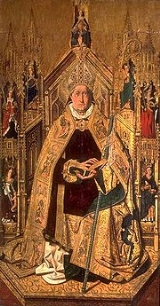
The abbot is a priest, chosen by the monks from among the fully professed monks. Once chosen, he must request blessing: the blessing of an abbot is celebrated by the bishop in whose diocese the monastery is or, with his permission, another abbot or bishop. The ceremony of such a blessing is similar in some aspects to the ordination of a bishop, with the new abbot being presented with the mitre, the ring, and the crosier as symbols of office and receiving the laying on of hands and blessing from the celebrant. Though the ceremony installs the new abbot into a position of legal authority, it does not confer further sacramental authority.

Once he has received this blessing, the abbot not only becomes father of his monks in a spiritual sense, but their major superior under canon law, and has the additional authority to confer the ministries of acolyte and lector . The abbey is a species of "exempt religious" in that it is, for the most part, answerable to the Pope, or to the abbot primate, rather than to the local bishop.

The abbot wears the same habit as his fellow monks, though by tradition he adds to it a pectoral cross.

Territorial abbot Territorial abbot

A territorial abbot or Abbot nullius heads a territorial abbey or territorial abbacey,... 

s follow all of the above, but in addition must receive a mandate of authority from the Pope over the territory around the monastery for which they are responsible.

Abbatial hierarchy

In several orders, there exists a pyramidal relationship between a major abbey and other ones , even when these are not priories Priory

A priory is a monastery [i] or monastic dependency whose superior is a prior [i]. ... 

 but have their own abbot.
As a daughter could often become a mother in a next phase, the 'family tree' can become very complex, but often the grandmother remains the only one with acknowledged seniority.

Sometimes a very real hold was maintained, so the Abbot of Cluny Cluny Abbey

The Abbey of Cluny was founded on 2 September 909 [i] by the Abbot Berno [i] and Count of Auvergne [i], ... 

 had such vast income from the network of filial monasteries that he was one of the most powerful men in the church, and a real papabile. In other cases the precedence is little more than a honorary status.

In several cases, the senior abbot is entitled to a specific style, such as Abbot general, abbot president, abbot primate Primate (religion)

Primate is a title or rank bestowed on some bishop [i]s in certain Christian [i] churches. ... 

 and archabbot.
Such titles may also apply to the presidents of federation of monasteries, not necessarily reserved for one abbey.

Modern abbots not as superior

The title abbé Abbé

... 

 , as commonly used in the Catholic church on the European continent, is the equivalent of the English "Father" , being loosely applied to all who have received the tonsure Tonsure

Tonsure is the practice of some Christian [i] churches and Hindu [i] temples of cutting the ... 

. This use of the title is said to have originated in the right conceded to the king of France, by the concordat between Pope Leo X Pope Leo X

Pope Leo X, born Giovanni di Lorenzo de' Medici was Pope from 1513 to his death.... 

 and Francis I Francis I of France

[i] in [[1515]... 

 , to appoint abbés commendataires to most of the abbeys in France. The expectation of obtaining these sinecures drew young men towards the church in considerable numbers, and the class of abbés so formed—abbés de cour they were sometimes called, and sometimes abbés de sainte espérance, —came to hold a recognized position. The connection many of them had with the church was of the slenderest kind, consisting mainly in adopting the title of abbé, after a remarkably moderate course of theological study, practising celibacy and wearing a distinctive dress—a short dark-violet coat with narrow collar. Being men of presumed learning and undoubted leisure, many of the class found admission to the houses of the French nobility as tutors or advisers. Nearly every great family had its abbé. The class did not survive the Revolution French Revolution

The French Revolution was a pivotal period in the history of French, Europe [i]an and Western [i] ... 

; but the courtesy title of abbé, having long lost all connection in people's minds with any special ecclesiastical function, remained as a convenient general term applicable to any clergyman.

Protestant abbots

In the German Evangelical Church the German title of Abt is sometimes bestowed, like the French abbé, as an honorary distinction, and survives to designate the heads of some monasteries converted at the Reformation into collegiate foundations.
Of these the most noteworthy is the abbey of Lokkum in Hanover Hanover

Hanover , on the river Leine [i], is the capital of the federal state of Lower Saxony [i] , Germany [i].... 

, founded as a Cistercian Cistercians

The Order of Cistercians , otherwise White Monks is a Roman Catholic [i] order [i] ... 

 house in 1163 by Count Wilbrand of Hallermund, and reformed in 1593. The abbot of Lokkum, who still carries a pastoral staff, takes precedence over all the clergy of Hanover, and was ex officio a member of the consistory of the kingdom. The governing body of the abbey consists of the abbot, prior and the "convent" of Stiftsherr Canon (priest)

A canon is a priest who is a member of certain bodies of the Christian [i] clergy [i] subje ... 

en
.

In the Church of England Church of England

The Church of England is the officially established [i] Christian [i] church [i] ... 

, the Bishop of Norwich Bishop of Norwich

... 

, by royal decree given by Henry VIII Henry VIII of England

Henry VIII was King of England [i] and Lord of Ireland [i] from ... 

, also holds the honorary title of "Abbot of St. Benet." This title hails back to England's separation from the See of Rome, when King Henry, as supreme head of the newly independent church, took over all of the monastaries, mainly for their possessions, except for St. Benet, which he spared because the abbot and his monks possessed no wealth, and lived like simple beggers, disposing the incumbent Bishop of Norwich and seating the abbot in his place, thus the dual title still held to this day.

There are several Benedictine Abbeys throughout the Anglican Communion. Most of them have mitred abbots.

See also

  • List of historical abbots
  • Hegumen
  • Archimandrite

Sources and references