

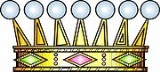
Freiherr

Encyclopedia

The German
German language
German is a West Germanic language, related to and classified alongside English and Dutch. With an estimated 90 – 98 million native speakers, German is one of the world's major languages and is the most widely-spoken first language in the European Union....
titles Freiherr (Baron) and Freifrau and Freiin (Baroness) are titles of nobility
Nobility
Nobility is a social class which possesses more acknowledged privileges or eminence than members of most other classes in a society, membership therein typically being hereditary. The privileges associated with nobility may constitute substantial advantages over or relative to non-nobles, or may be...
, used preceding a person's given name
Given name
A given name, in Western contexts often referred to as a first name, is a personal name that specifies and differentiates between members of a group of individuals, especially in a family, all of whose members usually share the same family name...
or, after 1919, before the surname
Surname
A surname is a name added to a given name and is part of a personal name. In many cases, a surname is a family name. Many dictionaries define "surname" as a synonym of "family name"...
. They are titles of lower noble
Nobility
Nobility is a social class which possesses more acknowledged privileges or eminence than members of most other classes in a society, membership therein typically being hereditary. The privileges associated with nobility may constitute substantial advantages over or relative to non-nobles, or may be...
rank in the former Holy Roman Empire
Holy Roman Empire
The Holy Roman Empire was a realm that existed from 962 to 1806 in Central Europe.It was ruled by the Holy Roman Emperor. Its character changed during the Middle Ages and the Early Modern period, when the power of the emperor gradually weakened in favour of the princes...
, and in its various German successor states, including Prussia, Bavaria, Württemberg
Württemberg
Württemberg , formerly known as Wirtemberg or Wurtemberg, is an area and a former state in southwestern Germany, including parts of the regions Swabia and Franconia....
, Hesse, etc.
In Austria-Hungary
Austria-Hungary
Austria-Hungary , more formally known as the Kingdoms and Lands Represented in the Imperial Council and the Lands of the Holy Hungarian Crown of Saint Stephen, was a constitutional monarchic union between the crowns of the Austrian Empire and the Kingdom of Hungary in...
and elsewhere, such as in the Baltic
Baltic countries
The term Baltic states refers to the Baltic territories which gained independence from the Russian Empire in the wake of World War I: primarily the contiguous trio of Estonia, Latvia, Lithuania ; Finland also fell within the scope of the term after initially gaining independence in the 1920s.The...
and Nordic countries
Nordic countries
The Nordic countries make up a region in Northern Europe and the North Atlantic which consists of Denmark, Finland, Iceland, Norway and Sweden and their associated territories, the Faroe Islands, Greenland and Åland...
, Freiherr (literally "free lord") came to be considered of equal rank to the title of Baron
Baron
Baron is a title of nobility. The word baron comes from Old French baron, itself from Old High German and Latin baro meaning " man, warrior"; it merged with cognate Old English beorn meaning "nobleman"...
. The original distinction from other barons was that a Freiherrs landed property was allodial
Allodial title
Allodial title constitutes ownership of real property that is independent of any superior landlord, but it should not be confused with anarchy as the owner of allodial land is not independent of his sovereign...
instead of a fief. Barons who received their title from the Holy Roman Emperor are sometimes known as Barons of the Holy Roman Empire, Reichsfreiherren, in order to distinguish them from other barons, although the title per se is simply Freiherr.
German title
A German Freiherr is called "Baron" in English: the status was practically the same, although the title was derived separately in the English and German languages.Even in German, a Freiherr is sometimes styled and addressed as "Baron", although this is not the official title.
The title Freiherr derives from the fact that the holder held free (allodial) title to his land, unlike ordinary barons, who were originally knights (Ritter
Ritter
Ritter is a designation used as a title of nobility in German-speaking areas. Traditionally it denotes the second lowest rank within the nobility, standing above "Edler" and below "Freiherr"...
) in vassal
Vassal
A vassal or feudatory is a person who has entered into a mutual obligation to a lord or monarch in the context of the feudal system in medieval Europe. The obligations often included military support and mutual protection, in exchange for certain privileges, usually including the grant of land held...
age to a higher lord or sovereign, and unlike medieval German ministerials
Ministerialis
Ministerialis ; a post-classical Latin word, used in English, meaning originally servitor, agent, in a broad range of senses...
who were bound to provide administrative services for a lord. A Freiherr sometimes exercised hereditary administrative and judicial prerogatives over those resident in his barony instead of the liege lord, who might be the duke
Duke
A duke or duchess is a member of the nobility, historically of highest rank below the monarch, and historically controlling a duchy...
(Herzog) or count
Count
A count or countess is an aristocratic nobleman in European countries. The word count came into English from the French comte, itself from Latin comes—in its accusative comitem—meaning "companion", and later "companion of the emperor, delegate of the emperor". The adjective form of the word is...
(Graf
Graf
Graf is a historical German noble title equal in rank to a count or a British earl...
).
All legitimate children of a Freiherr share his title and rank, and can be referred to as Baron; inheritance of the title is not restricted by primogeniture
Primogeniture
Primogeniture is the right, by law or custom, of the firstborn to inherit the entire estate, to the exclusion of younger siblings . Historically, the term implied male primogeniture, to the exclusion of females...
as is the baronial title in Britain and most Latin monarchies (France, Portugal, Spain, much of Italy). The wife of a Freiherr is titled Freifrau (literally "free lady"), and the daughter of a Freiherr is called Freiin (short for Freiherrin). Both titles are translated in English as "Baroness". Female forms of titles have been legally accepted as a variation in the surname after 1919 by a still valid decision of the German former High Court (Reichsgericht
Reichsgericht
The Reichsgericht was the highest court of the Deutsches Reich. It was established on October 1, 1879 when the Reichsjustizgesetze came into effect, building a widely regarded body of jurisprudence....
).
After the dissolution of the Holy Roman Empire in 1806, a Reichsfreiherr (Baron of the Empire) no longer belonged to the noble hierarchy of that dissolved
Abolished monarchy
Throughout history, monarchies have been abolished, either through revolutions, legislative reforms, coups d'état, or wars. The twentieth century saw a major acceleration of this process, with many monarchies violently overthrown by revolution or war, or else abolished as part of the process of...
realm. By a decision of the Congress of Vienna
Congress of Vienna
The Congress of Vienna was a conference of ambassadors of European states chaired by Klemens Wenzel von Metternich, and held in Vienna from September, 1814 to June, 1815. The objective of the Congress was to settle the many issues arising from the French Revolutionary Wars, the Napoleonic Wars,...
in 1815, their titles were nonetheless officially recognized. After 1806 the now independent German monarchies, such as Bavaria, Württemberg and Lippe
Lippe
Lippe is a Kreis in the east of North Rhine-Westphalia, Germany. Neighboring districts are Herford, Minden-Lübbecke, Höxter, Paderborn, Gütersloh, and district-free Bielefeld, which forms the region Ostwestfalen-Lippe....
could create their own nobility
Nobility
Nobility is a social class which possesses more acknowledged privileges or eminence than members of most other classes in a society, membership therein typically being hereditary. The privileges associated with nobility may constitute substantial advantages over or relative to non-nobles, or may be...
, including Freiherren (Prussia, as a kingdom prior to 1806, already exercised the prerogative of ennoblement). Some of the older baronial families (e.g. Reichsfreiherr von und zu Guttenberg
Guttenberg, Bavaria
Guttenberg is a municipality in the district of Kulmbach in Bavaria in Germany. The town is closely tied to the aristocratic family by the same name, the House of Guttenberg, which owns most of the land in the area...
-- see Karl-Theodor zu Guttenberg
Karl-Theodor zu Guttenberg
Karl-Theodor Freiherr zu Guttenberg is a German politician of the Christian Social Union ....
), von Waldenfels
Rudolf von Waldenfels
Rudolf Freiherr von Waldenfels is a German writer, journalist and actor. He is a member of the Waldenfels family, a German Adelsgeschlecht that dates back to the 13th century AD. He lives in Berlin and in his ancestral hometown of Lichtenberg, in Bavaria. He is married to the author and...
or vom und zum Stein) began to use Reichsfreiherr (Imperial Baron) in formal contexts to distinguish themselves from the new classes of barons created by monarchs of lesser stature than the former Holy Roman Emperors.
Nobility, although not abolished, lost recognition as a legal class in Germany in 1919 under the (Weimar Constitution
Weimar constitution
The Constitution of the German Reich , usually known as the Weimar Constitution was the constitution that governed Germany during the Weimar Republic...
), and again in 1949 in the Bonn
Bonn
Bonn is the 19th largest city in Germany. Located in the Cologne/Bonn Region, about 25 kilometres south of Cologne on the river Rhine in the State of North Rhine-Westphalia, it was the capital of West Germany from 1949 to 1990 and the official seat of government of united Germany from 1990 to 1999....
(Grundgesetz); hereditary noble titles legally became simply part of the surname (with the former title following the given name, e.g. Georg Freiherr von Platz), and might or might not be used by those entitled to them. The unofficial titles do, however, retain prestige in some circles of society.
Austrian title
The nobility was abolished in AustriaAustria
Austria , officially the Republic of Austria , is a landlocked country of roughly 8.4 million people in Central Europe. It is bordered by the Czech Republic and Germany to the north, Slovakia and Hungary to the east, Slovenia and Italy to the south, and Switzerland and Liechtenstein to the...
in 1919, and the use of hereditary titles was declared illegal. If "Wernher Freiherr von Braun" had been Austrian, for example, he would have been called simply "Wernher Braun" on his Austrian passport. By tradition, however, former titles are still widely in use in Austria.
Parallel titles
Similar titles have been seen in all parts of Europe that have historically been dominated by Germany – the Baltic States, Austria–Hungary, Sweden, Finland and to some extent in Denmark-Norway.Danish-Norwegian title
In DenmarkDenmark
Denmark is a Scandinavian country in Northern Europe. The countries of Denmark and Greenland, as well as the Faroe Islands, constitute the Kingdom of Denmark . It is the southernmost of the Nordic countries, southwest of Sweden and south of Norway, and bordered to the south by Germany. Denmark...
and Norway
Norway
Norway , officially the Kingdom of Norway, is a Nordic unitary constitutional monarchy whose territory comprises the western portion of the Scandinavian Peninsula, Jan Mayen, and the Arctic archipelago of Svalbard and Bouvet Island. Norway has a total area of and a population of about 4.9 million...
the title of Friherre was of equal rank to that of Baron, which gradually replaced it. It was instituted on 25 May 1671 with Christian V
Christian V of Denmark
Christian V , was king of Denmark and Norway from 1670 to 1699, the son of Frederick III of Denmark and Sophie Amalie of Brunswick-Lüneburg...
's 'Friherre' privileges. Today only a few Danish noble families use the title of Friherre and most of them are based in Sweden, where that version of the title is still more commonly used. The wife of a Danish or Norwegian Friherre is entitled Friherreinde, and the daughters are titled Baronesse. In fact, however, generally a Danish Friherre is referred to as "Baron".
Finnish title
Each head of a Finnish noble family was, since the Middle Ages, entitled to a vote in any provincial DietDiet (assembly)
In politics, a diet is a formal deliberative assembly. The term is mainly used historically for the Imperial Diet, the general assembly of the Imperial Estates of the Holy Roman Empire, and for the legislative bodies of certain countries.-Etymology:...
of Finland when held, as in the Realm's Herrainpäivät, later Aatelissääty of the Riksdag of the Estates
Riksdag of the Estates
The Riksdag of the Estates , was the name used for the Estates of the Swedish realm when they were assembled. Until its dissolution in 1866, the institution was the highest authority in Sweden next to the King...
. In the beginning, they were all without honorific titulature, and known just as "lords". In 1561, the Swedish king Eric XIV conferred the hereditary titles of count and "vapaaherra" on some, but not all of these nobles. The rest preserved their hereditary seats and votes in the Aatelissääty, and were still called lords. This prerogative was confirmed in the constitutional arrangements of 1625.
In subsequent centuries, while Finland remained an autonomous grand duchy
Grand duchy
A grand duchy, sometimes referred to as a grand dukedom, is a territory whose head of state is a monarch, either a grand duke or grand duchess.Today Luxembourg is the only remaining grand duchy...
, many families were raised in rank as counts, vapaaherras, or as untitled nobles. Families which were noble "from time immemorial" (i.e., no record exists of the family from a time when it was not deemed noble) were, in 1625, designated as "original nobility". While heads of the lowest, untitled noble families continued to enjoy the privilege of participation in the Aatelissääty, their Cadet
Cadet (genealogy)
In genealogy, a cadet is a younger son, as opposed to the firstborn heir. Compare puisne.- Etymology :The word is recorded in English since 1634, originally for a young son, identical to the French, which is itself derived from the gascon Occitan capdet "captain, chief", in turn from the Late...
s did not. All family members of "vapaaherra" (baronial) families were entitled to that same title, which in practice, came to mean that they were addressed as Paroni or Paronitar.
All nobles originally held their landed properties in allodial manner, rälssi (exemption from land taxes) being the distinguishing feature of the Finnish nobility
Finnish nobility
The Finnish nobility was historically a privileged class in Finland, deriving from its period as part of Sweden and the Russian Empire. Noble families and their descendants are still a part of Finnish republican society today, but except for the titles themselves, no longer retain any specific or...
as a class. Theoretically, all created vapaaherra families were given a barony (with some rights of taxation and jurisprudence), but such fiefs were only granted in the 16th and 17th centuries. Thereafter the "barony" was titular, usually in chief of some already-owned property, and sometimes that property was established as a fideicommiss. Their property tax exemption continued into the 20th century, being, however, diminished substantially by reforms of the 19th century. Nobility creations continued until the declaration of independency 1917, the end of the grand ducal monarchy.
Independent Finland was decided to be a constitutional monarchy and the German emperor's cousin, Prince of Hessen, Friedrich Karl was chosen the first king as Väinö I. Before his coronation, imperial Germany dissolved after losing the world war. Friedrich Karl decided to abandon the throne. Simultaneously the kingdom of Finland was cancelled and the republic was established. Granting nobility title was abandoned and the current nobility had no state privileges. Monarchists and republicans were arguing about the granting of titles and as a compromise a lifetime honorary title of "neuvos" (councillor) was established. There are numerous professional councillor titles and new ones have been founded. The neuvos (like vuorineuvos) title is usually used in formal connections.
Swedish title
As in Finland, with whom the position of Swedish nobilitySwedish nobility
The Swedish nobility were historically a legally and/or socially privileged class in Sweden, part of the so-called frälse . Today, the nobility is still very much a part of Swedish society but they do not maintain many of their former privileges...
shares most of its origins, each head of a noble house was, since the Middle Ages, entitled to a vote in any provincial diet when held, as in the Realm's Herredag, later Riddarhuset. From 1561, King Eric XIV began granting some of them the titles count and "friherre" (baron). The family members of a "friherre" were entitled to the same title, which in speech eventually became Baron or Baronessa.