
All Topics  
Charles I of England

 
Charles I of England

   Email Print
   Bookmark   Link


Charles I of England


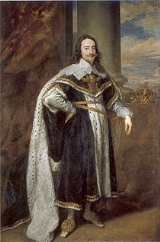
Charles I (19 November 1600 – 30 January 1649) was King of England, Scotland
List of monarchs of Scotland

The monarch of Scotland was the head of state of the Kingdom of Scotland. According to tradition, the first King of Scots was Kenneth MacAlpin , who founded the state in 843, although this is no longer taken seriously by historians....
 and Ireland
King of Ireland

The designation King of Ireland and Queen of Ireland was used during three periods of History of Ireland....
 from 27 March 1625 until his execution
Capital punishment

Capital punishment, the death penalty or execution, is the killing of a person by procedural law for Punishment#Retribution and Punishment#Incapacitation....
 on 30 January 1649. Charles famously engaged in a struggle for power with the Parliament of England
Parliament of England

The Parliament of England was the legislature of the Kingdom of England. Its roots can be traced back to the early medieval period. In a series of developments, it came increasingly to constrain the power of the King of England, and went on after the Act of Union 1707 to merge with the Parliament of Scotland and form the main basis of the Pa...
. He was an advocate of the Divine Right of Kings
Divine Right of Kings

The Divine Right of Kings is a politics and religion doctrine of royal absolutism. It asserts that a monarch is subject to no earthly authority, deriving his right to rule directly from the will of God....
, which was the belief that kings received their power from God. This Divine right of Kings could not be taken away (unlike the similar Mandate of Heaven
Mandate of Heaven

The Mandate of Heaven is a traditional Chinese philosophy concept concerning the legitimacy of rulers. Heaven would bless the authority of a just ruler, but would be displeased with a despotic ruler and would withdraw their mandate....
), even if he was stripped of his power.


Discussion
Ask a question about 'Charles I of England'
Start a new discussion about 'Charles I of England'
Answer questions from other users
Full Discussion Forum


Recent Posts


Timeline

1600   Born

1625   Prince Charles Stuart becomes King Charles I of England, Scotland and Ireland.

1626   The English Parliament impeach George Villiers, 1st Duke of Buckingham, favorite of Charles I of England.

1626   Charles I dissolves Parliament.

1628   Charles I reconvenes the English Parliament and accepts the Petition of Right as a concession to gain his subsidies.

1628   writs were issued in February 1628 by Charles I of England that every county in England (not just seaport towns) pay ship tax by this date.

1629   Charles I of England dissolves Parliament starting the Eleven Years Tyranny in which there was no parliament.

1632   Charles I of England issues charter for the colony of Maryland (named in honor of Henrietta Maria), under control of Lord Baltimore.

1639   Charles I starts the first of the Bishops Wars against Scotland.

1640   Charles I summons the Short Parliament in an attempt to fund the second of the Bishops Wars.


Quotations


I go from a corruptible to an incorruptible Crown, where no disturbance can be, no disturbance in the world.

Last words, said on the scaffold before his execution. (30 January, 1649).


Encyclopedia


Charles I (19 November 1600 – 30 January 1649) was King of England, Scotland
List of monarchs of Scotland

The monarch of Scotland was the head of state of the Kingdom of Scotland. According to tradition, the first King of Scots was Kenneth MacAlpin , who founded the state in 843, although this is no longer taken seriously by historians....
 and Ireland
King of Ireland

The designation King of Ireland and Queen of Ireland was used during three periods of History of Ireland....
 from 27 March 1625 until his execution
Capital punishment

Capital punishment, the death penalty or execution, is the killing of a person by procedural law for Punishment#Retribution and Punishment#Incapacitation....
 on 30 January 1649. Charles famously engaged in a struggle for power with the Parliament of England
Parliament of England

The Parliament of England was the legislature of the Kingdom of England. Its roots can be traced back to the early medieval period. In a series of developments, it came increasingly to constrain the power of the King of England, and went on after the Act of Union 1707 to merge with the Parliament of Scotland and form the main basis of the Pa...
. He was an advocate of the Divine Right of Kings
Divine Right of Kings

The Divine Right of Kings is a politics and religion doctrine of royal absolutism. It asserts that a monarch is subject to no earthly authority, deriving his right to rule directly from the will of God....
, which was the belief that kings received their power from God. This Divine right of Kings could not be taken away (unlike the similar Mandate of Heaven
Mandate of Heaven

The Mandate of Heaven is a traditional Chinese philosophy concept concerning the legitimacy of rulers. Heaven would bless the authority of a just ruler, but would be displeased with a despotic ruler and would withdraw their mandate....
), even if he was stripped of his power. Many subjects of England feared that he was attempting to gain absolute power
Absolute monarchy

Absolute monarchy is a monarchy form of government where the king or queen has absolute power over all aspects of his/her subjects' lives. Although some religious authorities may be able to discourage the monarch from some acts and the sovereign is expected to act according to custom, in an absolute monarchy there is no constitution or legal...
. Many of his actions, particularly the levying of tax
Tax

To tax is to impose a financial charge or other levy upon an individual or Legal person by a state or the functional equivalent of a state.Taxes are also imposed by many subnational entity....
es without Parliament's consent, caused widespread opposition.

Religious conflicts permeated Charles's reign. He married a Catholic princess, Henrietta Maria of France
Henrietta Maria of France

Henrietta Maria , was Princess of France and Queen Consort of England, Scotland and Ireland through her marriage to Charles I of England. She was the mother of two kings, Charles II of England and James II of England, and was grandmother to Mary II of Great Britain, William III of England, and Anne of Great Britain....
, over the objections of Parliament and public opinion. He further allied himself with controversial religious figures, including the ecclesiastic Richard Montagu
Richard Montagu

Richard Montagu was an English cleric and prelate....
 and William Laud
William Laud

Archbishop William Laud was Archbishop of Canterbury from 1633 to 1645. He pursued a High Church course and opposed Radical Reformation of Puritanism....
, whom Charles appointed Archbishop of Canterbury
Archbishop of Canterbury

The Archbishop of Canterbury is the chief bishop and principal leader of the Church of England, the symbolic head of the worldwide Anglican Communion and the Diocesan Bishop of the Diocese of Canterbury, the Episcopal see that churches must be in communion with in order to be a part of the Anglican Communion....
. Many of Charles's subjects felt this brought the Church of England too close to Roman Catholicism
Roman Catholic Church

The Roman Catholic Church, officially known as the Catholic Church is the world's largest Christianity Ecclesia , representing over half of all Christians and one-sixth of the world population....
. Charles's later attempts to force religious reforms upon Scotland
Scotland

conventional_long_name = ScotlandAlba|common_name= Scotland|image_flag = Flag of Scotland.svg|flag_width = 130px...
 led to the Bishops' Wars
Bishops' Wars

The Bishops? Wars ? Bella Episcoporum ? refers to two armed encounters between Charles I of England and the Scottish Covenanter in 1639 and 1640, which helped to set the stage for the English Civil War and the subsequent Wars of the Three Kingdoms...
 that weakened England's government and helped precipitate his downfall.

His last years were marked by the English Civil War
English Civil War

The English Civil War was a series of armed conflicts and political machinations between Roundhead and Cavalier. The First English Civil War and Second English Civil War civil wars pitted the supporters of Charles I of England against the supporters of the Long Parliament, while the Third English Civil War saw fighting between supporters...
, in which he was opposed by the forces of the English and Scottish Parliaments, which challenged his attempts to augment his own power, and by Puritan
Puritan

A Puritan of 16th and 17th century England was an associate of any number of religious groups advocating for more "purity" of worship and doctrine, as well as personal and group pietism....
s, who were hostile to his religious policies and supposed Catholic sympathies. Charles was defeated in the First Civil War (1642–45), after which Parliament expected him to accept demands for a constitutional monarchy. He instead remained defiant by attempting to forge an alliance with Scotland and escaping to the Isle of Wight
Isle of Wight

The Isle of Wight is an England island and county, located 3-8 km from the south coast of the mainland, in the English Channel. It is situated south of the county of Hampshire and is separated from mainland Britain by the Solent....
. This provoked a Second Civil War (1648–49) and a second defeat for Charles, who was subsequently captured, tried
Criminal procedure

'Criminal procedure' refers to the legal process for adjudication claims that someone has violated criminal law....
, convicted, and executed for high treason
High treason

High treason is criminal disloyalty to one's country. Participating in a war against one's country, attempting to overthrow its government, spying on its military, its diplomats, or its secret services for a hostile and foreign power, or attempting to kill its head of state are perhaps the best-known examples of high treason....
. The monarchy
British monarchy

The Monarchy of the United Kingdom is the constitutional monarchy of the United Kingdom and its British overseas territory.The present monarch, Queen Elizabeth II of the United Kingdom, has reigned since 6 February 1952....
 was then abolished and a republic called the Commonwealth of England
Commonwealth of England

The Commonwealth of England was the republic which ruled first Kingdom of England and Wales, and then Kingdom of Ireland and Kingdom of Scotland from 1649 to 1660....
, also referred to as the Cromwellian Interregnum
English Interregnum

The English Interregnum was the period of parliamentary and military rule under the Commonwealth of England after the English Civil War. It began with the regicide of Charles I of England in January 1649, and ended with the English Restoration of Charles II of England in 1660....
, was declared. Charles's son, Charles II
Charles II of England

Charles II was the Monarchy of Kingdom of England, Kingdom of Scotland, and Kingdom of Ireland.His father Charles I of England Regicide#The regicide of Charles I of England at Palace of Whitehall on 30 January 1649, at the climax of the English Civil War....
, became King after the restoration of the monarchy
English Restoration

The English Restoration, or simply The Restoration began in 1660 when the English monarchy, Scottish monarchy and Irish monarchy were restored under Charles II of England after the Interregnum that followed the English Civil War....
 in 1660. In that same year, Charles I was canonized
Canonization

Canonization is the act by which a particular Christian church declares a deceased person to be a saint and is included in the canon, or list, of recognized saints....
 by the Church of England
Church of England

The Church of England is the State religion Christianity Ecclesia in England, the Mother Church of the worldwide Anglican Communion and the oldest among the communion's thirty-eight independent national and regional churches....
.

Early life


The second son of James VI of Scotland and Anne of Denmark
Anne of Denmark

Anne of Denmark was queen consort of Kingdom of Scotland, Kingdom of England, and Kingdom of Ireland as spouse of King James I of England.The second daughter of King Frederick II of Denmark, Anne married James in 1589 at the age of fourteen and bore him three children who survived infancy, including the future Charles I of England....
, Charles was born at Dunfermline Palace
Dunfermline Palace

Dunfermline Palace is a former Scotland Scottish royalty palace in Dunfermline, Fife. It is currently a ruin under the care of Historic Scotland and an important tourist attraction in Dunfermline....
, Fife
Fife

Fife is a council area of Scotland, situated between the Firth of Tay and the Firth of Forth, with inland boundaries to Perth and Kinross and Clackmannanshire....
, on 19 November 1600, and, until the age of three, was unable to walk or talk. His paternal grandmother was Mary, Queen of Scots
Mary I of Scotland

Mary I was Queen of Scots from 14 December 1542 to 24 July 1567.She was the only surviving legitimate child of James V of Scotland. She was only six days old when her father died and left her Queen of Scots....
, who had been beheaded by Elizabeth I of England
Elizabeth I of England

Elizabeth I was List of English monarchs and Queen of Ireland from 17 November 1558 until her death. Sometimes called The Virgin Queen, Gloriana, or Good Queen Bess, Elizabeth was the fifth and last monarch of the House of Tudor....
 on 8 February 1587.

When Elizabeth
Elizabeth I of England

Elizabeth I was List of English monarchs and Queen of Ireland from 17 November 1558 until her death. Sometimes called The Virgin Queen, Gloriana, or Good Queen Bess, Elizabeth was the fifth and last monarch of the House of Tudor....
 died in March 1603 and James VI of Scotland became King of England as James I, Charles was originally left in Scotland in the care of nurses and servants because it was feared that the journey would damage his fragile health. He did make the journey in July 1604 and was subsequently placed under the charge of Alletta (Hogenhove) Carey, the Dutch-born wife of courtier Sir Robert Carey
Robert Carey

Robert Carey may refer to:* Robert Carey, 1st Earl of Monmouth , English nobleman* Robert D. Carey , 11th Governor of Wyoming* Robert Carey , British Army officer...
, who taught him how to walk and talk and insisted that he wear boots made of Spanish leather and brass to help strengthen his weak ankles. When Charles was an adult he was 5 feet 3 inches (162 cm) tall.

Charles was not as valued as his elder brother, Henry, Prince of Wales
Prince of Wales

Prince of Wales is a title traditionally granted to the Heir Apparent to the reigning monarch of the United Kingdom . The current Prince of Wales is Charles, Prince of Wales, the eldest son of Elizabeth II of the United Kingdom....
; Charles himself adored Henry and tried to emulate him. In 1603, Charles was created Duke of Albany
Duke of Albany

Duke of Albany is a peerage title that has occasionally been bestowed on the younger sons in the Scotland, and later the British, royal family, particularly in the Houses of House of Stuart and House of Hanover....
, with the subsidiary title
Subsidiary title

A subsidiary title is an hereditary title held by a royal or a noble but which is not regularly used to identify that person.For example, the Duke of Norfolk is also the Earl of Arundel, the Earl of Surrey, the Earl of Norfolk, the Baron Beaumont, the Baron Maltravers, the Baron FitzAlan, the Baron Clun, the Baron Oswaldestre, and the Baron...
s Marquess of Ormond, Earl of Ross and Lord Ardmannoch the sixth, in Scotland. Two years later, Charles was created Duke of York
Duke of York

The title Duke of York is a title of nobility in the British peerage. Since the 15th century, it has, when granted, usually been given to the second son of the British monarch....
, as was then, and remains, customary in the case of the Sovereign's second son. When his elder brother died of typhoid at the age of 18 in 1612, two weeks before Charles's 12th birthday, Charles became heir apparent
Heir apparent

An heir apparent is an heir who cannot be displaced from inheriting; the term is used in contrast to heir presumptive, the term for a conditional heir who is currently in line to inherit but could be displaced at any time in the future....
 (and the eldest living son of the Sovereign, thus automatically gaining several titles including Duke of Cornwall
Duke of Cornwall

The Dukedom of Cornwall was the first dukedom created in the peerage of England.The present Duke of Cornwall is Charles, Prince of Wales, the eldest son of Elizabeth II of the United Kingdom, the reigning British monarch ....
 and Duke of Rothesay
Duke of Rothesay

The title Duke of Rothesay was the official title possessed by the heir apparent to the throne of the Kingdom of Scotland. A separate Scottish throne has not existed since the Treaty of Union 1707 in 1707, which saw the joining of the Kingdom of Scotland with the Kingdom of England to form the Kingdom of Great Britain under Anne of Great Brit...
) and was subsequently created the Prince of Wales and Earl of Chester
Earl of Chester

The Earldom of Chester was one of the most powerful earldoms in medieval England. Since 1301 the title has generally been given to heirs-apparent to the English throne, and from the late 14th century it has been given only in conjunction with that of Prince of Wales....
 in November 1616. His sister Elizabeth
Elizabeth of Bohemia

Elisabeth, Electress Palatine and Queen of Bohemia was the eldest daughter of James I of England, King of England, Scotland and Ireland, and Anne of Denmark....
 married Frederick V
Frederick V, Elector Palatine

Frederick V was Electoral Palatinate , and, as Frederick I , King of Bohemia . He was the son and heir of Frederick IV, Elector Palatine and of Louise Juliana of Nassau, the daughter of William I of Orange and Charlotte of Bourbon....
, Elector Palatine in 1613 and moved to Heidelberg
Heidelberg

Heidelberg is a city in Baden-W?rttemberg, Germany. As of 2006, over 140,000 people live within the city's area. The town of Heidelberg is an administrative district of its own....
.

The new Prince of Wales was greatly influenced by his father's favourite
Favourite

In historical writings, when used in reference to a person, favourite, also spelled favorite , means the intimate companion of a ruler or other important person....
, George Villiers, 1st Duke of Buckingham
George Villiers, 1st Duke of Buckingham

George Villiers, 1st Duke of Buckingham was the favourite, claimed by some to be the lover, of King James I of England and one of the most rewarded royal courtiers in all history....
. The two of them travelled incognito to Spain
Spain

Spain or the Kingdom of Spain , is a country located in Southern Europe on the Iberian Peninsula.The Spanish constitution does not establish any official denomination of the country, even though Espa?a , Estado espa?ol and Naci?n espa?ola are used interchangeably....
 in 1623 to reach agreement on the long-pending Spanish Match
Spanish Match

The Spanish Match describes the policy and diplomatic negotiations towards a proposed marriage between Charles I of England, the son of James I of England of England, and Maria Anna of Spain, the daughter of Philip III of Spain....
 between Charles and Infanta Maria Anna of Spain
Maria Anna of Spain

Maria Anna , also known as Maria Anna of Austria, Infanta of Spain, Archduchess of Austria, and after marriage, The Holy Roman Empress and Queen of Hungary, was the youngest daughter of King Philip III of Spain and Margaret of Austria ....
, the daughter of King Philip III of Spain
Philip III of Spain

Philip III was the monarch of Spain and King of Portugal, where he ruled as Philip II , from 1598 until his death. His Political minister was the Francisco Gom?z de Sandoval y Rojas, Duke of Lerma....
. The trip ended badly, however, as the Spanish demanded that Charles convert to Roman Catholicism and remain in Spain for a year after the wedding as a sort of hostage to ensure England's compliance with all the terms of the treaty. Charles was outraged, and upon their return in October, he and Buckingham demanded that King James declare war on Spain.

With the encouragement of his Protestant advisers, James summoned Parliament so that he could request subsidies for a war effort. James also requested that Parliament sanction the marriage between the Prince of Wales and Princess Henrietta Maria of France
Henrietta Maria of France

Henrietta Maria , was Princess of France and Queen Consort of England, Scotland and Ireland through her marriage to Charles I of England. She was the mother of two kings, Charles II of England and James II of England, and was grandmother to Mary II of Great Britain, William III of England, and Anne of Great Britain....
, whom Charles met in Paris
Paris

Paris is the Capital of France and the country's largest city. It is situated on the river Seine, in northern France, at the heart of the ?le-de-France Regions of France ....
 whilst en route to Spain. It was a good match since she was a sister of Louis XIII
Louis XIII of France

Louis XIII reigned as List of French monarchs and List of Navarrese monarchs from 1610 to 1643....
 (their father, Henry IV
Henry IV of France

Henry de Bourbon, , ruled as Henry III, List of Navarrese monarchs, from 1572 to 1610, and as Henry IV, List of French monarchs, from 1589 to 1610....
, had died during her childhood). Parliament agreed to the marriage, but was extremely critical of the prior attempt to arrange a marital alliance with Spain. James was growing senile and as a result was finding it extremely difficult to control Parliament—the same problem would later haunt Charles during his reign. During the last year of James' reign, actual power was held not by him but by Charles and the Duke of Buckingham.

Both Charles and James were advocates of the Divine Right of Kings
Divine Right of Kings

The Divine Right of Kings is a politics and religion doctrine of royal absolutism. It asserts that a monarch is subject to no earthly authority, deriving his right to rule directly from the will of God....
, but James listened to the views of his subjects and favoured compromise and consensus. Charles I was shy and diffident, but also self-righteous, stubborn, opinionated, determined and confrontational. Charles believed he had no need to compromise or even explain his rules and that he was only answerable to God. He famously said: "Kings are not bound to give an account of their actions but to God alone," "I mean to show what I should speak in actions." Those actions were open to misinterpretation, and there were fears as early as 1626 that he was a potential tyrant.

Early reign

On 11 May 1625 Charles was married by proxy
Proxy marriage

A proxy marriage is marriage in which either the bride or the groom is not physically present for the wedding. During the solemnization of the marriage, based upon a power of attorney, a stand-in, or proxy, acts on behalf of one of the parties....
 to Henrietta Maria of France
Henrietta Maria of France

Henrietta Maria , was Princess of France and Queen Consort of England, Scotland and Ireland through her marriage to Charles I of England. She was the mother of two kings, Charles II of England and James II of England, and was grandmother to Mary II of Great Britain, William III of England, and Anne of Great Britain....
, nine years his junior. In his first Parliament, which he opened in May, many members were opposed to his marriage to Henrietta Maria, a Roman Catholic, fearing that Charles would lift restrictions on Roman Catholics and undermine the official establishment of Protestantism. Although he stated to Parliament that he would not relax restrictions relating to recusants
Recusancy

In the history of England, recusancy was a term used to describe the statutory offence of not complying with and conforming to the Established church or State religion, the Church of England....
, he promised to do exactly that in a secret marriage treaty with Louis XIII
Louis XIII of France

Louis XIII reigned as List of French monarchs and List of Navarrese monarchs from 1610 to 1643....
. The couple were married in person on 13 June 1625, in Canterbury
Canterbury

Canterbury lies at the heart of the City of Canterbury, a local government district of Kent, in South East England. It lies on the River Stour....
. Charles was crowned on 2 February 1626 at Westminster Abbey
Westminster Abbey

The Collegiate Church of St Peter at Westminster, which is almost always referred to popularly and informally as Westminster Abbey, is a large, mainly Gothic architecture Church , in Westminster, London, just to the west of the Palace of Westminster....
, but without his wife at his side due to the controversy. Charles and Henrietta had seven children, with three sons and three daughters surviving infancy.

Distrust of Charles's religious policies increased with his support of a controversial ecclesiastic, Richard Montagu
Richard Montagu

Richard Montagu was an English cleric and prelate....
. In a pamphlet, Montagu had argued against the teachings of John Calvin
John Calvin

John Calvin was an influential French people theology and pastor during the Protestant Reformation. He was a principal figure in the development of the system of Christian theology later called Calvinism....
, thereby bringing himself into disrepute amongst the Puritans. After a Puritan member of the House of Commons, John Pym
John Pym

John Pym was an England List of Parliaments of England, leader of the Long Parliament and a prominent critic of James I of England and then Charles I of England....
, attacked Montagu's pamphlet during debate, Montagu requested the king's aid in another pamphlet entitled "Appello Caesarem" (Latin
Latin

Latin is an Italic language, historically spoken in Latium and Ancient Rome. Through the Military history of the Roman Empire, Latin spread throughout the Mediterranean and a large part of Europe....
 "I appeal to Caesar", a reference to an appeal against Jewish persecution made by Saint Paul the Apostle
Paul of Tarsus

Saint Paul, also called Paul the Apostle, the Apostle Paul or Paul of Tarsus , was a Hellenistic Judaism, who called himself the "Apostle to the Gentiles", and was, together with Saint Peter and James the Just, the most notable of early Christian missionaries....
). Charles made the cleric one of his royal chaplains, increasing many Puritans' suspicions as to where Charles would lead the Church.

Charles's primary concern during his early reign was foreign policy. The Thirty Years' War
Thirty Years' War

The Thirty Years' War was one of the most destructive conflicts in European history. The war was fought primarily in Germany and at various points involved most of the countries of Europe....
, originally confined to Bohemia
Bohemia

History...
, was spiralling out of control into a wider war between Protestants and Catholics in Europe. In 1620, Frederick V, Elector Palatine
Frederick V, Elector Palatine

Frederick V was Electoral Palatinate , and, as Frederick I , King of Bohemia . He was the son and heir of Frederick IV, Elector Palatine and of Louise Juliana of Nassau, the daughter of William I of Orange and Charlotte of Bourbon....
, the husband of Charles's sister Elizabeth, had lost his hereditary lands in the Palatinate to the Holy Roman Emperor Ferdinand II
Ferdinand II, Holy Roman Emperor

Ferdinand II , of the House of Habsburg, Holy Roman Emperor , King of Bohemia , King of Hungary ....
. Having agreed to help his brother-in-law regain the Palatinate, Charles declared war on Spain, hoping to force the Catholic Spanish King Philip IV
Philip IV of Spain

Philip IV , was List of Spanish monarchs between 1621 and 1665, Sovereignty of the Spanish Netherlands, and List of Portuguese monarchs until 1640....
 to intercede with the Emperor on Frederick's behalf.

Parliament preferred an inexpensive naval attack on Spanish colonies in the New World, hoping that the capture of the Spanish treasure fleets could finance the war. Charles, however, preferred more aggressive (and more expensive) action on the Continent. Parliament only voted to grant a subsidy of £140,000; an insufficient sum for Charles. Moreover, the House of Commons limited its authorization for royal collection of tonnage and poundage
Tonnage and Poundage

Tonnage and Poundage were certain duties and taxes first levied in Edward II of England's reign on every tun of imported wine, which came mostly from Spain and Portugal, and on every pound weight of merchandise exported or imported....
 (two varieties of customs duties) to a period of one year, although previous sovereigns since 1414 had been granted the right for life. In this manner, Parliament could keep a check on expenditures by forcing Charles to seek the renewal of the grant each year. Charles's allies in the House of Lords, led by the Duke of Buckingham, refused to pass the bill. Although no Parliamentary authority for the levy of tonnage and poundage was obtained, Charles continued to collect the duties anyway.

The war with Spain went badly, largely due to Buckingham's incompetent leadership. Despite Parliament's protests, however, Charles refused to dismiss him, dismissing Parliament instead. He then provoked further unrest by trying to raise money for the war through a "forced loan" -- a tax levied without Parliamentary consent. Although partially successful in collecting the tax, Charles let the money dribble away in yet another military fiasco led by Buckingham. Summoned again in 1628, Parliament adopted a Petition of Right
Petition of right

In English law, a petition of right was a remedy available to subjects to recover property from the Crown.Before the Crown Proceedings Act 1947, the United Kingdom Crown could not be lawsuitd in contract....
 on 26 May, calling upon the King to acknowledge that he could not levy taxes without Parliament's consent, impose martial law on civilians, imprison them without due process, or quarter troops in their homes. Charles assented to the petition, though he continued to claim the right to collect customs duties without authorization from Parliament. Then, on 23 August 1628, Buckingham was assassinated. Although the death of Buckingham effectively ended the war and eliminated his leadership as an issue, it did not end the conflicts between Charles and Parliament over taxation and religious matters.

Personal rule

Charlesx3
In January 1629, Charles opened the second session of the Parliament, which had been prorogued
Parliamentary session

A legislative session is the period of time when a legislature is convened for the purpose of lawmaking. Legislatures plan their business using a legislative calendar....
 in June 1628, with a moderate speech on the tonnage and poundage issue. Members of the House of Commons began to voice their opposition in light of the Rolle case. Rolle was an MP whose goods were confiscated when he failed to pay tonnage and poundage. Many MPs viewed the confiscation as a breach of the Petition of Right
Petition of right

In English law, a petition of right was a remedy available to subjects to recover property from the Crown.Before the Crown Proceedings Act 1947, the United Kingdom Crown could not be lawsuitd in contract....
, arguing that the petition's freedom-from-arrest privilege extended to goods. When Charles ordered a parliamentary adjournment in March, members held the Speaker, Sir John Finch
John Finch

Sir John Finch, Baron Finch of Fordwich , was an English judge, and Speaker of the British House of Commons....
, down in his chair whilst three resolutions against Charles were read aloud. The last of these resolutions declared that anyone who paid tonnage or poundage not authorised by Parliament would "be reputed a betrayer of the liberties of England, and an enemy to the same". Though the resolution was not formally passed, many members declared their approval. The fact that a number of MPs had to be detained in Parliament is relevant in understanding that there was no universal opposition towards the King. Nevertheless, the provocation was too much for Charles, who dissolved parliament the same day. Immediately, he made peace with France and Spain. The following eleven years, during which Charles ruled without a Parliament, have been known as both the Eleven Years Tyranny
Personal Rule

The Personal Rule was the period from 1629 to 1640, when King Charles I of England of England, Scotland and Ireland ruled without recourse to Parliament of England....
 or simply as the Personal Rule
Personal Rule

The Personal Rule was the period from 1629 to 1640, when King Charles I of England of England, Scotland and Ireland ruled without recourse to Parliament of England....
. (Ruling without Parliament, though an exceptional exercise of the royal prerogative, was supported by precedent. By the middle of the 17th century, opinion had shifted, and many held the Personal Rule to be an illegitimate exercise of arbitrary, absolute power.)

Economic problems

Even after making peace, Charles still had to acquire funds in order to maintain his treasury. To raise revenue without reconvening Parliament, Charles first resurrected an all-but-forgotten law called the "Distraint of Knighthood," promulgated in 1279, which required anyone who earned £40 or more each year to present himself at the King's coronation to join the royal army as a knight. Relying on this old statute, Charles fined all individuals who had failed to attend his coronation in 1626.

Later, Charles reintroduced an obsolete feudal tax known as ship money
Ship money

Ship money was a tax, the levy of which by Charles I of England without the consent of British Parliament was one of the causes of the English Civil War....
, which proved even more unpopular. Under statutes of Edward I
Edward I of England

Edward I , popularly known as Longshanks, the English Justinian, and the Hammer of the Scots , was a House of Plantagenet King of England who achieved historical fame by conquering large parts of Wales and almost succeeding in doing the same to Scotland....
 and Edward III
Edward III of England

Edward III was one of the most successful List of the monarchs of the Kingdom of Englands of the Britain in the Middle Ages. Restoring royal authority after the disastrous reign of his father, Edward II of England, Edward III went on to transform the Kingdom of England into the most efficient military power in Europe....
, collection of ship money had been authorized only during wars. Charles, however, sought to collect the tax during peacetime. Although the first writ levying ship money, issued in 1634, did not provoke much immediate opposition, the second and third writs, issued in 1635 and 1636, aroused strong opposition, as it was now clear that the ancient prohibition on collecting ship money during peacetime had been swept away. Many attempted to resist payment, but the royal courts declared that the tax was within the King's prerogative. The collection of ship money during peacetime was a major cause of concern among the ruling class.

Personal Rule ended after the attempted enforcement of the Anglican and increasingly Arminian styled prayer book under Laud that precipitated a rebellion in Scotland in 1640.

Religious conflicts

Charles wished to move the Church of England away from Calvinism
Calvinism

Calvinism is a theology system and an approach to the Christian life that emphasizes the rule of God over all things. It was developed by several theologians, but it bears the name of the French Protestant Reformation John Calvin because of his prominent influence on it and because of his role in the confessional and ecclesiastical debates t...
 in a more traditional and sacramental direction. This goal was shared by his main political adviser, Archbishop William Laud
William Laud

Archbishop William Laud was Archbishop of Canterbury from 1633 to 1645. He pursued a High Church course and opposed Radical Reformation of Puritanism....
. Laud was appointed by Charles as the Archbishop of Canterbury
Archbishop of Canterbury

The Archbishop of Canterbury is the chief bishop and principal leader of the Church of England, the symbolic head of the worldwide Anglican Communion and the Diocesan Bishop of the Diocese of Canterbury, the Episcopal see that churches must be in communion with in order to be a part of the Anglican Communion....
 in 1633, and started a series of unpopular reforms in an attempt to impose order and authority on the church. Laud attempted to ensure religious uniformity by dismissing non-conformist clergymen and closing Puritan
Puritan

A Puritan of 16th and 17th century England was an associate of any number of religious groups advocating for more "purity" of worship and doctrine, as well as personal and group pietism....
 organizations. This was actively hostile to the Reformed
Reformed churches

The Reformed churches are a group of Christian Protestant Christian denomination formally characterized by a similar Calvinism system of doctrine, historically related to the churches that first arose especially in the Swiss Reformation led by Huldrych Zwingli and soon afterward appeared in nations throughout Western and Central Europe....
 tendencies of many of his king's English and Scottish subjects. His policy was obnoxious to Calvinist
Calvinism

Calvinism is a theology system and an approach to the Christian life that emphasizes the rule of God over all things. It was developed by several theologians, but it bears the name of the French Protestant Reformation John Calvin because of his prominent influence on it and because of his role in the confessional and ecclesiastical debates t...
 theology, and insisted that the Church of England's liturgy
Liturgy

A liturgy is the customary public worship done by a specific religious group, according to their particular traditions. The word may refer to an elaborate formal ritual such as the Eastern Orthodox Divine Liturgy and Mass , or a daily activity such as the Muslim salat and Jewish Jewish services....
 be celebrated using the form prescribed in the Book of Common Prayer
Book of Common Prayer

The Book of Common Prayer is the common title of a number of prayer books of the Church of England and used throughout the Anglican Communion. The first book, published in 1549 , in the reign of Edward VI of England, was a product of the English Reformation following the break with Roman Catholic Church....
. Laud was also an advocate of Arminian
Arminianism

Arminianism is a school of Soteriology thought within Protestant Christianity based on the Christian theology ideas of the Netherlands Dutch Reformed theologian Jacobus Arminius and his historic followers, the Remonstrants....
 theology, a view whose emphasis on the ability to reject salvation was viewed as heretical and virtually "Catholic" by strict Calvinists.
William Laud
To punish those who refused to accept his reforms, Laud used the two most feared and most arbitrary courts in the land, the Court of High Commission
Court of High Commission

The Court of High Commission was the supreme ecclesiastical court in England. It was instituted by the crown during the Protestant Reformation and finally dissolved by parliament in 1641....
 and the Court of Star Chamber
Star Chamber

The Star Chamber was an England court of law that sat at the royal Palace of Westminster until 1641. It was made up of Privy Counsellors, as well as common-law judges, and supplemented the activities of the common-law and equity courts in both civil and criminal matters....
. The former could compel individuals to provide self-incriminating testimony, whilst the latter could inflict any punishment whatsoever (including torture), with the sole exception of death.

The lawlessness of the Court of Star Chamber under Charles far exceeded that under any of his predecessors. Under Charles's reign, defendants were regularly hauled before the Court without indictment, due process of the law, or right to confront witnesses, and their testimonies were routinely extracted by the Court through torture.

The first years of the Personal Rule were marked by peace in England, to some extent due to tighter central control. Several individuals opposed Charles's taxes and Laud's policies. For example, in 1634, the ship Griffin left for America carrying religious dissidents, such as the Puritan minister Anne Hutchinson
Anne Hutchinson

Anne Hutchinson was a pioneer settler in Massachusetts, Rhode Island and New Netherlands, and the unauthorized minister of a English dissenters discussion group....
. However, the overall trend of the early Personal Rule period is one of peace. When, however, Charles attempted to impose his religious policies in Scotland he faced numerous difficulties. The King ordered the use of a new Prayer Book modelled on the English Book of Common Prayer
Book of Common Prayer

The Book of Common Prayer is the common title of a number of prayer books of the Church of England and used throughout the Anglican Communion. The first book, published in 1549 , in the reign of Edward VI of England, was a product of the English Reformation following the break with Roman Catholic Church....
, which, although supported by the Scottish Bishops, was resisted by many Presbyterian Scots, who saw the new Prayer Book as a vehicle for introducing Anglicanism to Scotland. When the General Assembly of the Church of Scotland abolished Episcopalian government (that is, governance of the Church by bishops) in 1638, replacing it with Presbyterian government (that is, governance by elders and deacons), Charles sought to put down what he saw as a rebellion against his authority.

In 1639, when the First Bishops' War
Bishops' Wars

The Bishops? Wars ? Bella Episcoporum ? refers to two armed encounters between Charles I of England and the Scottish Covenanter in 1639 and 1640, which helped to set the stage for the English Civil War and the subsequent Wars of the Three Kingdoms...
 broke out, Charles sought to collect taxes from his subjects, who refused to yield any further. Charles's war ended in a humiliating truce in June of the same year. In the Pacification of Berwick
Treaty of Berwick (1639)

The Treaty of Berwick was signed on 18 June 1639 between England and Scotland. Archibald Johnston was involved in the negotiations before King Charles was forced to sign the treaty....
, Charles agreed to grant his Scottish subjects civil and ecclesiastical freedoms.

Charles's military failure in the First Bishops' War in turn caused a financial and military crisis for Charles, which caused the end of Personal Rule. Due to his financial weakness, Charles was forced to call Parliament into session by 1640 in an attempt to raise funds. While the ruling class's grievances with the changes to government and finance during the Personal Rule period were a contributing factor in the Scottish Rebellion, the key issue of religion was the main reason that forced Charles to confront the ruling class in Parliament for the first time in eleven years. In essence, it was Charles's and Laud's confrontational religious modifications that ended what the Whig historians refer to as "The Eleven Years of Tyranny".

"Short" and "Long" Parliaments

Disputes regarding the interpretation of the peace treaty between Charles and the Church of Scotland
Church of Scotland

The Church of Scotland , known informally by its Scots language name, The Kirk, is the national church of Scotland. It is a Presbyterianism church , decisively shaped by the Scottish Reformation....
 led to further conflict. To subdue the Scots, Charles needed more money; therefore, he took the fateful step of recalling Parliament in April 1640. Although Charles offered to repeal ship money
Ship money

Ship money was a tax, the levy of which by Charles I of England without the consent of British Parliament was one of the causes of the English Civil War....
, and the House of Commons agreed to allow Charles to raise the funds for war, an impasse was reached when Parliament demanded the discussion of various abuses of power during the Personal Rule. As both sides refused to give ground on this matter, Parliament was dissolved in May 1640, less than a month after it assembled; thus, the Parliament became known as the "Short Parliament
Short Parliament

The Short Parliament of King Charles I of England is so called because it lasted only three weeks.After eleven years of attempting personal rule, Charles recalled Parliament in 1640, under the advice of Lord Wentworth, recently created Thomas Wentworth, 1st Earl of Strafford....
."
Carolus I Angliae
In the meantime, Charles attempted to defeat the Scots, but failed miserably. The humiliating Treaty of Ripon
Treaty of Ripon

The Treaty of Ripon was an agreement signed by Charles I of England, and the Scottish Covenanters on 26 October 1640, in the aftermath of the Bishops' Wars....
, signed after the end of the Second Bishops' War
Bishops' Wars

The Bishops? Wars ? Bella Episcoporum ? refers to two armed encounters between Charles I of England and the Scottish Covenanter in 1639 and 1640, which helped to set the stage for the English Civil War and the subsequent Wars of the Three Kingdoms...
 in October 1640, required the King to pay the expenses of the Scottish army he had just fought. Charles took the unusual step of summoning the magnum concilium
Magnum Concilium

The Magnum Concilium, or Great Council, was established in the reign of the Normans. It was a meeting held at certain times of the year where church leaders and wealthy landowners were invited to discuss affairs of the country with the monarch of England and was called for the last time in 1640 when Charles I of England was defeated by the S...
, the ancient council of all the Peers of the Realm, who were considered the King's hereditary counsellors. The magnum concilium had not been summoned for centuries. On the advice of the peers, Charles summoned another Parliament, which, in contrast with its predecessor, became known as the Long Parliament
Long Parliament

The Long Parliament is the name of the List of Parliaments of England called by Charles I of England, on 3 November 1640, following the Bishops' Wars....
.

The Long Parliament assembled in November 1640 under the leadership of John Pym
John Pym

John Pym was an England List of Parliaments of England, leader of the Long Parliament and a prominent critic of James I of England and then Charles I of England....
, and proved just as difficult for Charles as the Short Parliament. Although the members of the House of Commons thought of themselves as conservatives defending the King, Church and Parliamentary government against innovations in religion and the tyranny of Charles's advisors, Charles viewed many of them as dangerous rebels trying to undermine his rule.

To prevent the King from dissolving it at will, Parliament passed the Triennial Act, to which the Royal Assent was granted in February 1641. The Act required that Parliament was to be summoned at least once every three years, and that when the King failed to issue proper summons, the members could assemble on their own. In May, he assented to an even more far-reaching Act, which provided that Parliament could not be dissolved without its own consent. Charles was forced into one concession after another. He agreed to bills of attainder
Bill of attainder

A bill of attainder is an act of legislature declaring a person or group of persons guilty of some crime and punishing them without benefit of a trial....
 authorising the executions of Thomas Wentworth
Thomas Wentworth, 1st Earl of Strafford

Thomas Wentworth, 1st Earl of Strafford was an English statesman and a major figure in the period leading up to the English Civil War. He served in parliament and was a supporter of Charles I of England....
 and William Laud
William Laud

Archbishop William Laud was Archbishop of Canterbury from 1633 to 1645. He pursued a High Church course and opposed Radical Reformation of Puritanism....
. Ship money
Ship money

Ship money was a tax, the levy of which by Charles I of England without the consent of British Parliament was one of the causes of the English Civil War....
, fines in destraint of knighthood and forced loans were declared unlawful, and the hated Courts of Star Chamber
Star Chamber

The Star Chamber was an England court of law that sat at the royal Palace of Westminster until 1641. It was made up of Privy Counsellors, as well as common-law judges, and supplemented the activities of the common-law and equity courts in both civil and criminal matters....
 and High Commission were abolished. Although he made several important concessions, Charles improved his own military position by securing the favour of the Scots. He finally agreed to the official establishment of Presbyterianism; in return, he was able to enlist considerable anti-parliamentary support.
Henrietta Maria
In November 1641, the House of Commons passed the Grand Remonstrance
Grand Remonstrance

The Grand Remonstrance was a list of grievances presented to King Charles I of England by the Parliament of England on 1 December 1641, during the Long Parliament; it was one of the chief events which were to precipitate the English Civil War....
, a long list of grievances against actions by Charles' ministers that were asserted to be abuses of royal power Charles had committed since the beginning of his reign. The tension was heightened when the Irish rebelled
Irish Rebellion of 1641

The Irish Rebellion of 1641 began as an attempted coup d'?tat by Irish Roman Catholic Church gentry, but developed into inter communal violence between native Irish people and England and Scotland Protestant settlers, starting a conflict known as the Irish Confederate Wars....
 against Protestant English rule and rumours of Charles's complicity reached Parliament. An army was required to put down the rebellion but many members of the House of Commons feared that Charles might later use it against Parliament itself. The Militia Bill was intended to wrest control of the army from the King, but Charles refused to agree to it. However, Parliament decreed The Protestation
The Protestation

The Protestation was an attempt to avert the English Civil War. In July 1641, Parliament of England passed a bill requiring those over the age of 18 to sign the Protestation, an oath of allegiance to Charles I of England and the Church of England....
 as an attempt to lessen the conflict.

When rumours reached Charles that Parliament intended to impeach his Catholic Queen, Henrietta Maria, he took drastic action. It was possibly Henrietta who persuaded him to arrest the five members of the House of Commons who were perceived to be the most troublesome on charges of high treason, but the MPs had already slipped away by the time Charles arrived. Charles entered the House of Commons with an armed force on 4 January 1642, but found that his opponents had already escaped, with the exception of Oliver Cromwell
Oliver Cromwell

Oliver Cromwell was an English people Military history of the United Kingdom and Politics of England leader best known for his involvement in making England into a republican Commonwealth and for his later role as Lord Protector of England, Scotland, and Ireland....
 who had not fled the House of Commons, but nonetheless avoided arrest. He asked the Speaker, William Lenthall
William Lenthall

William Lenthall , was an England politician of the English Civil War period. He served as Speaker of the House of Commons .The second son of William Lenthall of North Leigh in Oxfordshire, a descendant of an old Herefordshire family, he was born at Henley-on-Thames....
, where the MPs had fled, and Lenthall famously replied, "May it please your Majesty, I have neither eyes to see nor tongue to speak in this place but as the House is pleased to direct me, whose servant I am here." This move was politically disastrous for Charles. It caused acute embarrassment for the monarch and essentially triggered the total breakdown of government in England. Afterwards, Charles could no longer feel safe in London and he began travelling north to raise an army against Parliament; the Queen, at the same time, went abroad to raise money to pay for it.

English Civil War

The English Civil War
English Civil War

The English Civil War was a series of armed conflicts and political machinations between Roundhead and Cavalier. The First English Civil War and Second English Civil War civil wars pitted the supporters of Charles I of England against the supporters of the Long Parliament, while the Third English Civil War saw fighting between supporters...
 had not yet started, but both sides began to arm. Following futile negotiations, Charles raised the royal standard (an anachronistic medieval gesture) in Nottingham
Nottingham

Nottingham is one of the three major city status in the United Kingdom in the East Midlands and is in the ceremonial county of Nottinghamshire, England....
 on 22 August 1642. He then set up his court at Oxford
Oxford

Oxford is a City status in the United Kingdom, and the county town of Oxfordshire, in South East England. It has a population of 151,000. The rivers River Cherwell and River Thames run through Oxford and meet south of the city centre....
, when his government controlled roughly the north and west of England, Parliament remaining in control of London and the south and east. Charles raised an army using the archaic method of the Commission of Array
Commission of Array

A Commission of Array was a Letters patent given by England royalty to officers or gentry in a given territory to muster and array the inhabitants, or see them in a condition for war....
. The Civil War started on 26 October 1642 with the inconclusive Battle of Edgehill
Battle of Edgehill

The Battle of Edgehill was the first pitched battle of the First English Civil War. It was fought near Edge Hill, Warwickshire and Kineton in southern Warwickshire on Sunday 23 October, 1642....
 and continued indecisively through 1643 and 1644, until the Battle of Naseby
Battle of Naseby

The Battle of Naseby was the key battle of the First English Civil War English Civil War. On 14 June 1645, the main army of Charles I of England was destroyed by the Roundhead New Model Army under Thomas Fairfax, 3rd Lord Fairfax of Cameron and Oliver Cromwell....
 tipped the military balance decisively in favour of Parliament. There followed a great number of defeats for the Royalists, and then the Siege of Oxford
Siege of Oxford

The Siege of Oxford was a Parliament of England victory late in the First English Civil War. Whereas the title of the event may suggest a single siege, there were in fact three individual engagements....
, from which Charles escaped in April 1646. He put himself into the hands of the Scottish Presbyterian army at Newark, and was taken to nearby Southwell
Southwell, Nottinghamshire

Southwell is a small city in Nottinghamshire, England. It is best known as the site of Southwell Minster, the seat of the List of Church of England dioceses that covers Nottinghamshire....
 while his "hosts" decided what to do with him. The Presbyterians finally arrived at an agreement with Parliament and delivered Charles to them in 1647. He was imprisoned at Holdenby House
Holdenby House

Holdenby House is a historic country house in Northamptonshire, traditionally pronounced and sometimes spelt Holmby. The house is situated in the parish of Holdenby, six miles northwest of Northampton and close to Althorp....
 in Northamptonshire
Northamptonshire

Northamptonshire is a landlocked Counties of England in the England East Midlands, with a population of 629,676 as at the United Kingdom Census 2001....
, until cornet George Joyce
George Joyce

Cornet George Joyce was an officer in the Parliamentary New Model Army during the English Civil War.According to some accounts, Joyce was a tailor in London before joining the Parliamentarian army....
 took him by force to Newmarket in the name of the New Model Army
New Model Army

The New Model Army was formed in 1645 by the roundhead in the English Civil War. It differed from other armies in the same conflict in that it was intended as an army liable for service anywhere in the country, rather than being tied to a single area or garrison....
. At this time mutual suspicion had developed between the New Model Army and Parliament, and Charles was eager to exploit it.

He was then transferred first to Oatlands
Oatlands

Oatlands is a village and small district near Weybridge in Surrey which has acquired its name from the Royal Tudor and Stuart Oatlands Palace, the site of which is now a luxury hotel....
 and then to Hampton Court
Hampton Court Palace

Hampton Court Palace is a former English royal palace in the London Borough of Richmond upon Thames in south west London. The palace is located south west of Charing Cross and upstream of Central London on the River Thames....
, where more involved but fruitless negotiations took place. He was persuaded that it would be in his best interests to escape — perhaps abroad, perhaps to France, or perhaps to the custody of Colonel Robert Hammond, Parliamentary Governor of the Isle of Wight
Isle of Wight

The Isle of Wight is an England island and county, located 3-8 km from the south coast of the mainland, in the English Channel. It is situated south of the county of Hampshire and is separated from mainland Britain by the Solent....
. He decided on the last course, believing Hammond to be sympathetic, and fled on 11 November. Hammond, however, was opposed to Charles, whom he confined in Carisbrooke Castle
Carisbrooke Castle

Carisbrooke Castle is a historic motte-and-bailey castle located in the village of Carisbrooke, near Newport, Isle of Wight, Isle of Wight. Charles I of England was imprisoned at the castle in the months prior to his trial....
.

From Carisbrooke, Charles continued to try to bargain with the various parties, eventually coming to terms with the Scottish Presbyterians that he would allow the establishment of Presbyterianism
Presbyterianism

Presbyterianism is a group of Christian congregations adhering to the Calvinism theological tradition within Protestantism. Presbyterian theology typically emphasizes the sovereignty of God, the authority of the Bible and the necessity of Divine grace through faith in Christ....
 in England as well as Scotland for a trial period. The Royalists rose in July 1648 igniting the Second Civil War
Second English Civil War

The Second English Civil War was the second of three wars known as the English Civil War which refers to the series of armed conflicts and political machinations which took place between Parliament of England and Cavaliers from 1642 until 1652 and include the First English Civil War and the Third English Civil War ....
, and as agreed with Charles the Scots invaded England. Most of the uprisings in England were put down by forces loyal to Parliament after little more than skirmishes, but uprisings in Kent
Kent

Kent is a Counties of England in southeast England, and is one of the home counties. It borders East Sussex, Surrey and Greater London and has a defined boundary with Essex in the middle of the River Thames estuary....
, Essex
Essex

Essex is a counties of England in the East of England England. The county town is Chelmsford, and the highest point of the county is Chrishall Common near the village of Langley, Essex, close to the Hertfordshire border, which reaches ....
 and Cumberland
Cumberland

Cumberland is one of the 39 historic counties of England. It formed an Administrative counties of England from 1889 to 1974 and now forms part of Cumbria....
, the rebellion in Wales
Wales

native_name = Cymru|conventional_long_name = Wales|common_name = Wales|image_flag = Flag of Wales 2.svg|national_motto = ...
 and the Scottish invasion involved the fighting of pitched battles and prolonged sieges. But with the defeat of the Scots at the Battle of Preston
Battle of Preston (1648)

The Battle of Preston was the major battle of the Second English Civil War. It resulted in a victory by the troops of Oliver Cromwell over the English Cavaliers and Scottish "Engagers" commanded by the James Hamilton, 3rd Marquess and 1st Duke of Hamilton....
, the Royalists lost any chance of winning the war.

Trial

Charles was moved to Hurst Castle
Hurst Castle

Hurst Castle on the south coast of England is one of Henry VIII's Device Forts built at the end of a long shingle spit at the west end of the Solent to guard the approaches to Portsmouth....
 at the end of 1648, and there after to Windsor Castle
Windsor Castle

Windsor Castle, in Windsor, Berkshire in the England county of Berkshire, is the largest inhabited castle in the world and, dating back to the time of William I of England, is the oldest in continuous occupation....
. In January 1649, in response to Charles's defiance of Parliament even after defeat, and his encouraging the second Civil War while in captivity, the House of Commons passed an Act of Parliament creating a court for Charles's trial. After the first Civil War, the parliamentarians accepted the premise that the King, although wrong, had been able to justify his fight, and that he would still be entitled to limited powers as King under a new constitutional settlement. It was now felt that by provoking the second Civil War even while defeated and in captivity, Charles showed himself incorrigible, dishonourable, and responsible for unjustifiable bloodshed.

The idea of trying a king was a novel one; previous monarchs had been deposed, but had never been brought to trial as monarchs. The High Court of Justice established by the Act consisted of 135 Commissioners but only about half of that number ever sat in judgement (all firm Parliamentarians); the prosecution
Prosecutor

The prosecutor is the chief legal representative of the prosecution in countries with either the common law adversarial system, or the Civil law inquisitorial system....
 was led by Solicitor General
Solicitor General for England and Wales

Her Majesty's Solicitor General for England and Wales, often known as the Solicitor General, is one of the Law Officers of the Crown, and the deputy of the Attorney General for England and Wales, whose duty is to advise the The Crown and Cabinet of the United Kingdom on the law....
 John Cooke
John Cooke (prosecutor)

John Cooke was the first Solicitor General for England and Wales of the Commonwealth of England and led the prosecution of Charles I of England....
.

His trial on charges of high treason and "other high crimes" began on 20 January 1649, but Charles refused to enter a plea, claiming that no court had jurisdiction over a monarch. He believed that his own authority to rule had been given to him by God and by the traditions and laws of England when he was crowned and anointed, and that the power wielded by those trying him was simply that which grew out of a barrel of gunpowder. In fact, when urged to enter a plea, he stated his objection with the words: "I would know by what power I am called hither, by what lawful authority...?" The court, by contrast, proposed an interpretation of the law that legitimized the trial, which was founded on

"...the fundamental proposition that the King of England was not a person, but an office whose every occupant was entrusted with a limited power to govern ‘by and according to the laws of the land and not otherwise’.


The trial began with a moment of high drama. After the proceedings were declared open, Solicitor General John Cooke rose to announce the indictment
Indictment

In the common law legal system, an indictment is a formal accusation that a person has committed a criminal offense. In those jurisdictions which retain the concept of a felony, the serious criminal offense would be a felony; those jurisdictions which have abolished the concept of a felony often substitute the concept of an indictable offenc...
; standing immediately to the right of the King, he began to speak, but he had only uttered a few words when Charles attempted to stop him by tapping him sharply on the shoulder with his cane and ordering him to "Hold". Cooke ignored this and continued, so Charles poked him a second time and rose to speak; despite this, Cooke continued his speech.

At this point Charles, incensed at being thus ignored, struck Cooke across the shoulder so forcefully that the ornate silver tip of the cane broke off, rolled down Cooke's gown and clattered onto the floor between them. Charles then ordered Cooke to pick it up, but Cooke again ignored him, and after a long pause, Charles stooped to retrieve it.

Over a period of a week, when Charles was asked to plead three times, he refused. It was then normal practice to take a refusal to plead as pro confesso: an admission of guilt, which meant that the prosecution could not call witnesses to its case. However, the trial did hear witnesses. Fifty-nine of the Commissioners
List of regicides of Charles I

Regicides of Charles I are considered to be the fifty-nine Commissioners who sat in judgement at High Court of Justice for the trial of Charles I of Charles I of England and signed his death warrant in 1649, along with other officials who participated in his trial or execution, and Hugh Peters an influential republican preacher....
 signed Charles's death warrant, possibly at the Red Lion Inn in Stathern, Leicestershire on 29 January 1649.

After the ruling, he was led from St. James's Palace
St. James's Palace

St. James's Palace is one of London's oldest palaces. It is situated on Pall Mall, London in London, just north of St. James's Park....
, where he was confined, to the Palace of Whitehall
Palace of Whitehall

File:Ingo Jones drawing.jpgThe Palace of Whitehall was the main residence of the English List of British monarchs in London from 1530 until 1698 when all except Inigo Jones's 1622 Banqueting House was destroyed by fire....
, where an execution scaffold had been erected in front of the Banqueting House.

Execution

Charles was beheaded
Decapitation

Decapitation , or beheading, is the cutting off of the head of a person or animal. Beheading typically refers to the act of intentional decapitation, e.g., as a means of murder or capital punishment; it may be accomplished, for example, with an axe, sword, knife, wire, or by means of a guillotine....
 on Tuesday 30 January 1649. At the execution it is reputed that he wore two cotton shirts as to prevent the cold weather causing any noticeable shivers that the crowd could have mistaken for fear or weakness. He put his head on the block after saying a prayer and signalled the executioner when he was ready; he was then beheaded with one clean stroke. His last words were, "I shall go from a corruptible to an incorruptible Crown, where no disturbance can be."

Philip Henry
Philip Henry (clergyman)

Philip Henry was an English people Nonconformism clergyman, born in London....
 records that moments after the execution, a moan was heard from the assembled crowd, some of whom then dipped their handkerchiefs in his blood, thus starting the cult of the Martyr King
Society of King Charles the Martyr

The Society of King Charles the Martyr is an Anglican devotional society and one of the Catholic Societies of the Church of England. . It is dedicated to and under the patronage of Charles I of England , the only person to be canonized by the Church of England after the English Reformation....
. However, no other eyewitness source, including Samuel Pepys
Samuel Pepys

Samuel Pepys, Fellow of the Royal Society was an English people Navy Board and Member of Parliament, who is now most famous for his diary. Although Pepys had no maritime experience, he rose by patronage, hard work and his talent for administration, to be the Chief Secretary to the Admiralty under James II of England....
, records this. Henry's account was written during the Restoration
English Restoration

The English Restoration, or simply The Restoration began in 1660 when the English monarchy, Scottish monarchy and Irish monarchy were restored under Charles II of England after the Interregnum that followed the English Civil War....
, some 12 years after the event though Henry was 19 when the King was executed and he and his family were Royalist propaganda writers.

The executioner was masked, and there is some debate over his identity. It is known that the Commissioners approached Richard Brandon
Richard Brandon

Richard Brandon was a 17th century England hangman. Brandon was the Common Hangman of London in 1649 and he is frequently cited as the man who executed the death warrant of Charles I of England by beheading the King on January 30, 1649, although the precise identity of the executioner is unknown....
, the common Hangman of London, but that he refused, and contemporary sources do not generally identify him as the King's headsman. Ellis's Historical Inquiries, however, names him as the executioner, contending that he stated so before dying. It is possible he relented and agreed to undertake the commission, but there are others who have been identified. An Irishman named Gunning is widely believed to have beheaded Charles, and a plaque naming him as the executioner is on show in the Kings Head pub in Galway
Galway

Galway is the fourth largest city in the Republic of Ireland and the only city in the province of Connacht in Republic of Ireland. The city is located on the west coast of Ireland....
, Ireland
Ireland

Ireland is the List of islands by area in Europe, and the twentieth-largest island in the world. It lies to the north-west of continental Europe and is surrounded by hundreds of islands and islet....
. William Hewlett
William Hewlett (regicide)

On 30 January, 1649, Captain William Hewlett was the officer in charge of the soldiers at the execution of Charles I.After the English Restoration, Captain Hewlett was convicted on 15 October 1660 for his part in the regicide of Charles I of England on January 30, 1649, but was not executed along with the other men who were tried with him:...
 was convicted of regicide
Regicide

The broad definition of regicide is the deliberate killing of a monarch, or the person responsible for the killing of a monarch. In a narrower sense, in the United Kingdom tradition, it refers to the judicial execution of a king after alleged due process of law....
 after the Restoration
English Restoration

The English Restoration, or simply The Restoration began in 1660 when the English monarchy, Scottish monarchy and Irish monarchy were restored under Charles II of England after the Interregnum that followed the English Civil War....
. In 1661, two people identified as "Dayborne and Bickerstaffe" were arrested but then discharged. Henry Walker, a revolutionary journalist, or his brother William, were suspected but never charged. Various local legends around England name local worthies. An examination performed in 1813 at Windsor suggests that the execution was done by an experienced headsman.

It was common practice for the head of a traitor to be held up and exhibited to the crowd with the words "Behold the head of a traitor!" Although Charles's head was exhibited, the words were not used. In an unprecedented gesture, one of the revolutionary leaders, Oliver Cromwell
Oliver Cromwell

Oliver Cromwell was an English people Military history of the United Kingdom and Politics of England leader best known for his involvement in making England into a republican Commonwealth and for his later role as Lord Protector of England, Scotland, and Ireland....
, allowed the King's head to be sewn back onto his body so the family could pay its respects. Charles was buried in private on the night of 7 February 1649, inside the Henry VIII vault in St George's Chapel, Windsor Castle. The royal retainers Sir Thomas Herbert, Capt. Anthony Mildmay, Sir Henry Firebrace, William Levett
William Levett

William Levett, Esq., was a longserving courtier to King Charles I of England. Levett accompanied the King during his flight from Parliamentary forces, including his escape from Hampton Court palace, and eventually to his imprisonment in Carisbrooke Castle on the Isle of Wight, and finally to the scaffold on which he was executed....
 Esq. and Abraham Dowcett (sometimes spelled Dowsett) conveyed the King's body to Windsor. The King's son, King Charles II, later planned an elaborate royal mausoleum, but it was never built.

Ten days after Charles's execution, a memoir
Memoir

As a literature genre, a memoir , or a reminiscence, forms a subclass of autobiography ? although the terms 'memoir' and 'autobiography' are today almost interchangeable....
 purporting to be from Charles's hand appeared for sale. This book, the Eikon Basilike
Eikon Basilike

The Eikon Basilike , The Pourtrature of His Sacred Majestie in His Solitudes and Sufferings, was a purported spiritual autobiography attributed to King Charles I of England....
 (Greek: the "Royal Portrait"), contained an apologia for royal policies, and it proved an effective piece of royalist propaganda. William Levett
Levett

Levett is an Anglo-Norman territorial surname deriving from the village of Livet-en-Ouche, now Jonquerets-de-Livet, in Eure, Normandy. Ancestors of the earliest Levett family in England, the de Livets were lord of the manor of the village of Livet, and undertenants of the de Henry de Ferrers, among the most powerful of William the Conqueror'...
, Charles's groom of the bedchamber, who accompanied Charles on the day of his execution, swore that he had personally witnessed the King writing the Eikon Basilike. John Cooke
John Cooke (prosecutor)

John Cooke was the first Solicitor General for England and Wales of the Commonwealth of England and led the prosecution of Charles I of England....
 published the speech he would have delivered if Charles had entered a plea, while Parliament commissioned John Milton
John Milton

John Milton II was an English poet, author, polemicist and civil servant for the Commonwealth of England. He is best known for his Epic poetry Paradise Lost and for his treatise condemning censorship, Areopagitica....
 to write a rejoinder, the Eikonoklastes
Eikonoklastes

Eikonoklastes is a book by John Milton, published October 1649. In it he provides a justification for the execution of Charles I, which had taken place on 30 January 1649....
 ("The Iconoclast"), but the response made little headway against the pathos of the royalist book.

Various prodigies were recorded in the contemporary popular press in relation to the execution - a beached whale at Dover died within an hour of the King; a falling star appeared that night over Whitehall; a man who had said that the King deserved to die had his eyes pecked out by crows.

Legacy

With the monarchy overthrown, power was assumed by a Council of State, which included Lord Fairfax, then Lord General of the Parliamentary Army, and Oliver Cromwell
Oliver Cromwell

Oliver Cromwell was an English people Military history of the United Kingdom and Politics of England leader best known for his involvement in making England into a republican Commonwealth and for his later role as Lord Protector of England, Scotland, and Ireland....
. The Long Parliament (known by then as the Rump Parliament
Rump Parliament

The Rump Parliament was the name of the English Parliament after Pride's Purge purged the Long Parliament on 6 December 1648 of those Members of Parliament hostile to the Grandee intention to try King Charles I of England for high treason....
) which had been called by Charles I in 1640 continued to exist (with varying influence) until Cromwell forcibly disbanded it completely in 1653. Cromwell then became Lord Protector
Lord Protector

Lord Protector is a particular British title for Heads of State, with two meanings at different periods of history.Feudal royal regent ...
 of England, Scotland and Ireland; a monarch in all but name: he was even "invested" on the royal coronation chair. Upon his death in 1658, Cromwell was briefly succeeded by his son, Richard Cromwell
Richard Cromwell

Richard Cromwell was the third son of Oliver Cromwell, and was the second Lord Protector#Cromwellian_republican_Commonwealth of England, Scotland and Ireland, for just under nine months, from 3 September 1658 until 25 May 1659....
. Richard Cromwell was an ineffective ruler, and the Long Parliament was reinstated in 1659. The Long Parliament dissolved itself in 1660, and the first elections in twenty years led to the election of a Convention Parliament
Convention Parliament

The term Convention Parliament has been applied to three different English Parliaments, of 1399, 1660 and 1689.The definition of the term convention parliament is generally taken to be:...
 which restored Charles I's eldest son to the monarchy as Charles II
Charles II of England

Charles II was the Monarchy of Kingdom of England, Kingdom of Scotland, and Kingdom of Ireland.His father Charles I of England Regicide#The regicide of Charles I of England at Palace of Whitehall on 30 January 1649, at the climax of the English Civil War....
.

The Colony of Carolina
Province of Carolina

The Province of Carolina from 1663 to 1712, was a North American Kingdom of Great Britain proprietary colony, controlled by the Lords Proprietor, a group of eight English noblemen led informally by member Anthony Ashley-Cooper, 1st Earl of Shaftesbury....
 in North America
North America

North America is the northern continent of the Americas, situated in the Earth's northern hemisphere and almost totally in the western hemisphere....
 was named for Charles I, as was the major city of Charleston
Charleston, South Carolina

Charleston is a city in Charleston County, South Carolina in the U.S. state of South Carolina. It is the largest city and county seat of Charleston County....
. Carolina later separated into North Carolina
North Carolina

North Carolina is a U.S. state located on the Atlantic Seaboard in the southeastern United States. The state borders South Carolina and Georgia to the south, Tennessee to the west and Virginia to the north....
 and South Carolina
South Carolina

South Carolina is a U.S. state in the Southern United States of the United States. It borders Georgia to the south and North Carolina to the north....
, which eventually declared independence from Great Britain during the formation of the United States
United States

The United States of America is a Federal government constitutional republic comprising U.S. state and a federal district. The country is situated mostly in central North America, where its Contiguous United States and Washington, D.C., the Capital districts and territories, lie between the Pacific Ocean and Atlantic Oceans, Borders of the U...
. To the north in the Virginia Colony, Cape Charles
Cape Charles, Virginia

Cape Charles is a town in Northampton County, Virginia, Virginia, United States. The population was 1,134 at the 2000 United States Census....
, the Charles River, Charles River Shire
Charles River Shire

Charles River Shire was one of eight shires of Virginia created in the Virginia Colony in 1634.During the 17th century, shortly after establishment of the Jamestown Settlement in 1607, English settlers and explored and began settling the areas adjacent to Hampton Roads....
, and Charles City Shire
Charles City Shire

Charles City Shire was formed in 1634 in the Virginia colony. It was named for Charles I of England, the then King of England, and was renamed Charles City County, Virginia in 1637....
 were named for him. Charles personally named the Charles River after himself. Charles City Shire survives almost 400 years later as Charles City County, Virginia
Charles City County, Virginia

Charles City County is a county located in the U.S. state – officially, "Commonwealth " – of Virginia. As of the United States Census, 2000, the population was 6,926....
. The Virginia Colony is now the Commonwealth of Virginia (one of the four U.S. states that are called commonwealths
Commonwealth (United States)

Four of the constituent U.S. state of the United States officially designate themselves Commonwealths: Kentucky, Massachusetts, Pennsylvania, and Virginia....
), and retains its official nickname of "The Old Dominion" bestowed by Charles II because it had remained loyal to Charles I during the English Civil War.

English furniture
Furniture

Furniture is the mass noun for the movable objects which may support the human body , provide storage, or hold objects on horizontal surfaces above the ground....
 produced during the reign of Charles I is distinctive and is commonly characterised as Charles I period.

Assessments

Archbishop William Laud
William Laud

Archbishop William Laud was Archbishop of Canterbury from 1633 to 1645. He pursued a High Church course and opposed Radical Reformation of Puritanism....
 described Charles as "A mild and gracious prince who knew not how to be, or how to be made, great."

Ralph Dutton says - "In spite of his intelligence and cultivation, Charles was curiously inept in his contacts with human beings. Socially, he was tactless and diffident, and his manner was not helped by his stammer and thick Scottish accent, while in public he was seldom able to make a happy impression."

Titles, styles, honours and arms


Titles and styles


  • 19 November 1600 – 27 March 1625: Prince (or Lord) Charles
  • 23 December 1603 – 27 March 1625: The Duke of Albany
  • 6 January 1605 – 27 March 1625: The Duke of York
  • 6 November 1612 – 27 March 1625: The Duke of Cornwall
  • 4 November 1616 – 27 March 1625: The Prince of Wales
  • 27 March 1625 – 30 January 1649: His Majesty The King


During his time as heir-apparent, Charles' full titles were Prince Charles, Prince of Wales and Earl of Chester, Duke of Cornwall, Duke of Rothesay, Duke of York, Duke of Albany, Marquess of Ormond, Earl of Carrick, Earl of Ross, Baron Renfrew, Lord Ardmannoch, Lord of the Isles, Prince and Great Steward of Scotland.

The official style
Style (manner of address)

A style of office, or honorific, is a legal, official, or recognized title, in other words a term which by tradition or law precedes a reference to a person who holds a post, or which is used to refer to the political office itself....
 of Charles I was "Charles, by the Grace of God, King of England, Scotland
List of monarchs of Scotland

The monarch of Scotland was the head of state of the Kingdom of Scotland. According to tradition, the first King of Scots was Kenneth MacAlpin , who founded the state in 843, although this is no longer taken seriously by historians....
, France and Ireland
Kingdom of Ireland

The Kingdom of Ireland was the name given to the Irish state from 1541, by the Crown of Ireland Act 1542 of the Parliament of Ireland. It was based on the contested legitimacy of the right of conquest....
, Defender of the Faith
Fidei defensor

Fidei defensor is an originally Latin title which translates to Defender of the Faith in English language and D?fenseur de la Foi in French language....
, etc." (The claim to France
France

France , officially the French Republic , is a country whose Metropolitan France is located in Western Europe and that also comprises various Overseas departments and territories of France....
 was only nominal, and was asserted by every English King from Edward III
Edward III of England

Edward III was one of the most successful List of the monarchs of the Kingdom of Englands of the Britain in the Middle Ages. Restoring royal authority after the disastrous reign of his father, Edward II of England, Edward III went on to transform the Kingdom of England into the most efficient military power in Europe....
 to George III
George III of the United Kingdom

George III was Kingdom of Great Britain and Kingdom of Ireland from 25 October 1760 until the union of these two countries on 1 January 1801, after which he was King of the United Kingdom of Great Britain and Ireland until his death....
, regardless of the amount of French territory actually controlled.) The authors of his death warrant, however, did not wish to use the religious portions of his title. It only referred to him as "Charles Stuart, King of England".

Honours

Charles I Memorial
*KG: Knight of the Garter
Order of the Garter

The Most Noble Order of the Garter is an order of chivalry, or knighthood, originating in medieval England, and presently bestowed on recipients in the United Kingdom and other Commonwealth realms; it is the pinnacle of the Orders, decorations, and medals of the United Kingdom....
, 24 April 1611 – 27 March 1625

Arms

As Duke of York, Charles bore the arms of the kingdom, differenced by a label argent of three points, each bearing three torteaux gules. As Prince of Wales he bore the arms of the kingdom, differenced by a label argent of three points. Whilst he was King, Charles I's arms
Heraldry

Heraldry is the profession, study, or art of devising, granting, and blazoning Coat of arms and ruling on questions of rank or protocol, as exercised by an officer of arms....
 were: Quarterly, I and IV Grandquarterly, Azure three fleurs-de-lis Or (for France) and Gules three lions passant guardant in pale Or (for England); II Or a lion rampant within a tressure flory-counter-flory Gules (for Scotland); III Azure a harp Or stringed Argent (for Ireland).

Ancestry

Of Charles's 16 great-great-grandparents, 5 were German, 4 Scottish
Scottish people

The Scots people are a nation and an ethnic group indigenous to Scotland.Historically, as an ethnic group, they emerged from an amalgamation of Celts, Picts, Gaels and Brythons....
, 2 English
English people

The English are a nation and ethnic group native to England who speak English language in England. The English identity as a people is of early medieval origin, when they were known in Old English as the Anglecynn....
, 2 French
French people

French people can refer to:* The legal residents and citizens of France, regardless of ancestry. For a legal discussion, see French nationality law....
, 2 Danish
Danish people

The term Dane may refer to:* People with a Danish ancestral or ethnic identity, whether living in Denmark, emigrants, or the descendants of emigrants....
 and 1 Polish, giving him a thoroughly cosmopolitan background.


Marriage and issue

the Children of Charles I of England Painting By Sir Anthony Van Dyck in 1637
Charles was father to a total of seven legitimate children, two of whom would eventually succeed him as king. His wife also had two stillbirth
Stillbirth

A stillbirth occurs when a fetus which has death in the uterus or during labor or childbirth, while exiting a woman's human body. The term is often used in distinction to live birth or miscarriage....
s.

Charles is also believed to have had a daughter, prior to his marriage with Henrietta Maria. Her name was Joanna Brydges, born 1619-20, the daughter of a Miss Brydges ("a member of a younger branch of the ancient Kentish family of that name"), possibly from the line of Brydges of Chandos and Sudeley. Joanna Brydges who was provided for by the estate of Mandinam, Carmarthenshire, was brought up in secrecy at Glamorgan, Wales. She went on to become second wife to Bishop Jeremy Taylor
Jeremy Taylor

Jeremy Taylor was a clergyman in the Church of England who achieved fame as an author during The Protectorate of Oliver Cromwell. He is sometimes known as the "Shakespeare of Divines" for his poetic style of expression and was often presented as a model of prose writing....
, author of Holy Living and Holy Dying and chaplain to both Archbishop Laud and Charles I. The Bishop and his wife Joanna Brydges left for Ireland, where Jeremy Taylor became Bishop of Down, Connor and Dromore in 1660. Joanna Brydges and Jeremy Taylor had several children, including two daughters, Joanna Taylor (Harrison) and Mary Taylor (Marsh).

NameBirthDeathNotes
Charles II, King of England, Scotland and Ireland
Charles II of England

Charles II was the Monarchy of Kingdom of England, Kingdom of Scotland, and Kingdom of Ireland.His father Charles I of England Regicide#The regicide of Charles I of England at Palace of Whitehall on 30 January 1649, at the climax of the English Civil War....
29 May 16306 February 1685Married Catherine of Braganza
Catherine of Braganza

Catherine of Braganza was a Portugal Infanta and the queen consort of Charles II of England of England, Scotland and Ireland....
 (1638 - 1705) in 1663. No legitimate issue. Charles II is believed to have fathered such illegitimate children as James Scott, 1st Duke of Monmouth
James Scott, 1st Duke of Monmouth

James Crofts, later James Scott, 1st Duke of Monmouth and 1st Duke of Buccleuch Privy Council of England , was an English nobleman. He was born in Rotterdam in the Netherlands, the illegitimate son of Charles II of England and his Mistress , Lucy Walter, who had followed him into continental exile after the execution of Charles II's fat...
, who later rose against James VII and II.
Mary, Princess Royal
Mary, Princess Royal and Princess of Orange

Mary, Princess Royal, Princess of Orange and Countess of Nassau was the eldest daughter of Charles I of England of England, Scotland, and Ireland and his queen, Henrietta Maria....
4 November 163124 December 1660Married William II, Prince of Orange (1626 - 1650) in 1641. She had one child: William III of England
William III of England

William III was a Prince of Orange by birth. From 1672 onwards, he governed as List_of_stadtholders_for_the_Low_Countries_provinces William III of Orange over Holland, Zeeland, Utrecht, Guelders, and Overijssel of the Dutch Republic....
James VII and II, King of England, Scotland and Ireland
James II of England

James II and VII was List of English monarchs, List of Scottish monarchs, and King of Ireland from 6 February 1685. He was the last Roman Catholic Church monarch to reign over the Kingdoms of Kingdom of England, Kingdom of Scotland, and Kingdom of Ireland....
14 October 163316 September 1701Married (1) Anne Hyde (1637 - 1671) in 1659. Had issue including Mary II of England
Mary II of England

Mary II reigned as List of English monarchs, List of Scottish monarchs, and King of Ireland from 1689 until her death. Mary, a Protestantism, came to the thrones following the Glorious Revolution, which resulted in the deposition of her Roman Catholic father, James II of England....
 and Anne of England;
Married (2) Mary of Modena
Mary of Modena

Mary of Modena was queen consort to James II of England....
 (1658 - 1718) in 1673. Had issue.
Elizabeth, Princess of England
Princess Elizabeth of England

Elizabeth of England and Scotland was the second daughter of King Charles I of England and Scotland and Henrietta Maria of France. Elizabeth was born on 28 December 1635 at St....
29 December 16358 September 1650No issue.
Anne, Princess of England
Princess Anne of England

Princess Anne of England was the daughter of Charles I of England and his queen consort, Henrietta Maria of France. She was born in St. James's Palace and died of natural causes in the Richmond Palace at the age of three....
17 March 16378 December 1640Died young. No issue.
Henry, Duke of Gloucester
Henry Stuart, Duke of Gloucester

Henry Stuart, Duke of Gloucester was the third adult son of Charles I of England and his queen consort, Henrietta Maria of France. He is also known as Henry of Oatland....
8 July 164018 September 1660 No issue.
Henrietta Anne, Princess of England
Henrietta Anne Stuart

Henrietta Anne of England, Duchess of Orl?ans , in French Henriette d'Angleterre, known familiarly as Minette, was the youngest daughter of King Charles I of England of England and Henrietta Maria of France....
16 June 164430 June 1670Married Philip I, Duke of Orléans (1640 - 1701) in 1661. Had legitimate issue. Among her descendants were the kings of Sardinia and Italy.


See also

  • List of regicides of Charles I
    List of regicides of Charles I

    Regicides of Charles I are considered to be the fifty-nine Commissioners who sat in judgement at High Court of Justice for the trial of Charles I of Charles I of England and signed his death warrant in 1649, along with other officials who participated in his trial or execution, and Hugh Peters an influential republican preacher....
  • Society of King Charles the Martyr
    Society of King Charles the Martyr

    The Society of King Charles the Martyr is an Anglican devotional society and one of the Catholic Societies of the Church of England. . It is dedicated to and under the patronage of Charles I of England , the only person to be canonized by the Church of England after the English Reformation....
  • Cultural depictions of Charles I of England
    Cultural depictions of Charles I of England

    Charles I of England has been depicted in popular culture a number of times....
  • Whigg


Further reading

pp. 211-235*****

External links

  • *


Books about Charles I available online


  • History of the Rebellion and Civil Wars in England: Begun in the Year 1641 by Edward Hyde, 1st Earl of Clarendon
    Edward Hyde, 1st Earl of Clarendon

    Edward Hyde, 1st Earl of Clarendon was an England historian and statesman, and grandfather of two British monarchs, Mary II of England and Anne of Great Britain....
     (1717): , , , , ,
  • The History of Great Britain Under the House of Stuart by David Hume
    David Hume

    David Hume was a Scotland philosopher, economist, historian and a key figure in the history of Western philosophy and the Scottish Enlightenment....
     (1759): ,
  • An Historical and Critical Account of the Lives and Writings of James I and Charles I, and the Lives of Oliver Cromwell and Charles II by William Harris (1814): , , , ,
  • (published by John Murray, 1820)
  • , by James Caulfield (1820)
  • A History of the British Empire, From the Accession of Charles I to the Restoration by George Brodie (1822): , , ,
  • Memoirs of the Court of King Charles the First by Lucy Aikin
    Lucy Aikin

    Lucy Aikin , daughter of John Aikin and niece of Anna Letitia Barbauld, born at Warrington, England, was an English historical writer.Lucy Aikin was born into a literary family....
     (1833): ,
  • by Richard Cattermole, with illustrations by George Cattermole
    George Cattermole

    George Cattermole was an England Painting, chiefly in Watercolor painting.He was born at Dickleburgh, near Diss, Norfolk. At the age of fourteen he began working as an architectural and topographical technical drawing; afterwards he contributed designs to be engraved in the annuals then so popular; thence he progressed into water-colour...
     (1845)
  • History of Charles the First and the English Revolution, from the Accession of Charles the First to His Execution by François Guizot
    François Guizot

    Fran?ois Pierre Guillaume Guizot was a France historian, orator, and statesman. Guizot was a dominant figure in French politics prior to the Revolution of 1848, actively opposing as a liberal the reactionary King Charles X before his overthrow in the July Revolution of 1830, then in government service to the "citizen king" Louis-Philippe of...
    , trans. Sir Andrew Scoble (1854): ,
  • , ed. John Bruce (1856)
  • by John Forster
    John Forster

    John Forster , was an England biographer and critic....
     (1860)
  • The Spanish Match; or, Charles Stuart at Madrid by William Harrison Ainsworth
    William Harrison Ainsworth

    William Harrison Ainsworth was an England historical novelist born in Manchester. He trained as a lawyer, but the legal profession had no attraction for him....
     (1865): , ,
  • by John Borough, ed. John Bruce (1869)
  • by Jacob Abbott
    Jacob Abbott

    Jacob Abbott was an United States writer of children's books.Abbott was born at Hallowell, Maine. He graduated from Bowdoin College in 1820; studied at Andover Theological Seminary in 1821, 1822, and 1824; was tutor in 1824-1825, and from 1825 to 1829 was professor of mathematics and natural philosophy at Amherst College; was licensed to p...
     (1876, 1904)
  • , ed. Catherine Mary Phillimore (1879)
  • The Fall of the Monarchy of Charles I, 1637-1649 by Samuel Rawson Gardiner
    Samuel Rawson Gardiner

    Samuel Rawson Gardiner was an England historian.The son of Rawson Boddam Gardiner, he was born near New Alresford. He was educated at Winchester College and Christ Church, Oxford, where he obtained a first class in Literae Humaniores....
     (1882): ,
  • , ed. Bertha Meriton Gardiner (1883)
  • History of England from the Accession of James I to the Outbreak of the Civil War, 1603-1642 by Samuel Rawson Gardiner
    Samuel Rawson Gardiner

    Samuel Rawson Gardiner was an England historian.The son of Rawson Boddam Gardiner, he was born near New Alresford. He was educated at Winchester College and Christ Church, Oxford, where he obtained a first class in Literae Humaniores....
     (1883-1891): , , , , , , , , ,
  • History of the Great Civil War, 1642-1649 by Samuel Rawson Gardiner
    Samuel Rawson Gardiner

    Samuel Rawson Gardiner was an England historian.The son of Rawson Boddam Gardiner, he was born near New Alresford. He was educated at Winchester College and Christ Church, Oxford, where he obtained a first class in Literae Humaniores....
     (1886-1901): , , ,
  • by Sir Claude Phillips (1896)
  • by Thomas Carlyle
    Thomas Carlyle

    Thomas Carlyle was a Scotland satire writer, essayist, historian and teacher during the Victorian era.He called economics the "dismal science", wrote articles for the Edinburgh Encyclopedia, and became a controversial social commentator....
     (1898)
  • by Sir Ralph Payne-Gallwey
    Sir Ralph Frankland-Payne-Gallwey, 3rd Baronet

    Sir Ralph William Frankland-Payne-Gallwey, 3rd Baronet was an accomplished engineer, historian, ballistics expert, and artist.He authored several books on military and sporting history, theory, and practice....
  • by Walter Phelps Dodge (1912)
  • , ed. Wallace Notestein & Frances Helen Relf (1921)


|-