

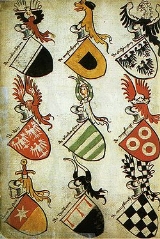
Coat of arms

Encyclopedia
A coat of arms is a unique heraldic
design on a shield
or escutcheon or on a surcoat
or tabard
used to cover and protect armour and to identify the wearer. Thus the term is often stated as "coat-armour", because it was anciently displayed on the front of a coat of cloth. The coat of arms on an escutcheon forms the central element of the full heraldic achievement which consists of shield, supporters, crest and motto. The design is a symbol unique to an individual person, and to his family, corporation, or state. Such displays are commonly called armorial bearings, armorial devices, heraldic devices, or simply armorials or arms.
Historically, armorial bearings were first used by feudal
lords and knight
s in the mid-12th century on battlefields as a way to identify allied from enemy soldiers. As the uses for heraldic designs expanded, other social classes who never would march in battle began to assume arms for themselves. Initially, those closest to the lords and knights adopted arms, such as persons employed as squires that would be in common contact with the armorial devices. Then priests and other ecclesiastical dignities adopted coats of arms, usually to be used as seals and other such insignia, and then towns and cities to likewise seal and authenticate documents. Eventually by the mid-13th century, peasants, commoners and burghers were adopting heraldic devices. The widespread assumption of arms led some states to regulate heraldry within their borders. However, in most of continental Europe, citizens freely adopted armorial bearings.
Despite no widespread regulation, and even with a lack in many cases of national-level regulation, heraldry has remained rather consistent across Europe, where traditions alone have governed the design and use of arms. Unlike seals
and other general emblem
s, heraldic achievements have a formal description called a blazon
, expressed in a jargon that allows for consistency in heraldic depictions.
In the 21st century, coats of arms are still in use by a variety of institutions and individuals; for example, universities have guidelines on how their coats of arms may be used, and protect their use as trademarks. Many societies exist that also aid in the design and registration of personal arms, and some nations, like England and Scotland, still maintain to this day the mediæval authorities that grant and regulate arms.
 In the heraldic traditions of England
and Scotland
an individual, rather than a family, had a coat of arms. In those traditions coats of arms are legal property transmitted from father to son; wives and daughters
could also bear arms modified to indicate their relation to the current holder of the arms. Undifferenced arms
are used only by one person at any given time. Other descendants of the original bearer could bear the ancestral arms only with some difference
: usually a color change or the addition of a distinguishing charge
. One such charge is the label
, which in British
usage (outside the Royal Family
) is now always the mark of an heir apparent
or (in Scotland) an heir presumptive.
Because of their importance in identification, particularly in seals on legal documents, the use of arms was strictly regulated; few countries continue in this today. This has been carried out by herald
s and the study of coats of arms is therefore called "heraldry". Some other traditions (e.g., Polish heraldry
) are less restrictive — allowing, for example, all members of a dynastic house or family to use the same arms, although one or more elements may be reserved to the head of the house.
In time, the use of arms spread from military entities to educational institutes, and other establishments. According to a design institute article, "The modern logo and corporate livery have evolved from the battle standard and military uniform of medieval times".
In his book, The Visual Culture of Violence in the Late Middle Ages, Valentin Groebner argues that the images composed on coats of arms are in many cases designed to convey a feeling of power and strength, often in military terms. The author Helen Stuart argues that some coats of arms were a form of corporate logo
. Museums on medieval armory also point out that as emblems they may be viewed as precursors to the corporate logos of modern society, used for group identity formation.
When knights were so encased in armour that no means of identifying them was left, the practice was introduced of painting their insignia of honour on their shield as an easy method of distinguishing them. Originally these were granted only to individuals, but were afterward made hereditary in England by King Richard I
, during his crusade
to Palestine.
has criminal jurisdiction
to enforce the laws of arms. In England, Northern Ireland
and Wales
the use of arms is a matter of civil law
and regulated from the College of Arms
and the Court of Chivalry
.
In reference to a dispute over the exercise of authority over the Officers of Arms in England, Arthur Annesley, 1st Earl of Anglesey
, Lord Privy Seal
, declared on 16 June 1673 that the powers of the Earl Marshal
were "to order, judge, and determine all matters touching arms, ensigns of nobility, honour, and chivalry; to make laws, ordinances, and statutes for the good government of the Officers of Arms; to nominate Officers to fill vacancies in the College of Arms; to punish and correct Officers of Arms for misbehaviour in the execution of their places". It was further declared that no patents of arms or any ensigns of nobility should be granted and no augmentation, alteration, or addition should be made to arms without the consent of the Earl Marshal.
, since 1552, the usage and granting of coats of arms has been strictly regulated by the Government of Ireland, through the Office of the Chief Herald of Ireland.
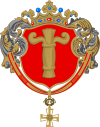 The heraldic tradition and style of modern and historic Germany
and the Holy Roman Empire
— including national and civic arms, noble and burgher arms
, ecclesiastical heraldry, heraldic displays and heraldic descriptions — stand in contrast to Gallo-British, Latin and Eastern heraldry, and strongly influenced the styles and customs of heraldry in the Nordic countries
, which developed comparatively late.
In the Nordic countries
, provinces, regions, cities and municipalities have a coat of arms. These are posted at the borders and on buildings containing official offices, as well as used in official documents and on the uniforms of municipal officers. Arms may also be used on souvernirs or other effects, given that an application has been granted by the municipal council.
as well as old republics like San Marino
and Switzerland
.
In Ireland
the usage and granting of coats of arms is strictly regulated by the Government of Ireland through the Office of the Chief Herald of Ireland.
In Italy
the use of coats of arms was only loosely regulated by the states existing before the unification
of 1860. Since the Consulta Araldica
, the college of arms
of the Kingdom of Italy
, was abolished in 1948, personal coats of arms and titles of nobility, though not outlawed, are not recognised.
Among the states ruled by communist regimes, coats of arms resembling the Soviet design
were adopted in all the Warsaw Pact
states except Czechoslovakia
and Poland.
Since 1989, some of the ex-Communist state
s, such as Romania
, have resumed their former arms, often with only the symbols of monarchy removed.
. Canada has its own Chief Herald
and Herald Chancellor. The Canadian Heraldic Authority
is situated at Rideau Hall
.
 The Great Seal of the United States
uses on the obverse as its central motif an heraldic achievement described as being the arms of the nation. The seal, and the armorial bearings, were adopted by the Continental Congress
on June 20, 1782, and is a shield divided palewise into thirteen pieces, with a blue chief, which is displayed upon the breast of an American bald eagle. The crest is thirteen stars breaking through a glory and clouds, displayed with no helm, torse or mantling (unlike most European precedents).
Only a few of the American states
have adopted a coat of arms, which is usually designed as part of the respective state's seal
. Vermont
has both a state seal and a state coat of arms
that are independent of one another (though both contain a pine tree, a cow and sheaves of grain); the seal is used to authenticate documents, whilst the heraldic device represents the state itself.
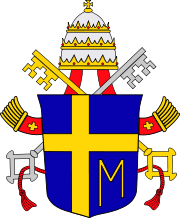 Vatican City State and the Holy See
each have their own coat of arms. As the Papacy is not hereditary, its occupants display their personal arms combined with those of their office.
Some Pope
s came from armiger
ous (noble) families; others adopted coats of arms during their career in the church. The latter typically allude to their ideal of life, or to specific Pontifical programmes. A well known and widely displayed example in recent times was Pope John Paul II
's coat of arms. His selection of a large letter M (for Mary
) on his coat of arms was intended to express the message of his strong Marian
devotion
.
Roman Catholic
Diocese
s also are assigned a coat of arms. A Basilica
, or papal church also gets a coat of arms, which is usually displayed on the building. These may be used in countries which otherwise do not use heraldic devices.
However in countries like Scotland with a strong statutory heraldic authority arms will need to be officially granted and recorded.
in the second half of the 20th century, European traditions of heraldry were partially adopted for state emblems.
These emblems often involve the star and crescent
symbol taken from the Ottoman flag
.
Another commonly seen charge is the eagle, which is a symbol attributed to Saladin
, and the hawk
of the Qureish.
today. The Japanese tradition is independent of the European, and thus very different in style; but as in Europe many abstract and floral elements are used.
Yet, even these simple designs often express an origin. An example in recent use is the logo of Mitsubishi
corporation which started as a shipping and maritime enterprise and whose emblem is based on a water chestnut
derived from its maritime history with a military naval influence. The word mitsu means the number 3 and the word hishi meaning "water chestnut" ' onMouseout='HidePop("24145")' href="/topics/Rendaku">rendaku
) originated from the emblem of the warrior Tosa Clan. The battleships of the Tosa Clan had been used in the late 19th century in the First Sino-Japanese War
to reach Korea and their name was given to a modern battleship
. The Tosa water chestnut leaf mon was then drawn as a rhombus
or diamond shape in the Mitsubishi logo.
s are used to identify ships (where they are called ensign
s), embassies and such, and they use the same colors
and designs found in heraldry, but they are not usually considered to be heraldic. A country may have both a national flag
and a national coat of arms, and the two may not look alike at all. For example, the flag of Scotland
(St Andrew's Cross) has a white saltire
on a blue field
, but the royal arms of Scotland
has a red lion within a double tressure on a gold (or)
field.
Heraldry
Heraldry is the profession, study, or art of creating, granting, and blazoning arms and ruling on questions of rank or protocol, as exercised by an officer of arms. Heraldry comes from Anglo-Norman herald, from the Germanic compound harja-waldaz, "army commander"...
design on a shield
Shield
A shield is a type of personal armor, meant to intercept attacks, either by stopping projectiles such as arrows or redirecting a hit from a sword, mace or battle axe to the side of the shield-bearer....
or escutcheon or on a surcoat
Surcoat
A surcoat was an outer garment commonly worn in the Middle Ages by both men and women. It can either refer to a coat worn over other garments or the outer garment of a person...
or tabard
Tabard
A tabard is a short coat, either sleeveless, or with short sleeves or shoulder pieces, which was a common item of men's clothing in the Middle Ages, usually for outdoors. It might be belted, or not...
used to cover and protect armour and to identify the wearer. Thus the term is often stated as "coat-armour", because it was anciently displayed on the front of a coat of cloth. The coat of arms on an escutcheon forms the central element of the full heraldic achievement which consists of shield, supporters, crest and motto. The design is a symbol unique to an individual person, and to his family, corporation, or state. Such displays are commonly called armorial bearings, armorial devices, heraldic devices, or simply armorials or arms.
Historically, armorial bearings were first used by feudal
Feudalism
Feudalism was a set of legal and military customs in medieval Europe that flourished between the 9th and 15th centuries, which, broadly defined, was a system for ordering society around relationships derived from the holding of land in exchange for service or labour.Although derived from the...
lords and knight
Knight
A knight was a member of a class of lower nobility in the High Middle Ages.By the Late Middle Ages, the rank had become associated with the ideals of chivalry, a code of conduct for the perfect courtly Christian warrior....
s in the mid-12th century on battlefields as a way to identify allied from enemy soldiers. As the uses for heraldic designs expanded, other social classes who never would march in battle began to assume arms for themselves. Initially, those closest to the lords and knights adopted arms, such as persons employed as squires that would be in common contact with the armorial devices. Then priests and other ecclesiastical dignities adopted coats of arms, usually to be used as seals and other such insignia, and then towns and cities to likewise seal and authenticate documents. Eventually by the mid-13th century, peasants, commoners and burghers were adopting heraldic devices. The widespread assumption of arms led some states to regulate heraldry within their borders. However, in most of continental Europe, citizens freely adopted armorial bearings.
Despite no widespread regulation, and even with a lack in many cases of national-level regulation, heraldry has remained rather consistent across Europe, where traditions alone have governed the design and use of arms. Unlike seals
Seal (device)
A seal can be a figure impressed in wax, clay, or some other medium, or embossed on paper, with the purpose of authenticating a document ; but the term can also mean the device for making such impressions, being essentially a mould with the mirror image of the design carved in sunken- relief or...
and other general emblem
Emblem
An emblem is a pictorial image, abstract or representational, that epitomizes a concept — e.g., a moral truth, or an allegory — or that represents a person, such as a king or saint.-Distinction: emblem and symbol:...
s, heraldic achievements have a formal description called a blazon
Blazon
In heraldry and heraldic vexillology, a blazon is a formal description of a coat of arms, flag or similar emblem, from which the reader can reconstruct the appropriate image...
, expressed in a jargon that allows for consistency in heraldic depictions.
In the 21st century, coats of arms are still in use by a variety of institutions and individuals; for example, universities have guidelines on how their coats of arms may be used, and protect their use as trademarks. Many societies exist that also aid in the design and registration of personal arms, and some nations, like England and Scotland, still maintain to this day the mediæval authorities that grant and regulate arms.
Traditions and usage
England
England is a country that is part of the United Kingdom. It shares land borders with Scotland to the north and Wales to the west; the Irish Sea is to the north west, the Celtic Sea to the south west, with the North Sea to the east and the English Channel to the south separating it from continental...
and Scotland
Scotland
Scotland is a country that is part of the United Kingdom. Occupying the northern third of the island of Great Britain, it shares a border with England to the south and is bounded by the North Sea to the east, the Atlantic Ocean to the north and west, and the North Channel and Irish Sea to the...
an individual, rather than a family, had a coat of arms. In those traditions coats of arms are legal property transmitted from father to son; wives and daughters
Women in heraldry
In English heraldry, a woman may bear arms by inheritance from her father or by grant to herself. When unmarried, she displays her arms on a lozenge or on an oval or oval-like shape. Traditionally, a woman does not display her arms on a shield, as the shield originated with knights and warfare,...
could also bear arms modified to indicate their relation to the current holder of the arms. Undifferenced arms
Undifferenced arms
Undifferenced arms are coats of arms which have no marks distinguishing the bearer by birth order or family position. In the Scottish and English heraldic traditions, these plain coats of arms are legal property transmitted from father to eldest male heir, and are used only by one person at any...
are used only by one person at any given time. Other descendants of the original bearer could bear the ancestral arms only with some difference
Cadency
In heraldry, cadency is any systematic way of distinguishing similar coats of arms belonging to members of the same family. Cadency is necessary in heraldic systems in which a given design may be owned by only one person at once...
: usually a color change or the addition of a distinguishing charge
Charge (heraldry)
In heraldry, a charge is any emblem or device occupying the field of an escutcheon . This may be a geometric design or a symbolic representation of a person, animal, plant, object or other device...
. One such charge is the label
Label (heraldry)
In heraldry, a label is a charge resembling the strap crossing the horse’s chest from which pendants are hung. It is usually a mark of difference, but has sometimes been borne simply as a charge in its own right....
, which in British
United Kingdom
The United Kingdom of Great Britain and Northern IrelandIn the United Kingdom and Dependencies, other languages have been officially recognised as legitimate autochthonous languages under the European Charter for Regional or Minority Languages...
usage (outside the Royal Family
British Royal Family
The British Royal Family is the group of close relatives of the monarch of the United Kingdom. The term is also commonly applied to the same group of people as the relations of the monarch in her or his role as sovereign of any of the other Commonwealth realms, thus sometimes at variance with...
) is now always the mark of an heir apparent
Heir apparent
An heir apparent or heiress apparent is a person who is first in line of succession and cannot be displaced from inheriting, except by a change in the rules of succession....
or (in Scotland) an heir presumptive.
Because of their importance in identification, particularly in seals on legal documents, the use of arms was strictly regulated; few countries continue in this today. This has been carried out by herald
Herald
A herald, or, more correctly, a herald of arms, is an officer of arms, ranking between pursuivant and king of arms. The title is often applied erroneously to all officers of arms....
s and the study of coats of arms is therefore called "heraldry". Some other traditions (e.g., Polish heraldry
Polish heraldry
Polish heraldry is a branch of heraldry focused on studying the development of coats of arms in the lands of historical Poland , as well as specifically-Polish traits of heraldry. The term is also used to refer to Polish heraldic system, as opposed to systems used elsewhere, notably in Western Europe...
) are less restrictive — allowing, for example, all members of a dynastic house or family to use the same arms, although one or more elements may be reserved to the head of the house.
In time, the use of arms spread from military entities to educational institutes, and other establishments. According to a design institute article, "The modern logo and corporate livery have evolved from the battle standard and military uniform of medieval times".
In his book, The Visual Culture of Violence in the Late Middle Ages, Valentin Groebner argues that the images composed on coats of arms are in many cases designed to convey a feeling of power and strength, often in military terms. The author Helen Stuart argues that some coats of arms were a form of corporate logo
Logo
A logo is a graphic mark or emblem commonly used by commercial enterprises, organizations and even individuals to aid and promote instant public recognition...
. Museums on medieval armory also point out that as emblems they may be viewed as precursors to the corporate logos of modern society, used for group identity formation.
When knights were so encased in armour that no means of identifying them was left, the practice was introduced of painting their insignia of honour on their shield as an easy method of distinguishing them. Originally these were granted only to individuals, but were afterward made hereditary in England by King Richard I
Richard I of England
Richard I was King of England from 6 July 1189 until his death. He also ruled as Duke of Normandy, Duke of Aquitaine, Duke of Gascony, Lord of Cyprus, Count of Anjou, Count of Maine, Count of Nantes, and Overlord of Brittany at various times during the same period...
, during his crusade
Third Crusade
The Third Crusade , also known as the Kings' Crusade, was an attempt by European leaders to reconquer the Holy Land from Saladin...
to Palestine.
British heraldry
In Scotland, the Lord Lyon King of ArmsLord Lyon King of Arms
The Lord Lyon King of Arms, the head of Lyon Court, is the most junior of the Great Officers of State in Scotland and is the Scottish official with responsibility for regulating heraldry in that country, issuing new grants of arms, and serving as the judge of the Court of the Lord Lyon, the oldest...
has criminal jurisdiction
Criminal jurisdiction
Criminal jurisdiction is a term used in constitutional law and public law to describe the power of courts to hear a case brought by a state accusing a defendant of the commission of a crime...
to enforce the laws of arms. In England, Northern Ireland
Northern Ireland
Northern Ireland is one of the four countries of the United Kingdom. Situated in the north-east of the island of Ireland, it shares a border with the Republic of Ireland to the south and west...
and Wales
Wales
Wales is a country that is part of the United Kingdom and the island of Great Britain, bordered by England to its east and the Atlantic Ocean and Irish Sea to its west. It has a population of three million, and a total area of 20,779 km²...
the use of arms is a matter of civil law
Civil law (common law)
Civil law, as opposed to criminal law, is the branch of law dealing with disputes between individuals or organizations, in which compensation may be awarded to the victim...
and regulated from the College of Arms
College of Arms
The College of Arms, or Heralds’ College, is an office regulating heraldry and granting new armorial bearings for England, Wales and Northern Ireland...
and the Court of Chivalry
Court of Chivalry
Her Majesty's High Court of Chivalry of England and Wales is a civil court in England. It has had jurisdiction in cases of the misuse of heraldic arms since the fourteenth century....
.
In reference to a dispute over the exercise of authority over the Officers of Arms in England, Arthur Annesley, 1st Earl of Anglesey
Arthur Annesley, 1st Earl of Anglesey
Arthur Annesley, 1st Earl of Anglesey PC was an Anglo-Irish royalist statesman. After short periods as President of the Council of State and Treasurer of the Navy, he served as Lord Privy Seal between 1673 and 1682 for Charles II...
, Lord Privy Seal
Lord Privy Seal
The Lord Privy Seal is the fifth of the Great Officers of State in the United Kingdom, ranking beneath the Lord President of the Council and above the Lord Great Chamberlain. The office is one of the traditional sinecure offices of state...
, declared on 16 June 1673 that the powers of the Earl Marshal
Earl Marshal
Earl Marshal is a hereditary royal officeholder and chivalric title under the sovereign of the United Kingdom used in England...
were "to order, judge, and determine all matters touching arms, ensigns of nobility, honour, and chivalry; to make laws, ordinances, and statutes for the good government of the Officers of Arms; to nominate Officers to fill vacancies in the College of Arms; to punish and correct Officers of Arms for misbehaviour in the execution of their places". It was further declared that no patents of arms or any ensigns of nobility should be granted and no augmentation, alteration, or addition should be made to arms without the consent of the Earl Marshal.
Irish heraldry
In IrelandIreland
Ireland is an island to the northwest of continental Europe. It is the third-largest island in Europe and the twentieth-largest island on Earth...
, since 1552, the usage and granting of coats of arms has been strictly regulated by the Government of Ireland, through the Office of the Chief Herald of Ireland.
German and Scandinavian heraldry
Germany
Germany , officially the Federal Republic of Germany , is a federal parliamentary republic in Europe. The country consists of 16 states while the capital and largest city is Berlin. Germany covers an area of 357,021 km2 and has a largely temperate seasonal climate...
and the Holy Roman Empire
Holy Roman Empire
The Holy Roman Empire was a realm that existed from 962 to 1806 in Central Europe.It was ruled by the Holy Roman Emperor. Its character changed during the Middle Ages and the Early Modern period, when the power of the emperor gradually weakened in favour of the princes...
— including national and civic arms, noble and burgher arms
Burgher arms
Burgher arms are coats of arms of commoners in heraldry of the European continent, and, by definition, the term is alien to British heraldry....
, ecclesiastical heraldry, heraldic displays and heraldic descriptions — stand in contrast to Gallo-British, Latin and Eastern heraldry, and strongly influenced the styles and customs of heraldry in the Nordic countries
Nordic countries
The Nordic countries make up a region in Northern Europe and the North Atlantic which consists of Denmark, Finland, Iceland, Norway and Sweden and their associated territories, the Faroe Islands, Greenland and Åland...
, which developed comparatively late.
In the Nordic countries
Nordic countries
The Nordic countries make up a region in Northern Europe and the North Atlantic which consists of Denmark, Finland, Iceland, Norway and Sweden and their associated territories, the Faroe Islands, Greenland and Åland...
, provinces, regions, cities and municipalities have a coat of arms. These are posted at the borders and on buildings containing official offices, as well as used in official documents and on the uniforms of municipal officers. Arms may also be used on souvernirs or other effects, given that an application has been granted by the municipal council.
Other European countries
At a national level, "coats of arms" were generally retained by European states with constitutional continuity of more than a few centuries, including constitutional monarchies like DenmarkCoat of arms of Denmark
The royal coat of arms is more complex. The shield is quartered by a silver cross fimbriated in red, derived from the Danish flag, the Dannebrog. The first and fourth quarters represent Denmark by three crowned lions passant accompanied by nine hearts; the second quarter contains two lions passant...
as well as old republics like San Marino
Coat of arms of San Marino
The coat of arms of San Marino probably originated in the fourteenth century. The official establishment took place on 6 April 1862 by a Decree of the Supreme Council; the same act introduced the crown on top of the shield....
and Switzerland
Coat of arms of Switzerland
The coat of arms of Switzerland shows the same white Greek cross as the flag of Switzerland, but on a red shield. The appearance of the coat of arms or shield varies greatly, but the federal resolution of 12 December 1889 on the coat of arms decrees that the four arms have equal lengths, in a ratio...
.
In Ireland
Ireland
Ireland is an island to the northwest of continental Europe. It is the third-largest island in Europe and the twentieth-largest island on Earth...
the usage and granting of coats of arms is strictly regulated by the Government of Ireland through the Office of the Chief Herald of Ireland.
In Italy
Italy
Italy , officially the Italian Republic languages]] under the European Charter for Regional or Minority Languages. In each of these, Italy's official name is as follows:;;;;;;;;), is a unitary parliamentary republic in South-Central Europe. To the north it borders France, Switzerland, Austria and...
the use of coats of arms was only loosely regulated by the states existing before the unification
Italian unification
Italian unification was the political and social movement that agglomerated different states of the Italian peninsula into the single state of Italy in the 19th century...
of 1860. Since the Consulta Araldica
Consulta Araldica
The Consulta Araldica was a college instituted by royal decree on 10 October 1869 to advise the Italian government on noble titles, coats of arms and related matters. It was part of the Ministry of the Interior...
, the college of arms
College of Arms
The College of Arms, or Heralds’ College, is an office regulating heraldry and granting new armorial bearings for England, Wales and Northern Ireland...
of the Kingdom of Italy
Kingdom of Italy (1861–1946)
The Kingdom of Italy was a state forged in 1861 by the unification of Italy under the influence of the Kingdom of Sardinia, which was its legal predecessor state...
, was abolished in 1948, personal coats of arms and titles of nobility, though not outlawed, are not recognised.
Among the states ruled by communist regimes, coats of arms resembling the Soviet design
Socialist heraldry
Socialist heraldry, also called communist heraldry, consists of emblems in a style typically adopted by communist states. Although commonly called coats of arms, most such devices are not actually coats of arms in the traditional heraldic sense...
were adopted in all the Warsaw Pact
Warsaw Pact
The Warsaw Treaty Organization of Friendship, Cooperation, and Mutual Assistance , or more commonly referred to as the Warsaw Pact, was a mutual defense treaty subscribed to by eight communist states in Eastern Europe...
states except Czechoslovakia
Coat of arms of Czechoslovakia
Several coats of arms were used during Czechoslovakia’s history, some alongside each other.-References:* *...
and Poland.
Since 1989, some of the ex-Communist state
Communist state
A communist state is a state with a form of government characterized by single-party rule or dominant-party rule of a communist party and a professed allegiance to a Leninist or Marxist-Leninist communist ideology as the guiding principle of the state...
s, such as Romania
Coat of arms of Romania
The coat of arms of Romania was adopted in the Romanian Parliament on 10 September 1992 as a representative coat of arms for Romania. It is based on the Lesser Coat of Arms of the Kingdom of Romania , redesigned by Victor Dima. As a central element it shows a golden aquila holding a cross in its...
, have resumed their former arms, often with only the symbols of monarchy removed.
Canada
The Queen of Canada has delegated her prerogative to grant armorial bearings to the Governor General of CanadaGovernor General of Canada
The Governor General of Canada is the federal viceregal representative of the Canadian monarch, Queen Elizabeth II...
. Canada has its own Chief Herald
Chief Herald of Canada
Chief Herald of Canada is the title held by the head of the Canadian Heraldic Authority. The Chief Herald of Canada directs the operations of the Canadian Heraldic Authority and makes the grants of arms. There are exceptions to this, such as certain grants made directly by the Governor General. The...
and Herald Chancellor. The Canadian Heraldic Authority
Canadian Heraldic Authority
The Canadian Heraldic Authority is part of the Canadian honours system under the Queen of Canada, whose authority is exercised by the Governor General. The Authority is responsible for the creation and granting of new coats of arms , flags and badges for Canadian citizens, permanent residents and...
is situated at Rideau Hall
Rideau Hall
Rideau Hall is, since 1867, the official residence in Ottawa of both the Canadian monarch and the Governor General of Canada. It stands in Canada's capital on a 0.36 km2 estate at 1 Sussex Drive, with the main building consisting of 170 rooms across 9,500 m2 , and 24 outbuildings around the...
.
United States
Great Seal of the United States
The Great Seal of the United States is used to authenticate certain documents issued by the United States federal government. The phrase is used both for the physical seal itself , and more generally for the design impressed upon it...
uses on the obverse as its central motif an heraldic achievement described as being the arms of the nation. The seal, and the armorial bearings, were adopted by the Continental Congress
Continental Congress
The Continental Congress was a convention of delegates called together from the Thirteen Colonies that became the governing body of the United States during the American Revolution....
on June 20, 1782, and is a shield divided palewise into thirteen pieces, with a blue chief, which is displayed upon the breast of an American bald eagle. The crest is thirteen stars breaking through a glory and clouds, displayed with no helm, torse or mantling (unlike most European precedents).
Only a few of the American states
U.S. state
A U.S. state is any one of the 50 federated states of the United States of America that share sovereignty with the federal government. Because of this shared sovereignty, an American is a citizen both of the federal entity and of his or her state of domicile. Four states use the official title of...
have adopted a coat of arms, which is usually designed as part of the respective state's seal
Seals of the U.S. states
The following gallery displays the official seals of the 50 states, federal district, and territories of the United States of America:-See also:* Coat of Arms of the U.S. States* Seals of Governors of the U.S. States* Flags of the U.S. states...
. Vermont
Vermont
Vermont is a state in the New England region of the northeastern United States of America. The state ranks 43rd in land area, , and 45th in total area. Its population according to the 2010 census, 630,337, is the second smallest in the country, larger only than Wyoming. It is the only New England...
has both a state seal and a state coat of arms
Coat of arms of Vermont
The coat of arms of Vermont is the official armorial bearings of the U.S. state of Vermont. Most of the elements found in the coat of arms originate in the Great Seal of Vermont designed by Ira Allen...
that are independent of one another (though both contain a pine tree, a cow and sheaves of grain); the seal is used to authenticate documents, whilst the heraldic device represents the state itself.
Catholic Church
Holy See
The Holy See is the episcopal jurisdiction of the Catholic Church in Rome, in which its Bishop is commonly known as the Pope. It is the preeminent episcopal see of the Catholic Church, forming the central government of the Church. As such, diplomatically, and in other spheres the Holy See acts and...
each have their own coat of arms. As the Papacy is not hereditary, its occupants display their personal arms combined with those of their office.
Some Pope
Pope
The Pope is the Bishop of Rome, a position that makes him the leader of the worldwide Catholic Church . In the Catholic Church, the Pope is regarded as the successor of Saint Peter, the Apostle...
s came from armiger
Armiger
In heraldry, an armiger is a person entitled to use a coat of arms. Such a person is said to be armigerous.-Etymology:The Latin word armiger literally means "armour-bearer". In high and late medieval England, the word referred to an esquire attendant upon a knight, but bearing his own unique...
ous (noble) families; others adopted coats of arms during their career in the church. The latter typically allude to their ideal of life, or to specific Pontifical programmes. A well known and widely displayed example in recent times was Pope John Paul II
Pope John Paul II
Blessed Pope John Paul II , born Karol Józef Wojtyła , reigned as Pope of the Catholic Church and Sovereign of Vatican City from 16 October 1978 until his death on 2 April 2005, at of age. His was the second-longest documented pontificate, which lasted ; only Pope Pius IX ...
's coat of arms. His selection of a large letter M (for Mary
Blessed Virgin Mary (Roman Catholic)
Roman Catholic veneration of the Blessed Virgin Mary is based on Holy Scripture: In the fullness of time, God sent his son, born of a virgin. The mystery of the incarnation of the Son of God through Mary thus signifies her honour as Mother of God...
) on his coat of arms was intended to express the message of his strong Marian
Mariology
Roman Catholic Mariology is theology concerned with the Virgin Mary, the mother of Jesus Christ as developed by the Catholic Church. Roman Catholic teachings on the subject have been based on the belief that "The Blessed Virgin, because she is the Mother of God, is believed to hold a certain...
devotion
Catholic devotions
A Roman Catholic devotion is a gift of oneself, or one's activities to God. It is a willingness and desire to dedicate oneself to serve God; either in terms of prayers or in terms of a set of pious acts such as the adoration of God or the veneration of the saints or the Virgin Mary.Roman Catholic...
.
Roman Catholic
Roman Catholic Church
The Catholic Church, also known as the Roman Catholic Church, is the world's largest Christian church, with over a billion members. Led by the Pope, it defines its mission as spreading the gospel of Jesus Christ, administering the sacraments and exercising charity...
Diocese
Diocese
A diocese is the district or see under the supervision of a bishop. It is divided into parishes.An archdiocese is more significant than a diocese. An archdiocese is presided over by an archbishop whose see may have or had importance due to size or historical significance...
s also are assigned a coat of arms. A Basilica
Basilica
The Latin word basilica , was originally used to describe a Roman public building, usually located in the forum of a Roman town. Public basilicas began to appear in Hellenistic cities in the 2nd century BC.The term was also applied to buildings used for religious purposes...
, or papal church also gets a coat of arms, which is usually displayed on the building. These may be used in countries which otherwise do not use heraldic devices.
However in countries like Scotland with a strong statutory heraldic authority arms will need to be officially granted and recorded.
Arab World
With the formation of the modern nation states of the Arab WorldArab world
The Arab world refers to Arabic-speaking states, territories and populations in North Africa, Western Asia and elsewhere.The standard definition of the Arab world comprises the 22 states and territories of the Arab League stretching from the Atlantic Ocean in the west to the Arabian Sea in the...
in the second half of the 20th century, European traditions of heraldry were partially adopted for state emblems.
These emblems often involve the star and crescent
Star and crescent
A star and crescent featuring in some combination form the basis of symbols widely found across the ancient world, with examples attested from the Eastern Mediterranean and Central Asia....
symbol taken from the Ottoman flag
Ottoman Flag
The term Ottoman flag refers to any of the flags used by the ruling Sultans of the Ottoman Dynasty. Various flags were used within the Ottoman Empire during its existence, and the sultan also used different personal flags on different occasions of state...
.
Another commonly seen charge is the eagle, which is a symbol attributed to Saladin
Saladin
Ṣalāḥ ad-Dīn Yūsuf ibn Ayyūb , better known in the Western world as Saladin, was an Arabized Kurdish Muslim, who became the first Sultan of Egypt and Syria, and founded the Ayyubid dynasty. He led Muslim and Arab opposition to the Franks and other European Crusaders in the Levant...
, and the hawk
Hawk
The term hawk can be used in several ways:* In strict usage in Australia and Africa, to mean any of the species in the subfamily Accipitrinae, which comprises the genera Accipiter, Micronisus, Melierax, Urotriorchis and Megatriorchis. The large and widespread Accipiter genus includes goshawks,...
of the Qureish.
Japan
The Japanese equivalents, called kamon (often abbreviated "mon"), are family badges which often date back to the 7th century, and are still actively used in JapanJapan
Japan is an island nation in East Asia. Located in the Pacific Ocean, it lies to the east of the Sea of Japan, China, North Korea, South Korea and Russia, stretching from the Sea of Okhotsk in the north to the East China Sea and Taiwan in the south...
today. The Japanese tradition is independent of the European, and thus very different in style; but as in Europe many abstract and floral elements are used.
Yet, even these simple designs often express an origin. An example in recent use is the logo of Mitsubishi
Mitsubishi
The Mitsubishi Group , Mitsubishi Group of Companies, or Mitsubishi Companies is a Japanese multinational conglomerate company that consists of a range of autonomous businesses which share the Mitsubishi brand, trademark and legacy...
corporation which started as a shipping and maritime enterprise and whose emblem is based on a water chestnut
Eleocharis dulcis
The Chinese water chestnut , more often called simply the water chestnut, is a grass-like sedge grown for its edible corms. The water chestnut is actually not a nut at all, but an aquatic vegetable that grows in marshes, underwater in the mud...
derived from its maritime history with a military naval influence. The word mitsu means the number 3 and the word hishi meaning "water chestnut" ' onMouseout='HidePop("24145")' href="/topics/Rendaku">rendaku
Rendaku
is a phenomenon in Japanese morphophonology that governs the voicing of the initial consonant of the non-initial portion of a compound or prefixed word...
) originated from the emblem of the warrior Tosa Clan. The battleships of the Tosa Clan had been used in the late 19th century in the First Sino-Japanese War
First Sino-Japanese War
The First Sino-Japanese War was fought between Qing Dynasty China and Meiji Japan, primarily over control of Korea...
to reach Korea and their name was given to a modern battleship
Japanese battleship Tosa
was a planned battleship of the Imperial Japanese Navy. Designed by Yuzuru Hiraga, she was envisioned as the lead ship of the Tosa class of two ships. The battleships would have been armed with ten guns and bring Japan closer to its goal of an "Eight-four" fleet...
. The Tosa water chestnut leaf mon was then drawn as a rhombus
Rhombus
In Euclidean geometry, a rhombus or rhomb is a convex quadrilateral whose four sides all have the same length. The rhombus is often called a diamond, after the diamonds suit in playing cards, or a lozenge, though the latter sometimes refers specifically to a rhombus with a 45° angle.Every...
or diamond shape in the Mitsubishi logo.
Flags and banners
FlagFlag
A flag is a piece of fabric with a distinctive design that is usually rectangular and used as a symbol, as a signaling device, or decoration. The term flag is also used to refer to the graphic design employed by a flag, or to its depiction in another medium.The first flags were used to assist...
s are used to identify ships (where they are called ensign
Ensign
An ensign is a national flag when used at sea, in vexillology, or a distinguishing token, emblem, or badge, such as a symbol of office in heraldry...
s), embassies and such, and they use the same colors
Tincture (heraldry)
In heraldry, tinctures are the colours used to emblazon a coat of arms. These can be divided into several categories including light tinctures called metals, dark tinctures called colours, nonstandard colours called stains, furs, and "proper". A charge tinctured proper is coloured as it would be...
and designs found in heraldry, but they are not usually considered to be heraldic. A country may have both a national flag
National flag
A national flag is a flag that symbolizes a country. The flag is flown by the government, but usually can also be flown by citizens of the country.Both public and private buildings such as schools and courthouses may fly the national flag...
and a national coat of arms, and the two may not look alike at all. For example, the flag of Scotland
Flag of Scotland
The Flag of Scotland, , also known as Saint Andrew's Cross or the Saltire, is the national flag of Scotland. As the national flag it is the Saltire, rather than the Royal Standard of Scotland, which is the correct flag for all individuals and corporate bodies to fly in order to demonstrate both...
(St Andrew's Cross) has a white saltire
Saltire
A saltire, or Saint Andrew's Cross, is a heraldic symbol in the form of a diagonal cross or letter ex . Saint Andrew is said to have been martyred on such a cross....
on a blue field
Field (heraldry)
In heraldry, the background of the shield is called the field. The field is usually composed of one or more tinctures or furs. The field may be divided or may consist of a variegated pattern....
, but the royal arms of Scotland
Royal coat of arms of Scotland
The royal coat of arms of Scotland was the official coat of arms of the monarchs of Scotland, and was used as the official coat of arms of the Kingdom of Scotland until the Acts of Union of 1707...
has a red lion within a double tressure on a gold (or)
Or (heraldry)
In heraldry, Or is the tincture of gold and, together with argent , belongs to the class of light tinctures called "metals". In engravings and line drawings, it may be represented using a field of evenly spaced dots...
field.
See also
- List of coats of arms
- Baron and FemeBaron and FemeIn English law, Baron and Feme is a phrase used for husband and wife, in relation to each other, who were accounted as one person by coverture. Hence, by the old law of evidence, the one party was excluded from giving evidence for or against the other in civil questions, and a relic of this is...
- Siebmachers WappenbuchSiebmachers WappenbuchSiebmachers Wappenbuch refers to two heraldic multivolume book series of armorial bearings or coats of arms of the nobility within the Holy Roman Empire .The Old Siebmacher...
(Coats of arms from Germany, Switzerland, Austria, etc.)
External links
- College of Arms: Repository of the coats of arms and pedigrees of English, Welsh, Northern Irish and Commonwealth families and their descendants together with, and in principle under the control of, the legal body the Court of ChivalryCourt of ChivalryHer Majesty's High Court of Chivalry of England and Wales is a civil court in England. It has had jurisdiction in cases of the misuse of heraldic arms since the fourteenth century....
, both medieval in origin. - The Court of the Lord Lyon: the statutory heraldry office for Scotland
- Free access to Burke's General Armory (incomplete, 1500 British surnames), Pimbley's Dictionary of Heraldry and Blason des familles d'Europe, Grand Armorial Universel (15,000 European surnames)
- Royal Dutch Library page for the "Wapenboek Beyeren" written by Claes Heynenzoon around 1400, containing over 1000 drawings of coats of arms
- General armorial of noble families in the Russian Empire (Gerbovnik)