


History of Finland

Encyclopedia
The land area that now makes up Finland
was settled immediately after the Ice Age
, beginning from around 8500 BCE. Most of the region was part of the Kingdom of Sweden
from the 13th century to 1809, when it was ceded to the Russian Empire
, becoming the autonomous Grand Duchy of Finland
. The Lutheran religion dominated. Finnish nationalism emerged, focused on Finnish cultural traditions, including music and especially its highly distinctive language. The catastrophic Finnish famine of 1866–1868 was followed by eased economic regulation and extensive emigration.
In 1917, Finland declared independence. A civil war between the Finnish Red Guards
and the White Guard
ensued a few months later with the "Whites" gaining the upper hand. After the internal affairs stabilized, the still mainly agrarian economy grew relatively fast. Relations with the West, especially Sweden and Britain, were strong but tensions remained with the Soviet Union. During the Second World War, Finland fought twice against the Soviet Union, but lost and had to cede most of Karelia
to the USSR. It remained an independent democracy but was forced to stay neutral during the Cold War
(1947-1991), a status called finlandization
.
Later half of its independent history, Finland has maintained a mixed economy
. Since its economic takeoff in the 1970s, its GDP per capita has been among the world's highest. An expanded welfare state
meant that from 1970 and 1990, the number of public sector employees and the tax burden increased more than most. In 1992 Finland simultaneously faced economic overheating and depressed Western, Russian and local markets. The country joined the European Union
in 1995. According to a 2005 poll, most Finns are reluctant to join NATO.
in Kristinestad
, Ostrobothnia. Excavations are underway and if the so far presented estimates hold true, it would be the only pre-glacial (Neanderthal
) site so far found in the Nordic countries
and some 125,000 years old http://www.nba.fi/fi/susiluola.
s. Their items are known as the Suomusjärvi culture and the Kunda culture
. Among the finds is the net of Antrea, one of the oldest fishing nets ever excavated (calibrated carbon dating: ca. 8300 BCE).
for Finland, although the subsistence was still based on hunting and fishing. Extensive networks of exchange existed across Finland and Northeastern Europe during 5th millennium BCE. For example flint from Scandinavia
and Valdai Hills
, amber
from Scandinavia and the Baltic region
, and slate
from Scandinavia and Lake Onega
found their way into Finnish archeological sites and asbestos
and soap stone from e.g. Saimaa
spread outside of Finland. Rock paintings, apparently related to shamanistic and totemistic belief systems, have been found especially in Eastern Finland, e.g. Astuvansalmi
.
From 3200 BCE onwards either immigrants or a strong cultural influence from south of the Gulf of Finland settled in southwestern Finland. This culture was a part of the European Battle Axe cultures, which have often been associated with the movement of Indo-European
speakers. The Battle-Axe or Cord Ceramic culture seems to have practiced agriculture
and animal husbandry
outside of Finland but the earliest confirmed traces of agriculture in Finland date later, approximately to the 2nd millennium BCE. Further inland the societies retained their hunting-gathering lifestyles.
The Battle axe and the Comb Ceramic cultures merged giving rise to the Kiukainen culture which existed between 2300 BCE and 1500 BCE featuring fundamentally a comb ceramic tradition with cord ceramic characteristics.
According to the recently most widespread presumption, Finno-Ugric (or Uralic) languages were first spoken in Finland and the adjacent areas during the (typical) Comb Ceramic period, around 4000 BCE at the latest. During the 2nd millennium BCE these evolved – possibly under an Indo-European (most likely Baltic) influence – into proto-Sami (inland) and proto(-Baltic)-Finnic (coast). However, this theory has been increasingly contested among comparative linguists. It has been suggested instead that the Finno-Ugric languages arrived in Finland later, perhaps only during the Iron Age. The Finnish language is thought to have started to differentiate during the Iron Age starting from the first centuries AD onwards.
Cultural influences from all points of the compass are visible in Finnish archeological finds from the very first settlements onwards. E.g. archaeological finds from Finnish Lapland suggest the presence of the Komsa culture. The Sujala finds equal in age with the earliest Komsa-artefacts from Norway but may suggest also a connection to the Swiderian culture
. South-Western Finland belonged to the Nordic Bronze Age
, which may be associated with Indo-European languages and according to Finnish Germanist Jorma Koivulehto speakers of Proto-Germanic language in particular. Artefacts found in Kalanti
and the province of Satakunta, for long monolingually Finnish, and their place-names have made several scholars argue for an existence of a proto-Germanic speaking population component a little later, during the Early and Middle Iron Age. Old Norse
-speaking population settled parts of Finland's coastal areas in the 12th to 13th centuries. Swedish language differentiated from the eastern Norse dialects by the 13th century. During the subsequent Swedish reign over Finland particularly the coastal areas witnessed waves of settlement from Sweden.
in Finland is considered to last from c.500 BC until c.1150 AD when the Swedish Conquest of Finland was complete and written history in Finland (the Middle Ages
) begins. There is no evidence of any form of writing in Finland, runes or otherwise, prior to the Swedish Conquest and all evidence regarding Finnish history prior to Swedish involvement is based on archaeological findings and the scant records of contemporaneous third parties.
The three main dialectal groups of Finnish-speakers, (proper-)Finns, Tavastians
and Karelians
probably emerged during the Iron Age. The archaeological culture of the Åland Islands
had a more prominent Swedish character than the rest of the country, possibly suggesting Scandinavian settlement.
The earliest findings of imported iron blades and local iron working appear in 500 BC. From about 50 AD, there are indications of a more intense long-distance exchange of goods in coastal Finland. Inhabitants exchanged their products, presumably, mostly furs, for weapons and ornaments with the Balts and the Scandinavians as well as with the peoples along the traditional eastern trade routes. The existence of richly furnished burials, usually with weapons, suggests that there was a chiefly elite in southern and western parts of the country. Hillforts spread over most of southern Finland at the end of the Iron and early Medieval Age. There is no commonly accepted evidence of early state formations in Finland, and the presumedly Iron Age origins of urbanisation are contested.
In the early Iron Age a word similar to Finns appeared for the first time in a written document when Tacitus
mentions Fenni in his Germania
. However, it is unclear if these have anything to do with the present Finnish people. The first Scandinavian documents mentioning a "land of the Finns" are two runestones: (Söderby
, Sweden, with the inscription finlont (U 582 †
), Gotland
with the inscription finlandi (G 319 M
) dating from the 11th century.
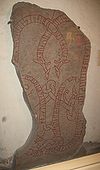 Contact between Sweden and what is now Finland was considerable even during pre-Christian times – the Vikings were known to Finns both due to their participation in commerce and plundering. There is commonly accepted evidence of Viking settlement in the Finnish mainland. The Åland Islands probably had Swedish settlement during the Viking Period. However, some scholars claim that the archipelago was deserted during the 11th century.
According to the archaeological finds, Christianity
gained a foothold in Finland during the 11th century. According to the very few written documents that have survived, the church in Finland was still in its early development in the 12th century. Later medieval legends describe Swedish attempts to conquer and Christianize Finland
sometime in the mid-1150s. In the early 13th century, Bishop Thomas became the first bishop of Finland. There were several secular powers who aimed to bring the Finns under their rule. These were Sweden, Denmark, the Republic of Novgorod in Northwestern Russia and probably the German crusading orders as well. Finns had their own chiefs, but most probably no central authority. Russian chronicles indicate there were conflict between Novgorod and the Finnic tribes
from the 11th or 12th century to the early 13th century.
The name "Finland" originally signified only the southwestern province that has been known as "Finland Proper
" since the 18th century. Österland
(lit. Eastern Land) was the original name for the Swedish realm's eastern part, but already in the 15th century Finland began to be used synonymously with Österland. The concept of a Finnish "country" in the modern sense developed only slowly during the period of the 15th–18th centuries.
It was the Swedish regent, Birger Jarl
, who established Swedish rule in Finland through the Second Swedish Crusade
, most often dated to 1249, which was aimed at Tavastians who had stopped being Christian again. Novgorod gained control in Karelia
, the region inhabited by speakers of Eastern Finnish dialects. Sweden however gained the control of Western Karelia with the Third Finnish Crusade in 1293. Western Karelians were from then on viewed as part of the western cultural sphere, while eastern Karelians turned culturally to Russia and Orthodoxy
. While eastern Karelians remain linguistically and ethnically closely related to the Finns, they are considered a people of their own by most. Thus, the northern border between Catholic and Orthodox Christendom came to lie at the eastern border of what would become Finland with the Treaty of Nöteborg
in 1323.
During the 13th century, Finland was integrated into medieval European civilization. The Dominican order
arrived in Finland around 1249 and came to exercise huge influence there. In the early 14th century, the first documents of Finnish students at Sorbonne
appear. In the south-western part of the country, an urban settlement evolved in Turku
. Turku was one of the biggest towns in the Kingdom of Sweden, and its population included German merchants and craftsmen. Otherwise the degree of urbanization was very low in medieval Finland. Southern Finland and the long coastal zone of the Bothnian Gulf
had a sparse farming settlement, organized as parishes and castellanies. In the other parts of the country a small population of Sami
hunters, fishermen and small-scale farmers lived. These were exploited by the Finnish and Karelian tax collectors. During the 12th and 13th centuries, great numbers of Swedish settlers moved to the southern and north-western coasts of Finland, to the Åland Islands
and to the archipelago between Turku and the Åland Islands: in these regions, the Swedish language is widely spoken even today. Swedish came to be the language of the high-status people in many other parts of Finland as well.
During the 13th century, the bishopric of Turku was established. The cathedral of Turku was the center of the cult of Saint Henry, and naturally the cultural center of the bishopric. The bishop had the ecclesiastical authority over much of today's Finland and was usually the most powerful man there. Bishops were often Finns, whereas the commanders in the castles were more often Scandinavian or German noblemen. In 1362, representatives from Finland were called to participate in the elections for king of Sweden. That year is often held to signify the incorporation of Finland into the kingdom of Sweden. As in the Scandinavian part of the kingdom, a gentry or (lower) nobility consisted of magnates and yeomen who could afford armament for a man and a horse. These were concentrated in the southern part of Finland.
The strong fortress of Vyborg
(Finnish: Viipuri, Swedish: Viborg) guarded the eastern border of Finland. Sweden and Novgorod signed the Treaty of Nöteborg
(Pähkinäsaari in Finnish) in 1323, but that would not last long. For example, in 1348 the Swedish king Magnus Eriksson
staged a failed crusade against the Orthodox "heretic
s", managing only to alienate his supporters and finally losing his crown. The bones of contention between Sweden and Novgorod were the northern coast-line of the Bothnian Gulf and the wilderness regions of Savo
in Eastern Finland. Novgorod considered these as hunting and fishing grounds of its Karelian subjects, protesting against the slow infiltration of Catholic settlers from the West. Occasional raids and clashes between Swedes and Novgorodians
occurred during the late 14th and 15th centuries, but for most of the time an uneasy peace prevailed. There existed internal tensions as well. During the 1380s a civil war in the Scandinavian part of Sweden brought unrest to Finland, too. The victor of this struggle was Queen Margaret I of Denmark
, who brought the three Scandinavian kingdoms of Sweden, Denmark and Norway under her rule (the "Kalmar Union
") in 1389. The next 130 years or so were characterized by attempts of different Swedish factions to break out of the Union. Finland was sometimes involved in these struggles, but in general the 15th century seems to have been a relatively prosperous time, characterized by population growth and economic development. Towards the end of the century, however, the situation on the eastern border was becoming more tense. The Principality of Moscow conquered Novgorod, preparing the way for a unified Russia, and soon tensions arose with Sweden. In 1495–1497, a war between Sweden and Russia was fought. The fortress-town of Vyborg
stood against a Russian siege: according to a contemporary legend, it was saved by a miracle.
In contrast to serfdom in Germany and Russia, the Finnish peasant was typically a freeholder who owned and controlled his small plot of land. There was no serfdom in which peasants were permanently attached to specific lands, and were ruled by the owners of that land. In Finland (and Sweden) the peasants formed one of the four estates and were represented in the parliament. Outside the political sphere, however, the peasants were considered at the bottom of the social order--just above vagabonds. The upper classes looked down on them as excessively prone to drunkenness and laziness, as clannish and untrustworthy, and especially as lacking honor and a sense of national spirit. This disdain dramatically changed in the 19th century when everyone idealized the peasant as the true carrier of Finnishness and the national ethos, as opposed to the Swedish-speaking elites.
The peasants were not passive; they were proud of their traditions and would band together and fight to uphold their traditional rights in the face of burdensome taxes from the king or new demands by the landowning nobility. The great "Club War" in the south in 1596-97 attacked the nobles and their new system of state feudalism; this bloody revolt was similar to other contemporary peasant wars in Europe. In the north, there was less tension between nobles and peasants and more equality among peasants, due to the practice of subdividing farms among heirs, to non farm economic activities, and to the small numbers of nobility and gentry. Often the nobles and landowners were paternalistic and helpful. The Crown usually sided with the nobles, but after the "restitution" of the 1680s it ended the practice of the nobility extracting labor from the peasants and instead began a new tax system whereby royal bureaucrats collected taxes directly from the peasants, who dislike the efficient new system. After 1800 growing population pressure resulted in larger numbers of poor crofters and landless laborers and the impoverishment of small farmers.
, bishop of Turku, published his translation of the New Testament
into the Finnish language
.
In 1550 Helsinki
was founded by Gustav Vasa under the name of Helsingfors, but remained little more than a fishing village for more than two centuries.
King Gustav Vasa died in 1560 and his crown was passed to his three sons in separate turns. King Erik XIV started an era of expansion when the Swedish crown took the city of Tallinn
in Estonia
under its protection in 1561. The Livonian War
was the beginning of a warlike era which lasted for 160 years. In the first phase, Sweden fought for the lordship of Estonia and Latvia
against Denmark, Poland and Russia. The common people of Finland suffered because of drafts, high taxes, and abuse by military personnel. This resulted in the Cudgel War
of 1596–97, a desperate peasant rebellion, which was suppressed brutally and bloodily. A peace treaty (the Treaty of Teusina) with Russia in 1595 moved the border of Finland further to the east and north, very roughly where the modern border lies.
An important part of the 16th century history of Finland was growth of the area settled by the farming population. The crown encouraged farmers from the province of Savonia
to settle the vast wilderness regions in Middle Finland. This was done, and the original Sami
population often had to leave. Some of the wilderness settled was traditional hunting and fishing territory of Karelia
n hunters. During the 1580s, this resulted in a bloody guerrilla warfare between the Finnish settlers and Karelians in some regions, especially in Ostrobothnia
.
 In 1611-1632 Sweden was ruled by King Gustavus Adolphus, whose military reforms transformed the Swedish army from a peasant militia into an efficient fighting machine, possibly the best in Europe. The conquest of Livonia
was now completed, and some territories were taken from internally divided Russia in the Treaty of Stolbova. In 1630, the Swedish (and Finnish) armies marched into Central Europe, as Sweden had decided to take part in the great struggle between Protestant and Catholic forces in Germany, known as the Thirty Years' War
. The Finnish light cavalry was known as the Hakkapeliitat
.
After the Peace of Westphalia
in 1648, the Swedish Empire
was one of the most powerful countries in Europe. During the war, several important reforms had been made in Finland:
However, the high taxation, continuing wars and the cold climate (the Little Ice Age
) made the Imperial era of Sweden rather gloomy times for Finnish peasants. In 1655–1660, the Northern Wars
were fought, taking Finnish soldiers to the battle-fields of Livonia
, Poland and Denmark. In 1676, the political system of Sweden was transformed into an absolute monarchy
.
In Middle and Eastern Finland, great amounts of tar
were produced for export. European nations needed this material for the maintenance of their fleets. According to some theories, the spirit of early capitalism
in the tar-producing province of Ostrobothnia
may have been the reason for the witch-hunt
wave that happened in this region during the late 17th century. The people were developing more expectations and plans for the future, and when these were not realized, they were quick to blame witches – according to a belief system the Lutheran church had imported from Germany.
The Empire had a colony in the New World in the modern-day Delaware-Pennsylvania area between 1638–1655. At least half of the immigrants were of Finnish origin.
The 17th century was an era of very strict Lutheran orthodoxy. In 1608, the law of Moses was declared the law of the land, in addition to secular legislation. Every subject of the realm was required to confess the Lutheran faith and church attendance was mandatory. Ecclesiastical penalties were widely used. The rigorous requirements of orthodoxy were revealed in the dismissal of the Bishop of Turku, Johan Terserus, who wrote a catechism
which was decreed heretical in 1664 by the theologians of the Academy of Åbo. On the other hand, the Lutheran requirement of the individual study of Bible prompted the first attempts at wide-scale education. The church required from each person a degree of literacy sufficient to read the basic texts of the Lutheran faith. Although the requirements could be fulfilled by learning the texts by heart, also the skill of reading became known among the population.
In 1696-1699, a famine
caused by climate decimated Finland. A combination of an early frost, the freezing temperatures preventing grain from reaching Finnish ports, and a lackluster response from the Swedish government saw about one-third of the population die. Soon afterwards, another war determining Finland's fate began (the Great Northern War
of 1700–21).
(1700–1721) was devastating, as Sweden and Russia fought for control of the Baltic. Harsh conditions --worsening poverty and repeated crop failures--among peasants undermined support for the war, leading to Sweden's defeat. Finland was a battleground as both armies ravaged the countryside, leading to famine, epidemics, social disruption and the loss of nearly half the population. By 1721 only 250,000 remained. Landowners had to pay higher wages to keep their peasants. Russia was the winner, annexing the south-eastern part
, including the town of Vyborg
, after the Treaty of Nystad
. The border with Russia came to lie roughly where it returned to after World War II. Sweden's status as a European great power was forfeit, and Russia was now the leading power in the North. The absolute monarchy was ended in Sweden. During this Age of Liberty, the Parliament
ruled the country, and the two parties of the Hats
and Caps
struggled for control leaving the lesser Court party, i.e. parliamentarians with close connections to the royal court, with little to no influence. The Caps wanted to have a peaceful relationship with Russia and were supported by many Finns, while other Finns longed for revenge and supported the Hats.
Finland by this time was depopulated, with a population in 1749 of 427,000. However with peace the population grew rapidly, and doubled before 1800. 90% of the population were typically classified as "peasant
s", most being free taxed yeomen. Society was divided into four Estates: peasants (free taxed yeomen), the clergy, nobility and burghers. A minority, mostly cottage
rs, were estateless, and had no political representation. Forty-five percent of the male population were enfranchised with full political representation in the legislature – although clerics, nobles and townsfolk had their own chambers in the parliament, boosting their political influence and excluding the peasantry on matters of foreign policy.
The mid-18th century was a relatively good time, partly because life was now more peaceful. However, during the Lesser Wrath (1741–1742), Finland was again occupied by the Russians after the government, during a period of Hat party dominance, had made a botched attempt to reconquer the lost provinces. Instead the result of the Treaty of Åbo
was that the Russian border was moved further to the west. During this time, Russian propaganda hinted at the possibility of creating a separate Finnish kingdom
.
Both the ascending Russian Empire and pre-revolutionary France aspired to have Sweden as a client state. Parliamentarians and others with influence were susceptible to taking bribes which they did their best to increase. The integrity and the credibility of the political system waned, and in 1771 the young and charismatic king Gustav III
staged a coup d'état
, abolished parliamentarism and reinstated royal power in Sweden – more or less with the support of the parliament. In 1788, he started a new war against Russia. Despite a couple of victorious battles
, the war was fruitless, managing only to bring disturbance to the economic life of Finland. The popularity of King Gustav III waned considerably. During the war, a group of officers made the famous Anjala declaration
demanding peace negotiations and calling of Riksdag (Parliament). An interesting sideline to this process was the conspiracy of some Finnish officers, who attempted to create an independent Finnish state with Russian support. After an initial shock, Gustav III crushed this opposition. In 1789, the new constitution of Sweden strengthened the royal power further, as well as improving the status of the peasantry. However, the continuing war had to be finished without conquests – and many Swedes now considered the king as a tyrant.
With the interruption of the war (1788–1790), the last decades of the 18th century had been an era of development in Finland. New things were changing even everyday life, such as starting of potato farming after the 1750s. New scientific and technical inventions were seen. The first hot air balloon in Finland (and in the whole Swedish kingdom) was made in Oulu (Uleåborg) in 1784, only a year after it was invented in France. Trade increased and the peasantry was growing more affluent and self-conscious. The Age of Enlightenment
's climate of broadened debate in the society on issues of politics, religion and morals would in due time highlight the problem that the overwhelming majority of Finns spoke only Finnish
, but the cascade of newspapers, belles-lettres and political leaflets was almost exclusively in Swedish
– when not in French
.
The two Russian occupations had been harsh and were not easily forgotten. These occupations were a seed of a feeling of separateness and otherness, that in a narrow circle of scholars and intellectuals at the university in Turku
was forming a sense of a separate Finnish identity representing the eastern part of the realm. The shining influence of the Russian imperial capital Saint Petersburg
was also much stronger in southern Finland than in other parts of Sweden, and contacts across the new border dispersed the worst fears for the fate of the educated and trading classes under a Russian régime. At the turn of the century, the Swedish-speaking educated classes of officers, clerics and civil servants were mentally well prepared for a shift of allegiance to the strong Russian Empire
.
King Gustav III was assassinated in 1792, and his son Gustav IV Adolf assumed the crown after a period of regency. The new king was not a particularly talented ruler; at least not talented enough to steer his kingdom through the dangerous era of the French Revolution
and Napoleonic wars
.
Meanwhile, the Finnish areas belonging to Russia after the peace treaties in 1721 and 1743 (not including Ingria), called "Old Finland" were initially governed with the old Swedish laws (a not uncommon practice in the expanding Russian Empire in the 18th century). However, gradually the rulers of Russia granted large estates of land to their non-Finnish favorites, ignoring the traditional landownership and peasant freedom laws of Old Finland. There were even cases where the noblemen punished peasants corporally, for example by flogging. The overall situation caused decline in the economy and morale in Old Finland, worsened since 1797 when the area was forced to send men to the Imperial Army. The construction of military installations in the area brought thousands of non-Finnish people to the region. In 1812, after the Russian conquest of Finland, "Old Finland" was rejoined to the rest of the country but the landownership question remained a serious problem until the 1870s.
between Sweden and Russia, Finland was again conquered by the armies of Tsar Alexander I
. The four Estates
of occupied Finland were assembled at the Diet of Porvoo
on March 29, 1809 to pledge allegiance to Alexander I of Russia
. Following the Swedish defeat in the war and the signing of the Treaty of Fredrikshamn on September 17, 1809, Finland remained a Grand Duchy
in the Russian Empire
until the end of 1917, with the czar as Grand Duke. Russia assigned Karelia
("Old Finland") to the Grand Duchy in 1812. During the years of Russian rule the degree of autonomy varied. Periods of censorship and political prosecution occurred, particularly in the two last decades of Russian control, but the Finnish peasantry remained free (unlike the Russian serfs) as the old Swedish law remained effective (including the relevant parts from Gustav III
's Constitution of 1772). The old four-chamber Diet
was re-activated in the 1860s agreeing to supplementary new legislation concerning internal affairs.
The beginnings of industrialism took place in Helsinki. Alfred Kihlman (1825-1904) began as a Lutheran priest and director of the elite Helsingfors boys' school, the Swedish Normal Lyceum. He became a financier and member of the diet. There was little precedent in Finland in the 1850s for raising venture capital. Kihlman was well connected and enlisted businessmen and capitalists to invest in new enterprises. In 1869, he organized a limited partnership that supported two years of developmental activities that led to the founding of the Nokia
company in 1871.
After 1890 industrial productivity stagnated because entrepreneurs were unable to keep up with technological innovations made by competitors in Germany, Britain and the United States. However, Russification opened up a large Russian market especially for machinery.
to predominance resulted from a 19th-century surge of Finnish nationalism, aided by Russian bureaucrats attempting to separate Finns from Sweden and to ensure the Finns' loyalty.
The publication in 1835 of the Finnish national epic
, the Kalevala
, a collection of traditional myths and legends which is the folklore
of the Karelian people (the Finnic
Russian Orthodox
people who inhabit the Lake Ladoga
-region of eastern Finland and present-day NW Russia), stirred the nationalism
that later led to Finland's independence from Russia. The Finnish national awakening in the mid-19th century was the result of members of the Swedish-speaking upper classes deliberately choosing to promote Finnish culture and language as a means of nation building, i.e. to establish a feeling of unity between all people in Finland including (and not of least importance) between the ruling elite and the ruled peasantry.
In 1863, the Finnish language gained an official position in administration. In 1892 Finnish finally became an equal official language and gained a status comparable to that of Swedish. Nevertheless, the Swedish language continued to be the language of culture, arts and business all the way to 1920s.
Movements toward Finnish national pride, as well as liberalism in politics and economics involved ethnic and class dimensions. The nationalist movement against Russia began with the "Fennomanian movement" led by Hegelian philosopher Johan Vilhelm Snellman
in the 1830s. Snellman sought to apply philosophy to social action and moved the basis of Finnish nationalism to establishment of the language in the schools, while remaining loyal to the czar. Fennomania became the Finnish Party in the 1860s.
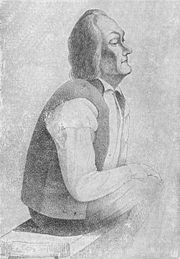 Liberalism was the central issue of the 1860s to 1880s. The language issue overlapped both liberalism and nationalism, and showed some a class conflict as well, with the peasants pitted against the conservative Swedish-speaking landowners and nobles. As complications, the Finnish activists divided into "old" (no compromise on the language question and conservative nationalism) and "young" (liberation from Russia) Finns. The leading liberals were Swedish-speaking intellectuals who called for more democracy; they became the radical leaders after 1880. The liberals organized for social democracy, labor unions, farmer cooperatives, and women's rights.
(1777-1852) on the other hand was a leader of the new pietism, with its subjectivity, revivalism, emphasis on personal morality, lay participation, and the social gospel
. The pietism appealed to the emerging middle class. The Ecclesiastical Law of 1869 combined the two strains. Finland's political and Lutheran leaders considered both Russian Orthodoxy and Roman Catholicism to be threats to the emerging nation. Orthodoxy was rejected as a weapon of Russification, while anti-Catholicism was long-standing. Anti-Semitism was also a factor, so the Dissenter Law of 1889 upgraded the status only of the minor Protestant sects.
), the Institute of Music of Helsinki University and the Helsinki Philharmonic Orchestra
, integrated Finland into the mainstream of European music. By far the most influential composer was Jean Sibelius
(1865-1957); he composed most of his music before 1930. In April 1892 Sibelius presented his new symphony 'Kullervo' in Helsinki. It featured poetry from the Kalevala, and was celebrated by critics as truly Finnish music.
) was the policy of the Russian czars designed to limit the special status of the Grand Duchy of Finland
and more fully integrate it politically, militarily, and culturally into the empire. Finns were strongly opposed and fought back by passive resistance and a strengthening of Finnish cultural identity. Key provisions were the "February Manifesto of 1899" which asserted the imperial government's right to rule Finland without the consent of local legislative bodies. Second, the "Language Manifesto of 1900" which made Russian the language of administration of Finland. Third, the conscription law of 1901 incorporated the Finnish army
into the imperial army and sent conscripts away to Russian training camps.
and the associated Finnish general strike of 1905, the old four-chamber Diet
was replaced by a unicameral Parliament of Finland
(the ""). For the first time in Europe, universal suffrage
(right to vote) and eligibility was implemented to include women: Finnish women were the first in Europe to gain full eligibility to vote; and have membership in an estate; land ownership or inherited titles were no longer required.
However, on the local level things were different, as in the municipal elections the number of votes was tied to amount of tax paid. Thus, rich people could cast a number of votes, while the poor perhaps none at all. The municipal voting system was changed to universal suffrage in 1917
when a left-wing majority was elected to Parliament.
, and also to Canada. They typically worked in lumbering and mining, and many were active in Marxist causes on the one hand, or the Finnish Evangelical Lutheran Church of America on the other. In the 21st century about 700,000 Americans and 110,000 Canadians claim Finnish ancestry.
in Russia, Finland received a new Senate
, a coalition-Cabinet with the same power structure as the Finnish Parliament. Based on the general election
in 1916, the Social Democrat
s had a small majority, and the Social Democrat Oskari Tokoi
became prime minister. The new Senate was willing to cooperate with the provisional government of Russia, but no agreement was reached. Finland considered the personal union
with Russia to be over after the dethroning of the Tsar
– although the Finns had de facto recognized the provisional government as the Tsar's successor by accepting its authority to appoint a new Governor General and Senate. They expected the Tsar's authority to be transferred to Finland's Parliament, which the provisional government of Russia refused, suggesting instead that the question should be settled by the Russian Constituent Assembly
.
For the Finnish Social Democrats it seemed as though the bourgeoisie was an obstacle on Finland's road to independence as well as on the proletariat's road to power. The non-Socialists in Tokoi's Senate were, however, more confident. They and most of the non-Socialists in the Parliament, rejected the Social Democrats' proposal on parliamentarism (the so-called "Power Act") as being too far-reaching and provocative. The act restricted Russia's influence on domestic Finnish matters, but didn't touch the Russian government's power on matters of defence and foreign affairs. For the Russian Provisional government this was, however, far too radical. As the Parliament had exceeded its authority, it was dissolved.
The minority of the Parliament, and of the Senate, were content. New elections promised a chance to gain majority, which they were convinced would improve the chances to reach an understanding with Russia. The non-Socialists were also inclined to cooperate with the Russian Provisional government because they feared the Socialists' power would grow, resulting in radical reforms, such as equal suffrage
in municipal elections, or a land reform
. The majority had the completely opposite opinion. They didn't accept the Provisional government's right to dissolve the Parliament.
The Social Democrats held on to the Power Act and opposed the promulgation
of the decree of dissolution of the Parliament, whereas the non-Socialists voted for promulgating it. The disagreement over the Power Act led to the Social Democrats leaving the Senate. When the Parliament met again after the summer recess in August 1917, only the groups supporting the Power Act were present. Russian troops took possession of the chamber, the Parliament was dissolved, and new elections were carried out. The result was a (small) non-Socialist majority and a purely non-Socialist Senate. The suppression of the Power Act, and the cooperation between Finnish non-Socialist forces and oppressive Russia provoked great bitterness among the Socialists, and had resulted in dozens of politically motivated attacks and murders.
of 1917 turned Finnish politics upside down. Now, the new non-Socialist majority of the Parliament desired total independence, and the Socialists came gradually to view Soviet Russia as an example to follow. On November 15, 1917, the Bolshevik
s declared a general right of self-determination, including the right of complete secession, "for the Peoples of Russia"
. On the same day the Finnish Parliament issued a declaration by which it temporarily took power in Finland.
Worried by the development in Russia, and Finland, the non-Socialist Senate proposed that Parliament declare Finland's independence
, which was agreed on in the Parliament on December 6, 1917. On December 18 (December 31 N. S.) the Soviet government issued a Decree
, recognizing Finland's independence, and on December 22 (January 4, 1918 N. S.) it was approved by the highest Soviet executive body – VTsIK. Germany and the Scandinavian countries followed without delay.
From January to May 1918, Finland experienced the brief but bitter Finnish Civil War
. On one side there were the "white" civil guards, who fought for the anti-Socialists. On the other side were the Red Guards, which consisted of workers and tenant farmers. The latter proclaimed a Finnish Socialist Workers' Republic
. World War I was still underway and the defeat of the Red Guards was achieved with support from Imperial Germany, while Sweden remained neutral and Russia withdrew its forces. The Reds lost the war and the White peasantry rose to political leadership in the 1920s-1930s. About 37,000 men died, most of them in prisoner camps ravaged by influenza and other diseases.
, with a a German prince as king. However, Germany's defeat in Nov. 1918 made the plan impossible and Finland instead became a republic, with Kaarlo Juho Ståhlberg
elected as its first President in 1919. Despite the bitter civil war, and repeated threats from fascist movements, Finland became and remained a free democracy under the rule of law. By contrast nearby Estonia
, in similar circumstances but without a civil war, started as a democracy and was turned into a dictatorship in 1934.
. The League decided that Finland should retain sovereignty over the Åland Islands, but they should be made an autonomous province. Thus Finland was under an obligation to ensure the residents of the Åland Islands a right to maintain the Swedish language
, as well as their own culture and local traditions. At the same time, an international treaty was concluded on the neutral status of Åland, under which it was prohibited to place military headquarters or forces on the islands.
in 1929. Initially the movement gained widespread support among anti-Communist Finns, but following a failed coup attempt
in 1932 it was banned and its leaders imprisoned.
and the Pork mutiny
. Relations with the Soviets were improved after the Treaty of Tartu
in 1920, in which Finland gained Petsamo
, but gave up its claims on East Karelia
.
Tens of thousands of radical Finns--from Finland, the United States and Canada--took up Stalin's 1923 appeal to create a new Soviet society in the Karelian Autonomous Soviet Socialist Republic (KASSR), a part of Russia.
Most were executed in the purges of the 1930s.
The Soviet Union started to tighten its policy against Finland in 1930s, limiting the navigation of Finnish merchant ships between Lake Ladoga
and the Gulf of Finland
and blocking it totally in 1937.
 During World War II, Finland fought two wars against the Soviet Union: the Winter War
of 1939–1940, resulting in the loss of Finnish Karelia
, and the Continuation War
of 1941–1944 (with considerable support from Nazi Germany
resulting in a swift invasion of neighboring areas
of the Soviet Union), eventually leading to the loss of Finland's only ice-free winter harbour Petsamo
. The Continuation War was, in accordance with the armistice conditions
, immediately followed by the Lapland War
of 1944–1945, when Finland fought the Germans to force them to withdraw from northern Finland back into Norway (then under German occupation).
In August 1939 Nazi-Germany and the Soviet Union signed the Molotov-Ribbentrop Pact
, where Finland and the Baltic states were given to the Soviet "sphere of influence". After the Invasion of Poland, the Soviet Union sent ultimatums to the Baltic countries, where it demanded military bases on their soil. The Baltic states accepted Soviet demands, and lost their independence in the summer of 1940. In October 1939, the Soviet Union sent the same kind of request to Finland, but the Finns refused to give any land areas or military bases for the usage of the Red Army. This caused the Soviet Union to start a military invasion against Finland
on 30 November 1939. Soviet leaders predicted that Finland would be conquered in a couple of weeks. However, even though the Red Army had huge superiority in men, tanks, guns and airplanes, the Finns were able to defend their country about 3.5 months and still avoid invasion successfully. The Winter War ended on 13 March 1940 with the Moscow peace treaty. Finland lost the Karelian Isthmus
to the Soviet Union after the war. The Winter War was a big loss of prestige for Soviet Union, and it was expelled from the League of Nations because of the illegal attack. Finland received lots of international goodwill and material help from many countries during the war.
After the Winter War the Finnish army was exhausted, and needed recovery and support as soon as possible. The British declined to help but in autumn 1940 Nazi Germany offered weapon deals to Finland, if the Finnish government would allow German troops to travel through Finland to occupied Norway. Finland accepted, weapon deals were made and military co-operation began in December 1940.
Finland's support from, and coordination with, Nazi Germany starting during the winter of 1940–41 and made other countries considerably less sympathetic to the Finnish cause; particularly since the Continuation War
led to a Finnish invasion of the Soviet Union designed not only to recover lost territory, but additionally to answer the irredentist sentiment of a Greater Finland
by incorporating East Karelia
, whose inhabitants were culturally related to the Finnish people, although religiously Russian Orthodox
. This invasion had caused the United Kingdom to declare war on Finland on 6 December 1941.
Finland managed to defend its democracy, contrary to most other countries within the Soviet sphere of influence, and suffered comparably limited losses in terms of civilian lives and property. It was, however, punished harsher than other German co-belligerents
and allies, having to pay large reparations
and resettle an eighth of its population after having lost an eighth of the territory including one of its industrial heartlands and the second-largest city of Viipuri
. After the war, the Soviet government settled these gained territories with people from many different regions of the USSR, for instance from Ukraine
.
The Finnish government did not participate in the systematic killing of Jews, although the country remained a "co-belligrent", a de facto
ally of Germany until 1944. In total, eight German Jewish refugees were handed over to the German authorities.
During and in between the wars, approximately 80,000 Finnish war-children were evacuated abroad: 5% went to Norway, 10% to Denmark, and the rest to Sweden. Most of the children were sent back by 1948, but 15–20% remained abroad.
The Moscow Armistice
was signed between Finland
on one side and the Soviet Union
and United Kingdom
on the other side on September 19, 1944, ending the Continuation War
. The armistice compelled Finland to drive German troops from its territory, leading to the Lapland War
1944-1945.
In 1947, Finland reluctantly declined Marshall aid in order to preserve good relations with the Soviets, ensuring Finnish autonomy. Nevertheless, the United States shipped secret development aid and financial aid to the non-communist SDP. Establishing trade with the Western powers, such as the United Kingdom, and the reparations to the Soviet Union caused Finland to transform itself from a primarily agrarian
economy to an industrialised
one. After the reparations had been paid off, Finland continued to trade with the Soviet Union in the framework of bilateral trade
.
Finland's role in the Second World War was in many ways strange. Firstly the Soviet Union tried to invade Finland in 1939–1940. However, even with massive superiority in military strength, the Soviet Union was unable to conquer Finland. In late 1940, German-Finnish co-operation began; it took a form that was unique when compared to relations with the Axis. Finland signed the Anti-Comintern Pact
, which made Finland an ally with Germany in the war against the Soviet Union. But, unlike all other Axis states, Finland never signed the Tripartite Pact
and so Finland never was de jure
an Axis nation.
In the Tehran Conference
of 1942, the leaders of the Allies
agreed that Finland was fighting a separate war against the Soviet Union, and that in no way was it hostile to the Western allies. The Soviet Union was the only Allied country which Finland had conducted military operations against. Unlike any of the Axis nations, Finland was a parliamentary democracy throughout the 1939–1945 period. The commander of Finnish armed forces during the Winter War and the Continuation War, Carl Gustaf Emil Mannerheim
, became the President of Finland
after the war. Finland made a separate peace contract with the Soviet Union on 19 September 1944, and was the only bordering country of USSR in Europe that kept its independence after the war.
era. Treaties signed in 1947 and 1948 with the Soviet Union included obligations and restraints on Finland, as well as territorial concessions. Both treaties have been abrogated by Finland since the 1991 dissolution of the Soviet Union, while leaving the borders untouched. Even though being a neighbour to the mighty Soviet Union sometimes resulted in overly cautious concern in foreign policy ("Finlandization
"), Finland developed closer co-operation with the other Nordic countries
and declared itself neutral
in superpower politics.
In 1952, Finland and the countries of the Nordic Council
entered into a passport union, allowing their citizens to cross borders without passports and soon also to apply for jobs and claim social security benefits in the other countries. Many from Finland used this opportunity to secure better paying jobs in Sweden in the 1950s and 1960s, dominating Sweden's first wave of post-war labour immigrants. Although Finnish wages and standard of living could not compete with wealthy Sweden until the 1980s, the Finnish economy rose remarkably from the ashes of World War II, resulting in the buildup of another Nordic-style welfare state.
Despite the passport union with Sweden, Norway, Denmark and Iceland Finland could not join the Nordic Council
until 1955 because of Soviet fears that Finland might become too close to the West. At that time the Soviet Union saw the Nordic Council
as part of NATO of which Denmark, Norway and Iceland were members.
That same year Finland joined the United Nations
, though it had already been associated with a number of UN specialized organisations. The first Finnish ambassador to the UN was G.A. Gripenberg (1956–1959), followed by Ralph Enckell (1959–1965), Max Jakobson
(1965–1972), Aarno Karhilo (1972–1977), Ilkka Pastinen (1977–1983), Keijo Korhonen (1983–1988), Klaus Törnudd (1988–1991), Wilhelm Breitenstein (1991–1998) and Marjatta Rasi (since 1998). In 1972 Max Jakobson was a candidate for Secretary-General
of the UN. In another remarkable event of 1955, the Soviet Union decided to return the Porkkala
peninsula to Finland, which had been rented to the Soviet Union in 1948 for 50 years as a military base, a situation which somewhat endangered Finnish sovereignty and neutrality.
Finland became an associate member of the European Free Trade Association
in 1961 and a full member in 1986. A trade agreement with the EEC
was complemented by another with the Soviet Bloc
. The first Conference for Security and Co-operation in Europe (CSCE), which lead to the creation of the OSCE, was held in Finland in 1972–1973. The CSCE was widely considered in Finland as a possible means of reducing tensions of the Cold War, and a personal triumph for President Urho Kekkonen
.
Officially claiming to be neutral
, Finland lay in the grey zone between the Western countries
and the Soviet Union. The "YYA Treaty" (Finno-Soviet Pact of Friendship, Cooperation, and Mutual Assistance) gave the Soviet Union some leverage in Finnish domestic politics. However, Finland maintained capitalism
unlike most other countries bordering the Soviet Union. Property rights were strong. While nationalization committees were set up in France and UK, Finland avoided nationalizations. After failed experiments with protectionism in the 1950s, Finland eased restrictions and made a free trade agreement with the European Community in 1973, making its markets more competitive. Local education markets expanded and an increasing number of Finns also went abroad to study in the United States or Western Europe, bringing back advanced skills. There was a quite common, but pragmatic-minded, credit and investment cooperation by state and corporations, though it was considered with suspicion. Support for capitalism was widespread. Savings rate hovered among the world's highest, at around 8% until the 80s. In the beginning of the 1970s, Finland's GDP per capita reached the level of Japan and the UK. Finland's economic development shared many aspects with export-led Asian countries.
a peak of 3.5 in 1947 to 1.5 in 1973. When baby boomers entered the workforce, the economy did not generate jobs fast enough and hundreds of thousands emigrated to the more industrialized Sweden, migration peaking in 1969 and 1970 (today 4.7 percent of Swedes speak Finnish). The 1952 Summer Olympics
brought international visitors and marked the nation's most visible presence on the international stage.
By the 1990s, farm laborers had nearly all moved on, leaving owners of small farms. By 2000 the social structure included a politically active working class, a primarily clerical middle class, and an upper bracket consisting of managers, entrepreneurs, and professionals. The social boundaries between these groups were not distinct. Causes of change included the growth of a mass culture, international standards, social mobility, and acceptance of democracy and equality as typified by the welfare state.
The generous system of welfare benefits emerged from a long process of debate, negotiations and maneuvers between efficiency-oriented modernizers on the one hand and Social Democrats and labor unions. A compulsory system provides old-age and disability insurance, financed mostly by taxes on employers. The national government provides unemployment insurance, maternity benefits, family allowances, and day-care centers. Health insurance covers most of the cost of outpatient care. The national health act of 1972 provided for the establishment of free health centers in every municipality. There were major cutbacks in the early 1990s, but they were distributed to minimize the harm to the vast majority of voters.
In 1991 Finland fell into a depression
caused by a combination of economic overheating
, fixed currency, depressed Western, Soviet, and local markets. Stock market and housing prices declined by 50%. The growth in the 1980s was based on debt and defaults started rolling in. GDP declined by 15% and unemployment
increased from a virtual full employment to one fifth of the workforce. The crisis was amplified by trade unions' initial opposition to any reforms. Politicians struggled to cut spending and the public debt doubled to around 60% of GDP. Some 7–8% of GDP was needed to bail out failing banks and force banking sector consolidation. After devaluations the depression bottomed out in 1993.
countries and Finland has topped many indicators of national performance.
Until 1991, President Mauno Koivisto
and two of the three major parties, Center Party and the Social Democrats opposed the idea of European Union membership and preferred entering into the European Economic Area
treaty. However, after Sweden had submitted its membership application in 1991 and the Soviet Union was dissolved at the end of the year, Finland submitted its own application to the EC
in March 1992. The accession process was marked by heavy public debate, where the differences of opinion did not follow party lines. Officially, all three major parties were supporting the Union membership, but members of all parties participated in the campaign against the membership. Before the parliamentary decision to join the EU, a consultative referendum
was held on April 16, 1994 in which 56.9% of the votes were in favour of joining. The process of accession was completed on January 1, 1995, when Finland joined the European Union
along with Austria and Sweden. Leading Finland into the EU is held as the main achievement of the Centrist-Conservative government of Esko Aho
then in power.
In the economic policy, the EU membership forced large changes. While politicians were previously involved in setting interest rates, the central bank was given an inflation-targeting mandate until Finland joined the eurozone
. During Prime Minister Paavo Lipponen
's two successive governments 1995–2003, several large state companies were privatized fully or partially. Matti Vanhanen's two cabinets followed suit until autumn 2008, when the state became a major shareholder in the Finnish telecom company Elisa with the intention to secure the Finnish ownership of a strategically important industry.
In addition to fast integration with the European Union, safety against Russian leverage has been increased by building fully NATO-compatible military. 1000 troops (a high per-capita amount) are simultaneously committed in NATO and UN operations. Finland has also opposed energy projects that increase dependency on Russian imports. At the same time, Finland remains one of the last non-NATO members in Europe and there seems to be not enough support for full membership unless Sweden joins first.
The population is aging with the birth rate at 10.42 births/1,000 population or fertility rate at 1.8. With median age at 41.6 years Finland is one of the oldest countries.
Finland
Finland , officially the Republic of Finland, is a Nordic country situated in the Fennoscandian region of Northern Europe. It is bordered by Sweden in the west, Norway in the north and Russia in the east, while Estonia lies to its south across the Gulf of Finland.Around 5.4 million people reside...
was settled immediately after the Ice Age
Ice age
An ice age or, more precisely, glacial age, is a generic geological period of long-term reduction in the temperature of the Earth's surface and atmosphere, resulting in the presence or expansion of continental ice sheets, polar ice sheets and alpine glaciers...
, beginning from around 8500 BCE. Most of the region was part of the Kingdom of Sweden
Sweden
Sweden , officially the Kingdom of Sweden , is a Nordic country on the Scandinavian Peninsula in Northern Europe. Sweden borders with Norway and Finland and is connected to Denmark by a bridge-tunnel across the Öresund....
from the 13th century to 1809, when it was ceded to the Russian Empire
Russian Empire
The Russian Empire was a state that existed from 1721 until the Russian Revolution of 1917. It was the successor to the Tsardom of Russia and the predecessor of the Soviet Union...
, becoming the autonomous Grand Duchy of Finland
Grand Duchy of Finland
The Grand Duchy of Finland was the predecessor state of modern Finland. It existed 1809–1917 as part of the Russian Empire and was ruled by the Russian czar as Grand Prince.- History :...
. The Lutheran religion dominated. Finnish nationalism emerged, focused on Finnish cultural traditions, including music and especially its highly distinctive language. The catastrophic Finnish famine of 1866–1868 was followed by eased economic regulation and extensive emigration.
In 1917, Finland declared independence. A civil war between the Finnish Red Guards
Red Guards (Finland)
The Red Guards formed the army of Red Finland during the Finnish Civil War in 1918. The combined strength of the Red Guard was about 30,000 at the beginning of the Civil War, and peaked at 90,000-120,000 during the course of the conflict....
and the White Guard
White Guard (Finland)
The White Guard was a voluntary militia that emerged victorious over the socialist Red Guard as part of the Whites in the Finnish Civil War of 1918...
ensued a few months later with the "Whites" gaining the upper hand. After the internal affairs stabilized, the still mainly agrarian economy grew relatively fast. Relations with the West, especially Sweden and Britain, were strong but tensions remained with the Soviet Union. During the Second World War, Finland fought twice against the Soviet Union, but lost and had to cede most of Karelia
Karelia
Karelia , the land of the Karelian peoples, is an area in Northern Europe of historical significance for Finland, Russia, and Sweden...
to the USSR. It remained an independent democracy but was forced to stay neutral during the Cold War
Cold War
The Cold War was the continuing state from roughly 1946 to 1991 of political conflict, military tension, proxy wars, and economic competition between the Communist World—primarily the Soviet Union and its satellite states and allies—and the powers of the Western world, primarily the United States...
(1947-1991), a status called finlandization
Finlandization
Finlandization is a term used to describe the influence that one powerful country may have on the policies of a smaller neighboring country.It is generally considered to be pejorative, originating in West German political debate of the late 1960s and 1970s...
.
Later half of its independent history, Finland has maintained a mixed economy
Mixed economy
Mixed economy is an economic system in which both the state and private sector direct the economy, reflecting characteristics of both market economies and planned economies. Most mixed economies can be described as market economies with strong regulatory oversight, in addition to having a variety...
. Since its economic takeoff in the 1970s, its GDP per capita has been among the world's highest. An expanded welfare state
Welfare state
A welfare state is a "concept of government in which the state plays a key role in the protection and promotion of the economic and social well-being of its citizens. It is based on the principles of equality of opportunity, equitable distribution of wealth, and public responsibility for those...
meant that from 1970 and 1990, the number of public sector employees and the tax burden increased more than most. In 1992 Finland simultaneously faced economic overheating and depressed Western, Russian and local markets. The country joined the European Union
European Union
The European Union is an economic and political union of 27 independent member states which are located primarily in Europe. The EU traces its origins from the European Coal and Steel Community and the European Economic Community , formed by six countries in 1958...
in 1995. According to a 2005 poll, most Finns are reluctant to join NATO.
Paleolithic
If confirmed, the oldest archeological site in Finland would be the Wolf CaveWolf Cave
Wolf Cave is a crack in the Pyhävuori mountain in Kristinestad , near the Karijoki municipality in Finland. The upper part of the crack has been packed with soil, forming a cave. In 1996, some objects were found in the cave that brought about speculations that it could have been inhabited in the...
in Kristinestad
Kristinestad
Kristinestad is a town and a municipality in Finland. It is located in the western part of Finland on the shore of the Bothnian Sea. The population of Kristinestad is and the municipality covers an area of of which is inland water . The population density is . The population is bilingual...
, Ostrobothnia. Excavations are underway and if the so far presented estimates hold true, it would be the only pre-glacial (Neanderthal
Neanderthal
The Neanderthal is an extinct member of the Homo genus known from Pleistocene specimens found in Europe and parts of western and central Asia...
) site so far found in the Nordic countries
Nordic countries
The Nordic countries make up a region in Northern Europe and the North Atlantic which consists of Denmark, Finland, Iceland, Norway and Sweden and their associated territories, the Faroe Islands, Greenland and Åland...
and some 125,000 years old http://www.nba.fi/fi/susiluola.
Mesolithic
The earliest traces of modern humans are known from ca. 8500 BCE and are post-glacial. The people were first probably seasonal hunter-gathererHunter-gatherer
A hunter-gatherer or forage society is one in which most or all food is obtained from wild plants and animals, in contrast to agricultural societies which rely mainly on domesticated species. Hunting and gathering was the ancestral subsistence mode of Homo, and all modern humans were...
s. Their items are known as the Suomusjärvi culture and the Kunda culture
Kunda culture
Kunda Culture, with its roots in Swiderian culture is a mesolithic hunter-gatherer communities of the Baltic forest zone extending eastwards through Latvia into northern Russia dating to the period 8000–5000 BC by calibrated radiocarbon dating...
. Among the finds is the net of Antrea, one of the oldest fishing nets ever excavated (calibrated carbon dating: ca. 8300 BCE).
Neolithic
Around 5300 BCE pottery appeared in Finland. The earliest representatives belong to the Comb Ceramic Cultures, known for their distinctive decorating patterns. This marks the beginning of the neolithicNeolithic
The Neolithic Age, Era, or Period, or New Stone Age, was a period in the development of human technology, beginning about 9500 BC in some parts of the Middle East, and later in other parts of the world. It is traditionally considered as the last part of the Stone Age...
for Finland, although the subsistence was still based on hunting and fishing. Extensive networks of exchange existed across Finland and Northeastern Europe during 5th millennium BCE. For example flint from Scandinavia
Scandinavia
Scandinavia is a cultural, historical and ethno-linguistic region in northern Europe that includes the three kingdoms of Denmark, Norway and Sweden, characterized by their common ethno-cultural heritage and language. Modern Norway and Sweden proper are situated on the Scandinavian Peninsula,...
and Valdai Hills
Valdai Hills
The Valdai Hills are an upland region in north-west of central Russia running north-south, about midway between Saint Petersburg and Moscow, spanning the Novgorod, Tver, Pskov, and Smolensk Oblasts....
, amber
Amber
Amber is fossilized tree resin , which has been appreciated for its color and natural beauty since Neolithic times. Amber is used as an ingredient in perfumes, as a healing agent in folk medicine, and as jewelry. There are five classes of amber, defined on the basis of their chemical constituents...
from Scandinavia and the Baltic region
Baltic region
The terms Baltic region, Baltic Rim countries, and Baltic Rim refer to slightly different combinations of countries in the general area surrounding the Baltic Sea.- Etymology :...
, and slate
Slate
Slate is a fine-grained, foliated, homogeneous metamorphic rock derived from an original shale-type sedimentary rock composed of clay or volcanic ash through low-grade regional metamorphism. The result is a foliated rock in which the foliation may not correspond to the original sedimentary layering...
from Scandinavia and Lake Onega
Lake Onega
Lake Onega is a lake in the north-west European part of Russia, located on the territory of Republic of Karelia, Leningrad Oblast and Vologda Oblast. It belongs to the basin of Baltic Sea, Atlantic Ocean, and is the second largest lake in Europe after Lake Ladoga...
found their way into Finnish archeological sites and asbestos
Asbestos
Asbestos is a set of six naturally occurring silicate minerals used commercially for their desirable physical properties. They all have in common their eponymous, asbestiform habit: long, thin fibrous crystals...
and soap stone from e.g. Saimaa
Saimaa
Saimaa is a lake in southeastern Finland. At approximately , it is the largest lake in Finland, and the fourth largest in Europe. It was formed by glacial melting at the end of the Ice Age. Major towns on the lakeshore include Lappeenranta, Imatra, Savonlinna, Mikkeli, Varkaus, and Joensuu. The...
spread outside of Finland. Rock paintings, apparently related to shamanistic and totemistic belief systems, have been found especially in Eastern Finland, e.g. Astuvansalmi
Astuvansalmi
The Astuvansalmi rock paintings are located in Ristiina, Southern Savonia, Finland at the shores of the lake Yövesi, which is a part of the large lake Saimaa. The rock paintings are the largest found in the whole of Scandinavia...
.
From 3200 BCE onwards either immigrants or a strong cultural influence from south of the Gulf of Finland settled in southwestern Finland. This culture was a part of the European Battle Axe cultures, which have often been associated with the movement of Indo-European
Indo-European languages
The Indo-European languages are a family of several hundred related languages and dialects, including most major current languages of Europe, the Iranian plateau, and South Asia and also historically predominant in Anatolia...
speakers. The Battle-Axe or Cord Ceramic culture seems to have practiced agriculture
Agriculture
Agriculture is the cultivation of animals, plants, fungi and other life forms for food, fiber, and other products used to sustain life. Agriculture was the key implement in the rise of sedentary human civilization, whereby farming of domesticated species created food surpluses that nurtured the...
and animal husbandry
Animal husbandry
Animal husbandry is the agricultural practice of breeding and raising livestock.- History :Animal husbandry has been practiced for thousands of years, since the first domestication of animals....
outside of Finland but the earliest confirmed traces of agriculture in Finland date later, approximately to the 2nd millennium BCE. Further inland the societies retained their hunting-gathering lifestyles.
The Battle axe and the Comb Ceramic cultures merged giving rise to the Kiukainen culture which existed between 2300 BCE and 1500 BCE featuring fundamentally a comb ceramic tradition with cord ceramic characteristics.
Bronze Age
The Bronze Age began some time after 1500 BCE. The coastal regions of Finland were a part of the Nordic Bronze Culture, whereas in the inland regions the influences came from the bronze-using cultures of Northern and Eastern Russia.Chronology of the Finno-Ugric, Finnic, Indo-European and Germanic languages in Finland
The question of the time lines for the evolution and spread of the contemporary languages is controversial and new theories challenging older postulations have been introduced continuously.According to the recently most widespread presumption, Finno-Ugric (or Uralic) languages were first spoken in Finland and the adjacent areas during the (typical) Comb Ceramic period, around 4000 BCE at the latest. During the 2nd millennium BCE these evolved – possibly under an Indo-European (most likely Baltic) influence – into proto-Sami (inland) and proto(-Baltic)-Finnic (coast). However, this theory has been increasingly contested among comparative linguists. It has been suggested instead that the Finno-Ugric languages arrived in Finland later, perhaps only during the Iron Age. The Finnish language is thought to have started to differentiate during the Iron Age starting from the first centuries AD onwards.
Cultural influences from all points of the compass are visible in Finnish archeological finds from the very first settlements onwards. E.g. archaeological finds from Finnish Lapland suggest the presence of the Komsa culture. The Sujala finds equal in age with the earliest Komsa-artefacts from Norway but may suggest also a connection to the Swiderian culture
Swiderian culture
Swiderian culture, also published in English literature as Sviderian and Swederian, is the name of Final Palaeolithic cultural complexes in Poland and the surrounding areas. The type-site is Świdry Wielkie, in Otwock. The Swiderian is recognized as a distinctive culture that developed on the sand...
. South-Western Finland belonged to the Nordic Bronze Age
Nordic Bronze Age
The Nordic Bronze Age is the name given by Oscar Montelius to a period and a Bronze Age culture in Scandinavian pre-history, c. 1700-500 BC, with sites that reached as far east as Estonia. Succeeding the Late Neolithic culture, its ethnic and linguistic affinities are unknown in the absence of...
, which may be associated with Indo-European languages and according to Finnish Germanist Jorma Koivulehto speakers of Proto-Germanic language in particular. Artefacts found in Kalanti
Uusikaupunki
Uusikaupunki , is a town and municipality of Finland.It is located in the Finland Proper region. The municipality has a population of and covers an area of of which is inland water. The population density is .The municipality is unilingually Finnish...
and the province of Satakunta, for long monolingually Finnish, and their place-names have made several scholars argue for an existence of a proto-Germanic speaking population component a little later, during the Early and Middle Iron Age. Old Norse
Old Norse
Old Norse is a North Germanic language that was spoken by inhabitants of Scandinavia and inhabitants of their overseas settlements during the Viking Age, until about 1300....
-speaking population settled parts of Finland's coastal areas in the 12th to 13th centuries. Swedish language differentiated from the eastern Norse dialects by the 13th century. During the subsequent Swedish reign over Finland particularly the coastal areas witnessed waves of settlement from Sweden.
Iron Age
The Iron AgeIron Age
The Iron Age is the archaeological period generally occurring after the Bronze Age, marked by the prevalent use of iron. The early period of the age is characterized by the widespread use of iron or steel. The adoption of such material coincided with other changes in society, including differing...
in Finland is considered to last from c.500 BC until c.1150 AD when the Swedish Conquest of Finland was complete and written history in Finland (the Middle Ages
Middle Ages
The Middle Ages is a periodization of European history from the 5th century to the 15th century. The Middle Ages follows the fall of the Western Roman Empire in 476 and precedes the Early Modern Era. It is the middle period of a three-period division of Western history: Classic, Medieval and Modern...
) begins. There is no evidence of any form of writing in Finland, runes or otherwise, prior to the Swedish Conquest and all evidence regarding Finnish history prior to Swedish involvement is based on archaeological findings and the scant records of contemporaneous third parties.
The three main dialectal groups of Finnish-speakers, (proper-)Finns, Tavastians
Tavastia (historical province)
Tavastia, Tavastland or Häme, Russian Emi or Yemi, is a historical province in the south of Finland. It borders Finland Proper, Satakunta, Ostrobothnia, Savonia and Uusimaa.- Administration :...
and Karelians
Karelians
The Karelians are a Baltic-Finnic ethnic group living mostly in the Republic of Karelia and in other north-western parts of the Russian Federation. The historic homeland of Karelians includes also parts of present-day Eastern Finland and the formerly Finnish territory of Ladoga Karelia...
probably emerged during the Iron Age. The archaeological culture of the Åland Islands
Åland Islands
The Åland Islands form an archipelago in the Baltic Sea. They are situated at the entrance to the Gulf of Bothnia and form an autonomous, demilitarised, monolingually Swedish-speaking region of Finland...
had a more prominent Swedish character than the rest of the country, possibly suggesting Scandinavian settlement.
The earliest findings of imported iron blades and local iron working appear in 500 BC. From about 50 AD, there are indications of a more intense long-distance exchange of goods in coastal Finland. Inhabitants exchanged their products, presumably, mostly furs, for weapons and ornaments with the Balts and the Scandinavians as well as with the peoples along the traditional eastern trade routes. The existence of richly furnished burials, usually with weapons, suggests that there was a chiefly elite in southern and western parts of the country. Hillforts spread over most of southern Finland at the end of the Iron and early Medieval Age. There is no commonly accepted evidence of early state formations in Finland, and the presumedly Iron Age origins of urbanisation are contested.
In the early Iron Age a word similar to Finns appeared for the first time in a written document when Tacitus
Tacitus
Publius Cornelius Tacitus was a senator and a historian of the Roman Empire. The surviving portions of his two major works—the Annals and the Histories—examine the reigns of the Roman Emperors Tiberius, Claudius, Nero and those who reigned in the Year of the Four Emperors...
mentions Fenni in his Germania
Germania (book)
The Germania , written by Gaius Cornelius Tacitus around 98, is an ethnographic work on the Germanic tribes outside the Roman Empire.-Contents:...
. However, it is unclear if these have anything to do with the present Finnish people. The first Scandinavian documents mentioning a "land of the Finns" are two runestones: (Söderby
Söderby
Söderby is a village in Vormsi Parish, Lääne County, in western Estonia....
, Sweden, with the inscription finlont (U 582 †
Rundata
The Scandinavian Runic-text Data Base is a project involving the creation and maintenance of a database of runic inscriptions. The project's goal is to comprehensively catalog runestones in a machine-readable way for future research...
), Gotland
Gotland
Gotland is a county, province, municipality and diocese of Sweden; it is Sweden's largest island and the largest island in the Baltic Sea. At 3,140 square kilometers in area, the region makes up less than one percent of Sweden's total land area...
with the inscription finlandi (G 319 M
Rundata
The Scandinavian Runic-text Data Base is a project involving the creation and maintenance of a database of runic inscriptions. The project's goal is to comprehensively catalog runestones in a machine-readable way for future research...
) dating from the 11th century.
The Middle Ages
According to the archaeological finds, Christianity
Christianity
Christianity is a monotheistic religion based on the life and teachings of Jesus as presented in canonical gospels and other New Testament writings...
gained a foothold in Finland during the 11th century. According to the very few written documents that have survived, the church in Finland was still in its early development in the 12th century. Later medieval legends describe Swedish attempts to conquer and Christianize Finland
First Swedish Crusade
First Swedish Crusade is a legendary military expedition presumably in the 1150s that has traditionally been seen as the conquest of Finland by Sweden, with pagan Finns converting to Christianity. According to the legend, the crusade was conducted by King Eric IX of Sweden...
sometime in the mid-1150s. In the early 13th century, Bishop Thomas became the first bishop of Finland. There were several secular powers who aimed to bring the Finns under their rule. These were Sweden, Denmark, the Republic of Novgorod in Northwestern Russia and probably the German crusading orders as well. Finns had their own chiefs, but most probably no central authority. Russian chronicles indicate there were conflict between Novgorod and the Finnic tribes
Finnish-Novgorodian wars
The Finnish–Novgorodian wars were a series of conflicts that took place between Finnic tribes in eastern Fennoscandia called "Yem", and the Republic of Novgorod from the 11th or 12th century to early 13th century. The wars seem to have contributed to the eventual Swedish conquest of Finland in...
from the 11th or 12th century to the early 13th century.
The name "Finland" originally signified only the southwestern province that has been known as "Finland Proper
Finland Proper (historical province)
Finland Proper, , is a historical province in south western Finland, centred on the historic city of Turku and the Turku Castle. It borders Satakunta, Tavastia and Uusimaa. It is also bounded by the Baltic sea facing Åland. There is also a modern region by the name Finland Proper...
" since the 18th century. Österland
Österland
Österland or Österlanden , one of the four traditional lands of Sweden, was a medieval term used for the southern part of Finland. It gradually fell out of use by the 15th century...
(lit. Eastern Land) was the original name for the Swedish realm's eastern part, but already in the 15th century Finland began to be used synonymously with Österland. The concept of a Finnish "country" in the modern sense developed only slowly during the period of the 15th–18th centuries.
It was the Swedish regent, Birger Jarl
Birger jarl
, or Birger Magnusson, was a Swedish statesman, Jarl of Sweden and a member of the House of Bjelbo, who played a pivotal role in the consolidation of Sweden. Birger also led the Second Swedish Crusade, which established Swedish rule in Finland. Additionally, he is traditionally attributed to have...
, who established Swedish rule in Finland through the Second Swedish Crusade
Second Swedish Crusade
The Second Swedish Crusade was a Swedish military expedition to areas in present-day Finland by Birger jarl in the 13th century. As a result of the crusade, Finland became permanently part of Sweden for the next 550 years.-Year of the crusade:...
, most often dated to 1249, which was aimed at Tavastians who had stopped being Christian again. Novgorod gained control in Karelia
Karelia
Karelia , the land of the Karelian peoples, is an area in Northern Europe of historical significance for Finland, Russia, and Sweden...
, the region inhabited by speakers of Eastern Finnish dialects. Sweden however gained the control of Western Karelia with the Third Finnish Crusade in 1293. Western Karelians were from then on viewed as part of the western cultural sphere, while eastern Karelians turned culturally to Russia and Orthodoxy
Eastern Orthodox Church
The Orthodox Church, officially called the Orthodox Catholic Church and commonly referred to as the Eastern Orthodox Church, is the second largest Christian denomination in the world, with an estimated 300 million adherents mainly in the countries of Belarus, Bulgaria, Cyprus, Georgia, Greece,...
. While eastern Karelians remain linguistically and ethnically closely related to the Finns, they are considered a people of their own by most. Thus, the northern border between Catholic and Orthodox Christendom came to lie at the eastern border of what would become Finland with the Treaty of Nöteborg
Treaty of Nöteborg
Treaty of Nöteborg, also known as Treaty of Oreshek , is a conventional name for the peace treaty that was signed at Orekhovets on August 12, 1323. It was the first settlement between Sweden and Novgorod Republic regulating their border...
in 1323.
During the 13th century, Finland was integrated into medieval European civilization. The Dominican order
Dominican Order
The Order of Preachers , after the 15th century more commonly known as the Dominican Order or Dominicans, is a Catholic religious order founded by Saint Dominic and approved by Pope Honorius III on 22 December 1216 in France...
arrived in Finland around 1249 and came to exercise huge influence there. In the early 14th century, the first documents of Finnish students at Sorbonne
Collège de Sorbonne
The Collège de Sorbonne was a theological college of the University of Paris, founded in 1257 by Robert de Sorbon, after whom it is named. With the rest of the Paris colleges, it was suppressed during the French Revolution. It was restored in 1808 but finally closed in 1882. The name Sorbonne...
appear. In the south-western part of the country, an urban settlement evolved in Turku
Turku
Turku is a city situated on the southwest coast of Finland at the mouth of the Aura River. It is located in the region of Finland Proper. It is believed that Turku came into existence during the end of the 13th century which makes it the oldest city in Finland...
. Turku was one of the biggest towns in the Kingdom of Sweden, and its population included German merchants and craftsmen. Otherwise the degree of urbanization was very low in medieval Finland. Southern Finland and the long coastal zone of the Bothnian Gulf
Gulf of Bothnia
The Gulf of Bothnia is the northernmost arm of the Baltic Sea. It is situated between Finland's west coast and Sweden's east coast. In the south of the gulf lie the Åland Islands, between the Sea of Åland and the Archipelago Sea.-Name:...
had a sparse farming settlement, organized as parishes and castellanies. In the other parts of the country a small population of Sami
Sami people
The Sami people, also spelled Sámi, or Saami, are the arctic indigenous people inhabiting Sápmi, which today encompasses parts of far northern Sweden, Norway, Finland, the Kola Peninsula of Russia, and the border area between south and middle Sweden and Norway. The Sámi are Europe’s northernmost...
hunters, fishermen and small-scale farmers lived. These were exploited by the Finnish and Karelian tax collectors. During the 12th and 13th centuries, great numbers of Swedish settlers moved to the southern and north-western coasts of Finland, to the Åland Islands
Åland Islands
The Åland Islands form an archipelago in the Baltic Sea. They are situated at the entrance to the Gulf of Bothnia and form an autonomous, demilitarised, monolingually Swedish-speaking region of Finland...
and to the archipelago between Turku and the Åland Islands: in these regions, the Swedish language is widely spoken even today. Swedish came to be the language of the high-status people in many other parts of Finland as well.
During the 13th century, the bishopric of Turku was established. The cathedral of Turku was the center of the cult of Saint Henry, and naturally the cultural center of the bishopric. The bishop had the ecclesiastical authority over much of today's Finland and was usually the most powerful man there. Bishops were often Finns, whereas the commanders in the castles were more often Scandinavian or German noblemen. In 1362, representatives from Finland were called to participate in the elections for king of Sweden. That year is often held to signify the incorporation of Finland into the kingdom of Sweden. As in the Scandinavian part of the kingdom, a gentry or (lower) nobility consisted of magnates and yeomen who could afford armament for a man and a horse. These were concentrated in the southern part of Finland.
The strong fortress of Vyborg
Vyborg
Vyborg is a town in Leningrad Oblast, Russia, situated on the Karelian Isthmus near the head of the Bay of Vyborg, to the northwest of St. Petersburg and south from Russia's border with Finland, where the Saimaa Canal enters the Gulf of Finland...
(Finnish: Viipuri, Swedish: Viborg) guarded the eastern border of Finland. Sweden and Novgorod signed the Treaty of Nöteborg
Treaty of Nöteborg
Treaty of Nöteborg, also known as Treaty of Oreshek , is a conventional name for the peace treaty that was signed at Orekhovets on August 12, 1323. It was the first settlement between Sweden and Novgorod Republic regulating their border...
(Pähkinäsaari in Finnish) in 1323, but that would not last long. For example, in 1348 the Swedish king Magnus Eriksson
Magnus IV of Sweden
Magnus Eriksson as Magnus IV was king of Sweden , including Finland, as Magnus VII King of Norway , including Iceland and Greenland, and also ruled Scania . He has also vindictively been called Magnus Smek...
staged a failed crusade against the Orthodox "heretic
Christian heresy
Christian heresy refers to non-orthodox practices and beliefs that were deemed to be heretical by one or more of the Christian churches. In Western Christianity, the term "heresy" most commonly refers to those beliefs which were declared to be anathema by the Catholic Church prior to the schism of...
s", managing only to alienate his supporters and finally losing his crown. The bones of contention between Sweden and Novgorod were the northern coast-line of the Bothnian Gulf and the wilderness regions of Savo
Savo
Savo may refer to:* Savo Island near Guadalcanal in the Solomon Islands* Battle of Savo Island, 9 August 1942* Savonian dialects of the Finnish language* Savonia or , a historical province of Finland* Savo - a main-belt asteroid...
in Eastern Finland. Novgorod considered these as hunting and fishing grounds of its Karelian subjects, protesting against the slow infiltration of Catholic settlers from the West. Occasional raids and clashes between Swedes and Novgorodians
Swedish-Novgorodian Wars
Swedish–Novgorodian Wars were a series of conflicts in the 12th and 13th centuries between the Republic of Novgorod and medieval Sweden over control of the Gulf of Finland, an area vital to the Hanseatic League and part of the Varangian-Byzantine trade route...
occurred during the late 14th and 15th centuries, but for most of the time an uneasy peace prevailed. There existed internal tensions as well. During the 1380s a civil war in the Scandinavian part of Sweden brought unrest to Finland, too. The victor of this struggle was Queen Margaret I of Denmark
Margaret I of Denmark
Margaret I was Queen of Denmark, Norway and Sweden and founder of the Kalmar Union, which united the Scandinavian countries for over a century. Although she acted as queen regnant, the laws of contemporary Danish succession denied her formal queenship. Her title in Denmark was derived from her...
, who brought the three Scandinavian kingdoms of Sweden, Denmark and Norway under her rule (the "Kalmar Union
Kalmar Union
The Kalmar Union is a historiographical term meaning a series of personal unions that united the three kingdoms of Denmark, Norway , and Sweden under a single monarch, though intermittently and with a population...
") in 1389. The next 130 years or so were characterized by attempts of different Swedish factions to break out of the Union. Finland was sometimes involved in these struggles, but in general the 15th century seems to have been a relatively prosperous time, characterized by population growth and economic development. Towards the end of the century, however, the situation on the eastern border was becoming more tense. The Principality of Moscow conquered Novgorod, preparing the way for a unified Russia, and soon tensions arose with Sweden. In 1495–1497, a war between Sweden and Russia was fought. The fortress-town of Vyborg
Vyborg
Vyborg is a town in Leningrad Oblast, Russia, situated on the Karelian Isthmus near the head of the Bay of Vyborg, to the northwest of St. Petersburg and south from Russia's border with Finland, where the Saimaa Canal enters the Gulf of Finland...
stood against a Russian siege: according to a contemporary legend, it was saved by a miracle.
The peasants
While the king of Sweden set in his governor to rule Finland, in day to day reality the villagers ran their own affairs using traditional local assemblies (called the ting) which selected a local a "lagman", or lawman, to enforce the norms. The Swedes used the parish system to collect taxes. The socken (local parish) was at once a community religious organization and a judicial district that administered the king's law. The ting participated in the taxation process; taxes were collected by the bailiff, a royal appointee.In contrast to serfdom in Germany and Russia, the Finnish peasant was typically a freeholder who owned and controlled his small plot of land. There was no serfdom in which peasants were permanently attached to specific lands, and were ruled by the owners of that land. In Finland (and Sweden) the peasants formed one of the four estates and were represented in the parliament. Outside the political sphere, however, the peasants were considered at the bottom of the social order--just above vagabonds. The upper classes looked down on them as excessively prone to drunkenness and laziness, as clannish and untrustworthy, and especially as lacking honor and a sense of national spirit. This disdain dramatically changed in the 19th century when everyone idealized the peasant as the true carrier of Finnishness and the national ethos, as opposed to the Swedish-speaking elites.
The peasants were not passive; they were proud of their traditions and would band together and fight to uphold their traditional rights in the face of burdensome taxes from the king or new demands by the landowning nobility. The great "Club War" in the south in 1596-97 attacked the nobles and their new system of state feudalism; this bloody revolt was similar to other contemporary peasant wars in Europe. In the north, there was less tension between nobles and peasants and more equality among peasants, due to the practice of subdividing farms among heirs, to non farm economic activities, and to the small numbers of nobility and gentry. Often the nobles and landowners were paternalistic and helpful. The Crown usually sided with the nobles, but after the "restitution" of the 1680s it ended the practice of the nobility extracting labor from the peasants and instead began a new tax system whereby royal bureaucrats collected taxes directly from the peasants, who dislike the efficient new system. After 1800 growing population pressure resulted in larger numbers of poor crofters and landless laborers and the impoverishment of small farmers.
The 16th century
In 1521 the Kalmar Union collapsed and Gustav Vasa became the King of Sweden. During his rule, the Swedish church was reformed (1527). The state administration underwent extensive reforms and development too, giving it a much stronger grip on the life of local communities – and ability to collect higher taxes. Following the policies of the Reformation, in 1551 Mikael AgricolaMikael Agricola
Mikael Agricola was a clergyman who became the de facto founder of written Finnish and a prominent proponent of the Protestant Reformation in Sweden . He is often called the "father of the Finnish written language". Agricola was consecrated as the bishop of Turku in 1554, without papal approval...
, bishop of Turku, published his translation of the New Testament
New Testament
The New Testament is the second major division of the Christian biblical canon, the first such division being the much longer Old Testament....
into the Finnish language
Finnish language
Finnish is the language spoken by the majority of the population in Finland Primarily for use by restaurant menus and by ethnic Finns outside Finland. It is one of the two official languages of Finland and an official minority language in Sweden. In Sweden, both standard Finnish and Meänkieli, a...
.
In 1550 Helsinki
Helsinki
Helsinki is the capital and largest city in Finland. It is in the region of Uusimaa, located in southern Finland, on the shore of the Gulf of Finland, an arm of the Baltic Sea. The population of the city of Helsinki is , making it by far the most populous municipality in Finland. Helsinki is...
was founded by Gustav Vasa under the name of Helsingfors, but remained little more than a fishing village for more than two centuries.
King Gustav Vasa died in 1560 and his crown was passed to his three sons in separate turns. King Erik XIV started an era of expansion when the Swedish crown took the city of Tallinn
Tallinn
Tallinn is the capital and largest city of Estonia. It occupies an area of with a population of 414,940. It is situated on the northern coast of the country, on the banks of the Gulf of Finland, south of Helsinki, east of Stockholm and west of Saint Petersburg. Tallinn's Old Town is in the list...
in Estonia
Estonia
Estonia , officially the Republic of Estonia , is a state in the Baltic region of Northern Europe. It is bordered to the north by the Gulf of Finland, to the west by the Baltic Sea, to the south by Latvia , and to the east by Lake Peipsi and the Russian Federation . Across the Baltic Sea lies...
under its protection in 1561. The Livonian War
Livonian War
The Livonian War was fought for control of Old Livonia in the territory of present-day Estonia and Latvia when the Tsardom of Russia faced a varying coalition of Denmark–Norway, the Kingdom of Sweden, the Union of the Grand Duchy of Lithuania and the Kingdom of Poland.During the period 1558–1578,...
was the beginning of a warlike era which lasted for 160 years. In the first phase, Sweden fought for the lordship of Estonia and Latvia
Latvia
Latvia , officially the Republic of Latvia , is a country in the Baltic region of Northern Europe. It is bordered to the north by Estonia , to the south by Lithuania , to the east by the Russian Federation , to the southeast by Belarus and shares maritime borders to the west with Sweden...
against Denmark, Poland and Russia. The common people of Finland suffered because of drafts, high taxes, and abuse by military personnel. This resulted in the Cudgel War
Cudgel War
The Club War was a 1596/97 peasant uprising in the kingdom of Sweden against exploitation by nobility and military in what is today Finland...
of 1596–97, a desperate peasant rebellion, which was suppressed brutally and bloodily. A peace treaty (the Treaty of Teusina) with Russia in 1595 moved the border of Finland further to the east and north, very roughly where the modern border lies.
An important part of the 16th century history of Finland was growth of the area settled by the farming population. The crown encouraged farmers from the province of Savonia
Savonia (historical province)
Savonia is a historical province in the east of Finland. It borders to Uusimaa, Tavastia, Ostrobothnia, and Karelia. Largest cities in Savo by population are Kuopio, Mikkeli, Savonlinna and Varkaus.-Administration:...
to settle the vast wilderness regions in Middle Finland. This was done, and the original Sami
Sami people
The Sami people, also spelled Sámi, or Saami, are the arctic indigenous people inhabiting Sápmi, which today encompasses parts of far northern Sweden, Norway, Finland, the Kola Peninsula of Russia, and the border area between south and middle Sweden and Norway. The Sámi are Europe’s northernmost...
population often had to leave. Some of the wilderness settled was traditional hunting and fishing territory of Karelia
Karelia
Karelia , the land of the Karelian peoples, is an area in Northern Europe of historical significance for Finland, Russia, and Sweden...
n hunters. During the 1580s, this resulted in a bloody guerrilla warfare between the Finnish settlers and Karelians in some regions, especially in Ostrobothnia
Ostrobothnia (historical province)
Ostrobothnia, and , is a historical province of Finland to the west and north in Finland. It borders on Karelia, Savonia, Tavastia and Satakunda in the south, and on Västerbotten in Sweden, and Laponia in the north...
.
The 17th century – the Swedish Empire
Livonia
Livonia is a historic region along the eastern shores of the Baltic Sea. It was once the land of the Finnic Livonians inhabiting the principal ancient Livonian County Metsepole with its center at Turaida...
was now completed, and some territories were taken from internally divided Russia in the Treaty of Stolbova. In 1630, the Swedish (and Finnish) armies marched into Central Europe, as Sweden had decided to take part in the great struggle between Protestant and Catholic forces in Germany, known as the Thirty Years' War
Thirty Years' War
The Thirty Years' War was fought primarily in what is now Germany, and at various points involved most countries in Europe. It was one of the most destructive conflicts in European history....
. The Finnish light cavalry was known as the Hakkapeliitat
Hakkapeliitta
Hakkapeliitta is a historiographical term used for a Finnish light cavalryman in the service of King Gustavus Adolphus of Sweden during the Thirty Years' War...
.
After the Peace of Westphalia
Peace of Westphalia
The Peace of Westphalia was a series of peace treaties signed between May and October of 1648 in Osnabrück and Münster. These treaties ended the Thirty Years' War in the Holy Roman Empire, and the Eighty Years' War between Spain and the Dutch Republic, with Spain formally recognizing the...
in 1648, the Swedish Empire
Swedish Empire
The Swedish Empire refers to the Kingdom of Sweden between 1561 and 1721 . During this time, Sweden was one of the great European powers. In Swedish, the period is called Stormaktstiden, literally meaning "the Great Power Era"...
was one of the most powerful countries in Europe. During the war, several important reforms had been made in Finland:
- 1637–1640 and 1648–1654 Count Per Brahe functioned as general governor of Finland. Many important reforms were made and many towns were founded. His period of administration is generally considered very beneficial to the development of Finland.
- 1640 Finland's first university, the Academy of Åbo, was founded in Turku at the proposal of Count Per Brahe by Queen Christina of Sweden.
- 1642 The whole BibleBibleThe Bible refers to any one of the collections of the primary religious texts of Judaism and Christianity. There is no common version of the Bible, as the individual books , their contents and their order vary among denominations...
was published in Finnish.
However, the high taxation, continuing wars and the cold climate (the Little Ice Age
Little Ice Age
The Little Ice Age was a period of cooling that occurred after the Medieval Warm Period . While not a true ice age, the term was introduced into the scientific literature by François E. Matthes in 1939...
) made the Imperial era of Sweden rather gloomy times for Finnish peasants. In 1655–1660, the Northern Wars
Northern Wars
Northern Wars is a term used for a series of wars fought in northern and northeastern Europe in the 16th and 17th century. An internationally agreed nomenclature for these wars has not yet been devised...
were fought, taking Finnish soldiers to the battle-fields of Livonia
Livonia
Livonia is a historic region along the eastern shores of the Baltic Sea. It was once the land of the Finnic Livonians inhabiting the principal ancient Livonian County Metsepole with its center at Turaida...
, Poland and Denmark. In 1676, the political system of Sweden was transformed into an absolute monarchy
Charles XI of Sweden
Charles XI also Carl, was King of Sweden from 1660 until his death, in a period in Swedish history known as the Swedish empire ....
.
In Middle and Eastern Finland, great amounts of tar
Tar
Tar is modified pitch produced primarily from the wood and roots of pine by destructive distillation under pyrolysis. Production and trade in tar was a major contributor in the economies of Northern Europe and Colonial America. Its main use was in preserving wooden vessels against rot. The largest...
were produced for export. European nations needed this material for the maintenance of their fleets. According to some theories, the spirit of early capitalism
Capitalism
Capitalism is an economic system that became dominant in the Western world following the demise of feudalism. There is no consensus on the precise definition nor on how the term should be used as a historical category...
in the tar-producing province of Ostrobothnia
Ostrobothnia (historical province)
Ostrobothnia, and , is a historical province of Finland to the west and north in Finland. It borders on Karelia, Savonia, Tavastia and Satakunda in the south, and on Västerbotten in Sweden, and Laponia in the north...
may have been the reason for the witch-hunt
Witch-hunt
A witch-hunt is a search for witches or evidence of witchcraft, often involving moral panic, mass hysteria and lynching, but in historical instances also legally sanctioned and involving official witchcraft trials...
wave that happened in this region during the late 17th century. The people were developing more expectations and plans for the future, and when these were not realized, they were quick to blame witches – according to a belief system the Lutheran church had imported from Germany.
The Empire had a colony in the New World in the modern-day Delaware-Pennsylvania area between 1638–1655. At least half of the immigrants were of Finnish origin.
The 17th century was an era of very strict Lutheran orthodoxy. In 1608, the law of Moses was declared the law of the land, in addition to secular legislation. Every subject of the realm was required to confess the Lutheran faith and church attendance was mandatory. Ecclesiastical penalties were widely used. The rigorous requirements of orthodoxy were revealed in the dismissal of the Bishop of Turku, Johan Terserus, who wrote a catechism
Catechism
A catechism , i.e. to indoctrinate) is a summary or exposition of doctrine, traditionally used in Christian religious teaching from New Testament times to the present...
which was decreed heretical in 1664 by the theologians of the Academy of Åbo. On the other hand, the Lutheran requirement of the individual study of Bible prompted the first attempts at wide-scale education. The church required from each person a degree of literacy sufficient to read the basic texts of the Lutheran faith. Although the requirements could be fulfilled by learning the texts by heart, also the skill of reading became known among the population.
In 1696-1699, a famine
Great Famine of Finland (1695–1697)
The Great Famine of Finland killed about a third of the Finnish population in two years....
caused by climate decimated Finland. A combination of an early frost, the freezing temperatures preventing grain from reaching Finnish ports, and a lackluster response from the Swedish government saw about one-third of the population die. Soon afterwards, another war determining Finland's fate began (the Great Northern War
Great Northern War
The Great Northern War was a conflict in which a coalition led by the Tsardom of Russia successfully contested the supremacy of the Swedish Empire in northern Central Europe and Eastern Europe. The initial leaders of the anti-Swedish alliance were Peter I the Great of Russia, Frederick IV of...
of 1700–21).
Wars
The Great Northern WarGreat Northern War
The Great Northern War was a conflict in which a coalition led by the Tsardom of Russia successfully contested the supremacy of the Swedish Empire in northern Central Europe and Eastern Europe. The initial leaders of the anti-Swedish alliance were Peter I the Great of Russia, Frederick IV of...
(1700–1721) was devastating, as Sweden and Russia fought for control of the Baltic. Harsh conditions --worsening poverty and repeated crop failures--among peasants undermined support for the war, leading to Sweden's defeat. Finland was a battleground as both armies ravaged the countryside, leading to famine, epidemics, social disruption and the loss of nearly half the population. By 1721 only 250,000 remained. Landowners had to pay higher wages to keep their peasants. Russia was the winner, annexing the south-eastern part
Old Finland
thumb|right|260px|The areas that Sweden lost to Russia in the wars of 1721 and 1743Old Finland is a name used for the areas that Russia gained from Sweden in the Great Northern War and in the Russo-Swedish War...
, including the town of Vyborg
Vyborg
Vyborg is a town in Leningrad Oblast, Russia, situated on the Karelian Isthmus near the head of the Bay of Vyborg, to the northwest of St. Petersburg and south from Russia's border with Finland, where the Saimaa Canal enters the Gulf of Finland...
, after the Treaty of Nystad
Treaty of Nystad
The Treaty of Nystad was the last peace treaty of the Great Northern War. It was concluded between the Tsardom of Russia and Swedish Empire on 30 August / 10 September 1721 in the then Swedish town of Nystad , after Sweden had settled with the other parties in Stockholm and Frederiksborg.During...
. The border with Russia came to lie roughly where it returned to after World War II. Sweden's status as a European great power was forfeit, and Russia was now the leading power in the North. The absolute monarchy was ended in Sweden. During this Age of Liberty, the Parliament
Riksdag of the Estates
The Riksdag of the Estates , was the name used for the Estates of the Swedish realm when they were assembled. Until its dissolution in 1866, the institution was the highest authority in Sweden next to the King...
ruled the country, and the two parties of the Hats
Hats (party)
The Hats were a Swedish political faction active during the Age of Liberty . Their name derives from the tricorne hat worn by officers and gentlemen. They vied for power with the Caps. The Hats, who ruled Sweden from 1738 to 1765, advocated an alliance with France and an assertive foreign policy,...
and Caps
Caps (party)
The Caps were a political faction during the Age of Liberty in Sweden. The primary rivals of the Caps were known as the Hats. The Hats are actually responsible for the Caps' name, as it comes from a contraction of Night-cap, a name used to suggest that the Caps were the soft and timid party...
struggled for control leaving the lesser Court party, i.e. parliamentarians with close connections to the royal court, with little to no influence. The Caps wanted to have a peaceful relationship with Russia and were supported by many Finns, while other Finns longed for revenge and supported the Hats.
Finland by this time was depopulated, with a population in 1749 of 427,000. However with peace the population grew rapidly, and doubled before 1800. 90% of the population were typically classified as "peasant
Peasant
A peasant is an agricultural worker who generally tend to be poor and homeless-Etymology:The word is derived from 15th century French païsant meaning one from the pays, or countryside, ultimately from the Latin pagus, or outlying administrative district.- Position in society :Peasants typically...
s", most being free taxed yeomen. Society was divided into four Estates: peasants (free taxed yeomen), the clergy, nobility and burghers. A minority, mostly cottage
Cottage
__toc__In modern usage, a cottage is usually a modest, often cozy dwelling, typically in a rural or semi-rural location. However there are cottage-style dwellings in cities, and in places such as Canada the term exists with no connotations of size at all...
rs, were estateless, and had no political representation. Forty-five percent of the male population were enfranchised with full political representation in the legislature – although clerics, nobles and townsfolk had their own chambers in the parliament, boosting their political influence and excluding the peasantry on matters of foreign policy.
The mid-18th century was a relatively good time, partly because life was now more peaceful. However, during the Lesser Wrath (1741–1742), Finland was again occupied by the Russians after the government, during a period of Hat party dominance, had made a botched attempt to reconquer the lost provinces. Instead the result of the Treaty of Åbo
Treaty of Åbo
The Treaty of Åbo or the Treaty of Turku was a peace treaty signed between the Russian Empire and Sweden in Turku on 7. Augustjul./ 18. Augustgreg...
was that the Russian border was moved further to the west. During this time, Russian propaganda hinted at the possibility of creating a separate Finnish kingdom
Kingdom of Finland (1742)
The attempt to create a Kingdom of Finland in 1742 is a little known chapter in the history of Finland. Following the Russian occupation in the Russo-Swedish War and vague promises of making the country independent, Finns elected the then Duke Peter of Holstein-Gottorp as the King of Finland...
.
Both the ascending Russian Empire and pre-revolutionary France aspired to have Sweden as a client state. Parliamentarians and others with influence were susceptible to taking bribes which they did their best to increase. The integrity and the credibility of the political system waned, and in 1771 the young and charismatic king Gustav III
Gustav III of Sweden
Gustav III was King of Sweden from 1771 until his death. He was the eldest son of King Adolph Frederick and Queen Louise Ulrica of Sweden, she a sister of Frederick the Great of Prussia....
staged a coup d'état
Coup d'état
A coup d'état state, literally: strike/blow of state)—also known as a coup, putsch, and overthrow—is the sudden, extrajudicial deposition of a government, usually by a small group of the existing state establishment—typically the military—to replace the deposed government with another body; either...
, abolished parliamentarism and reinstated royal power in Sweden – more or less with the support of the parliament. In 1788, he started a new war against Russia. Despite a couple of victorious battles
Battle of Svensksund
The Battle of Svensksund was a naval battle fought in the Gulf of Finland outside the present day city of Kotka on 9 July 1790. The Swedish naval forces dealt the Russian fleet a devastating defeat that resulted in an end to the Russo-Swedish War of 1788–90...
, the war was fruitless, managing only to bring disturbance to the economic life of Finland. The popularity of King Gustav III waned considerably. During the war, a group of officers made the famous Anjala declaration
Anjala conspiracy
The Anjala conspiracy of 1788 was a scheme by disgruntled Swedish officers to end Gustav III's Russian War of 1788–90. Declaring Finland an independent state was part of the plot, although it is disputed what importance the conspirators connected to that aspect.- Rising anger against the king...
demanding peace negotiations and calling of Riksdag (Parliament). An interesting sideline to this process was the conspiracy of some Finnish officers, who attempted to create an independent Finnish state with Russian support. After an initial shock, Gustav III crushed this opposition. In 1789, the new constitution of Sweden strengthened the royal power further, as well as improving the status of the peasantry. However, the continuing war had to be finished without conquests – and many Swedes now considered the king as a tyrant.
With the interruption of the war (1788–1790), the last decades of the 18th century had been an era of development in Finland. New things were changing even everyday life, such as starting of potato farming after the 1750s. New scientific and technical inventions were seen. The first hot air balloon in Finland (and in the whole Swedish kingdom) was made in Oulu (Uleåborg) in 1784, only a year after it was invented in France. Trade increased and the peasantry was growing more affluent and self-conscious. The Age of Enlightenment
Age of Enlightenment
The Age of Enlightenment was an elite cultural movement of intellectuals in 18th century Europe that sought to mobilize the power of reason in order to reform society and advance knowledge. It promoted intellectual interchange and opposed intolerance and abuses in church and state...
's climate of broadened debate in the society on issues of politics, religion and morals would in due time highlight the problem that the overwhelming majority of Finns spoke only Finnish
Finnish language
Finnish is the language spoken by the majority of the population in Finland Primarily for use by restaurant menus and by ethnic Finns outside Finland. It is one of the two official languages of Finland and an official minority language in Sweden. In Sweden, both standard Finnish and Meänkieli, a...
, but the cascade of newspapers, belles-lettres and political leaflets was almost exclusively in Swedish
Swedish language
Swedish is a North Germanic language, spoken by approximately 10 million people, predominantly in Sweden and parts of Finland, especially along its coast and on the Åland islands. It is largely mutually intelligible with Norwegian and Danish...
– when not in French
French language
French is a Romance language spoken as a first language in France, the Romandy region in Switzerland, Wallonia and Brussels in Belgium, Monaco, the regions of Quebec and Acadia in Canada, and by various communities elsewhere. Second-language speakers of French are distributed throughout many parts...
.
The two Russian occupations had been harsh and were not easily forgotten. These occupations were a seed of a feeling of separateness and otherness, that in a narrow circle of scholars and intellectuals at the university in Turku
Turku
Turku is a city situated on the southwest coast of Finland at the mouth of the Aura River. It is located in the region of Finland Proper. It is believed that Turku came into existence during the end of the 13th century which makes it the oldest city in Finland...
was forming a sense of a separate Finnish identity representing the eastern part of the realm. The shining influence of the Russian imperial capital Saint Petersburg
Saint Petersburg
Saint Petersburg is a city and a federal subject of Russia located on the Neva River at the head of the Gulf of Finland on the Baltic Sea...
was also much stronger in southern Finland than in other parts of Sweden, and contacts across the new border dispersed the worst fears for the fate of the educated and trading classes under a Russian régime. At the turn of the century, the Swedish-speaking educated classes of officers, clerics and civil servants were mentally well prepared for a shift of allegiance to the strong Russian Empire
Russian Empire
The Russian Empire was a state that existed from 1721 until the Russian Revolution of 1917. It was the successor to the Tsardom of Russia and the predecessor of the Soviet Union...
.
King Gustav III was assassinated in 1792, and his son Gustav IV Adolf assumed the crown after a period of regency. The new king was not a particularly talented ruler; at least not talented enough to steer his kingdom through the dangerous era of the French Revolution
French Revolution
The French Revolution , sometimes distinguished as the 'Great French Revolution' , was a period of radical social and political upheaval in France and Europe. The absolute monarchy that had ruled France for centuries collapsed in three years...
and Napoleonic wars
Napoleonic Wars
The Napoleonic Wars were a series of wars declared against Napoleon's French Empire by opposing coalitions that ran from 1803 to 1815. As a continuation of the wars sparked by the French Revolution of 1789, they revolutionised European armies and played out on an unprecedented scale, mainly due to...
.
Meanwhile, the Finnish areas belonging to Russia after the peace treaties in 1721 and 1743 (not including Ingria), called "Old Finland" were initially governed with the old Swedish laws (a not uncommon practice in the expanding Russian Empire in the 18th century). However, gradually the rulers of Russia granted large estates of land to their non-Finnish favorites, ignoring the traditional landownership and peasant freedom laws of Old Finland. There were even cases where the noblemen punished peasants corporally, for example by flogging. The overall situation caused decline in the economy and morale in Old Finland, worsened since 1797 when the area was forced to send men to the Imperial Army. The construction of military installations in the area brought thousands of non-Finnish people to the region. In 1812, after the Russian conquest of Finland, "Old Finland" was rejoined to the rest of the country but the landownership question remained a serious problem until the 1870s.
Historical population of Finland
- 1750: 428,000
- 1770: 561,000
- 1790: 706,000
- 1810: 863,000
- 1830: 1,372,000
- 1850: 1,637,000
- 1870: 1,769,000
- 1890: 2,380,000
- 1910: 2,943,000
- 1930: 3,463,000
- 1950: 4,030,000
- 1970: 4,598,000
- 1990: 4,977,000
- 2010: 5,375,000
Russian Grand Duchy
During the Finnish WarFinnish War
The Finnish War was fought between Sweden and the Russian Empire from February 1808 to September 1809. As a result of the war, the eastern third of Sweden was established as the autonomous Grand Duchy of Finland within the Russian Empire...
between Sweden and Russia, Finland was again conquered by the armies of Tsar Alexander I
Alexander I of Russia
Alexander I of Russia , served as Emperor of Russia from 23 March 1801 to 1 December 1825 and the first Russian King of Poland from 1815 to 1825. He was also the first Russian Grand Duke of Finland and Lithuania....
. The four Estates
Riksdag of the Estates
The Riksdag of the Estates , was the name used for the Estates of the Swedish realm when they were assembled. Until its dissolution in 1866, the institution was the highest authority in Sweden next to the King...
of occupied Finland were assembled at the Diet of Porvoo
Diet of Finland
The Diet of Finland , was the legislative assembly of the Grand Duchy of Finland from 1809 to 1906 and the recipient of the powers of the Swedish Riksdag of the Estates....
on March 29, 1809 to pledge allegiance to Alexander I of Russia
Alexander I of Russia
Alexander I of Russia , served as Emperor of Russia from 23 March 1801 to 1 December 1825 and the first Russian King of Poland from 1815 to 1825. He was also the first Russian Grand Duke of Finland and Lithuania....
. Following the Swedish defeat in the war and the signing of the Treaty of Fredrikshamn on September 17, 1809, Finland remained a Grand Duchy
Grand duchy
A grand duchy, sometimes referred to as a grand dukedom, is a territory whose head of state is a monarch, either a grand duke or grand duchess.Today Luxembourg is the only remaining grand duchy...
in the Russian Empire
Russian Empire
The Russian Empire was a state that existed from 1721 until the Russian Revolution of 1917. It was the successor to the Tsardom of Russia and the predecessor of the Soviet Union...
until the end of 1917, with the czar as Grand Duke. Russia assigned Karelia
Old Finland
thumb|right|260px|The areas that Sweden lost to Russia in the wars of 1721 and 1743Old Finland is a name used for the areas that Russia gained from Sweden in the Great Northern War and in the Russo-Swedish War...
("Old Finland") to the Grand Duchy in 1812. During the years of Russian rule the degree of autonomy varied. Periods of censorship and political prosecution occurred, particularly in the two last decades of Russian control, but the Finnish peasantry remained free (unlike the Russian serfs) as the old Swedish law remained effective (including the relevant parts from Gustav III
Gustav III of Sweden
Gustav III was King of Sweden from 1771 until his death. He was the eldest son of King Adolph Frederick and Queen Louise Ulrica of Sweden, she a sister of Frederick the Great of Prussia....
's Constitution of 1772). The old four-chamber Diet
Riksdag of the Estates
The Riksdag of the Estates , was the name used for the Estates of the Swedish realm when they were assembled. Until its dissolution in 1866, the institution was the highest authority in Sweden next to the King...
was re-activated in the 1860s agreeing to supplementary new legislation concerning internal affairs.
Economy
Before 1860 overseas merchant firms and the owners of landed estates had accumulated wealth that became available for industrial investments. After 1860 the government liberalized economic laws and began to build a suitable physical infrastructure of ports, railroads and telegraph lines. The domestic market was small but rapid growth took place after 1860 in export industries drawing on forest resources and mobile rural laborers. Industrialization began during the mid-19th century from forestry to industry, mining and machinery and laid the foundation of Finland's current day prosperity, even though agriculture employed a relatively large part of the population until the post–World War II era.The beginnings of industrialism took place in Helsinki. Alfred Kihlman (1825-1904) began as a Lutheran priest and director of the elite Helsingfors boys' school, the Swedish Normal Lyceum. He became a financier and member of the diet. There was little precedent in Finland in the 1850s for raising venture capital. Kihlman was well connected and enlisted businessmen and capitalists to invest in new enterprises. In 1869, he organized a limited partnership that supported two years of developmental activities that led to the founding of the Nokia
Nokia
Nokia Corporation is a Finnish multinational communications corporation that is headquartered in Keilaniemi, Espoo, a city neighbouring Finland's capital Helsinki...
company in 1871.
After 1890 industrial productivity stagnated because entrepreneurs were unable to keep up with technological innovations made by competitors in Germany, Britain and the United States. However, Russification opened up a large Russian market especially for machinery.
Nationalism
Particularly following Finland's incorporation into the Swedish central administration during the 16th and 17th centuries, Swedish was spoken by about 15% of the population, especially the upper and middle classes. Swedish was the language of administration, public institutions, education and cultural life. Only the peasants spoke Finnish. The emergence of FinnishFinnish language
Finnish is the language spoken by the majority of the population in Finland Primarily for use by restaurant menus and by ethnic Finns outside Finland. It is one of the two official languages of Finland and an official minority language in Sweden. In Sweden, both standard Finnish and Meänkieli, a...
to predominance resulted from a 19th-century surge of Finnish nationalism, aided by Russian bureaucrats attempting to separate Finns from Sweden and to ensure the Finns' loyalty.
The publication in 1835 of the Finnish national epic
National epic
A national epic is an epic poem or a literary work of epic scope which seeks or is believed to capture and express the essence or spirit of a particular nation; not necessarily a nation-state, but at least an ethnic or linguistic group with aspirations to independence or autonomy...
, the Kalevala
Kalevala
The Kalevala is a 19th century work of epic poetry compiled by Elias Lönnrot from Finnish and Karelian oral folklore and mythology.It is regarded as the national epic of Finland and is one of the most significant works of Finnish literature...
, a collection of traditional myths and legends which is the folklore
Folklore
Folklore consists of legends, music, oral history, proverbs, jokes, popular beliefs, fairy tales and customs that are the traditions of a culture, subculture, or group. It is also the set of practices through which those expressive genres are shared. The study of folklore is sometimes called...
of the Karelian people (the Finnic
Finnic peoples
The Finnic or Fennic peoples were historic ethnic groups who spoke various languages traditionally classified as Finno-Permic...
Russian Orthodox
Russian Orthodox Church
The Russian Orthodox Church or, alternatively, the Moscow Patriarchate The ROC is often said to be the largest of the Eastern Orthodox churches in the world; including all the autocephalous churches under its umbrella, its adherents number over 150 million worldwide—about half of the 300 million...
people who inhabit the Lake Ladoga
Lake Ladoga
Lake Ladoga is a freshwater lake located in the Republic of Karelia and Leningrad Oblast in northwestern Russia, not far from Saint Petersburg. It is the largest lake in Europe, and the 14th largest lake by area in the world.-Geography:...
-region of eastern Finland and present-day NW Russia), stirred the nationalism
Nationalism
Nationalism is a political ideology that involves a strong identification of a group of individuals with a political entity defined in national terms, i.e. a nation. In the 'modernist' image of the nation, it is nationalism that creates national identity. There are various definitions for what...
that later led to Finland's independence from Russia. The Finnish national awakening in the mid-19th century was the result of members of the Swedish-speaking upper classes deliberately choosing to promote Finnish culture and language as a means of nation building, i.e. to establish a feeling of unity between all people in Finland including (and not of least importance) between the ruling elite and the ruled peasantry.
In 1863, the Finnish language gained an official position in administration. In 1892 Finnish finally became an equal official language and gained a status comparable to that of Swedish. Nevertheless, the Swedish language continued to be the language of culture, arts and business all the way to 1920s.
Movements toward Finnish national pride, as well as liberalism in politics and economics involved ethnic and class dimensions. The nationalist movement against Russia began with the "Fennomanian movement" led by Hegelian philosopher Johan Vilhelm Snellman
Johan Vilhelm Snellman
Johan Vilhelm Snellman was an influential Fennoman philosopher and Finnish statesman, ennobled in 1866.Snellman was born in Stockholm, Sweden, as son of Kristian Henrik Snellman, a ship's captain...
in the 1830s. Snellman sought to apply philosophy to social action and moved the basis of Finnish nationalism to establishment of the language in the schools, while remaining loyal to the czar. Fennomania became the Finnish Party in the 1860s.
Religion
The Finns were Lutherans but there were two strains that eventually merged to form the modern Finnish church. On the one hand was the high-church emphasis on ritual, with its roots in traditional peasant collective society. Paavo RuotsalainenPaavo Ruotsalainen
Paavo Ruotsalainen was a Finnish farmer and lay preacher.Born in Tölvänniemi as the oldest son of plain farmers, he received his first bible at age six. At the time of his confirmation he had already read it three times. His preoccupation with the words of the bible gained him the nickname...
(1777-1852) on the other hand was a leader of the new pietism, with its subjectivity, revivalism, emphasis on personal morality, lay participation, and the social gospel
Social Gospel
The Social Gospel movement is a Protestant Christian intellectual movement that was most prominent in the early 20th century United States and Canada...
. The pietism appealed to the emerging middle class. The Ecclesiastical Law of 1869 combined the two strains. Finland's political and Lutheran leaders considered both Russian Orthodoxy and Roman Catholicism to be threats to the emerging nation. Orthodoxy was rejected as a weapon of Russification, while anti-Catholicism was long-standing. Anti-Semitism was also a factor, so the Dissenter Law of 1889 upgraded the status only of the minor Protestant sects.
Music
Before 1790 music was found in Lutheran churches and in folk traditions. In 1790 music lovers founded the Åbo Musical Society; it gave the first major stimulus to serious music by Finnish composers. In the 1880s, new institutions, especially the Helsinki Music Institute (since 1939 called the Sibelius AcademySibelius Academy
The Sibelius Academy is a university-level music school which operates in Helsinki and Kuopio, Finland. It also has an adult education centre in Järvenpää and a training centre in Seinäjoki. The Academy is the only music university in Finland. It is among the biggest European music universities...
), the Institute of Music of Helsinki University and the Helsinki Philharmonic Orchestra
Helsinki Philharmonic Orchestra
The Helsinki Philharmonic Orchestra is an orchestra based in Helsinki, Finland...
, integrated Finland into the mainstream of European music. By far the most influential composer was Jean Sibelius
Jean Sibelius
Jean Sibelius was a Finnish composer of the later Romantic period whose music played an important role in the formation of the Finnish national identity. His mastery of the orchestra has been described as "prodigious."...
(1865-1957); he composed most of his music before 1930. In April 1892 Sibelius presented his new symphony 'Kullervo' in Helsinki. It featured poetry from the Kalevala, and was celebrated by critics as truly Finnish music.
Women
Upper and upper middle class women took the lead in the deaconess movement in Finland. Coordinated by the Lutheran church, the women undertook local charitable social work to ameliorate harsh living conditions created by peasants adjusting to city life. They promoted nursing as a suitable profession for respectable women. Their efforts helped redefine the complex relationship between private charities and the traditional state and church responsibility for social welfare. Because they volunteered without pay and emphasized motherhood and nurturing as moral values for women, they contributed to the entrenchment of what in the 20th century became widespread gender roles.Russification
The policy of Russification of Finland (1899–1905 and 1908–1917, called sortokaudet/sortovuodet (times/years of oppression) in FinnishFinnish language
Finnish is the language spoken by the majority of the population in Finland Primarily for use by restaurant menus and by ethnic Finns outside Finland. It is one of the two official languages of Finland and an official minority language in Sweden. In Sweden, both standard Finnish and Meänkieli, a...
) was the policy of the Russian czars designed to limit the special status of the Grand Duchy of Finland
Grand Duchy of Finland
The Grand Duchy of Finland was the predecessor state of modern Finland. It existed 1809–1917 as part of the Russian Empire and was ruled by the Russian czar as Grand Prince.- History :...
and more fully integrate it politically, militarily, and culturally into the empire. Finns were strongly opposed and fought back by passive resistance and a strengthening of Finnish cultural identity. Key provisions were the "February Manifesto of 1899" which asserted the imperial government's right to rule Finland without the consent of local legislative bodies. Second, the "Language Manifesto of 1900" which made Russian the language of administration of Finland. Third, the conscription law of 1901 incorporated the Finnish army
Military of the Grand Duchy of Finland
Between 1809 and 1917 Finland was an autonomous part of the Russian Empire as the Grand Duchy of Finland. Between 1881 and 1901 the Grand Duchy had its own army. Before that several other military units had also been formed....
into the imperial army and sent conscripts away to Russian training camps.
Democratic change
In 1906, as a result of the Russian Revolution of 1905Russian Revolution of 1905
The 1905 Russian Revolution was a wave of mass political and social unrest that spread through vast areas of the Russian Empire. Some of it was directed against the government, while some was undirected. It included worker strikes, peasant unrest, and military mutinies...
and the associated Finnish general strike of 1905, the old four-chamber Diet
Diet of Finland
The Diet of Finland , was the legislative assembly of the Grand Duchy of Finland from 1809 to 1906 and the recipient of the powers of the Swedish Riksdag of the Estates....
was replaced by a unicameral Parliament of Finland
Parliament of Finland
The Eduskunta , is the parliament of Finland. The unicameral parliament has 200 members and meets in the Parliament House in Helsinki. The latest election to the parliament took place on April 17, 2011.- Constitution :...
(the ""). For the first time in Europe, universal suffrage
Universal suffrage
Universal suffrage consists of the extension of the right to vote to adult citizens as a whole, though it may also mean extending said right to minors and non-citizens...
(right to vote) and eligibility was implemented to include women: Finnish women were the first in Europe to gain full eligibility to vote; and have membership in an estate; land ownership or inherited titles were no longer required.
However, on the local level things were different, as in the municipal elections the number of votes was tied to amount of tax paid. Thus, rich people could cast a number of votes, while the poor perhaps none at all. The municipal voting system was changed to universal suffrage in 1917
when a left-wing majority was elected to Parliament.
Emigration trends
Emigration was especially important 1890-1914, with many young men and some families headed to Finnish settlements in the United StatesFinnish American
Finnish Americans are Americans of Finnish descent, who currently number about 700,000.-History:Some Finns, like the ancestors of John Morton, came to the Swedish colony of New Sweden, that existed in mid-17th century....
, and also to Canada. They typically worked in lumbering and mining, and many were active in Marxist causes on the one hand, or the Finnish Evangelical Lutheran Church of America on the other. In the 21st century about 700,000 Americans and 110,000 Canadians claim Finnish ancestry.
- 1880s: 26,000
- 1890s: 59,000
- 1900s: 159,000
- 1910s: 67,000
- 1920s: 73,000
- 1930s: 3,000
- 1940s: 7,000
- 1950s 32,000
Independence and Civil War
In the aftermath of the February RevolutionFebruary Revolution
The February Revolution of 1917 was the first of two revolutions in Russia in 1917. Centered around the then capital Petrograd in March . Its immediate result was the abdication of Tsar Nicholas II, the end of the Romanov dynasty, and the end of the Russian Empire...
in Russia, Finland received a new Senate
Senate of Finland
The Senate of Finland combined the functions of cabinet and supreme court in the Grand Duchy of Finland from 1816 to 1917 and in the independent Republic of Finland from 1917 to 1918....
, a coalition-Cabinet with the same power structure as the Finnish Parliament. Based on the general election
General election
In a parliamentary political system, a general election is an election in which all or most members of a given political body are chosen. The term is usually used to refer to elections held for a nation's primary legislative body, as distinguished from by-elections and local elections.The term...
in 1916, the Social Democrat
Social democracy
Social democracy is a political ideology of the center-left on the political spectrum. Social democracy is officially a form of evolutionary reformist socialism. It supports class collaboration as the course to achieve socialism...
s had a small majority, and the Social Democrat Oskari Tokoi
Oskari Tokoi
Antti Oskari Tokoi was a Finnish socialist who served as a leader of the Social Democratic Party of Finland. During the short-lived Revolution of 1918, Tokoi participated as a leading figure in the revolutionary government....
became prime minister. The new Senate was willing to cooperate with the provisional government of Russia, but no agreement was reached. Finland considered the personal union
Personal union
A personal union is the combination by which two or more different states have the same monarch while their boundaries, their laws and their interests remain distinct. It should not be confused with a federation which is internationally considered a single state...
with Russia to be over after the dethroning of the Tsar
Tsar
Tsar is a title used to designate certain European Slavic monarchs or supreme rulers. As a system of government in the Tsardom of Russia and Russian Empire, it is known as Tsarist autocracy, or Tsarism...
– although the Finns had de facto recognized the provisional government as the Tsar's successor by accepting its authority to appoint a new Governor General and Senate. They expected the Tsar's authority to be transferred to Finland's Parliament, which the provisional government of Russia refused, suggesting instead that the question should be settled by the Russian Constituent Assembly
Russian Constituent Assembly
The All Russian Constituent Assembly was a constitutional body convened in Russia after the October Revolution of 1917. It is generally reckoned as the first democratically elected legislative body of any kind in Russian history. It met for 13 hours, from 4 p.m...
.
For the Finnish Social Democrats it seemed as though the bourgeoisie was an obstacle on Finland's road to independence as well as on the proletariat's road to power. The non-Socialists in Tokoi's Senate were, however, more confident. They and most of the non-Socialists in the Parliament, rejected the Social Democrats' proposal on parliamentarism (the so-called "Power Act") as being too far-reaching and provocative. The act restricted Russia's influence on domestic Finnish matters, but didn't touch the Russian government's power on matters of defence and foreign affairs. For the Russian Provisional government this was, however, far too radical. As the Parliament had exceeded its authority, it was dissolved.
The minority of the Parliament, and of the Senate, were content. New elections promised a chance to gain majority, which they were convinced would improve the chances to reach an understanding with Russia. The non-Socialists were also inclined to cooperate with the Russian Provisional government because they feared the Socialists' power would grow, resulting in radical reforms, such as equal suffrage
Suffrage
Suffrage, political franchise, or simply the franchise, distinct from mere voting rights, is the civil right to vote gained through the democratic process...
in municipal elections, or a land reform
Land reform
[Image:Jakarta farmers protest23.jpg|300px|thumb|right|Farmers protesting for Land Reform in Indonesia]Land reform involves the changing of laws, regulations or customs regarding land ownership. Land reform may consist of a government-initiated or government-backed property redistribution,...
. The majority had the completely opposite opinion. They didn't accept the Provisional government's right to dissolve the Parliament.
The Social Democrats held on to the Power Act and opposed the promulgation
Promulgation
Promulgation is the act of formally proclaiming or declaring a new statutory or administrative law after its enactment. In some jurisdictions this additional step is necessary before the law can take effect....
of the decree of dissolution of the Parliament, whereas the non-Socialists voted for promulgating it. The disagreement over the Power Act led to the Social Democrats leaving the Senate. When the Parliament met again after the summer recess in August 1917, only the groups supporting the Power Act were present. Russian troops took possession of the chamber, the Parliament was dissolved, and new elections were carried out. The result was a (small) non-Socialist majority and a purely non-Socialist Senate. The suppression of the Power Act, and the cooperation between Finnish non-Socialist forces and oppressive Russia provoked great bitterness among the Socialists, and had resulted in dozens of politically motivated attacks and murders.
Independence
The October RevolutionOctober Revolution
The October Revolution , also known as the Great October Socialist Revolution , Red October, the October Uprising or the Bolshevik Revolution, was a political revolution and a part of the Russian Revolution of 1917...
of 1917 turned Finnish politics upside down. Now, the new non-Socialist majority of the Parliament desired total independence, and the Socialists came gradually to view Soviet Russia as an example to follow. On November 15, 1917, the Bolshevik
Bolshevik
The Bolsheviks, originally also Bolshevists , derived from bol'shinstvo, "majority") were a faction of the Marxist Russian Social Democratic Labour Party which split apart from the Menshevik faction at the Second Party Congress in 1903....
s declared a general right of self-determination, including the right of complete secession, "for the Peoples of Russia"
Declaration of Rights of Peoples of Russia
The Declaration of the Rights of the Peoples of Russia was a document promulgated by the Bolshevik government of Russia on November 15 , 1917 .The document proclaimed:...
. On the same day the Finnish Parliament issued a declaration by which it temporarily took power in Finland.
Worried by the development in Russia, and Finland, the non-Socialist Senate proposed that Parliament declare Finland's independence
Finland's declaration of independence
The Finnish declaration of independence was adopted by the Parliament of Finland on 6 December 1917. It declared Finland an independent and sovereign nation state rather than an autonomous Russian Grand duchy.-Revolution in Russia:...
, which was agreed on in the Parliament on December 6, 1917. On December 18 (December 31 N. S.) the Soviet government issued a Decree
Soviet Decrees
Decrees were legislative acts of the highest Soviet institutions, primarily of the Council of People's Commissars and of the Supreme Soviet or VTsIK , issued between 1917 and 1924...
, recognizing Finland's independence, and on December 22 (January 4, 1918 N. S.) it was approved by the highest Soviet executive body – VTsIK. Germany and the Scandinavian countries followed without delay.
Civil War
Finland after 1917 was bitterly divided along social lines. The Whites consisted of the Swedish-speaking middle and upper classes and the farmers and peasantry who dominated the northern two-thirds of the land. They had a conservative outlook and rejected socialism. The socialist-Communist Reds comprised the Finnish-speaking urban workers and the landless rural cottagers. They had a radical outlook and rejected capitalism.From January to May 1918, Finland experienced the brief but bitter Finnish Civil War
Finnish Civil War
The Finnish Civil War was a part of the national, political and social turmoil caused by World War I in Europe. The Civil War concerned control and leadership of The Grand Duchy of Finland as it achieved independence from Russia after the October Revolution in Petrograd...
. On one side there were the "white" civil guards, who fought for the anti-Socialists. On the other side were the Red Guards, which consisted of workers and tenant farmers. The latter proclaimed a Finnish Socialist Workers' Republic
Finnish Socialist Workers' Republic
The Finnish Socialist Workers' Republic was a short-lived Finnish socialist government, established by a revolution just prior to the Finnish Civil War and in the aftermath of the October Revolution...
. World War I was still underway and the defeat of the Red Guards was achieved with support from Imperial Germany, while Sweden remained neutral and Russia withdrew its forces. The Reds lost the war and the White peasantry rose to political leadership in the 1920s-1930s. About 37,000 men died, most of them in prisoner camps ravaged by influenza and other diseases.
Finland in the inter-war era
After the civil war the parliament, controlled by the Whites, voted to establish a constitutional monarchy to be called the Kingdom of FinlandKingdom of Finland (1918)
The Kingdom of Finland was an abortive attempt to establish a monarchy in Finland, following Finland's independence from Russia. Had the German Empire endured, Prince Frederick Charles of Hesse would have been installed as King of Finland.-History:...
, with a a German prince as king. However, Germany's defeat in Nov. 1918 made the plan impossible and Finland instead became a republic, with Kaarlo Juho Ståhlberg
Kaarlo Juho Ståhlberg
Kaarlo Juho Ståhlberg was a Finnish jurist and academic, who played a central role in the drafting of the Constitution of Finland in 1919. He was the first President of Finland and a nationalist liberal.-Early life:...
elected as its first President in 1919. Despite the bitter civil war, and repeated threats from fascist movements, Finland became and remained a free democracy under the rule of law. By contrast nearby Estonia
History of Estonia
Estonia was settled near the end of the last glacial era, beginning from around 8500 BC. Before the German invasions in the 13th century proto-Estonians of the Ancient Estonia worshipped the spirits of nature...
, in similar circumstances but without a civil war, started as a democracy and was turned into a dictatorship in 1934.
Agrarian reform
Large scale agrarian reform in the 1920s involved breaking up the large estates controlled by the old nobility and selling the land to ambitious peasants. The farmers became strong supporters of the government.Diplomacy
The new republic faced a dispute over the Åland Islands, which were overwhelmingly Swedish-speaking and sought retrocession to Sweden. However, as Finland was not willing to cede the islands, they were offered an autonomous status. Nevertheless, the residents did not approve the offer, and the dispute over the islands was submitted to the League of NationsLeague of Nations
The League of Nations was an intergovernmental organization founded as a result of the Paris Peace Conference that ended the First World War. It was the first permanent international organization whose principal mission was to maintain world peace...
. The League decided that Finland should retain sovereignty over the Åland Islands, but they should be made an autonomous province. Thus Finland was under an obligation to ensure the residents of the Åland Islands a right to maintain the Swedish language
Swedish language
Swedish is a North Germanic language, spoken by approximately 10 million people, predominantly in Sweden and parts of Finland, especially along its coast and on the Åland islands. It is largely mutually intelligible with Norwegian and Danish...
, as well as their own culture and local traditions. At the same time, an international treaty was concluded on the neutral status of Åland, under which it was prohibited to place military headquarters or forces on the islands.
Prohibition
Alcohol abuse had a long history, especially regarding binge drinking and public intoxication, which became a crime in 1733. In the 19th century the punishments became stiffer and stiffer, but the problem persisted. A strong total abstinence movement emerged that cut consumption on half from the 1880s to the 1910s, and gave Finland the lowest drinking rate in Europe. Four attempts at instituting prohibition of alcohol during the Grand Duchy period were rejected by the czar; with the czar gone Finland enacted prohibition from 1919. Smuggling emerged and enforcement was slipshod. Criminal convictions for drunkenness went up by 500%, and violence and crime rates soared. Public opinion turned against the law, and a national plebiscite went 70% for repeal, so prohibition was ended in early 1932.Politics
Nationalist sentiment remaining from the Civil War developed into the proto-Fascist Lapua MovementLapua Movement
The Lapua Movement , was a Finnish radical nationalist and anti-communist political movement founded in and named after the town of Lapua. After radicalisation it turned towards far-right politics and was banned after a failed coup-d'état in 1932...
in 1929. Initially the movement gained widespread support among anti-Communist Finns, but following a failed coup attempt
Mäntsälä rebellion
The Mäntsälä rebellion was a failed coup attempt by the Lapua Movement to overthrow the Finnish government.On February 27, 1932 some 400 armed members of the Suojeluskunta militia interrupted a meeting of Social Democrats in Mäntsälä with small arms fire...
in 1932 it was banned and its leaders imprisoned.
Relations with Soviet Union
In the wake of the Civil War there were many incidents along the border between Finland and Soviet Russia, such as the Aunus expeditionAunus expedition
The Aunus expedition was an attempt by Finnish volunteers to occupy parts of East Karelia in 1919, during the Russian Civil War. Aunus is the Finnish name for Olonets Karelia...
and the Pork mutiny
Pork mutiny
The Pork mutiny was an incident in Northern Finland in 1922. On February 2 a group of armed Red Guard members crossed the Finnish-Soviet border near Kuolajärvi and Savukoski. They advanced to a logging yard owned by Kemijoki Oy...
. Relations with the Soviets were improved after the Treaty of Tartu
Treaty of Tartu (Russian–Finnish)
The Treaty of Tartu between Finland and Soviet Russia was signed on 14 October 1920 after negotiations that lasted for four months. The treaty confirmed the border between Finland and Soviet Russia after the Finnish civil war and Finnish volunteer expeditions in Russian East Karelia. Ratifications...
in 1920, in which Finland gained Petsamo
Pechengsky District
Pechengsky District is an administrative and municipal district , one of the five in Murmansk Oblast, Russia. It is located to the northwest of the Kola Peninsula on the coast of the Barents Sea and borders with Finland in the south and southwest and with Norway in the west, northwest, and north...
, but gave up its claims on East Karelia
East Karelia
East Karelia , also rendered as Eastern Karelia or Russian Karelia, is a name for the part of Karelia that since the Treaty of Stolbova in 1617 has remained Christian Orthodox under Russian supremacy. It is separated from the western part of Karelia, called Finnish Karelia or historically Swedish...
.
Tens of thousands of radical Finns--from Finland, the United States and Canada--took up Stalin's 1923 appeal to create a new Soviet society in the Karelian Autonomous Soviet Socialist Republic (KASSR), a part of Russia.
Most were executed in the purges of the 1930s.
The Soviet Union started to tighten its policy against Finland in 1930s, limiting the navigation of Finnish merchant ships between Lake Ladoga
Lake Ladoga
Lake Ladoga is a freshwater lake located in the Republic of Karelia and Leningrad Oblast in northwestern Russia, not far from Saint Petersburg. It is the largest lake in Europe, and the 14th largest lake by area in the world.-Geography:...
and the Gulf of Finland
Gulf of Finland
The Gulf of Finland is the easternmost arm of the Baltic Sea. It extends between Finland and Estonia all the way to Saint Petersburg in Russia, where the river Neva drains into it. Other major cities around the gulf include Helsinki and Tallinn...
and blocking it totally in 1937.
Finland in World War II
Winter War
The Winter War was a military conflict between the Soviet Union and Finland. It began with a Soviet offensive on 30 November 1939 – three months after the start of World War II and the Soviet invasion of Poland – and ended on 13 March 1940 with the Moscow Peace Treaty...
of 1939–1940, resulting in the loss of Finnish Karelia
Finnish Karelia
Karelia is a historical province of Finland. It refers to the Western Karelia that during the second millennium has been under western dominance, religiously and politically. Western, i.e. Finnish Karelia is separate from Eastern, i.e...
, and the Continuation War
Continuation War
The Continuation War was the second of two wars fought between Finland and the Soviet Union during World War II.At the time of the war, the Finnish side used the name to make clear its perceived relationship to the preceding Winter War...
of 1941–1944 (with considerable support from Nazi Germany
Nazi Germany
Nazi Germany , also known as the Third Reich , but officially called German Reich from 1933 to 1943 and Greater German Reich from 26 June 1943 onward, is the name commonly used to refer to the state of Germany from 1933 to 1945, when it was a totalitarian dictatorship ruled by...
resulting in a swift invasion of neighboring areas
East Karelia
East Karelia , also rendered as Eastern Karelia or Russian Karelia, is a name for the part of Karelia that since the Treaty of Stolbova in 1617 has remained Christian Orthodox under Russian supremacy. It is separated from the western part of Karelia, called Finnish Karelia or historically Swedish...
of the Soviet Union), eventually leading to the loss of Finland's only ice-free winter harbour Petsamo
Pechengsky District
Pechengsky District is an administrative and municipal district , one of the five in Murmansk Oblast, Russia. It is located to the northwest of the Kola Peninsula on the coast of the Barents Sea and borders with Finland in the south and southwest and with Norway in the west, northwest, and north...
. The Continuation War was, in accordance with the armistice conditions
Moscow Armistice
The Moscow Armistice was signed between Finland on one side and the Soviet Union and United Kingdom on the other side on September 19, 1944, ending the Continuation War...
, immediately followed by the Lapland War
Lapland War
The Lapland War were the hostilities between Finland and Nazi Germany between September 1944 and April 1945, fought in Finland's northernmost Lapland Province. While the Finns saw this as a separate conflict much like the Continuation War, German forces considered their actions to be part of the...
of 1944–1945, when Finland fought the Germans to force them to withdraw from northern Finland back into Norway (then under German occupation).
In August 1939 Nazi-Germany and the Soviet Union signed the Molotov-Ribbentrop Pact
Molotov-Ribbentrop Pact
The Molotov–Ribbentrop Pact, named after the Soviet foreign minister Vyacheslav Molotov and the German foreign minister Joachim von Ribbentrop, was an agreement officially titled the Treaty of Non-Aggression between Germany and the Soviet Union and signed in Moscow in the late hours of 23 August 1939...
, where Finland and the Baltic states were given to the Soviet "sphere of influence". After the Invasion of Poland, the Soviet Union sent ultimatums to the Baltic countries, where it demanded military bases on their soil. The Baltic states accepted Soviet demands, and lost their independence in the summer of 1940. In October 1939, the Soviet Union sent the same kind of request to Finland, but the Finns refused to give any land areas or military bases for the usage of the Red Army. This caused the Soviet Union to start a military invasion against Finland
Winter War
The Winter War was a military conflict between the Soviet Union and Finland. It began with a Soviet offensive on 30 November 1939 – three months after the start of World War II and the Soviet invasion of Poland – and ended on 13 March 1940 with the Moscow Peace Treaty...
on 30 November 1939. Soviet leaders predicted that Finland would be conquered in a couple of weeks. However, even though the Red Army had huge superiority in men, tanks, guns and airplanes, the Finns were able to defend their country about 3.5 months and still avoid invasion successfully. The Winter War ended on 13 March 1940 with the Moscow peace treaty. Finland lost the Karelian Isthmus
Karelian Isthmus
The Karelian Isthmus is the approximately 45–110 km wide stretch of land, situated between the Gulf of Finland and Lake Ladoga in northwestern Russia, to the north of the River Neva . Its northwestern boundary is the relatively narrow area between the Bay of Vyborg and Lake Ladoga...
to the Soviet Union after the war. The Winter War was a big loss of prestige for Soviet Union, and it was expelled from the League of Nations because of the illegal attack. Finland received lots of international goodwill and material help from many countries during the war.
After the Winter War the Finnish army was exhausted, and needed recovery and support as soon as possible. The British declined to help but in autumn 1940 Nazi Germany offered weapon deals to Finland, if the Finnish government would allow German troops to travel through Finland to occupied Norway. Finland accepted, weapon deals were made and military co-operation began in December 1940.
Finland's support from, and coordination with, Nazi Germany starting during the winter of 1940–41 and made other countries considerably less sympathetic to the Finnish cause; particularly since the Continuation War
Continuation War
The Continuation War was the second of two wars fought between Finland and the Soviet Union during World War II.At the time of the war, the Finnish side used the name to make clear its perceived relationship to the preceding Winter War...
led to a Finnish invasion of the Soviet Union designed not only to recover lost territory, but additionally to answer the irredentist sentiment of a Greater Finland
Greater Finland
Greater Finland was an idea which was born in some irredentist movements emphasizing pan-Finnicism and expressed a Finnish version of pre-World War II European nationalism. It was imagined to include Finland as well as territories inhabited by ethnically-related Finnic peoples: Finns, Karelians,...
by incorporating East Karelia
Finnish military administration in Eastern Karelia, 1941–1944
Finnish military administration in Eastern Karelia was an interim administrative system established in those areas of the Karelo-Finnish Soviet Socialist Republic of the Soviet Union which were occupied by the Finnish army during the Continuation War. The military administration was set up on July...
, whose inhabitants were culturally related to the Finnish people, although religiously Russian Orthodox
Russian Orthodox Church
The Russian Orthodox Church or, alternatively, the Moscow Patriarchate The ROC is often said to be the largest of the Eastern Orthodox churches in the world; including all the autocephalous churches under its umbrella, its adherents number over 150 million worldwide—about half of the 300 million...
. This invasion had caused the United Kingdom to declare war on Finland on 6 December 1941.
Finland managed to defend its democracy, contrary to most other countries within the Soviet sphere of influence, and suffered comparably limited losses in terms of civilian lives and property. It was, however, punished harsher than other German co-belligerents
Co-belligerence
Co-belligerence is the waging of a war in cooperation against a common enemy without a formal treaty of military alliance.Co-belligerence is a broader and less precise status of wartime partnership than a formal military alliance. Co-belligerents may support each other materially, exchange...
and allies, having to pay large reparations
War reparations
War reparations are payments intended to cover damage or injury during a war. Generally, the term war reparations refers to money or goods changing hands, rather than such property transfers as the annexation of land.- History :...
and resettle an eighth of its population after having lost an eighth of the territory including one of its industrial heartlands and the second-largest city of Viipuri
Vyborg
Vyborg is a town in Leningrad Oblast, Russia, situated on the Karelian Isthmus near the head of the Bay of Vyborg, to the northwest of St. Petersburg and south from Russia's border with Finland, where the Saimaa Canal enters the Gulf of Finland...
. After the war, the Soviet government settled these gained territories with people from many different regions of the USSR, for instance from Ukraine
Ukraine
Ukraine is a country in Eastern Europe. It has an area of 603,628 km², making it the second largest contiguous country on the European continent, after Russia...
.
The Finnish government did not participate in the systematic killing of Jews, although the country remained a "co-belligrent", a de facto
De facto
De facto is a Latin expression that means "concerning fact." In law, it often means "in practice but not necessarily ordained by law" or "in practice or actuality, but not officially established." It is commonly used in contrast to de jure when referring to matters of law, governance, or...
ally of Germany until 1944. In total, eight German Jewish refugees were handed over to the German authorities.
During and in between the wars, approximately 80,000 Finnish war-children were evacuated abroad: 5% went to Norway, 10% to Denmark, and the rest to Sweden. Most of the children were sent back by 1948, but 15–20% remained abroad.
The Moscow Armistice
Moscow Armistice
The Moscow Armistice was signed between Finland on one side and the Soviet Union and United Kingdom on the other side on September 19, 1944, ending the Continuation War...
was signed between Finland
Finland
Finland , officially the Republic of Finland, is a Nordic country situated in the Fennoscandian region of Northern Europe. It is bordered by Sweden in the west, Norway in the north and Russia in the east, while Estonia lies to its south across the Gulf of Finland.Around 5.4 million people reside...
on one side and the Soviet Union
Soviet Union
The Soviet Union , officially the Union of Soviet Socialist Republics , was a constitutionally socialist state that existed in Eurasia between 1922 and 1991....
and United Kingdom
United Kingdom
The United Kingdom of Great Britain and Northern IrelandIn the United Kingdom and Dependencies, other languages have been officially recognised as legitimate autochthonous languages under the European Charter for Regional or Minority Languages...
on the other side on September 19, 1944, ending the Continuation War
Continuation War
The Continuation War was the second of two wars fought between Finland and the Soviet Union during World War II.At the time of the war, the Finnish side used the name to make clear its perceived relationship to the preceding Winter War...
. The armistice compelled Finland to drive German troops from its territory, leading to the Lapland War
Lapland War
The Lapland War were the hostilities between Finland and Nazi Germany between September 1944 and April 1945, fought in Finland's northernmost Lapland Province. While the Finns saw this as a separate conflict much like the Continuation War, German forces considered their actions to be part of the...
1944-1945.
In 1947, Finland reluctantly declined Marshall aid in order to preserve good relations with the Soviets, ensuring Finnish autonomy. Nevertheless, the United States shipped secret development aid and financial aid to the non-communist SDP. Establishing trade with the Western powers, such as the United Kingdom, and the reparations to the Soviet Union caused Finland to transform itself from a primarily agrarian
Agriculture
Agriculture is the cultivation of animals, plants, fungi and other life forms for food, fiber, and other products used to sustain life. Agriculture was the key implement in the rise of sedentary human civilization, whereby farming of domesticated species created food surpluses that nurtured the...
economy to an industrialised
Industrialisation
Industrialization is the process of social and economic change that transforms a human group from an agrarian society into an industrial one...
one. After the reparations had been paid off, Finland continued to trade with the Soviet Union in the framework of bilateral trade
Bilateralism
Bilateralism consists of the political, economic, or cultural relations between two sovereign states. For example, free trade agreements signed by two states are examples of bilateral treaties. It is in contrast to unilateralism or multilateralism, which refers to the conduct of diplomacy by a...
.
Finland's role in the Second World War was in many ways strange. Firstly the Soviet Union tried to invade Finland in 1939–1940. However, even with massive superiority in military strength, the Soviet Union was unable to conquer Finland. In late 1940, German-Finnish co-operation began; it took a form that was unique when compared to relations with the Axis. Finland signed the Anti-Comintern Pact
Anti-Comintern Pact
The Anti-Comintern Pact was an Anti-Communist pact concluded between Nazi Germany and the Empire of Japan on November 25, 1936 and was directed against the Communist International ....
, which made Finland an ally with Germany in the war against the Soviet Union. But, unlike all other Axis states, Finland never signed the Tripartite Pact
Tripartite Pact
The Tripartite Pact, also the Three-Power Pact, Axis Pact, Three-way Pact or Tripartite Treaty was a pact signed in Berlin, Germany on September 27, 1940, which established the Axis Powers of World War II...
and so Finland never was de jure
De jure
De jure is an expression that means "concerning law", as contrasted with de facto, which means "concerning fact".De jure = 'Legally', De facto = 'In fact'....
an Axis nation.
In the Tehran Conference
Tehran Conference
The Tehran Conference was the meeting of Joseph Stalin, Franklin D. Roosevelt and Winston Churchill between November 28 and December 1, 1943, most of which was held at the Soviet Embassy in Tehran, Iran. It was the first World War II conference amongst the Big Three in which Stalin was present...
of 1942, the leaders of the Allies
Allies
In everyday English usage, allies are people, groups, or nations that have joined together in an association for mutual benefit or to achieve some common purpose, whether or not explicit agreement has been worked out between them...
agreed that Finland was fighting a separate war against the Soviet Union, and that in no way was it hostile to the Western allies. The Soviet Union was the only Allied country which Finland had conducted military operations against. Unlike any of the Axis nations, Finland was a parliamentary democracy throughout the 1939–1945 period. The commander of Finnish armed forces during the Winter War and the Continuation War, Carl Gustaf Emil Mannerheim
Carl Gustaf Emil Mannerheim
Baron Carl Gustaf Emil Mannerheim was the military leader of the Whites in the Finnish Civil War, Commander-in-Chief of Finland's Defence Forces during World War II, Marshal of Finland, and a Finnish statesman. He was Regent of Finland and the sixth President of Finland...
, became the President of Finland
President of Finland
The President of the Republic of Finland is the nation's head of state. Under the Finnish constitution, executive power is vested in the President and the government, with the President possessing extensive powers. The President is elected directly by the people of Finland for a term of six years....
after the war. Finland made a separate peace contract with the Soviet Union on 19 September 1944, and was the only bordering country of USSR in Europe that kept its independence after the war.
Neutrality in Cold War
Finland retained a democratic constitution and free economy during the Cold WarCold War
The Cold War was the continuing state from roughly 1946 to 1991 of political conflict, military tension, proxy wars, and economic competition between the Communist World—primarily the Soviet Union and its satellite states and allies—and the powers of the Western world, primarily the United States...
era. Treaties signed in 1947 and 1948 with the Soviet Union included obligations and restraints on Finland, as well as territorial concessions. Both treaties have been abrogated by Finland since the 1991 dissolution of the Soviet Union, while leaving the borders untouched. Even though being a neighbour to the mighty Soviet Union sometimes resulted in overly cautious concern in foreign policy ("Finlandization
Finlandization
Finlandization is a term used to describe the influence that one powerful country may have on the policies of a smaller neighboring country.It is generally considered to be pejorative, originating in West German political debate of the late 1960s and 1970s...
"), Finland developed closer co-operation with the other Nordic countries
Nordic countries
The Nordic countries make up a region in Northern Europe and the North Atlantic which consists of Denmark, Finland, Iceland, Norway and Sweden and their associated territories, the Faroe Islands, Greenland and Åland...
and declared itself neutral
Neutral country
A neutral power in a particular war is a sovereign state which declares itself to be neutral towards the belligerents. A non-belligerent state does not need to be neutral. The rights and duties of a neutral power are defined in Sections 5 and 13 of the Hague Convention of 1907...
in superpower politics.
In 1952, Finland and the countries of the Nordic Council
Nordic Council
The Nordic Council is a geo-political, inter-parliamentary forum for co-operation between the Nordic countries. It was established following World War II and its first concrete result was the introduction in 1952 of a common labour market and free movement across borders without passports for the...
entered into a passport union, allowing their citizens to cross borders without passports and soon also to apply for jobs and claim social security benefits in the other countries. Many from Finland used this opportunity to secure better paying jobs in Sweden in the 1950s and 1960s, dominating Sweden's first wave of post-war labour immigrants. Although Finnish wages and standard of living could not compete with wealthy Sweden until the 1980s, the Finnish economy rose remarkably from the ashes of World War II, resulting in the buildup of another Nordic-style welfare state.
Despite the passport union with Sweden, Norway, Denmark and Iceland Finland could not join the Nordic Council
Nordic Council
The Nordic Council is a geo-political, inter-parliamentary forum for co-operation between the Nordic countries. It was established following World War II and its first concrete result was the introduction in 1952 of a common labour market and free movement across borders without passports for the...
until 1955 because of Soviet fears that Finland might become too close to the West. At that time the Soviet Union saw the Nordic Council
Nordic Council
The Nordic Council is a geo-political, inter-parliamentary forum for co-operation between the Nordic countries. It was established following World War II and its first concrete result was the introduction in 1952 of a common labour market and free movement across borders without passports for the...
as part of NATO of which Denmark, Norway and Iceland were members.
That same year Finland joined the United Nations
United Nations
The United Nations is an international organization whose stated aims are facilitating cooperation in international law, international security, economic development, social progress, human rights, and achievement of world peace...
, though it had already been associated with a number of UN specialized organisations. The first Finnish ambassador to the UN was G.A. Gripenberg (1956–1959), followed by Ralph Enckell (1959–1965), Max Jakobson
Max Jakobson
Max Jakobson is a retired Finnish Jewish diplomat and journalist.Jakobson began his career as a journalist. He worked at the BBC. From 1953 to 1974 he was employed by the Finnish foreign ministry, eventually acting as Finland's ambassador to the United Nations and Sweden...
(1965–1972), Aarno Karhilo (1972–1977), Ilkka Pastinen (1977–1983), Keijo Korhonen (1983–1988), Klaus Törnudd (1988–1991), Wilhelm Breitenstein (1991–1998) and Marjatta Rasi (since 1998). In 1972 Max Jakobson was a candidate for Secretary-General
Secretary-General
-International intergovernmental organizations:-International nongovernmental organizations:-Sports governing bodies:...
of the UN. In another remarkable event of 1955, the Soviet Union decided to return the Porkkala
Porkkala
Porkkala is a peninsula in the Gulf of Finland located at Kirkkonummi in Southern Finland.The peninsula had great strategic value, as coastal artillery based there would be able to reach more than halfway across the Gulf of Finland...
peninsula to Finland, which had been rented to the Soviet Union in 1948 for 50 years as a military base, a situation which somewhat endangered Finnish sovereignty and neutrality.
Finland became an associate member of the European Free Trade Association
European Free Trade Association
The European Free Trade Association or EFTA is a free trade organisation between four European countries that operates parallel to, and is linked to, the European Union . EFTA was established on 3 May 1960 as a trade bloc-alternative for European states who were either unable to, or chose not to,...
in 1961 and a full member in 1986. A trade agreement with the EEC
European Economic Community
The European Economic Community The European Economic Community (EEC) The European Economic Community (EEC) (also known as the Common Market in the English-speaking world, renamed the European Community (EC) in 1993The information in this article primarily covers the EEC's time as an independent...
was complemented by another with the Soviet Bloc
Eastern bloc
The term Eastern Bloc or Communist Bloc refers to the former communist states of Eastern and Central Europe, generally the Soviet Union and the countries of the Warsaw Pact...
. The first Conference for Security and Co-operation in Europe (CSCE), which lead to the creation of the OSCE, was held in Finland in 1972–1973. The CSCE was widely considered in Finland as a possible means of reducing tensions of the Cold War, and a personal triumph for President Urho Kekkonen
Urho Kekkonen
Urho Kaleva Kekkonen , was a Finnish politician who served as Prime Minister of Finland and later as the eighth President of Finland . Kekkonen continued the “active neutrality” policy of his predecessor President Juho Kusti Paasikivi, a doctrine which came to be known as the “Paasikivi–Kekkonen...
.
Officially claiming to be neutral
Neutral country
A neutral power in a particular war is a sovereign state which declares itself to be neutral towards the belligerents. A non-belligerent state does not need to be neutral. The rights and duties of a neutral power are defined in Sections 5 and 13 of the Hague Convention of 1907...
, Finland lay in the grey zone between the Western countries
Western world
The Western world, also known as the West and the Occident , is a term referring to the countries of Western Europe , the countries of the Americas, as well all countries of Northern and Central Europe, Australia and New Zealand...
and the Soviet Union. The "YYA Treaty" (Finno-Soviet Pact of Friendship, Cooperation, and Mutual Assistance) gave the Soviet Union some leverage in Finnish domestic politics. However, Finland maintained capitalism
Capitalism
Capitalism is an economic system that became dominant in the Western world following the demise of feudalism. There is no consensus on the precise definition nor on how the term should be used as a historical category...
unlike most other countries bordering the Soviet Union. Property rights were strong. While nationalization committees were set up in France and UK, Finland avoided nationalizations. After failed experiments with protectionism in the 1950s, Finland eased restrictions and made a free trade agreement with the European Community in 1973, making its markets more competitive. Local education markets expanded and an increasing number of Finns also went abroad to study in the United States or Western Europe, bringing back advanced skills. There was a quite common, but pragmatic-minded, credit and investment cooperation by state and corporations, though it was considered with suspicion. Support for capitalism was widespread. Savings rate hovered among the world's highest, at around 8% until the 80s. In the beginning of the 1970s, Finland's GDP per capita reached the level of Japan and the UK. Finland's economic development shared many aspects with export-led Asian countries.
Society and the welfare state
Before 1940 Finland was a poor rural nation of urban and rural workers and independent farmers. There was a small middle class, employed chiefly as civil servants and in small local businesses. As late as 1950 half of the workers were in agriculture and only a third lived in urban towns. The new jobs in manufacturing, services and trade quickly attracted people to the towns and cities. The average number of births per woman declined from baby boomBaby boom
A baby boom is any period marked by a greatly increased birth rate. This demographic phenomenon is usually ascribed within certain geographical bounds and when the number of annual births exceeds 2 per 100 women...
a peak of 3.5 in 1947 to 1.5 in 1973. When baby boomers entered the workforce, the economy did not generate jobs fast enough and hundreds of thousands emigrated to the more industrialized Sweden, migration peaking in 1969 and 1970 (today 4.7 percent of Swedes speak Finnish). The 1952 Summer Olympics
1952 Summer Olympics
The 1952 Summer Olympics, officially known as the Games of the XV Olympiad, were an international multi-sport event held in Helsinki, Finland in 1952. Helsinki had been earlier given the 1940 Summer Olympics, which were cancelled due to World War II...
brought international visitors and marked the nation's most visible presence on the international stage.
By the 1990s, farm laborers had nearly all moved on, leaving owners of small farms. By 2000 the social structure included a politically active working class, a primarily clerical middle class, and an upper bracket consisting of managers, entrepreneurs, and professionals. The social boundaries between these groups were not distinct. Causes of change included the growth of a mass culture, international standards, social mobility, and acceptance of democracy and equality as typified by the welfare state.
The generous system of welfare benefits emerged from a long process of debate, negotiations and maneuvers between efficiency-oriented modernizers on the one hand and Social Democrats and labor unions. A compulsory system provides old-age and disability insurance, financed mostly by taxes on employers. The national government provides unemployment insurance, maternity benefits, family allowances, and day-care centers. Health insurance covers most of the cost of outpatient care. The national health act of 1972 provided for the establishment of free health centers in every municipality. There were major cutbacks in the early 1990s, but they were distributed to minimize the harm to the vast majority of voters.
Economy
Until 1970 Finland and other Nordic countries had relatively low taxes, low regulation, and some of the highest income levels in the world. Then Nordic countries saw a dramatic change. In Finland, the number of bureaucrats and overall taxation were doubled between 1970 and 1990. Corruption became widespread in 1970s and 1980s.In 1991 Finland fell into a depression
Early 1990s recession in Finland
Early 1990s recession in Finland beginning of the 1990s was one of Finland's history's worst economic crises from its economy effects, worse than the depression of the 1930s in Finland....
caused by a combination of economic overheating
Overheating (economics)
Overheating of an economy occurs when its productive capacity is unable to keep pace with growing aggregate demand. It is generally characterised by an above-trend rate of economic growth, where growth is occurring at an unsustainable rate...
, fixed currency, depressed Western, Soviet, and local markets. Stock market and housing prices declined by 50%. The growth in the 1980s was based on debt and defaults started rolling in. GDP declined by 15% and unemployment
Unemployment
Unemployment , as defined by the International Labour Organization, occurs when people are without jobs and they have actively sought work within the past four weeks...
increased from a virtual full employment to one fifth of the workforce. The crisis was amplified by trade unions' initial opposition to any reforms. Politicians struggled to cut spending and the public debt doubled to around 60% of GDP. Some 7–8% of GDP was needed to bail out failing banks and force banking sector consolidation. After devaluations the depression bottomed out in 1993.
Recent history
The GDP growth rate has since been one of the highest of OECDOrganisation for Economic Co-operation and Development
The Organisation for Economic Co-operation and Development is an international economic organisation of 34 countries founded in 1961 to stimulate economic progress and world trade...
countries and Finland has topped many indicators of national performance.
Until 1991, President Mauno Koivisto
Mauno Koivisto
Mauno Henrik Koivisto is a Finnish politician who served as the ninth President of Finland from 1982 to 1994. He also served as Prime Minister 1968–1970 and 1979–1982...
and two of the three major parties, Center Party and the Social Democrats opposed the idea of European Union membership and preferred entering into the European Economic Area
European Economic Area
The European Economic Area was established on 1 January 1994 following an agreement between the member states of the European Free Trade Association and the European Community, later the European Union . Specifically, it allows Iceland, Liechtenstein and Norway to participate in the EU's Internal...
treaty. However, after Sweden had submitted its membership application in 1991 and the Soviet Union was dissolved at the end of the year, Finland submitted its own application to the EC
European Union
The European Union is an economic and political union of 27 independent member states which are located primarily in Europe. The EU traces its origins from the European Coal and Steel Community and the European Economic Community , formed by six countries in 1958...
in March 1992. The accession process was marked by heavy public debate, where the differences of opinion did not follow party lines. Officially, all three major parties were supporting the Union membership, but members of all parties participated in the campaign against the membership. Before the parliamentary decision to join the EU, a consultative referendum
Referendum
A referendum is a direct vote in which an entire electorate is asked to either accept or reject a particular proposal. This may result in the adoption of a new constitution, a constitutional amendment, a law, the recall of an elected official or simply a specific government policy. It is a form of...
was held on April 16, 1994 in which 56.9% of the votes were in favour of joining. The process of accession was completed on January 1, 1995, when Finland joined the European Union
European Union
The European Union is an economic and political union of 27 independent member states which are located primarily in Europe. The EU traces its origins from the European Coal and Steel Community and the European Economic Community , formed by six countries in 1958...
along with Austria and Sweden. Leading Finland into the EU is held as the main achievement of the Centrist-Conservative government of Esko Aho
Esko Aho
Esko Tapani Aho is a statesman and former Prime Minister of Finland.-Early life and career:Aho was born in Veteli, Finland. Prior to attending university, he began a career in politics. From 1974 to 1979, he was Chairman of the Finnish Centre Youth, which had before him grown many of his...
then in power.
In the economic policy, the EU membership forced large changes. While politicians were previously involved in setting interest rates, the central bank was given an inflation-targeting mandate until Finland joined the eurozone
Eurozone
The eurozone , officially called the euro area, is an economic and monetary union of seventeen European Union member states that have adopted the euro as their common currency and sole legal tender...
. During Prime Minister Paavo Lipponen
Paavo Lipponen
Paavo Tapio Lipponen is a Finnish politician and former reporter. He was Prime Minister of Finland from 1995 to 2003, and Chairman of the Social Democratic Party of Finland from 1993 to 2005...
's two successive governments 1995–2003, several large state companies were privatized fully or partially. Matti Vanhanen's two cabinets followed suit until autumn 2008, when the state became a major shareholder in the Finnish telecom company Elisa with the intention to secure the Finnish ownership of a strategically important industry.
In addition to fast integration with the European Union, safety against Russian leverage has been increased by building fully NATO-compatible military. 1000 troops (a high per-capita amount) are simultaneously committed in NATO and UN operations. Finland has also opposed energy projects that increase dependency on Russian imports. At the same time, Finland remains one of the last non-NATO members in Europe and there seems to be not enough support for full membership unless Sweden joins first.
The population is aging with the birth rate at 10.42 births/1,000 population or fertility rate at 1.8. With median age at 41.6 years Finland is one of the oldest countries.
See also
- Finnish people
- History of SwedenHistory of SwedenModern Sweden started out of the Kalmar Union formed in 1397 and by the unification of the country by King Gustav Vasa in the 16th century. In the 17th century Sweden expanded its territories to form the Swedish empire. Most of these conquered territories had to be given up during the 18th century...
- History of RussiaHistory of RussiaThe history of Russia begins with that of the Eastern Slavs and the Finno-Ugric peoples. The state of Garðaríki , which was centered in Novgorod and included the entire areas inhabited by Ilmen Slavs, Veps and Votes, was established by the Varangian chieftain Rurik in 862...
- History of EstoniaHistory of EstoniaEstonia was settled near the end of the last glacial era, beginning from around 8500 BC. Before the German invasions in the 13th century proto-Estonians of the Ancient Estonia worshipped the spirits of nature...
- History of EuropeHistory of EuropeHistory of Europe describes the history of humans inhabiting the European continent since it was first populated in prehistoric times to present, with the first human settlement between 45,000 and 25,000 BC.-Overview:...
- History of the European UnionHistory of the European UnionThe European Union is a geo-political entity covering a large portion of the European continent. It is founded upon numerous treaties and has undergone expansions that have taken it from 7 member states to 27, a majority of states in Europe....
- List of Finnish wars
- List of Finnish treaties
- List of Presidents of Finland
- List of Prime Ministers of Finland
- Military history of Finland
- Politics of FinlandPolitics of FinlandPolitics of Finland takes place in a framework of a parliamentary representative democratic republic and of a multi-party system. The President of Finland is the head of state, leads the foreign policy, and is the Commander-in-chief of the Defense Forces. The Prime Minister of Finland is the head...
- Monarchy of FinlandMonarchy of FinlandThe nation of Finland has never been an independent sovereign monarchy: no attempt to establish one was crowned with success. When it finally became established as a modern independent nation-state, it was— despite a very brief flirtation with monarchy—in the form of a republic.-Early...
Further reading
- Frederiksen, Niels Christian. Finland; its public and private economy (1902) online edition
- Graham Jr., Malbone W. New Governments of Eastern Europe (1927). pp 169-245 online edition, on 1917-1926
- Jussila, Hentilä, Nevakivi. From Grand Duchy to a Modern State: A Political History of Finland Since 1809 (Hurst & Co. 1999).
- Jutikkala, Eino, and Kauko Pirinen. A History of Finland (4th ed. 1984)
- Kallio, Veikko. Finland: A Cultural History (Helsinki: WSOY, 1994)
- Kirby, David. A concise history of Finland. (Cambridge University Press,2006) . ISBN 978-0-521-53989-0. excerpt and text search
- Lavery, Jason. The History of Finland (The Greenwood Histories of the Modern Nations) (2006) excerpt and text search
- Lewis, Richard D. Finland: Cultural Lone Wolf (2004) cultural interpretation of recent history excerpt and text search
- Lofgren, O. "Historical Perspectives on Scandinavian Peasantries," Annual Review of Anthropology Vol. 9: 187-215 (1980) DOI: 10.1146/annurev.an.09.100180.001155
- Meinander, Henrik. A History of Finland (Columbia University Press; 2011); 227 pages; focus is since 1900.
- Paasivirta, Juhani. Finland and Europe: The Period of Autonomy and the International Crises, 1808-1914 (U. of Minnesota Press, 1981)
- Pesonen, Pertti, and Olavi Riihinen. Dynamic Finland: The Political System and the Welfare State (2004), history since 1970
- Raunio, Tapio, and Teija Tiilikainen. Finland in the European Union (F. Cass, 2003) online edition
- Schoolfield, George C., ed. A History of Finland's Literature ((U. of Nebraska Press, 1998) online edition
- Singleton, Frederick. 'A Short History of Finland (1998) excerpt and text search
- Upton, Anthony E. The Finnish Revolution, 1917-1918 (U. of Minnesota Press, 1980)
- Wuorinen; John H. Finland and World War II, 1939-1944 (1948) online edition
External links
- History of Finland – World History Database
- Finnish historical documents at WikiSource
- History of Finland: A selection of events and documents by Pauli Kruhse
- History of Finland: Primary Documents
- Diplomatarium Fennicum – Publishing of medieval documents (the National Archives of Finland)
- ProKarelias collection of international treaties concerning independent Finland
- Historical Atlas of Finland
- Vintage Finland - slideshow by Life magazine