

Viscount

Encyclopedia
A viscount or viscountess (for female)
is a member of the European nobility
whose comital
title ranks usually, as in the British peerage, above a baron
, below an earl
(in the United Kingdom) or a count
(the earl's continental equivalent).
visconte (modern French
: vicomte), itself from Medieval Latin
vicecomitem, accusative
of vicecomes, from Late Latin
vice- "deputy" + Latin
comes
(originally "companion; later Roman imperial courtier or trusted appointee, ultimately count).
As a rank in British peerage
, it was first recorded in 1440, when John Beaumont
was created Viscount Beaumont by King Henry VI
. The word viscount corresponds in the UK to the Anglo-Saxon shire reeve
(root of the non-nobiliary, royal-appointed office of sheriff
). Thus early viscounts were originally normally given their titles by the monarch, not hereditary; but soon they too tended to establish hereditary principalities lato sensu (in the wider sense).
A British viscount is addressed in speech as Lord [X], while his wife is Lady [X], and he is formally styled "The Viscount [X]". The children of a viscount are known as The Honourable
[Forename] [Surname].
, the UK's leading authority on etiquette
, suggest that in conversation a viscount should be referred to as Lord X rather than the Viscount X. Ecclesiastical, ambassadorial and military ranks precede a viscount's rank in correspondence. For example, Major-General the Viscount X. The wife of a viscount is a viscountess and is known as Lady X. Use of the title viscountess in speech is socially incorrect.
However, in such case titles of the etymological Burgrave
family (not in countries with a viscount-form, such as Italian burgravio alongside visconte) bearers of the title could establish themselves at the same gap, thus at generally the same level. Consequentally a Freiherr (or Baron) ranks not immediately below a Graf, but below a Burggraf.
Thus in Dutch
, Burggraaf is the rank above Baron, below Graaf (i.e., Count) in the kingdoms of the Netherlands and of Belgium (by Belgian law, its equivalents in the other official languages are Burggraf in German
and vicomte in French
). In Welsh
the title is rendered as Isiarll
.
This is the case with:
is a member of the European nobility
Nobility
Nobility is a social class which possesses more acknowledged privileges or eminence than members of most other classes in a society, membership therein typically being hereditary. The privileges associated with nobility may constitute substantial advantages over or relative to non-nobles, or may be...
whose comital
Count
A count or countess is an aristocratic nobleman in European countries. The word count came into English from the French comte, itself from Latin comes—in its accusative comitem—meaning "companion", and later "companion of the emperor, delegate of the emperor". The adjective form of the word is...
title ranks usually, as in the British peerage, above a baron
Baron
Baron is a title of nobility. The word baron comes from Old French baron, itself from Old High German and Latin baro meaning " man, warrior"; it merged with cognate Old English beorn meaning "nobleman"...
, below an earl
Earl
An earl is a member of the nobility. The title is Anglo-Saxon, akin to the Scandinavian form jarl, and meant "chieftain", particularly a chieftain set to rule a territory in a king's stead. In Scandinavia, it became obsolete in the Middle Ages and was replaced with duke...
(in the United Kingdom) or a count
Count
A count or countess is an aristocratic nobleman in European countries. The word count came into English from the French comte, itself from Latin comes—in its accusative comitem—meaning "companion", and later "companion of the emperor, delegate of the emperor". The adjective form of the word is...
(the earl's continental equivalent).
Etymology
The word viscount, known to be used in English since 1387, comes from Old FrenchOld French
Old French was the Romance dialect continuum spoken in territories that span roughly the northern half of modern France and parts of modern Belgium and Switzerland from the 9th century to the 14th century...
visconte (modern French
French language
French is a Romance language spoken as a first language in France, the Romandy region in Switzerland, Wallonia and Brussels in Belgium, Monaco, the regions of Quebec and Acadia in Canada, and by various communities elsewhere. Second-language speakers of French are distributed throughout many parts...
: vicomte), itself from Medieval Latin
Medieval Latin
Medieval Latin was the form of Latin used in the Middle Ages, primarily as a medium of scholarly exchange and as the liturgical language of the medieval Roman Catholic Church, but also as a language of science, literature, law, and administration. Despite the clerical origin of many of its authors,...
vicecomitem, accusative
Accusative case
The accusative case of a noun is the grammatical case used to mark the direct object of a transitive verb. The same case is used in many languages for the objects of prepositions...
of vicecomes, from Late Latin
Vulgar Latin
Vulgar Latin is any of the nonstandard forms of Latin from which the Romance languages developed. Because of its nonstandard nature, it had no official orthography. All written works used Classical Latin, with very few exceptions...
vice- "deputy" + Latin
Latin
Latin is an Italic language originally spoken in Latium and Ancient Rome. It, along with most European languages, is a descendant of the ancient Proto-Indo-European language. Although it is considered a dead language, a number of scholars and members of the Christian clergy speak it fluently, and...
comes
Comes
Comes , plural comites , is the Latin word for companion, either individually or as a member of a collective known as comitatus, especially the suite of a magnate, in some cases large and/or formal enough to have a specific name, such as a cohors amicorum. The word comes derives from com- "with" +...
(originally "companion; later Roman imperial courtier or trusted appointee, ultimately count).
As a rank in British peerage
Peerage
The Peerage is a legal system of largely hereditary titles in the United Kingdom, which constitute the ranks of British nobility and is part of the British honours system...
, it was first recorded in 1440, when John Beaumont
Baron Beaumont
The title of Baron Beaumont is an ancient one in the Peerage of England, created in 1309 for a younger part of the de Brienne-family. The sixth Baron Beaumont was created Viscount Beaumont in 1432; after the death of the 2nd Viscount both titles fell into abeyance...
was created Viscount Beaumont by King Henry VI
Henry VI of England
Henry VI was King of England from 1422 to 1461 and again from 1470 to 1471, and disputed King of France from 1422 to 1453. Until 1437, his realm was governed by regents. Contemporaneous accounts described him as peaceful and pious, not suited for the violent dynastic civil wars, known as the Wars...
. The word viscount corresponds in the UK to the Anglo-Saxon shire reeve
Sheriff
A sheriff is in principle a legal official with responsibility for a county. In practice, the specific combination of legal, political, and ceremonial duties of a sheriff varies greatly from country to country....
(root of the non-nobiliary, royal-appointed office of sheriff
Sheriff
A sheriff is in principle a legal official with responsibility for a county. In practice, the specific combination of legal, political, and ceremonial duties of a sheriff varies greatly from country to country....
). Thus early viscounts were originally normally given their titles by the monarch, not hereditary; but soon they too tended to establish hereditary principalities lato sensu (in the wider sense).
Viscounts in the United Kingdom and the Commonwealth
A viscount is said to hold a "viscountship" or "viscounty", or (more as the area of his jurisdiction) a "viscountcy". The female equivalent of a viscount is a viscountess. There are approximately 270 viscountships currently extant in the peerages of the British Isles.- In British practice, the title of a viscount may be either a place name, or a surname, or sometimes, a combination thereof. In any event, the styleStyle (manner of address)A style of office, or honorific, is a legal, official, or recognized title. A style, by tradition or law, precedes a reference to a person who holds a post or political office, and is sometimes used to refer to the office itself. An honorific can also be awarded to an individual in a personal...
of a viscount is "The Viscount [X]", or "The Viscount [X] of [Y]". He is addressed as "My Lord". Examples include The Viscount Falmouth (place name); The Viscount Hardinge (surname); The Viscount Gage of Castle Island (surname of place name); and The Viscount Combermere of Bhurtpore (placename of placename). An exception exists for Viscounts in the peerage of Scotland, who were traditionally styled "The Viscount of [X]", as in: The Viscount of Arbuthnott (surname)—very few maintain this style, instead using the more common version "The Viscount [X]".
A British viscount is addressed in speech as Lord [X], while his wife is Lady [X], and he is formally styled "The Viscount [X]". The children of a viscount are known as The Honourable
The Honourable
The prefix The Honourable or The Honorable is a style used before the names of certain classes of persons. It is considered an honorific styling.-International diplomacy:...
[Forename] [Surname].
- A specifically British custom is the use of viscount as a courtesy titleCourtesy titleA courtesy title is a form of address in systems of nobility used for children, former wives and other close relatives of a peer. These styles are used 'by courtesy' in the sense that the relatives do not themselves hold substantive titles...
for the heir of an earl or marquess. The peer's heir apparentHeir apparentAn heir apparent or heiress apparent is a person who is first in line of succession and cannot be displaced from inheriting, except by a change in the rules of succession....
will sometimes be referred to as a viscount, if the second most senior title held by the head of the family is a viscountcy. For example, the eldest son of the Earl HoweEarl HoweEarl Howe is a title that has been created twice in British history, for members of the Howe and Curzon-Howe family respectively.The first creation, in the Peerage of Great Britain, was in 1788 for Richard Howe, but became extinct on his death in 1799....
is Viscount Curzon, because this is the second most senior title held by the Earl.
- A more recent example of the above is with the Earl of WessexPrince Edward, Earl of WessexPrince Edward, Earl of Wessex KG GCVO is the third son and fourth child of Elizabeth II and The Duke of Edinburgh...
's son, JamesJames, Viscount SevernJames, Viscount Severn is the second child and only son of Prince Edward, Earl of Wessex, and Sophie, Countess of Wessex, and the youngest grandchild of Elizabeth II and the Duke of Edinburgh...
, who is styled Viscount Severn.
- The son of a marquess or an earl can be referred to as a viscount when the title of viscount is not the second most senior if those above it share their name with the substantive titleSubstantive titleA substantive title is a title of nobility or royalty held by someone , which was acquired either by direct grant or inheritance...
. For example, the second most senior title of the Marquess of SalisburyMarquess of SalisburyMarquess of Salisbury is a title in the Peerage of Great Britain. It was created in 1789 for the 7th Earl of Salisbury. Most of the holders of the title have been prominent in British political life over the last two centuries, particularly the 3rd Marquess, who served three times as Prime Minister...
is the Earl of SalisburyEarl of SalisburyEarl of Salisbury is a title that has been created several times in British history. It has a complex history, being first created for Patrick de Salisbury in the middle twelfth century. It was eventually inherited by Alice, wife of Thomas, Earl of Lancaster...
. The eldest son of the Marquess does not use the title Earl of Salisbury, but rather the next most senior title, Viscount Cranborne. This is because peers sign their name with the name of their title only (e.g., "Salisbury") thus to prevent confusion the heir would not use the title Earl of Salisbury.
- Sometimes the son of a peer can be referred to as a viscount even when he could use a more senior courtesy title which differs in name from the substantive title. Family tradition plays a role in this. For example, the eldest son of the Marquess of LondonderryMarquess of LondonderryMarquess of Londonderry is a title in the Peerage of Ireland. It was created in 1816 for Robert Stewart, 1st Earl of Londonderry. He had earlier represented County Down in the Irish House of Commons. Stewart had already been created Baron Londonderry in 1789, Viscount Castlereagh in 1795 and Earl...
is Viscount Castlereagh, even though the Marquess is also the Earl Vane.
Coronet
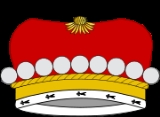
A viscount's coronet of rank bears 16 silver balls around the rim. Like all heraldic coronets, it is mostly worn at the coronation of a sovereign, but a viscount has the right to bear his coronet of rank on his coat of arms, above the shield.Continental forms of the title
- The title of viscount is less common in Italy ("visconte"), though the noble ViscontiHouse of ViscontiVisconti is the family name of two important Italian noble dynasties of the Middle Ages. There are two distinct Visconti families: The first one in the Republic of Pisa in the mid twelfth century who achieved prominence first in Pisa, then in Sardinia where they became rulers of Gallura...
family, once rulers of Milan, offers an outstanding example. In Italy, a younger member of a conte (count)'s family, assigned a fortified roccaRocca (architecture)Rocca is an Italian term meaning a high, fortifiable stronghold, usually located in smaller towns, beneath or on which the village or town clustered, within which its inhabitants might take refuge at times of trouble; under its owners' patronage the settlement might hope to find prosperity in...
on the outskirts of the territory, would be more likely to be "X, dei conti di Y" ("X, of the counts of Y") than Viscount. - In the former kingdom of PortugalPortugalPortugal , officially the Portuguese Republic is a country situated in southwestern Europe on the Iberian Peninsula. Portugal is the westernmost country of Europe, and is bordered by the Atlantic Ocean to the West and South and by Spain to the North and East. The Atlantic archipelagos of the...
a visconde ranks above a barão (baron) and below a conde. The first Portuguese viscountcy, that of D. Leonel de Lima, visconde de Vila Nova de Cerveira, dates from the reign of Afonso V. A flood of viscountcies, some 86 new titles, was awarded in Portugal between 1848 and 1880 (Portuguese Wikipedia). - In the kingdom of Spain the title was awarded from the reign of Felipe IVPhilip IV of SpainPhilip IV was King of Spain between 1621 and 1665, sovereign of the Spanish Netherlands, and King of Portugal until 1640...
(1621–65; Habsburg dynasty) until 1846.
Correct form of address
There are rules on how one should address a viscount. Debrett'sDebrett's
Debrett’s is a specialist publisher, founded in 1769 with the publication of the first edition of The New Peerage. The name "Debrett's" honours John Debrett...
, the UK's leading authority on etiquette
Etiquette
Etiquette is a code of behavior that delineates expectations for social behavior according to contemporary conventional norms within a society, social class, or group...
, suggest that in conversation a viscount should be referred to as Lord X rather than the Viscount X. Ecclesiastical, ambassadorial and military ranks precede a viscount's rank in correspondence. For example, Major-General the Viscount X. The wife of a viscount is a viscountess and is known as Lady X. Use of the title viscountess in speech is socially incorrect.
Equivalent western titles
There are non-etymological equivalents to the title of Viscount (i.e., 'Vice-Count') in several languages including German.However, in such case titles of the etymological Burgrave
Burgrave
A burgrave is literally the count of a castle or fortified town. The English form is derived through the French from the German Burggraf and Dutch burg- or burch-graeve .* The title is originally equivalent to that of castellan or châtelain, meaning keeper of a castle and/or fortified town...
family (not in countries with a viscount-form, such as Italian burgravio alongside visconte) bearers of the title could establish themselves at the same gap, thus at generally the same level. Consequentally a Freiherr (or Baron) ranks not immediately below a Graf, but below a Burggraf.
Thus in Dutch
Dutch language
Dutch is a West Germanic language and the native language of the majority of the population of the Netherlands, Belgium, and Suriname, the three member states of the Dutch Language Union. Most speakers live in the European Union, where it is a first language for about 23 million and a second...
, Burggraaf is the rank above Baron, below Graaf (i.e., Count) in the kingdoms of the Netherlands and of Belgium (by Belgian law, its equivalents in the other official languages are Burggraf in German
German language
German is a West Germanic language, related to and classified alongside English and Dutch. With an estimated 90 – 98 million native speakers, German is one of the world's major languages and is the most widely-spoken first language in the European Union....
and vicomte in French
French language
French is a Romance language spoken as a first language in France, the Romandy region in Switzerland, Wallonia and Brussels in Belgium, Monaco, the regions of Quebec and Acadia in Canada, and by various communities elsewhere. Second-language speakers of French are distributed throughout many parts...
). In Welsh
Welsh language
Welsh is a member of the Brythonic branch of the Celtic languages spoken natively in Wales, by some along the Welsh border in England, and in Y Wladfa...
the title is rendered as Isiarll
Welsh peers
This is an index of Welsh peers whose primary peerage, life peerage, and baronetcy titles includes a Welsh place-name origin or its territorial qualification is within the historic counties of Wales....
.
Non-western counterparts
Like other major Western noble titles, Viscount is sometimes used to render certain titles in non-western languages with their own traditions, even though they are as a rule historically unrelated and thus hard to compare which are considered 'equivalent' in relative rank.This is the case with:
- the Chinese Tzu or Zi (子), hereditary title of nobility first established in the Zhou dynastyZhou DynastyThe Zhou Dynasty was a Chinese dynasty that followed the Shang Dynasty and preceded the Qin Dynasty. Although the Zhou Dynasty lasted longer than any other dynasty in Chinese history, the actual political and military control of China by the Ji family lasted only until 771 BC, a period known as...
- the Korean cognate jajak or Pansoh
- the Japanese cognate Shishaku or Shi, fourth of the five peerage ranks established in the Meiji era, based both on the British viscount and Zhou Chinese zi
- the Vietnamese cognate TửTUTu is the 2nd-person singular subject pronoun in Spanish, Italian, Lithuanian, Portuguese, French, Irish, Latvian, Romanian, Latin, and Hindustani and may also refer to:* Tuberculin Units, a measure of strength of tuberculin...
- the Manchu jingkini hafan
See also
- List of British Viscountcies
- List of Viscountcies in Portugal
- ViscontiHouse of ViscontiVisconti is the family name of two important Italian noble dynasties of the Middle Ages. There are two distinct Visconti families: The first one in the Republic of Pisa in the mid twelfth century who achieved prominence first in Pisa, then in Sardinia where they became rulers of Gallura...
, the leading noble family that became ruling dukes of Milan, apparently taking its surname from a returning crusader Ottone who was created Visconte of Milan - Shen KuoShen KuoShen Kuo or Shen Gua , style name Cunzhong and pseudonym Mengqi Weng , was a polymathic Chinese scientist and statesman of the Song Dynasty...
, a Chinese viscount