


Courtly love

Encyclopedia
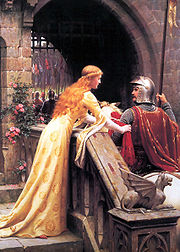
Chivalry
Chivalry is a term related to the medieval institution of knighthood which has an aristocratic military origin of individual training and service to others. Chivalry was also the term used to refer to a group of mounted men-at-arms as well as to martial valour...
expressing love and admiration. Generally, courtly love was secret and between members of the nobility
Nobility
Nobility is a social class which possesses more acknowledged privileges or eminence than members of most other classes in a society, membership therein typically being hereditary. The privileges associated with nobility may constitute substantial advantages over or relative to non-nobles, or may be...
. It was also generally not practiced between husband and wife.
Courtly love began in the ducal and princely courts
Noble court
The court of a monarch, or at some periods an important nobleman, is a term for the extended household and all those who regularly attended on the ruler or central figure...
of Aquitaine
Aquitaine
Aquitaine , archaic Guyenne/Guienne , is one of the 27 regions of France, in the south-western part of metropolitan France, along the Atlantic Ocean and the Pyrenees mountain range on the border with Spain. It comprises the 5 departments of Dordogne, :Lot et Garonne, :Pyrénées-Atlantiques, Landes...
, Provence
Provence
Provence ; Provençal: Provença in classical norm or Prouvènço in Mistralian norm) is a region of south eastern France on the Mediterranean adjacent to Italy. It is part of the administrative région of Provence-Alpes-Côte d'Azur...
, Champagne
Champagne (province)
The Champagne wine region is a historic province within the Champagne administrative province in the northeast of France. The area is best known for the production of the sparkling white wine that bears the region's name...
and ducal Burgundy
Duchy of Burgundy
The Duchy of Burgundy , was heir to an ancient and prestigious reputation and a large division of the lands of the Second Kingdom of Burgundy and in its own right was one of the geographically larger ducal territories in the emergence of Early Modern Europe from Medieval Europe.Even in that...
, at the end of the eleventh century. In essence, courtly love was an experience between erotic desire
Eroticism
Eroticism is generally understood to refer to a state of sexual arousal or anticipation of such – an insistent sexual impulse, desire, or pattern of thoughts, as well as a philosophical contemplation concerning the aesthetics of sexual desire, sensuality and romantic love...
and spiritual attainment that now seems contradictory, "a love at once illicit and morally elevating, passionate and discipline
Discipline
In its original sense, discipline is referred to systematic instruction given to disciples to train them as students in a craft or trade, or to follow a particular code of conduct or "order". Often, the phrase "to discipline" carries a negative connotation. This is because enforcement of order –...
d, humiliating and exalting, human and transcendent
Transcendence (philosophy)
In philosophy, the adjective transcendental and the noun transcendence convey the basic ground concept from the word's literal meaning , of climbing or going beyond, albeit with varying connotations in its different historical and cultural stages...
".
The term "courtly love" was first popularized by Gaston Paris
Gaston Paris
Bruno Paulin Gaston Paris , known as Gaston Paris, was a French writer and scholar.He was nominated for the Nobel Prize in Literature in 1901, 1902 and 1903.-Biography:Paris was born at Avenay...
in 1883, and has since come under a wide variety of definitions and uses, even being dismissed as nineteenth-century romantic
Romanticism
Romanticism was an artistic, literary and intellectual movement that originated in the second half of the 18th century in Europe, and gained strength in reaction to the Industrial Revolution...
fiction. Its interpretation, origins and influences continue to be a matter of critical debate.
Origin of term
Gaston Paris
Bruno Paulin Gaston Paris , known as Gaston Paris, was a French writer and scholar.He was nominated for the Nobel Prize in Literature in 1901, 1902 and 1903.-Biography:Paris was born at Avenay...
in his 1883 article "Études sur les romans de la Table Ronde: Lancelot du Lac, II: Le conte de la charrette", a treatise inspecting Chretien de Troyes
Chrétien de Troyes
Chrétien de Troyes was a French poet and trouvère who flourished in the late 12th century. Perhaps he named himself Christian of Troyes in contrast to the illustrious Rashi, also of Troyes...
's Lancelot, the Knight of the Cart
Lancelot, the Knight of the Cart
Lancelot, the Knight of the Cart is an Old French poem by Chrétien de Troyes. Chrétien probably composed the work at the same time as or slightly before writing Yvain, the Knight of the Lion, which refers to the action in Lancelot a number of times...
(1177). Paris said amour courtois was an idolization
Role model
The term role model generally means any "person who serves as an example, whose behaviour is emulated by others".The term first appeared in Robert K. Merton's socialization research of medical students...
and ennobling discipline. The lover (idolizer) accepts the independence of his mistress and tries to make himself worthy of her by acting bravely and honorably (nobly) and by doing whatever deeds she might desire, subjecting himself to a series of tests (ordeals) to prove to her his ardor and commitment. Sexual satisfaction, Paris said, may not have been a goal or even end result, but the love was not entirely Platonic
Platonic love
Platonic love is a chaste and strong type of love that is non-sexual.-Amor Platonicus:The term amor platonicus was coined as early as the 15th century by the Florentine scholar Marsilio Ficino. Platonic love in this original sense of the term is examined in Plato's dialogue the Symposium, which has...
either, as it was based on sexual attraction
Sexual attraction
Sexual attractiveness or sex appeal refers to an individual's ability to attract the sexual or erotic interest of another person, and is a factor in sexual selection or mate choice. The attraction can be to the physical or other qualities or traits of a person, or to such qualities in the context...
(see section on sexuality below for further views).
The term and Paris's definition were soon widely accepted and adopted. In 1936 C. S. Lewis
C. S. Lewis
Clive Staples Lewis , commonly referred to as C. S. Lewis and known to his friends and family as "Jack", was a novelist, academic, medievalist, literary critic, essayist, lay theologian and Christian apologist from Belfast, Ireland...
wrote The Allegory of Love
The Allegory of Love
The Allegory of Love: A Study in Medieval Tradition , by C. S. Lewis , is an influential exploration of the allegorical treatment of love in the Middle Ages and the Renaissance....
further solidifying courtly love as a "love of a highly specialized sort, whose characteristics may be enumerated as Humility, Courtesy, Adultery, and the Religion of Love".
Later, historians such as D. W. Robertson in the 1960s and John C. Moore and E. Talbot Donaldson in the 1970s, were critical of the term as being a modern invention, Donaldson calling it "The Myth of Courtly Love", because it is not supported in medieval texts. Even though the term "courtly love" does appear only in just one extant Provençal poem (as cortez amors in a late 12th century lyric by Peire d'Alvernhe
Peire d'Alvernhe
Peire d'Alvernhe or d'Alvernha was an Auvergnat troubadour with twenty-one or twenty-four surviving works. He composed in an "esoteric" and "formally complex" style known as the trobar clus...
), it is closely related to the term fin'amor ("fine love") which does appear frequently in Provençal and French, as well as German translated as hohe Minne. In addition, other terms and phrases associated with "courtliness" and "love" are common throughout the Middle Ages. Even though Paris used a term with little support in the contemporaneous literature, it was not a neologism and does usefully describe a particular conception of love and focuses on the courtliness that was at its essence.
Richard Trachsler says that “the concept of courtly literature is linked to the idea of the existence of courtly texts, texts produced and read by men and women sharing some kind of elaborate culture they all have in common.” He argues that many of the texts that scholars claim to be courtly also include “uncourtly” texts, and argues that there is no clear way to determine “where courtliness ends and uncourtliness starts” since readers would enjoy texts which were supposed to be entirely courtly without realizing they were also enjoying texts which were uncourtly. This presents a clear problem in the understanding of courtliness.
History
The practice of courtly love was developed in the castle lifeNoble court
The court of a monarch, or at some periods an important nobleman, is a term for the extended household and all those who regularly attended on the ruler or central figure...
of four regions: Aquitaine
Aquitaine
Aquitaine , archaic Guyenne/Guienne , is one of the 27 regions of France, in the south-western part of metropolitan France, along the Atlantic Ocean and the Pyrenees mountain range on the border with Spain. It comprises the 5 departments of Dordogne, :Lot et Garonne, :Pyrénées-Atlantiques, Landes...
, Provence
Provence
Provence ; Provençal: Provença in classical norm or Prouvènço in Mistralian norm) is a region of south eastern France on the Mediterranean adjacent to Italy. It is part of the administrative région of Provence-Alpes-Côte d'Azur...
, Champagne
Champagne (province)
The Champagne wine region is a historic province within the Champagne administrative province in the northeast of France. The area is best known for the production of the sparkling white wine that bears the region's name...
and ducal Burgundy
Duchy of Burgundy
The Duchy of Burgundy , was heir to an ancient and prestigious reputation and a large division of the lands of the Second Kingdom of Burgundy and in its own right was one of the geographically larger ducal territories in the emergence of Early Modern Europe from Medieval Europe.Even in that...
, from around the time of the First Crusade
First Crusade
The First Crusade was a military expedition by Western Christianity to regain the Holy Lands taken in the Muslim conquest of the Levant, ultimately resulting in the recapture of Jerusalem...
(1099). Eleanor of Aquitaine
Eleanor of Aquitaine
Eleanor of Aquitaine was one of the wealthiest and most powerful women in Western Europe during the High Middle Ages. As well as being Duchess of Aquitaine in her own right, she was queen consort of France and of England...
brought ideals of courtly love from Aquitaine first to the court of France, then to England, where she was queen to two kings. Her daughter Marie, Countess of Champagne
Marie de Champagne
Marie of France , Countess of Champagne was the elder daughter of Louis VII of France and his first wife, Eleanor of Aquitaine.- Family :Marie's younger sister was Alix of France....
brought courtly behavior to the Count of Champagne
Count of Champagne
The Counts of Champagne ruled the region of Champagne from 950 to 1316. Champagne evolved from the county of Troyes in the late eleventh century and Hugh I was the first to officially use the title "Count of Champagne". When Louis became King of France in 1314, upon the death of his father Philip...
's court. Courtly love found its expression in the lyric poems written by troubadour
Troubadour
A troubadour was a composer and performer of Old Occitan lyric poetry during the High Middle Ages . Since the word "troubadour" is etymologically masculine, a female troubadour is usually called a trobairitz....
s, such as William IX, Duke of Aquitaine
William IX of Aquitaine
William IX , called the Troubador, was the Duke of Aquitaine and Gascony and Count of Poitou between 1086 and his death. He was also one of the leaders of the Crusade of 1101...
(1071–1126), one of the first troubadour
Troubadour
A troubadour was a composer and performer of Old Occitan lyric poetry during the High Middle Ages . Since the word "troubadour" is etymologically masculine, a female troubadour is usually called a trobairitz....
poets.
Poets adopted the terminology of feudalism
Feudalism
Feudalism was a set of legal and military customs in medieval Europe that flourished between the 9th and 15th centuries, which, broadly defined, was a system for ordering society around relationships derived from the holding of land in exchange for service or labour.Although derived from the...
, declaring themselves the vassal
Vassal
A vassal or feudatory is a person who has entered into a mutual obligation to a lord or monarch in the context of the feudal system in medieval Europe. The obligations often included military support and mutual protection, in exchange for certain privileges, usually including the grant of land held...
of the lady and addressing her as midons (my lord), a sort of code name so that the poet did not have to reveal the lady's name, but which was flattering by addressing her as his lord. The troubadour's model of the ideal lady was the wife of his employer or lord, a lady of higher status, usually the rich and powerful female head of the castle. When her husband was away on Crusade or other business she dominated the household and cultural affairs; sometimes this was the case even when the husband was at home. The lady was rich and powerful and the poet gave voice to the aspirations of the courtier class, for only those who were noble could engage in courtly love. This new kind of love saw nobility not based on wealth and family history, but on character and actions; thus appealing to poorer knights who saw an avenue for advancement.
The rules of courtly love were codified by the late 12th century in Andreas Capellanus
Andreas Capellanus
Andreas Capellanus was the 12th-century author of a treatise commonly known as De amore , and often known in English, somewhat misleadingly, as The Art of Courtly Love, though its realistic, somewhat cynical tone suggests that it is in some measure an antidote to courtly love...
' highly influential work De Amore
De amore (Andreas Capellanus)
Andreas Capellanus was the twelfth century author of a treatise commonly titled De amore , also known as De arte honeste amandi, for which a possible English translation is The Art of Courtly Love...
("Concerning Love"). De amore lists such rules as "Marriage is no real excuse for not loving", "He who is not jealous cannot love", "No one can be bound by a double love", and "When made public love rarely endures".
Andalusian and Islamic influence
Many of the conventions of courtly love can be traced to Ovid, through Andreas CapellanusAndreas Capellanus
Andreas Capellanus was the 12th-century author of a treatise commonly known as De amore , and often known in English, somewhat misleadingly, as The Art of Courtly Love, though its realistic, somewhat cynical tone suggests that it is in some measure an antidote to courtly love...
, but it is doubtful that they are all traceable to this origin. Accounts of courtly love often overlook the Arabist
Arabic literature
Arabic literature is the writing produced, both prose and poetry, by writers in the Arabic language. The Arabic word used for literature is adab which is derived from a meaning of etiquette, and implies politeness, culture and enrichment....
hypothesis, which has been posed in some form almost from the beginnings of the term "courtly love" in the modern period. A proposed source for the differences is the Arabic poets
Arabic poetry
Arabic poetry is the earliest form of Arabic literature. Present knowledge of poetry in Arabic dates from the 6th century, but oral poetry is believed to predate that. Arabic poetry is categorized into two main types, rhymed, or measured, and prose, with the former greatly preceding the latter...
and poetry of Muslim Spain
Al-Andalus
Al-Andalus was the Arabic name given to a nation and territorial region also commonly referred to as Moorish Iberia. The name describes parts of the Iberian Peninsula and Septimania governed by Muslims , at various times in the period between 711 and 1492, although the territorial boundaries...
and the broader European contact with the Islamic world
Islamic Golden Age
During the Islamic Golden Age philosophers, scientists and engineers of the Islamic world contributed enormously to technology and culture, both by preserving earlier traditions and by adding their own inventions and innovations...
.
Given that practices similar to courtly love were already prevalent in Al-Andalus
Al-Andalus
Al-Andalus was the Arabic name given to a nation and territorial region also commonly referred to as Moorish Iberia. The name describes parts of the Iberian Peninsula and Septimania governed by Muslims , at various times in the period between 711 and 1492, although the territorial boundaries...
and elsewhere in the Islamic world, it is very likely that Islamic practices influenced the Christian Europeans. William of Aquitane
William X of Aquitaine
William X , called the Saint, was Duke of Aquitaine, Duke of Gascony, and Count of Poitou between 1126 and 1137. He was the son of William IX by his second wife, Philippa of Toulouse....
, for example, was involved in the First Crusade
First Crusade
The First Crusade was a military expedition by Western Christianity to regain the Holy Lands taken in the Muslim conquest of the Levant, ultimately resulting in the recapture of Jerusalem...
, and in the ongoing Reconquista
Reconquista
The Reconquista was a period of almost 800 years in the Middle Ages during which several Christian kingdoms succeeded in retaking the Muslim-controlled areas of the Iberian Peninsula broadly known as Al-Andalus...
in Spain, so that he would have come into contact with Muslim culture a great deal.
According to G. E. von Grunebaum, there were several elements which developed in Arabic literature. The notions of "love for love's sake" and "exaltation of the beloved lady" have been traced back to Arabic literature
Arabic literature
Arabic literature is the writing produced, both prose and poetry, by writers in the Arabic language. The Arabic word used for literature is adab which is derived from a meaning of etiquette, and implies politeness, culture and enrichment....
of the 9th and 10th centuries. The notion of the "ennobling power" of love was developed in the early 11th century by the Persian psychologist and philosopher
Early Islamic philosophy
Early Islamic philosophy or classical Islamic philosophy is a period of intense philosophical development beginning in the 2nd century AH of the Islamic calendar and lasting until the 6th century AH...
, Ibn Sina
Avicenna
Abū ʿAlī al-Ḥusayn ibn ʿAbd Allāh ibn Sīnā , commonly known as Ibn Sīnā or by his Latinized name Avicenna, was a Persian polymath, who wrote almost 450 treatises on a wide range of subjects, of which around 240 have survived...
(known as "Avicenna" in Europe), in his treatise Risala fi'l-Ishq (Treatise on Love). The final element of courtly love, the concept of "love as desire never to be fulfilled", was at times implicit in Arabic poetry
Arabic poetry
Arabic poetry is the earliest form of Arabic literature. Present knowledge of poetry in Arabic dates from the 6th century, but oral poetry is believed to predate that. Arabic poetry is categorized into two main types, rhymed, or measured, and prose, with the former greatly preceding the latter...
, but was first developed into a doctrine in European literature
European literature
European literature refers to the literature of Europe.European literature includes literature in many languages; among the most important of the modern written works are those in English, Spanish, French, Dutch, Polish, German, Italian, Modern Greek, Czech and Russian and works by the...
, in which all four elements of courtly love were present.
According to an argument outlined by Maria Rosa Menocal
María Rosa Menocal
María Rosa Menocal is a Cuban-born scholar of medieval culture and history. Menocal earned a B.A., M.A., and Ph.D. from the University of Pennsylvania...
in The Arabic Role in Medieval Literary History, in 11th-century Spain, a group of wandering poets appeared who would go from court to court, and sometimes travel to Christian courts in southern France, a situation closely mirroring what would happen in southern France about a century later. Contacts between these Spanish poets and the French troubadours were frequent. The metrical forms used by the Spanish poets were similar to those later used by the troubadours.

Analysis
The historic analysis of courtly love varies between various schools of historians. That sort of history which views the early Middle Ages dominated by a prudish and patriarcal theocracy, views courtly love as a "humanist" reaction to the puritanical views of the Catholic Church. In the language of the scholars who endorse this view, courtly love is cherished for its exaltation of femininity as an ennobling, spiritual, and moral force, in contrast to the ironclad chauvinism of the first and second estates. The condemnation of courtly love in the beginning of the 13th century by the church as heretical, is seen by these scholars as the Church's attempt to put down this "sexual rebellion."However, other scholars note that courtly love was certainly tied to the Church's effort to civilize the crude Germanic feudal codes in the late 11th century. It has also been suggested that the prevalence of arranged marriages required other outlets for the expression of more personal occurrences of romantic love, and thus it was not in reaction to the prudery or patriarchy of the Church but to the nuptial customs of the era that courtly love arose.
In the Germanic cultural world a special form of courtly love can be found, namely minne
Minne
Minne may be:*in origin, the Middle High German for "remembrance", see Minni*courtly love in Middle High German courtly tradition*Frau Minne, a personification of romantic love in German courtly tradition...
.
At times, the lady could be a princesse lointaine
Princesse lointaine
A princess lointaine or princesse lointaine, is a stock character from medieval romances. The romantic interest of many knights errant, she was usually a woman of much higher birth, often far distant from the knight, and usually wealthier than he was, beautiful, and of admirable character...
, a far-away princess, and some tales told of men who had fallen in love with women whom they had never seen, merely on hearing their perfection described, but normally she was not so distant. As the etiquette
Etiquette
Etiquette is a code of behavior that delineates expectations for social behavior according to contemporary conventional norms within a society, social class, or group...
of courtly love became more complicated, the knight might wear the colors of his lady: where blue or black were sometimes the colors of faithfulness, green could be a sign of unfaithfulness. Salvation, previously found in the hands of the priesthood, now came from the hands of one's lady. In some cases, there were also women troubadours who expressed the same sentiment for men.
Literary convention
The literary convention of courtly love can be found in most of the major authors of the Middle Ages such as Geoffery Chaucer, John GowerJohn Gower
John Gower was an English poet, a contemporary of William Langland and a personal friend of Geoffrey Chaucer. He is remembered primarily for three major works, the Mirroir de l'Omme, Vox Clamantis, and Confessio Amantis, three long poems written in French, Latin, and English respectively, which...
, Dante
DANTE
Delivery of Advanced Network Technology to Europe is a not-for-profit organisation that plans, builds and operates the international networks that interconnect the various national research and education networks in Europe and surrounding regions...
, Marie de France
Marie de France
Marie de France was a medieval poet who was probably born in France and lived in England during the late 12th century. She lived and wrote at an undisclosed court, but was almost certainly at least known about at the royal court of King Henry II of England...
, Chretien de Troyes
Chrétien de Troyes
Chrétien de Troyes was a French poet and trouvère who flourished in the late 12th century. Perhaps he named himself Christian of Troyes in contrast to the illustrious Rashi, also of Troyes...
, Gottfried von Strassburg
Gottfried von Strassburg
Gottfried von Strassburg is the author of the Middle High German courtly romance Tristan and Isolt, an adaptation of the 12th-century Tristan and Iseult legend. Gottfried's work is regarded, alongside Wolfram von Eschenbach's Parzival and the Nibelungenlied, as one of the great narrative...
and Sir Thomas Malory.
The medieval genres in which courtly love conventions can be found include the lyric
Lyric poetry
Lyric poetry is a genre of poetry that expresses personal and emotional feelings. In the ancient world, lyric poems were those which were sung to the lyre. Lyric poems do not have to rhyme, and today do not need to be set to music or a beat...
, the Romance
Romance (genre)
As a literary genre of high culture, romance or chivalric romance is a style of heroic prose and verse narrative that was popular in the aristocratic circles of High Medieval and Early Modern Europe. They were fantastic stories about marvel-filled adventures, often of a knight errant portrayed as...
and the allegory
Allegory
Allegory is a demonstrative form of representation explaining meaning other than the words that are spoken. Allegory communicates its message by means of symbolic figures, actions or symbolic representation...
.
Lyric
Courtly love was born in the lyricLyric poetry
Lyric poetry is a genre of poetry that expresses personal and emotional feelings. In the ancient world, lyric poems were those which were sung to the lyre. Lyric poems do not have to rhyme, and today do not need to be set to music or a beat...
, first appearing with Provençal poets in the 11th century, including itinerant and courtly minstrels such as the French troubadour
Troubadour
A troubadour was a composer and performer of Old Occitan lyric poetry during the High Middle Ages . Since the word "troubadour" is etymologically masculine, a female troubadour is usually called a trobairitz....
s and trouvère
Trouvère
Trouvère , sometimes spelled trouveur , is the Northern French form of the word trobador . It refers to poet-composers who were roughly contemporary with and influenced by the troubadours but who composed their works in the northern dialects of France...
s. This French tradition spread later to the German Minnesänger, such as Walther von der Vogelweide
Walther von der Vogelweide
Walther von der Vogelweide is the most celebrated of the Middle High German lyric poets.-Life history:For all his fame, Walther's name is not found in contemporary records, with the exception of a solitary mention in the travelling accounts of Bishop Wolfger of Erla of the Passau diocese:...
and Wolfram von Eschenbach
Wolfram von Eschenbach
Wolfram von Eschenbach was a German knight and poet, regarded as one of the greatest epic poets of his time. As a Minnesinger, he also wrote lyric poetry.-Life:...
.
Romance
The vernacular poetry of the romans courtois, or courtly romancesRomance (genre)
As a literary genre of high culture, romance or chivalric romance is a style of heroic prose and verse narrative that was popular in the aristocratic circles of High Medieval and Early Modern Europe. They were fantastic stories about marvel-filled adventures, often of a knight errant portrayed as...
, included many examples of courtly love. Some of them are set within the cycle of poems celebrating King Arthur
King Arthur
King Arthur is a legendary British leader of the late 5th and early 6th centuries, who, according to Medieval histories and romances, led the defence of Britain against Saxon invaders in the early 6th century. The details of Arthur's story are mainly composed of folklore and literary invention, and...
's court. This was a literature of leisure, directed to a largely female audience for the first time in European history.
Allegory
Medieval allegory has courtly love elements, for example the first part of The Romance of the Rose.Others
Perhaps the most important and popular work was that of Andreas CapellanusAndreas Capellanus
Andreas Capellanus was the 12th-century author of a treatise commonly known as De amore , and often known in English, somewhat misleadingly, as The Art of Courtly Love, though its realistic, somewhat cynical tone suggests that it is in some measure an antidote to courtly love...
's De Amore
De amore (Andreas Capellanus)
Andreas Capellanus was the twelfth century author of a treatise commonly titled De amore , also known as De arte honeste amandi, for which a possible English translation is The Art of Courtly Love...
which described the ars amandi ("the art of loving") in twelfth century Provence
Provence
Provence ; Provençal: Provença in classical norm or Prouvènço in Mistralian norm) is a region of south eastern France on the Mediterranean adjacent to Italy. It is part of the administrative région of Provence-Alpes-Côte d'Azur...
. His work followed in the tradition of the Roman work Ars amatoria ("Art of Love") by Ovid
Ovid
Publius Ovidius Naso , known as Ovid in the English-speaking world, was a Roman poet who is best known as the author of the three major collections of erotic poetry: Heroides, Amores, and Ars Amatoria...
.
The themes of courtly love were not confined to the medieval, but seen both in serious and comic forms in Elizabethan times. Shakespeare's Romeo and Juliet, for example, shows Romeo attempting to love Rosaline in an almost contrived courtly fashion while Mercutio mocks him for it.
Sexuality
A point of ongoing controversy about courtly love is to what extent it was sexual. All courtly love was erotic to some degree, and not purely platonicPlatonic love
Platonic love is a chaste and strong type of love that is non-sexual.-Amor Platonicus:The term amor platonicus was coined as early as the 15th century by the Florentine scholar Marsilio Ficino. Platonic love in this original sense of the term is examined in Plato's dialogue the Symposium, which has...
—the troubadours speak of the physical beauty of their ladies and the feelings and desires the ladies arouse in them. However, it is unclear what a poet should do: live a life of perpetual desire channeling his energies to higher ends, or physically consummate. Scholars have seen it both ways.
Denis de Rougemont
Denis de Rougemont
Denis de Rougemont was a Swiss writer, who wrote in French.He studied at the University of Neuchâtel, and then moved to Paris in 1930. There he wrote for and edited various publications, associating with the personalist groupings and the non-conformists of the 1930s...
said that the troubadours were influenced by Cathar
Cathar
Catharism was a name given to a Christian religious sect with dualistic and gnostic elements that appeared in the Languedoc region of France and other parts of Europe in the 11th century and flourished in the 12th and 13th centuries...
doctrines which rejected the pleasures of the flesh and that they were metaphorically addressing the spirit and soul of their ladies. Rougemont also said that courtly love subscribed to the code of chivalry
Chivalry
Chivalry is a term related to the medieval institution of knighthood which has an aristocratic military origin of individual training and service to others. Chivalry was also the term used to refer to a group of mounted men-at-arms as well as to martial valour...
, and therefore a knight's loyalty was always to his King before his mistress. Edmund Reiss claimed it was also a spiritual love, but a love that had more in common with Christian love, or caritas
Charity (virtue)
In Christian theology charity, or love , means an unlimited loving-kindness toward all others.The term should not be confused with the more restricted modern use of the word charity to mean benevolent giving.- Caritas: altruistic love :...
. On the other hand, scholars such as Mosché Lazar claim it was adulterous sexual love with physical possession of the lady the desired end.
Many scholars identify courtly love as the "pure love" described in 1184 by Andreas Capellanus
Andreas Capellanus
Andreas Capellanus was the 12th-century author of a treatise commonly known as De amore , and often known in English, somewhat misleadingly, as The Art of Courtly Love, though its realistic, somewhat cynical tone suggests that it is in some measure an antidote to courtly love...
in De amore libri tres
De amore (Andreas Capellanus)
Andreas Capellanus was the twelfth century author of a treatise commonly titled De amore , also known as De arte honeste amandi, for which a possible English translation is The Art of Courtly Love...
:
Within the corpus of troubadour poems there is a wide range of attitudes, even across the works of individual poets. Some poems are physically sensual, even bawdily imagining nude embraces, while others are highly spiritual and border on the platonic.
The medieval phenomenon of courtly love in all of its slavish devotion and ambivalence has been suggested by some writers to be a precursor of BDSM
BDSM
BDSM is an erotic preference and a form of sexual expression involving the consensual use of restraint, intense sensory stimulation, and fantasy power role-play. The compound acronym BDSM is derived from the terms bondage and discipline , dominance and submission , and sadism and masochism...
.
Real-world practice
A continued point of controversy is whether courtly love was purely literary or was actually practiced in real life. There are no historical records that offer evidence of its presence in reality. Historian John Benton found no documentary evidence in law codes, court cases, chronicles or other historical documents. However, the existence of the non-fiction genre of courtesy bookCourtesy book
A Courtesy book or Book of Manners was a book dealing with issues of etiquette, behaviour and morals, with a particular focus on the life at princely courts...
s is perhaps evidence for its practice. For example, according to the courtesy book by Christine de Pizan
Christine de Pizan
Christine de Pizan was a Venetian-born late medieval author who challenged misogyny and stereotypes prevalent in the male-dominated medieval culture. As a poet, she was well known and highly regarded in her own day; she completed 41 works during her 30 year career , and can be regarded as...
called Book of the Three Virtues (ca. 1405), which expresses disapproval of courtly love, the convention was being used to justify and cover up illicit love affairs. Courtly love probably found expression in the real world in customs such as the crowning of Queens of Love and Beauty at tournaments
Tournament (medieval)
A tournament, or tourney is the name popularly given to chivalrous competitions or mock fights of the Middle Ages and Renaissance . It is one of various types of hastiludes....
. Philip le Bon, in his Feast of the Pheasant in 1454, relied on parable
Parable
A parable is a succinct story, in prose or verse, which illustrates one or more instructive principles, or lessons, or a normative principle. It differs from a fable in that fables use animals, plants, inanimate objects, and forces of nature as characters, while parables generally feature human...
s drawn from courtly love to incite his nobles to swear to participate in an anticipated crusade, while well into the 15th century numerous actual political and social conventions were largely based on the formulas dictated by the "rules" of courtly love.
Courts of love
A point of controversy was the existence of "courts of love", first mentioned by Andreas Capellanus. These were supposed courts made up of tribunals staffed by 10 to 70 women who would hear a case of love and rule on it based on the rules of love. 19th century historians took the existence of these courts as fact, however later historians such as Benton noted "none of the abundant letters, chronicles, songs and pious dedications" suggest they ever existed outside of the poetic literature. According to Diane Bornstein, one way to reconcile the differences between the references to courts of love in the literature, and the lack of documentary evidence in real life, is that they were like literary salons or social gatherings, where people read poems, debated questions of love, and played word games of flirtation.Stages of courtly love
(Adapted from Barbara Tuchman)- Attraction to the lady, usually via eyes/glance
- Worship of the lady from afar
- Declaration of passionate devotion
- Virtuous rejection by the lady
- Renewed wooing with oaths of virtue and eternal fealty
- Moans of approaching death from unsatisfied desire (and other physical manifestations of lovesickness)
- Heroic deeds of valor which win the lady's heart
- Consummation of the secret love
- Endless adventures and subterfuges avoiding detection
Further reading
- Duby, Georges. The Knight, the Lady, and the Priest: the Making of Modern Marriage in Medieval France. Translated by Barbara BrayBarbara BrayBarbara Bray was a British translator and critic.An identical twin , she was educated at Girton College, Cambridge, where she read English, with papers in French and Italian...
. New York: Pantheon Books, 1983. (ISBN 0-226-16768-2) - Gaunt, Simon. “Marginal Men, Marcabru, and Orthodoxy: The Early Troubadours and Adultery.” Medium Aevum 59 (1990): 55-71.
- Lewis, C. S. The Allegory of Love: A Study in Medieval Tradition. Oxford, Clarendon Press, 1936. (ISBN 0-19-281220-3)
- Lupack, Alan. The Oxford Guide to Arthurian Literature and Legend. Oxford: University Press, 2005.
- Menocal, Maria Rosa. The Arabic Role in Medieval Literary History. Philadelphia: University of Pennsylvania Press, 2003. (ISBN 0-8122-1324-6)
- Murray, Jacqueline. Love, Marriage, and Family in the Middle Ages. Canada: Broadview Press Ltd., 2001.
- Newman, Francis X. The Meaning of Courtly Love. Albany: State University of New York Press, 1968. (ISBN 0-87395-038-0)
- Capellanus, Andreas. The Art of Courtly Love. New York: Columbia University Press, 1964.
- Schultz, James A. Courtly Love, the Love of Courtliness, and the History of Sexuality. Chicago: The University of Chicago Press, 2006. (ISBN 0-226-74089-7)
- Ward, Matt C. The Ideas of Courtly Love Oxford, University Press, 1923
- Busby, Keith, and Christopher Kleinhenz. Courtly Arts and the Art of Courtliness: Selected Papers from the Eleventh Triennial Congress of the International Courtly Literature Society. Cambridge, MA: D.S. Brewer, 2006. 679-692.
External links
- Debora B. Schwartz, "Backgrounds to Romance: 'Courtly Love'", California Polytechnic State University
- Michael Delahoyde, Courtly Love, Washington State University.
- Andreas Capellanus, "The Art of Courtly Love (btw. 1174-1186)", extracts via the Internet Medieval Sourcebook.
- "Courtly love". In Encyclopædia BritannicaEncyclopædia BritannicaThe Encyclopædia Britannica , published by Encyclopædia Britannica, Inc., is a general knowledge English-language encyclopaedia that is available in print, as a DVD, and on the Internet. It is written and continuously updated by about 100 full-time editors and more than 4,000 expert...
Online.