


Plantation

Encyclopedia
A plantation is a long artificially established forest
, farm
or estate, where crops are grown for sale, often in distant market
s rather than for local on-site consumption
. The term plantation is informal and not precisely defined.
Crops grown on plantations include fast-growing tree
s (often conifers), cotton
, coffee
, tobacco
, sugar cane, sisal
, some oil seeds (notably oil palm
s) and rubber trees. Farms that produce alfalfa
, Lespedeza
, clover
, and other forage
crops are usually not called plantations. The term "plantation" has usually not included large orchard
s (except for banana plantation
s), but does include the planting of trees for lumber
. A plantation is always a monoculture
over a large area and does not include extensive naturally occurring stands of plants that have economic value. Because of its large size, a plantation takes advantage of economies of scale
. Protectionist
policies and natural comparative advantage
have contributed to determining where plantations have been located.
Among the earliest examples of plantations were the latifundia
of the Roman Empire
, which produced large quantities of wine and olive oil for export. Plantation agriculture grew rapidly with the increase in international trade and the development of a worldwide economy that followed the expansion of European colonial empires
. Like every economic activity, it has changed over time. Earlier forms of plantation agriculture were associated with large disparities of wealth and income, foreign ownership and political influence, and exploitative social systems such as indentured labor and slavery. The history of the environmental, social and economic issues relating to plantation agriculture are covered in articles that focus on those subjects.
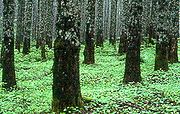 Industrial plantations are established to produce a high volume of wood in a short period of time. Plantations are grown by state forestry authorities (for example, the Forestry Commission
in Britain) and/or the paper and wood industries and other private landowners (such as Weyerhaeuser
and International Paper
in the United States
, Asia Pulp & Paper (APP) in Indonesia). Christmas tree
s are often grown on plantations as well. In southern and southeastern Asia, rubber
, oil palm
, and more recently teak
plantations have replaced the natural forest.
Industrial plantations are actively managed for the commercial production of forest products. Industrial plantations are usually large-scale. Individual blocks are usually even-aged and often consist of just one or two species. These species can be exotic or indigenous. The plants used for the plantation are often genetically altered for desired traits such as growth and resistance to pests and diseases in general and specific traits, for example in the case of timber species, volumic wood production and stem straightness. Forest genetic resources
are the basis for genetic alteration. Selected individuals grown in seed orchard
s are a good source for seeds to develop adequate planting material.
Wood production on a tree plantation is generally higher than that of natural forests. While forests managed for wood production commonly yield between 1 and 3 cubic meters per hectare per year, plantations of fast-growing species commonly yield between 20 and 30 cubic meters or more per hectare annually; a Grand Fir
plantation at Craigvinean in Scotland
has a growth rate of 34 cubic meters per hectare per year (Aldhous & Low 1974), and Monterey Pine
plantations in southern Australia
can yield up to 40 cubic meters per hectare per year (Everard & Fourt 1974). In 2000, while plantations accounted for 5% of global forest, it is estimated that they supplied about 35% of the world's roundwood.
Some plantation trees, such as pines and eucalyptus, can be at high risk of fire damage because their leaf oils and resins are flammable to the point of a tree being explosive under some conditions. Conversely, an afflicted plantation can in some cases be cleared of pest species cheaply through the use of a prescribed burn, which kills all lesser plants but does not significantly harm the mature trees.
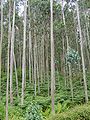 In contrast to a naturally regenerated forest, plantations are typically grown as even-aged monoculture
s, primarily for timber
production.
In the 1970s, Brazil
began to establish high-yield, intensively managed, short rotation plantations. These types of plantations are sometimes called fast-wood plantations or fiber farms and often managed on a short-rotation basis, as little as 5 to 15 years. They are becoming more widespread in South America, Asia and other areas. The environmental and social impacts of this type of plantation has caused them to become controversial. In Indonesia
, for example, large multi-national pulp companies have harvested large areas of natural forest without regard for regeneration. From 1980 to 2000, about 50% of the 1.4 million hectares of pulpwood plantations in Indonesia have been established on what was formerly natural forest land.
The replacement of natural forest with tree plantations has also caused social problems. In some countries, again, notably Indonesia, conversions of natural forest are made with little regard for rights of the local people. Plantations established purely for the production of fiber provide a much narrower range of services than the original natural forest for the local people. India
has sought to limit this damage by limiting the amount of land owned by one entity and, as a result, smaller plantations are owned by local farmers who then sell the wood to larger companies. Some large environmental organizations are critical of these high-yield plantations and are running an anti-plantation campaign, notably the Rainforest Action Network
and Greenpeace
.
Teak and bamboo plantations in India have given good results and an alternative crop solution to farmers of central India, where conventional farming was popular. But due to rising input costs of farming many farmers have done teak and bamboo plantations which require very little water (only during first two years). Teak and bamboo have legal protection from theft. Bamboo, once planted, gives output for 50 years till flowering occurs. Teak requires 20 years to grow to full maturity and fetch returns. Indirectly it also contributes to the positive impact on the climate change problem.
.
and loss of habitat
will likely result. In some cases, their establishment may involve draining wetland
s to replace mixed hardwood
s that formerly predominated with pine species.
If a plantation is established on abandoned agricultural land, or highly degraded land, it can result in an increase in both habitat and biodiversity. A planted forest can be profitably established on lands that will not support agriculture or suffer from lack of natural regeneration.
The tree species used in a plantation is also an important factor. Where non-native varieties or species are grown, few of the native fauna are adapted to exploit these and further biodiversity loss occurs. However, even non-native tree species may serve as corridors
for wildlife and act as a buffer for native forest, reducing edge effect
.
Once a plantation is established, how it is managed becomes the important environmental factor. The single most important factor of management is the rotation period. Plantations harvested on longer rotation periods (30 years or more) can provide similar benefits to a naturally regenerated forest managed for wood production, on a similar rotation. This is especially true if native species are used. In the case of exotic species, the habitat can be improved significantly if the impact is mitigated by measures such as leaving blocks of native species in the plantation, or retaining corridors of natural forest. In Brazil, similar measures are required by government regulations.
, about 7% of the natural closed forest being lost in the tropics is land being converted to plantations. The remaining 93% of the loss is land being converted to agriculture and other uses. Worldwide, an estimated 15% of plantations in tropical countries are established on closed canopy natural forest.
In the Kyoto Protocol
, there are proposals encouraging the use of plantations to reduce carbon dioxide
levels (though this idea is being challenged by some groups on the grounds that the sequestered CO2 is eventually released after harvest).
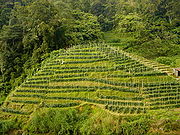 Crops may be called plantation crops because of their association with a specific type of farming economy. Most of these involve a large landowner, raising crops with economic value rather than for subsistence, with a number of employees carrying out the work. Often it referred to crops newly introduced to a region. In past times it has been associated with slavery
, indentured labour, and other economic models of high inequity. However, arable and dairy farming are both usually (but not always) excluded from such definitions. A comparable economic structure in antiquity was the latifundia
that produced commercial quantities of olive oil
or wine
, for export. One plantation crop is bananas and there are others as well.
, coffee
, and cacao are generally called plantations. Some spice and high value crops grown from permanent perennial stock, such as black pepper
may also be so called. When the holding belongs to a single individual, that person may be called a planter.
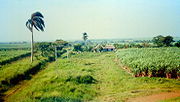 Plantings of para rubber
, the tree Hevea brasiliensis, are usually called plantations.
, sugarcane
, pineapple
, and cotton
, especially in historical usage.
Before the rise of cotton in the American South, indigo
and rice
were also sometimes called plantation crops.
in 1610, the original colonists were called "Planters" and their fishing rooms were known as "fishing plantations". These terms were used well into the 20th century.
The following three plantations are maintained by the Government of Newfoundland and Labrador
as provincial heritage sites:
Other fishing plantations:
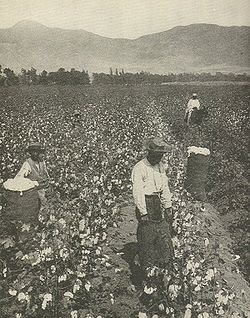 African slave labor
extracted from forcibly transported Africans was used extensively to work on early plantations (such as cotton and sugar plantations) in the American colonies and the United States
, throughout the Caribbean
, the Americas and in Europe
an-occupied areas of Africa. Several notable historians and economists such as Eric Williams
, Walter Rodney
and Karl Marx
contend that the global capitalist
economy was largely founded on the creation and produce of thousands of slave labour camps based in colonial
plantations exploiting tens of millions of abducted Africans.
In modern times, the low wages typically paid to plantation workers are the basis of plantation profitability in some areas with minimal employee-protection legislation. Sugarcane
plantations in the Caribbean
and Brazil
, worked by slave labour, were also examples of the plantation system.
In more recent times, overt slavery has been replaced by "para-slavery" or slavery-in-kind, including the sharecropping system. At its most extreme, workers are in "debt bondage
": they must work to pay off a debt at such punitive interest rates that it may never be paid off. Others work unreasonably long hours and are paid subsistence wages that (in practice) may only be spent in the company store
.
In Brazil
, a sugarcane plantation was termed an engenho ("engine"), and the 17th-century English usage for organized colonial production was "factory". Such colonial social and economic structures are discussed at Plantation economy
. Sugar workers on plantations in Cuba
and elsewhere in the Caribbean lived in company towns known as Bateys.
, antebellum
plantations were centered on a "plantation house", the residence of the owner, where important business was conducted. Slavery and plantations had different characteristics in different regions of the South. As the Upper South of the Chesapeake Bay Colony developed first, historians of the antebellum South defined planters as those who held 20 or more slaves. Major planters held many more, especially in the Deep South as it developed. The majority of slaveholders held 10 or fewer slaves, often just a few to labor domestically. By the late 18th century, most planters in the Upper South had switched from exclusive tobacco cultivation to mixed crop production, both because tobacco had exhausted the soil and because of changing markets. The shift away from tobacco meant they had slaves in excess of the number needed for labor, and they began to sell them in the internal slave trade.
There was a variety of domestic architecture on plantations. The largest and wealthiest planter families, for instance, those with estates fronting on the James River
in Virginia
, constructed mansions in brick and Georgian style, e.g. Shirley Plantation
. Common or smaller planters in the late 18th and 19th century had more modest wood frame buildings, such as Southall Plantation
in Charles City County
.
In the Low Country of South Carolina, by contrast, even before the American Revolution
, planters holding large rice and cotton plantations in South Carolina
typically owned hundreds of slaves. In Charleston and Savannah, the elite also held numerous slaves to work as household servants. The 19th-century development of the Deep South
for cotton cultivation depended on large plantations with much more acreage than was typical of the Chesapeake Bay
area, and for labor, planters held hundreds of slaves.
Until December 1865 slavery was legal in parts of the United States. Most slaves were employed in agriculture, and "planter" was a term commonly used to describe a farmer with many slaves.
The term "planter" has no universally accepted definition but academic historians have defined it to identify the elite class, "a landowning farmer of substantial means." In the "Black Belt
" counties of Alabama
and Mississippi
, the terms “"planter" and "farmer" were often synonymous. Robert Fogel and Stanley Engerman define large planters as owning over 50 slaves, and medium planters as owning between 16 and 50 slaves. In his study of Black Belt counties in Alabama, Jonathan Wiener defines planters by ownership of real property, rather than of slaves. A planter, for Wiener, owned at least $10,000 worth of real estate in 1850 and $32,000 worth in 1860, equivalent to about the top 8 percent of landowners. In his study of southwest Georgia, Lee Formwalt also defines planters in size of land holdings rather than slaves. Formwalt's planters are in the top 4.5 percent of landowners, translating into real estate worth $6,000 or more in 1850, $24,000 or more in 1860, and $11,000 or more in 1870. In his study of Harrison County, Texas, Randolph B. Campbell classifies large planters as owners of 20 slaves, and small planters as owners of between ten and 19 slaves. In Chicot and Phillips Counties, Arkansas, Carl H. Moneyhon defines large planters as owners of twenty or more slaves, and six hundred or more acres.
Forest
A forest, also referred to as a wood or the woods, is an area with a high density of trees. As with cities, depending where you are in the world, what is considered a forest may vary significantly in size and have various classification according to how and what of the forest is composed...
, farm
Farm
A farm is an area of land, or, for aquaculture, lake, river or sea, including various structures, devoted primarily to the practice of producing and managing food , fibres and, increasingly, fuel. It is the basic production facility in food production. Farms may be owned and operated by a single...
or estate, where crops are grown for sale, often in distant market
Market
A market is one of many varieties of systems, institutions, procedures, social relations and infrastructures whereby parties engage in exchange. While parties may exchange goods and services by barter, most markets rely on sellers offering their goods or services in exchange for money from buyers...
s rather than for local on-site consumption
Consumption (economics)
Consumption is a common concept in economics, and gives rise to derived concepts such as consumer debt. Generally, consumption is defined in part by comparison to production. But the precise definition can vary because different schools of economists define production quite differently...
. The term plantation is informal and not precisely defined.
Crops grown on plantations include fast-growing tree
Tree
A tree is a perennial woody plant. It is most often defined as a woody plant that has many secondary branches supported clear of the ground on a single main stem or trunk with clear apical dominance. A minimum height specification at maturity is cited by some authors, varying from 3 m to...
s (often conifers), cotton
Cotton
Cotton is a soft, fluffy staple fiber that grows in a boll, or protective capsule, around the seeds of cotton plants of the genus Gossypium. The fiber is almost pure cellulose. The botanical purpose of cotton fiber is to aid in seed dispersal....
, coffee
Coffee
Coffee is a brewed beverage with a dark,init brooo acidic flavor prepared from the roasted seeds of the coffee plant, colloquially called coffee beans. The beans are found in coffee cherries, which grow on trees cultivated in over 70 countries, primarily in equatorial Latin America, Southeast Asia,...
, tobacco
Tobacco
Tobacco is an agricultural product processed from the leaves of plants in the genus Nicotiana. It can be consumed, used as a pesticide and, in the form of nicotine tartrate, used in some medicines...
, sugar cane, sisal
Sisal
Sisal is an agave that yields a stiff fibre traditionally used in making twine, rope and also dartboards. The term may refer either to the plant or the fibre, depending on context...
, some oil seeds (notably oil palm
Oil palm
The oil palms comprise two species of the Arecaceae, or palm family. They are used in commercial agriculture in the production of palm oil. The African Oil Palm Elaeis guineensis is native to West Africa, occurring between Angola and Gambia, while the American Oil Palm Elaeis oleifera is native to...
s) and rubber trees. Farms that produce alfalfa
Alfalfa
Alfalfa is a flowering plant in the pea family Fabaceae cultivated as an important forage crop in the US, Canada, Argentina, France, Australia, the Middle East, South Africa, and many other countries. It is known as lucerne in the UK, France, Australia, South Africa and New Zealand, and known as...
, Lespedeza
Lespedeza
Lespedeza is a genus of some 40 species of flowering plants in the pea family , commonly known as bush clovers or Japanese clovers...
, clover
Clover
Clover , or trefoil, is a genus of about 300 species of plants in the leguminous pea family Fabaceae. The genus has a cosmopolitan distribution; the highest diversity is found in the temperate Northern Hemisphere, but many species also occur in South America and Africa, including at high altitudes...
, and other forage
Forage
Forage is plant material eaten by grazing livestock.Historically the term forage has meant only plants eaten by the animals directly as pasture, crop residue, or immature cereal crops, but it is also used more loosely to include similar plants cut for fodder and carried to the animals, especially...
crops are usually not called plantations. The term "plantation" has usually not included large orchard
Orchard
An orchard is an intentional planting of trees or shrubs that is maintained for food production. Orchards comprise fruit or nut-producing trees which are grown for commercial production. Orchards are also sometimes a feature of large gardens, where they serve an aesthetic as well as a productive...
s (except for banana plantation
Banana plantation
A banana plantation is a commercial agricultural facility found in tropical climates where bananas are grown. -Geographic distribution of banana plantations:...
s), but does include the planting of trees for lumber
Lumber
Lumber or timber is wood in any of its stages from felling through readiness for use as structural material for construction, or wood pulp for paper production....
. A plantation is always a monoculture
Monoculture
Monoculture is the agricultural practice of producing or growing one single crop over a wide area. It is also known as a way of farming practice of growing large stands of a single species. It is widely used in modern industrial agriculture and its implementation has allowed for large harvests from...
over a large area and does not include extensive naturally occurring stands of plants that have economic value. Because of its large size, a plantation takes advantage of economies of scale
Economies of scale
Economies of scale, in microeconomics, refers to the cost advantages that an enterprise obtains due to expansion. There are factors that cause a producer’s average cost per unit to fall as the scale of output is increased. "Economies of scale" is a long run concept and refers to reductions in unit...
. Protectionist
Protectionism
Protectionism is the economic policy of restraining trade between states through methods such as tariffs on imported goods, restrictive quotas, and a variety of other government regulations designed to allow "fair competition" between imports and goods and services produced domestically.This...
policies and natural comparative advantage
Comparative advantage
In economics, the law of comparative advantage says that two countries will both gain from trade if, in the absence of trade, they have different relative costs for producing the same goods...
have contributed to determining where plantations have been located.
Among the earliest examples of plantations were the latifundia
Latifundia
Latifundia are pieces of property covering very large land areas. The latifundia of Roman history were great landed estates, specializing in agriculture destined for export: grain, olive oil, or wine...
of the Roman Empire
Roman Empire
The Roman Empire was the post-Republican period of the ancient Roman civilization, characterised by an autocratic form of government and large territorial holdings in Europe and around the Mediterranean....
, which produced large quantities of wine and olive oil for export. Plantation agriculture grew rapidly with the increase in international trade and the development of a worldwide economy that followed the expansion of European colonial empires
Colonialism
Colonialism is the establishment, maintenance, acquisition and expansion of colonies in one territory by people from another territory. It is a process whereby the metropole claims sovereignty over the colony and the social structure, government, and economics of the colony are changed by...
. Like every economic activity, it has changed over time. Earlier forms of plantation agriculture were associated with large disparities of wealth and income, foreign ownership and political influence, and exploitative social systems such as indentured labor and slavery. The history of the environmental, social and economic issues relating to plantation agriculture are covered in articles that focus on those subjects.
Industrial plantations
Forestry Commission
The Forestry Commission is a non-ministerial government department responsible for forestry in Great Britain. Its mission is to protect and expand Britain's forests and woodlands and increase their value to society and the environment....
in Britain) and/or the paper and wood industries and other private landowners (such as Weyerhaeuser
Weyerhaeuser
Weyerhaeuser is one of the largest pulp and paper companies in the world. It is the world's largest private sector owner of softwood timberland; and the second largest owner of United States timberland, behind Plum Creek Timber...
and International Paper
International Paper
International Paper Company is an American pulp and paper company, the largest such company in the world. It has approximately 59,500 employees, and it is headquartered in Memphis, Tennessee.-History:...
in the United States
United States
The United States of America is a federal constitutional republic comprising fifty states and a federal district...
, Asia Pulp & Paper (APP) in Indonesia). Christmas tree
Christmas tree
The Christmas tree is a decorated evergreen coniferous tree, real or artificial, and a tradition associated with the celebration of Christmas. The tradition of decorating an evergreen tree at Christmas started in Livonia and Germany in the 16th century...
s are often grown on plantations as well. In southern and southeastern Asia, rubber
Rubber
Natural rubber, also called India rubber or caoutchouc, is an elastomer that was originally derived from latex, a milky colloid produced by some plants. The plants would be ‘tapped’, that is, an incision made into the bark of the tree and the sticky, milk colored latex sap collected and refined...
, oil palm
Oil palm
The oil palms comprise two species of the Arecaceae, or palm family. They are used in commercial agriculture in the production of palm oil. The African Oil Palm Elaeis guineensis is native to West Africa, occurring between Angola and Gambia, while the American Oil Palm Elaeis oleifera is native to...
, and more recently teak
Teak
Teak is the common name for the tropical hardwood tree species Tectona grandis and its wood products. Tectona grandis is native to south and southeast Asia, mainly India, Indonesia, Malaysia, and Burma, but is naturalized and cultivated in many countries, including those in Africa and the...
plantations have replaced the natural forest.
Industrial plantations are actively managed for the commercial production of forest products. Industrial plantations are usually large-scale. Individual blocks are usually even-aged and often consist of just one or two species. These species can be exotic or indigenous. The plants used for the plantation are often genetically altered for desired traits such as growth and resistance to pests and diseases in general and specific traits, for example in the case of timber species, volumic wood production and stem straightness. Forest genetic resources
Forest genetic resources
-Introduction:Forest genetic resources or tree genetic resources are genetic material of shrub and tree species of actual or future value...
are the basis for genetic alteration. Selected individuals grown in seed orchard
Seed orchard
A seed orchard is an intensively-managed plantation of specifically arranged trees for the mass production of genetically improved seeds to create plants, or seeds for the establishment of new forests.-General:...
s are a good source for seeds to develop adequate planting material.
Wood production on a tree plantation is generally higher than that of natural forests. While forests managed for wood production commonly yield between 1 and 3 cubic meters per hectare per year, plantations of fast-growing species commonly yield between 20 and 30 cubic meters or more per hectare annually; a Grand Fir
Grand Fir
Abies grandis is a fir native to the Pacific Northwest and Northern California of North America, occurring at altitudes of sea level to 1,800 m...
plantation at Craigvinean in Scotland
Scotland
Scotland is a country that is part of the United Kingdom. Occupying the northern third of the island of Great Britain, it shares a border with England to the south and is bounded by the North Sea to the east, the Atlantic Ocean to the north and west, and the North Channel and Irish Sea to the...
has a growth rate of 34 cubic meters per hectare per year (Aldhous & Low 1974), and Monterey Pine
Monterey Pine
The Monterey Pine, Pinus radiata, family Pinaceae, also known as the Insignis Pine or Radiata Pine is a species of pine native to the Central Coast of California....
plantations in southern Australia
Australia
Australia , officially the Commonwealth of Australia, is a country in the Southern Hemisphere comprising the mainland of the Australian continent, the island of Tasmania, and numerous smaller islands in the Indian and Pacific Oceans. It is the world's sixth-largest country by total area...
can yield up to 40 cubic meters per hectare per year (Everard & Fourt 1974). In 2000, while plantations accounted for 5% of global forest, it is estimated that they supplied about 35% of the world's roundwood.
Growth cycle
- In the first year, the ground is prepared usually by the combination of burning, herbicide spraying, and/or cultivationTillageTillage is the agricultural preparation of the soil by mechanical agitation of various types, such as digging, stirring, and overturning. Examples of human-powered tilling methods using hand tools include shovelling, picking, mattock work, hoeing, and raking...
and then saplings are planted by human crew or by machine. The saplings are usually obtained in bulk from industrial nurseries, which may specialize in selective breeding in order to produce fast growing disease- and pest-resistant strains. - In the first few years until the canopy closes, the saplings are looked after, and may be dusted or sprayed with fertilizers or pesticides until established.
- After the canopy closes, with the tree crowns touching each other, the plantation is becoming dense and crowded, and tree growth is slowing due to competition. This stage is termed 'pole stage'. When competition becomes too intense (for pinePinePines are trees in the genus Pinus ,in the family Pinaceae. They make up the monotypic subfamily Pinoideae. There are about 115 species of pine, although different authorities accept between 105 and 125 species.-Etymology:...
trees, when the live crownLive crownThe live crown is the top part of a tree, the part that has green leaves . The ratio of the size of a tree's live crown to its total height is used in estimating its health and its level of competition with neighboring trees....
is less than a third of the tree's total height), it is time to thin out the section. There are several methods for thinningThinningThinning is a term used in agricultural sciences to mean the removal of some plants, or parts of plants, to make room for the growth of others.- Forestry :...
, but where topography permits, the most popular is 'row-thinning', where every third or fourth or fifth row of trees is removed, usually with a harvesterHarvester (forestry)A harvester is a type of heavy forestry vehicle employed in cut-to-length logging operations for felling, delimbing and bucking trees. A forest harvester is typically employed together with a forwarder that hauls the logs to a roadside landing.- History :...
. Many trees are removedThinningThinning is a term used in agricultural sciences to mean the removal of some plants, or parts of plants, to make room for the growth of others.- Forestry :...
, leaving regular clear lanes through the section so that the remaining trees have room to expand again. The removed trees are delimbedDelimbing*An extension or projecting part of a tree.When the tree is lying on the ground, branches may be storing enormous potential energy through mechanical strain. When a branch is cut, often with a chain saw, this energy can be released suddenly and the branch can jump dangerously. In addition, a branch...
, forwarded to the forest road, loaded onto trucks, and sent to a mill. A typical pole stage plantation tree is 7–30 cm in diameter at breast heightDiameter at breast heightDiameter at breast height, or DBH, is a standard method of expressing the diameter of the trunk or bole of a standing tree. DBH is one of the most common dendrometric measurements....
(dbh). Such trees are sometimes not suitable for timberTimberTimber may refer to:* Timber, a term common in the United Kingdom and Australia for wood materials * Timber, Oregon, an unincorporated community in the U.S...
, but are used as pulp for paper and particleboard, and as chips for oriented strand boardOriented strand boardOriented strand board, also known as OSB and SmartPly , is an engineered wood product formed by layering strands of wood in specific orientations. In appearance, it may have a rough and variegated surface with the individual strips Oriented strand board, also known as OSB (UK) and SmartPly (UK &...
. - As the trees grow and become dense and crowded again, the thinning process is repeated. Depending on growth rate and species, trees at this age may be large enough for timber milling; if not, they are again used as pulp and chips.
- Around year 10-60 the plantation is now mature and (in economic terms) is falling off the back side of its growth curve. That is to say, it is passing the point of maximum wood growth per hectare per year, and so is ready for the final harvest. All remaining trees are felled, delimbed, and taken to be processed.
- The ground is cleared, and the cycle is repeated.
Some plantation trees, such as pines and eucalyptus, can be at high risk of fire damage because their leaf oils and resins are flammable to the point of a tree being explosive under some conditions. Conversely, an afflicted plantation can in some cases be cleared of pest species cheaply through the use of a prescribed burn, which kills all lesser plants but does not significantly harm the mature trees.
Criticism of industrial plantations
Monoculture
Monoculture is the agricultural practice of producing or growing one single crop over a wide area. It is also known as a way of farming practice of growing large stands of a single species. It is widely used in modern industrial agriculture and its implementation has allowed for large harvests from...
s, primarily for timber
Timber
Timber may refer to:* Timber, a term common in the United Kingdom and Australia for wood materials * Timber, Oregon, an unincorporated community in the U.S...
production.
- Plantations are usually near- or total monocultures. That is, the same species of tree is planted across a given area, whereas a natural forest would contain a far more diverse range of tree species.
- Plantations may include tree species that would not naturally occur in the area. They may include unconventional types such as hybrids, and genetically modifiedGenetic engineeringGenetic engineering, also called genetic modification, is the direct human manipulation of an organism's genome using modern DNA technology. It involves the introduction of foreign DNA or synthetic genes into the organism of interest...
trees may be used sometime in the future. Since the primary interest in plantations is to produce woodWoodWood is a hard, fibrous tissue found in many trees. It has been used for hundreds of thousands of years for both fuel and as a construction material. It is an organic material, a natural composite of cellulose fibers embedded in a matrix of lignin which resists compression...
or pulpWood pulpPulp is a lignocellulosic fibrous material prepared by chemically or mechanically separating cellulose fibres from wood, fibre crops or waste paper. Wood pulp is the most common raw material in papermaking.-History:...
, the types of trees found in plantations are those that are best-suited to industrial applications. For example, pinePinePines are trees in the genus Pinus ,in the family Pinaceae. They make up the monotypic subfamily Pinoideae. There are about 115 species of pine, although different authorities accept between 105 and 125 species.-Etymology:...
, spruceSpruceA spruce is a tree of the genus Picea , a genus of about 35 species of coniferous evergreen trees in the Family Pinaceae, found in the northern temperate and boreal regions of the earth. Spruces are large trees, from tall when mature, and can be distinguished by their whorled branches and conical...
and eucalyptusEucalyptusEucalyptus is a diverse genus of flowering trees in the myrtle family, Myrtaceae. Members of the genus dominate the tree flora of Australia...
are widely planted far beyond their natural range because of their fast growth rate, tolerance of rich or degraded agricultural land and potential to produce large volumes of raw material for industrial use. - Plantations are always young forests in ecological terms. Typically, trees grown in plantations are harvested after 10 to 60 years, rarely up to 120 years. This means that the forests produced by plantations do not contain the type of growth, soil or wildlife typical of old-growth natural forest ecosystems. Most conspicuous is the absence of decaying dead wood, a crucial component of natural forest ecosystems.
In the 1970s, Brazil
Brazil
Brazil , officially the Federative Republic of Brazil , is the largest country in South America. It is the world's fifth largest country, both by geographical area and by population with over 192 million people...
began to establish high-yield, intensively managed, short rotation plantations. These types of plantations are sometimes called fast-wood plantations or fiber farms and often managed on a short-rotation basis, as little as 5 to 15 years. They are becoming more widespread in South America, Asia and other areas. The environmental and social impacts of this type of plantation has caused them to become controversial. In Indonesia
Indonesia
Indonesia , officially the Republic of Indonesia , is a country in Southeast Asia and Oceania. Indonesia is an archipelago comprising approximately 13,000 islands. It has 33 provinces with over 238 million people, and is the world's fourth most populous country. Indonesia is a republic, with an...
, for example, large multi-national pulp companies have harvested large areas of natural forest without regard for regeneration. From 1980 to 2000, about 50% of the 1.4 million hectares of pulpwood plantations in Indonesia have been established on what was formerly natural forest land.
The replacement of natural forest with tree plantations has also caused social problems. In some countries, again, notably Indonesia, conversions of natural forest are made with little regard for rights of the local people. Plantations established purely for the production of fiber provide a much narrower range of services than the original natural forest for the local people. India
India
India , officially the Republic of India , is a country in South Asia. It is the seventh-largest country by geographical area, the second-most populous country with over 1.2 billion people, and the most populous democracy in the world...
has sought to limit this damage by limiting the amount of land owned by one entity and, as a result, smaller plantations are owned by local farmers who then sell the wood to larger companies. Some large environmental organizations are critical of these high-yield plantations and are running an anti-plantation campaign, notably the Rainforest Action Network
Rainforest Action Network
Rainforest Action Network is an environmental organization based in San Francisco, California, USA. The organization was founded by Randy "Hurricane" Hayes and Mike Roselle in 1985, with the financial help of Fund for Wild Nature....
and Greenpeace
Greenpeace
Greenpeace is a non-governmental environmental organization with offices in over forty countries and with an international coordinating body in Amsterdam, The Netherlands...
.
Farm or home plantations
Farm or home plantations are typically established for the production of timber and fire wood for home use and sometimes for sale. Management may be less intensive than with Industrial plantations. In time, this type of plantation can become difficult to distinguish from naturally regenerated forest.Teak and bamboo plantations in India have given good results and an alternative crop solution to farmers of central India, where conventional farming was popular. But due to rising input costs of farming many farmers have done teak and bamboo plantations which require very little water (only during first two years). Teak and bamboo have legal protection from theft. Bamboo, once planted, gives output for 50 years till flowering occurs. Teak requires 20 years to grow to full maturity and fetch returns. Indirectly it also contributes to the positive impact on the climate change problem.
Environmental plantations
These may be established for watershed or soil protection. They are established for erosion control, landslide stabilization and windbreaks. Such plantations are established to foster native species and promote forest regeneration on degraded lands as a tool of environmental restorationEnvironmental restoration
Environmental restoration is a term common in the citizens’ environmental movement. Environmental restoration is closely allied with ecological restoration or environmental remediation...
.
Ecological impact
Probably the single most important factor a plantation has on the local environment is the site where the plantation is established. If natural forest is cleared for a planted forest then a reduction in biodiversityBiodiversity
Biodiversity is the degree of variation of life forms within a given ecosystem, biome, or an entire planet. Biodiversity is a measure of the health of ecosystems. Biodiversity is in part a function of climate. In terrestrial habitats, tropical regions are typically rich whereas polar regions...
and loss of habitat
Habitat (ecology)
A habitat is an ecological or environmental area that is inhabited by a particular species of animal, plant or other type of organism...
will likely result. In some cases, their establishment may involve draining wetland
Wetland
A wetland is an area of land whose soil is saturated with water either permanently or seasonally. Wetlands are categorised by their characteristic vegetation, which is adapted to these unique soil conditions....
s to replace mixed hardwood
Hardwood
Hardwood is wood from angiosperm trees . It may also be used for those trees themselves: these are usually broad-leaved; in temperate and boreal latitudes they are mostly deciduous, but in tropics and subtropics mostly evergreen.Hardwood contrasts with softwood...
s that formerly predominated with pine species.
If a plantation is established on abandoned agricultural land, or highly degraded land, it can result in an increase in both habitat and biodiversity. A planted forest can be profitably established on lands that will not support agriculture or suffer from lack of natural regeneration.
The tree species used in a plantation is also an important factor. Where non-native varieties or species are grown, few of the native fauna are adapted to exploit these and further biodiversity loss occurs. However, even non-native tree species may serve as corridors
Wildlife corridor
A wildlife corridor or green corridor is an area of habitat connecting wildlife populations separated by human activities . This allows an exchange of individuals between populations, which may help prevent the negative effects of inbreeding and reduced genetic diversity that often occur within...
for wildlife and act as a buffer for native forest, reducing edge effect
Edge effect
The edge effect in ecology is the effect of the juxtaposition or placing side by side of contrasting environments on an ecosystem.This term is commonly used in conjunction with the boundary between natural habitats, especially forests, and disturbed or developed land. Edge effects are especially...
.
Once a plantation is established, how it is managed becomes the important environmental factor. The single most important factor of management is the rotation period. Plantations harvested on longer rotation periods (30 years or more) can provide similar benefits to a naturally regenerated forest managed for wood production, on a similar rotation. This is especially true if native species are used. In the case of exotic species, the habitat can be improved significantly if the impact is mitigated by measures such as leaving blocks of native species in the plantation, or retaining corridors of natural forest. In Brazil, similar measures are required by government regulations.
Plantations and natural forest loss
Many forestry experts claim that the establishment of plantations will reduce or eliminate the need to exploit natural forest for wood production. In principle this is true because due to the high productivity of plantations less land is needed. Many point to the example of New Zealand, where 19% of the forest area provides 99% of the supply of industrial round wood. It has been estimated that the worlds needs for fiber could be met by just 5% of the world forest (Sedjo&Botkin1997). However in practice, plantations are replacing natural forest, for example in Indonesia. According to the FAOFood and Agriculture Organization
The Food and Agriculture Organization of the United Nations is a specialised agency of the United Nations that leads international efforts to defeat hunger. Serving both developed and developing countries, FAO acts as a neutral forum where all nations meet as equals to negotiate agreements and...
, about 7% of the natural closed forest being lost in the tropics is land being converted to plantations. The remaining 93% of the loss is land being converted to agriculture and other uses. Worldwide, an estimated 15% of plantations in tropical countries are established on closed canopy natural forest.
In the Kyoto Protocol
Kyoto Protocol
The Kyoto Protocol is a protocol to the United Nations Framework Convention on Climate Change , aimed at fighting global warming...
, there are proposals encouraging the use of plantations to reduce carbon dioxide
Carbon dioxide
Carbon dioxide is a naturally occurring chemical compound composed of two oxygen atoms covalently bonded to a single carbon atom...
levels (though this idea is being challenged by some groups on the grounds that the sequestered CO2 is eventually released after harvest).
Other types of plantation
Slavery
Slavery is a system under which people are treated as property to be bought and sold, and are forced to work. Slaves can be held against their will from the time of their capture, purchase or birth, and deprived of the right to leave, to refuse to work, or to demand compensation...
, indentured labour, and other economic models of high inequity. However, arable and dairy farming are both usually (but not always) excluded from such definitions. A comparable economic structure in antiquity was the latifundia
Latifundia
Latifundia are pieces of property covering very large land areas. The latifundia of Roman history were great landed estates, specializing in agriculture destined for export: grain, olive oil, or wine...
that produced commercial quantities of olive oil
Olive oil
Olive oil is an oil obtained from the olive , a traditional tree crop of the Mediterranean Basin. It is commonly used in cooking, cosmetics, pharmaceuticals, and soaps and as a fuel for traditional oil lamps...
or wine
Wine
Wine is an alcoholic beverage, made of fermented fruit juice, usually from grapes. The natural chemical balance of grapes lets them ferment without the addition of sugars, acids, enzymes, or other nutrients. Grape wine is produced by fermenting crushed grapes using various types of yeast. Yeast...
, for export. One plantation crop is bananas and there are others as well.
High value food crops
Plantings of a number of trees or shrubs grown for food or beverage, including teaTea
Tea is an aromatic beverage prepared by adding cured leaves of the Camellia sinensis plant to hot water. The term also refers to the plant itself. After water, tea is the most widely consumed beverage in the world...
, coffee
Coffea
Coffea is a genus of flowering plants in the Rubiaceae family. They are shrubs or small trees native to tropical and southern Africa and tropical Asia. Seeds of several species are the source of the popular beverage coffee. Coffee ranks as one of the world's most valuable and widely traded...
, and cacao are generally called plantations. Some spice and high value crops grown from permanent perennial stock, such as black pepper
Black pepper
Black pepper is a flowering vine in the family Piperaceae, cultivated for its fruit, which is usually dried and used as a spice and seasoning. The fruit, known as a peppercorn when dried, is approximately in diameter, dark red when fully mature, and, like all drupes, contains a single seed...
may also be so called. When the holding belongs to a single individual, that person may be called a planter.
Sugar
Sugar plantations were highly valued in the Caribbean by the British and French colonists in the 19th and 20th centuries and the use of sugar in Europe rose during this period. Sugarcane is still an important crop in Cuba. Sugar plantations also arose in countries such as Barbados and Cuba because of the natural endowments that they had. These natural endowments included soil that was conducive to growing sugar and a high marginal product of labor realized through the increasing number of slaves.Rubber
Rubber
Natural rubber, also called India rubber or caoutchouc, is an elastomer that was originally derived from latex, a milky colloid produced by some plants. The plants would be ‘tapped’, that is, an incision made into the bark of the tree and the sticky, milk colored latex sap collected and refined...
, the tree Hevea brasiliensis, are usually called plantations.
Arable crops
These include tobaccoTobacco
Tobacco is an agricultural product processed from the leaves of plants in the genus Nicotiana. It can be consumed, used as a pesticide and, in the form of nicotine tartrate, used in some medicines...
, sugarcane
Sugarcane
Sugarcane refers to any of six to 37 species of tall perennial grasses of the genus Saccharum . Native to the warm temperate to tropical regions of South Asia, they have stout, jointed, fibrous stalks that are rich in sugar, and measure two to six metres tall...
, pineapple
Pineapple
Pineapple is the common name for a tropical plant and its edible fruit, which is actually a multiple fruit consisting of coalesced berries. It was given the name pineapple due to its resemblance to a pine cone. The pineapple is by far the most economically important plant in the Bromeliaceae...
, and cotton
Cotton
Cotton is a soft, fluffy staple fiber that grows in a boll, or protective capsule, around the seeds of cotton plants of the genus Gossypium. The fiber is almost pure cellulose. The botanical purpose of cotton fiber is to aid in seed dispersal....
, especially in historical usage.
Before the rise of cotton in the American South, indigo
Indigo dye
Indigo dye is an organic compound with a distinctive blue color . Historically, indigo was a natural dye extracted from plants, and this process was important economically because blue dyes were once rare. Nearly all indigo dye produced today — several thousand tons each year — is synthetic...
and rice
Rice
Rice is the seed of the monocot plants Oryza sativa or Oryza glaberrima . As a cereal grain, it is the most important staple food for a large part of the world's human population, especially in East Asia, Southeast Asia, South Asia, the Middle East, and the West Indies...
were also sometimes called plantation crops.
Fishing plantations in Newfoundland and Labrador
When Newfoundland was colonized by EnglandEngland
England is a country that is part of the United Kingdom. It shares land borders with Scotland to the north and Wales to the west; the Irish Sea is to the north west, the Celtic Sea to the south west, with the North Sea to the east and the English Channel to the south separating it from continental...
in 1610, the original colonists were called "Planters" and their fishing rooms were known as "fishing plantations". These terms were used well into the 20th century.
The following three plantations are maintained by the Government of Newfoundland and Labrador
Government of Newfoundland and Labrador
The Government of Newfoundland and Labrador refers to the provincial government of the province of Newfoundland and Labrador. Its powers and structure are set out in the Constitution Act, 1867....
as provincial heritage sites:
- Sea-Forest Plantation was a 17th-century fishing plantation established at Cuper's Cove (present-day Cupids) under a royal charterRoyal CharterA royal charter is a formal document issued by a monarch as letters patent, granting a right or power to an individual or a body corporate. They were, and are still, used to establish significant organizations such as cities or universities. Charters should be distinguished from warrants and...
issued by King James IJames I of EnglandJames VI and I was King of Scots as James VI from 24 July 1567 and King of England and Ireland as James I from the union of the English and Scottish crowns on 24 March 1603...
. - Mockbeggar Plantation is an 18th-century fishing plantation at BonavistaBonavista, Newfoundland and LabradorBonavista is a town on the Bonavista Peninsula, Newfoundland in the Canadian province of Newfoundland and Labrador. Unlike many Newfoundland coastal settlements, Bonavista was built on an open plain, not in a steep cove, and thus had room to expand to its current area of 31.5 square...
. - Pool Plantation a 17th-century fishing plantation maintained by Sir David Kirke and his heirs at FerrylandFerryland, Newfoundland and LabradorFerryland is a town in Newfoundland and Labrador on the Avalon Peninsula. According to the 2006 Statistics Canada census, its population is 529. Addresses in Ferryland use the alphanumerically lowest postal codes in Canada, starting with A0A....
. The plantation was destroyed by FrenchFranceThe French Republic , The French Republic , The French Republic , (commonly known as France , is a unitary semi-presidential republic in Western Europe with several overseas territories and islands located on other continents and in the Indian, Pacific, and Atlantic oceans. Metropolitan France...
invaders in 1696.
Other fishing plantations:
- Bristol's Hope Plantation, a 17th-century fishing plantation established at Harbour Grace, created by the Bristol Society of Merchant-Adventurers.
- Benger Plantation, an 18th-century fishing plantation maintained by James Benger and his heirs at Ferryland. It was built on the site of Georgia plantation.
- Piggeon's Plantation, an 18th-century fishing plantation maintained by Ellias Piggeon at Ferryland.
Slavery, para-slavery and plantations
Slavery
Slavery is a system under which people are treated as property to be bought and sold, and are forced to work. Slaves can be held against their will from the time of their capture, purchase or birth, and deprived of the right to leave, to refuse to work, or to demand compensation...
extracted from forcibly transported Africans was used extensively to work on early plantations (such as cotton and sugar plantations) in the American colonies and the United States
United States
The United States of America is a federal constitutional republic comprising fifty states and a federal district...
, throughout the Caribbean
Caribbean
The Caribbean is a crescent-shaped group of islands more than 2,000 miles long separating the Gulf of Mexico and the Caribbean Sea, to the west and south, from the Atlantic Ocean, to the east and north...
, the Americas and in Europe
Europe
Europe is, by convention, one of the world's seven continents. Comprising the westernmost peninsula of Eurasia, Europe is generally 'divided' from Asia to its east by the watershed divides of the Ural and Caucasus Mountains, the Ural River, the Caspian and Black Seas, and the waterways connecting...
an-occupied areas of Africa. Several notable historians and economists such as Eric Williams
Eric Williams
Eric Eustace Williams served as the first Prime Minister of Trinidad and Tobago. He served from 1956 until his death in 1981. He was also a noted Caribbean historian, and is widely regarded as "The Father of The Nation."...
, Walter Rodney
Walter Rodney
Walter Rodney was a prominent Guyanese historian and political activist, who was assassinated in Guyana in 1980.-Career:...
and Karl Marx
Karl Marx
Karl Heinrich Marx was a German philosopher, economist, sociologist, historian, journalist, and revolutionary socialist. His ideas played a significant role in the development of social science and the socialist political movement...
contend that the global capitalist
Capitalism
Capitalism is an economic system that became dominant in the Western world following the demise of feudalism. There is no consensus on the precise definition nor on how the term should be used as a historical category...
economy was largely founded on the creation and produce of thousands of slave labour camps based in colonial
Colonialism
Colonialism is the establishment, maintenance, acquisition and expansion of colonies in one territory by people from another territory. It is a process whereby the metropole claims sovereignty over the colony and the social structure, government, and economics of the colony are changed by...
plantations exploiting tens of millions of abducted Africans.
In modern times, the low wages typically paid to plantation workers are the basis of plantation profitability in some areas with minimal employee-protection legislation. Sugarcane
Sugarcane
Sugarcane refers to any of six to 37 species of tall perennial grasses of the genus Saccharum . Native to the warm temperate to tropical regions of South Asia, they have stout, jointed, fibrous stalks that are rich in sugar, and measure two to six metres tall...
plantations in the Caribbean
Caribbean
The Caribbean is a crescent-shaped group of islands more than 2,000 miles long separating the Gulf of Mexico and the Caribbean Sea, to the west and south, from the Atlantic Ocean, to the east and north...
and Brazil
Brazil
Brazil , officially the Federative Republic of Brazil , is the largest country in South America. It is the world's fifth largest country, both by geographical area and by population with over 192 million people...
, worked by slave labour, were also examples of the plantation system.
In more recent times, overt slavery has been replaced by "para-slavery" or slavery-in-kind, including the sharecropping system. At its most extreme, workers are in "debt bondage
Debt bondage
Debt bondage is when a person pledges him or herself against a loan. In debt bondage, the services required to repay the debt may be undefined, and the services' duration may be undefined...
": they must work to pay off a debt at such punitive interest rates that it may never be paid off. Others work unreasonably long hours and are paid subsistence wages that (in practice) may only be spent in the company store
Truck system
A truck system is an arrangement in which employees are paid in commodities or some currency substitute , rather than with standard money. This limits employees' ability to choose how to spend their earnings—generally to the benefit of the employer...
.
In Brazil
Brazil
Brazil , officially the Federative Republic of Brazil , is the largest country in South America. It is the world's fifth largest country, both by geographical area and by population with over 192 million people...
, a sugarcane plantation was termed an engenho ("engine"), and the 17th-century English usage for organized colonial production was "factory". Such colonial social and economic structures are discussed at Plantation economy
Plantation economy
A plantation economy is an economy which is based on agricultural mass production, usually of a few staple products grown on large farms called plantations. Plantation economies rely on the export of cash crops as a source of income...
. Sugar workers on plantations in Cuba
Cuba
The Republic of Cuba is an island nation in the Caribbean. The nation of Cuba consists of the main island of Cuba, the Isla de la Juventud, and several archipelagos. Havana is the largest city in Cuba and the country's capital. Santiago de Cuba is the second largest city...
and elsewhere in the Caribbean lived in company towns known as Bateys.
Plantations in the antebellum American South
In the American SouthSouthern United States
The Southern United States—commonly referred to as the American South, Dixie, or simply the South—constitutes a large distinctive area in the southeastern and south-central United States...
, antebellum
History of the United States (1789–1849)
With the election of George Washington as the first president in 1789, the new government acted quickly to rebuild the nation's financial structure. Enacting the program of Treasury Secretary Alexander Hamilton, the government assumed the Revolutionary war debts of the state and the national...
plantations were centered on a "plantation house", the residence of the owner, where important business was conducted. Slavery and plantations had different characteristics in different regions of the South. As the Upper South of the Chesapeake Bay Colony developed first, historians of the antebellum South defined planters as those who held 20 or more slaves. Major planters held many more, especially in the Deep South as it developed. The majority of slaveholders held 10 or fewer slaves, often just a few to labor domestically. By the late 18th century, most planters in the Upper South had switched from exclusive tobacco cultivation to mixed crop production, both because tobacco had exhausted the soil and because of changing markets. The shift away from tobacco meant they had slaves in excess of the number needed for labor, and they began to sell them in the internal slave trade.
There was a variety of domestic architecture on plantations. The largest and wealthiest planter families, for instance, those with estates fronting on the James River
James River (Virginia)
The James River is a river in the U.S. state of Virginia. It is long, extending to if one includes the Jackson River, the longer of its two source tributaries. The James River drains a catchment comprising . The watershed includes about 4% open water and an area with a population of 2.5 million...
in Virginia
Virginia
The Commonwealth of Virginia , is a U.S. state on the Atlantic Coast of the Southern United States. Virginia is nicknamed the "Old Dominion" and sometimes the "Mother of Presidents" after the eight U.S. presidents born there...
, constructed mansions in brick and Georgian style, e.g. Shirley Plantation
Shirley Plantation
Shirley Plantation is an estate located on the north bank of the James River in Charles City County, Virginia. It is located on State Route 5, a scenic byway which runs between the independent cities of Richmond and Williamsburg...
. Common or smaller planters in the late 18th and 19th century had more modest wood frame buildings, such as Southall Plantation
Piney Grove at Southall's Plantation
Piney Grove at Southall's Plantation is a property listed on the National Register of Historic Places in Charles City County, Virginia. The scale and character of the collection of domestic architecture at this site recalls the vernacular architectural traditions of the eighteenth, nineteenth and...
in Charles City County
Charles City County, Virginia
As of the census of 2000, there were 6,926 people, 2,670 households, and 1,975 families residing in the county. The population density was 38 people per square mile . There were 2,895 housing units at an average density of 16 per square mile...
.
In the Low Country of South Carolina, by contrast, even before the American Revolution
American Revolution
The American Revolution was the political upheaval during the last half of the 18th century in which thirteen colonies in North America joined together to break free from the British Empire, combining to become the United States of America...
, planters holding large rice and cotton plantations in South Carolina
South Carolina
South Carolina is a state in the Deep South of the United States that borders Georgia to the south, North Carolina to the north, and the Atlantic Ocean to the east. Originally part of the Province of Carolina, the Province of South Carolina was one of the 13 colonies that declared independence...
typically owned hundreds of slaves. In Charleston and Savannah, the elite also held numerous slaves to work as household servants. The 19th-century development of the Deep South
Deep South
The Deep South is a descriptive category of the cultural and geographic subregions in the American South. Historically, it is differentiated from the "Upper South" as being the states which were most dependent on plantation type agriculture during the pre-Civil War period...
for cotton cultivation depended on large plantations with much more acreage than was typical of the Chesapeake Bay
Chesapeake Bay
The Chesapeake Bay is the largest estuary in the United States. It lies off the Atlantic Ocean, surrounded by Maryland and Virginia. The Chesapeake Bay's drainage basin covers in the District of Columbia and parts of six states: New York, Pennsylvania, Delaware, Maryland, Virginia, and West...
area, and for labor, planters held hundreds of slaves.
Until December 1865 slavery was legal in parts of the United States. Most slaves were employed in agriculture, and "planter" was a term commonly used to describe a farmer with many slaves.
The term "planter" has no universally accepted definition but academic historians have defined it to identify the elite class, "a landowning farmer of substantial means." In the "Black Belt
Black Belt (U.S. region)
The Black Belt is a region of the Southern United States. Although the term originally described the prairies and dark soil of central Alabama and northeast Mississippi, it has long been used to describe a broad agricultural region in the American South characterized by a history of plantation...
" counties of Alabama
Alabama
Alabama is a state located in the southeastern region of the United States. It is bordered by Tennessee to the north, Georgia to the east, Florida and the Gulf of Mexico to the south, and Mississippi to the west. Alabama ranks 30th in total land area and ranks second in the size of its inland...
and Mississippi
Mississippi
Mississippi is a U.S. state located in the Southern United States. Jackson is the state capital and largest city. The name of the state derives from the Mississippi River, which flows along its western boundary, whose name comes from the Ojibwe word misi-ziibi...
, the terms “"planter" and "farmer" were often synonymous. Robert Fogel and Stanley Engerman define large planters as owning over 50 slaves, and medium planters as owning between 16 and 50 slaves. In his study of Black Belt counties in Alabama, Jonathan Wiener defines planters by ownership of real property, rather than of slaves. A planter, for Wiener, owned at least $10,000 worth of real estate in 1850 and $32,000 worth in 1860, equivalent to about the top 8 percent of landowners. In his study of southwest Georgia, Lee Formwalt also defines planters in size of land holdings rather than slaves. Formwalt's planters are in the top 4.5 percent of landowners, translating into real estate worth $6,000 or more in 1850, $24,000 or more in 1860, and $11,000 or more in 1870. In his study of Harrison County, Texas, Randolph B. Campbell classifies large planters as owners of 20 slaves, and small planters as owners of between ten and 19 slaves. In Chicot and Phillips Counties, Arkansas, Carl H. Moneyhon defines large planters as owners of twenty or more slaves, and six hundred or more acres.
See also
- List of plantations
- Plantations in the American SouthPlantations in the American SouthPlantations were an important aspect of the history of the American South, particularly the antebellum .-Planter :The owner of a plantation was called a planter...
External links
- Trends in Round wood production
- Earth Repair Network Advocates plantation forestry.
- "Pulping the South" Criticism of industrial plantations.
- NGO World Rainforest Movement