
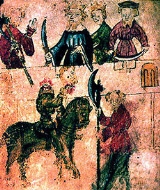
Gawain is
King ArthurKing Arthur is a legendary British leader of the late 5th and early 6th centuries, who, according to Medieval histories and romances, led the defence of Britain against Saxon invaders in the early 6th century. The details of Arthur's story are mainly composed of folklore and literary invention, and...
's nephew and a Knight of the
Round TableThe Round Table is King Arthur's famed table in the Arthurian legend, around which he and his Knights congregate. As its name suggests, it has no head, implying that everyone who sits there has equal status. The table was first described in 1155 by Wace, who relied on previous depictions of...
who appears very early in the Arthurian legend's development. He is one of a select number of Round Table members to be referred to as the greatest knight, most notably in
Sir Gawain and the Green KnightSir Gawain and the Green Knight is a late 14th-century Middle English alliterative romance outlining an adventure of Sir Gawain, a knight of King Arthur's Round Table. In the poem, Sir Gawain accepts a challenge from a mysterious warrior who is completely green, from his clothes and hair to his...
. He is almost always portrayed as the son of Arthur's sister
MorgauseMorgause , known in earlier works as Gwyar or Anna, is the sister or half-sister of King Arthur in the Arthurian legend. In her earliest appearance she is Arthur's full sister by Uther Pendragon and Igraine; Gwyar is her name and she is the mother of Gwalchmei...
(or Anna) and King
LotLot or Loth is the eponymous king of Lothian in the Arthurian legend. He is best known as the father of Sir Gawain. Such a ruler evidently first appeared in hagiographical material concerning Saint Kentigern , which feature a Leudonus, king of Leudonia, a Latin name for Lothian...
of Orkney and
LothianLothian forms a traditional region of Scotland, lying between the southern shore of the Firth of Forth and the Lammermuir Hills....
, and his brothers are
AgravainSir Agravain or Sir Agravaine is a nephew of King Arthur and a Knight of the Round Table in Arthurian legend. He is the second son of King Lot of Orkney and Lothian and Morgause , full brother to Gawain, Gaheris and Gareth. His half-brother and most frequent associate in the Post-Vulgate Cycle is...
,
GaherisGaheris is a figure of Arthurian legend, a knight of the Round Table, and a son of Morgause and King Lot of Orkney and Lothian. His brothers are Gawain, Agravaine, Gareth and Mordred, a half-brother. His mother is a daughter of Gorlois and Igraine, and a sister of Elaine and Morgan le Fay...
,
GarethSir Gareth was a Knight of the Round Table in Arthurian Legend. He was the youngest son of Lot and of Morgause, King Arthur's half-sister, thus making him Arthur's nephew, as well as brother to Gawain, Agravain, Gaheris, and half brother of Mordred...
, and
MordredMordred or Modred is a character in the Arthurian legend, known as a notorious traitor who fought King Arthur at the Battle of Camlann, where he was killed and Arthur fatally wounded. Tradition varies on his relationship to Arthur, but he is best known today as Arthur's illegitimate son by his...
. In some works he has sisters as well.
Gawain is often portrayed as a formidable but brash warrior, fiercely loyal to his king and family. He is a friend to young knights, a defender of the poor, and as "the Maidens' Knight", a defender of women as well. In some works, his strength waxes and wanes with the sun; in the most common form of this motif, his might triples by noon, but fades as the sun sets. His knowledge of herbs makes him a great healer, and he is credited with at least three children: Florence, Lovell, and
GingalainSir Gingalain , also known as Le Bel Inconnu, or The Fair Unknown, is a character from Arthurian legend whose exploits are recorded in numerous versions of a popular medieval romance. His nickname differs depending on the version and language; he is known in English as Libeaus Desconus...
, the last of which is also called
Libeaus DesconusLibeaus Desconus is a 14th century Middle English version of the popular "Fair Unknown" story. Its author is thought to be Thomas Chestre. The story matter displays strong parallels to that of Renaut de Beaujeu's Le Bel Inconnu; both versions describe the adventures of Gingalain, the son of King...
or Le Bel Inconnu, the Fair Unknown. In later
WelshWales is a country that is part of the United Kingdom and the island of Great Britain, bordered by England to its east and the Atlantic Ocean and Irish Sea to its west. It has a population of three million, and a total area of 20,779 km²...
Arthurian literature, Gawain is considered synonymous with the native champion Gwalchmei. Gawain appears in English, French and Celtic literature as well as in Italy where he appears in the architecture of the north portal in the cathedral of Modena, constructed in 1184.
Name
It has been generally assumed that the name Gawain is derived from the Welsh Gwalchmei ap Gwyar. However, the medievalist
Roger Sherman LoomisRoger Sherman Loomis was an American scholar and one of the foremost authorities on medieval and Arthurian literature.-Biography:...
suggests a derivation from the epithet
Gwallt Avwyn, found in the list of heroes in
Culhwch and OlwenCulhwch and Olwen is a Welsh tale about a hero connected with Arthur and his warriors that survives in only two manuscripts: a complete version in the Red Book of Hergest, ca. 1400, and a fragmented version in the White Book of Rhydderch, ca. 1325. It is the longest of the surviving Welsh prose...
, which he translates as "hair like reins" or "bright hair". Loomis' etymology has not gained wide acceptance among modern Arthurian scholars, however. An alternate etymology, proposed by the Dutch scholar Lauran Toorians, would derive the name Gawain not from the Middle Welsh Gwalchmei, but rather from the medieval Dutch name Walewein (attested in Flanders and Northern France c. 1100 AD). Toorians suggests that the name entered Britain during the large settlement of Flemings in Wales in the early 12th century.
Gwalchmei was a traditional hero of Welsh legend whose popularity greatly increased after foreign versions, particularly those derived from
Geoffrey of MonmouthGeoffrey of Monmouth was a cleric and one of the major figures in the development of British historiography and the popularity of tales of King Arthur...
's
Historia Regum BritanniaeThe Historia Regum Britanniae is a pseudohistorical account of British history, written c. 1136 by Geoffrey of Monmouth. It chronicles the lives of the kings of the Britons in a chronological narrative spanning a time of two thousand years, beginning with the Trojans founding the British nation...
, became known in Wales. The early romance
Culhwch and OlwenCulhwch and Olwen is a Welsh tale about a hero connected with Arthur and his warriors that survives in only two manuscripts: a complete version in the Red Book of Hergest, ca. 1400, and a fragmented version in the White Book of Rhydderch, ca. 1325. It is the longest of the surviving Welsh prose...
, associated with the
MabinogionThe Mabinogion is the title given to a collection of eleven prose stories collated from medieval Welsh manuscripts. The tales draw on pre-Christian Celtic mythology, international folktale motifs, and early medieval historical traditions...
, written in the later part of the 11th century, ascribes to Gwalchmei the same relationship with Arthur that Gawain is later given: he is Arthur's sister's son and one of his leading warriors. However, he is mentioned only twice in the text; once in the extensive list of Arthur's court towards the beginning of the story, and again as one of the "Six Helpers" who Arthur sends with the protagonist
CulhwchCulhwch , in Welsh mythology, is the son of Cilydd son of Celyddon and Goleuddydd, a cousin of Arthur and the protagonist of the story Culhwch and Olwen...
on his journey to find his love
OlwenIn Welsh mythology, Olwen is the daughter of the giant Ysbaddaden and cousin of Goreu. She is the heroine of the story Culhwch and Olwen in the Mabinogion....
. Unlike the other helpers he takes no further part in the action, suggesting he was added to the romance later under the influence of the Welsh versions of Geoffrey's
Historia. Still, Gwalchmei was clearly a traditional figure; other early references to him include the
Welsh TriadsThe Welsh Triads are a group of related texts in medieval manuscripts which preserve fragments of Welsh folklore, mythology and traditional history in groups of three. The triad is a rhetorical form whereby objects are grouped together in threes, with a heading indicating the point of likeness...
; the
Englynion y BeddauThe Englynion y Beddau is a Middle Welsh verse catalogue listing the resting places of legendary heroes. It consists of a series of englynion, or short stanzas in quantitative meter, and survives in a number of manuscripts...
(
Stanzas of the Graves), which lists the site of his grave; the
Trioedd y Meirch (
Triads of the Horses), which praises his horse
Keincaled (known as
GringoletIn Arthurian legend, Gringolet is Sir Gawain's horse. A sturdy charger, Gringolet was known far and wide for his ability in combat. He appears in very many romances in several different languages, and the prominent translator and Arthurian scholar D.D.R...
to later French authors); and Cynddelw's elegy for
Owain GwyneddOwain Gwynedd ap Gruffydd , in English also known as Owen the Great, was King of Gwynedd from 1137 until his death in 1170. He is occasionally referred to as "Owain I of Gwynedd"; and as "Owain I of Wales" on account of his claim to be King of Wales. He is considered to be the most successful of...
, which compares Owain's boldness to that of Gwalchmei. In the Welsh Triads, Triad 4 lists him as one of the "Three Well-Endowed Men of the Isle of Britain" (probably referring to his inheritance), while Triads 75 and 91 praise his generosity to guests and his fearlessness, respectively. Some versions of Triads 42 and 46 also praise his horse Keincaled, echoing the
Triads of the Horses. A tale recorded by sixteenth century Welsh scholar Sion Dafydd Rhys claims that Gwalchmai destroyed three witches by trickery.
Scholars are not entirely convinced that the later character of Gawain is derived from the Welsh Gwalchmei ap Gwyar, but later Welsh writers clearly thought this was the case; the name "Gwalchmei" consistently substitutes for "Gawain" in Cymric translations and adaptations of foreign works, such as the
Welsh RomancesThe Three Welsh Romances are three Middle Welsh tales associated with the Mabinogion. They are versions of Arthurian tales that also appear in the work of Chrétien de Troyes. Critics have debated whether the Welsh Romances are based on Chrétien's poems or if they derive from a shared original...
of the
Mabinogion. The name itself is the subject of speculation; in Welsh, the term
gwalch translates as falcon or hawk, but both
mei and the alternate
mai are more obscure. They may be archaic petrified genitives of Middle Welsh
ma, meaning "plain, field" (from Brythonic
*magos, genitive
*magesos), but the exact relationship is debated.
Mai is the modern Welsh name for the month of May, leading to the popular speculation that the name means "Hawk of May," but this derivation is unlikely. Additionally, not all scholars accept the
gwalch derivation; noted Celticist John Koch has suggested the name could be derived from a Brythonic original
*Wolcos Magesos, "Wolf/Errant Warrior of the Plain." At any rate the spelling "Gwalchmai" has become popular, and there is a small village in
AngleseyAnglesey , also known by its Welsh name Ynys Môn , is an island and, as Isle of Anglesey, a county off the north west coast of Wales...
called
GwalchmaiGwalchmai is a village on Anglesey in north Wales.- Location :Gwalchmai is less than a mile from the A55 and the Anglesey Show Ground and less than two miles from RAF Mona.- Amenities and history :...
, probably named after the 12th-century bard
Gwalchmai ap MeilyrGwalchmai ap Meilyr was a Welsh language court poet from Ynys Môn who composed poems in praise of Owain Gwynedd, king of Gwynedd, and his brothers. He was the son of another poet, Meilyr Brydydd, and father of the poets Meilyr ap Gwalchmai and Einion ap Gwalchmai...
.
The
Gwyar (meaning "gore" or "spilled blood/bloodshed") in Gwalchmei ap Gwyar is likely the name of Gwalchmei's mother, rather than his father as is the standard in the Welsh Triads. Matronyms were sometimes used in Wales, as in the case of Math fab Mathonwy and
Gwydion fab DônGwydion fab Dôn is a magician, hero and trickster of Welsh mythology, appearing most prominently in the Fourth Branch of the Mabinogi, which focuses largely on his relationship with his young nephew, Lleu Llaw Gyffes...
, and were also fairly common in early
IrelandIreland is an island to the northwest of continental Europe. It is the third-largest island in Europe and the twentieth-largest island on Earth...
. Gwyar is named as a female, a daughter of Amlawdd Wledig, in one version of the hagiographical genealogy
Bonedd y Saint, while the 14th-century
Birth of Arthur substitutes Gwyar for Geoffrey's Anna as Gwalchmei/Gawain's mother. Other sources do not follow this substitution, however, indicating that Gwyar and Anna/Morgause originated independently.
Celtic origins
Some theories claim that the Gawain legend has its ultimate source in Celtic myth. Parallels between this Arthurian hero and the Irish hero Setanta who became known as
CuchulainnCú Chulainn or Cúchulainn , and sometimes known in English as Cuhullin , is an Irish mythological hero who appears in the stories of the Ulster Cycle, as well as in Scottish and Manx folklore...
appear throughout the literature about the character of Gawain. Gawain’s father is considered by some to be analogous to the
Irish god LughLug or Lugh is an Irish deity represented in mythological texts as a hero and High King of the distant past. He is known by the epithets Lámhfhada , for his skill with a spear or sling, Ildánach , Samhildánach , Lonnbeimnech and Macnia , and by the...
, who was said to be the father of Cuchulainn. The fact that, in some of the literature concerning Gawain, his strength waxes and wanes with the rising and setting of the sun is indicative of this analogy, and suggests an Irish rather than a Welsh origin. Celtic themes and motifs also appear in the tales
Island of Women (in which he travels to the Other-world) and in an English romance entitled
The Marriage of Syr Gawayne. In the latter, the knight is coupled with a woman who is either a fairy or the relation of a sorcerer. Thus, Gawain is connected in multiple myths to the Celtic concept of Other-world.
Prominence in Arthurian literature
The character of Gawain is seen more often in the various incarnations of Arthurian legend than are many knights. In fact, there are more medieval romances dedicated to narrating the adventures of Gawain than there are even to Lancelot, who is perhaps better known in popular culture today. Even when he is not the protagonist, he often appears in a supporting role that offers some prominence in the tale. In
Chrétien de TroyesChrétien de Troyes was a French poet and trouvère who flourished in the late 12th century. Perhaps he named himself Christian of Troyes in contrast to the illustrious Rashi, also of Troyes...
's
Perceval, the Story of the GrailPerceval, the Story of the Grail is the unfinished fifth romance of Chrétien de Troyes. Probably written between 1181 and 1191, it is dedicated to Chrétien's patron Philip, Count of Flanders...
, the greater part of the verse focuses on Gawain rather than on the character after whom it is named. In
Thomas MalorySir Thomas Malory was an English writer, the author or compiler of Le Morte d'Arthur. The antiquary John Leland as well as John Bale believed him to be Welsh, but most modern scholars, beginning with G. L...
's
Le Morte d'ArthurLe Morte d'Arthur is a compilation by Sir Thomas Malory of Romance tales about the legendary King Arthur, Guinevere, Lancelot, and the Knights of the Round Table...
, Gawain plays a significant role, in for instance the quest for the
Holy GrailThe Holy Grail is a sacred object figuring in literature and certain Christian traditions, most often identified with the dish, plate, or cup used by Jesus at the Last Supper and said to possess miraculous powers...
and the events leading up to Arthur’s death. Though he figures importantly in much of Arthurian literature, in French texts he is more often found in a supporting position (as in
Perceval). In English ones, however, he frequently has the principal role.
Character
Sir Gawain in particular of all Arthur’s knights is known for his courteousness. In "Gawain: His Reputation, His Courtesy and His Appearance in Chaucer’s Squire’s Tale," B.J. Whiting collected quantitative evidence of this quality being stronger in Gawain than in any of the other knights of the Round Table. He notes the words “courteous”, “courtesy” and “courteously” being used in reference to Arthur’s nephew 178 times in total, which is greater than the tally for all other knights in Arthurian literature. In many romances, he is depicted as a model for this chivalric attribute. In
Sir Gawain and the Green KnightSir Gawain and the Green Knight is a late 14th-century Middle English alliterative romance outlining an adventure of Sir Gawain, a knight of King Arthur's Round Table. In the poem, Sir Gawain accepts a challenge from a mysterious warrior who is completely green, from his clothes and hair to his...
, for example, Gawain receives the kisses of
Lady BertilakLady Bertilak is a character in the medieval poem Sir Gawain and the Green Knight. She is ordered by her husband, the Green Knight, or Lord Bertilak, to test Sir Gawain's purity.-Analysis:...
with discretion, at once not wanting to insult her by refusing her advances and not wanting to betray the hospitality of her husband.
Family
The character of Gawain is connected by familial ties to specific characters in much of the literature concerning Arthurian legend. His relationship to Arthur is established as early as Geoffrey of Monmouth’s History of the Kings of Britain, in which he is said to be the nephew of the king. In Gillian Brashaw’s 1980 trilogy entitled Hawk of May, Morgawse (known in other texts as Morgause) is the knight’s mother, while his brother, who is later revealed to be cousin instead, is Medraut (in other texts, Mordred). According to the fifteenth-century tale entitled
The Wedding of Sir Gawain and Dame Ragnelle, Gawain’s wife is Ragnelle, or the “Loathly Lady”. He marries her out of the desire to save the life of his king, who might have forfeit himself to a knight known as Sir Gromer Somer Joure were he not able to come up with the answer to the question of what women most desire. The unattractive Dame Ragnelle offers her answer in return for Gawain as her husband, but on their wedding night reveals her true form as a beautiful young woman. She bears him a son, called Gyngolyn in this text, but whose name is varied in other texts and is sometimes referred to only as the “Fair Unknown.” Though Gawain is most often depicted as the son of King Lot, in Vera Chapman’s
The Green Knight (1975) he is the offspring of Leonie and Gareth of Lyonesse and is instead Lot’s nephew.
Gawain in early literature
In the
Gesta Regum Anglorum of around 1125,
William of MalmesburyWilliam of Malmesbury was the foremost English historian of the 12th century. C. Warren Hollister so ranks him among the most talented generation of writers of history since Bede, "a gifted historical scholar and an omnivorous reader, impressively well versed in the literature of classical,...
records that Gawain's grave had been uncovered in
PembrokeshirePembrokeshire is a county in the south west of Wales. It borders Carmarthenshire to the east and Ceredigion to the north east. The county town is Haverfordwest where Pembrokeshire County Council is headquartered....
during the reign of
William the ConquerorWilliam I , also known as William the Conqueror , was the first Norman King of England from Christmas 1066 until his death. He was also Duke of Normandy from 3 July 1035 until his death, under the name William II...
, and writes that the great nephew of Arthur had been driven from his kingdom by
HengestHengist and Horsa are figures of Anglo-Saxon, and subsequently British, legend, which records the two as the Germanic brothers who led the Angle, Saxon, and Jutish armies that conquered the first territories of Great Britain in the 5th century AD...
's brother, though he continued to harry them severely.
Gawain is a major character in the Arthurian section of
Geoffrey of MonmouthGeoffrey of Monmouth was a cleric and one of the major figures in the development of British historiography and the popularity of tales of King Arthur...
's
Historia Regum BritanniaeThe Historia Regum Britanniae is a pseudohistorical account of British history, written c. 1136 by Geoffrey of Monmouth. It chronicles the lives of the kings of the Britons in a chronological narrative spanning a time of two thousand years, beginning with the Trojans founding the British nation...
(History of the Kings of Britain) written in 1136, where he is a superior warrior and potential heir to the throne until he is tragically struck down by
MordredMordred or Modred is a character in the Arthurian legend, known as a notorious traitor who fought King Arthur at the Battle of Camlann, where he was killed and Arthur fatally wounded. Tradition varies on his relationship to Arthur, but he is best known today as Arthur's illegitimate son by his...
's forces. Several later works expand on Geoffrey's mention of Gawain's boyhood spent in
RomeRome is the capital of Italy and the country's largest and most populated city and comune, with over 2.7 million residents in . The city is located in the central-western portion of the Italian Peninsula, on the Tiber River within the Lazio region of Italy.Rome's history spans two and a half...
, the most important of which is the anonymous
Medieval LatinMedieval Latin was the form of Latin used in the Middle Ages, primarily as a medium of scholarly exchange and as the liturgical language of the medieval Roman Catholic Church, but also as a language of science, literature, law, and administration. Despite the clerical origin of many of its authors,...
romance
The Rise of Gawain, Nephew of ArthurDe Ortu Waluuanii Nepotis Arturi is an anonymous Medieval Latin romance dating to the 12th or 13th century. An Arthurian tale, it describes the birth, boyhood deeds, and early adventures of King Arthur's nephew Gawain. The romance gives the most detailed account of Gawain's early years of any...
, which describes his birth, boyhood and early adventures leading up to his knighting by his uncle.
An influx of romances written in French appeared in the wake of Chretien’s works, and in these Gawain was characterized variously. He is the hero, sometimes he aids the hero, sometimes he is the subject of
burlesqueBurlesque is a literary, dramatic or musical work intended to cause laughter by caricaturing the manner or spirit of serious works, or by ludicrous treatment of their subjects...
humor. In the
Vulgate CycleThe Lancelot–Grail, also known as the Prose Lancelot, the Vulgate Cycle, or the Pseudo-Map Cycle, is a major source of Arthurian legend written in French. It is a series of five prose volumes that tell the story of the quest for the Holy Grail and the romance of Lancelot and Guinevere...
, he is depicted as a proud and worldly knight who demonstrates through his failures the danger of neglecting the spirit for the futile gifts of the material world. On the
GrailThe Holy Grail is a sacred object figuring in literature and certain Christian traditions, most often identified with the dish, plate, or cup used by Jesus at the Last Supper and said to possess miraculous powers...
quest, his intentions are always the purest, but he is unable to use God's grace to see the error in his ways. Later, when his brothers Agravain and Mordred plot to destroy
LancelotSir Lancelot du Lac is one of the Knights of the Round Table in the Arthurian legend. He is the most trusted of King Arthur's knights and plays a part in many of Arthur's victories...
and
GuinevereGuinevere was the legendary queen consort of King Arthur. In tales and folklore, she was said to have had a love affair with Arthur's chief knight Sir Lancelot...
by exposing their love affair, Gawain tries to stop them. When Guinevere is sentenced to burn at the stake and Arthur deploys his best knights to guard the execution, Gawain nobly refuses to take part in the deed even though his brothers will be there. But when Lancelot returns to rescue Guinevere, a battle between Lancelot's and Arthur's knights ensues and Gawain's brothers, except for Mordred, are killed. This turns his friendship with Lancelot into hatred, and his desire for vengeance causes him to draw Arthur into a war with Lancelot in France. In the king's absence, Mordred usurps the throne, and the Britons must return to save Britain. Gawain is mortally wounded in battle against Mordred's armies, and writes to Lancelot apologizing for his actions and asking for him to come to Britain to help defeat Mordred.
The Middle Dutch
Roman van Walewein by Penninc and Pieter Vostaert, and the Middle High German romance
Diu Crône by Heinrich von dem Türlin are both dedicated primarily to Gawain, and in Wirnt von Grafenberg’s Middle High German
Wigalois he is the father of the protagonist.
Gawain in English literature
For the
EnglishThe English are a nation and ethnic group native to England, who speak English. The English identity is of early mediaeval origin, when they were known in Old English as the Anglecynn. England is now a country of the United Kingdom, and the majority of English people in England are British Citizens...
and
ScotsThe Scottish people , or Scots, are a nation and ethnic group native to Scotland. Historically they emerged from an amalgamation of the Picts and Gaels, incorporating neighbouring Britons to the south as well as invading Germanic peoples such as the Anglo-Saxons and the Norse.In modern use,...
, Gawain remained a respectable and heroic figure. He is the subject of several romances and lyrics in the dialects of those countries. He is the hero of one of the greatest works of
Middle EnglishMiddle English is the stage in the history of the English language during the High and Late Middle Ages, or roughly during the four centuries between the late 11th and the late 15th century....
literature,
Sir Gawain and the Green KnightSir Gawain and the Green Knight is a late 14th-century Middle English alliterative romance outlining an adventure of Sir Gawain, a knight of King Arthur's Round Table. In the poem, Sir Gawain accepts a challenge from a mysterious warrior who is completely green, from his clothes and hair to his...
, where he is portrayed as an excellent, but human, knight. In
The Wedding of Sir Gawain and Dame RagnelleThe Wedding of Sir Gawain and Dame Ragnelle is a 15th-century English poem, one of several versions of the "loathly lady" story popular during the Middle Ages...
, his wits, virtue and respect for women frees his wife, a
loathly ladyThe loathly lady is a common literary device used in medieval literature, most famously in Geoffrey Chaucer's The Wife of Bath's Tale. The motif was prominent in Celtic mythology and to a lesser extent Germanic mythology, where the lady often represented the sovereignty of the...
, from her curse of ugliness. Other important English Gawain romances include
The Awntyrs off ArthureThe Awntyrs off Arthure at the Terne Wathelyne is an Arthurian romance of 702 lines written in Middle English alliterative verse. Despite its title, it centres on the deeds of Sir Gawain...
(
The Adventures of Arthur) and
The Avowyng of Arthur.
These glowing portraits of Gawain all but ended with Sir
Thomas MalorySir Thomas Malory was an English writer, the author or compiler of Le Morte d'Arthur. The antiquary John Leland as well as John Bale believed him to be Welsh, but most modern scholars, beginning with G. L...
's
Le Morte d'ArthurLe Morte d'Arthur is a compilation by Sir Thomas Malory of Romance tales about the legendary King Arthur, Guinevere, Lancelot, and the Knights of the Round Table...
, which is based mainly, but not exclusively, on French works from the Vulgate and Post-Vulgate Cycles. Here Gawain partly retains the negative characteristics attributed to him by the later French, and partly retains his earlier positive representations, creating a character seen by some as inconsistent, and by others as a believably flawed hero. Gawain is cited in Robert Laneham's letter describing the entertainments at Kenilworth in 1575, and the recopying of earlier works such as
The Greene KnightThe Greene Knight is a late medieval rhyming romance, found in the Percy Folio Manuscript. The storyline effectively parallels the more famous Sir Gawain and the Green Knight in describing the dealings of Gawain, King Arthur's nephew, with the Greene Knight.The text was edited by Thomas Hahn for...
suggests that a popular tradition of Gawain continued. The
Child BalladsThe Child Ballads are a collection of 305 ballads from England and Scotland, and their American variants, collected by Francis James Child in the late nineteenth century...
include a preserved legend in the positive light,
The Marriage of Sir Gawain"The Marriage of Sir Gawain" is an English Arthurian ballad, collected as Child Ballad 31. Found in the Percy Folio, it is a fragmented account of the story of Sir Gawain and the loathly lady, which has been preserved in fuller form in the medieval poem The Wedding of Sir Gawain and Dame Ragnelle...
a fragmentary version of the story of
The Wedding of Sir Gawain and Dame Ragnelle. He also appears in the rescue of Guinevere and plays a significant role though Lancelot overshadows him. Gawain appears in Tennyson’s “Passing of Arthur” as a frivolous figure who is held in contempt by Sir Bedivere. The character appears in a positive light in novels like
Gillian BradshawGillian Marucha Bradshaw is an American writer of historical fiction, historical fantasy, children's literature, science fiction, and contemporary science-based novels, who currently lives in Britain...
's
Hawk of MayHawk of May is the first of a trilogy of fantasy novels written by Gillian Bradshaw which interprets the King Arthur legend. It recounts, from the viewpoint of the warrior Gwalchmai ap Lot, Arthur's rise to power...
, Thomas Berger's
Arthur Rex,
Hal Foster's comic strip
Prince ValiantPrince Valiant in the Days of King Arthur, or simply Prince Valiant, is a long-run comic strip created by Hal Foster in 1937. It is an epic adventure that has told a continuous story during its entire history, and the full stretch of that story now totals more than 3700 Sunday strips...
, and
Stephen R. LawheadStephen R. Lawhead, born , is a best-selling American writer known for his works of fantasy, science fiction, and more recently, historical fiction, particularly Celtic historical fiction...
's
Pendragon CycleThe Pendragon Cycle is a series of fantasy or semi-historical books based on the Arthurian legend, written by Stephen R. Lawhead. They are:*Taliesin *Merlin *Arthur *Pendragon *Grail...
. He is also the subject of
Harrison BirtwistleSir Harrison Paul Birtwistle CH is a British contemporary composer.-Life:Birtwistle was born in Accrington, a mill town in Lancashire some 20 miles north of Manchester. His interest in music was encouraged by his mother, who bought him a clarinet when he was seven, and arranged for him to have...
's and
David HarsentDavid Harsent is an English poet & TV scriptwriter. As Jack Curtis and David Lawrence he has published a number of crime fiction novels....
's opera
GawainGawain is an opera with music by Harrison Birtwistle to a libretto by David Harsent. The story is based on the Middle English romance Sir Gawain and the Green Knight. The opera was a commission from the Royal Opera House, London, where it was first performed on 30 May 1991. Rhian Samuel has...
.
The loves of Sir Gawain
Scholar M. Gaston Paris draws attention to the phenomenon that, since Gawain is known in multiple tales as “the Maidens’ Knight”, his name is thus attached to no female in particular. He is the champion of all women. and through this reputation, he has avoided the name pairing seen in tales of Eric and Lancelot (the former being inextricably linked with Enide, the latter with Guinevere). He has, however, been connected to more than one woman in the course of Arthurian literature. In the alliterative Middle-English poem
Sir Gawain and the Green KnightSir Gawain and the Green Knight is a late 14th-century Middle English alliterative romance outlining an adventure of Sir Gawain, a knight of King Arthur's Round Table. In the poem, Sir Gawain accepts a challenge from a mysterious warrior who is completely green, from his clothes and hair to his...
, Sir Bertilak’s wife flirts with him. In the aforementioned
The Wedding of Sir Gawain and Dame RagnelleThe Wedding of Sir Gawain and Dame Ragnelle is a 15th-century English poem, one of several versions of the "loathly lady" story popular during the Middle Ages...
, he marries the cursed Ragnelle, and in giving her “sovereignty” in the relationship, lifts the spell laid upon her that had given her a hag-like appearance. He is also associated with a vague supernatural figure in various tales. The hero of La Bel Inconnu is the progeny of Gawain and a fairy called Blancemal, and in the Marvels of Rigomer, Gawain is rescued by the fay, Lorie. In the German tale, Wizalois, the mother of his son is known as Florie, who is likely another version of the Lorie of Rigomer. In her earliest incarnations, Gawain’s love is either the princess or queen of the Other-world.
Portrayals in media
- Murray Head
Murray Seafield Saint-George Head is a British actor and singer, most recognised for his international hit songs "Superstar" and "One Night in Bangkok" and his album Say It Ain't So...
in Gawain and the Green KnightGawain and the Green Knight is a 1973 film directed by Stephen Weeks, and starring Murray Head as Gawain and Nigel Green in his final theatrical film as the Green Knight...
- Liam Neeson
Liam John Neeson, OBE is an Irish actor who has been nominated for an Oscar, a BAFTA and three Golden Globe Awards.He has starred in a number of notable roles including Oskar Schindler in Schindler's List, Michael Collins in Michael Collins, Peyton Westlake in Darkman, Jean Valjean in Les...
in ExcaliburExcalibur is a 1981 dramatic fantasy film directed, produced and co-written by John Boorman that retells the legend of King Arthur and the knights of the Round Table. Adapted from the 15th century Arthurian romance, Le Morte d'Arthur by Thomas Malory, Excalibur features the music of Richard Wagner...
- Robert Gywn Davin in First Knight
First Knight is a 1995 American medieval film based on Arthurian legend, directed by Jerry Zucker. It stars Richard Gere as Lancelot, Julia Ormond as Guinevere, Sean Connery as King Arthur and Ben Cross as Malagant....
- Joel Edgerton
Joel Edgerton is an Australian film and television actor.-Early life:Edgerton was born in Blacktown, Sydney, to a homemaker mother and a solicitor/property developer father, Michael. His brother, Nash Edgerton, is a stuntman and filmmaker...
in King ArthurKing Arthur is a 2004 film directed by Antoine Fuqua and written by David Franzoni. It stars Clive Owen as the title character, Ioan Gruffudd as Lancelot, and Keira Knightley as Guinevere....
- Noah Huntley
Noah Cornelius Marmaduke Huntley is an English actor, known for his role as Will Curtis in Holby City.-Background:...
in The Mists of AvalonThe Mists of Avalon is a 2001 miniseries based on the novel of the same name by Marion Zimmer Bradley. It was produced by American cable channel TNT and directed by Uli Edel...
- Eoin Macken
Eoin Christopher Macken is an Irish actor and film maker.Eoin has modelled for Abercrombie and Fitch, Ralph Lauren, and GQ....
in Merlin (TV series)Merlin is a British fantasy-adventure television programme by Julian Jones, Jake Michie, Julian Murphy and Johnny Capps. It began broadcasting on BBC One on 20 September 2008. The show is based on the Arthurian legends of the wizard Merlin and his relationship with Prince Arthur but differs from...
- Clive Standen
Clive Standen is an English actor best known for playing Sir Gawain in the Starz series Camelot as well as 'Archer', the brother of Robin Hood in the BBC TV series Robin Hood and Private Carl Harris in the British sci-fi show Doctor Who.-Acting:Standen's first experience of stunts, horse...
in Camelot (TV series)Camelot is a historical-fantasy-drama television series which premiered on April 1, 2011. It was co-produced by the Starz cable network and GK-TV which began production during the summer of 2010...
External links