
All Topics  
Alfred the Great

 
Alfred the Great

   Email Print
   Bookmark   Link


Alfred the Great


Alfred the Great (; 849 – October 26, 899), also spelled Ælfred, was king of the southern Anglo-Saxon
Anglo-Saxons

Anglo-Saxons is the term usually used to describe the invading tribes in the south and east of Great Britain starting from the early 5th century AD, and their creation of the English nation, lasting until the Norman conquest of England of 1066....
 kingdom of Wessex
Wessex

West Saxon redirects here. For other meanings of Wessex or West Saxon see Wessex .Wessex , from the Old English Westseaxe , was an Anglo-Saxon kingdom of the West Saxons, in South West England, from the 6th century, until the emergence of the English state in the 9th century, under the Wessex dynasty....
 from 871 to 899. Alfred is noted for his defence of the kingdom against the Danish
Danish people

The term Dane may refer to:* People with a Danish ancestral or ethnic identity, whether living in Denmark, emigrants, or the descendants of emigrants....
 Vikings, becoming the only English
English people

The English are a nation and ethnic group native to England who speak English language in England. The English identity as a people is of early medieval origin, when they were known in Old English as the Anglecynn....
 king to be awarded the epithet
Epithet

An epithet is a descriptive word or phrase accompanying or occurring in place of the name of a person or thing, which has become a fixed formula....
 "the Great". Alfred was the first King of the West Saxons
List of monarchs of Wessex

This is a list of monarchs of Wessex until 924. For later monarchs, see the List of monarchs in the British Isles. While the details of the later monarchs are confirmed by a number of sources, the earlier ones are in many cases obscure....
 to style himself "King of the English". Details of his life are described in a work by the Welsh
Welsh people

The Welsh people are an ethnic group and nation associated with Wales and the Welsh language. John Davies argues that the origin of the "Welsh nation" can be traced to the late 4th and early 5th centuries, following the Roman withdrawal from Britain, although Celtic languages seem to have been spoken in Wales far longer....
 scholar Asser
Asser

Asser was a Welsh monk from St. David's, Kingdom of Dyfed, who became Bishop of Sherborne in the 890s. In about 885 he was asked by Alfred the Great to leave St....
.


Discussion
Ask a question about 'Alfred the Great'
Start a new discussion about 'Alfred the Great'
Answer questions from other users
Full Discussion Forum


Recent Posts


Timeline

868   In England Alfred the Great marries Ealhswith and goes to the aid of Burgred of Mercia, who is attacked by Danes.

871   Alfred the Great succeeds as king of Wessex after Ethelred's death.

878   The Danes force king Alfred the Great of Wessex to retreat to a fort in Athelney, Somerset. Later, in the Battle of Ethandun (Edington), King Alfred the Great of Wessex defeats the Danes of the Danelaw under Guthrum. The Treaty of Wedmore divides England between the Anglo-Saxons and the Danes.

878   The Danes force king Alfred the Great of Wessex to retreat to a fort in Athelney, Somerset. Later, in the Battle of Ethandun (Edington), King Alfred the Great of Wessex defeats the Danes of the Danelaw under Guthrum. The Treaty of Wedmore divides England between the Anglo-Saxons and the Danes.

886   Alfred the Great captures London and renames it Lundenburgh. The boundaries between Wessex and the Danelaw are shifted.

890   First ceremonial visit by a Welsh king (Anarawd, King of Gwynedd to an English court (that of Alfred the Great).

890   Ottar from Hålogaland met king Alfred the Great, who wrote down his story.

893   Asser writes ''Life of King Alfred''.

894   Northumbrians and East Angles swear allegiance to Alfred the Great, and promptly break their truce by attacking the south-west of England.

899   Died


Encyclopedia


Alfred the Great (; 849 – October 26, 899), also spelled Ælfred, was king of the southern Anglo-Saxon
Anglo-Saxons

Anglo-Saxons is the term usually used to describe the invading tribes in the south and east of Great Britain starting from the early 5th century AD, and their creation of the English nation, lasting until the Norman conquest of England of 1066....
 kingdom of Wessex
Wessex

West Saxon redirects here. For other meanings of Wessex or West Saxon see Wessex .Wessex , from the Old English Westseaxe , was an Anglo-Saxon kingdom of the West Saxons, in South West England, from the 6th century, until the emergence of the English state in the 9th century, under the Wessex dynasty....
 from 871 to 899. Alfred is noted for his defence of the kingdom against the Danish
Danish people

The term Dane may refer to:* People with a Danish ancestral or ethnic identity, whether living in Denmark, emigrants, or the descendants of emigrants....
 Vikings, becoming the only English
English people

The English are a nation and ethnic group native to England who speak English language in England. The English identity as a people is of early medieval origin, when they were known in Old English as the Anglecynn....
 king to be awarded the epithet
Epithet

An epithet is a descriptive word or phrase accompanying or occurring in place of the name of a person or thing, which has become a fixed formula....
 "the Great". Alfred was the first King of the West Saxons
List of monarchs of Wessex

This is a list of monarchs of Wessex until 924. For later monarchs, see the List of monarchs in the British Isles. While the details of the later monarchs are confirmed by a number of sources, the earlier ones are in many cases obscure....
 to style himself "King of the English". Details of his life are described in a work by the Welsh
Welsh people

The Welsh people are an ethnic group and nation associated with Wales and the Welsh language. John Davies argues that the origin of the "Welsh nation" can be traced to the late 4th and early 5th centuries, following the Roman withdrawal from Britain, although Celtic languages seem to have been spoken in Wales far longer....
 scholar Asser
Asser

Asser was a Welsh monk from St. David's, Kingdom of Dyfed, who became Bishop of Sherborne in the 890s. In about 885 he was asked by Alfred the Great to leave St....
. Alfred was a learned man, and encouraged education and improved his kingdom's law
LAW

LAW may refer to:* Anti-tank warfare, e.g. the US Army M72 LAW or the British Army LAW 80*Palestinian Society for the Protection of Human Rights ...
 system as well as its military
Military

A military is an organization authorized by its nation to use force, usually including use of weapons, in defending its country by combating actual or Threat of force ....
 structure.

Childhood

Alfred was born in 847 at Wantage, Oxfordshire
Oxfordshire

Oxfordshire is a county in the South East England region, bordering on Northamptonshire, Buckinghamshire, Berkshire, Wiltshire, Gloucestershire, and Warwickshire....
 (in the historic county
Historic counties of England

The historic counties of England are ancient subdivisions of England established for administration by the Normans and in most cases based on earlier Anglo-Saxons kingdoms and shires....
 of Berkshire
Berkshire

Berkshire is a Home Counties in the South East England of England. It is also often referred to as the Royal County of Berkshire because of the presence of the royal residence of Windsor Castle in the county; this usage, which dates to the 19th century at least, was recognised by the Queen in 1958, and Letters patent issued confirming...
). He was the youngest son of King Æthelwulf of Wessex, by his first wife, Osburga
Osburga

Osburga or Osburh was the first wife of King ?thelwulf of Wessex and mother of Alfred the Great, "a religious woman, noble both by birth and by nature"....
. In 868 Alfred married Ealhswith, daughter of Ethelred Mucil.

At five years old, Alfred is said to have been sent to Rome
Rome

Rome is the capital city of Italy and Lazio, and is Italy's largest and most populous city, with 2,724,347 residents in an urban area of some ....
 where, according to the Anglo-Saxon Chronicle
Anglo-Saxon Chronicle

The Anglo-Saxon Chronicle is a collection of annals in Old English language chronicling the history of the Anglo-Saxons. The annals were created late in the 9th century, probably in Wessex, during the reign of Alfred the Great....
, he was confirmed by Pope Leo IV
Pope Leo IV

Pope Saint Leo IV was pope from April 10, 847 to July 17, 855.A Rome by birth, he was unanimously chosen to succeed Pope Sergius II. When he was elected, on April 10, 847, he was cardinal of Santi Quattro Coronati, and had been subdeacon of Pope Gregory IV and archpriest under his predecessor....
 who "anointed him as king." Victorian
Victorian era

The Victorian Era of the United Kingdom of Great Britain and Ireland was the period of Victoria of the United Kingdom reign from June 1837 to January 1901....
 writers interpreted this as an anticipatory coronation
Coronation

A coronation is a ceremony marking the investiture of a monarch with regal power, specifically involving the placement of a coronation crown upon his or her head, and the presentation of other items of regalia....
 in preparation for his ultimate succession to the throne of Wessex. However, this coronation could not have been foreseen at the time, since Alfred had three living elder brothers. A letter of Leo IV shows that Alfred was made a "consul
Consul

Consul was the highest elected office of the Roman Republic and an appointive office under the Roman Empire. The title was also used in other city states, and revived in modern states, notably French Republic before the Napoleon I of Franceic counter-revolution....
" and a misinterpretation of this investiture, deliberate or accidental, could explain later confusion. It may also be based on Alfred later having accompanied his father on a pilgrimage to Rome and spending some time at the court of Charles the Bald
Charles the Bald

File:Charles le Chauve denier Bourges after 848.jpgCharles the Bald , Holy Roman Emperor and King of West Francia , was the youngest son of the Emperor Louis the Pious by his second wife Judith, daughter of Welf....
, King of the Franks, around 854–855. On their return from Rome in 856, Æthelwulf was deposed by his son Æthelbald. Æthelwulf died in 858, and Wessex was ruled by three of Alfred's brothers in succession.

Asser tells the story about how as a child Alfred won a prize of a volume of poetry in English, offered by his mother to the first of her children able to memorise it. This story may be true, or it may be a myth intended to illustrate the young Alfred's love of learning.

Under Ethelred

During the short reigns of his two eldest brothers, Ethelbald
Ethelbald of Wessex

King ?thelbald of Wessex or Ethelbald was the second of the five sons of King Ethelwulf of Wessex and Osburga and was born in about 831 or 834....
 and Ethelbert
Ethelbert of Wessex

Ethelbert or ??elberht of Wessex was the third son of Ethelwulf of Wessex and was born around 835. He got his first taste of kingship in 855 when he was left in charge of Kent while his father, Ethelwulf, was in Rome....
, Alfred is not mentioned. However with the accession of the third brother, Ethelred
Ethelred of Wessex

King Ethelred of Wessex was the fourth son of King Ethelwulf of Wessex, and an older brother of Alfred the Great. He is sometimes referred to as King Ethelred I of Kingdom of England, but it is open to question whether he should be regarded as a king of England, since in his time the English were still divided into a number of kingdoms, no...
, in 866, the public life of Alfred began. It is during this period that Asser applies to him the unique title of "secundarius", which may indicate a position akin to that of the Celt
Celt

Celts , is a modern term used to describe any of the European peoples who spoke, or speak, a Celtic languages. The term is also used in a wider sense to describe the Modern Celts of those peoples, notably those who participate in a Celtic culture....
ic tanist
Tanistry

Tanistry was a system for passing on titles and lands. In this system the Tanist was the office of heir-apparent, or second-in-command, among the Gaels patrilineal dynasties of Ireland, Scotland and Isle of Man, to succeed to the Chiefs of the Name or to the kingship....
, a recognised successor closely associated with the reigning monarch. It is possible that this arrangement was sanctioned by the Witenagemot
Witenagemot

The Witenagemot or the Witena gemot , also known as the Witan was a political institution in Anglo-Saxon England which operated from before the seventh century until the eleventh century....
, to guard against the danger of a disputed succession should Ethelred fall in battle. The arrangement of crowning a successor as Royal prince and military commander is well-known among other Germanic
Germanic monarchy

Germanic monarchy, also called barbarian monarchy, was a monarchical systemof government which was predominant among the Germanic tribes of Late Antiquity and the Early Middle Ages....
 tribes, such as the Swedes
Swedish people

Swedes are people from Sweden or of Swedish decent. Unlike the United States, United Kingdom, and Australian Censuses, Statistics Sweden does not classify the Swedish population by race or ethnicity....
 and Franks
Franks

The Franks or Frankish people were a West Germanic ethnic group first identified in the 3rd century as living north and east of the Lower Rhine River....
, with whom the Anglo-Saxon
Anglo-Saxon

Anglo-Saxon may refer to:* Anglo-Saxons, a Germanic people inhabiting parts of England during the Dark Ages* Anglo-Saxon architecture* Anglo-Saxon economy ...
s were closely related.

In 868, Alfred is recorded fighting beside his brother Ethelred, in an unsuccessful attempt to keep the invading Danes out of the adjoining Kingdom of Mercia. For nearly two years, Wessex was spared attacks because Alfred paid the Vikings to leave him alone. However, at the end of 870, the Danes arrived in his homeland. The year that followed has been called "Alfred's year of battles". Nine martial engagements were fought with varying fortunes, though the place and date of two of the battles have not been recorded. In Berkshire, a successful skirmish at the Battle of Englefield, on 31 December 870, was followed by a severe defeat at the Siege and Battle of Reading
Battle of Reading (871)

The first Battle of Reading was a battle on January 4 871 near Reading, Berkshire in what is now the England county of Berkshire. The battle occurred when Ethelred of Wessex and his brother Alfred the Great attacked a Denmark army, which was invading Britain and was camped near Reading....
, on 5 January 871, and then, four days later, a brilliant victory at the Battle of Ashdown
Battle of Ashdown

The Battle of Ashdown, in Berkshire , took place on 8 January 871. Alfred the Great, then a mere prince of twenty-one, led the Wessex army of his brother, King Ethelred of Wessex, in a victorious battle against the invading Viking....
 on the Berkshire Downs
North Wessex Downs AONB

The North Wessex Downs Area of Outstanding Natural Beauty is located in the England counties of Berkshire, Hampshire, Oxfordshire and Wiltshire....
, possibly near Compton
Compton, Berkshire

}|-|width="50%"|Population:|| 1 407 |-|width="50%"|Formal status:||Village|-!colspan=2 bgcolor="#ff9999"|Administration|-|width="50%"|District:||align="left"|West Berkshire...
 or Aldworth
Aldworth

Aldworth is a small village and civil parish, close to the northern edge of Berkshire, England. It lies in the rural area between Reading, Berkshire, Newbury, Berkshire and Streatley, Berkshire....
. Alfred is particularly credited with the success of this latter conflict. However, later that month, on 22 January, the English were again defeated at Basing and, on the following 22 March at the Battle of Merton
Battle of Merton

The Battle of Merton was fought in April 871. It was one of eight known to be fought that year by King Ethelred of Wessex in England, who was defending his kingdom against an army of Viking invaders....
 (perhaps Marden in Wiltshire
Wiltshire

Wiltshire is a Ceremonial counties of England in the South West England of England. It is landlocked and borders the counties of Dorset, Somerset, Hampshire, Gloucestershire, Oxfordshire and Berkshire....
 or Martin in Dorset
Dorset

Dorset , is a Counties of England in South West England on the English Channel coast. The county town is Dorchester, Dorset, situated in the south of the county at ....
) in which Ethelred was killed. The two unidentified battles may also have occurred in between.

King at war

In April 871, King Ethelred died, and Alfred succeeded to the throne of Wessex and the burden of its defence, despite the fact that Ethelred left two young sons. Although contemporary turmoil meant the accession of Alfred, an adult with military experience and patronage resources, over his nephews went unchallenged, he remained obliged to secure their property rights. While he was busy with the burial ceremonies for his brother, the Danes defeated the English in his absence at an unnamed spot, and then again in his presence at Wilton
Wilton, Wiltshire

Wilton is a town in Wiltshire, , England, with a rich heritage dating back to the Anglo-Saxons. Today it is dwarfed by its larger and more famous neighbour, Salisbury, but still has a range of notable shops and attractions, including Wilton House....
 in May. Following this, peace was made and, for the next five years, the Danes occupied other parts of England. However, in 876, under their new leader, Guthrum
Guthrum

The name Guthrum corresponds to Norwegian language Guttom and to Danish language Gorm.The name Guthrum may refer to these kings:* Guthrum, who fought against Alfred the Great...
, the Danes slipped past the English army and attacked Wareham
Wareham, Dorset

Wareham is a historic market town and, under the name Wareham Town, a civil parish, in the England county of Dorset. The town is situated on the River Frome, Dorset eight miles south west of Poole....
 in Dorset
Dorset

Dorset , is a Counties of England in South West England on the English Channel coast. The county town is Dorchester, Dorset, situated in the south of the county at ....
. From there, early in 877, and under the pretext of talks, they moved westwards and took Exeter in Devon
Devon

Devon is a large Counties of England in South West England. The county is also referred to as Devonshire, but that is an entirely unofficial name, rarely used inside of the county but often indicating a shire....
. There, Alfred blockaded them, and with a relief fleet having been scattered by a storm, the Danes were forced to submit. They withdrew to Mercia but, in January 878, made a sudden attack on Chippenham
Chippenham, Wiltshire

Chippenham is a market town in Wiltshire, England, located at , some 21 km east of Bath, Somerset and 163 km west of London. In the United Kingdom Census 2001 the population of the town was recorded as 28,065....
, a royal stronghold in which Alfred had been staying over Christmas, "and most of the people they reduced, except the King Alfred, and he with a little band made his way by wood and swamp, and after Easter he made a fort at Athelney
Athelney

Athelney is located between the villages of Burrowbridge and Lyng, Somerset in the Sedgemoor district of Somerset, England. The area is known as the Isle of Athelney, because it was once a very low isolated island in the 'very great swampy and impassable marshes' of the Somerset Levels....
, and from that fort kept fighting against the foe." (Anglo-Saxon Chronicle).

Kingalfredstatuewantage
A popular legend originating from early 12th century
12th century

As a means of recording the passage of time, the 12th century is the period from 1101 to 1200 in accordance with the Julian calendar in the Christian Era/Common Era....
 chronicles, tells how when he first fled to the Somerset Levels
Somerset Levels

The Somerset Levels is a sparsely populated coastal plain and wetland area of central Somerset, England, between the Quantock Hills and Mendip Hills hills....
, Alfred was given shelter by a peasant woman who, unaware of his identity, left him to watch some cakes she had left cooking on the fire. Preoccupied with the problems of his kingdom, Alfred accidentally let the cakes burn and was taken to task by the woman upon her return. Upon realising the king's identity, the woman apologised profusely, but Alfred insisted that he was the one who needed to apologise. From his fort at Athelney
Athelney

Athelney is located between the villages of Burrowbridge and Lyng, Somerset in the Sedgemoor district of Somerset, England. The area is known as the Isle of Athelney, because it was once a very low isolated island in the 'very great swampy and impassable marshes' of the Somerset Levels....
, a marshy island near North Petherton
North Petherton

North Petherton is a small town and civil parish in Somerset, England, situated on the edge of the eastern foothills of the Quantock hills, and close to the edge of the Somerset Levels....
, Alfred was able to mount an effective resistance movement while rallying the local militia
Militia

The term militia is commonly used today to refer to a military force composed of ordinary citizens to provide defense, emergency law enforcement, or paramilitary service, in times of emergency without being paid a regular salary or committed to a fixed term of service....
 from Somerset
Somerset

Somerset is a Counties of England in South West England. The county town is Taunton, which is in the south of the county. The Ceremonial counties of England of Somerset borders the counties of Bristol and Gloucestershire to the north, Wiltshire to the east, Dorset to the south-east, and Devon to the south-west....
, Wiltshire
Wiltshire

Wiltshire is a Ceremonial counties of England in the South West England of England. It is landlocked and borders the counties of Dorset, Somerset, Hampshire, Gloucestershire, Oxfordshire and Berkshire....
 and Hampshire
Hampshire

Hampshire , sometimes historically Southamptonshire, Hamptonshire, , or the County of Southampton, is a Counties of England on the south coast of England....
.

Another story relates how Alfred disguised himself as a minstrel
Minstrel

A minstrel was a Middle Ages European bard who performed songs whose lyrics told stories about distant places or about real or imaginary historical events....
 in order to gain entry to Guthrum
Guthrum

The name Guthrum corresponds to Norwegian language Guttom and to Danish language Gorm.The name Guthrum may refer to these kings:* Guthrum, who fought against Alfred the Great...
's camp and discover his plans. This supposedly led to the Battle of Ethandun, which may have been fought near Westbury, Wiltshire
Westbury, Wiltshire

Westbury is a town and civil parish in the west of the England county of Wiltshire, most famous for the Westbury White Horse....
. The result was a decisive victory for Alfred. The Danes submitted and, according to Asser, Guthrum and 29 of his chief men received baptism
Baptism

In Christianity, baptism is the ritual act, with the use of water, by which one is admitted as a full member of the Christian Church and, in the view of some, as a member of the particular Church in which the baptism is administered....
 when they signed the Treaty of Wedmore
Treaty of Wedmore

The Peace of Wedmore is a term used by historians for an event referred to by the monk Asser in his Life of Alfred, outlining how in 878 the Viking leader Guthrum the Old was baptism and accepted Alfred the Great as his adoptive father....
. As a result, England
England

native_name =|conventional_long_name = England|common_name = England|image_flag = Flag of England.svg|image_coat = England COA.svg|symbol_type = Royal Coat of Arms...
 became split in two: the southwestern half was kept by the Saxons
Anglo-Saxons

Anglo-Saxons is the term usually used to describe the invading tribes in the south and east of Great Britain starting from the early 5th century AD, and their creation of the English nation, lasting until the Norman conquest of England of 1066....
, and the northeastern half including London
London

London is the capital of both England and the United Kingdom, and the most populous municipality in the European Union. An important settlement for two millennia, History of London goes back to its founding by the Roman Empire....
, thence known as the Danelaw
Danelaw

The Danelaw, as recorded in the Anglo-Saxon Chronicle , is a historical name given to the part of Great Britain in which the laws of the "Danes" dominated those of the Anglo-Saxons....
, was kept by the Vikings. By the following year (879), both Wessex and Mercia, west of Watling Street
Watling Street

Watling Street is the name given to an ancient trackway in England and Wales that was first used by the Celts mainly between the modern cities of Canterbury and St Albans....
, were cleared of the invaders.

For the next few years there was peace, with the Danes being kept busy in Europe. A landing in Kent in 884 or 885 close to Plucks Gutter
Plucks Gutter

Plucks Gutter is a small hamlet in Kent, England where the River Little Stour and River Great Stour meet. During the Middle Ages, the two rivers met the Wantsum Channel at Stourmouth, but the combined rivers now flow onward to the sea via Sandwich, Kent to Pegwell Bay near Ramsgate, leaving Plucks Gutter some six miles in a straight line and...
, though successfully repelled, encouraged the East Anglia
East Anglia

East Anglia is a region of eastern England. It was named after one of the ancient Heptarchy, the Kingdom of the East Angles, which was in turn named after the homeland of the Angles, Angeln, in northern Germany....
n Danes to rise up. The measures taken by Alfred to repress this uprising culminated in the taking of London in 885 or 886, and an agreement was reached between Alfred and Guthrum, known as the Treaty of Alfred and Guthrum
Treaty of Alfred and Guthrum

The Treaty of Alfred and Guthrum is an agreement between Alfred the Great of Wessex and Guthrum the Old, the Viking ruler of East Anglia. Its date is uncertain, but must have been between 878 and 890....
. Once more, for a time, there was a lull, but in the autumn of 892 or 893, the Danes attacked again. Finding their position in Europe somewhat precarious, they crossed to England in 330 ships in two divisions. They entrenched themselves, the larger body at Appledore, Kent
Appledore, Kent

Appledore is a village and civil parish in the Ashford of Kent, England. The village centre is 12 miles south-west of Ashford, Kent town, and on the northern edge of the Romney Marsh The northerly part of this village is Appledore Heath....
, and the lesser, under Haesten, at Milton also in Kent. The invaders brought their wives and children with them, indicating a meaningful attempt at conquest and colonisation. Alfred, in 893 or 894, took up a position from whence he could observe both forces. While he was in talks with Haesten, the Danes at Appledore broke out and struck northwestwards. They were overtaken by Alfred's oldest son, Edward
Edward the Elder

Edward the Elder was Kingdom of England . He was the son of Alfred the Great and Alfred's wife, Ealhswith, and became King upon his father's death in 899....
, and were defeated in a general engagement at Farnham
Farnham

Farnham is a town in Surrey, England, within the Borough of Waverley Borough Council. The town is situated some 42 miles southwest of London in the extreme west of Surrey, adjacent to the border with Hampshire....
 in Surrey
Surrey

Surrey is a counties of England in the South East England of England and is one of the Home Counties. The county borders Greater London, Kent, East Sussex, West Sussex, Hampshire, and Berkshire....
. They were obliged to take refuge on an island in the Hertfordshire Colne
River Colne, Hertfordshire

The Colne is a river in England which is a tributary of the River Thames. It flows mainly through Hertfordshire and forms the boundary between the South Bucks district of Buckinghamshire and the London Borough of Hillingdon....
, where they were blockaded and were ultimately compelled to submit. The force fell back on Essex and, after suffering another defeat at Benfleet
Benfleet

South Benfleet is a town in the Castle Point district of Essex, 30 miles east of London. The Benfleet post town includes South Benfleet, Thundersley and Hadleigh, Essex....
, coalesced with Haesten's force at Shoebury
Shoeburyness

Shoeburyness is a town in southeast Essex, England, situated at the mouth of the river Thames. It is within the borough of Southend-on-Sea, and is situated at the far east of the borough, around east of Southend town centre....
.

Alfred had been on his way to relieve his son at Thorney when he heard that the Northumbria
Northumbria

Northumbria is primarily the name of both a medieval petty kingdom of the Angles people, in what is now north east England and southern Scotland, and of the earldom which succeeded it when a united Anglo-Saxon kingdom became England....
n and East Anglia
East Anglia

East Anglia is a region of eastern England. It was named after one of the ancient Heptarchy, the Kingdom of the East Angles, which was in turn named after the homeland of the Angles, Angeln, in northern Germany....
n Danes were besieging Exeter
Exeter

Exeter Exeter was the most south-westerly Roman fortified settlement in Roman Britain and has existed since time immemorial. Exeter Cathedral, founded in 1050 is Anglicanism....
 and an unnamed stronghold on the North Devon
North Devon

North Devon is a Non-metropolitan district in Devon, England. Its council is based in Barnstaple. Other towns and villages in the North Devon district include Braunton, Fremington, Devon, Ilfracombe, Instow, South Molton, Lynton and Lynmouth....
 shore. Alfred at once hurried westward and raised the Siege
Siege

A siege is a military blockade of a city or fortress with the intent of conquering by Battle of attrition and/or assault. The term derives from sedere, Latin for "to sit." A siege occurs when an attacker encounters a city or fortress that cannot be easily taken by a coup de main and refuses to surrender ....
 of Exeter
Exeter

Exeter Exeter was the most south-westerly Roman fortified settlement in Roman Britain and has existed since time immemorial. Exeter Cathedral, founded in 1050 is Anglicanism....
. The fate of the other place is not recorded. Meanwhile the force under Haesten set out to march up the Thames Valley
Thames Valley

The Thames Valley generally implies the region that drains into the River Thames , from west of Cirencester to London but is used in a more specific term by the government....
, possibly with the idea of assisting their friends in the west. But they were met by a large force under the three great ealdormen of Mercia
Mercia

Mercia was one of the kingdoms of the Anglo-Saxons Heptarchy. It was centred on the valley of the River Trent and its tributaries in the region now known as the English Midlands....
, Wiltshire
Wiltshire

Wiltshire is a Ceremonial counties of England in the South West England of England. It is landlocked and borders the counties of Dorset, Somerset, Hampshire, Gloucestershire, Oxfordshire and Berkshire....
 and Somerset
Somerset

Somerset is a Counties of England in South West England. The county town is Taunton, which is in the south of the county. The Ceremonial counties of England of Somerset borders the counties of Bristol and Gloucestershire to the north, Wiltshire to the east, Dorset to the south-east, and Devon to the south-west....
, and made to head off to the northwest, being finally overtaken and blockaded at Buttington
Buttington

Buttington is a village in Powys, Wales. The Montgomery Canal passes through the village.References...
. Some identify this with Buttington Tump at the mouth of the River Wye
River Wye

:See River Wye for other rivers called Wye.The River Wye is the Rivers of Great Britain#Longest rivers in the United Kingdom in the United Kingdom and for parts of its length forms part of the border between England and Wales....
, others with Buttington near Welshpool
Welshpool

Welshpool is a town in Powys, Wales, only 4 miles from the border with England. The town is low-lying on the River Severn; the Welsh language name Y Trallwng literally meaning 'the marshy or sinking land'....
. An attempt to break through the English lines was defeated. Those who escaped retreated to Shoebury. Then after collecting reinforcements they made a sudden dash across England and occupied the ruined Roman
Ancient Rome

Ancient Rome was a civilization that grew out of a small agricultural community founded on the Italian Peninsula as early as the 10th century BC....
 walls of Chester. The English did not attempt a winter blockade but contented themselves with destroying all the supplies in the neighbourhood. Early in 894 (or 895), want of food obliged the Danes to retire once more to Essex
Essex

Essex is a counties of England in the East of England England. The county town is Chelmsford, and the highest point of the county is Chrishall Common near the village of Langley, Essex, close to the Hertfordshire border, which reaches ....
. At the end of this year and early in 895 (or 896), the Danes drew their ships up the Thames and Lea
River Lee (England)

The River Lee or River Lea in England originates in Leagrave Park , Leagrave, Luton in the Chiltern Hills and flows generally southeast, east, and then south to London where it meets the River Thames , the last section being known as Bow Creek....
 and fortified themselves twenty miles (32 km) north of London. A direct attack on the Danish lines failed, but later in the year, Alfred saw a means of obstructing the river so as to prevent the egress of the Danish ships. The Danes realised that they were out-manoeuvred. They struck off northwestwards and wintered at Cwatbridge near Bridgnorth
Bridgnorth

Bridgnorth is a town in Shropshire, England, along the Severn Valley . It is split into Low Town and High Town, named on account of their elevations relative to the River Severn, which separates the upper town on the right bank from the lower on the left....
. The next year, 896 (or 897), they gave up the struggle. Some retired to Northumbria
Northumbria

Northumbria is primarily the name of both a medieval petty kingdom of the Angles people, in what is now north east England and southern Scotland, and of the earldom which succeeded it when a united Anglo-Saxon kingdom became England....
, some to East Anglia
East Anglia

East Anglia is a region of eastern England. It was named after one of the ancient Heptarchy, the Kingdom of the East Angles, which was in turn named after the homeland of the Angles, Angeln, in northern Germany....
. Those who had no connections in England withdrew back to Europe
Europe

Europe is, conventionally, one of the world's seven continents. Comprising the westernmost peninsula of Eurasia, Europe is generally divided from Asia to its east by the water divide of the Ural Mountains, the Ural , the Caspian Sea, and by the Caucasus Mountains to the southeast....
.

Reorganisation

, 871-899. Legend: AELFRED REX SAXONUM "Ælfred King of the Saxon".]] After the dispersal of the Danish invaders, Alfred turned his attention to the increase of the navy
Navy

A navy is the branch of a nation's military forces principally designated for naval warfare and amphibious warfare; namely, lake- or ocean-borne combat operations and related functions....
, partly to repress the ravages of the Northumbrian and East Anglian Danes on the coasts of Wessex, and to prevent the landing of fresh invaders. This is not, as often asserted, the beginning of the English Navy
Royal Navy

The Royal Navy of the United Kingdom is the oldest of the British Armed Forces . From the mid-18th century until well into the 20th century, it was the most powerful navy in the world, playing a key part in establishing the British Empire as the dominant world power from 1815 until the early 1940s....
. There had been earlier naval operations under Alfred. One naval engagement was fought in the reign of Æthelwulf in 851 by Alfred's brother, Athelstan, and earlier ones, possibly in 833 and 840. The Anglo-Saxon Chronicle, however, does credit Alfred with the construction of a new type of ship, built according to the king's own designs, "swifter, steadier and also higher/more responsive (hierran) than the others". However, these new ships do not seem to have been a great success, as we hear of them grounding in action and foundering in a storm. Nevertheless both the British
United Kingdom

The United Kingdom of Great Britain and Northern Ireland, commonly known as the United Kingdom , the UK or Britain,is a sovereign state located off the northwestern coast of continental Europe....
 Royal Navy
Royal Navy

The Royal Navy of the United Kingdom is the oldest of the British Armed Forces . From the mid-18th century until well into the 20th century, it was the most powerful navy in the world, playing a key part in establishing the British Empire as the dominant world power from 1815 until the early 1940s....
 and the United States Navy
United States Navy

The United States Navy is the navy of the United States Armed Forces. It is one of the seven uniformed services of the United States. The U.S. Navy currently has approximately 331,682 personnel on active duty as of 31 December 2008 and 124,000 in the United States Navy Reserve....
 claim Alfred as the founder of their traditions.

Alfred's main fighting force, the fyrd, was separated into two, "so that there was always half at home and half out" (Anglo-Saxon Chronicle). The level of organisation required to mobilise his large army in two shifts, of which one was feeding the other, must have been considerable. The complexity which Alfred's administration had attained by 892 is demonstrated by a reasonably reliable charter whose witness list includes a thesaurius, cellararius and pincerna—treasurer, food-keeper and butler. Despite the irritation which Alfred must have felt in 893, when one division, which had "completed their call-up (stemn)", gave up the siege of a Danish army just as Alfred was moving to relieve them, this system seems to have worked remarkably well on the whole.

One of the weaknesses of pre-Alfredian defences had been that, in the absence of a standing army, fortresses were largely left unoccupied, making it very possible for a Viking force to quickly secure a strong strategic position. Alfred substantially upgraded the state of the defences of Wessex, by erecting a net of fortified burh
Burh

A Burh is an Old English language name for a fortified town or other defended site, such as a hill fort. The boundaries of ancient burhs can often still be traced to modern urban borough limits....
s (or boroughs) throughout the kingdom that were also planned as centres of habitation and trade. No area of Wessex would be at more than 20 miles of one of these burhs. During the systematic excavation of at least four of these burhs (at Wareham
Wareham, Dorset

Wareham is a historic market town and, under the name Wareham Town, a civil parish, in the England county of Dorset. The town is situated on the River Frome, Dorset eight miles south west of Poole....
, Cricklade
Cricklade

Cricklade is a small town in north Wiltshire in England, on the River Thames, situated midway between Swindon and Cirencester.Cricklade is twinned with Suc?-sur-Erdre in France....
, Lydford
Lydford

Lydford, sometimes spelled Lidford, is a village, once an important town, in Devon situated six miles north of Tavistock, Devon on the western fringe of Dartmoor in the West Devon district, 27 m....
 and Wallingford
Wallingford

Wallingford is a small market town and civil parish in the upper Thames Valley in Oxfordshire, England....
), it has been demonstrated that "in every case the rampart associated by the excavators with the borough of the Alfredian period was the primary defence on the site" (Brooks). The obligations for the upkeep and defence of these and many other sites, with permanent garrisons, are further documented in surviving transcripts of the administrative manuscript known as the Burghal Hidage
Burghal Hidage

The Burghal Hidage is an Old English language document providing a list of Wessex's fortified burhs. It offers an unusually detailed picture of the network of burhs that Alfred the Great designed to defend his kingdom from the predations of Viking invaders....
. Dating from, at least, within twenty years of Alfred's death, if not actually from his reign, it almost certainly reflects Alfredian policy. Comparison of town plans for Wallingford and Wareham with that of Winchester, shows "that they were laid out in the same scheme" (Wormald), thus supporting the proposition that these newly established burhs were also planned as centres of habitation and trade as well as a place of safety in moments of immediate danger. Thereafter, the English population and its wealth were drawn into such towns where it was not only safer from Viking soldiers, but also taxable by the King.

Alfred is thus credited with a significant degree of civil reorganisation, especially in the districts ravaged by the Danes. Even if one rejects the thesis crediting the "Burghal Hidage" to Alfred, what is undeniable is that, in the parts of Mercia acquired by Alfred from the Vikings, the shire
Shire

A shire is a traditional administrative division of United Kingdom and Australia. Shire has been effectively synonymous with county since the Norman Conquest....
 system seems now to have been introduced for the first time. This is probably what prompted the legend that Alfred was the inventor of shires, hundreds
Hundred (division)

A hundred is a geographic division formerly used in England, Wales, Denmark, South Australia, some parts of the USA, Germany , Sweden, Finland and Norway, which historically was used to divide a larger region into smaller administrative divisions....
 and tithings. Alfred's care for the administration of justice is testified both by history and legend; and he has gained the popular title "protector of the poor". Of the actions of the Witangemot, we do not hear very much under Alfred. He was certainly anxious to respect its rights, but both the circumstances of the time and the character of the king would have tended to throw more power into his hands. The legislation of Alfred probably belongs to the later part of the reign, after the pressure of the Danes had relaxed. He also paid attention to the country's finances, though details are lacking.

Legal reform

Alfred the Great’s most enduring work was his legal code
Legal code

A legal code is a body of law written by a governmental body, such as a U.S. state, a Canada Provinces and territories of Canada or Germany States of Germany or a municipality....
, called Deemings, or Book of Dooms (Book of Laws). Sir Winston Churchill
Winston Churchill

Sir Winston Leonard Spencer-Churchill, Order of the Garter, Order of Merit, Order of the Companions of Honour, Territorial Decoration, Fellow of the Royal Society, Her Majesty's Most Honourable Privy Council, Queen's Privy Council for Canada was a Politics of the United Kingdom known chiefly for his leadership of the United King...
 believed that Alfred blended the Mosaic Law, Celtic Law
Celtic law

A number of law codes have in the past been in use in Celtic countries. While these vary considerably in details, there are certain points of similarity....
, and old customs of the pagan Anglo-Saxons
Anglo-Saxons

Anglo-Saxons is the term usually used to describe the invading tribes in the south and east of Great Britain starting from the early 5th century AD, and their creation of the English nation, lasting until the Norman conquest of England of 1066....
. Dr. F.N. Lee traced the parallels between Alfred’s Code and the Mosaic Code. Alternatively, Thomas Jefferson
Thomas Jefferson

Thomas Jefferson was the List of Presidents of the United States President of the United States , the principal author of the United States Declaration of Independence , and one of the most influential Founding Fathers of the United States for his promotion of the ideals of republicanism in the United States....
, author of the American Declaration of Independence, third president of the United States, and political theorist, concluded after tracing the history of English common law: "The common law
Common law

Common law refers to law and the corresponding Legal systems of the world developed through legal opinion of courts and similar tribunals , rather than through statute law or Executive ....
 existed while the Anglo-Saxons were yet pagans, at a time when they had never yet heard the name of Christ pronounced or that such a character existed". Churchill stated that Alfred’s Code was amplified by his successors and grew into the body of Customary Law administered by the Shire and The Hundred Courts. This led to the Charter of Liberties
Charter of Liberties

The Charter of Liberties, also called the Coronation Charter, was a written proclamation by Henry I of England, issued upon his ascension to the throne in 1100....
, granted by Henry I of England
Henry I of England

Henry I was the fourth son of William I the Conqueror. He succeeded his elder brother William II of England as King of England in 1100 and defeated his eldest brother, Robert Curthose, to become Duke of Normandy in 1106....
, AD 1100.

Foreign relations

Asser speaks grandiosely of Alfred's relations with foreign powers, but little definite information is available. His interest in foreign countries is shown by the insertions which he made in his translation of Orosius
Orosius

Paulus Orosius was a Christianity historian, theology and disciple of Augustine of Hippo who came from Gallaecia , probably from the capital city Bracara Augusta....
. He certainly corresponded with Elias III
Elias III of Jerusalem

Elias III was the Greek Orthodox Patriarch of Jerusalem from the dates 878 AD to 907 AD.See also *Alfred the Great...
, the Patriarch of Jerusalem
Orthodox Patriarch of Jerusalem

The Greek Orthodox Patriarch of Jerusalem is the head bishop of the Greek Orthodox Church of Jerusalem, ranking fourth of nine Patriarchs in the Eastern Orthodox Church....
, and possibly sent a mission to India
India

India, officially the Republic of India , is a country in South Asia. It is the List of countries and outlying territories by total area country by geographical area, the List of countries by population country, and the most populous liberal democracy in the world....
. Contact was also made with the Caliph
Caliph

The Caliph is the head of state in a Caliphate, and the title for the leader of the Islamic Ummah, an Islamic community ruled by the Shari'ah....
 in Baghdad
Baghdad

Baghdad is the Capital of Iraq and of Baghdad Governorate, with which it is also coterminous. With a municipal population estimated at 6.5 million, it is the largest city in Iraq, and the second largest city in the Arab World....
. Embassies to Rome conveying the English alms to the Pope
Pope

The Pope is the Bishop of Rome, the leader of the Roman Catholic Church and head of state of Vatican City. The current pope is Pope Benedict XVI, who was elected April 19, 2005 in Papal conclave, 2005....
 were fairly frequent. Around 890, Wulfstan of Haithabu undertook a journey from Haithabu on Jutland
Jutland

File:Jutland peninsula 2.pngJutland , historically also called Cimbria, is a peninsula in Europe. Jutland forms the mainland part of Denmark as well as the northernmost part of Germany....
 along the Baltic Sea
Baltic Sea

The Baltic Sea is a brackish inland sea located in Northern Europe, from 53?N to 66?N latitude and from 20?E to 26?E longitude. It is bounded by the Scandinavian Peninsula, the mainland of Europe, and the Denmark islands....
 to the Prussia
Prussia

Prussia was, most recently, a historic state originating out of the Duchy of Prussia and the Margraviate of Brandenburg. This state had for centuries substantial influence on Germany and European history....
n trading town of Truso
Truso

Truso, situated on Lake Druzno, was an Prussia town near the Baltic Sea just east of the Vistula River. It was one of the trading posts on the Amber Road, and is thought to be the antecedent of the city of Elblag ....
. Alfred ensured he reported to him details of his trip.

Alfred's relations with the Celtic princes in the western half of Britain
Great Britain

Great Britain is an island lying to the northwest of Continental Europe. It is the List of islands by area, and the largest in Europe. With a population of 58.9 million people it is List of islands by population....
 are clearer. Comparatively early in his reign, according to Asser, the southern Welsh
South Wales

South Wales is an area of Wales bordered by England and the Bristol Channel to the east and south, and Mid Wales and West Wales to the north and west....
 princes, owing to the pressure on them of North Wales
North Wales

File:North Wales .pngNorth Wales is the northernmost unofficial region of Wales, bordered to the south by Mid Wales and to the east by England....
 and Mercia
Mercia

Mercia was one of the kingdoms of the Anglo-Saxons Heptarchy. It was centred on the valley of the River Trent and its tributaries in the region now known as the English Midlands....
, commended themselves to Alfred. Later in the reign the North Welsh
North Wales

File:North Wales .pngNorth Wales is the northernmost unofficial region of Wales, bordered to the south by Mid Wales and to the east by England....
 followed their example, and the latter cooperated with the English in the campaign of 893 (or 894). That Alfred sent alms to Irish
Ireland

Ireland is the List of islands by area in Europe, and the twentieth-largest island in the world. It lies to the north-west of continental Europe and is surrounded by hundreds of islands and islet....
 as well as to European monasteries may be taken on Asser's authority. The visit of the three pilgrim "Scots" (i.e. Irish) to Alfred in 891 is undoubtedly authentic. The story that he himself in his childhood was sent to Ireland to be healed by Saint Modwenna, though mythical, may show Alfred's interest in that island.

Religion and culture

Very little is known of the church under Alfred. The Danish attacks had been particularly damaging to the monasteries, and though Alfred founded two or three new monasteries and enticed foreign monks to England, monasticism did not revive significantly during his reign. The Danish raids had also an impact on learning, leading to the practical extinction of Latin even among the clergy: the preface to Alfred's translation of Pope Gregory I
Pope Gregory I

Pope Saint Gregory I or Gregory the Great was pope from 3 September 590 until his death.He is also known as Gregory the Dialogist in Eastern Orthodoxy because of his Dialogues....
's Pastoral Care
Pastoral Care

Liber Regulae Pastoralis or Regula Pastoralis is a treatise on the responsibilities of the clergy written by Pope Gregory I around the year 590, shortly after his Pope inauguration....
 into Old English
Old English language

Old English is an early form of the English language that was spoken and written in parts of what are now England and south-eastern Scotland between the mid-5th century and the mid-12th century....
 bearing eloquent, if not impartial witness, to this.

Alfred established a court school, following the example of Charlemagne
Charlemagne

Charlemagne was List of Frankish kings from 768 to his death. He expanded the Franks kingdoms into a Carolingian Empire that incorporated much of Western Europe and Central Europe....
. To this end, he imported scholars like Grimbald
Grimbald

Saint Grimbald or Grimwald was a Benedictine, invited to England by King Alfred the Great in 885. Grimbald arrived in England and declined the see of Canterbury, preferring to remain a monk....
 and John the Saxon from Europe, and Asser from South Wales. Not only did the King see to his own education, he also made the series of translations for the instruction of his clergy and people, most of which survive. These belong to the later part of his reign, probably the last four years, of which the chronicles are almost silent.

Apart from the lost Handboc or Encheiridion, which seems to have been merely a commonplace book kept by the king, the earliest work to be translated was the Dialogues of Gregory, a book greatly popular in the Middle Ages
Middle Ages

File:Karl 1 mit papst gelasius gregor1 sacramentar v karl d kahlen.jpgThe Middle Ages of European history are a period in history which lasted for roughly a millennium, commonly dated from the fall of the Roman Empire in the 5th century to the beginning of the Early Modern Period in the 16th century, marked by the division of Western Christi...
. In this case the translation was made by Alfred's great friend Werferth
Werferth

Werferth was an English bishop of Worcester, from 873 to 915. A contemporary and friend of Alfred the Great, he was a significant translator, from Latin into Old English....
, Bishop of Worcester
Bishop of Worcester

The Bishop of Worcester is the Ordinary of the Church of England Anglican Diocese of Worcester in the Province of Canterbury, England.The diocese covers the county of Worcestershire, the Metropolitan Borough of Dudley, and parts of the City of Wolverhampton....
, the king merely furnishing a foreword. The next work to be undertaken was Gregory's Pastoral Care, especially for the good of the parish clergy. In this, Alfred keeps very close to his original; but the introduction which he prefixed to it is one of the most interesting documents of the reign, or indeed of English history. The next two works taken in hand were historical, the Universal History of Orosius
Orosius

Paulus Orosius was a Christianity historian, theology and disciple of Augustine of Hippo who came from Gallaecia , probably from the capital city Bracara Augusta....
 and Bede
Bede

Bede , , was a monasticism at the Northumbrian monastery of Saint Peter at Monkwearmouth, today part of Sunderland, England, and of its companion monastery, Saint Paul's, in modern Jarrow , both in the Kingdom of Northumbria....
's Ecclesiastical History of the English People
Historia ecclesiastica gentis Anglorum

The Historia ecclesiastica gentis Anglorum is a work in Latin by the Bede on the history of the Church in England, and of England generally; its main focus is on the conflict between Roman Catholic Church and Celtic Christianity....
. The priority should likely be given to the Orosius, but the point has been much debated. In the Orosius, by omissions and additions, Alfred so remodels his original as to produce an almost new work; in the Bede the author's text is closely stuck to, no additions being made, though most of the documents and some other less interesting matters are omitted. Of late years doubts have been raised as to Alfred's authorship of the Bede translation. But the skeptics cannot be regarded as having proved their point.

Alfred's translation of The Consolation of Philosophy
Consolation of Philosophy

Consolation of Philosophy is a philosophy work by Anicius Manlius Severinus Boethius, written in about the year 524. It has been described as the single most important and influential work in the West on Medieval and early Renaissance Christianity, and is also the last great Western work that can be called Classical....
 of Boethius
Anicius Manlius Severinus Boethius

Anicius Manlius Severinus Bo?thius was a Christian or pagan philosopher of the 6th century. He was born in Rome to an ancient and important family which included emperors Petronius Maximus and Olybrius and many Roman consul....
 was the most popular philosophical handbook of the Middle Ages. Here again Alfred deals very freely with his original and though the late Dr. G. Schepss showed that many of the additions to the text are to be traced not to Alfred himself, but to the glosses and commentaries which he used, still there is much in the work which is solely Alfred's and highly characteristic of his genius. It is in the Boethius that the oft-quoted sentence occurs: "My will was to live worthily as long as I lived, and after my life to leave to them that should come after, my memory in good works." The book has come down to us in two manuscripts only. In one of these the writing is prose, in the other a combination of prose and alliterating verse. The latter manuscript was severely damaged in the 18th and 19th centuries, and the authorship of the verse has been much disputed; but likely it also is by Alfred. In fact, he writes in the prelude that he first created a prose work and then used it as the basis for his poem, the Lays of Boethius
Lays of Boethius

The Lays of Boethius is King Alfred's 9th century Old English version of the Consolation of Philosophy by Boethius.Alfred actually wrote two versions of the Consolation of Philosophy....
, his crowning literary achievement. He spent a great deal of time working on these books, which he tells us he gradually wrote through the many stressful times of his reign to refresh his mind. Of the authenticity of the work as a whole there has never been any doubt.

The last of Alfred's works is one to which he gave the name Blostman, i.e., "Blooms" or Anthology. The first half is based mainly on the Soliloquies of St Augustine of Hippo, the remainder is drawn from various sources, and contains much that is Alfred's own and highly characteristic of him. The last words of it may be quoted; they form a fitting epitaph for the noblest of English kings. "Therefore he seems to me a very foolish man, and truly wretched, who will not increase his understanding while he is in the world, and ever wish and long to reach that endless life where all shall be made clear."

Beside these works of Alfred's, the Saxon Chronicle almost certainly, and a Saxon Martyrology, of which fragments only exist, probably owe their inspiration to him. A prose version of the first fifty Psalms
Psalms

Psalms is a book of the Hebrew Bible , included in the collected works known as the "Writings" or Ketuvim....
 has been attributed to him; and the attribution, though not proved, is perfectly possible. Additionally, Alfred appears as a character in The Owl and the Nightingale
The Owl and the Nightingale

The Owl and the Nightingale is a 12th or 13th century Middle English poem detailing a debate between an owl and a nightingale as overheard by the poem's narrator....
,
where his wisdom and skill with proverbs is attested. Additionally, The Proverbs of Alfred
The Proverbs of Alfred

The Proverbs of Alfred is a collection of the putative sayings of Alfred the Great of England in late Anglo-Saxon language or early Middle English....
, which exists for us in a thirteenth century manuscript contains sayings that very likely have their origins partly with the king.

The Alfred jewel
Alfred Jewel

The Alfred Jewel is an Anglo-Saxon art dating from the late 9th century, first discovered in 1693.The Alfred Jewel was made in the reign of Alfred the Great and is inscribed "AELFRED MEC HEHT GEWYRCAN", meaning "Alfred ordered me made"....
, discovered in Somerset
Somerset

Somerset is a Counties of England in South West England. The county town is Taunton, which is in the south of the county. The Ceremonial counties of England of Somerset borders the counties of Bristol and Gloucestershire to the north, Wiltshire to the east, Dorset to the south-east, and Devon to the south-west....
 in 1693, has long been associated with King Alfred because of its Old English inscription "AELFRED MEC HEHT GEWYRCAN" (Alfred Ordered Me To Be Made). This relic, of unknown use, certainly dates from Alfred's reign but it is possibly just one of several that once existed. The inscription does little to clarify the identity of the central figure which has long been believed to depict God or Christ.

Veneration

Alfred is venerated as a saint by the Catholic Church
Roman Catholic Church

The Roman Catholic Church, officially known as the Catholic Church is the world's largest Christianity Ecclesia , representing over half of all Christians and one-sixth of the world population....
 and the Eastern Orthodox Church
Eastern Orthodox Church

The Eastern Orthodox Church is the second largest single Christian communion in the world with an estimated 225 million members worldwide. It is considered by its adherents to be the Four Marks of the Church established by Jesus Christ and his Apostles nearly 2000 years ago....
 and is regarded as a hero of the Christian Church
Saints in Anglicanism

In a Catholic sense the term "saint" refers to any person in Heaven—however, since the 10th century, the title "Saint" is only given to persons who have been officially recognized by the Church....
 in the Anglican Communion
Anglican Communion

The Anglican Communion is an international association of national Anglican churches. There is no single "Anglican Church" with universal juridical authority as each national or regional church has full autonomy....
, with a feast day of 26 October, and may often be found depicted in stained glass
Stained glass

For the Blackford Oakes novel, see Stained Glass The term stained glass can refer to the material of coloured glass or the craft of working with it....
 in Church of England parish church
Church of England parish church

A parish church in the Church of England is the church which acts as the religious centre for the people within the smallest and most basic Church of England administrative region, known as a parish....
es. Also, Alfred University
Alfred University

Alfred University is a small, comprehensive university in the Alfred , New York in Western New York New York, United States, an hour south of Rochester, New York and two hours southeast of Buffalo, New York....
, in New York State, was named after him; a large statue of his likeness is in the center of campus.

Family

In 868, Alfred married Ealhswith
Ealhswith

Ealhswith, or Ealswitha, of the Gaini was the daughter of ?thelred Mucil, Ealdorman of the Gaini. She was married in 868, to Alfred the Great, king of Wessex....
, daughter of Ealdorman
Ealdorman

An ealdorman is the term used for a high-ranking royal official and prior magistrate of an Anglo-Saxons shire from about the ninth century to the time of King Cnut....
 of the Gaini
Gaini

The Gaini were a tribe or former kingdom of early Anglo-Saxon people, thought to have settled in the area around modern Gainsborough, Lincolnshire in northern Lincolnshire during the 6th century....
 (who is also known as Aethelred Mucill), who was from the Gainsborough region of Lincolnshire
Lincolnshire

Lincolnshire is a Counties of England in the east of England. It borders Norfolk, Cambridgeshire, Rutland, Leicestershire, Nottinghamshire, South Yorkshire, and the East Riding of Yorkshire....
. She appears to have been the maternal granddaughter of a King of Mercia. They had five or six children together, including Edward the Elder
Edward the Elder

Edward the Elder was Kingdom of England . He was the son of Alfred the Great and Alfred's wife, Ealhswith, and became King upon his father's death in 899....
, who succeeded his father as king, Ethelfleda
Ethelfleda

Ethelfleda , also spelled Ethelfled, was the eldest daughter of King Alfred the Great of Wessex and his wife Ealhswith. She was born around AD 872....
, who would become Queen
Queen

In singular form, 'Queen' may refer to:In government and monarchy:See also...
 of Mercia
Mercia

Mercia was one of the kingdoms of the Anglo-Saxons Heptarchy. It was centred on the valley of the River Trent and its tributaries in the region now known as the English Midlands....
 in her own right, and Ælfthryth who married Baldwin II
Baldwin II, Count of Flanders

Baldwin II , nicknamed Calvus was the second count of Flanders. He was also hereditary abbot of St. Bertin from 892 till his death. He was the son of Baldwin I of Flanders and Judith of Flanders, a daughter of Charles the Bald....
 the Count of Flanders
Count of Flanders

The count of Flanders was the ruler or sub-ruler of the Flanders from the 9th century until the abolition of the position by the French Revolution in 1790....
. His mother was Osburga
Osburga

Osburga or Osburh was the first wife of King ?thelwulf of Wessex and mother of Alfred the Great, "a religious woman, noble both by birth and by nature"....
 daughter of Oslac of the Isle of Wight
Isle of Wight

The Isle of Wight is an England island and county, located 3-8 km from the south coast of the mainland, in the English Channel. It is situated south of the county of Hampshire and is separated from mainland Britain by the Solent....
, Chief Butler of England. Asser
Asser

Asser was a Welsh monk from St. David's, Kingdom of Dyfed, who became Bishop of Sherborne in the 890s. In about 885 he was asked by Alfred the Great to leave St....
, in his Vita Alfredi asserts that this shows his lineage from the Jutes
Jutes

The Jutes, Iuti, or Iutae were a Germanic people who, according to Bede, were one of the three most powerful Germanic peoples of the time....
 of the Isle of Wight. This is unlikely as Bede
Bede

Bede , , was a monasticism at the Northumbrian monastery of Saint Peter at Monkwearmouth, today part of Sunderland, England, and of its companion monastery, Saint Paul's, in modern Jarrow , both in the Kingdom of Northumbria....
 tells us that they were all slaughtered by the Saxon under Caedwalla. However, ironically Alfred could trace his line via the House of Wessex itself, from King Wihtred of Kent, whose mother was the sister of the last island king, Arwald
Arwald

Arwald was the last Jutish King of the Isle of Wight and last pagan king in or of England until the Vikings in the 9th century. His name may have been "Arwald" or "Atwald" because Bede's script is often difficult to read....
.

Ancestry


style="background: #ccddcc; text-align: center; border: 1px solid #667766" class="NavHead">Ancestors of Alfred the Great er>

Death, burial and legacy

Alfred died on 26 October. The actual year is not certain, but it was not necessarily 901 as stated in the Anglo-Saxon Chronicle. How he died is unknown, although he suffered throughout his life with a painful and unpleasant illness - probably Crohn's disease
Crohn's disease

Crohn's disease is an inflammatory disease which may affect any part of the gastrointestinal tract from mouth to anus, causing a wide variety of symptoms....
, which seems to have been inherited by his grandson King Edred. He was originally buried temporarily in the Old Minster
Old Minster, Winchester

The Old Minster was the Anglo-Saxons cathedral for the diocese of Wessex and then diocese of Winchester from 660 to 1093. It stood on a site immediately north of and partially beneath its successor, Winchester Cathedral....
 in Winchester
Winchester

Winchester is the county town of Hampshire, in South East England. It lies at the heart of the wider City of Winchester, a local government district, and is located at the western end of the South Downs, along the course of the River Itchen, Hampshire....
, then moved to the New Minster
New Minster, Winchester

The New Minster, Winchester was a royal Benedictine abbey founded in 901 in Winchester in the England county of Hampshire.Alfred the Great had intended to build the monastery, but only got around to buying the land....
 (perhaps built especially to receive his body). When the New Minster moved to Hyde
Hyde Abbey

Hyde Abbey was a Benedictine monastery just outside the walls of Winchester, Hampshire, dissolved and demolished in 1538.At the time Alfred the Great refounded the royal city of Winchester about 880 AD, the Saxon cathedral and the royal palace stood at the heart of the city....
, a little north of the city, in 1110, the monks transferred to Hyde Abbey
Hyde Abbey

Hyde Abbey was a Benedictine monastery just outside the walls of Winchester, Hampshire, dissolved and demolished in 1538.At the time Alfred the Great refounded the royal city of Winchester about 880 AD, the Saxon cathedral and the royal palace stood at the heart of the city....
 along with Alfred's body. During the reign of Henry VIII
Henry VIII of England

Henry VIII was King of England from 21 April 1509 until his death. He was also Lordship of Ireland and claimant to the Early Modern France. Henry was the second monarch of the House of Tudor, succeeding his father, Henry VII of England....
 his crypt was looted by the new, Anglican owners of the old church in which he had been laid to rest. His coffin was melted down for its lead and his bones were unceremoniously reburied in the churchyard. This grave was apparently excavated during the building of a new prison in 1788 and the bones scattered. However, bones found on a similar site in the 1860s were also declared to be Alfred's and later buried in Hyde churchyard. Extensive excavations in 1999 revealed what is believed to be his grave-cut, that of his wife Eahlswith, and that of their son Edward the Elder but barely any human remains.

A number of educational establishments are named in Alfred's honour. These are:

  • The University of Winchester
    University of Winchester

    The University of Winchester is a university in Winchester, Hampshire, England. It was given university status by the Privy Council in June 2005, having previously been known as "University College Winchester", and earlier as "King Alfred's College, Winchester"....
     was named 'King Alfred's College, Winchester' between 1840 and 2004, whereupon it was re-named "University College Winchester".
  • Alfred University
    Alfred University

    Alfred University is a small, comprehensive university in the Alfred , New York in Western New York New York, United States, an hour south of Rochester, New York and two hours southeast of Buffalo, New York....
    , as well as Alfred State College
    Alfred State College

    Alfred State College is a State University of New York College of Technology located in Alfred , New York, New York in Allegany County, New York....
     located in Alfred, NY
    Alfred (village), New York

    Alfred is a village located in the Alfred , New York in Allegany County, New York, New York, USA. The population was 3,954 at the 2000 census....
    , are both named after the king.
  • In honour of Alfred, the University of Liverpool
    University of Liverpool

    The University of Liverpool is a university in the city of Liverpool, England. It is a member of the Russell Group, and founded in 1881 it is also one of the six original "red brick university" civic universities....
     created a King Alfred Chair of English Literature
    King Alfred Chair of English Literature

    The King Alfred Chair of English Literature was founded at the University of Liverpool, England in 1881.The holders of the chair have been:*1881-1889: Andrew Cecil Bradley...
    .
  • University College, Oxford
    University College, Oxford

    University College , is one of the Colleges of the University of Oxford of the University of Oxford in England. It is a contender for being the oldest of the colleges of the university, and is amongst the largest in terms of population....
     is erroneously said to have been founded by King Alfred.
  • King Alfred's College, a secondary school in Wantage, Oxfordshire. The Birthplace of Alfred.
  • King's Lodge School, in Chippenham, Wiltshire
    Chippenham, Wiltshire

    Chippenham is a market town in Wiltshire, England, located at , some 21 km east of Bath, Somerset and 163 km west of London. In the United Kingdom Census 2001 the population of the town was recorded as 28,065....
     is so named because King Alfred's hunting lodge is reputed to have stood on or near the site of the school.
  • The King Alfred School & Specialist Sports Academy, Burnham Road, Highbridge is so named due to its rough proximity to Brent Knoll (a Beacon Site) and Athelny.
  • The King Alfred School in Barnet, North London, UK.
  • King Alfred's Middle School, Shaftesbury
    Shaftesbury

    Shaftesbury is a town in North Dorset, England, situated on the A30 road near the Wiltshire border 20 miles west of Salisbury, Wiltshire. The town is built 750 foot above sea level on the side of a chalk and greensand hill, which is part of Cranborne Chase, the only significant hilltop settlement in Dorset....
    , Dorset
    Dorset

    Dorset , is a Counties of England in South West England on the English Channel coast. The county town is Dorchester, Dorset, situated in the south of the county at ....
     [Now defunct after reorganisation]


Wantage statue

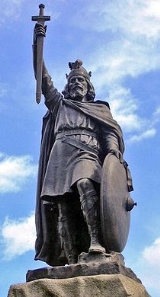
The statue of Alfred the Great, situated in the Wantage market place, was sculpted by Count Gleichen
Prince Victor of Hohenlohe-Langenburg

Admiral Victor Ferdinand Franz Eugen Gustaf Adolf Constantin Friedrich of Hohenlohe-Langenburg Order of the Bath , also known as Count Gleichen, was an officer in the Royal Navy, and a sculptor....
, a relative of Queen Victoria
Victoria of the United Kingdom

Victoria was from 20 June 1837 the Queen regnant of the United Kingdom of Great Britain and Ireland and from 1 May 1876 the first Empress of India of the British Raj until her death....
, and unveiled on 14 July, 1877 by the Prince and Princess of Wales, the future Edward VII
Edward VII of the United Kingdom

Edward VII was Monarch of the United Kingdom of Great Britain and Ireland and the British Dominions and Emperor of India from 22 January 1901 until his death on 6 May 1910....
 and his wife.

The statue was vandalised on New Year's Eve
New Year's Eve

New Year's Eve is on , the final day of the Gregorian calendar year, and the day before New Year's Day.New Year's Eve is a separate observance from the observance of New Year's Day....
 2007, losing part of its right arm and axe. After the arm and axe being replaced the statue was again vandalised on Christmas Eve
Christmas Eve

Christmas Eve, December 24, is the night before Christmas Day, which celebrates the birth of Jesus Christ ....
 2008 again losing its axe.

See also

  • British military history
    British military history

    The military history of the peoples of the British Isles is long and varied, extending from the prehistoric and ancient historic period, through the Roman invasion of Britain of Julius Caesar and Claudius, with the subsequent Roman Britain of most of the island; warfare in the Great Britain in the Middle Ages, including the invasions of the S...
  • Kingdom of England
    Kingdom of England

    The Kingdom of England was, from 927 to 1707, a state in North-West Europe. The Kingdom of England spanned the southern two-thirds of the island of Great Britain and a number of smaller outlying islands?what is today the legal unit of England and Wales....
  • Lays of Boethius
    Lays of Boethius

    The Lays of Boethius is King Alfred's 9th century Old English version of the Consolation of Philosophy by Boethius.Alfred actually wrote two versions of the Consolation of Philosophy....
  • Alfred Jewel
    Alfred Jewel

    The Alfred Jewel is an Anglo-Saxon art dating from the late 9th century, first discovered in 1693.The Alfred Jewel was made in the reign of Alfred the Great and is inscribed "AELFRED MEC HEHT GEWYRCAN", meaning "Alfred ordered me made"....


Further reading

  • Pratt, David: The political thought of King Alfred the Great (Cambridge Studies in Medieval Life and Thought: Fourth Series, 2007) ISBN
9780521803502
  • Parker, Joanne: England's Darling The Victorian Cult of Alfred the Great, 2007, ISBN 9780719073564
  • Pollard, Justin: Alfred the Great : the man who made England, 2006, ISBN 0719566665
  • Fry, Fred: Patterns of Power: The Military Campaigns of Alfred the Great, 2006, ISBN 9781905226931
  • Giles, J. A. (ed.): The Whole Works of King Alfred the Great (Jubilee Edition, 3 vols, Oxford and Cambridge, 1858)
  • The whole works of King Alfred the Great, with preliminary essays, illustrative of the history, arts, and manners, of the ninth century, 1969, OCLC 28387
  • For a novelization of King Alfred's exploits, there is Bernard Cornwell's series, beginning with The Last Kingdom.

External links

  • Britannia History
  • Lays of Boethius