


Primogeniture

Encyclopedia
Primogeniture is the right, by law or custom, of the firstborn
to inherit the entire estate
, to the exclusion of younger siblings (compare to ultimogeniture
). Historically, the term implied male primogeniture, to the exclusion of females. According to the Norman
tradition, the first-born son inherited the entirety of a parent's wealth, estate, title or office and then would be responsible for any further passing of the inheritance to his siblings. In the absence of children, inheritance passed to the collateral relatives, in order of seniority
of the males of collateral lines. The eligible descendants of deceased elder siblings take precendence over living younger siblings, such that inheritance is settled in the manner of a depth-first search
.
The principle has applied in history to inheritance of real property (land) and inherited titles and offices, most notably monarchies.
Variations on primogeniture modify the right of the first-born son to the entirety of a family's inheritance (see appanage
) or, in the West since World War II with the wider promotion of feminism, eliminate the preference for male over female siblings. Six monarchies in Europe have eliminated male preference: Sweden, Norway, Netherlands
, Belgium
, Denmark
and Luxembourg
.
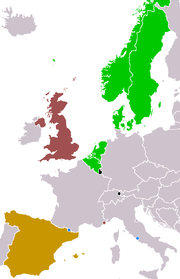 The type of marriage prevalent in each culture plays a crucial role in the adoption of differing primogenitures. In Christian Europe, the church had a monopoly on the power to sanction marriage. It discouraged polygamy and divorce. Consequently, in Europe, it was extremely difficult to ensure succession solely by direct male line or even by direct offspring. In Islam
ic, and Oriental cultures, religion either sanctioned polygyny
or use of consorts, or had no authority over marriage; monarchs could consequently ensure sufficient numbers of male offspring to confirm the succession. In such cultures, female heads of state were rare or non-existent. In Japan, the Meiji Emperor was the last to have a female consort. While the Japanese system still mandates that the heir to the throne must be a male, there is only one male grandchild of the current emperor.
Absolute, equal or lineal primogeniture, known in French as aînesse intégrale (integral primogeniture), is inheritance by the oldest surviving child without regard to gender. It is also known as (full) cognatic primogeniture today. This form of primogeniture was not practiced by any modern monarchy before 1980.
However, according to Poumarede (1972) the Basques
of the Kingdom of Navarre
transmitted title and property to the first-born, whatever the gender. This inheritance practice was followed by the high nobility and free families alike in the early
and high middle ages
. The Navarrese monarchy itself had been inherited by dynasties from outside of Navarre, which followed different succession laws (usually male preference primogeniture, until Navarre was absorbed into the French crown when it followed Salic law). Aînesse intégrale practices weakened among the high nobility of Navarre once Navarre became more exposed to and pressured by outside influences, and largely disappeared from use by the high nobility once the Kingdom of Navarre was merged with the French crown. Eventually only the Basque gentry and free families of the Basque Country and other regions continued to follow this practice until as late as the 19th century.
Sweden
revised its constitution
to adopt royal succession by absolute primogeniture in 1980, displacing King Carl XVI Gustaf
's infant son, Carl Philip, in favor of his elder daughter, Victoria
, in the process. Several other monarchies have since followed suit: Netherlands
in 1983, Norway
in 1990, Belgium
in 1991, Denmark
(see below) in 2009 and Luxembourg
in 2011.
Recently other countries have changed or have considered changing to absolute primogeniture:
A variation of this system allows women to succeed, as long as their offspring does not, in order to keep the throne in the family. Such were the cases of the few Empresses of Japan. In Norway, a nuance on this system excludes every member of the family who isn't a direct descendant of the last reigning monarch.
The motivation behind this system is recent and based on some views of equality between men and women
. An ancient and alternative way in which women managed to rise to power, especially without displacing the direct male line descendants of the first monarchs, is the historical Consortium or Coregency between husband and wife or other relatives, the most notable of these being the cases of Hatshepsut
and Thutmose III
, as well as the Ptolemaic Dynasty
's Kings and Queens.
males inheriting before females of the male line. This is the same as semi-Salic primogeniture. Complete exclusion of females from dynastic
succession is commonly referred to as application of the Salic law
(see Terra salica
).
In the 19th century, only the royal houses of Bourbon
and Savoy
among Europe's historic national dynasties continued to exclude women from succession, while the new monarchies or dynasties of France (under the Bonapartes), Belgium, Denmark (from 1853), Sweden (from 1810), and the Balkan realms of Albania
, Bulgaria
, Montenegro
, Romania
, and Serbia
introduced Salic law. During this era, Spain fought civil wars
which pitted the Salic and female-line heirs of their dynasties against one another for possession of the crown
.
Most British and French titles (particularly newer creations) of nobility descend to the senior male by primogeniture, to the exclusion of females, and agnatic cadet
s may bear courtesy title
s. A variation on Salic primogeniture allows the sons of women to inherit, but not women themselves, an example being succession to the throne of Spain from 1947–1978. This is the law in Liechtenstein
and was in the former Archduchy of Austria
. Another variation is the so-called Semi-Salic Law, which allows women to succeed only at the extinction of all the male descendants. Such were the cases of Bourbon Spain until 1833 and the dominions of Austria-Hungary
, as well as the former Kingdom of Württemberg
. This was the law of Luxembourg
until equal primogeniture was introduced on 20 June 2011.
; i.e., only through males back to a common ancestor.
"Agnatic-cognatic primogeniture" allows female agnates (or their descendants) to inherit once there are no surviving male agnates. The term semi-Salic succession is used in the same meaning. Usually, women do not succeed by application of the same kind of primogeniture as was in effect among males in the family. Rather, the female who is nearest in kinship to the last male monarch of the family inherits, even if another female agnate of the dynasty is senior by primogeniture. Among sisters (and the lines of descendants issuing from them), the elder are preferred to the younger. In reckoning consanguinity
or proximity of blood
the law defines who among female relatives is "nearest" to the last male. Definitions varied among monarchies where semi-Salic succession was prevalent.
, such as the Castilian Siete Partidas
. Male-preferred primogeniture is currently practised in Monaco
, Spain
, Thailand
and the sixteen Commonwealth Realms. It also used to be practised in Portugal
. It is usually the rule for Scotland
and baronies by writ in the United Kingdom
; although baronies by writ go into abeyance
if there are several surviving sisters or their legitimate descendants.
The Spanish Constitution of 1978 codifies an example of male preference primogeniture as it has been traditionally practiced in Spain.
This system has religious Jewish-Christian roots. It appears at the end of the Book of Numbers
36:1-12, when five daughters claim the inheritance of their father at the lack of male sons and despite having other male relatives. Then they are allowed to inherit, as long as they marry a member of their tribe, in order to prevent the transfer of their share of the tribal lands to the hands of elements of other tribes and so they do, by marrying their uncles' sons.
is an example in an Africa
n culture of matrilineal
primogeniture: not only is dynastic
descent reckoned through the female line, but only females are eligible to inherit.
of Northern Britain and the Etruscans of Italy. Some Kingdoms and Tribes in Africa practice the same use. One of the reasons related to this usage might be related with the fact of the certainty of the relationship to the previous King and Kings, since the son, and daughter, of a sister are, even if they don't have the same father, his relation (Mater semper certa est
).
The term "uterine" implies the woman in whose uterus a fetus developed, which is usually, but not always, the woman whose egg was fertilized to form the embryo. Prior to the 1970s, these were always the same woman, as remains the case for naturally conceived children. However, in cases of surrogacy
, in vitro fertilization, and egg donation, it is now possible for a baby born from the uterus of one woman to be the genetic offspring of the egg of another offspring. Therefore, it is now important, in certain situations, to distinguish between "ovarian primogeniture" and "uterine primogeniture".
s to a monastic order who would take the disinherited son. Many of the Spanish Conquistador
s were younger sons who had to make their fortune in war. In the late 17th and early 18th centuries, many younger sons of English
aristocrats specifically chose to leave England for Virginia
in the Colonies. Many of the early Virginians who were plantation
owners were such younger sons who had left England fortuneless due to primogeniture laws.
In Japan, the Imperial chronologies include eight reigning empresses from ancient times up through the Edo period; however, their successors were most often selected from amongst the males of the paternal Imperial bloodline, which is why some conservative scholars argue that the women's reigns were temporary and that male-only succession tradition must be maintained. Japanese empresses
such as Empress Genshō
(680-748), who succeeded her mother the Empress Gemmei
(661-721) on the throne (but only because she was a Princess of the Imperial family, daughter of Prince Kusakabe), remain the sole exceptions to this conventional argument.
The fact that the eldest son "scooped the pool" often led to ill-feeling amongst younger sons and daughters. Through marriage, estates inherited by primogeniture were combined and some nobles achieved wealth and power sufficient to pose a threat even to the crown itself. Finally, nobles tended to complain about and resist rules of primogeniture (though this opposition might indicate primogeniture among nobles was good for the king).
In Democracy in America
, Alexis de Tocqueville
argues that the abolition of the laws of primogeniture and entail
in the law of inheritance of private property (as opposed to inheritance of a monarchy) result in the more rapid division of land and thus force landed people to seek wealth outside the family estate in order to maintain their previous standard of living
, accelerating the death of the landed aristocracy
and also quickening the shift to democracy
.
for the account to seem plausible to the people living there prior to the Roman Empire.
, which governed much of Europe, made no real distinction between the oldest or youngest, male or female when it came to the law of inheritance.
of land-owning feudal lords be kept as large and united as possible to maintain social stability as well as the wealth, power and social standing of their families.
Adam Smith
, in his book An Inquiry into the Nature and Causes of the Wealth of Nations
, explains the origin of primogeniture in Europe in the following way:
royal milieu, where the Salic law
(attributed to the Salian Franks
) forbade any inheritance of a crown through the female line. This rule was adopted to solve the dispute over the legitimate successor
of Charles IV of France
(Edward III of England
or Philip VI of France
, though the former would have a stronger claim should proximity of blood
be considered). Conflict between the Salic law and the male-preferred system was also the genesis of Carlism
in Spain
.
The crowns of Hanover
and Great Britain
, which had been in personal union
since 1714, were separated in 1837 upon the death of King William IV
: his niece Victoria
inherited the British crown under male-preference primogeniture but, because of semi-Salic law, was ineligible to that of Hanover, which passed to William's eldest surviving brother, Ernest I
.
In 1890, the divergence of the thrones of Luxembourg and the Netherlands, both ruled by semi-Salic law, was caused by the fact that the Luxembourg line of succession went back more generations than the Dutch one. The Luxembourg succession was ruled by the provisions of the Nassau House Treaty of 1783. Where the succession is concerned, Luxembourg is the successor state to the Principality of (Orange-)Nassau-Dietz. The Dutch succession only went back to King William I (1815–1840). Therefore Luxembourg still had agnatic heirs from another branch of the House of Nassau left to succeed, while in the Netherlands the male line starting with William I was depleted.
Since the Middle Ages, the semi-Salic principle was prevalent for the inheritance of feudal land in the Holy Roman Empire: inheritance was allowed through females when the male line expired. Females themselves did not inherit, but their male issue could. For example, a grandfather without sons was succeeded by his grandson, the son of his daughter, although the daughter still lived. Likewise, an uncle without sons of his own was succeeded by his nephew, a son of his sister, even if the sister still lived.
Common in feudal Europe outside of Germany was land inheritance based on a form of primogeniture: A lord
was succeeded by his eldest son but, failing sons, either by daughters or sons of daughters. In most medieval Western European feudal fiefs, females (such as daughters and sisters) were allowed to succeed, brothers failing. But usually the husband of the heiress became the real lord, assuming his wife's title with the suffix jure uxoris
.
In more complex medieval cases, the sometimes conflicting principles of proximity of blood
and primogeniture competed, and outcomes were at times unpredictable. Proximity meant that an heir closer in degree of kinship to the lord in question was given precedence although that heir was not necessarily the heir by primogeniture.
However, primogeniture increasingly won legal cases over proximity in later centuries.
Later, when lands were strictly divided among noble families and tended to remain fixed, agnatic primogeniture (practically the same as Salic Law
) became usual: succession going to the eldest son of the monarch; if the monarch had no sons, the throne would pass to the nearest male relative in the male line.
Some countries however accepted female rulers early on, so that if the monarch had no sons, the throne would pass to the eldest daughter. For example, in 1632 Queen Christina of Sweden
succeeded to the throne after the death of her father, King Gustav II Adolf
.
In England, primogeniture was mandatory for inheritance of land. Until the Statute of Wills
was passed in 1540, a will could control only the inheritance of personal property. Real estate (land) passed to the eldest male descendant by operation of law. The statute added a provision that a landowner could "devise" land by the use of a new device called a "testament". The rule of primogeniture in England was not changed until the Administration of Estates Act in 1925.
In law, the rule of inheritance whereby land descends to the oldest son. Under the feudal system of medieval Europe, primogeniture generally governed the inheritance of land held in military tenure (see knight
). The effect of this rule was to keep the father’s land for the support of the son who rendered the required military service. When feudalism declined and the payment of a tax was substituted for military service, the need for primogeniture disappeared. In England, consequently, there was enacted the Statute of Wills (1540), which permitted the oldest son to be entirely cut off from inheriting, and in the 17th century military tenure was abolished; primogeniture is, nevertheless, still customary in England. In the United States primogeniture never became widely established.
An alternative theory posits that the preference for males arose out of a desire to maximize reproductive success. It was thought that, because of a sexual double standard
, in which males were able to produce illegitimate and legitimate
children, a son would ultimately increase one's posterity more than a daughter. However, as history informs us, some women have also produced illegitimate children not necessarily of peerage lineage.
In modern times, Hakubun Shimomura
argued that the Chrysanthemum Throne
should be inherited only by those whose paternal ancestors had held it, to preserve a genetic bloodline.
has made it possible to recognize that a strict gender preference in succession rules leads to heirs who share considerably more DNA with the distant ancestors who precede them in the line than would otherwise be the case. This was not known until modern times and did not influence the practice in antiquity, but it has recently begun to do so. For example, Hakubun Shimomura
gave "preserving that Y chromosome" as his reason for opposing a proposal to allow a future child of Princess Aiko
to become Emperor one day, even if there were no grandsons of Emperor Akihito
.
Because the human Y chromosome
changes relatively slowly over time and is only passed along the direct male line, it may be used to trace paternal lineage. The human Y chromosome is unable to recombine with the X chromosome
, except for small pieces of pseudoautosomal region
s at the telomeres (which comprise about 5% of the chromosome's length).
Both sons and daughters inherit 22 chromosomes of autosomal DNA
from each parent. Daughters also inherit one X chromosome from each parent, but sons inherit a Y chromosome from their fathers and an X chromosome from their mothers. Mitochondrial DNA
is inherited almost exclusively through the female line; all children inherit it only from their mothers.
Because Y chromosomes are smaller than X chromosomes, sons inherit a slightly smaller proportion of the genome from their fathers—half of the autosomal DNA, plus a Y chromosome) than daughters (half of the autosomal DNA, plus one X chromosome—which is in turn slightly smaller than the proportion that children of either gender inherit from their mothers—half of the autosomal DNA, plus one X chromosome, plus all mitochondrial DNA). Sons inherit slightly more than half of their nuclear DNA (all DNA except mitochrondrial DNA) from their mothers and slightly less than half from their fathers; daughters inherit equal amounts from each parent. If mitochrondrial DNA is considered, children of both genders inherit slightly more total DNA from their mothers than from their fathers. However, mitochrondria contain so much less DNA
than chromosomes that the daughters can be assumed to inherit approximately 50% of their total DNA from each parent, even though this is technically true only of autosomal DNA.
Because children inherit equal amounts of autosomal DNA from each parent, the amount inherited from any particular distant ancestor is extremely tiny. Although 1/2 is inherited from each parent, only 1/4 is inherited from each grandparent (unless the parents are siblings), 1/8 from each third generation ancestor (great-grandparent), and so forth. By the tenth generation, the genetic contribution of each ancestor is less than 0.1%. After another ten generations, it is less than one part in one million. In successive generations, the genetic resemblance of any particular ancestor becomes no greater than that between any two individuals of the same ethnicity. For example, the similarity in autosomal DNA between the Emperor Keitai
of Japan, and the current Emperor, approximately 1,500 years later, is no more than would be expected between any two random persons of purely Japanese ancestry.
and any mutations that may have happened. An example is the Chrysanthemum Throne
in Japan, where every male Emperor from the year 507 (Emperor Keitai
) to the present (as of 2010) theoretically shares a nearly identical Y chromosome, which is one of the reasons for opposition in Japan to adopting a gender-neutral system.
However, if any succession occurs through a female line in any generation, then none of the Y chromosome DNA continues through the line. For example, although there would be the same Y chromosome in the princes expected (as of 2010) to be the next two Kings of the United Kingdom of Great Britain and Northern Ireland (HRH Prince Charles, the Prince of Wales, son of Her Majesty Queen Elizabeth, and HRH Prince William, son of HRH Princess of Wales Diana Spencer), that DNA would be inherited from the father of the current (as of 2010) Prince of Wales (HRH Prince Charles), and not from the Queen or the prior Kings. Similarly, although HSH Prince Albert II of Monaco and his predecessor Rainer III would have the same Y chromosomes, any similarity to that of his predecessor Louis II would be purely coincidence, because Rainer III inherited the throne through his mother, Princess Charlotte, and not through her husband Prince Pierre. Although a male-line relationship is suggested by the fact that Louis II and Rainer III shared the last name Grimaldi, this actually resulted from Prince Pierre taking his wife's maiden surname as his own surname, which is a form of "false paternal event" (a situation in which a male's surname differs from that of his genetic father).
Additionally, if the mother of any of the males in the line was actually impregnated by someone other than the previous member of the male line, then the Y chromosomes in her son and all subsequent members of the line would be that of the man who impregnated her, and not that of any of the previous members of the line. For example, if a man's wife (or, in lines that are not restricted to legitimate children, his mistress) was impregnated by a rapist or another lover, or was already pregnant when she married him, then a resulting son could be the next in the line, but have no genetic relationship to his predecessor.
in Africa, and when a throne is held by males, but inherited by the son of the sister of a prior King (so that the maternal grandmother of the King in one generation is the mother of the King in the previous generation), not by the sons of Kings (except in cases of incest). In lines where a Kings's son-in-law may inherit a throne, that son-in-law would not share any DNA with his predecessors (except by coincidence), but his legitimate sons would have the same mitochondrial DNA as the previous King (the son of their maternal grandmother).
Unlike autosomal DNA and Y chromosome DNA, inheritance of mitochondrial DNA is not affected by adultery, since mitochondrial DNA of a naturally conceived child is inherited only from the mother. Prior to the development of in vitro fertilization in the 1970s, all babies inherited their mitochondrial DNA from the woman in whose uterus they had developed. However, when an egg is removed from one woman, fertilized in vitro, and then placed in another woman, the resulting child inherits its mitochrondrial DNA from the woman in whose ovary the egg originated, and not the woman in whose uterus the child developed. This occurs in cases of egg donation and in cases of gestational surrogacy
. Therefore, even in a line following strict uterine succession, it is possible for different members of the line born after the development of in vitro fertilization to have different mitochrondrial DNA, if either (a) an heir was conceived through egg donation, or (b) strict application of a rule of "uterine" succession allowed a child to inherit from the surrogate who bore it, rather than from those who supplied the egg and sperm and raised the child as their own. It is unknown whether in vitro fertilization, surrogacy, and egg donation will jeopardize inheritance rights in the future. One solution is for the genetic parents to "adopt" the child to ensure that they are legally recognized as parents.
Firstborn
Firstborn may refer to:* The first born baby in childbirth* primogeniture* bechor in rabbinical JudaismFilms and books* Firstborn , a 1984 film that stars Teri Garr, Peter Weller, and Christopher Collet...
to inherit the entire estate
Estate (law)
An estate is the net worth of a person at any point in time. It is the sum of a person's assets - legal rights, interests and entitlements to property of any kind - less all liabilities at that time. The issue is of special legal significance on a question of bankruptcy and death of the person...
, to the exclusion of younger siblings (compare to ultimogeniture
Ultimogeniture
Ultimogeniture, also known as postremogeniture or junior right, is the tradition of inheritance by the last-born of the entirety of, or a privileged position in, a parent's wealth, estate or office...
). Historically, the term implied male primogeniture, to the exclusion of females. According to the Norman
Normandy
Normandy is a geographical region corresponding to the former Duchy of Normandy. It is in France.The continental territory covers 30,627 km² and forms the preponderant part of Normandy and roughly 5% of the territory of France. It is divided for administrative purposes into two régions:...
tradition, the first-born son inherited the entirety of a parent's wealth, estate, title or office and then would be responsible for any further passing of the inheritance to his siblings. In the absence of children, inheritance passed to the collateral relatives, in order of seniority
Seniority
Seniority is the concept of a person or group of people being in charge or in command of another person or group. This control is often granted to the senior person due to experience or length of service in a given position, but it is not uncommon for a senior person to have less experience or...
of the males of collateral lines. The eligible descendants of deceased elder siblings take precendence over living younger siblings, such that inheritance is settled in the manner of a depth-first search
Depth-first search
Depth-first search is an algorithm for traversing or searching a tree, tree structure, or graph. One starts at the root and explores as far as possible along each branch before backtracking....
.
The principle has applied in history to inheritance of real property (land) and inherited titles and offices, most notably monarchies.
Variations on primogeniture modify the right of the first-born son to the entirety of a family's inheritance (see appanage
Appanage
An apanage or appanage or is the grant of an estate, titles, offices, or other things of value to the younger male children of a sovereign, who would otherwise have no inheritance under the system of primogeniture...
) or, in the West since World War II with the wider promotion of feminism, eliminate the preference for male over female siblings. Six monarchies in Europe have eliminated male preference: Sweden, Norway, Netherlands
Monarchy of the Netherlands
The Netherlands has been an independent monarchy since 16 March 1815, and has been governed by members of the House of Orange-Nassau since.-Constitutional role and position of the monarch:...
, Belgium
Monarchy of Belgium
Monarchy in Belgium is constitutional and popular in nature. The hereditary monarch, at present Albert II, is the head of state and is officially called King of the Belgians .-Origins:...
, Denmark
Monarchy of Denmark
The monarchy in Denmark is the constitutional monarchy of the Kingdom of Denmark, which includes Denmark, Greenland and the Faroe Islands.As a constitutional monarch, the Queen is limited to non-partisan, ceremonial functions...
and Luxembourg
Grand Duke of Luxembourg
The Grand Duke of Luxembourg is the sovereign monarch and head of state of Luxembourg. Luxembourg has been a grand duchy since 15 March 1815, when it was elevated from a duchy when placed in personal union with the United Kingdom of the Netherlands...
.
Definitions
Islam
Islam . The most common are and . : Arabic pronunciation varies regionally. The first vowel ranges from ~~. The second vowel ranges from ~~~...
ic, and Oriental cultures, religion either sanctioned polygyny
Polygyny
Polygyny is a form of marriage in which a man has two or more wives at the same time. In countries where the practice is illegal, the man is referred to as a bigamist or a polygamist...
or use of consorts, or had no authority over marriage; monarchs could consequently ensure sufficient numbers of male offspring to confirm the succession. In such cultures, female heads of state were rare or non-existent. In Japan, the Meiji Emperor was the last to have a female consort. While the Japanese system still mandates that the heir to the throne must be a male, there is only one male grandchild of the current emperor.
Absolute cognatic primogeniture
Absolute, equal or lineal primogeniture, known in French as aînesse intégrale (integral primogeniture), is inheritance by the oldest surviving child without regard to gender. It is also known as (full) cognatic primogeniture today. This form of primogeniture was not practiced by any modern monarchy before 1980.
However, according to Poumarede (1972) the Basques
Basque people
The Basques as an ethnic group, primarily inhabit an area traditionally known as the Basque Country , a region that is located around the western end of the Pyrenees on the coast of the Bay of Biscay and straddles parts of north-central Spain and south-western France.The Basques are known in the...
of the Kingdom of Navarre
Kingdom of Navarre
The Kingdom of Navarre , originally the Kingdom of Pamplona, was a European kingdom which occupied lands on either side of the Pyrenees alongside the Atlantic Ocean....
transmitted title and property to the first-born, whatever the gender. This inheritance practice was followed by the high nobility and free families alike in the early
Early Middle Ages
The Early Middle Ages was the period of European history lasting from the 5th century to approximately 1000. The Early Middle Ages followed the decline of the Western Roman Empire and preceded the High Middle Ages...
and high middle ages
High Middle Ages
The High Middle Ages was the period of European history around the 11th, 12th, and 13th centuries . The High Middle Ages were preceded by the Early Middle Ages and followed by the Late Middle Ages, which by convention end around 1500....
. The Navarrese monarchy itself had been inherited by dynasties from outside of Navarre, which followed different succession laws (usually male preference primogeniture, until Navarre was absorbed into the French crown when it followed Salic law). Aînesse intégrale practices weakened among the high nobility of Navarre once Navarre became more exposed to and pressured by outside influences, and largely disappeared from use by the high nobility once the Kingdom of Navarre was merged with the French crown. Eventually only the Basque gentry and free families of the Basque Country and other regions continued to follow this practice until as late as the 19th century.
Sweden
Sweden
Sweden , officially the Kingdom of Sweden , is a Nordic country on the Scandinavian Peninsula in Northern Europe. Sweden borders with Norway and Finland and is connected to Denmark by a bridge-tunnel across the Öresund....
revised its constitution
Constitution
A constitution is a set of fundamental principles or established precedents according to which a state or other organization is governed. These rules together make up, i.e. constitute, what the entity is...
to adopt royal succession by absolute primogeniture in 1980, displacing King Carl XVI Gustaf
Carl XVI Gustaf of Sweden
Carl XVI Gustaf is the reigning King of Sweden since 15 September 1973, succeeding his grandfather King Gustaf VI Adolf because his father had predeceased him...
's infant son, Carl Philip, in favor of his elder daughter, Victoria
Victoria, Crown Princess of Sweden
Victoria, Crown Princess of Sweden, Duchess of Västergötland is the heiress-apparent to the Swedish throne. If she ascends to the throne as expected, she will be Sweden's fourth queen regnant .-Early life:...
, in the process. Several other monarchies have since followed suit: Netherlands
Netherlands
The Netherlands is a constituent country of the Kingdom of the Netherlands, located mainly in North-West Europe and with several islands in the Caribbean. Mainland Netherlands borders the North Sea to the north and west, Belgium to the south, and Germany to the east, and shares maritime borders...
in 1983, Norway
Norway
Norway , officially the Kingdom of Norway, is a Nordic unitary constitutional monarchy whose territory comprises the western portion of the Scandinavian Peninsula, Jan Mayen, and the Arctic archipelago of Svalbard and Bouvet Island. Norway has a total area of and a population of about 4.9 million...
in 1990, Belgium
Belgium
Belgium , officially the Kingdom of Belgium, is a federal state in Western Europe. It is a founding member of the European Union and hosts the EU's headquarters, and those of several other major international organisations such as NATO.Belgium is also a member of, or affiliated to, many...
in 1991, Denmark
Denmark
Denmark is a Scandinavian country in Northern Europe. The countries of Denmark and Greenland, as well as the Faroe Islands, constitute the Kingdom of Denmark . It is the southernmost of the Nordic countries, southwest of Sweden and south of Norway, and bordered to the south by Germany. Denmark...
(see below) in 2009 and Luxembourg
Luxembourg
Luxembourg , officially the Grand Duchy of Luxembourg , is a landlocked country in western Europe, bordered by Belgium, France, and Germany. It has two principal regions: the Oesling in the North as part of the Ardennes massif, and the Gutland in the south...
in 2011.
Recently other countries have changed or have considered changing to absolute primogeniture:
- In July 2006, the NepalNepalNepal , officially the Federal Democratic Republic of Nepal, is a landlocked sovereign state located in South Asia. It is located in the Himalayas and bordered to the north by the People's Republic of China, and to the south, east, and west by the Republic of India...
ese government proposed adopting equal primogeniture, but the monarchy was abolished 28 May 2008. - In ThailandThailandThailand , officially the Kingdom of Thailand , formerly known as Siam , is a country located at the centre of the Indochina peninsula and Southeast Asia. It is bordered to the north by Burma and Laos, to the east by Laos and Cambodia, to the south by the Gulf of Thailand and Malaysia, and to the...
, the last two constitutionsConstitution of ThailandThe Constitution of the Kingdom of Thailand is the supreme law of Thailand. Since the change from an absolute monarchy to a constitutional democracy in 1932, Thailand has had 17 charters and constitutions, reflecting the high degree of political instability and frequency of military coups faced...
allow the succession of a female monarch. However after the birth of Crown Prince Maha VajiralongkornMaha VajiralongkornSomdet Phra Boromma-orasathirat Chao Fa Maha Vajiralongkorn Sayammakutratchakuman is the only son of Bhumibol Adulyadej, the King of Thailand, and Queen Sirikit...
's son, Dipangkorn RasmijotiDipangkorn RasmijotiPrince Dipangkorn Rasmijoti , a member of the Royal Family of Thailand, is a grandson of King Bhumibol Adulyadej of Thailand, and is the fifth son of Crown Prince Maha Vajiralongkorn. His mother is Princess Srirasmi, the Crown Prince's third legal wife...
to his third wifeSrirasmiPrincess Srirasmi of Thailand , or Srirasmi, Princess of Thailand, is the consort of Crown Prince Maha Vajiralongkorn. Born to a family of modest means, she entered the service of the Crown Prince at the age of 22...
in 2005, the permission of a female monarch is unlikely. - In JapanJapanJapan is an island nation in East Asia. Located in the Pacific Ocean, it lies to the east of the Sea of Japan, China, North Korea, South Korea and Russia, stretching from the Sea of Okhotsk in the north to the East China Sea and Taiwan in the south...
, there have been debates over whether to adopt absolute primogeniture, as Princess Aiko is the only child of Crown PrinceCrown PrinceA crown prince or crown princess is the heir or heiress apparent to the throne in a royal or imperial monarchy. The wife of a crown prince is also titled crown princess....
NaruhitoNaruhito, Crown Prince of Japanis the eldest son of Emperor Akihito and Empress Michiko, which makes him the heir apparent to the Chrysanthemum Throne of Japan.-Early life and education:...
. However, the birth of Prince HisahitoPrince Hisahito of Akishinois the third child of the Prince and Princess Akishino, and their only son. He is third in line to become Emperor of Japan.Prince Hisahito has two older sisters, Princess Mako of Akishino and Princess Kako of Akishino .- Name :His personal name Hisahito in this case means "serene and virtuous,"...
, a son of Prince AkishinoPrince AkishinoFumihito, The Prince Akishino is a member of the Japanese imperial family...
(younger brother of Crown Prince Naruhito, and next in line to the Chrysanthemum ThroneEmperor of JapanThe Emperor of Japan is, according to the 1947 Constitution of Japan, "the symbol of the state and of the unity of the people." He is a ceremonial figurehead under a form of constitutional monarchy and is head of the Japanese Imperial Family with functions as head of state. He is also the highest...
after Naruhito) has temporarily side-lined the debate. - In the United KingdomUnited KingdomThe United Kingdom of Great Britain and Northern IrelandIn the United Kingdom and Dependencies, other languages have been officially recognised as legitimate autochthonous languages under the European Charter for Regional or Minority Languages...
, the Succession to the Crown BillSuccession to the Crown BillThe Succession to the Crown Bill was a British Private Member's Bill aimed at reforming the manner of succession to the British Monarchy published in the House of Lords by Labour peer Lord Dubs on 9 December 2004, and withdrawn by him on 14 January 2005, after the Government said that it would...
of 2004 proposed changing the line of succession to the British throneLine of succession to the British ThroneThe line of succession to the British throne is the ordered sequence of those people eligible to succeed to the throne of the United Kingdom and the other 15 Commonwealth realms. By the terms of the Act of Settlement 1701, the succession is limited to the descendants of the Electress Sophia of...
to absolute primogeniture. The same proposal is part of the Equality BillEquality BillThe Equality Act 2010 is an Act of Parliament of the United Kingdom.The primary purpose of the Act is to consolidate the complicated and numerous array of Acts and Regulations, which formed the basis of anti-discrimination law in Great Britain...
announced in 2008, though shortly after the announcement, the Attorney GeneralAttorney General for England and WalesHer Majesty's Attorney General for England and Wales, usually known simply as the Attorney General, is one of the Law Officers of the Crown. Along with the subordinate Solicitor General for England and Wales, the Attorney General serves as the chief legal adviser of the Crown and its government in...
announced that there were "no immediate plans to legislate" on that part of the bill; one of the reasons concerning this was the difficulty in making it approved in the 15 other Commonwealth realmCommonwealth RealmA Commonwealth realm is a sovereign state within the Commonwealth of Nations that has Elizabeth II as its monarch and head of state. The sixteen current realms have a combined land area of 18.8 million km² , and a population of 134 million, of which all, except about two million, live in the six...
s. With the agreement of the other Commonwealth realms, the UK government announced legislation to change to gender equal primogeniture in 2011. - In 2006 and 2009, the Danish parliamentFolketingThe Folketing , is the national parliament of Denmark. The name literally means "People's thing"—that is, the people's governing assembly. It is located in Christiansborg Palace, on the islet of Slotsholmen in central Copenhagen....
voted almost unanimously, only with two abstentions, in favour of a new royal succession law that would allow a first-born child to ascend the throne. This was approved by a referendum held on 7 June 2009. - In 2006, King Juan Carlos I of SpainJuan Carlos I of SpainJuan Carlos I |Italy]]) is the reigning King of Spain.On 22 November 1975, two days after the death of General Francisco Franco, Juan Carlos was designated king according to the law of succession promulgated by Franco. Spain had no monarch for 38 years in 1969 when Franco named Juan Carlos as the...
issued a decree reforming the succession to noble titles from male preference primogeniture to absolute cognatic primogeniture, where the first born inherits title regardless of gender.
The order of succession for all noble dignitaries is determined in accordance with the title of concession and, if there is none, with that traditionally applied in these cases. When the order of succession to the title is not specified in the nobility title creation charter, the following rules apply:
- Absolute preference is given to the direct descending line over the collateral and ascending line, and, within the same line, the closest degree takes precedence over the more remote and, within the same degree, the elder over the younger, combined with the principles of first-born and representation.
- Men and women have an equal right of succession in Grandee of Spain and nobility titles, and no person may be given preference in the normal order of succession for reasons of gender.
A variation of this system allows women to succeed, as long as their offspring does not, in order to keep the throne in the family. Such were the cases of the few Empresses of Japan. In Norway, a nuance on this system excludes every member of the family who isn't a direct descendant of the last reigning monarch.
The motivation behind this system is recent and based on some views of equality between men and women
Sex and intelligence
Research on sex and psychology investigates cognitive and behavioral differences between men and women. This research employs experimental tests of cognition, which take a variety of forms. Tests focus on possible differences in areas such as IQ, spatial reasoning, and emotion.Most IQ tests are...
. An ancient and alternative way in which women managed to rise to power, especially without displacing the direct male line descendants of the first monarchs, is the historical Consortium or Coregency between husband and wife or other relatives, the most notable of these being the cases of Hatshepsut
Hatshepsut
Hatshepsut also Hatchepsut; meaning Foremost of Noble Ladies;1508–1458 BC) was the fifth pharaoh of the eighteenth dynasty of Ancient Egypt...
and Thutmose III
Thutmose III
Thutmose III was the sixth Pharaoh of the Eighteenth Dynasty. During the first twenty-two years of Thutmose's reign he was co-regent with his stepmother, Hatshepsut, who was named the pharaoh...
, as well as the Ptolemaic Dynasty
Ptolemaic dynasty
The Ptolemaic dynasty, was a Macedonian Greek royal family which ruled the Ptolemaic Empire in Egypt during the Hellenistic period. Their rule lasted for 275 years, from 305 BC to 30 BC...
's Kings and Queens.
Agnatic primogeniture
"Agnatic primogeniture" or "patrilineal primogeniture" is inheritance according to seniority of birth among the sons of a monarch or head of family, with sons and their male issue inheriting before brothers and their issue, and male-linePatrilineality
Patrilineality is a system in which one belongs to one's father's lineage. It generally involves the inheritance of property, names or titles through the male line as well....
males inheriting before females of the male line. This is the same as semi-Salic primogeniture. Complete exclusion of females from dynastic
Dynasty
A dynasty is a sequence of rulers considered members of the same family. Historians traditionally consider many sovereign states' history within a framework of successive dynasties, e.g., China, Ancient Egypt and the Persian Empire...
succession is commonly referred to as application of the Salic law
Salic law
Salic law was a body of traditional law codified for governing the Salian Franks in the early Middle Ages during the reign of King Clovis I in the 6th century...
(see Terra salica
Terra salica
Terra salica was a legal term used in the Salian code. It referred to land that could be passed on to male heirs alone, and could not be sold or otherwise disposed. In other words, it was not alienable. This tradition was practiced by other peoples, and was done to give prolonged stability to...
).
In the 19th century, only the royal houses of Bourbon
House of Bourbon
The House of Bourbon is a European royal house, a branch of the Capetian dynasty . Bourbon kings first ruled Navarre and France in the 16th century. By the 18th century, members of the Bourbon dynasty also held thrones in Spain, Naples, Sicily, and Parma...
and Savoy
House of Savoy
The House of Savoy was formed in the early 11th century in the historical Savoy region. Through gradual expansion, it grew from ruling a small county in that region to eventually rule the Kingdom of Italy from 1861 until the end of World War II, king of Croatia and King of Armenia...
among Europe's historic national dynasties continued to exclude women from succession, while the new monarchies or dynasties of France (under the Bonapartes), Belgium, Denmark (from 1853), Sweden (from 1810), and the Balkan realms of Albania
Albania
Albania , officially known as the Republic of Albania , is a country in Southeastern Europe, in the Balkans region. It is bordered by Montenegro to the northwest, Kosovo to the northeast, the Republic of Macedonia to the east and Greece to the south and southeast. It has a coast on the Adriatic Sea...
, Bulgaria
Bulgaria
Bulgaria , officially the Republic of Bulgaria , is a parliamentary democracy within a unitary constitutional republic in Southeast Europe. The country borders Romania to the north, Serbia and Macedonia to the west, Greece and Turkey to the south, as well as the Black Sea to the east...
, Montenegro
Montenegro
Montenegro Montenegrin: Crna Gora Црна Гора , meaning "Black Mountain") is a country located in Southeastern Europe. It has a coast on the Adriatic Sea to the south-west and is bordered by Croatia to the west, Bosnia and Herzegovina to the northwest, Serbia to the northeast and Albania to the...
, Romania
Romania
Romania is a country located at the crossroads of Central and Southeastern Europe, on the Lower Danube, within and outside the Carpathian arch, bordering on the Black Sea...
, and Serbia
Serbia
Serbia , officially the Republic of Serbia , is a landlocked country located at the crossroads of Central and Southeast Europe, covering the southern part of the Carpathian basin and the central part of the Balkans...
introduced Salic law. During this era, Spain fought civil wars
Carlist Wars
The Carlist Wars in Spain were the last major European civil wars in which contenders fought to establish their claim to a throne. Several times during the period from 1833 to 1876 the Carlists — followers of Infante Carlos and his descendants — rallied to the cry of "God, Country, and King" and...
which pitted the Salic and female-line heirs of their dynasties against one another for possession of the crown
The Crown
The Crown is a corporation sole that in the Commonwealth realms and any provincial or state sub-divisions thereof represents the legal embodiment of governance, whether executive, legislative, or judicial...
.
Most British and French titles (particularly newer creations) of nobility descend to the senior male by primogeniture, to the exclusion of females, and agnatic cadet
Cadet (genealogy)
In genealogy, a cadet is a younger son, as opposed to the firstborn heir. Compare puisne.- Etymology :The word is recorded in English since 1634, originally for a young son, identical to the French, which is itself derived from the gascon Occitan capdet "captain, chief", in turn from the Late...
s may bear courtesy title
Courtesy title
A courtesy title is a form of address in systems of nobility used for children, former wives and other close relatives of a peer. These styles are used 'by courtesy' in the sense that the relatives do not themselves hold substantive titles...
s. A variation on Salic primogeniture allows the sons of women to inherit, but not women themselves, an example being succession to the throne of Spain from 1947–1978. This is the law in Liechtenstein
Liechtenstein
The Principality of Liechtenstein is a doubly landlocked alpine country in Central Europe, bordered by Switzerland to the west and south and by Austria to the east. Its area is just over , and it has an estimated population of 35,000. Its capital is Vaduz. The biggest town is Schaan...
and was in the former Archduchy of Austria
Archduchy of Austria
The Archduchy of Austria , one of the most important states within the Holy Roman Empire, was the nucleus of the Habsburg Monarchy and the predecessor of the Austrian Empire...
. Another variation is the so-called Semi-Salic Law, which allows women to succeed only at the extinction of all the male descendants. Such were the cases of Bourbon Spain until 1833 and the dominions of Austria-Hungary
Austria-Hungary
Austria-Hungary , more formally known as the Kingdoms and Lands Represented in the Imperial Council and the Lands of the Holy Hungarian Crown of Saint Stephen, was a constitutional monarchic union between the crowns of the Austrian Empire and the Kingdom of Hungary in...
, as well as the former Kingdom of Württemberg
Kingdom of Württemberg
The Kingdom of Württemberg was a state that existed from 1806 to 1918, located in present-day Baden-Württemberg, Germany. It was a continuation of the Duchy of Württemberg, which came into existence in 1495...
. This was the law of Luxembourg
Luxembourg
Luxembourg , officially the Grand Duchy of Luxembourg , is a landlocked country in western Europe, bordered by Belgium, France, and Germany. It has two principal regions: the Oesling in the North as part of the Ardennes massif, and the Gutland in the south...
until equal primogeniture was introduced on 20 June 2011.
Agnatic-cognatic primogeniture
One's agnate may be male or female provided that the kinship is calculated patrilineallyPatrilineality
Patrilineality is a system in which one belongs to one's father's lineage. It generally involves the inheritance of property, names or titles through the male line as well....
; i.e., only through males back to a common ancestor.
"Agnatic-cognatic primogeniture" allows female agnates (or their descendants) to inherit once there are no surviving male agnates. The term semi-Salic succession is used in the same meaning. Usually, women do not succeed by application of the same kind of primogeniture as was in effect among males in the family. Rather, the female who is nearest in kinship to the last male monarch of the family inherits, even if another female agnate of the dynasty is senior by primogeniture. Among sisters (and the lines of descendants issuing from them), the elder are preferred to the younger. In reckoning consanguinity
Consanguinity
Consanguinity refers to the property of being from the same kinship as another person. In that respect, consanguinity is the quality of being descended from the same ancestor as another person...
or proximity of blood
Proximity of blood
Proximity of blood, or closeness in degree of kinship, is one of the ways to determine hereditary succession based on genealogy. It was at loggerheads with primogeniture in numerous medieval succession disputes....
the law defines who among female relatives is "nearest" to the last male. Definitions varied among monarchies where semi-Salic succession was prevalent.
Male-preference cognatic primogeniture
Male preference cognatic primogeniture (also known as mixed-female succession) allows a female to succeed if she has no living brothers and no deceased brothers who left surviving legitimate descendants. This was the most common primogeniture practiced in Western European feudalismFeudalism
Feudalism was a set of legal and military customs in medieval Europe that flourished between the 9th and 15th centuries, which, broadly defined, was a system for ordering society around relationships derived from the holding of land in exchange for service or labour.Although derived from the...
, such as the Castilian Siete Partidas
Siete Partidas
The Siete Partidas or simply Partidas was a Castilian statutory code first compiled during the reign of Alfonso X of Castile , with the intent of establishing a uniform body of normative rules for the kingdom. The codified and compiled text was originally called the Libro de las Leyes...
. Male-preferred primogeniture is currently practised in Monaco
Monaco
Monaco , officially the Principality of Monaco , is a sovereign city state on the French Riviera. It is bordered on three sides by its neighbour, France, and its centre is about from Italy. Its area is with a population of 35,986 as of 2011 and is the most densely populated country in the...
, Spain
Spain
Spain , officially the Kingdom of Spain languages]] under the European Charter for Regional or Minority Languages. In each of these, Spain's official name is as follows:;;;;;;), is a country and member state of the European Union located in southwestern Europe on the Iberian Peninsula...
, Thailand
Thailand
Thailand , officially the Kingdom of Thailand , formerly known as Siam , is a country located at the centre of the Indochina peninsula and Southeast Asia. It is bordered to the north by Burma and Laos, to the east by Laos and Cambodia, to the south by the Gulf of Thailand and Malaysia, and to the...
and the sixteen Commonwealth Realms. It also used to be practised in Portugal
Portugal
Portugal , officially the Portuguese Republic is a country situated in southwestern Europe on the Iberian Peninsula. Portugal is the westernmost country of Europe, and is bordered by the Atlantic Ocean to the West and South and by Spain to the North and East. The Atlantic archipelagos of the...
. It is usually the rule for Scotland
Scotland
Scotland is a country that is part of the United Kingdom. Occupying the northern third of the island of Great Britain, it shares a border with England to the south and is bounded by the North Sea to the east, the Atlantic Ocean to the north and west, and the North Channel and Irish Sea to the...
and baronies by writ in the United Kingdom
United Kingdom
The United Kingdom of Great Britain and Northern IrelandIn the United Kingdom and Dependencies, other languages have been officially recognised as legitimate autochthonous languages under the European Charter for Regional or Minority Languages...
; although baronies by writ go into abeyance
Abeyance
Abeyance is a state of expectancy in respect of property, titles or office, when the right to them is not vested in any one person, but awaits the appearance or determination of the true owner. In law, the term abeyance can only be applied to such future estates as have not yet vested or possibly...
if there are several surviving sisters or their legitimate descendants.
The Spanish Constitution of 1978 codifies an example of male preference primogeniture as it has been traditionally practiced in Spain.
The Crown of Spain shall be inherited by the successors of H.M. Juan Carlos I de Borbón, the legitimate heir of the historic dynasty. Succession to the throne shall follow the regular order of primogeniture and representation, the first line having preference over subsequent lines; and within the same line the closer grade over the more remote; and within the same grade the male over female, and in the same sex, the elder over the younger.
This system has religious Jewish-Christian roots. It appears at the end of the Book of Numbers
Book of Numbers
The Book of Numbers is the fourth book of the Hebrew Bible, and the fourth of five books of the Jewish Torah/Pentateuch....
36:1-12, when five daughters claim the inheritance of their father at the lack of male sons and despite having other male relatives. Then they are allowed to inherit, as long as they marry a member of their tribe, in order to prevent the transfer of their share of the tribal lands to the hands of elements of other tribes and so they do, by marrying their uncles' sons.
Matrilineal primogeniture
"Matrilineal primogeniture" is a form of succession where the eldest female child inherits the throne to the total exclusion of males. The order of succession to the position of the Rain QueenRain Queen
The Modjadji or Rain Queen is the hereditary queen of Balobedu, a people of the Limpopo Province of South Africa. The succession to the position of Rain Queen is matrilineal, meaning that the Queen's eldest daughter is the heir, and that males are not entitled to inherit the throne at all...
is an example in an Africa
Africa
Africa is the world's second largest and second most populous continent, after Asia. At about 30.2 million km² including adjacent islands, it covers 6% of the Earth's total surface area and 20.4% of the total land area...
n culture of matrilineal
Matrilineality
Matrilineality is a system in which descent is traced through the mother and maternal ancestors. Matrilineality is also a societal system in which one belongs to one's matriline or mother's lineage, which can involve the inheritance of property and/or titles.A matriline is a line of descent from a...
primogeniture: not only is dynastic
Dynasty
A dynasty is a sequence of rulers considered members of the same family. Historians traditionally consider many sovereign states' history within a framework of successive dynasties, e.g., China, Ancient Egypt and the Persian Empire...
descent reckoned through the female line, but only females are eligible to inherit.
Uterine (or ovarian) primogeniture
A right of succession may also be inherited by a male through a female ancestor or spouse, to the exclusion of any female heir who might be older or of nearer proximity of blood; Spain's mid-twentieth century dynastic succession law has been mentioned. In such cases, inheritance was based on uterine kinship, so a king would typically be succeeded by his sister's son. This particular system of inheritance applied to the thrones of the PictsPicts
The Picts were a group of Late Iron Age and Early Mediaeval people living in what is now eastern and northern Scotland. There is an association with the distribution of brochs, place names beginning 'Pit-', for instance Pitlochry, and Pictish stones. They are recorded from before the Roman conquest...
of Northern Britain and the Etruscans of Italy. Some Kingdoms and Tribes in Africa practice the same use. One of the reasons related to this usage might be related with the fact of the certainty of the relationship to the previous King and Kings, since the son, and daughter, of a sister are, even if they don't have the same father, his relation (Mater semper certa est
Mater semper certa est
Mater semper certa est is a Roman-law principle which has the power of praesumptio iuris et de iure, meaning that no counter-evidence can be made against this principle...
).
The term "uterine" implies the woman in whose uterus a fetus developed, which is usually, but not always, the woman whose egg was fertilized to form the embryo. Prior to the 1970s, these were always the same woman, as remains the case for naturally conceived children. However, in cases of surrogacy
Surrogacy
Surrogacy is an arrangement in which a woman carries and delivers a child for another couple or person. This woman may be the child's genetic mother , or she may carry the pregnancy to delivery after having an embryo, to which she has no genetic relationship whatsoever, transferred to her uterus...
, in vitro fertilization, and egg donation, it is now possible for a baby born from the uterus of one woman to be the genetic offspring of the egg of another offspring. Therefore, it is now important, in certain situations, to distinguish between "ovarian primogeniture" and "uterine primogeniture".
Debate
Primogeniture prevents the subdivision of estates and diminishes internal pressures to sell property (for example, if two children inherit a house and neither can afford to buy out the other's share). In Western Europe, most younger sons of the nobility had no prospect of inheriting property, and were obliged to seek careers in the Church, in military service, or in government. Wills often included bequestBequest
A bequest is the act of giving property by will. Strictly, "bequest" is used of personal property, and "devise" of real property. In legal terminology, "bequeath" is a verb form meaning "to make a bequest."...
s to a monastic order who would take the disinherited son. Many of the Spanish Conquistador
Conquistador
Conquistadors were Spanish soldiers, explorers, and adventurers who brought much of the Americas under the control of Spain in the 15th to 16th centuries, following Europe's discovery of the New World by Christopher Columbus in 1492...
s were younger sons who had to make their fortune in war. In the late 17th and early 18th centuries, many younger sons of English
England
England is a country that is part of the United Kingdom. It shares land borders with Scotland to the north and Wales to the west; the Irish Sea is to the north west, the Celtic Sea to the south west, with the North Sea to the east and the English Channel to the south separating it from continental...
aristocrats specifically chose to leave England for Virginia
Virginia
The Commonwealth of Virginia , is a U.S. state on the Atlantic Coast of the Southern United States. Virginia is nicknamed the "Old Dominion" and sometimes the "Mother of Presidents" after the eight U.S. presidents born there...
in the Colonies. Many of the early Virginians who were plantation
Plantation
A plantation is a long artificially established forest, farm or estate, where crops are grown for sale, often in distant markets rather than for local on-site consumption...
owners were such younger sons who had left England fortuneless due to primogeniture laws.
In Japan, the Imperial chronologies include eight reigning empresses from ancient times up through the Edo period; however, their successors were most often selected from amongst the males of the paternal Imperial bloodline, which is why some conservative scholars argue that the women's reigns were temporary and that male-only succession tradition must be maintained. Japanese empresses
Japanese empresses
In Japan, empress may refer to either or .- Empresses regnant :There were eight female imperial reigns in Japan's early history between 593 and 770, and two more in the early modern period...
such as Empress Genshō
Empress Gensho
was the 44th emperor of Japan, according to the traditional order of succession.Genshō's reign spanned the years 715 through 724.In the history of Japan, Genshō was the fifth of eight women to take on the role of empress regnant. The four female monarchs before Genshō were: Suiko, Kōgyoku/Saimei,...
(680-748), who succeeded her mother the Empress Gemmei
Empress Gemmei
, also known as Empress Genmyō, was the 43rd emperor of Japan, according to the traditional order of succession.Gemmei's reign spanned the years 707 through 715....
(661-721) on the throne (but only because she was a Princess of the Imperial family, daughter of Prince Kusakabe), remain the sole exceptions to this conventional argument.
The fact that the eldest son "scooped the pool" often led to ill-feeling amongst younger sons and daughters. Through marriage, estates inherited by primogeniture were combined and some nobles achieved wealth and power sufficient to pose a threat even to the crown itself. Finally, nobles tended to complain about and resist rules of primogeniture (though this opposition might indicate primogeniture among nobles was good for the king).
In Democracy in America
Democracy in America
De la démocratie en Amérique is a classic French text by Alexis de Tocqueville. A "literal" translation of its title is Of Democracy in America, but the usual translation of the title is simply Democracy in America...
, Alexis de Tocqueville
Alexis de Tocqueville
Alexis-Charles-Henri Clérel de Tocqueville was a French political thinker and historian best known for his Democracy in America and The Old Regime and the Revolution . In both of these works, he explored the effects of the rising equality of social conditions on the individual and the state in...
argues that the abolition of the laws of primogeniture and entail
Fee tail
At common law, fee tail or entail is an estate of inheritance in real property which cannot be sold, devised by will, or otherwise alienated by the owner, but which passes by operation of law to the owner's heirs upon his death...
in the law of inheritance of private property (as opposed to inheritance of a monarchy) result in the more rapid division of land and thus force landed people to seek wealth outside the family estate in order to maintain their previous standard of living
Standard of living
Standard of living is generally measured by standards such as real income per person and poverty rate. Other measures such as access and quality of health care, income growth inequality and educational standards are also used. Examples are access to certain goods , or measures of health such as...
, accelerating the death of the landed aristocracy
Aristocracy
Aristocracy , is a form of government in which a few elite citizens rule. The term derives from the Greek aristokratia, meaning "rule of the best". In origin in Ancient Greece, it was conceived of as rule by the best qualified citizens, and contrasted with monarchy...
and also quickening the shift to democracy
Democracy
Democracy is generally defined as a form of government in which all adult citizens have an equal say in the decisions that affect their lives. Ideally, this includes equal participation in the proposal, development and passage of legislation into law...
.
Biblical
The earliest account of primogeniture to be widely known in modern times involved Isaac's son Jacob being born second and Isaac's son, Esau being born first and entitled to the "birthright" (bekhorah בְּכוֹרָה), but eventually selling it to Isaac's second son, Jacob, for a small amount of food. Although the veracity of this account has not been established through other sources, its widespread acceptance shows that primogeniture was sufficiently common in the Middle EastMiddle East
The Middle East is a region that encompasses Western Asia and Northern Africa. It is often used as a synonym for Near East, in opposition to Far East...
for the account to seem plausible to the people living there prior to the Roman Empire.
Roman Law
During the Roman Empire, Roman lawRoman law
Roman law is the legal system of ancient Rome, and the legal developments which occurred before the 7th century AD — when the Roman–Byzantine state adopted Greek as the language of government. The development of Roman law comprises more than a thousand years of jurisprudence — from the Twelve...
, which governed much of Europe, made no real distinction between the oldest or youngest, male or female when it came to the law of inheritance.
Reemergence in medieval and modern times
The law of Primogeniture in Europe has its origins in Medieval Europe; which due to the feudal system necessitated that the estatesFiefdom
A fee was the central element of feudalism and consisted of heritable lands granted under one of several varieties of feudal tenure by an overlord to a vassal who held it in fealty in return for a form of feudal allegiance and service, usually given by the...
of land-owning feudal lords be kept as large and united as possible to maintain social stability as well as the wealth, power and social standing of their families.
Adam Smith
Adam Smith
Adam Smith was a Scottish social philosopher and a pioneer of political economy. One of the key figures of the Scottish Enlightenment, Smith is the author of The Theory of Moral Sentiments and An Inquiry into the Nature and Causes of the Wealth of Nations...
, in his book An Inquiry into the Nature and Causes of the Wealth of Nations
The Wealth of Nations
An Inquiry into the Nature and Causes of the Wealth of Nations, generally referred to by its shortened title The Wealth of Nations, is the magnum opus of the Scottish economist and moral philosopher Adam Smith...
, explains the origin of primogeniture in Europe in the following way:
Historical examples
A case of agnatic primogeniture is exemplified in the FrenchFrance
The French Republic , The French Republic , The French Republic , (commonly known as France , is a unitary semi-presidential republic in Western Europe with several overseas territories and islands located on other continents and in the Indian, Pacific, and Atlantic oceans. Metropolitan France...
royal milieu, where the Salic law
Salic law
Salic law was a body of traditional law codified for governing the Salian Franks in the early Middle Ages during the reign of King Clovis I in the 6th century...
(attributed to the Salian Franks
Franks
The Franks were a confederation of Germanic tribes first attested in the third century AD as living north and east of the Lower Rhine River. From the third to fifth centuries some Franks raided Roman territory while other Franks joined the Roman troops in Gaul. Only the Salian Franks formed a...
) forbade any inheritance of a crown through the female line. This rule was adopted to solve the dispute over the legitimate successor
Hundred Years' War
The Hundred Years' War was a series of separate wars waged from 1337 to 1453 by the House of Valois and the House of Plantagenet, also known as the House of Anjou, for the French throne, which had become vacant upon the extinction of the senior Capetian line of French kings...
of Charles IV of France
Charles IV of France
Charles IV, known as the Fair , was the King of France and of Navarre and Count of Champagne from 1322 to his death: he was the last French king of the senior Capetian lineage....
(Edward III of England
Edward III of England
Edward III was King of England from 1327 until his death and is noted for his military success. Restoring royal authority after the disastrous reign of his father, Edward II, Edward III went on to transform the Kingdom of England into one of the most formidable military powers in Europe...
or Philip VI of France
Philip VI of France
Philip VI , known as the Fortunate and of Valois, was the King of France from 1328 to his death. He was also Count of Anjou, Maine, and Valois from 1325 to 1328...
, though the former would have a stronger claim should proximity of blood
Proximity of blood
Proximity of blood, or closeness in degree of kinship, is one of the ways to determine hereditary succession based on genealogy. It was at loggerheads with primogeniture in numerous medieval succession disputes....
be considered). Conflict between the Salic law and the male-preferred system was also the genesis of Carlism
Carlism
Carlism is a traditionalist and legitimist political movement in Spain seeking the establishment of a separate line of the Bourbon family on the Spanish throne. This line descended from Infante Carlos, Count of Molina , and was founded due to dispute over the succession laws and widespread...
in Spain
Spain
Spain , officially the Kingdom of Spain languages]] under the European Charter for Regional or Minority Languages. In each of these, Spain's official name is as follows:;;;;;;), is a country and member state of the European Union located in southwestern Europe on the Iberian Peninsula...
.
The crowns of Hanover
Hanover
Hanover or Hannover, on the river Leine, is the capital of the federal state of Lower Saxony , Germany and was once by personal union the family seat of the Hanoverian Kings of Great Britain, under their title as the dukes of Brunswick-Lüneburg...
and Great Britain
Great Britain
Great Britain or Britain is an island situated to the northwest of Continental Europe. It is the ninth largest island in the world, and the largest European island, as well as the largest of the British Isles...
, which had been in personal union
Personal union
A personal union is the combination by which two or more different states have the same monarch while their boundaries, their laws and their interests remain distinct. It should not be confused with a federation which is internationally considered a single state...
since 1714, were separated in 1837 upon the death of King William IV
William IV of the United Kingdom
William IV was King of the United Kingdom of Great Britain and Ireland and of Hanover from 26 June 1830 until his death...
: his niece Victoria
Victoria of the United Kingdom
Victoria was the monarch of the United Kingdom of Great Britain and Ireland from 20 June 1837 until her death. From 1 May 1876, she used the additional title of Empress of India....
inherited the British crown under male-preference primogeniture but, because of semi-Salic law, was ineligible to that of Hanover, which passed to William's eldest surviving brother, Ernest I
Ernest Augustus I of Hanover
Ernest Augustus I was King of Hanover from 20 June 1837 until his death. He was the fifth son and eighth child of George III, who reigned in both the United Kingdom and Hanover...
.
In 1890, the divergence of the thrones of Luxembourg and the Netherlands, both ruled by semi-Salic law, was caused by the fact that the Luxembourg line of succession went back more generations than the Dutch one. The Luxembourg succession was ruled by the provisions of the Nassau House Treaty of 1783. Where the succession is concerned, Luxembourg is the successor state to the Principality of (Orange-)Nassau-Dietz. The Dutch succession only went back to King William I (1815–1840). Therefore Luxembourg still had agnatic heirs from another branch of the House of Nassau left to succeed, while in the Netherlands the male line starting with William I was depleted.
Since the Middle Ages, the semi-Salic principle was prevalent for the inheritance of feudal land in the Holy Roman Empire: inheritance was allowed through females when the male line expired. Females themselves did not inherit, but their male issue could. For example, a grandfather without sons was succeeded by his grandson, the son of his daughter, although the daughter still lived. Likewise, an uncle without sons of his own was succeeded by his nephew, a son of his sister, even if the sister still lived.
Common in feudal Europe outside of Germany was land inheritance based on a form of primogeniture: A lord
Lord
Lord is a title with various meanings. It can denote a prince or a feudal superior . The title today is mostly used in connection with the peerage of the United Kingdom or its predecessor countries, although some users of the title do not themselves hold peerages, and use it 'by courtesy'...
was succeeded by his eldest son but, failing sons, either by daughters or sons of daughters. In most medieval Western European feudal fiefs, females (such as daughters and sisters) were allowed to succeed, brothers failing. But usually the husband of the heiress became the real lord, assuming his wife's title with the suffix jure uxoris
Jure uxoris
Jure uxoris is a Latin term that means "by right of his wife" or "in right of a wife". It is commonly used to refer to a title held by a man whose wife holds it in her own right. In other words, he acquired the title simply by being her husband....
.
In more complex medieval cases, the sometimes conflicting principles of proximity of blood
Proximity of blood
Proximity of blood, or closeness in degree of kinship, is one of the ways to determine hereditary succession based on genealogy. It was at loggerheads with primogeniture in numerous medieval succession disputes....
and primogeniture competed, and outcomes were at times unpredictable. Proximity meant that an heir closer in degree of kinship to the lord in question was given precedence although that heir was not necessarily the heir by primogeniture.
- The Burgundian succession in 1361 was resolved in favor of John, son of a younger daughter, on basis of blood proximity, being a nearer cousin of the dead duke than Charles, grandson of the elder daughter. Proximity sometimes favored younger lines (directly contrary to the outcome from applying primogeniture), since it was more probable that from a younger line, a member of an earlier generation was still alive compared with the descendants of the elder line.
- In dispute over the Scottish successionCompetitors for the Crown of ScotlandWith the death of Alexander III of Scotland in 1286 without a male heir, the throne of Scotland had become the possession of the three-year old Margaret, Maid of Norway, the granddaughter of the King...
, 1290–91, the BruceBruceThe English language name Bruce arrived in Scotland with the Normans, from the place name Brix of the Manche département in Normandy, France, meaning "the willowlands"...
family pleaded tanistryTanistryTanistry was a Gaelic system for passing on titles and lands. In this system the Tanist was the office of heir-apparent, or second-in-command, among the Gaelic patrilineal dynasties of Ireland, Scotland and Man, to succeed to the chieftainship or to the kingship.-Origins:The Tanist was chosen from...
and proximity of bloodProximity of bloodProximity of blood, or closeness in degree of kinship, is one of the ways to determine hereditary succession based on genealogy. It was at loggerheads with primogeniture in numerous medieval succession disputes....
, whereas BalliolJohn of ScotlandJohn Balliol , known to the Scots as Toom Tabard , was King of Scots from 1292 to 1296.-Early life:Little of John's early life is known. He was born between 1248 and 1250 at an unknown location, possibilities include Galloway, Picardy and Barnard Castle, County Durham...
argued his claim based on primogeniture. The arbiter, Edward I of EnglandEdward I of EnglandEdward I , also known as Edward Longshanks and the Hammer of the Scots, was King of England from 1272 to 1307. The first son of Henry III, Edward was involved early in the political intrigues of his father's reign, which included an outright rebellion by the English barons...
, decided in favor of primogeniture. But later, the Independence WarsWars of Scottish IndependenceThe Wars of Scottish Independence were a series of military campaigns fought between the independent Kingdom of Scotland and the Kingdom of England in the late 13th and early 14th centuries....
reverted the situation in favor of the Bruce, due to political exigency.
- The Earldom of GloucesterEarl of GloucesterThe title of Earl of Gloucester was created several times in the Peerage of England. A fictional earl is also a character in William Shakespeare's play King Lear. See also Duke of Gloucester.-Earls of Gloucester, 1st Creation :...
(in the beginning of 14th century) went to full sisters of the dead earl, not to his half-sisters, though they were elder, having been born of the father's first marriage, while the earl himself was from second marriage. Full siblings were considered higher in proximity than half-siblings.
However, primogeniture increasingly won legal cases over proximity in later centuries.
Later, when lands were strictly divided among noble families and tended to remain fixed, agnatic primogeniture (practically the same as Salic Law
Salic law
Salic law was a body of traditional law codified for governing the Salian Franks in the early Middle Ages during the reign of King Clovis I in the 6th century...
) became usual: succession going to the eldest son of the monarch; if the monarch had no sons, the throne would pass to the nearest male relative in the male line.
Some countries however accepted female rulers early on, so that if the monarch had no sons, the throne would pass to the eldest daughter. For example, in 1632 Queen Christina of Sweden
Christina of Sweden
Christina , later adopted the name Christina Alexandra, was Queen regnant of Swedes, Goths and Vandals, Grand Princess of Finland, and Duchess of Ingria, Estonia, Livonia and Karelia, from 1633 to 1654. She was the only surviving legitimate child of King Gustav II Adolph and his wife Maria Eleonora...
succeeded to the throne after the death of her father, King Gustav II Adolf
Gustavus Adolphus of Sweden
Gustav II Adolf has been widely known in English by his Latinized name Gustavus Adolphus Magnus and variously in historical writings also as Gustavus, or Gustavus the Great, or Gustav Adolph the Great,...
.
In England, primogeniture was mandatory for inheritance of land. Until the Statute of Wills
Statute of Wills
The Statute of Wills was an Act of the Parliament of England. It made it possible, for the first time in English history, for landholders to determine who would inherit their land upon their death by permitting bequest by will...
was passed in 1540, a will could control only the inheritance of personal property. Real estate (land) passed to the eldest male descendant by operation of law. The statute added a provision that a landowner could "devise" land by the use of a new device called a "testament". The rule of primogeniture in England was not changed until the Administration of Estates Act in 1925.
In law, the rule of inheritance whereby land descends to the oldest son. Under the feudal system of medieval Europe, primogeniture generally governed the inheritance of land held in military tenure (see knight
Knight
A knight was a member of a class of lower nobility in the High Middle Ages.By the Late Middle Ages, the rank had become associated with the ideals of chivalry, a code of conduct for the perfect courtly Christian warrior....
). The effect of this rule was to keep the father’s land for the support of the son who rendered the required military service. When feudalism declined and the payment of a tax was substituted for military service, the need for primogeniture disappeared. In England, consequently, there was enacted the Statute of Wills (1540), which permitted the oldest son to be entirely cut off from inheriting, and in the 17th century military tenure was abolished; primogeniture is, nevertheless, still customary in England. In the United States primogeniture never became widely established.
Reasons for which male lines are more commonly used than female lines
The preference for males in most systems of primogeniture (and in other mechanisms of hereditary succession) comes mostly from the perceived nature of the tasks and role of the monarch: A monarch most usually was, first and foremost, a military protector. It is also related to perceived social and cultural roles defined for men in documented societies.- It was very useful, or even requisite, that the monarch be a warrior and military commander. Also, war troops (consisting typically only of males) were perceived to approve only males as their commanders.
- Additionally, in such monarchies as France, the monarch held a certain mystical position, some best described as priestly position (high priest or demigod). That sort of position was, depending on the tradition in question, often denied to females. In the French monarchy, one of the official explanations for the Salic LawSalic lawSalic law was a body of traditional law codified for governing the Salian Franks in the early Middle Ages during the reign of King Clovis I in the 6th century...
was that the monarch was obliged to use certain sacred instruments, which females are forbidden even to touch.
An alternative theory posits that the preference for males arose out of a desire to maximize reproductive success. It was thought that, because of a sexual double standard
Double standard
A double standard is the unjust application of different sets of principles for similar situations. The concept implies that a single set of principles encompassing all situations is the desirable ideal. The term has been used in print since at least 1895...
, in which males were able to produce illegitimate and legitimate
Legitimacy (law)
At common law, legitimacy is the status of a child who is born to parents who are legally married to one another; and of a child who is born shortly after the parents' divorce. In canon and in civil law, the offspring of putative marriages have been considered legitimate children...
children, a son would ultimately increase one's posterity more than a daughter. However, as history informs us, some women have also produced illegitimate children not necessarily of peerage lineage.
In modern times, Hakubun Shimomura
Hakubun Shimomura
is a Japanese politician of the Liberal Democratic Party, a member of the House of Representatives in the Diet . A native of Takasaki, Gunma and graduate of Waseda University, he had served in the assembly of Tokyo for two terms since 1989. He was elected to the House of Representatives for the...
argued that the Chrysanthemum Throne
Chrysanthemum Throne
The is the English term used to identify the throne of the Emperor of Japan. The term can refer to very specific seating, such as the takamikura throne in the Shishin-den at Kyoto Imperial Palace....
should be inherited only by those whose paternal ancestors had held it, to preserve a genetic bloodline.
Genetics and preference for males (or females)
Although gender preference originated for other reasons, the modern science of geneticsGenetics
Genetics , a discipline of biology, is the science of genes, heredity, and variation in living organisms....
has made it possible to recognize that a strict gender preference in succession rules leads to heirs who share considerably more DNA with the distant ancestors who precede them in the line than would otherwise be the case. This was not known until modern times and did not influence the practice in antiquity, but it has recently begun to do so. For example, Hakubun Shimomura
Hakubun Shimomura
is a Japanese politician of the Liberal Democratic Party, a member of the House of Representatives in the Diet . A native of Takasaki, Gunma and graduate of Waseda University, he had served in the assembly of Tokyo for two terms since 1989. He was elected to the House of Representatives for the...
gave "preserving that Y chromosome" as his reason for opposing a proposal to allow a future child of Princess Aiko
Aiko, Princess Toshi
, born 1 December 2001, is the daughter and only child of the heir apparent to the Japanese throne, Crown Prince Naruhito, and Crown Princess Masako....
to become Emperor one day, even if there were no grandsons of Emperor Akihito
Akihito
is the current , the 125th emperor of his line according to Japan's traditional order of succession. He acceded to the throne in 1989.-Name:In Japan, the emperor is never referred to by his given name, but rather is referred to as "His Imperial Majesty the Emperor" which may be shortened to . In...
.
Because the human Y chromosome
Y chromosome
The Y chromosome is one of the two sex-determining chromosomes in most mammals, including humans. In mammals, it contains the gene SRY, which triggers testis development if present. The human Y chromosome is composed of about 60 million base pairs...
changes relatively slowly over time and is only passed along the direct male line, it may be used to trace paternal lineage. The human Y chromosome is unable to recombine with the X chromosome
X chromosome
The X chromosome is one of the two sex-determining chromosomes in many animal species, including mammals and is common in both males and females. It is a part of the XY sex-determination system and X0 sex-determination system...
, except for small pieces of pseudoautosomal region
Pseudoautosomal region
The pseudoautosomal regions, PAR1 and PAR2 are homologous sequences of nucleotides on the X and Y chromosomes.The pseudoautosomal regions get their name because any genes located within them are inherited just like any autosomal genes...
s at the telomeres (which comprise about 5% of the chromosome's length).
Both sons and daughters inherit 22 chromosomes of autosomal DNA
Autosome
An autosome is a chromosome that is not a sex chromosome, or allosome; that is to say, there is an equal number of copies of the chromosome in males and females. For example, in humans, there are 22 pairs of autosomes. In addition to autosomes, there are sex chromosomes, to be specific: X and Y...
from each parent. Daughters also inherit one X chromosome from each parent, but sons inherit a Y chromosome from their fathers and an X chromosome from their mothers. Mitochondrial DNA
Mitochondrial DNA
Mitochondrial DNA is the DNA located in organelles called mitochondria, structures within eukaryotic cells that convert the chemical energy from food into a form that cells can use, adenosine triphosphate...
is inherited almost exclusively through the female line; all children inherit it only from their mothers.
Because Y chromosomes are smaller than X chromosomes, sons inherit a slightly smaller proportion of the genome from their fathers—half of the autosomal DNA, plus a Y chromosome) than daughters (half of the autosomal DNA, plus one X chromosome—which is in turn slightly smaller than the proportion that children of either gender inherit from their mothers—half of the autosomal DNA, plus one X chromosome, plus all mitochondrial DNA). Sons inherit slightly more than half of their nuclear DNA (all DNA except mitochrondrial DNA) from their mothers and slightly less than half from their fathers; daughters inherit equal amounts from each parent. If mitochrondrial DNA is considered, children of both genders inherit slightly more total DNA from their mothers than from their fathers. However, mitochrondria contain so much less DNA
DNA
Deoxyribonucleic acid is a nucleic acid that contains the genetic instructions used in the development and functioning of all known living organisms . The DNA segments that carry this genetic information are called genes, but other DNA sequences have structural purposes, or are involved in...
than chromosomes that the daughters can be assumed to inherit approximately 50% of their total DNA from each parent, even though this is technically true only of autosomal DNA.
Because children inherit equal amounts of autosomal DNA from each parent, the amount inherited from any particular distant ancestor is extremely tiny. Although 1/2 is inherited from each parent, only 1/4 is inherited from each grandparent (unless the parents are siblings), 1/8 from each third generation ancestor (great-grandparent), and so forth. By the tenth generation, the genetic contribution of each ancestor is less than 0.1%. After another ten generations, it is less than one part in one million. In successive generations, the genetic resemblance of any particular ancestor becomes no greater than that between any two individuals of the same ethnicity. For example, the similarity in autosomal DNA between the Emperor Keitai
Emperor Keitai
, also known as Keitai-okimi, was the 26th emperor of Japan, according to the traditional order of succession.No firm dates can be assigned to this emperor's life or reign, but he is conventionally considered to have reigned from 507–531....
of Japan, and the current Emperor, approximately 1,500 years later, is no more than would be expected between any two random persons of purely Japanese ancestry.
Y chromosomes
In a strictly agnatic line of succession, in which only a son, grandson, great-grandson, etc., or a brother, a half-brother who has the same father, a cousin who shares a paternal grandfather, etc., may inherit, every member of the line would theoretically have identical Y chromosomes, except for the pseudoautosomal regionPseudoautosomal region
The pseudoautosomal regions, PAR1 and PAR2 are homologous sequences of nucleotides on the X and Y chromosomes.The pseudoautosomal regions get their name because any genes located within them are inherited just like any autosomal genes...
and any mutations that may have happened. An example is the Chrysanthemum Throne
Chrysanthemum Throne
The is the English term used to identify the throne of the Emperor of Japan. The term can refer to very specific seating, such as the takamikura throne in the Shishin-den at Kyoto Imperial Palace....
in Japan, where every male Emperor from the year 507 (Emperor Keitai
Emperor Keitai
, also known as Keitai-okimi, was the 26th emperor of Japan, according to the traditional order of succession.No firm dates can be assigned to this emperor's life or reign, but he is conventionally considered to have reigned from 507–531....
) to the present (as of 2010) theoretically shares a nearly identical Y chromosome, which is one of the reasons for opposition in Japan to adopting a gender-neutral system.
However, if any succession occurs through a female line in any generation, then none of the Y chromosome DNA continues through the line. For example, although there would be the same Y chromosome in the princes expected (as of 2010) to be the next two Kings of the United Kingdom of Great Britain and Northern Ireland (HRH Prince Charles, the Prince of Wales, son of Her Majesty Queen Elizabeth, and HRH Prince William, son of HRH Princess of Wales Diana Spencer), that DNA would be inherited from the father of the current (as of 2010) Prince of Wales (HRH Prince Charles), and not from the Queen or the prior Kings. Similarly, although HSH Prince Albert II of Monaco and his predecessor Rainer III would have the same Y chromosomes, any similarity to that of his predecessor Louis II would be purely coincidence, because Rainer III inherited the throne through his mother, Princess Charlotte, and not through her husband Prince Pierre. Although a male-line relationship is suggested by the fact that Louis II and Rainer III shared the last name Grimaldi, this actually resulted from Prince Pierre taking his wife's maiden surname as his own surname, which is a form of "false paternal event" (a situation in which a male's surname differs from that of his genetic father).
Additionally, if the mother of any of the males in the line was actually impregnated by someone other than the previous member of the male line, then the Y chromosomes in her son and all subsequent members of the line would be that of the man who impregnated her, and not that of any of the previous members of the line. For example, if a man's wife (or, in lines that are not restricted to legitimate children, his mistress) was impregnated by a rapist or another lover, or was already pregnant when she married him, then a resulting son could be the next in the line, but have no genetic relationship to his predecessor.
Mitochondrial DNA
In strict ovarian primogeniture (which was the same as uterine primogeniture until the development of "in vitro fertilization" in the 1970s, and still is the same in nearly all cases) and in strict matrilineal primogeniture, all members of a line would have identical mitochondrial DNA, except for mutations. (Each child's mitochrondrial DNA is inherited from its mother, who inherited it from her mother, who inherited it from her mother, etc.) This applies both in all-female lines, such as the Rain QueenRain Queen
The Modjadji or Rain Queen is the hereditary queen of Balobedu, a people of the Limpopo Province of South Africa. The succession to the position of Rain Queen is matrilineal, meaning that the Queen's eldest daughter is the heir, and that males are not entitled to inherit the throne at all...
in Africa, and when a throne is held by males, but inherited by the son of the sister of a prior King (so that the maternal grandmother of the King in one generation is the mother of the King in the previous generation), not by the sons of Kings (except in cases of incest). In lines where a Kings's son-in-law may inherit a throne, that son-in-law would not share any DNA with his predecessors (except by coincidence), but his legitimate sons would have the same mitochondrial DNA as the previous King (the son of their maternal grandmother).
Unlike autosomal DNA and Y chromosome DNA, inheritance of mitochondrial DNA is not affected by adultery, since mitochondrial DNA of a naturally conceived child is inherited only from the mother. Prior to the development of in vitro fertilization in the 1970s, all babies inherited their mitochondrial DNA from the woman in whose uterus they had developed. However, when an egg is removed from one woman, fertilized in vitro, and then placed in another woman, the resulting child inherits its mitochrondrial DNA from the woman in whose ovary the egg originated, and not the woman in whose uterus the child developed. This occurs in cases of egg donation and in cases of gestational surrogacy
Surrogacy
Surrogacy is an arrangement in which a woman carries and delivers a child for another couple or person. This woman may be the child's genetic mother , or she may carry the pregnancy to delivery after having an embryo, to which she has no genetic relationship whatsoever, transferred to her uterus...
. Therefore, even in a line following strict uterine succession, it is possible for different members of the line born after the development of in vitro fertilization to have different mitochrondrial DNA, if either (a) an heir was conceived through egg donation, or (b) strict application of a rule of "uterine" succession allowed a child to inherit from the surrogate who bore it, rather than from those who supplied the egg and sperm and raised the child as their own. It is unknown whether in vitro fertilization, surrogacy, and egg donation will jeopardize inheritance rights in the future. One solution is for the genetic parents to "adopt" the child to ensure that they are legally recognized as parents.