


Divine Right of Kings

Encyclopedia
Politics
Politics is a process by which groups of people make collective decisions. The term is generally applied to the art or science of running governmental or state affairs, including behavior within civil governments, but also applies to institutions, fields, and special interest groups such as the...
and religious
Religion
Religion is a collection of cultural systems, belief systems, and worldviews that establishes symbols that relate humanity to spirituality and, sometimes, to moral values. Many religions have narratives, symbols, traditions and sacred histories that are intended to give meaning to life or to...
doctrine of royal and political legitimacy. It asserts that a monarch
Monarch
A monarch is the person who heads a monarchy. This is a form of government in which a state or polity is ruled or controlled by an individual who typically inherits the throne by birth and occasionally rules for life or until abdication...
is subject to no earthly authority, deriving his right to rule directly from the will of God
God
God is the English name given to a singular being in theistic and deistic religions who is either the sole deity in monotheism, or a single deity in polytheism....
. The king is thus not subject to the will of his people, the aristocracy
Aristocracy
Aristocracy , is a form of government in which a few elite citizens rule. The term derives from the Greek aristokratia, meaning "rule of the best". In origin in Ancient Greece, it was conceived of as rule by the best qualified citizens, and contrasted with monarchy...
, or any other estate of the realm, including (in the view of some, especially in Protestant countries) the Church. A weaker or more moderate form of this political theory does hold, however, that the king is subject to the Church and the Pope
Pope
The Pope is the Bishop of Rome, a position that makes him the leader of the worldwide Catholic Church . In the Catholic Church, the Pope is regarded as the successor of Saint Peter, the Apostle...
although completely irreproachable in other ways. But according to this doctrine in its strong form, only God can judge an unjust king. The doctrine implies that any attempt to depose the king or to restrict his powers runs contrary to the will of God and may constitute a sacrilegious act
Sacrilege
Sacrilege is the violation or injurious treatment of a sacred object. In a less proper sense, any transgression against the virtue of religion would be a sacrilege. It can come in the form of irreverence to sacred persons, places, and things...
.
The remoter origins of the theory are rooted in the medieval idea that God had bestowed earthly power on the king, just as God had given spiritual power and authority to the Church, centering on the Pope
Pope
The Pope is the Bishop of Rome, a position that makes him the leader of the worldwide Catholic Church . In the Catholic Church, the Pope is regarded as the successor of Saint Peter, the Apostle...
. The immediate author of the theory was Jean Bodin
Jean Bodin
Jean Bodin was a French jurist and political philosopher, member of the Parlement of Paris and professor of law in Toulouse. He is best known for his theory of sovereignty; he was also an influential writer on demonology....
, who based it on the interpretation of Roman law
Roman law
Roman law is the legal system of ancient Rome, and the legal developments which occurred before the 7th century AD — when the Roman–Byzantine state adopted Greek as the language of government. The development of Roman law comprises more than a thousand years of jurisprudence — from the Twelve...
. With the rise of nation-states and the Protestant Reformation
Protestant Reformation
The Protestant Reformation was a 16th-century split within Western Christianity initiated by Martin Luther, John Calvin and other early Protestants. The efforts of the self-described "reformers", who objected to the doctrines, rituals and ecclesiastical structure of the Roman Catholic Church, led...
, the theory of divine right justified the king's absolute authority in both political and spiritual matters. The theory came to the fore in England under the reign of James I of England
James I of England
James VI and I was King of Scots as James VI from 24 July 1567 and King of England and Ireland as James I from the union of the English and Scottish crowns on 24 March 1603...
(1603–1625, also James VI of Scotland
James I of England
James VI and I was King of Scots as James VI from 24 July 1567 and King of England and Ireland as James I from the union of the English and Scottish crowns on 24 March 1603...
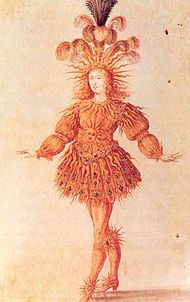
1567–1625). Louis XIV of France
Louis XIV of France
Louis XIV , known as Louis the Great or the Sun King , was a Bourbon monarch who ruled as King of France and Navarre. His reign, from 1643 to his death in 1715, began at the age of four and lasted seventy-two years, three months, and eighteen days...
(1643–1715), though Catholic, strongly promoted the theory as well.
The theory of divine right was abandoned in England during the Glorious Revolution
Glorious Revolution
The Glorious Revolution, also called the Revolution of 1688, is the overthrow of King James II of England by a union of English Parliamentarians with the Dutch stadtholder William III of Orange-Nassau...
of 1688–89. The American and French revolutions of the late eighteenth century further weakened the theory's appeal, and by the early twentieth century, it had been virtually abandoned.
Such doctrines are, in the English-speaking world
English-speaking world
The English-speaking world consists of those countries or regions that use the English language to one degree or another. For more information, please see:Lists:* List of countries by English-speaking population...
, largely associated with the House of Tudor and the early House of Stuart
House of Stuart
The House of Stuart is a European royal house. Founded by Robert II of Scotland, the Stewarts first became monarchs of the Kingdom of Scotland during the late 14th century, and subsequently held the position of the Kings of Great Britain and Ireland...
in Britain and the theology of the Caroline divines
Caroline Divines
The Caroline Divines were influential theologians and writers in the Anglican Church who lived during the reigns of King Charles I and, after the Restoration, King Charles II . This is commonly considered a golden age of Anglican scholarship...
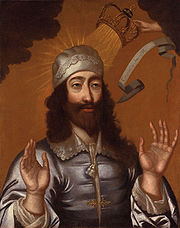
who held their tenure at the pleasure of James I of England (VI of Scotland), Charles I
Charles I of England
Charles I was King of England, King of Scotland, and King of Ireland from 27 March 1625 until his execution in 1649. Charles engaged in a struggle for power with the Parliament of England, attempting to obtain royal revenue whilst Parliament sought to curb his Royal prerogative which Charles...
and Charles II
Charles II of England
Charles II was monarch of the three kingdoms of England, Scotland, and Ireland.Charles II's father, King Charles I, was executed at Whitehall on 30 January 1649, at the climax of the English Civil War...
.
The Scots
Scots language
Scots is the Germanic language variety spoken in Lowland Scotland and parts of Ulster . It is sometimes called Lowland Scots to distinguish it from Scottish Gaelic, the Celtic language variety spoken in most of the western Highlands and in the Hebrides.Since there are no universally accepted...
textbooks of the divine right of kings were written in 1597-98 by James VI of Scotland before his accession to the English throne. His Basilikon Doron
Basilikon Doron
The Basilikon Doron is a treatise on government written by King James VI of Scotland, later King James I of England, in 1599. Basilikon Doron in the Greek language means royal gift. It was written in the form of a private and confidential letter to the King's eldest son, Henry, Duke of...
, a manual on the duties of a king, was written to edify his four-year-old son Henry Frederick
Henry Frederick
Henry Frederick may refer to:* Henry Frederick, Prince of Wales , Duke of Cornwall and of Rothesay, etc., eldest son of James I of England, VI of Scots* Henry Frederick Compton Cavendish , British soldier, politician and courtier...
king "acknowledgeth himself ordained for his people, having received from the god a burden of government, whereof he must be countable". The idea of the divine right to rule has appeared in many cultures Eastern and Western spanning all the way back to the first god king Gilgamesh
Gilgamesh
Gilgamesh was the fifth king of Uruk, modern day Iraq , placing his reign ca. 2500 BC. According to the Sumerian king list he reigned for 126 years. In the Tummal Inscription, Gilgamesh, and his son Urlugal, rebuilt the sanctuary of the goddess Ninlil, in Tummal, a sacred quarter in her city of...
.
Historical parallels in the West
The conception of ordinationOrdination
In general religious use, ordination is the process by which individuals are consecrated, that is, set apart as clergy to perform various religious rites and ceremonies. The process and ceremonies of ordination itself varies by religion and denomination. One who is in preparation for, or who is...
brought with it largely unspoken parallels with the Anglican and Catholic priesthood
Priesthood (Catholic Church)
The ministerial orders of the Catholic Church include the orders of bishops, deacons and presbyters, which in Latin is sacerdos. The ordained priesthood and common priesthood are different in function and essence....
, but the overriding metaphor in James' handbook was that of a father's relation to his children. "Just as no misconduct on the part of a father can free his children from obedience to the fifth commandment
Ten Commandments
The Ten Commandments, also known as the Decalogue , are a set of biblical principles relating to ethics and worship, which play a fundamental role in Judaism and most forms of Christianity. They include instructions to worship only God and to keep the Sabbath, and prohibitions against idolatry,...
, so no misgovernment on the part of a king can release his subjects from their allegiance." James' reading of The True Law of Free Monarchies
The True Law of Free Monarchies
The True Law of Free Monarchies; or, The Reciprocal and Mutual Duty Betwixt a Free King and His Natural Subjects is a treatise or essay of political theory by James VI of Scotland...
allowed that "...a good king will frame all his actions to be according to the law, yet is he not bound thereto but of his good will..." James also had printed his Defense of the Right of Kings in the face of English theories of inalienable popular and clerical rights.
One passage in scripture supporting the idea of divine right of kings was Romans Chapter 13. Martin Luther
Martin Luther
Martin Luther was a German priest, professor of theology and iconic figure of the Protestant Reformation. He strongly disputed the claim that freedom from God's punishment for sin could be purchased with money. He confronted indulgence salesman Johann Tetzel with his Ninety-Five Theses in 1517...
, when urging the secular authorities to crush the Peasant Rebellion of 1525
German Peasants' War
The German Peasants' War or Great Peasants' Revolt was a widespread popular revolt in the German-speaking areas of Central Europe, 1524–1526. At its height in the spring and summer of 1525, the conflict involved an estimated 300,000 peasants: contemporary estimates put the dead at 100,000...
in Germany in his Against the Murderous, Thieving Hordes of Peasants
Against the Murderous, Thieving Hordes of Peasants
Against the Murderous, Thieving Hordes of Peasants is a piece written by Martin Luther, related to The German Peasants' War. The Peasants' War took place between 1524 and 1526, as a result of a tumultuous collection of grievances in many different spheres: political, economic, social, and...
, based his argument on St. Paul's Epistle to the Romans 13:1-7.
It is related to the ancient (but not current) Catholic philosophies regarding monarchy in which the monarch is God's viceregent upon the Earth and therefore subject to no inferior power. However, in Roman Catholic jurisprudence the monarch is always subject to natural
Natural law
Natural law, or the law of nature , is any system of law which is purportedly determined by nature, and thus universal. Classically, natural law refers to the use of reason to analyze human nature and deduce binding rules of moral behavior. Natural law is contrasted with the positive law Natural...
and divine law
Divine law
Divine law is any law that in the opinion of believers, comes directly from the will of God . Like natural law it is independent of the will of man, who cannot change it. However it may be revealed or not, so it may change in human perception in time through new revelation...
which are regarded as superior to the monarch. The possibility of monarchy declining morally, overturning natural law, and degenerating into a tyranny oppressive of the general welfare was answered theologically with the Catholic concept of extra-legal tyrannicide
Tyrannicide
Tyrannicide literally means the killing of a tyrant, or one who has committed the act. Typically, the term is taken to mean the killing or assassination of tyrants for the common good. The term "tyrannicide" does not apply to tyrants killed in battle or killed by an enemy in an armed conflict...
, ideally ratified by the Pope. The Pope assumed at times, due to the non-existence of other possibilities and on account of the Church's spiritual superiority over kingdoms, the place of an arbiter of natural and divine law, in deposing kings that had offended it, for instance in attacking the liberty of the Church.
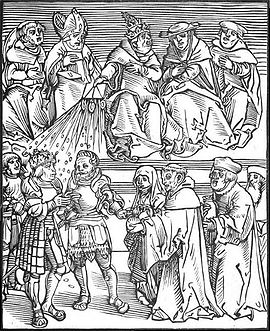
- The Old Testament, in which a line of kings was created by God through the prophecy of Jacob/Israel who created his son Judah to be king and retain the sceptre until the coming of the Messiah, alongside the line of priests created in his other son, LeviLeviLevi/Levy was, according to the Book of Genesis, the third son of Jacob and Leah, and the founder of the Israelite Tribe of Levi ; however Peake's commentary suggests this as postdiction, an eponymous metaphor providing an aetiology of the connectedness of the tribe to others in the Israelite...
. Later, a line of Judges (who were not kings as they only had the power to provide insight to the people and not to take action to enforce their rulings) was created alongside the line of High Priests created by MosesMosesMoses was, according to the Hebrew Bible and Qur'an, a religious leader, lawgiver and prophet, to whom the authorship of the Torah is traditionally attributed...
through AaronAaronIn the Hebrew Bible and the Qur'an, Aaron : Ααρών ), who is often called "'Aaron the Priest"' and once Aaron the Levite , was the older brother of Moses, and a prophet of God. He represented the priestly functions of his tribe, becoming the first High Priest of the Israelites...
. Later still, the Prophet Samuel re-instituted the line of kings in SaulSaul-People:Saul is a given/first name in English, the Anglicized form of the Hebrew name Shaul from the Hebrew Bible:* Saul , including people with this given namein the Bible:* Saul , a king of Edom...
, under the inspiration of God. - The New Testament in which the first Pope, St Peter, commands that all Christians shall honour the Roman Emperor even though, at that time, he was still a pagan emperor. Likewise, Jesus Christ proclaims in the Gospel of Matthew that one should, "Render unto Caesar the things which are Caesar’s," that is at first, literally, the payment of taxes as binding those who use the imperial currencyCurrencyIn economics, currency refers to a generally accepted medium of exchange. These are usually the coins and banknotes of a particular government, which comprise the physical aspects of a nation's money supply...
, but more widely interpreted the offer of obedience and submission to the proclaimed worldly king in matters not contrary to conscienceConscienceConscience is an aptitude, faculty, intuition or judgment of the intellect that distinguishes right from wrong. Moral judgement may derive from values or norms...
. - The endorsement by the popes and the Church of the line of emperors beginning with the Emperors ConstantineConstantine IConstantine the Great , also known as Constantine I or Saint Constantine, was Roman Emperor from 306 to 337. Well known for being the first Roman emperor to convert to Christianity, Constantine and co-Emperor Licinius issued the Edict of Milan in 313, which proclaimed religious tolerance of all...
and TheodosiusTheodosius ITheodosius I , also known as Theodosius the Great, was Roman Emperor from 379 to 395. Theodosius was the last emperor to rule over both the eastern and the western halves of the Roman Empire. During his reign, the Goths secured control of Illyricum after the Gothic War, establishing their homeland...
, later the Eastern Roman emperors, and finally the Western Roman emperor, CharlemagneCharlemagneCharlemagne was King of the Franks from 768 and Emperor of the Romans from 800 to his death in 814. He expanded the Frankish kingdom into an empire that incorporated much of Western and Central Europe. During his reign, he conquered Italy and was crowned by Pope Leo III on 25 December 800...
and his successors, the Catholic Holy Roman EmperorsHoly Roman EmpireThe Holy Roman Empire was a realm that existed from 962 to 1806 in Central Europe.It was ruled by the Holy Roman Emperor. Its character changed during the Middle Ages and the Early Modern period, when the power of the emperor gradually weakened in favour of the princes...
.
The French Huguenot nobles and clergy, having rejected the Pope and the Catholic Church, were left only with the supreme power of the king who, they taught, could not be gainsaid or judged by anyone. Since there was no longer the countervailing power of the Papacy and since the Church of England was a creature of the State and had become subservient to it, this meant that there was nothing to regulate the powers of the king and he became an absolute power. In theory, divine
Divine law
Divine law is any law that in the opinion of believers, comes directly from the will of God . Like natural law it is independent of the will of man, who cannot change it. However it may be revealed or not, so it may change in human perception in time through new revelation...
, natural
Natural law
Natural law, or the law of nature , is any system of law which is purportedly determined by nature, and thus universal. Classically, natural law refers to the use of reason to analyze human nature and deduce binding rules of moral behavior. Natural law is contrasted with the positive law Natural...
, customary, and constitutional law
Constitutional law
Constitutional law is the body of law which defines the relationship of different entities within a state, namely, the executive, the legislature and the judiciary....
still held sway over the king but, absent a superior spiritual power, it was difficult to see how they could be enforced since the king could not be tried by any of his own courts.
Some of the symbolism within the coronation
Coronation of the British monarch
The coronation of the British monarch is a ceremony in which the monarch of the United Kingdom is formally crowned and invested with regalia...
ceremony for British monarchs, in which they are anointed
Anointed
Anointed is a Contemporary Christian music group from Columbus, Ohio, known for their strong vocals and harmonies, featuring siblings Steve Crawford and Da'dra Crawford Greathouse, along with former members Nee-C Walls and Mary Tiller . Their musical style includes elements of R&B, Pop, Rock,...
with Holy oil
Holy oil
Holy oil may refer to:* Holy anointing oil, a perfume used to anoint the vessels of the Jewish Tabernacle* Holy Oil , a consecrated oil used in the administration of certain sacraments and ecclesiastical functions...
s by the Archbishop of Canterbury
Archbishop of Canterbury
The Archbishop of Canterbury is the senior bishop and principal leader of the Church of England, the symbolic head of the worldwide Anglican Communion, and the diocesan bishop of the Diocese of Canterbury. In his role as head of the Anglican Communion, the archbishop leads the third largest group...
, thereby ordaining
Holy Orders
The term Holy Orders is used by many Christian churches to refer to ordination or to those individuals ordained for a special role or ministry....
them to monarchy, perpetuates the ancient Roman Catholic monarchical ideas and ceremonial (although few Protestants realize this, the ceremony is nearly entirely based upon that of the Coronation of the Holy Roman Emperor). However, in the UK, the symbolism ends there since the real governing authority of the Monarch was all but extinguished by the Whig revolution of 1688-89 (see Glorious Revolution
Glorious Revolution
The Glorious Revolution, also called the Revolution of 1688, is the overthrow of King James II of England by a union of English Parliamentarians with the Dutch stadtholder William III of Orange-Nassau...
). The king or queen of the United Kingdom
United Kingdom
The United Kingdom of Great Britain and Northern IrelandIn the United Kingdom and Dependencies, other languages have been officially recognised as legitimate autochthonous languages under the European Charter for Regional or Minority Languages...
is one of the last monarchs still to be crowned in the traditional Christian ceremonial, which in most other countries has been replaced by an inauguration
Inauguration
An inauguration is a formal ceremony to mark the beginning of a leader's term of office. An example is the ceremony in which the President of the United States officially takes the oath of office....
or other declaration.
Aryan
Aryan is an English language loanword derived from Sanskrit ārya and denoting variously*In scholarly usage:**Indo-Iranian languages *in dated usage:**the Indo-European languages more generally and their speakers...
and Egyptian
Ancient Egypt
Ancient Egypt was an ancient civilization of Northeastern Africa, concentrated along the lower reaches of the Nile River in what is now the modern country of Egypt. Egyptian civilization coalesced around 3150 BC with the political unification of Upper and Lower Egypt under the first pharaoh...
traditions. In pagan religions, the king was often seen as a kind of god and so was an unchallengeable despot. The ancient Roman Catholic tradition overcame this idea with the doctrine of the "Two Swords" and so achieved, for the very first time, a balanced constitution for states. The advent of Protestantism saw something of a return to the idea of a mere unchallengeable despot.
Thomas Aquinas
Thomas Aquinas
Thomas Aquinas, O.P. , also Thomas of Aquin or Aquino, was an Italian Dominican priest of the Catholic Church, and an immensely influential philosopher and theologian in the tradition of scholasticism, known as Doctor Angelicus, Doctor Communis, or Doctor Universalis...
condoned extra-legal tyrannicide
Tyrannicide
Tyrannicide literally means the killing of a tyrant, or one who has committed the act. Typically, the term is taken to mean the killing or assassination of tyrants for the common good. The term "tyrannicide" does not apply to tyrants killed in battle or killed by an enemy in an armed conflict...
in the worst of circumstances:
"When there is no recourse to a superior by whom judgment can be made about an invader, then he who slays a tyrant to liberate his fatherland is [to be] praised and receives a reward" (Commentary on the Magister Sententiarum).
On the other hand, Aquinas forbade the overthrow by his subjects of any morally, Christianly and spiritually legitimate king. The only human power capable of deposing the king was the pope. The reasoning was that if a subject may overthrow his superior for some bad law who was to be the judge of whether the law was bad? If the subject could so judge his own superior then all lawful superior authority could lawfully be overthrown by the arbitrary judgement of an inferior and thus all law was under constant threat. Towards the end of the Middle Ages many philosophers such as Nicholas of Cusa
Nicholas of Cusa
Nicholas of Kues , also referred to as Nicolaus Cusanus and Nicholas of Cusa, was a cardinal of the Catholic Church from Germany , a philosopher, theologian, jurist, mathematician, and an astronomer. He is widely considered one of the great geniuses and polymaths of the 15th century...
and Francisco Suarez
Francisco Suárez
Francisco Suárez was a Spanish Jesuit priest, philosopher and theologian, one of the leading figures of the School of Salamanca movement, and generally regarded among the greatest scholastics after Thomas Aquinas....
propounded similar theories. The Church was the final guarantor that Christian kings would follow the laws and constitutional traditions of their ancestors and the laws of the presumptive god and of justice. Similarly, the Chinese concept of Mandate of Heaven
Mandate of Heaven
The Mandate of Heaven is a traditional Chinese philosophical concept concerning the legitimacy of rulers. It is similar to the European concept of the divine right of kings, in that both sought to legitimaze rule from divine approval; however, unlike the divine right of kings, the Mandate of...
required that the emperor properly carry out the proper ritual
Ritual
A ritual is a set of actions, performed mainly for their symbolic value. It may be prescribed by a religion or by the traditions of a community. The term usually excludes actions which are arbitrarily chosen by the performers....
s, consult his ministers, and made it extremely difficult to undo any acts carried out by an ancestor.
The French prelate Bossuet made a classic statement of the doctrine of Divine Right in a sermon preached before King Louis XIV:
In affirming that the king is answerable only to God, however, Bossuet emphasizes that God will hold the king's actions to special scrutiny, thus balancing an unchallengeable Divine Right with an inexorable Divine Responsibility.
Relationship with the Doctrine of Two Swords
However, this overlooks those parts of Scripture which provide for the doctrine of the "Two Swords" and for the medieval Roman Catholic concept of the powers, rights and duties of kings to protect the Christian Constitution of states, to defend and extend the boundaries of Christendom by lawful means only, to protect and defend the innocent, the weak, the poor and vulnerable, and to protect the Church and the Papacy with the king's own life, if necessary. The emperor was the first knight of Christendom and the other Christian kings his brother-knights sworn to Christian chivalry with all its manifold obligations to justice and charity.This concept partly lived on in the divine right of kings but was much undermined and attenuated by the cutting away of the spiritual arm, turning it into a mere department of state, subsidiary to the king. The result was that this then appeared to say that any attempt by his subjects to hold the king to his historic obligations would be contrary to the will of God and any person so acting would be damned.
Divine right in Asian countries
In ChinaChina
Chinese civilization may refer to:* China for more general discussion of the country.* Chinese culture* Greater China, the transnational community of ethnic Chinese.* History of China* Sinosphere, the area historically affected by Chinese culture...
and East Asia
East Asia
East Asia or Eastern Asia is a subregion of Asia that can be defined in either geographical or cultural terms...
, rulers justified their rule using a similar concept called the Mandate of Heaven
Mandate of Heaven
The Mandate of Heaven is a traditional Chinese philosophical concept concerning the legitimacy of rulers. It is similar to the European concept of the divine right of kings, in that both sought to legitimaze rule from divine approval; however, unlike the divine right of kings, the Mandate of...
. It was similar to the European notion of the divine right of kings in that both sought to legitimize rule from divine approval. However, while the divine right of kings granted unconditional legitimacy, the Mandate of Heaven was conditional on the just behavior of the ruler. Heaven
Heaven
Heaven, the Heavens or Seven Heavens, is a common religious cosmological or metaphysical term for the physical or transcendent place from which heavenly beings originate, are enthroned or inhabit...
would bless the authority of a just ruler, but would be displeased with a despotic ruler and would withdraw its mandate. The Mandate of Heaven would then transfer to those who would rule best.
Whereas revolution is never legitimate under the divine right of kings, the philosophy associated with the mandate of heaven approved of the overthrow of unjust rulers. In China, the right of rebellion against an unjust ruler had been a part of the political philosophy ever since the Zhou dynasty
Zhou Dynasty
The Zhou Dynasty was a Chinese dynasty that followed the Shang Dynasty and preceded the Qin Dynasty. Although the Zhou Dynasty lasted longer than any other dynasty in Chinese history, the actual political and military control of China by the Ji family lasted only until 771 BC, a period known as...
, whose rulers had used this philosophy to justify their overthrow of the previous Shang dynasty
Shang Dynasty
The Shang Dynasty or Yin Dynasty was, according to traditional sources, the second Chinese dynasty, after the Xia. They ruled in the northeastern regions of the area known as "China proper" in the Yellow River valley...
. Chinese historians interpreted a successful revolt as evidence that the Mandate of Heaven had passed.
In the Malay Annals, the raja
Raja
Raja is an Indian term for a monarch, or princely ruler of the Kshatriya varna...
s and sultan
Sultan
Sultan is a title with several historical meanings. Originally, it was an Arabic language abstract noun meaning "strength", "authority", "rulership", and "dictatorship", derived from the masdar سلطة , meaning "authority" or "power". Later, it came to be used as the title of certain rulers who...
s of the Malay States (now Malaysia and Brunei
Brunei
Brunei , officially the State of Brunei Darussalam or the Nation of Brunei, the Abode of Peace , is a sovereign state located on the north coast of the island of Borneo, in Southeast Asia...
) as well as their predecessors, such as the ancient kingdom of Majapahit, also claimed divine right to rule. The sultan is mandated by God, and the sultan is expected to lead his country and people in religious matters, ceremonies as well as prayers. This divine right is called Daulat, and although presently the notion of divine right is somewhat obsolete, one can still see banners and posters with pictures of the reigning sultan with words "Daulat Tuanku", similar to the European proclamation of "Long live the King", on streets and buildings.
Opposition
In the late mid sixteenth century, among groups of English Protestant exiles fleeing from Queen Mary IMary I of England
Mary I was queen regnant of England and Ireland from July 1553 until her death.She was the only surviving child born of the ill-fated marriage of Henry VIII and his first wife Catherine of Aragon. Her younger half-brother, Edward VI, succeeded Henry in 1547...
, some of the earliest anti-monarchist publications emerged. “Weaned off uncritical royalism by the actions of Queen Mary… The political thinking of men like Ponet
John Ponet
John Ponet was the Bishop of Winchester, the Bishop of Rochester, and a controversial Protestant religious leader.In his day, Ponet was an influential Protestant theologian...
, Knox
John Knox
John Knox was a Scottish clergyman and a leader of the Protestant Reformation who brought reformation to the church in Scotland. He was educated at the University of St Andrews or possibly the University of Glasgow and was ordained to the Catholic priesthood in 1536...
, Goodman
Christopher Goodman
Christopher Goodman BD was an English reforming clergyman and writer. He was a Marian exile, who left England to escape persecution during the counter-reformation in the reign of Queen Mary I of England. He was the author of a work on limits to obedience to rulers, and a contributor to the Geneva...
and Hales.
In 1553, Mary I, a Roman Catholic, succeeded her Protestant half brother, Edward VI
Edward VI of England
Edward VI was the King of England and Ireland from 28 January 1547 until his death. He was crowned on 20 February at the age of nine. The son of Henry VIII and Jane Seymour, Edward was the third monarch of the Tudor dynasty and England's first monarch who was raised as a Protestant...
, to the English throne. Mary set about trying to restore Roman Catholicism by making sure that: Edward's religious laws were abolished in the Statute of Repeal Act (1553); the Protestant religious laws passed in the time of Henry VIII
Henry VIII of England
Henry VIII was King of England from 21 April 1509 until his death. He was Lord, and later King, of Ireland, as well as continuing the nominal claim by the English monarchs to the Kingdom of France...
were repealed; and the Revival of the Heresy Acts
Revival of the Heresy Acts
In November 1554, the Revival of the Heresy Acts revived three former Acts against heresy; the letters patent of 1382 of King Richard II, an Act of 1401 of King Henry IV, and an Act of 1414 of King Henry V...
were passed in 1554. The Marian Persecutions
Marian Persecutions
The Marian Persecutions were carried out against religious reformers, Protestants, and other dissenters for their heretical beliefs during the reign of Mary I of England. The excesses of this period were mythologized in the historical record of Foxe's Book of Martyrs...
began soon afterwards. In January 1555, the first of nearly 300 Protestants were burnt at the stake under 'Bloody Mary'. When Thomas Wyatt the younger
Thomas Wyatt the younger
Sir Thomas Wyatt the younger was a rebel leader during the reign of Queen Mary I of England; his rising is traditionally called "Wyatt's rebellion".-Birth and career:...
instigated what became known as Wyatt's rebellion
Wyatt's rebellion
Wyatt's Rebellion was a popular uprising in England in 1554, named after Thomas Wyatt the younger, one of its leaders. The rebellion arose out of concern over Queen Mary I's determination to marry Philip II of Spain, which was an unpopular policy with the English...
, John Ponet
John Ponet
John Ponet was the Bishop of Winchester, the Bishop of Rochester, and a controversial Protestant religious leader.In his day, Ponet was an influential Protestant theologian...
, the highest-ranking ecclesiastic among the exiles, allegedly participated in the uprising. He escaped to Strasbourg
Strasbourg
Strasbourg is the capital and principal city of the Alsace region in eastern France and is the official seat of the European Parliament. Located close to the border with Germany, it is the capital of the Bas-Rhin département. The city and the region of Alsace are historically German-speaking,...
after the Rebellion's defeat and, the following year, he published A Shorte Treatise of Politike Power, in which he put forward a theory of justified opposition to secular rulers.
“Ponet’s treatise comes first in a new wave of anti-monarchical writings… It has never been assessed at its true importance, for it antedates by several years those more brilliantly expressed but less radical Huguenot
Huguenot
The Huguenots were members of the Protestant Reformed Church of France during the 16th and 17th centuries. Since the 17th century, people who formerly would have been called Huguenots have instead simply been called French Protestants, a title suggested by their German co-religionists, the...
writings which have usually been taken to represent the Tyrannicide
Tyrannicide
Tyrannicide literally means the killing of a tyrant, or one who has committed the act. Typically, the term is taken to mean the killing or assassination of tyrants for the common good. The term "tyrannicide" does not apply to tyrants killed in battle or killed by an enemy in an armed conflict...
-theories of the Reformation
Protestant Reformation
The Protestant Reformation was a 16th-century split within Western Christianity initiated by Martin Luther, John Calvin and other early Protestants. The efforts of the self-described "reformers", who objected to the doctrines, rituals and ecclesiastical structure of the Roman Catholic Church, led...
”.
Ponet's pamphlet was republished on the eve of King Charles I's execution.
According to US President John Adams
John Adams
John Adams was an American lawyer, statesman, diplomat and political theorist. A leading champion of independence in 1776, he was the second President of the United States...
, Ponet's work contained "all the essential principles of liberty, which were afterward dilated on by Sidney and Locke
John Locke
John Locke FRS , widely known as the Father of Liberalism, was an English philosopher and physician regarded as one of the most influential of Enlightenment thinkers. Considered one of the first of the British empiricists, following the tradition of Francis Bacon, he is equally important to social...
" including the idea of a three-branched government.
In due course, opposition to the divine right of kings came from a number of sources, including poet John Milton
John Milton
John Milton was an English poet, polemicist, a scholarly man of letters, and a civil servant for the Commonwealth of England under Oliver Cromwell...
in his pamphlet The Tenure of Kings and Magistrates
The Tenure of Kings and Magistrates
The Tenure of Kings and Magistrates is a book by John Milton, in which he defends the right of people to execute a guilty sovereign, whether tyrannical or not....
.
Probably the two most famous declarations of a right to revolution against tyranny in the English language are John Locke
John Locke
John Locke FRS , widely known as the Father of Liberalism, was an English philosopher and physician regarded as one of the most influential of Enlightenment thinkers. Considered one of the first of the British empiricists, following the tradition of Francis Bacon, he is equally important to social...
’s Essay concerning The True Original, Extent, and End of Civil-Government and Thomas Jefferson’s formulation in the United States Declaration of Independence
United States Declaration of Independence
The Declaration of Independence was a statement adopted by the Continental Congress on July 4, 1776, which announced that the thirteen American colonies then at war with Great Britain regarded themselves as independent states, and no longer a part of the British Empire. John Adams put forth a...
that "all men are created equal
All men are created equal
The quotation "All men are created equal" has been called an "immortal declaration", and "perhaps" the single phrase of the United States Revolutionary period with the greatest "continuing importance". Thomas Jefferson first used the phrase in the Declaration of Independence as a rebuttal to the...
".
See also
|
Concordat of Worms The Concordat of Worms, sometimes called the Pactum Calixtinum by papal historians, was an agreement between Pope Calixtus II and Holy Roman Emperor Henry V on September 23, 1122 near the city of Worms... Cuius regio, eius religio Cuius regio, eius religio is a phrase in Latin translated as "Whose realm, his religion", meaning the religion of the ruler dictated the religion of the ruled... |
First Council of the Lateran The Council of 1123 is reckoned in the series of Ecumenical councils by the Catholic Church. It was convoked by Pope Calixtus II in December, 1122, immediately after the Concordat of Worms... Robert Bellarmine Robert Bellarmine was an Italian Jesuit and a Cardinal of the Catholic Church. He was one of the most important figures in the Counter-Reformation... |
Robert Filmer thumbnail|150px|right|Robert Filmer Sir Robert Filmer was an English political theorist who defended the divine right of kings... Sovereignty Sovereignty is the quality of having supreme, independent authority over a geographic area, such as a territory. It can be found in a power to rule and make law that rests on a political fact for which no purely legal explanation can be provided... The True Law of Free Monarchies The True Law of Free Monarchies; or, The Reciprocal and Mutual Duty Betwixt a Free King and His Natural Subjects is a treatise or essay of political theory by James VI of Scotland... |
Further reading
- Burgess, Glenn. "The Divine Right of Kings Reconsidered" The English Historical Review 107 No. 425 (October 1992:837-861).