

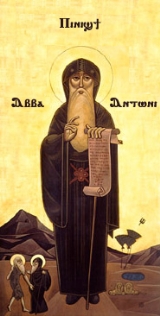
Monk

Encyclopedia
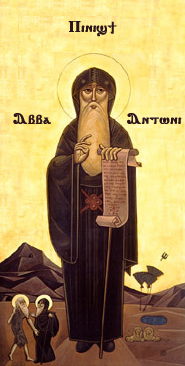
Asceticism
Asceticism describes a lifestyle characterized by abstinence from various sorts of worldly pleasures often with the aim of pursuing religious and spiritual goals...
, living either alone or with any number of monks, while always maintaining some degree of physical separation from those not sharing the same purpose. The concept is ancient and can be seen in many religions and in philosophy.
In the Greek language the term can apply to women; but in modern English it is in use only for men, while nun
Nun
A nun is a woman who has taken vows committing her to live a spiritual life. She may be an ascetic who voluntarily chooses to leave mainstream society and live her life in prayer and contemplation in a monastery or convent...
is used for female monastics.
Although the term monachos (“monk”) is of Christian origin, in the English language it tends to be used analogously or loosely also for both male and female ascetics from other religious or philosophical backgrounds.
The term monk is generic and in some religious or philosophical traditions it therefore may be considered interchangeable with other terms such as ascetic. However, being generic, it is not interchangeable with terms that denote particular kinds of monk, such as cenobite, hermit
Hermit
A hermit is a person who lives, to some degree, in seclusion from society.In Christianity, the term was originally applied to a Christian who lives the eremitic life out of a religious conviction, namely the Desert Theology of the Old Testament .In the...
, anchorite
Anchorite
Anchorite denotes someone who, for religious reasons, withdraws from secular society so as to be able to lead an intensely prayer-oriented, ascetic, and—circumstances permitting—Eucharist-focused life...
, hesychast
Hesychasm
Hesychasm is an eremitic tradition of prayer in the Eastern Orthodox Church, and some of the Eastern Catholic Churches, such as the Byzantine Rite, practised by the Hesychast Hesychasm is an eremitic tradition of prayer in the Eastern Orthodox Church, and some of the Eastern Catholic Churches,...
, solitary.
Eastern Christianity
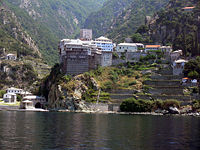
World (theology)
-Christian views on the World:In Christianity, the concept connotes the fallen and corrupt world order of human society. The world is frequently cited alongside the flesh and the Devil as a source of temptation that Christians should flee...
in order to pray unceasingly for the world. They do not, in general, have as their primary purpose the running of social services, as is common in Western Christianity, but instead are concerned with attaining theosis
Theosis
In Christian theology, divinization, deification, making divine or theosis is the transforming effect of divine grace. This concept of salvation is historical and fundamental for Christian understanding that is prominent in the Eastern Orthodox Church and also in the Catholic Church, and is a...
, or union with God. However, care for the poor and needy has always been an obligation of monasticism, so Orthodox monasteries are not normally "cloistered" like some contemplative Western houses are, though the level of contact will vary from community to community. Orthodox hermits, on the other hand, have little or no contact with the outside world.
Orthodox monasticism does not have religious orders as are found in the West, nor do they have Rules in the same sense as the Rule of St. Benedict. Rather, Eastern monastics study and draw inspiration from the writings of the Desert Fathers
Desert Fathers
The Desert Fathers were hermits, ascetics, monks, and nuns who lived mainly in the Scetes desert of Egypt beginning around the third century AD. The most well known was Anthony the Great, who moved to the desert in 270–271 and became known as both the father and founder of desert monasticism...
as well as other Church Fathers
Church Fathers
The Church Fathers, Early Church Fathers, Christian Fathers, or Fathers of the Church were early and influential theologians, eminent Christian teachers and great bishops. Their scholarly works were used as a precedent for centuries to come...
; probably the most influential of which are the Greater Asketikon and Lesser Asketikon of St. Basil the Great and the Philokalia
Philokalia
The Philokalia is a collection of texts written between the 4th and 15th centuries by spiritual masters of the Eastern Orthodox hesychast tradition. They were originally written for the guidance and instruction of monks in "the practise of the contemplative life". The collection was compiled in...
, which was compiled by St. Nikodemos of the Holy Mountain and St. Makarios of Corinth. Hesychasm
Hesychasm
Hesychasm is an eremitic tradition of prayer in the Eastern Orthodox Church, and some of the Eastern Catholic Churches, such as the Byzantine Rite, practised by the Hesychast Hesychasm is an eremitic tradition of prayer in the Eastern Orthodox Church, and some of the Eastern Catholic Churches,...
is of primary importance in the ascetical theology of the Orthodox Church.
Most communities are self-supporting, and the monastic’s daily life is usually divided into three parts: (a) communal worship in the catholicon
Katholikon
A Katholikon or Catholicon is the major temple of a monastery, or diocese in the Eastern Orthodox Church. The name derives from the fact that it is the largest temple where all gather together to celebrate the major feast days of the liturgical year. At other times, the smaller temples or...
(the monastery's main church); (b) hard manual labour; and (c) private prayer, spiritual study, and rest when necessary. Meals are usually taken in common in a sizable dining hall known as a trapeza
Refectory
A refectory is a dining room, especially in monasteries, boarding schools and academic institutions. One of the places the term is most often used today is in graduate seminaries...
(refectory), at elongated refectory table
Refectory table
A refectory table is a highly elongated table used originally for dining in monasteries in Medieval times. In the Late Middle Ages the table gradually became a banqueting or feasting table in castles and other noble residences. The original table manufacture was by hand and created of oak or...
s. Food is usually simple and is eaten in silence while one of the brethren reads aloud from the spiritual writings of the Holy Fathers
Church Fathers
The Church Fathers, Early Church Fathers, Christian Fathers, or Fathers of the Church were early and influential theologians, eminent Christian teachers and great bishops. Their scholarly works were used as a precedent for centuries to come...
. The monastic lifestyle takes a great deal of serious commitment; those newcomers with romantic notions about this sort of lifestyle usually do not last more than a few days. Within the cenobitic community, all monks conform to a common way of living based on the traditions of that particular monastery. In struggling to attain this conformity, the monastic comes to realize his own shortcomings and is guided by his spiritual father
Starets
A starets is an elder of a Russian Orthodox monastery who functions as venerated adviser and teacher. Elders or spiritual fathers are charismatic spiritual leaders whose wisdom stems from God as obtained from ascetic experience...
in how to deal honestly with them. Attaining this level of self-discipline is perhaps the most difficult and painful accomplishment any human being can make; but the end goal, to become like an angel on earth (an "earthly angel and a heavenly man", as the church hymn
Hymn
A hymn is a type of song, usually religious, specifically written for the purpose of praise, adoration or prayer, and typically addressed to a deity or deities, or to a prominent figure or personification...
s put it), is the reason monastics are held in such high esteem. For this same reason, Bishops are almost always chosen from the ranks of monks.
Eastern monasticism is found in three distinct forms: anchoritic (a solitary living in isolation), cenobitic
Cenobitic
Cenobitic monasticism is a monastic tradition that stresses community life. Often in the West, the community belongs to a religious order and the life of the cenobitic monk is regulated by a religious rule, a collection of precepts...
(a community living and worshiping together under the direct rule of an abbot or abbess), and the "middle way" between the two, known as the skete
Skete
A Skete is a monastic style community that allows relative isolation for monks, but alsoallows for communal services and the safety of shared resources and protection...
(a community of individuals living separately but in close proximity to one another, who come together only on Sundays and feast days, working and praying the rest of the time in solitude, but under the direction of an elder). One normally enters a cenobitic community first, and only after testing and spiritual growth would one go on to the skete or, for the most advanced, become a solitary anchorite. However, one is not necessarily expected to join a skete or become a solitary; most monastics remain in the cenobuim the whole of their lives.
In general, Orthodox monastics have little or no contact with the outside world, including their own families. The purpose of the monastic life is union with God, the means is through leaving the world (i.e., the life of the passions). After tonsure, Orthodox monks and nuns are never permitted to cut their hair. The hair of the head and the beard remain uncut as a symbol of the vows they have taken, reminiscent of the Nazarites from the Old Testament
Old Testament
The Old Testament, of which Christians hold different views, is a Christian term for the religious writings of ancient Israel held sacred and inspired by Christians which overlaps with the 24-book canon of the Masoretic Text of Judaism...
. The Tonsure
Tonsure
Tonsure is the traditional practice of Christian churches of cutting or shaving the hair from the scalp of clerics, monastics, and, in the Eastern Orthodox Church, all baptized members...
of monks is the token of a consecrated life, and symbolizes the cutting off of their self-will.
Degrees
Religious habit
A religious habit is a distinctive set of garments worn by members of a religious order. Traditionally some plain garb recognisable as a religious habit has also been worn by those leading the religious eremitic and anachoritic life, although in their case without conformity to a particular uniform...
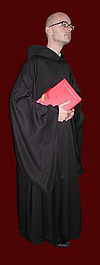
in the Eastern Church (with certain slight regional variations), and it is the same for both monks and nuns. Each successive grade is given a portion of the habit, the full habit being worn only by those in the highest grade, known for that reason as the "Great Schema", or "Great Habit".
The various profession rites are normally performed by the Abbot, but if the abbot has not been ordained a priest, or if the monastic community is a convent, a hieromonk
Hieromonk
Hieromonk , also called a Priestmonk, is a monk who is also a priest in the Orthodox Church and Eastern Catholicism....
will perform the service. The abbot or hieromonk who performs a tonsure must be of at least the rank he is tonsuring into. In other words, only a hieromonk who has been tonsured into the Great Schema may himself tonsure a Schemamonk. A bishop, however, may tonsure into any rank, regardless of his own.
Novice (Slavonic: Poslushnik), lit. "one under obedience"—Those wishing to join a monastery begin their lives as novices. After coming to the monastery and living as a guest for not less than three days, the revered abbot or abbess may bless the candidate to become a novice. There is no formal ceremony for the clothing of a novice, he or she simply receives permission to wear the clothing of a novice. In the Eastern monastic tradition, novices may or may not dress in the black inner cassock (Greek: Anterion, Eisorasson; Slavonic: Podriasnik) and wear the soft monastic hat (Greek: Skoufos, Slavonic: Skufia), depending on the tradition of the local community, and in accordance to the abbot’s directives. The inner-cassock and the skoufos are the first part of the Orthodox monastic habit. In some communities, the novice also wears the leather belt. He is also given a prayer rope
Prayer rope
A prayer rope is a loop made up of complex knots, usually out of wool or silk....
and instructed in the use of the Jesus Prayer
Jesus Prayer
The Jesus Prayer or "The Prayer" is a short, formulaic prayer esteemed and advocated within the Eastern Orthodox church:The prayer has been widely taught and discussed throughout the history of the Eastern Churches. It is often repeated continually as a part of personal ascetic practice, its use...
. If a novice chooses to leave during the period of the novitiate, no penalty is incurred. He may also be asked to leave at any time if his behaviour does not conform to the monastic life, or if the superior discerns that he is not called to monasticism. When the abbot or abbess deems the novice ready, he is asked if he wishes to join the monastery. Some, out of humility, will choose to remain novices all their lives. Every stage of the monastic life must be entered into voluntarily.
Rassaphore, (Slavonic: Ryassophore), lit. "Robe-bearer"—If the novice continues on to become a monk, he is clothed in the first degree of monasticism at a formal service known as the Tonsure
Tonsure
Tonsure is the traditional practice of Christian churches of cutting or shaving the hair from the scalp of clerics, monastics, and, in the Eastern Orthodox Church, all baptized members...
. Although there are no formal vows made at this point, the candidate is normally required to affirm his commitment to persevere in the monastic life. The abbot will then perform the tonsure, cutting a small amount of hair from four spots on the head, forming a cross. He is then given the outer cassock (Greek: Rasson, Exorasson, or Mandorrason; Slavonic: Riassa)—an outer robe with wide sleeves, something like the cowl
Cowl
This article is about the garment used by monks and nuns. For other uses, see Cowl or Cowling .The cowl is an item of clothing consisting of a long, hooded garment with wide sleeves. Originally it may have referred simply to the hooded portion of a cloak...
used in the West, but without a hood—from which the name of Rassaphore is derived. He is also given a brimless hat with a veil, known as a klobuk
Klobuk
thumbA klobuk is an item of clerical clothing worn by Eastern Orthodox and Eastern Catholic monastics and bishops, especially in the Russian tradition...
, and a leather belt is fastened around his waist. His habit is usually black, signifying that he is now dead to the world, and he receives a new name. Although the Rassaphore does not make formal vows, he is still morally obligated to continue in the monastic estate for the rest of his life. Some will remain Rassaphores permanently without going on to the higher degrees.
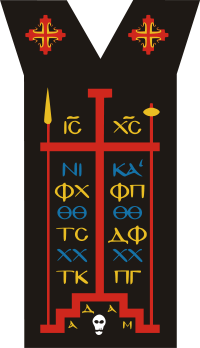
Stavrophore, (Slavonic: Krestonosets), lit. "Cross-bearer"—The next level for Eastern monastics takes place some years after the first tonsure when the abbot feels the monk has reached an appropriate level of discipline, dedication, and humility. This degree is also known as the Little Schema, and is considered to be a "betrothal" to the Great Schema. At this stage, the monk makes formal vows of stability, chastity, obedience and poverty. Then he is tonsured and clothed in the habit, which in addition to that worn by the Rassaphore, includes the paramandyas (Slavonic: paraman), a piece of square cloth worn on the back, embroidered with the instruments of the Passion
Passion (Christianity)
The Passion is the Christian theological term used for the events and suffering – physical, spiritual, and mental – of Jesus in the hours before and including his trial and execution by crucifixion...
(see picture above), and connected by ties to a wooden cross worn over the heart. The paramandyas represents the yoke of Christ. Because of this addition he is now called Stavrophore, or Cross-bearer. He is also given a wooden hand cross (or "profession cross"), which he should keep in his icon corner
Icon Corner
The Icon Corner is a small worship space prepared in the homes of Eastern Orthodox or Greek-Catholic Christians.The Book of Acts and the Epistles of the Apostle Paul record that in the early Church, Christians used to meet in the homes of the faithful. This tradition of the "House Church"...
, and a beeswax candle, symbolic of monastic vigilance the sacrificing of himself for God. He will be buried holding the cross, and the candle will be burned at his funeral. In the Slavic practice, the Stavrophore also wears the monastic mantle. The rasson (outer robe) worn by the Stavrophore is more ample than that worn by the Rassaphore. The abbot increases the Stavrophore monk’s prayer rule, allows a more strict personal ascetic practice, and gives the monk more responsibility.
Great Schema (Greek: Megaloschemos, Slavonic: Skhimnik)—Monks whose abbot feels they have reached a high level of spiritual excellence reach the final stage, called the Great Schema. The tonsure of a Schemamonk follows the same format as the Stavrophore, and he makes the same vows and is tonsured in the same manner. But in addition to all the garments worn by the Stavrophore, he is given the Analavos (Slavonic: Analav) which is the article of monastic vesture emblematic of the Great Schema. For this reason, the analavos itself is sometimes called the "Great Schema." The analavos comes down in the front and the back, somewhat like the scapular
Scapular
The term scapular as used today refers to two specific, yet related, Christian Sacramentals, namely the monastic and devotional scapulars, although both forms may simply be referred to as "scapular"....
in Western monasticism, although the two garments are probably not related. It is often intricately embroidered with the instruments of the Passion and the Trisagion
Trisagion
The Trisagion , sometimes called by its opening line Agios O Theos or by the Latin Tersanctus, is a standard hymn of the Divine Liturgy in most of the Eastern Orthodox Churches, Oriental Orthodox Churches and Catholic Churches.In those Churches which use the Byzantine Rite, the Trisagion is chanted...
(the angelic hymn). The Greek form does not have a hood, the Slavic form has a hood and lappets on the shoulders, so that the garment forms a large cross covering the monk's shoulders, chest, and back. Another piece added is the Polystavrion or "Many Crosses", which consists of a cord with a number of small crosses plaited into it. The polystavrion forms a yoke around the monk and serves to hold the analavos in place, and reminds the monastic that he is bound to Christ and that his arms are no longer fit for worldly activities, but that he must labor only for the Kingdom of Heaven
Kingdom of God
The Kingdom of God or Kingdom of Heaven is a foundational concept in the Abrahamic religions: Judaism, Christianity and Islam.The term "Kingdom of God" is found in all four canonical gospels and in the Pauline epistles...
. Among the Greeks, the mantle is added at this stage. The paramandyas of the Megaloschemos is larger than that of the Stavrophore, and if he wears the klobuk, it is of a distinctive thimble shape, called a koukoulion
Cowl
This article is about the garment used by monks and nuns. For other uses, see Cowl or Cowling .The cowl is an item of clothing consisting of a long, hooded garment with wide sleeves. Originally it may have referred simply to the hooded portion of a cloak...
, the veil of which is usually embroidered with crosses. In some monastic traditions the Great Schema is only given to monks and nuns on their death bed, while in others they may be elevated after as little as 25 years of service.
Eastern Orthodox monks are addressed as "Father" even if they are not priests; but when conversing among themselves, monks will often address one another as "Brother." Novices are always referred to as "Brother." Among the Greeks, old monks are often called Gheronda, or "Elder", out of respect for their dedication. In the Slavic tradition, the title of Elder (Slavonic: Starets
Starets
A starets is an elder of a Russian Orthodox monastery who functions as venerated adviser and teacher. Elders or spiritual fathers are charismatic spiritual leaders whose wisdom stems from God as obtained from ascetic experience...
) is normally reserved for those who are of an advanced spiritual life, and who serve as guides to others.
For the Orthodox, Mother is the correct term for nuns who have been tonsured Stavrophore or higher. Novices and Rassophores are addressed as "Sister". Nuns live identical ascetic lives to their male counterparts and are therefore also called monachai (the feminine plural of monachos), and their community is likewise called a monastery.
Many (but not all) Orthodox seminaries
Seminary
A seminary, theological college, or divinity school is an institution of secondary or post-secondary education for educating students in theology, generally to prepare them for ordination as clergy or for other ministry...
are attached to monasteries, combining academic preparation for ordination
Ordination
In general religious use, ordination is the process by which individuals are consecrated, that is, set apart as clergy to perform various religious rites and ceremonies. The process and ceremonies of ordination itself varies by religion and denomination. One who is in preparation for, or who is...
with participation in the community's life of prayer, and hopefully benefiting from the example and wise counsel of the monks. Bishops are required by the sacred canons
Canon law
Canon law is the body of laws & regulations made or adopted by ecclesiastical authority, for the government of the Christian organization and its members. It is the internal ecclesiastical law governing the Catholic Church , the Eastern and Oriental Orthodox churches, and the Anglican Communion of...
of the Orthodox Church to be chosen from among the monastic clergy. It should be noted that the requirement is specifically that they be monastics, not simply celibate (see clerical celibacy
Clerical celibacy
Clerical celibacy is the discipline by which some or all members of the clergy in certain religions are required to be unmarried. Since these religions consider deliberate sexual thoughts, feelings, and behavior outside of marriage to be sinful, clerical celibacy also requires abstension from these...
). Monks who have been ordained to the priesthood are called hieromonk
Hieromonk
Hieromonk , also called a Priestmonk, is a monk who is also a priest in the Orthodox Church and Eastern Catholicism....
s (priest-monks); monks who have been ordained to the diaconate are called hierodeacon
Hierodeacon
A Hierodeacon , sometimes translated "deacon-monk", in Eastern Orthodox Christianity is a monk who has been ordained a deacon...
s (deacon-monks). A Schemamonk who is a priest is called a Hieroschemamonk. Most monks are not ordained; a community will normally only present as many candidates for ordination to the bishop as the liturgical needs of the community require.
Roman Catholicism
Religious order
A religious order is a lineage of communities and organizations of people who live in some way set apart from society in accordance with their specific religious devotion, usually characterized by the principles of its founder's religious practice. The order is composed of initiates and, in some...
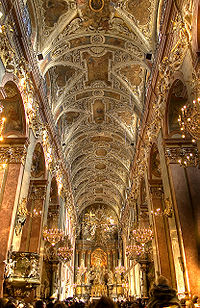
who lives a communal life in a monastery
Monastery
Monastery denotes the building, or complex of buildings, that houses a room reserved for prayer as well as the domestic quarters and workplace of monastics, whether monks or nuns, and whether living in community or alone .Monasteries may vary greatly in size – a small dwelling accommodating only...
, abbey
Abbey
An abbey is a Catholic monastery or convent, under the authority of an Abbot or an Abbess, who serves as the spiritual father or mother of the community.The term can also refer to an establishment which has long ceased to function as an abbey,...
, or priory
Priory
A priory is a house of men or women under religious vows that is headed by a prior or prioress. Priories may be houses of mendicant friars or religious sisters , or monasteries of monks or nuns .The Benedictines and their offshoots , the Premonstratensians, and the...
under a monastic rule of life (such as the Rule of St. Benedict) and under the vows of poverty, chastity, and obedience. St. Benedict of Nursia is considered to be the founder of western monasticism. He authored the Rule of St. Benedict, which is the foundation for the Order of St. Benedict and all of its reforms such as the Cistercians and the Trappists
Trappists
The Order of Cistercians of the Strict Observance , or Trappists, is a Roman Catholic religious order of cloistered contemplative monks who follow the Rule of St. Benedict...
.
The religious vows taken in the West were first developed by St. Benedict
Benedict of Nursia
Saint Benedict of Nursia is a Christian saint, honored by the Roman Catholic Church as the patron saint of Europe and students.Benedict founded twelve communities for monks at Subiaco, about to the east of Rome, before moving to Monte Cassino in the mountains of southern Italy. There is no...
. These vows were three in number: obedience, conversion of life, and stability. Obedience requires that monks are willing to obey the Catholic Church, as represented by the superior person of the monastery, which is an abbot
Abbot
The word abbot, meaning father, is a title given to the head of a monastery in various traditions, including Christianity. The office may also be given as an honorary title to a clergyman who is not actually the head of a monastery...
or prior
Prior
Prior is an ecclesiastical title, derived from the Latin adjective for 'earlier, first', with several notable uses.-Monastic superiors:A Prior is a monastic superior, usually lower in rank than an Abbot. In the Rule of St...
. Conversion of life means, generally, that the monk will release himself from the binds and false hopes of this earthly life and dedicate his life to working for God (i.e. be an instrument for God's work while here on Earth). Stability means they vow to stay in that single monastery for the remainder of their lives, and, upon death, will be buried "on-campus". The latter vow is currently unique to Benedictines.
The solemn vows in other religious communities were eventually established as vows of obedience, poverty, and chastity. Poverty requires that they renounce any ownership of property or assets, except for items that were allowed to them by their superior (such as a religious habit
Religious habit
A religious habit is a distinctive set of garments worn by members of a religious order. Traditionally some plain garb recognisable as a religious habit has also been worn by those leading the religious eremitic and anachoritic life, although in their case without conformity to a particular uniform...
, shoes, a cloak
Cloak
A cloak is a type of loose garment that is worn over indoor clothing and serves the same purpose as an overcoat; it protects the wearer from the cold, rain or wind for example, or it may form part of a fashionable outfit or uniform. Cloaks are as old as human history; there has nearly always been...
, etc.), and to live meekly, sharing whatever they might have with the poor. Chastity requires that since they were willing to dedicate their lives to God, they sacrificed the love between men and women and would not marry. Also, they give up any act of sexual conduct.
To become a monk, one first must become a postulant
Postulant
A postulant was originally one who makes a request or demand; hence, a candidate. The use of the term is now generally restricted to those asking for admission into a monastery or a convent, both before actual admission and for the length of time preceding their admission into the novitiate...
, during which time the man lives at the monastery to evaluate whether he is called to become a monk. As a postulant, the man is not bound by any vows, and is free to leave the monastery
Monastery
Monastery denotes the building, or complex of buildings, that houses a room reserved for prayer as well as the domestic quarters and workplace of monastics, whether monks or nuns, and whether living in community or alone .Monasteries may vary greatly in size – a small dwelling accommodating only...
at any time. If the postulant and the community agree that the postulant should become a monk, the man is received as a novice
Novice
A novice is a person or creature who is new to a field or activity. The term is most commonly applied in religion and sports.-Buddhism:In many Buddhist orders, a man or woman who intends to take ordination must first become a novice, adopting part of the monastic code indicated in the vinaya and...
, at which time he is given his religious habit
Religious habit
A religious habit is a distinctive set of garments worn by members of a religious order. Traditionally some plain garb recognisable as a religious habit has also been worn by those leading the religious eremitic and anachoritic life, although in their case without conformity to a particular uniform...
, and begins to participate more fully in the life of the monastery. Following a period as a novice, usually six months to a year, the novice is given the option to take the solemn vows, which can be renewed annually for a period of years. After a few years, the monk can make permanent vows, which are binding for life.
The monastic life generally consists of prayer in the form of the Liturgy of the Hours
Liturgy of the hours
The Liturgy of the Hours or Divine Office is the official set of daily prayers prescribed by the Catholic Church to be recited at the canonical hours by the clergy, religious orders, and laity. The Liturgy of the Hours consists primarily of psalms supplemented by hymns and readings...
(also known as the Divine Office
Liturgy of the hours
The Liturgy of the Hours or Divine Office is the official set of daily prayers prescribed by the Catholic Church to be recited at the canonical hours by the clergy, religious orders, and laity. The Liturgy of the Hours consists primarily of psalms supplemented by hymns and readings...
) and divine reading (lectio divina
Lectio Divina
In Christianity, Lectio Divina is a traditional Catholic practice of scriptural reading, meditation and prayer intended to promote communion with God and to increase the knowledge of God's Word...
) and manual labor. Among most religious orders, monks live in simple, austere rooms called cells and come together daily to celebrate the Conventual Mass and to recite the Liturgy of the Hours
Liturgy of the hours
The Liturgy of the Hours or Divine Office is the official set of daily prayers prescribed by the Catholic Church to be recited at the canonical hours by the clergy, religious orders, and laity. The Liturgy of the Hours consists primarily of psalms supplemented by hymns and readings...
. In most communities, the monks take their meals together in the refectory
Refectory
A refectory is a dining room, especially in monasteries, boarding schools and academic institutions. One of the places the term is most often used today is in graduate seminaries...
. While there is no vow of silence, many communities have a period of silence lasting from evening until the next morning and some others restrict talking to only when it is necessary for the monks to perform their work and during weekly recreation.
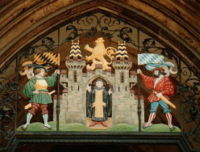
Holy Orders
The term Holy Orders is used by many Christian churches to refer to ordination or to those individuals ordained for a special role or ministry....
as priests
Priesthood (Catholic Church)
The ministerial orders of the Catholic Church include the orders of bishops, deacons and presbyters, which in Latin is sacerdos. The ordained priesthood and common priesthood are different in function and essence....
or deacons, are referred to as choir monks, as they have the obligation to recite the entire Divine Office
Liturgy of the hours
The Liturgy of the Hours or Divine Office is the official set of daily prayers prescribed by the Catholic Church to be recited at the canonical hours by the clergy, religious orders, and laity. The Liturgy of the Hours consists primarily of psalms supplemented by hymns and readings...
daily in choir. Those monks who are not ordained into Holy Orders
Holy Orders
The term Holy Orders is used by many Christian churches to refer to ordination or to those individuals ordained for a special role or ministry....
are referred to as lay brothers. In most monastic communities today, little distinction exists between the lay brothers and the choir monks. However, historically, the roles of the two groups of monks within the monastery differed. The work of the choir monks was considered to be prayer, chanting the seven hours of the Divine Office
Liturgy of the hours
The Liturgy of the Hours or Divine Office is the official set of daily prayers prescribed by the Catholic Church to be recited at the canonical hours by the clergy, religious orders, and laity. The Liturgy of the Hours consists primarily of psalms supplemented by hymns and readings...
and celebrating the Mass
Mass (liturgy)
"Mass" is one of the names by which the sacrament of the Eucharist is called in the Roman Catholic Church: others are "Eucharist", the "Lord's Supper", the "Breaking of Bread", the "Eucharistic assembly ", the "memorial of the Lord's Passion and Resurrection", the "Holy Sacrifice", the "Holy and...
daily whereas the lay brothers provided for the material needs of the community by growing food, preparing meals, maintaining the monastery and the grounds. This distinction arose historically because generally those monks who could read Latin
Latin
Latin is an Italic language originally spoken in Latium and Ancient Rome. It, along with most European languages, is a descendant of the ancient Proto-Indo-European language. Although it is considered a dead language, a number of scholars and members of the Christian clergy speak it fluently, and...
typically became choir monks, while those monks who were illiterate or could not read Latin
Latin
Latin is an Italic language originally spoken in Latium and Ancient Rome. It, along with most European languages, is a descendant of the ancient Proto-Indo-European language. Although it is considered a dead language, a number of scholars and members of the Christian clergy speak it fluently, and...
became lay brothers. Since the lay brothers could not recite the Divine Office in Latin, they would instead pray easily memorizable prayers such as the Our Father
Lord's Prayer
The Lord's Prayer is a central prayer in Christianity. In the New Testament of the Christian Bible, it appears in two forms: in the Gospel of Matthew as part of the discourse on ostentation in the Sermon on the Mount, and in the Gospel of Luke, which records Jesus being approached by "one of his...
or the Hail Mary
Hail Mary
The Angelic Salutation, Hail Mary, or Ave Maria is a traditional biblical Catholic prayer asking for the intercession of the Virgin Mary, the mother of Jesus. The Hail Mary is used within the Catholic Church, and it forms the basis of the Rosary...
as many as 150 times per day. Since the Second Vatican Council
Second Vatican Council
The Second Vatican Council addressed relations between the Roman Catholic Church and the modern world. It was the twenty-first Ecumenical Council of the Catholic Church and the second to be held at St. Peter's Basilica in the Vatican. It opened under Pope John XXIII on 11 October 1962 and closed...
, the distinction between choir monks and lay brothers has been deemphasized, as the council allowed the Divine Office
Liturgy of the hours
The Liturgy of the Hours or Divine Office is the official set of daily prayers prescribed by the Catholic Church to be recited at the canonical hours by the clergy, religious orders, and laity. The Liturgy of the Hours consists primarily of psalms supplemented by hymns and readings...
to be said in the vernacular language, effectively opening participation to all of the monks.
Within western monasticism, it is important to differentiate between monks and friars. Monks generally live a contemplative life of prayer confined within a monastery while friars usually engage in an active ministry of service to the outside community. The monastic orders include all Benedictines (the Order of Saint Benedict
Order of Saint Benedict
The Order of Saint Benedict is a Roman Catholic religious order of independent monastic communities that observe the Rule of St. Benedict. Within the order, each individual community maintains its own autonomy, while the organization as a whole exists to represent their mutual interests...
and its later reforms including the Cistercians and the Trappists
Trappists
The Order of Cistercians of the Strict Observance , or Trappists, is a Roman Catholic religious order of cloistered contemplative monks who follow the Rule of St. Benedict...
) and the Carthusian
Carthusian
The Carthusian Order, also called the Order of St. Bruno, is a Roman Catholic religious order of enclosed monastics. The order was founded by Saint Bruno of Cologne in 1084 and includes both monks and nuns...
s, who live according to their own Statutes, and not according to the Rule of St. Benedict proper. Orders of friars include the Franciscan
Franciscan
Most Franciscans are members of Roman Catholic religious orders founded by Saint Francis of Assisi. Besides Roman Catholic communities, there are also Old Catholic, Anglican, Lutheran, ecumenical and Non-denominational Franciscan communities....
s, Dominicans
Dominican Order
The Order of Preachers , after the 15th century more commonly known as the Dominican Order or Dominicans, is a Catholic religious order founded by Saint Dominic and approved by Pope Honorius III on 22 December 1216 in France...
, Carmelites
Carmelites
The Order of the Brothers of Our Lady of Mount Carmel or Carmelites is a Catholic religious order perhaps founded in the 12th century on Mount Carmel, hence its name. However, historical records about its origin remain uncertain...
, and Augustinians
Augustinians
The term Augustinians, named after Saint Augustine of Hippo , applies to two separate and unrelated types of Catholic religious orders:...
. Although the Canons Regular
Canons Regular
Canons Regular are members of certain bodies of Canons living in community under the Augustinian Rule , and sharing their property in common...
, such as the Norbertines, live in community, they are neither monks nor friars as they are characterized by their clerical state and not by any monastic vows.
Anglicanism
Monastic life in EnglandEngland
England is a country that is part of the United Kingdom. It shares land borders with Scotland to the north and Wales to the west; the Irish Sea is to the north west, the Celtic Sea to the south west, with the North Sea to the east and the English Channel to the south separating it from continental...
came to an abrupt end when King Henry VIII
Henry VIII of England
Henry VIII was King of England from 21 April 1509 until his death. He was Lord, and later King, of Ireland, as well as continuing the nominal claim by the English monarchs to the Kingdom of France...
broke from the Roman Catholic Church
Roman Catholic Church
The Catholic Church, also known as the Roman Catholic Church, is the world's largest Christian church, with over a billion members. Led by the Pope, it defines its mission as spreading the gospel of Jesus Christ, administering the sacraments and exercising charity...
establishing the Church of England
Church of England
The Church of England is the officially established Christian church in England and the Mother Church of the worldwide Anglican Communion. The church considers itself within the tradition of Western Christianity and dates its formal establishment principally to the mission to England by St...
. He initiated the Dissolution of the Monasteries
Dissolution of the Monasteries
The Dissolution of the Monasteries, sometimes referred to as the Suppression of the Monasteries, was the set of administrative and legal processes between 1536 and 1541 by which Henry VIII disbanded monasteries, priories, convents and friaries in England, Wales and Ireland; appropriated their...
, during which all of the monasteries
Monastery
Monastery denotes the building, or complex of buildings, that houses a room reserved for prayer as well as the domestic quarters and workplace of monastics, whether monks or nuns, and whether living in community or alone .Monasteries may vary greatly in size – a small dwelling accommodating only...
within England
England
England is a country that is part of the United Kingdom. It shares land borders with Scotland to the north and Wales to the west; the Irish Sea is to the north west, the Celtic Sea to the south west, with the North Sea to the east and the English Channel to the south separating it from continental...
were destroyed. While many monks were executed, many fled to continental Europe
Europe
Europe is, by convention, one of the world's seven continents. Comprising the westernmost peninsula of Eurasia, Europe is generally 'divided' from Asia to its east by the watershed divides of the Ural and Caucasus Mountains, the Ural River, the Caspian and Black Seas, and the waterways connecting...
an monasteries where they were able to continue their monastic life.
Shortly after the beginning of the revival of the Catholic Movement
Anglo-Catholicism
The terms Anglo-Catholic and Anglo-Catholicism describe people, beliefs and practices within Anglicanism that affirm the Catholic, rather than Protestant, heritage and identity of the Anglican churches....
in the Church of England, there was felt to be a need for a restoration of the monastic life. In the 1840s, Anglican priest John Henry Newman established a community of men at Littlemore
Littlemore
Littlemore is a district of Oxford, England. It has a parish council that also represents parts of Rose Hill. It is about southeast of the city centre of Oxford, between Rose Hill, Blackbird Leys, Cowley, and Sandford-on-Thames.-History:...
near Oxford
Oxford
The city of Oxford is the county town of Oxfordshire, England. The city, made prominent by its medieval university, has a population of just under 165,000, with 153,900 living within the district boundary. It lies about 50 miles north-west of London. The rivers Cherwell and Thames run through...
. From then on, there have been (re-)established many communities of monks, friar
Friar
A friar is a member of one of the mendicant orders.-Friars and monks:...
s and other religious communities for men in the Anglican Communion
Anglican Communion
The Anglican Communion is an international association of national and regional Anglican churches in full communion with the Church of England and specifically with its principal primate, the Archbishop of Canterbury...
. There are Anglican Benedictine
Benedictine
Benedictine refers to the spirituality and consecrated life in accordance with the Rule of St Benedict, written by Benedict of Nursia in the sixth century for the cenobitic communities he founded in central Italy. The most notable of these is Monte Cassino, the first monastery founded by Benedict...
s, Franciscan
Franciscan
Most Franciscans are members of Roman Catholic religious orders founded by Saint Francis of Assisi. Besides Roman Catholic communities, there are also Old Catholic, Anglican, Lutheran, ecumenical and Non-denominational Franciscan communities....
s, Cistercians, and in the Episcopal Church
Episcopal Church (United States)
The Episcopal Church is a mainline Anglican Christian church found mainly in the United States , but also in Honduras, Taiwan, Colombia, Ecuador, Haiti, the Dominican Republic, Venezuela, the British Virgin Islands and parts of Europe...
in the USA, Dominicans
Dominican Order
The Order of Preachers , after the 15th century more commonly known as the Dominican Order or Dominicans, is a Catholic religious order founded by Saint Dominic and approved by Pope Honorius III on 22 December 1216 in France...
, as well as other monastic orders such as the Society of Saint John the Evangelist.
Some Anglican religious communities are contemplative, some active, but a distinguishing feature of the monastic life among Anglicans is that most practice the so-called "mixed life." Anglican monks recite the Divine Office in choir daily, either the full eight services of the Breviary
Breviary
A breviary is a liturgical book of the Latin liturgical rites of the Catholic Church containing the public or canonical prayers, hymns, the Psalms, readings, and notations for everyday use, especially by bishops, priests, and deacons in the Divine Office...
or the four offices found in the Book of Common Prayer
Book of Common Prayer
The Book of Common Prayer is the short title of a number of related prayer books used in the Anglican Communion, as well as by the Continuing Anglican, "Anglican realignment" and other Anglican churches. The original book, published in 1549 , in the reign of Edward VI, was a product of the English...
and celebrate the Eucharist
Eucharist
The Eucharist , also called Holy Communion, the Sacrament of the Altar, the Blessed Sacrament, the Lord's Supper, and other names, is a Christian sacrament or ordinance...
daily. Many orders take on external works such as service to the poor, giving religious retreats, or other active ministries within their immediate communities. Like Roman Catholic monks, Anglican monks also take the monastic vows of poverty, chastity, and obedience.
In the early 20th century when the Catholic Movement
Anglo-Catholicism
The terms Anglo-Catholic and Anglo-Catholicism describe people, beliefs and practices within Anglicanism that affirm the Catholic, rather than Protestant, heritage and identity of the Anglican churches....
was at its height, the Anglican Communion
Anglican Communion
The Anglican Communion is an international association of national and regional Anglican churches in full communion with the Church of England and specifically with its principal primate, the Archbishop of Canterbury...
had hundreds of orders and communities, and thousands of religious followers. However, since the 1960s there has been a sharp falling off in the numbers of religious in many parts of the Anglican Communion. Many once large and international communities have been reduced to a single convent or monastery composed of elderly men or women. In the last few decades of the 20th century, novices have for most communities been few and far between. Some orders and communities have already become extinct.
There are however, still several thousand Anglican monks working today in approximately 200 communities around the world. The most surprising growth has been in the Melanesian countries of the Solomon Islands
Solomon Islands
Solomon Islands is a sovereign state in Oceania, east of Papua New Guinea, consisting of nearly one thousand islands. It covers a land mass of . The capital, Honiara, is located on the island of Guadalcanal...
, Vanuatu
Vanuatu
Vanuatu , officially the Republic of Vanuatu , is an island nation located in the South Pacific Ocean. The archipelago, which is of volcanic origin, is some east of northern Australia, northeast of New Caledonia, west of Fiji, and southeast of the Solomon Islands, near New Guinea.Vanuatu was...
and Papua New Guinea
Papua New Guinea
Papua New Guinea , officially the Independent State of Papua New Guinea, is a country in Oceania, occupying the eastern half of the island of New Guinea and numerous offshore islands...
. The Melanesian Brotherhood
Melanesian Brotherhood
The Melanesian Brotherhood is an Anglican religious community of men in simple vows based primarily in the Solomon Islands, Vanuatu, and Papua New Guinea.- History :...
, founded at Tabalia
Tabalia
Tabalia is the name of the Mother House of the Melanesian Brotherhood on northeastern Guadalcanal in the Solomon Islands.Tabalia was given by Ini Kopuria to the Melanesian Brotherhood...
, Guadalcanal
Guadalcanal
Guadalcanal is a tropical island in the South-Western Pacific. The largest island in the Solomons, it was discovered by the Spanish expedition of Alvaro de Mendaña in 1568...
, in 1925 by Ini Kopuria
Ini Kopuria
Ini Kopuria , a police officer from Maravovo, Guadalcanal, Solomon Islands formed the Melanesian Brotherhood in 1925. He and the Bishop of Melanesia, the Right Reverend John Manwaring Steward, realised Ini's dream by forming a band of brothers to take the Gospel of Jesus Christ to the...
, is now the largest Anglican Community in the world with over 450 brothers in the Solomon Islands, Vanuatu, Papua New Guinea, the Philippines
Philippines
The Philippines , officially known as the Republic of the Philippines , is a country in Southeast Asia in the western Pacific Ocean. To its north across the Luzon Strait lies Taiwan. West across the South China Sea sits Vietnam...
and the United Kingdom
United Kingdom
The United Kingdom of Great Britain and Northern IrelandIn the United Kingdom and Dependencies, other languages have been officially recognised as legitimate autochthonous languages under the European Charter for Regional or Minority Languages...
.
Lutheranism

Loccum Abbey
Loccum Abbey is a former Cistercian monastery in the town of Rehburg-Loccum, Lower Saxony, near Steinhude Lake.-History:...
and Amelungsborn Abbey
Amelungsborn Abbey
Amelungsborn Abbey, also Amelunxborn Abbey near Negenborn and Stadtoldendorf, in the Landkreis of Holzminden in the Weserbergland, was the second oldest Cistercian foundation in Lower Saxony, Germany, after Walkenried Abbey...
have the longest traditions as Lutheran monasteries. Since the 19th and 20th century, there has been a renewal in the monastic life among Lutheranism. There are many present-day Lutherans who practice the monastic teaching of the Roman Catholic Church.
In American Lutheran traditions, "The Congregation of the Servants of Christ" was established at St. Augustine's House in Oxford, Michigan
Oxford, Michigan
Oxford is a village in Oakland County in the U.S. state of Michigan. The population was 3,436 at the 2010 census. The village is located within Oxford Charter Township. The village occupies one square mile and is both politically and geographically a part of the township. The village calls itself...
, in 1958 when some other men joined Father Arthur Kreinheder
Arthur Kreinheder
Father Arthur Carl Kreinheder, C.S.C. was an American Lutheran Benedictine monk and founder of a Lutheran religious order, The Congregation of the Servants of Christ.Kreinheder was born in Saint Paul, Minnesota...
in observing the monastic life and offices of prayer. These men and others came and went over the years. The community has always remained small; at times the only member was Father Arthur. During the 35 years of its existence over 25 men tested their vocations to monastic life by living at the house for some time, from a few months to many years, but at Father Arthur's death in 1989 only one permanent resident remained. At the beginning of 2006, there was 2 permanent professed members and 2 long-term guests. Strong ties remain with this community and their brothers in Sweden (Östanbäck monastery
Östanbäck monastery
Östanbäck Monastery is a Lutheran Benedictine monastery for men in the Church of Sweden, located outside Sala in Sweden.-History:The background of the monastery lies in the Lutheran High Church Movement...
) and in Germany (Priory of St. Wigbert
Priory of St. Wigbert
Priory of St Wigbert is an ecumenical Benedictine monastery for men, belonging to the Lutheran Church of Thuringia. It is located in Werningshausen near Erfurt in Germany. This community includes Congregatio Canonicorum Sancti Augustini...
).
Methodism
- Main article: Methodist Diaconal OrderMethodist diaconal order-Ecclesiology:In the Methodist Church of Great Britain, deacons are only created as members of a permanent order called the . The MDO is therefore both a religious order and an Order of Ministry, or in other words, an order of Clerks Regular....
.
Within the Worldwide Methodist Church there exist a number of diaconal orders. Like Roman Catholic canon
Canon (priest)
A canon is a priest or minister who is a member of certain bodies of the Christian clergy subject to an ecclesiastical rule ....
s and Jesuits, they are ordained (as deacons) but are also organised into a religious order.
Buddhism
Buddhism
Buddhism is a religion and philosophy encompassing a variety of traditions, beliefs and practices, largely based on teachings attributed to Siddhartha Gautama, commonly known as the Buddha . The Buddha lived and taught in the northeastern Indian subcontinent some time between the 6th and 4th...
, the situation of Buddhist asceticism is different.
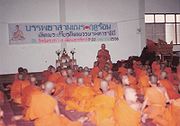
There is often a trial period prior to ordination, to see if a candidate wishes to become a Buddhist monk, a period almost entirely indistinct--in theory, and likely in practice--from the novitiate at Western monasteries. If he does, he remains in the monastery; otherwise, he is free to leave.
In Theravada
Theravada
Theravada ; literally, "the Teaching of the Elders" or "the Ancient Teaching", is the oldest surviving Buddhist school. It was founded in India...
Buddhism, bhikkhu
Bhikkhu
A Bhikkhu or Bhikṣu is an ordained male Buddhist monastic. A female monastic is called a Bhikkhuni Nepali: ). The life of Bhikkhus and Bhikkhunis is governed by a set of rules called the patimokkha within the vinaya's framework of monastic discipline...
is the term for monk. Their disciplinary code is called the patimokkha
Patimokkha
In Buddhism, the Patimokkha is the basic Theravada code of monastic discipline, consisting of 227 rules for fully ordained monks and 311 for nuns . It is contained in the Suttavibhanga, a division of the Vinaya Pitaka.- Parajika :...
, which is part of the larger Vinaya
Vinaya
The Vinaya is the regulatory framework for the Buddhist monastic community, or sangha, based in the canonical texts called Vinaya Pitaka. The teachings of the Buddha, or Buddhadharma can be divided into two broad categories: 'Dharma' or doctrine, and 'Vinaya', or discipline...
. They live lives of mendicancy, and go on a morning almsround (Pali
Páli
- External links :* *...
: pindapata) every day. The local people give food for the monks to eat, though the monks are not permitted to positively ask for anything. The monks live in monasteries, and have an important function in traditional Asian society. Young boys can be ordained as samanera
Samanera
A samanera ) may be translated as novice monk in a Buddhist context. The literal meaning is 'small samana', that is, small renunciate where 'small' has the meaning of boy or girl. In the Vinaya monastic discipline, a man under the age of 20 cannot ordain as a bhikkhu, but can ordain as a samanera...
s. Both bhikkhus and samaneras eat only in the morning, and are not supposed to lead a luxurious life. Their rules forbid the use of money, although this rule is nowadays not kept by all monks. The monks are part of the Sangha
Sangha
Sangha is a word in Pali or Sanskrit that can be translated roughly as "association" or "assembly," "company" or "community" with common goal, vision or purpose...
, the third of the Triple Gem of Buddha
Gautama Buddha
Siddhārtha Gautama was a spiritual teacher from the Indian subcontinent, on whose teachings Buddhism was founded. In most Buddhist traditions, he is regarded as the Supreme Buddha Siddhārtha Gautama (Sanskrit: सिद्धार्थ गौतम; Pali: Siddhattha Gotama) was a spiritual teacher from the Indian...
, Dhamma, Sangha.
In Mahayana
Mahayana
Mahāyāna is one of the two main existing branches of Buddhism and a term for classification of Buddhist philosophies and practice...
Buddhism, the term 'Sangha' strictly speaking refers to those who have achieved certain levels of understanding. They are therefore called 'community of the excellent ones' ; however, these in turn need not be monks (i.e., hold such vows
Religious vows
Religious vows are the public vows made by the members of religious communities pertaining to their conduct, practices and views.In the Buddhist tradition, in particular within the Mahayana and Vajrayana tradition, many different kinds of religious vows are taken by the lay community as well as by...
). Several Mahayana orders accept female practitioners as monks, instead of using the normal title of "nun", and they are considered equal to male ascetics in all respects.
The Bhikkhus are only allowed 4 items (other than their robes): a razor
Razor
A razor is a bladed tool primarily used in the removal of unwanted body hair through the act of shaving. Kinds of razors include straight razors, disposable razors and electric razors....
, a needle
Sewing needle
A sewing needle is a long slender tool with a pointed tip. The first needles were made of bone or wood; modern ones are manufactured from high carbon steel wire, nickel- or 18K gold plated for corrosion resistance. The highest quality embroidery needles are plated with two-thirds platinum and...
, an alms bowl and a water strainer.
In Vajrayana
Vajrayana
Vajrayāna Buddhism is also known as Tantric Buddhism, Tantrayāna, Mantrayāna, Secret Mantra, Esoteric Buddhism and the Diamond Vehicle...
Buddhism, monkhood is part of the system of 'vows of individual liberation'; these vows are taken in order to develop one's own personal ethical discipline. The monks and nuns form the (ordinary) sangha. As for the Vajrayana vows of individual liberation, there are four steps: A lay person may take the 5 vows called 'approaching virtue' (in Tibetan
Robes
Robes is an electronic indie new wave synth band from Carrboro, North Carolina. Members include Patrick Cudahy and Chris Williams. They've been in various bands over the last decade or so with lots of funny names: Joby's Opinon, Jacuzzi Brothers, Smooth Hedges, The Soft Drink. Sound reference...
. After that, one can become a 'novice' (Pali samanera
Samanera
A samanera ) may be translated as novice monk in a Buddhist context. The literal meaning is 'small samana', that is, small renunciate where 'small' has the meaning of boy or girl. In the Vinaya monastic discipline, a man under the age of 20 cannot ordain as a bhikkhu, but can ordain as a samanera...
, Tib. getshül); the last and final step is to take all vows of the 'fully ordained monk' (gelong). This term 'gelong' (Tib. < dge long>, in the female form gelongma) is the translation of Skt. bikshu (for women bikshuni) which is the equivalent of the Pali term bhikkhuni
Bhikkhuni
A bhikkhuni or bhikṣuṇī is a fully ordained female Buddhist monastic. Male monastics are called bhikkhus. Both bhikkhunis and bhikkhus live by the vinaya...
; bhikkhu
Bhikkhu
A Bhikkhu or Bhikṣu is an ordained male Buddhist monastic. A female monastic is called a Bhikkhuni Nepali: ). The life of Bhikkhus and Bhikkhunis is governed by a set of rules called the patimokkha within the vinaya's framework of monastic discipline...
is the word used in Theravada Buddhism (Sri Lanka, Burma, Thailand).
Chinese
China
Chinese civilization may refer to:* China for more general discussion of the country.* Chinese culture* Greater China, the transnational community of ethnic Chinese.* History of China* Sinosphere, the area historically affected by Chinese culture...
Buddhist monks have been traditionally and stereotypically linked with the practice of the Chinese martial arts
Chinese martial arts
Chinese martial arts, also referred to by the Mandarin Chinese term wushu and popularly as kung fu , are a number of fighting styles that have developed over the centuries in China. These fighting styles are often classified according to common traits, identified as "families" , "sects" or...
or Kung fu, and monks are frequently important characters in martial arts film
Martial arts film
Martial arts film is a film genre. A sub-genre of the action film, martial arts films contain numerous fights between characters, usually as the films' primary appeal and entertainment value, and often as a method of storytelling and character expression and development. Martial arts are frequently...
s. This association is focused around the Shaolin Monastery. The Buddhist monk Bodhidharma
Bodhidharma
Bodhidharma was a Buddhist monk who lived during the 5th/6th century AD. He is traditionally credited as the transmitter of Ch'an to China, and regarded as the first Chinese patriarch...
, traditionally credited as the founder of Zen
Zen
Zen is a school of Mahāyāna Buddhism founded by the Buddhist monk Bodhidharma. The word Zen is from the Japanese pronunciation of the Chinese word Chán , which in turn is derived from the Sanskrit word dhyāna, which can be approximately translated as "meditation" or "meditative state."Zen...
Buddhism in China, is also claimed to have introduced Kalaripayattu (which later evolved into Kung Fu) to the country. This latter claim has however been a source of much controversy (see Bodhidharma, the martial arts, and the disputed India connection) One more feature about the Chinese Buddhist monks is that they practice the burning marks on their scalp, finger or part of the skin on their anterior side of the forearm with incense as a sign of ordination.
In Thailand
Thailand
Thailand , officially the Kingdom of Thailand , formerly known as Siam , is a country located at the centre of the Indochina peninsula and Southeast Asia. It is bordered to the north by Burma and Laos, to the east by Laos and Cambodia, to the south by the Gulf of Thailand and Malaysia, and to the...
and Burma, it is common for boys to spend some time living as a monk in a monastery. Most stay for only a few years and then leave, but a number continue on in the ascetic life for the rest of their lives.
In Mongolia
Mongolia
Mongolia is a landlocked country in East and Central Asia. It is bordered by Russia to the north and China to the south, east and west. Although Mongolia does not share a border with Kazakhstan, its western-most point is only from Kazakhstan's eastern tip. Ulan Bator, the capital and largest...
during the 1920s, there were about 110,000 monks, including children, who made up about one-third of the male population, many of whom were killed in the purges of Choibalsan.
Jainism
One of the most intense forms of Asceticism can be found in JainismJainism
Jainism is an Indian religion that prescribes a path of non-violence towards all living beings. Its philosophy and practice emphasize the necessity of self-effort to move the soul towards divine consciousness and liberation. Any soul that has conquered its own inner enemies and achieved the state...
, one of the world's oldest religions. Jainism encourages fasting, yoga practices, meditation in difficult postures, and other austerities. According to Jains, one's highest goal should be attaining Nirvana
Nirvana
Nirvāṇa ; ) is a central concept in Indian religions. In sramanic thought, it is the state of being free from suffering. In Hindu philosophy, it is the union with the Supreme being through moksha...
or Moksha
Moksha
Within Indian religions, moksha or mukti , literally "release" , is the liberation from samsara and the concomitant suffering involved in being subject to the cycle of repeated death and reincarnation or rebirth.-Origins:It is highly probable that the concept of moksha was first developed in...
(i.e., liberation from samsara
Samsara
thumb|right|200px|Traditional Tibetan painting or [[Thanka]] showing the [[wheel of life]] and realms of saṃsāraSaṅsāra or Saṃsāra , , literally meaning "continuous flow", is the cycle of birth, life, death, rebirth or reincarnation within Hinduism, Buddhism, Bön, Jainism, Sikhism, and other...
, the cycle of birth and rebirth). For this, a soul has to be without attachment or self indulgence. This can be achieved only by the monks and nuns who take five great vows: of non-violence, of truth, of non-stealing, of non-possession and of celibacy.
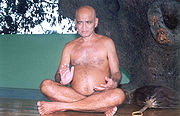
Mahavira
Mahāvīra is the name most commonly used to refer to the Indian sage Vardhamāna who established what are today considered to be the central tenets of Jainism. According to Jain tradition, he was the 24th and the last Tirthankara. In Tamil, he is referred to as Arukaṉ or Arukadevan...
, the twenty-fourth "fordmaker" or Tirthankara. The Acaranga Sutra
Acaranga Sutra
The Acaranga Sutra is the first of the eleven Angas, part of the agamas which were compiled based on the teachings of Lord Mahavira.The Acaranga Sutra discusses the conduct of a Jain monk...
, or Book of Good Conduct, is a sacred book within Jainism that discusses the ascetic code of conduct. Other texts that provide insight into conduct of ascetics include Yogashastra by Acharya Hemachandra and Niyamasara by Acharya Kundakunda
Kundakunda
Kundakunda is a celebrated Jain Acharya, Jain scholar monk, 2nd century CE, composer of spiritual classics such as: Samayasara, Niyamasara, Pancastikayasara, Pravacanasara, Atthapahuda and Barasanuvekkha. He occupies the highest place in the tradition of the Jain acharyas.He belonged to the Mula...
. Other illustrious Jain works on ascetic conduct are Oghanijjutti, Pindanijjutti, Cheda Sutta, and Nisiha Suttafee.
Full Jain monk in either Svetambara
Svetambara
The Śvētāmbara is one of the two main sects of Jainism, the other being the Digambar. Śvētāmbara "white-clad" is a term describing its ascetics' practice of wearing white clothes, which sets it apart from the Digambara "sky-clad" Jainas, whose ascetic practitioners go naked...
or Digambara
Digambara
Digambara "sky-clad" is one of the two main sects of Jainism. "Sky-clad" has many different meaning and associations throughout Indian religions. Many representations of deities within these traditions are depicted as sky-clad, e.g. Samantabhadra/Samantabhadrī in Yab-Yum...
tradition can belong to one of these ranks:
- AcharyaAcharyaIn Indian religions and society, an acharya is a guide or instructor in religious matters; founder, or leader of a sect; or a highly learned man or a title affixed to the names of learned men...
: leader of the order - Upadhyaya: a learned monk, who both teaches and studies himself
- Muni: an ordinary monk
These three are mentioned is the three lines of the Namokar Mantra. In the Digambara
Digambara
Digambara "sky-clad" is one of the two main sects of Jainism. "Sky-clad" has many different meaning and associations throughout Indian religions. Many representations of deities within these traditions are depicted as sky-clad, e.g. Samantabhadra/Samantabhadrī in Yab-Yum...
tradition, a junior monk can be a:
- Ailak: they use one piece of cloth
- KshullakKshullakA kshullak is a junior Digambar Jain monk. A kshullak wears two garments as opposed to a full monk who wears no clothes.A kshullak is sometimes accorded the title Varni, when they are engaged in studying and teaching....
: they may use two pieces of cloth
The Svetambar Terapanthi sect has a new rank of junior monks who are called samana. The nuns are called Aryikas in Digambar tradition and Sadhvi in the Svetambar tradition.
Ascetic vows
As per the Jain vows, the monks and nuns renounce all relations and possessions. Jain ascetics practice complete non-violence. AhimsaAhimsa in Jainism
Ahiṃsā in Jainism is a fundamental principle forming the cornerstone of its ethics and doctrine. The term "ahimsa" means “non-violence”, “non-injury” or absence of desire to harm any life forms. Vegetarianism and other non-violent practices and rituals of Jains flow from the principle of Ahiṃsā...
is the first and foremost vow of a Jain ascetic. They do not hurt any living being, be it an insect or a human. They carry a special broom to sweep away any insects that may cross their path. Some Jain monks wear a cloth over the mouth to prevent accidental harm to airborne germs and insects. They also do not use electricity as it involves violence. Furthermore, they do not use any devices or machines.
As they are without possession and attachment, they travel from city to city, often crossing forests and deserts, and always barefoot. Jain ascetics do not stay in a single place for more than two months to prevent themselves from becoming attached to any location. However during four months of monsoon (rainy season) known as chaturmaas, they continue to stay in a single place to avoid killing the life forms that thrive during the rains.
Jain monks and nuns practice complete celibacy. They do not touch or share a sitting platform with a person of opposite sex.
Dietary practices
Jain ascetics follow a strict vegetarian diet without root vegetables. Shvetambara monks do not cook food but solicit alms from householders. DigambaraDigambara
Digambara "sky-clad" is one of the two main sects of Jainism. "Sky-clad" has many different meaning and associations throughout Indian religions. Many representations of deities within these traditions are depicted as sky-clad, e.g. Samantabhadra/Samantabhadrī in Yab-Yum...
monks have only a single meal a day. Neither group will beg for food, but a Jain ascetic may accept a meal from a householder, provided that the latter is pure of mind and body and offers the food of his own volition and in the prescribed manner. During such an encounter, the monk remains standing and eats only a measured amount. Fasting (i.e., abstinence from food and sometimes water) is a routine feature of Jain asceticism. Fasts last for a day or longer, up to a month. Some monks avoid (or limit) medicine and/or hospitalization out of disregard for the physical body.
Austerities and other daily practices
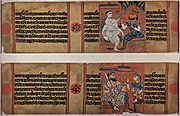
Every day is spent either in study of scriptures or meditation or teaching to lay people. They stand aloof from worldly matters. Many Jain ascetics take a final vow of Santhara or Sallekhana (i.e., a peaceful and detached death where medicines, food, and water are abandoned). This is done when death is imminent or when a monk feels that he is unable to adhere to his vows on account of advanced age or terminal disease.
Quotes on ascetic practices from the Akaranga Sutra as Hermann Jacobi
Hermann Jacobi
Hermann Georg Jacobi was an eminent German Indologist.-Education:Jacobi was born in Köln on 11 February 1850...
translated it:
Vaishnava
Madhvaacharya (MadhvacharyaMadhvacharya
Madhvācārya was the chief proponent of Tattvavāda "Philosophy of Reality", popularly known as the Dvaita school of Hindu philosophy. It is one of the three most influential Vedānta philosophies. Madhvācārya was one of the important philosophers during the Bhakti movement. He was a pioneer in...
), the Dwaita philosopher, established ashta matha (Eight Monasteries). He appointed a monk (called swamiji or swamigalu in local parlance) for each matha or monastery who has the right to worship Madhvacharya's murti
Murti
In Hinduism, a murti , or murthi, or vigraha or pratima typically refers to an image which expresses a Divine Spirit . Meaning literally "embodiment", a murti is a representation of a divinity, made usually of stone, wood, or metal, which serves as a means through which a divinity may be worshiped...
of Lord Krishna
Krishna
Krishna is a central figure of Hinduism and is traditionally attributed the authorship of the Bhagavad Gita. He is the supreme Being and considered in some monotheistic traditions as an Avatar of Vishnu...
by rotation. Each matha's swamiji gets a chance to worship after fourteen years. This ritual is called Paryaya
Paryaya
"Paryaya" in Sanskrit means "alternative". It can be loosely meant as "Another".-Paryaya ritual at Udupi:Paryaya is a religious ritual which takes place every alternate year in Krishna Matha of Udupi...
and has been used also outside his sampradaya
Sampradaya
In Hinduism, a sampradaya can be translated as ‘tradition’ or a ‘religious system’, although the word commands much more respect and power in the Indian context than its translations in English does...
, e.g. in Gaudiya Vaisnava Radharamana temple
Temple
A temple is a structure reserved for religious or spiritual activities, such as prayer and sacrifice, or analogous rites. A templum constituted a sacred precinct as defined by a priest, or augur. It has the same root as the word "template," a plan in preparation of the building that was marked out...
in Vrindavan
Vrindavan
Vrindavan also known as Vraj is a town in the Mathura district of Uttar Pradesh, India...
.
Similar in appearance to Buddhist monks, brahmacari
Brahmacharya
Brahmacharya is one of the four stages of life in an age-based social system as laid out in the Manu Smrti and later Classical Sanskrit texts in Hinduism. It refers to an educational period of 14–20 years which starts before the age of puberty. During this time the traditional vedic sciences are...
monks from the International Society for Krishna Consciousness
International Society for Krishna Consciousness
The International Society for Krishna Consciousness , known colloquially as the Hare Krishna movement, is a Gaudiya Vaishnava religious organization. It was founded in 1966 in New York City by A.C. Bhaktivedanta Swami Prabhupada...
(ISKCON), or Hare Krishnas
International Society for Krishna Consciousness
The International Society for Krishna Consciousness , known colloquially as the Hare Krishna movement, is a Gaudiya Vaishnava religious organization. It was founded in 1966 in New York City by A.C. Bhaktivedanta Swami Prabhupada...
as they are popularly known, are the best known Vaishnava monks outside India. They are a common sight in many places around the world. Their appearance—simple saffron
Saffron
Saffron is a spice derived from the flower of Crocus sativus, commonly known as the saffron crocus. Crocus is a genus in the family Iridaceae. Each saffron crocus grows to and bears up to four flowers, each with three vivid crimson stigmas, which are each the distal end of a carpel...
dhoti
Dhoti
The dhoti or pancha is the traditional men's garment in the in India, Bangladesh and Sri Lanka. A similar garment is worn in some rural areas of Punjab province in Pakistan, but the use is fast declining...
, shaved head with sikha
Sikha
The sikha or shikha is a Sanskrit word that refers to a long tuft, or lock of hair left on top or on the back of the shaven head of a male Orthodox Hindu...
, Tulasi neckbeads and tilaka
Tilaka
200px|thumb|right|Indian woman with tilaka and [[Bindi |bindi]]In Hinduism, the tilaka or tika or tilak is a mark worn on the forehead and other parts of the body...
markings—and social customs (sadhana
Sadhana
Sādhanā literally "a means of accomplishing something" is ego-transcending spiritual practice. It includes a variety of disciplines in Hindu, Sikh , Buddhist and Muslim traditions that are followed in order to achieve various spiritual or ritual objectives.The historian N...
) date back many thousands of years to the Vedic era with its varnasrama society. This social scheme includes both monastic and lay stages meant for various persons in various stages of life as per their characteristics (guna
Guna
' means 'string' or 'a single thread or strand of a cord or twine'. In more abstract uses, it may mean 'a subdivision, species, kind, quality', or an operational principle or tendency....
) and work (karma
Karma
Karma in Indian religions is the concept of "action" or "deed", understood as that which causes the entire cycle of cause and effect originating in ancient India and treated in Hindu, Jain, Buddhist and Sikh philosophies....
).
ISKCON started as a predominantly monastic group but nowadays the majority of members live as lay persons. Many of them, however, spent some time as monks. New persons joining ISKCON as full-time members (living in its centers) first undergo a three-month Bhakta training, which includes learning the basics of brahmacari
Brahmacharya
Brahmacharya is one of the four stages of life in an age-based social system as laid out in the Manu Smrti and later Classical Sanskrit texts in Hinduism. It refers to an educational period of 14–20 years which starts before the age of puberty. During this time the traditional vedic sciences are...
(monastic) life. After that they can decide if they prefer to continue as monks or as married Grihastha
Grihastha
Grihasthya refers to the second phase of an individual's life in the Vedic ashram system. It is often called 'the householders life' revolving as it does around the duties of maintaining a household and leading a family-centred life.-Usage:...
s.
Brahmacari older than fifty years (as per ISKCON rule) can become sannyasi. Sannyasa
Sannyasa
Sannyasa is the order of life of the renouncer within the Hindu scheme of āśramas, or life stages. It is considered the topmost and final stage of the ashram systems and is traditionally taken by men or women at or beyond the age of fifty years old or by young monks who wish to renounce worldly...
, a life of full dedication to spiritual pursuits, is the highest stage of life in the varnasrama society. It is permanent and one cannot give it up. A Sannyasi is given the title Swami
Swami
A swami sometimes abbreviated "Sw." is an ascetic or yogi who has been initiated into the religious monastic order founded by Adi Sankara, or to a religious teacher.The Oxford English Dictionary gives the etymology as...
. Older grihastha with grown-up children are traditionally expected to accept vanaprastha
Vanaprastha
A Vanaprastha is a person who is living in the forest as a hermit after partially giving up material desires. Vanaprastha ashram is the stage of life in the Vedic ashram system, when a person one gradually withdraws from the world...
(celibate retired) life.
The role of monastic orders in India
India
India , officially the Republic of India , is a country in South Asia. It is the seventh-largest country by geographical area, the second-most populous country with over 1.2 billion people, and the most populous democracy in the world...
n and now also Western
Western world
The Western world, also known as the West and the Occident , is a term referring to the countries of Western Europe , the countries of the Americas, as well all countries of Northern and Central Europe, Australia and New Zealand...
society has to some extent been adapted over the years in accordance with ever-changing social structures.
See also
- HermitHermitA hermit is a person who lives, to some degree, in seclusion from society.In Christianity, the term was originally applied to a Christian who lives the eremitic life out of a religious conviction, namely the Desert Theology of the Old Testament .In the...
- Into Great SilenceInto Great SilenceInto Great Silence is a documentary film directed by Philip Gröning that was first released in 2005. It is an intimate portrayal of the everyday lives of Carthusian monks of the Grande Chartreuse, high in the French Alps . The idea for the film was proposed to the monks in 1984, but the...
— The award-winning documentary on the hermitHermitA hermit is a person who lives, to some degree, in seclusion from society.In Christianity, the term was originally applied to a Christian who lives the eremitic life out of a religious conviction, namely the Desert Theology of the Old Testament .In the...
monks of the Roman Catholic CarthusianCarthusianThe Carthusian Order, also called the Order of St. Bruno, is a Roman Catholic religious order of enclosed monastics. The order was founded by Saint Bruno of Cologne in 1084 and includes both monks and nuns...
Order. - Lay brothers
- MonasticismMonasticismMonasticism is a religious way of life characterized by the practice of renouncing worldly pursuits to fully devote one's self to spiritual work...
- NunNunA nun is a woman who has taken vows committing her to live a spiritual life. She may be an ascetic who voluntarily chooses to leave mainstream society and live her life in prayer and contemplation in a monastery or convent...
- Religious orderReligious orderA religious order is a lineage of communities and organizations of people who live in some way set apart from society in accordance with their specific religious devotion, usually characterized by the principles of its founder's religious practice. The order is composed of initiates and, in some...
- Rule of St BenedictRule of St BenedictThe Rule of Saint Benedict is a book of precepts written by St. Benedict of Nursia for monks living communally under the authority of an abbot. Since about the 7th century it has also been adopted by communities of women...
- SanghaSanghaSangha is a word in Pali or Sanskrit that can be translated roughly as "association" or "assembly," "company" or "community" with common goal, vision or purpose...
- Sannyasi
External links
- "Monk" article in Catholic EncyclopediaCatholic EncyclopediaThe Catholic Encyclopedia, also referred to as the Old Catholic Encyclopedia and the Original Catholic Encyclopedia, is an English-language encyclopedia published in the United States. The first volume appeared in March 1907 and the last three volumes appeared in 1912, followed by a master index...
(1913) - Orthodox Monasteries Internet Directory
- Historyfish.net Texts and articles on Western Christian Monks, Monastics, and the Monastic Life.
- An Orthodox novice and A hieromonk, Photos from Valaam MonasteryValaam MonasteryThe Valaam Monastery, or Valamo Monastery is a stauropegic Orthodox monastery in Russian Karelia, located on Valaam, the largest island in Lake Ladoga, the largest lake in Europe.-History:...
, Russia - Monasticism Studies Area at www.monachos.net