

Baron

Encyclopedia
- Not to be confused with BaronetBaronetA baronet or the rare female equivalent, a baronetess , is the holder of a hereditary baronetcy awarded by the British Crown...
.
Baron is a title of nobility. The word baron comes from Old French
Old French
Old French was the Romance dialect continuum spoken in territories that span roughly the northern half of modern France and parts of modern Belgium and Switzerland from the 9th century to the 14th century...
baron, itself from Old High German
Old High German
The term Old High German refers to the earliest stage of the German language and it conventionally covers the period from around 500 to 1050. Coherent written texts do not appear until the second half of the 8th century, and some treat the period before 750 as 'prehistoric' and date the start of...
and Latin
Latin
Latin is an Italic language originally spoken in Latium and Ancient Rome. It, along with most European languages, is a descendant of the ancient Proto-Indo-European language. Although it is considered a dead language, a number of scholars and members of the Christian clergy speak it fluently, and...
(liber) baro meaning "(free) man, (free) warrior"; it merged with cognate Old English
Old English language
Old English or Anglo-Saxon is an early form of the English language that was spoken and written by the Anglo-Saxons and their descendants in parts of what are now England and southeastern Scotland between at least the mid-5th century and the mid-12th century...
beorn meaning "nobleman". The mediaeval Latin word baro, baronis, was used originally to denote a tenant-in-chief
Tenant-in-chief
In medieval and early modern European society the term tenant-in-chief, sometimes vassal-in-chief, denoted the nobles who held their lands as tenants directly from king or territorial prince to whom they did homage, as opposed to holding them from another nobleman or senior member of the clergy....
of the early Norman kings, which class developed into feudal barons
English feudal barony
In England, a feudal barony or barony by tenure was a form of Feudal land tenure, namely per baroniam under which the land-holder owed the service of being one of the king's barons. It must be distinguished from a barony, also feudal, but which existed within a county palatine, such as the Barony...
who held their lands from the king by the feudal tenure
Feudal land tenure
Under the English feudal system several different forms of land tenure existed, each effectively a contract with differing rights and duties attached thereto. Such tenures could be either free-hold, signifying that they were hereditable or perpetual, or non-free where the tenancy terminated on the...
per baroniam and were entitled to attend parliament
Parliament
A parliament is a legislature, especially in those countries whose system of government is based on the Westminster system modeled after that of the United Kingdom. The name is derived from the French , the action of parler : a parlement is a discussion. The term came to mean a meeting at which...
.
Barons in the United Kingdom and the Commonwealth
In the British peer systemPeerage
The Peerage is a legal system of largely hereditary titles in the United Kingdom, which constitute the ranks of British nobility and is part of the British honours system...
, barons rank below viscount
Viscount
A viscount or viscountess is a member of the European nobility whose comital title ranks usually, as in the British peerage, above a baron, below an earl or a count .-Etymology:...
s, and form the lowest rank in the peerage. A female of baronial rank has the honorific title baroness. A baron may hold a barony (plural baronies), if the title relates originally to a feudal baron
Feudal baron
Feudal baron may refer to:*English feudal barony*Scottish feudal barony*Irish feudal barony...
y by tenure, although such tenure is now obsolete in England and any such titles are now held in gross
Hereditary in gross
An office, not being held by serjeanty, or attached to some particular office or title, is said to be "in gross".Such offices are inherited in the same manner as a barony by writ: by sons in order of birth, and then by daughters...
, if they survive at all, as very few do, sometimes along with some vestigial manorial rights, or by grand serjeanty
Serjeanty
Under the feudal system in late and high medieval England, tenure by serjeanty was a form of land-holding in return for some specified service, ranking between tenure by knight-service and tenure in socage...
.
William I
William I of England
William I , also known as William the Conqueror , was the first Norman King of England from Christmas 1066 until his death. He was also Duke of Normandy from 3 July 1035 until his death, under the name William II...
introduced "baron" as a rank in England
England
England is a country that is part of the United Kingdom. It shares land borders with Scotland to the north and Wales to the west; the Irish Sea is to the north west, the Celtic Sea to the south west, with the North Sea to the east and the English Channel to the south separating it from continental...
to distinguish the men who had pledged their loyalty to him (see Feudalism
Feudalism
Feudalism was a set of legal and military customs in medieval Europe that flourished between the 9th and 15th centuries, which, broadly defined, was a system for ordering society around relationships derived from the holding of land in exchange for service or labour.Although derived from the...
). Previously, in the Anglo-Saxon kingdom of England, the king's companions held the title of earls and in Scotland
Scotland
Scotland is a country that is part of the United Kingdom. Occupying the northern third of the island of Great Britain, it shares a border with England to the south and is bounded by the North Sea to the east, the Atlantic Ocean to the north and west, and the North Channel and Irish Sea to the...
, the title of thane
Thane (Scotland)
Thane was the title given to a local royal official in medieval eastern Scotland, equivalent to a count, who was at the head of an administrative and socio-economic unit known as a shires or thanages....
. All who held their barony "in chief of the king" (that is, directly from William and his successors) became alike barones regis (barons of the king), bound to perform a stipulated service, and welcome to attend his council. Before long, the greatest of the nobles, especially in the marches
Marches
A march or mark refers to a border region similar to a frontier, such as the Welsh Marches, the borderland between England and Wales. During the Frankish Carolingian Dynasty, the word spread throughout Europe....
, such as the Earls of Chester
Earl of Chester
The Earldom of Chester was one of the most powerful earldoms in medieval England. Since 1301 the title has generally been granted to heirs-apparent to the English throne, and from the late 14th century it has been given only in conjunction with that of Prince of Wales.- Honour of Chester :The...
or the Bishops of Durham, might refer to their own tenants as "barons", where lesser magnates spoke simply of their "men" (homines).
.jpg)
Henry II of England
Henry II ruled as King of England , Count of Anjou, Count of Maine, Duke of Normandy, Duke of Aquitaine, Duke of Gascony, Count of Nantes, Lord of Ireland and, at various times, controlled parts of Wales, Scotland and western France. Henry, the great-grandson of William the Conqueror, was the...
, the Dialogus de Scaccario already distinguished greater (who held in baroniam by knights' service) or lesser baronies (generally smaller single manors). Within a century of the Norman Conquest, as in Thomas Becket
Thomas Becket
Thomas Becket was Archbishop of Canterbury from 1162 until his murder in 1170. He is venerated as a saint and martyr by both the Roman Catholic Church and the Anglican Communion...
's case (1164), there arose the practice of sending to each greater baron a special summons to the council that evolved into the House of Lords
House of Lords
The House of Lords is the upper house of the Parliament of the United Kingdom. Like the House of Commons, it meets in the Palace of Westminster....
, while the lesser barons, Magna Carta
Magna Carta
Magna Carta is an English charter, originally issued in the year 1215 and reissued later in the 13th century in modified versions, which included the most direct challenges to the monarch's authority to date. The charter first passed into law in 1225...
(1215) stipulated, would receive summons only in general, through the sheriff
Sheriff
A sheriff is in principle a legal official with responsibility for a county. In practice, the specific combination of legal, political, and ceremonial duties of a sheriff varies greatly from country to country....
s. Thus appeared a definite distinction, which eventually had the effect of restricting to the greater barons the rights and privileges of peerage.
Later, the sovereign could create a new barony in one of two ways: by a writ of summons directing someone to Parliament
Parliament
A parliament is a legislature, especially in those countries whose system of government is based on the Westminster system modeled after that of the United Kingdom. The name is derived from the French , the action of parler : a parlement is a discussion. The term came to mean a meeting at which...
, or by letters patent
Letters patent
Letters patent are a type of legal instrument in the form of a published written order issued by a monarch or president, generally granting an office, right, monopoly, title, or status to a person or corporation...
. Writs of summons featured in medieval times, but creation by letters patent has become the norm. Baronies thus no longer directly relate to land ownership, following the Modus Tenendi Parliamenta (1419), the Feudal Tenure Act (1662)
Tenures Abolition Act 1660
The Tenures Abolition Act 1660 was an Act of Parliament of the Parliament of England passed in 1660. The long title of the Act was An act for taking away the Court of Wards and liveries, and tenures in capite, and by knights-service, and purveyance, and for settling a revenue upon his Majesty in...
, and the Fines and Recoveries Act (1834) which enabled such titles to be dis-entailed.
In the twentieth century Britain introduced the concept of non-hereditary life peer
Life peer
In the United Kingdom, life peers are appointed members of the Peerage whose titles cannot be inherited. Nowadays life peerages, always of baronial rank, are created under the Life Peerages Act 1958 and entitle the holders to seats in the House of Lords, presuming they meet qualifications such as...
s. All appointees to this distinction have taken place at the rank of baron, and life-peers are not counted as part of the aristocracy.
In addition, baronies are often subsidiary titles, that is, as courtesy titles.
Scotland
In ScotlandScotland
Scotland is a country that is part of the United Kingdom. Occupying the northern third of the island of Great Britain, it shares a border with England to the south and is bounded by the North Sea to the east, the Atlantic Ocean to the north and west, and the North Channel and Irish Sea to the...
, the rank of baron is a rank of the ancient feudal nobility of Scotland and refers to a holder of a feudal barony, formerly a feudal superiority over a proper territorial entity erected into a free barony by a Crown Charter, and is not usually considered a rank of Peerage
Peerage
The Peerage is a legal system of largely hereditary titles in the United Kingdom, which constitute the ranks of British nobility and is part of the British honours system...
; as such it can be transferred by either inheritance or conveyance.
The Scottish equivalent of an English baron is a Lord of Parliament
Lord of Parliament
A Lord of Parliament was the lowest rank of nobility automatically entitled to attend sessions of the pre-Union Parliament of Scotland. Post-Union, it is a member of the lowest rank of the Peerage of Scotland, ranking below a viscount...
.
Style of address
Normally one refers to or addresses Baron [X] as Lord [X] and his wife as Lady [X]. In the case of women who hold baronies in their own right, they can be referred to as Baroness [X] as well as Lady [X]. In direct address, they can also be referred to as My Lord, Your Lordship, or Your Ladyship, but never as My Lady (except in the case of a female judge). The husband of a Baroness in her own right does not receive any style in her right. Children of Barons and Baronesses in their own right, whether hereditary or for life, have the style The Honourable [Forename] [Surname]. After the death of the father or mother, the child may continue to use the style Honourable.Scottish feudal barons style their surnames similarly to Clan Chiefs, with the name of their barony following their name, as in John Smith of Edinburgh or John Smith, Baron of Edinburgh. Most formally, and in writing, they are styled as The Much Honoured Baron of Edinburgh. Their wives are styled Lady Edinburgh, or The Baroness of Edinburgh. The phrase Lady of Edinburgh is wrong, if the lady in question does not hold a Scottish barony in her own right. Orally, Scottish barons may be addressed with the name of their barony, as in Edinburgh or else as Baron without anything else following, which if present would suggest a peerage barony. Informally, when referring to a Scots feudal baron in the third person, the name Laird of [X] is used or simply [X].
Non-Scottish barons are styled The Right Honourable The Lord [Barony]. Barons' wives are styled The Right Honourable The Lady [Barony]. Baronesses in their own right are either titled The Right Honourable The Baroness [Barony] or The Right Honourable The Lady [Barony], mainly based on personal preference (cf, Margaret, Lady Thatcher
Margaret Thatcher
Margaret Hilda Thatcher, Baroness Thatcher, was Prime Minister of the United Kingdom from 1979 to 1990...
and Brenda, Baroness Hale
Brenda Hale, Baroness Hale of Richmond
Brenda Marjorie Hale, Baroness Hale of Richmond, DBE, QC, PC, FBA is a British legal academic, barrister, judge and a Justice of the Supreme Court of the United Kingdom....
hold the same title). Note the order of the names. 'Lady Margaret Thatcher' would denote that she was the daughter of an earl, marquess or duke. Right Honourable is frequently abbreviated to Rt Hon. When referred to by the Sovereign in public instruments, The Right Honourable is changed to Our right trusty and well-beloved, with counsellor attached if they are a Privy Counsellor
Privy Council of the United Kingdom
Her Majesty's Most Honourable Privy Council, usually known simply as the Privy Council, is a formal body of advisers to the Sovereign in the United Kingdom...
.
Courtesy barons are styled simply Lord [Barony], and their wives are Lady [Barony]. The style of Right Honourable and/or the article "The" in front of the title is not used for them.
Coronet
A baron, in the peerage of England and Wales, Great Britain, (Northern) Ireland, or the United kingdom, or lord, in the peerage of Scotland, is entitled to a coronetCoronet
A coronet is a small crown consisting of ornaments fixed on a metal ring. Unlike a crown, a coronet never has arches.The word stems from the Old French coronete, a diminutive of coronne , itself from the Latin corona .Traditionally, such headgear is – as indicated by the German equivalent...
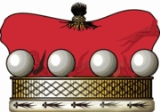
bearing six silver balls (called pearls, but never real pearls) around the rim, equally spaced and all of equal size and height. The rim itself is neither jewelled, nor "chased" (which is the case for the coronets of peers of higher degree).
The actual coronet is mostly worn on certain ceremonial occasions, such as the coronation of a new monarch, but a baron can bear his coronet of rank on his coat of arms
Coat of arms
A coat of arms is a unique heraldic design on a shield or escutcheon or on a surcoat or tabard used to cover and protect armour and to identify the wearer. Thus the term is often stated as "coat-armour", because it was anciently displayed on the front of a coat of cloth...
above the shield. In heraldry, the baron's coronet is shown with four of the balls visible.
Scottish feudal barons were entitled to a red cap of maintenance (chapeau) turned up ermine if petitioning for a grant or matriculation of a coat of arms
Coat of arms
A coat of arms is a unique heraldic design on a shield or escutcheon or on a surcoat or tabard used to cover and protect armour and to identify the wearer. Thus the term is often stated as "coat-armour", because it was anciently displayed on the front of a coat of cloth...
between the 1930s and 2004. This chapeau is identical to the red cap worn by an English baron, but without the silver balls or gilt. This is sometimes depicted in armorial paintings between the shield and the helmet. Additionally, if the baron is the head of a family he may include a chiefly coronet which is similar to a ducal coronet, but with four strawberry leaves. Because the chapeau was a relatively recent innovation, a number of ancient Arms of Scottish feudal barons do not display the chapeau. Now Scottish feudal barons are principally recognised by the baron's helm, which in Scotland is a steel helmet with grille of three grilles, garnished in gold. Occasionally the great tilting-helm garnished with gold is shown, or a helmet befitting a higher rank, if held.
The Low Countries
In the medieval era, some allodialAllodial title
Allodial title constitutes ownership of real property that is independent of any superior landlord, but it should not be confused with anarchy as the owner of allodial land is not independent of his sovereign...
and enfief
Fiefdom
A fee was the central element of feudalism and consisted of heritable lands granted under one of several varieties of feudal tenure by an overlord to a vassal who held it in fealty in return for a form of feudal allegiance and service, usually given by the...
ed lands held by nobles were created or recognized as baronies by the Holy Roman Emperor
Holy Roman Emperor
The Holy Roman Emperor is a term used by historians to denote a medieval ruler who, as German King, had also received the title of "Emperor of the Romans" from the Pope...
s, within whose realm most of the Low Countries
Low Countries
The Low Countries are the historical lands around the low-lying delta of the Rhine, Scheldt, and Meuse rivers, including the modern countries of Belgium, the Netherlands, Luxembourg and parts of northern France and western Germany....
lay. Subsequently, the Habsburgs continued to confer the baronial title in the Southern Netherlands
Southern Netherlands
Southern Netherlands were a part of the Low Countries controlled by Spain , Austria and annexed by France...
, first as kings of Spain and then, again, as emperors until abolition of the Holy Roman Empire, but these had become titular
Title
A title is a prefix or suffix added to someone's name to signify either veneration, an official position or a professional or academic qualification. In some languages, titles may even be inserted between a first and last name...
elevations rather than grants of new territory.
In the Netherlands
Netherlands
The Netherlands is a constituent country of the Kingdom of the Netherlands, located mainly in North-West Europe and with several islands in the Caribbean. Mainland Netherlands borders the North Sea to the north and west, Belgium to the south, and Germany to the east, and shares maritime borders...
after 1815, titles of baron authorized by previous monarchs (except those of the Napoleonic Kingdom of Holland
Kingdom of Holland
The Kingdom of Holland 1806–1810 was set up by Napoleon Bonaparte as a puppet kingdom for his third brother, Louis Bonaparte, in order to better control the Netherlands. The name of the leading province, Holland, was now taken for the whole country...
) were usually recognized by the Dutch
Netherlands
The Netherlands is a constituent country of the Kingdom of the Netherlands, located mainly in North-West Europe and with several islands in the Caribbean. Mainland Netherlands borders the North Sea to the north and west, Belgium to the south, and Germany to the east, and shares maritime borders...
kings. But such recognition was not automatic, having to be authenticated by the Supreme Council of Nobility and then approved by the sovereign. This ceased to be possible after the Dutch constitution was revised in 1983. More than one hundred Dutch baronial families have been recognized. The title is usually inherited by all males descended patrilineally
Patrilineality
Patrilineality is a system in which one belongs to one's father's lineage. It generally involves the inheritance of property, names or titles through the male line as well....
from the original recipient of the title, although in a few noble families baron is the title of cadet family members, while in a few others it is heritable according to primogeniture.
After its secession
Secession
Secession is the act of withdrawing from an organization, union, or especially a political entity. Threats of secession also can be a strategy for achieving more limited goals.-Secession theory:...
in 1830, Belgium incorporated into its nobility all titles of baron borne by Belgian citizens which had been recognized by the Netherlands since 1815. In addition, its monarchs have since created or recognized other titles of baron, and the sovereign continues to exercise the prerogative to confer baronial and other titles of nobility.
Luxembourg's monarch retains the right to confer the baronial title. Two of the grand duchy's prime ministers inherited baronial titles that were used during their tenures in office, Victor de Tornaco
Victor de Tornaco
Baron Victor de Tornaco was a Luxembourgian politician. An Orangist, he was the fourth Prime Minister of Luxembourg, serving for seven years, from 26 September 1860 until 3 December 1867....
and Félix de Blochausen.
France
During the Ancien Régime, French baronies were very much like Scottish ones. Feudal landholders were entitled to style themselves baron if they were nobles; a roturier (commonerCommoner
In British law, a commoner is someone who is neither the Sovereign nor a peer. Therefore, any member of the Royal Family who is not a peer, such as Prince Harry of Wales or Anne, Princess Royal, is a commoner, as is any member of a peer's family, including someone who holds only a courtesy title,...
) could only be a seigneur de la baronnie (lord of the barony). These baronies could be sold freely, until the abolition of feudalism in 1789. The title of baron was assumed as a titre de courtoisie
Courtesy title
A courtesy title is a form of address in systems of nobility used for children, former wives and other close relatives of a peer. These styles are used 'by courtesy' in the sense that the relatives do not themselves hold substantive titles...
by many nobles, both members of the Nobles of the Robe
Nobles of the Robe
Under the Old Regime, the Nobles of the Robe or Nobles of the Gown were French aristocrats who owed their rank to judicial or administrative posts — often bought outright for high sums. As a rule, these positions did not grant the holder with a title , but were honorary positions almost always...
and cadets of Nobles of the Sword
Nobles of the Sword
The Nobles of the Sword refers to the class of traditional or old nobility in France during the Middle Ages and the Early Modern periods. This class was heir to a militaristic ideology of professional chivalry...
who had no legal right to any noble title. Napoléon created a new empire nobility, in which baron was the second lowest title. The titles followed a male-only line of descent and could not be purchased. In 1815, King Louis XVIII created a new peerage system
Peerage of France
The Peerage of France was a distinction within the French nobility which appeared in the Middle Ages. It was abolished in 1789 during the French Revolution, but it reappeared in 1814 at the time of the Bourbon Restoration which followed the fall of the First French Empire...
based on the British model. Baron-peer was the lowest title, but the heirs to pre-1789 barons could remain barons, as could the elder sons of viscount-peers and younger sons of count-peers. This peerage was abolished in 1848, though some titles still exist today.
Germany
In pre-republican GermanyGermany
Germany , officially the Federal Republic of Germany , is a federal parliamentary republic in Europe. The country consists of 16 states while the capital and largest city is Berlin. Germany covers an area of 357,021 km2 and has a largely temperate seasonal climate...
all the knight
Knight
A knight was a member of a class of lower nobility in the High Middle Ages.By the Late Middle Ages, the rank had become associated with the ideals of chivalry, a code of conduct for the perfect courtly Christian warrior....
ly families of the Holy Roman Empire
Holy Roman Empire
The Holy Roman Empire was a realm that existed from 962 to 1806 in Central Europe.It was ruled by the Holy Roman Emperor. Its character changed during the Middle Ages and the Early Modern period, when the power of the emperor gradually weakened in favour of the princes...
(sometimes distinguished by the prefix von
Von
In German, von is a preposition which approximately means of or from.When it is used as a part of a German family name, it is usually a nobiliary particle, like the French, Spanish and Portuguese "de". At certain times and places, it has been illegal for anyone who was not a member of the nobility...
) eventually were recognised as of baronial rank, although Ritter is the literal translation for "knight", and persons who held that title enjoyed a distinct, but lower, rank in Germany's nobility than barons (Freiherr
Freiherr
The German titles Freiherr and Freifrau and Freiin are titles of nobility, used preceding a person's given name or, after 1919, before the surname...
en). Families which had always held this status were called "original nobility" (Uradel
Uradel
The German and Scandinavian term Uradel refers to nobility who can trace back their noble ancestry at least to the year 1400 and probably originates from leadership positions during the Migration Period.-Divisions of German nobility:Uradel : Nobility that originates from leadership positions held...
), and were heraldically entitled to a three pointed coronet. Families which had been ennobled at a definite point in time (Briefadel or "nobility by patent
Letters patent
Letters patent are a type of legal instrument in the form of a published written order issued by a monarch or president, generally granting an office, right, monopoly, title, or status to a person or corporation...
") had seven points on their coronet. These families held their fief in vassal
Vassal
A vassal or feudatory is a person who has entered into a mutual obligation to a lord or monarch in the context of the feudal system in medieval Europe. The obligations often included military support and mutual protection, in exchange for certain privileges, usually including the grant of land held...
age from a suzerain. The holder of an allodial (i.e. suzerain-free) barony was thus called a Free Lord, or Freiherr
Freiherr
The German titles Freiherr and Freifrau and Freiin are titles of nobility, used preceding a person's given name or, after 1919, before the surname...
. Subsequently, sovereigns in Germany conferred the title of Freiherr as a rank in the nobility, without implication of allodial or feudal status.
Today there is no legal privilege associated with hereditary titles in Germany, and in Austria they have been banned (though persisting in social use). In republican Germany, Freiherr and Baron remain heritable only as part of the legal surname
Surname
A surname is a name added to a given name and is part of a personal name. In many cases, a surname is a family name. Many dictionaries define "surname" as a synonym of "family name"...
, (and may thereby be transmitted by females to their husbands and children, without implication of nobility).
In Luxembourg
Luxembourg
Luxembourg , officially the Grand Duchy of Luxembourg , is a landlocked country in western Europe, bordered by Belgium, France, and Germany. It has two principal regions: the Oesling in the North as part of the Ardennes massif, and the Gutland in the south...
and Liechtenstein
Liechtenstein
The Principality of Liechtenstein is a doubly landlocked alpine country in Central Europe, bordered by Switzerland to the west and south and by Austria to the east. Its area is just over , and it has an estimated population of 35,000. Its capital is Vaduz. The biggest town is Schaan...
(where German is the official language), barons remain members of the recognized nobility, and the sovereigns retain authority to confer the title (morganatic
Morganatic marriage
In the context of European royalty, a morganatic marriage is a marriage between people of unequal social rank, which prevents the passage of the husband's titles and privileges to the wife and any children born of the marriage...
cadets of the princely dynasty received the title Baron of Lanskron, using both "Freiherr" and "Baron" for different members of this branch).
Generally, all legitimate males of a German baronial family inherit the title Freiherr or Baron from birth, as well as all legitimate daughters inherit the title of Freiin or Baroness. As a result, German barons have been more numerous than those of, e.g., France, Spain, and the United Kingdom, where primogeniture
Primogeniture
Primogeniture is the right, by law or custom, of the firstborn to inherit the entire estate, to the exclusion of younger siblings . Historically, the term implied male primogeniture, to the exclusion of females...
prevails.
Nordic countries
The corresponding title is Baron in the Danish nobilityDanish nobility
Nobility in Denmark was a leading social class until the 19th or 20th century. Danish nobility exists yet and has a recognized status in Denmark, a monarchy, but its real privileges have been abolished....
and that of Norway
Norwegian nobility
Norwegian nobility are persons and families who in early times belonged to the supreme social, political, and military class and who later were members of the institutionalised nobility in the Kingdom of Norway. It has its historical roots in the group of chieftains and warriors which evolved...
, Friherre in the Swedish nobility
Swedish nobility
The Swedish nobility were historically a legally and/or socially privileged class in Sweden, part of the so-called frälse . Today, the nobility is still very much a part of Swedish society but they do not maintain many of their former privileges...
, and Vapaaherra in the nobility of Finland.
In the beginning, Finnish nobles were all without honorific titulature, and known simply as lords. Since the Middle Ages
Middle Ages
The Middle Ages is a periodization of European history from the 5th century to the 15th century. The Middle Ages follows the fall of the Western Roman Empire in 476 and precedes the Early Modern Era. It is the middle period of a three-period division of Western history: Classic, Medieval and Modern...
, each head of a noble family had been entitled to a vote in any of Finland's provincial diet
Diet (assembly)
In politics, a diet is a formal deliberative assembly. The term is mainly used historically for the Imperial Diet, the general assembly of the Imperial Estates of the Holy Roman Empire, and for the legislative bodies of certain countries.-Etymology:...
s whenever held, as in the realm's Herrainpäivät, later Aatelissääty of the Riksdag of the Estates
Riksdag of the Estates
The Riksdag of the Estates , was the name used for the Estates of the Swedish realm when they were assembled. Until its dissolution in 1866, the institution was the highest authority in Sweden next to the King...
. In 1561, Sweden's King Eric XIV granted the hereditary titles of count
Count
A count or countess is an aristocratic nobleman in European countries. The word count came into English from the French comte, itself from Latin comes—in its accusative comitem—meaning "companion", and later "companion of the emperor, delegate of the emperor". The adjective form of the word is...
and vapaaherra to some of these, but not all. Although their cadet
Cadet
A cadet is a trainee to become an officer in the military, often a person who is a junior trainee. The term comes from the term "cadet" for younger sons of a noble family.- Military context :...
family members were not entitled to vote or sit in the Riksdag, they were legally entitled to the same title as the head of the family, but in custom
Tradition
A tradition is a ritual, belief or object passed down within a society, still maintained in the present, with origins in the past. Common examples include holidays or impractical but socially meaningful clothes , but the idea has also been applied to social norms such as greetings...
ary address they became Paroni or Paronitar. Theoretically, in the sixteenth and seventeenth centuries, families elevated to vapaaherra status were granted a barony in fief, enjoying some rights of taxation and judicial authority. Subsequently, the "barony" was titular, usually attached to a family property, which was sometimes entailed
Fee tail
At common law, fee tail or entail is an estate of inheritance in real property which cannot be sold, devised by will, or otherwise alienated by the owner, but which passes by operation of law to the owner's heirs upon his death...
. Their exemptions from taxes on landed properties continued into the twentieth century, although in the nineteenth century tax reforms narrowed this privilege. Nobility creations continued until 1917, the end of Finland's grand ducal monarchy
Grand Duchy of Finland
The Grand Duchy of Finland was the predecessor state of modern Finland. It existed 1809–1917 as part of the Russian Empire and was ruled by the Russian czar as Grand Prince.- History :...
.
Spain
In Spain the title follows VizcondeViscount
A viscount or viscountess is a member of the European nobility whose comital title ranks usually, as in the British peerage, above a baron, below an earl or a count .-Etymology:...
in the noble hierarchy, and ranks above Señor. Baronesa is the feminine form, for the wife of a baron or for a woman who has been granted the title in her own right. In general, titles of baron created before the nineteenth century originate from the Crown of Aragon
Crown of Aragon
The Crown of Aragon Corona d'Aragón Corona d'Aragó Corona Aragonum controlling a large portion of the present-day eastern Spain and southeastern France, as well as some of the major islands and mainland possessions stretching across the Mediterranean as far as Greece...
. Barons lost territorial jurisdiction around the middle of the nineteenth century, and from then on the title became purely honorific. Although most barons have not also held the rank of grandeza
Grandee
Grandee is the word used to render in English the Iberic high aristocratic title Grande , used by the Spanish nobility; Portuguese nobility, and Brazilian nobility....
, the title has been conferred in conjunction with the grandeza. The sovereign continues to grant baronial titles.
In other languages
The title was quite common in most European countries, in various languages, whether Germanic, Romance, Slavonic or other), often in a slightly modified form. In Italian, the word used was Barone.Elsewhere
Like other major Western noble titles, Baron is sometimes used to render certain titles in non-western languages with their own traditions, even though they are necessarily historically unrelated and thus hard to compare, which are considered 'equivalent' in relative rank.This is the case with China's nán (男), hereditary title of nobility of the fifth rank (男爵), as well as its derivatives and adaptations:
- the Indian equivalent damapatiDamapatiDamapati in India was a term for the master or sovereign of the home or piece of land comparable to the title of Freiherr or baron. The title is mostly not hereditary like the tile of Don, but given as an honorary tile...
- the Japanese equivalent danshaku (だんしゃく, 男爵)
- the Korean equivalent namjak (남작, 男爵)
- the Manchu equivalent ashan-i hafan
- the Vietnamese equivalent nam tước
- the Romanian equivalent Baroneasă for Baroness.
In some republics of continental Europe, the unofficial title of "Baron" retains a purely social prestige, with no particular political privilege
Privilege
A privilege is a special entitlement to immunity granted by the state or another authority to a restricted group, either by birth or on a conditional basis. It can be revoked in certain circumstances. In modern democratic states, a privilege is conditional and granted only after birth...
s.
In the Polynesian island monarchy of Tonga
Tonga
Tonga, officially the Kingdom of Tonga , is a state and an archipelago in the South Pacific Ocean, comprising 176 islands scattered over of ocean in the South Pacific...
, as opposed to the situation in Europe, barons are granted this imported title (in English), alongside traditional chiefly styles, and continue to hold and exercise some political power
Power (sociology)
Power is a measurement of an entity's ability to control its environment, including the behavior of other entities. The term authority is often used for power perceived as legitimate by the social structure. Power can be seen as evil or unjust, but the exercise of power is accepted as endemic to...
.
Furthermore it is customary in Western
Western world
The Western world, also known as the West and the Occident , is a term referring to the countries of Western Europe , the countries of the Americas, as well all countries of Northern and Central Europe, Australia and New Zealand...
languages to use the word Baron to render somewhat 'equivalent' ranks in non-related aristocratic hierarchies in non-Western cultures.
See also
- Barony (country subdivision)
- Scottish feudal baronyScottish feudal baronyA Scottish feudal barony used to be attached to a particular piece of land on which is the "caput" , or the essence of the barony, normally a building, such as a castle or manor house...
- English feudal baronyEnglish feudal baronyIn England, a feudal barony or barony by tenure was a form of Feudal land tenure, namely per baroniam under which the land-holder owed the service of being one of the king's barons. It must be distinguished from a barony, also feudal, but which existed within a county palatine, such as the Barony...
- Irish feudal baronyIrish feudal baronyIn Ireland, most originally-feudal titular baronies have long disappeared through obsolescence or disuse. The Lordship of Finegal was granted to Walter de Lacy for seven knight's fees, "although the lords thereof hold elsewhere in capite", according to the unusual grant in 1208 by John, Lord of...
- FeudalismFeudalismFeudalism was a set of legal and military customs in medieval Europe that flourished between the 9th and 15th centuries, which, broadly defined, was a system for ordering society around relationships derived from the holding of land in exchange for service or labour.Although derived from the...
- Fief
- LordLordLord is a title with various meanings. It can denote a prince or a feudal superior . The title today is mostly used in connection with the peerage of the United Kingdom or its predecessor countries, although some users of the title do not themselves hold peerages, and use it 'by courtesy'...
- List of baronies in the peerages of the British Isles
- List of Scottish feudal baronies
- Scottish feudal lordship
- Marcher Lord
- List of Marcher lordships
- Tenures Abolition Act 1660Tenures Abolition Act 1660The Tenures Abolition Act 1660 was an Act of Parliament of the Parliament of England passed in 1660. The long title of the Act was An act for taking away the Court of Wards and liveries, and tenures in capite, and by knights-service, and purveyance, and for settling a revenue upon his Majesty in...
- Land tenureLand tenureLand tenure is the name given, particularly in common law systems, to the legal regime in which land is owned by an individual, who is said to "hold" the land . The sovereign monarch, known as The Crown, held land in its own right. All private owners are either its tenants or sub-tenants...
- Land tenure in EnglandLand tenure in EnglandLand tenure in EnglandEven before the Norman Conquest, there was a strong tradition of landholding in Anglo-Saxon law. When William the Conqueror asserted sovereignty over England in 1066, he confiscated the property of the recalcitrant English landowners...
- Honour (feudal land tenure)
Sources
- Sanders, I. J. English Baronies: A Study of their Origin and Descent, 1086–1327. Clarendon Press, 1960.
- Heraldica
- The Royal Ark