

University of Paris

Encyclopedia
University
A university is an institution of higher education and research, which grants academic degrees in a variety of subjects. A university is an organisation that provides both undergraduate education and postgraduate education...
located in Paris
Paris
Paris is the capital and largest city in France, situated on the river Seine, in northern France, at the heart of the Île-de-France region...
, France
France
The French Republic , The French Republic , The French Republic , (commonly known as France , is a unitary semi-presidential republic in Western Europe with several overseas territories and islands located on other continents and in the Indian, Pacific, and Atlantic oceans. Metropolitan France...
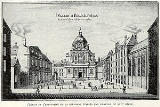
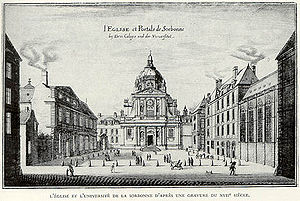
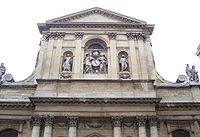
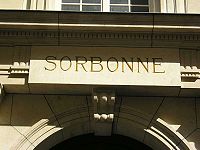
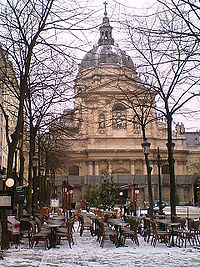
and one of the earliest to be established in Europe. It was founded in the mid 12th century, and officially recognized as a university probably between 1160 and 1250 (or possibly as early as 1190). After many changes, including a century of suspension (1793–1896), it ceased to exist in 1970 and 13 autonomous universities (University of Paris I–XIII) were created from it. The university is often referred to as the Sorbonne or La Sorbonne after the collegiate institution (Collège de Sorbonne
Collège de Sorbonne
The Collège de Sorbonne was a theological college of the University of Paris, founded in 1257 by Robert de Sorbon, after whom it is named. With the rest of the Paris colleges, it was suppressed during the French Revolution. It was restored in 1808 but finally closed in 1882. The name Sorbonne...
) founded about 1257 by Robert de Sorbon
Robert de Sorbon
Robert de Sorbon was a French theologian, the chaplain of Louis IX of France, and founder of the Sorbonne college in Paris....
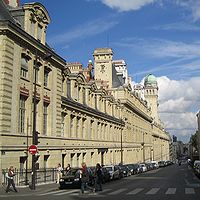
. In fact, the university as such was older and was never completely centered on the Sorbonne. Of the 13 current successor universities, the first 4 have a presence in the historical Sorbonne building, and three include "Sorbonne" in their names.
The universities in Paris are now essentially independent of each other, and some fall under the Académie of Créteil
Créteil
-Health:As of 1 January 2006, 27 pharmacies, about 60 dentists, about 60 general practitioners, 10 pediatricians, and a half-dozen ophthalmologists and dermatologists constitute the general medical staff of the city.Health facilities include:...
or the Académie of Versailles rather than the Académie of Paris
Paris
Paris is the capital and largest city in France, situated on the river Seine, in northern France, at the heart of the Île-de-France region...
. Some residual administrative functions of the 13 universities are formally supervised by a common chancellor, the Rector
Rector
The word rector has a number of different meanings; it is widely used to refer to an academic, religious or political administrator...
of the Académie of Paris, with offices in the Sorbonne. As of 2006, Maurice Quénet is the Rector of the Academy of Paris and Chancellor of the Universities of Paris. The Vice-Chancellor of the Universities of Paris is Pierre Gregory. Despite this link, and the historical ties, there is no University of Paris system that binds the universities at an academic level.
Origin and early organization
Like the other early medieval universitiesMedieval university
Medieval university is an institution of higher learning which was established during High Middle Ages period and is a corporation.The first institutions generally considered to be universities were established in Italy, France, and England in the late 11th and the 12th centuries for the study of...
(Bologna
University of Bologna
The Alma Mater Studiorum - University of Bologna is the oldest continually operating university in the world, the word 'universitas' being first used by this institution at its foundation. The true date of its founding is uncertain, but believed by most accounts to have been 1088...
, Oxford
University of Oxford
The University of Oxford is a university located in Oxford, United Kingdom. It is the second-oldest surviving university in the world and the oldest in the English-speaking world. Although its exact date of foundation is unclear, there is evidence of teaching as far back as 1096...
, Salamanca
University of Salamanca
The University of Salamanca is a Spanish higher education institution, located in the town of Salamanca, west of Madrid. It was founded in 1134 and given the Royal charter of foundation by King Alfonso IX in 1218. It is the oldest founded university in Spain and the third oldest European...
, Cambridge
University of Cambridge
The University of Cambridge is a public research university located in Cambridge, United Kingdom. It is the second-oldest university in both the United Kingdom and the English-speaking world , and the seventh-oldest globally...
, Padua
University of Padua
The University of Padua is a premier Italian university located in the city of Padua, Italy. The University of Padua was founded in 1222 as a school of law and was one of the most prominent universities in early modern Europe. It is among the earliest universities of the world and the second...
), the University of Paris was already well established before it received a specific foundation act from the Church in 1200. The earliest historical reference to the university as such is found in Matthew of Paris's reference to his own teacher's study (an abbot of St. Albans) and his acceptance into "the fellowship of the elect Masters" at the university of Paris in about 1170. Additionally, it is known that Pope Innocent III
Pope Innocent III
Pope Innocent III was Pope from 8 January 1198 until his death. His birth name was Lotario dei Conti di Segni, sometimes anglicised to Lothar of Segni....
, having assumed the papacy at the age of 37, had completed his studies at the University of Paris by 1182 at the age of 21. It grew up in the latter part of the twelfth century around the Notre Dame Cathedral
Notre Dame de Paris
Notre Dame de Paris , also known as Notre Dame Cathedral, is a Gothic, Roman Catholic cathedral on the eastern half of the Île de la Cité in the fourth arrondissement of Paris, France. It is the cathedral of the Catholic Archdiocese of Paris: that is, it is the church that contains the cathedra of...
as a corporation
Corporation
A corporation is created under the laws of a state as a separate legal entity that has privileges and liabilities that are distinct from those of its members. There are many different forms of corporations, most of which are used to conduct business. Early corporations were established by charter...
similar to other medieval corporations, such as guild
Guild
A guild is an association of craftsmen in a particular trade. The earliest types of guild were formed as confraternities of workers. They were organized in a manner something between a trade union, a cartel, and a secret society...
s of merchants or artisans. The medieval Latin term universitas had the more general meaning of a guild. The university of Paris was known as a universitas magistrorum et scholarium (a guild of masters and scholars). Later universities such as the Charles University in Prague
Charles University in Prague
Charles University in Prague is the oldest and largest university in the Czech Republic. Founded in 1348, it was the first university in Central Europe and is also considered the earliest German university...
or the University of Heidelberg had different origins.
The university had four faculties: Arts
ARts
aRts, which stands for analog Real time synthesizer, is an audio framework that is no longer under development. It is best known for previously being used in KDE to simulate an analog synthesizer....
, Medicine
Medicine
Medicine is the science and art of healing. It encompasses a variety of health care practices evolved to maintain and restore health by the prevention and treatment of illness....
, Law
Law
Law is a system of rules and guidelines which are enforced through social institutions to govern behavior, wherever possible. It shapes politics, economics and society in numerous ways and serves as a social mediator of relations between people. Contract law regulates everything from buying a bus...
, and Theology
Theology
Theology is the systematic and rational study of religion and its influences and of the nature of religious truths, or the learned profession acquired by completing specialized training in religious studies, usually at a university or school of divinity or seminary.-Definition:Augustine of Hippo...
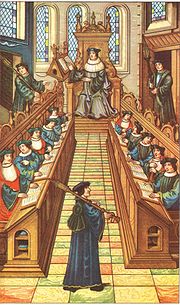
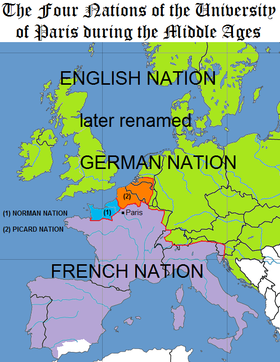
. The Faculty of Arts was the lowest in rank, but also the largest as students had to graduate there to be admitted to one of the higher faculties. The students were divided into four nationes
Nation (university)
Student nations or simply nations are regional corporations of students at a university. Once widespread across Europe in medieval times, they are now largely restricted to the ancient universities of Sweden and Finland...
according to language or regional origin: France, Normandy, Picardy, and England. The last came to be known as the Alemannian (German) nation. Recruitment to each nation was wider than the names might imply: the English-German nation included students from Scandinavia and Eastern Europe.
The faculty and nation system of the University of Paris (along with that of the University of Bologna) became the model for all later medieval universities. Under the governance of the Church, students wore robes and shaved the tops of their heads in tonsure
Tonsure
Tonsure is the traditional practice of Christian churches of cutting or shaving the hair from the scalp of clerics, monastics, and, in the Eastern Orthodox Church, all baptized members...
, to signify they were under the protection of the church. Students operated according to the rules and laws of the Church and were not subject to the king's laws or courts. This presented ongoing problems of students abusing the laws of the city, which had no direct recourse for justice and had to appeal to Church courts. Students were often very young, entering the school at age 13 or 14 and staying for 6 to 12 years.
The original schools
Three schools were especially famous at Paris, the palatine or palace school, the school of Notre-Dame, and that of Sainte-Geneviève AbbeySainte-Geneviève Abbey
The Abbey of St Genevieve was a French monastery in Paris, suppressed at the time of the French Revolution.-History:...
. The decline of royalty brought about the decline of the first. The other two were ancient but did not have much visibility in the early centuries. The glory of the palatine school doubtless eclipsed theirs, until it completely gave way to them. These two centres were much frequented and many of their masters were esteemed for their learning.
Liège
Liège is a major city and municipality of Belgium located in the province of Liège, of which it is the economic capital, in Wallonia, the French-speaking region of Belgium....
, he continued his studies at Paris, entered or allied himself with the chapter of Ste-Geneviève, and attracted many pupils via his teaching. Distinguished professors from the school of Notre-Dame in the eleventh century include Lambert, disciple of Filbert of Chartres; Drogo of Paris; Manegold of Germany; Anselm of Laon
Anselm of Laon
Anselm of Laon was a French theologian and founder of a school of scholars who helped to pioneer biblical hermeneutics.Remembered in the century after his death as "Anselmus" or "Anselm", his name was more properly "Ansellus" or, in Modern French, "Anseau."Born of very humble parents at Laon...
. These two schools attracted scholars from every country and produced many illustrious men, among whom were: St. Stanislaus of Szczepanów
Stanislaus of Szczepanów
Stanislaus of Szczepanów, or Stanisław Szczepanowski, was a Bishop of Kraków known chiefly for having been martyred by the Polish king Bolesław II the Bold...
, Bishop of Kraków; Gebbard, Archbishop of Salzburg; St. Stephen, third Abbot of Cîteaux
Stephen Harding
Saint Stephen Harding is a Christian saint and abbot, one of the founders of the Cistercian Order.-Life:Stephen Harding was born in Dorset, England. He was placed in Sherborne Abbey at a young age, but eventually put aside the cowl and became a travelling scholar. He eventually moved to Molesme...
; Robert d'Arbrissel, founder of the Abbey of Fontevrault etc. Three other men who added prestige to the schools of Notre-Dame and Ste-Geneviève were William of Champeaux
William of Champeaux
Guillaume de Champeaux , also known as William of Champeaux or Guglielmus de Campellis , was a French philosopher and theologian.He was born at Champeaux near Melun...
, Abélard, and Peter Lombard
Peter Lombard
Peter Lombard was a scholastic theologian and bishop and author of Four Books of Sentences, which became the standard textbook of theology, for which he is also known as Magister Sententiarum-Biography:Peter Lombard was born in Lumellogno , in...
.
Humanistic instruction comprised grammar
Grammar
In linguistics, grammar is the set of structural rules that govern the composition of clauses, phrases, and words in any given natural language. The term refers also to the study of such rules, and this field includes morphology, syntax, and phonology, often complemented by phonetics, semantics,...
, rhetoric
Rhetoric
Rhetoric is the art of discourse, an art that aims to improve the facility of speakers or writers who attempt to inform, persuade, or motivate particular audiences in specific situations. As a subject of formal study and a productive civic practice, rhetoric has played a central role in the Western...
, dialectics, arithmetic
Arithmetic
Arithmetic or arithmetics is the oldest and most elementary branch of mathematics, used by almost everyone, for tasks ranging from simple day-to-day counting to advanced science and business calculations. It involves the study of quantity, especially as the result of combining numbers...
, geometry
Geometry
Geometry arose as the field of knowledge dealing with spatial relationships. Geometry was one of the two fields of pre-modern mathematics, the other being the study of numbers ....
, music
Music
Music is an art form whose medium is sound and silence. Its common elements are pitch , rhythm , dynamics, and the sonic qualities of timbre and texture...
, and astronomy
Astronomy
Astronomy is a natural science that deals with the study of celestial objects and phenomena that originate outside the atmosphere of Earth...
(trivium and quadrivium
Quadrivium
The quadrivium comprised the four subjects, or arts, taught in medieval universities, after teaching the trivium. The word is Latin, meaning "the four ways" , and its use for the 4 subjects has been attributed to Boethius or Cassiodorus in the 6th century...
). To the higher instruction belonged dogmatic
Dogmatic theology
Dogmatic theology is that part of theology dealing with the theoretical truths of faith concerning God and his works, especially the official theology recognized by an organized Church body, such as the Roman Catholic Church, Dutch Reformed Church, etc...
and moral theology
Moral theology
Moral theology is a systematic theological treatment of Christian ethics. It is usually taught on Divinity faculties as a part of the basic curriculum.- External links :*...
, whose source was the Scriptures and the Patristic Fathers. It was completed by the study of Canon law
Canon law (Catholic Church)
The canon law of the Catholic Church, is a fully developed legal system, with all the necessary elements: courts, lawyers, judges, a fully articulated legal code and principles of legal interpretation. It lacks the necessary binding force present in most modern day legal systems. The academic...
.
The school of St-Victor arose to rival those of Notre-Dame and Ste-Geneviève. It was founded by William of Champeaux when he withdrew to the Abbey of St-Victor. Its most famous professors are Hugh of St. Victor and Richard of St. Victor
Richard of St. Victor
Richard of Saint Victor is known today as one of the most influential religious thinkers of his time. He was a prominent mystical theologian, and was prior of the famous Augustinian Abbey of Saint Victor in Paris from 1162 until his death in 1173....
.
The plan of studies expanded in the schools of Paris, as it did elsewhere. A Bolognese
Bologna
Bologna is the capital city of Emilia-Romagna, in the Po Valley of Northern Italy. The city lies between the Po River and the Apennine Mountains, more specifically, between the Reno River and the Savena River. Bologna is a lively and cosmopolitan Italian college city, with spectacular history,...
compendium of canon law called the Decretum Gratiani
Decretum Gratiani
The Decretum Gratiani or Concordia discordantium canonum is a collection of Canon law compiled and written in the 12th century as a legal textbook by the jurist known as Gratian. It forms the first part of the collection of six legal texts, which together became known as the Corpus Juris Canonici...
brought about a division of the theology department. Hitherto the discipline of the Church had not been separate from so-called theology; they were studied together under the same professor. But this vast collection necessitated a special course, which was undertaken first at Bologna, where Roman law
Roman law
Roman law is the legal system of ancient Rome, and the legal developments which occurred before the 7th century AD — when the Roman–Byzantine state adopted Greek as the language of government. The development of Roman law comprises more than a thousand years of jurisprudence — from the Twelve...
was taught. In France, first Orléans
Orléans
-Prehistory and Roman:Cenabum was a Gallic stronghold, one of the principal towns of the Carnutes tribe where the Druids held their annual assembly. It was conquered and destroyed by Julius Caesar in 52 BC, then rebuilt under the Roman Empire...
and then Paris erected chairs of canon law. Before the end of the twelfth century, the Decretal
Decretal
Decretals is the name that is given in Canon law to those letters of the pope which formulate decisions in ecclesiastical law.They are generally given in answer to consultations, but are sometimes due to the initiative of the popes...
s of Gerard (or Girard) La Pucelle
Gerard la Pucelle
Gerard la Pucelle was a peripatetic Anglo-French scholar of canon law, clerk, and Bishop of Coventry.-Life:...
, Mathieu d'Angers, and Anselm (or Anselle) of Paris, were added to the Decretum Gratiani. However, civil law
Civil law (legal system)
Civil law is a legal system inspired by Roman law and whose primary feature is that laws are codified into collections, as compared to common law systems that gives great precedential weight to common law on the principle that it is unfair to treat similar facts differently on different...
was not included at Paris.
In the twelfth century, medicine
Medicine
Medicine is the science and art of healing. It encompasses a variety of health care practices evolved to maintain and restore health by the prevention and treatment of illness....
began to be publicly taught at Paris: the first professor of medicine in Paris records is Hugo, physicus excellens qui quadrivium docuit.
Two things were necessary to be a professor: knowledge and appointment. Knowledge was proved by examination, the appointment came from the examiner himself, who was the head of the school, and was known as scholasticus, capiscol, and chancellor. This was called the licence or faculty to teach. The licence had to be granted freely. No one could teach without it; on the other hand, the examiner could not refuse to award it when the applicant deserved it.
Chancellor (ecclesiastical)
Two quite distinct officials of some Christian churches have the title Chancellor.*In some churches, the Chancellor of a diocese is a lawyer who represents the church in legal matters....
, gave professorial investiture in their respective territories where they had jurisdiction.
Besides Notre-Dame, Ste-Geneviève, and St-Victor, there were several schools on the "Island" and on the "Mount". "Whoever", says Crevier "had the right to teach might open a school where he pleased, provided it was not in the vicinity of a principal school." Thus a certain Adam, who was of English origin, kept his "near the Petit Pont
Petit Pont
The Petit Pont is a bridge crossing the River Seine in Paris, built in 1853, although a structure has crossed the river at this point since antiquity. The present bridge is a single stone arch linking the IVe arrondissement and the Île de la Cité, with the 5th arrondissement, between quai de...
"; another Adam, Parisian by birth, "taught at the Grand Pont which is called the Pont-au-Change" (Hist. de l'Univers. de Paris, I, 272).
The number of students in the school of the capital grew constantly, so that lodgings were insufficient. French students included princes of the blood, sons of the nobility, and the most distinguished youths of the kingdom. The courses at Paris were considered so necessary as a completion of studies that many foreigners flocked to them. Popes Celestine II
Pope Celestine II
Pope Celestine II , born Guido di Castello, was pope from 1143 to 1144.-Early life:Guido di Castello, possibly the son of a local noble, Niccolo di Castello, was born either in Città di Castello, situated in Paterna Santa Felicita upon the Apennines, or at Macerata in the March of Ancona.Guido had...
, Adrian IV
Pope Adrian IV
Pope Adrian IV , born Nicholas Breakspear or Breakspeare, was Pope from 1154 to 1159.Adrian IV is the only Englishman who has occupied the papal chair...
and Innocent III
Pope Innocent III
Pope Innocent III was Pope from 8 January 1198 until his death. His birth name was Lotario dei Conti di Segni, sometimes anglicised to Lothar of Segni....
studied at Paris, and Alexander III
Pope Alexander III
Pope Alexander III , born Rolando of Siena, was Pope from 1159 to 1181. He is noted in history for laying the foundation stone for the Notre Dame de Paris.-Church career:...
sent his nephews there.
Illustrious German and British students included Otto of Freising
Otto of Freising
Otto von Freising was a German bishop and chronicler.-Life:He was the fifth son of Leopold III, margrave of Austria, by his wife Agnes, daughter of the emperor Henry IV...
en, Cardinal Conrad, Archbishop of Mainz, St. Thomas of Canterbury
Thomas Becket
Thomas Becket was Archbishop of Canterbury from 1162 until his murder in 1170. He is venerated as a saint and martyr by both the Roman Catholic Church and the Anglican Communion...
, and John of Salisbury
John of Salisbury
John of Salisbury , who described himself as Johannes Parvus , was an English author, educationalist, diplomat and bishop of Chartres, and was born at Salisbury.-Early life and education:...
; while Ste-Geneviève became practically the seminary for Denmark
Denmark
Denmark is a Scandinavian country in Northern Europe. The countries of Denmark and Greenland, as well as the Faroe Islands, constitute the Kingdom of Denmark . It is the southernmost of the Nordic countries, southwest of Sweden and south of Norway, and bordered to the south by Germany. Denmark...
. The chroniclers of the time called Paris the city of letters par excellence, placing it above Athens
Athens
Athens , is the capital and largest city of Greece. Athens dominates the Attica region and is one of the world's oldest cities, as its recorded history spans around 3,400 years. Classical Athens was a powerful city-state...
, Alexandria
Alexandria
Alexandria is the second-largest city of Egypt, with a population of 4.1 million, extending about along the coast of the Mediterranean Sea in the north central part of the country; it is also the largest city lying directly on the Mediterranean coast. It is Egypt's largest seaport, serving...
, Rome
Rome
Rome is the capital of Italy and the country's largest and most populated city and comune, with over 2.7 million residents in . The city is located in the central-western portion of the Italian Peninsula, on the Tiber River within the Lazio region of Italy.Rome's history spans two and a half...
, and other cities: "At that time", we read in the Chroniques de St-Denis, "there flourished at Paris philosophy
Philosophy
Philosophy is the study of general and fundamental problems, such as those connected with existence, knowledge, values, reason, mind, and language. Philosophy is distinguished from other ways of addressing such problems by its critical, generally systematic approach and its reliance on rational...
and all branches of learning, and there the seven arts were studied and held in such esteem as they never were at Athens, Egypt, Rome, or elsewhere in the world" ("Les gestes de Philippe-Auguste"). Poets said the same thing in their verses, and they compared it to all that was greatest, noblest, and most valuable in the world.
Matthew Paris
Matthew Paris was a Benedictine monk, English chronicler, artist in illuminated manuscripts and cartographer, based at St Albans Abbey in Hertfordshire...
, John of Celles, twenty-first Abbot of St Albans, England, was admitted as a member of the teaching corps of Paris after he had followed the courses (Vita Joannis I, XXI, abbat. S. Alban). The masters as well as the students were divided according to national origin, for as the same historian states, Henry II, King of England
Henry II of England
Henry II ruled as King of England , Count of Anjou, Count of Maine, Duke of Normandy, Duke of Aquitaine, Duke of Gascony, Count of Nantes, Lord of Ireland and, at various times, controlled parts of Wales, Scotland and western France. Henry, the great-grandson of William the Conqueror, was the...
, in his difficulties with St. Thomas of Canterbury, wished to submit his cause to a tribunal composed of professors of Paris, chosen from various provinces (Hist. major, Henry II, to end of 1169). This was probably the beginnings of that division according to "nation
Nation
A nation may refer to a community of people who share a common language, culture, ethnicity, descent, and/or history. In this definition, a nation has no physical borders. However, it can also refer to people who share a common territory and government irrespective of their ethnic make-up...
s" which was later to play an important part in the university. After a decision made by Celestine III, both professors and students had the privilege of being amenable only to the ecclesiastical courts, not to civil courts. Other decisions dispensed them from residence in case they possessed benefices and permitted them to receive their revenues.
The three schools of Notre-Dame, Ste-Geneviève, and St-Victor may be regarded as the triple cradle of the Universitas scholarium, which included masters and students; hence the name University. Henry Denifle
Henry Denifle
Henry Denifle, in German Heinrich Seuse Denifle , was an Austrian paleographer and historian.-Life and work:...
and some others hold that this honour is exclusive to the school of Notre-Dame (Chartularium Universitatis Parisiensis), but the reasons do not seem convincing. He excludes St-Victor because, at the request of the abbot and the religious of St-Victor, Gregory IX in 1237 authorized them to resume the interrupted teaching of theology. But the university was in large part founded about 1208, as is shown by a Bull of Innocent III. Consequently the schools of St-Victor might well have furnished their contingent towards its formation. Secondly, Denifle excludes the schools of Ste-Geneviève because there had been no interruption in the teaching of the liberal arts. Now this is far from proved, and moreover, it seems incontestable that theology also had never ceased to be taught, which is sufficient for our point. Besides, the chancellor of Ste-Geneviève continued to give degrees in arts, something he would have ceased to have done when the university was organized if his abbey had no share in its organization. And while the name Universitas scholarium is quite intelligible on the basis of the common opinion, it is incompatible with the recent (Denifle's) view, according to which there would have been schools outside the university of paris.
Organization in the thirteenth century
Philip II of France
Philip II Augustus was the King of France from 1180 until his death. A member of the House of Capet, Philip Augustus was born at Gonesse in the Val-d'Oise, the son of Louis VII and his third wife, Adela of Champagne...
issued a diploma "for the security of the scholars of Paris" that made the students subject only to ecclesiastical jurisdiction. The provost and other officers were forbidden to arrest a student for any offence, unless this was done to hand over the culprit to ecclesiastical authority. The king's officers could never lay hands on the head of the schools unless they had a mandate from an ecclesiastical authority. This action was motivated at least in part by a violent incident between students and officers outside the city walls at a pub.
In 1215, the Apostolic legate, Robert de Courçon, issued new rules governing who could become a professor. To teach the arts it was necessary to have reached the age of twenty-one, to have studied these arts at least six years, and to take an engagement as professor for at least two years. For a chair in theology the candidate had to be thirty years of age with eight years of theological studies, of which the last three years were devoted to special courses of lectures in preparation for the mastership. These studies had to be made in the local schools under the direction of a master, for at Paris one was not regarded as a scholar unless he had a particular master. Lastly, purity of morals was as important as reading. The licence was granted, according to custom, gratuitously, without oath or condition. Masters and students were permitted to unite, even by oath, in defence of their rights, when they could not otherwise obtain justice in serious matters. No mention is made either of law or of medicine, probably because these sciences were less prominent.
Priscian
Priscian
Priscianus Caesariensis , commonly known as Priscian, was a Latin grammarian. He wrote the Institutiones grammaticae on the subject...
's "Grammar", Aristotle
Aristotle
Aristotle was a Greek philosopher and polymath, a student of Plato and teacher of Alexander the Great. His writings cover many subjects, including physics, metaphysics, poetry, theater, music, logic, rhetoric, linguistics, politics, government, ethics, biology, and zoology...
's "Dialectics", mathematics, astronomy, music, rhetoric and philosophy were taught in the arts course; to these might be added the Ethics of the Stagyrite and the fourth book of the Topics. But it was forbidden to read the books of Aristotle on Metaphysics and Physics, or abbreviations of them.
In 1229, a denial of justice by the queen led to suspension of the courses. The pope intervened with a Bull
Papal bull
A Papal bull is a particular type of letters patent or charter issued by a Pope of the Catholic Church. It is named after the bulla that was appended to the end in order to authenticate it....
that began with lavish praise of the university: "Paris", said Gregory IX
Pope Gregory IX
Pope Gregory IX, born Ugolino di Conti, was pope from March 19, 1227 to August 22, 1241.The successor of Pope Honorius III , he fully inherited the traditions of Pope Gregory VII and of his uncle Pope Innocent III , and zealously continued their policy of Papal supremacy.-Early life:Ugolino was...
, "mother of the sciences, is another Cariath-Sepher, city of letters". He commissioned the Bishops of Le Mans and Senlis and the Archdeacon of Châlons to negotiate with the French Court for the restoration of the university, but by the end of 1230 they had accomplished nothing. Gregory IX then addressed a Bull of 1231 to the masters and scholars of Paris. Not only did he settle the dispute, he empowered the university to frame statutes concerning the discipline of the schools, the method of instruction, the defence of theses, the costume of the professors, and the obsequies of masters and students (expanding upon Robert de Courçon's statutes). Most importantly, the pope granted the university the right to suspend its courses, if justice were denied it, until it should receive full satisfaction.
The pope authorized Pierre Le Mangeur to collect a moderate fee for the conferring of the license of professorship. Also, for the first time, the scholars had to pay for their education: two sous weekly, to be deposited in the common fund.
The Rector
The university was organized as follows: at the head of the teaching body was a rectorRector
The word rector has a number of different meanings; it is widely used to refer to an academic, religious or political administrator...
. The office was elective and of short duration; at first it was limited to four or six weeks. Simon de Brion, legate of the Holy See
Holy See
The Holy See is the episcopal jurisdiction of the Catholic Church in Rome, in which its Bishop is commonly known as the Pope. It is the preeminent episcopal see of the Catholic Church, forming the central government of the Church. As such, diplomatically, and in other spheres the Holy See acts and...
in France, realizing that such frequent changes caused serious inconvenience, decided that the rectorate should last three months, and this rule was observed for three years. Then the term was lengthened to one, two, and sometimes three years. The right of election belonged to the procurators
Promagistrate
A promagistrate is a person who acts in and with the authority and capacity of a magistrate, but without holding a magisterial office. A legal innovation of the Roman Republic, the promagistracy was invented in order to provide Rome with governors of overseas territories instead of having to elect...
of the four nations
Nation (university)
Student nations or simply nations are regional corporations of students at a university. Once widespread across Europe in medieval times, they are now largely restricted to the ancient universities of Sweden and Finland...
.
The four nations
Faculty of Arts
The Faculty of Arts was one of the four traditional divisions of the teaching bodies of medieval universities, the others being Theology, Law and Medicine...
.
The territories covered by the four nations were:
- French nation: all the Romance-speakingRomance languagesThe Romance languages are a branch of the Indo-European language family, more precisely of the Italic languages subfamily, comprising all the languages that descend from Vulgar Latin, the language of ancient Rome...
parts of Europe except those included within the Norman and Picard nations - English nation (renamed 'German nation' after the Hundred Years' WarHundred Years' WarThe Hundred Years' War was a series of separate wars waged from 1337 to 1453 by the House of Valois and the House of Plantagenet, also known as the House of Anjou, for the French throne, which had become vacant upon the extinction of the senior Capetian line of French kings...
): the British IslesBritish IslesThe British Isles are a group of islands off the northwest coast of continental Europe that include the islands of Great Britain and Ireland and over six thousand smaller isles. There are two sovereign states located on the islands: the United Kingdom of Great Britain and Northern Ireland and...
, the Germanic-speakingGermanic languagesThe Germanic languages constitute a sub-branch of the Indo-European language family. The common ancestor of all of the languages in this branch is called Proto-Germanic , which was spoken in approximately the mid-1st millennium BC in Iron Age northern Europe...
parts of continental Europe (except those included within the Picard nation), and the Slavic-speakingSlavic languagesThe Slavic languages , a group of closely related languages of the Slavic peoples and a subgroup of Indo-European languages, have speakers in most of Eastern Europe, in much of the Balkans, in parts of Central Europe, and in the northern part of Asia.-Branches:Scholars traditionally divide Slavic...
parts of the Europe. The majority of students within that nation came from Germany and Scotland, and when it was renamed 'German nation' it was also sometimes called natio Germanorum et Scotorum ("nation of the Germans and Scots"). - Norman nation: ecclesiastical province of Rouen, which corresponded approximately to the Duchy of NormandyDuchy of NormandyThe Duchy of Normandy stems from various Danish, Norwegian, Hiberno-Norse, Orkney Viking and Anglo-Danish invasions of France in the 9th century...
. This was a Romance-speaking territory, but it was not included within the French nation. - Picard nation: the Romance-speaking bishopricDioceseA diocese is the district or see under the supervision of a bishop. It is divided into parishes.An archdiocese is more significant than a diocese. An archdiocese is presided over by an archbishop whose see may have or had importance due to size or historical significance...
s of Beauvais, NoyonAncient Diocese of NoyonThe former French Catholic diocese of Noyon lay in the north-east of France, around Noyon. It was formed when Saint Medardus moved the seat of the bishopric at Vermandois to Noyon, in the sixth century. For four centuries it was united with the bishopric of Tournai...
, AmiensRoman Catholic Diocese of AmiensThe Roman Catholic Diocese of Amiens , is a diocese of the Latin Rite of the Roman Catholic Church in France. The diocese comprises the department of Somme...
, LaonAncient diocese of LaonThe diocese of Laon in the present-day département of Aisne, was a Catholic diocese for around 1300 years, up to the French Revolution. Its seat was in Laon, France, with the Laon Cathedral. From early in the 13th century, the bishop of Laon was a Pair de France, among the elite.-History:The...
, and ArrasRoman Catholic Diocese of ArrasThe Roman Catholic Diocese of Arras, is a diocese of the Latin Rite of the Roman Catholic church, in France. The episcopal see is the Arras Cathedral, in the city of Arras. The diocese encompasses all of the Department of Pas-de-Calais, in the Region of Nord-Pas-de-Calais...
; the bilingual (Romance and Germanic-speaking) bishoprics of ThérouanneAncient Diocese of ThérouanneThe former French diocese of Thérouanne controlled a large part of the left bank of the river Scheldt during the Middle Ages. Territorially it was part of the county of Artois which belonged to the county of Flanders....
, Cambrai, and TournaiRoman Catholic Diocese of TournaiThe Roman Catholic Diocese of Tournai, also called , is a diocese of the Latin Rite of the Roman Catholic church in Belgium. The diocese was formed in 1146, by the splitting of the diocese of Noyon and Tournai that had existed since the 7th century. It is now suffragan of the archdiocese of...
; a large part of the bilingual bishopric of Liège; the southernmost part of the Germanic-speaking bishopric of UtrechtRoman Catholic Archdiocese of UtrechtThe Archdiocese of Utrecht is an archdiocese of the Catholic Church in the Netherlands. The archdiocese is the metropolitan for 6 suffragans, the dioceses of Breda, Groningen-Leeuwarden, Haarlem-Amsterdam, Roermond, Rotterdam, and 's-Hertogenbosch....
(the part of that bishopric located south of the Meuse RiverMeuse RiverThe Maas or Meuse is a major European river, rising in France and flowing through Belgium and the Netherlands before draining into the North Sea...
; the rest of the bishopric north of the Meuse River belonged to the English nation). It was estimated that about half of the students in the Picard nation were Romance-speakers (PicardPicard languagePicard is a language closely related to French, and as such is one of the larger group of Romance languages. It is spoken in two regions in the far north of France – Nord-Pas-de-Calais and Picardy – and in parts of the Belgian region of Wallonia, the district of Tournai and a part of...
and WalloonWalloon languageWalloon is a Romance language which was spoken as a primary language in large portions of the Walloon Region of Belgium and some villages of Northern France until the middle of the 20th century. It belongs to the langue d'oïl language family, whose most prominent member is the French language...
), and the other half were Germanic-speakers (West FlemishWest FlemishWest Flemish , , , Fransch vlaemsch in French Flemish) is a group of dialects or regional language related to Dutch spoken in parts of the Netherlands, Belgium, and France....
, East FlemishEast FlemishEast Flemish is a group of dialects of the Dutch language, which is a Low Franconian language. It is spoken in the province of East Flanders in Belgium, but also spoken in Zeeuws-Vlaanderen in the Netherlands.-Brabantic Expansion:...
, BrabantianBrabantianBrabantian or Brabantish, also Brabantic , is a dialect group of the Dutch language. It is named after the historical Duchy of Brabant which corresponded mainly to the Dutch province of North Brabant, the Belgian provinces of Antwerp and Flemish Brabant, as well as the institutional Region of...
and Limburgish dialects).
Faculties
To classify professors' knowledge, the schools of Paris gradually divided into faculties. Professors of the same science were brought into closer contact until the community of rights and interests cemented the union and made them distinct groups. The faculty of medicine seems to have been the last to form. But the four faculties were already formally established by 1254, when the university described in a letter "theology, jurisprudence, medicine, and rational, natural, and moral philosophy". The masters of theology often set the example for the other faculties, e.g. they were the first to adopt an official seal.The faculties of theology, canon law, and medicine, were called "superior faculties". The title of "Dean
Dean (education)
In academic administration, a dean is a person with significant authority over a specific academic unit, or over a specific area of concern, or both...
" as designating the head of a faculty, came into use by 1268 in the faculties of law and medicine, and by 1296 in the faculty of theology. It seems that at first the deans were the oldest masters. The faculty of arts continued to have four procurators of its four nations and its head was the rector. As the faculties became more fully organized, the division into four nations partially disappeared for theology, law and medicine, though it continued in arts. Eventually the superior faculties included only doctors, leaving the bachelors to the faculty of arts. At this period, therefore, the university had two principal degrees
Academic degree
An academic degree is a position and title within a college or university that is usually awarded in recognition of the recipient having either satisfactorily completed a prescribed course of study or having conducted a scholarly endeavour deemed worthy of his or her admission to the degree...
, the baccalaureate
Bachelor's degree
A bachelor's degree is usually an academic degree awarded for an undergraduate course or major that generally lasts for three or four years, but can range anywhere from two to six years depending on the region of the world...
and the doctorate
Doctorate
A doctorate is an academic degree or professional degree that in most countries refers to a class of degrees which qualify the holder to teach in a specific field, A doctorate is an academic degree or professional degree that in most countries refers to a class of degrees which qualify the holder...
. It was not until much later that the licentiate
Licentiate
Licentiate is the title of a person who holds an academic degree called a licence. The term may derive from the Latin licentia docendi, meaning permission to teach. The term may also derive from the Latin licentia ad practicandum, which signified someone who held a certificate of competence to...
and the DEA
DEA (former French degree)
A Master of Advanced Studies is a non-consecutive postgraduate degree awarded predominantly in European countries. A MAS program offers comprehensive training in a specific field and can either give access to higher qualification in one's profession or lead to a new profession...
became intermediate degrees.
Colleges
College
A college is an educational institution or a constituent part of an educational institution. Usage varies in English-speaking nations...
s (colligere, to assemble); meaning not centers of instruction, but simple student boarding-houses. Each had a special goal, being established for students of the same nationality or the same science. Often, masters lived in each college and oversaw its activities.
Four colleges appeared in the twelfth century; they became more numerous in the thirteenth, including Collège d'Harcourt (1280) and the Collège de Sorbonne
Collège de Sorbonne
The Collège de Sorbonne was a theological college of the University of Paris, founded in 1257 by Robert de Sorbon, after whom it is named. With the rest of the Paris colleges, it was suppressed during the French Revolution. It was restored in 1808 but finally closed in 1882. The name Sorbonne...
(1257). Thus the University of Paris assumed its basic form. It was composed of seven groups, the four nations of the faculty of arts, and the three superior faculties of theology, law, and medicine. Men who had studied at Paris became an increasing presence in the high ranks of the Church hierarchy; eventually, students at the University of Paris saw it as a right that they would be eligible to benifices. Church officials such as St. Louis and Clement IV lavishly praised the university.
Besides the famous Collège de Sorbonne, other collegia provided housing and meals to students, sometimes for those of the same geographical origin in a more restricted sense than that represented by the nations. There were 8 or 9 collegia for foreign students: the oldest one was the Danish
Denmark
Denmark is a Scandinavian country in Northern Europe. The countries of Denmark and Greenland, as well as the Faroe Islands, constitute the Kingdom of Denmark . It is the southernmost of the Nordic countries, southwest of Sweden and south of Norway, and bordered to the south by Germany. Denmark...
college, the Collegium danicum or dacicum, founded in 1257. Swedish
Sweden
Sweden , officially the Kingdom of Sweden , is a Nordic country on the Scandinavian Peninsula in Northern Europe. Sweden borders with Norway and Finland and is connected to Denmark by a bridge-tunnel across the Öresund....
students could, during the 13 and 14th centuries, live in one of three Swedish colleges, the Collegium Upsaliense, the Collegium Scarense or the Collegium Lincopense, named after the Swedish dioceses of Uppsala
Uppsala
- Economy :Today Uppsala is well established in medical research and recognized for its leading position in biotechnology.*Abbott Medical Optics *GE Healthcare*Pfizer *Phadia, an offshoot of Pharmacia*Fresenius*Q-Med...
, Skara
Skara
Skara is a locality and the seat of Skara Municipality, Västra Götaland County, Sweden with 18595 inhabitants in 2005. Despite its small size, it has a long educational and ecclesiastical history. One of Sweden's oldest high schools, Katedralskolan , is situated in Skara...
and Linköping
Linköping
Linköping is a city in southern middle Sweden, with 104 232 inhabitants in 2010. It is the seat of Linköping Municipality with 146 736 inhabitants and the capital of Östergötland County...
. The German College, Collegium alemanicum is mentioned as early as 1345, the Scots college
Scots College (Paris)
The Scots College was a college of the University of Paris, France, founded by an Act of the Parlement of Paris on 8 July 1333. The act was a ratification of an event that had already taken place, the founding of the Collegium Scoticum, one of a number of national colleges into which the...
or Collegium scoticum was founded in 1325. The Lombard college or Collegium lombardicum was founded in the 1330s. The Collegium constantinopolitanum was, according to a tradition, founded in the 13th century to facilitate a merging of the eastern and western churches. It was later reorganized as a French institution, the Collège de la Marche-Winville. The Collège de Montaigu
Collège de Montaigu
The Collège de Montaigu was one of the constituent colleges of the Faculty of Arts of the University of Paris. The college, originally called the Collège des Aicelins, was founded in 1314 by Giles Aicelin, the Archbishop of Rouen...
was founded by the Archbishop of Rouen
Archbishop of Rouen
The Roman Catholic Archdiocese of Rouen is an Archdiocese of the Latin Rite of the Roman Catholic Church in France. As one of the fifteen Archbishops of France, the ecclesiastical province of the archdiocese comprises the majority of Normandy....
in the 14th century, and reformed in the 15th century by the humanist
Humanism
Humanism is an approach in study, philosophy, world view or practice that focuses on human values and concerns. In philosophy and social science, humanism is a perspective which affirms some notion of human nature, and is contrasted with anti-humanism....
Jan Standonck
Jan Standonck
Jan Standonck was a Dutch priest, Scholastic, and reformer.He was part of the great movement for reform in the 15th century French church. His approach was to reform the recruitment and education of the clergy, along very ascetic lines, heavily influenced by the hermit saint Francis of Paola...
, when it attracted reformers from within the Roman Catholic Church
Roman Catholic Church
The Catholic Church, also known as the Roman Catholic Church, is the world's largest Christian church, with over a billion members. Led by the Pope, it defines its mission as spreading the gospel of Jesus Christ, administering the sacraments and exercising charity...
(such as Erasmus and Ignatius of Loyola
Ignatius of Loyola
Ignatius of Loyola was a Spanish knight from a Basque noble family, hermit, priest since 1537, and theologian, who founded the Society of Jesus and was its first Superior General. Ignatius emerged as a religious leader during the Counter-Reformation...
) and those who subsequently became Protestants (John Calvin
John Calvin
John Calvin was an influential French theologian and pastor during the Protestant Reformation. He was a principal figure in the development of the system of Christian theology later called Calvinism. Originally trained as a humanist lawyer, he broke from the Roman Catholic Church around 1530...
and John Knox
John Knox
John Knox was a Scottish clergyman and a leader of the Protestant Reformation who brought reformation to the church in Scotland. He was educated at the University of St Andrews or possibly the University of Glasgow and was ordained to the Catholic priesthood in 1536...
).
Later history
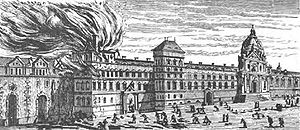
Hesiod
Hesiod was a Greek oral poet generally thought by scholars to have been active between 750 and 650 BC, around the same time as Homer. His is the first European poetry in which the poet regards himself as a topic, an individual with a distinctive role to play. Ancient authors credited him and...
, Plato
Plato
Plato , was a Classical Greek philosopher, mathematician, student of Socrates, writer of philosophical dialogues, and founder of the Academy in Athens, the first institution of higher learning in the Western world. Along with his mentor, Socrates, and his student, Aristotle, Plato helped to lay the...
, Demosthenes
Demosthenes
Demosthenes was a prominent Greek statesman and orator of ancient Athens. His orations constitute a significant expression of contemporary Athenian intellectual prowess and provide an insight into the politics and culture of ancient Greece during the 4th century BC. Demosthenes learned rhetoric by...
, Cicero
Cicero
Marcus Tullius Cicero , was a Roman philosopher, statesman, lawyer, political theorist, and Roman constitutionalist. He came from a wealthy municipal family of the equestrian order, and is widely considered one of Rome's greatest orators and prose stylists.He introduced the Romans to the chief...
, Virgil
Virgil
Publius Vergilius Maro, usually called Virgil or Vergil in English , was an ancient Roman poet of the Augustan period. He is known for three major works of Latin literature, the Eclogues , the Georgics, and the epic Aeneid...
, and Sallust
Sallust
Gaius Sallustius Crispus, generally known simply as Sallust , a Roman historian, belonged to a well-known plebeian family, and was born at Amiternum in the country of the Sabines...
. The prohibition to teach civil law was never well observed at Paris, but in 1679 Louis XIV authorized the teaching of civil law in the faculty of decretals. Thus, the name "faculty of law" replaced that of "faculty of decretals". The colleges meantime had multiplied; those of Cardinal Le-Moine and Navarre
Collège de Navarre
The College of Navarre was one of the colleges of the historic University of Paris, rivaling the Sorbonne and renowned for its library. It was founded by Queen Joan I of Navarre in 1305, who provided for three departments, the arts with 20 students, philosophy with 30 and theology with 20...
were founded in the fourteenth century. The Hundred Years' War was fatal to these establishments, but the university set about remedying the injury.
Remarkable for its teaching, the University of Paris played an important part: in the Church, during the Great Schism
East-West Schism
The East–West Schism of 1054, sometimes known as the Great Schism, formally divided the State church of the Roman Empire into Eastern and Western branches, which later became known as the Eastern Orthodox Church and the Roman Catholic Church, respectively...
; in the councils, in dealing with heresies and divisions; in the State, during national crises. Under the domination of England
England
England is a country that is part of the United Kingdom. It shares land borders with Scotland to the north and Wales to the west; the Irish Sea is to the north west, the Celtic Sea to the south west, with the North Sea to the east and the English Channel to the south separating it from continental...
it played a role in the trial of Joan of Arc.
Proud of its rights and privileges, the University of Paris fought energetically to maintain them, hence the long struggle against the mendicant orders on academic as well as on religious grounds. Hence also the shorter conflict against the Jesuits, who claimed by word and action a share in its teaching. It made liberal use of its right to decide administratively according to occasion and necessity. In some instances it openly endorsed the censures of the faculty of theology and pronounced condemnation in its own name, as in the case of the Flagellants.
Its patriotism was especially manifested on two occasions. During the captivity of King John, when Paris was given over to factions, the university sought to restore peace; and under Louis XIV, when the Spaniards crossed the Somme and threatened the capital, it placed two hundred men at the king's disposal and offered the Master of Arts degree gratuitously to scholars who should present certificates of service in the army (Jourdain, Hist. de l'Univers. de Paris au XVIIe et XVIIIe siècle, 132-34; Archiv. du ministère de l'instruction publique).
Suppression of the colleges and establishment of the University of France
The ancient university disappeared with ancient France in the French RevolutionFrench Revolution
The French Revolution , sometimes distinguished as the 'Great French Revolution' , was a period of radical social and political upheaval in France and Europe. The absolute monarchy that had ruled France for centuries collapsed in three years...
. On 15 Sept., 1793, petitioned by the Department of Paris and several departmental groups, the National Convention
National Convention
During the French Revolution, the National Convention or Convention, in France, comprised the constitutional and legislative assembly which sat from 20 September 1792 to 26 October 1795 . It held executive power in France during the first years of the French First Republic...
decided that independently of the primary schools,
"there should be established in the Republic three progressive degrees of instruction; the first for the knowledge indispensable to artisans and workmen of all kinds; the second for further knowledge necessary to those intending to embrace the other professions of society; and the third for those branches of instruction the study of which is not within the reach of all men".
Measures were to be taken immediately: "For means of execution the department and the municipality of Paris are authorized to consult with the Committee of Public Instruction of the National Convention, in order that these establishments shall be put in action by 1 November next, and consequently colleges now in operation and the faculties of theology, medicine, arts, and law are suppressed throughout the Republic". This was the death-sentence of the university. It was not to be restored after the Revolution had subsided, any more than those of the provinces.
All the faculties were replaced by a single centre, the University of France
University of France
The University of France was a highly centralized educational state organization founded by Napoleon I in 1808 and given authority not only over the individual, previously independent, universities, but also over primary and secondary education. The former individual universities were henceforth...
. After a century, people recognized that the new system was less favourable to study. They restored the old system of separate faculties in 1896, but without the faculty of theology.
Student revolt and reorganization
In 1968 the cultural revolution (see also Situationist International), resulted in the closing of the university for the third time in history. (The first occasion had been in 1229, and the second had been due to the invasionBattle of France
In the Second World War, the Battle of France was the German invasion of France and the Low Countries, beginning on 10 May 1940, which ended the Phoney War. The battle consisted of two main operations. In the first, Fall Gelb , German armoured units pushed through the Ardennes, to cut off and...
by the German army
Nazi Germany
Nazi Germany , also known as the Third Reich , but officially called German Reich from 1933 to 1943 and Greater German Reich from 26 June 1943 onward, is the name commonly used to refer to the state of Germany from 1933 to 1945, when it was a totalitarian dictatorship ruled by...
of 1940.) In 1968, students were protesting against the organization of the university and its restrictions, as well as general social issues.
The University of Paris has subsequently been reorganised into several autonomous universities and schools, some of which still carry the Sorbonne name. The historical campus, located in the Quartier Latin on the Rive Gauche, in the 5th arrondissement of Paris, features mural paintings by Pierre Puvis de Chavannes
Pierre Puvis de Chavannes
Pierre Puvis de Chavannes was a French painter, who became the president and co-founder of the Société Nationale des Beaux-Arts and whose work influenced many other artists.-Life:...
. It was divided for use among several of the universities of Paris, the prestigious École Nationale des Chartes
École Nationale des Chartes
The École Nationale des Chartes is a grand établissement, an elite French university-level educational institution based in Paris. It provides education and training for archivists and librarians and forms part of the University of Paris.-History:...
and the Rector's services.
In March 2006 la Sorbonne was occupied again as part of country-wide protests against the government's introduction of the CPE
First Employment Contract
The contrat première embauche was a new form of employment contract pushed in spring 2006 in France by Prime Minister Dominique de Villepin...
(first employment contract), which some young people thought would adversely affect them.
Present universities
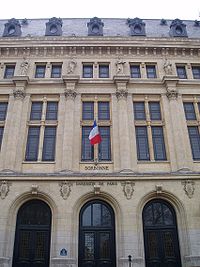
Île-de-France (région)
Île-de-France is the wealthiest and most populated of the twenty-two administrative regions of France, composed mostly of the Paris metropolitan area....
region.
Thirteen successor universities
| I | Pantheon-Sorbonne University | Website | Academy of Paris | Sorbonne Paris Cité |
| II | Pantheon-Assas University | Website | Academy of Paris | Sorbonne Universités |
| III | University of the New Sorbonne University of Paris III: Sorbonne Nouvelle The New Sorbonne University is a public university in Paris, France.The Université de la Sorbonne Nouvelle is a founding member of the Paris Universitas, a union of 6 Parisian universities.... |
Website | Academy of Paris | Sorbonne Paris Cité |
| IV | Paris-Sorbonne University | Website | Academy of Paris | Sorbonne Universités |
| V | René Descartes University | Website | Academy of Paris | Sorbonne Paris Cité |
| VI | Pierre and Marie Curie University Pierre and Marie Curie University The Paris VI University , or the Pierre and Marie Curie University , is a university located on the Jussieu Campus in the Latin Quarter of the 5th arrondissement of Paris, France.... |
Website | Academy of Paris | Sorbonne Universités |
| VII | Denis Diderot University | Website | Academy of Paris | Sorbonne Paris Cité |
| VIII | University of Vincennes in Saint-Denis | Website | Academy of Créteil | not in an alliance |
| IX | Paris Dauphine University | Website | Academy of Paris | not in an alliance |
| X | University of Paris Ouest | Website | Academy of Versailles | not in an alliance |
| XI | University of Paris Sud Paris-Sud 11 University University of Paris-Sud or University of Paris-Sud or University of Paris XI is a French university distributed among several campuses in the southern suburb of Paris... |
Website | Academy of Versailles | UniverSud Paris |
| XII | University of Paris Est Paris 12 Val de Marne University Paris-Est Créteil Val-de-Marne University was inaugurated in 1970. It is a multidisciplinary centre based principally in Créteil . Medicine is taught at the CHU Henri-Mondor, inaugurated in 1969... |
Website | Academy of Créteil | Université Paris-Est |
| XIII | University of Paris Nord Paris 13 University University of Paris 13 is one of the thirteen universities in Paris which replaced the University of Paris in 1970. It is also identified as University of Paris North .-External links:*... |
Website | Academy of Créteil | Université Paris Cité |
Five alliances of universities
Most of these universities have joined, or are in the process of forming (Summer 2010), new groupings along the lines of a collegiate universityCollegiate university
A collegiate university is a university in which governing authority and functions are divided between a central administration and a number of constituent colleges...
. Typically, these groupings take the legal form of a Center for Research and Higher Education (Pôle de Recherche et d'Enseignement Supérieur, or PRES), though some have opted for other forms of organization. These groupings mix universities and grandes écoles.
There are five such centers in the Paris region:
| Grouping | Universities | Grandes écoles |
|---|---|---|
| HESAM Only a project as of 2010. |
Paris I Panthéon-Sorbonne | École nationale supérieure d'arts et métiers École Nationale Supérieure d'Arts et Métiers Arts et Métiers ParisTech is the French leading engineering school in the fields of mechanics and industrialization.The school trained 85,000 engineers since its foundation in 1780 by the Duke of La Rochefoucauld-Liancourt.... Conservatoire National des Arts et Métiers Conservatoire National des Arts et Métiers The Conservatoire National des Arts et Métiers , or National Conservatory of Arts and Crafts, is a doctoral degree-granting higher education establishment operated by the French government, dedicated to providing education and conducting research for the promotion of science and industry... École française d'Extrême-Orient École française d'Extrême-Orient The École française d'Extrême-Orient is a French institute dedicated to the study of Asian societies. Translated into English, it approximately means the French School of the Far East. It was founded in 1900 with headquarters in Hanoi in what was then French Indochina. After independence, its... École des hautes études en sciences sociales École des Hautes Études en Sciences Sociales The École des hautes études en sciences sociales is a leading French institution for research and higher education, a Grand Établissement. Its mission is research and research training in the social sciences, including the relationship these latter maintain with the natural and life sciences... École pratique des hautes études École pratique des hautes études The École pratique des hautes études is a Grand Établissement in Paris, France. It is counted among France's most prestigious research and higher education institutions.... ESCP Europe |
| Sorbonne Universités | Paris II Panthéon-Assas Paris IV Paris-Sorbonne Paris VI Pierre and Marie Curie Pierre and Marie Curie University The Paris VI University , or the Pierre and Marie Curie University , is a university located on the Jussieu Campus in the Latin Quarter of the 5th arrondissement of Paris, France.... |
École Nationale des Chartes École Nationale des Chartes The École Nationale des Chartes is a grand établissement, an elite French university-level educational institution based in Paris. It provides education and training for archivists and librarians and forms part of the University of Paris.-History:... European Institute of Business Administration INSEAD INSEAD is an international graduate business school and research institution. It has campuses in Europe , Asia , and the Middle East , as well as a research center in Israel... Muséum National d'Histoire Naturelle Institut National d'histoire de l'art |
| Université Paris Cité | Paris III New Sorbonne University of Paris III: Sorbonne Nouvelle The New Sorbonne University is a public university in Paris, France.The Université de la Sorbonne Nouvelle is a founding member of the Paris Universitas, a union of 6 Parisian universities.... Paris V René Descartes Paris VII Denis Diderot Paris XIII Nord Paris 13 University University of Paris 13 is one of the thirteen universities in Paris which replaced the University of Paris in 1970. It is also identified as University of Paris North .-External links:*... |
Sciences-po Paris Institut d'Études Politiques de Paris The Institut d'études politiques de Paris , simply referred to as Sciences Po , is a public research and higher education institution in Paris, France, specialised in the social sciences. It has the status of grand établissement, which allows its admissions process to be highly selective... Institut national des langues et civilisations orientales Institut national des langues et civilisations orientales The Institut National des Langues et Civilisations Orientales is located in Paris, France. It was founded in 1795 after the French Revolution and is now one of the country's Grands établissements with a specialization in African, Asian, East European, Oceanian languages and civilisations... École des Hautes Études en Santé Publique EHESP EHESP, or Ecole des Hautes Etudes en Sante Publique, is known as the EHESP School of Public Health. With a campus in Rennes and Paris it is designed to form the next generation of French and international professionals in public health... Institut de Physique du Globe de Paris Institut de Physique du Globe de Paris The Institut de Physique du Globe de Paris is a French governmental, non-profit research and higher education establishment located in Paris, dedicated to the study of earth and planetary sciences by combining observations, laboratory analysis and construction of conceptual analogical and... |
| Université Paris-Est | Marne la Vallée University of Marne la Vallée The University Paris-Est Marne-la-Vallée is a French university, in the Academy of Créteil.-See also:* List of public universities in France by academy... Paris XII Val de Marne Paris 12 Val de Marne University Paris-Est Créteil Val-de-Marne University was inaugurated in 1970. It is a multidisciplinary centre based principally in Créteil . Medicine is taught at the CHU Henri-Mondor, inaugurated in 1969... |
École nationale des ponts et chaussées École Nationale des Ponts et Chaussées Founded in 1747, the École nationale des ponts et chaussées , often referred to as les Ponts, is the world's oldest civil engineering school... École supérieure d'ingénieurs en électronique et électrotechnique École Supérieure d'Ingénieurs en Électronique et Électrotechnique ESIEE, , are two French Graduate Schools of Engineering located in Marne-la-Vallée and Amiens delivering the equivalent of a Master's Degree.-General information:It was founded in 1904 and was known until the 1960s as the Breguet school... |
| UniverSud Paris | Paris XI - Orsay Paris-Sud 11 University University of Paris-Sud or University of Paris-Sud or University of Paris XI is a French university distributed among several campuses in the southern suburb of Paris... Versailles-Saint-Quentin-en-Yvelines Versailles Saint-Quentin-en-Yvelines University Versailles Saint-Quentin-en-Yvelines University is a French university, in the Academy of Versailles.- Sciences :Located in Versailles and Le Chesnay.... Évry Val d'Essonne |
ENS de Cachan École Normale Supérieure de Cachan The École Normale Supérieure de Cachan is one of the most prestigious French Grandes Écoles. Like all the other Grandes Écoles, this higher education institution is not included in the mainstream framework of the French public universities... École centrale Paris École Centrale Paris École Centrale Paris is a French university-level institution in the field of engineering. It is also known by its original name École centrale des arts et manufactures, or ECP. Founded in 1829, it is one of the oldest and most prestigious engineering schools in France and has the special status... École supérieure d'électricité |
Some alliances have been terminated, such as Paris Universitas
Paris Universitas
Paris Universitas was an alliance of six institutions of higher education in Paris, France, that existed from 2005 to 2010. Paris Universitas offers a wide range of disciplines, from medicine to the humanities, engineering, law, management and the social sciences...
or Paris Centre Universités
Paris Centre Universités
Paris Centre Universités is the alliance of three Parisian universities which, each one, constitutes a reference in its disciplinary fields:* Université Paris 1 Panthéon-Sorbonne* Université Paris 5 René Descartes* Université Paris 7 Denis Diderot- See also :...
, some other are still in discussion.
See also
- University of Paris strike of 1229University of Paris strike of 1229In 1229, a student riot at the University of Paris resulted in the deaths of a number of students, and the ensuing "dispersion" or student strike in protest lasted more than two years and led to a number of reforms of the medieval university...
- University of Paris (Condemnations)
- List of University of Paris people
- List of public universities in France by academy
- Sorbonne Graduate Business SchoolSorbonne Graduate Business SchoolThe Institut d'Administration des Entreprises de Paris is a public business school, part of University of Paris 1 Pantheon-Sorbonne in France...
- École normale supérieureÉcole normale supérieureAn école normale supérieure or ENS is a type of publicly funded higher education in France. A portion of the student body who are French civil servants are called Normaliens....
- Nobel Prize RankingNobel Prize laureates by university affiliationThis list of Nobel laureates by university affiliation shows the university affiliation of winners of the Nobel Prize...
- List of medieval universities
- Société des Amis des Universités de ParisSociété des Amis des Universités de ParisThe Société des Amis des Universités de Paris is a public utility and non-profit association of private status regulated by the French law of 1901 on associations...
Further reading
- André Tuilier: Histoire de l'Université de Paris et de la Sorbonne ("History of the University of Paris and of the Sorbonne"), in 2 volumes (From the Origins to Richelieu, From Louis XIV to the Crisis of 1968), Paris: Nouvelle Librairie de France, 1997 ;
- Jean-Louis Leutrat: De l'Université aux Universités ("From the University to the Universities"), Paris: Association des Universités de Paris, 1997
- Philippe Rive: La Sorbonne et sa reconstruction ("The Sorbonne and its Reconstruction"), Lyon: La Manufacture, 1987
- Jacques Verger: Histoire des Universités en France ("History of French Universities"), Toulouse: Editions Privat, 1986
External links
- Study Abroad in France
- Academy of Paris
- Sorbonne - Universités Paris I, III, IV and V (official homepage)
- History of the University of Paris
- News coverage of the most recent occupation of the Sorbonne
- Education Authority of Paris
- english language coverage of the struggle against the CPE in France, including the occupations and demonstrations around the Sorbonne