
All Topics  
Early modern Europe


   Email Print
   Bookmark   Link


Early modern Europe


Early modern is the term used by historians to refer to a period in the history of Western Europe
Western Europe

Western Europe refers to the countries in the western most half of Europe. This concept has had different meanings, political and cultural as well as geographical issues have influenced the area....
 and its first colonies
Colony

In politics and in history, a colony is a Territory under the immediate political control of a state. For colonies in antiquity, city-states would often found their own colonies....
 which spanned the centuries between the end of the Middle Ages
Middle Ages

File:Karl 1 mit papst gelasius gregor1 sacramentar v karl d kahlen.jpgThe Middle Ages of European history are a period in history which lasted for roughly a millennium, commonly dated from the fall of the Roman Empire in the 5th century to the beginning of the Early Modern Period in the 16th century, marked by the division of Western Christi...
 and the beginning of the Industrial Revolution
Industrial Revolution

The Industrial Revolution was a period in the late 18th and early 19th centuries when major changes in agriculture, manufacturing, production, and transportation had a profound effect on the socioeconomics and cultural conditions in United Kingdom....
, roughly the late 15th century to the late 18th century. The early modern period is often stated to have begun with such events as the invention of moveable type printing in the 1450s, the discovery of America by Christopher Columbus
Christopher Columbus

Christopher Columbus was a Republic of Genoa navigator, colonialist and explorer whose voyages across the Atlantic Ocean?funded by Queen Isabella of Spain?led to general European awareness of the America in the Western Hemisphere....
 in 1492 or the start of the Protestant Reformation
Protestant Reformation

The Protestant Reformation was a Christian reform movement in Europe. It is thought to have begun in 1517 with Martin Luther's Ninety-Five Theses and may be considered to have ended with the Peace of Westphalia in 1648....
 in 1517.


Discussion
Ask a question about 'Early modern Europe'
Start a new discussion about 'Early modern Europe'
Answer questions from other users
Full Discussion Forum


Encyclopedia


Early modern is the term used by historians to refer to a period in the history of Western Europe
Western Europe

Western Europe refers to the countries in the western most half of Europe. This concept has had different meanings, political and cultural as well as geographical issues have influenced the area....
 and its first colonies
Colony

In politics and in history, a colony is a Territory under the immediate political control of a state. For colonies in antiquity, city-states would often found their own colonies....
 which spanned the centuries between the end of the Middle Ages
Middle Ages

File:Karl 1 mit papst gelasius gregor1 sacramentar v karl d kahlen.jpgThe Middle Ages of European history are a period in history which lasted for roughly a millennium, commonly dated from the fall of the Roman Empire in the 5th century to the beginning of the Early Modern Period in the 16th century, marked by the division of Western Christi...
 and the beginning of the Industrial Revolution
Industrial Revolution

The Industrial Revolution was a period in the late 18th and early 19th centuries when major changes in agriculture, manufacturing, production, and transportation had a profound effect on the socioeconomics and cultural conditions in United Kingdom....
, roughly the late 15th century to the late 18th century. The early modern period is often stated to have begun with such events as the invention of moveable type printing in the 1450s, the discovery of America by Christopher Columbus
Christopher Columbus

Christopher Columbus was a Republic of Genoa navigator, colonialist and explorer whose voyages across the Atlantic Ocean?funded by Queen Isabella of Spain?led to general European awareness of the America in the Western Hemisphere....
 in 1492 or the start of the Protestant Reformation
Protestant Reformation

The Protestant Reformation was a Christian reform movement in Europe. It is thought to have begun in 1517 with Martin Luther's Ninety-Five Theses and may be considered to have ended with the Peace of Westphalia in 1648....
 in 1517. Its end point is often linked with the outset of the French Revolution
French Revolution

The French Revolution was a period of political and social upheaval and radical change in the history of France, during which the French governmental structure, previously an absolute monarchy with feudalism for the aristocracy and Roman Catholic Church clergy, underwent radical change to forms based on Age of Enlightenment principles of cit...
 in 1789, or with the more nebulous origins of industrialism in late 18th century Britain. As with most periodization
Periodization

Periodization is the attempt to categorize or divide time into named blocks. The result is a descriptive abstraction that provides a useful handle on periods of time with relatively stable characteristics....
s of history, however, the precise dates chosen vary.

The early modern period was characterized by profound changes in many realms of human endeavor. Among the most important include the development of science
Science

In its broadest sense, science refers to any systematic knowledge or practice. In its more usual restricted sense, science refers to a system of acquiring knowledge based on scientific method, as well as to the organized body of knowledge gained through such research....
 as a formalized practice, increasingly rapid technological progress
History of technology

The history of technology is the history of the invention of tools and techniques. Background knowledge has enabled people to create new things, and conversely, many scientific endeavors have become possible through technologies which assist humans to travel to places we could not otherwise go, and probe the nature of the universe in more d...
, and the establishment of secularized civic politics
Politics

Politics is the process by which groups of people make decisions. The term is generally applied to behaviour within civil governments, but politics has been observed in all human group interactions, including corporation, academia, and religion institutions....
, law courts and the nation state. Capitalist economies began to develop in a nascent form, first in the northern Italian
Italy

Italy , officially the Italian Republic , is a country located on the Italian Peninsula in Southern Europe and on the two largest islands in the Mediterranean Sea, Sicily and Sardinia....
 republic
Republic

A republic is a state or country that is not led by a hereditary monarch but in which the people have an impact on its government. The word originates from the Latin term res publica....
s such as Genoa
Genoa

Genoa is a city and an important seaport in northern Italy, the capital of the Province of Genoa and of the region of Liguria. The city has a population of about 610,000 and the urban area has a population of about 900,000....
 and Venice
Venice

Venice is a city in northern Italy, the capital city of the Italian regions Veneto, a population of 271,251 . Together with Padua, Italy, the city is included in the Padua-Venice Metropolitan Area ....
 and in the cities of the Low Countries
Low Countries

The Low Countries, the historical region of de Nederlanden, are the country on low-lying land around the river delta of the Rhine, Scheldt, and Meuse River rivers....
, later in France
France

France , officially the French Republic , is a country whose Metropolitan France is located in Western Europe and that also comprises various Overseas departments and territories of France....
, Germany
Germany

Germany , officially the Federal Republic of Germany , is a country in Central Europe. It is bordered to the north by the North Sea, Denmark, and the Baltic Sea; to the east by Poland and the Czech Republic; to the south by Austria and Switzerland; and to the west by France, Luxembourg, Belgium, and the Netherlands....
 and England
England

native_name =|conventional_long_name = England|common_name = England|image_flag = Flag of England.svg|image_coat = England COA.svg|symbol_type = Royal Coat of Arms...
. The early modern period also saw the rise and dominance of the economic theory of mercantilism
Mercantilism

Mercantilism is an economic theory that holds that the prosperity of a nation is dependent upon its supply of Capital , and that the world economy of international trade is "unchangeable"....
. As such, the early modern period is often associated with the decline and eventual disappearance (at least in Western Europe) of feudalism
Feudalism

Feudalism, a term first used in the early modern period , in its most classic sense refers to a Middle Ages European political system composed of a set of reciprocal law and military obligations among the warrior nobility, revolving around the three key concepts of lords, vassals, and fiefs....
 and serfdom. The Protestant Reformation greatly altered the religious balance of Christendom
Christendom

Christendom usually refers to Christianity as a territorial phenomenon. It can also refer to the part of the world in which Christianity prevails....
, creating a formidable new opposition to the dominance of the Catholic Church
Roman Catholic Church

The Roman Catholic Church, officially known as the Catholic Church is the world's largest Christianity Ecclesia , representing over half of all Christians and one-sixth of the world population....
, especially in Northern Europe
Northern Europe

Northern Europe is the northern part or region of Europe. The United Nations defines Northern Europe as including the following countries and dependent regions:...
. The early modern period also witnessed the circumnavigation
Circumnavigation

To circumnavigate a place, such as an island, a continent, or the Earth, is to travel all the way around it by boat or ship. More recently, the term has also been used to cover aerial round-the-world flights....
 of the earth and the establishment of regular European contact with the Americas
Americas

The Americas are the region of the Western hemisphere that consists of the continents of North America and South America with their associated islands and regions....
, India
India

India, officially the Republic of India , is a country in South Asia. It is the List of countries and outlying territories by total area country by geographical area, the List of countries by population country, and the most populous liberal democracy in the world....
, China
China

China is a Culture of China, an ancient civilization, and, depending on perspective, a national or multinational entity extending over a large area in East Asia....
, Japan
Japan

Japan is an island country in East Asia. Located in the Pacific Ocean, it lies to the east of the Sea of Japan, People's Republic of China, North Korea, South Korea and Russia, stretching from the Sea of Okhotsk in the north to the East China Sea and Taiwan in the south....
 and Southeast Asia
Southeast Asia

Southeast Asia or Southeastern Asia is a subregion of Asia, consisting of the countries that are geographically south of China, east of India and north of Australia....
. The ensuing rise of global systems of international economic, cultural and intellectual exchange played an important role in the development of capitalism
Capitalism

Capitalism is an economic system in which wealth, and the means of producing wealth, are private property and controlled rather than commonly, publicly, or state-owned and controlled....
 and represents the earliest phase of globalization
Globalization

Globalization in its literal sense is the process of transformation of local or regional phenomena into global ones. It can be described as a process by which the people of the world are unified into a single society and function together....
.

Some of the more notable events of the early modern period included the Reformation and the religious conflicts it provoked (including the French Wars of Religion
French Wars of Religion

The French Wars of Religion is the name given to a period of civil war and military operations, primarily between France Roman Catholic Church and Protestantism , which also involved the factional struggles between the aristocratic houses of France such as the House of Bourbon and House of Guise ....
 and the Thirty Years' War
Thirty Years' War

The Thirty Years' War was one of the most destructive conflicts in European history. The war was fought primarily in Germany and at various points involved most of the countries of Europe....
), the European colonization of the Americas
European colonization of the Americas

The start of the European colonization of the Americas is typically dated to 1492, although there was at least one earlier colonization effort....
 and the peak of the European witch-hunt
Witch-hunt

A witch hunt is a search for witches or evidence of witchcraft, often involving moral panic, mass hysteria and mob lynching, but in historical instances also legally sanctioned and involving official witchcraft trials....
 phenomenon.

Periodization


Regardless of the precise dates used to define its beginning and end points, the early modern period is generally agreed to have comprised the Renaissance
Renaissance

The Renaissance was a cultural movement that spanned roughly the 14th to the 17th century, beginning in Italy in the late Middle Ages and later spreading to the rest of Europe....
, the Reformation, the Scientific Revolution
Scientific revolution

The period which many History of science call the Scientific Revolution is commonly viewed as the foundation and origin of modern science.It was a time roughly coinciding with the later part of the Middle Ages and through the Renaissance in which scientific ideas in physics, astronomy, and biology evolved rapidly....
, and the Enlightenment
Age of Enlightenment

The Age of Enlightenment or The Enlightenment is a term used to describe a time in Western philosophy and cultural life centered upon the eighteenth century, in which rationalism was advocated as the primary source and legitimacy for authority....
. As such, historians have attributed a number of fundamental changes to the period, notably the increasingly rapid progress of science
Science

In its broadest sense, science refers to any systematic knowledge or practice. In its more usual restricted sense, science refers to a system of acquiring knowledge based on scientific method, as well as to the organized body of knowledge gained through such research....
 and technology
Technology

Technology is a broad concept that deals with an animal species' usage and knowledge of tools and crafts, and how it affects an animal species' ability to control and adapt to its Natural environment....
, the secularization of politics
Politics

Politics is the process by which groups of people make decisions. The term is generally applied to behaviour within civil governments, but politics has been observed in all human group interactions, including corporation, academia, and religion institutions....
, and the diminution of the absolute authority of the Roman Catholic Church
Roman Catholic Church

The Roman Catholic Church, officially known as the Catholic Church is the world's largest Christianity Ecclesia , representing over half of all Christians and one-sixth of the world population....
 as well as the lessening of the influence of all faiths upon national governments. Many historians have identified the early modern period as the epoch in which individuals began to think of themselves as belonging to a national polity -- a notable break from medieval modes of self-identification, which had been largely based upon religion
Religion

A religion is an organized approach to human spirituality which usually encompasses a set of myth, symbols, beliefs and practices, often with a supernatural or transcendence quality, that give meaning to the practitioner's experiences of life through reference to a higher power or truth....
 (belonging to a universal Christendom
Christendom

Christendom usually refers to Christianity as a territorial phenomenon. It can also refer to the part of the world in which Christianity prevails....
), language, or feudal allegiance (belonging to the manor or extended household of a particular magnate
Magnate

Magnate, from the Late Latin magnas, a great man, itself from Latin magnus 'great', designates a noble or other man in a high social position, by birth, wealth or other qualities....
 or lord
Lord

Lord is a title with various meanings. It can denote a Prince#Prince_as_a_generic_word_for_ruler or a Examples of feudalism . The title today is mostly used in connection with the peerage of the United Kingdom or its predecessor countries, although some users of the title do not themselves hold peerages, and use it 'Courtesy titles in the U...
.

The beginning of the early modern period is not clear-cut, but is generally accepted to be in the late 15th century or early 16th century. Significant dates in this transitional phase from medieval to early modern Europe can be noted:

  • 1450
The invention of the first European movable type
Movable Type

Movable Type is a blog software developed by the company Six Apart. It was publicly announced on 3 September 2001, and version 1.0 was publicly released on 8 October 2001....
 printing process by Johannes Gutenberg
Johannes Gutenberg

Johannes Gensfleisch zur Laden zum Gutenberg was a Germany goldsmith and printer who is credited with being the first European to use movable type printing, in around 1439, and the global inventor of the mechanical printing press....
, a device that fundamentally changed the circulation of information. Movable type, which allowed individual characters to be arranged to form words and which is an invention separate from the printing press, had also been invented in, but not known outside of, China
China

China is a Culture of China, an ancient civilization, and, depending on perspective, a national or multinational entity extending over a large area in East Asia....
.
  • 1453
The conquest of Constantinople
Fall of Constantinople

The Fall of Constantinople was a siege in which the Ottoman Empire under the command of Sultan Mehmed II attempted to capture the capital of the Byzantine Empire, Constantinople which was defended by the army of Emperor Constantine XI....
 by the Ottomans signalled the end of the Byzantine empire
Byzantine Empire

Byzantine Empire and Eastern Roman Empire are conventional names used to describe the Roman Empire during the Middle Ages, centered on its capital of Constantinople....
; the Battle of Castillon
Battle of Castillon

The Battle of Castillon of 1453 was the last battle fought between the French and the English during the Hundred Years' War. This was the first battle in European history where cannons were a major factor in deciding the battle....
 concluded the Hundred Years' War
Hundred Years' War

The Hundred Years' War was a prolonged conflict lasting from 1337 to 1453 between two royal houses for the French throne, which was vacant with the extinction of the senior House of Capet line of French kings....
.
  • 1485
    • England
      England

      native_name =|conventional_long_name = England|common_name = England|image_flag = Flag of England.svg|image_coat = England COA.svg|symbol_type = Royal Coat of Arms...
  • : The last Plantagenet king, Richard III
    Richard III of England

    Richard III was List of the monarchs of the Kingdom of England of Kingdom of England from 1483 until his death. He was the last king from the House of York, and his defeat at the Battle of Bosworth Field marked the culmination of the Wars of the Roses and the end of the Plantagenet dynasty....
    , was killed at Bosworth
    Battle of Bosworth Field

    The Battle of Bosworth or Bosworth Field was House of Lancaster Henry VII of England defeat of House of York Richard III of England, ending the Plantagenet dynasty to begin a new Tudor dynasty....
     and the medieval civil wars of aristocratic factions gave way to early modern Tudor
    Tudor dynasty

    The House of Tudor was a prominent European royal house that ruled the Kingdom of England and its realms from 1485 until 1603. Founded by Henry VII of England, who, though his paternal family was Welsh people ?his grandfather was Owen Tudor? was himself also a legitimized descendent of the royal House of Lancaster....
     monarchy, in the person of Henry VII
    Henry VII of England

    Henry VII was the Kingdom of England and Lordship of Ireland from his usurpation of the crown on 22 August 1485 until his death on 21 April 1509, as the first monarch of the Tudor dynasty....
    .
  • 1492
    • Spain
      Spain

      Spain or the Kingdom of Spain , is a country located in Southern Europe on the Iberian Peninsula.The Spanish constitution does not establish any official denomination of the country, even though Espa?a , Estado espa?ol and Naci?n espa?ola are used interchangeably....
  • : The first documented European voyage to the Americas by the Italian
    Italy

    Italy , officially the Italian Republic , is a country located on the Italian Peninsula in Southern Europe and on the two largest islands in the Mediterranean Sea, Sicily and Sardinia....
     explorer Christopher Columbus
    Christopher Columbus

    Christopher Columbus was a Republic of Genoa navigator, colonialist and explorer whose voyages across the Atlantic Ocean?funded by Queen Isabella of Spain?led to general European awareness of the America in the Western Hemisphere....
    ; the end of the Reconquista
    Reconquista

    The Reconquista was a period of 800 years in the Middle Ages during which several Christian kingdoms of the Iberian Peninsula succeeded in retaking the Iberian Peninsula from the Muslims....
    , with the final expulsion of the Moors
    Moors

    In the Spanish language, the term for Moors is Moro; in Portuguese language the word is mouro. There seems to have been some confusion about the relationship of the word moro/mouro to the word moreno , both from Greek language ma?ros, i.e....
     from the Iberian Peninsula
    Iberian Peninsula

    The Iberian Peninsula, or Iberia, is located in the extreme southwest of Europe and includes modern-day Spain, Portugal, Andorra and Gibraltar and a very small area of France....
    ; the Spanish government expels the Jews
    Alhambra decree

    The Alhambra Decree was an edict issued on 31 March 1492 by the joint Catholic Monarchs of Spain ordering the expulsion of Jews from the Kingdom of Spain and its territories and possessions by 31 July of that year....
    .
  • 1494
    • France
      France

      France , officially the French Republic , is a country whose Metropolitan France is located in Western Europe and that also comprises various Overseas departments and territories of France....
    • Italy
      Italy

      Italy , officially the Italian Republic , is a country located on the Italian Peninsula in Southern Europe and on the two largest islands in the Mediterranean Sea, Sicily and Sardinia....
  • : French king Charles VIII
    Charles VIII of France

    Charles VIII, called the Affable, , was List of French monarchs from 1483 to his death. Charles was a member of the House of Valois. His invasion of Italy initiated the long series of Italian Wars which characterized the first half of the 16th century....
     invaded Italy, drastically altering the status quo and beginning a series of wars which would punctuate the Italian Renaissance
    Italian Renaissance

    The Italian Renaissance began the opening phase of the Renaissance, a period of great cultural change and achievement in Europe that spanned the period from the end of the 13th century to about 1600, marking the transition between Medieval and Early Modern Europe....
    .
  • 1513
First formulation of modern politics
Politics

Politics is the process by which groups of people make decisions. The term is generally applied to behaviour within civil governments, but politics has been observed in all human group interactions, including corporation, academia, and religion institutions....
 with the publication of Machiavelli's The Prince
The Prince

Il Principe is a politics treatise by the Florence Civil service and Political philosophy Niccol? Machiavelli. Originally called De Principatibus , it was originally written in 1513, but not published until 1532, five years after Machiavelli's death....
.
  • 1517
The Reformation
Protestant Reformation

The Protestant Reformation was a Christian reform movement in Europe. It is thought to have begun in 1517 with Martin Luther's Ninety-Five Theses and may be considered to have ended with the Peace of Westphalia in 1648....
 begins with Martin Luther
Martin Luther

Martin Luther was a Germans monk, theology, university professor, priest, father of Protestantism, and Protestant Reformers whose ideas started the Protestant Reformation and changed the course of Western culture....
 nailing his ninety-five theses
95 Theses

The Ninety-Five Theses on the Power and Efficacy of Indulgences, commonly known as The Ninety-Five Theses, were written by Martin Luther in 1517 and are widely regarded as the primary catalyst for the Protestant Reformation....
 to the door of the church in Wittenberg
Wittenberg

Wittenberg, officially Lutherstadt Wittenberg, is a town in Germany in the States of Germany Saxony-Anhalt, on the Elbe River. It has a population of about 50,000....
, Germany
Germany

Germany , officially the Federal Republic of Germany , is a country in Central Europe. It is bordered to the north by the North Sea, Denmark, and the Baltic Sea; to the east by Poland and the Czech Republic; to the south by Austria and Switzerland; and to the west by France, Luxembourg, Belgium, and the Netherlands....
.
  • 1545
The Council of Trent
Council of Trent

The Council of Trent was the 16th century Ecumenical Council of the Roman Catholic Church. Considered one of the Church's most important councils, it convened in Trento between December 13, 1545, and December 4, 1563 in twenty-five sessions for three periods....
 marks the end of the medieval Roman Catholic Church
Roman Catholic Church

The Roman Catholic Church, officially known as the Catholic Church is the world's largest Christianity Ecclesia , representing over half of all Christians and one-sixth of the world population....
.


The end date of the early modern period is variously associated with the Industrial Revolution
Industrial Revolution

The Industrial Revolution was a period in the late 18th and early 19th centuries when major changes in agriculture, manufacturing, production, and transportation had a profound effect on the socioeconomics and cultural conditions in United Kingdom....
, which began in Britain in about 1750, or the beginning of the French Revolution
French Revolution

The French Revolution was a period of political and social upheaval and radical change in the history of France, during which the French governmental structure, previously an absolute monarchy with feudalism for the aristocracy and Roman Catholic Church clergy, underwent radical change to forms based on Age of Enlightenment principles of cit...
 in 1789, which drastically transformed the state of European politics and ushered in the Napoleonic Era
Napoleonic Era

The Napoleonic Era is a period in the history of France and Europe. It is generally classified as including the fourth and final stage of the French Revolution, the first being the National Assembly, the second being the Legislative Assembly, and the third being the French Directory....
 and modern Europe.

The role of nobles in the Feudal System
Feudalism

Feudalism, a term first used in the early modern period , in its most classic sense refers to a Middle Ages European political system composed of a set of reciprocal law and military obligations among the warrior nobility, revolving around the three key concepts of lords, vassals, and fiefs....
 had yielded to the notion of the Divine Right of Kings
Divine Right of Kings

The Divine Right of Kings is a politics and religion doctrine of royal absolutism. It asserts that a monarch is subject to no earthly authority, deriving his right to rule directly from the will of God....
 during the Middle Ages
Middle Ages

File:Karl 1 mit papst gelasius gregor1 sacramentar v karl d kahlen.jpgThe Middle Ages of European history are a period in history which lasted for roughly a millennium, commonly dated from the fall of the Roman Empire in the 5th century to the beginning of the Early Modern Period in the 16th century, marked by the division of Western Christi...
 (in fact, this consolidation of power from the land-owning nobles to the titular monarchs was one of the most prominent themes of the Middle Ages). Among the most notable political changes included the abolition of serfdom
Serfdom

Serfdom is the socio-economic status of unfree peasants under feudalism, and specifically relates to Manorialism. It was a condition of Debt bondage or modified slavery which developed primarily during the High Middle Ages in Europe....
 and the crystallization of kingdoms into nation-states. Perhaps even more significantly, with the advent of the Reformation
Protestant Reformation

The Protestant Reformation was a Christian reform movement in Europe. It is thought to have begun in 1517 with Martin Luther's Ninety-Five Theses and may be considered to have ended with the Peace of Westphalia in 1648....
, the notion of Christendom
Christendom

Christendom usually refers to Christianity as a territorial phenomenon. It can also refer to the part of the world in which Christianity prevails....
 as a unified political entity was destroyed. Many kings and rulers used this radical shift in the understanding of the world to further consolidate their sovereignty over their territories. For instance, many of the Germanic states (as well as English Reformation
England

native_name =|conventional_long_name = England|common_name = England|image_flag = Flag of England.svg|image_coat = England COA.svg|symbol_type = Royal Coat of Arms...
) converted to Protestantism
Protestantism

Protestantism is a movement within Christianity that originated in the sixteenth-century Protestant Reformation. It is considered to be one of the three principal traditions of Christianity, together with Roman Catholicism and Eastern Orthodoxy....
 in an attempt to slip out of the grasp of the Pope
Pope

The Pope is the Bishop of Rome, the leader of the Roman Catholic Church and head of state of Vatican City. The current pope is Pope Benedict XVI, who was elected April 19, 2005 in Papal conclave, 2005....
.

The intellectual developments of the period included the creation of the economic theory of mercantilism
Mercantilism

Mercantilism is an economic theory that holds that the prosperity of a nation is dependent upon its supply of Capital , and that the world economy of international trade is "unchangeable"....
 and the publication of enduringly influential works of political and social philosophy
Philosophy

Philosophy is the study of general problems concerning matters such as existence, knowledge, truth, beauty, justice, validity, mind, and language....
, such as Machiavelli's The Prince
The Prince

Il Principe is a politics treatise by the Florence Civil service and Political philosophy Niccol? Machiavelli. Originally called De Principatibus , it was originally written in 1513, but not published until 1532, five years after Machiavelli's death....
 (1513) and Thomas More
Thomas More

Saint Thomas More was an English lawyer, author, and statesman who in his lifetime gained a reputation as a leading Renaissance humanist scholar, and occupied many public offices, including Lord Chancellor ....
's Utopia
Utopia (book)

Utopia, with the subtitle On the best state of a republic and on the new island of Utopia , is a 1516 book by Sir Saint Thomas More....
 (1515).

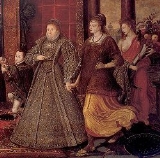
Elizabethan period


Elizabeth Succession Allegory
This period refers to England 1558–1603. The Elizabethan Era
Elizabethan era

The Elizabethan era is associated with Elizabeth I of England's reign and is often considered to be the Golden Age in History of England. It was the height of the English Renaissance and saw the flowering of English poetry and English literature....
 is the period associated with the reign of Queen Elizabeth I
Elizabeth I of England

Elizabeth I was List of English monarchs and Queen of Ireland from 17 November 1558 until her death. Sometimes called The Virgin Queen, Gloriana, or Good Queen Bess, Elizabeth was the fifth and last monarch of the House of Tudor....
 (1558–1603) and is often considered to be a golden age
Golden age

The term Golden age in ancient Greece mythology and legend but can also be found in other ancient cultures . It refers either to the highest age in the Greek spectrum of Iron, Bronze, Silver and Golden ages, or to a time in the beginnings of Humanity which was perceived as an ideal state, or utopia, when mankind was pure and immortal....
 in English history
History of England

The history of England did not begin until the arrival of the Anglo-Saxons, when the partition of Britain into several countries largely began. It was the history of Britain that began in the prehistoric during which time Stonehenge was erected....
. It was the height of the English Renaissance
English Renaissance

The English Renaissance was a Cultural movement and Art movement in England dating from the early 16th century to the early 17th century. It is associated with the pan-European Renaissance that many cultural historians believe originated in northern Italy in the 14th century....
, and saw the flowering of English literature
English literature

The term English literature refers to literature written in the English language, including literature composed in English by writers not necessarily from England; Joseph Conrad was Polish, Robert Burns was Scottish, James Joyce was Irish, Dylan Thomas was Welsh, Edgar Allan Poe was American, Salman Rushdie is Indian, V.S....
 and poetry
English poetry

The history of English poetry stretches from the middle of the 7th century to the present day. Over this period, English poets have written some of the most enduring poems in European culture, and the language and its poetry have spread around the globe....
. This was also the time during which Elizabethan theatre grew. William Shakespeare
William Shakespeare

William Shakespeare was an English people poet and playwright, widely regarded as the greatest writer in the English language and the world's preeminent dramatist....
, among others, composed plays that broke away from England's past style of plays. It was an age of expansion and exploration abroad. At home the Protestant Reformation
Protestant Reformation

The Protestant Reformation was a Christian reform movement in Europe. It is thought to have begun in 1517 with Martin Luther's Ninety-Five Theses and may be considered to have ended with the Peace of Westphalia in 1648....
 was established and successfully defended against the Catholic
Roman Catholic Church

The Roman Catholic Church, officially known as the Catholic Church is the world's largest Christianity Ecclesia , representing over half of all Christians and one-sixth of the world population....
 powers of the Continent
Continental Europe

Continental Europe, also referred to as mainland Europe or simply the Continent, is the continent of Europe, explicitly excluding European islands and, at times, peninsulas....
.

Reformation


The Protestant Reformation
Protestant Reformation

The Protestant Reformation was a Christian reform movement in Europe. It is thought to have begun in 1517 with Martin Luther's Ninety-Five Theses and may be considered to have ended with the Peace of Westphalia in 1648....
 was a 16th-century movement to reform the Catholic Church
Roman Catholic Church

The Roman Catholic Church, officially known as the Catholic Church is the world's largest Christianity Ecclesia , representing over half of all Christians and one-sixth of the world population....
 in Western Europe
Western Europe

Western Europe refers to the countries in the western most half of Europe. This concept has had different meanings, political and cultural as well as geographical issues have influenced the area....
. The Reformation was started on 31 October, 1517 by Martin Luther
Martin Luther

Martin Luther was a Germans monk, theology, university professor, priest, father of Protestantism, and Protestant Reformers whose ideas started the Protestant Reformation and changed the course of Western culture....
, who posted his 95 Theses
95 Theses

The Ninety-Five Theses on the Power and Efficacy of Indulgences, commonly known as The Ninety-Five Theses, were written by Martin Luther in 1517 and are widely regarded as the primary catalyst for the Protestant Reformation....
 criticizing the practice of indulgences to the door of the Castle Church in Wittenberg
Wittenberg

Wittenberg, officially Lutherstadt Wittenberg, is a town in Germany in the States of Germany Saxony-Anhalt, on the Elbe River. It has a population of about 50,000....
, commonly used to post notices to the University community. In November he mailed them to various religious authorities of the day. The Reformation ended in division and the establishment of new church movements. The four most important traditions to emerge directly from the Reformation were Lutheranism, the Reformed (also called Calvinist or Presbyterian) tradition, Anglicanism
Anglicanism

Anglicanism is a tradition of Christianity faith. Churches in this tradition either have historical connections to the Church of England or have similar beliefs, worship and church structures....
, and the Anabaptist
Anabaptist

Anabaptists are Christianity of the Radical Reformation. Various groups at various times have been called Anabaptist, but the term is most commonly used to refer to the Anabaptists of 16th century Europe....
s. Subsequent Protestant churches generally trace their roots back to these initial four schools of the Reformation. It also led to the Catholic or Counter Reformation
Counter-Reformation

The Counter-Reformation denotes the period of Roman Catholic Church revival from the pontificate of Pope Pius IV in 1560 to the close of the Thirty Years' War, 1648....
 within the Roman Catholic Church through a variety of new spiritual movements, reforms of religious communities, the founding of seminaries, the ction of Catholic theology as well as structural changes in the institution of the Church.

Age of Enlightenment


The Age of Enlightenment
Age of Enlightenment

The Age of Enlightenment or The Enlightenment is a term used to describe a time in Western philosophy and cultural life centered upon the eighteenth century, in which rationalism was advocated as the primary source and legitimacy for authority....
 refers to the 18th century in European philosophy
Europe

Europe is, conventionally, one of the world's seven continents. Comprising the westernmost peninsula of Eurasia, Europe is generally divided from Asia to its east by the water divide of the Ural Mountains, the Ural , the Caspian Sea, and by the Caucasus Mountains to the southeast....
, and is often thought of as part of a period which includes the Age of Reason. The term also more specifically refers to a historical intellectual movement, The Enlightenment. This movement advocated rationality
Rationalism

In epistemology and in its modern sense, rationalism is "any view appealing to reason as a source of knowledge or justification" . In more technical terms it is a method or a theory "in which the criterion of the truth is not sensory but intellectual and deductive" ....
 as a means to establish an authoritative system of aesthetics
Aesthetics

Aesthetics or esthetics is commonly known as the study of senses or sensori-emotional values, sometimes called judgments of sentiment and taste ....
, ethics
Ethics

Ethics is a word for a philosophy that encompasses proper conduct and good living. It is significantly broader than the common conception of ethics as the analyzing of right and wrong....
, and logic
Logic

Logic is the study of the principles of valid demonstration and inference. Logic is a branch of philosophy, a part of the classical Trivium . The word derives from Greek language ?????? , fem....
. The intellectual leaders of this movement regarded themselves as a courageous elite, and regarded their purpose as one of leading the world toward progress and out of a long period of doubtful tradition
Tradition

The word tradition comes from the Latin traditionem, acc. of traditio which means "handing over, passing on", and is used in a number of ways in the English language:...
, full of irrationality, superstition, and tyranny, which they believed began during a historical period they called the Dark Ages
Dark Ages

Dark Age or Dark Ages is a term in historiography referring to a period of cultural decline or societal collapse that took place in Western Europe between the Decline of the Roman Empire and the eventual recovery of learning....
. This movement also provided a framework for the American
American Revolution

The American Revolution refers to the political upheaval during the last half of the 18th century in which the Thirteen Colonies of North America overthrew the governance of the British Empire and then rejected the British monarchy to become the sovereign United States of America....
 and French Revolution
French Revolution

The French Revolution was a period of political and social upheaval and radical change in the history of France, during which the French governmental structure, previously an absolute monarchy with feudalism for the aristocracy and Roman Catholic Church clergy, underwent radical change to forms based on Age of Enlightenment principles of cit...
s, the Latin American independence movement, and the Polish–Lithuanian Commonwealth Constitution of May 3, and also led to the rise of liberalism
Liberalism

Liberalism is a broad class of political philosophy that considers individualism liberty and equality to be the most important political goals....
 and the birth of socialism
Socialism

Socialism refers to a broad set of economic theories of social organization advocating public or state ownership and administration of the means of production and distribution of goods, and a society characterized by equality for all individuals, with a fair or Egalitarianism method of compensation....
 and communism
Communism

Communism is a socioeconomic structure and political ideology that promotes the establishment of an egalitarianism, classlessness, stateless society based on common ownership and control of the means of production and property in general....
. It is matched by the high baroque
Baroque

In the the arts, the Baroque was a Western cultural Epoch , starting roughly at the beginning of the 17th century in Rome, Italy. It was exemplified by drama and grandeur in Baroque sculpture, Baroque painting, literature, Baroque dance, and Baroque music....
 and classical eras in music, and the neo-classical
Neoclassicism

Neoclassicism is the name given to quite distinct Cultural movement in the Decorative art and visual arts, literature, theatre, music, and architecture that draw upon Western classical art and culture ....
 period in the arts, and receives contemporary application in the unity of science movement which includes logical positivism
Logical positivism

Logical positivism is a school of philosophy that combines empiricism, the idea that observational evidence is indispensable for knowledge of the world, with a version of rationalism incorporating mathematical and logico-linguistic constructs and deductions in epistemology.See, e.g., : in Stanford Encyclopedia of Philosophy
.

Difference between 'early modern' and the Renaissance


The expression "early modern" is sometimes, and incorrectly, used as a substitute for the term Renaissance
Renaissance

The Renaissance was a cultural movement that spanned roughly the 14th to the 17th century, beginning in Italy in the late Middle Ages and later spreading to the rest of Europe....
. However, "Renaissance" is properly used in relation to a diverse series of cultural developments; which occurred over several hundred years in many different parts of Europe
Europe

Europe is, conventionally, one of the world's seven continents. Comprising the westernmost peninsula of Eurasia, Europe is generally divided from Asia to its east by the water divide of the Ural Mountains, the Ural , the Caspian Sea, and by the Caucasus Mountains to the southeast....
—especially central and northern Italy
Italy

Italy , officially the Italian Republic , is a country located on the Italian Peninsula in Southern Europe and on the two largest islands in the Mediterranean Sea, Sicily and Sardinia....
—and span the transition from late Medieval civilization and the opening of the early modern period.

The term early modern is most often applied to Europe, and its overseas empire. However, it has also been employed in the history of the Ottoman Empire
Ottoman Empire

The Ottoman Empire , also known by its contemporaries as the Turkish Empire or Turkey , was an empire that lasted from 1299?1923. It was Treaty of Lausanne by the Republic of Turkey, which was officially proclaimed on October 29, 1923....
. In the historiography of Japan
Japan

Japan is an island country in East Asia. Located in the Pacific Ocean, it lies to the east of the Sea of Japan, People's Republic of China, North Korea, South Korea and Russia, stretching from the Sea of Okhotsk in the north to the East China Sea and Taiwan in the south....
, the Edo period
Edo period

The , or , is a division of History of Japan running from 1603 to 1868. The period marks the governance of the Edo or Tokugawa shogunate, which was officially established in 1603 by the first Edo shogun Tokugawa Ieyasu....
 from 1590 to 1868 is also sometimes referred to as the early modern period.

Religion in early modern Europe

Lucas Cranach   Antichrist
Initially, religion was one of the most decisive factors in early modern Europe. The time between 1550 and 1650 is commonly described as age of religious wars. The Protestant Reformation
Protestant Reformation

The Protestant Reformation was a Christian reform movement in Europe. It is thought to have begun in 1517 with Martin Luther's Ninety-Five Theses and may be considered to have ended with the Peace of Westphalia in 1648....
 had divided western Christianity into Catholicism
Catholicism

Catholicism is a broad term for the body of the Catholic faith, its Theology and doctrines, its Catholic liturgy, Ethics, spiritual, and behavioral characteristics, as well as a religious people as a whole....
 and Protestantism
Protestantism

Protestantism is a movement within Christianity that originated in the sixteenth-century Protestant Reformation. It is considered to be one of the three principal traditions of Christianity, together with Roman Catholicism and Eastern Orthodoxy....
. The divide between the new denominations was deep. Protestants commonly alleged that the catholic Pope
Pope

The Pope is the Bishop of Rome, the leader of the Roman Catholic Church and head of state of Vatican City. The current pope is Pope Benedict XVI, who was elected April 19, 2005 in Papal conclave, 2005....
 was the Antichrist
Antichrist

The Antichrist is one who fulfills Biblical prophecies concerning an adversary of New Testament view on Jesus' life while resembling him in a deceptive manner....
. Conflict between Christian factions reached its height in France with the French Wars of Religion
French Wars of Religion

The French Wars of Religion is the name given to a period of civil war and military operations, primarily between France Roman Catholic Church and Protestantism , which also involved the factional struggles between the aristocratic houses of France such as the House of Bourbon and House of Guise ....
 and the 1572 St. Bartholomew's Day Massacre
St. Bartholomew's Day massacre

The St. Bartholomew's Day massacre in 1572 was a targeted group of assassinations, followed by a wave of Roman Catholic mob violence, both directed against the Huguenots , during the French Wars of Religion....
.

Outbreaks against Catholics also occurred in Protestant countries, leading to endemic conflicts in some areas, such as Ireland
Ireland

Ireland is the List of islands by area in Europe, and the twentieth-largest island in the world. It lies to the north-west of continental Europe and is surrounded by hundreds of islands and islet....
, where the British government imported Protestants and expelled Catholic landowners following a long period of conflict over control of the island.

Catholic countries

Only in Italy, Spain and Portugal the Catholic authorities managed to suppress Protestantism completely. After a "few dozen" Protestants had been executed in Spain in the 1550s, Protestantism failed to gain a foothold there and the conflict between the Christian denominations did not become an issue within the country. Nevertheless, the Spanish Inquisition
Spanish Inquisition

The Spanish Inquisition was an ecclesiastical tribunal established in 1478 by Catholic Monarchs Ferdinand II of Aragon and Isabella I of Castile....
 continued its work until the 19th century.

Goa Inquisition
During the period of Colonial Conquest, Portugal also established the Inquisition in the part of India, that was part of Portuguese Empire
Portuguese Empire

The Portuguese Empire was the first global empire in history and also the earliest and longest lived of the modern European Colonialism empires, spanning almost six centuries, from the capture of Ceuta in 1415 to the handover of Macau in 1999....
. The Goa Inquisition
Goa Inquisition

The Goa Inquisition was the office of the Inquisition acting in the Indian state of Goa and the rest of the Portuguese empire in Asia. It was established in 1560, briefly suppressed from 1774-1778, and finally abolished in 1812....
 discriminated Hindus who were living in the area, and persecuted Hindus, Muslim and Jews who had converted to Catholicism, but were being suspected of continuing their old faith in secret.

Protestant Martyrs under Mary
Many Protestant Christians were burnt at the stake or otherwise killed in the reign of Queen Mary I of England
Mary I of England

Mary I , was Queen of England and Monarchy of Ireland from 19 July 1553 until her death. The fourth crowned monarch of the Tudor dynasty, she is remembered for restoring England to Roman Catholicism after succeeding her short-lived half brother, Edward VI of England, to the English throne....
, including Thomas Cranmer
Thomas Cranmer

Thomas Cranmer was a leader of the English Reformation and Archbishop of Canterbury during the reigns of Henry VIII of England and Edward VI of England....
 and two bishops Hugh Latimer
Hugh Latimer

Hugh Latimer was the bishop of Worcester, and by his death he became a famous martyr among Protestants and the Church of England.Latimer was born into a family of farmers in Thurcaston, Leicestershire....
 and Nicholas Ridley
Nicholas Ridley (martyr)

Nicholas Ridley was an England clergyman. He came from a prominent family in Tynedale, Northumberland, and was born early in the sixteenth century....
, the Oxford Martyrs
Oxford Martyrs

The Oxford Martyrs were tried for heresy in 1555 and subsequently burnt at the stake in Oxford, England, for their religious beliefs and teachings....
.

Expulsion of the Salzburgers from Austria
On October 31, 1731, the Catholic ruler of Salzburg, Austria, Archbishop Leopold von Firmian, issued an edict expelling as many as 20,000 Lutherans from his principality
Principality

A principality is a monarchy feudatory or sovereign state, ruled or reigned over by a monarch with the title of prince or princess, or a monarch with another title within the generic use of the term prince....
. Many Lutherans, given only eight days to leave their homes, froze to death as they wandered throughout the winter seeking shelter. The wealthier ones who were allowed three months to dispose of their property fared better. Some of these Salzburgers reached London
London

London is the capital of both England and the United Kingdom, and the most populous municipality in the European Union. An important settlement for two millennia, History of London goes back to its founding by the Roman Empire....
, from whence they sailed to the Province of Georgia
Province of Georgia

The Province of Georgia was one of the Southern colonies in British North America. It was the last of the Thirteen original colonies established by Kingdom of Great Britain in what later became the United States....
. Others found new homes in the Netherlands
Netherlands

The Netherlands is a country that is part of the Kingdom of the Netherlands. It is a parliamentary democratic constitutional monarchy. The Netherlands is located in North-West Europe, and bordered by the North Sea to the north and west, Belgium to the south, and Germany to the east....
 and East Prussia
East Prussia

East Prussia refers to the main part of the Prussia along the southeastern Baltic Sea from the 13th century to 1945. From 1772?1829 and 1878?1945, the Province of East Prussia was a province of the Germany state of Prussia....
.

Persecution of Huguenots by Catholics
The slaughter of Huguenots (French
France

France , officially the French Republic , is a country whose Metropolitan France is located in Western Europe and that also comprises various Overseas departments and territories of France....
 Protestants) by Catholics at Sens, Burgundy, in 1562 occurred at the beginning of more than thirty years of religious strife between French Protestants and Catholics. These wars produced numerous atrocities. The worst was the notorious St. Bartholomew’s Day Massacre in Paris
Paris

Paris is the Capital of France and the country's largest city. It is situated on the river Seine, in northern France, at the heart of the ?le-de-France Regions of France ....
 on August 24, 1572. Thousands of Huguenots were butchered by Roman Catholic mobs. Although an accommodation between the two sides was sealed in 1598 by the Edict of Nantes
Edict of Nantes

The Edict of Nantes was issued on 13 April 1598 by Henry IV of France to grant the Calvinism Protestants of France substantial rights in a nation still considered essentially Catholicism....
, religious privileges of Huguenots eroded during the seventeenth century and were extinguished in 1685 by the revocation of the edict. Perhaps as many as 400,000 French Protestants emigrated to various parts of the world, including the British North American colonies. Persecution was resumed under Louis XV
Persecution of Huguenots under Louis XV

The persecution of Huguenots under Louis XV refers to hostile activities against French Protestants between 1724 and 1764 during the reign of Louis XV....
, 1724-1764, gradually subsiding in the decades leading up to the triumph of laïcité
Laïcité

In French language, la?cit? is a France concept of a secular society, connoting the absence of religious involvement in government affairs as well as absence of government involvement in religious affairs ....
 in France.

Drowning of Protestants in Ireland
Approximately one hundred Protestants from Loughgall Parish, County Armagh
County Armagh

County Armagh is a counties of Ireland in Ulster in the north east of Ireland. It is the smallest, in area, of the six counties that form Northern Ireland and second smallest in Ulster....
, were executed by mobs at the bridge over the River Bann
River Bann

The River Bann is the longest river in Northern Ireland, the total length being 80 miles . The river winds its way from the south east corner of the province to the north west coast, pausing in the middle to widen into the enormous Lough Neagh....
 near Portadown, Ulster. This atrocity occurred at the beginning of the Irish Rebellion of 1641
Irish Rebellion of 1641

The Irish Rebellion of 1641 began as an attempted coup d'?tat by Irish Roman Catholic Church gentry, but developed into inter communal violence between native Irish people and England and Scotland Protestant settlers, starting a conflict known as the Irish Confederate Wars....
. Having held the Protestants as prisoners and tortured them, the Catholics drove them to the bridge, where they were stripped naked and forced into the water below at swordpoint. Survivors of the plunge were shot.

Protestant countries


Execution of Mennonites in the Netherlands
In the Netherlands
Netherlands

The Netherlands is a country that is part of the Kingdom of the Netherlands. It is a parliamentary democratic constitutional monarchy. The Netherlands is located in North-West Europe, and bordered by the North Sea to the north and west, Belgium to the south, and Germany to the east....
, David van der Leyen and Levina Ghyselins, described variously as Dutch Anabaptist
Anabaptist

Anabaptists are Christianity of the Radical Reformation. Various groups at various times have been called Anabaptist, but the term is most commonly used to refer to the Anabaptists of 16th century Europe....
s or Mennonite
Mennonite

The Mennonites are a group of Christianity Anabaptist denominations named after Menno Simons , though his writings articulated, and thereby, formalized the teachings of earlier Swiss founders....
s, were executed by Catholic authorities in Ghent
Ghent

Ghent is a city and a municipality located in the Flemish region, Belgium. It is the capital and biggest city of the East Flanders province. The city started as a settlement at the confluence of the Rivers Scheldt and Lys River and became in the Middle Ages one of the largest and richest cities of northern Europe....
 in 1554. Strangled and burned, van der Leyen was finally dispatched with an iron fork. Thieleman J. van Braght's Martyrs Mirror
Martyrs Mirror

The Martyrs Mirror or The Bloody Theater, first published in 1660 in Dutch language by Thieleman J. van Braght, documents the stories and testimonies of Christian martyrs, especially Anabaptists....
 is considered by modern Mennonites as second only in importance to the Bible
Bible

The Bible is the central religious text of Judaism and Christianity. The exact Books of the Bible is dependent on the religious traditions of specific denominations....
 in perpetuating their faith.

Persecution Jesuit in Great Britain
Jesuits like John Ogilvie
Saint John Ogilvie

John Ogilvie , was a Scotland Catholic martyr.Ogilvie, the son of a wealthy laird, was born into a respected Calvinist family near Keith, Scotland in Banffshire, Scotland and was educated in mainland Europe where he attended a number of Catholic educational establishments, under the Benedictines at Regensburg in Germany and with the Jesuits...
 (and seminary priests) were under constant surveillance and threat from the Protestant governments of England and Scotland
Scotland

conventional_long_name = ScotlandAlba|common_name= Scotland|image_flag = Flag of Scotland.svg|flag_width = 130px...
. Ogilvie was sentenced to death by a Glasgow
Glasgow

Glasgow is the largest city in Scotland and List of largest United Kingdom settlements by population in the United Kingdom. The city is situated on the River Clyde in the country's Scottish Lowlands....
 court and hanged on March 10, 1615.

Brian Cansfield, a Jesuit priest, was seized while at prayer by English Protestant authorities in Yorkshire
Yorkshire

Yorkshire is a Historic counties of England of northern England and the largest in Great Britain. Because of its great size, over time functions were increasingly undertaken by its subdivisions, which have been subject to History of local government in Yorkshire....
. Cansfield was beaten and imprisoned under harsh conditions. He died on August 3, 1643, from the effects of his ordeal. Another Jesuit priest, Ralph Corbington, was hanged by the English government in London, September 17, 1644, for professing his faith.

Massacres of Catholics in Ireland
Thousands of Catholic residents were massacred by Oliver Cromwell
Oliver Cromwell

Oliver Cromwell was an English people Military history of the United Kingdom and Politics of England leader best known for his involvement in making England into a republican Commonwealth and for his later role as Lord Protector of England, Scotland, and Ireland....
's Protestant troops at Drogheda
Drogheda

Drogheda is an industrial and port town in County Louth on the east coast of Republic of Ireland, 56 km north of Dublin. Drogheda is the largest town in Ireland, recently surpassing its neighbour Dundalk....
, Wexford
Wexford

Wexford is the county town of County Wexford in Republic of Ireland. It is situated near the south-eastern tip of Ireland, close to Rosslare Europort....
, and Waterford
Waterford

Waterford is the primary city of the South East region. Founded in 914 in Ireland AD, by the Vikings, it is Ireland's oldest city. It is the fifth largest city in the country of Republic of Ireland....
, during the Irish campaign of autumn and winter 1649. All of the survivors of Drogheda and many from other places were sold as slaves to the West Indies. In 1652, all Catholic-owned estates east of the River Shannon
River Shannon

The River Shannon is, at 386 km , the longest Rivers of Ireland. It divides the west of Ireland from the east and south . County Clare, being west of the Shannon but part of the province of Munster, is the major exception....
 were confiscated, and their residents were evicted en-masse amid plague and famine that killed an even greater number. Approximately 600,000 people, nearly half the Irish population, died during the Cromwellian conquest of Ireland
Cromwellian conquest of Ireland

The Cromwellian conquest of Ireland refers to the re-conquest of Ireland by the forces of the English Parliament, led by Oliver Cromwell during the Wars of the Three Kingdoms....
. The penal laws of 1690 caused still more destitution and emigration.

Political powers

  • Ottoman Empire
    Ottoman Empire

    The Ottoman Empire , also known by its contemporaries as the Turkish Empire or Turkey , was an empire that lasted from 1299?1923. It was Treaty of Lausanne by the Republic of Turkey, which was officially proclaimed on October 29, 1923....
  • Habsburg Spain
    Habsburg Spain

    Habsburg Spain refers to the history of Spain over the 16th and 17th centuries , when Spain was ruled by the major branch of the Habsburg dynasty ....
  • Habsburg Monarchy
    Habsburg Monarchy

    The Habsburg Monarchy covered the territories ruled by the junior Austria branch of the House of Habsburg , and then by the successor House of Habsburg-Lorraine , between 1526 and 1867/1918....
  • Kingdom of Portugal
    Kingdom of Portugal

    The Kingdom of Portugal was Portugal's general designation under the Portuguese monarchy. The kingdom was located in the west of the Iberian Peninsula, Europe, and existed from 1139 to 1910....
  • Dutch Republic
    Dutch Republic

    The Republic of the Seven United Netherlands was a European republic between 1581 and 1795, in about the same location as the modern Kingdom of the Netherlands, which is the successor state....
  • Early Modern Britain
    Early Modern Britain

    Early Modern Britain is the history of Great Britain, roughly corresponding to the 16th, 17th, and 18th centuries. Major historical events in Early Modern British history include the English Renaissance, the English Reformation and Scottish Reformation, the English Civil War, the Restoration of Charles II of England, the Glorious Revolution,...
  • Early Modern France
    Early Modern France

    Early Modern France is the early modern period of French history from the end of the 15th century to the end of the 18th century . During this period France evolved from a feudalism regime to an increasingly centralized state organized around a powerful absolute monarchy that relied on the doctrine of the Divine Right of Kings and the explic...
  • Early Modern Italy
  • Early Modern Romania
    Early Modern Romania

    Early Modern Romania is the portion of History of Romania that falls in the early modern period, roughly from the end of the 15th century to the end of the 18th century During this period the Romanian lands were characterised by the slow disappearance of the feudalism system, the leadership of some rulers like Vasile Lupu and Dimitrie Cantem...
  • Polish–Lithuanian Commonwealth
  • Kingdom of Hungary
    Kingdom of Hungary

    The Kingdom of Hungary , which existed from 1000 to 1918, and then from 1920 to 1946, was a considerable state in Central Europe....


See also

  • Renaissance
    Renaissance

    The Renaissance was a cultural movement that spanned roughly the 14th to the 17th century, beginning in Italy in the late Middle Ages and later spreading to the rest of Europe....
  • Early Modern English
    Early Modern English

    Early Modern English is the stage of the English language used from about the end of the Middle English period to 1650. Thus, the first edition of the King James Bible and the works of William Shakespeare both belong to the late phase of Early Modern English, although the King James Bible intentionally keeps some archaisms that were not comm...
  • Early Modern warfare
  • Periodization
    Periodization

    Periodization is the attempt to categorize or divide time into named blocks. The result is a descriptive abstraction that provides a useful handle on periods of time with relatively stable characteristics....
  • Tokugawa period - the period of Japanese history often called "early modern".


Referred literature

  • John Coffey (2000), Persecution and Toleration in Protestant England 1558-1689, Studies in Modern History, Pearson Education
  • Benjamin J. Kaplan (2007), Divided by Faith. Religious Conflict and the Practice of Toleration in Early Modern Europe. Cambridge University Press
ougvne;rognoignj[qeroigjm'PSGJM[QERIOGJ'[PRWIGM'QEIPORGJ[OQERIGJ'QERIOQERGJQE'RIGF'RGPOJEWKR[GPIJQER[GPIJQERGPOIERJQG[PQEIJG[PQGIJ[GJQER[I

External links